




Q1. What Are the 9 Best AI SOC Platforms for Healthcare Organizations in 2026? (Research Method)
The nine best AI SOC platforms for healthcare in 2026 are UnderDefense MAXI, Prophet Security, Dropzone AI, Radiant Security, D3 Security Morpheus, Microsoft Security Copilot, CrowdStrike Charlotte AI, Arctic Wolf Aurora, and Intezer. UnderDefense MAXI leads this list because its Agentic Teammates handle roughly 80% of Tier 1 and Tier 2 SecOps work autonomously, while 120 certified engineers validate every action taken.
Choosing an AI SOC for a hospital or clinic group is a high-stakes procurement decision, because the same platform that triages alerts also touches protected health information, EHR audit logs, and clinical network segments. For this report, we analyzed agentic AI SOC and managed detection platforms with documented healthcare deployments, then scored nine against a fixed rubric: clinical telemetry depth, HIPAA and business associate agreement posture, autonomy level with approval gating, response ownership, integration breadth, organization-size fit, and pricing transparency. This guide is written for healthcare CISOs, IT directors, and compliance leads who are preparing a shortlist or an RFP.
Why the Overnight Gap Is the Real Problem
Attackers do not wait for the day shift. The fastest break-in time observed across recent intrusion research sits around 51 seconds, which is shorter than the time it takes an on-call IT director to open a laptop.
Healthcare feels this harder than any other sector. The Verizon 2026 DBIR healthcare snapshot recorded 1,492 incidents, of which 1,438 became confirmed data disclosures. Roughly 96% of incidents turned into breaches, the worst conversion rate of any industry, which is why round-the-clock coverage matters more here than in any other vertical.
How We Scored the Nine Platforms
Each platform earned a score out of 100 across five weighted criteria, then converted to a five-star band. The weights were set deliberately, because healthcare failure modes differ from generic enterprise ones.
- Clinical telemetry depth (25%): ingestion of EHR audit logs, identity, PACS, and medical device traffic
- HIPAA evidence and BAA posture (20%): signed business associate agreement, PHI redaction, and immutable audit logs
- Autonomous investigation depth (20%): whether the agent reasons in a loop or summarizes once
- Response ownership (20%): whether containment is executed or escalated back to your team
- Pricing transparency and size fit (15%): published rates, and suitability from single hospital to IDN
No vendor paid for placement. Vendor-published claims are kept separate from third-party verified reviews throughout, and the full rubric follows our published AI SOC evaluation questions.
AI SOC Platform Comparison for Healthcare (2026)
| Provider | Best For | Key Strength | Compliance |
| UnderDefense MAXI 5.0 | Hospitals and clinic groups wanting agentic AI plus human response ownership | Full incident context in 2 minutes, containment within 5, 250+ integrations, and no vendor lock-in | HIPAA, SOC 2, ISO 27001, and GDPR automation built into the platform |
| Prophet Security 4.6 | Security teams that want deep autonomous alert investigation | Multi-step agentic investigation with exportable reasoning traces | SOC 2 Type II; BAA availability to verify per deal |
| Dropzone AI 4.5 | Health systems with an existing SOC needing Tier 1 augmentation | Pre-trained AI analyst that plugs into current SIEM and EDR | SOC 2 Type II; PHI handling policy to verify |
| Radiant Security 4.3 | High alert volumes with lean staffing | Automated triage and response plan generation at scale | SOC 2; HIPAA support varies by deployment |
| D3 Security Morpheus 4.2 | Approval-gated response in clinical environments | Codeless playbooks with human approval routing | HIPAA-aligned workflows, and a healthcare-specific practice |
| Microsoft Security Copilot 4.4 | Microsoft-native hospitals on Defender and Sentinel | Native identity and E5 telemetry reasoning | HIPAA BAA available through Microsoft agreements |
| CrowdStrike Charlotte AI 4.5 | Endpoint-heavy clinical estates | Triage on top of mature endpoint detection telemetry | HIPAA BAA available; endpoint-centric evidence |
| Arctic Wolf Aurora 3.8 | Concierge-style fully managed coverage | Named concierge security team model | HIPAA and PCI DSS readiness assistance |
| Intezer 4.2 | Automated malware and phishing verdicts | Deep file and URL analysis automation | SOC 2; narrower PHI exposure surface |
How to Read This Table in 90 Seconds
If you run a 200-bed hospital with no night shift, read three columns only. Start with response ownership, then BAA posture, then pricing transparency.
Everything else is negotiable during onboarding. A platform that detects beautifully but hands the containment decision back to your one on-call admin at 2 a.m. has not solved your actual problem, which is the distinction we unpack in our AI SOC versus MDR and MSSP comparison.
1.1 UnderDefense MAXI: Best Overall Agentic AI SOC for Healthcare
Overview
UnderDefense MAXI is an agentic AI SOC platform delivered with a human-led service layer, built for organizations that need 24/7 coverage without hiring a full internal SOC. Its multi-agent system, described as Agentic Teammates, autonomously handles roughly 80% of Tier 1 and Tier 2 security operations work. Certified engineers then validate actions before anything touches a production clinical system.
For healthcare buyers, the practical draw is vendor-agnostic architecture. The UnderDefense MAXI platform connects to the tools a hospital already owns rather than requiring a rip and replace of trusted EDR or SIEM investments.
Core Services
- Agentic AI SOC with 24/7 detection, investigation, and response
- Managed SIEM and log management with customer data ownership
- Incident response and ransomware containment
- Compliance automation for HIPAA, SOC 2, ISO 27001, and GDPR
- Virtual CISO advisory and penetration testing as adjacent engagements
Why Healthcare Organizations Consider UnderDefense
The platform delivers full incident context in about 2 minutes, with containment inside 5 minutes for critical incidents. It carries 250+ integrations and 1,500+ correlation rules, plus a May 2026 on-premise build for closed, sovereign, and air-gapped environments.
There is also a ChatOps behavior worth naming. Analysts confirm suspicious activity directly with the affected user over Slack or Teams, which resolves ambiguous clinician logins fast.
Ideal Customer Profile
Best suited for:
- Community hospitals and multi-site clinic groups with lean IT teams
- Health systems that want to keep their existing SIEM and EDR
- Compliance-driven organizations preparing for HIPAA or SOC 2 evidence requests
- Teams with a documented overnight or weekend coverage gap
Commercial Model
UnderDefense publishes pricing openly, starting at $11 per device per month for MDR tiers, with Enhanced and Professional tiers at $15 and $20. A freemium MAXI platform tier costs nothing to start, and a public SOC cost calculator lets a CFO model in-house versus managed coverage before any sales call.
When to Shortlist
Shortlist UnderDefense when the requirement is continuous coverage with response ownership, rather than another alert feed. It fits RFPs where no vendor lock-in and data ownership are hard requirements, and our guidance on data sovereignty and lock-in covers how to word those clauses.
Customer Reviews
“The biggest win for me was getting actual control over our security alerts. Before the guys from UD stepped in, we were getting bombarded with alerts from all our security tools. Their team cleaned up our configurations and got the noise under control within the first week.”
Verified User in Marketing and Advertising, Small-Business UnderDefense G2 Verified Review
“UnderDefense MAXI integrates well with our systems, specifically with our SIEM, Splunk. Their team is proactive in identifying and addressing threats, providing 24/7 oversight.”
Oleg K., Director Information Security, 4.5/5 UnderDefense G2 Verified Review
“No Underdefense’s fault entirely, but getting all our logs and stuff flowing took longer than I expected.”
Andriy H., Co-Founder and CTO, 4.5/5 UnderDefense G2 Verified Review
That last one is fair, and I would rather it stay on the page. Integration timelines depend on how many log sources a hospital has and who owns access to them.
1.2 Prophet Security: Best for Autonomous Alert Investigation Depth
Overview
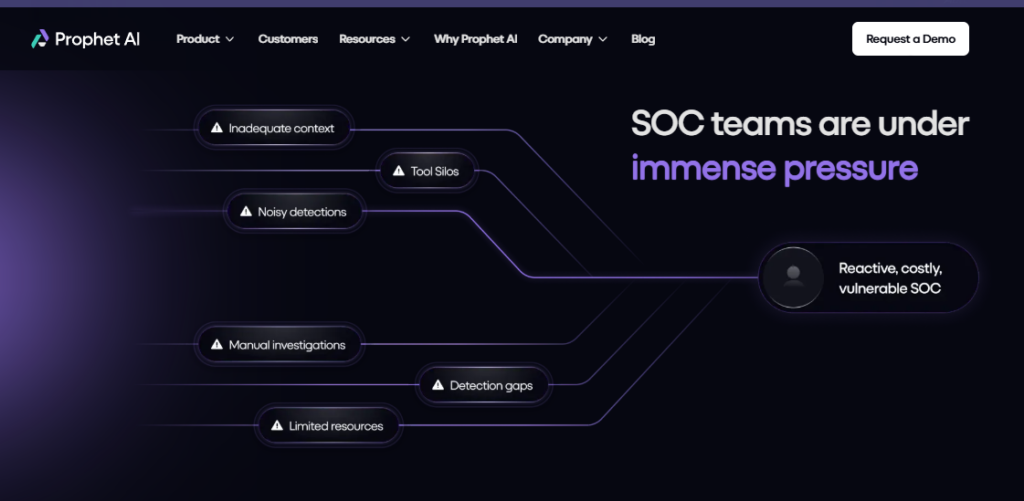
Prophet Security is an AI SOC analyst platform focused on one job done deeply: investigating every alert autonomously before a human sees it. The product sits on top of an existing detection stack and produces a documented verdict with the evidence behind it. Buyers typically already own a SIEM and want the investigation layer, rather than a replacement service.
The healthcare relevance is investigative transparency. A verdict that shows its queries is far easier to defend in an OCR investigation than a confidence score with no working, a theme we cover in depth on AI SOC explainability and transparency.
Core Services
- Autonomous alert triage and multi-step investigation
- Evidence and reasoning trace generation per alert
- Integrations with major SIEM, EDR, identity, and cloud sources
- Investigation summaries mapped to attacker techniques
- Analyst feedback loops that tune future dispositions
Why Healthcare Organizations Consider Prophet Security
Hospitals drowning in duplicate alerts across Defender, endpoint, and email tooling get back analyst hours. Depth of reasoning is the useful test here, since agentic investigation of a single alert can require dozens of tool queries rather than one summarization pass.
The honest limitation is scope. Response ownership stays with your team, so a lean hospital IT group still needs someone available to act at 3 a.m.
Ideal Customer Profile
Best suited for:
- Health systems with an existing internal SOC or a strong security engineer
- Teams that already run a SIEM and want triage capacity, rather than full outsourcing
- Organizations that need exportable investigation evidence for audits
Commercial Model
Pricing is quote-based and typically scales with alert or data volume rather than device count. Public per-seat rates are not published, so healthcare buyers should model cost against their real monthly alert volume during the pilot, using an AI SOC pricing guide as the benchmark.
When to Shortlist
Shortlist Prophet Security when the bottleneck is investigation capacity and your team already owns response. It is a weaker fit where 24/7 human containment is the actual gap.
A note on evidence discipline: no verified G2, Gartner, or Reddit reviews for Prophet Security met our sourcing standard, so none are quoted here.
Author’s Perspective
UnderDefense’s read on this category is that the AI SOC debate gets framed backwards. The question is rarely whether AI can triage, but who takes the action once triage lands.
I think of AI agents as foot soldiers and human engineers as the generals directing them. Monitoring-only tools that parrot alerts back at a hospital IT team just relocate the exhaustion, which is the pattern behind most alert fatigue in lean clinical teams.
I could be reading UnderDefense’s own deployment data too strongly here, but the pattern is consistent. The clients who improve fastest are the ones who let agents close commodity noise and reserve human judgment for anything touching EHR or clinical segments.
UnderDefense positioning: UnderDefense MAXI ranks first on this list because it combines agentic investigation with engineers who execute containment, keeps customer data and SIEM ownership intact across 250+ integrations, and publishes its pricing openly. We built it that way after watching too many teams pay for visibility they could not act on.
1.3 Dropzone AI: Best for Augmenting an Existing Hospital SOC
Overview
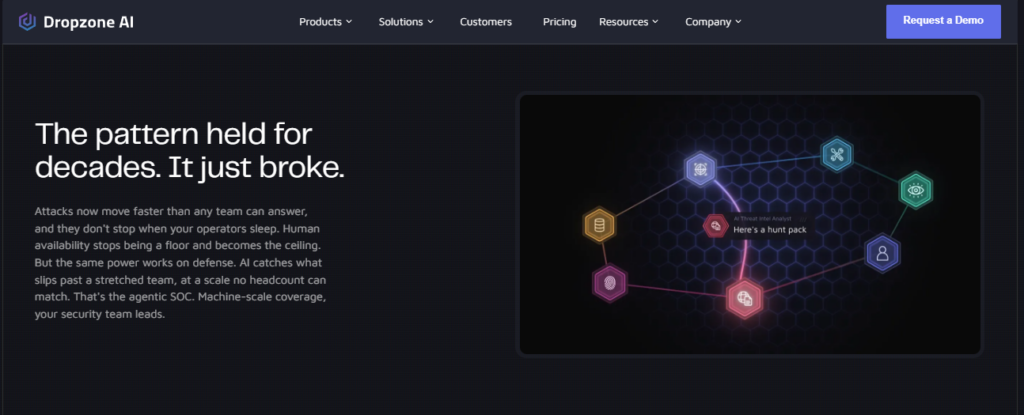
Dropzone AI is a pre-trained AI SOC analyst that investigates alerts alongside your existing team. It does not replace your SIEM (the system that stores and correlates security logs) or your endpoint tooling. Instead, it reads what those tools produce and writes an investigation for each alert.
For health systems that already employ two or three security engineers, this fills the daytime backlog gap. The agent works through the queue nobody has time for.
Core Services
- Autonomous alert investigation with written conclusions
- Pre-trained detection knowledge, so no playbook building upfront
- Integrations with common SIEM, EDR, email, and identity sources
- Investigation reports formatted for handoff to a human analyst
- Feedback tuning based on analyst corrections
Why Healthcare Organizations Consider Dropzone AI
Onboarding is light, which matters when your IT team also supports clinical devices. The product is designed to start producing investigations quickly, without a long detection engineering project, and our guidance on layering an AI SOC over an existing SIEM explains where that shortcut holds up.
The structural trade-off is response. Dropzone investigates and reports, so containment still lands on your staff at 3 a.m.
Ideal Customer Profile
Best suited for:
- Health systems with an existing internal SOC or security engineering function
- Teams keeping their current SIEM and wanting triage capacity added
- Organizations with a clear internal on-call rotation already funded
Commercial Model
Pricing is quote-based and generally scales with alert volume or user count. No public rate card exists, so hospital buyers should benchmark against their real monthly alert counts during a trial, and our Dropzone pricing breakdown covers the variables that move the quote.
When to Shortlist
Shortlist Dropzone AI when the bottleneck is investigation throughput and your team already owns response. It is a weaker fit for a hospital with no night coverage at all.
1.4 Radiant Security: Best for High-Volume Triage Automation
Overview
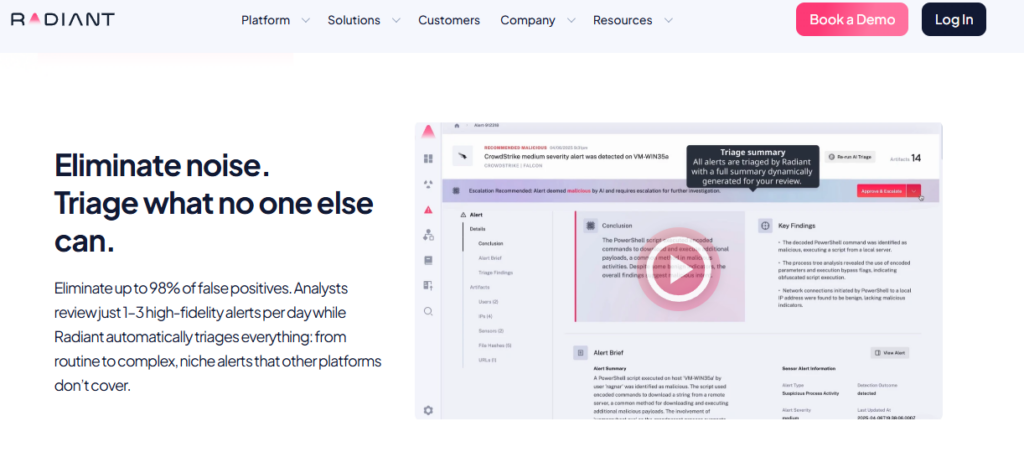
Radiant Security focuses on processing large alert volumes automatically. The platform triages incoming alerts, then generates a suggested response plan for each verified incident. It targets teams whose queues have grown faster than their headcount.
Large multi-hospital groups often sit in exactly this position. Adding a site adds telemetry without adding analysts.
Core Services
- Automated triage across the full alert queue
- Response plan generation per confirmed incident
- Integrations with major SIEM, EDR, email, and cloud tools
- Root cause and impact summaries for analyst review
- Metrics reporting on triage volume and time saved
Why Healthcare Organizations Consider Radiant Security
The pitch lands with teams measuring alerts per analyst per shift. Automating the commodity 80% frees people for the cases that need judgment, which is the core argument in our work on using an agentic AI SOC to reduce analyst burnout.
Response plan generation still requires someone to execute the plan. That gap matters most in the hours when a hospital has nobody watching.
Ideal Customer Profile
Best suited for:
- Multi-site clinic groups and IDNs with heavy alert volume
- Teams with an analyst available to action generated plans
- Organizations that have already tuned out obvious noise
Commercial Model
Subscription pricing is based on organization size and data volume, quoted per deal. Ask specifically whether ingest overages are billed separately, since clinical log sources grow quietly, and compare against our Radiant Security pricing analysis.
When to Shortlist
Shortlist Radiant Security when volume, rather than coverage hours, is the pain. Pair it with a staffed rotation, or the plans pile up unexecuted.
1.5 D3 Security Morpheus: Best for Approval-Gated Response Routing
Overview
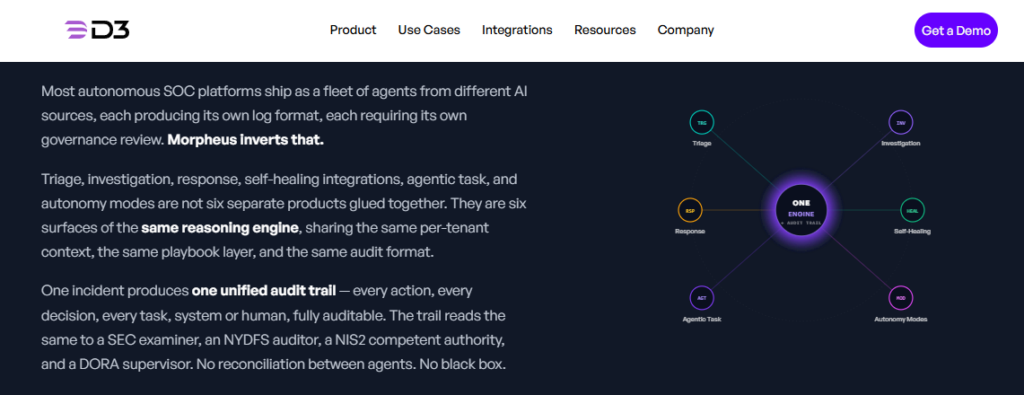
D3 Security’s Morpheus is an automation and orchestration platform with an AI layer on top. Its strength is controlled automation, where each action can require a named human approval before it runs. The company maintains a documented healthcare practice.
Approval gating matters more in hospitals than almost anywhere else. Auto-isolating a workstation in an operating theatre is a patient safety event.
Core Services
- Codeless playbooks for detection, triage, and response
- Human approval routing before sensitive actions execute
- Event pipeline that filters noise before playbook execution
- Broad integration library across security and IT tooling
- Case management with full action audit history
Why Healthcare Organizations Consider D3 Morpheus
The audit history is the quiet selling point. Every automated step is recorded, which helps when an OCR investigator asks who decided what, and it mirrors the principles behind human-in-the-loop SOC design.
The trade-off is effort. Orchestration platforms reward teams with the engineering time to build and maintain playbooks properly.
Ideal Customer Profile
Best suited for:
- Hospitals with clinical network segments that must never be auto-contained
- Teams with in-house automation engineering capacity
- Organizations already running a mature SIEM and case workflow
Commercial Model
It is licensed as a platform, priced by deployment scope and module selection. Implementation services are typically a separate line item worth scoping early.
When to Shortlist
Shortlist D3 Morpheus when governance of automated actions is the requirement. Skip it if you need coverage running next week with no build effort.
1.6 Microsoft Security Copilot: Best for Microsoft-Native Health Systems
Overview
Microsoft Security Copilot adds AI-assisted investigation to the Microsoft security stack. It reasons over Defender, Sentinel, Entra identity, and Purview data that many hospitals already generate. Health systems standardized on Microsoft E5 licensing get the deepest value here.
Identity is the practical strength. Most healthcare intrusions run through a clinician account before touching anything else.
Core Services
- AI-assisted investigation across Defender and Sentinel
- Natural language querying of security data
- Incident summarization for reporting and handoff
- Identity and email threat context via Entra and Purview
- Guided response recommendations inside the Microsoft console
Why Healthcare Organizations Consider Security Copilot
A HIPAA business associate agreement is available under standard Microsoft enterprise agreements, which shortens legal review. Telemetry already lives in the tenant, so onboarding is mostly licensing, and teams standardized here often pair it with managed detection for Microsoft 365.
The structural limit is scope. Third-party clinical systems, older EHR log formats, and medical device traffic sit outside the native estate.
Ideal Customer Profile
Best suited for:
- Hospitals fully standardized on Microsoft E5 and Sentinel
- Teams with analysts who work daily inside the Microsoft console
- Organizations whose main risk sits in identity and email
Commercial Model
Pricing is consumption-based through Security Compute Units, billed hourly on top of existing licensing. Forecast usage carefully, because investigation-heavy months cost more than quiet ones.
When to Shortlist
Shortlist Security Copilot when the estate is genuinely Microsoft-first. Verify third-party and clinical device coverage before signing.
1.7 CrowdStrike Charlotte AI: Best for Endpoint-Heavy Clinical Estates
Overview
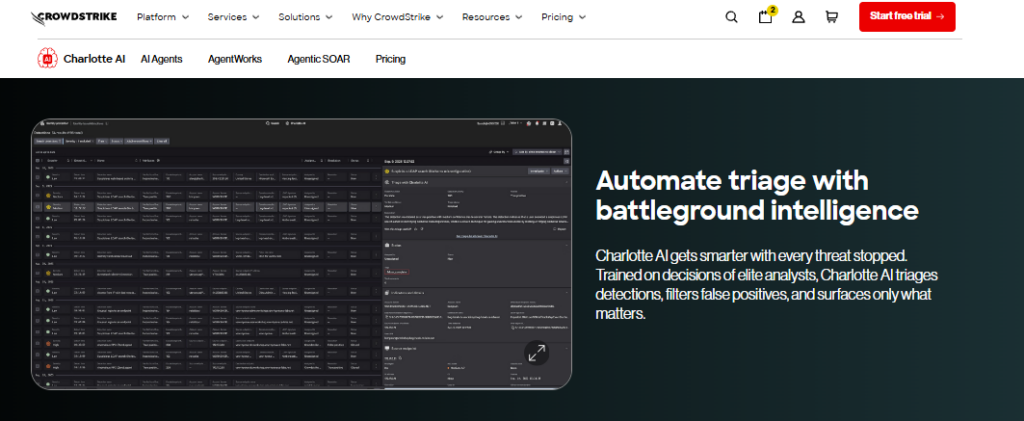
Charlotte AI is CrowdStrike’s agentic layer built on top of Falcon endpoint telemetry. It triages detections and answers investigation questions using data the Falcon sensor already collects. Hospitals with thousands of managed workstations get quick value.
Endpoint depth is real here. Detection quality on the underlying platform is well established across enterprise deployments.
Core Services
- Automated detection triage with confidence scoring
- Natural language investigation over Falcon telemetry
- Threat hunting assistance across endpoint data
- Workflow automation through Falcon Fusion
- Integration with CrowdStrike’s managed service tiers
Why Healthcare Organizations Consider Charlotte AI
Ransomware containment on endpoints is fast, and a HIPAA business associate agreement is available. For a hospital where the primary risk is workstation encryption, that combination is compelling, and it pairs naturally with a documented ransomware response checklist.
The trade-off is platform gravity. Value concentrates inside the CrowdStrike ecosystem, so telemetry from EHR audit logs, PACS imaging systems, and older clinical devices needs additional tooling.
Ideal Customer Profile
Best suited for:
- Health systems already standardized on Falcon endpoint protection
- Estates with large managed workstation and server counts
- Teams with analysts trained on the Falcon console
Commercial Model
Licensing is module-based per endpoint, with Charlotte AI capabilities tied to higher Falcon bundles. Ask which tier includes agentic triage, since packaging changes between renewal cycles.
When to Shortlist
Shortlist Charlotte AI when endpoint coverage is the priority and Falcon is already deployed. Pair it with separate coverage for clinical and identity telemetry.
1.8 Arctic Wolf Aurora: Best for Concierge-Style Managed Coverage
Overview
Arctic Wolf delivers a fully outsourced security operations experience through its Concierge Security model. Customers get a named team rather than only software, which suits organizations with no internal security staff. The Aurora platform underneath handles detection and telemetry processing.
The relationship model is the product. For a community hospital with one IT generalist, having a named contact has real operational value.
Core Services
- 24/7 managed detection and response coverage
- Named Concierge Security Team engagement model
- Log monitoring, threat hunting, and risk management
- Security awareness training
- Compliance readiness assistance including HIPAA and PCI DSS
Why Healthcare Organizations Consider Arctic Wolf
Buyers with no security team get structure quickly, plus documented compliance support. Onboarding is guided end to end.
Verified reviews point to a recurring structural limit around remediation ownership. One Gartner reviewer described solid detection with heavy reliance on the client team to actually remediate, a pattern we examine across Arctic Wolf alternatives.
Ideal Customer Profile
Best suited for:
- Community hospitals and clinics with no internal security function
- Compliance-driven organizations wanting guided readiness support
- Teams comfortable with a vendor-managed telemetry pipeline
Commercial Model
Subscription pricing is aligned to organization size and monitored assets, quoted per deal. Note the contract mechanics, since one reviewer flagged a 60-day renewal notice window instead of the more typical 30 days, and our Arctic Wolf pricing guide details what sits inside each tier.
When to Shortlist
Shortlist Arctic Wolf when a fully managed relationship matters more than platform flexibility. Confirm in writing who executes containment.
Customer Reviews
“I can’t find anything I like very much about Arctic Wolf anymore. We’ve had some accuracy issues in responding to our tickets. These inaccuracies have led to us having to explain why our third-party vendor made an assessment mistake when presenting a critical external vulnerability for remediation.”
Verified User in Hospital and Health Care, Enterprise, 2/5 Arctic Wolf G2 Verified Review
“Arctic Wolf provides Solid detection and response capabilities, but overly relies on the clients team for remediation, which really hurts the value of the service.”
VP of Technology, 3/5 Arctic Wolf Gartner Verified Review
1.9 Intezer: Best for Automated Malware and Phishing Verdicts
Overview
Intezer automates one slice of SOC work extremely well: deciding whether a file, URL, or email is malicious. It analyzes suspicious artifacts and returns a verdict with supporting evidence. Hospitals with heavy phishing volume see immediate queue relief.
Scope discipline is a feature here. A narrow tool touching fewer PHI systems is also a smaller audit surface.
Core Services
- Automated malware and file analysis with code reuse detection
- Phishing email triage and URL verdicts
- Endpoint memory forensics scanning
- Alert triage integrations with SIEM and email security tools
- Evidence reports attached to each verdict
Why Healthcare Organizations Consider Intezer
Phishing remains a steady drain on hospital help desks, and automated verdicts remove the guesswork. Analysts stop manually detonating attachments.
The limitation is deliberate coverage narrowness. Intezer will not investigate an anomalous EHR access pattern or a lateral movement chain across clinical VLANs, which is why it usually sits beside broader threat detection tooling.
Ideal Customer Profile
Best suited for:
- Hospitals with high phishing report volumes
- Teams wanting to automate one specific triage workflow
- Organizations layering it under a broader SOC platform
Commercial Model
Subscription tiers are based on analysis volume, with a free tier for basic file scanning. Cost modelling is straightforward compared with full platform licensing.
When to Shortlist
Shortlist Intezer as a component rather than a SOC replacement. It complements an agentic platform instead of competing with one.
Author’s Perspective
UnderDefense’s read on this back half of the list is that most of these tools are excellent at one layer and honest about it. The confusion comes from procurement treating a triage layer and a staffed operation as the same purchase.
I have watched hospital teams buy brilliant investigation tooling and still get paged at 2 a.m. The investigation was already done. Nobody was authorized or awake to act on it.
I could be reading UnderDefense’s deployment pattern too strongly, but the correlation holds. Coverage gaps close when response ownership is contractual, and stay open when it is implied.
UnderDefense positioning: UnderDefense MAXI pairs agentic investigation with engineers who execute containment inside 5 minutes of full context, across 250+ integrations and without locking customers into a proprietary SIEM. That design choice came from watching teams pay for verdicts they had no one to action.
Q2. How Were These AI SOC Platforms Selected and Scored?
Each platform scored out of 100 across five weighted criteria: EHR and clinical telemetry depth (25%), HIPAA evidence and BAA posture (20%), autonomous investigation depth (20%), response ownership versus alert-only handoff (20%), and pricing transparency plus org-size fit (15%). Scores of 81 to 100 earn five stars, 61 to 80 four, 41 to 60 three, and 21 to 40 two.
Why These Five Criteria, and Not Ease of Use
Generic software rubrics score onboarding speed and interface polish. Those matter, but they do not predict how a platform behaves when a nurse’s account starts pulling 400 patient records at 2 a.m.
So the weights follow healthcare failure modes instead. Clinical telemetry depth carries the most weight, because a platform that cannot read EHR audit logs (the record of who opened which patient chart) is blind to the most common insider risk, a gap we unpack in our guide to AI SOC for healthcare.
The Rubric and Its Weights
| Criterion | Weight | What earns points |
| Clinical telemetry depth | 25% | Named EHR audit log ingestion, identity, PACS imaging, and medical device traffic |
| HIPAA evidence and BAA posture | 20% | Countersigned business associate agreement, PHI redaction, and immutable audit logs per 45 CFR 164.312(b) |
| Autonomous investigation depth | 20% | Multi-step agentic reasoning with exportable traces, rather than one summarization pass |
| Response ownership | 20% | Containment executed by the provider, versus a plan handed back to your team |
| Pricing transparency and size fit | 15% | Published rates, plus suitability from single hospital to integrated delivery network |
Audit controls are a required standard under the HIPAA Security Rule, with no wiggle room for addressability. That is why log immutability sits inside the scoring rather than in a nice-to-have column.
How the Star Bands Work
The math is deliberately boring. Weighted criterion scores sum to a total out of 100, then map to a star band with no rounding favors.
Vendor-published claims were kept in a separate column from third-party verified reviews throughout. Where a capability appeared only in marketing material, it scored as unverified rather than as present, which is the same discipline behind our AI SOC evaluation framework.
Disclosure Rules We Held Ourselves To
No vendor paid for placement in this list. UnderDefense publishes per-device pricing openly, starting at $11 per device per month with a free MAXI platform tier, which is why it scores full marks on the transparency criterion where most rivals score partial.
Three vendors on the list have no public rate card at all. That is scored as a gap, because a hospital CFO cannot model a budget against a quote that arrives after three sales calls, and our AI SOC pricing guide shows what a modellable rate card looks like.
Author’s Perspective
UnderDefense’s read is that most vendor rubrics get compliance backwards. A certification badge tells you a vendor passed an audit once, and tells you almost nothing about how the platform behaves during an incident.
Compliance shows up as the result of a working security program. Approach it as a checkbox list and you get zero value while still getting popped.
So we weighted operational depth above certification counts, and I might be leaning too hard on that. If your board reads certifications as the primary signal, adjust the weights and rescore, since the rubric is published precisely so you can.
What Buyers Say About Scoring for Response
“The biggest win for me was getting actual control over our security alerts. Before the guys from UD stepped in, we were getting bombarded with alerts from all our security tools.”
Verified User in Marketing and Advertising, Small-Business UnderDefense G2 Verified Review
“Arctic Wolf provides Solid detection and response capabilities, but overly relies on the clients team for remediation, which really hurts the value of the service.”
VP of Technology, 3/5 Arctic Wolf Gartner Verified Review
That second quote is why response ownership carries a full 20%. Detection quality and remediation ownership are separate purchases, and reviews expose the gap faster than datasheets do.
UnderDefense positioning: UnderDefense MAXI scored 5 stars on this rubric, carried by vendor-agnostic integration across 250+ tools, published per-device pricing, and containment executed rather than escalated. Every one of those is checkable without a sales call, which is the standard we tried to hold every vendor to.
Q3. What Is an AI SOC for Healthcare, and How Does It Change Alert Triage Compared With MDR or a Managed SIEM?
An AI SOC for healthcare is a security operations model where AI agents autonomously investigate alerts across EHR, endpoint, identity, cloud, and medical device telemetry, escalating only validated threats with a full evidence trail. A managed SIEM forwards alerts, and MDR triages behind a black box. An agentic AI SOC produces a decision and, at its strongest, executes the response.
The Taxonomy, Without the Marketing
Five things get sold under overlapping names. Here is what each one actually does for a hospital.
| Model | What it does | Who acts on the alert |
| SIEM | Stores and correlates logs from your tools | Your team, from scratch |
| SOAR | Runs pre-built playbooks you engineer | Automation you built and maintain |
| MDR | Vendor analysts triage, then escalate | Mostly your team, after handoff |
| SOC-as-a-Service | Outsourced monitoring and staffing | Vendor monitors, escalation varies |
| Agentic AI SOC | Agents investigate, humans validate and contain | Provider agents plus provider engineers |
The dividing line is not intelligence, but where the decision and the action live. A managed SIEM can be excellent and still leave your one on-call admin holding the pager.
One Alert, Walked End to End
Take a real shape of alert: a clinician account signs in at 02:14 from an unfamiliar country, then queries the EHR.
A SIEM raises a correlation rule and waits. An agentic system pulls the identity history, checks the device, checks whether that clinician is on shift, checks prior geographies, then reaches a documented verdict.
UnderDefense MAXI adds a step most tools skip. Analysts confirm the activity with the affected clinician directly over Slack or Teams, which settles an ambiguous login in minutes rather than hours.
The Triage Economics
Depth costs queries. A serious agentic investigation runs roughly 40 to 50 queries across six different tools, and some platforms make well over 100 model calls to close a single alert.
That volume is exactly why humans stop doing it manually. UnderDefense MAXI targets 2-minute Alert-to-Triage with 15-minute escalation for critical incidents, and containment inside 5 minutes of full context, benchmarks we detail in our work on AI SOC investigation speed.
Why Tier 1 Gets Uplifted, Not Deleted
Research on LLM agents in Tier 1 triage shows reliable performance on high-volume, low-ambiguity alerts and measurable error rates on ambiguous ones. So the honest framing is augmentation.
I think of agents as foot soldiers and engineers as the generals directing them. Automation clears commodity noise, and it gives people room to work the cases that need judgment.
Three Questions That Expose a Wrapper
Ask these in the demo, in this order:
- Show me the query trail for one closed alert, line by line
- Is root cause inferred symbolically, or purely probabilistically?
- When an analyst corrects the agent, does that become an inspectable rule or an opaque model update?
Recent SOC investigation patent filings claim neuro-symbolic planning with logic-based root cause inference, which is a real architectural difference. A vendor that cannot answer question two is likely summarizing, rather than reasoning, and our list of AI SOC evaluation questions covers the follow-ups.
Author’s Perspective
UnderDefense’s read is that the category argues about autonomy percentages while buyers actually need auditability. Show me the working, and I will trust the verdict.
I could be over-indexing on evidence trails. But every hospital conversation I have had ends at the same place: who acts, how fast, and can you prove what happened afterward.
UnderDefense positioning: UnderDefense MAXI delivers full incident context in about 2 minutes and hands the analyst a line-by-line query trail rather than a confidence score with no working. We kept the platform vendor-agnostic across 250+ integrations so customers keep their SIEM and their data.
Q4. Which AI SOC HIPAA Compliance Capabilities Actually Matter, and Why Is the AI SOC Itself a Business Associate?
No AI SOC is inherently HIPAA compliant. Compliance rests on five verifiable controls: a signed business associate agreement, automatic PHI redaction before data reaches any model, immutable audit logs of every agent action, encryption in transit and at rest, and evidence retention that survives an HHS OCR investigation. The agent itself is in scope.
“HIPAA-Ready” Is Not a Control
Marketing pages say HIPAA-ready. A countersigned business associate agreement, the contract that binds a vendor handling PHI to Security Rule obligations, says something different.
The gap matters legally. Missing BAAs have produced multi-million dollar settlements, including a $3M resolution involving a medical center, which is why our AI SOC compliance guide starts with contract evidence rather than certifications.
The Five Controls to Verify Before Connecting Telemetry
| Control | What to demand as evidence | Rule anchor |
| Business associate agreement | Countersigned BAA naming AI processing and sub-processors | 45 CFR 164.308(b)(1) |
| PHI redaction | Documented redaction before model inference, with test output | 164.312(a)(1) access control |
| Immutable audit logs | Full record of every agent action and who approved it | 164.312(b) audit controls, required |
| Encryption in transit and at rest | Cipher documentation plus key management ownership | 164.312(e)(2)(ii) |
| Evidence retention | Exportable retention meeting the 6-year documentation limit | 164.316(b) |
Sub-processor chains deserve a specific question. AI vendors routinely pass data to model providers, and that chain needs BAA coverage end to end, a discipline that overlaps directly with vendor risk management.
The AI SOC Becomes a New Audit Surface
Once agents read PHI and take actions, those actions belong in your control register. Audit controls under 164.312(b) apply to the agent’s activity, the same as any other system touching ePHI.
UnderDefense MAXI includes compliance automation for HIPAA, SOC 2, ISO 27001, and GDPR inside the platform, plus a May 2026 on-premise build for sovereign and air-gapped environments. Some healthcare buyers simply will not let PHI leave their perimeter, and that is a reasonable position addressed by our AI SOC data residency options.
Framework Mapping to Require in the RFP
Ask for three mappings, in writing:
- MITRE ATT&CK technique IDs on every AI-generated investigation
- NIST CSF 2.0 alignment for the detection and response functions
- NIST SP 800-61 lifecycle alignment for escalation paths
SOC 2 Type II adds operating-effectiveness evidence over a period, rather than a point-in-time design opinion. For agent governance, that distinction is the whole point, and AI SOC guardrails are where that evidence gets produced.
Three Agentic Audit-Failure Modes
These are the ones that surface repeatedly:
- Prompt logs containing raw PHI, because redaction ran after logging rather than before
- Agent actions with no named approver, which breaks accountability during an OCR review
- Model updates that erase the reasoning path, leaving no defensible record of why an alert closed
Structured feedback conversion, where an analyst correction becomes an inspectable rule, is claimed in recent AI agent patent filings. Ask whether your vendor’s learning is inspectable or opaque, a test we set out in our piece on AI SOC explainability.
Author’s Perspective
UnderDefense’s position is that investigation depth is the audit trail. Forty to fifty queries across six tools, captured line by line, is something an auditor can actually read.
I distrust any vendor claiming an unbiased model. I would rather see the bias measured and adjusted, because a model described as neutral is a model nobody is checking.
UnderDefense positioning: UnderDefense MAXI generates source-linked investigation evidence and ships compliance automation for HIPAA, SOC 2, and ISO 27001 as part of the platform. Audit prep becomes an export, which is how we prefer to spend a Friday.
Q5. How Does an AI SOC Stop Healthcare Ransomware and Monitor EHR Access Before Clinical Systems Go Down?
An AI SOC stops healthcare ransomware by compressing the window between initial access and encryption. With ransomware present in a large share of breaches and healthcare converting nearly every incident into a confirmed disclosure, the only durable metric is containment before exfiltration: identity isolation, session revocation, and host quarantine executed in minutes, driven by EHR audit logs as well as endpoint data.
Situation: One IT Director, 150 Beds, 3 a.m.
Picture a 150-bed community hospital. One IT director carries the phone, and the SIEM (the tool that stores and correlates security logs) sends email alerts nobody reads until morning.
Nothing is broken in that setup. It simply has no one awake inside it, which is the exact gap that 24/7 AI SOC coverage is meant to close.
Complication: The Attacker Moves in Minutes
Modern intrusion speed has outrun overnight staffing. In documented cloud intrusions, actors have social-engineered credentials, then created an admin IAM role and launched a compute instance in under a minute.
Healthcare makes this worse structurally. Verizon’s 2026 analysis puts ransomware-driven vulnerability exploitation as the leading healthcare attack vector, followed by social engineering and stolen credentials.
The M&M Network Problem
Most hospitals I see have a hard candy shell on the outside and a soft chocolate center. Perimeter controls are mature, and the interior assumes everyone inside belongs there.
One compromised clinician identity defeats that whole design. And one bad login from Thailand can be a 2020 compromise still quietly working today.
The Telemetry Most Platforms Skip
“Patient data monitoring” means nothing in an RFP. Name the log sources:
- Epic, Cerner, or Meditech audit logs, showing which user opened which chart
- Break-glass access events, the emergency override that bypasses normal permissions
- Record snooping patterns, one employee viewing a celebrity or a neighbor
- FHIR and HL7 API calls, the interfaces that move clinical data between systems
- PACS imaging system access, often unmonitored entirely
UnderDefense MAXI pulls EHR, identity, and cloud telemetry through 250+ integrations backed by 1500+ correlation rules, so clinical audit logs sit beside endpoint data rather than in a separate silo.
Resolution: The Containment Sequence
Speed comes from a fixed, boring order of operations:
- Revoke the active session and refresh tokens
- Disable the identity, then force re-enrollment of MFA
- Quarantine the host at the network layer
- Block the outbound destination across the estate
- Snapshot evidence before anything is cleaned
Containment inside 5 minutes of full context is achievable, and UnderDefense reports no ransomware incident across six years of client operations under that model. I hold that number carefully, since absence of an event is always weaker proof than presence of one, and our ransomware response checklist sets out the same sequence step by step.
A Zero-Cost Hunt You Can Run Tomorrow
Pull your OAuth grant list from Microsoft 365 or Google Workspace. It is a genuinely rich source of shadow clinical tools, and it costs nothing.
You will find transcription apps, scheduling tools, and AI note-takers with mailbox scope nobody approved. That list is also your unwritten vendor risk register.
Change the Board Metric
Retire “alerts detected.” It measures noise volume, not safety.
Report “incidents contained before data disclosure” instead. That is the number a hospital board can act on.
What Practitioners Report
“The biggest win for me was getting actual control over our security alerts. Before the guys from UD stepped in, we were getting bombarded with alerts from all our security tools.”
Verified User in Marketing and Advertising, Small-Business UnderDefense G2 Verified Review
“Log collectors show working, however when asked to provide logs for an investigation no logs could be provided. Analysts provide little context, and when asked for more information in the investigation nothing is ever provided or even communicated.”
CISO, Manufacturing, 2/5 Arctic Wolf Gartner Verified Review
UnderDefense positioning: UnderDefense MAXI executes containment rather than escalating a recommendation, with EHR and identity telemetry unified through 250+ integrations. We built it that way because the hospital teams we work with have no second shift to hand the ticket to.
Q6. Which AI SOC Fits Your Hospital or Clinic Size, and What Does It Cost Against Staffing In-House?
A 150-bed community hospital with no night shift needs a managed AI SOC with human response included. A 20 to 40 site clinic group needs identity-first coverage on flat per-site pricing. An IDN with an existing SOC needs an agentic layer that plugs into its SIEM. Staffing 24/7 internally costs roughly $620,815 a year in loaded salaries for five people.
Tier 1: Community Hospital, Under 300 Beds
You have one to three IT people and no security specialist. Response ownership is the only criterion that matters here.
Recommended: UnderDefense MAXI, which publishes rates from $11 per device per month and offers a free platform tier for evaluation. Runner-up: Arctic Wolf, for its named Concierge team. Not recommended: investigation-only tools, since nobody on staff can action the output overnight. Our view on AI SOC fit for smaller organizations covers the staffing math behind that.
Tier 2: Multi-Site Clinic Group, 20 to 40 Locations
Your risk is identity and email, spread thin across many small sites. Flat, predictable per-site pricing beats consumption billing.
Recommended: a Microsoft-native option if you already run E5 everywhere, which pairs well with managed detection for Microsoft 365. Runner-up: an agentic platform with flat per-device pricing. Not recommended: orchestration platforms needing playbook engineering you cannot staff.
Tier 3: IDN or Academic Health System
You already run a SOC and a mature SIEM. What you need is triage capacity and night coverage, without surrendering your data.
Recommended: an agentic layer that sits on your existing SIEM. Runner-up: an endpoint-native AI assistant if you are standardized there. Not recommended: anything requiring telemetry migration into a proprietary lake.
The Build Versus Buy Math
| Option | Annual cost | What you get |
| In-house 24/7 rota | ~$620,815 (5 loaded roles at ~$124,163) | Coverage, plus hiring and attrition risk |
| UnderDefense MAXI | From $11/device/month, managed SOC plans from $162/asset annually | Agentic triage plus engineers who contain |
| Quote-only vendors | Unknown until sales cycle 3 | Varies, hard to budget |
Five people is the bare minimum for genuine 24/7/365 coverage. Four people cannot cover a year of nights, weekends, and holidays without burning out, a case we set out fully in the AI SOC build versus buy analysis.
WHERE THIS IS HANDLED
UnderDefense publishes SOC pricing and a calculator for in-house versus managed coverage. If you are building the CFO case for 24/7 coverage, you can model your own numbers before talking to anyone. See SOC pricing
Stop Trying to Prove Breach-Prevention ROI
Proving prevention ROI is a trap. You are being asked to prove a negative, and you will lose that argument in every budget meeting.
Replace the ROI slide with one question for the CFO: what is our projected cost of business interruption per day? Anchor it against the healthcare breach average of $7.42 million, the highest of any industry for the 14th year running, with 279 days to identify and contain, and frame the ask with our AI SOC ROI business case.
The One-Page Budget Map
Map current spend onto NIST CSF 2.0 functions on a single page. It shows the CFO where money goes and where you have nothing at all.
That page converts a security ask into a coverage gap. Coverage gaps get funded, while tool wishlists get deferred, which is the core of practical security budget planning.
What Buyers Say About Value
“We do get 24/7 support from UnderDefense and the response time is very quick. They are also very transparent with their pricing model which helped us plan our budget.”
Verified User, Mid-Market UnderDefense G2 Verified Review
“Beware they add a 60 day renewal notice instead of the typical 30 day notice. If you dont give notice of cancelling any services before 60 days, you will automatically renew everything.”
Verified User in Electrical/Electronic Manufacturing, Mid-Market, 1.5/5 Arctic Wolf G2 Verified Review
UnderDefense positioning: UnderDefense MAXI serves all three tiers with published pricing and a free platform tier, so a hospital can model cost before a sales call rather than after three meetings. That was a deliberate choice, because opaque pricing wastes everyone’s quarter.
Q7. Where Do AI SOC Platforms Fail in Clinical Environments, and How Should You Run a 30-Day Evaluation?
AI SOC platforms fail in four repeatable ways: hallucinated dispositions on ambiguous alerts, black-box triage missing HIPAA audit context, automating a broken workflow so it fails faster, and the agent becoming an attack surface through prompt injection in clinical documents. Evaluate in four gates using your own labelled alerts, rather than vendor demo data.
Failure One: Confident Wrong Answers
Research on LLM agents in Tier 1 triage shows solid performance on clean, high-volume alerts and real error rates on ambiguous ones. The dangerous output is a confidently closed alert that should have escalated.
The control is architectural. Require a hard confidence floor below which the system must escalate, and never let a vendor tune that floor upward to improve its own close-rate metrics, a boundary we formalize as AI SOC guardrails.
Failure Two: Triage With No Audit Context
Verified reviews of AI-forward providers include a recurring complaint about over-reliance on AI producing responses that lacked actionable insights. A verdict without the reasoning cannot survive an OCR review.
The control is exportable reasoning traces per alert, written to your own storage. UnderDefense MAXI produces a line-by-line query trail from roughly 40 to 50 queries across six tools, which is what an auditor can actually read.
Failure Three: Automating Something Broken
Automation faithfully and beautifully executes the underlying brokenness. One widely discussed agentic coding incident ended with the agent deleting a production database.
So fix the workflow before you automate it. I apply a PRD-first rule: the agent writes the plan, a human approves the plan, then the agent acts, which is the essence of human-in-the-loop SOC design.
The Autonomy Boundary, Redlined
Draw this line before day one of any pilot:
- May auto-close: commodity phishing, known-benign scanner noise, and duplicate alerts
- Always escalates to a human: anything touching EHR, PACS imaging, clinical VLANs, or a physician account
- Never auto-contains: devices in operating theatres, ICU, or life-support paths
UnderDefense MAXI analysts confirm suspicious activity directly with the affected clinician over Slack or Teams before response actions execute, which resolves an ambiguous login without isolating a working nurse mid-shift. We compare that pattern across vendors in our review of ChatOps verification in AI SOC platforms.
Failure Four: The Agent as Attack Surface
A red team hid a crafted instruction in PDF metadata. A chart-ingesting multimodal AI followed it, wrote out its own system prompt, and leaked internal logic.
Your clinical documents are untrusted input. Require documented input sanitization, plus prompt-injection testing results, before any agent reads patient-facing files, and treat that testing as part of your AI risk management program.
Three Litmus Tests That Break Demos
Ask these in the room:
- Is root cause inferred symbolically, with logic you can inspect, or purely probabilistically?
- When an analyst corrects the agent, does that become an inspectable rule?
- Is this genuinely agentic, or 2024-era ML alert triage renamed?
That third question matters because granted machine-learning triage patents predate the current wave. Renaming is common, and easy to catch.
The Four-Gate 30-Day Evaluation
Run it in this order:
- Export 90 days of labelled closed alerts from your own environment, with your dispositions hidden
- Restrict the pilot to non-PHI network segments until the BAA is countersigned
- Require exportable reasoning traces for every alert the platform closes
- Measure Alert-to-Triage against your overnight baseline, rather than against a daytime average
Compare the platform’s dispositions to your analysts’ labels. Disagreements are the interesting data, and they will tell you more than any demo, which is why our evaluation guide for teams with an existing SIEM and EDR starts with your own alert history.
What I’m Still Sitting With
You do not win in cybersecurity. It behaves more like a zombie apocalypse, where the goal is holding the perimeter another night.
UnderDefense’s read is that agent governance becomes the next audit frontier within 18 to 24 months, ahead of agent capability. I might be early on that call, and I would genuinely like to hear from hospital teams already writing agent actions into their control registers.
TALK TO US
UnderDefense runs these 30-day evaluations against a hospital’s own alert history. If you want your evaluation scoped against your real telemetry and compliance obligations, tell us what your overnight gap looks like. Talk to our team
1. What is the best AI SOC for healthcare organizations in 2026?
The nine platforms we scored are UnderDefense MAXI, Prophet Security, Dropzone AI, Radiant Security, D3 Security Morpheus, Microsoft Security Copilot, CrowdStrike Charlotte AI, Arctic Wolf Aurora, and Intezer. UnderDefense MAXI ranks first on our rubric because its agentic teammates handle roughly 80% of Tier 1 and Tier 2 security operations work, and certified engineers validate every action before it touches a clinical system.
Best is conditional, so read the shortlist against your own constraints:
-
Lean hospital IT team with no night shift: prioritize a provider that executes containment, rather than an investigation-only tool.
-
Existing SOC and mature SIEM: prioritize an agentic triage layer that leaves your data where it lives.
-
Microsoft-standardized clinic group: prioritize native identity and email telemetry reasoning.
A platform that detects beautifully but hands the containment decision back to one on-call admin at 2 a.m. has not solved the actual problem. That is why response ownership carries a full 20% of the score, alongside EHR telemetry depth and HIPAA evidence. Our full breakdown of HIPAA compliant threat detection for healthcare shows how each vendor scored, and where the published claims stop and verified reviews begin.
2. Which AI SOC HIPAA compliance capabilities actually matter?
No AI SOC is inherently HIPAA compliant, and any vendor claiming otherwise is describing marketing rather than a control. Five capabilities decide it, and each one has evidence you can demand in writing:
-
Countersigned business associate agreement naming AI processing and every sub-processor in the chain, under 45 CFR 164.308(b)(1).
-
Automatic PHI redaction before data reaches any model, with documented test output.
-
Immutable audit logs of every agent action and its named approver, since audit controls under 164.312(b) are a required standard.
-
Encryption in transit and at rest, with clear key management ownership.
-
Exportable evidence retention that survives an HHS OCR investigation and meets the six-year documentation limit.
Once agents read PHI and take actions, those actions belong in your own control register. The AI SOC becomes a new audit surface, rather than a tool sitting outside scope.
UnderDefense MAXI ships compliance automation for HIPAA, SOC 2, ISO 27001, and GDPR inside the platform, plus an on-premise build for sovereign and air-gapped environments where PHI cannot leave the perimeter. Our AI SOC compliance guide lists the exact artifacts to request before telemetry is connected.
3. Does an AI SOC vendor need to sign a business associate agreement?
Yes. If the platform processes, stores, or transmits protected health information on your behalf, it is a business associate, and the agent itself falls in scope. That includes AI SOC providers whose agents read EHR audit logs, mailbox content, or endpoint data containing patient identifiers.
Two details get missed in procurement:
-
Sub-processor coverage. AI vendors routinely pass data to model providers, and BAA coverage has to run end to end through that chain, not stop at the first contract.
-
Prompt and log hygiene. Raw PHI landing in prompt logs, because redaction ran after logging rather than before, is a recurring audit failure that no BAA repairs after the fact.
The gap matters legally. Missing BAAs have produced multi-million dollar resolutions, including a $3M settlement involving a medical center.
UnderDefense treats the countersigned BAA as a gate rather than paperwork, which is why we recommend restricting any pilot to non-PHI network segments until it is executed. Teams shortlisting vendors can use our AI SOC evaluation questions to force the sub-processor answer into writing during the first call rather than the third.
4. How does an AI SOC differ from MDR or a managed SIEM for a hospital?
The dividing line is not intelligence, but where the decision and the action live.
-
SIEM stores and correlates logs. Your team investigates from scratch.
-
SOAR runs playbooks you engineer and maintain.
-
MDR has vendor analysts triage, then escalate. Mostly your team acts after the handoff.
-
SOC-as-a-Service outsources monitoring and staffing, with escalation quality that varies widely.
-
Agentic AI SOC has agents investigate across EHR, endpoint, identity, cloud, and device telemetry, with humans validating and containing.
Walk one alert through it. A clinician account signs in at 02:14 from an unfamiliar country, then queries the EHR. A SIEM raises a correlation rule and waits. An agentic system pulls identity history, checks the device, checks whether that clinician is on shift, checks prior geographies, then reaches a documented verdict.
UnderDefense MAXI adds a step most tools skip, with analysts confirming activity directly with the affected clinician over Slack or Teams, which settles an ambiguous login in minutes rather than hours. A managed SIEM can be excellent and still leave your one on-call admin holding the pager, a distinction we unpack in AI SOC versus MDR, MSSP, and SOAR.
5. How does an AI SOC stop healthcare ransomware before clinical systems go down?
By compressing the window between initial access and encryption. Modern intrusion speed has outrun overnight staffing, with documented cloud intrusions where actors social-engineered credentials, created an admin IAM role, and launched a compute instance in under a minute.
Containment comes from a fixed, boring order of operations:
-
Revoke the active session and refresh tokens.
-
Disable the identity, then force MFA re-enrollment.
-
Quarantine the host at the network layer.
-
Block the outbound destination across the estate.
-
Snapshot evidence before anything is cleaned.
Most hospitals still run an M&M network, with a hard shell outside and a soft center inside, so one compromised clinician identity defeats the whole design. UnderDefense reports no ransomware incident across six years of client operations under a containment-inside-five-minutes model, and I hold that number carefully, since absence of an event is weaker proof than presence of one.
Change the board metric too. Retire alerts detected, which measures noise volume, and report incidents contained before data disclosure instead. Our ransomware response checklist sets out the same sequence in a format an on-call IT director can follow at 3 a.m.
6. Can an AI SOC monitor EHR access and detect record snooping?
Only if it ingests the right log sources by name. Patient data monitoring means nothing in an RFP, so require the vendor to list what it reads:
-
Epic, Cerner, or Meditech audit logs, showing which user opened which chart.
-
Break-glass access events, the emergency override that bypasses normal permissions.
-
Record snooping patterns, such as one employee viewing a celebrity or a neighbor.
-
FHIR and HL7 API calls, the interfaces moving clinical data between systems.
-
PACS imaging system access, which often goes unmonitored entirely.
A platform that cannot read EHR audit logs is blind to the most common insider risk, which is why clinical telemetry depth carries the heaviest weight in our scoring. UnderDefense MAXI pulls EHR, identity, and cloud telemetry through 250+ integrations backed by 1,500+ correlation rules, so clinical audit logs sit beside endpoint data rather than in a separate silo.
One zero-cost hunt is worth running tomorrow. Pull your OAuth grant list from Microsoft 365 or Google Workspace, and you will find transcription apps, scheduling tools, and AI note-takers holding mailbox scope nobody approved. That list doubles as your unwritten vendor risk register.
7. What does an AI SOC cost compared with staffing 24/7 coverage in-house?
Five people is the bare minimum for genuine 24/7/365 coverage, which works out to roughly $620,815 a year in loaded salaries at about $124,163 per role. Four people cannot cover a year of nights, weekends, and holidays without burning out.
Against that baseline, published rates are easier to model:
-
UnderDefense MAXI: from $11 per device per month, with managed SOC plans from $162 per asset annually and a free platform tier for evaluation.
-
Quote-only vendors: unknown until the third sales cycle, which a hospital CFO cannot budget against.
Stop trying to prove breach-prevention ROI, because you are being asked to prove a negative and you will lose that argument in every budget meeting. Replace the ROI slide with one question for the CFO: what is our projected cost of business interruption per day? Anchor it against the healthcare breach average of $7.42 million, the highest of any industry for the 14th year running, with 279 days to identify and contain.
Then map current spend onto NIST CSF 2.0 functions on a single page. Coverage gaps get funded, while tool wishlists get deferred. UnderDefense publishes its SOC pricing and a calculator so you can model in-house versus managed coverage before speaking to anyone.
8. How should a hospital run a 30-day AI SOC evaluation safely?
Run four gates in this order, using your own alerts rather than vendor demo data:
-
Export 90 days of labelled closed alerts from your environment, with your dispositions hidden from the vendor.
-
Restrict the pilot to non-PHI network segments until the BAA is countersigned.
-
Require exportable reasoning traces for every alert the platform closes, written to your own storage.
-
Measure Alert-to-Triage against your overnight baseline, rather than against a daytime average.
Compare the platform’s dispositions to your analysts’ labels, because the disagreements are the interesting data and they will tell you more than any demo. Redline the autonomy boundary before day one as well: commodity phishing and duplicate alerts may auto-close, anything touching EHR, PACS, clinical VLANs, or a physician account always escalates, and devices in operating theatres, ICU, or life-support paths are never auto-contained.
Watch for the four failure modes too, which are confident wrong closures, black-box triage with no audit context, automating an already broken workflow, and prompt injection hidden in clinical documents. UnderDefense runs these evaluations against a hospital’s own alert history, and our guide to evaluating AI SOC platforms with an existing SIEM and EDR covers the gate mechanics in detail.