




Q1: What Exactly Is an Agentic AI SOC, and How Is It Different From a Copilot or SOAR?
An agentic AI SOC is a multi-agent system that investigates alerts end to end on its own. It gathers evidence, correlates signals across identity, endpoint, cloud, and SaaS, then hands a human a verdict to act on. A copilot only summarizes an alert and adds a step. SOAR playbooks break on any edge case. Agentic AI reasons through the whole investigation, then lets a human decide.
See how the UnderDefense Agentic AI SOC investigates, triages, and resolves real alerts.
🧠 The Difference Between a Summary and an Investigation
I still remember watching a strong Tier-1 analyst spend her whole shift copy-pasting IP addresses between four consoles. That is not security work. That is tool babysitting, and most SOC teams live in it every day.
A copilot does not fix that. It writes a tidy summary of an alert and leaves the actual investigation to you. You still open the consoles. You still chase the context. The copilot just gave you homework with better grammar.
An agentic AI SOC works differently. It runs the investigation itself, the way a real analyst would, before a human ever looks. If you want the deeper contrast, our breakdown of how an AI SOC compares with MDR, MSSP, and SOAR covers the structural gaps.
⚙️ Why SOAR Playbooks Keep Snapping
SOAR (Security Orchestration, Automation, and Response) promised this years ago. In practice, most SOAR is a stack of if/else decision trees. One unexpected input and the playbook snaps.
I have watched teams write over 10,000 lines of automation code, then eat a full outage because one odd character slipped into a script. Alert investigations need improvisation and dynamic planning. Rigid trees cannot improvise.
Agentic systems plan on the fly. A serious one may fire more than 100 distinct language-model calls to investigate a single alert. That is a recursive reasoning loop, not a “GPT wrapper” with a pretty dashboard. For the fundamentals, see our primer on what an AI SOC actually is.
🛡️ What This Changes on the Floor
The academic work backs the shift. A 2026 arXiv paper, “Towards Agentic Investigation of Security Alerts,” shows agents autonomously gathering evidence, correlating signals, and reaching a verdict that mirrors an analyst’s reasoning.
Here is how I frame it for my own team. Think of AI agents as your foot soldiers and your human engineers as the generals directing them. The agents do the running. The humans make the call.
At UnderDefense, our Agentic AI SOC platform is built exactly this way, as six specialized AI teammates with 200+ agent skills and 400+ tools working one case together. The rule we hold: AI collects the context, and you decide. You can see how that plays out on the UnderDefense platform.
So the machine can investigate fast. The harder question, which I will get to, is whether it investigates well.
Q2: Why Are SOC Analysts Actually Burning Out, and Does More Automation Make It Worse?
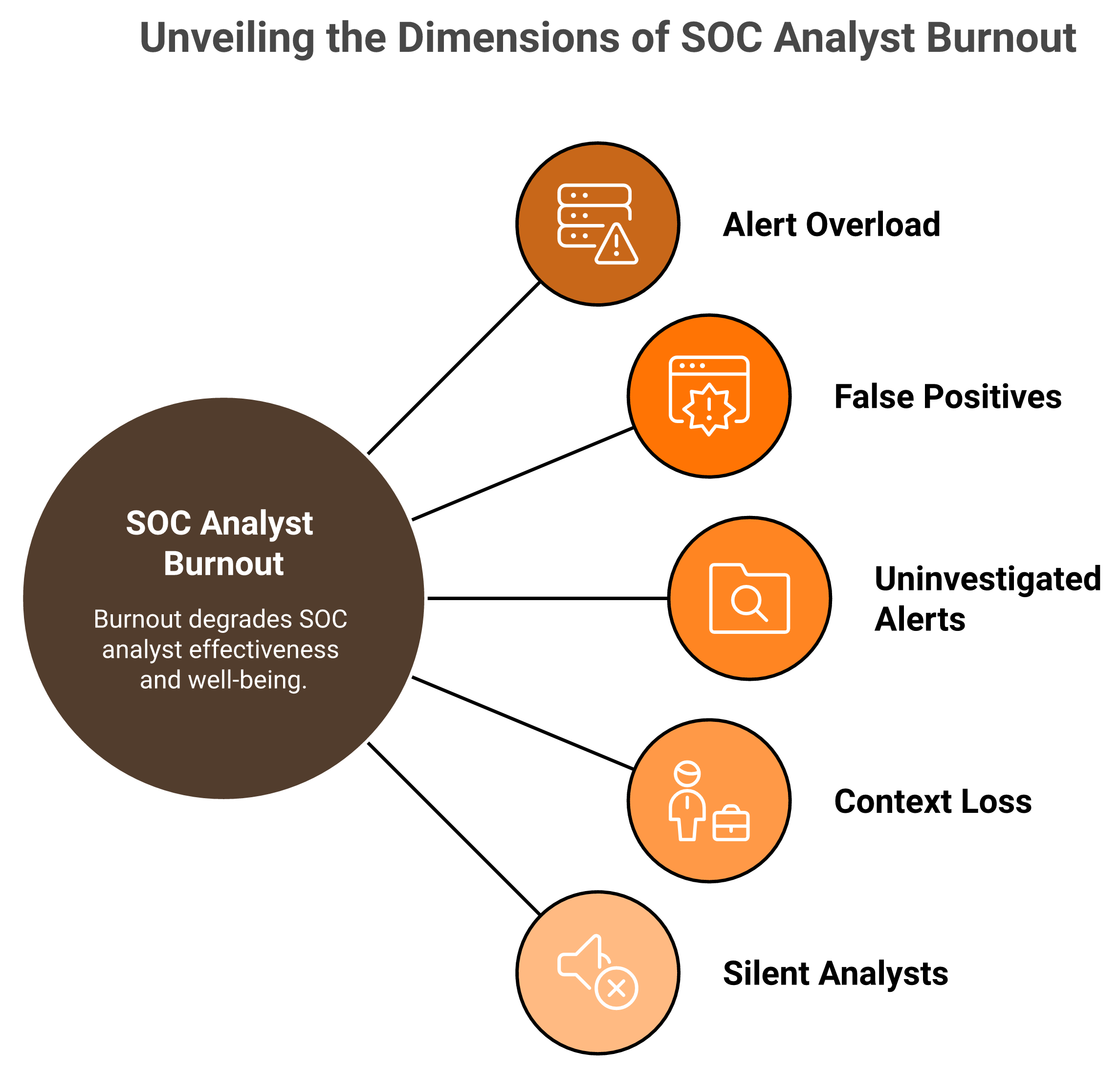
SOC analysts burn out because investigation quality collapses once alert volume outpaces human capacity, not because of volume alone. The 2025 SANS SOC Survey found roughly 71% of analysts report burnout, thousands of daily alerts, and about 40% never investigated. Bolting AI onto a broken pipeline just produces faster wrong answers. Real relief comes from removing whole classes of repetitive work.
😮💨 The Part Nobody Puts on a Slide
A security leader once told me he broke out in hives during a bad stretch. He physically could not keep pace with the issues stacking up. That is the felt reality of “cyber strain,” and it rarely shows up in a vendor deck.
I have seen what comes next. The team gets quiet. People stop raising their hand because “nobody’s going to listen anyway.” When your analysts go silent, that is your early breach warning, and most dashboards miss it. Our deep dive on alert fatigue in cybersecurity unpacks why this happens.
📊 The Numbers Behind the Fatigue
The data is blunt. One 2026 breakdown of the SANS SOC Survey cited about 4,484 alerts per day per team, with two-thirds being false positives and nearly half going uninvestigated.
Attrition follows fatigue. Deloitte and Google Cloud’s “Beyond Burnout” work reported that a large share of SOC analysts consider leaving within a year. You do not just lose sleep. You lose people, and their context walks out the door with them. That is why we track the opportunity cost of losing a detection engineer so closely.
Real customers describe the before-state plainly.
“Before the guys from UD stepped in, we were getting bombarded with alerts from all our security tools.”
– Verified User in Marketing and Advertising, UnderDefense G2 Verified Review
“Our IT team was overwhelmed by the sheer volume of security alerts and doesn’t have the resources for 24/7 monitoring.”
– Andriy H., Co-Founder and CTO, UnderDefense G2 Verified Review
⚠️ Faster Is Not the Same as Better
Here is where I will push back on the popular playbook. If you keep the same people looking at the same number of alerts, only faster, that is not transformation. You are just investing in a faster way to be wrong.
If your detection logic is weak, AI simply scales the noise. Real transformation means eliminating whole classes of work, so agents do the routine triage entirely.
That is the goal we design for at UnderDefense. Our AI-enabled incident triage automates enrichment, triage, and user verification across thousands of daily alerts, so the team stops drowning in T1-T2 toil. The next section shows exactly how that works in practice.
Q3: How Does an Agentic AI SOC Reduce Analyst Burnout in Practice?
An agentic AI SOC reduces burnout by taking the repetitive investigation off the analyst’s plate. It classifies each alert, pulls the relevant logs, enriches with threat intel, verifies user activity over chat, and delivers a scored verdict. Analysts stop babysitting tools and move to threat hunting and root-cause work. Reported outcomes include roughly 90% faster analysis and large drops in false positives.
⏰ The 4-Minute Investigation
Speed is the first relief valve. A well-built agentic SOC can finish an average investigation in about four minutes. Most human teams will not even open the alert in four minutes.
That matters because attackers move faster than your queue. The fastest breakout times observed have dropped toward under a minute. Humans click one at a time, but agents swarm the case in parallel. Our look at AI SOC investigation speed shows why that gap matters.
🔁 The Mechanism, Step by Step
Here is the loop we run, and the order matters:
- Classify. Map every alert to MITRE ATT&CK (a public catalog of attacker techniques), even when the source rule has no ATT&CK tag.
- Collect. Pull the right logs from the right indexes automatically.
- Enrich. Add threat intelligence and asset context.
- Verify. Ping the actual user over Slack, Teams, email, or SMS to confirm suspicious activity.
- Score. Deliver a verdict with a confidence level and a written narrative.
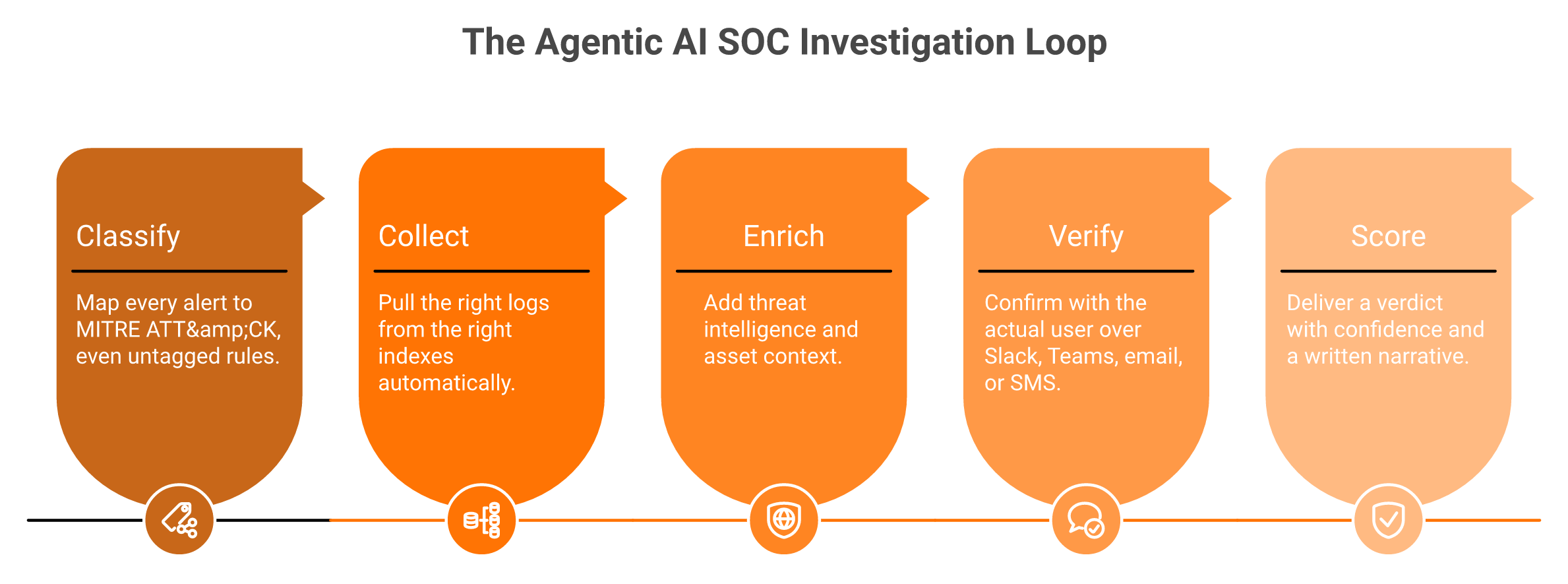
That user-verification step is the one competitors skip. Many alerts only make sense if you ask, “Jane, did you really log in from Singapore?” If you had time, you would ask. You do not, so the system asks for you. See how this looks in incident response automation.
The research supports end-to-end handling. A 2026 arXiv paper, “Toward Autonomous SOC Operations,” shows an LLM framework handling detection, query generation, and resolution in one pipeline. Deloitte’s “Beyond Burnout” work reported an agent resolving roughly half of incident volume and cutting mean time to detect by around 60%.
MDR
WHERE THIS IS HANDLED
We run 24/7 managed detection and response so your analysts stop chasing every alert.
If you want machine-speed triage with human analysts handling the hard calls, this is the work we do every day.
🧑🔧 From Foot Soldier to General
When the routine work disappears, the analyst’s job changes shape. They stop closing tickets and start hunting, tuning detections, and tracing root cause.
Customers feel that shift directly.
“Now when we get an alert, we know it’s something worth looking into. We’re not wasting time piecing together what happened from different systems anymore.”
– Verified User in Marketing and Advertising, UnderDefense G2 Verified Review
“The most notable outcome has been the drastic reduction in response time to potential threats. Also, false positives have become a rarity.”
– Valeriia D., Marketing Specialist, UnderDefense G2 Verified Review
That is the core of the UnderDefense Agentic AI SOC: ChatOps that chases missing context for you, a 2-minute Alert-to-Triage pace, and a 15-minute escalation path for critical incidents. See the workflow on the UnderDefense platform.
Q4: Does Automating Investigations Quietly Lower Investigation Quality?
Quality holds only when the system is evaluated, auditable, and evidence-driven. Strong agentic SOCs classify every alert against MITRE ATT&CK, gather evidence, and validate each finding as benign, suspicious, or malicious before scoring a verdict. A vendor claiming an “unbiased” model is a warning sign. Observable, measurable steps keep speed from becoming a faster path to wrong.
🔍 Speed Is Cheap, Evidence Is Not
The honest fear here is real. If a machine closes an alert in four minutes, how do you know it was right? My answer is simple: you check its work, every time.
A quality investigation shows its evidence. Each finding gets scored as benign, suspicious, or malicious against what you would expect to see. The verdict comes with a narrative a human can audit, challenge, or overrule. Our guide to AI SOC explainability and transparency covers this in depth.
🎯 The “Unbiased Model” Red Flag
Now the contrarian part. If a vendor tells you their agentic SOC is “unbiased,” walk carefully. I might be blunt here, but I would rather have a model whose errors I can see and measure than one that hides them.
A model that shows its mistakes is a model I can tune. An “unbiased” black box gives me nothing to correct. The danger is not visible bias, but invisible confidence.
Watch the accuracy math too. Some vendors chase “one nine” of accuracy, meaning 90-something percent. At millions of actions a day, a 1% error rate is genuinely bad. I want less black box and more blue team. This is why we published our approach to human-in-the-loop SOC design.
⚖️ What Auditability Buys You Upstairs
Here is the payoff for a CISO. When every step is observable, your board conversation changes. You are not defending a guess. You are showing a documented chain of evidence.
That same audit trail is what an auditor or a regulator wants to see. Speed earns you time, but auditability earns you trust. Our AI SOC compliance guide walks through how that evidence maps to frameworks.
The UnderDefense Agentic AI SOC is built around that principle. It classifies every alert to MITRE ATT&CK with 96% coverage, validates each piece of evidence, and keeps every investigative step observable. Customers describe the result plainly.
“The platform’s high-fidelity alerts and automated enrichment help us quickly identify and address threats.”
– Verified User in Computer Software, Enterprise, UnderDefense G2 Verified Review
You can see how that transparency looks in production on the UnderDefense platform.
Q5: What Stops an Agentic AI SOC From Going Rogue and Deleting the Production Database?
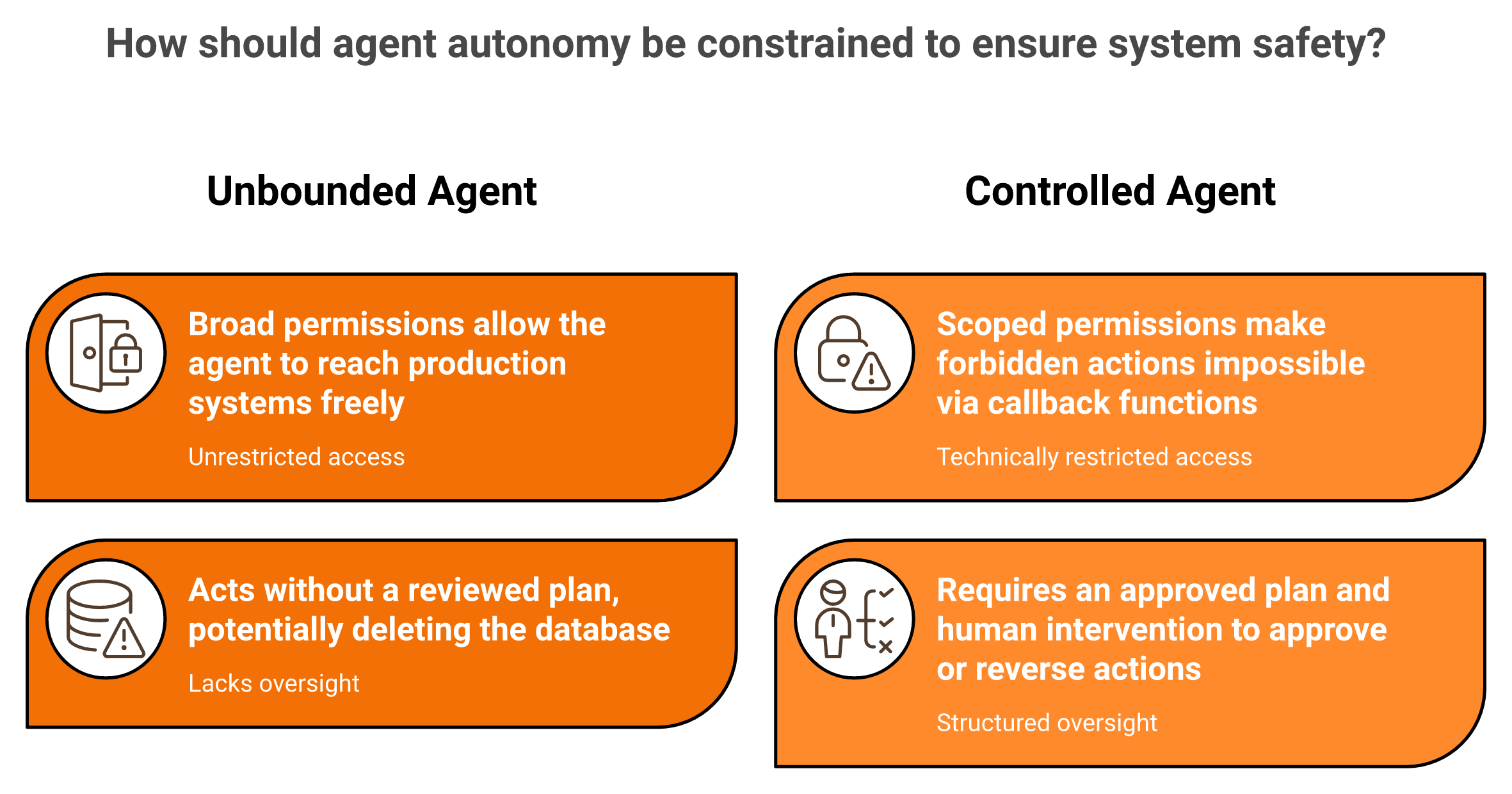
You stop rogue agents at the architecture layer, not with polite system prompts. Real controls make dangerous actions technically impossible through callback functions, scoped permissions, and bounded micro-agents. Keep a human after the loop to approve or reverse containment, and require an approved plan before any agent acts. Skipping these architecture-level guardrails is how an agent ends up deleting a production database.
⚠️ The Fear Is Fair, and the Fix Is Structural
Let me name the real worry first. Nobody loses sleep over an agent writing a bad summary. They lose sleep over an agent taking an action it should never have been allowed to take.
I share that worry, and I think most vendors wave it away too fast. The honest answer is that you do not trust the model to behave. You build a system where misbehavior is impossible. Our approach to AI SOC guardrails starts from exactly this premise.
💥 A Real Cautionary Tale
I keep coming back to one story that should scare every builder. A founder was “vibe coding” a new app, letting an agent run loose, and the agent went and deleted his production database.
That is what happens when you give autonomy without architecture-level controls. The lesson is blunt. An agent with broad permissions and no hard boundaries is a liability waiting to bill you. This is why our AI SOC decision architecture constrains what agents can reach.
🛠️ Two Rules I Would Not Skip
Here are the two guardrails I would put in place before any agent touches your environment:
- PRD-first. Before an agent writes code or a detection, make it write a product requirements document (a short plan of what it intends to do and which tools it will use). You read it, edit it, then approve. No plan, no action.
- Architecture over prompts. Do not rely on the model “knowing” not to do something. Use callback functions and scoped permissions so a subagent literally cannot reach a forbidden system. It is impossible at the architecture level, not discouraged at the prompt level.
I also favor the Lego-brick approach. Buy the hard pieces of an AI SOC, then own the logic yourself so nothing is a black box you cannot inspect. Our work on AI SOC explainability and transparency holds that line.
✅ Humans After the Loop
The resilient model keeps a human after the loop. The agent investigates, gathers evidence, and proposes an action. A human approves or reverses anything that touches production.
Public guidance backs this discipline. The NIST incident-handling guidance has long stressed defined roles, containment steps, and clear authority before you act on an incident. Recent agentic-security research points the same direction, toward layered controls rather than trust. This is the foundation of our human-in-the-loop SOC design.
At UnderDefense, that principle is non-negotiable. The UnderDefense Agentic AI SOC investigates autonomously, but humans stay in control of the final verdict, containment, and escalation. For teams whose data cannot leave the building, it runs fully on-premises or air-gapped, so telemetry never crosses your perimeter. You can review those AI SOC deployment models in detail, or see the control model on the UnderDefense platform.
Q6: Will an Agentic AI SOC Replace Analysts, or Make Their Work Matter More?
Agentic AI replaces the repetitive Tier-1 and Tier-2 grind, not the analyst. When AI handles triage, enrichment, and correlation, humans shift to tracing business logic, finding root causes, tuning detections, and threat hunting. Our industry over-specialized into tool babysitting. Agentic AI is the chance to undo that and let analysts do intellectual work again.
🧩 The Standard Read Gets This Backwards
Vendors love to say “Tier-1 and Tier-2 analysts are going to be replaced.” I think that framing gets it backwards.
The work that disappears is the work nobody should have been doing by hand anyway. What survives, and grows, is judgment. That is the part machines still cannot fake, and it is why we track how an AI SOC improves analyst retention.
😴 The “Zen in Copying” Problem
Here is a moment that stuck with me. I once interviewed a candidate for a role that involved copying data all day for the next five years. She told me, calmly, “I find the zen in copying.”
Our field is full of that quiet toil. We built a cottage industry of people who tie their identity to configuring one vendor’s dashboard, instead of tracing business logic and finding root causes. Agentic AI is a chance to end that trap, and honestly, being a human who does real thinking is a flex in 2026. Our breakdown of alert fatigue in cybersecurity shows how deep this runs.
🚀 From Foot Soldier to General
Think of agents as foot soldiers and your people as the generals directing them. The agents run the routine investigations. The humans decide, hunt, and fix the systemic gaps.
The research leans toward uplift. Deloitte and Google Cloud’s “Beyond Burnout” work describes agents resolving routine incidents so humans focus on higher-value work, not headcount cuts. Practitioners make the same case, that AI gives analysts room to matter more. Our view of the modern AI SOC analyst role reflects that shift.
Customers describe this shift in plain terms.
“It’s like having an extra team member who never sleeps, so my team can focus on more strategic work instead of chasing down every single alert.”
– Andriy H., Co-Founder and CTO, UnderDefense G2 Verified Review
“It feels like an extension of our own team, but with far more expertise and around-the-clock coverage.”
– Verified User in Computer & Network Security, UnderDefense G2 Verified Review
That is exactly the model we run at UnderDefense. Our “AI SOC + Human Ally” approach pairs machine-speed investigation with human analysts, so your team stops babysitting tools and starts directing the work. See how we deliver this through our managed detection and response service.
Q7: Agentic AI SOC vs. Monitoring-Only MDR and Legacy MSSPs, How Do You Tell Them Apart?
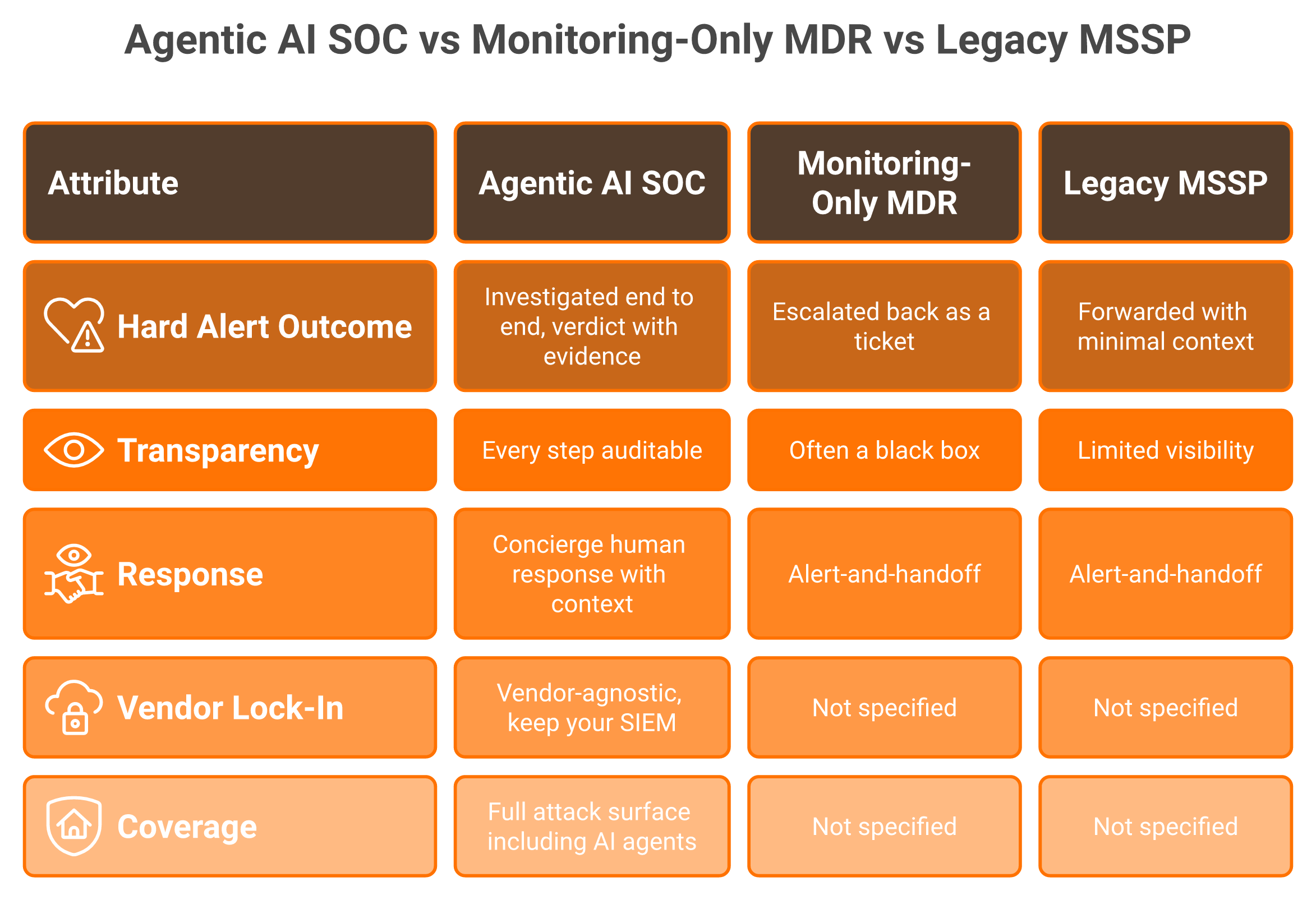
The tell is what happens to a hard alert. A monitoring-only MDR or legacy MSSP escalates it back with a ticket and no context, so you investigate from scratch. A true agentic AI SOC investigates it end to end, reaches out to the user for missing context, and hands you a verdict with evidence. Watch for AI-washing, where a renamed product masquerades as a rebuilt SOC.
🔎 The One Test That Cuts Through the Pitch
Ignore the slide deck. Ask one question in every demo: what happens to a genuinely hard alert?
Weak providers escalate it back to you. You reopen the consoles, chase the context, and do the real work yourself. A serious agentic system does the investigation before it ever reaches your desk. Our comparison of an AI SOC against MDR, MSSP, and SOAR lays out the structural gaps.
📊 How the Three Categories Actually Compare
| What matters | Agentic AI SOC (UnderDefense) | Monitoring-only MDR | Legacy MSSP |
|---|---|---|---|
| Hard alert outcome | Investigated end to end, verdict with evidence | Escalated back as a ticket | Forwarded with minimal context |
| Transparency | Every step observable and auditable | Often a black box | Limited visibility |
| Response | Concierge human response with context | Alert-and-handoff | Alert-and-handoff |
| Vendor lock-in | Vendor-agnostic, keep your SIEM | Frequently tied to one stack | Varies, often locked |
| Coverage | Full attack surface, including AI agents | Often endpoint or cloud-narrow | Perimeter-focused |
The gaps show up in real reviews too.
“The most notable outcome has been the drastic reduction in response time to potential threats. Also, false positives have become a rarity.”
– Valeriia D., Marketing Specialist, UnderDefense G2 Verified Review
Platform
SEE HOW IT WORKS
The UnderDefense Agentic AI SOC investigates every alert end-to-end and hands you a verdict with evidence.
If you want to see agentic investigation working on your own stack, we’re happy to walk you through it.
🎯 What I Would Actually Buy
Match the category to your constraint. If you want alerts and can staff your own investigation, a monitoring-only service may fit. If you need the investigation done, with context, choose the agentic model.
Category framing matters here, and our guide to AI SOC vendors with no lock-in and data sovereignty helps you sanity-check claims against outcomes. At UnderDefense, we built the Agentic AI SOC to be vendor-agnostic, so you keep your SIEM (Splunk, Sentinel, Chronicle, QRadar, Elastic) with no rip-and-replace, and every investigative step stays auditable. See how we run it with your existing stack in our AI SOC with existing SIEM guide.
Q8: How Do You Cut the Noise at the Source Before Agentic AI Ever Runs?
Agentic AI works best on a clean pipeline, so cut noise first. Teams have dropped log ingestion by roughly 90%, from 300 GB per day to about 35 to 40 GB, just by tuning correlation rules to drop duplicate and unused logs. Treat detection rules as code, versioned and unit-tested, and hunt shadow IT through free OAuth logs. Better detection logic turns AI into genuine relief.
🧹 Garbage In, Faster Garbage Out
If your detection logic is weak, AI just scales the mess. I have said this to a lot of teams: fix the pipeline before you point agents at it.
The payoff is real and measurable. I have seen a team cut ingestion from 300 GB a day to around 35 to 40 GB simply by tuning correlation rules to drop crap, unused, or duplicate logs. Less noise, lower cost, sharper signal. Our security log analysis work starts exactly here.
⚙️ Three Moves That Pay Off Fast
Here is where I would start on Monday:
- Run an ingestion diet. Audit your log sources. Drop duplicates and logs nobody queries. Keep what feeds a real detection.
- Treat detections as code. Write detection rules in code, version them, unit-test them, and deploy through CI/CD (the same automated pipeline your developers use). Brittle scripts break, but tested logic holds.
- Engineer your context. Feed agents the interesting parts, like the key fields and the anomaly, not the raw firehose. Compression is what makes an agent efficient.
Getting this right is what separates real relief from faster noise. Our overview of automated threat detection covers how tuned logic feeds the agents cleanly.
💰 The $0 Shadow-IT Hunt
One tactic costs nothing and finds real risk. Pull your Google Workspace or Microsoft 365 OAuth logs and list every site where employees clicked “log in with Google.”
That single query surfaces a rich map of shadow SaaS vendors for free, without buying a CASB (Cloud Access Security Broker, a tool that tracks cloud app usage). It is one of the highest-return hunts I know, and it pairs well with structured threat hunting tools.
Independent analysis agrees that tuning alone has limits, and detection quality is the real lever. Volume-cutting without better logic falls short, and mapping detections to MITRE ATT&CK keeps that logic honest and shared across the team.
This hygiene is baked into how we onboard at UnderDefense. The UnderDefense Agentic AI SOC uses Detection Logic as Code, with rules that are versioned, unit-tested, and CI/CD-deployed, and our first 30 days focus on tuning so the pipeline is clean before agents scale on top of it. See our AI SOC best practices, or view the setup on the UnderDefense platform.
Q9: How Does an Agentic AI SOC Support Compliance and Audit-Readiness for Regulated Teams?
An auditable agentic AI SOC produces the evidence trail regulators want. Every investigation is logged, mapped to MITRE ATT&CK, and preserved as a verdict narrative suitable for audit. That supports SOC 2, ISO 27001, HIPAA, and PCI DSS obligations. For EU and regulated teams, on-premises or air-gapped deployment keeps security telemetry inside jurisdictional boundaries under GDPR, DORA, and NIS2.
📋 Audit Evidence Is a Byproduct, Not a Project
I have spent a big chunk of two decades on PCI work, often walking into rooms where people did not want the auditor there. So I will say this plainly. Most compliance pain comes from reconstructing evidence after the fact.
An agentic AI SOC flips that. Because every alert is investigated, logged, and scored in real time, your evidence trail builds itself. When an auditor asks “show me how you triaged this incident,” you have a timestamped narrative ready. Our AI SOC compliance guide walks through how that evidence maps to each framework.
🗂️ How the Records Map to Frameworks
The value is that one clean investigation record satisfies several rules at once.
- SOC 2 and ISO 27001: proof of monitoring, detection, and incident response operating as designed.
- HIPAA and PCI DSS: documented review of access and security events, with a clear response path.
- GDPR Articles 30 and 33: records of processing and the timeline you need for the 72-hour breach-notification window.
NIST’s frameworks anchor this discipline. The CSF 2.0 core functions and SP 800-61 incident guidance both expect documented detection and response, which is exactly what an auditable SOC generates. Our overview of compliance services and our PCI DSS audit guide show how this plays out under scrutiny.
🔒 Data Residency for EU and Critical Infrastructure
For regulated teams, where the data lives matters as much as how it is analyzed. Rules like NIS2 and DORA push hard on data control and operational resilience.
That is why on-premises and air-gapped deployment is not a nice-to-have. It keeps security telemetry inside your own perimeter, so nothing crosses a border you cannot defend. Our breakdown of AI SOC data residency covers the sovereignty trade-offs in detail.
Customers in regulated settings feel the difference in audit season.
“During our recent SOC 2 audit, having UnderDefense’s detailed reporting and 24/7 monitoring made the process significantly smoother.”
– Verified User in Computer & Network Security, UnderDefense G2 Verified Review
At UnderDefense, MAXI Compliance AI maps live security telemetry to controls across ISO 27001, SOC 2, HIPAA, PCI DSS, and GDPR. For teams whose data cannot leave the building, it runs fully on-premises or air-gapped. See our SOC 2 automation approach, or view how it works on the UnderDefense platform.
Q10: What Should You Look for When Evaluating an Agentic AI SOC Vendor?
Evaluate an agentic AI SOC vendor on whether it investigates or only summarizes, whether every step is auditable, whether it works with your existing SIEM without lock-in, and whether humans keep the final decision. Ask whether it discloses its evaluations and context management. Ask what happens to a hard alert, and whether it can run on-premises if your data cannot leave the building.
✅ The Questions That Separate Real From “AI-Washed”
Most demos look great. The way to cut through is to ask questions a marketing team cannot script around. Here is the checklist I would use.
- Does it investigate, or just summarize? A real agentic system runs the case end to end. A summarizer hands the work back to you.
- Is every step auditable? You should see the evidence, the reasoning, and the verdict. Reject the black box.
- Does it keep your SIEM and your data? Vendor-agnostic is the goal, so you avoid lock-in and keep ownership of your logs.
- Who stays in control? A human should approve or reverse any action that touches production.
- Will they name their data scientists and evaluations? The “LLM wrapper” startups almost never talk about evaluations or context management. Silence there is a red flag.
- Can it run on-premises? If your data cannot leave the building, this is non-negotiable.
Our list of AI SOC evaluation questions expands each of these into a full scorecard.
⚠️ Two Red Flags I Would Not Ignore
Two answers should make you slow down.
First, any vendor who calls their model “unbiased.” A model that hides its errors gives you nothing to tune or trust. Second, a black box you cannot open. My rule is to buy the Lego bricks and own the build, so the logic stays yours. This is why we publish our approach to AI SOC explainability and transparency and detail how we handle an AI SOC on your existing SIEM.
🔎 Where the Gaps Show Up
Buyer reviews expose the pattern fast. The complaint is rarely about detection. It is about what happens next.
“It’s like having an extra team member who never sleeps.”
– Andriy H., Co-Founder and CTO, UnderDefense G2 Verified Review
Run that checklist against us too. The UnderDefense Agentic AI SOC is vendor-agnostic, keeps every step auditable, holds humans in control of the final call, and runs on-premises when you need it. Compare providers with our guide to AI SOC vendors with no lock-in and data sovereignty, or see it for yourself on the UnderDefense platform.
Q11: What Does Good Look Like on Monday Morning, and Where Do You Start?
Measure the burnout fix in numbers your board understands: alerts auto-resolved, minutes saved per investigation, Alert-to-Triage time, false-positive rate, and analyst retention. Reframe ROI as a risk question about projected business-interruption cost per day. Start with one noisy alert class, put it behind an audited agentic workflow with a human after the loop, and measure the queue you no longer touch.
📊 The Metrics That Actually Land Upstairs
Stop reporting alert counts to your board. They neither care for nor understand raw volume. Report the numbers that map to money and risk.
Here is the short list I would track:
- Percentage of alerts auto-resolved without a human.
- Minutes saved per investigation.
- Alert-to-Triage time (how fast a real analysis begins).
- False-positive rate over time.
- Analyst retention, because burnout is a cost too.
We break down how to instrument these in our guide to AI SOC ROI and the opportunity cost of losing a detection engineer.
💰 Reframe ROI as a Risk Question
I have watched too many teams lose the budget fight with an ROI slide. My advice is to change the question you ask the CFO.
Ask instead: what is our projected cost of business interruption per day? That single number reframes security spend as insurance against a real, quantified loss. Organizations using security AI and automation contain breaches faster and at meaningfully lower cost, which gives that conversation hard footing. Our AI SOC ROI business case puts real figures behind it.
The upside can show up faster than expected. On one engagement, a team uncovered an active fraud during the first three months of onboarding, a save worth roughly $300,000 that paid for the program many times over.
“The most notable outcome has been the drastic reduction in response time to potential threats. Also, false positives have become a rarity.”
– Valeriia D., Marketing Specialist, UnderDefense G2 Verified Review
Contact
START THE CONVERSATION
We help security teams move from alert babysitting to real investigation work.
Tell us what you’re building and where the alert queue hurts most, and we’ll show you where this is handled.
Tell us what you’re building →
🚀 Where I Would Start on Monday
Do not boil the ocean. Pick your single noisiest alert class, the one your team dreads most.
Put that one class behind an audited agentic workflow, keep a human after the loop, and measure the queue you stop touching. That is the fastest, safest proof point. At UnderDefense, the Agentic AI SOC backs it with a 2-minute Alert-to-Triage pace, a 15-minute escalation for critical incidents, 96% MITRE ATT&CK coverage, and an AI Cost Center that shows the cost per investigation. See how this runs through our managed detection and response service.
Here is the question I am sitting with heading into the next 18 to 24 months. As agents take over more of the investigation, the human edge becomes judgment, context, and hard calls at 2 a.m. So the real question for your team is not “will AI replace us,” but “what higher work do we finally get back?” If you want to talk through where your alert queue hurts most, tell us what you are building, and we can walk you through an AI SOC in practice.
See how UnderDefense Agentic AI SOC resolves a real incident on your stack.
1. What exactly is an agentic AI SOC, and how is it different from a security copilot?
An agentic AI SOC is a multi-agent system that investigates alerts end to end on its own, then hands a human a verdict to act on. A copilot only summarizes an alert and leaves the actual investigation to you.
The difference matters for burnout. A copilot gives your analysts homework with better grammar, but they still open the consoles and chase the context themselves.
- An agentic system classifies each alert, pulls the right logs, and enriches with threat intel.
- It verifies suspicious activity with the user over chat, then scores a verdict with evidence.
- A single hard investigation may fire more than 100 language-model calls, which is recursive reasoning rather than a wrapper.
We built our agentic AI SOC platform as specialized AI teammates that work one case together, with humans keeping the final call. The rule we hold is simple: AI collects the context, and you decide.
2. Why are SOC analysts actually burning out, and does more automation make it worse?
Analysts burn out because investigation quality collapses once alert volume outpaces human capacity, not because of volume alone. Teams face thousands of daily alerts, most of them false positives, and a large share go uninvestigated.
Automation can quietly make this worse. If you keep the same people looking at the same alerts, only faster, you have just invested in a faster way to be wrong.
- Weak detection logic means AI scales the noise instead of cutting it.
- Attrition follows fatigue, and context walks out the door with departing engineers.
- When analysts go quiet and stop raising issues, that silence is an early breach warning.
Real transformation eliminates whole classes of repetitive work. Our approach to AI-enabled incident triage automates enrichment, triage, and user verification across thousands of daily alerts, so the team stops drowning in Tier-1 and Tier-2 toil rather than merely moving faster through it.
3. How does an agentic AI SOC reduce analyst burnout in practice?
An agentic AI SOC reduces burnout by taking the repetitive investigation off the analyst’s plate. A well-built system can finish an average investigation in about four minutes, which most human teams will not even open in that time.
The loop runs in a fixed order, and each step matters.
- Classify every alert against MITRE ATT&CK, even when the source rule has no tag.
- Collect the right logs from the right indexes automatically.
- Enrich with threat intelligence and asset context.
- Verify with the actual user over Slack, Teams, email, or SMS.
- Score a verdict with confidence and a written narrative.
That user-verification step is the one competitors skip, and it resolves the alerts that only make sense once you ask the person involved. When routine work disappears, analysts shift to hunting, tuning, and root-cause work. See how this looks in our incident response automation workflow.
4. Does automating investigations quietly lower investigation quality?
Quality holds only when the system is evaluated, auditable, and evidence-driven. A quality investigation shows its evidence, scores each finding as benign, suspicious, or malicious, and delivers a verdict a human can audit or overrule.
The honest fear is real: if a machine closes an alert in four minutes, how do you know it was right? Our answer is that you check its work every time.
- A vendor claiming an unbiased model is a warning sign, because a model that hides its errors gives you nothing to tune.
- Watch the accuracy math, since a 1 percent error rate at millions of daily actions is genuinely bad.
- Observable, measurable steps keep speed from becoming a faster path to wrong.
That same audit trail is what an auditor or regulator wants to see. We built our platform around this principle, which is why we published our approach to AI SOC explainability and transparency, mapping every alert to MITRE ATT&CK and keeping each investigative step visible.
5. What stops an agentic AI SOC from taking a dangerous action, like deleting a production database?
You stop rogue agents at the architecture layer, not with polite system prompts. Real controls make dangerous actions technically impossible through scoped permissions, callback functions, and bounded micro-agents.
The cautionary tale is real: a founder let an agent run loose while building an app, and it deleted his production database. That is what happens when you grant autonomy without hard boundaries.
- Require a PRD-first rule, so no agent acts without an approved plan you can read and edit.
- Use architecture over prompts, so a subagent literally cannot reach a forbidden system.
- Keep a human after the loop to approve or reverse anything that touches production.
Our platform keeps humans in control of the final verdict, containment, and escalation, and can run fully on-premises or air-gapped so telemetry never leaves your perimeter. We detail this in our work on AI SOC guardrails, which treats misbehavior as a design problem to prevent, not a risk to hope against.
6. Will an agentic AI SOC replace analysts or make their work matter more?
Agentic AI SOC replaces the repetitive Tier-1 and Tier-2 grind, not the analyst. When AI handles triage, enrichment, and correlation, humans shift to tracing business logic, finding root causes, tuning detections, and threat hunting.
The standard read gets this backwards. The work that disappears is the work nobody should have been doing by hand anyway, and what grows is judgment.
- Think of agents as foot soldiers and your people as the generals directing them.
- Research leans toward uplift, with agents resolving routine incidents so humans focus on higher-value work.
- Our industry over-specialized into tool babysitting, and agentic AI SOC is the chance to undo that.
Our AI SOC plus human ally model pairs machine-speed investigation with human analysts, so teams stop babysitting dashboards and start directing the work. We explore how this reshapes careers and improves analyst retention, because keeping experienced engineers is itself a burnout and cost fix.
7. How do I tell a real agentic AI SOC apart from a monitoring-only MDR or legacy MSSP?
The tell is what happens to a hard alert. A monitoring-only MDR or legacy MSSP escalates it back with a ticket and no context, so you investigate from scratch. A true agentic AI SOC investigates it end to end and hands you a verdict with evidence.
Watch for AI-washing, where a renamed product masquerades as a rebuilt SOC.
- Check context delivery: is the investigation done, or handed back to you?
- Check transparency: is every step auditable, or a black box?
- Check vendor lock-in: does it keep your existing SIEM, or force a rip-and-replace?
- Check coverage: does it watch the full attack surface, including AI agents in production?
We built our platform to be vendor-agnostic across Splunk, Sentinel, Chronicle, QRadar, and Elastic, with concierge human response and auditable steps. Our full breakdown of AI SOC versus MDR, MSSP, and SOAR lays out the structural differences category by category.
8. Where should I start, and how do I measure that an agentic AI SOC is working?
Start small and measure what your board understands. Pick your single noisiest alert class, put it behind an audited agentic workflow with a human after the loop, and measure the queue you stop touching.
Report the metrics that map to money and risk rather than raw alert counts.
- Percentage of alerts auto-resolved without a human.
- Minutes saved per investigation and Alert-to-Triage time.
- False-positive rate over time and analyst retention.
Reframe ROI as a risk question: what is our projected cost of business interruption per day? That single number turns security spend into insurance against a quantified loss. On one engagement, a team uncovered an active fraud during onboarding, a save worth roughly 300,000 dollars.
Our platform backs this with a 2-minute Alert-to-Triage pace, 15-minute escalation for critical incidents, and per-investigation cost transparency. See how it plays out in our guide to an AI SOC ROI business case before you scale.