




Q1. AI SOC Results in 2026: What the Before-and-After Numbers Actually Show
A real AI SOC deployment moves three measurable things: investigation time, coverage, and cost. In documented deployments, robust investigations dropped from hours to roughly 7 to 8 minutes, teams reclaimed about 8.3 hours per person each day on enrichment, and an independent Cloud Security Alliance benchmark found AI-assisted analysts 45 to 61% faster and more accurate. The honest caveat: AI speeds up good detections, and it speeds up being wrong on weak ones.
See how the UnderDefense Agentic AI SOC investigates, triages, and resolves real alerts.
The numbers that actually held up
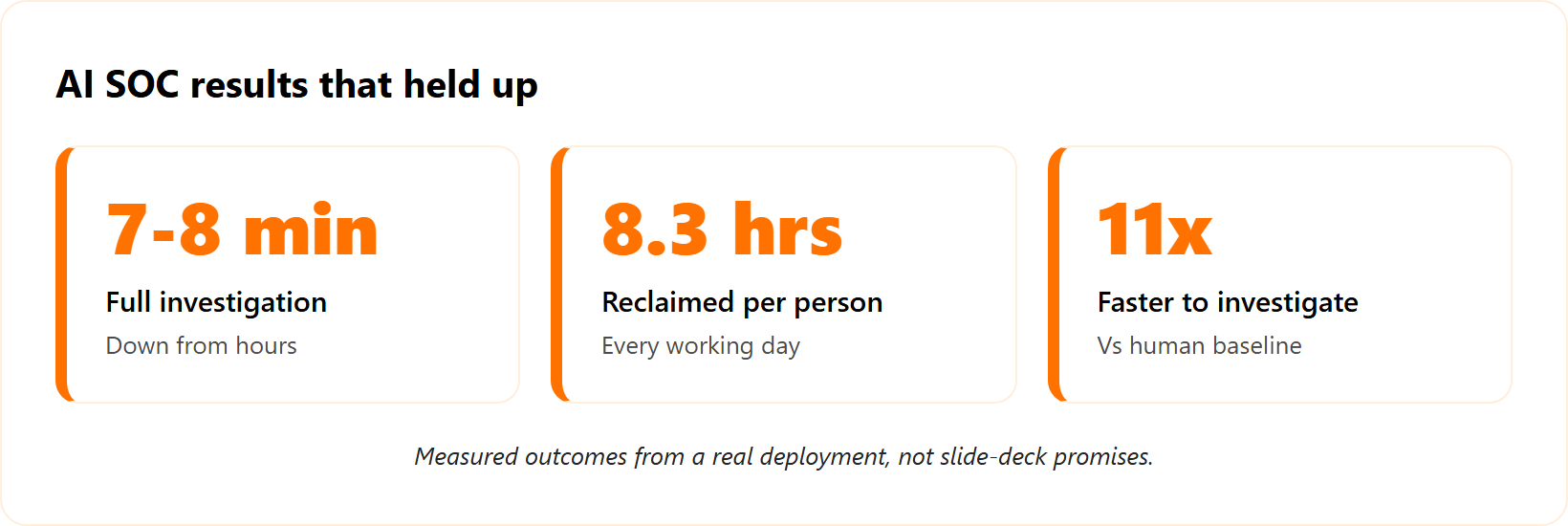
Let me start with what I have watched happen, not what a slide deck promised. In one deployment, full investigations fell to 7 to 8 minutes, all tools engaged, sometimes sharper than an analyst rushing through twenty alerts an hour. Early on, with just serverless functions and a state machine, we saved 8.3 hours per person, per day, instantly.
That tracks with outside research. A 2025 Cloud Security Alliance benchmark study of 148 SOC and incident response professionals found AI-assisted analysts completed investigations 45 to 61% faster, with 22 to 29% better accuracy. Speed and coverage moved together. That part surprised even me.
The anxiety nobody says out loud
Here is the real question under the search. You are wading through marketing that oversells AI, and you are wondering exactly what percentage of the manual grunt work this removes. You are also wondering whether it is just a faster way to be wrong if your underlying detections are weak.
That fear is correct. If you are drowning in false positives, or letting real threats walk past shallow filters, no AI saves you. A faster engine on a bad map gets you lost quicker. Operational blindness does not disappear because a model now narrates it.
What this article proves
So I am going to show you, not tell you. Ahead, you will see a real before-and-after from a deployment with hard numbers, including a 12,000-investigation head-to-head against a human SOC team. We will cover the metrics worth tracking, the ROI math that holds up to a board, and the honest limits of where AI still cannot go alone.
This is the same posture we take when our UnderDefense Agentic AI SOC platform runs an AI SOC on top of a customer’s existing stack. We measure first, then claim. My current read: the gains are real, the hype is not, and the difference shows up in your baseline.
Q2. What Exactly Is an AI SOC, and Where Does the Human Still Sit?
An AI SOC uses AI agents to do the investigation grunt work, pulling context, enriching alerts, and reconstructing what happened, while human analysts decide and act. It is not a robot replacing your team. Think of AI agents as foot soldiers and your analysts as generals directing them, with special-forces humans handling the complex missions agents cannot. The correct posture: AI collects context, you decide.
The plain-English definition
A Security Operations Center, or SOC, is the team and tooling that watches for threats and responds. An AI SOC adds agents that read the raw signals, gather the context around an alert, and assemble the story a human would otherwise build by hand.
Here is the line I hold to: AI collects context, you decide. The framing some vendors use, “AI makes decisions,” gets it backwards. The decision, especially the one that touches a user or a production system, stays human.
A way to picture the division of labor
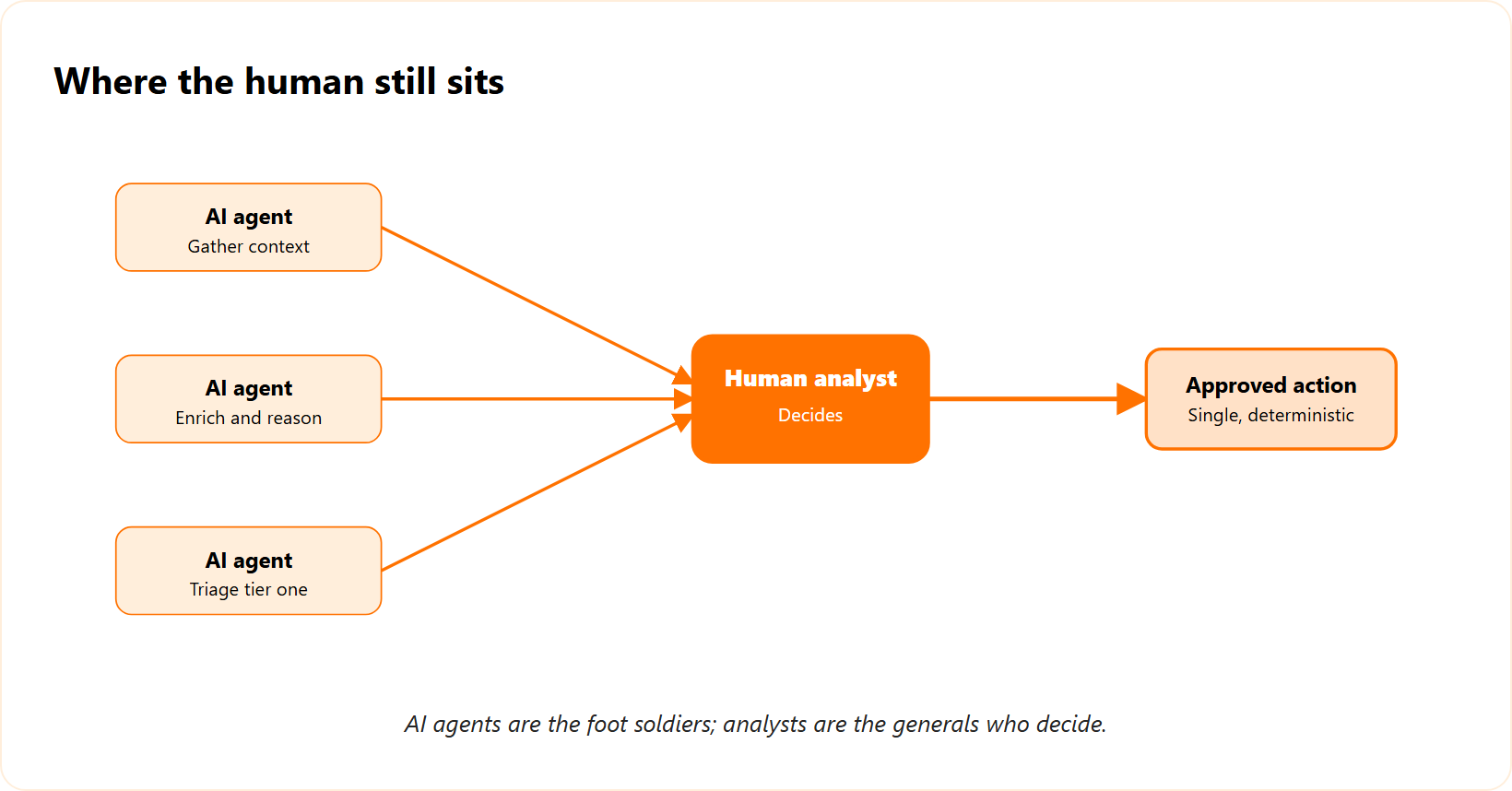
Think of AI agents as your foot soldiers. Your engineers and analysts work as generals, directing those foot soldiers and acting as special forces on the missions agents are not equipped for. The foot soldiers cover volume. The humans cover judgment.
I also describe agents as teenagers. They are supremely intelligent, and they have no fear of consequence. Sometimes they do something genuinely dumb. You build the system so it can protect the world from them, with oversight and tight guardrails on any action.
What this means on Monday
This division is observable, not theoretical. Modern patents describe SOC agents that investigate alerts using large language models and logic-based reasoning to infer root cause. The mechanism is real. The autonomy is bounded.
In our own AI SOC inside UnderDefense Agentic AI SOC, AI triages roughly 38% of tier-one alerts, and humans stay heavily in the loop while we tune the prompts. That “Human Ally” model is the point. You start conservative, you watch what the agents do, and you widen their lane only as the evidence earns it. This is also why the debate about AI replacing SOC teams misses the operational reality.
Q3. Which AI SOC Metrics Actually Matter, and How Do You Measure Them?
The metrics that prove an AI SOC works are tied to investigation, not dashboards: mean time to detect (MTTD), mean time to investigate (MTTI), false-positive load, the percentage of tier-one alerts AI triages, and analyst hours reclaimed. Two distinct SLAs matter and belong tracked separately: a 2-minute Alert-to-Triage SLA and a 15-minute escalation SLA for critical incidents. A single blended “MTTR” hides both.
Why most metrics get gamed
Here is a question I ask every prospect, and it stings: are your alerts any good? The honest answer is usually no. If you are still buried in false positives, a prettier dashboard changes nothing, and SOAR (Security Orchestration, Automation, and Response) does not save you either.
So measure the work, not the wallpaper. Count how long it takes to investigate, how much noise you carry, and how many hours your people get back. One number I see abused is “MTTR,” Mean Time to Respond. It quietly blends two different promises into one comforting average.
The two SLAs you must split
I separate them on purpose. A 2-minute Alert-to-Triage SLA tells you how fast a human eye reaches the alert. A 15-minute escalation SLA for critical incidents tells you how fast the serious ones move. Blend those, and you can hide a slow critical path behind a fast trivial one.
This matters enough that I treat SLAs in cybersecurity as a board-level number, not an internal footnote.
| Metric | Plain formula | What it proves | How to baseline before you deploy |
|---|---|---|---|
| MTTD (detect) | Time from event to alert | Detection coverage works | Sample 30 days of confirmed incidents |
| MTTI (investigate) | Time from alert to verdict | Investigation speed | Time 50 real alerts, end to end |
| False-positive load | False alerts / total alerts | Detection quality | Count closed-as-benign over a month |
| AI triage share | Alerts AI handles / total | Capacity gained | Measure tier-one volume first |
| Alert-to-Triage SLA | Alert to human eyes | Responsiveness | Log current first-touch times |
| Critical escalation SLA | Alert to escalation | Serious-threat speed | Track only sev-1 and sev-2 |
The research behind the noise problem
This is grounded in real research, not vibes. A 2025 ACM Computing Surveys review identified four structural root causes of alert fatigue, and showed why bolt-on filters keep failing. The SANS 2025 Detection and Response work found 73% of teams name excessive false positives as their top detection challenge. Baseline that 73% problem in your own shop before you trust any “after” number.
Inside UnderDefense Agentic AI SOC, we track the 2-minute Alert-to-Triage and 15-minute critical-escalation SLAs separately, and we baseline false-positive load before we claim any improvement. Customers feel that noise reduction fast, which is one of the clearer benefits of MDR in practice.
“The biggest win for me was getting actual control over our security alerts. Before the guys from UD stepped in, we were getting bombarded with alerts from all our security tools. Their team cleaned up our configurations and got the noise under control within the first week.”
Verified User in Marketing and Advertising, Small-Business UnderDefense G2 Verified Review
“It has significantly reduced the number of false positives, allowing our team to focus on real threats. We used to be swamped with alerts, but now we can swiftly identify and address actual vulnerabilities, optimizing our response time.”
Darina I., Customer Success Manager UnderDefense G2 Verified Review
Q4. Before and After: A Real AI SOC Deployment, by the Numbers
In a real before-and-after, a customer ran a 12,000-investigation bake-off over two weeks against a black-box AI: the result was 99.3% agreement with their human SOC team, and an 11x faster mean time to investigate. Elsewhere, full investigations fell to 7 to 8 minutes, and teams reclaimed 8.3 hours per person daily. Meanwhile median break-in time has dropped to 48 minutes, the speed you now race against.
The situation: a team drowning in toil
Picture a SOC analyst on hour six of copy-paste triage. Pull the alert, enrich it, check the user, check the host, write the verdict, repeat. I once hired someone for exactly this, and warned her about the grind. She told me she finds the zen in copying.
I respect that honesty, and I have met many people who find calm in the toil. The hard truth is the toil does not go away on its own. It just buries the one alert that mattered under nineteen that did not.
The complication: prove it against humans
A customer decided to test us without trusting us, which is the right instinct. They sent 12,000 investigations over a two-week period as a bake-off. Same alerts, our system on one side behind a black box, their seasoned SOC team on the other.
No partial credit. The question was simple: would the AI agree with experienced humans on real work, and would it be faster, or just louder?
The resolution: agreement and speed
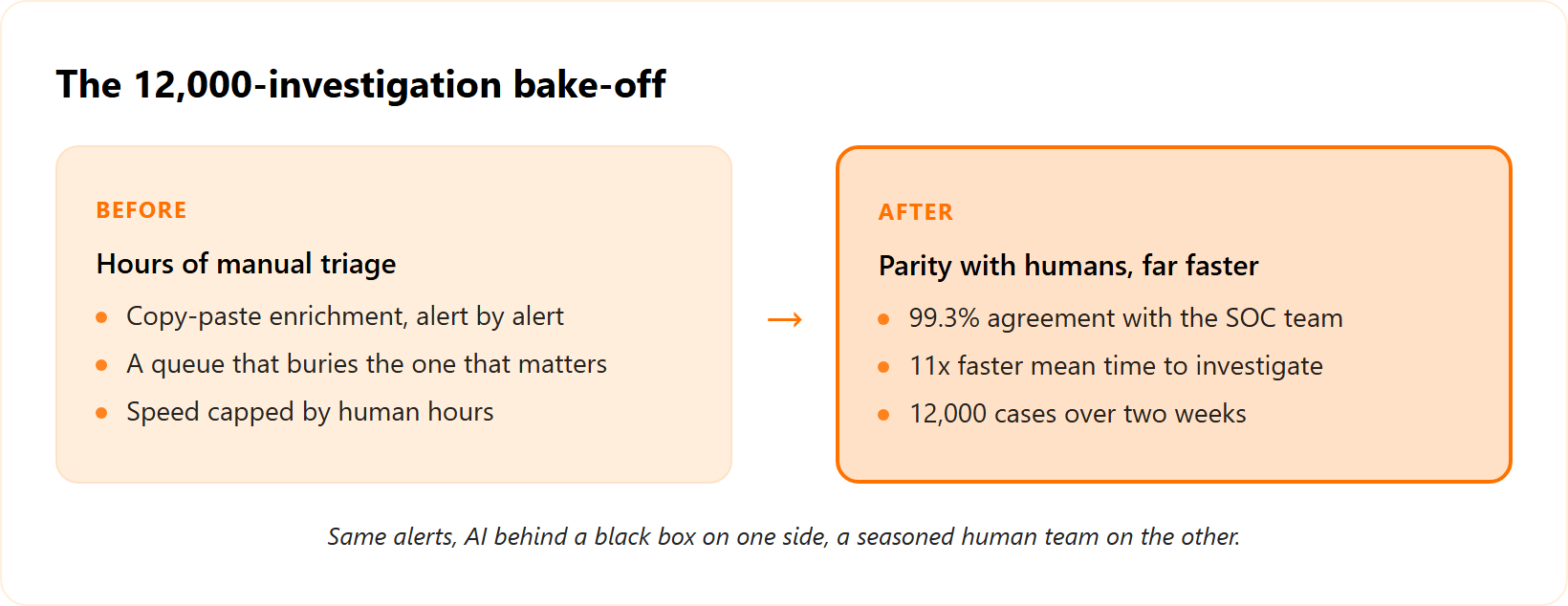
The result was 99.3% agreement between their security operations team and our system. On mean time to investigate, we were 11x faster. That is not a faster way to be wrong, that is parity on judgment with a large gap on speed.
| Metric | Before | After | Source |
|---|---|---|---|
| Investigation agreement vs. humans | Baseline | 99.3% | First-party bake-off |
| Mean time to investigate | 1x | 11x faster | First-party bake-off |
| Full investigation time | Hours | 7 to 8 minutes | First-party deployment |
| Analyst hours reclaimed | 0 | 8.3 hrs/person/day | First-party deployment |
| Cross-study speed gain | Baseline | 45 to 61% faster | CSA 2025 |
The stakes: you race a faster attacker
Here is why the speed matters beyond comfort. Median break-in time has dropped to around 48 minutes, and the fastest we have seen is roughly 51 seconds. Take a moment to realign that against your SLA expectations, because the attacker already has. We have watched our own incident response team race exactly this clock.
We run this kind of AI SOC on top of a customer’s existing SIEM or XDR through our MDR service, so they keep their data and their tools. The agents investigate, our analysts decide, and the customer owns the stack. That ownership matters as much as the numbers.
“Now, not only do we get alerts, but we also get clear guidance on how to handle them. This has significantly reduced our response time… Also, false positives have become a rarity, ensuring that our team’s focus remains on genuine threats.”
Valeriia D., Marketing Specialist UnderDefense G2 Verified Review
“When they escalate something, they include the context we need to understand the issue quickly. We’re not wasting time piecing together what happened from different systems anymore.”
Verified User in Marketing and Advertising, Small-Business UnderDefense G2 Verified Review
One honest note: the same review flagged that integration setup took some back-and-forth upfront. That is fair, and true of any real deployment. You invest time in configuration to earn the clean numbers later, and a clear guide to MDR services helps you plan that upfront work.
Q5. How Do You Calculate AI SOC ROI, and Why Is the Usual Method a Trap?
Calculate AI SOC ROI from what you can audit: hours reclaimed (8.3 per person daily), faster investigations (11x), and avoided headcount. Proving breach-prevention ROI is a trap, because you cannot reliably prove a negative. Tie savings to labor cost, and to IBM’s finding that heavy AI-and-automation users cut breach cost and duration, then bring a defensible dollar number to the board.
Stop trying to prove a breach you stopped
Here is the question I tell CISOs to drop: “What did we save by preventing a breach?” You cannot prove a negative with a straight face. The board hears a guess, and a smart CFO pokes a hole in it.
I have made this mistake myself, early on. The math always collapsed under one question: how do you know that breach was coming? So I quit that argument, and switched to numbers I can show on a screen.
Math you can actually defend
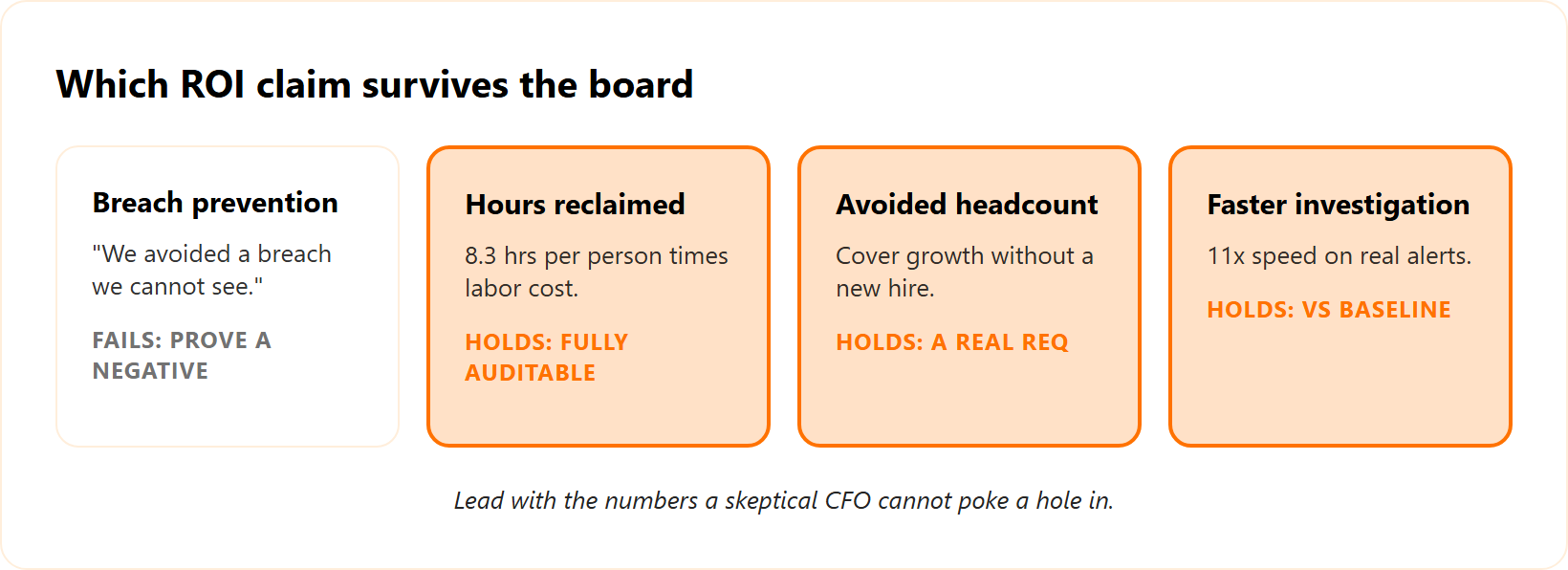
Anchor ROI in operational savings, the work hours your team gets back. With AI handling first-pass investigation, teams reclaim about 8.3 hours per person each day, and investigations run roughly 11x faster. Multiply reclaimed hours by loaded labor cost, and you have a real figure. A simple SOC cost calculator makes that exercise faster.
| ROI approach | What it claims | Why it holds up, or fails |
|---|---|---|
| Breach-prevention math | “We avoided a $4M breach” | Fails, you cannot prove a negative |
| Hours reclaimed | 8.3 hrs/person/day x labor cost | Holds up, every line is auditable |
| Avoided headcount | Cover growth without hiring | Holds up, tied to a real req you did not open |
| Faster investigation | 11x speed on real alerts | Holds up, measured against your baseline |
That operational story has outside backing. The IBM and Ponemon Cost of a Data Breach Report 2025 found organizations using security AI and automation extensively saw materially lower breach costs and shorter breach lifecycles than those that did not. You can cite that as context, then lead with your own hours, anchored to your cybersecurity budget.
The story the board remembers
One number that lands: a customer saved roughly $300,000 in the first three months, because the system surfaced a fraud they had not even been looking for. That was not a prevented breach guess. That was money that did not leave the building, with a trail to show.
Documented deployments have shown returns near 830% over three years, with about 99% noise reduction. Transparent, line-item pricing is what makes that math clean, which is why our MDR pricing stays legible on purpose, so your ROI does not depend on decoding an opaque contract.
My honest caveat: the 830% and the $300K are real deployment outcomes, and your mileage depends on your alert quality and your size. Bring the hours first. They never argue back, and our UnderDefense Agentic AI SOC ROI view surfaces them for you.
Q6. Can AI SOC Automation Fully Replace Human Analysts?
No. A fully autonomous SOC from tier one to tier three remains technically impossible and operationally reckless, because you cannot let software quarantine users at will without oversight. The workable model constrains AI to reasoning and context-gathering, while remediation stays a deterministic, tightly coupled action a human approves. AI manages when an action fits; the action itself is a single, controlled call.
The promised land that does not exist yet
Every few months, someone sells the “lights-out SOC,” fully autonomous, no humans. I have built a lot of this with my own team, and I will say it plainly: a fully autonomous SOC from tier one to tier three is still technically impossible. Anyone telling you otherwise is selling a roadmap, not a product.
The standard hype read gets this backwards. The danger is not that AI is too dumb. The danger is software with the authority to quarantine users at will, acting on a wrong conclusion, at scale, at 3 a.m. These are the kinds of AI SOC red flags worth screening for.
Where I draw the hard line
I describe agents as supremely intelligent teenagers with no fear of consequence. They reason well, and they will occasionally do something genuinely reckless. So you design the system to protect the world from them.
Here is the split I trust:
- AI handles reasoning, context-gathering, and enrichment, the heavy investigation work.
- The remediation action stays a single, deterministic, tightly coupled call.
- A human approves anything that touches a user, an endpoint, or production.
Even the patent literature respects this line. A 2025 USPTO patent for autonomous cyber-security investigation using graphs scopes its autonomy to investigation and analysis, not unsupervised destructive action. The word “autonomous” stops at the investigation boundary, by design. This is the heart of the question of whether AI kills or saves the SOC.
The bias problem nobody markets
There is a deeper reason humans stay. I do not believe an unbiased model exists, and a model with quiet bias making unsupervised quarantine calls is a real operational risk.
That is exactly why we built our MDR service around concierge analyst response. The AI does the grunt reasoning, and our analysts approve the action that matters. I might be wrong on the timeline, but my current read is that the safe autonomy ceiling stays below “fire the response on its own” for years. Smart SOC automation respects that ceiling.
Q7. Can an AI SOC Add Capacity Without Adding Headcount, and How Do You Report It to the Board?
Yes. An AI SOC lets a fixed team cover growing alert volume by handling first-pass investigation, so capacity scales without proportional hiring. With AI triaging around 38% of tier-one alerts and reclaiming 8.3 hours per person daily, analysts shift to higher-value escalation work. Report it to the board in three numbers: hours reclaimed, percentage of alerts AI handles, and the two SLAs (2-minute Alert-to-Triage, 15-minute critical escalation).
Hiring cannot win this race
Alert volume climbs every quarter. Your headcount does not, and the hiring market for skilled analysts is brutal. Throwing bodies at a growing queue is a losing trade, and you feel it on every on-call rotation. This is part of why so many teams weigh outsourced versus in-house SOC models.
The toil does not disappear on its own either. Someone has to pull context, check the host, and write the verdict, over and over. The trick is moving that load off humans, without moving it off the books.
Capacity without a new req
This is where an AI SOC earns its keep. In our environment, AI triages about 38% of tier-one alerts, and the team reclaims roughly 8.3 hours per person each day. That reclaimed time absorbs the volume growth a new hire would have covered, which is one of the clearer benefits of MDR.
I think being a human is a flex in 2026. Your people stop doing copy-paste triage, and start doing the work humans are actually good at:
- Complex escalations the agents cannot close.
- Threat hunting and tuning detections.
- The judgment calls that touch the business.
The agents are the foot soldiers on volume. Your analysts become the generals, directing the work and handling the hard missions. That reallocation is the capacity gain, not a magic headcount cut.
The three-number board update
When you walk into the board room, skip the dashboard tour. Report three things, every time:
- Hours reclaimed per analyst (tie it to labor cost).
- Percentage of alerts AI handles end to end (capacity proof).
- The two SLAs, tracked separately, 2-minute Alert-to-Triage and 15-minute critical escalation.
A single blended “MTTR” hides both SLAs, so keep them split, and treat SLAs in cybersecurity as the board number. Independent work supports the pressure you are managing: the SANS 2025 Detection and Response Survey found excessive false positives remain the top detection challenge for most teams, and a 2025 Cloud Security Alliance benchmark showed AI-assisted analysts working 45 to 61% faster.
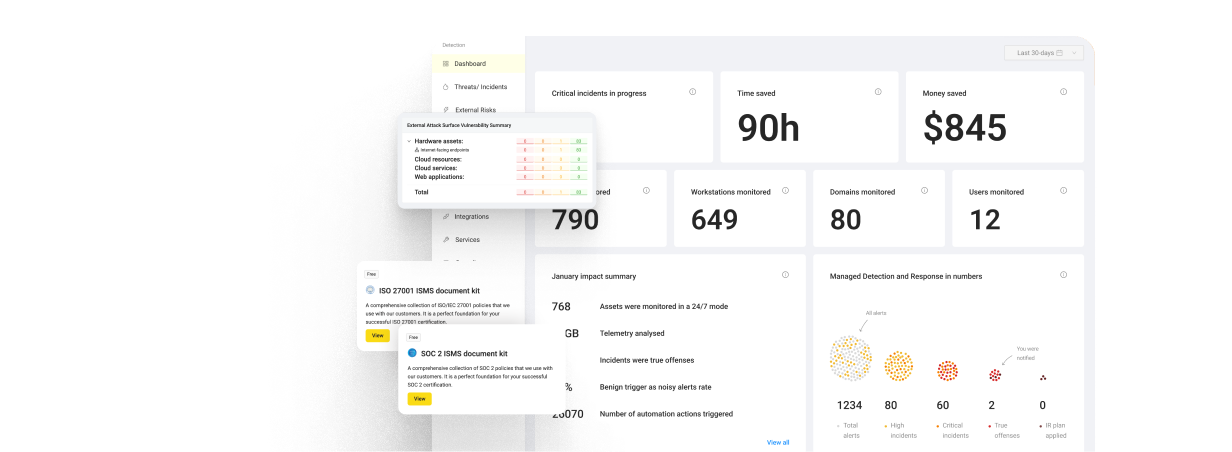
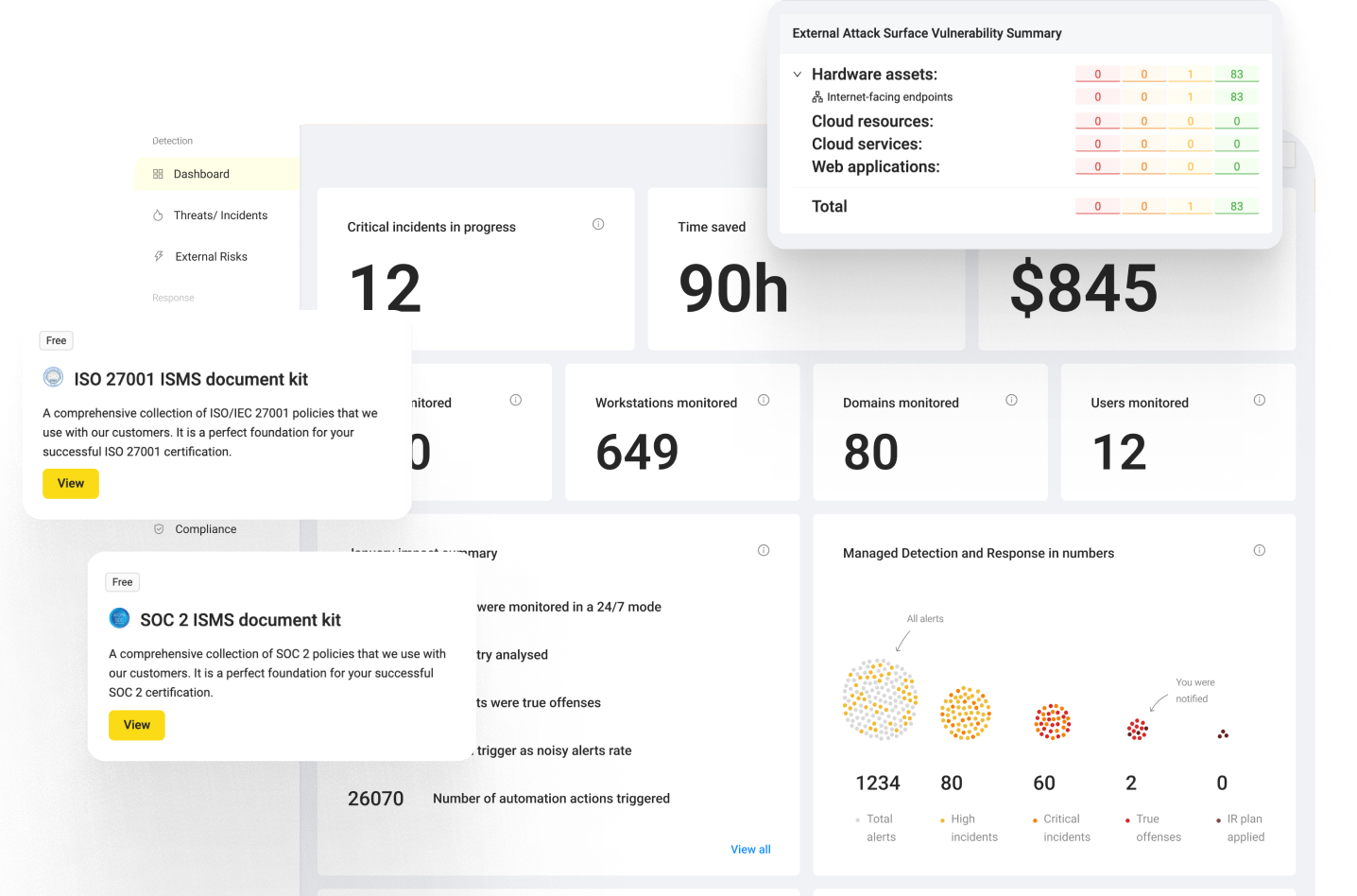
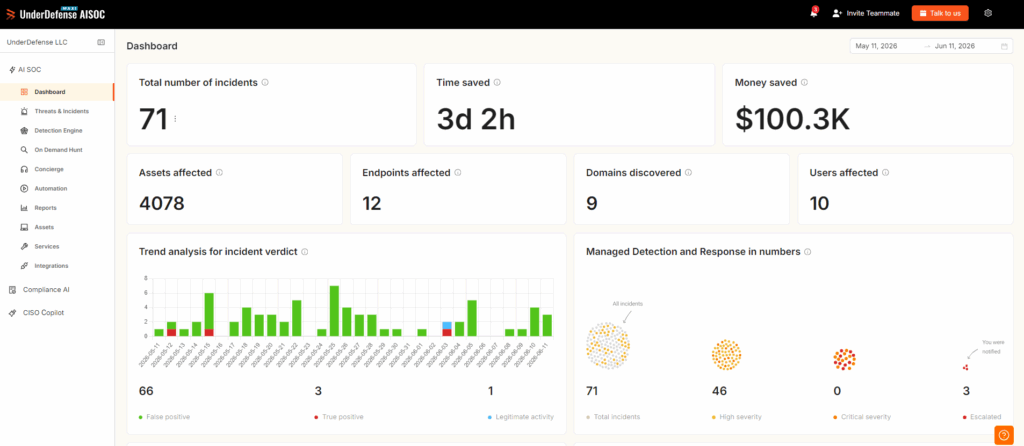
Our UnderDefense Agentic AI SOC platform surfaces hours reclaimed, cost saved, and the false-positive versus true-positive trend in one ROI view, so your board update is three screenshots, not a spreadsheet exercise. My honest note: those percentages move with your alert quality, so baseline first, then report the delta, the same way you would track SOC metrics over time.
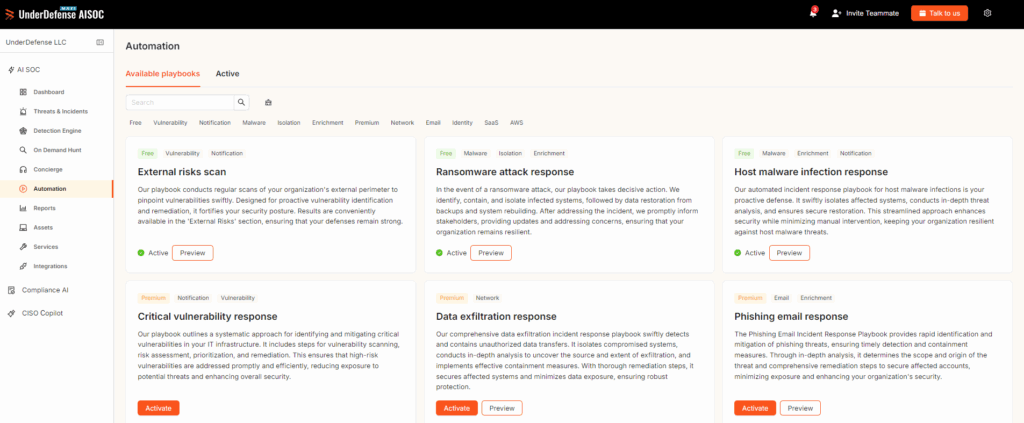
Q8. AI SOC vs. Monitoring-Only Tools and Alert-Dumping MSSPs: What’s the Real Difference?
Monitoring-only tools and legacy MSSPs hand you alerts; an AI SOC plus human ally hands you investigated context and an analyst who responds. The difference is not the technology but the humans operating it around the clock. Point tools add another glass of pain, and alert-dumping MSSPs push triage burden back onto you. A vendor-agnostic AI SOC investigates on top of your existing SIEM and XDR, then acts, without lock-in.
The alert that lands on your desk anyway
Picture the legacy model. A tool fires an alert, an MSSP forwards it with a one-line note, and your lean team still does the real investigation. You bought coverage, and you got a queue. It is one of the bigger reasons businesses switch cybersecurity providers.
Operators say this out loud in reviews. The structural problem is not bad people, but a model that stops at detection, and hands triage and remediation back to you.
“Still not quite there with the remediation side of things. We receive alerts, but not necessarily a clear path to resolution… This is not an extension of our security team as was originally sold.”
Sr. Cybersecurity Engineer, Manufacturing Arctic Wolf Gartner Verified Review
“Over the past few years, we’ve undergone several external penetration tests, and during these assessments, Red Canary was not able to identify the malicious activity while the tests were ongoing.”
Verified User in Insurance, Enterprise Red Canary G2 Verified Review
Investigate, respond, and keep your data
Here is the model I built UnderDefense around. The AI SOC plus human ally investigates first, delivers context, and an analyst responds, instead of forwarding a riddle. The difference is not the technology but the humans operating it around the clock, backed by our SOC service.
| Capability | UnderDefense Agentic AI SOC | Monitoring-only tool | Legacy MSSP |
|---|---|---|---|
| Context delivered | Full investigation, root cause | Raw alert, you enrich | One-line forward |
| Response included | Yes, analyst-approved action | No, detection only | Often “your team handles it” |
| Vendor lock-in | None, runs on your stack | Ties you to one ecosystem | Contract and tooling lock |
| Transparency | Open pricing, auditable verdicts | Varies | Often opaque |
A point tool gives you one more glass of pain to stare at, another console, another login. A vendor-agnostic AI SOC runs on top of your existing SIEM and XDR, so you keep your data and your investment, an approach you can compare against other MDR competitors. The reliance-on-one-tool problem is real, and operators feel it.
“I wish the integrations beyond Crowdstrike were a bit more robust… Red Canary is perhaps too reliant on Crowdstrike and less on our other sources which are important.”
Verified User in Computer Software, Enterprise Red Canary G2 Verified Review
To be fair, these categories have real strengths. A monitoring tool gives clean visibility, and a mature MSSP brings process. My read is that for a 500 to 5,000-person team under deadline, the structural gap is who does the investigation, and who owns the data, and that is where the AI SOC plus human ally model fits best. If you are weighing options, our MDR buyers guide lays out the criteria.
Q9. What Does Implementing an AI SOC Actually Look Like, and What Breaks?
Implementing an AI SOC is harder than the demo looks: investigating one alert can require 100-plus large language model (LLM) calls, and each test case needs running 5 to 15 times to trust a true-positive verdict. Start with a product requirements document for every agent before you build, keep humans heavily in the loop early, and constrain remediation to deterministic actions. The failures are real, an unexpected character in a script has caused full outages.
The demo hides the hard part
The vendor demo shows one clean alert, one clean answer. Reality is messier. For a typical alert, the system can fire over 100 distinct LLM invocations to gather context, reason, and reach a verdict.
I have lived this. Building our own orchestration, I was personally breaking out in hives trying to keep the system from going crazy. The work of making sure it stays sane, every single run, is the real cost nobody puts on a slide.
Test it like it can hurt you
Here is the rule I trust: run each test case 5 to 15 times before you believe its verdict. LLMs are non-deterministic, so one good run proves nothing. You are checking whether it is reliably right, not occasionally right.
The failures bite hard. One unexpected character passed into a script caused a full-on outage in our environment. That is the kind of edge case academic work is now chasing too, where LLM pipelines can cut false positives, while flagging reliability and prompt-robustness as open problems. Screening for these AI SOC red flags early saves you later.
A Monday-morning build order
If you are doing this in-house, here is the order I would follow:
- Write a product requirements document (PRD) for every agent before any code, and define what “done” and “correct” mean.
- Keep humans heavily in the loop early, while you tune prompts and watch behavior.
- Run the 5-to-15-times test on every case, and log the disagreements.
- Constrain remediation to a single, deterministic action a human approves.
- Instrument everything, so a bad run is visible, not silent.
Most lean teams do not have the engineers to babysit 100-plus LLM calls per alert. That is exactly why our SOC service runs this orchestration as a managed service, so your team gets the outcome without building and breaking it first. Thoughtful SOC automation is what separates a working system from a fragile one.
I might be wrong on where the line sits for your org, but my read is that the orchestration tax is steeper than almost anyone budgets for. What surfaces when you actually run this is humbling, in a good way, which is also why our UnderDefense Agentic AI SOC platform exists to absorb that complexity for you.
Q10. How Do AI SOC Results Map to Compliance and Regulatory Timelines?
Faster response is a compliance win as much as an efficiency one. The SEC’s four-business-day 8-K Item 1.05 rule, and GDPR’s 72-hour Article 33 window, mean slow investigation creates regulatory exposure. An AI SOC that cuts time-to-context helps you meet SOC 2, ISO 27001, and HIPAA evidence expectations, and report within statutory windows. Map your two SLAs to your disclosure clocks before an incident forces the math.
Speed is a regulatory metric now
Most teams frame response speed as an efficiency story. The regulators reframed it as a deadline. Once an incident is material, the SEC’s 8-K Item 1.05 rule gives U.S. public companies four business days to disclose.
The clock is even tighter elsewhere. Under GDPR Article 33, a controller must notify the supervisory authority of a personal-data breach within 72 hours of becoming aware. If your investigation takes three days to even establish what happened, you have spent your entire window before you can write a sentence. A clear compliance roadmap keeps that math from surprising you.
Map your SLAs to your disclosure clocks
Here is the connection that matters. A faster time-to-context shortens the gap between “alert fired” and “we know if this is reportable.” That is the difference between calm disclosure and a scramble with lawyers at midnight.
Your frameworks expect the same discipline:
- SOC 2 Type II and ISO/IEC 27001 want documented detection, response, and evidence you can show an auditor.
- HIPAA expects timely breach assessment and notification for protected health data, which matters most for MDR in healthcare.
- NIST SP 800-61 sets the incident-handling baseline auditors lean on.
So track the two SLAs separately, a 2-minute Alert-to-Triage and a 15-minute critical escalation, and line them up against your four-day and 72-hour windows. A single blended “MTTR” hides whether you can actually hit a statutory clock, so treat SLAs in cybersecurity as a disclosure metric. We pair our compliance services (SOC 2, ISO 27001, HIPAA) with concierge response, so the evidence and the timeline hold up together. My current read is that the firms that pre-map this avoid the worst 2 a.m. version of the conversation, and our incident response team has lived enough of those to know.
Q11. Is an AI SOC Right for Your Organization?
An AI SOC fits you if your team is buried in investigation toil, your detections are decent, and you need enterprise-grade response without enterprise headcount. It suits scaling tech firms, mid-market enterprises, healthcare, and PE portfolio companies unifying fragmented stacks. It will not fix weak detections, so address those first. If you can baseline your investigation time and false-positive load today, you are ready to test.
Where it fits, and where it does not
Time is the currency of the cloud. Companies rise fast, and they fall fast, and a slow security team taxes everything. An AI SOC pays off when your people spend their days on investigation toil they will never finish by hand.
Run yourself against this quick rubric:
- Good fit: lean team, growing alert volume, decent detections, fragmented SIEM and EDR you want unified, and real compliance pressure.
- Strong fit: scaling tech firms, mid-market enterprises, healthcare, and PE portfolio companies standardizing security across acquisitions.
- Not yet: your detections are noisy or shallow, fix those first, because faster investigation on bad signals just gets you to the wrong answer quicker.
That last point is the honest gate. I will tell a prospect to delay if their alerts are weak, because no AI saves a broken detection layer. Weighing outsourced versus in-house SOC options early helps you decide where that work belongs.
See how UnderDefense Agentic AI SOC resolves a real incident on your stack.
A human invitation, not a hard sell
The reassuring part is what teams say after they cross that line. The pattern in reviews is steady, more control, less noise, and real response.
“The platform itself is straightforward, it pulls in data from all our existing security tools, so we didn’t have to rip and replace anything… We needed round-the-clock monitoring for compliance reasons, but building our own SOC wasn’t realistic with our budget and the current hiring market. UnderDefense fills that gap without us having to hire a full team.”
Verified User in Marketing and Advertising, Small-Business UnderDefense G2 Verified Review
“It’s reassuring to know they’re always watching for threats, and it doesn’t cost a fortune… The platform works really well with our other security tools, which makes things much simpler.”
Serhii B., Chief Information Security Officer UnderDefense G2 Verified Review
“UnderDefense Agentic AI SOC integrates well with our systems, specifically with our SIEM, Splunk… Their adherence to SLAs gives me confidence in our infrastructure’s protection.”
Oleg K., Director of Information Security UnderDefense G2 Verified Review
Being a human is a flex in 2026. The goal is to put your people on the work that needs judgment, and let the agents carry the toil, on top of the stack you already own through our MDR service. If you can baseline your investigation time and false-positive load this week, that is the real start of the conversation, and our MDR buyers guide gives you the criteria to bring to it.
1. What measurable results should we expect from an AI SOC deployment?
We measure first, then claim, so here is what held up in real deployments rather than slide-deck promises.
- Full investigations dropped from hours to roughly 7 to 8 minutes, with all tools engaged.
- Teams reclaimed about 8.3 hours per person each day on enrichment work.
- Mean time to investigate ran roughly 11x faster against a human baseline.
- Noise reduction reached near 99% in documented cases.
An independent 2025 Cloud Security Alliance benchmark of 148 professionals found AI-assisted analysts completed investigations 45 to 61% faster, with 22 to 29% better accuracy, so speed and coverage moved together.
Our honest caveat is that AI speeds up good detections, and it speeds up being wrong on weak ones. If you are drowning in false positives, a faster engine on a bad map just gets you lost quicker. That is why we baseline your false-positive load before claiming any improvement. To see how we frame these numbers, review the metrics worth tracking, then map them to your own environment with our SOC service before you commit budget.
2. How do we calculate AI SOC ROI in a way the board will accept?
We tell CISOs to drop the breach-prevention pitch, because you cannot prove a negative with a straight face, and a smart CFO pokes a hole in it.
Instead, we anchor ROI in numbers you can audit on a screen:
- Hours reclaimed, about 8.3 per person daily, multiplied by loaded labor cost.
- Avoided headcount, tied to a real requisition you did not open.
- Faster investigation, roughly 11x, measured against your own baseline.
One story that lands: a customer saved roughly $300,000 in the first three months because the system surfaced a fraud they were not even looking for. Documented deployments have shown returns near 830% over three years.
The IBM and Ponemon Cost of a Data Breach Report 2025 found organizations using security AI and automation extensively saw materially lower breach costs, which you can cite as context after leading with your own hours. Transparent, line-item pricing keeps that math clean, so your ROI does not depend on decoding an opaque contract. Run the exercise with our SOC cost calculator, then sanity-check it against our MDR pricing.
3. Can you share a real AI SOC case study with before-and-after numbers?
We can, and the most useful one came from a customer who decided to test us without trusting us, which is exactly the right instinct.
They ran a two-week bake-off, sending 12,000 investigations through our system behind a black box on one side, and their seasoned human SOC team on the other. Same alerts, no partial credit.
- The result was 99.3% agreement between their team and our system.
- On mean time to investigate, we were 11x faster.
That is parity on judgment with a large gap on speed, not a faster way to be wrong. Elsewhere, full investigations fell to 7 to 8 minutes, and one customer reclaimed 8.3 hours per person daily.
The stakes are real: median break-in time has dropped to around 48 minutes, and the fastest we have seen is roughly 51 seconds. We run this kind of AI SOC on top of your existing SIEM or XDR through our MDR service, so you keep your data and tools. For more documented outcomes, our MTTR reduction case study shows the same pattern in production.
4. Which AI SOC metrics actually matter, and how do we measure them?
We measure the work, not the wallpaper, because a prettier dashboard changes nothing if you are still buried in false positives.
The metrics that prove an AI SOC works are tied to investigation:
- Mean time to detect (MTTD) and mean time to investigate (MTTI).
- False-positive load, your alerts closed as benign over a month.
- Percentage of tier-one alerts AI triages end to end.
- Analyst hours reclaimed per person.
We also split two SLAs that buyers often blend: a 2-minute Alert-to-Triage SLA, and a 15-minute escalation SLA for critical incidents. A single blended MTTR hides whether your serious threats actually move fast, so we track them separately.
The SANS 2025 Detection and Response work found excessive false positives remain the top detection challenge for most teams, so baseline that load in your own shop before you trust any after number. We treat SLAs in cybersecurity as a board-level number, and our UnderDefense MAXI platform surfaces hours reclaimed and the false-positive trend in one view.
5. Can AI SOC automation fully replace our human analysts?
No, and we say that as a team that has built a lot of this ourselves. A fully autonomous SOC from tier one to tier three is still technically impossible, and anyone telling you otherwise is selling a roadmap, not a product.
The danger is not that AI is too dumb. The danger is software with authority to quarantine users at will, acting on a wrong conclusion, at scale, at 3 a.m. So we draw a hard line:
- AI handles reasoning, context-gathering, and enrichment, the heavy investigation work.
- The remediation action stays a single, deterministic, tightly coupled call.
- A human approves anything that touches a user, an endpoint, or production.
We describe agents as supremely intelligent teenagers with no fear of consequence; they reason well, and they will occasionally do something reckless. We also do not believe a fully unbiased model exists, which makes unsupervised quarantine calls a real operational risk.
That is why we built our MDR service around concierge analyst response, where the AI does the grunt reasoning and our analysts approve the action that matters. For more, see whether AI kills or saves your SOC team.
6. How does an AI SOC add capacity without adding headcount?
Alert volume climbs every quarter, your headcount does not, and the hiring market for skilled analysts is brutal, so throwing bodies at a growing queue is a losing trade.
An AI SOC moves that load off humans without moving it off the books. In our environment, AI triages about 38% of tier-one alerts, and the team reclaims roughly 8.3 hours per person each day. That reclaimed time absorbs the volume growth a new hire would have covered.
Your people stop doing copy-paste triage and start doing the work humans are actually good at:
- Complex escalations the agents cannot close.
- Threat hunting and tuning detections.
- Judgment calls that touch the business.
When you update the board, skip the dashboard tour and report three things: hours reclaimed per analyst, percentage of alerts AI handles end to end, and the two SLAs tracked separately. The 2025 Cloud Security Alliance benchmark showed AI-assisted analysts working 45 to 61% faster, which backs the capacity story. This reallocation is one of the clearer benefits of MDR, and it is why teams weigh outsourced versus in-house SOC models.
7. How is an AI SOC different from a monitoring tool or an alert-dumping MSSP?
Monitoring-only tools and legacy MSSPs hand you alerts; an AI SOC plus human ally hands you investigated context and an analyst who responds. The difference is not the technology but the humans operating it around the clock.
In the legacy model, a tool fires an alert, an MSSP forwards it with a one-line note, and your lean team still does the real investigation. You bought coverage, and you got a queue.
- A point tool gives you one more glass of pain to stare at, another console, another login.
- An alert-dumping MSSP pushes triage and remediation burden back onto you.
- A vendor-agnostic AI SOC investigates on top of your existing SIEM and XDR, then acts, without lock-in.
To be fair, these categories have real strengths; a monitoring tool gives clean visibility, and a mature MSSP brings process. For a 500 to 5,000-person team under deadline, though, the structural gap is who does the investigation, and who owns the data. That is the model we built UnderDefense around, backed by our SOC service. If you are comparing options, our MDR buyers guide lays out the criteria.
8. Is an AI SOC right for our organization, and how do we know we are ready?
An AI SOC fits you if your team is buried in investigation toil, your detections are decent, and you need enterprise-grade response without enterprise headcount.
Run yourself against this quick rubric:
- Good fit: lean team, growing alert volume, decent detections, fragmented SIEM and EDR you want unified, and real compliance pressure.
- Strong fit: scaling tech firms, mid-market enterprises, healthcare, and PE portfolio companies standardizing security across acquisitions.
- Not yet: noisy or shallow detections, because faster investigation on bad signals just gets you to the wrong answer quicker.
That last point is the honest gate. We will tell a prospect to delay if their alerts are weak, since no AI saves a broken detection layer. Faster response is also a compliance win, helping you meet the SEC four-business-day 8-K rule and GDPR’s 72-hour window, so map your two SLAs to your disclosure clocks before an incident forces the math.
If you can baseline your investigation time and false-positive load this week, that is the real start of the conversation. Bring those numbers, and our MDR service will run on top of the stack you already own.