




Q1. What should a cybersecurity budget actually cost in 2027 (and is the 13% benchmark a trap)?
Most organizations spend roughly 13% of their IT budget on security in 2027, up from 8.6% in 2020, or about 0.7% of revenue. Regulated sectors push toward 10 to 15%. Treat that number as a starting line, not a goal. The sharper question is whether each dollar measurably reduces the probability of material impact from a cyber event over the next three years.
See how the UnderDefense Agentic AI SOC investigates, triages, and resolves real alerts.
The benchmark everyone quotes, and why it lies
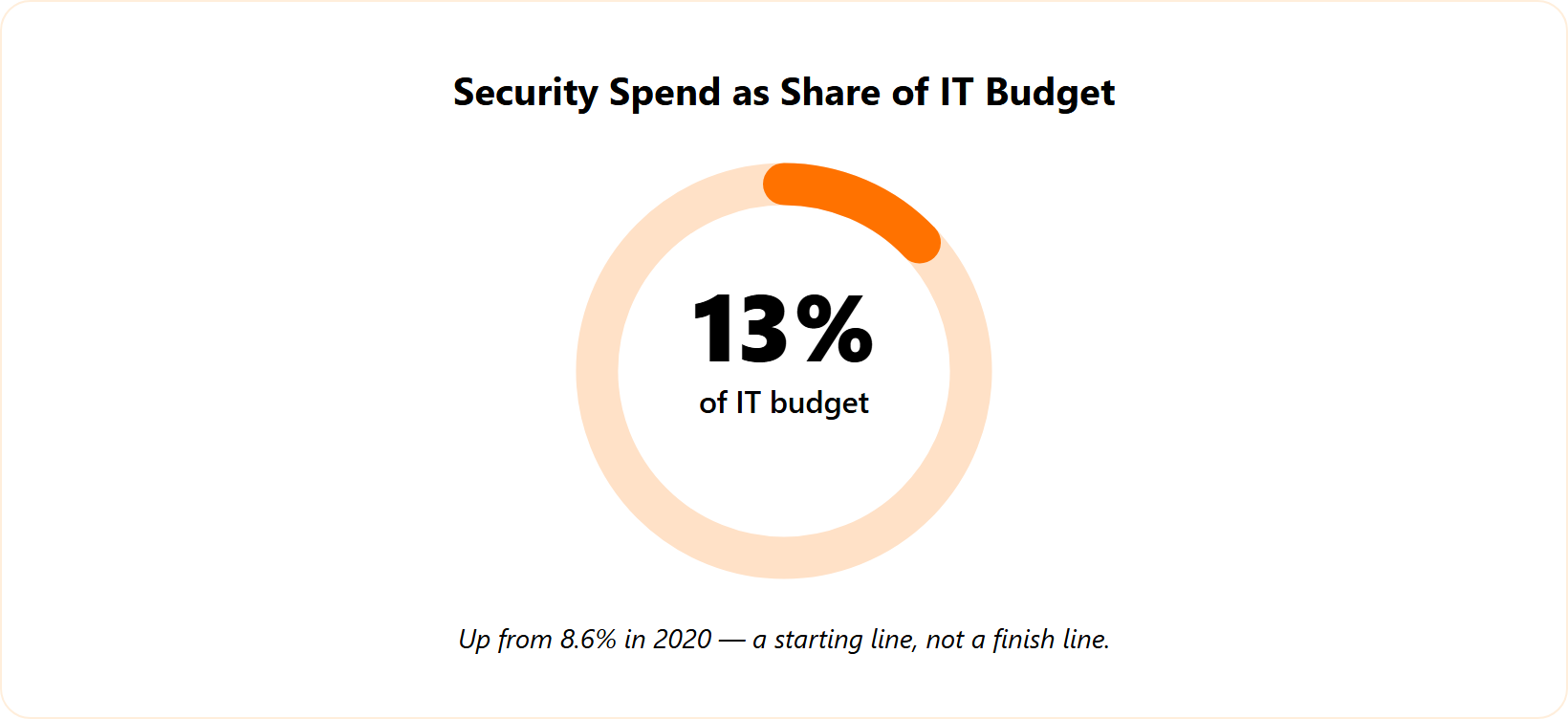
Every budget season, someone walks into the room holding the 13% figure like a verdict. The IANS Security Budget Benchmark shows security spend climbing from 8.6% of IT budget in 2020 to 13.2% by 2024.
That climb matters more than the headline. If the benchmark keeps rising and your budget stays flat, your budget is shrinking in real terms. A flat number reads as a cut.
What the macro picture tells you
Gartner projects global security and risk spending near $244 billion in 2026, one of the largest single-year jumps on record, pushed hard by the scramble to govern AI systems. So the pressure on your number is real and external.
If you want to pressure-test the math early, our 2026 cybersecurity budget playbook walks through the same modeling we use with clients.
Why the percentage stops being useful
Here is where I might be wrong, but my read after sitting on every side of this is firm. The average team manages around 76 security tools. A bigger percentage spent on a 77th tool nobody operates does not lower your risk.
The benchmark answers “how much,” and ignores “where” and “who runs it.” That gap is where money quietly dies.
Reframe the number before you defend it
The phrase I keep coming back to is simple. Your job is to reduce the probability of material impact due to a cyber event over the next three years. That sentence survives a board meeting in a way that “we hit 13%” never will.
At UnderDefense, we frame budgets around that material-impact question first, then size the spend. The number follows the risk, never the other way around, and our virtual CISO team helps leaders defend that logic.
Q2. How do you build a security budget that survives a CFO interrogation?
Build the budget around quantified financial exposure rather than “cost of downtime” math a CFO can argue down to zero. Map your dollars to NIST Cybersecurity Framework risk families on a single page to expose blind spots. Translate cyber risk into financial terms the board understands, and avoid trying to prove a breach you prevented. Lead with exposure reduced.
The room where budgets die
Picture the scene. The board is fatigued. Members are openly questioning whether the security capital is distributed well, and the CISO answers with a wall of technical metrics nobody in the room cares about or follows.
That meeting goes badly every time. The fix is not better slides. The fix is speaking in the one language the table shares, which is money.
Two traps to walk away from
Two popular playbooks quietly fail under CFO pressure. I have watched both collapse in real rooms.
- Breach-prevention ROI. Proving a negative is close to impossible. If I had no breach this year, I cannot cleanly point to the one control that prevented it, so I generally avoid that claim entirely.
- Cost of downtime. This number almost always gets argued down to nothing. The CFO asks whether revenue really dropped, and “maybe” loses the argument.
Lead with either trap, and you hand the CFO the win.
The reframe that actually holds
Here is the move that works. Open NIST CSF 2.0, list the risk families, and allocate your budget dollars into those families on one page. That single visual is genuinely enlightening.
You might discover you spend zero in any proactive capacity. That is a finding a CFO understands instantly, because it looks like an uninsured line on a balance sheet. Reviewing your security stack guide against that one-pager surfaces the same gaps.
Translate risk into exposure
The leaders breaking through right now translate cyber risk into financial exposure, then show how each dollar shrinks it. IBM’s 2025 Cost of a Data Breach report gives you a clean anchor: organizations using AI and automation extensively saved about $1.9 million per breach.
Your Monday action is small and concrete. Build the one-page NIST allocation, mark the empty families, and walk in with exposure reduced as your headline. Teams sizing this for the first time often start with our cybersecurity budget for mid-market firms breakdown.
Q3. How should you allocate the 2027 budget across detection, response, compliance, and people?
A workable 2027 split keeps roughly 70% for core operations and reserves 30% for emerging threats and innovation. The allocation that fails most often funds tools before the people to run them. Before you add any platform, audit existing entitlements, since much may already sit inside a license you own, and fund the analysts who will actually operate what you buy.
Start with a defensible split
The 70/30 split gives you a starting frame. Seventy percent holds the lights on, and thirty percent funds what is coming next. Adjust it to your risk families from the prior section, but start there so the conversation has a shape.
The split is the easy part. The hard part is what you fund inside it. The classic mistake shows up clearly in the outsourced vs in-house SOC decision.
The Ferrari problem
I once inherited a program where my predecessor had purchased every cybersecurity toy on the market. All the bells and whistles were there. The catch was that he ran out of money buying tools before he hired the people to manage them.
So I had a rookie team trying to run a fleet of Ferraris. Those engines mostly sat idle. The lesson stuck with me: a tool nobody operates is not a control, but a liability with a license fee.
| Coverage Metric | Reported Value |
|---|---|
| Endpoints monitored | 1,499 |
| Identities covered | 1,529 of 3,000 |
| Risky assets | 277 |
| Risky users | 1,192 |
| MFA-missing accounts | 8 |
People cost more than the dashboard
Run the math before you sign anything. With a 30% internal overhead load, a single loaded SOC analyst position runs about $124,163 a year. Five analysts land near $620,815 a year, and that was in 2017 dollars.
If you want to model your own numbers, the SOC cost calculator makes the staffing math concrete.
Free budget you already have
Before funding new headcount or tools, find the money hiding in plain sight.
- Audit your E5 entitlements. Microsoft bundles a large security portfolio into E5. Some of what you are about to buy separately may already be paid for.
- Run a free shadow-IT sweep. As a Google admin, you can see every site where staff authenticated through OAuth consent. That list becomes a rich map of vendors in your environment you never knew about.
At UnderDefense, our vendor-agnostic MDR service operates the tools you already own rather than forcing a rip-and-replace. The cheapest control is often the one already sitting in your license.
Q4. In-house SOC vs MDR vs AI SOC: what does each 24/7 monitoring option actually cost?
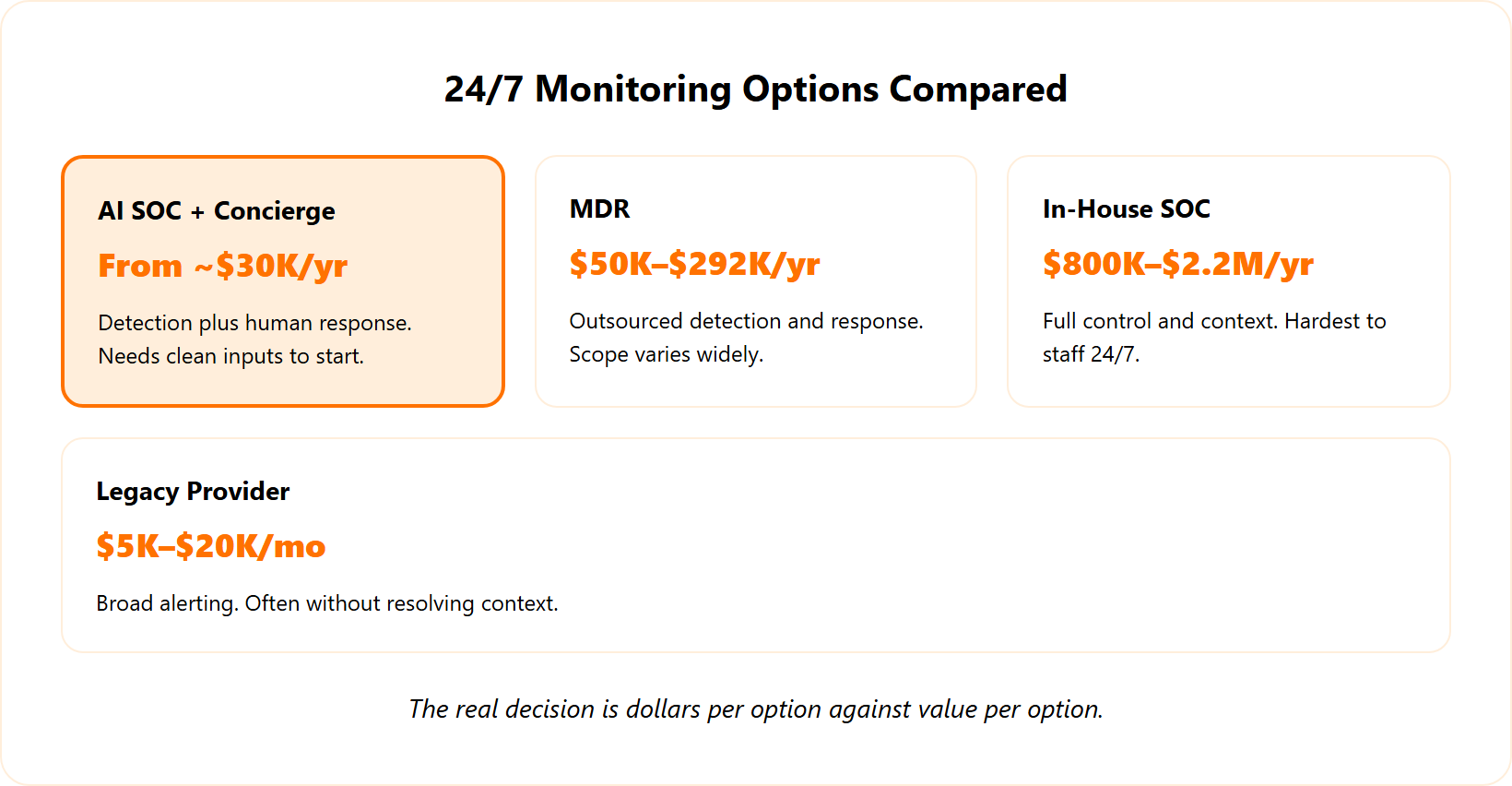
A 24/7 in-house SOC runs roughly $800K to $2.2M per year. Managed detection and response typically lands at $50K to $292K a year, about $3 to $25 per endpoint monthly. Legacy managed security provider packages run $5K to $20K a month at the enterprise tier. An AI SOC platform can start near $30K a year. The real decision is dollars-per-option against value-per-option.
The question every CISO actually asks
A CISO said it to me plainly on a planning call. “I need to do something. It is irresponsible not to monitor 24/7. So of my options, what are the dollars for each, and what value do I get from each?”
That is the right question. Here is the honest cost map.
| Option | Typical 2027 Cost | What You Get | The Structural Trade-Off |
|---|---|---|---|
| Agentic AI SOC plus concierge analysts | From ~$30K/year | Detection, context, and human-led response | Requires clean detection inputs to start |
| Managed detection and response | $50K to $292K/year | Outsourced detection and response | Varies widely by scope and active response |
| In-house SOC | $800K to $2.2M/year | Full control and context | Highest cost; hardest to staff 24/7 |
| Legacy managed security provider | $5K to $20K/month | Broad monitoring and alerting | Often alerts without resolving context |
The 24/7 math nobody escapes
The scoreboard does not look good when you do the time math. If your team works 9 to 5 and the attacker works 24/7, you are going to get your butts kicked. That gap is the entire reason this market exists.
Building your own 24/7 coverage means roughly five loaded analysts before tooling, which puts you back at the $620K-plus figure from the prior section. The continuous security monitoring comparison spells out why coverage gaps cost so much.
Where alert-only coverage leaves you
Broad monitoring often sends an alert and stops there. You still own the grunt work of figuring out what happened, which defeats the point of outsourcing.
“Before the guys from UD stepped in, we were getting bombarded with alerts from all our security tools. Their team cleaned up our configurations and got the noise under control within the first week. When they escalate something, they include the context we need to understand the issue quickly.”
Verified User in Marketing and Advertising, Small-Business UnderDefense Agentic AI SOC G2 Verified Review
The reallocation lever most teams miss
Here is the crossover worth modeling. An AI SOC can start near $30K a year and cut a large share of alert waste, while an enterprise legacy provider contract runs into six figures. Industry analysis pegs AI-SOC platforms at roughly 40% less alert waste.
| Metric | Reported Value |
|---|---|
| Incidents handled | 71 |
| Analyst time saved | 3 days 2 hours |
| Cost saved | $100.3K |
For us, the value shows up as measurable returns. Our customers see strong noise reduction and a clear return over three years, with a 2-minute Alert-to-Triage and a 15-minute escalation for critical incidents as the operating SLAs on the UnderDefense Agentic AI SOC platform.
“UnderDefense is surprisingly affordable considering the level of protection we get. Their proactive threat hunting and rapid response have saved us from incidents that could have been incredibly costly.”
Verified User in Program Development, Mid-Market UnderDefense Agentic AI SOC G2 Verified Review
“Its reassuring to know they’re always watching for threats, and it doesn’t cost a fortune. They catch and stop problems quickly, which is a huge relief.”
Serhii B., Chief Information Security Officer, Mid-Market UnderDefense Agentic AI SOC G2 Verified Review
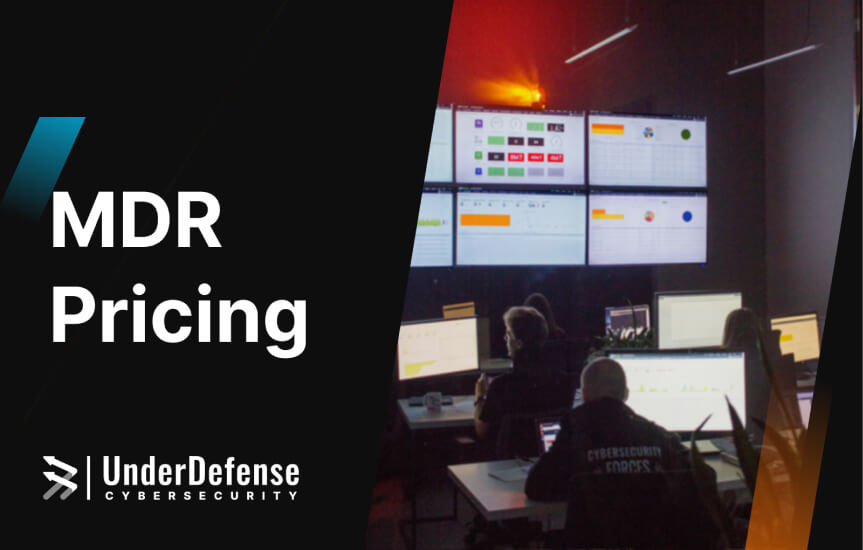
The best fit depends on size and constraints. Lean teams under real compliance pressure usually win with an AI SOC plus concierge response. Large regulated enterprises with deep budgets may still justify an in-house build, and our MDR pricing page lays out the numbers transparently.
Q5. What is an “AI SOC,” and why is it a maturity model rather than a product you can buy?
An AI SOC is a maturity model with painful prerequisites, not a product you switch on. Weak detections cause AI to amplify noise rather than remove it. AI collects context at machine speed, and humans decide. Recent patents for LLM-driven and neuro-symbolic alert investigation show the capability is real, but budget first for clean detection engineering and data hygiene.
The pitch that sets off my alarm
Every week a vendor tells a CISO that AI fixes the SOC. I have learned to distrust that sentence. An AI SOC is closer to a maturity model with a lot of painful prerequisites than a box you plug in.
The prerequisites are where the money goes. Data hygiene, log coverage, and tuned detections come first. Skip them, and the AI just runs faster in the wrong direction. If you are weighing the hype, our take on whether AI kills or saves your SOC team walks through the same reasoning.
The twist nobody on the demo mentions
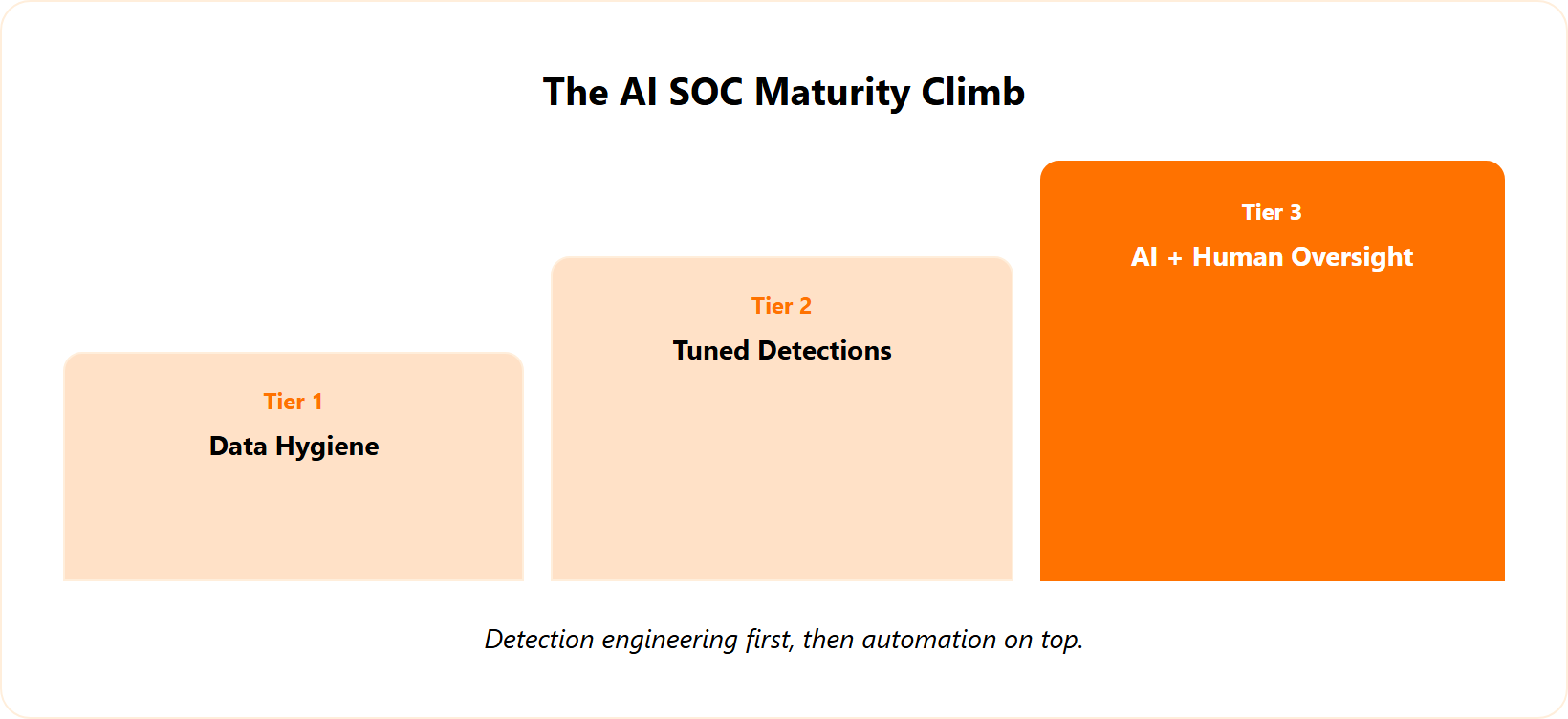
Here is the part the slick demo skips. If your alerts are bad, AI is not going to save you. It will confidently triage garbage and hand you garbage at scale.
So the honest order is detection engineering first, then automation on top. That sequence is unglamorous, and it is the whole game. We flag the warning signs in our list of AI SOC red flags.
| Detection Capability | What It Covers |
|---|---|
| Pre-built detection rules | Mapped to MITRE ATT&CK tactics |
| Technique coverage | Reconnaissance, Initial Access, Lateral Movement |
| Technique IDs | T1071, T1105 with enable toggles |
The capability is real, and it is heavy
I do not want to sound like a skeptic who thinks this is vapor. It is not. When you actually run this, investigating a single alert can take over 100 distinct large language model calls to gather context autonomously.
The patent record backs the category up. There are now granted and published filings for LLM-driven incident investigation and reporting and for neuro-symbolic alert investigation. Machine-learning alert triage has its own patent lineage too. This is engineering, not a press release.
How I frame the division of labor
My rule is simple. AI collects context, and you decide. Think of the agents as your foot soldiers and your human engineers and analysts as the generals.
At UnderDefense, we built the UnderDefense Agentic AI SOC platform around that exact stance, as analyst augmentation rather than analyst replacement. AI is whatever machines have not done yet, and the judgment call stays human. Being a human is a flex in 2026. To see how that judgment plugs into existing tooling, review our UnderDefense Agentic AI SOC integrations.
Q6. Can you trust a fully autonomous SOC, or do you still need humans in the loop?
A fully autonomous SOC remains technically out of reach in 2027. No software safely replaces tier-one through tier-three without human oversight, especially when actions like quarantining users or stopping instances carry real-world blast radius. Some platforms automate level-two alert closure and sub-minute containment, but the responsible budget funds humans who command the automation.
The honest answer is “not yet”
I will say the quiet part plainly. It is still technically impossible to run a fully autonomous SOC. The claim is unrealistic in both technology readiness and the real-world consequences of software quarantining users with no human in the loop.
Picture a piece of software locking out your CFO at 2 a.m. on a bad inference. The blast radius of a wrong autonomous action is the reason humans stay in command. Our breakdown of SOC automation covers where the gates belong.
Giving the other side its due
I want to be fair, because the other side has real wins. Strong platforms now automate level-two alert closure, and some can stop a compromised EC2 cloud instance in under a minute. That speed is genuine and valuable.
So the line is not “automation bad.” The line is which actions earn autonomy and which need a human gate. A dedicated SOC service exists precisely to make that call.
| Playbook Category | Response Type |
|---|---|
| Ransomware | Pre-built containment workflow, tiered |
| Phishing email | Pre-built response workflow, tiered |
| Host malware | Pre-built response workflow, tiered |
| Data exfiltration | Pre-built response workflow, tiered |
| Critical vulnerability | Pre-built response workflow, tiered |
Treat your agents like talented teenagers
Here is the analogy I keep using. Agents are like teenagers, supremely intelligent with no fear of consequence. You give them real responsibility, and you also keep the car keys on a hook.
The clean way to think about it is action control versus access control. Patents for ML-based triage and likelihood assessment show how vendors gate confidence before acting. Your Monday action is to define which response actions auto-execute and which wait for human approval. At UnderDefense, our concierge analysts and incident response team play the generals directing those automated foot soldiers.
Q7. Where does AI triage and detection engineering pay back the budget you spend on it?
Roughly 25 to 30% of alerts go uninvestigated, and analysts spend about 70% of their time on false positives, so spending more on headcount alone rarely fixes the queue. The payback comes from funding detection engineering and AI-driven contextual triage that reduce the investigation grunt work, freeing analysts for the threats that carry material impact.
The queue nobody finishes
Let me show you where the money leaks. Detection-engineering field data shows about 25 to 30% of alerts never get investigated, and analysts burn roughly 70% of their time on false positives. Some teams face up to 10,000 alerts a day, and analyst accuracy drops around 40% after twelve hours on shift.
Throwing bodies at that queue is expensive and slow. The hiring market makes it slower still, which is one reason teams revisit the outsourced versus in-house SOC question.
| Detected Threat | Triage Attribute |
|---|---|
| VPN logins from unapproved locations | Severity, source, asset, status, assignee |
| M365 impossible travel | Severity, source, asset, status, assignee |
| Suspicious workspace logins | Severity, source, asset, status, assignee |
Where the spend actually pays back
The fix is funding detection engineering and contextual triage, not just headcount. Research on federated, explainable alert prioritization shows AI can rank alerts by context and plug into your existing SIEM and SOAR rather than adding another standalone tool.
There is a 2027 capacity signal worth pricing in too. Every AI agent generates around 450% more traffic than a human, so the demand on triage is climbing fast. Budget for that wave now, and lean on our managed SIEM approach to keep data ownership in your hands.
What the reallocation looks like
“Before UnderDefense Agentic AI SOC, we were slightly overwhelmed with alerts and often unsure of how to prioritize or respond to them. Now, not only do we get alerts, but we also get clear guidance on how to handle them.”
Valeriia D., Marketing Specialist UnderDefense Agentic AI SOC G2 Verified Review
“Their team cleaned up our configurations and got the noise under control within the first week. When they escalate something, they include the context we need to understand the issue quickly.”
Verified User in Marketing and Advertising UnderDefense Agentic AI SOC G2 Verified Review
Reallocate part of your headcount budget toward detection engineering and AI triage. With the UnderDefense Agentic AI SOC platform, that shows up as a 2-minute Alert-to-Triage and a 15-minute escalation for critical incidents, so the grunt work shrinks and your people chase what matters.
Q8. How much should you budget for compliance automation in 2027, and where does it pay for itself?
A single automated SOC 2 program saves roughly $60K to $80K a year versus manual evidence collection, and running SOC 2, ISO 27001, and HIPAA together costs 30 to 60% less than separately. Budget compliance automation as a self-funding line, since the reclaimed audit-prep hours can finance the detection and response upgrade you actually need.
The math that flips compliance from cost to funding
Most teams file compliance under “tax.” I see it as a funding source. A single automated SOC 2 program saves about $60K to $80K a year over manual evidence collection.
Run frameworks together, and the savings compound. Mapping SOC 2, ISO 27001, and HIPAA on shared controls costs 30 to 60% less than running each one alone. One control, mapped once, satisfies several auditors, as our compliance roadmap lays out.
New 2027 cost lines you cannot skip
Two regulatory deadlines belong as their own budget lines this year.
- SEC disclosure readiness. Public companies must disclose a material cyber incident on Form 8-K Item 1.05 within four business days. Fund a materiality-assessment and disclosure workflow before you need it.
- Multi-framework evidence. Build dual-mapped controls once so each new customer or regulator request reuses the same audit-ready evidence.
The goal here is verifiable evidence, and auditors increasingly want proof over policy documents. For EU-regulated firms, our EU Cyber Resilience Act guide maps the 2027 deadlines.
Why co-managed visibility pays beyond the audit
“They’ve also made our audit process much less painful. The reports from their platform give us clear evidence of our security controls and incident response capabilities. When auditors or clients ask questions about our security posture, we can pull up exactly what they need to see.”
Verified User in Marketing and Advertising UnderDefense Agentic AI SOC G2 Verified Review
“Their vCISO team was amazing in supporting us with ISO 27001. The 30-day impact reports transformed our understanding of security posture.”
Val R., Small-Business UnderDefense Agentic AI SOC G2 Verified Review
Here is the kicker from real engagements. Continuous visibility once helped a customer save 300,000 dollars in the first three months, because the monitoring accidentally surfaced a fraud nobody was looking for. Our compliance services team builds that audit-ready evidence as a byproduct of monitoring, so the line pays for itself and then some. If you need a strategic owner for the program, our virtual CISO advisory carries it from policy to proof.
Q9. What should you ask every MDR and AI SOC vendor before you sign in 2027?
Ask three things before signing. Will you log in to our SIEM or XDR, or must we ship data to your platform? If we terminate, do all correlation rules, integrations, and detection logic stay with us? And can you show transparent, itemized pricing? Vendors who hold your detection logic hostage or hide pricing are selling lock-in.
The questions that reveal the real deal
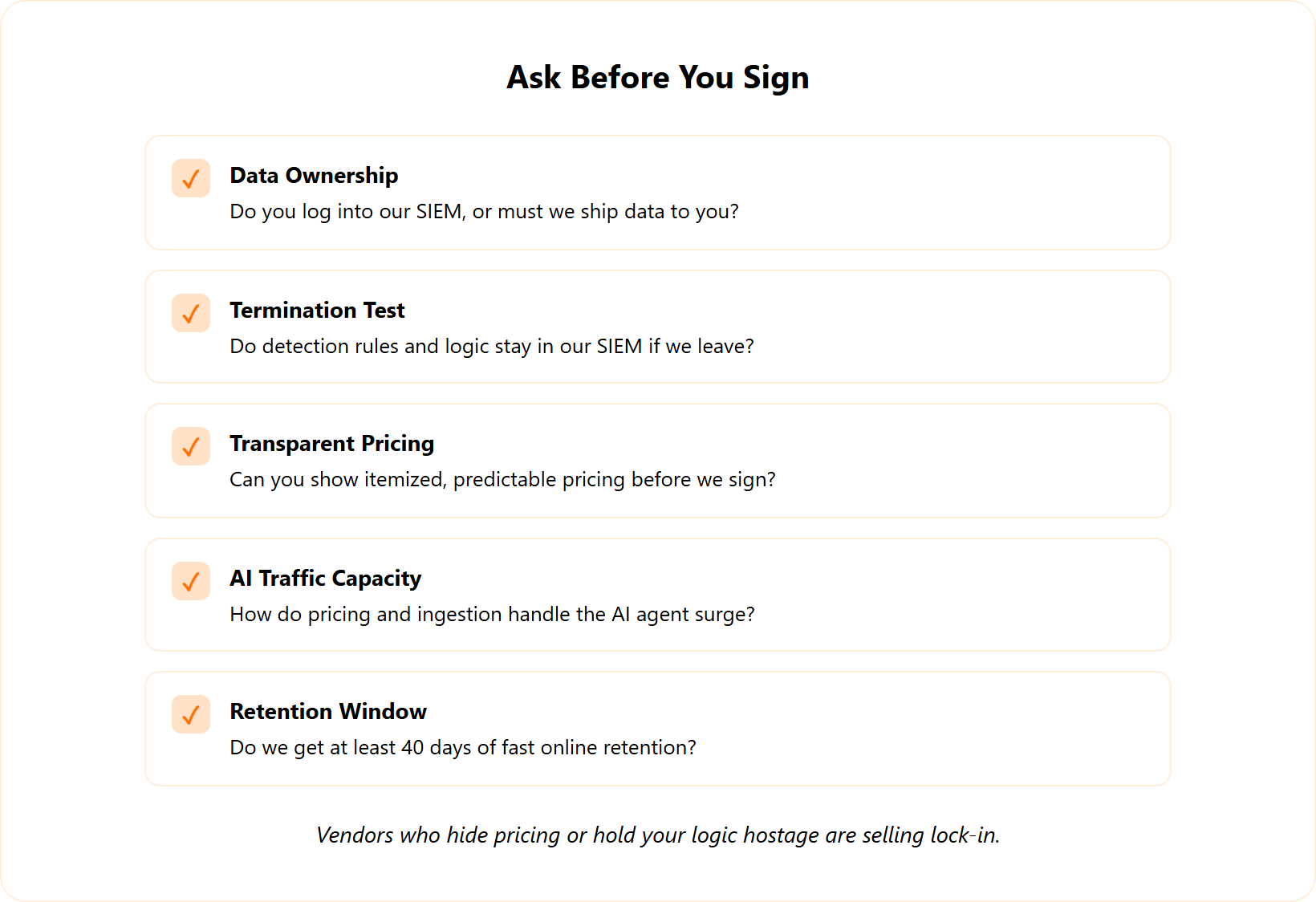
I have sat on both sides of these contracts. The polished demo rarely tells you what happens when the relationship ends. These five questions surface that fast.
Paste them straight into your RFP and watch how the room reacts. If you want a structured starting point, our MDR buyers guide covers the same ground.
- Data ownership. Will you log in to our SIEM (security information and event management system) and XDR (extended detection and response), or do you require us to forward data to your platform? Owning your data keeps your options open.
- The termination test. If we terminate, do all correlation rules, integrations, and detection logic remain in our SIEM? This single question separates partners from captors.
- Transparent pricing. Can you show itemized, predictable pricing before we sign? Opaque contracts tend to grow at renewal.
The questions vendors hope you skip
Two more questions matter for 2027 specifically, and most buyers forget them. They map directly to the criteria in our guide on how to choose a SIEM.
- Capacity for the AI wave. Each AI agent generates around 450% more traffic than a human, so ask how pricing and ingestion handle that surge. The demand signal is climbing.
- Retention window. Plan for at least 40 days of immediate online retention, roughly six weeks of data on fast storage. Anything less, and your investigations hit a wall mid-case.
What good answers sound like
A confident vendor answers all five without flinching. A nervous one reframes the question. The way a provider handles the exit clause is also why businesses switch cybersecurity providers in the first place.
“The issues they found were unique, so you know they were not just using tools to test. They got in and really found edge case issues other testers have not.”
VP, Security and Compliance, Legal Tech Company UnderDefense Clutch Verified Review
“UnderDefense Agentic AI SOC integrates well with our systems, specifically with our SIEM, Splunk. Their adherence to SLAs gives me confidence in our infrastructure’s protection.”
Oleg K., Director of Information Security UnderDefense Agentic AI SOC G2 Verified Review
At UnderDefense, we pass our own termination test by design. Your detection logic lives in your SIEM, our pricing is itemized, and we log into your stack rather than trapping your data in ours. If a vendor cannot say the same, you are renting your own security back from them. Read the contract for the exit clause before you read it for the features, and our vendor-agnostic MDR service is built around that principle.
Q10. What does a defensible 2027 security budget look like put together?
A defensible 2027 budget starts near the 13% benchmark, maps every dollar to a NIST CSF risk family, funds operators before tools, picks one 24/7 model on dollars-versus-value, self-funds compliance through automation, and locks vendor exit rights in writing. The goal is provable reduction of material impact over three years, not a bigger number.
The whole article on one page
Here is how the pieces fit together as a worked example. Start at the roughly 13% IT-budget benchmark, then force every dollar onto a NIST Cybersecurity Framework risk family so blind spots show. The ROI anchor stays constant. IBM puts the global average breach at $4.44 million, with about $1.9 million saved when AI and automation run extensively.
| Budget Move | What It Does | Anchor |
|---|---|---|
| Start at ~13% of IT spend | Sets a defensible baseline | IANS benchmark |
| Map dollars to NIST CSF families | Exposes proactive gaps | NIST CSF 2.0 |
| Fund operators before tools | Stops the idle-Ferrari failure | Lived experience |
| Pick one 24/7 model on value | Sizes detection and response | IBM breach math |
| Self-fund compliance via automation | Turns a cost into a funding source | SOC 2 savings |
| Lock exit rights in writing | Prevents vendor lock-in | Termination test |
The cost of carrying it alone
I will end on something personal, because the number lies without the human cost behind it. A peer once told me the unmanaged issue load got so heavy that he broke out in hives. That is the credibility tax of tools without operators, and it is the same trap we describe as cybersecurity technical debt.
Where I would start on Monday
So build the one-page NIST allocation first. Mark the empty families, fund the people before the next platform, and write your exit rights into the contract. Our cybersecurity budget guide for mid-market firms gives you a template to adapt.
My read after doing this across many environments is that the budget that wins is the one that proves it lowered material impact, and the team that survives is the one with humans commanding the automation. At UnderDefense, that pressure-testing is the work our virtual CISO team does every day, so if you want a second set of eyes before your finance review, the door is open. The question I am still sitting with for 2027 is simple. When AI agents outnumber your analysts, who is left to ask whether the machine got it right?
1. What percentage of IT budget should go to cybersecurity in 2027?
Most organizations now spend roughly 13% of their IT budget on security, up from about 8.6% in 2020, or near 0.7% of revenue. Regulated sectors often push toward 10 to 15%. We treat that figure as a starting line, never a target.
Here is the trap we see every budget season. A team quotes the benchmark, hits the number, and assumes the job is done. If the benchmark keeps climbing while your budget stays flat, your budget is shrinking in real terms.
- Anchor the spend to a single question: does each dollar reduce the probability of material impact over the next three years?
- Watch tool sprawl, since the average team manages around 76 tools and a 77th nobody operates lowers nothing.
- Adjust the percentage to your risk profile, not the industry average.
The percentage answers how much and ignores where and who runs it, which is where money quietly dies. We walk leaders through this modeling in our 2026 cybersecurity budget playbook, so the number follows the risk rather than the other way around.
2. How do I build a security budget that survives a CFO interrogation?
We build budgets around quantified financial exposure rather than the vague math a CFO can argue down to zero. Two popular playbooks fail under pressure, and we avoid both.
- Breach-prevention ROI: proving a negative is nearly impossible, so we never lead with the breach we supposedly stopped.
- Cost of downtime: this number gets argued down fast when the CFO asks whether revenue really dropped.
The move that holds is concrete. Open NIST CSF 2.0, list the risk families, and allocate your dollars into those families on one page. That single visual is genuinely enlightening, because it can reveal you spend zero in any proactive capacity.
A CFO reads that gap like an uninsured line on a balance sheet. From there, translate cyber risk into financial exposure and show how each dollar shrinks it, using a clean anchor like the roughly $1.9 million saved per breach with extensive AI and automation.
Your Monday action is small: build the one-page allocation, mark the empty families, and lead with exposure reduced. Our virtual CISO team helps leaders defend exactly that logic in the finance review.
3. How should I allocate the 2027 budget across detection, response, compliance, and people?
A workable split keeps roughly 70% for core operations and reserves 30% for emerging threats and innovation. Adjust it to your risk families, but start there so the conversation has a shape.
The hard part is what you fund inside the split. The most common failure funds tools before the people to run them. We once inherited a program stuffed with every security toy on the market, run by a rookie team with no budget left to operate them, which means those engines mostly sat idle.
- Fund the analysts before the next platform, since a tool nobody operates is a liability with a license fee.
- Audit your E5 entitlements, because much of what you plan to buy may already be paid for.
- Run a free shadow-IT sweep through your Google admin OAuth consent logs to map hidden vendors.
The cheapest control is often the one already sitting in your license. Our vendor-agnostic MDR service operates the tools you already own rather than forcing a rip-and-replace, so the spend stretches further.
4. What does an in-house SOC, MDR, and AI SOC each actually cost for 24/7 monitoring?
Here is the honest cost map for round-the-clock coverage in 2027.
- In-house SOC: roughly $800K to $2.2M per year, since 24/7 staffing means about five loaded analysts before tooling.
- Managed detection and response: typically $50K to $292K a year, around $3 to $25 per endpoint monthly.
- Legacy managed security provider: roughly $5K to $20K a month at the enterprise tier, often alerting without resolving context.
- AI SOC with concierge analysts: can start near $30K a year.
The real decision is dollars per option against value per option. If your team works 9 to 5 and the attacker works 24/7, the time math alone explains why this market exists.
Lean teams under compliance pressure usually win with an AI SOC plus human response, while large regulated enterprises may still justify an in-house build. We publish the numbers openly on our MDR pricing page, with a 2-minute Alert-to-Triage and a 15-minute escalation for critical incidents as the operating SLAs.
5. Is an AI SOC a product I can buy, or something I have to build toward?
An AI SOC is closer to a maturity model with painful prerequisites than a product you switch on. The slick demo skips the part that matters most: if your alerts are bad, AI will not save you. It will confidently triage garbage at scale.
So the honest order is detection engineering first, then automation on top. The prerequisites are where the budget goes.
- Data hygiene and log coverage come before any AI layer.
- Tuned detections mapped to a framework like MITRE ATT&CK do the heavy lifting.
- The capability is real, since investigating a single alert can take over 100 distinct large language model calls.
Our rule is simple: AI collects context, and humans decide. Think of the agents as foot soldiers and your engineers as the generals. We built the UnderDefense MAXI platform around analyst augmentation rather than replacement, because the judgment call stays human. Budget for clean detection inputs first, and the AI layer pays back instead of amplifying noise.
6. Can I trust a fully autonomous SOC, or do I still need humans in the loop?
A fully autonomous SOC is still technically out of reach in 2027. No software safely replaces tier-one through tier-three without human oversight, especially when actions like quarantining a user carry real-world blast radius.
Picture software locking out your CFO at 2 a.m. on a bad inference. That risk is the reason humans stay in command of the response.
- Strong platforms now automate level-two alert closure and can stop a compromised cloud instance in under a minute.
- The line is not ‘automation bad,’ but which actions earn autonomy and which need a human gate.
- Define action control versus access control: decide what auto-executes and what waits for approval.
We treat agents like talented teenagers, supremely capable with no fear of consequence, so we keep the car keys on a hook. The responsible budget funds the humans who command the automation. Our concierge analysts and incident response team play the generals directing those automated foot soldiers around the clock.
7. How much can compliance automation save, and where does it pay for itself?
We treat compliance as a funding source, not a tax. A single automated SOC 2 program saves roughly $60K to $80K a year over manual evidence collection, and the savings compound when you run frameworks together.
- Running SOC 2, ISO 27001, and HIPAA on shared controls costs 30 to 60% less than running each separately.
- One control, mapped once, can satisfy several auditors at the same time.
- Reclaimed audit-prep hours can finance the detection and response upgrade you actually need.
Two 2027 cost lines deserve their own budget. Public companies must disclose a material cyber incident within four business days, so fund a materiality and disclosure workflow before you need it. Build dual-mapped controls once so each new request reuses audit-ready evidence.
The kicker comes from real engagements: continuous visibility once helped a customer save $300,000 in three months, because the monitoring surfaced a fraud nobody was looking for. Our compliance services build that audit-ready evidence as a byproduct of monitoring, so the line pays for itself.
8. What should I ask every MDR or AI SOC vendor before signing in 2027?
Ask three things before you sign, then watch how the room reacts. Vendors who hold your detection logic hostage or hide pricing are selling lock-in.
- Data ownership: will you log in to our SIEM and XDR, or must we ship data to your platform?
- The termination test: if we terminate, do all correlation rules, integrations, and detection logic stay in our SIEM?
- Transparent pricing: can you show itemized, predictable pricing before we sign?
Two more questions matter for 2027 specifically, and most buyers forget them. Each AI agent generates around 450% more traffic than a human, so ask how pricing and ingestion handle that surge. And plan for at least 40 days of immediate online retention, roughly six weeks of data on fast storage, or your investigations hit a wall mid-case.
A confident vendor answers all five without flinching. We pass our own termination test by design, since your detection logic lives in your SIEM and our pricing is itemized. Read the exit clause before the feature list, and start with our MDR buyers guide for a structured checklist.