




Key takeaways:
- 10 service categories, not one product. MDR, SOCaaS, managed SIEM, managed EDR, MXDR, incident response, cloud security, compliance automation, vCISO and penetration testing each solve a different problem from a different kind of provider.
- Platform dependency cuts the shortlist in half. Providers that require a proprietary agent cannot run on the tools you already own. That one question eliminates most of the market before any demo.
- Industry median dwell time is 14 days. Capable providers are measured in minutes and prove it with a named client result, not a projected SLA.
- Start with the gap. The vendor follows. The “How to Choose” section runs in the order that produces a shortlist.
Managed cybersecurity services is a procurement category that contains at least ten structurally different products. Most buyers discover that distinction six months into a contract that was never right for the problem they had.
A security team that needs a 24/7 SOC processing EDR telemetry is buying something different from a team that needs to pass a SOC 2 audit by Q3. Both are different from a company that needs someone to continuously find cloud misconfigurations before a threat actor does. The service types differ. The provider profiles differ. The deployment models differ.
This guide covers the 10 service categories that make up the managed cybersecurity market in 2026, with 25+ providers mapped across them. Use it to match the right service type to the actual problem you’re solving, before a contract locks in the wrong one.
UnderDefense delivers 24/7 detection and response, compliance automation, vCISO and penetration testing from one platform.
Managed Cybersecurity Services: Definition and Key Categories
Managed cybersecurity services are security functions (monitoring, detection, response, compliance) run by a third-party provider on behalf of a business that cannot build or staff those functions internally.
The category splits into two shapes.
- Some services replace a whole function: managed detection and response (MDR) and security operations center as a service (SOCaaS) both hand over full-time monitoring and response, running continuously for as long as the contract does.
- Others are narrower and usually project- or engagement-based, priced and delivered on their own schedule: penetration testing, compliance consulting and vCISO advisory all fit this shape.
A business rarely buys just one. A mid-market company handling card payments commonly runs MDR for daily monitoring, a compliance service ahead of its PCI DSS audit, and an annual penetration test, three separate line items from three different vendors, or occasionally one vendor covering more than one.
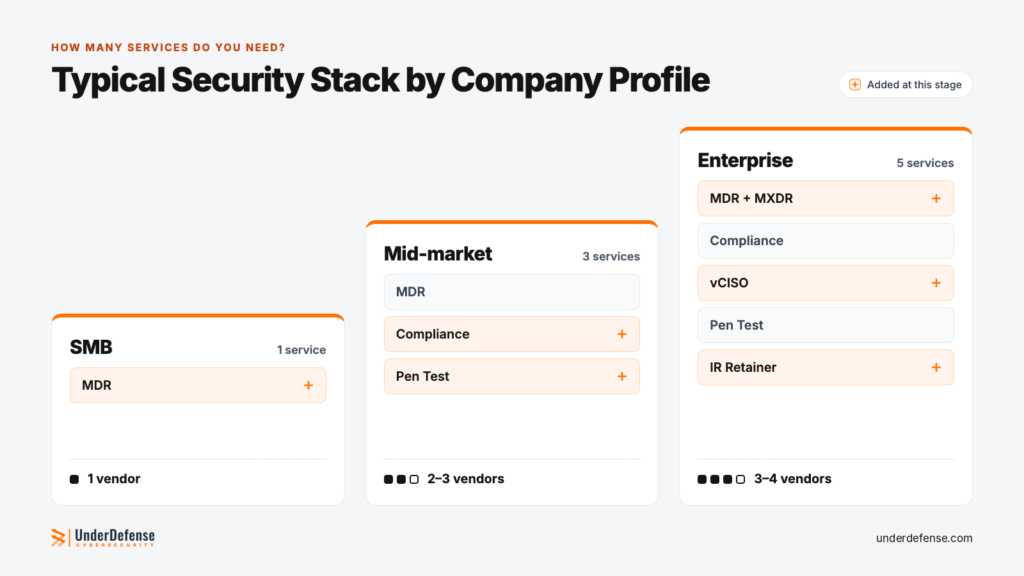
Providers split along a similar line. Among the top cybersecurity service providers, some, like UnderDefense, Arctic Wolf and Optiv, sell across several of these categories from one platform or one consulting practice. Others specialize deliberately: Coalfire and RSI Security stay in compliance, Rivial Data Security and Fractional CISO stay in advisory work, and Red Canary, Expel and Intezer stay narrowly focused on detection and response.
Neither approach is automatically better. A specialist often goes deeper in its one category than a generalist can, and a generalist saves a buyer from managing multiple separate vendor relationships at once.
The 10 Types of Managed Cybersecurity Services
The 10 types of managed cybersecurity services are: managed detection and response (MDR), SOCaaS, managed SIEM, managed EDR, MXDR, incident response, managed cloud security, compliance automation, vCISO, and penetration testing. Each covers a different problem, runs on a different pricing model, and comes from a different kind of provider.
The sections below cover what each service does, who sells it in 2026, and how providers compare across coverage scope, deployment model, platform dependency, and best-fit use case.
1. Managed Detection and Response (MDR)
Managed detection and response (MDR) is a 24/7 security monitoring service that pairs automated threat detection with a human team that investigates alerts and acts on confirmed threats. The difference from basic monitoring is response: an MDR provider contains a confirmed threat; forwarding the alert is only the first step.
MDR sits on top of tools a company already owns (EDR agents, SIEM, cloud logs) without replacing them.
MDR is the right starting point for any company that needs continuous coverage but cannot staff a 24/7 analyst team internally.
| Provider | Coverage | Deployment Model | Platform Dependency | Best For |
| UnderDefense | Endpoint, network, cloud, identity, SIEM | Fully managed or co-managed; on-prem AI SOC option | Vendor-agnostic; no proprietary agent required | Mid-market to enterprise; existing stack; air-gapped environments |
| Huntress | Endpoint, identity (M365) | Fully managed | Proprietary Huntress agent required | SMBs; MSP-delivered; no in-house SOC |
| Arctic Wolf | Endpoint, network, cloud, SaaS | Fully managed | Proprietary Aurora sensor required | Mid-market all-in-one; named advisory team |
| Sophos MDR | Endpoint-first; some third-party telemetry | Fully managed | Sophos agent preferred; limited third-party support | Sophos-stack environments; SMB to mid-market |
| CrowdStrike Falcon Complete | Endpoint, identity, cloud | Fully managed | Falcon agent required | Organizations standardized on CrowdStrike |
| Secureworks Taegis | Endpoint, identity, email, network, cloud, OT/ICS | Fully managed or co-managed | Vendor-neutral open XDR; bring-your-own telemetry | Enterprise; OT environments |
The comparison table above covers the six most active providers in this category as of 2026. UnderDefense delivers coverage in this space through its Agentic AI SOC platform.
2. Security Operations Center as a Service (SOCaaS)
Security operations center as a service (SOCaaS) delivers a full SOC, including analysts, tooling and process without a business having to build or staff one internally. It differs from MDR mainly in scope: SOCaaS often includes the SIEM platform itself, while MDR is the monitoring layer sitting on top of a SIEM a company already runs.
The decision between the two categories comes down to one question: does a SIEM already exist? If a company already uses Splunk or Sentinel and wants to keep that system, it is usually better suited to an MDR integrated on top of the existing solution. A company with no SIEM and no appetite to run one finds SOCaaS the faster path to full coverage.
| Provider | Coverage | Deployment Model | Platform Dependency | Best For |
| UnderDefense | Full SOC; SIEM-agnostic layer | Fully managed or co-managed; on-prem option | Vendor-agnostic; works over any existing SIEM | Companies with existing SIEM needing 24/7 analyst coverage |
| Arctic Wolf | Endpoint, network, cloud | Fully managed | Proprietary Aurora platform + sensor | Mid-market; no existing SIEM; bundled platform |
| Trustwave | SIEM + threat hunting | Co-managed (Splunk) or fully hosted | Splunk-specialist; also hosted SIEM option | Organizations with existing Splunk licensing |
| Alert Logic | SOC + vulnerability scanning | Fully managed | Cloud-native; proprietary platform | SMB to mid-market; full-stack coverage |
| Secureworks Taegis | XDR + full SOC layer | Fully managed or co-managed | Vendor-neutral; open XDR telemetry model | Enterprise; existing Secureworks relationship |
| Proficio | Hosted or co-managed SIEM | Fully managed or co-managed | Hosted SIEM or co-managed over existing platform | Cost-conscious mid-market |
The decision between MDR and SOCaaS is settled by one question about existing infrastructure. The provider comparison above reflects the six most active platforms in this category as of 2026.
3. Managed SIEM (Security Information and Event Management)
Managed SIEM is a service where a provider operates and continuously tunes a company’s security information and event management platform, converting raw log data into prioritized findings. The category exists because a SIEM without ongoing tuning produces more noise than signal, and tuning is not a one-time task completed at deployment.
Most organizations bring in managed SIEM to close the gap between having the platform and getting consistent value from it. The analyst layer is what makes the difference: detection rules that stay current, correlation logic that improves over time, and a team that investigates what the platform surfaces.
| Provider | Coverage | Deployment Model | Platform Dependency | Best For |
| UnderDefense | Co-managed over any existing SIEM; detection tuning included | Co-managed; on-prem option | Vendor-agnostic; any SIEM platform | Companies wanting analyst coverage without platform migration |
| Huntress | Managed SIEM per log source; 24/7 SOC included | Fully managed | Proprietary Huntress SIEM | SMB to mid-market; per-source billing model |
| IBM Security (QRadar) | Full SIEM management; integrated threat intelligence | Fully managed | QRadar platform; IBM ecosystem | Large enterprise; existing IBM environment |
| Splunk (managed) | Industry-standard platform; extensive integrations | Co-managed | Splunk platform required | Organizations needing maximum platform flexibility |
| LogRhythm | SIEM + compliance reporting | Fully managed or co-managed | LogRhythm platform | Mid-market; compliance-driven environments |
| Trustwave | Co-managed Splunk; SOC analyst layer | Co-managed | Splunk-specialist | Companies with existing Splunk investment |
Data ingest volume grows as environments expand, so a quote based on today’s log volume should be revisited annually. The providers above represent the range from large enterprise platforms to SMB-oriented managed options.
4. Managed Endpoint Detection and Response (EDR)
Managed endpoint detection and response (EDR) puts continuous expert-monitored coverage on laptops, servers and other endpoint devices, catching and containing threats at the device level before they move laterally. It is narrower than MDR, which layers network, cloud and identity signals on top of endpoint telemetry.
The central decision in this category: does the provider sell its own EDR agent, or does it operate the one a company already has? A company still choosing its endpoint platform simplifies the evaluation by buying from a vendor that sells both the agent and the management layer. A company that has already standardized on one platform, often after a multi-year rollout, typically gets more value from a provider that manages what it already runs.
| Provider | Coverage | Deployment Model | Platform Dependency | Best For |
| UnderDefense | Operates and tunes any existing EDR agent | Co-managed or fully managed | Vendor-agnostic; no proprietary agent required | Companies already standardized on a specific EDR platform |
| Huntress | Endpoint; persistent foothold detection; human SOC review | Fully managed | Huntress agent layered on existing EDR | SMBs; MSP-delivered; Windows/macOS/Linux |
| SentinelOne | Endpoint; Vigilance MDR tier available | Fully managed (Vigilance) | SentinelOne Singularity agent required | Organizations buying endpoint platform and management together |
| Intezer | Forensic triage of every endpoint alert, including live memory scans; SIEM, identity and cloud alerts on Complete tier | Fully managed AI SOC; on-demand expert escalation | Works over existing EDR (CrowdStrike, SentinelOne, Defender); 100+ integrations | Teams that need low-severity and EDR-“mitigated” alerts verified |
| Sophos MDR | Endpoint; some third-party telemetry supported | Fully managed | Sophos agent preferred; limited third-party support | SMB to mid-market; Sophos-ecosystem buyers |
The five providers above represent the primary options in this category, from platform-agnostic management and AI-led forensic triage to proprietary-agent models. The right choice depends on whether the organization is still selecting its endpoint platform or has already standardized on one.
5. Managed Extended Detection and Response (MXDR)
Managed extended detection and response (MXDR) applies continuous monitoring across every layer at once (endpoint, network, cloud and email) correlated in a single platform. It is the broadest detection-and-response category, built for organizations whose risk surface spans multiple environments that need to be watched together, not as separate feeds.
The value of MXDR is in correlation: a threat that looks like noise on the endpoint layer often becomes a clear pattern when network and identity signals are added. A provider that connects those layers well surfaces attacks that single-source monitoring would miss entirely.
| Provider | Coverage | Deployment Model | Platform Dependency | Best For |
| UnderDefense | Endpoint, network, cloud, identity | Fully managed or co-managed; on-prem option | Vendor-agnostic; no platform lock-in | Cross-layer coverage without replacing existing stack |
| ReliaQuest GreyMatter | Endpoint, network, cloud, email | Co-managed | Vendor-neutral; runs over existing SIEM or replaces it | Enterprise; multi-tool environments; SIEM consolidation |
| Arctic Wolf | Endpoint, network, cloud | Fully managed | Proprietary Aurora platform required | Mid-market to enterprise; all-in-one preference |
| Heimdal | Endpoint, network, email, cloud | Fully managed | Proprietary Heimdal platform | European compliance requirements; SMB to mid-market |
The four providers above reflect the current range in this category, from open vendor-neutral platforms to proprietary all-in-one deployments. A cross-layer detection example from a named client is the right evaluation benchmark before signing.
6. Incident Response Management
Incident response services give a business a dedicated team to investigate, contain and recover from an active breach. This is a different engagement from the continuous monitoring MDR provides, even when both come from the same provider. Most organizations structure IR as a standing arrangement: a team already familiar with the environment, with access provisioned and an escalation path documented before anything happens.
That preparation is what a retainer actually buys. A provider who knows the environment before an incident starts moves faster on day one than one who is learning it under pressure.
| Provider | Coverage | Deployment Model | Platform Dependency | Best For |
| UnderDefense | Forensics, containment, recovery; 40-hour retainer pre-bundled | Retainer-based; integrated with ongoing monitoring | Vendor-agnostic; works within existing environment | Mid-market; IR pre-included with monitoring platform |
| eSentire | Atlas XDR; 100–200 IR hours pre-bundled annually | Retainer-based; three package tiers | Bring-your-own signals supported | Mid-market regulated sectors; contractual 15-min MTTC SLA |
| Secureworks | IR + forensics alongside Taegis XDR | Retainer or on-demand | Taegis XDR; vendor-neutral telemetry | Enterprise; OT/ICS environments |
| Mandiant (Google Cloud) | Large-scale forensics; nation-state attribution | On-demand or retainer | Platform-agnostic | Enterprise; complex or nation-state attributed incidents |
| Pondurance | IR retainer combined with managed detection | Retainer-based; co-managed | Works with existing tools | Mid-market; combined MDR and IR from one provider |
The five providers above span the range from retainer-bundled mid-market options to large-scale forensic specialists. IR terms are significantly easier to negotiate before an incident than during one.
7. Managed Cloud Security Services
Managed cloud security covers AWS, Azure, GCP and Kubernetes environments specifically, catching the misconfigurations and identity issues that endpoint-first monitoring stacks typically miss. An exposed storage bucket or an over-permissioned service role rarely surfaces in a traditional EDR-focused platform.
Multi-cloud environments raise the stakes directly. A company running workloads across AWS and Azure needs a provider that covers both platforms’ native logging and identity models with equal detection depth across each.
| Provider | Coverage | Deployment Model | Platform Dependency | Best For |
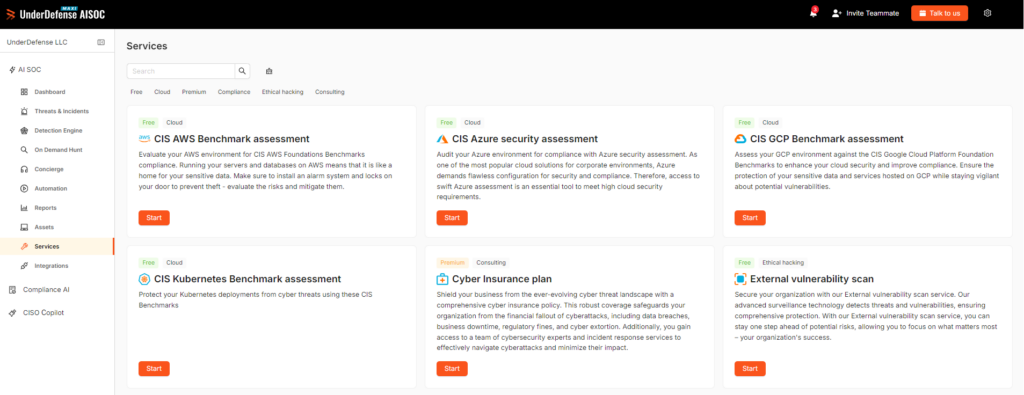
| UnderDefense | AWS, Azure, GCP, Kubernetes; part of broader platform | Fully managed or co-managed; on-prem option | Vendor-agnostic; no separate cloud-only SKU | Companies wanting cloud coverage without adding a point solution |
| Palo Alto Networks (Prisma Cloud) | AWS, Azure, GCP, Kubernetes; CSPM + runtime protection | Fully managed or self-managed | Prisma Cloud platform; cloud-native | Enterprise; large multi-cloud deployments |
| Zscaler | Network and access-control; zero-trust architecture | Fully managed | Zscaler platform; cloud-first environments | Organizations running zero-trust network access programs |
| Cisco | Broad cloud infrastructure security | Fully managed | Cisco ecosystem | Enterprise; existing Cisco environment |
The four providers above reflect the range from cloud-native platform specialists to broader security platforms that include cloud coverage as one layer. Multi-cloud detection depth is the criterion worth probing before any evaluation concludes.
8. Security Compliance Services
Security compliance services help a business prepare for and pass an audit (SOC 2, ISO 27001, HIPAA, PCI DSS, GDPR) without pulling an internal team off its core work for months. The service covers evidence collection, control mapping, gap remediation and questionnaire automation. The audit itself always comes from an independent auditor, separate from the compliance vendor doing the preparation work.
Two delivery models exist in this category. Automation-led platforms reduce manual evidence-gathering and keep posture monitoring continuous between audits, making it practical to run multiple frameworks in parallel. Consulting-heavy providers go deeper on interpretation and remediation, typically as a project-based engagement scoped to one framework at a time.
| Provider | Coverage | Deployment Model | Platform Dependency | Best For |
| UnderDefense | SOC 2, ISO 27001, HIPAA, PCI DSS, GDPR; automated evidence collection + consulting | Platform + continuous posture monitoring; multi-framework in parallel | Automation-led; integrates with existing tools | Multi-framework programs; automation-led; scalable across frameworks |
| RSI Security | SOC 2, ISO 27001, HIPAA, PCI DSS | Consulting-led; project-based | Framework-agnostic; advisory model | Organizations needing deep control remediation support |
| Coalfire | PCI DSS specialist; compliance-driven testing | Consulting-led; audit-focused | Framework-agnostic; QSA attestation | Regulated industries requiring formal PCI attestation |
| Optiv | Multi-framework compliance consulting | Consulting-led; enterprise engagements | Framework-agnostic | Enterprise; large multi-framework programs |
| CyberSecOp | SOC 2, ISO 27001, HIPAA | Consulting-led; project-based | Framework-agnostic | Smaller businesses; lower-complexity single-framework needs |
The five providers above span the range from automation-led multi-framework platforms to consulting-heavy single-framework specialists. The right choice depends on how many frameworks are in scope and how much internal capacity exists for ongoing evidence work.
9. Virtual Chief Information Security Officer (CISO) Services
A virtual CISO service provides senior security leadership: risk assessment, strategic planning, board reporting on a fractional basis. It fits companies that need security judgment at the leadership level without the headcount or salary attached to a full-time hire.
The real tradeoff in this category is between a pure advisory firm and a provider that pairs vCISO guidance with its own monitoring platform. A pure advisory vCISO brings strategic judgment without a platform attached. A vCISO bundled with monitoring brings the same judgment already informed by what the monitoring is seeing in the environment, a meaningful difference when strategic decisions are grounded in real telemetry.
| Provider | Coverage | Deployment Model | Platform Dependency | Best For |
| UnderDefense | Security strategy & roadmap, risk management, compliance oversight, IR planning, vendor management, security awareness training; paired with live monitoring | Fractional; integrated with Agentic AI SOC | Strategy informed by real telemetry from the same platform doing the monitoring | Companies wanting advisory and monitoring from one team; decisions grounded in live data |
| Rivial Data Security | Risk-focused vCISO; pure advisory | Fractional; pure advisory | Platform-agnostic; no monitoring attached | Organizations needing independent strategic guidance |
| FRSecure | vCISO + security program development | Fractional; program-building engagements | Platform-agnostic | Building a security program from early stages |
| SideChannel | Fractional CISO; flexible engagement models | Fractional; no long-term commitment required | Platform-agnostic | Mid-market; flexible advisory without multi-year lock-in |
| Fractional CISO | Governance and board reporting focus | Fractional; governance-led | Platform-agnostic | Board and audit committee reporting |
The providers above reflect the primary delivery models in this category, from pure advisory to advisory integrated with live monitoring. The practical tradeoff between independence and operational context is the deciding factor for most buyers.
10. Penetration Testing and Vulnerability Assessment Services
Penetration testing simulates a real attack against a company’s networks, applications and cloud infrastructure to find exploitable gaps before an actual attacker does. It differs from ongoing monitoring services in being point-in-time work: a pentest is a snapshot of defenses on the day it ran, valuable but perishable as the environment changes underneath it.
Pricing varies significantly by test type and scope. Red team engagements sit at the high end. Web application and network tests cover the mid-range. Most compliance frameworks that mandate penetration testing specify a minimum annual frequency, but environments change faster than that in most organizations, which is the argument for more frequent scoping.
| Provider | Coverage | Deployment Model | Platform Dependency | Best For |
| UnderDefense | Network, web app, cloud, IoT, red team; compliance-mapped reporting | Project-based; all test types available | Vendor-agnostic; works with any environment or stack | Mid-market to enterprise; broad test type coverage |
| Rapid7 | Pen testing alongside MDR and vulnerability management | Project-based; integrated with Rapid7 MDR | InsightIDR/Rapid7 ecosystem preferred | Organizations combining testing with ongoing Rapid7 MDR |
| Trustwave | Pen testing within broader MSSP offering | Project-based; compliance-focused | Works within existing Trustwave managed relationship | Organizations wanting testing within an existing managed security relationship |
| Coalfire | PCI DSS and compliance-driven testing; QSA attestations | Project-based; audit-focused | Framework-agnostic; formal attestation specialist | Regulated industries requiring compliance attestation alongside findings |
| Bright Defense | Web application, API, and network penetration testing services; remediation guidance and retest support | Project-based; three fixed-scope plans | Confirm requirements during scoping | Startups, SMBs, and SaaS companies needing testing alongside SOC 2 or ISO 27001 readiness support |
The ten categories above cover the full scope of what the managed security market sells in 2026. The question of which one a specific organization actually needs is a different exercise and the next section walks through exactly that decision.
How to Choose the Right Managed Cybersecurity Service Provider
Choosing the best managed cybersecurity services for your organization comes down to three decisions: identifying the specific security gap you need to close, matching that gap to the correct service category, and then evaluating providers within that category on deployment model, platform dependency, and contractual accountability.
Most buying decisions go wrong at the first step: organizations evaluate providers before they have defined the problem.
The questions below are structured to fix that: answer them in order, and by the end you will have a shortlist instead of a vendor list.
What specific gap am I trying to close?
This is the question that decides everything else. The answer cannot be “better security”. It needs to be specific enough to point at a service category.
Three gaps account for most buying decisions in this market:
- No 24/7 coverage. The internal team monitors during business hours. Nights, weekends, and holidays are unmonitored. This is an MDR or SOCaaS decision, and it is the highest-priority gap to close before anything else.
- A platform that nobody is running properly. A SIEM that fires thousands of alerts a week with no one triaging them, or an EDR with no one investigating what it surfaces, is a managed SIEM or managed EDR decision. The tooling exists; what is missing is the operational layer on top of it.
- A compliance deadline. A SOC 2, ISO 27001, or PCI DSS audit with a fixed date is a compliance services decision. It is a separate budget line from monitoring and usually a separate provider.
If more than one gap is present, sequence them. Close the monitoring gap first. Add compliance services when a deadline makes it urgent. Layer additional categories once the foundation is stable.
Do I already have tools I want to keep?
This question cuts the provider list in half before any feature comparison begins.
If the organization has already standardized on a SIEM, an EDR platform, or both, and has no intention of replacing them, then only vendor-agnostic providers are viable options.
Providers that require their own proprietary sensor or agent are asking the organization to run a second tool alongside one it already owns and operates. That is an additional deployment project, an additional license cost, and an additional conversation with every team that manages the endpoints.
If no tools exist and the organization is starting from scratch, a bundled platform from a single provider is the faster path. There is no existing investment to protect and no migration to manage.
What is my internal team’s actual capacity?
The honest answer to this question shapes the delivery model.
- A team with two or three security staff who are already fully occupied with day-to-day operations needs a fully managed service. Adding a co-managed layer on top of a team with no capacity to engage with it produces a provider relationship where alerts queue up on both sides with no one acting on them.
- A team with an established security function that covers daytime operations but cannot maintain 24/7 coverage is a co-managed buyer. The provider fills the coverage gap; the internal team handles escalations and owns the tool configurations.
- A team with a mature SOC that needs specific expertise (cloud security, compliance, penetration testing) is a specialist buyer. The right purchase is targeted. A full SOC replacement is a different engagement.
Overstating internal capacity is the most common mistake buyers make when scoping a managed security engagement. The provider delivers what the contract says; the value only materializes if someone on the customer side is engaged enough to act on what the provider surfaces.
Can my organization share telemetry with a third party?
For most organizations, the answer is yes. For some, the answer is no, and it eliminates a significant portion of the cloud-delivered managed security market.
Regulated industries (defense contractors, government agencies, certain financial institutions) operate in environments where security telemetry cannot leave the organization’s own infrastructure. For these buyers, the only viable options are providers that run the monitoring platform, AI and detection logic included, inside the customer’s own infrastructure. No data leaves the environment.
This is a small but non-trivial segment of the market. Providers that offer genuine on-premises deployment as a standard option are worth identifying early in the evaluation if data residency is a constraint.
How many service categories do I actually need?
Most organizations need more than one but fewer than they think.
A mid-market company handling card payments commonly runs MDR for daily monitoring, compliance services ahead of a PCI DSS audit, and an annual penetration test: three separate line items, often from two or three different providers.
The mistake is buying a broad multi-service engagement from a single provider on the assumption that consolidation equals efficiency. The right question is not “how many services does this provider offer” but “how deep is their delivery in the specific category I need most.”
Start with one category. Evaluate expansion once the first engagement is delivering value.
What does a realistic shortlist look like?
After answering the questions above, a workable shortlist is three to five providers.
The filters that produce it:
- Delivery model match. Fully managed or co-managed: eliminate providers that do not fit.
- Platform dependency match. Vendor-agnostic or bundled platform: eliminate providers that conflict with existing tool investments.
- Coverage scope match. Does the provider cover the specific environments that need monitoring (endpoint, cloud, OT, identity) with native detection logic? Log forwarding without detection logic is not equivalent coverage.
- Verified buyer evidence. G2, Gartner Peer Insights, and Clutch all carry verified reviews filterable by company size and industry. The recurring complaints in reviews from organizations comparable to yours reveal more about delivery quality than any marketing claim. Calibration time, reporting depth, and escalation responsiveness are the three categories that generate the most consistent negative feedback across this market.
Three to five of the top cybersecurity service providers that pass all four filters is the right shortlist size.
Questions to Ask a Managed Security Provider Before Signing
The questions that matter are the ones vendors rarely volunteer answers to. These seven reveal the most about actual delivery quality. Ask them in every evaluation, regardless of how strong the demo looked.
1. What action do you take on a confirmed threat at 2 a.m. without contacting my team first?
This separates MDR from monitoring. A provider that says “we alert your on-call team” is selling monitoring. A provider that says “we isolate the affected endpoint and open a ticket with a full investigation summary” is selling response. Get the specific pre-authorized action list in writing before signing.
2. How long does it take before detection is fully tuned to our environment?
Ask for a specific timeline and ask what the false positive rate typically looks like in weeks one through four versus week eight. A provider claiming day-one full coverage is describing a best case few environments actually get. A provider that cannot give a concrete answer has not measured it.
3. Do you require us to deploy your proprietary agent, or do you work with the EDR we already run?
Not every provider works with the tools you already own. Some require deploying their own proprietary sensor or agent, which means an additional deployment project, an additional license cost, and an additional conversation with every team that manages the endpoints.
UnderDefense operates on whichever EDR, SIEM or cloud logging stack the customer already runs (across endpoint, network, cloud and identity) with no proprietary agent, no second deployment, and no rip-and-replace. Anti-lock-in matters significantly more to a buyer who has already invested in a SIEM or EDR they intend to keep running.
Ask any provider you evaluate for a specific list of the telemetry sources they support natively versus those that require a proprietary component before coverage is possible.
4. Can you give me real MTTD and MTTC figures from a named client, not a projected SLA?
The global mean time to identify and contain a breach remains measured in months, according to IBM’s 2026 Cost of a Data Breach report. A provider worth the contract operates in minutes and hours. The gap between those two timelines is where breaches become business events. Ask for a specific, named client result as proof. A projected SLA from a sales deck is a different thing entirely from a documented outcome from a live environment.
One benchmark from a published UnderDefense case study: one of the 10 largest US government organizations in the financial sector reduced its average time to identify and analyze a high or critical alert to 9 minutes, with full resolution averaging 23 minutes, and approximately $700K in estimated savings after moving monitoring to UnderDefense.
Ask the provider you are evaluating for a comparable result: same format, named client, documented outcome.
5. What is included in the base contract versus what triggers overage billing?
Incident response hours, forensic retainers and extended investigation support are commonly priced as separate add-ons across this market. Some providers include a fixed IR retainer in the base contract; others bill hourly from the first minute of an active engagement. Ask specifically what triggers overage billing and at what rate before an incident makes the question urgent.
6. What does your reporting look like, and how often do we meet?
Ask for a sample report before signing. Some providers deliver environment-specific reporting with trend data and gap analysis. Others deliver automated alert summaries with no analytical layer. The report quality is a direct proxy for the analyst engagement quality.
7. Can you show me your MITRE ATT&CK coverage map for the specific tools we already run?
Coverage claims at the category level are less useful than coverage claims tied to the specific tools generating telemetry in your environment. A provider covering 90% of MITRE techniques on a different customer’s stack is not the same as 90% coverage on your Splunk deployment with your specific log sources. Ask for the map tied to your environment, not a generic one.
UnderDefense, for example, reports 96% MITRE ATT&CK coverage against the specific telemetry sources in scope.
Managed Security Service Onboarding: What to Expect
Onboarding a managed security service takes between four and twelve weeks to reach full, tuned coverage, depending on environment complexity and the provider’s deployment model.
Three phases apply across most categories:
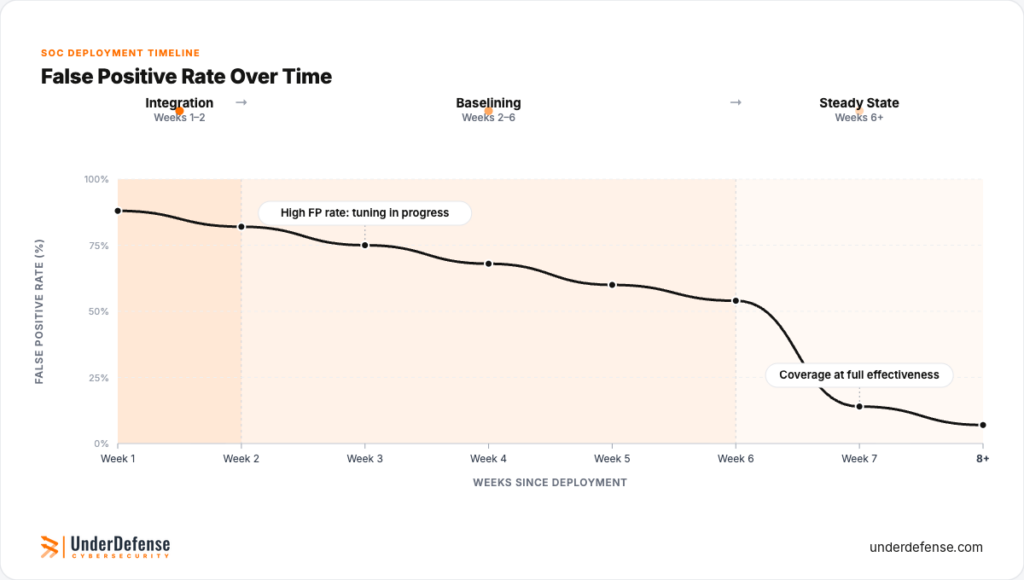
Integration (days one through fourteen)
The provider connects to the customer’s existing tools: EDR agents, SIEM, cloud logs, identity providers. Most providers complete basic integration within two weeks for standard environments. Environments with legacy or custom systems take longer, and this is where the gap between a vendor-agnostic provider and one that requires a proprietary platform shows up most directly.
Baselining (weeks two through six)
The platform learns what normal looks like in the environment. During this period, false positive rates are higher than they will be at steady state. Alert volume during baselining is not representative of long-term operations. Buyers who evaluate detection quality during week two are measuring the wrong thing.
Steady state (week six onward)
Detection logic is tuned, false positive rates have dropped, and the analyst team has enough context to investigate alerts efficiently. This is the period that reflects the actual ongoing value of the service.
Why Organizations Buy Managed Cybersecurity Services
Managed cybersecurity services exist to close four gaps that recur across almost every organization that buys them, regardless of size or industry: chronic understaffing for 24/7 coverage, a shrinking window between intrusion and lateral movement, alert volume that outpaces internal capacity, and regulatory pressure that keeps expanding in scope and consequence.
The Staffing Gap Most Organizations Cannot Close Internally
A six-to-eight analyst team running three shifts around the clock, with enough depth to handle simultaneous incidents, costs over $1 million annually in a major US market before tooling, threat intelligence subscriptions and training are added.
A managed provider functions as an extension of a team a company cannot fully build on its own without solving hiring, on-call rotations and analyst retention from scratch.
The economics are straightforward: a managed service at $50,000–$200,000 per year delivers coverage that would cost five to ten times more to replicate internally at equivalent quality.
The less obvious problem is continuity. When a senior analyst leaves an in-house team, institutional knowledge of the environment leaves with them. A managed provider’s platform retains detection logic, tuned rules and investigation history regardless of individual analyst turnover.
Breakout Time: Why Detection Speed Matters More Than Detection Coverage
Modern attackers move faster than most internal teams can respond. Mandiant’s M-Trends 2026 report places global median dwell time at 14 days, but that figure masks how quickly an attacker with initial access moves laterally. Once they reach a second host, escalate privileges or establish persistence, containment becomes significantly harder and more expensive.
A team that monitors only during business hours is operating on a timeline built for threats that no longer move this slowly. Cloud, hybrid and remote infrastructure expand the attack surface an internal team has to watch simultaneously. The more environments a company adds, the more entry points exist and the fewer of them get continuous coverage without a managed layer on top.
The cost of that gap is measurable. A published case study with AirSlate, a SaaS unicorn, documents 35 hours saved per week for the IT team on security alert management after moving monitoring to UnderDefense: the equivalent of nearly a full analyst work week returned to strategic work every week. That time had previously gone to alert triage. Continuous monitored detection exists specifically to close that gap at the moment something fires.
Alert Volume Without Triage Produces the Same Outcome as No Monitoring
A SIEM or EDR platform without expert tuning generates alerts at a rate no small internal team can process. IBM’s 2026 Cost of a Data Breach report found that organizations using AI and automation in security operations cut breach costs by an average of $1.93 million. The gap is not detection capability. It is the capacity to act on what the tooling already surfaces.
The failure mode is structural. When alert volume exceeds what a team can process, analysts triage by volume. Low-and-slow attacks (credential stuffing, supply chain compromise, persistent access established weeks before anything obvious fires) sit below the noise threshold. Noisy ransomware gets action. Quiet intrusions move further.
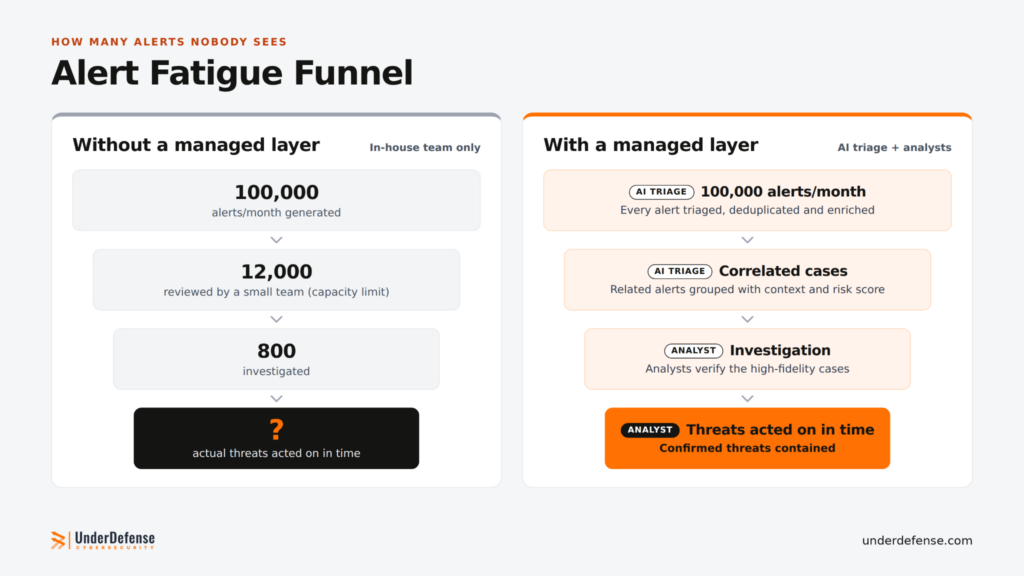
Managed cybersecurity services solve this by pairing tooling with analysts who investigate what fires, separate a real incident from background noise and act on the ones that need action, freeing the internal team to focus on the incidents that require judgment.
The Cost of Getting Compliance Wrong
IBM’s 2026 Cost of a Data Breach report puts the average US breach at $11.5 million: a record high and more than double the global average of $4.99 million, driven by higher costs for detection, escalation, and business disruption.
A failed SOC 2 audit does not carry a fixed fine, but the downstream consequence, like losing an enterprise customer that required it, can exceed the cost of the compliance program itself.
SOC 2, ISO 27001, HIPAA, PCI DSS and GDPR requirements keep expanding in scope. What was a one-time audit project five years ago is now a continuous evidence collection exercise, with auditors expecting posture to be monitored between certification cycles, not assembled in a sprint the month before the audit.
Compliance automation services exist to convert that ongoing burden into a managed function: continuous evidence collection, framework mapping and posture monitoring running in the background while the internal team focuses on operations.
A company that runs compliance manually across multiple frameworks is doing a significant amount of work that a platform can do instead, at a fraction of the time and error rate. A published case study with a global BPO operating across eight countries documents what that shift looks like in practice: using UnderDefense MAXI Compliance AI for SOC 2 and ISO 27001 simultaneously, the organization reached audit readiness twice as fast with 30% less manual effort, while keeping the same compliance team as the business scaled.
Become 40% audit-ready in the first 40 minutes with UnderDefense MAXI Compliance AI
Run an AI audit simulation to test your audit readiness, and prevent failure.
Building the Right Managed Security Stack for Your Organization
There is no single right combination:
- A four-person IT team at a credit union needs 24/7 monitoring first and compliance help second.
- A Series B SaaS company facing its first enterprise customer’s security questionnaire often needs compliance automation before it needs a larger SOC.
- A manufacturer adding OT environments to an already-monitored network needs cloud and network coverage expanded to include them.
The right sequence is: identify the highest-risk gap, close it with the right service type, then layer additional categories as the business and its obligations grow.
UnderDefense covers detection and response, compliance automation and penetration testing from one platform, so a company that starts with monitoring does not face a re-platforming project when compliance or testing needs follow.
Most managed security services take four to twelve weeks to reach tuned coverage. The first 30 days determine whether that timeline holds.
Before committing to a scope, UnderDefense maps your environment and models TCO against your actual stack. Get a free consultation to walk through the options.
1. What is the difference between managed cybersecurity services and managed IT security services?
Managed cybersecurity services are built around threat detection, response and strategic defense, identifying active threats, containing incidents and maintaining a security posture over time. Managed IT security services are operational and infrastructure-focused: firewalls, antivirus, patch management, network monitoring and email filtering. The distinction matters in procurement because the two service types solve different problems, often come from different kinds of providers, and rarely share a budget line.
2. What are the main features of a strong MSSP?
The features that separate a capable managed security service provider from a monitoring-only service are: 24/7 analyst coverage with documented response capability; a SIEM or detection platform that is continuously tuned to the customer’s environment; incident response included in the base contract or available under a pre-signed retainer; compliance support for the frameworks that matter to the customer’s industry; and transparent reporting that shows what was detected, investigated and resolved.
3. What's included in managed security service pricing?
Pricing varies significantly by service type and provider. Continuous monitoring and detection, analyst coverage, and a SIEM or detection platform form the base of most contracts. Incident response hours, compliance support and penetration testing are commonly scoped and priced separately. UnderDefense publishes a starting rate: $11 per device per month across endpoint, network, cloud and identity, with UnderDefense MAXI Compliance AI starting at $499 per month.
4. What is the difference between MDR and XDR?
MDR is a managed service in which a provider supplies the analysts, the tooling and the 24/7 coverage. XDR is a platform architecture. It correlates telemetry across endpoint, network, cloud and identity into a single detection layer. The two are not mutually exclusive: most MDR providers deliver their service on top of an XDR platform. The meaningful question for a buyer is not MDR versus XDR but whether the provider’s detection logic is genuinely cross-layer or whether it is endpoint-first with other sources bolted on.
5. Do small businesses need managed cybersecurity services?
The services most relevant to small businesses are MDR or SOCaaS for monitoring coverage, compliance automation ahead of a specific audit, and penetration testing if a customer or insurer has required it. The staffing math favors outsourcing at almost any company size: a single dedicated security analyst costs more annually than a managed service covering the same function, and a solo analyst cannot provide 24/7 coverage. The threshold where managed security stops making economic sense is when an organization already has a mature internal SOC, which most companies below 2,000 employees do not.