




For companies holding multiple compliance frameworks at scale, audit readiness is the gate on every enterprise contract, and manually, that gate gets expensive to keep open.
Helpware, a global BPO provider, faced this at scale: SOC 2 and ISO 27001 across 8 countries, with every audit cycle touching a live contract. It reached audit readiness twice as fast and kept the same compliance team while the business doubled, by moving both frameworks onto one platform with automated control cross-mapping.
What This Means If You Run Compliance At Scale
Helpware’s experience maps to a few patterns that hold for any organization operating at scale in a regulated industry.
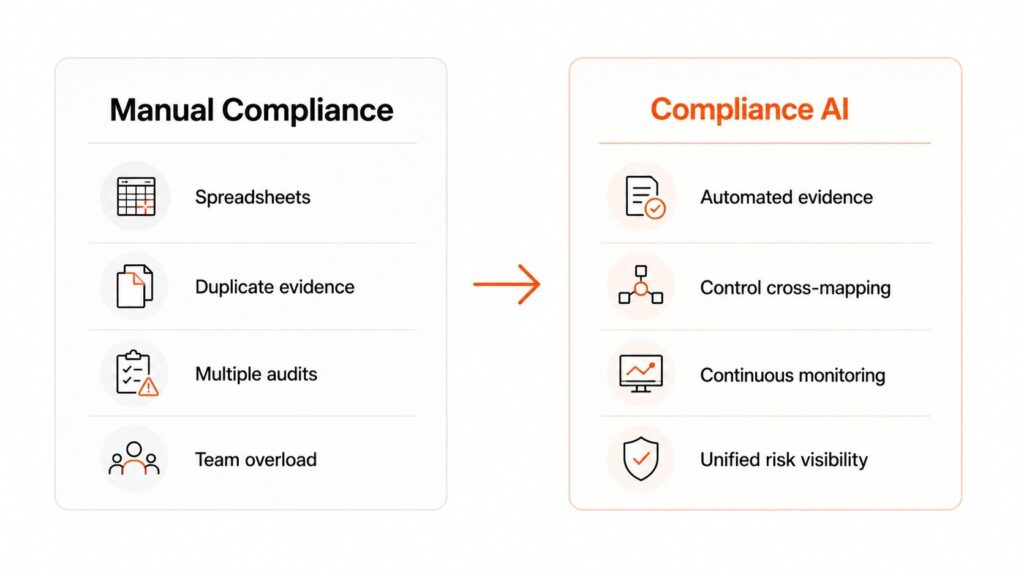
- Multi-framework cross-mapping is the single largest time recovery available. For anyone running SOC 2 plus ISO 27001, or adding PCI DSS and GDPR, a GRC platform for multi-framework eliminates duplicate evidence work.
- The platform has to scale with business complexity. The test is whether you can add a framework, country, or regulated client without adding compliance FTEs.
- Risk depth has to match organizational complexity. A company handling client data across multiple jurisdictions needs scored, categorized, owned risk.
- And vendor lock-in is a risk itself. Bundling the platform with audit services limits the ability to negotiate, switch auditors, or control cost. Keeping the platform independent of the audit firm preserves that leverage.
Compliance stops being a cost center the moment it stops being manual. Helpware kept its team the same size, doubled its business, opened access to US and European deals, and turned its certifications into something sales could close with.
Discover how Compliance AI can cut audit effort and accelerate certifications.

What Was Actually Breaking
As Helpware grew from a mid-size outsourcer into a global operator, the case for compliance automation for BPOs stopped being a tooling preference and became a business risk.
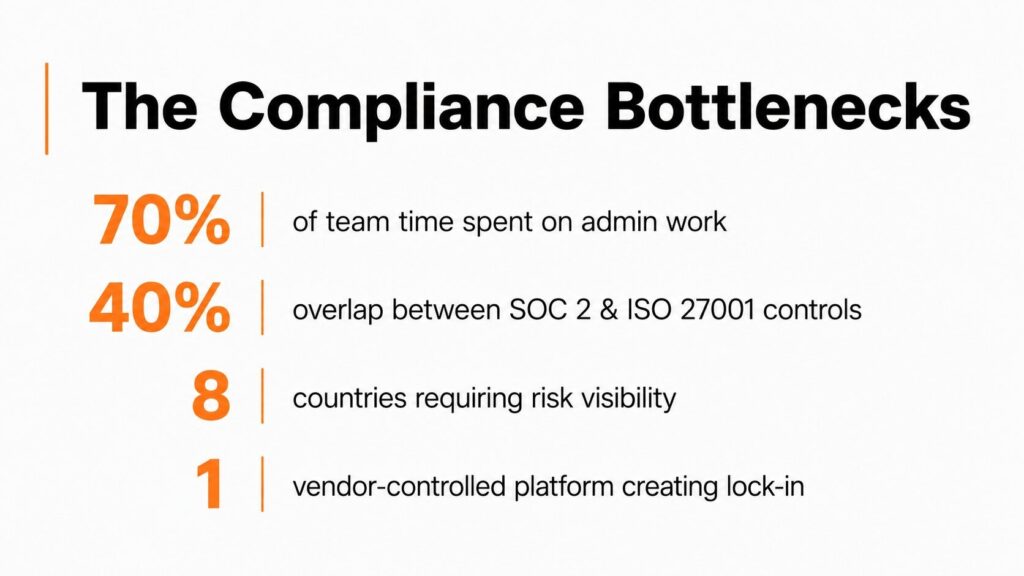
The compliance team could not scale with the business. Every new country, client, and framework multiplied the manual work, evidence gathering, policy reviews, and control tracking, while headcount stayed flat. The team was spending 70% of its time on administrative tasks rather than on the risk decisions it was actually hired to make.
Multi-framework overlap created duplicate effort. SOC 2 and ISO 27001 share roughly 40% of their control requirements, yet the team maintained separate evidence and audit packages for each. The same work, done twice, every cycle.
Risk management required improvement. With client data flowing through 8 countries, Helpware needed a real risk register with quantitative scoring, cross-geography visibility, and vendor risk tracking.
Leadership had no current view between audit cycles. The CISO and executives worked from reports that were manual, slow to compile, and outdated by the time they landed. Compliance posture was not a live number.
And the previous GRC vendor bundled its platform with audit services. Switching auditors meant switching the entire platform and losing years of compliance history. Vendor lock-in had quietly become a strategic constraint on cost and negotiation.
Why These Five Problems Reached the Executive Team
None of those five problems is new. They are what compliance looks like when a company scales faster than its tooling. The reason they reached the executive level at Helpware is that each one carried a revenue consequence: slower sales cycles, blocked market access, and a compliance function that grew more expensive without getting more reliable.
The goal of the project was to make compliance keep pace with the business without adding headcount, and to turn certification from a recurring fire drill into a standing asset that sales could use.
An 8-Week Deployment Across 8 Countries and Two Frameworks
UnderDefense deployed its Compliance AI platform for Helpware in four phases and reached full production readiness in 8 weeks.
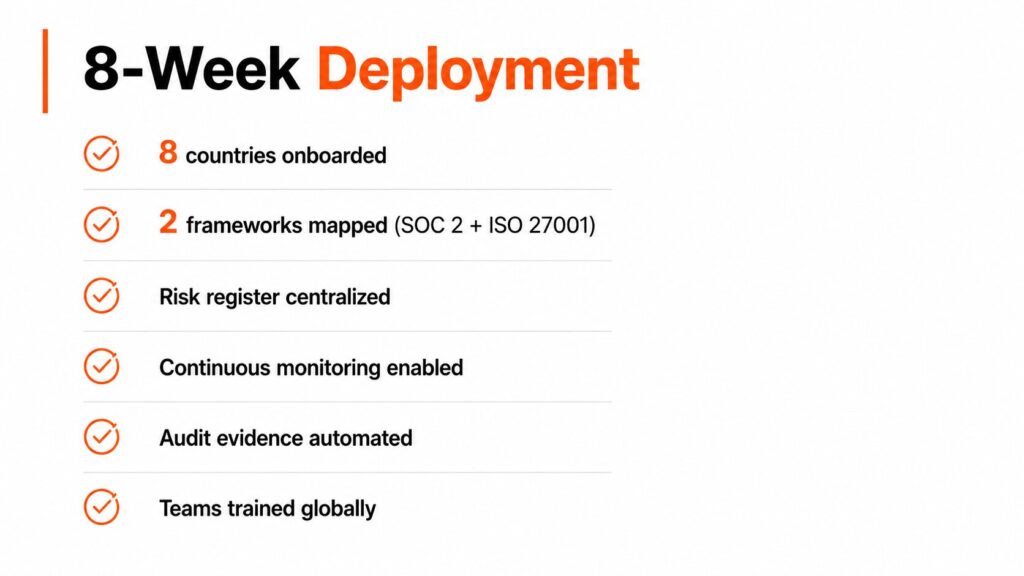
- The first three weeks covered migration.
All compliance data moved off the legacy platform, and SOC 2 compliance automation went live first, with SOC 2 Type II and ISO 27001 configured using pre-built control mappings and integrated into Jira, Slack, AWS, Azure, and Google Workspace. - Weeks three through five built a centralized risk register.
It covered operational, IT, cyber, and vendor risk across all 8 countries, with inherent and residual scoring on five-level likelihood and impact scales. - Weeks five through seven turned on continuous control monitoring through connected integrations, activated the CISO Copilot, and set up automated task workflows with email and Slack notifications.
- The final week ran a full audit rehearsal, generated complete evidence packages, and trained compliance leads and control owners across every office.
The speed comes from the automation itself. The same engine that mapped controls and pulled evidence for Helpware does the first-pass setup for any new framework automatically, mapping controls, collecting evidence, and flagging gaps instead of waiting on manual configuration. That is what compressed an 8-country, two-framework rollout into 8 weeks instead of the multi-month effort the same scope takes by hand.
See what the platform automates before your team starts.

The Numbers a CISO Can Take to the Board
The outcomes are where the business case proves out.
- 2× faster audit readiness.
Cross-mapping SOC 2 and ISO 27001 controls meant evidence submitted for one framework automatically satisfied the overlapping requirements of the other. The duplicate-work tax that had doubled every audit cycle was removed, cutting prep time close to half.
- 30% less manual effort.
Automated evidence collection and AI-assisted queries pulled the team off administrative work. The majority of their time shifted from spreadsheets to actual risk decisions.
- 50+ automated checks running 24/7.
Continuous control monitoring replaced point-in-time reviews. Instead of discovering a control had drifted during audit prep, Helpware sees it the day it happens.
- Risk visibility across 8 countries, in one view.
For the first time, the CISO has a single real-time picture of risk posture across all geographies, with quantitative inherent and residual scoring and heatmap visualization. A risk that scores Critical before controls and Medium after mitigation is now documented, owned, and tracked.
- Audit independence restored.
Because evidence packages are standardized and portable, Helpware now selects auditors on quality and fit rather than being tied to whoever sold the platform. That is leverage on cost and on negotiation that the bundled model had taken away.
Why This Reaches the Revenue Line
Two of the outcomes do more than save time, and they are the ones a CISO can take to the executive team.
- The first is the framework roadmap.
Progress made for one certification carries forward to the next. An ISO 27001 compliance platform that cross-maps to SOC 2, PCI DSS, GDPR, HIPAA, and NIST CSF turns the next framework into incremental work on a base that already exists, rather than a fresh project. For a company expanding into new regulated markets, that is the difference between adding a certification and rebuilding for one. - The second is the Trust Center.
Prospects in regulated industries always pause to ask whether a vendor is secure enough, and that question is usually what slows a deal in security review. The Trust Center answers it before it is asked. Sales can share one link that shows live compliance posture, audit progress, and the policies in force, and security questionnaires get answered without pulling the security team into every deal. For Helpware’s enterprise clients, that is a direct accelerator: shorter sales cycles, higher win rates in competitive deals, and less time lost to manual reviews. Compliance work that used to sit in a binder becomes a visible signal of reliability that the revenue team can actually use.
Let Compliance Close Deals Instead of Slowing Them
Compliance AI cross-maps SOC 2, ISO 27001, PCI DSS, and GDPR so each new framework builds on the last, while a shared Trust Center link answers security reviews before they stall a deal. See how the platform gets a team audit-ready without adding headcount.
Get a live view of how Compliance AI maps controls, collects evidence, and surfaces gaps automatically.