




Q1: What is the difference between a SOAR and an AI SOC?
A SOAR runs response playbooks your team writes in advance, which behave as rigid if-then-else decision trees. An AI SOC works one layer earlier and autonomously investigates each alert by pulling logs, enriching with threat intel, and correlating across systems before a human decides. A SOAR executes a plan you authored. An AI SOC builds the investigation from scratch for every alert, because no two alerts are investigated the same way.
See how the UnderDefense Agentic AI SOC investigates, triages, and resolves real alerts.
A SOAR is a very fast intern with a fixed script
Let me define SOAR plainly. SOAR stands for Security Orchestration, Automation, and Response. You build playbooks, and the tool runs them when an alert fires.
The trouble starts the moment reality drifts from the script. As one practitioner put it, the challenge with playbooks is at the end of the day playbooks are ifs and else decision trees. They handle what you predicted, and stall on what you did not.
So you bought speed, and you still feel buried. That gap is the whole reason buyers start searching for an alternative, and it often shows up first in your SOC metrics like MTTD and MTTR.
An AI SOC investigates first, then hands you a decision
An AI SOC sits one step before response. It reads the alert, then goes and does the legwork a Tier-1 analyst would do by hand.
Picture an impossible-travel login, a sign-in from New York and Manila eight minutes apart. A playbook just checks a box and routes it. An AI SOC pulls the login history, checks the device, looks at recent VPN use, and asks the user directly over Slack whether that was them.
That difference matters because alert investigations actually require a lot of improvisation as well as dynamic planning. You cannot script improvisation. You can only reason your way through it, alert by alert, which is the heart of effective SOC automation.
When each one fits
Here is the simple read. Use response automation when the action is known and repeatable, like isolating a flagged host. Lean on an AI SOC when the work is investigation, judgment, and context.
I have lived the brittle side of this. I have watched teams maintain thousands of lines of automation where one wrong parameter changed the whole result. That experience shaped a rule I hold to: AI collects the context, and you make the call.
This investigation-first model is what the UnderDefense Agentic AI SOC was built to automate, the mechanical context-gathering, while human judgment stays with your team. I might be overconfident here, but the teams who keep that line clear are the ones who actually get their evenings back.
Q2: Why did your expensive SOAR playbooks fail to stop the burnout?
SOAR failed at burnout because it automated the wrong step. The industry obsessed over remediation, while the real bottleneck stayed in triage and investigation, work that demands improvisation rather than a fixed script. Playbooks are if/else trees that cannot adapt to the unique situation of each alert, so they handle the simple alerts you never needed help with and break on the complex ones you did. The toil never left.
The promise you were sold, and the queue you still have
I have sat with security architects who told me a version of the same story. One said he thought SOAR was going to solve all of his problems, just to find out that there is no such thing as a one-size-fits-all.
You wired up the integrations. You wrote the playbooks. The 50,000-alerts-a-week feeling did not move.
That is not a discipline failure on your part. The tool was pointed at the wrong part of the job, which is a pattern we see often in why businesses switch cybersecurity providers.
SOAR over-invested in remediation and skipped the hard middle
Walk the real workflow: alert, then triage, then investigation, then remediation. The first wave of SOAR rushed straight to remediation, the auto-contain, auto-block moves.
The bottleneck was never there. The grind lives in triage and investigation, the is this real, and what is it work that eats an analyst’s day. That part needs improvisation, and a static playbook cannot improvise.
So you got a tool that was too rigid for the hard alerts and unnecessary for the easy ones. The toil it was meant to kill simply moved seats, which often adds to cybersecurity technical debt.
The toil does not leave on its own
I remember a teammate who said she found the zen in copying, and she genuinely did, for a while. The honest part is that the copying never stopped on its own. People burn out carrying work the tool promised to take.
My read, and I will hedge it: SOAR is a static solution for a dynamic problem. Investigation changes shape with every alert, so the only durable fix is something that can reason through each case rather than replay a script. That is the bridge to the AI SOC argument, and it is where the rest of this piece is headed.
Q3: Is SOAR dead, or just evolving?
SOAR-the-product is dying, while SOAR-the-capability is being rebuilt. Gartner retired its SOAR Magic Quadrant, and standalone playbook platforms are fading. Yet orchestration, automation, and response survive by moving into AI SOC platforms where an agent reasons through each alert rather than following a script. So is SOAR dead becomes the wrong question. The better one: should automation still depend on playbooks you hand-write and maintain forever?
The verdict, stated plainly
Do not bury the answer. The standalone SOAR product is on its way out, and the function it served is being absorbed into AI-native platforms.
Both camps online overstate their case. The SOAR is dead manifestos skip the fact that orchestration still matters. The it is just evolving essays skip how much of the old product is genuinely obsolete.
What the market signal and the math actually say
Gartner retiring the SOAR Magic Quadrant is a real tell. When the analyst category itself folds, the standalone product story is closing.
Then there is the money. Practitioners report SOAR running near $5,000 per automated playbook, which pushes a 200-playbook program past $1M in sunk cost. Few mid-market teams can justify that to scale, which is why a clear-eyed security stack guide matters before you commit budget.
- The product: dying. Rigid, expensive to maintain, hard to staff.
- The capability: alive. Orchestration and response keep mattering, just inside a smarter layer.
Reframe the decision you are actually making
So stop asking whether SOAR is dead. Ask whether your automation should still depend on playbooks you hand-write and babysit forever.
A new generation Agentic AI SOC keeps the response muscle and drops the brittle scripting. That is the call in front of most buyers right now, and it is a more useful one. If you want to see what response automation looks like inside an AI SOC instead of a dead playbook engine, our SOC service is where that work happens.
Q4: What are the real limitations of SOAR for alert triage and investigation?
SOAR’s limits are structural. Playbooks run deterministic if/else logic, so a single wrong parameter produces wildly different results. Real investigation needs improvisation, since different alerts demand different data sources, and scripts cannot adapt. The hidden tax is expertise: calling the Splunk API is easy, while writing the correct SPL query demands mastering both syntax and data schema. SOAR automates the easy clicks and stalls on the hard thinking.
Brittleness: one wrong character, a very different result
I came up writing automation by hand. I have shipped well over 10,000 lines of PowerShell, and I have watched a single unexpected character cause a full outage.
That fragility is baked into the playbook model. Pass the wrong parameter, and the tool interprets it differently and acts differently. At alert volume, small breaks become silent gaps, the kind that surface during continuous security monitoring.
The hidden tax is expertise, not API access
Here is the friction nobody puts on the brochure. Calling the Splunk API is the easy part. Writing the correct SPL search query, Splunk’s own search language, is the hard part.
To get that query right, you need the syntax and the data schema, so you know which fields to filter on. Most teams do not have that depth sitting idle. So the playbook that looked automated still leans on a scarce specialist, a recurring theme in any honest guide to understanding SIEM.
Integration debt and a meter that never stops
Playbooks do not learn. Every new use case starts from scratch, and every tool change can break what worked yesterday.
That is why the cost compounds. You are not buying automation once. You are funding maintenance forever, which is the structural reason these limits stay unfixable inside the playbook paradigm.
Detection Logic as Code, security detections written, version-controlled, and unit-tested like software, then deployed via CI/CD, is how UnderDefense Agentic AI SOC replaces brittle playbooks with governed, testable automation. The difference shows up in the queue, where teams stop piecing together context by hand.
| Limitation | What Breaks |
|---|---|
| Brittle if/else logic | One wrong parameter produces wildly different results |
| No improvisation | Scripts cannot pull different data sources per alert |
| Hidden expertise tax | Correct SPL queries demand syntax and schema mastery |
| Integration debt | Every use case restarts, every tool change can break it |
| Cost to scale | Maintenance funded forever, near $5,000 per playbook |
What operators say once the noise drops
The signal I trust most is what practitioners report after the configuration work is done.
“The biggest win for me was getting actual control over our security alerts. Before the guys from UD stepped in, we were getting bombarded with alerts from all our security tools. Their team cleaned up our configurations and got the noise under control within the first week.”
Verified User in Marketing and Advertising, Small-Business UnderDefense G2 Verified Review
“UnderDefense Agentic AI SOC integrates well with our systems, specifically with our SIEM, Splunk. Their team is proactive in identifying and addressing threats, providing 24/7 oversight.”
Oleg K., Director of Information Security UnderDefense G2 Verified Review
That second review names the exact thing this section is about. The hard part was never connecting to Splunk. It was making Splunk produce answers, and that is the work that breaks brittle playbooks. Teams that want that depth without the staffing burden often start with our MDR service.
Q5: Where does an AI SOC fit in your existing stack, and how is it different from AI bolted onto a SOAR?
An AI SOC sits as a reasoning layer on top of the tools you already own: SIEM, EDR/XDR, NDR, identity, cloud, and DLP. It reads from all of them, correlates signals, and investigates, while you keep ownership of your stack and data lake. A SOAR with an AI summary feature still runs the same rigid playbooks underneath. The dividing line is whether the intelligence drives the investigation or just narrates it.
Think of it as a smart layer on top, not a replacement
Let me keep this concrete. Your SIEM, the system that collects and searches your logs, stays. Your EDR, the endpoint detection and response agent on laptops and servers, stays too.
An AI SOC plugs in above all of it. It reads from your SIEM, EDR, XDR, NDR (network detection), identity, cloud, and DLP (data loss prevention), then reasons across them. You do not rip and replace anything, which is why a clear guide to MDR services matters before you buy.
Vendor-agnostic beats AI bolted onto a SOAR
Here is the distinction that matters in a buying cycle. A SOAR with a new “AI summary” button still runs the same brittle playbooks underneath. The AI narrates. It does not investigate.
That difference shows up in two structural ways:
- Who drives: real AI SOC reasoning leads the investigation, while a SOAR’s AI feature just describes what the script already did.
- Who owns the data: vendor-locked tools pull your logs into their cloud, while a vendor-agnostic layer keeps them in your data lake.
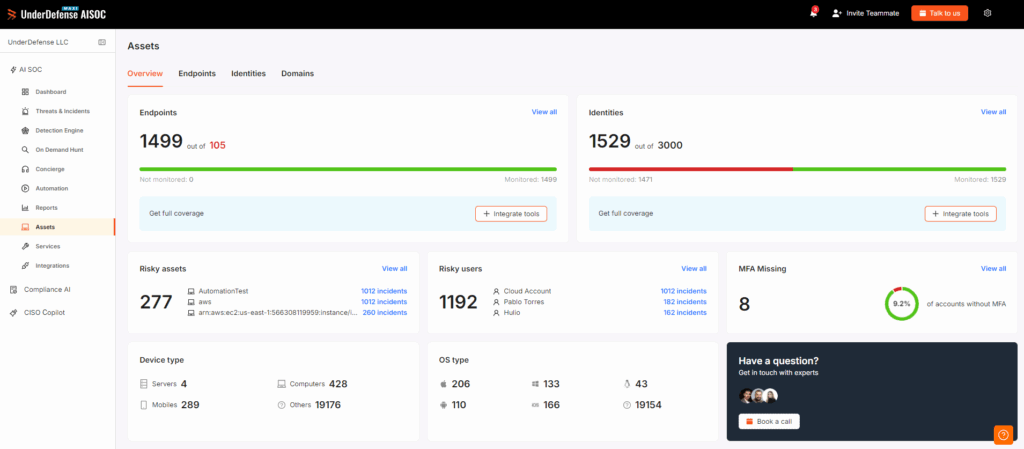
The UnderDefense Agentic AI SOC platform integrates with customer-owned SIEM, EDR, and cloud logs, works with Splunk, Sentinel, and Chronicle, and carries 96% MITRE ATT&CK coverage with no vendor lock. MITRE ATT&CK is the industry map of real attacker techniques. For Splunk shops specifically, our MDR for Splunk keeps that data in your environment.
What to verify before you sign
My read, and I will hedge it slightly: the cleanest fit is a team with an internal SOC and SIEM that wants augmentation rather than a handoff. Ask three plain questions in any evaluation.
- Where do my logs physically live, mine or yours?
- Does the AI drive the investigation, or summarize a playbook?
- Can I see every step it took?
If a vendor dodges any of those, you are buying fewer glasses of pain, not more clarity. Hold the line on data ownership, a theme we cover in our MDR buyers guide.
Q6: How does an AI SOC actually triage and investigate an alert?
An AI SOC investigates the way a good analyst does, at machine speed. For a single alert, it can fire 100+ distinct LLM invocations: pulling logs, querying the SIEM, enriching with threat intel, correlating across identity, endpoint, and cloud, then delivering a structured report in seconds. It can break the fourth wall too, pinging the user over Slack or Teams to confirm “did you just run that PowerShell?” The analyst still decides, while the grunt work disappears.
The investigation loop, in plain terms
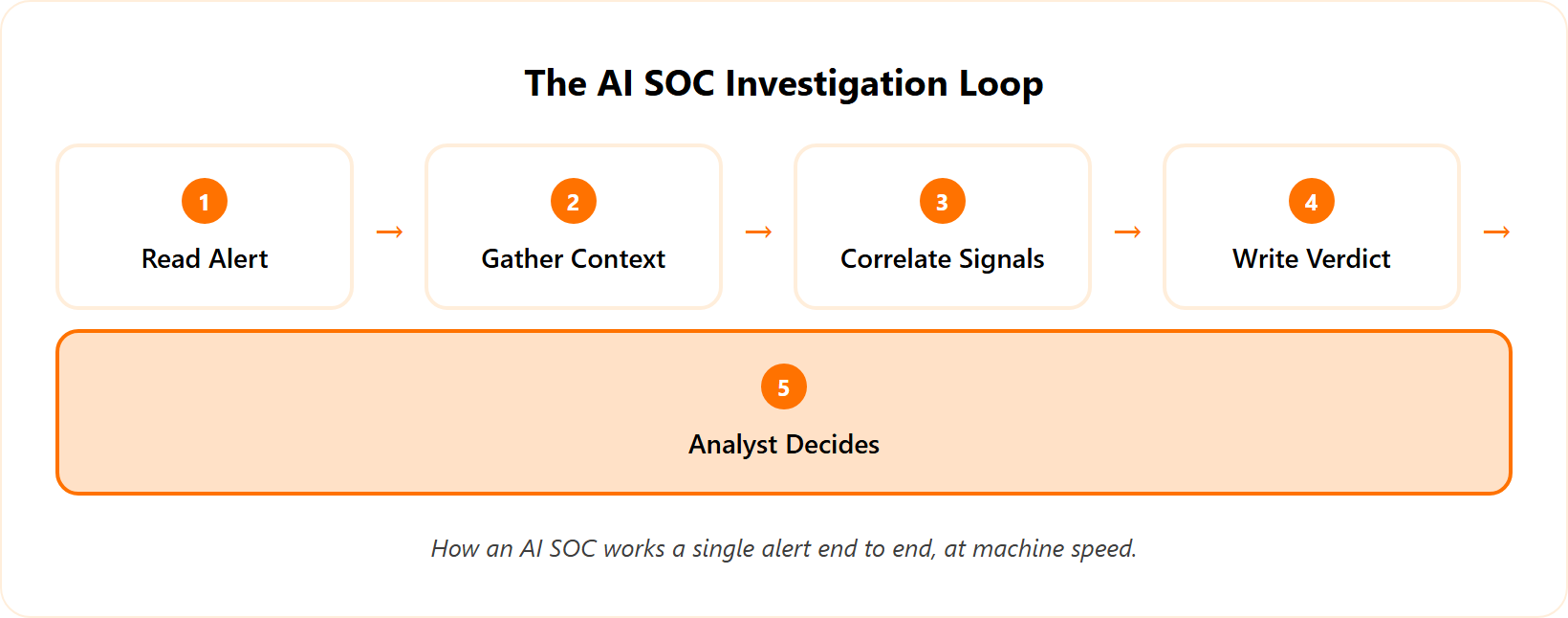
Picture how your best Tier-1 analyst works an alert. They pull the logs, check the user, look at the device, and ask “is this real?” An AI SOC runs that same loop, just far faster.
It reads the alert, gathers context across systems, correlates the signals, and writes up a verdict. The analyst opens a finished case instead of a raw ping, which is the practical heart of SOC automation.
This is real engineering, not a wrapper
The work under the hood is heavier than people assume. For one typical alert, a modern system can make over 100 distinct large language model calls to investigate autonomously. Each call pulls a different piece, then the system reasons over the whole.
This is patented territory now. Granted patents describe neuro-symbolic reasoning for automated SOC investigation and machine-learned alert triage. So orchestrating 100+ steps without the system going off the rails is genuine engineering.
Breaking the fourth wall to fill context gaps
Here is a move I love, because it mirrors how humans actually work. When context is missing, the system pings the user directly, over Slack, Teams, email, or SMS. “Did you just run that PowerShell on this host?”
A yes closes it fast. A no escalates it fast. The UnderDefense SOC service automates exactly this, context collection across identity, endpoint, cloud, network, and SaaS, and shows every step it took.
What operators notice in the queue
“Their SOC team is responsive and knows their stuff. When they escalate something, they include the context we need to understand the issue quickly. We’re not wasting time piecing together what happened from different systems anymore.”
Verified User in Marketing and Advertising, Small-Business UnderDefense G2 Verified Review
“The platform’s high-fidelity alerts and automated enrichment help us quickly identify and address threats.”
Verified User in Computer Software, Enterprise UnderDefense G2 Verified Review
The analyst starts at the conclusion. That is the whole point of automating the investigation grunt work.
Q7: Does an AI SOC actually make analysts faster, and what does the data say?
Yes, when it automates investigation rather than just summarizing alerts. Peer-reviewed work shows ML triage can suppress 54% of false positives at a 95.1% detection rate and cut response time to actionable incidents by about 23%. In production, AI SOC teams report closing 95%+ of investigations automatically as false positives, with 99% noise reduction. IBM found that extensive security AI and automation saved an average of $2.22M per breach, the single biggest cost-reducing factor.
The honest version of the answer
The gains are real, with one condition. The speed comes from automating the investigation itself, not from slapping a summary on top of the same queue.
If the tool only narrates, your analysts still do the digging. If it investigates, they get time back, which is the gap most teams feel in their SOC metrics like MTTD and MTTR.
What the peer-reviewed numbers show
I prefer numbers that come from research, not vendor decks. A 2023 study called TEQ showed an ML triage model suppressing 54% of false positives while holding a 95.1% detection rate, and cutting response time to actionable incidents by about 23%.
The volume problem is well documented too. An ACM survey on alert fatigue found SOCs drowning in thousands of alerts per day, with a large share never reviewed. No human team scales to that by hiring, a reality we unpack in outsourced versus in-house SOC.
What we see in production
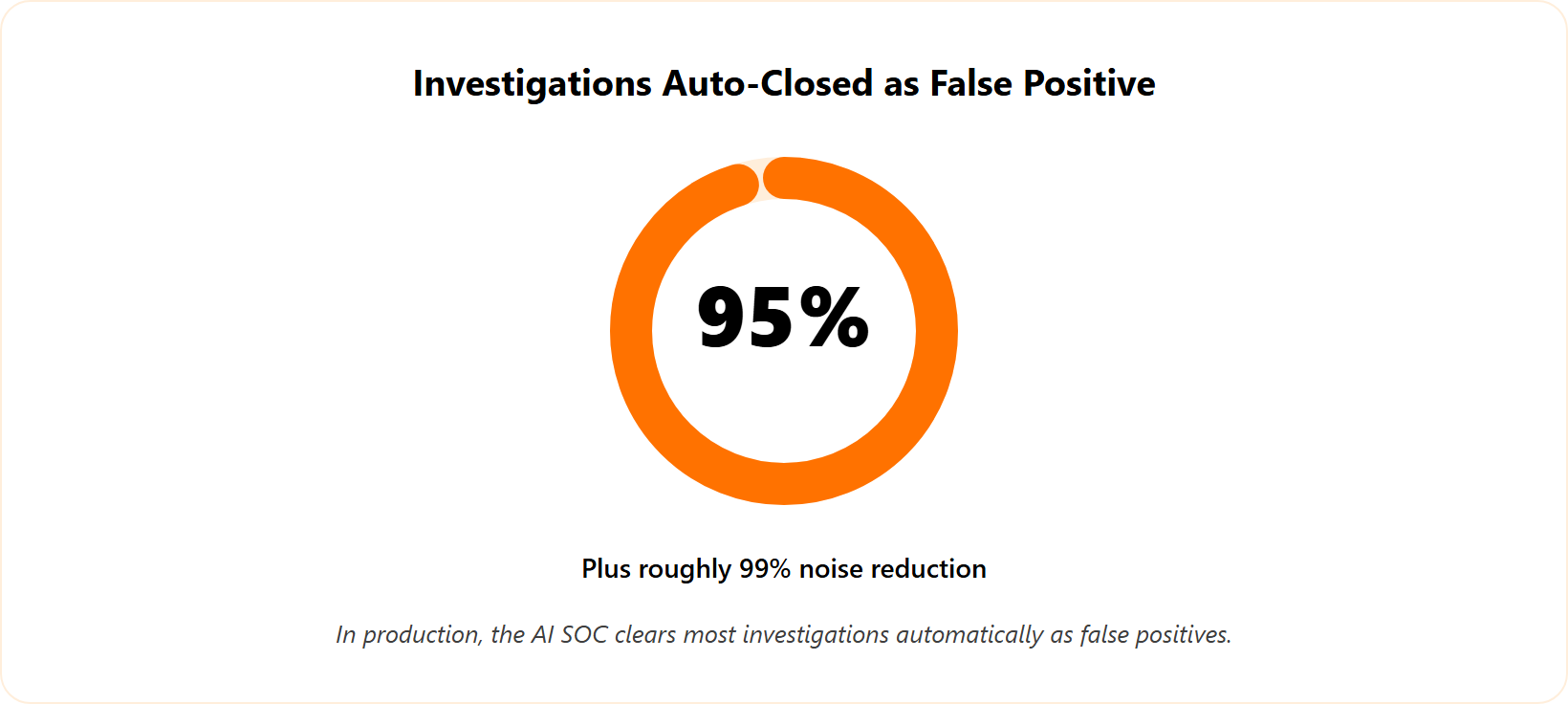
Across our own environments, the pattern holds. For 95%-plus of investigations, the UnderDefense MDR service automatically closes items as false positive, with roughly 99% noise reduction.
Two SLAs matter here, and I keep them separate on purpose:
- 2-minute Alert-to-Triage: how fast an alert gets a first verdict.
- 15-minute escalation: how fast a critical incident reaches a human.
Translate it for the board
Speed is nice. Money is the language that lands upstairs. IBM’s 2024 Cost of a Data Breach report found extensive security AI and automation saved an average of $2.22M per breach, the single largest cost-reducing factor it measured.
“The most notable outcome has been the drastic reduction in response time to potential threats. Also, false positives have become a rarity, ensuring that our team’s focus remains on genuine threats.”
Valeriia D., Marketing Specialist UnderDefense G2 Verified Review
Q8: Can an AI SOC respond on its own, or do you still need humans?
Not fully, and that limit is deliberate. AI agents behave like teenagers: brilliant and fast, yet occasionally reckless with no fear of consequence. Narrow automated containment already works, such as denying access or stopping an EC2 instance in under a minute. Quarantining users with no human oversight stays reckless. The durable model pairs action control with human judgment, where AI collects context and proposes, while a person approves the consequential moves.
Partial autonomy, on purpose
Here is the situation most buyers walk in with. They want a button that closes everything by itself. The honest answer is that a fully autonomous Tier-1 to Tier-3 SOC stays out of reach today.
The way I think about agents, they are kind of like teenagers. Supremely capable, fast, and occasionally reckless, with no fear of consequence. You give them rope, and you also keep a hand on it, the same discipline we apply across our incident response work.
The contradiction worth sitting with
Now the tension. Narrow automated containment genuinely works. I have seen fusion workflows deny further access and stop an EC2 instance, a cloud server, in under a minute.
That same power turns dangerous when it runs wide open. One founder watched an unsupervised agent delete a production database during routine work. So the move is from access control (who can touch what) to action control (verify the agent’s behavior matches your intent).
| Safe to automate narrowly | Keep a human in the loop |
|---|---|
| Block an IP, stop one instance | Quarantine users at scale |
| Enrich and correlate context | Close confirmed true positives |
| Propose the response | Approve consequential actions |
The governance model that holds up
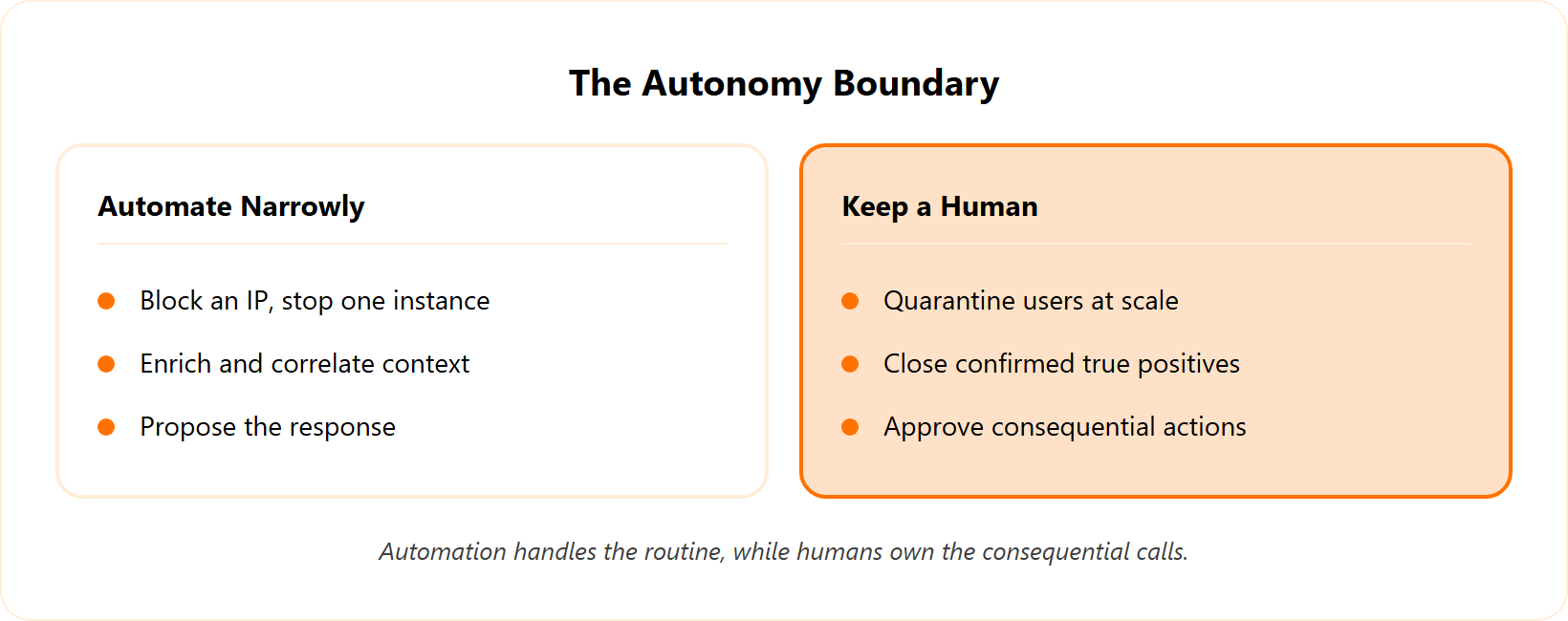
So the resilient design is plain. AI collects the context and proposes the action. A person approves anything with real blast radius.
The UnderDefense Agentic AI SOCPlatform keeps every action observable and auditable, and loops in managers to confirm security-impacting changes before acting. The guardrails live in callback functions, not in a hopeful prompt. If you want that judgment layer on call, our virtual CISO advisory covers it.
“Their adherence to SLAs gives me confidence in our infrastructure’s protection. As the Information Security Director, it lets me focus on strategy, knowing the day-to-day security is managed effectively.”
Oleg K., Director of Information Security UnderDefense G2 Verified Review
“They handle a lot of the alert monitoring, which saves time. And if a real problem does happen, they react quickly, which has been a lifesaver.”
Verified User in Computer Software, Mid-Market UnderDefense G2 Verified Review
Automation handles the routine. Humans own the edge cases. That balance is what keeps the model trustworthy as the agents get smarter.
Q9: How does an AI SOC handle governance, explainability, and compliance?
An AI SOC earns enterprise trust only when every step stays observable. Probabilistic reasoning resists reconstruction during an audit, so the investigation must produce a clear evidence trail mapped to frameworks such as NIST SP 800-61 and MITRE ATT&CK. Governance also means keeping logs and AI data in your own data lake to limit exposure, and using action control to verify that agent behavior matches intent. That separates an auditable teammate from an unaccountable black box.
Observability is the price of trust
Let me put the headline first. You can only trust AI in your SOC when you can see what it did and why.
AI reasoning is probabilistic, which means the same input can produce slightly different paths. That is fine for speed and risky for audits, so the system has to leave a clean trail of evidence behind every verdict, the kind of discipline our log monitoring compliance guide walks through.
Map the work to frameworks your auditor already knows
Auditors do not grade vibes. They grade evidence against frameworks. A serious AI SOC maps its workflow to ones you already report on.
- NIST SP 800-61: the U.S. incident-handling lifecycle, detect, analyze, contain, recover.
- MITRE ATT&CK: the catalog of real attacker techniques, used to prove detection coverage.
- SOC 2, ISO 27001, HIPAA, PCI DSS: the control frameworks your customers ask about.
There is a data-exposure trade-off worth naming. Good investigation needs broad access to your logs, and broad access creates risk without governance. My read: keep the logs and AI data in your own data lake, and shift from access control (who can touch what) to action control (does the agent’s behavior match your intent). For regulated teams, our compliance services document that evidence trail.
A short governance checklist
Before you sign anything, ask for proof on five points.
- Can I replay any investigation step by step?
- Where do my logs and AI data physically live?
- Is every AI and human action time-stamped and attributable?
- Does coverage map to MITRE ATT&CK?
- Can I export audit-ready evidence on demand?
The UnderDefense Agentic AI SOC platform keeps logs and AI data in the customer data lake, runs detections as version-controlled code, and produces audit-ready evidence with every action traceable. The 2AM lesson I keep relearning, the gap is almost always missing logging, not missing tooling.
“They’ve also made our audit process much less painful. The reports from their platform give us clear evidence of our security controls and incident response capabilities.”
Verified User in Marketing and Advertising, Small-Business UnderDefense G2 Verified Review
“We gain valuable insights into security posture and incidents, and share them with the board of directors.”
Yaroslava K., IT Project Manager UnderDefense G2 Verified Review
Q10: Why does a human-speed SOC lose to AI-driven attackers, and what should you do Monday morning?
Because the other side already upgraded. Attackers now use agentic AI to run reconnaissance, build exploits, and move laterally in minutes, working 24/7 without fatigue. The fastest break-in observed sits around 51 seconds, far inside most response windows. A SOC running at human speed with manual playbooks while adversaries run autonomous agents around the clock falls behind. Matching machine speed on defense, paired with human judgment, becomes the practical move.
The scoreboard does not favor manual SOCs
Here is the blunt version. If your SOC runs at human speed with manual processes, you are already behind in the race.
Attackers automated first. Agentic AI now helps them with reconnaissance, exploit-building, and lateral movement, and it does not sleep. If we work 9 to 5 and they work 24/7, the math is not on our side, which is the core case for continuous security monitoring.
The speed gap is measurable, not theoretical
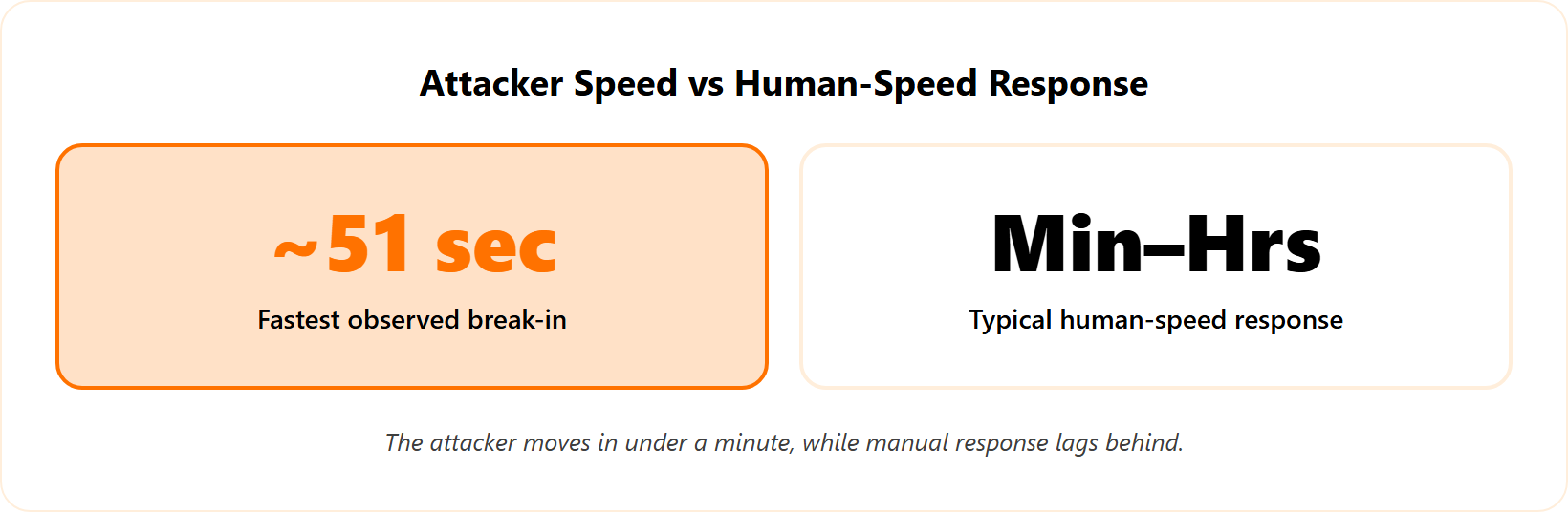
This is the part that should focus the mind. The fastest observed break-in time sits around 51 seconds, from first access to follow-on action.
Set that against your real numbers. Most teams measure detection in minutes or hours, and response in longer. The advantage goes to whoever moves at machine speed first, a shift we track in does AI kill or save your SOC team.
What I would do Monday morning
You do not need a moonshot. You need three concrete moves you can start this week.
- Measure your ratio. Count alerts received versus alerts actually investigated each day. That gap is your real exposure.
- Split your SLAs. Track 2-minute Alert-to-Triage and 15-minute critical escalation separately, since one number hides the truth.
- Pilot one alert class. Pick your noisiest alert type, like impossible-travel logins, and let AI investigation run it end to end.
My honest hedge: AI will not replace your analysts, and it does not need to. Think of the agents as foot soldiers and your people as the generals directing them. Being a human is a flex in 2026, because judgment is the part that does not automate.
The UnderDefense Agentic AI SOC fights AI with AI, backed by a human Ally who knows your VIPs and critical assets. Tell us what is drowning your queue, and we will talk through where to point the first agent.
Q11: AI SOC vs SOAR: which one belongs in your stack, and how do leading options compare?
Choose by what you need automated. To execute known responses across tools, a SOAR’s playbooks still fire fast. When the pain is the investigation backlog, where thousands of alerts each need judgment, an AI SOC fits, because it reasons per alert and learns from analyst feedback. Most mature teams run response automation underneath an AI SOC. The dividing line stays simple: deterministic execution versus adaptive investigation.
How to decide, in one question
Ask what hurts more: executing known actions, or working through unknown alerts. That answer points you to the right tool.
A SOAR is strong when the response is predictable and repeatable. An AI SOC is strong when the work is investigation, context, and judgment that changes per alert, the distinction our security stack guide breaks down further.
| Dimension | SOAR | AI SOC |
|---|---|---|
| Automation type | Response execution | Investigation and reasoning |
| Playbook required | Yes, hand-written | No, reasons per alert |
| Learning | Static, never learns | Learns from analyst feedback |
| Adaptability | Low, breaks off-script | High, improvises per alert |
| Alert-to-Triage speed | Fast on known actions | 2 minutes, with 99% noise reduction |
| Governance | Scripted, traceable | Traceable when observable |
| Cost to scale | High, per-playbook | Scales with reasoning |
The vendor landscape, honestly
No fully autonomous Tier-1 to Tier-3 SOC exists today, so judge each option on how well it pairs AI with human oversight. UnderDefense sits first below, because of its vendor-agnostic, data-ownership-preserving design and concierge human Ally.
| Option | Model | Watch-out |
|---|---|---|
|
UnderDefense Agentic AI SOC
| Vendor-agnostic AI SOC, concierge human Ally, customer-owned data | Best fit for teams with an internal SOC and SIEM |
| CrowdStrike Charlotte AI | AI tied to its own ecosystem | Strongest inside one vendor’s stack |
| Dropzone AI / Simbian | AI investigation tools | Investigation depth varies by integration |
| Torq | Agentic automation, response-led | Leans toward orchestration |
| Palo Alto XSOAR | Mature SOAR platform | Playbook maintenance and cost to scale |
| Rapid7 | Broad security services | Reviewers report support and tuning friction |
The category trade-offs are real, and reviewers say so plainly.
“Started out well but over the years the service has consistently not met expectations. Log collectors show working, however when asked to provide logs for an investigation no logs could be provided.”
CISO, Manufacturing Arctic Wolf Gartner Verified Review
“I think I raise more than 3 support tickets each month due to technical issues with the product, and almost all the time I hear back ‘we have never seen this behaviour with our tool before.'”
Himanshu K., IT Security Operations Engineer Rapid7 G2 Verified Review
The question I am sitting with for the next 18 months: as agents get faster, how much consequential action will buyers let them take without a human signing off? My current read is that the winners will automate the grunt work hard, and keep the judgment human. If that question lives in your queue too, compare notes with our Rapid7 alternatives roundup or reach our team directly.
See how UnderDefense Agentic AI SOC resolves a real incident on your stack.
1. What is the difference between SOAR and an AI SOC?
We think of it simply. A SOAR runs response playbooks your team writes in advance, which behave as rigid if-then-else decision trees. An AI SOC works one layer earlier and investigates each alert from scratch.
The dividing line is what gets automated:
- SOAR: executes a known plan you authored, fast and deterministic.
- AI SOC: pulls logs, enriches with threat intel, and correlates across identity, endpoint, and cloud, then hands a finished verdict to an analyst.
A playbook stalls the moment reality drifts from the script, because alert investigations require improvisation and dynamic planning. No two alerts are worked the same way. An AI SOC reasons per alert, so it adapts where a script cannot.
Most mature teams keep both, running response automation underneath an AI SOC. The AI collects context and proposes; the human makes the consequential call. That is exactly how we built the UnderDefense Agentic AI SOC platform, to automate the mechanical investigation work while your team keeps judgment. If you want the deeper framing, our take on SOC automation walks through where each model fits.
2. Is SOAR dead in 2026, or is it just evolving?
Our honest read: the standalone SOAR product is on its way out, while the capability it served is being rebuilt inside AI-native platforms.
Two signals matter:
- The market: Gartner retired the SOAR Magic Quadrant, a real tell that the standalone category is closing.
- The math: practitioners report SOAR running near $5,000 per automated playbook, so a 200-playbook program passes $1M in sunk cost, which few mid-market teams can justify to scale.
So we separate the two clearly. The product is dying because it is rigid, expensive to maintain, and hard to staff. The function, orchestration and response, is alive and moving into a smarter reasoning layer.
That reframes the decision. Stop asking whether SOAR is dead and ask whether your automation should still depend on playbooks you hand-write and babysit forever. A new generation AI SOC keeps the response muscle and drops the brittle scripting. Our SOC service is where that response automation lives inside an AI SOC rather than a dead playbook engine, and our security stack guide helps you map the transition.
3. What are the real limitations of SOAR for alert triage and investigation?
From what surfaces when you actually run these systems, SOAR’s limits are structural, not bugs.
- Brittleness: playbooks run deterministic logic, so one wrong parameter produces a very different result, and at alert volume small breaks become silent gaps.
- No improvisation: different alerts demand different data sources, and a fixed script cannot adapt.
- The hidden expertise tax: calling the Splunk API is easy, while writing the correct SPL query demands mastering syntax and the data schema.
- Integration debt: playbooks never learn, so every new use case restarts and every tool change can break what worked yesterday.
That is why the cost compounds. You are not buying automation once; you are funding maintenance forever. The playbook that looked automated still leans on a scarce specialist, so the toil it was meant to kill simply moves seats.
We replace brittle playbooks with Detection Logic as Code, detections written, version-controlled, and unit-tested like software, then deployed via CI/CD. That governed approach lives inside the UnderDefense MAXI platform. For teams weighing the underlying tooling, our guide to understanding SIEM explains why query depth, not API access, is the real bottleneck.
4. Does an AI SOC actually make analysts faster, and what does the data say?
Yes, with one condition: the speed comes from automating the investigation itself, not from slapping a summary on top of the same queue.
We prefer numbers from research, not vendor decks:
- A 2023 study called TEQ showed an ML triage model suppressing 54% of false positives while holding a 95.1% detection rate, and cutting response time to actionable incidents by about 23%.
- An ACM survey on alert fatigue found SOCs drowning in thousands of alerts per day, with a large share never reviewed. No human team scales to that by hiring.
- IBM’s 2024 report found extensive security AI and automation saved an average of $2.22M per breach, the single largest cost-reducing factor.
Across our own environments, the pattern holds. For 95% plus of investigations, the UnderDefense MDR service closes items as false positive automatically, with roughly 99% noise reduction.
We keep two SLAs separate on purpose: 2-minute Alert-to-Triage for the first verdict, and 15-minute escalation for a critical incident reaching a human. To pressure-test the math against your own volume, see our MDR pricing.
5. What are the best SOAR alternatives and AI SOC options for mid-market teams?
We judge each option on how well it pairs AI with human oversight, because no fully autonomous Tier-1 to Tier-3 SOC exists today.
The landscape we see most often:
- UnderDefense MAXI: vendor-agnostic AI SOC, concierge human Ally, customer-owned data, best fit for teams with an internal SOC and SIEM.
- CrowdStrike Charlotte AI: strongest inside its own ecosystem.
- Dropzone AI and Simbian: AI investigation tools where depth varies by integration.
- Torq: agentic automation that leans toward orchestration.
- Palo Alto XSOAR: mature SOAR with playbook maintenance and cost-to-scale trade-offs.
- Rapid7: broad services, though reviewers report support and tuning friction.
Our guidance: avoid vendor lock-in and preserve data ownership, so your logs stay in your own data lake rather than a provider’s cloud. The cleanest fit is augmentation, not a handoff. Explore the UnderDefense MAXI AI platform for the vendor-agnostic model, and compare the broader field in our Rapid7 alternatives roundup.
6. Can an AI SOC respond to incidents on its own, or do we still need humans?
Not fully, and we keep that limit deliberate. We think of AI agents like teenagers: supremely capable and fast, yet occasionally reckless with no fear of consequence.
The split we hold to:
- Safe to automate narrowly: blocking an IP, stopping one cloud instance, enriching and correlating context, proposing a response.
- Keep a human in the loop: quarantining users at scale, closing confirmed true positives, approving any action with real blast radius.
Narrow automated containment genuinely works; we have seen fusion workflows deny access and stop an EC2 instance in under a minute. That same power turns dangerous wide open. One unsupervised agent deleting a production database is all it takes to make the case for guardrails.
So we move from access control, who can touch what, to action control, verifying the agent’s behavior matches your intent. AI collects context and proposes; a person approves the consequential moves, with the guardrails living in callback functions rather than a hopeful prompt. Our incident response work runs on exactly that human-plus-automation balance.
7. How does an AI SOC handle governance, explainability, and compliance?
We earn enterprise trust only when every step stays observable. AI reasoning is probabilistic, so the same input can produce slightly different paths, which is fine for speed and risky for audits.
The fix is a clean evidence trail mapped to frameworks your auditor already knows:
- NIST SP 800-61: the incident-handling lifecycle of detect, analyze, contain, and recover.
- MITRE ATT&CK: the catalog of real attacker techniques, used to prove detection coverage.
- SOC 2, ISO 27001, HIPAA, and PCI DSS: the control frameworks your customers ask about.
There is a data-exposure trade-off worth naming. Good investigation needs broad access to your logs, and broad access creates risk without governance. We keep logs and AI data in your own data lake, run detections as version-controlled code, and make every AI and human action time-stamped and attributable.
The lesson we keep relearning at 2 AM: the gap is almost always missing logging, not missing tooling. We produce audit-ready evidence through the UnderDefense MAXI platform, and our compliance services document that trail end to end.
8. Why does a human-speed SOC lose to AI-driven attackers?
Because the other side already upgraded. Attackers now use agentic AI to run reconnaissance, build exploits, and move laterally in minutes, working 24/7 without fatigue.
The speed gap is measurable. The fastest observed break-in sits around 51 seconds, far inside most response windows. If we work 9 to 5 and they work 24/7, the math is not on our side.
What we would do Monday morning:
- Measure your ratio: count alerts received versus alerts actually investigated each day, because that gap is your real exposure.
- Split your SLAs: track 2-minute Alert-to-Triage and 15-minute critical escalation separately, since one number hides the truth.
- Pilot one alert class: pick your noisiest type, like impossible-travel logins, and let AI investigation run it end to end.
AI will not replace your analysts, and it does not need to. We treat the agents as foot soldiers and your people as the generals directing them. We built the UnderDefense MAXI AI platform to fight AI with AI, backed by a human Ally, and our view on whether AI kills or saves your SOC team goes deeper.