





TL;DR
- PwC’s 2025 survey of 1,802 executives found 85% say compliance requirements grew more complex in three years.
- EY’s 2025 survey found large companies send each third party 55 questionnaires on average.
- Two of these seven platforms publish a price on their own website: UnderDefense and Secureframe.
- For a first SOC 2, weigh the auditor model; at renewal, weigh cross-framework mapping and test depth.
Table of contents
- What Compliance Automation Tools Replace in an Audit Cycle
- How These 7 Compliance Automation Platforms Were Evaluated
- Compliance Automation Platforms Compared Side by Side
- The 7 Best Compliance Automation Software Solutions for 2026
- Continuous Evidence vs Audit Season: What Changes Operationally
- What Compliance Automation Software Costs in 2026
- Choosing by Audit Stage: First SOC 2 vs Renewal
- Run a Two-Week Evidence Test Before You Sign
- Frequently Asked Questions
An enterprise prospect’s security review lands with a 200-question spreadsheet and a request for your SOC 2 Type II report, and the evidence behind your last audit is eight months old. That request is now routine.
EY’s 2025 survey of 500 risk leaders at companies with $250 million or more in revenue found they send each third party an average of 55 questionnaires, and 45% of those questionnaires run 101 to 200 questions.
The rules multiply too. In PwC’s Global Compliance Survey 2025, published in March 2025, 85% of respondents said compliance requirements have become more complex over the last three years, and 82% of companies plan to invest more in technology that automates compliance work.
Automated compliance software exists so the next request gets answered from evidence collected last night. This guide compares seven platforms on framework coverage, how deep the evidence collection goes, how auditors work inside each one, and what each publishes about price.
UnderDefense publishes this guide and ranks its own product, UnderDefense MAXI Compliance AI, first. The reasoning is stated in its entry, and its limitations are listed with the same weight as everyone else’s. This guide assumes you lead security at a SaaS or technology company of 200 or more people, and that enterprise deals are what put the audit on your calendar.
See how UnderDefense MAXI Compliance AI proves your controls
What Compliance Automation Tools Replace in an Audit Cycle
Without software, audit prep runs on a spreadsheet of controls, a shared drive of screenshots and a few weeks of chasing engineers for exports. Each screenshot proves one setting on one day. When the auditor samples a different date, someone goes back for another export, and the work restarts every audit season.
Compliance automation tools connect to your cloud accounts, identity provider, code repositories, HR system and laptops through APIs or a device agent. They test each control on a schedule, attach the result as evidence and map it to every framework that shares the control. A passing MFA test can count toward SOC 2, ISO 27001 and HIPAA at once.
Most platforms on this list also bundle policy templates, a trust center for sharing your reports and AI that drafts questionnaire answers from your own policies. Board oversight, vendor contract review and policy sign-off still need a person, so SOC 2 automation covers most of the evidence work and stops at the judgment calls.
What the software does not replace is the audit itself. A SOC 2 report still comes from an independent CPA firm, and an ISO 27001 certificate from an accredited certification body. The platform decides how much of your team’s time goes into proving the controls; the auditor decides whether they work.
How These 7 Compliance Automation Platforms Were Evaluated
Every vendor below was checked on its own website and, where one exists, its AWS Marketplace listing during the first week of October 2026. Integration counts, test counts and prices are quoted as each vendor states them, and where a vendor’s own pages disagree, the entry says so.
Five criteria decided the order:
- Framework coverage, counting SOC 2, ISO 27001, HIPAA, PCI DSS and GDPR as the baseline and noting DORA, CMMC, FedRAMP and ISO 42001.
- Evidence depth, measured by the integration count, the number of automated tests and how often they run.
- Device coverage, meaning whether a laptop agent checks disk encryption, screen lock and OS updates, or whether you rely on your MDM.
- The auditor model: an audit-firm network, a bundled audit or bring-your-own, plus the access an auditor gets inside the platform.
- Price transparency, from a published rate on the vendor’s site to a quote-only form.
A sixth question carried more weight than any single feature: does the evidence show that a control was configured, or that it held up in practice? A disabled account in the identity provider is configuration evidence. Proof that nobody signed in with it after the employee’s last day is activity evidence, and only one platform here says it attaches security monitoring data to its compliance evidence.
Scope matters as well. Risk registers, policy workflows and board reporting are the core of a GRC suite, while control tests and evidence collection are the core of a compliance platform, a split worked through in GRC tools vs compliance platforms. Every platform below is built for audit evidence first, with risk registers and vendor reviews as modules.
Compliance Automation Platforms Compared Side by Side
The table follows the ranking order. Prices are the lowest figure each vendor publishes, with the source in the cost section further down; ratings are left out because the review platforms could not be checked directly for every vendor.
| Platform | Best for | How evidence is collected | Auditor model | Main limitation | Published price (from) |
|---|---|---|---|---|---|
| UnderDefense MAXI Compliance AI | Evidence backed by live monitoring | 250+ integrations, 24/7 auto-checks, security operations data | Four partner audit firms or your own | Questionnaire automation only on the top package | $499/month (Free plan $0) |
| Vanta | Broad frameworks, wide auditor choice | 400+ integrations, 1,400+ hourly tests, device monitor | 100+ audit firms or your own | One framework per tier | $14,000/year (AWS, 1-20 employees) |
| Drata | Engineering teams testing as code | 300+ integrations, daily control updates, Drata Agent | Audit Alliance of 175+ firms | Custom frameworks are an add-on on every plan | $25,000/year platform + $7,500 per framework (AWS) |
| Secureframe | Federal frameworks, published entry price | 300+ integrations, daily monitoring, device agent | Audit partner network | One custom test on the entry tier | $7,500/year |
| Sprinto | First audit with guided help | 300+ integrations, device agent, Jira sync | Network auditors or your own | 20 AI questionnaires a year | $7,500/year + $2,000 first framework (AWS) |
| Thoropass | Software and audit in one contract | API integrations vetted by its auditors | In-house CPA firm | No published integration count | $8,700/year + $5,800 SOC 2 audit (AWS) |
| Hyperproof | Multi-framework programs at renewal | 200+ integrations, scheduled syncs, no device agent | Dedicated audit space, your auditor | No published pricing | Not published |
Read the price column with care: AWS Marketplace figures are list prices, most of them for a stated headcount band, so a 500-person company should expect a private quote.
The 7 Best Compliance Automation Software Solutions for 2026
Every entry closes on a verdict that names who should shortlist the platform and the catch to check first.
1. UnderDefense MAXI Compliance AI: Best for Evidence Backed by Security Operations
Best for: Evidence backed by live monitoring
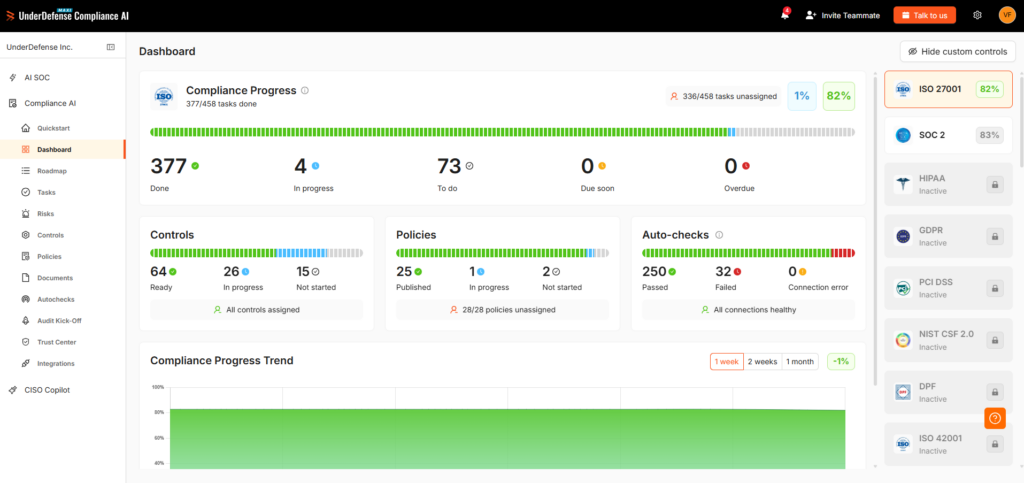
Overview: UnderDefense MAXI Compliance AI connects to your cloud, identity, code and security tools, then tests your controls against SOC 2, ISO 27001, HIPAA, GDPR and PCI DSS. UnderDefense reports 250+ integrations. The framework panel in its app also lists NIST CSF 2.0, the EU-US Data Privacy Framework and ISO 42001.
The product ranks first here for one reason. UnderDefense also runs the UnderDefense Agentic AI SOC, and for customers who use both, the same platform attaches SIEM logs, incident history and monitoring output to their compliance evidence. UnderDefense’s own example is offboarding: the evidence shows the disabled account and confirms no access came from it after the person left.
UnderDefense used the product on itself. In August 2026 it announced ISO/IEC 27001:2022 certification from an accredited certification body, run on its own platform, with its SOC 2 Type II examination in the final stage. Its trust center shows the ISO certificate and a SOC 2 Type I report behind an access request.
One customer case puts numbers on the result. In UnderDefense’s case study of Helpware, a global BPO provider running SOC 2 and ISO 27001 across 8 countries, the company reports 2x faster audit readiness and 50+ automated checks running 24/7, and it kept the same compliance team while the business doubled. The case study gives no baseline for the 2x figure.
Key features:
- Auto-checks run 24/7 against each framework’s requirements, so a configuration change that breaks a control shows up as a failed check the same day.
- A gap assessment builds a roadmap of tasks with named owners once your tools are connected; UnderDefense says customers reach 40% audit readiness in the first 40 minutes.
- A CISO Copilot reviews submitted evidence for artifact type, observation window, relevance and expiry before an auditor sees it.
- A Trust Center publishes your live controls and documents through one shareable link, with access requests and an optional custom domain.
- Questionnaire automation drafts answers from your policies and past answers, and an analyst reviews them before anything goes out.
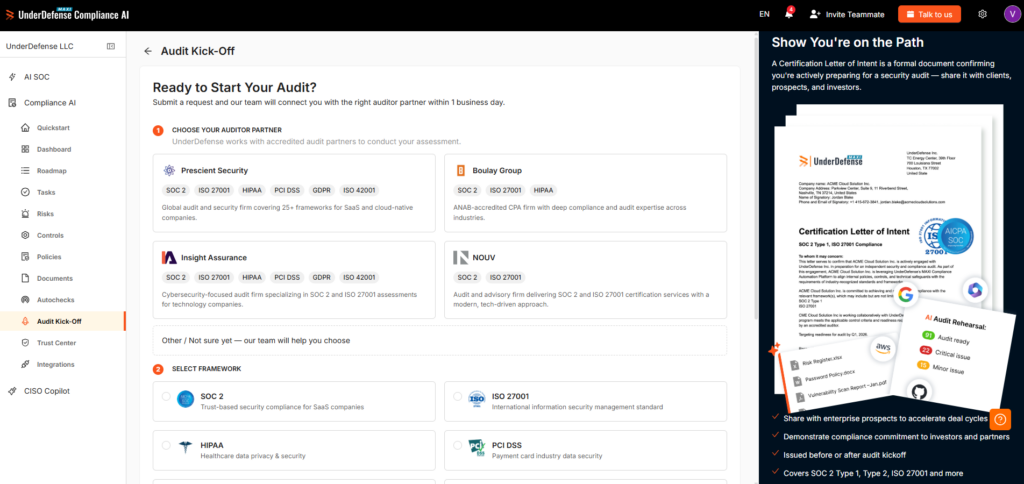
- An Audit Kick-Off screen matches you with one of four accredited partner audit firms within one business day, or you bring your own auditor with a read-only role.
How it works in practice: You connect AWS, Azure or Google Cloud, your identity provider, your code repositories and ticketing first. The gap assessment then scores each framework and turns the gaps into roadmap tasks. Policies start from expert-written templates and move through review and approval inside the platform.
When the score is high enough, the Audit Kick-Off screen asks you to choose an auditor partner and a framework, and the platform can issue a Certification Letter of Intent to share with prospects while the audit runs.
UnderDefense’s own estimates of full audit readiness run from 4 months on its top package to 18 months on the free one, so read the 40-minute figure as a starting score.
Pricing: UnderDefense publishes four monthly compliance packages: Free at $0, Starter from $499, Essential from $1,299 and Certified from $1,899. Consulting hours scale from 24 a year on Starter to 90 on Certified, with extra help at $65 an hour. Access to the auditor pool starts at Starter, and questionnaire automation (24 a month) sits only in Certified.
Pros: Prices published on its own site, compliance evidence and security monitoring from one vendor, a free package to test the workflow, expert consulting hours in every paid package, ISO 27001 run on its own product
Cons: Questionnaire automation is limited to the Certified package. Fewer public reviews cover the compliance module, since its G2 listing sits under security operations categories. UnderDefense’s own comparison concedes a narrower native integration catalog than Vanta or Drata.
How to start using it:
- Sign up for the free package and connect your cloud and identity provider first.
- Review the gap assessment for the one framework your next customer asked for.
- Assign every roadmap task to a named owner with a due date.
- Publish the Trust Center link and send it with your next security questionnaire.
- Book the audit through the kick-off screen once the readiness score stops moving.
Why it’s a good compliance automation software: It answers the auditor’s second question, whether a control held up, with security data most compliance tools never collect. The published packages let you budget before a sales call.
Clutch reviewers rate UnderDefense as a company 4.9 out of 5 across 66 reviews (September 2026), and a reviewer at Solva, which worked with UnderDefense on ISO 27001, wrote, “We successfully passed our ISO audit.”
Final verdict: Shortlist it if you want one vendor behind both your audit evidence and your security monitoring, and you value a published price. If your first priority is the largest integration catalog, test Vanta or Drata alongside it.
Want evidence your auditor and your SOC both read? Start compliance automation
2. Vanta: Best for Broad Frameworks and Auditor Choice
Best for: Broad frameworks, wide auditor choice
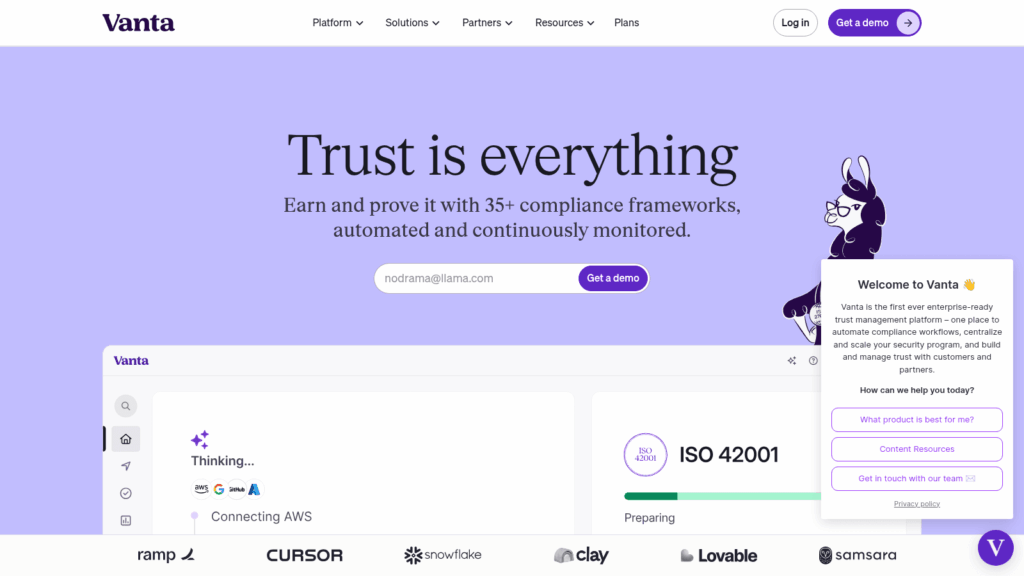
Overview: Vanta calls itself an “Agentic Trust Platform” and lists 35+ compliance frameworks on its homepage, from SOC 2 and ISO 27001 to DORA, CMMC 2.0, FedRAMP and ISO 42001. Its product page describes 1,400+ automated tests that run hourly across 400+ integrations.
The audit side is where it is widest. Vanta lists 100+ audit firms in its network and lets you bring your own; auditors work in a separate portal with a Full or Controlled view of your data. In July 2025 it acquired Riskey, a third- and fourth-party risk company, now built into its vendor risk product.
The tier structure is cumulative. Essentials already carries the Vanta AI Agent, automated evidence collection, continuous controls monitoring, an Auditor API and a Trust Center. Plus adds automated policy onboarding and access management, and Professional adds risk management with custom scoring, a dashboard and custom monitoring tests.
Key features:
- Hourly automated tests, so a failed control surfaces within the hour it breaks.
- The Vanta Device Monitor, built on osquery and read-only, which checks laptops without changing their settings.
- An auditor portal where firms see test source data, which cuts down screenshot requests.
- Questionnaire automation, with 25 questionnaires a year on Plus and 144 on Professional.
- Custom tests through the platform or the Vanta API for self-hosted systems.
Fit and setup: Vanta suits a company preparing two or more frameworks that wants to pick its own auditor. Custom tests, SCIM, custom roles and advanced reporting start at the Professional tier, so a team with self-hosted systems or strict access rules should price that tier from the start.
Vendor risk is sold standalone or as an add-on, and Vanta’s AI review of vendor security documents is available only to customers who buy that module.
Pricing: Vanta’s pricing page is a demo request. Its AWS Marketplace listing shows Essentials at $14,000, Plus at $21,500 and Professional at $23,000 for 12 months, each as a starting cost for 1 to 20 employees, with Trust Center from $6,000 and third-party risk management for up to 50 vendors at $13,600.
Pros: 35+ frameworks, hourly test cadence, 100+ audit firms to choose from, read-only device monitoring
Cons: Every tier includes one framework, custom tests start at Professional, AI vendor security reviews and continuous vendor monitoring are add-ons on every tier, so a full vendor risk program costs more than the base package.
Why it’s a good compliance automation software: Hourly tests give a multi-framework program fast feedback on drift. The auditor network and portal give you choice and fewer screenshot requests.
Final verdict: Shortlist Vanta if you expect to add frameworks every year and want auditor options. Price the Professional tier if you run self-hosted systems.
3. Drata: Best for Engineering-Led Control Testing
Best for: Engineering teams testing as code
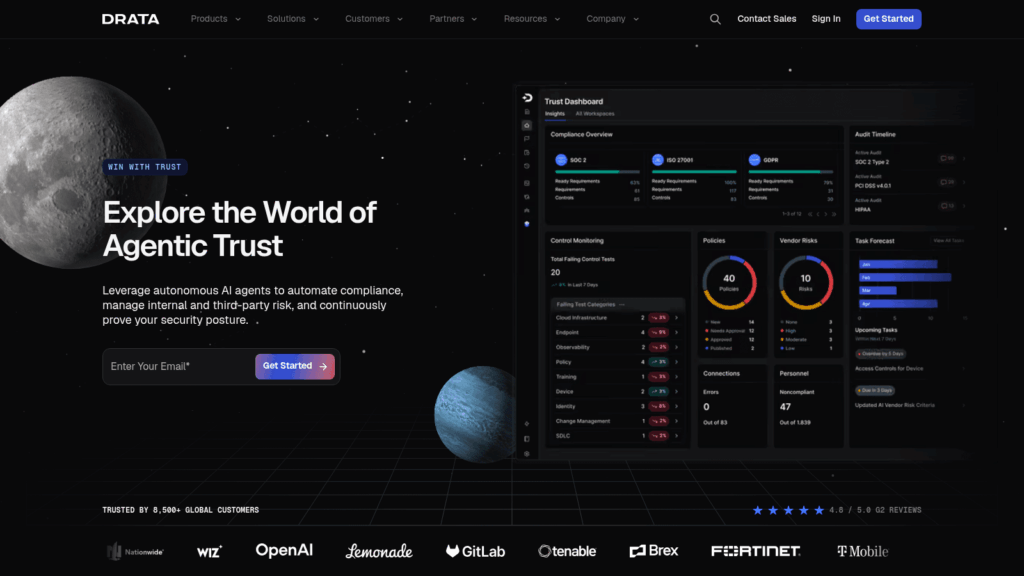
Overview: Drata lists 30+ pre-built frameworks and connects to over 300 tools, or your own systems through its API. Its test library holds 1,000+ infrastructure tests across AWS, Azure and Google Cloud, and control statuses update daily.
Drata bought SafeBase in February 2025 and folded the brand into Drata in March 2026, so its trust center is the product SafeBase built. Its Compliance as Code feature lets engineers manage controls in the same workflow as infrastructure changes.
The product splits into tracks. GRC plans cover controls, evidence and risk; Assurance plans cover the trust center and questionnaires, with AI help for 10 questionnaires on the entry Assurance plan; vendor risk is a separate product, which gained agentic assessments in September 2026. Its risk module starts from a pre-mapped library of 150+ risks.
Key features:
- The Drata Agent for macOS, Windows and Ubuntu, with read-only access to disk encryption, screen lock, antivirus and update settings.
- Compliance as Code, so control checks live next to the infrastructure they test.
- Audit Hub, a portal where auditors pick samples and request documents.
- The Audit Alliance, which Drata says includes 175+ audit firms.
- AI Questionnaire Assistance and a trust center inherited from SafeBase.
Fit and setup: Drata fits a company whose engineers already work in infrastructure as code and want controls in the same pipeline. Its entry plan is capped at 50 employees and one framework from a fixed list of five, so a 200-person company starts at Advanced or above.
Advanced opens any available framework plus custom connections and tests; Enterprise adds user access reviews and the Pro versions of risk management and compliance as code.
Pricing: Drata shows no prices on its own site. Its AWS Marketplace listing prices the platform at $25,000 for 12 months with capacity for a 100-employee organization, each framework at $7,500, and the Trust Center and Risk Management modules at $25,000 and $50,000.
Pros: 1,000+ cloud infrastructure tests, compliance as code, a large audit-firm alliance, a mature trust center
Cons: The entry plan stops at 50 employees, custom frameworks are an add-on even on Enterprise, separately priced modules on AWS mean a full program can run well past the $25,000 platform fee.
Why buyers shortlist it: Its test library and compliance-as-code workflow suit teams that treat controls like software. Auditors get a dedicated workspace for sampling.
Final verdict: Shortlist Drata if your engineers own compliance work and live in infrastructure as code. Add up the modules before comparing its price with the rest.
4. Secureframe: Best for Federal Frameworks and a Published Entry Price
Best for: Federal frameworks, published entry price
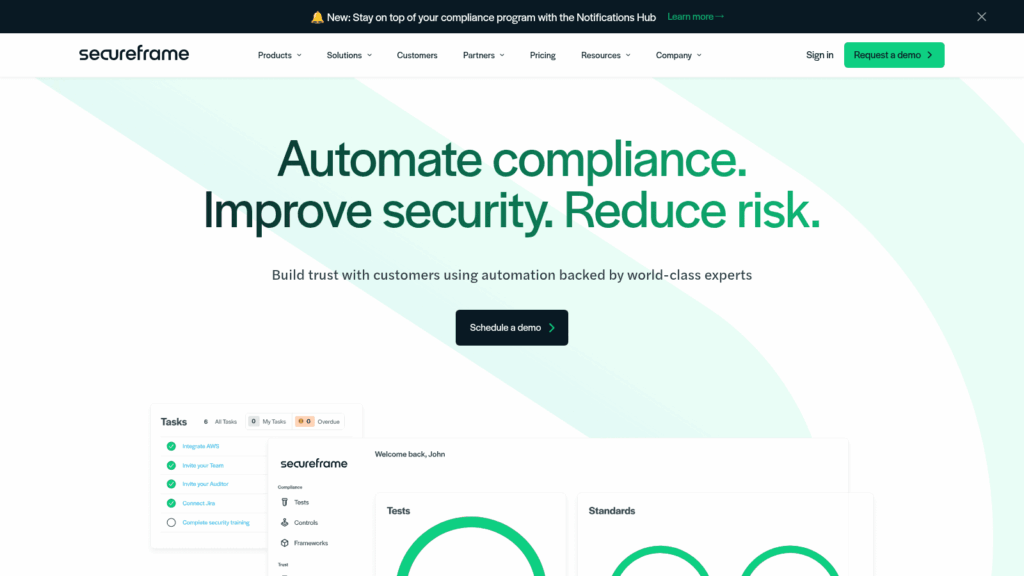
Overview: Secureframe publishes a price on its own pricing page, which few vendors here do: its Fundamentals tier starts at $7,500 a year. Its frameworks page names 35 frameworks, counted one by one for this guide, grouped as commercial, federal, privacy and AI, including FedRAMP, GovRAMP, TX-RAMP and CMMC 2.0.
The federal focus is recent and deliberate. Secureframe launched Secureframe Defense for CMMC in March 2026 and announced its own FedRAMP 20x Moderate authorization in May 2026. Its homepage cites more than 30 in-house compliance experts and former auditors, and its AWS listing says each customer is assigned a dedicated compliance expert who is a former auditor.
The 2026 releases point the same way: user access reviews arrived in April and a hosted MCP server in August, so AI assistants your team already uses can query compliance status directly.
Key features:
- Continuous daily monitoring with alerts for failing tests across 300+ integrations.
- The Secureframe Agent, a background process that checks firewall, disk encryption and password policy on each laptop.
- Free audit readiness support with every subscription, from a team that includes former auditors.
- Comply AI for remediation, risk, policies and control mapping, plus Trust AI for questionnaires.
- Custom tests with your own query logic, including tests for on-premises systems on the higher tier.
Fit and setup: Secureframe fits a company selling to US government or defense buyers, or one that wants a known entry price before talking to sales. Teams that need SSO, SCIM or unlimited custom tests should plan for the Complete tier, which is quote-only. Complete also lifts Trust Center document requests from 15 a year to unlimited and adds automatic vendor and shadow-IT detection.
Pricing: Fundamentals starts at $7,500 a year on Secureframe’s site. Its AWS Marketplace listing shows the platform for up to 100 employees at $7,500 plus the first framework at $7,500 for 12 months, so confirm which figure covers your scope.
Pros: Published entry price, federal and defense frameworks, former auditors on staff, daily monitoring
Cons: Fundamentals allows one custom test, AI questionnaire automation is capped at 100 questions a year on Fundamentals against 15,000 on Complete, SSO and SCIM need the quote-only Complete tier.
Its real strength: It is the only vendor here that pairs a price on its own site with FedRAMP and CMMC on its framework list. That makes early budgeting easier for government-facing SaaS.
Final verdict: Shortlist Secureframe if US federal or defense customers are on your roadmap. A 200-person company should price Complete from the start.
5. Sprinto: Best for a First Audit With Guided Help
Best for: First audit with guided help
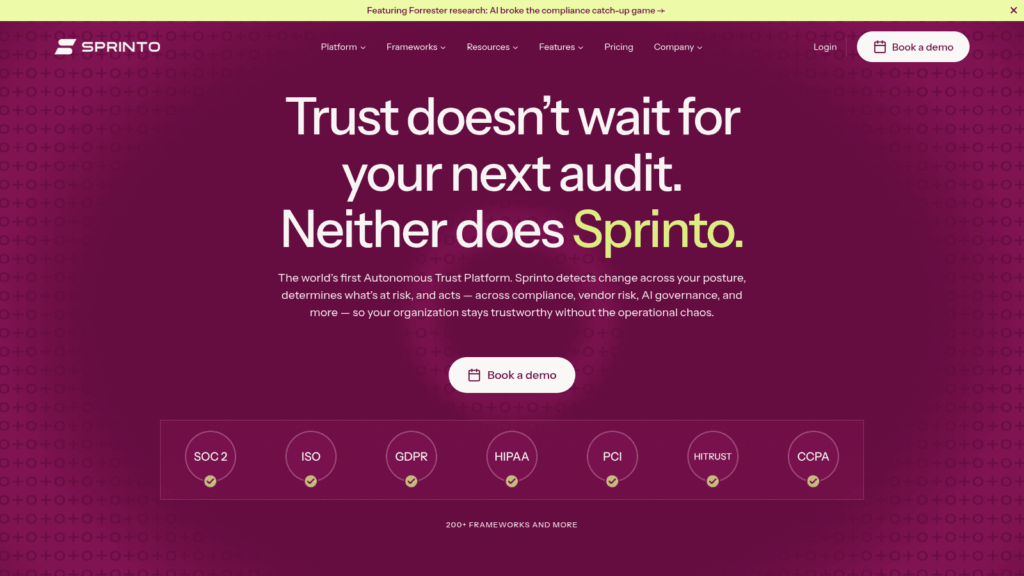
Overview: Sprinto now calls itself an “Autonomous Trust Platform.” Its pricing page says 25+ frameworks are automated out of the box, with 200+ more digitized, and it lists 300+ integrations. Each plan includes one framework of your choice.
What sets it apart for a first audit is support. Sprinto’s in-house lead auditors guide customers through their first audit as standard, and an in-platform channel lets your external auditor work with you directly.
The Growth plan is where operations scale. It adds custom workflows and API access, multi-step approvals, configurable SLAs, Slack and Teams support with weekend priority, quarterly business reviews and a dedicated customer success manager. AI features include an evidence gap analysis and custom AI agents. Its framework picker lists SOC 2, ISO 27001, HIPAA, PCI DSS, GDPR, NIST CSF, ISO 42001, DORA and CMMC Levels 2 and 3.
Key features:
- A device agent that checks encryption, OS and password posture on each laptop.
- Two-way Jira task sync, so a failed check becomes a ticket in your engineers’ queue.
- Programmable custom checks and a rule engine on the Growth plan.
- Auditor access through Sprinto’s network or your own, with an in-platform collaboration channel.
- A public trust center with a custom domain.
Fit and setup: Sprinto suits a team heading into its first certification that wants hands-on guidance. RBAC, custom roles and multi-step approvals sit on the Growth plan, which a company of 200 or more with separated duties will likely need.
Pricing: Sprinto’s site has no prices. On AWS Marketplace, Sprinto lists a 12-month Starter Platform covering companies of 100 employees or fewer at $7,500, with the first compliance framework from $2,000; enterprise risk, vendor risk and multi-entity Zones are paid add-ons.
Pros: Guided first audit, two-way Jira sync, 300+ integrations, low AWS list entry point
Cons: AI questionnaire automation is capped at 20 a year on both plans, RBAC and custom roles need Growth, FedRAMP is not on its framework list.
Why it made this list: The guided first audit removes the biggest unknown for a team that has never been through one. Its Jira sync keeps remediation in tools engineers already use.
Final verdict: Shortlist Sprinto for a first certification with guidance included. A team fielding dozens of questionnaires a year will outgrow the 20-a-year cap.
6. Thoropass: Best for Software and Audit in One Contract
Best for: Software and audit, one contract
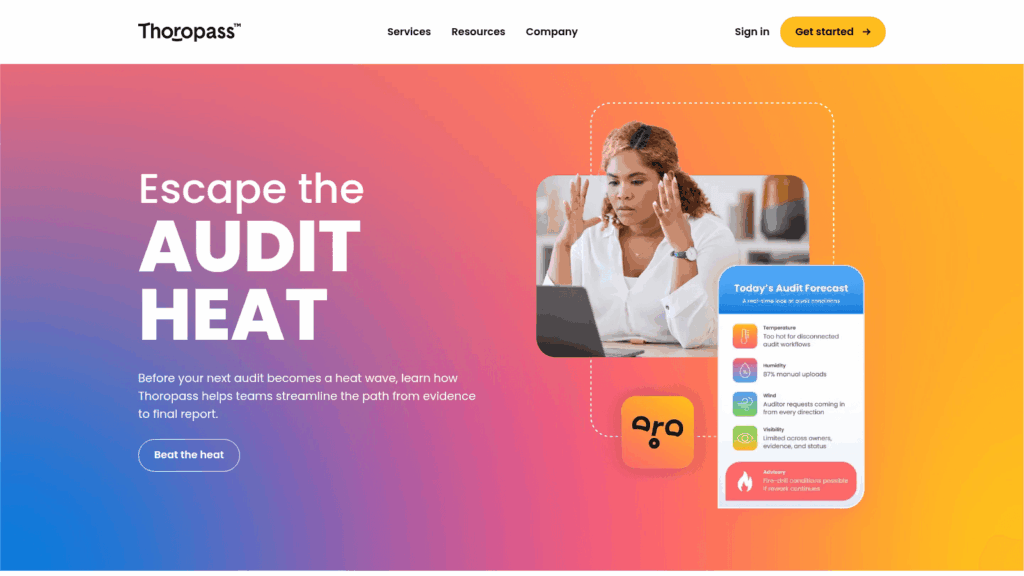
Overview: Thoropass is the only vendor here that owns its audit firm. Thoropass Assurance, renamed from Laika Compliance in December 2025, is a licensed CPA firm registered with the AICPA, and in September 2026 a sister entity was accredited to run ISO 27001:2022 certification audits.
Thoropass now describes itself as an audit lifecycle platform, and its FAQ says it can sit on top of a third-party GRC platform you already run. Its integrations are vetted and approved by its auditors, and a feature called First Pass AI screens evidence before the auditor reviews it.
Its 2026 releases added Smart Sort AI in January and an MCP server in July, alongside a generative AI tool for due diligence questionnaires. Industry pages target SaaS, fintech and healthcare, which matches its HITRUST e1, i1 and r2 coverage.
Key features:
- A bundled audit from its own CPA firm, with one vendor for readiness and the report.
- First Pass AI, which pre-screens evidence for gaps before the audit.
- Integrations its auditors have approved, which reduces disputes over evidence format.
- Frameworks including SOC 1, SOC 2, ISO 27001, HITRUST, HIPAA, PCI DSS, NIST CSF 2.0 and ISO 42001.
- Penetration testing and vulnerability scanning from the same vendor.
Fit and setup: Thoropass fits a company that wants one contract and one team from readiness to report, or one that already runs a GRC tool and needs the audit side. If your board or customers want the auditor contracted separately from the software vendor, read its independence page before signing.
In December 2025 Thoropass reported that its CPA firm received a pass, the highest rating, on its AICPA peer review.
Pricing: Thoropass publishes no price on its site and quotes software and audit together. Its AWS Marketplace listing shows the platform, including the first framework, from $8,700 and a SOC 2 audit subscription from $5,800, each for 12 months.
Pros: In-house CPA firm, auditor-approved integrations, works on top of an existing GRC tool, pentesting available
Cons: No published integration count, DORA and FedRAMP are not on its framework list, some buyers prefer an auditor with no commercial tie to the readiness software.
Who should shortlist it: Teams that want readiness and audit from one accountable vendor. It also suits teams keeping their current GRC tool.
Final verdict: Shortlist Thoropass if one contract matters more to you than auditor choice. Confirm its framework list covers your next market first.
7. Hyperproof: Best for Multi-Framework Programs at Renewal
Best for: Multi-framework programs at renewal
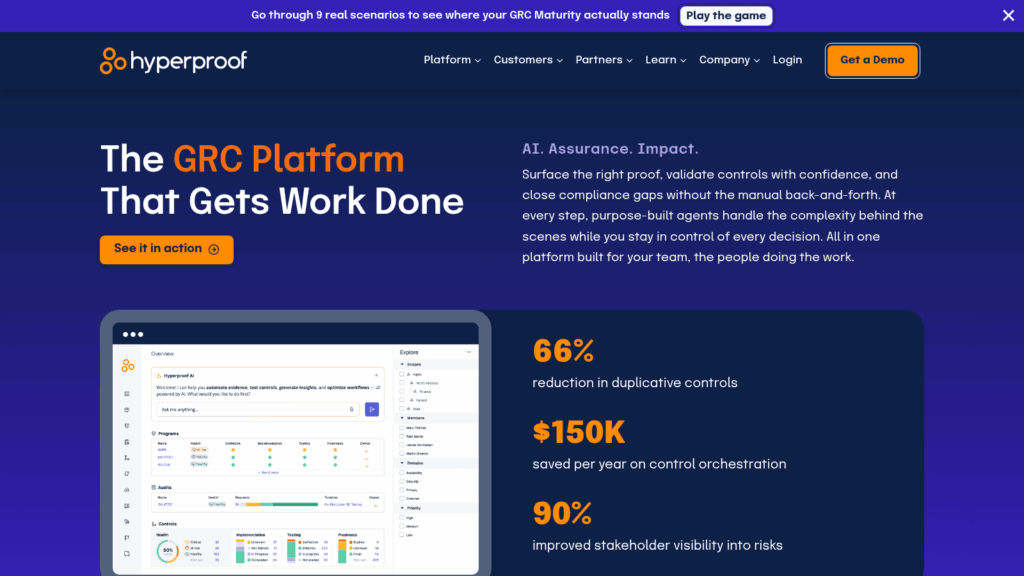
Overview: Hyperproof describes itself as built for large, multi-framework organizations. Its frameworks page lists 160+ pre-built frameworks (its AI page says 140+), and cross-framework mapping lets one control serve several programs. Remediation tasks can flow to Jira, ServiceNow or Asana.
Evidence arrives through Hypersyncs, which collect on demand or on a schedule you set, and Livesyncs, which pull continuously from cloud storage. In October 2025 Hyperproof acquired Expent.ai for vendor risk work, and in March 2026 it announced FedRAMP Moderate authorization.
Key features:
- Cross-framework control mapping, so a renewal that adds a framework reuses existing controls.
- A custom test builder with spreadsheet-style syntax and configurable failure responses.
- Two-way ServiceNow sync and Jira issue creation for remediation work.
- A dedicated audit space where requests link to controls and evidence.
- AI agents named Discover, Validate, Advise and Act, currently in an early access program.
Fit and setup: Hyperproof suits a company running three or more frameworks, often at its second or third renewal, with a GRC owner who lives in ServiceNow or Jira. It has no device agent, so laptop evidence comes through your MDM and endpoint integrations. It supports multiple risk registers and added a trust management product in April 2025, and Hyperproof Gov runs in a FedRAMP environment for public-sector programs.
Pricing: Hyperproof publishes no prices, and its pricing link redirects to a product page with a proposal request. No AWS Marketplace listing was found, so budget only after a scoped quote.
Pros: 160+ frameworks, cross-framework mapping, two-way ServiceNow sync, FedRAMP Moderate authorization
Cons: No published pricing, AI features require the early access program with tenant-level opt-out only, no laptop agent of its own.
Where it beats the alternatives: Its mapping depth pays off when every renewal adds a framework. ServiceNow teams get remediation inside their existing workflow.
Final verdict: Shortlist Hyperproof for a mature, multi-framework program. For a first SOC 2, the platforms higher on this list fit better.
Start a guided compliance walkthrough →
Continuous Evidence vs Audit Season: What Changes Operationally
A SOC 2 Type II report covers a period of time, usually several months, and the auditor samples dates across it. Under an audit-season model, your team rebuilds that period from exports and screenshots in the weeks before fieldwork, and any gap in the middle stays invisible until the auditor finds it.
Continuous evidence flips the timing. Vanta runs its tests hourly, Drata and Secureframe update daily, Hyperproof syncs on the schedule you set, and UnderDefense runs auto-checks 24/7. A control that breaks on a Tuesday shows up as a failed test that week, while it is still cheap to fix.
The operating change shows up in four places:
- Engineers fix drift as tickets during normal sprints, so the pre-audit crunch shrinks to a review.
- Security questionnaires get answered from current evidence, often through a trust center link sent with the first reply.
- The auditor samples from a system of record, so screenshot requests drop and fieldwork shortens.
- Renewals start from a year of stored evidence, so the second audit begins where the first one ended.
The questionnaire point is where the sales team feels the difference. A shared trust center lets one link answer the repeated questions buyers send, a pattern covered in the case for a supply-chain trust center. When enterprise buyers each send dozens of questionnaires, a single source of current answers is worth more than any one automated test.
Configuration Evidence and Activity Evidence
Most automated tests check configuration. They confirm MFA is enforced, a storage bucket is private and a departed employee’s account is disabled. That proves a control was set up correctly at the moment of the test.
Activity evidence answers a harder question: did anyone use the gap before it closed? It comes from sign-in logs, endpoint telemetry and SIEM data, which compliance automation platforms rarely read. When the auditor asks about a late offboarding, configuration evidence shows when the account was disabled, and activity evidence shows nobody used it in between.
Ask each vendor in your pilot which kind its tests produce, because security compliance automation tools differ most on this point. A platform that only produces configuration evidence still saves months of work, but you will need your security team’s logs for the activity questions.
What Compliance Automation Software Costs in 2026
Price transparency varies widely across compliance automation software. Two vendors on this list publish a price on their own site, four publish list prices on AWS Marketplace, and one publishes nothing.
| Platform | Lowest published figure | Where it is published | What the figure covers |
|---|---|---|---|
| UnderDefense MAXI Compliance AI | $0, then $499, $1,299 and $1,899 per month | UnderDefense pricing page | Monthly packages; auditor pool from $499 |
| Vanta | $14,000 per year | AWS Marketplace | Essentials package, 1-20 employees |
| Drata | $25,000 per year + $7,500 per framework | AWS Marketplace | Platform for a 100-employee organization |
| Secureframe | $7,500 per year | Secureframe pricing page | Fundamentals tier, one framework |
| Sprinto | $7,500 per year + $2,000 first framework | AWS Marketplace | Starter platform, up to 100 employees |
| Thoropass | $8,700 per year + $5,800 SOC 2 audit | AWS Marketplace | Platform with first framework, plus audit |
| Hyperproof | Not published | None found | Proposal request only |
Three adjustments make these numbers comparable. Add the audit fee for every vendor except Thoropass, whose AWS listing prices one next to the platform. Add a framework fee for each standard beyond the first. Then replace each AWS list price with the private quote your headcount triggers, since the Vanta, Drata and Sprinto figures cover 100 employees or fewer.
A compliance platform competes for the same budget line as your SOC tooling and managed services, so size them together in your security budget planning for the coming year. Plan for the second-year price too, because most of these lists price each added framework or module separately.
Choosing by Audit Stage: First SOC 2 vs Renewal
The right platform depends less on company size than on where you sit in the audit cycle. A first audit and a third renewal need different things from the same category of software.
Your First SOC 2 or ISO 27001 Audit
For a first audit, the auditor relationship and the guidance matter most. You need help choosing scope, writing policies and picking an auditor whose report your enterprise buyers will accept.
Most first-time teams also face a sequencing choice. A SOC 2 Type I report tests whether controls are designed correctly on one date, and a Type II report tests whether they operated across a period. A common sequence is to hand a Type I to an urgent prospect and start the Type II observation window the same week, which works only if evidence collection is already automated.
Thoropass bundles the audit, Sprinto guides the first audit with in-house lead auditors, Secureframe includes free readiness support, and UnderDefense pairs the platform with consulting hours and an auditor match within one business day. If your team has never scoped an audit, compare the human help as closely as the software, or bring in compliance consulting for the scoping work.
Renewals and Added Frameworks
At renewal, the work shifts from building controls to keeping them working and adding frameworks without duplicating effort. Cross-framework mapping, test depth and custom tests decide how much the second framework costs in hours.
Hyperproof’s mapping and Vanta’s hourly tests suit this stage, and Drata’s compliance-as-code fits teams that want controls in their pipelines. Check per-framework pricing before renewal talks, because Vanta, Drata, Secureframe and Sprinto all include one framework in their base packages.
Renewal is also the moment new frameworks arrive from the sales pipeline: ISO 42001 from customers asking about AI, DORA from European financial clients, CMMC from defense work. Before you renew, list the frameworks your next four quarters of deals will ask for and confirm each one is on the vendor’s list, since Thoropass, for example, lists neither DORA nor FedRAMP.
Run a Two-Week Evidence Test Before You Sign
Demos show finished dashboards. A two-week trial on your own systems shows how much of your evidence a platform collects without manual uploads, which is the number that decides your team’s workload.
- Pick one framework and the five controls your last auditor sampled most.
- Connect the same cloud account, identity provider and code repository to your top two platforms.
- Count how many of those controls each platform tests automatically after one week.
- Break one control on purpose, such as disabling MFA for a test user, and time how fast each platform flags it.
- Send each vendor’s trust center link to a friendly customer and ask whether it would answer their questionnaire.
- Ask each vendor which questions its evidence cannot answer, then decide who on your team will answer them.
The platform that tests the most of your sampled controls and flags the broken one first is usually the right buy, whatever the demo looked like. For teams fielding many questionnaires, also run a past questionnaire through each vendor’s questionnaire tool, UnderDefense’s questionnaire automation included, and compare the drafts with your submitted answers.
Bring your last auditor’s sample list and one live questionnaire. Walk through it with UnderDefense
Frequently Asked Questions
Does compliance automation software replace the auditor?
No. The attestation and the certificate stay with licensed auditors and accredited registrars, whichever platform you pick. The software collects and organizes evidence and gives the auditor access to it. Thoropass is the one vendor here that owns a CPA firm, and even its AWS listing prices the audit as a separate subscription.
How long does SOC 2 readiness take with compliance automation tools?
It depends on how many controls you already run. UnderDefense’s own package estimates range from 4 to 18 months to full readiness, and a Type II report then needs an observation period of several months on top. Platforms shorten the evidence work; they cannot shorten the observation window your auditor sets.
Can one platform cover SOC 2 and ISO 27001 at the same time?
Yes. Most platforms here map one control to several frameworks, so an MFA test counts toward both. Most base packages include one framework, though, so check the price of the second before you sign. Helpware, in UnderDefense’s case study, ran SOC 2 and ISO 27001 together across 8 countries.
Do security compliance automation tools need an agent on employee laptops?
Most do. Vanta, Drata, Secureframe and Sprinto each ship a device agent that checks settings such as disk encryption and password or screen-lock policy. Hyperproof has no agent and relies on your MDM and endpoint integrations. If your MDM already reports those settings, an integration can replace a second agent on every laptop.
Which automated compliance software publishes its prices?
UnderDefense publishes four monthly packages from $0 to $1,899 on its own site, and Secureframe publishes a $7,500-a-year Fundamentals tier. Vanta, Drata, Sprinto and Thoropass list prices on AWS Marketplace, mostly for small headcount bands. Hyperproof publishes no figure on its site or on AWS Marketplace.
Book a 30-minute
compliance readiness session
- See which SOC 2 or ISO 27001 controls your stack already passes
- Get a gap list with a named owner for every open task
- Get matched with an accredited audit partner within one business day