









Your SOC 2 auditor or a customer’s security review wants an offensive test by a fixed date, and the two quotes on your desk use “red team” and “pentest” for different work. Buy the wrong one, and the report doesn’t cover the systems they asked about, so the audit or the deal waits for a second test.
Here is how to tell the two tests apart and which one to buy first.
TL;DR
- A penetration test asks what can be exploited; a red team asks whether anyone would notice.
- Buy the pentest first while critical findings are open or no SOC watches your environment.
- Buy the red team once known gaps are closed and your SOC has been through a purple team session.
- The guide covers what each report should contain, how providers price each test, and when a customer, auditor, or regulator decides the test for you.
Table of contents
- How a Penetration Test and a Red Team Differ
- Red Teaming vs Penetration Testing Side by Side
- What a Penetration Test Proves
- What a Red Team Proves That a Penetration Test Cannot
- Which Test to Buy First
- When a Customer, Auditor, or Regulator Names the Test
- How UnderDefense Runs Penetration Tests and Red Team Engagements
- What Each Costs and How Providers Price Them
- Frequently Asked Questions
Whoever asked rarely says which answer they want. Even so, red team vs penetration testing is a choice between two questions, and the report you get back can answer only the one you paid for.
This guide is for CISOs, IT Directors, and Heads of Security who have to answer a request for a security test. You’ll leave knowing which test answers your request, what each report should contain, and the order to buy them in.
UnderDefense, which publishes this guide, runs both tests, so it walks through each one from the buyer’s side.
Not sure which test your requester asked for? Get it scoped
How a Penetration Test and a Red Team Differ
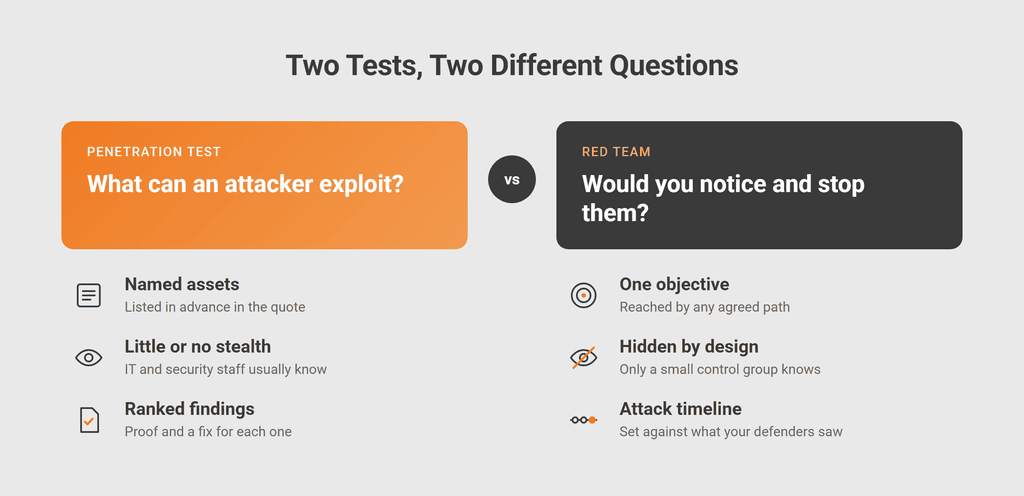
A penetration test answers “what can an attacker exploit?” and a red team answers “would you notice and stop them?” Both use real attack techniques, which is why quotes blur them.
What a penetration test is
NIST SP 800-53 Rev. 5 (2020) defines penetration testing as “A test methodology in which assessors, typically working under specific constraints, attempt to circumvent or defeat the security features of a system.”
The constraints are the point. Once you name the scope, such as an external perimeter, a web application, or an Entra ID tenant, testers try to break everything inside it, usually with your IT team’s knowledge.
Success is a ranked list of what an attacker could exploit, with proof of each finding, so your engineers can fix it. Scope comes in several types of penetration tests. The type you pick decides which assets get covered.
What a red team is
The Committee on National Security Systems glossary (CNSSI 4009-2022), the source the NIST glossary carries for red team, describes “A group of people authorized and organized to emulate a potential adversary’s attack or exploitation capabilities against an enterprise’s security posture.” The same entry says the aim is to show the impact of successful attacks and what works for the defenders.
A red team starts from an objective, such as reaching the finance system or taking over a privileged Entra ID account. It takes whatever path gets there, keeps quiet along the way, and only a small control group at your company knows it’s happening.
Success is a timeline of what the attackers did, set against what your SOC saw and did about it. A third format often sits between the two: a purple team session, where testers run techniques openly while your analysts watch and tune detections until they fire.
Which one to buy depends on what’s still open in your environment and on who asked for the test, which the later sections work through.
Red Teaming vs Penetration Testing Side by Side
The table below sets out penetration testing vs red teaming on the seven points that change what you buy. The pentest lengths come from UnderDefense’s published tiers and the red team minimum from the EU’s Digital Operational Resilience Act (DORA) rules of 2025; every other row is this article’s judgment, drawn from the definitions above.
| Point of comparison | Penetration test | Red team |
|---|---|---|
| Question answered | What can an attacker exploit? | Would you notice and stop them? |
| Scope | Named assets, listed in advance | An objective, by any agreed path |
| Who knows it’s happening | IT and security staff, usually | A small control group |
| Stealth | Little or none | Central to the test |
| Length at UnderDefense’s published tiers | 2 weeks (Standard) or 3 to 4 weeks (Professional) | Scoped per objective; at least 12 weeks active under DORA |
| Output | Ranked findings with proof and fixes | Attack timeline against what defenders saw |
| Who should buy it (judgment) | Teams with open findings or no SOC | Teams with closed findings and a tested SOC |
🔍 Read the scope row first when you compare two quotes. A proposal that lists IP ranges, applications, and cloud accounts and promises a findings list is a pentest, whatever its title says.
A proposal that names objectives, states who at your company will be told, and reports against detection is a red team. If a quote says “red team” and then lists assets, ask which alerts it will measure.
The length row tells you how much of the time before your deadline the testing itself will take. A red team’s length follows its objectives, so ask each provider to state it in the quote; for a regulated test under DORA, the active phase alone lasts at least 12 weeks.
The stealth row explains why neither test can stand in for the other. A pentest has no reason to hide, so testers can run loud scanners and work through every asset in scope.
A red team pays for its stealth in coverage: it follows a few quiet paths to the objective and leaves much of your environment untouched. A clean red team result tells you little about the assets it never visited.
A clean pentest, for its part, tells you nothing about whether your analysts would have seen the testers at work. Know which of those two gaps you’re closing before you compare prices.
What a Penetration Test Proves
A penetration test proves that a specific chain of weaknesses works on your real systems. One of UnderDefense’s own engagements shows how far that proof goes. If your last report listed findings and said nothing about detection, this one marks the line between the two questions.
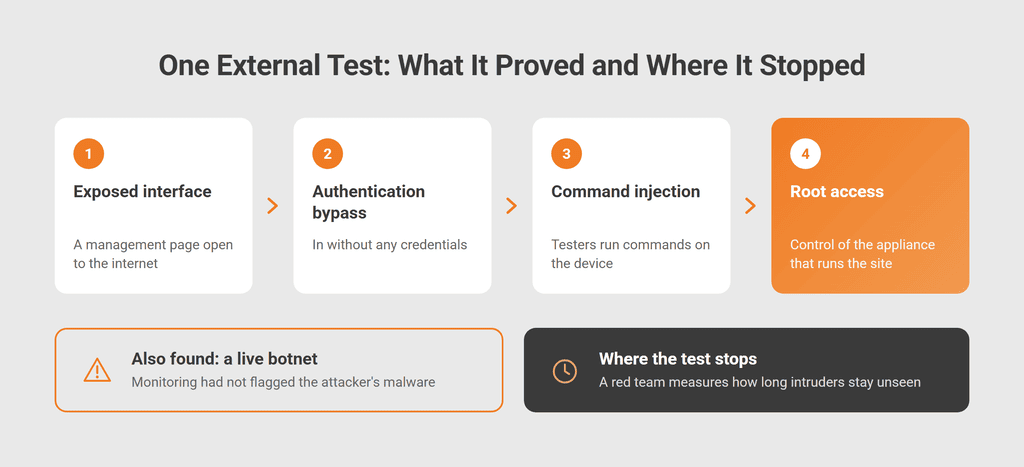
In one external penetration test, UnderDefense’s team gained full root access to a network appliance that controlled an entire client site. The client stays anonymous, so the lesson sits in the chain itself.
Three critical UniFi OS vulnerabilities made it possible, and the chain needed no credentials, no phishing, and no prior access to the network. Anyone who found the exposed device could have walked the same path.
The flaws are CVE-2026-34908, CVE-2026-34909, and CVE-2026-34910, each rated 10.0 on the Common Vulnerability Scoring System (CVSS), the top of the scale, which puts them first in any patch queue. The first two were authentication bypasses on a management interface exposed to the internet.
The third let the testers inject commands, which a service account’s sudo rights carried through to root. That’s the proof a pentest delivers: an exploitable chain on a live system, with enough evidence for an engineer to reproduce it and close it.
A customer or auditor can read that result and know what was tried, while your team gets a clear first fix. The test also found something nobody had scoped.
The appliance was also running botnet malware placed by a real attacker, and the client’s monitoring had not flagged any of it: the appliance ran no agent and sent no logs, so nothing could flag it. One engagement surfaced an exploitable chain and a live compromise on the same device.
That last line raises the second question every CISO carries: would anyone notice a real attacker? On that one appliance, the finding shows monitoring missed the intruder.
The test can’t tell you how long an intruder would stay unseen across Entra ID, your endpoints, and AWS, because the testers set out to find and prove a way in. A pentest finds the open door; measuring how long someone could stay inside unseen takes a different test.
What the pentest report should contain
Ask to see a sample of a penetration testing report before you sign, because the sample shows what your requester will eventually read. It should include:
- The scope, the dates, and the method (black box, gray box, or white box, meaning how much the testers know about your systems up front)
- An executive summary a board or customer can follow
- Each finding’s severity, proof of exploitation, and steps to reproduce
- Remediation guidance for each finding
- Retest results showing which findings are closed
📝 The retest line is the one a requester reads most closely, since it shows whether the findings you paid to discover were ever fixed. A report without it leaves the same question open at the next renewal.
What a Red Team Proves That a Penetration Test Cannot
A red team proves how your detection and response behave against someone trying to stay hidden. It adds three things a pentest leaves out: objectives, stealth, and timing.
An objective gives the test a finish line and pushes the testers to chain identity, endpoint, and cloud weaknesses the way an intruder would. Stealth means your SOC, in-house or outsourced, works the activity as if it were real, so you see how an escalation runs at 2 a.m.
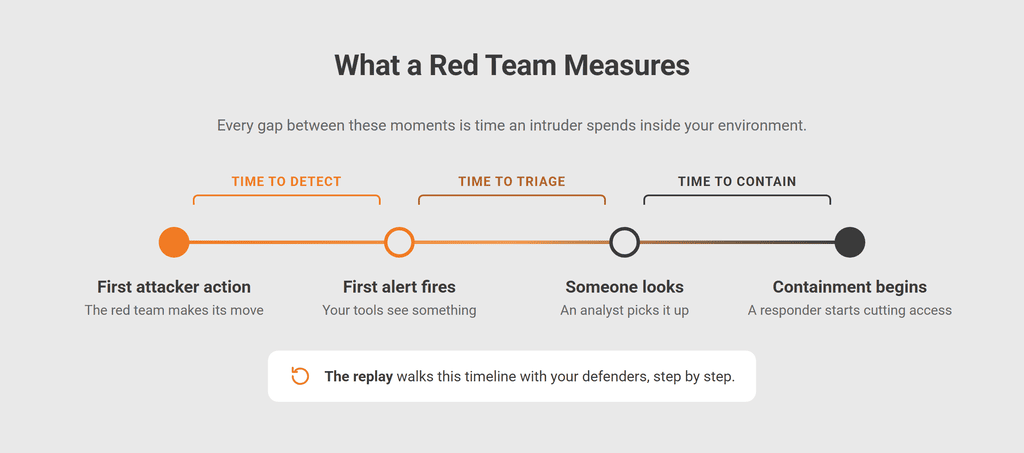
Timing is the measurement itself: when the first action happened, when the first alert fired, when someone looked, and when containment began. Those gaps are the time to detect, to triage, and to contain, and each one is time an intruder spends inside.
Regulators have published where this tends to break. The 2025 CBEST thematic from the Bank of England, the Prudential Regulation Authority (PRA), and the Financial Conduct Authority (FCA) (page last updated January 2026) draws on 13 CBEST assessments run in 2025. CBEST is the UK regulators’ intelligence-led program of live testing at key financial institutions.
Those 13 were live tests at real firms, so the findings come from simulated attacks on production systems.
Firms with insufficient detection, such as poorly tuned monitoring or alerting, it found, “were less able to detect potential cyberattacks in the early stages of the simulated attack.” You may answer to a different regulator, but the pattern carries over: those gaps surface when someone runs a simulated attack and watches the response.
The same page warns that “tactical fixes alone are insufficient,” since quick remediation can leave the underlying weakness in place. Retest and root-cause notes keep a pentest from ending in tactical fixes; a red team shows which of those causes still let an attacker through.
UnderDefense saw the same pattern in a purple team and phishing simulation at a leading US food producer. In the first phishing wave, 43 of the 331 people who received the emails clicked the malicious links. During the simulation, “A 10GB file was exfiltrated to Dropbox,” and “6 days of silent C2 activity” (command and control) went unnoticed by the food producer’s security monitoring.
The purple team replay
The replay is where a red team pays back its cost. Testers and defenders walk the timeline together, step by step: this was the action, this is what your endpoint detection and response (EDR) tool logged, this is why nobody was paged. Run as a purple team session, it goes further, with testers repeating a technique while your analysts tune the detection until it fires.
What the red team report should contain
A red team report earns its fee only when it ties each attacker action to a defender response. Look for these parts in any sample a provider shows you:
- The objectives, and whether each one was reached
- The attack path, step by step, with timestamps
- What each step left in your logs, and who acted on it
- Time to detect and time to contain, measured across the engagement
- Underlying causes, with fixes in priority order
- A date for the replay session
- The evidence handling and clean-up record
If a sample stops at a list of exploited weaknesses, you’re looking at a pentest report with a different title, and the detection question stays open. That question is usually the one the board asked.
Find out which alerts your SOC would miss in a red team
Which Test to Buy First
Buy the pentest first if critical findings are open or no SOC watches your environment. Once findings are closed and your SOC is live and tested, buy the red team.
A red team run against open critical findings spends your budget proving what the last report already said. With nobody watching, a stealth test leaves no response to measure.
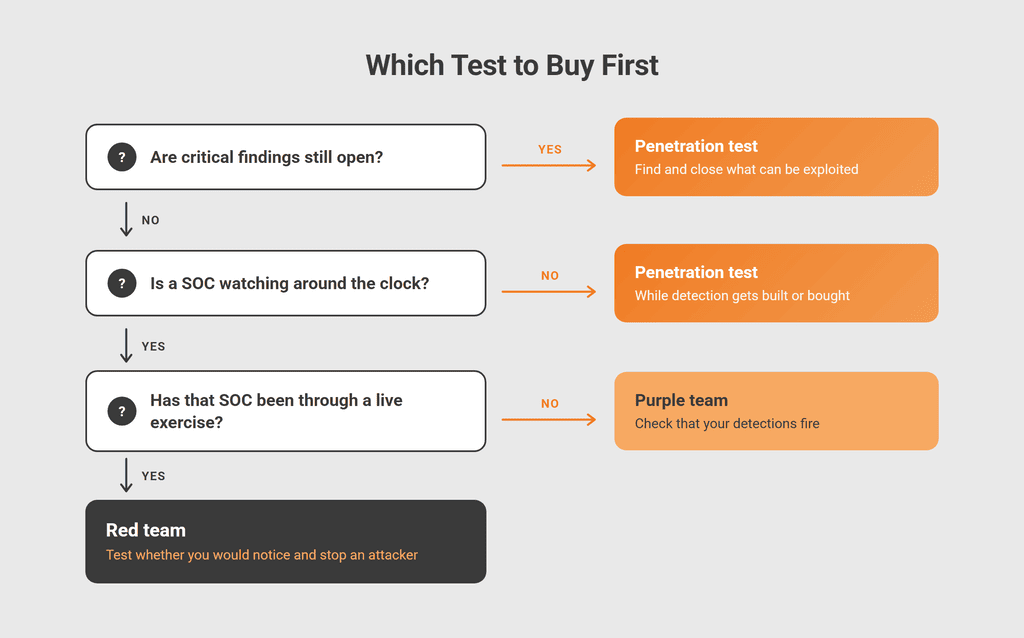
Work through your own program in order. Are last year’s critical and high findings closed? Is someone watching Microsoft 365, your EDR, and AWS around the clock?
Has that SOC been through a purple team session yet? The table maps your answers to the next purchase, and it’s this article’s judgment, so weigh it against who asked for the test.
| Where you are today | Buy next (judgment) | What it answers |
|---|---|---|
| No recent test, or critical findings open | Penetration test | What can be exploited today? |
| Findings closed, nobody watching around the clock | Penetration test, while detection gets built or bought | Did the fixes hold? |
| SOC is new or recently changed | Purple team | Do your detections fire? |
| Findings closed, SOC live and tuned | Red team | Would you notice and stop them? |
| Red team done, fixes shipped | Red team with new objectives | Did detection improve? |
⚠️ Two situations bend that path. A dated request from a customer or auditor comes first, so buy what it names and plan the next step afterward. A large change, such as a cloud migration or an acquisition, moves the affected systems back to the first row even when the rest of the company sits further along.
Whichever row you land on, the result depends on the groundwork. Time spent preparing for a pentest (scope, access, and who gets told) keeps testers on the assets that matter.
The same discipline applies to a red team’s objectives and control group. Once the first report is closed, the next row is usually the better use of your 2027 budget.
When a Customer, Auditor, or Regulator Names the Test
When a customer or auditor asks for “a pentest,” they usually want dated, third-party evidence that someone tried to break the systems they depend on. SOC 2 and ISO 27001 don’t prescribe a pentest, though auditors often ask for one as evidence that controls work.
So read the request literally before you price anything. A red team report seldom fits it: it covers a few paths by design and carries sensitive detail about your detection gaps that you may not want in a customer’s file. Before you buy, put these questions to whoever asked:
- Which systems must the test cover?
- How recent must the evidence be, and by what date?
- Will a summary or letter of attestation do, or do you need the full report?
- Do you require a specific test type or method?
The answers often settle the choice in one email, while giving you something concrete to put in front of both providers. Who asked also tells you which question sits behind the words. A customer’s security team and an auditor usually want the first question answered, with coverage and a date.
An insurer’s form deserves the same literal reading, so ask the broker what the underwriter will accept. A board that says “red team” is often asking the second question, would anyone notice, and the decision table above tells you whether that test is ready to give a useful answer.
Regulated red teaming is different, because the rule sets the method. In the EU, threat-led penetration testing (TLPT) under DORA and TIBER-EU, the European Central Bank’s red teaming framework, set it. In the UK, CBEST does. Both apply only to selected financial firms under their regulators.
If your firm is in one of those programs, your regulator’s process sets the scope. There, running a red team assessment involves a control team, threat intelligence, and a formal closure. UnderDefense runs DORA threat-led penetration testing, so a firm in one of those programs can scope its TLPT and its annual pentest with one provider.
How UnderDefense Runs Penetration Tests and Red Team Engagements
UnderDefense scopes both tests in one conversation and prices the pentest before you call: its published Standard tier includes manual exploitation, the full technical report, a letter of attestation, and a free post-remediation retest. The same engineers, with CEH, OSCP, and OSCE credentials, cover network, cloud, web application, and red team work, as they have since the company was founded as a penetration-testing firm in 2017.
Your 2027 budget gets a starting number from published pentest pricing. Standard starts at $8,000 (2 weeks), and its letter of attestation serves as evidence for SOC 2, ISO 27001, PCI DSS, and HIPAA. Professional starts at $12,000 (3 to 4 weeks).
An external vulnerability assessment of your perimeter, with a summary report, starts at $5,000 (External Perimeter, up to 5 days). Red team work is quoted per engagement, so bring the objective you want tested and ask for the days behind the figure. If your customer or auditor wants a test report or a letter, price from Standard upward.
G2 rates UnderDefense 5.0 out of 5 from 83 reviews as of November 2026. On Clutch, a VP of Security and Compliance at a legal tech company with 501 to 1,000 employees wrote of a gray-box test that “they were not just using tools to test.”
For clients who also run the UnderDefense Agentic AI SOC, test findings feed detection and SOC response, so analysts turn what the testers found into detections.
Pentest or red team? Ask the team that runs both
What Each Costs and How Providers Price Them
With pentests priced by scope and days and red teams quoted per objective, the two numbers on your desk measure different work. A lower figure on one quote says little until you know which question it answers.
Most providers build a pentest quote from the assets in scope and the tester days those assets need. The IP ranges, cloud accounts, and internal access you include all move that number, and so does the box model, since black box work spends tester days on discovery.
Applications add their own drivers. A web application penetration testing quote moves with the number of user roles and APIs, and with whether testers work in production or staging.
Red team quotes move with different things: the number of objectives, the paths you allow (phishing and physical entry among them), how long the team stays active, the threat intelligence behind the scenarios, and the replay. Ask each provider to show days by activity and to state what’s excluded, retest and replay above all.
Two quotes, each broken down by activity, tell you more than any published average.
Bring the request on your desk; UnderDefense scopes the matching test
- Review your attack surface and what belongs in scope
- Choose between a pentest, a purple team session, or a full red team
- Find out which report your requester needs: a summary, a full report, or a letter
Frequently Asked Questions
Is red teaming better than penetration testing?
Neither is better, because they answer different questions. A penetration test shows what can be exploited, while a red team shows whether you’d notice and stop it. Red teaming pays off once known exploitable gaps are closed and a tested SOC is in place, which is why it usually comes later in a security program.
Can a red team replace an annual penetration test?
No. A red team follows a few paths to an objective, so most of your assets go untested, and a customer or auditor asking for coverage won’t get it from that report. Keep the pentest on its annual schedule and add the red team alongside it.
Do you need a penetration test before a red team?
In most cases, yes. A recent pentest gives you the findings to close, so a red team doesn’t spend its time rediscovering them. A company that already tests regularly, keeps its findings closed, and has a live, tested SOC can go straight to a red team.
What is purple teaming?
Purple teaming has testers run attack techniques openly while defenders watch, check what was logged, and tune detections until they fire. It suits a new SOC, or the replay after a red team, because the team learns and measures at the same time.
How long does a red team engagement take compared with a penetration test?
A red team’s length depends on its objectives. UnderDefense’s published pentest tiers run 2 weeks (Standard) or 3 to 4 weeks (Professional). For a DORA threat-led test, the EU’s 2025 rules say the active red team phase “shall last for at least 12 weeks,” so a regulator’s date needs the most lead time.