








Your EU customer’s procurement team sent the data processing agreement (DPA) back with an Article 32 annex to fill in and a breach-notification clause to sign, and the contract won’t be signed until you do. A privacy spreadsheet can list the measures, but it can’t show that any of them actually runs.
This guide shows which of nine tools can prove it, and which work stays with your team.
TL;DR
- GDPR compliance software does two jobs, privacy operations and security of processing, and most tools lean toward one.
- Nine tools are compared by the GDPR articles they produce evidence or workflow for, from records of processing to breach notification.
- Six of these nine lead with privacy operations, and few of them answer an Article 32 annex alone.
- A closing section maps the seven steps between an alert and a 72-hour notification, and which of them a tool can carry.
Table of contents
- GDPR Compliance Software Covers Two Jobs: Privacy Operations and Security of Processing
- What EU Regulators Handled in 2025 and What It Means for Your Tool Choice
- Seven Criteria for Choosing GDPR Compliance Software
- GDPR Compliance Software Compared Side by Side
- The 9 Best GDPR Compliance Software Solutions for 2027
- The 72-Hour Clock: What Has to Happen Between an Alert and a Notification
- Frequently Asked Questions
GDPR compliance software can close that gap once you know which job you’re buying it for. This guide compares nine tools on one template and sorts them by the GDPR articles they produce evidence or workflow for.
Every competitor fact was read on the vendor’s own site in November 2026, and prices and product names are as each vendor published them then. UnderDefense MAXI Compliance AI, ranked first, keeps Article 32 evidence current from live security data and runs the incident and breach-notification workflow that Articles 33 and 34 call for.
This list stays on software products. If you’re also weighing outside help, GDPR compliance services are a separate purchase with a separate comparison.
Disclosure: UnderDefense publishes this article and ranks its own UnderDefense MAXI Compliance AI first, using the same template and criteria as every other entry. The ranking is this article’s own assessment.
Prove your GDPR security measures before an EU customer asks
GDPR Compliance Software Covers Two Jobs: Privacy Operations and Security of Processing
GDPR compliance software splits into two jobs, and most products are built for one of them:
- Privacy operations covers the record of processing activities (RoPA), data subject requests (DSRs), impact assessments, and consent.
- Security of processing means showing that your technical measures run, then catching and reporting a breach when they fail.
The privacy job comes from Articles 30, 15 to 22, 35, 6, and 7 of the GDPR (Regulation (EU) 2016/679), in application since May 2018. The security job comes from Article 32, which asks for appropriate technical and organizational measures, and from Articles 33 and 34 on breach notification.
📎 Your customer’s annex draws on the second group, while most privacy spreadsheets only record the first. A contract explains why the annex lands on your desk.
Article 28(3)(f) has the processor assist the controller with its obligations under Articles 32 to 36, and Article 28(3)(h) has it make available the information needed to demonstrate compliance. Here is how the two jobs divide between a tool and your people.
| Job | GDPR article | What a tool can automate | What stays with people |
|---|---|---|---|
| Records of processing | Art. 30 | Inventory, updates from connected systems, exports | Purposes and lawful basis |
| Data subject requests | Arts. 15 to 22 | Intake, identity checks, retrieval, deletion tasks | Exemptions and disputed requests |
| Data protection impact assessments (DPIAs) | Art. 35 | Triggers, templates, routing | Judging risk, signing off |
| Consent | Arts. 6 and 7 | Banners, receipts, withdrawal logs | Choosing the lawful basis |
| Security measures | Art. 32 | Tests of encryption, multi-factor authentication (MFA), and logging | Choosing measures that fit the risk |
| Breach notification | Arts. 33 and 34 | Alerts, triage, templates, deadlines | Risk assessment, the decision to notify |
A GDPR compliance platform of any size can hold the evidence and route the work, and your data protection officer (DPO), privacy lead, or security lead still owns each decision. The split resembles the older governance, risk, and compliance debate over GRC tools vs compliance platforms: find out where your gap sits before you compare features.
What EU Regulators Handled in 2025 and What It Means for Your Tool Choice
EU regulators ran a large cross-border caseload in 2025, and their coordinated work centered on how companies handle individuals’ rights. So your tool should leave a record a regulator or a customer can read later. The EDPB Annual Report 2025, published in April 2026 by the European Data Protection Board, gives the figures.
In 2025, 414 cross-border cases were created in the EDPB’s case register, according to that report. Authorities also triggered 1,299 One-Stop-Shop procedures under Article 60, where one lead authority coordinates a cross-border case. Of those, 572 led to final decisions.
Those are procedures between authorities. For a processor, that cooperation means a case about one of your customers can reach authorities in several countries, and each reads the same records.
The same report describes the 2025 coordinated enforcement action on the right to erasure: 32 authorities took part and 764 controllers responded, with the findings published in February 2026. Weigh that when you compare request workflows. Logged deadlines, exemption decisions, and proof of deletion carry more weight than a polished intake form.
A non-EU processor meets this in two ways. Article 3(2) can apply GDPR directly when processing relates to offering goods or services to people in the EU or monitoring their behavior there. More often, the pressure arrives first through your customer, whose authority can ask how it chose and supervises you.
Reporting rules are moving too: the EDPB adopted a common breach notification template in June 2026. Ask each vendor how quickly its breach forms will follow it.
A tool helps most inside a regulatory compliance program that already has owners and deadlines.
Seven Criteria for Choosing GDPR Compliance Software
Choose GDPR software against these seven criteria, because together they cover both jobs and show where each product stops. Ask vendors to demonstrate each one on screen, using a system from your own stack.
1. Data Mapping and Records of Processing
Article 30 needs a current record, and the export is the test. Does the inventory update from Okta, Entra ID, Salesforce, and HubSpot, or from surveys alone? If you’re a processor, you also keep the separate Article 30(2) record, which the tool should handle too.
2. Data Subject Request Workflow
Look for identity verification, deadlines, retrieval across systems, and an audit log for the rights in Articles 15 to 22. Then ask which connectors can delete data, since some can only report what they hold.
3. DPIA Workflow
A useful tool flags the Article 35 trigger, pre-fills the assessment from your records, and captures your DPO’s review. Templates alone leave the linking between records and assessments with your team.
4. Consent Management
Articles 6 and 7 matter most if you run consumer-facing properties, and a B2B processor may need far less here. Where consent matters, check for timestamped receipts, easy withdrawal, and enforcement in downstream systems.
5. Article 32 Evidence From Live Systems
The tool should show that each measure in your annex runs. Ask for tests that read encryption, MFA, and logging settings from AWS or Azure, Okta or Entra ID, and CrowdStrike or SentinelOne.
Find out how often each test runs and what your customer sees when one fails. A control library with attestations documents intent, and your customer may ask for more. Teams drafting the Article 32 annex for the first time often bring in a compliance consulting team for the risk assessment, then keep the evidence current in a platform.
6. Breach Detection and the 72-Hour Workflow
Finding an incident and managing the notification are separate jobs, and many privacy tools start once someone reports an incident. Ask first what feeds them, then check for risk assessment, notification templates, deadlines, and an Article 33(5) record.
7. Processor and DPA Tracking
You’re someone’s processor, and you have subprocessors of your own, so Article 28 runs in both directions. Look for vendor records tied to processing activities and subprocessor visibility. Does the tool track DPA terms, or only store the files?
GDPR Compliance Software Compared Side by Side
The table below sorts all nine by main focus, request workflow, and Article 32 evidence, using what each vendor documents on its own site. Read the “Main focus” column first, since it tells you which half of GDPR each product was built around.
| Vendor | Best for | Main focus | Data subject request workflow | Article 32 evidence from live systems | Other frameworks | Published pricing |
|---|---|---|---|---|---|---|
| UnderDefense MAXI Compliance AI | A DPA annex due now | Security of processing and breach workflow | Pair with a privacy tool | Yes, from connected security tools | SOC 2, ISO 27001, HIPAA, PCI DSS, DORA, NIST CSF 2.0 | Yes, four packages |
| OneTrust Privacy Automation | Multi-jurisdiction privacy offices | Privacy operations | Yes, listed on Suite | In a separate package | California’s Consumer Privacy Act (CCPA), Brazil’s data protection law (LGPD) | No |
| TrustArc | Teams wanting a validation letter | Privacy operations | Yes, Individual Rights Manager | Control mapping and attestation | CCPA, HIPAA, ISO 27001 | No |
| Osano | Consent-first programs | Privacy operations | Yes, Subject Rights | Not described on product pages | Many privacy laws, incl. CCPA | Yes, consent plans |
| Securiti Data Privacy | Both jobs on one data graph | Both | Yes, DSR Automation | Data and access monitoring | NIST’s AI Risk Management Framework, EU AI Act | No |
| DataGrail | Small, non-technical privacy teams | Privacy operations | Yes, Request Manager | Vendor assessments only, per its table | CCPA, other state privacy laws | No |
| Transcend | High request volume | Privacy operations | Yes, DSR Automation | Not described on pages read | California’s privacy laws (CCPA/CPRA), Brazil’s LGPD | No |
| Vanta | Adding GDPR to a program run in Vanta | Both | Portal and queue live; automation maturing, per Vanta | Yes, automated evidence | SOC 2, ISO 27001, HIPAA, the EU’s NIS2 cybersecurity directive | No |
| DataGuard | Teams needing an external DPO | Privacy operations | Yes, Data Subject Request | Documented measures; checks on advanced tier | UK GDPR, ISO 27001, NIS2 | No |
🔍 Most GDPR compliance tools on this list start from the privacy side, so a privacy tool alone rarely answers an Article 32 annex. If the annex is your gap, start with UnderDefense MAXI Compliance AI, which pairs evidence from connected systems with a breach-notification workflow and published prices, or Vanta, whose evidence comes from connected systems but whose breach notices stay with your team. If your gap is records and requests, start with OneTrust, TrustArc, DataGrail, Transcend, or DataGuard.
Breach handling cuts across that split. UnderDefense MAXI Compliance AI, OneTrust, Securiti, and DataGuard each name a breach workflow. Published pricing is thin: UnderDefense and Osano show figures, and the other seven ask you to request a quote.
The 9 Best GDPR Compliance Software Solutions for 2027
The best GDPR compliance software for your team depends on which article your customer or regulator is asking about. Each of the nine entries below uses the same labels for a line-by-line comparison of UnderDefense MAXI Compliance AI, OneTrust, TrustArc, Osano, Securiti, DataGrail, Transcend, Vanta, and DataGuard.
1. UnderDefense MAXI Compliance AI: Best for Security-of-Processing Evidence When a DPA Annex Is Due
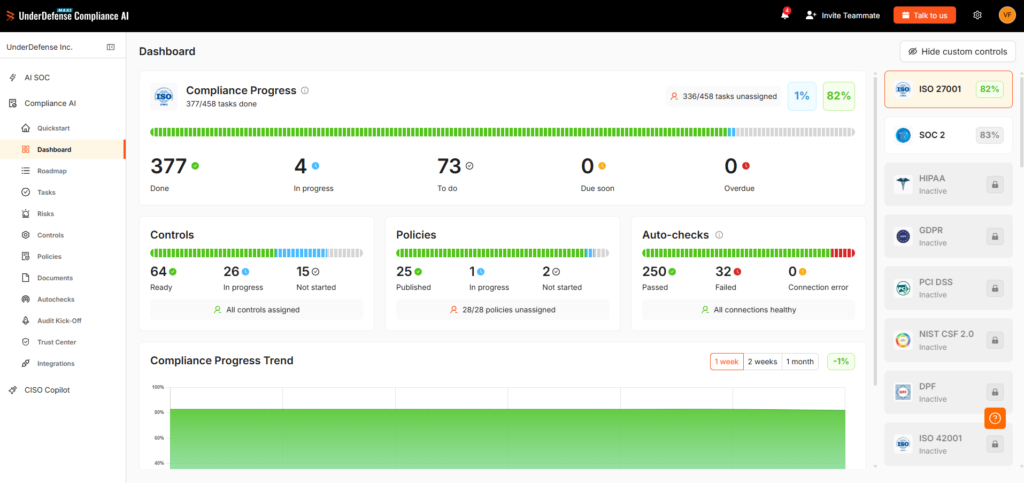
Overview: MAXI Compliance AI gives you proof that the technical measures in your Article 32 annex run, from encryption and MFA to logging, and helps you build the organizational ones.
It maps live data from the cloud, identity, and endpoint tools you already use to GDPR controls, keeps that evidence current, and runs the incident and breach-notification workflow that Articles 33 and 34 call for.
UnderDefense is rated 5.0 out of 5 from 83 reviews on G2 as of November 2026.
When your customer asks for that proof, you show evidence that is current on the day they ask, and your own auditor works with the evidence and reports in the platform, with the access you grant. Nobody rebuilds a spreadsheet the week before the review.
Key features:
- Continuous evidence for Article 32 measures, mapped from live security data
- An incident and breach-notification workflow for Articles 33 and 34, next to the evidence it draws on
- One evidence set reused across GDPR, SOC 2, ISO 27001, HIPAA, PCI DSS, and DORA
- Organizational measures for the annex: custom policies, security awareness training, and BC/DR plans from the Essential package, and a custom incident response plan from Certified
- Deployment as SaaS, hybrid, or fully on-premises, including air-gapped environments
- A shared Trust Center link for customers and auditors
GDPR coverage: Article 32, through evidence from live systems, and Articles 33 and 34, through the platform’s incident and breach-notification workflow.
The evidence side shows in Helpware’s results. The outsourcing provider moved its SOC 2 and ISO 27001 program, which spans eight countries, onto the platform, and its case study reports “2× faster audit readiness” and “30% less manual effort.”
Integrations and setup: MAXI Compliance AI connects to 250+ security tools, including Microsoft Entra ID and Microsoft 365, AWS, Azure, Okta, CrowdStrike, and SentinelOne, and tools without a native connector join through MCP (Model Context Protocol). The measures in your annex can then be read from tools your team already runs, and MAXI Compliance AI sits on top of that stack without replacing it.
Pricing: UnderDefense’s published compliance packages put Starter from $499 a month, Essential from $1,299, and Certified from $1,899, next to a Free tier (read November 2026). That lets you budget the annex work before a first sales call.
Pros:
- Article 32 evidence comes from the cloud, identity, and endpoint tools you already run
- A breach-notification workflow for Articles 33 and 34 on the same platform as that evidence
- GDPR evidence counts toward security frameworks such as SOC 2 and ISO 27001
- Every paid package includes 24, 48, or 90 hours a year with UnderDefense compliance consultants, depending on the package, so your team doesn’t run the program alone
- On-premises or air-gapped deployment when personal data has to stay in your own environment
- Published monthly prices for every paid package, plus a Free tier
Cons:
- Built for security of processing: pair it with a privacy tool for records of processing, data subject requests, and consent
Who should skip it: Teams whose only gap is records of processing, data subject requests, or consent, which a privacy-operations tool from this list handles.
The UnderDefense Agentic AI SOC works on the same data if you also want alerts investigated around the clock.
Is your data processing annex ready to sign? Ask an expert
2. OneTrust Privacy Automation: Best for Privacy Operations Across Many Jurisdictions, With a Breach Module
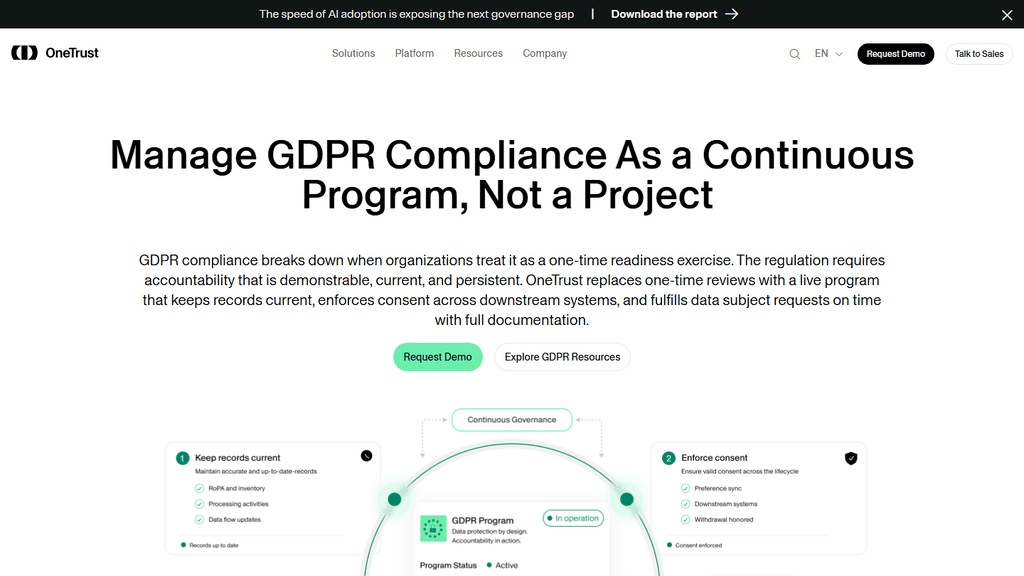
Overview: OneTrust sells privacy as packages: Privacy Automation covers mapping, assessments, vendors, requests, and incidents, and consent is priced as its own family. Its GDPR page covers keeping records current and fulfilling requests with documentation. A DPO’s office working across many laws gets the most from that breadth.
Key features:
- A live record of processing activities (RoPA) drawn from assessments, integrations, questionnaires, and bulk imports
- DPIA triggers assessed against Article 35 criteria, then routed for DPO review
- DSR automation covering intake, identity verification, discovery, deletion, and redaction
- Consent receipts with version history and timestamps
- Privacy Incident Management with notification templates, owners, and deadlines
GDPR coverage: Article 30 (auto-generated RoPA); Articles 15 to 22 (access, rectification, erasure, portability, restriction, and objection); Article 35; Articles 6 and 7; Article 28 (vendor due diligence and a central DPA record); and Articles 33 and 34 through the incident module.
For Article 32, the privacy pages describe vendor security obligations. OneTrust’s pricing page lists Tech Risk & Compliance as a separate package. Raise your annex when you ask for a quote.
Integrations and setup: OneTrust’s integrations marketplace includes Salesforce, HubSpot, and ServiceNow, plus an Okta integration for consent, and separate data discovery across Microsoft 365 and Azure. It runs as SaaS, and its docs ask for administrator-level access to each connected system’s console.
Pricing: Quote-based. The pricing page shows no figures (read November 2026). Privacy Automation is priced on users and privacy asset inventory, consent management on average daily visitors, and Universal Consent & Preference Management on data subject profiles.
Pros:
- Covers every privacy-operations article on one vendor’s platform, plus a named breach workflow
- Notification guidance by jurisdiction, for teams answering several regulators
- Regulatory research through DataGuidance
- Consent choices enforced in downstream systems
Cons:
- No published price, and a full GDPR scope touches several meters
- Within Privacy Automation, the pricing page lists DSR automation and incident management on the Suite card
- The incident docs describe business administrators reporting incidents. Detection still depends on your security stack
Who should skip it: A security lead whose gap is Article 32 evidence alone, or a small team that wants a published price before its first sales call.
3. TrustArc: Best for Privacy Operations With an Independent GDPR Validation Letter
Overview: TrustArc sells privacy software whose apps sit in two families, Privacy Studio and Governance Suite, and its GDPR Validation gives you a letter to show customers.
Privacy and legal teams running a controls-based program across many laws are its natural buyers.
Key features:
- Data Mapping & Risk Manager with configurable Article 30 reports for controllers and processors
- PrivacyCentral, which maps controls across privacy and security laws and standards
- Assessment Manager templates for DPIAs, transfer impact, and vendor risk
- Individual Rights Manager, which routes tasks into Jira, ServiceNow, and Salesforce
GDPR coverage: Article 30; Articles 15 to 22 (access, deletion, correction, portability, restriction, and objection); Article 35; and Articles 6 and 7 through Consent & Preference Manager. On Article 28, TrustArc tracks third parties and says the product shouldn’t be described as “automatically creating data protection agreements”.
For Article 32, it documents control mapping and attestations against standards such as ISO 27001 and NIST. For Articles 33 and 34, Nymity Research offers a breach index, sample regulator reports, and response plan templates.
Integrations and setup: TrustArc lists no-code integrations, including Okta, Microsoft Entra ID, Google Workspace, Salesforce, HubSpot, and Jira. It runs as SaaS. Its Solution Descriptions note that uncommon systems may need a connector build with engineering.
Pricing: Quote-based, with no figures on its product pages (read November 2026). Its subscription agreement bills annually in advance unless the order says otherwise, and terms renew automatically for one year unless either party gives 30 days’ notice. Put the notice date in your calendar before renewal.
Pros:
- Control mapping across privacy and security standards
- A third-party letter you can hand to customers, which TrustArc says is “not a formal Article 42 certification”
- Regulatory depth through Nymity Research
Cons:
- Apps are sold separately, and the Solution Descriptions list Assessment Manager as an optional add-on alongside Data Mapping & Risk Expert+
- A true-up applies when connector tasks exceed the purchased quantity by more than 10%, and a busy year can raise the bill
- Its Article 33 and 34 materials are research and templates, and a breach workflow module isn’t described on its product pages
Who should skip it: Teams that need live evidence of Article 32 measures or a managed breach workflow in the same product.
Show an EU customer that your security measures are switched on
4. Osano: Best for Privacy Operations That Start With Consent and an EU Representative
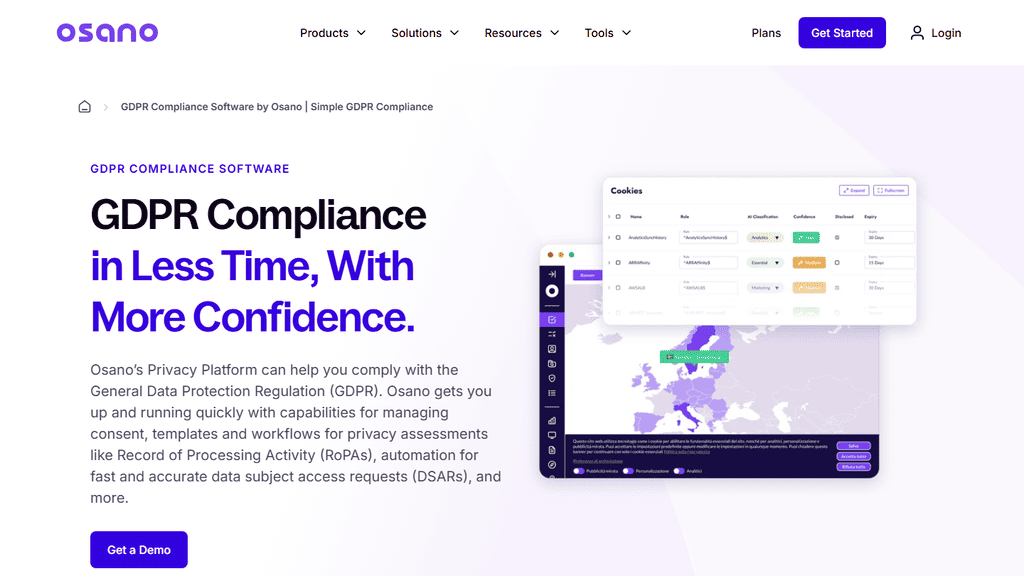
Overview: Osano’s GDPR software covers consent, assessments, and data subject access requests. Its plans page names Cookie Consent, Subject Rights, Vendor Risk, Data Mapping, and Assessments as separate products.
Look here first if you run a non-EU SaaS or e-commerce company with a small privacy function and a website consent gap.
Key features:
- One JavaScript tag to deploy consent, which blocks trackers until the visitor agrees
- Subject Rights with forms, identity verification, templates, routing, and audit logs
- Data Mapping that generates a RoPA from the same store of information
- Vendor Risk scoring, with a vendor library you can score against
- A GDPR representative through its Dublin subsidiary
GDPR coverage: Article 30; Articles 15 to 22, with automated delete or export where APIs exist; Article 35, through DPIA templates based on standards such as ISO and NIST; Articles 6 and 7, with timestamped, hashed consent logs; and Article 28, through vendor assessments, stored agreements, and a subprocessor view.
Article 27 representation comes from the Plus plan. Its product pages don’t describe Article 32 evidence or a breach workflow.
Integrations and setup: Consent takes one tag. Data discovery connects by API with read-only access, and Osano’s connector table shows which systems support each action. Salesforce, HubSpot, and ServiceNow support summaries and user deletion, while Jira, Slack, and Microsoft Teams support summaries.
Pricing: Published for Cookie Consent (read November 2026): Free at $0 per month, Plus at $199 per month, and Basic Privacy at a custom price. The free tier lets you try consent before any contract. Subject Rights, Data Mapping, and Assessments need a consultation.
Pros:
- A published entry price and a free tier
- A GDPR representative listed from the Plus plan
- Connector documentation that states what each integration can do
Cons:
- Published prices cover Cookie Consent tiers. A full GDPR scope needs a quote
- Basic Subject Rights is described as intake forms and basic workflows, and starts at the custom tier
Who should skip it: A B2B processor whose customers ask about Article 32 and breach detection, since consent is Osano’s strongest job.
5. Securiti Data Privacy: Best for Both Jobs on One Data Graph Across Hybrid Multicloud
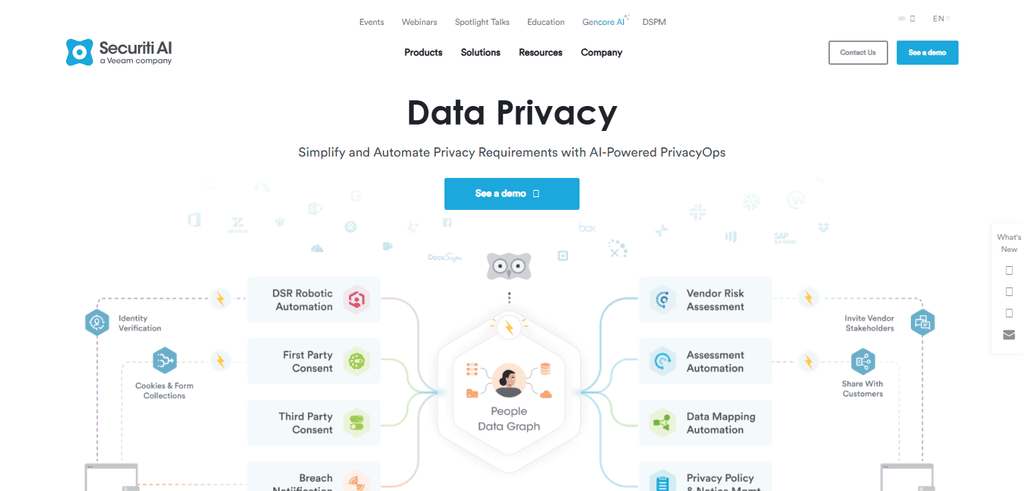
Overview: Securiti Data Privacy still uses the PrivacyOps label, and it runs on Securiti’s DataAI Command Platform. Veeam acquired Securiti in December 2025. The privacy modules and the data security modules share one knowledge graph, which suits an enterprise with personal data spread across hybrid multicloud and SaaS.
Key features:
- DSR Automation with identity verification and encrypted responses
- A People Data Graph that finds an individual’s data across structured and unstructured systems
- Data Mapping that generates Article 30 reports
- Breach Management with notification templates and an audit trail
- Breach Impact Analysis to identify affected individuals
GDPR coverage: Securiti’s GDPR map covers Article 30, the data subject rights, Article 35, Article 7, and Article 28, and it places Article 32 on its data-flow row.
On Article 32, Securiti describes continuous scans against security controls and access monitoring for least privilege. Those read your data layer. Test them against the measures your annex names.
For Articles 33 and 34, Breach Management gathers incident details, identifies scope, and manages notices to users and regulators. Its pages describe incidents being reported through a portal. Ask what feeds it.
Integrations and setup: Securiti’s connector page names Okta, Salesforce, HubSpot, Jira, Slack, OneDrive, SharePoint Online, and Outlook. Its education site describes a cloud option, or running the scanning in your own private cloud so data is scanned close to its source.
Pricing: Quote-based. The pricing page offers personalized pricing, with modules bought by use case (read November 2026). A free trial covers the Privacy Center.
Pros:
- Privacy operations and data security share one data graph
- A named breach workflow, plus impact analysis of who was affected
- An article-by-article GDPR map you can check in a demo
Cons:
- No published price, and cost depends on which modules you choose
- A wide platform sold across security, data, privacy, and governance teams, which may exceed a privacy-only need
- Branding is still moving: Veeam launched a Veeam-named version of the platform in May 2026. Confirm what your quote covers
- Its GDPR map is dated November 20, 2023. The module pages are the better guide
Who should skip it: A company of a few hundred people on SaaS tools that needs request handling and a RoPA, with no data estate large enough to justify a data graph.
6. DataGrail: Best for Privacy Operations Run by a Small, Non-Technical Team
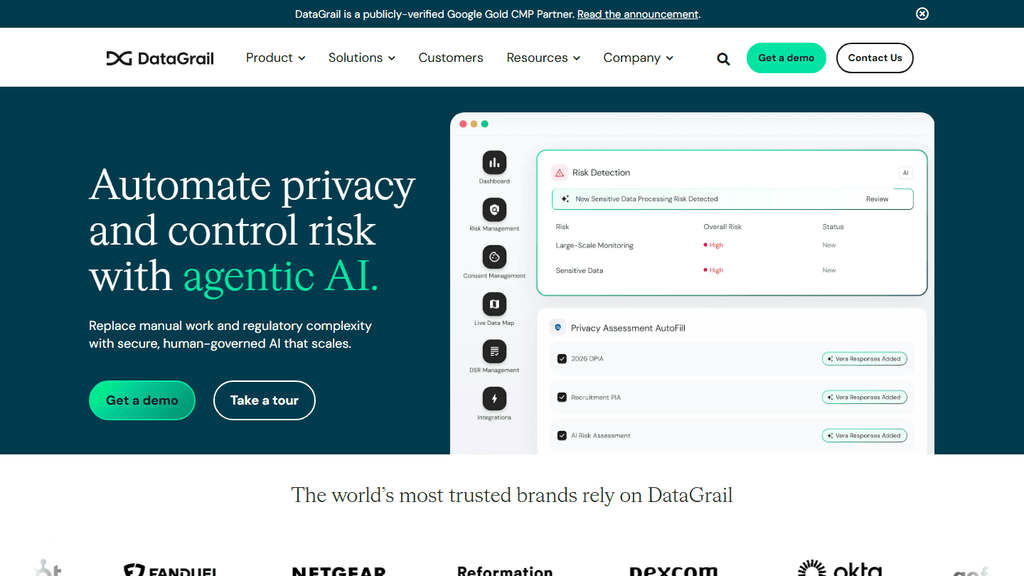
Overview: DataGrail builds privacy software for small privacy teams. Its products are Live Data Map, Request Manager, Consent Management, Smart Assessments, and Risk Register, with an AI agent called Vera. Small privacy or legal teams at SaaS-heavy companies can build their system inventory from a single sign-on provider.
Key features:
- Request Manager for access, deletion, and opt-out requests
- Live Data Map, which generates and maintains a RoPA
- RoPA exports as CSV or PDF
- Smart Assessments for DPIAs, with reasoning and citations for each suggestion
GDPR coverage: DataGrail’s GDPR table maps Article 30 to Live Data Map, Articles 12 to 23 to Request Manager, Article 35 to its assessments, and Articles 28 and 32 to vendor and subprocessor assessment. Its consent product covers GDPR and other frameworks, though the table has no consent row.
That table applies Article 32 to vendors only. It has no row for Articles 33 and 34, and a breach module isn’t described on the product pages read in November 2026.
Integrations and setup: DataGrail’s docs name Okta, Microsoft Entra ID, Google Apps, Salesforce, and HubSpot. System detection starts from your single sign-on (SSO) provider.
Pricing: Quote-based, with no pricing page found (read November 2026). Its compliance solution page describes buying the whole platform or single products.
Pros:
- A public GDPR table that ties each requirement to an article and a tool
- A RoPA generated from a live map, with audit-ready exports
- No-code onboarding built for non-technical teams
- A named human expert assigned to customers, per its assessments page
Cons:
- No published price
- Article 32 and breach notification sit outside its GDPR table, apart from vendor assessment
- Some systems run through Direct Contact integrations, which DataGrail describes as “an integrated email workflow”
Who should skip it: Teams answering a customer’s Article 32 annex or breach clause, which need security evidence this table doesn’t cover.
7. Transcend DSR Automation: Best for Privacy Operations With High Request Volume and Engineering Support
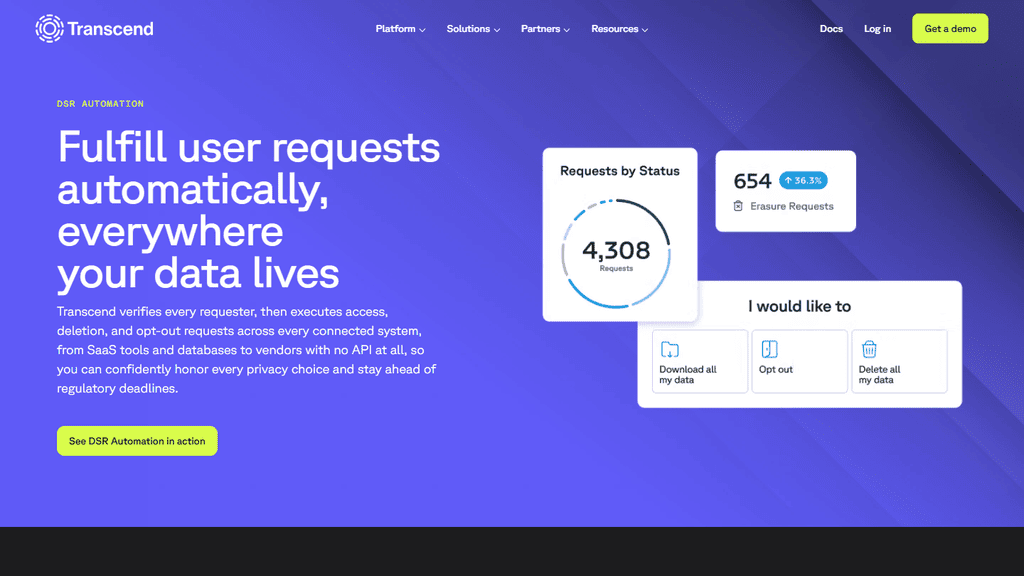
Overview: Transcend’s platform now leads with AI agents on its homepage. Data subject requests remain a core product: DSR Automation has its own page, docs, and nav entry. Enterprises with engineering support, high request volume, and systems that lack APIs get the most from it.
Key features:
- Requester verification, then access, deletion, and opt-out actions across connected systems, including vendors with no API
- Requests handled for your own customers, or for the businesses you process data for when they forward one
- Sombra, a gateway you can self-host to keep personal data encrypted under keys you control
- Data Inventory that exports a versioned RoPA as PDF or CSV
- Assessments for DPIAs and transfer impact, versioned and locked on approval
GDPR coverage: Transcend’s GDPR page addresses Article 30 and access, deletion, correction, and transfer rights. Its docs also name rectification and restriction actions.
Article 35 runs through Assessments, and its consent product logs each choice with a timestamp and audit trail for Articles 6 and 7. Vendor risk reviews support Article 28.
Article 32 evidence and a customer breach workflow aren’t described on the pages read in November 2026. Sombra protects data moving through Transcend, and your annex asks about your own measures.
Integrations and setup: Named integrations include Okta, Jira, Google Workspace, Salesforce, and Azure Active Directory, with setup guides for several others. Sombra can run inside your infrastructure or be Transcend-hosted, and custom systems can use Custom Functions written by your engineers.
Pricing: Quote-based. The pricing page is a contact form (read November 2026). For self-hosting, Transcend gives a hosting benchmark of around $170 to $180 per month for its AWS Terraform module, an infrastructure cost on top of the license.
Pros:
- Fulfillment that reaches systems with no API
- Processor-side requests handled alongside your own, which fits a company serving EU customers
- Customer-held keys when you self-host Sombra
- A RoPA drawn from the same inventory that drives fulfillment
Cons:
- No published price
- Customer-held keys require self-hosting: on the Transcend-hosted option, its docs say Transcend’s key management service (KMS) stores the keys
- Its homepage now leads with AI agents. Check that your quote names DSR Automation
Who should skip it: A small team with low request volume, or anyone whose gap is Article 32 evidence.
8. Vanta: Best for Adding GDPR to a SOC 2 or ISO 27001 Program Already Run in Vanta
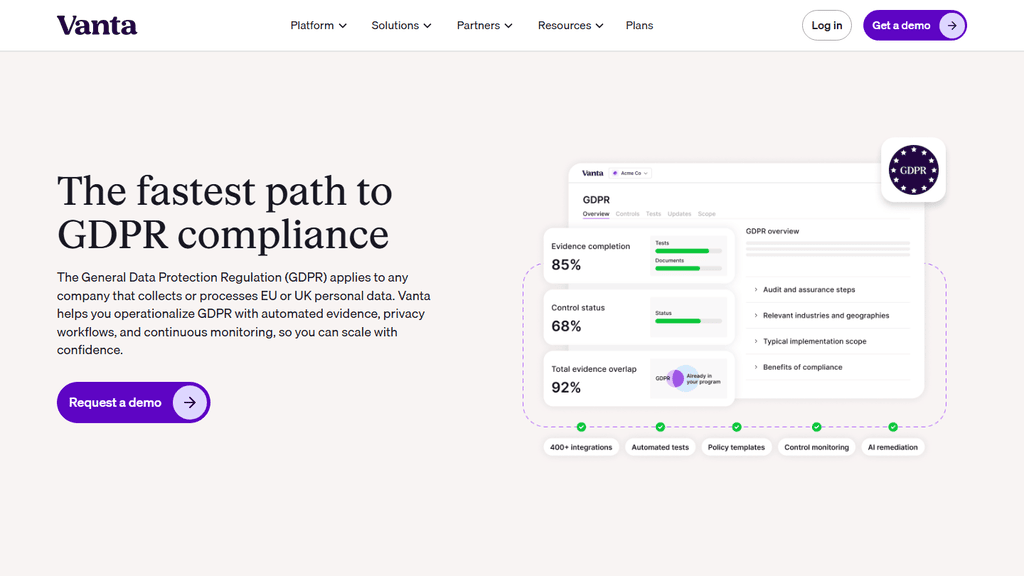
Overview: Vanta’s GDPR product combines automated evidence, privacy workflows, and continuous monitoring, and turns controller- and processor-specific requirements into tasks. If you already run SOC 2 or ISO 27001 in Vanta, GDPR can join the same program.
Key features:
- Records of Processing Activities that document purposes, data categories, legal bases, and processors
- Impact assessments tied to the Data Inventory and your ROPA
- Evidence pulled directly from your systems, with continuous monitoring
- GDPR evidence reused across other frameworks, including HIPAA
GDPR coverage: Article 30, with processors recorded in the same place; Article 35; and Article 32, its strongest job, through evidence from connected systems. For Articles 15 to 22, Vanta’s product updates list Data Subject Request Management as Early Access in July 2026.
For Articles 6 and 7, it records legal bases, and Vanta advises pairing it with a consent platform. For Articles 33 and 34, it supports an incident response plan and incident tests through tools such as Jira, and says it “doesn’t send notifications on your behalf”.
Integrations and setup: Vanta’s integrations page names AWS, Azure, Okta, and Jira. Vanta says many teams finish in about 30 to 40 hours of focused work over a few weeks. Plan that staff time alongside the license.
Pricing: Quote-based. The pricing page shows four plans with no figures (read November 2026).
Pros:
- Article 32 evidence drawn from connected systems
- Article 30 and DPIA records linked to one inventory
- One program across GDPR, SOC 2, ISO 27001, and others
Cons:
- Needs a separate consent platform, by Vanta’s own guidance
- Vanta said in August 2026 that its request portal and queue are live and data subject access request (DSAR) automation is “still maturing”. Check its status in a demo
- Breach notices stay with your team
- No published price
Who should skip it: A consumer brand whose main GDPR work is consent and high-volume requests across many data systems.
9. DataGuard: Best for Privacy Operations Plus an External DPO in Europe
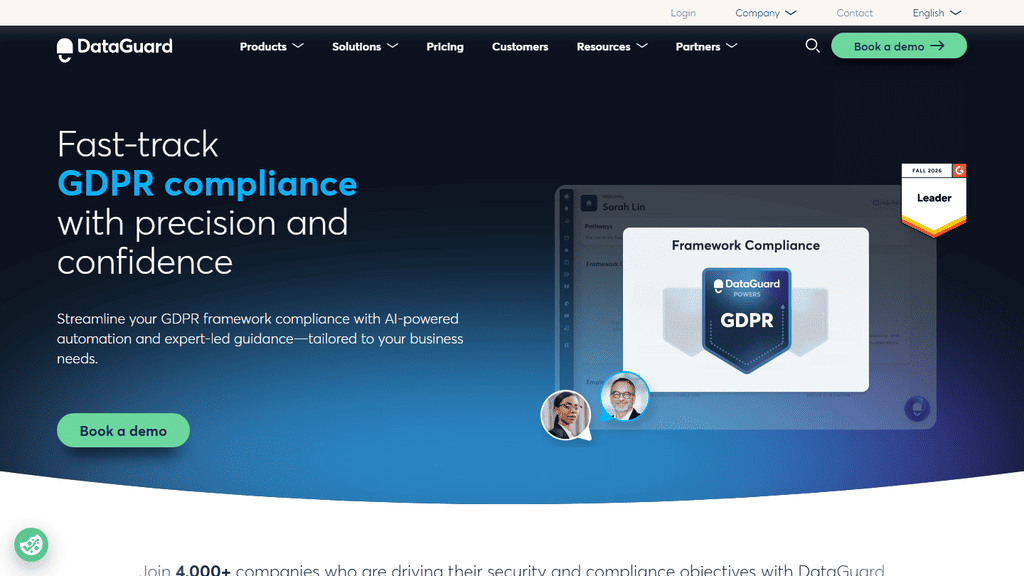
Overview: DataGuard sells privacy software with access to its own privacy experts. It names EU and UK GDPR, ISO 27001, NIS2, and TISAX (the German automotive industry’s security assessment) among its frameworks. A European company with no in-house DPO can get privacy operations software and an external DPO from one vendor.
Key features:
- Data Mapping & RoPA, with migration from spreadsheets
- Data Subject Request forms, deadlines, and an auditable record
- DPIA & Risk Assessment templates with risk scoring
- Incident & Breach Management with a guided workflow
GDPR coverage: Article 30, Articles 15 to 22, Article 35, and Article 28, through Third-Party Risk Management that maps processors and sub-processors. Articles 6 and 7 come through Consent Management and Cookie Management, both add-ons.
For Articles 33 and 34, the breach module helps determine reportability and sends notifications to internal teams and authorities. Article 32 starts as documentation of technical and organizational measures, with controls tracking that maps evidence to requirements.
Integrations and setup: DataGuard’s integrations page names Asana and Jira for tasks, Azure for asset updates, and HubSpot, Salesforce, and Snowflake for consent data. It publishes no integration count.
Base and Pro include guided setup. DataGuard says clients of its GDPR audit need 3 to 6 months before they receive their final data protection documentation. Start well ahead of a customer deadline.
Pricing: Quote-based. The pricing page lists Base, Pro, and Enterprise, each with “Get a quote” (read November 2026). External Data Protection Officer is an add-on with no published fee.
Pros:
- Every privacy-operations article has a named module
- A breach module that addresses reportability and notifying authorities
- Software and a named external DPO from one vendor
Cons:
- No published price
- Advanced approval flows, a customizable template library, and privacy reporting need Compliance Platform (Advanced)
- Automated asset import and vulnerability checks need Security Platform (Advanced), and cloud misconfiguration checks are an add-on
- Base has no expert access in its compliance table
Who should skip it: A processor outside the EU with its own privacy lead that needs live evidence from AWS, Okta, and CrowdStrike for an annex this quarter, unless a demo shows that coverage.
The 72-Hour Clock: What Has to Happen Between an Alert and a Notification
Article 33(1) requires a controller to notify its authority “without undue delay” and, where feasible, within a limit of “72 hours after having become aware” of a personal data breach. The hours before that decision need an owner too.
Seven Steps From Alert to Notification
Give each step a named owner before you need one, and use software where it speeds the work. The list marks which steps a tool can carry and which need a person.
- Detect. Your security monitoring (SIEM), endpoint detection and response (EDR), and identity tools raise the alert. Software does this, and it only sees what you connected.
- Triage. A person or your security provider decides whether the alert is a real incident.
- Confirm personal data is involved. Your data map shows what each affected system holds. A person confirms the scope.
- Assess risk. Templates help structure this, and your DPO or privacy lead judges the risk to individuals.
- Decide. A named person decides whether the breach is unlikely to result in a risk, and records why.
- Notify. A processor notifies its controller without undue delay under Article 33(2). A controller notifies the authority, and informs individuals under Article 34 when the risk is high. Software supplies templates and deadlines.
- Document. Article 33(5) requires a record of the facts, effects, and remedial action, whether or not you notified.
⏱️ Step 3 is usually where awareness begins. EDPB Guidelines 9/2022, updated in 2023, treat a controller as aware once it has “a reasonable degree of certainty” that personal data was compromised, and allow a short investigation first. They also say that, in principle, your customer becomes aware once you inform it: your speed sets the start of its clock.
Compliance software with a breach workflow carries steps 4 to 7: templates, deadlines, and the Article 33(5) record. As a processor you still inform your controller without undue delay, and your DPO or privacy lead owns the decisions.
The deadline itself may change. The EU Council’s negotiating mandate of October 2026 would move authority notification to 96 hours for breaches likely to result in a high risk. It isn’t law, so plan against 72 hours when you sign today’s clause.
Bring the DPA annex and check each measure against live systems
- See which Article 32 measures your stack already proves
- Get 24, 48, or 90 consulting hours a year, by package
- Run incident and breach-notification steps in one workflow
Frequently Asked Questions
Does GDPR apply to a US company with EU customers?
Often, yes. Article 3(2) applies when processing relates to offering goods or services to people in the EU or monitoring their behavior there.
A company outside the EU acting as a processor also takes on Article 28 duties through the DPA it signs. Check whether Article 27 requires an EU representative.
Is there an official GDPR certification?
Yes, though it’s voluntary and narrow. Article 42 provides for certification of processing operations against approved criteria, and the EDPB register, read in November 2026, lists schemes such as Europrivacy. Software can’t award it, and no tool makes a company compliant.
How quickly must a personal data breach be reported under GDPR?
A controller must notify its authority without undue delay and, where feasible, within 72 hours of becoming aware, unless the breach is unlikely to result in a risk. A processor notifies its controller without undue delay. Article 33(5) requires documenting every breach either way.
Can one platform cover GDPR, SOC 2, and ISO 27001?
Partly. Security evidence for access reviews, encryption, and logging can serve all three, and multi-framework compliance automation software reuses it. Records of processing, data subject requests, and consent have no SOC 2 equivalent and need their own check.
How much does GDPR compliance software cost?
It ranges from free plans to quote-only contracts. Two of the nine publish figures, UnderDefense MAXI Compliance AI and Osano for its consent plans, and their entries list them. The other seven show none on their pricing or product pages, so ask which GDPR articles each quote includes.