






Q1. What Are GDPR Compliance Services and Why Do Organizations Need Them in 2026?
⚠️ The 2026 GDPR Enforcement Reality
GDPR compliance services encompass the full spectrum of external support, including consulting, auditing, software platforms, managed compliance, and outsourced DPO, that organizations use to achieve, maintain, and prove compliance with the EU General Data Protection Regulation. And in 2026, the operational stakes have never been higher. Cumulative GDPR fines now exceed €7.1 billion, with €1.2 billion issued in 2025 alone, reversing what briefly looked like a downward trend. Over 60% of the total fine value has been imposed since January 2023, and enforcement is no longer limited to Big Tech: finance, healthcare, telecommunications, and public sector organizations are firmly in scope.
The EDPB adopted its 2026–2027 work programme grounded in four pillars: enhancing harmonisation, reinforcing enforcement culture, safeguarding data protection in cross-regulatory landscapes, and contributing to global dialogue. This programme implements the Helsinki Statement commitments aimed at making GDPR compliance easier while simultaneously strengthening consistency and boosting cross-regulatory cooperation. Any organization processing personal data of EU residents, regardless of where it’s headquartered, falls within scope, making this relevant far beyond EU-based companies.
❌ The Annual Audit Trap
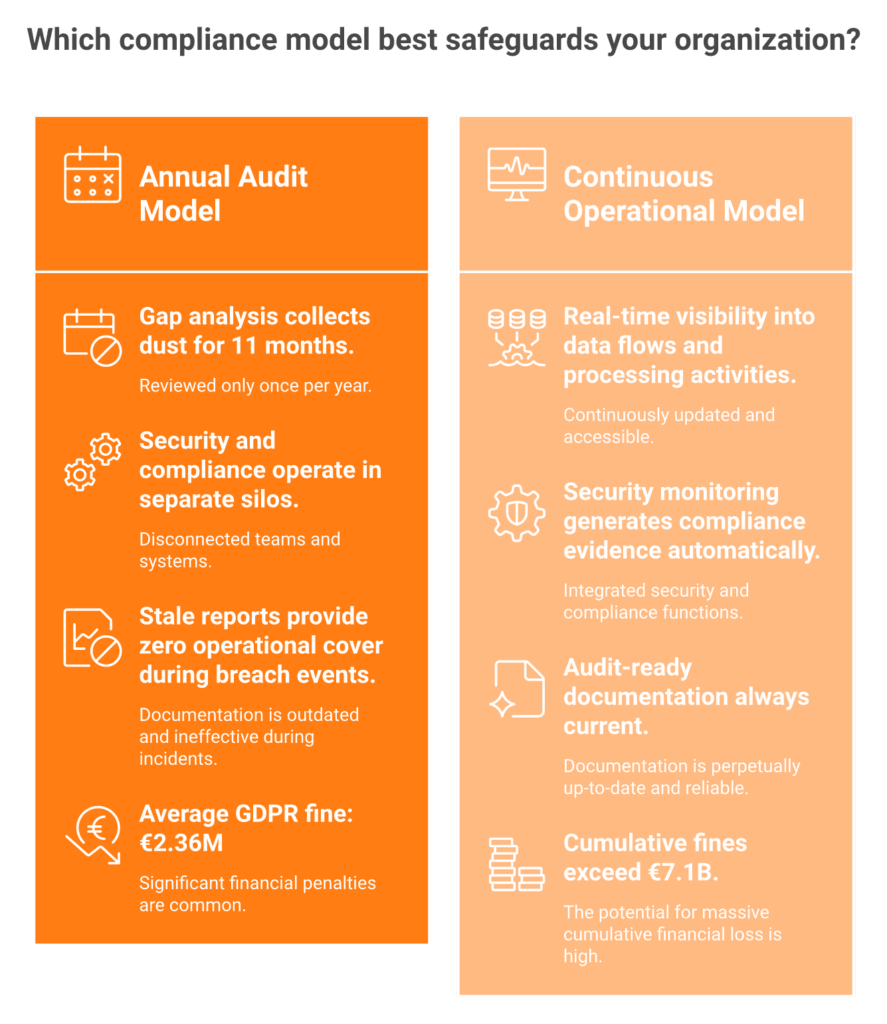
Here’s what breaks in practice: most organizations still treat GDPR compliance as an annual consulting engagement. A firm comes in, runs a gap analysis, produces a report, and everyone moves on. That report collects dust for 11 months while data processing activities change weekly, new SaaS tools get deployed monthly, employee access patterns shift constantly, and sub-processor chains evolve without documentation. When a supervisory authority shows up, or worse, a breach notification clock starts ticking, that stale gap analysis provides zero operational cover.
The disconnect runs deeper than documentation. Traditional MSSPs and security providers treat compliance as a separate product from continuous security monitoring. Your security team is managing alerts in one system while your compliance officer is maintaining spreadsheets in another. The result? Security incidents go undetected while compliance reports show green. As of March 2025, a total of 2,245 GDPR fines have been recorded, with an average fine of €2,360,409 across all countries. That average isn’t being driven by annual audit failures alone but by organizations that couldn’t demonstrate operational controls were actually functioning.
✅ Compliance as Continuous Operational Capability
The critical shift for 2026: GDPR compliance is not a project with a start and end date but an operational capability that must be embedded in your security architecture. The convergence of GDPR with the EU AI Act (DPIAs mapping to Fundamental Rights Impact Assessments, automated decision-making under Article 22, and transparency requirements) and global privacy laws (CCPA/CPRA, LGPD, and India DPDP Act) means compliance now requires real-time visibility into data flows, processing activities, and security events across jurisdictions.
The EDPB’s 2026 Coordinated Enforcement Framework specifically targets “compliance with the obligations of transparency and information (Articles 12, 13 and 14 GDPR),” meaning supervisory authorities will actively audit whether your transparency mechanisms are current and operational, not just documented. This is not something you fix with a once-a-year consulting engagement. It requires continuous monitoring, real-time evidence generation, and security operations that understand data processing context.
How UnderDefense Bridges Security and Compliance
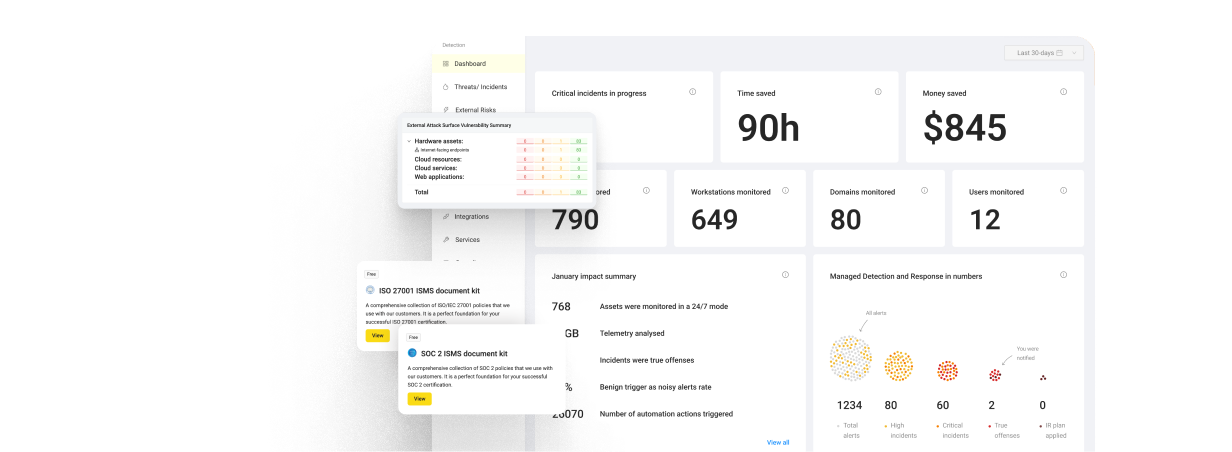
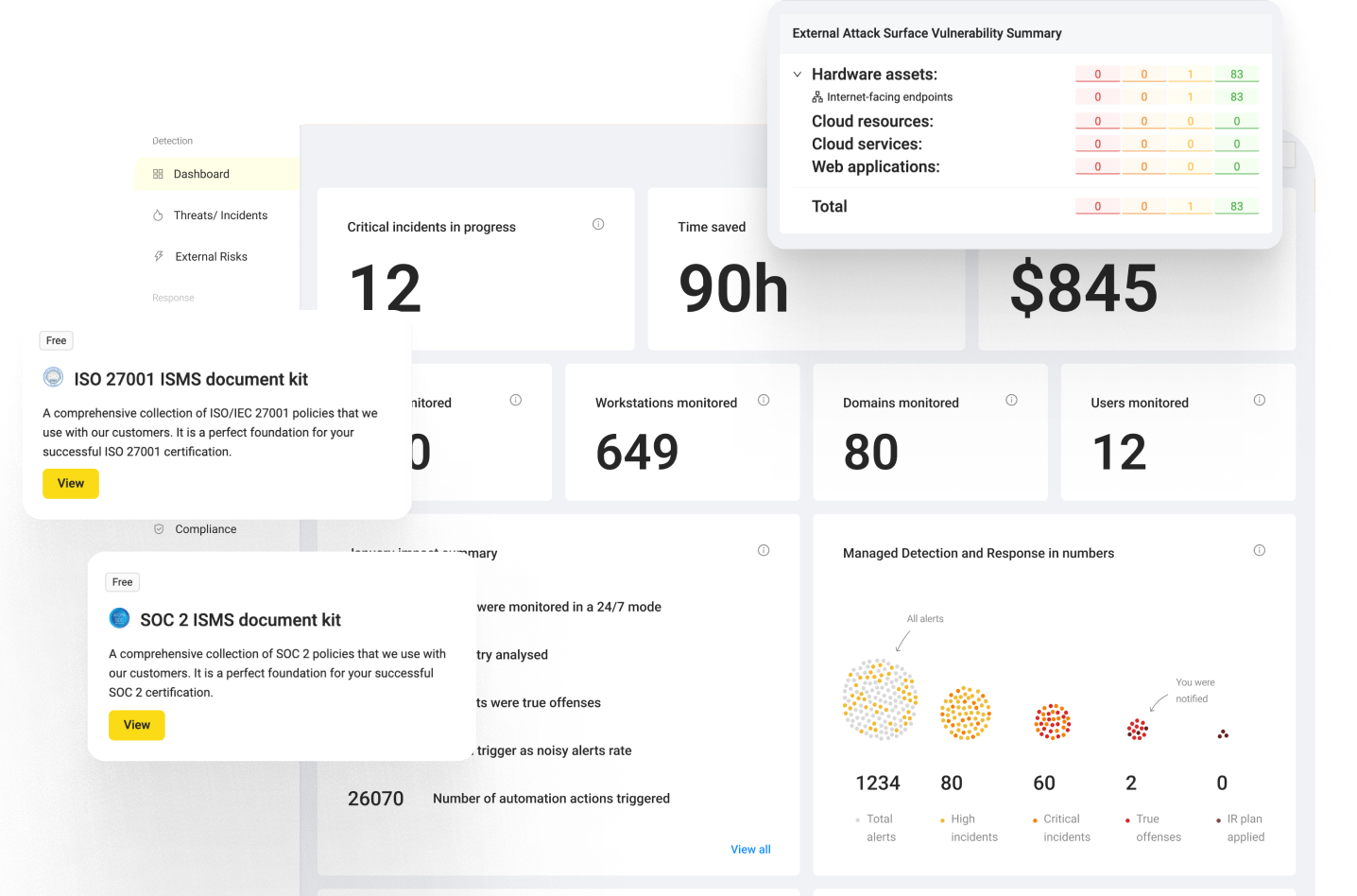
At UnderDefense, we designed the UnderDefense MAXI platform as the operational layer bridging security monitoring and compliance evidence generation. Our MDR doesn’t just detect threats. It generates audit-ready evidence for GDPR Article 32 (security of processing), Article 33 (breach notification within 72 hours), and Article 35 (DPIA support) through continuous monitoring across 250+ integrated tools. Forever-free compliance kits covering SOC 2, HIPAA, and ISO 27001 are bundled with the service, and our documented 2-minute alert-to-triage and 15-minute escalation for critical incidents proves security controls are operational, not theoretical.
With enforcement now widening across sectors and the EDPB pushing stricter cross-border coordination, the cost of non-compliance dwarfs the cost of any service model. Organizations that integrate compliance into their security operations, rather than treating it as a separate function, reduce both breach risk and audit preparation time by orders of magnitude.
Q2. What Are the Five GDPR Compliance Service Models and How Do They Compare?
The GDPR Compliance Services Taxonomy
GDPR compliance services are not interchangeable. Each model serves a distinct purpose, budget range, and organizational maturity level. Most mature organizations use two to three models simultaneously. Choosing the wrong model for your stage wastes budget; failing to layer models leaves dangerous gaps. The framework below provides the structured taxonomy for informed procurement decisions.
📌 The Five Service Models
Consulting — Boutique or Big-4 firms providing gap analysis, remediation roadmaps, policy drafting, privacy-by-design advisory, and strategic counsel. Project-based engagements typically run 4–16 weeks, delivering a formal report with prioritized recommendations. Best for organizations starting their compliance journey or navigating complex regulatory changes like EU AI Act convergence.
Auditing — Independent assessment of current compliance posture against GDPR requirements. Includes pre-certification readiness checks, post-breach reviews, and regulatory response preparation. Engagement-based with formal deliverables including risk scoring and remediation priorities. Best for organizations needing third-party validation before regulator interactions or board reporting.
Managed Compliance — Ongoing outsourced compliance operations combining technology and human oversight for continuous monitoring, policy lifecycle management, regulatory change tracking, and SLA-backed response times. Best for mid-market organizations that need continuous compliance but can’t justify a full in-house privacy team.
Software Platforms — SaaS tools automating consent management, DSAR workflows, data mapping, ROPA maintenance, DPIA templates, and cross-framework evidence collection. Best for organizations with some internal compliance expertise that need operational efficiency and scalable automation.
DPO-as-a-Service — External Data Protection Officer fulfilling Article 37–39 obligations including regulatory interface, breach reporting coordination, staff training, and supervisory authority communication. Outsourced DPO retainers range from €300–€1,000/month at the budget tier to €5,000–€15,000+/month for multi-jurisdictional, complex environments.
Service Model Comparison
| Model | Delivery Type | Best For | Typical Duration | Key Deliverables |
|---|---|---|---|---|
| Consulting | Project-based | Gap assessment, remediation roadmap | 4–16 weeks | Gap analysis report, policy drafts, remediation plan |
| Auditing | Engagement-based | Third-party validation, readiness checks | 2–6 weeks | Formal audit report, risk scoring, remediation priorities |
| Managed Compliance | Ongoing retainer | Continuous compliance operations | 12+ months | Regulatory tracking, policy updates, SLA-backed monitoring |
| Software Platforms | SaaS subscription | Automation at scale | Ongoing | Consent management, DSAR workflows, ROPA, DPIA templates |
| DPO-as-a-Service | Ongoing retainer | Regulatory interface, Article 37–39 fulfillment | 12+ months | Supervisory authority communication, breach coordination, training |
🔗 Hybrid Models and Layering Strategies
The most common mid-market stack combines software as the operational backbone, consulting for strategic initiatives, and outsourced DPO for the regulatory interface. This layered approach ensures continuous automation handles routine compliance tasks while expert judgment covers complex regulatory interpretations and supervisory authority engagement.
The EDPB’s 2026–2027 work programme pushes toward “compliance by design” standards that increasingly favor continuous managed approaches layered with software automation over point-in-time consulting alone. Organizations relying exclusively on annual consulting engagements will find themselves constantly playing catch-up as regulatory expectations shift toward demonstrable, real-time controls.
How UnderDefense Simplifies
UnderDefense eliminates the disconnect between security operations and compliance evidence by bundling forever-free compliance kits (SOC 2, HIPAA, and ISO 27001) with its MDR service, meaning the security monitoring that protects your data also generates the audit evidence that proves you’re protecting it. This bridges the gap between Model 3 (Managed Compliance) and Model 4 (Software), reducing the need for separate compliance-only tools while your security operations run continuously in the background.
Q3. How Much Do GDPR Compliance Services Cost in 2026, and What Is the ROI?
💰 Why GDPR Compliance Pricing Is Opaque
Pricing transparency is the single biggest buyer frustration in the GDPR compliance market. Most consulting firms require “contact sales,” enterprise software hides behind “custom pricing,” and managed services vary wildly by scope. The result is that budget holders can’t plan, CFOs can’t justify spend, and organizations default to the cheapest option, which often means the least effective one. This section provides the consolidated benchmarking resource that doesn’t exist elsewhere.
Pricing Benchmarks by Model and Company Size
| Model | Startup/SMB (1–100 emp.) | Mid-Market (100–1,000 emp.) | Enterprise (1,000+ emp.) |
|---|---|---|---|
| Consulting | €500–1,000/day | €1,000–2,000/day | €1,500–3,000/day |
| Auditing | €3,000–10,000/engagement | €10,000–30,000/engagement | €25,000–100,000+ |
| Software Platforms | €50–600/month | €600–5,000/month | €5,000–25,000+/month |
| Managed Compliance | €1,000–3,000/month | €3,000–8,000/month | €8,000–25,000/month |
| DPO-as-a-Service | €300–1,000/month | €1,500–5,000/month | €5,000–15,000+/month |
Initial GDPR implementation costs at enterprise scale range from €250,000 to €1M+, with PwC data showing 88% of global enterprises spending over $1 million annually on GDPR compliance. For mid-market organizations, total annual ongoing spend typically lands between €30,000 and €80,000 with a well-structured programme. DPO outsourcing costs range from €300/month for lighter advisory to €15,000+/month for multi-jurisdictional, complex environments.
⚠️ Hidden Cost Factors and ROI Quantification
Cost multipliers buyers consistently miss:
- Implementation/onboarding fees, often 2–3x the first month’s subscription cost
- Per-DSAR processing charges, ranging from €3,000–€40,000 annually depending on volume and automation level
- Staff training, costing €25–€229 per person per year
- Vendor audit programme, running €5,000–€20,000 annually
- Multi-jurisdiction uplift, with premium pricing for cross-border transfer advisory, SCCs, and adequacy decision monitoring
- Regulatory change update fees, as separate charges for adapting to new guidelines or enforcement actions
💸 Quantifying the ROI
The ROI math works in four dimensions:
- Fine avoidance — Average GDPR fine of €2.36 million across all countries, with cumulative fines exceeding €7.1 billion
- Operational efficiency — Automated DSARs reduce processing time by up to 80%; consent management platforms eliminate manual cookie banner audits
- Customer trust — Enterprise buyers increasingly require GDPR evidence before procurement; compliance becomes a revenue enabler, not just a cost center
- Reduced breach cost — Organizations with incident response plans and demonstrable security controls save significantly per breach on average, with UnderDefense case studies documenting avoidance of a potential €650K loss through integrated SIEM and SOC operations
How UnderDefense Simplifies
UnderDefense publishes transparent per-endpoint pricing ($11–15/endpoint/month) for its MDR service that includes compliance evidence generation, with no hidden implementation fees and no separate compliance software purchase. Forever-free compliance kits are bundled, and 30-day turnkey onboarding eliminates the 3–6 month deployment timelines typical of enterprise security platforms. When your security monitoring automatically generates audit evidence, you stop paying separately for compliance tools that merely document what your security stack should be doing in the first place.
Q4. What Core Capabilities Should Every GDPR Compliance Service Deliver?
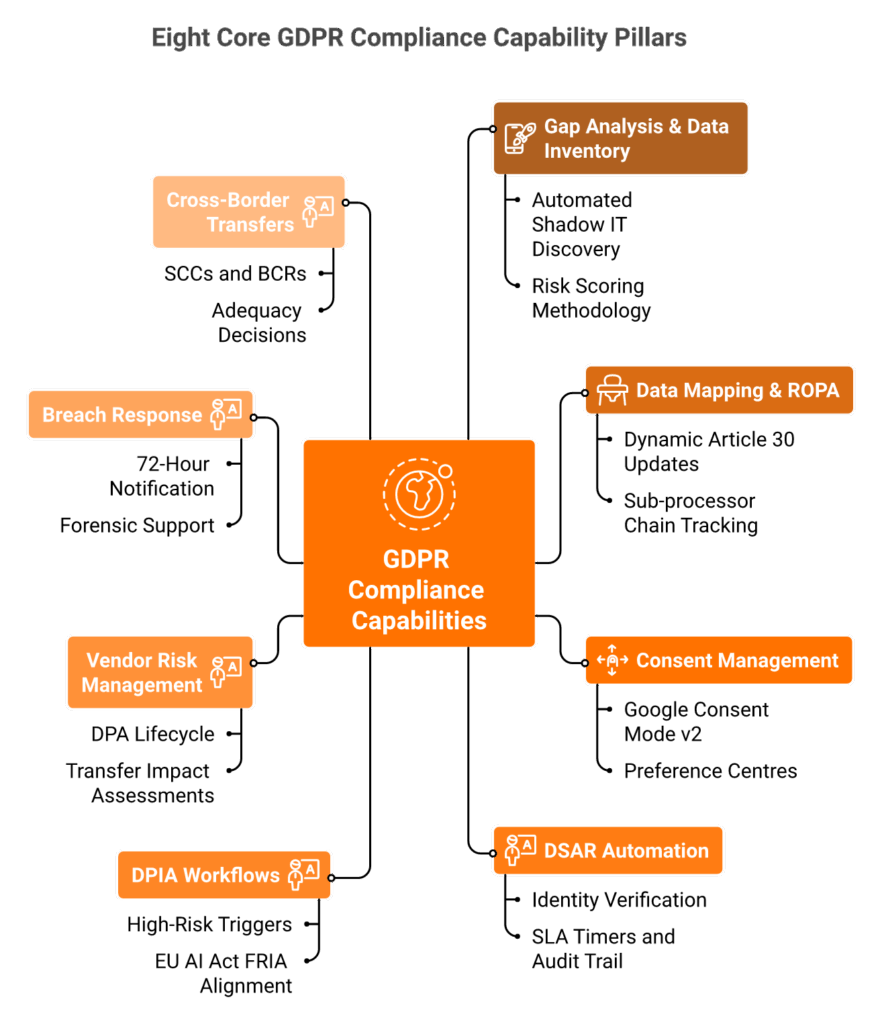
The Eight Capability Pillars
Regardless of whether you choose consulting, software, or managed services, your provider must demonstrably deliver across eight core capability areas. A provider strong in consent management but weak in breach response leaves dangerous gaps, and those gaps are exactly where regulators and attackers find you. Here’s the structured evaluation framework.
📋 The Eight Capabilities with Evaluation Criteria
Gap Analysis & Data Inventory — Data discovery across cloud/SaaS/on-prem environments, processing activity cataloguing, legal basis documentation, and risk scoring methodology. Look for automated discovery that covers shadow IT, not just known systems.
Data Mapping & ROPA — Automated Records of Processing Activities maintenance per Article 30, data flow visualization, and sub-processor chain tracking. Evaluate whether ROPA updates dynamically as your data processing changes or requires manual refresh.
Consent Management — CMP implementation, Google Consent Mode v2 configuration, cookie banner compliance, consent analytics, preference centres, and legitimate interest assessments. Confirm the CMP integrates with your analytics and ad tech stack without breaking conversion tracking.
DSAR Automation — Intake forms, identity verification, automated data discovery across systems, redaction workflows, fulfilment tracking with SLA timers, and audit trail documentation. Processing costs range from €3,000 to €40,000 annually depending on volume.
DPIA Workflows — Automated triggers for high-risk processing, risk scoring methodologies, DPIA templates aligned with supervisory authority guidance, and review/approval workflows. Critical for EU AI Act convergence where DPIAs map directly to Fundamental Rights Impact Assessments.
Vendor & Third-Party Risk Management — DPA execution and lifecycle management, sub-processor monitoring, continuous vendor compliance tracking, and Transfer Impact Assessments for cross-border sub-processors.
Breach Response & Incident Management — 72-hour supervisory authority notification compliance, breach simulation exercises, response playbooks, data subject communication templates, and forensic support. ⏰ The 72-hour clock starts when you become “aware” of a breach, not when investigation concludes.
Cross-Border Data Transfer Advisory — Standard Contractual Clauses (SCCs), Binding Corporate Rules (BCRs), adequacy decisions, Transfer Impact Assessments, and EU-US Data Privacy Framework implementation.
Capability Coverage by Service Model
| Capability | Consulting | Auditing | Managed Compliance | Software Platform | DPO-as-a-Service |
|---|---|---|---|---|---|
| Gap Analysis & Data Inventory | ✅ Strong | ✅ Strong | ✅ Strong | ⚠️ Partial | ⚠️ Partial |
| Data Mapping & ROPA | ⚠️ Partial | ⚠️ Partial | ✅ Strong | ✅ Strong | ❌ Weak |
| Consent Management | ❌ Weak | ❌ Weak | ⚠️ Partial | ✅ Strong | ❌ Weak |
| DSAR Automation | ❌ Weak | ❌ Weak | ✅ Strong | ✅ Strong | ⚠️ Partial |
| DPIA Workflows | ✅ Strong | ✅ Strong | ✅ Strong | ⚠️ Partial | ✅ Strong |
| Vendor Risk Management | ⚠️ Partial | ⚠️ Partial | ✅ Strong | ⚠️ Partial | ✅ Strong |
| Breach Response & Incident Mgmt | ⚠️ Partial | ❌ Weak | ✅ Strong | ❌ Weak | ⚠️ Partial |
| Cross-Border Transfer Advisory | ✅ Strong | ⚠️ Partial | ⚠️ Partial | ❌ Weak | ✅ Strong |
This matrix reveals a critical pattern: no single service model covers all eight capabilities strongly. The most common gaps are in breach response (consulting and software platforms) and consent management (consulting and DPO services). Mature organizations address this by layering models, but that layering only works when your security operations and compliance operations share the same data.
How UnderDefense Simplifies
UnderDefense’s MDR directly addresses capability #7 (breach response) with a documented 2-minute alert-to-triage and 15-minute escalation for critical incidents, along with 72-hour notification support, while generating continuous evidence for capability #1 (gap analysis via real-time security posture monitoring). The UnderDefense MAXI platform’s integration across 250+ tools means security telemetry flows directly into compliance evidence, not through a manual export process. Forever-free compliance kits provide documentation frameworks supporting capabilities #2 through #6, bridging the gap between security operations and compliance evidence generation that traditional service models leave disconnected.
“UnderDefense also helped us navigate key compliance requirements, ensuring we met industry standards smoothly and efficiently. What stood out the most was their responsiveness and flexibility, no matter the issue, they tackled it quickly and professionally.”
— Arman N., CTO, Mid-Market UnderDefense – G2 Verified Review
“They’ve also made our audit process much less painful. The reports from their platform give us clear evidence of our security controls and incident response capabilities. When auditors or clients ask questions about our security posture, we can pull up exactly what they need to see.”
— Verified User, Marketing and Advertising UnderDefense – G2 Verified Review
Q5. Which GDPR Compliance Software Platforms Lead in 2026?
Seven platforms define the GDPR compliance software landscape in 2026, each excelling in different capability areas. The critical differentiator most buyers overlook: whether the platform generates compliance evidence backed by actual security operations, or just documents policies nobody enforces.
⭐ Platform Comparison: Capabilities, Pricing, and Best Fit
| Platform | Core Strength | GDPR Capabilities | Cross-Framework | Pricing | G2 Rating | Best For |
|---|---|---|---|---|---|---|
| UnderDefense | Security-integrated compliance evidence | Continuous Article 32/33/35 documentation through 24/7 MDR | SOC 2 + HIPAA + ISO 27001 bundled | $11–15/endpoint/mo (published) | 4.8/5 | Orgs needing proof their controls work |
| OneTrust | Most comprehensive privacy management suite | Consent, DSAR, DPIA, vendor risk, data mapping | GDPR + CCPA + LGPD + AI Act | Custom enterprise pricing | 4.3/5 | Large enterprises with multi-regulation needs |
| Vanta | Automated compliance evidence collection | Strong SOC 2 + ISO 27001 + GDPR monitoring | 400+ integrations, 35+ frameworks | From ~$10K/year | 4.6/5 | SaaS companies pursuing multi-framework certification |
| TrustArc | Privacy management and consent | DPIA automation, assessment workflows | GDPR + CCPA | Custom pricing | 4.1/5 | Enterprises with established privacy programs |
| BigID | AI-driven data discovery and classification | Strongest data mapping and ROPA automation | GDPR + CCPA | Custom pricing | 4.4/5 | Data-intensive organizations |
| Scrut | Compliance automation platform | Cross-framework mapping, evidence collection | GDPR + SOC 2 + ISO 27001 + HIPAA | Competitive mid-market pricing | 4.9/5 | Mid-market multi-framework compliance |
| Usercentrics | Consent management specialist | CMP + Google Consent Mode v2 + cookie compliance | GDPR + ePrivacy | From ~€8/mo | 4.5/5 | Websites and apps focused on consent optimization |
OneTrust was named a Leader in the Forrester Wave for Privacy Management Software, Q4 2025, scoring highest in both Current Offering and Strategy categories. BigID leads on data discovery and classification. If your primary challenge is answering “where does our sensitive data actually live,” it’s the strongest choice. Vanta stands out for SaaS companies that need rapid multi-framework evidence collection across 400+ integrations.
✅ Where UnderDefense Fits in This Stack
UnderDefense occupies a unique position. It’s not a consent management tool or privacy policy generator. It’s the security operations layer that makes every other compliance tool’s claims defensible by providing continuous monitoring, incident response, and audit-ready breach documentation.
When your auditor asks “How do you know your Article 32 technical measures are actually working?”, the answer should come from operational evidence, not a checkbox. We provide that evidence through 24/7 MDR monitoring, real-time threat detection across 250+ integrated tools, and documented incident response workflows that satisfy both auditors and supervisory authorities.
“The reports from their platform give us clear evidence of our security controls and incident response capabilities. When auditors or clients ask questions about our security posture, we can pull up exactly what they need to see.”
— Verified User, Marketing and Advertising UnderDefense – G2 Verified Review
“UnderDefense MAXI improves security posture in general. It made easier for us to make informed security decisions, and helped us to comply with important regulations.”
— Serhii I., CEO UnderDefense – G2 Verified Review
UnderDefense detected and contained threats 2 days faster than CrowdStrike OverWatch in documented case studies, because compliance evidence is only as credible as the security controls generating it.
Q6. Which GDPR Compliance Consulting Firms and DPO Providers Should You Know?
Why Provider Credentials Matter More Than Ever
GDPR consulting and DPO outsourcing quality varies enormously, from Big-4 firms charging €3,000/day to freelance “GDPR consultants” with no privacy certifications whatsoever. Supervisory authorities increasingly scrutinize whether DPOs have genuine independence and expertise under Articles 37–39, making credential verification a compliance requirement, not just due diligence.
Here’s the operational reality: a DPO who can’t explain what a DPIA looks like for your specific processing activities isn’t protecting you but serving as a checkbox hire waiting for an enforcement action. The market has matured enough that you can and should demand specificity.
📋 Leading GDPR Consulting Firms
Big-4 Firms (Deloitte, PwC, EY, KPMG): Broadest geographic coverage and multi-regulation expertise. Best for enterprise-scale, multi-jurisdiction engagements where you need teams deployed across 10+ countries simultaneously. Highest cost tier (€2,000–3,000+/day), longest timelines, and often heavy on strategy but lighter on implementation.
Boutique Specialists (Fieldfisher, Bird & Bird, Privaon, URM Consulting): Deeper GDPR specialization, faster delivery timelines, and more accessible pricing for mid-market organizations. Firms like Privaon offer dedicated DPO-as-a-Service alongside consulting, providing continuity between assessment and ongoing management.
🔍 DPO-as-a-Service Providers
| Provider | Type | Strength | Coverage | Pricing |
|---|---|---|---|---|
| DataGuard | Platform + DPO | 4,000+ organizations served, combines ISO 27001/SOC 2 with DPO | EU-focused, 50+ countries | Custom-scoped |
| Engage Compliance | People-led DPO | Transparent comparison published, dedicated practitioner model | UK/EU | Published tiers |
| DPO Centre | People-led DPO | Named DPO, established network | UK/EU | Custom |
| Privaon | Consulting + DPO | GDPR-native firm with technical depth | Nordics/EU | Custom |
| Globeria | Budget DPO | Entry-level outsourced DPO | EU | From €149/mo |
DataGuard stands out for mid-market companies wanting a single platform combining security certification (ISO 27001, SOC 2) with DPO services, strong for organizations that don’t want to manage separate vendors for privacy and security compliance.
⚠️ Red Flags When Evaluating Providers
- No named DPO on contract, just “a team” without individual accountability
- No documented methodology for DPIAs, RoPAs, or DSAR handling
- No client references in your industry, as healthcare Article 9 processing is fundamentally different from SaaS processor obligations
- Pricing that excludes regulatory change monitoring, since EDPB guidance shifts quarterly and your DPO should track it
- Contracts without defined SLAs for DSAR response or breach notification assistance
- No demonstrated supervisory authority interaction experience, because you want someone who’s been through an inquiry, not just read about one
Reference Check Questions to Ask Existing Clients
- How quickly did they respond to your last DSAR escalation?
- Have they assisted with a supervisory authority inquiry or complaint?
- Do they proactively flag regulatory changes affecting your operations?
How UnderDefense Complements Consulting Engagements
UnderDefense isn’t a GDPR consulting firm or DPO provider but the security operations layer that works alongside your consulting firm or outsourced DPO. When your DPO needs to report a breach to a supervisory authority within 72 hours, our concierge analysts provide the forensic evidence and incident documentation they need, because the clock doesn’t wait for manual log reviews.
Q7. How Do You Evaluate, Select, and Scope the Right GDPR Service Provider?
The Decision Dilemma
Selecting a GDPR compliance approach is two decisions in one: first, build (in-house team) vs. buy (outsourced services), and second, which combination of service models fits your size, budget, risk exposure, and compliance maturity. Most organizations get both wrong because they optimize for cost instead of capability coverage.
I’ve seen this play out dozens of times: a company buys the cheapest compliance software, hires a freelance DPO for €200/month, and calls it done. Then a supervisory authority sends an inquiry, and nobody can produce incident logs, demonstrate continuous monitoring, or explain how technical measures under Article 32 actually operate. That’s not compliance but theater.
✅ Build vs. Buy: The Framework
| Factor | Build (In-House) | Buy (Outsourced) | Hybrid (Most Common) |
|---|---|---|---|
| When it makes sense | 100+ employees in scope, existing legal/compliance team, budget for dedicated DPO (€70K–120K/yr + tools) | Under 500 employees, no internal privacy expertise, needing rapid compliance for funding/customer requirements | Internal compliance champion + outsourced DPO + software platform + security-integrated MDR |
| Advantages | Full control, deep organizational context | Speed to compliance, lower upfront cost, specialist expertise | Balances cost with capability, builds internal maturity |
| Risks | Expensive, slow to staff, single point of failure | Vendor dependency, less organizational context | Coordination overhead between providers |
📋 The Right Evaluation Framework
- Regulatory Expertise Currency — Updated on EDPB 2026–2027 guidance and EU AI Act convergence?
- Industry-Specific Experience — Healthcare Article 9, fintech DORA, SaaS processor obligations?
- Security Integration — Compliance service connected to security monitoring, or siloed?
- Pricing Transparency — Published rates with clear scope, or “contact sales” with scope creep?
- Scalability — Grows from 50 to 5,000 employees without re-architecture?
- Post-Engagement Sustainability — Builds internal capability, or creates vendor dependency?
- Evidence Generation — Audit-ready documentation generated automatically, or manual reporting?
💰 Service Scoping by Company Size
| Company Size | Recommended Stack | Estimated Monthly Cost |
|---|---|---|
| Startup (1–50) | Software + outsourced DPO | ~€500–1,500/mo |
| Mid-Market (50–500) | Software + managed compliance + outsourced DPO | ~€3,000–10,000/mo |
| Enterprise (500+) | Consulting + software + managed + internal DPO with external advisory | ~€10,000–30,000/mo |
⚠️ Critical gap most miss: security-integrated compliance evidence, required across all tiers.
❌ Common Selection Mistakes
- Choosing on brand alone, as Big-4 doesn’t mean best fit for a 75-person SaaS company
- Ignoring security integration, because compliance without operational security evidence is a paper exercise
- Accepting opaque pricing. If you can’t get a clear quote before signing, expect scope creep
- Not verifying regulatory currency. Ask when they last updated their DPIA templates
- Not testing breach response capability. Can they help you meet the 72-hour notification window?
Where UnderDefense Stands
| Criterion | UnderDefense Score | Why |
|---|---|---|
| Security Integration | ✅ 2/2 | 250+ tools, real-time evidence generation |
| Pricing Transparency | ✅ 2/2 | $11–15/endpoint/month published |
| Evidence Generation | ✅ 2/2 | Continuous Article 32/33/35 documentation |
“UnderDefense also helped us navigate key compliance requirements, ensuring we met industry standards smoothly and efficiently. What stood out the most was their responsiveness and flexibility, no matter the issue, they tackled it quickly and professionally.”
— Arman N., CTO UnderDefense – G2 Verified Review
“Building our cybersecurity from scratch felt like a daunting challenge. Enter UnderDefense MAXI and its 30-day impact report. Plus, their vCISO team was amazing in supporting us with ISO 27001.”
— Val R., Small Business UnderDefense – G2 Verified Review
The real question isn’t “Which GDPR service is cheapest?” but “Which combination can I prove is working when a supervisory authority investigates?”
Q8. How Do the EU AI Act and Global Privacy Laws Change GDPR Compliance Requirements?
The Regulatory Collision Course
The EU AI Act, effective August 2025 with enforcement escalating through 2026, creates overlapping obligations with GDPR for any organization using AI systems that process personal data. Simultaneously, CCPA/CPRA, Brazil’s LGPD, and India’s DPDP Act create parallel compliance requirements that multiply scope for global organizations. The challenge is clear: siloed GDPR-only compliance services can’t address this convergence.
Both sets of penalties apply independently. A high-risk AI system deployed without a conformity assessment can attract an AI Act fine of up to €15 million or 3% of global turnover, while the same system’s GDPR failures can attract fines of up to €20 million or 4% of global turnover.
📋 GDPR ↔ EU AI Act Obligation Overlap Map
| Obligation Area | GDPR Reference | AI Act Reference | Action Required |
|---|---|---|---|
| Impact Assessments | DPIA (Article 35) | FRIA (Article 27) | Unified assessment process: conduct DPIA first, then expand to FRIA dimensions |
| Automated Decision-Making | Article 22 (right not to be subject to automated decisions) | High-risk AI classification | Dual trigger analysis for any AI system making decisions about individuals |
| Transparency | Articles 13–14 (information to data subjects) | AI Act transparency obligations for all AI systems | Combined transparency notices covering both data processing and AI system operation |
| Data Governance | Data minimization (Article 5(1)(c)) | AI Act training data governance requirements | Training data audits must satisfy both data minimization and AI data quality rules |
| Incident Reporting | Breach notification (Article 33), 72 hours | Serious incident reporting for high-risk AI | Parallel notification workflows for both supervisory authorities and market surveillance authorities |
The good news: much of the analysis overlaps. A well-structured DPIA can feed directly into your AI Act conformity assessment. The AI Act explicitly allows a FRIA to complement a DPIA, suggesting organizations should conduct the DPIA first, then expand to address broader fundamental rights dimensions.
🌍 Multi-Regulation Alignment Beyond the EU
GDPR + CCPA/CPRA: Consent models diverge fundamentally. GDPR requires opt-in, while CCPA operates on opt-out. DSAR obligations overlap but differ in scope and timelines. Penalty structures vary (percentage-based vs. per-violation fines).
GDPR + LGPD (Brazil): High structural overlap in principles and legal bases, but key differences in legal basis definitions and cross-border transfer mechanisms. Organizations already GDPR-compliant have a significant head start on LGPD.
GDPR + India DPDP Act: India’s framework introduces stricter data localization requirements and a different consent architecture. Cross-border transfer mechanisms diverge significantly from GDPR adequacy decisions.
Multi-regulation alignment services are emerging as a distinct category, with platforms like OneTrust and BigID leading cross-framework mapping.
How UnderDefense Simplifies the Security Layer
UnderDefense’s UnderDefense MAXI platform provides the continuous AI-aware monitoring layer that feeds both GDPR and EU AI Act evidence requirements, detecting anomalous automated decision-making patterns, generating incident documentation that satisfies both regulatory frameworks, and supporting 72-hour breach notification timelines that both GDPR and AI Act serious incident reporting demand.
When your compliance team needs to demonstrate that your Article 32 technical measures work and that your high-risk AI systems are continuously monitored, the evidence comes from the same place: a security operations layer that actually watches, detects, and responds, not a policy document that says you planned to.
Q9. What Does GDPR Compliance Look Like for Healthcare, Fintech, SaaS, and E-Commerce?
GDPR compliance requirements vary dramatically by industry because the type of personal data processed, the regulatory overlap, supervisory authority expectations, and typical data architectures differ fundamentally. A healthcare organization processing patient records under Article 9 faces an entirely different scoping exercise than a SaaS company managing sub-processor chains across three continents. Healthcare, fintech, SaaS, and e-commerce organizations each face unique compliance surfaces that directly determine which service model delivers the most value, and getting this wrong means you’re either overpaying for services you don’t need or under-investing in areas that carry real regulatory exposure.
🏥 Healthcare: Special Category Data Demands Special Attention
Healthcare is where GDPR bites hardest. Health data falls under Article 9’s “special category” classification, which means processing is prohibited by default unless you meet a specific legal basis: explicit consent, medical diagnosis necessity, or public health interest. Pre-ticked boxes and implied consent don’t cut it. National health data laws layer additional requirements on top of GDPR (Finland’s Biobank Act, Germany’s Digital Health Regulations), and DPIAs are mandatory for any large-scale health data processing. If you’re outsourcing your DPO, they need genuine healthcare regulatory expertise, not a generic privacy consultant reading from a template. ✅ Explicit consent or specific Article 9 legal basis required for all patient data ✅ DPIAs mandatory for large-scale health data processing operations ⚠️ National health data laws (e.g., Finland’s Biobank Act, Germany’s digital health rules) layer on GDPR ✅ Outsourced DPO must have healthcare-specific regulatory expertise
Recommended model: Managed services + DPO-as-a-Service
💰 Fintech: Where PSD2, DORA, and GDPR Collide
Fintech operates at the intersection of multiple regulatory frameworks. PSD2 strong customer authentication requirements intersect directly with GDPR consent mechanisms, and DORA creates parallel incident reporting obligations that must be coordinated with GDPR’s 72-hour breach notification timeline. Cross-border payment data transfers require Transfer Impact Assessments, and supervisory authority scrutiny runs high. Daily breach notifications across the EU exceeded 400 per day in 2025 for the first time. ✅ PSD2 authentication intersects with GDPR consent management ✅ DORA creates parallel incident reporting, so coordinate with Article 33 timelines ⚠️ Cross-border payment data transfers require Transfer Impact Assessments ✅ High supervisory authority scrutiny across all EU jurisdictions
Recommended model: Consulting + software + managed security
💻 SaaS: Processor Obligations and Sub-Processor Chains at Scale
SaaS companies typically operate as data processors under Article 28, which means airtight Data Processing Agreements aren’t optional but your compliance foundation. Sub-processor chain management becomes a genuine burden at scale, DSAR fulfillment must be architecturally supported in your product, and privacy by design is increasingly a competitive requirement for winning enterprise contracts. ✅ Article 28 processor obligations require airtight DPAs with every customer ✅ Sub-processor chain management becomes compliance burden at scale ⚠️ DSAR fulfillment must be architecturally supported in your product ✅ Privacy by design is a competitive differentiator for enterprise deals
Recommended model: Software + consulting
🛒 E-Commerce: Consent Management Is Your Primary Compliance Surface
For e-commerce, the compliance surface is dominated by consent management: cookie banners, email marketing permissions, customer profiling, and Google Consent Mode v2 (now required for EU ad targeting). Cross-border customer data transfers for fulfillment and marketing data retention policies round out the primary obligations. ✅ Consent management dominates: cookie banners, email marketing, and profiling ✅ Google Consent Mode v2 required for EU ad targeting ⚠️ Cross-border customer data transfers for fulfillment logistics ✅ Marketing data retention policies need documented legal basis
Recommended model: Software (consent-focused) + outsourced DPO
How UnderDefense Supports All Four Verticals
We serve all four verticals with dedicated MDR solutions: healthcare compliance monitoring generating HIPAA+GDPR dual evidence, fintech threat detection integrated with DORA incident reporting, SaaS security operations documenting processor-level controls, and e-commerce breach response protecting customer payment data. Our German Healthcare Leader case study documented measurable reduction in audit preparation time while maintaining 24/7 threat monitoring across multi-site operations, because compliance evidence should be a byproduct of good security operations, not a separate workstream.
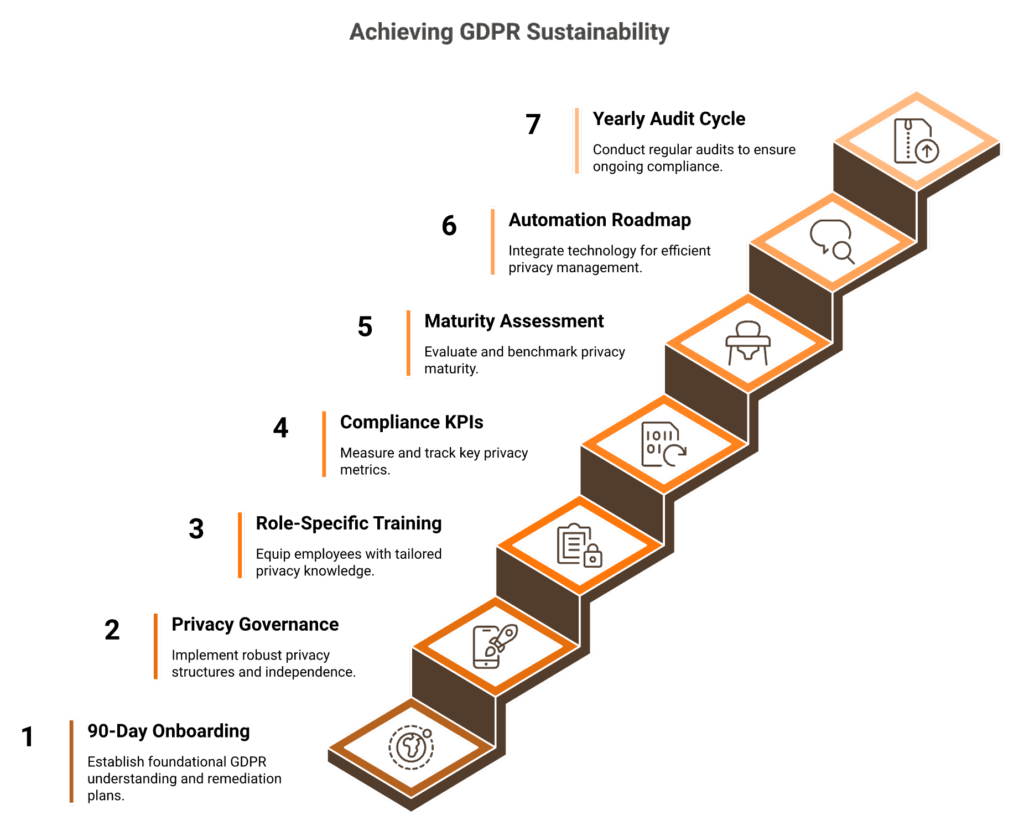
Q10. How Do You Build a Sustainable GDPR Compliance Program After the Initial Engagement Ends?
Most GDPR engagements deliver a report and a remediation plan. The consultant leaves, your team checks a few boxes, and within 6–12 months the compliance posture quietly degrades. Policies go unupdated. New processing activities aren’t assessed. DSAR response times slip. Staff training lapses. Vendor DPAs go unreviewed. The engagement ends, but GDPR obligations don’t, and supervisory authorities don’t care about the gap between your last audit and your next breach. This section provides the sustainability roadmap that most providers never cover.
Step 1: ⏰ Onboarding & Expectations: The First 90 Days
What should the first 30/60/90 days look like with any provider? Set clear deliverable milestones: gap analysis complete by day 30, remediation plan approved by day 60, knowledge transfer and internal documentation by day 90. If your provider can’t articulate these milestones upfront, that’s a red flag. The onboarding phase should produce artifacts your team can maintain independently, not black-box reports only the consultant understands.
Step 2: Privacy Governance Infrastructure
Establish your DPO structure (internal or outsourced per Article 37 requirements), form a privacy committee, and deploy privacy champions across business units. Article 38 independence requirements mean your DPO can’t be someone who also makes processing decisions. Create review boards that meet quarterly to assess new processing activities, regulatory changes, and vendor relationships.
Step 3: 📋 Training & Culture: Role-Specific, Not Generic
Generic “click through this slideshow” training is compliance theater. Build role-specific programs:
- Developers: Privacy by design in microservices and DevOps pipelines
- Marketers: Consent mechanisms, profiling restrictions, and legitimate interest documentation
- Executives: Accountability frameworks, risk appetite, and supervisory authority engagement
- All staff: Annual refreshers mapped to regulatory changes and enforcement trends
Step 4: Compliance KPIs & Metrics That Actually Matter
Track what matters. Without metrics, you can’t prove sustainability to auditors or the board:
| KPI | Target |
|---|---|
| DSAR response time | < 25 days |
| Consent capture rates | > 90% documented |
| Vendor DPA completion | 100% of active processors |
| DPIA completion rate | All high-risk processing assessed |
| Training completion | 95%+ annually |
| Breach readiness score | Tested quarterly |
Step 5: Privacy Maturity Assessment
Benchmark your program annually against established frameworks: AICPA Privacy Maturity Model, NIST Privacy Framework, or ISO 27701. A five-level maturity structure (Initial → Developing → Defined → Managed → Optimized) gives you an objective measure of progress and helps justify budget requests.
Step 6: 🔄 Automation Roadmap: Four Phases
- Phase 1, Foundational: Manual processes documented and repeatable
- Phase 2, Assisted: Key workflows automated (DSARs, consent management)
- Phase 3, Integrated: Cross-system automation with your security stack
- Phase 4, Competitive advantage: Privacy becomes a product differentiator
Step 7: Yearly Audit Planning Cycle
- Q1: Consent and cookie compliance audit
- Q2: Vendor and third-party DPA review
- Q3: DPIA portfolio review for new processing activities
- Q4: Governance effectiveness and training impact assessment
⚠️ Common Sustainability Pitfalls
These are the failures that show up repeatedly in enforcement actions: new cloud services deployed without DPIA, departing employees retaining data access, sub-processor changes not reflected in DPAs, cookie consent banners outdated after platform changes, security incident response procedures left untested, and privacy impact not assessed for AI/ML deployments.
How UnderDefense Simplifies Ongoing Compliance
We provide the continuous security monitoring layer that prevents compliance degradation: 24/7 threat detection documenting ongoing Article 32 compliance, automated evidence generation for audit readiness, and concierge analyst support ensuring breach notification timelines are met. Our 30-day onboarding means this sustainability layer deploys before the consulting engagement even ends, creating continuity rather than a gap.
Q11. What Are the Best Managed Cybersecurity Services That Support GDPR Compliance?
The most effective GDPR compliance programs in 2026 integrate managed cybersecurity services directly into their compliance architecture, because Article 32 requires demonstrable security controls, Article 33 demands 72-hour breach notification, and supervisory authorities increasingly ask for continuous monitoring evidence, not annual audit snapshots. Enforcement reached €1.2 billion in fines during 2025 alone, with regulators targeting operational failures, not just policy gaps.
✅ What Separates GDPR-Ready Managed Cybersecurity Services
Not all managed security providers produce compliance-ready output. Here’s what to evaluate:
- Continuous compliance evidence generation — Article 32/33/35 documentation produced automatically as a byproduct of security operations, not a manual add-on
- Vendor-agnostic integration — Works with your existing SIEM, EDR, and cloud tools without forcing proprietary replacement or data lock-in
- Breach response SLAs — Documented 2-minute alert-to-triage and 15-minute escalation for critical incidents that supports 72-hour notification timelines under Article 33
- Cross-framework support — GDPR + SOC 2 + ISO 27001 + HIPAA evidence from one platform, reducing duplicate effort by 40–60%
- Transparent pricing — Published per-endpoint rates, not opaque enterprise quotes that require three meetings and an NDA to see
🔍 The Evaluation Challenge
Each managed cybersecurity service approaches GDPR compliance integration differently. Some bundle compliance kits at no extra cost, others charge separately for audit evidence modules, and many provide detection-only monitoring without breach response capability. The right choice depends on whether you need a security vendor that also produces compliance artifacts, or a compliance vendor that claims to understand security. For organizations evaluating the full landscape, we’ve published a detailed breakdown comparing managed cybersecurity providers on exactly these criteria.
This analysis is based on EDPB enforcement data, published vendor pricing, documented response time benchmarks, and operational outcomes across 500+ MDR deployments.
Q12. Frequently Asked Questions About GDPR Compliance Services
These are the most frequently asked questions about GDPR compliance services based on search trends, supervisory authority guidance, and enterprise buyer inquiries in 2026.
❓ How much does GDPR compliance cost for a small business?
SMBs typically spend €500–3,000/month combining software (€8–50/user) and outsourced DPO services (€149–500/month), with an initial gap analysis costing €3,000–10,000. The total depends on data complexity, processing volume, and whether you need cross-border transfer assessments.
❓ How long does it take to become GDPR compliant?
Initial compliance typically takes 3–6 months for mid-market organizations using consulting + software. But compliance is an ongoing obligation, not a one-time achievement. Policies need updating, new processing activities need assessment, and staff training requires annual refreshers.
❓ Do I need a Data Protection Officer?
Article 37 requires a DPO if you’re a public authority, conduct large-scale systematic monitoring, or process special category data at scale. Outsourced DPO services fulfill this requirement from approximately €149/month, and often provide better independence than an internal hire who also wears three other hats.
❓ What’s the difference between GDPR compliance software and a GDPR consultant?
Software automates operational workflows (consent management, DSARs, and data mapping) on an ongoing basis. Consultants provide strategic advisory, gap analysis, and remediation planning on a project basis. Most mid-market organizations need both: software for daily operations and consultants for regulatory interpretation, DPIA methodology, and audit preparation.
❓ Can I handle GDPR compliance in-house without external services?
Organizations with dedicated privacy counsel and compliance staff can manage in-house. But most mid-market companies lack the specialized expertise for DPIA methodology, cross-border transfer assessments, and regulatory change monitoring. The honest answer: you can do it in-house if you invest in the people, but most teams are already stretched thin on security and IT operations.
❓ What certifications should a GDPR service provider have?
Look for CIPP/E (IAPP privacy certification), ISO 27701 (privacy information management), and Europrivacy seal. Verify supervisory authority interaction experience and industry-specific references. A provider with certifications but no enforcement experience is like a pilot with a license but no flight hours.
❓ How does GDPR compliance relate to SOC 2 and ISO 27001?
GDPR Article 32 security requirements overlap significantly with SOC 2 Trust Service Criteria and ISO 27001 Annex A controls. Cross-framework compliance platforms can map shared controls to reduce duplicate effort by 40–60%. This is where the right managed security partner pays for itself: one monitoring layer producing evidence for multiple frameworks simultaneously.
❓ What happens if I suffer a data breach, and how do GDPR services help?
Breach response services support the mandatory 72-hour supervisory authority notification under Article 33, data subject communication under Article 34, forensic investigation, and remediation documentation. Daily breach notifications across the EU exceeded 400 per day in 2025, and regulators penalize organizations that can’t demonstrate they had adequate detection measures in place.
❓ What is the EU AI Act’s impact on GDPR compliance?
Organizations using AI systems that process personal data face dual obligations. GDPR DPIAs and AI Act Fundamental Rights Impact Assessments overlap but aren’t identical. The August 2026 compliance deadline for high-risk AI systems means providers must be updated on both frameworks. Article 9 amendments are already being proposed to accommodate AI-enabled medical device processing.
How UnderDefense Bridges the Gap
For organizations where the gap between security monitoring and compliance evidence creates risk, UnderDefense’s MDR bridges that divide with 24/7 threat detection that generates continuous Article 32/33 documentation, ensuring your compliance claims are backed by operational security controls. Start with a free security assessment to identify where your compliance evidence has gaps your current tools can’t fill.
1. What are the five GDPR compliance service models and when should you use each?
GDPR compliance services fall into five distinct models, and most mature organizations layer two to three simultaneously.
-
Consulting delivers project-based gap analysis, remediation roadmaps, and policy drafting over 4–16 weeks — best for organizations starting their compliance journey or navigating regulatory shifts like EU AI Act convergence.
-
Auditing provides independent posture assessment with risk scoring and remediation priorities — ideal before regulator interactions or board reporting.
-
Managed compliance offers ongoing outsourced operations with continuous monitoring, policy lifecycle management, and SLA-backed response — suited for mid-market organizations without in-house privacy teams.
-
Software platforms automate consent management, DSAR workflows, data mapping, and ROPA maintenance — best for teams with some internal expertise needing operational scale.
-
DPO-as-a-Service fulfills Article 37–39 obligations, from €300/month for lighter advisory to €15,000/month for multi-jurisdictional complexity.
The critical insight: no single model covers all eight core compliance capabilities strongly. We bridge this gap by bundling forever-free compliance kits (SOC 2, HIPAA, ISO 27001) with our MDR service, so the security monitoring protecting your data also generates the audit evidence proving you’re protecting it.
2. How much do GDPR compliance services cost in 2026, and what ROI should you expect?
Pricing varies dramatically by model and company size. Here are the 2026 benchmarks:
-
Consulting: €500–€3,000/day depending on firm tier and company size
-
Auditing: €3,000–€100,000 per engagement
-
Software platforms: €50–€25,000/month
-
Managed compliance: €1,000–€25,000/month
-
DPO-as-a-Service: €300–€15,000/month
Mid-market organizations typically spend €30,000–€80,000 annually on a well-structured programme. Enterprise implementations range from €250,000 to €1M initially, with PwC data showing 88% of global enterprises spending over €1 million annually. Hidden cost multipliers include implementation fees (often 2–3× the first month’s subscription), per-DSAR processing charges (€3,000–€40,000/year), and multi-jurisdiction uplift premiums. ROI operates across four dimensions: fine avoidance (average fine of €2.36M), operational efficiency, customer trust as a revenue enabler, and reduced breach costs. We publish transparent per-endpoint pricing — €11–15/endpoint/month — with no hidden fees and compliance evidence generation included.
3. Which GDPR compliance software platforms are leading in 2026?
Seven platforms define the 2026 landscape, each excelling in different capability areas:
-
OneTrust — Most comprehensive privacy management suite; Forrester Wave Leader Q4 2025. Best for large enterprises with multi-regulation needs. Custom enterprise pricing.
-
Vanta — Automated compliance evidence collection across 400+ integrations and 35 frameworks. Best for SaaS companies pursuing multi-framework certification. From €10K/year.
-
BigID — Strongest AI-driven data discovery and classification. Best for data-intensive organizations needing ROPA automation. Custom pricing.
-
Scrut — Cross-framework mapping with competitive mid-market pricing. G2 rating: 4.9/5.
-
Usercentrics — Consent management specialist with Google Consent Mode v2. From €8/month.
-
TrustArc — Established privacy management and DPIA automation for enterprises.
The critical differentiator most buyers overlook: whether a platform generates compliance evidence backed by actual security operations, or just documents policies nobody enforces. We provide the security operations layer that makes every other compliance tool’s claims defensible — continuous monitoring, incident response, and audit-ready breach documentation through 24/7 MDR.
4. How does the EU AI Act change GDPR compliance requirements in 2026?
The EU AI Act, effective August 2025 with enforcement escalating through 2026, creates overlapping obligations for any organization using AI systems that process personal data. Key convergence areas include:
-
Impact assessments: GDPR DPIAs (Article 35) and AI Act Fundamental Rights Impact Assessments (Article 27) overlap but aren’t identical — conduct the DPIA first, then expand to FRIA dimensions.
-
Automated decision-making: Article 22 GDPR rights intersect with high-risk AI classification, triggering dual analysis for AI systems making decisions about individuals.
-
Transparency: Articles 13–14 GDPR information obligations must now cover AI Act transparency requirements in combined notices.
-
Incident reporting: GDPR’s 72-hour breach notification runs parallel to AI Act serious incident reporting, requiring coordinated notification workflows.
Both penalty regimes apply independently — up to €15M or 3% of turnover under the AI Act, plus up to €20M or 4% under GDPR. Our MAXI platform provides continuous AI-aware monitoring that feeds both GDPR and EU AI Act evidence requirements, detecting anomalous automated decision-making and generating documentation satisfying both frameworks.
5. What core capabilities should every GDPR compliance service deliver?
Regardless of service model, your provider must demonstrably deliver across eight capability pillars:
-
Gap analysis & data inventory — automated discovery covering shadow IT, not just known systems
-
Data mapping & ROPA — dynamic Article 30 records that update as processing changes
-
Consent management — CMP with Google Consent Mode v2 and analytics integration
-
DSAR automation — intake, identity verification, redaction workflows, and SLA timers
-
DPIA workflows — automated triggers with risk scoring aligned to supervisory authority guidance
-
Vendor & third-party risk management — DPA lifecycle management and sub-processor monitoring
-
Breach response & incident management — 72-hour notification support with forensic documentation
-
Cross-border data transfer advisory — SCCs, BCRs, adequacy decisions, and Transfer Impact Assessments
No single service model covers all eight capabilities strongly. Managed compliance excels at breach response and vendor monitoring, while software platforms lead on consent and DSAR automation. We address this by providing breach response through our MDR with documented 2-minute alert-to-triage times, while forever-free compliance kits cover capabilities 2–6 — bridging what traditional service models leave disconnected.
6. How do you build a sustainable GDPR compliance programme after the initial engagement ends?
Most GDPR engagements deliver a report, the consultant leaves, and compliance quietly degrades within 6–12 months. Building sustainability requires a structured seven-step roadmap:
-
First 90 days: Set clear milestones — gap analysis complete by day 30, remediation plan by day 60, knowledge transfer by day 90
-
Privacy governance: Establish DPO structure (internal or outsourced per Article 37), form privacy committees, deploy privacy champions across business units
-
Role-specific training: Developers get privacy-by-design in DevOps; marketers learn consent mechanisms and profiling restrictions; executives understand accountability frameworks
-
Compliance KPIs: Track DSAR response time (<25 days), consent capture rate (>90%), vendor DPA completion (100%), breach readiness (tested quarterly)
-
Maturity benchmarking: Assess annually against NIST Privacy Framework or ISO 27701 across five levels
-
Yearly audit cycle: Q1 consent/cookie audit → Q2 vendor DPA review → Q3 DPIA portfolio review → Q4 governance effectiveness assessment
The sustainability layer most organizations miss is continuous security monitoring — 24/7 threat detection that continuously documents Article 32 compliance, generates audit evidence automatically, and prevents the compliance degradation that point-in-time assessments can’t catch.
7. What does GDPR compliance look like for healthcare, fintech, SaaS, and e-commerce?
GDPR compliance surfaces vary dramatically by industry:
-
Healthcare: Article 9 special category data demands explicit consent or specific legal basis for all patient records. DPIAs are mandatory for large-scale health data processing, and national laws (Finland’s Biobank Act, Germany’s digital health regulations) layer additional requirements. Outsourced DPOs need genuine healthcare regulatory expertise. Recommended model: managed services + DPO-as-a-Service.
-
Fintech: PSD2 strong customer authentication intersects with GDPR consent, DORA creates parallel incident reporting obligations that must coordinate with Article 33 timelines, and cross-border payment data requires Transfer Impact Assessments. Recommended model: consulting + software + managed security.
-
SaaS: Article 28 processor obligations require airtight DPAs with every customer, sub-processor chain management is a genuine compliance burden at scale, and DSAR fulfilment must be architecturally supported in your product. Recommended model: software + consulting.
-
E-commerce: Consent management dominates — cookie banners, email marketing, customer profiling, and Google Consent Mode v2 for EU ad targeting. Recommended model: software (consent-focused) + outsourced DPO.
We serve all four verticals through dedicated MDR solutions that generate industry-specific compliance evidence as a byproduct of security operations.
8. How do you evaluate and select the right GDPR compliance provider?
Provider selection requires evaluating seven critical criteria that most organizations overlook:
-
Regulatory expertise currency — Are they updated on EDPB 2026/2027 guidance and EU AI Act convergence?
-
Industry-specific experience — Healthcare Article 9, fintech DORA, SaaS processor obligations each require specialized knowledge
-
Security integration — Is the compliance service connected to security monitoring, or siloed?
-
Pricing transparency — Published rates with clear scope, or “contact sales” with scope creep?
-
Scalability — Can it grow from 50 to 5,000 employees without re-architecture?
-
Post-engagement sustainability — Does it build internal capability or create vendor dependency?
-
Evidence generation — Audit-ready documentation generated automatically, or manual reporting?
The most common selection mistakes: choosing on brand alone (Big-4 doesn’t mean best fit for a 75-person SaaS company), ignoring security integration (compliance without operational evidence is a paper exercise), and accepting opaque pricing. The real question isn’t “Which GDPR service is cheapest?” but “Which combination can I prove is working when a supervisory authority investigates?” We provide transparent per-endpoint pricing, 250-tool integration, and continuous Article 32/33/35 documentation — making your compliance claims defensible with operational evidence.