




Q1. What Is SOC 2 Automation and Why Do Security Leaders Need It in 2026?
If your compliance analyst is still screenshotting AWS IAM policies and pasting them into a shared Google Drive folder, your security team is doing compliance work instead of actual security work. That’s the manual SOC 2 reality for hundreds of organizations right now: weeks of evidence gathering across spreadsheets, chasing engineering teams for proof that controls exist, and preparing for audits that consume entire quarters.
SOC 2 is built on five Trust Service Criteria: Security, Availability, Processing Integrity, Confidentiality, and Privacy, defined by the AICPA as the foundation for how service organizations protect customer data. And with SOC 2 now the #1 requested certification by enterprise procurement teams, it’s not optional anymore. It’s a sales prerequisite.
⚠️ The Manual Compliance Trap
What Breaks in Real Life
Here’s what breaks in real life: teams assemble evidence once a year, scramble during audit windows, and have zero visibility into whether controls drifted the day after the auditor left. Traditional GRC tools like ServiceNow GRC, or let’s be honest, a shared Excel tracker, require dedicated compliance analysts and still leave gaps. I’ve seen organizations fail audits because a single S3 bucket encryption change went unnoticed for five months. The cost? $15K–$30K in wasted audit fees, plus 3–6 months of delayed enterprise deals while the team scrambles to remediate and re-engage the auditor.
✅ The Automation Paradigm Shift
From Annual Scramble to Continuous Readiness
SOC 2 automation platforms emerged to solve evidence collection, continuous monitoring, and control mapping at scale. They integrate with cloud infrastructure (AWS, Azure, GCP), identity providers (Okta, Azure AD), HR systems (BambooHR, Rippling), and code repositories (GitHub, GitLab) to auto-collect evidence against Trust Service Criteria. The result: weeks instead of months to audit readiness, and continuous compliance instead of point-in-time snapshots.
But automation is not a silver bullet. The remaining 20% of controls that require human judgment represent the controls that matter most, and that’s where most vendors go silent.
Where Security Operations and Compliance Converge
Closing the Gap Between Paperwork and Posture
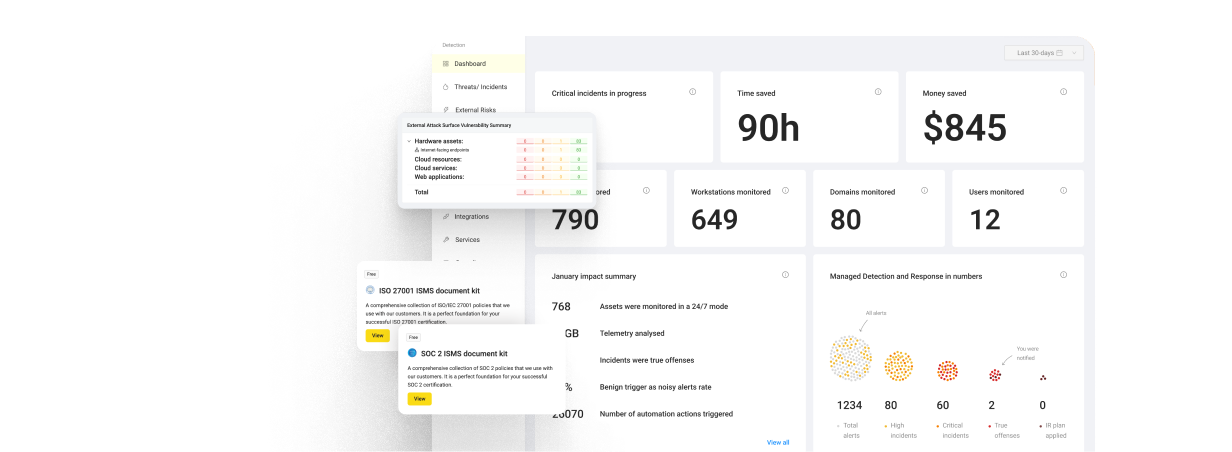
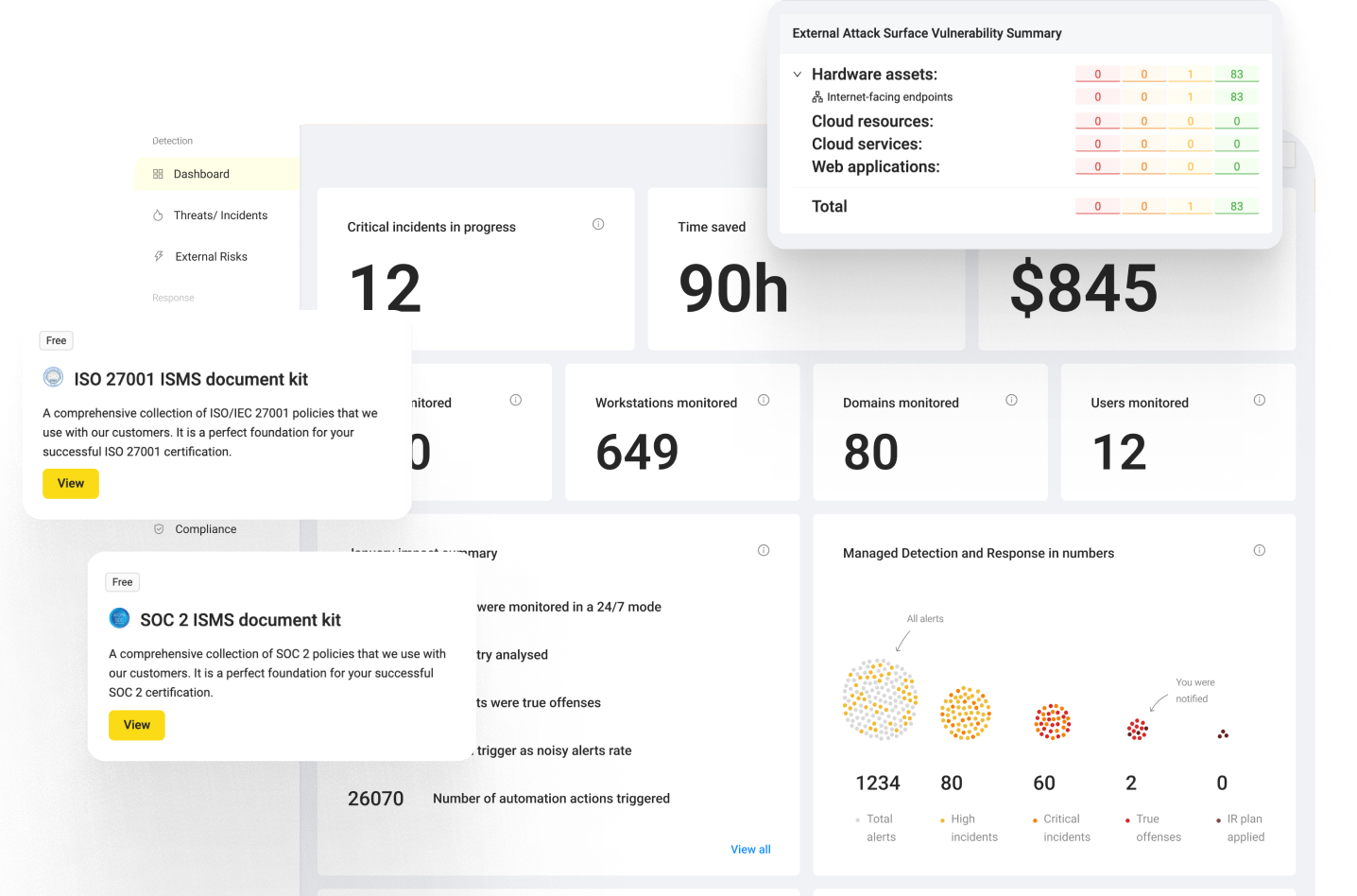
Automation platforms handle evidence collection, but they can’t detect threats, respond to incidents, or verify that your security controls actually work under attack. We built UnderDefense’s MAXI Compliance to bridge that gap: forever-free SOC 2 compliance kits integrated directly into our MDR service. The same platform that detects and responds to threats 24/7 also generates the audit evidence proving those controls are operational, not just configured. That’s the difference between compliance paperwork and actual security posture.
Organizations with SOC 2 Type 2 reports close enterprise deals 35–50% faster than those without. For Series A startups chasing their first $100K+ contract, SOC 2 automation is more than an efficiency play. It’s a revenue enablement strategy that directly impacts pipeline velocity. The question isn’t whether to automate, but whether your automation actually proves your controls work, or just proves they exist.
Q2. What Can SOC 2 Automation Actually Automate? (Complete Capabilities Breakdown)
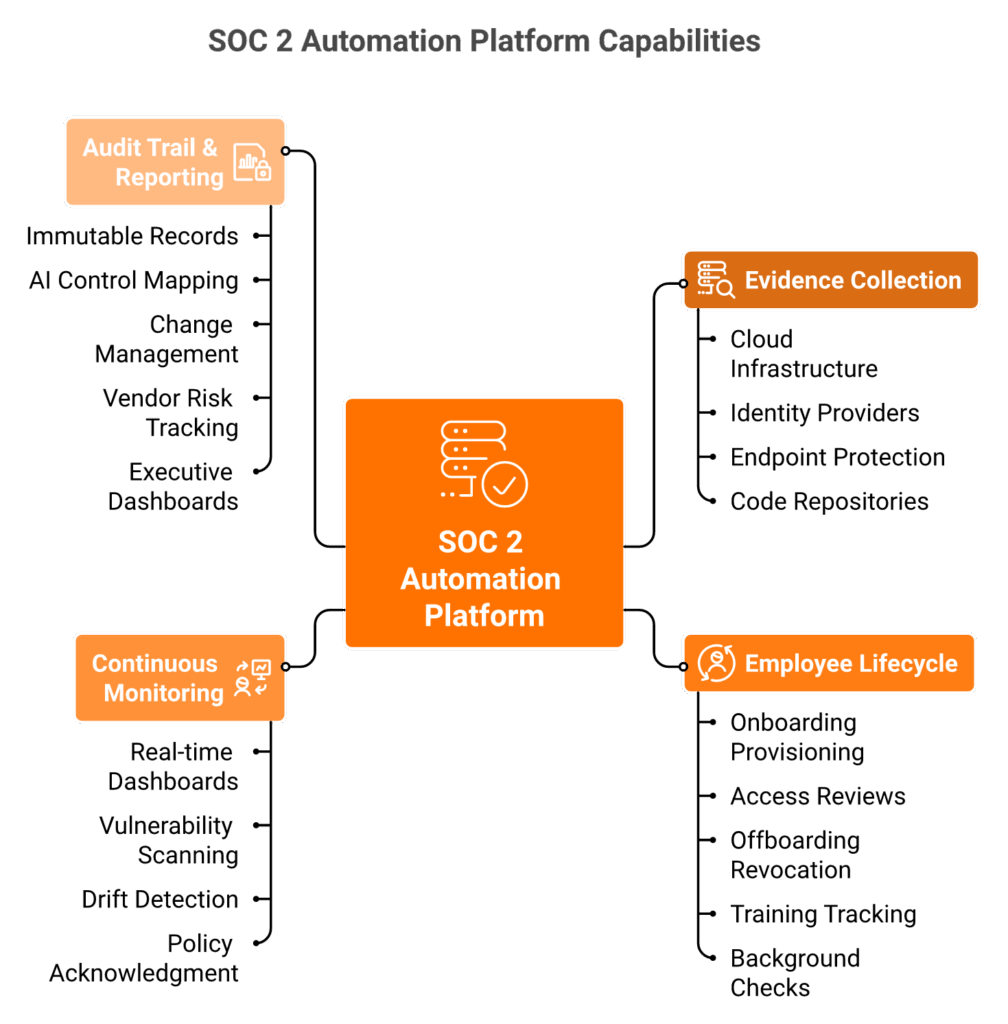
SOC 2 automation platforms eliminate the manual grind across four core categories: evidence collection, employee lifecycle management, continuous monitoring, and audit trail generation. Here’s exactly what gets automated, and what each capability maps to in practice.
📋 Evidence Collection Automation
The Highest-Value Category
This is the highest-value category. Platforms auto-pull configurations and evidence via API from your existing stack:
- Cloud infrastructure — AWS S3 encryption status, Azure network security groups, GCP IAM policies pulled continuously instead of quarterly screenshots
- Identity providers — Okta and Azure AD access logs, MFA enforcement status, conditional access policies
- Endpoint protection — EDR/MDM tools (CrowdStrike, Jamf, Intune) confirm agent deployment, device encryption, and OS patch status
- Code repositories — GitHub branch protection rules, GitLab merge request approvals, CI/CD pipeline change evidence
What took a compliance analyst 40+ hours of manual screenshot collection now runs continuously via API integration.
👤 Employee Lifecycle & Access Automation
Where Auditors Focus Hardest
Automated workflows handle the access controls auditors scrutinize most heavily (mapped to CC6.1–CC6.3 logical access controls):
- Onboarding — Role-appropriate permissions provisioned automatically when HR marks a new hire as active
- Access reviews — Scheduled reviews flag terminated employees still carrying active accounts, with automated revocation workflows
- Offboarding — Access removal confirmed within policy-mandated timeframes, with timestamped evidence
- Training tracking — Security awareness completion auto-logged with reminders for overdue employees
- Background checks — Pre-employment screening verification integrated through HR platforms like BambooHR or Rippling
🔍 Continuous Monitoring, Scanning & Alerting
Transforming SOC 2 from Annual Event to Operational Discipline
This is where automation transforms SOC 2 from an annual event to an operational discipline:
- Real-time compliance dashboards show posture against all five TSC categories at any moment
- Vulnerability scanning integrations pull results from Qualys, Tenable, or Nessus and map findings directly to SOC 2 controls
- Drift detection alerts when controls fall out of compliance: MFA disabled for an admin account, an unencrypted storage bucket created, a firewall rule changed
- Policy acknowledgment tracking confirms employee sign-off with timestamps
Teams remediate before the auditor arrives, not after.
🗂️ Audit Trail, Control Mapping & Reporting
Eliminating Manual Spreadsheet Work
- Immutable evidence records with timestamps generated automatically for every control
- AI-driven control mapping matches existing controls to Trust Service Criteria, identifying gaps without manual spreadsheet work
- Change management evidence pulled from CI/CD pipelines (Jira tickets, pull request approvals) to prove change control processes
- Vendor risk tracking monitors third-party compliance status and questionnaire responses
- Executive dashboards provide board-ready reporting on overall readiness percentage
UnderDefense’s MAXI platform and forever-free SOC 2 compliance kits generate operational security evidence automatically, because the same system monitoring for threats is simultaneously proving your security controls work. That eliminates the gap between “compliance evidence” and “actual security posture” that standalone automation platforms can’t close.
Q3. What SOC 2 Controls Can Never Be Fully Automated? The Human Judgment Layer
Every SOC 2 automation vendor promises “80% of compliance automated.” What they don’t prominently disclose is that the remaining 20% represents the controls that matter most, the ones that require human judgment, organizational context, and risk acceptance decisions that no algorithm can make on your behalf. These are the controls auditors scrutinize most heavily, and they’re the ones most likely to produce findings that derail your report.

❌ The Un-Automatable Controls (Mapped to TSC)
Where No Platform Can Substitute for People
Here’s the specific list, mapped to Trust Service Criteria, that no platform can fully handle:
- Risk acceptance and tolerance decisions (CC3.1–CC3.4) — Management must decide which risks to accept, transfer, or mitigate based on business context. No tool knows your risk appetite.
- Board and management oversight (CC1.2) — Governance accountability requires human decision-making at the leadership level.
- Incident response judgment (CC7.3–CC7.4) — Severity classification, business impact assessment, stakeholder communication strategy, and containment vs. eradication decisions.
- Audit scoping and boundary decisions — Defining which systems, processes, and TSC categories are in scope requires business context no tool possesses.
- Vendor risk evaluation beyond questionnaires — Assessing whether a third-party’s security posture actually protects your data requires human analysis of contracts, architecture, and context.
- Security control design decisions — Choosing which controls to implement based on your specific threat landscape and risk appetite.
- Policy writing requiring leadership sign-off — Automation generates templates, but leadership must make policy decisions reflecting organizational values.
- HR-related controls — Background checks, termination procedures, and access revocation judgment calls involving employee relations.
- Auditor communication and walkthrough participation — The human relationship layer of the audit process.
🤖 The AI-Era Reality
Why Professional Judgment Remains Irreplaceable
Even with AI-powered compliance tools, professional judgment remains irreplaceable. AI can flag a misconfigured firewall rule, but it can’t determine whether the business exception your CTO approved last quarter is still valid. AI can detect an access anomaly, but it can’t verify with the employee whether that 2 AM login was legitimate overtime or credential compromise.
People, process, tools: it’s the same triad we keep coming back to. Automation scales the routine. Humans handle the edge cases. You can’t have one without the other and call it real security.
✅ How UnderDefense Closes the Human Judgment Gap
Detection Plus Verified Human Response
This is exactly why we pair AI-driven detection with human analyst response. When SOC 2 controls flag anomalies requiring judgment, such as suspicious access patterns, potential insider threats, or ambiguous incident severity, our concierge analysts verify directly with affected users via Slack, Teams, or email. The system generates audit evidence proving not just detection but verified human response, the exact evidence auditors look for in CC7.2 (incident detection) and CC7.3 (incident response) controls.
“Their team provided us with clear and detailed insights into security vulnerabilities, along with practical recommendations on how to fix them. This level of transparency made it easy for our team to take action.”
— Arman N., CTO UnderDefense – G2 Verified Review
“Not having to worry about ransomware, alert overload and reporting. Getting a clear view of my security posture, where the threats are coming from and how they are handled.”
— Arlin O., Enterprise UnderDefense – G2 Verified Review
Automation platforms tell your auditor that controls are configured. We tell your auditor that controls are working, because we test them against real threats 24/7 and respond with human judgment when automation reaches its limit.
Q4. How Much Does SOC 2 Automation Cost? Full TCO Breakdown by Company Size
SOC 2 automation costs $20K–$150K+ in the first year depending on company size, scope, and whether you’re pursuing Type 1 or Type 2. Here’s the complete breakdown, consolidating data that’s currently scattered across a dozen vendor pages into one reference.
💰 Total First-Year Cost by Company Size
| Cost Component | Startup (<50 emp.) | Mid-Market (50–250) | Enterprise (250+) |
|---|---|---|---|
| Automation Platform | $7K–$15K/yr | $15K–$45K/yr | $30K–$65K+/yr |
| Audit Fees (Type 1) | $5K–$12K | $12K–$30K | $25K–$50K+ |
| Audit Fees (Type 2) | $7K–$20K | $20K–$50K | $35K–$80K+ |
| Readiness Assessment | $5K–$15K | $10K–$25K | $15K–$50K |
| Internal FTE Time | 0.25 FTE | 0.5 FTE | 0.5–1.0 FTE |
| Total (Type 2, Year 1) | $20K–$55K | $50K–$120K | $80K–$200K+ |
💸 Platform Pricing by Named Vendor
What Real Market Data Shows
Not all platforms price the same way. Here’s what real market data shows:
- Vanta — $9.5K–$25K/yr for SOC 2; per-employee pricing, add-on frameworks extra
- Drata — $12K–$45K/yr depending on company size and framework count; enterprise tiers with custom integrations run significantly higher
- Secureframe — $1.5K–$8K/yr at the startup tier, scaling to $22K–$42K/yr for mid-market
- Sprinto — From $8K/yr with competitive startup pricing
- Thoropass — $12K–$25K/yr, includes auditor matching
- UnderDefense
- MDR at $11–$15/endpoint/month
Common pricing models: per-employee, flat-tier, or per-framework add-ons. Enterprise tiers with custom integrations and dedicated CSMs typically run 2–3x higher than published starting prices.
⏰ Audit Fees: Type 1 vs. Type 2
Scope, Complexity, and Auditor Firm Matter
Audit fees depend on scope (number of TSC categories), complexity (multi-cloud, hybrid environments), and auditor firm:
- Type 1 audit — $5K–$35K. Boutique CPA firms sit at the lower end; Big 4 firms start at $25K+
- Type 2 audit — $7K–$80K+. Requires a minimum 3–6 month observation window before audit execution
- Readiness assessment — $10K–$50K for pre-audit gap identification
- Gap remediation — $5K–$25K for implementing missing controls (the cost most vendors leave out of their marketing)
⚠️ Opportunity cost: Every month without a SOC 2 report blocks enterprise pipeline. For mid-market SaaS, average deal sizes of $50K–$250K sit waiting while sales cycles extend 2–4 months without compliance proof.
The Hidden Cost: Internal FTE
What Automation Vendors Never Include in ROI Calculators
Even with full automation, someone must own the program: responding to control failures, managing remediation tickets, coordinating with auditors, and making the risk acceptance decisions covered in Q3. Estimate 0.25 FTE for startups, scaling to a full-time dedicated compliance manager for enterprises. This is often the largest hidden cost, and the one automation vendors never include in their ROI calculators.
UnderDefense’s forever-free SOC 2 compliance kits eliminate the separate compliance platform cost entirely when paired with MDR, saving $8K–$25K/yr while generating higher-quality operational security evidence that proves controls work under real conditions, not just in configuration snapshots.
Q5. SOC 2 Type 1 vs. Type 2: How Does Automation Change the Timeline and Evidence?
SOC 2 Type 1 evaluates whether your controls are properly designed and implemented at a single point in time. SOC 2 Type 2 evaluates whether those same controls actually worked over a sustained period, typically 3 to 12 months. Automation impacts each differently, and if you don’t understand the distinction, you’ll overspend on one and underprepare for the other.
⏰ Type 1: Where Automation Delivers Immediate ROI
With automation, Type 1 preparation compresses from the traditional 3–6 months down to 4–8 weeks. The reason is straightforward: Type 1 is about proving controls exist, and platforms can auto-pull configurations, policies, and access controls from API-accessible systems in hours rather than weeks of manual screenshot collection. Manual Type 1 prep typically requires 200–400 hours of internal labor. With automation, that drops to 40–80 hours.
⚠️ Type 2: Where Automation Alone Falls Short
Here’s where most teams get tripped up. Type 2 requires a minimum observation window, usually 3 to 6 months, that no automation can compress. Auditors aren’t looking for green dashboards. They’re looking for evidence that your controls detected real incidents, that your team responded appropriately, and that failures were identified and remediated during the observation period. Automation handles continuous monitoring status beautifully, but it cannot fabricate incident response evidence when no active security operations exist.
The Real Numbers
| Metric | Manual Approach | With Automation |
|---|---|---|
| Type 1 prep time | 3–6 months | 4–8 weeks |
| Internal labor (Type 1) | 200–400 hours | 40–80 hours |
| Type 2 ongoing evidence | 15–20 hrs/month | 2–5 hrs/month |
| Total zero-to-Type 2 report | 12–18 months | 6–12 months |
The monthly evidence burden is where automation pays dividends over time, dropping from 15–20 hours per month of manual log collection and control verification down to 2–5 hours when your compliance platform is pulling data automatically.
✅ How Active Security Operations Close the Type 2 Gap
The piece most compliance-only platforms miss is this: Type 2 auditors specifically want documented incident detection timestamps, analyst-verified response actions, containment records with chain-of-custody, and remediation completion logs. A compliance platform can show your firewall rules exist. It cannot show that your team caught and contained a credential compromise at 2:47 AM on a Tuesday.
We built UnderDefense’s 24/7 MDR to generate exactly this kind of operational evidence as a natural byproduct of active security operations. Your SOC 2 evidence accumulates automatically while your organization is actually being protected: documented detection timestamps, analyst response actions, containment records, and remediation logs all mapped to Trust Service Criteria. The Type 2 observation period stops being a compliance burden and starts being proof that your security posture is real, not theoretical.
Q6. Are You Ready for SOC 2 Automation? Readiness Scorecard and Decision Framework
Before you commit budget to a SOC 2 automation platform, score your organization against these 10 readiness criteria. Getting honest about where you stand saves you from buying a tool your infrastructure can’t support, or worse, discovering mid-audit that your evidence pipeline has gaps.
📋 SOC 2 Automation Readiness Checklist
- ☐ Cloud infrastructure uses API-accessible platforms (AWS, Azure, GCP), not legacy on-prem only
- ☐ Identity management is centralized (Okta, Azure AD, Google Workspace) rather than local accounts
- ☐ HR system supports API integration for employee lifecycle events
- ☐ At least 0.25 FTE dedicated to compliance program ownership
- ☐ Existing security controls cover at least 50% of targeted Trust Service Criteria categories
- ☐ Endpoint management uses MDM/EDR with API access (Jamf, Intune, CrowdStrike)
- ☐ Development workflows use version-controlled repositories with merge approvals
- ☐ Your organization has, or is willing to adopt, formal security policies
- ☐ A clear timeline driver exists (enterprise deal, partnership requirement, board mandate)
- ☐ Budget allocated for both platform and audit fees (not just one)
⭐ Score Interpretation
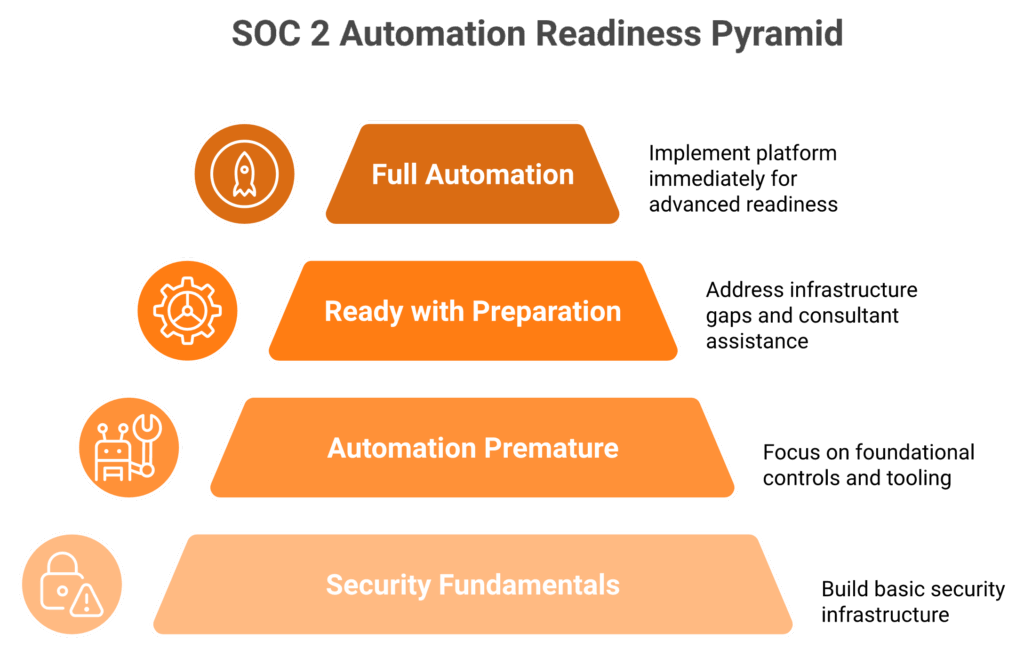
| Score | Readiness Level | Recommended Path | Expected Timeline |
|---|---|---|---|
| 8–10 ✅ | Ready for full automation | Implement platform immediately | 4–8 weeks to Type 1 |
| 5–7 ✅ | Ready with preparation | Address infra gaps first; consider consultant-assisted automation | 8–12 weeks |
| 3–4 ✅ | Automation may be premature | Focus on foundational controls and centralizing tooling | Fully outsourced compliance |
| 0–2 ✅ | Start with security fundamentals | Build basic security infrastructure before compliance adds value | Manual-first approach |
🔍 Decision Tree by Stage
Automate (score 7+, $15K+ budget, 0.5+ FTE available): Full platform deployment: Vanta, Drata, Sprinto, or UnderDefense MAXI Compliance.
Consultant-Assisted Automation (score 5–7, limited internal expertise): Pair a platform with guided implementation from a compliance advisor.
Fully Outsourced (score <5, startup with no security infrastructure): Engage an MDR provider that bundles compliance from day one.
Manual-First (score <3, very early stage): Prioritize centralizing identity management, deploying EDR, and formalizing policies before investing in automation.
✅ How UnderDefense Closes Readiness Gaps from Day One
Regardless of your score, the constant requirement across every tier is operational security evidence. UnderDefense’s MDR service, with forever-free SOC 2 compliance kits, provides the security operations foundation from day one: 24/7 monitoring activates within 30 days, compliance evidence starts accumulating immediately, and your readiness score improves automatically as real security controls come online. Most organizations go from 3–4 checked items to 8+ within 30 days of MDR onboarding, because real security infrastructure is being deployed, not just compliance checkboxes.
“The biggest problem they solved was our 24/7 coverage gap. We needed round-the-clock monitoring for compliance reasons, but building our own SOC wasn’t realistic with our budget and the current hiring market. UnderDefense fills that gap without us having to hire a full team.”
— Verified User, Marketing and Advertising UnderDefense – G2 Verified Review
“Really like using UnderDefense MAXI platform, as it has everything from early risk detection and compliance to incident response automation and 24/7 protection with MDR.”
— Serhii I., CEO UnderDefense – G2 Verified Review
Q7. Which SOC 2 Automation Platform Should You Choose? Evaluation Criteria and Comparison Matrix
You’re choosing a SOC 2 automation platform that will manage your compliance posture for years. Pick wrong, and you’re locked into a vendor that doesn’t scale, charges per-framework add-on fees, or provides compliance evidence disconnected from actual security operations. The evaluation criteria most buyers use, integration count and brand recognition, are exactly the wrong criteria.
The Right Evaluation Framework
Eight Criteria That Actually Determine Long-Term Platform Value
- Integration depth with your actual stack, not just count, but quality of evidence pulled from each connected system
- Continuous monitoring granularity: real-time drift detection vs. periodic scans that miss control changes between intervals
- Automated remediation vs. ticket-based manual follow-up. Does the platform help you fix gaps, or just flag them?
- Multi-framework support and cross-standard control mapping (ISO 27001, HIPAA, PCI DSS, GDPR), critical if you’ll need more than SOC 2
- AI/ML capabilities for risk assessment, gap detection, and predictive compliance
- Native security features vs. dashboard-only compliance layer. Does the platform prove controls work, or just prove they exist?
- Auditor network/marketplace and auditor acceptance of platform-generated evidence
- Pricing transparency: published rates vs. opaque “contact sales” with per-framework add-ons
📋 Platform Comparison Matrix
| Platform | Pricing | Key Strength | Limitation | G2 Rating | Ideal Buyer |
|---|---|---|---|---|---|
| UnderDefense | $11–15/endpoint/mo (forever-free SOC 2 kit + MDR) | Operational security evidence + compliance in one service; 250+ integrations | Compliance module newer to market vs. standalone platforms | G2 High Performer MDR | Orgs wanting security + compliance from one provider |
| Vanta | $9.5K–$25K/yr | Strongest brand recognition; 300+ integrations | Per-framework pricing adds up fast; compliance-only layer | 4.6/5 | Series A/B SaaS needing fast SOC 2 |
| Drata | $10K–$15K/yr | Strong automation; clean UI | Limited native security features; evidence ≠ operational proof | 4.7/5 | Mid-market with established cloud stack |
| Secureframe | $12K–$20K/yr | Strong AI features; good auditor network | Higher price ceiling; less startup-friendly | 4.6/5 | Multi-framework mid-market |
| Sprinto | From $8K/yr | Most affordable; strong startup focus | Fewer enterprise integrations | 4.8/5 | Early-stage startups on tight budgets |
| Thoropass | $12K–$25K/yr | End-to-end service with auditor matching | Premium pricing for bundled audit | 4.5/5 | Orgs wanting audit + platform in one |
| Scytale | $8K–$18K/yr | Fast onboarding; streamlined for startups | Smaller integration library | 4.8/5 | Startups needing speed |
| Hyperproof | $15K–$40K/yr | Enterprise GRC focus; multi-framework strength | Complex setup; high cost floor | 4.6/5 | Enterprise GRC teams |
🔍 Decision Framework by Scenario
Startup with no security infrastructure → UnderDefense MDR + compliance kit (security + compliance from day 1), paired with Sprinto or Scytale for additional automation.
Series A/B with existing cloud stack → Vanta or Drata for compliance automation + UnderDefense for operational evidence.
Mid-market needing multiple frameworks → Secureframe or Thoropass + UnderDefense MDR for continuous security evidence.
Enterprise GRC → Hyperproof for governance layer + UnderDefense MDR for operational security proof.
The real question isn’t “Which compliance platform has the most integrations?” but “Does my compliance evidence reflect my actual security posture?” Every platform above handles evidence collection. Only UnderDefense proves controls work under real attack conditions, with a 100% ransomware prevention record across 500+ MDR clients and zero customer churn.
“UnderDefense has changed our approach to cybersecurity. At first, we hired them for managed SIEM service, but after they demonstrated the value of MDR, our management was motivated to act on it.”
— Yaroslava K., IT Project Manager UnderDefense – G2 Verified Review
“Their team provided us with clear and detailed insights into security vulnerabilities, along with practical recommendations on how to fix them. This level of transparency made it easy for our team to take action.”
— Arman N., CTO UnderDefense – G2 Verified Review
Q8. Best SOC Tools That Accelerate SOC 2 Audit Readiness
The tools that most impact SOC 2 audit readiness aren’t just compliance automation platforms. They’re the security operations tools that generate the operational evidence auditors value most. SIEM/XDR for log aggregation, MDR for 24/7 monitoring and incident response evidence, EDR for endpoint protection validation, and identity management for access control proof. UnderDefense, CrowdStrike, Splunk, and Microsoft Sentinel each lead different segments of this stack.
Quick Evaluation Criteria
What Separates SOC 2-Ready Security Tools from the Rest
- Automated evidence generation mapped directly to Trust Service Criteria
- Continuous logging with tamper-proof audit trails
- Incident detection and response documentation with timestamps and chain-of-custody
- Integration with compliance automation platforms for seamless evidence aggregation
- 24/7 monitoring capability that satisfies CC7.1–CC7.2 requirements
🔍 Where UnderDefense Spans Multiple Categories
Each tool category serves a different layer of the SOC 2 evidence stack. UnderDefense’s MAXI platform uniquely spans multiple categories, combining SIEM integration, MDR with 24/7 analyst response, and compliance evidence generation in one service. Rather than stitching together separate tools for detection, response, and compliance documentation, the MAXI platform generates audit-ready artifacts as a natural output of active security operations.
For a complete breakdown of security tools that strengthen your SOC 2 compliance posture, with pricing, features, and deployment considerations for each platform, see the full ranking below.
This analysis is based on documented SOC 2 audit outcomes, G2 Spring 2025 rankings, published pricing, and operational results across 500+ MDR deployments.
Q9. Step-by-Step SOC 2 Automation Implementation: From Integration to Audit Day
Most implementation guides give you a generic checklist. Here’s what actually happens, week by week, when you deploy SOC 2 automation, including what your engineers, HR team, and employees experience on the ground.
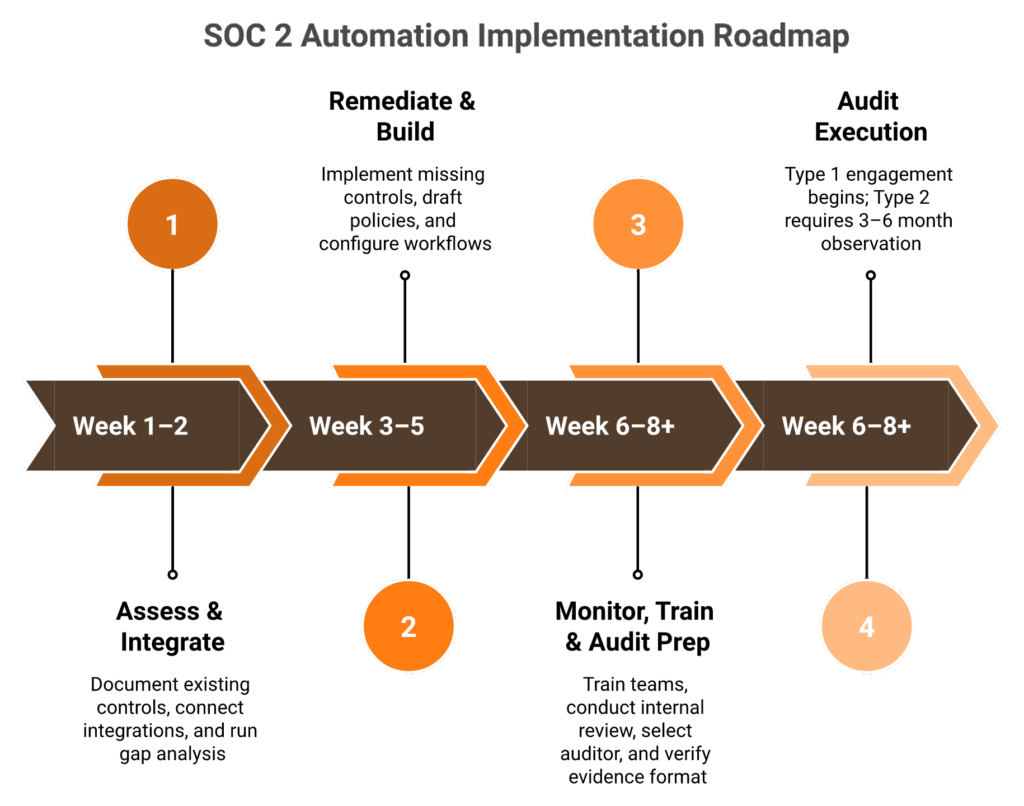
Phase 1: Assess & Integrate (Week 1–2)
⏰ Establish Your Baseline First
Before touching any platform, document your existing controls across all Trust Service Criteria categories you’re targeting. This means cataloging what you already have: access control policies, encryption standards, incident response procedures, and identifying what’s missing.
Select your automation platform and connect high-priority integrations first: cloud infrastructure (AWS/Azure/GCP), identity provider (Okta/Azure AD), HR system (BambooHR/Rippling), code repositories (GitHub/GitLab), and EDR/MDM tools (CrowdStrike/Jamf). Run the initial automated gap analysis.
📝 Your Output: A Gap Report
The deliverable here is a gap report showing exactly which controls need implementation, remediation, or documentation. This is your roadmap, not a vague “you need better security” assessment, but a specific list: “Control CC6.1 requires MFA enforcement on all admin accounts. Current state: MFA enabled for 73% of admin accounts.” That level of specificity is what makes automation valuable in Phase 1.
Phase 2: Remediate & Build (Week 3–5)
✅ Implement What’s Missing
This is where most delays happen. Budget 2–3 weeks for remediation depending on gap severity. Implement missing controls identified in the gap analysis. Draft or customize security policies: acceptable use, access control, incident response, change management, and vendor management.
Configure automated access review workflows. Enable continuous monitoring and set alert thresholds for control drift. Map controls to Trust Service Criteria in the platform. Assign control owners across engineering, HR, and operations teams. This is critical, because SOC 2 isn’t a security-team-only exercise.
⚠️ The Organizational Change Nobody Warns You About
SOC 2 automation changes daily workflows across your company. Developers will see new pull request approval requirements. HR gets automated onboarding/offboarding checklists. IT admins encounter access review prompts they didn’t have before. If you don’t communicate these changes proactively, you’ll get resistance. Run a 30-minute all-hands explaining what’s changing and why. It saves weeks of back-and-forth later.
Phase 3: Monitor, Train & Audit Prep (Week 6–8+)
🔍 Enable Full Continuous Monitoring
Train engineering teams on new workflows: developers encounter access review prompts, security training assignments, and code-signing requirements. HR experiences automated background check tracking and offboarding verification. All employees face periodic access review confirmations and policy acknowledgment requests. Most complete these in under 5 minutes.
Conduct an internal readiness review before engaging your auditor.
💰 Choosing Your Auditor: Big 4 vs. Boutique
This decision matters more than most guides acknowledge. Big 4 firms (Deloitte, PwC, EY, KPMG) cost $60,000–$450,000+ for Type 2, carry the strongest brand recognition for enterprise buyers, but move slower (6–18+ months). Boutique CPA firms range from $15,000–$75,000, offer faster timelines (3–9 months), and provide more flexible engagement models.
Verify auditor acceptance of your platform’s automated evidence format. Most auditors now accept evidence from major platforms (Vanta, Drata, Secureframe), but confirm in advance. Auditor marketplace features in platforms like Thoropass and Vanta simplify selection.
Phase 4: Audit Execution & Day-to-Day Reality
📋 Pilot Before You Go Full Scope
For Type 1, auditor engagement begins around Week 6–8. For Type 2, the mandatory observation window starts, minimum 3 months, and no automation can shorten this.
Consider a pilot approach: deploy automation for 2–3 high-priority TSC categories first, validate evidence quality with your auditor, then expand to full scope.
Day-to-day employee experience post-deployment: developers see minimal workflow disruption (automated checks run in the background), HR receives automated compliance task notifications, and employees complete quarterly access reviews in under 5 minutes. The goal is compliance that operates invisibly. If your employees constantly complain about compliance friction, your implementation needs tuning.
How UnderDefense accelerates this: UnderDefense’s 30-day MDR onboarding generates operational security evidence from day one. The security monitoring protecting your environment simultaneously builds your SOC 2 evidence trail, compressing gap remediation because your controls are actively operational, not just documented.
Q10. Post-Audit Strategy: Continuous Compliance, Scaling, and Avoiding Common Pitfalls
It’s 60 days after your SOC 2 Type 2 audit. Compliance dashboard shows green. But DevOps just spun up a new AWS account without your security baseline applied. An employee’s MFA was disabled during a support ticket and never re-enabled. A terminated contractor’s access wasn’t revoked because HR’s offboarding workflow had a gap. Your auditor won’t see this for 10 months, but an attacker could exploit it tomorrow.
This is compliance drift, and based on what we see across hundreds of organizations, it affects 40%+ of companies between audit cycles.
Why Compliance Drift Happens
❌ Treating SOC 2 as an Event, Not a Discipline
Compliance drift occurs because organizations treat SOC 2 as an annual event, not an operational discipline. The audit report gets filed, the champagne gets poured, and within weeks, the daily vigilance fades. But drift is just one of five critical pitfalls that undermine SOC 2 programs:
- Over-relying on automation without human oversight: Automation flags issues, but someone must still act on them. A dashboard showing “control failure detected” means nothing if nobody investigates within hours.
- Choosing platforms based on marketing rather than integration fit: The platform with the most integrations isn’t valuable if it can’t deeply connect to YOUR specific stack.
- Underestimating organizational change management: SOC 2 automation changes developer workflows, HR processes, and access review habits. People resist what they don’t understand.
- Neglecting post-audit continuous compliance: Treating the audit report as the finish line rather than the starting line.
- Vendor lock-in and data portability blindness: Your evidence, control mappings, and compliance configurations may not be portable if you switch platforms. Always verify: Can you export your evidence repository? Are control mappings in standard formats? What’s the switching cost?
📋 How It Should Work + Scaling Strategy
Continuous compliance means security monitoring, threat detection, and compliance evidence generation run as a single integrated system. When a control drifts, it’s detected and remediated in hours, not discovered 10 months later during audit prep.
Year-over-year renewal: automation reduces annual audit prep from 200+ hours to 40–60 hours. Scaling across frameworks: SOC 2 control mappings provide 60–70% overlap with ISO 27001, making multi-framework compliance achievable with incremental effort. For platform migration planning: maintain control mapping documentation independently of any platform, export evidence quarterly, and ensure audit trail continuity during any transition.
UnderDefense’s Approach to Continuous Compliance
✅ Security Operations That Double as Compliance Evidence
UnderDefense’s MAXI platform provides continuous security monitoring that simultaneously serves as continuous compliance monitoring. Access anomalies are detected, verified by human analysts, and documented in real-time, creating an always-current evidence trail proving controls are continuously operational. The forever-free SOC 2 compliance kit ensures evidence is audit-formatted and always current.
With a 2-minute alert-to-triage SLA and 15-minute escalation for critical incidents, control failures are addressed before they become audit findings, not after.
From annual compliance scrambles to continuous audit readiness: that’s the difference between a compliance tool and an integrated security operations partner that never stops monitoring.
“UnderDefense has changed our approach to cybersecurity. At first, we hired them for managed SIEM service, but after they demonstrated the value of MDR, our management was motivated to act on it. Now, with their security monitoring and incident response, we know our endpoints are well-protected.”
— Yaroslava K., IT Project Manager UnderDefense – G2 Verified Review
“They’ve also made our audit process much less painful. The reports from their platform give us clear evidence of our security controls and incident response capabilities. When auditors or clients ask questions about our security posture, we can pull up exactly what they need to see.”
— Verified User in Marketing and Advertising UnderDefense – G2 Verified Review
“Really like using UnderDefense MAXI platform, as it has everything from early risk detection and compliance to incident response automation and 24/7 protection with MDR.”
— Serhii I., CEO UnderDefense – G2 Verified Review
Q11. How Is AI Reshaping SOC 2 Automation, and Where Does Professional Judgment Still Win?
AI is transforming every layer of SOC 2 compliance. LLMs generate policy documents in minutes rather than weeks. AI agents auto-classify control evidence against Trust Service Criteria with 90%+ accuracy. Machine learning models predict compliance drift before it happens by analyzing historical control failure patterns. Cross-framework simultaneous compliance, achieving SOC 2, ISO 27001, and HIPAA concurrently, is becoming viable as AI maps control overlaps automatically.
These aren’t theoretical capabilities. They’re shipping in production platforms right now.
⚠️ The Rise of “Compliance Hallucination”
Where AI Gets It Wrong
But AI-generated compliance is creating a new risk worth naming: “compliance hallucination.” AI can draft a beautifully formatted access control policy that doesn’t reflect how your organization actually manages access. AI can auto-classify evidence that looks right but maps to the wrong control objective. Automated remediation can close tickets without verifying the fix actually works in your specific environment.
Auditors are increasingly applying professional skepticism to AI-generated artifacts. The AICPA’s revised SOC 2 description criteria now emphasize disclosure of formal risk assessments, and service auditors may request more detailed evidence: logs showing continuous monitoring, incident response records, and automated control workflows.
Predictive analytics for proactive audit finding prevention is powerful, but predictions must be validated by humans who understand business context. An AI might flag “unusual access pattern” on a Friday night. A human analyst who knows your engineering team ships releases every Friday can distinguish a legitimate deployment from a compromised credential. That context gap is where compliance hallucination thrives.
Emerging Models: Continuous Assurance
✅ From Annual Audits to Always-On Attestation
Continuous assurance is replacing annual audit cycles for mature organizations. Instead of a point-in-time Type 2 report, continuous assurance models provide real-time compliance attestation powered by always-on monitoring. Automated remediation closes the loop without engineering tickets. When a control drifts, the platform auto-remediates and logs the correction.
Cross-framework mapping means a single evidence collection effort satisfies SOC 2, ISO 27001, HIPAA, and PCI DSS simultaneously. These innovations compress compliance timelines and reduce costs, but they amplify the importance of human oversight at critical decision points. Risk acceptance decisions, audit scoping judgment calls, and incident response context still require a person who understands your business.
UnderDefense’s AI + Human Synthesis
🔍 AI Handles Volume, Humans Handle Judgment
UnderDefense’s MAXI platform embodies the practical version of this synthesis: AI-driven threat detection processes millions of events daily; human analysts make the judgment calls that generate the most valuable compliance evidence: verified incident responses, confirmed threat containments, and documented risk decisions with full business context.
When your auditor asks “Show me how you handled an actual security incident,” UnderDefense provides timestamped, analyst-verified evidence that no AI-only compliance tool can match. This is observable, auditable, and reproducible, not a black box that generates convincing-looking paperwork.
AI won’t replace your compliance program, but it will replace compliance programs that don’t integrate AI with human expertise. The question for 2026 and beyond isn’t whether to adopt AI in compliance, but whether your AI-powered evidence reflects reality or just generates documentation that looks correct on the surface.
Q12. SOC 2 Automation FAQ: Costs, Timelines, Auditor Acceptance, and Automation Limits
How much does SOC 2 automation cost?
💰 Total year-one investment typically ranges from $20K–$200K+, including platform fees ($7K–$50K/year), audit fees ($15K–$75K for boutique firms; $60K–$450K+ for Big 4), and internal time allocation. UnderDefense’s forever-free compliance kit eliminates platform cost when paired with MDR, bundling security operations with compliance evidence generation.
Can SOC 2 be fully automated?
❌ No. Approximately 70–80% of evidence collection and monitoring can be automated, but risk acceptance decisions, audit scoping, incident response judgment, and auditor communication require human involvement. Automation accelerates the mechanical work; professional judgment handles the decisions that carry organizational risk.
How long does SOC 2 automation take?
⏰ Type 1: 4–8 weeks with automation (point-in-time assessment of control design). Type 2: 6–12 months total, including the mandatory 3+ month observation window that no technology can shorten. Automation compresses preparation time, not the observation period required by the standard.
What is the best SOC 2 automation platform?
The right platform depends on your stage and stack:
| Platform | Best For |
|---|---|
| UnderDefense | Integrated security + compliance (MDR generates evidence automatically) |
| Sprinto | Best value for startups with straightforward compliance needs |
| Vanta | Strongest brand recognition and broadest integration library |
| Drata | Deepest automation depth for technical teams |
| Secureframe | Most advanced AI features for evidence classification |
Do auditors accept automated evidence?
✅ Yes. Most auditors now accept evidence from major automation platforms. However, confirm acceptance with your specific auditor during engagement. Big 4 firms may have additional documentation requirements or format preferences. The AICPA’s updated guidance increasingly emphasizes evidence of continuous monitoring and automated control workflows, which actually favors automation-generated evidence over manual screenshots.
Is SOC 2 automation worth it for startups?
✅ Yes, if you’re pursuing enterprise customers. The ROI isn’t just compliance cost savings; it’s accelerated deal cycles. Enterprise procurement teams increasingly require SOC 2 as a gating criterion, and every month you delay certification is pipeline revenue you can’t close. Startups with fewer than 50 employees routinely achieve SOC 2 Type 1 in 4–6 weeks with automation.
What’s the difference between SOC 2 Type 1 and Type 2?
Type 1 evaluates control design at a single point in time, confirming that appropriate controls exist. Type 2 evaluates operational effectiveness over a 3–12 month observation period, proving controls actually work consistently. Enterprise buyers increasingly require Type 2 because it demonstrates sustained security discipline, not just a snapshot.
How does SOC 2 automation help with continuous compliance?
Automation platforms provide real-time monitoring that detects control drift between audits, reducing the annual preparation scramble. But continuous compliance requires active security operations, not just dashboard monitoring. When a control drifts at 2 AM, someone needs to remediate it, not just log it. UnderDefense’s MDR provides both: continuous monitoring that generates compliance evidence and 24/7 human response that ensures controls stay operational.
1. How much does SOC 2 automation cost in the first year, and what's included?
Total first-year SOC 2 automation investment typically ranges from $20K to $200K+, depending on company size, scope, and audit type. This breaks down into three major cost buckets:
-
Automation platform fees: $7K–$50K/year. Platforms like Sprinto start around $8K/year, while enterprise tiers on Vanta or Drata can reach $45K–$65K/year.
-
Audit fees: $5K–$35K for Type 1; $7K–$80K for Type 2. Boutique CPA firms sit at the lower end, while Big 4 firms (Deloitte, PwC, EY, KPMG) start at $25K and scale significantly higher.
-
Internal FTE time: Often the largest hidden cost. Estimate 0.25 FTE for startups, scaling to a full-time dedicated compliance manager for enterprises.
Most vendors also leave out readiness assessments ($10K–$50K) and gap remediation ($5K–$25K) from their marketing. We built our forever-free SOC 2 compliance kits to eliminate the separate platform cost entirely when paired with MDR, saving $8K–$25K/year while generating operational security evidence that proves controls work under real conditions.
2. What percentage of SOC 2 compliance can actually be automated?
Approximately 70–80% of SOC 2 evidence collection and monitoring can be automated. Platforms handle cloud configuration pulls, identity provider access logs, endpoint protection status, employee lifecycle tracking, and continuous control monitoring via API integrations. The remaining 20% represents the controls that matter most to auditors:
-
Risk acceptance and tolerance decisions (CC3.1–CC3.4)
-
Board and management oversight (CC1.2)
-
Incident response judgment calls (CC7.3–CC7.4)
-
Audit scoping and boundary decisions
-
Vendor risk evaluation beyond automated questionnaires
-
Security control design decisions based on your threat landscape
These controls require human judgment, organizational context, and risk acceptance decisions that no algorithm can make. We pair AI-driven detection with human analyst response so that when anomalies require judgment, our concierge analysts verify directly with affected users. The system generates audit evidence proving both detection and verified human response, which is exactly the evidence auditors scrutinize under CC7.2 and CC7.3 controls.
3. How long does it take to get SOC 2 certified with automation?
SOC 2 timelines depend on whether you’re pursuing Type 1 or Type 2:
-
Type 1 (point-in-time): 4–8 weeks with automation, down from 3–6 months manually. Automation compresses preparation because platforms auto-pull configurations, policies, and access controls from API-accessible systems in hours rather than weeks of manual screenshot collection.
-
Type 2 (observation period): 6–12 months total, including a mandatory 3–6 month observation window that no technology can shorten. Auditors need evidence that controls detected real incidents and that your team responded appropriately over sustained periods.
The critical distinction: automation compresses preparation time, not the observation period required by the standard. We built our 24/7 MDR service to generate operational security evidence from day one, so the Type 2 observation period produces real incident detection timestamps, analyst response actions, and remediation logs mapped to Trust Service Criteria, rather than just dashboard screenshots.
4. Which SOC 2 automation platform should we choose: Vanta, Drata, Sprinto, or Secureframe?
The right platform depends on your company stage, existing stack, and whether you need compliance-only automation or integrated security operations evidence:
-
Sprinto (from $8K/year): Best value for early-stage startups with straightforward compliance needs. Strong startup focus, fewer enterprise integrations.
-
Vanta ($9.5K–$25K/year): Strongest brand recognition with 300+ integrations. Per-framework pricing adds up fast if you need ISO 27001 or HIPAA alongside SOC 2.
-
Drata ($10K–$15K/year): Deepest automation with a clean UI. Limited native security features; evidence collection without operational proof.
-
Secureframe ($12K–$20K/year): Most advanced AI features for evidence classification. Higher price ceiling, less startup-friendly.
The evaluation criteria most buyers use, integration count and brand recognition, are exactly the wrong criteria. What matters is integration depth, continuous monitoring granularity, and whether the platform proves controls work or just proves they exist. We built the UnderDefense MAXI platform to bridge that gap, providing operational security evidence plus compliance in one service with 250+ integrations.
5. Is SOC 2 automation worth it for startups with fewer than 50 employees?
Yes, if you’re pursuing enterprise customers. The ROI extends far beyond compliance cost savings. Enterprise procurement teams increasingly require SOC 2 as a gating criterion, and every month you delay certification is pipeline revenue you can’t close. Organizations with SOC 2 Type 2 reports close enterprise deals 35–50% faster than those without. For startups, SOC 2 automation is a revenue enablement strategy:
-
Startups with fewer than 50 employees routinely achieve SOC 2 Type 1 in 4–6 weeks with automation.
-
Manual Type 1 prep requires 200–400 hours of internal labor. Automation drops that to 40–80 hours.
-
Monthly ongoing evidence burden drops from 15–20 hours to 2–5 hours with automated monitoring.
Before investing, score your organization against a readiness checklist: API-accessible cloud infrastructure, centralized identity management, at least 0.25 FTE for compliance ownership, and budget for both platform and audit fees. We provide forever-free SOC 2 compliance kits with MDR, so startups get security operations and compliance evidence generation without a separate platform cost.
6. What is compliance drift, and how do we prevent it after a SOC 2 audit?
Compliance drift occurs when security controls fall out of their audited state between audit cycles. Based on what we see across hundreds of organizations, it affects 40%+ of companies. Common scenarios include DevOps spinning up new cloud accounts without security baselines, MFA being disabled during support tickets and never re-enabled, or terminated contractor access remaining active due to offboarding workflow gaps. Drift happens because organizations treat SOC 2 as an annual event rather than an operational discipline. Five critical pitfalls drive this:
-
Over-relying on automation without human oversight
-
Choosing platforms based on marketing rather than integration fit
-
Underestimating organizational change management
-
Neglecting post-audit continuous compliance
-
Vendor lock-in and data portability blindness
Continuous compliance requires security monitoring, threat detection, and compliance evidence generation running as a single integrated system. Year-over-year, automation reduces annual audit prep from 200+ hours to 40–60 hours, and SOC 2 control mappings provide 60–70% overlap with ISO 27001 for multi-framework scaling.
7. How is AI changing SOC 2 compliance automation in 2026?
AI is transforming every layer of SOC 2 compliance in 2026. LLMs generate policy documents in minutes rather than weeks. AI agents auto-classify control evidence against Trust Service Criteria with 90%+ accuracy. Machine learning models predict compliance drift before it happens by analyzing historical control failure patterns. Cross-framework simultaneous compliance, achieving SOC 2, ISO 27001, and HIPAA concurrently, is becoming viable as AI maps control overlaps automatically. However, AI-generated compliance introduces a new risk we call “compliance hallucination.” AI can draft policies that don’t reflect actual organizational practices, auto-classify evidence that maps to wrong control objectives, or close remediation tickets without verifying fixes work in your specific environment. Auditors are increasingly applying professional skepticism to AI-generated artifacts. Continuous assurance is replacing annual audit cycles for mature organizations, providing real-time compliance attestation powered by always-on monitoring. The UnderDefense MAXI platform embodies the practical AI-human synthesis: AI-driven threat detection processes millions of events daily while human analysts make judgment calls that generate the most valuable compliance evidence.
8. What SOC tools generate the best evidence for SOC 2 audit readiness?
The tools that most impact SOC 2 audit readiness aren’t compliance automation platforms alone. They’re the security operations tools generating operational evidence auditors value most:
-
SIEM/XDR: Log aggregation with tamper-proof audit trails for continuous monitoring evidence.
-
MDR: 24/7 monitoring and incident response evidence with timestamped detection and response documentation.
-
EDR: Endpoint protection validation confirming agent deployment, device encryption, and OS patch status.
-
Identity Management: Access control proof through centralized authentication logs and MFA enforcement records.
What separates SOC 2-ready tools from the rest includes automated evidence generation mapped to Trust Service Criteria, continuous logging with chain-of-custody, and 24/7 monitoring capability satisfying CC7.1–CC7.2 requirements. The UnderDefense MAXI platform uniquely spans multiple categories, combining SIEM integration, MDR with 24/7 analyst response, and compliance evidence generation in one service, producing audit-ready artifacts as a natural output of active security operations.