




Q1. What exactly is ReliaQuest’s AI-only SOC approach in 2026?
Last month a Security Director messaged me before a renewal call. Her line stuck with me. “My GreyMatter dashboard is beautiful, but I still can’t tell you why it closed that alert.” That gap, between a slick platform and a verdict you can defend, is what this whole question hinges on.
ReliaQuest’s AI-only SOC approach runs on GreyMatter, an agentic AI security operations platform. It uses six role-based “Agentic Teammates,” 200 plus skills, and 400 plus tools to autonomously triage and investigate Tier 1 and Tier 2 alerts and contain threats in under five minutes. The aim is to remove routine SecOps work while people supervise. That trades hands-off speed against the transparency buyers need to trust a verdict.
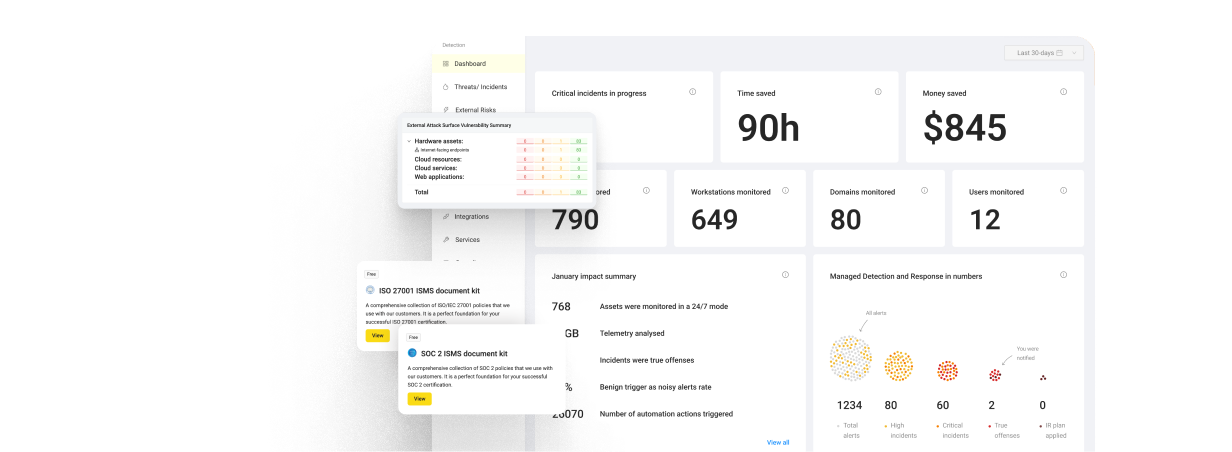
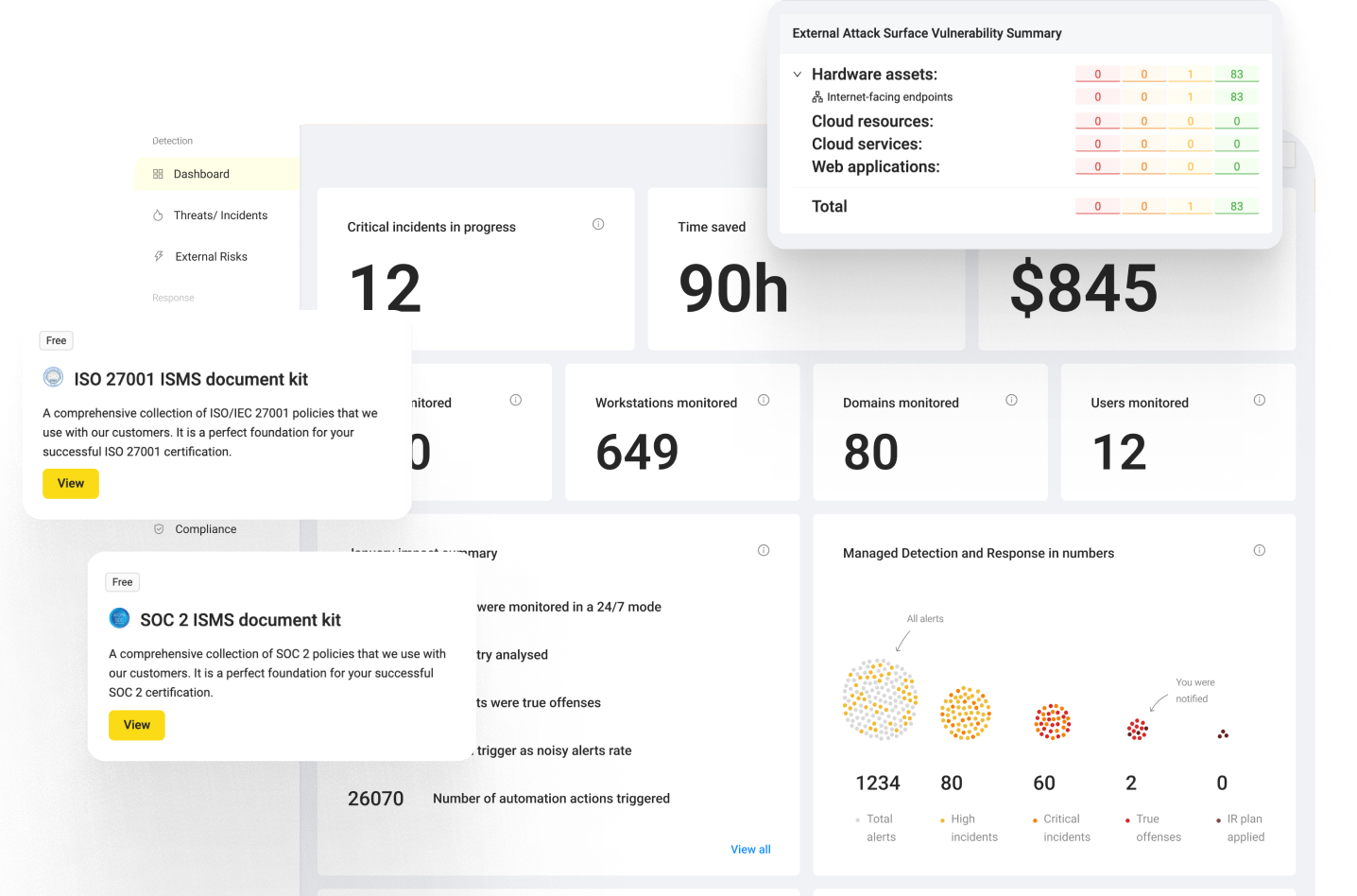
See how the UnderDefense Agentic AI SOC investigates, triages, and resolves real alerts.
🧩 What “agentic” actually means here
Let me define the jargon in plain terms first. An AI agent does one task. An agentic system chains many agents toward one outcome, like closing an investigation.
ReliaQuest frames GreyMatter as the second kind. Six specialized agents split the work: one classifies the alert, one pulls logs, one gathers evidence, one scores it, and so on. On paper, that mirrors how a human SOC team divides a case. If you are weighing this model, our AI SOC versus traditional SOC breakdown is worth a read.
⚙️ One alert is heavier than it looks
Here is the part vendor decks skip. Investigating a single alert with this kind of architecture can trigger over 100 distinct large language model calls. Keeping that orchestra in tune, so the system does not “go crazy,” is genuinely hard engineering.
I think about it like this. AI agents are your foot soldiers. Your human engineers and analysts are the generals directing them. ReliaQuest reports 99.3% agreement between its security team and the AI. Those are strong signals. They are also vendor-reported, so treat them as a starting point, not a verdict.
🎯 The real trade-off buyers must weigh
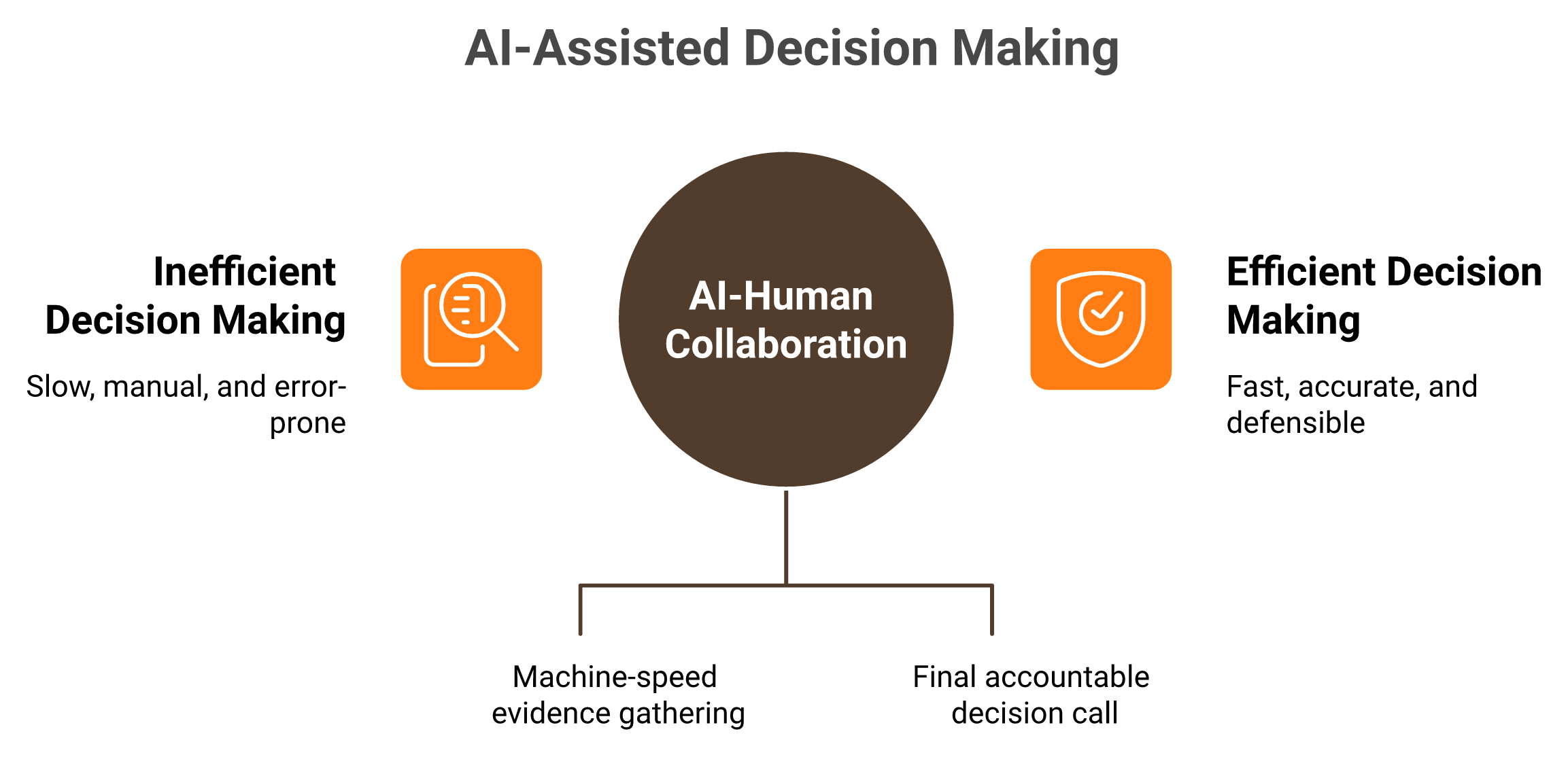
Here is where I might sound contrarian. High autonomy is not the prize by itself. The three things that actually decide your outcome are autonomy, auditability, and ownership. You can have fast and opaque, or slower and explainable, and that choice follows you for the length of the contract.
From what surfaces when you actually run these systems, the fast-and-opaque path feels great in the demo and hurts at 2 a.m. during a real incident. That is the tension the rest of this guide unpacks, and our guide to AI SOC explainability and transparency goes deeper on it.
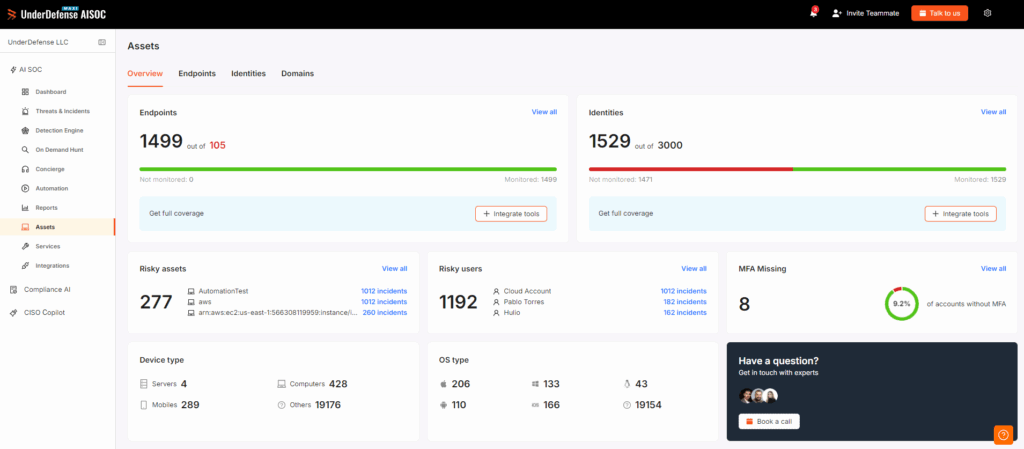
At UnderDefense, we built our Agentic AI SOC on a different starting assumption. Our framing is simple: AI collects context, you decide. The machine does the investigation grunt work, and a human owns the final verdict, with every step observable. You can see how that plays out on the UnderDefense Agentic AI SOC platform.
Q2. Why are buyers questioning the ‘AI-only’ SOC model heading into 2026?
Every vendor added “agentic” to their homepage sometime last year. Same product, new sticker. Security leaders noticed, and now the word triggers a shrug instead of a demo request. That fatigue is the real starting point for this question.
Buyers question AI-only SOCs because automation that fails to eliminate a whole class of work just generates noise faster. Independent research still finds 50% to 90% of SOC alerts are false positives. The practitioner read is blunt: AI accelerates and contextualizes well, but for roughly 70% of nuanced cases it cannot yet own the decision. So “AI-only” reads as risk, not maturity.
⚠️ Faster noise is still noise
Here is the test I apply. If you still have the same humans looking through the same number of alerts, just doing it faster, that is not transformation. You have sped up the treadmill.
Real change happens when the system eliminates a whole class of work, so a human never touches it again. Anything short of that is a high-speed noise generator with a nicer UI. Most “AI-only” pitches quietly fail this test, which is why we wrote our deep dive on alert fatigue.
🧠 The “unbiased model” myth
Now the contrarian part. The standard read gets this backwards. Vendors sell an “unbiased” AI as the goal. I want the opposite.
I am happy if I can see my model’s bias, because then I can measure it and adjust it. The true danger is a model that claims no bias at all. If someone tells you their model is perfectly neutral, they are either wrong or hiding something. A measurable flaw beats an invisible one every day of the week.
✅ What “real” looks like
So what should a buyer actually demand? Two things, together, not separately.
- The system removes work permanently, not just faster.
- The system shows its reasoning, so a human can audit the call.
I could be slightly off on the exact percentage of cases AI can close solo. The direction is not in doubt. Speed without a visible reasoning trail is a liability you inherit at renewal, and our human-in-the-loop SOC design guide explains why.
This is the honest gap we set out to close at UnderDefense. Too often, a vendor renamed the product, while our job was to rebuild the SOC and the outcomes underneath it. We reduce alert noise and keep every decision explainable through our MDR service, so a human always has the final say.
Q3. What do ReliaQuest GreyMatter customer reviews actually say in 2026?
I read a lot of MDR reviews. The GreyMatter ones follow a clear rhythm. The first half of each review praises the speed. The second half asks, quietly, “but why can’t I see what it did?” That split is the whole story.
ReliaQuest GreyMatter earns strong aggregate scores, around 4.7 on Gartner Peer Insights and 4.5 on G2. Users report real wins on incident reduction and ROI. The recurring complaint stays just as consistent: a growing emphasis on AI and automation that produced responses lacking actionable insight, weak reporting transparency, and tickets coming back “without clear answers.” Love the speed, question the clarity.
📊 The pattern in one view
| ✅ What reviewers praise | ⚠️ What reviewers question |
|---|---|
| High aggregate ratings (Gartner 4.7, G2 4.5) | “Very poor reporting and transparency” |
| Strong ROI and incident reduction reported | “All tickets are coming back to customers without clear answers” |
| Fast, automated investigation | “Weak concierge support, people who understand org” |
| Big-enterprise scale | “Customers are alone when facing the breach” |
💰 A metric is not a verdict
Here is where I want to be fair and precise. ReliaQuest markets 99.3% agreement between its team and the AI. That is a good number.
But a number is not the same as a usable verdict. From what I see in real queues, an alert can be “resolved” statistically and still land back on your analyst’s desk with no explanation. The reviews above name that exact gap. The metric measures agreement, not clarity, a point our roundup of ReliaQuest alternatives explores in detail.
For contrast, transparency is exactly what our own users tend to call out first. Two verified UnderDefense reviews:
“When they escalate something, they include the context we need to understand the issue quickly. We’re not wasting time piecing together what happened from different systems anymore.”
Verified User in Marketing and Advertising UnderDefense G2 Verified Review
“It offers clear and actionable insights, allowing us to react promptly to any security issue.”
Darina I., Customer Success Manager UnderDefense G2 Verified Review
That clarity gap is exactly what we designed our SOC service around, with observable, auditable investigation steps. I will show the full contrast in a later section, so the comparison stays honest rather than rushed.
Q4. Is GreyMatter a black box, and does your detection logic stay portable if you leave?
A CISO put it perfectly on a call last quarter. “I want to own the SIEM, so I can take my toys and leave.” That single sentence captures the fear behind this whole section. The tech is one thing. The exit is another.
The sharpest 2026 buyer fear with GreyMatter is portability. If a vendor positions itself as a SIEM replacement, does your detection logic leave with you, or stay trapped in their platform? Before you sign, run what I call the Termination Test: confirm in writing that all correlation rules, integrations, and detection logic remain in your SIEM if the contract ends. If the answer is vague, that vagueness is the answer.
🔒 Why lock-in bites at renewal, not signing
Detection logic is institutional memory. Every tuned rule reflects an incident your team lived through. When that logic sits inside a vendor’s proprietary platform, leaving means starting your detection engineering from scratch.
That is the quiet cost of “SIEM replacement” positioning. It feels like consolidation on day one. It feels like a hostage negotiation on the day you want to switch, which is why our guide to avoiding SIEM vendor lock-in matters here.
📋 The Termination Test: ask these before you sign
Put these questions in the contract conversation, not the offboarding call:
- If we terminate, do all correlation and detection rules remain in our SIEM?
- Do our integrations and data pipelines stay intact without your platform?
- Is our tuned detection logic exportable in a standard, readable format?
- Do we keep the threat intelligence and enrichment context we helped build?
- Who owns the raw logs, and where do they physically live?
If you get clean “yes” answers, good. If you get “it depends” or a sales redirect, price that risk in now. Our AI SOC evaluation questions give you the full list.
⚖️ The honest “it depends”
I will hedge here, because this is real. There is a legitimate debate between SIEM-as-a-service and SIEM-as-a-platform. Some lean teams genuinely want the vendor to own the SIEM, and that can be the right call for them.
The mistake is choosing lock-in by accident. Own the trade-off deliberately, with the exit terms written down.
This is why we built our managed SIEM to work with your customer-owned SIEM, whether that is Splunk, Sentinel, or Chronicle, rather than replacing it. We treat detection rules as Detection Logic as Code, versioned and owned by you, so there is nothing to hold hostage if you ever walk. That preserves the investments you already made.
Q5. AI-only SOC vs human-augmented SOC: which platform trade-offs actually matter?
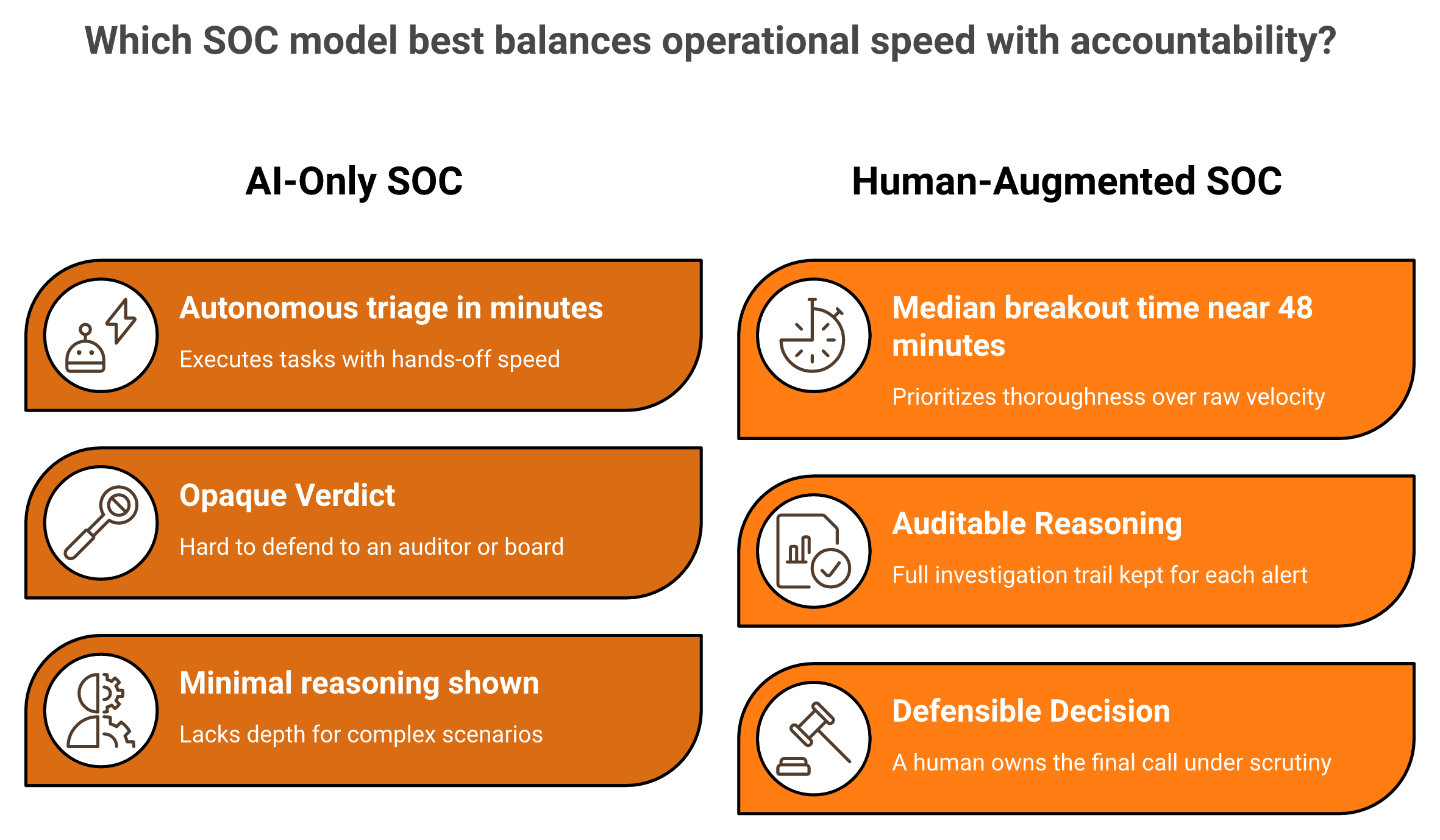
Here is a number that should reset every SLA conversation. The fastest break-in time we track is around 51 seconds, and median breakout has dropped to roughly 48 minutes. Now line that up against how long your SOC actually takes to reach a verdict. That gap is where the AI-only versus human-augmented debate really lives.
The trade-off that matters is not speed alone, since every AI SOC is fast. It is the balance of autonomy, auditability, data residency, cost, and org-context. Research even names an “Alert Triage Latency Paradox”: verbose AI reasoning is accurate and auditable but slow and costly, while minimal reasoning is fast but opaque. AI-only models optimize for hands-off speed. Human-augmented models optimize for a verdict you can defend to an auditor or a board.
📊 The trade-offs side by side
| Criterion | AI-Only SOC | Human-Augmented SOC |
|---|---|---|
| Autonomy | High, closes alerts solo | High on routine, human owns edge cases |
| Auditability | Often opaque (“glass box” varies) | Every step observable |
| Data residency | Frequently vendor-hosted | Can stay in customer data lake |
| Latency and token cost | Fast, but cost hides in reasoning depth | Machine-speed triage, human verdict |
| Org-context | Treats alerts uniformly | Learns VIPs, execs, critical assets |
| Vendor lock-in | Higher (proprietary stack) | Lower (works on your SIEM) |
| Breach-day support | Self-serve tickets | Human ally, 15-minute critical escalation |
⚠️ The latency paradox in plain terms
Let me decode that research finding. If the AI explains its reasoning fully, you get an auditable trail, but it runs slower and burns more tokens. Strip the reasoning to go fast, and you lose the paper trail.
That is a genuine engineering tension, not marketing spin. My honest read: for the roughly 70% of nuanced cases, you want the reasoning kept, even at a cost. SOC teams solve incidents with knowledge, skill, and ability. Complex tooling helps, but no tool is a cure-all on its own, a theme we expand in our AI SOC explainability guide.
✅ Who each model is not for
Be honest about fit. An AI-only SOC is a poor fit if you face audits that demand a defensible reasoning trail, or if you cannot risk being alone during a live breach. A pure human SOC is a poor fit if you drown in Tier 1 alert volume and cannot hire your way out, a tension our human-in-the-loop SOC design guide unpacks.
We built the UnderDefense Agentic AI SOC approach to sit at that balance point. The AI does machine-speed investigation, and a human owns the verdict, so you get both the speed and the defensible answer through our SOC service.
Q6. Can an AI-only SOC leave you ‘alone when facing the breach’?
Picture a security lead at 2 a.m. Endpoints are lighting up, the console is closing tickets automatically, and none of them explain what to actually do next. That silence, in the worst hour, is the real test of any SOC.
The moment that separates a tool from a partner is a live breach. Reviews of over-automated SOCs surface a recurring fear: customers feel alone when facing the breach, with weak concierge support and no one who understands the org. AI can contextualize and accelerate. It cannot yet own the hardest decisions under fire. When breakout time is measured in seconds, the real question is simple. Who picks up the phone?
😰 I have watched this break people
I will be direct about the human cost, because I lived a version of it. Building a SOC under fire is brutal. I have seen a security leader develop physical symptoms, literally breaking out in hives, because the alert load outran the team.
I have also watched a predecessor buy every shiny tool, then run out of budget before hiring the people to run them. A rookie team managing a fleet of Ferraris, with the engines mostly sitting idle. Tools without people is not resilience. It is expensive stress, which is exactly why we frame our incident response around people first.
📞 What real human-ally support looks like
Here is what our own users describe on a bad day:
“Now, when alerts pop up, there’s no panic. With their guidance, we know precisely what steps to take next.”
Valeriia D., Marketing Specialist UnderDefense G2 Verified Review
“They handle a lot of the alert monitoring, which saves time. And if a real problem does happen, they react quickly, which has been a lifesaver.”
Verified User in Computer Software UnderDefense G2 Verified Review
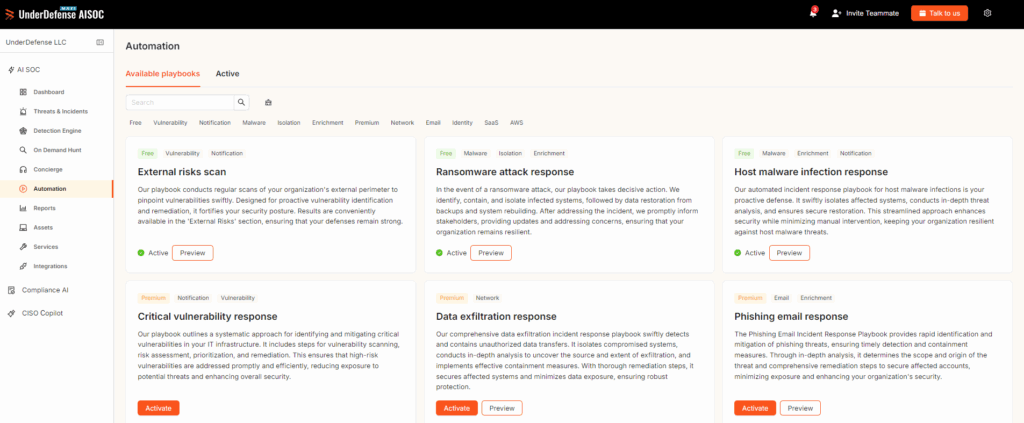
This is exactly why our model keeps a human incident response team on the line. When something critical fires, we escalate within 15 minutes and communicate directly with the affected users, so no one is left alone with a ticket. Our MDR service and AI SOC SLA guide spell out how that works.
Q7. How does UnderDefense’s ‘AI SOC + Human Ally’ model close the gaps buyers report?
Buyers keep naming the same three pains about AI-only SOCs. It is opaque, it locks you in, and no one on the other end knows your business. So let me answer each one directly, with how we actually built around it.
UnderDefense’s “AI SOC + Human Ally” model answers all three. Every investigative step stays observable and auditable. The platform works on top of your existing SIEM. And concierge analysts message your real users over Slack, Teams, email, or SMS to resolve alerts that competitors escalate back. The philosophy stays simple: AI collects context at machine speed, and you decide.
🧭 Complaint, cost, and how we answer it
| Buyer complaint | What it costs you | How UnderDefense answers |
|---|---|---|
| Black-box investigation | Guesswork, failed audits | Every step observable and auditable |
| Vendor lock-in | Detection logic held hostage | Runs on your SIEM; you own the logs |
| Weak concierge, no org context | Alone during a breach | Human analysts learn your VIPs and execs |
| Tickets handed back “no answer” | Wasted analyst hours | We ChatOps your users to close the gap |
🛡️ Proof, not promises
Here is where I want evidence to carry the weight. Across all our managed clients, we have had zero ransomware cases in six years. We run a 2-minute alert-to-triage target and 15-minute escalation for critical incidents, with 96% MITRE ATT&CK coverage.
Ownership is the other half. We treat detection rules as Detection Logic as Code, versioned and owned by you, so nothing is trapped if you leave. Think less black box, more blue team, a philosophy we detail in our AI SOC decision architecture guide.
“Their SOC team is responsive and knows their stuff. When they escalate something, they include the context we need to understand the issue quickly.”
Verified User in Marketing and Advertising UnderDefense G2 Verified Review
You can see the workflow yourself on the UnderDefense Agentic AI SOC platform, and our guide to running an AI SOC on your existing SIEM shows the integration path.
Q8. What does an AI-only SOC cost to run, and where do the hidden costs hide?
The sticker price is the smallest number in the contract. The real bill hides in orchestration, tuning, and the people you still need. Let me pull those hidden drivers into the light, because CFOs and PE operating partners deserve the whole math.
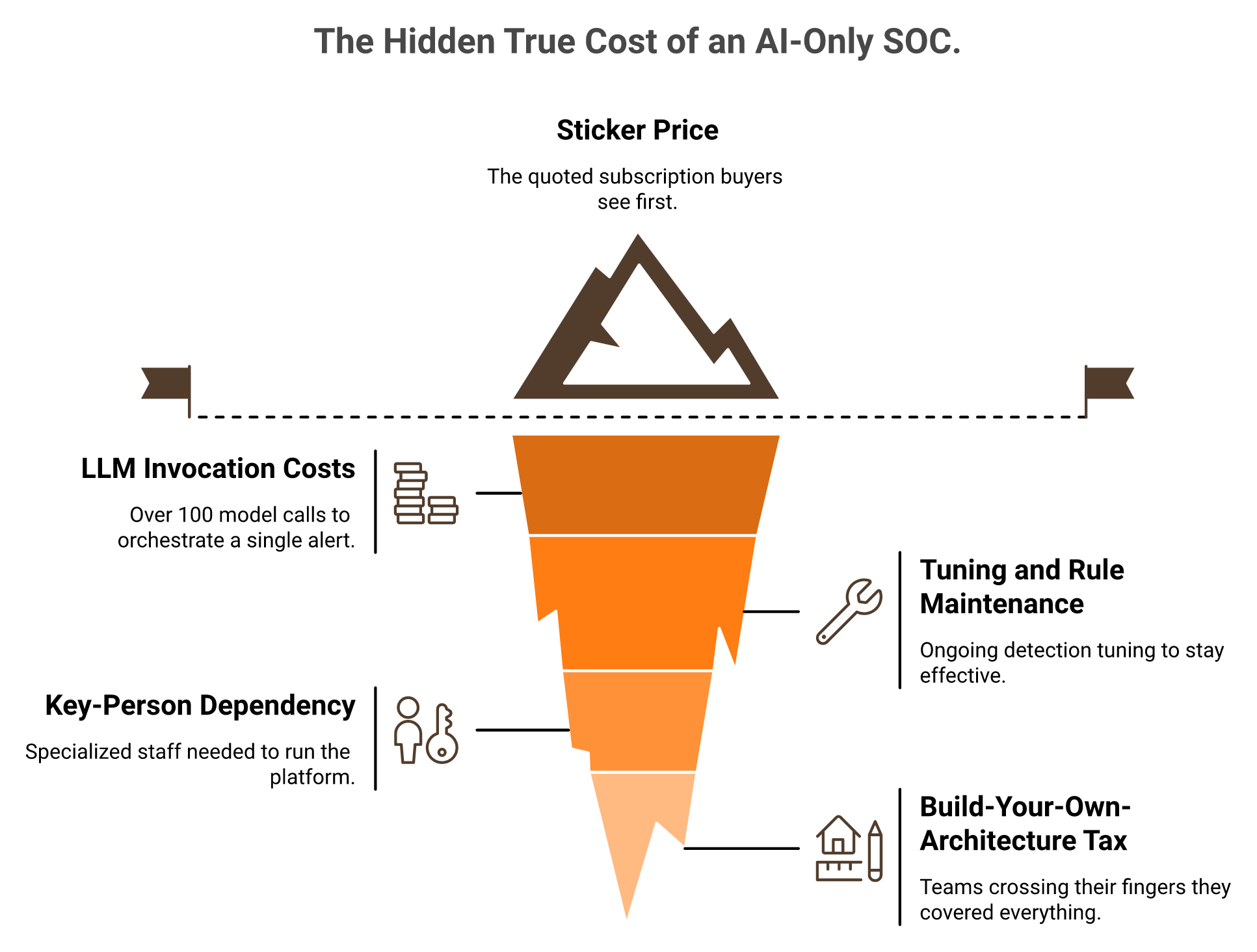
Orchestrating one alert can trigger over 100 LLM invocations, so token, tuning, and key-person costs compound fast. At the deal level, competitive AI-only SOCs have been winning contracts above the $300K mark. Buyers who build their own agentic architecture describe it plainly: it is so new that you just cross your fingers you have covered everything. Transparent per-endpoint pricing and live token visibility separate a predictable partner from an open-ended commitment.
💰 Visible cost vs hidden cost
| Visible cost | Hidden cost driver |
|---|---|
| Platform license | 100 plus LLM invocations per alert |
| Per-endpoint or seat fee | Detection tuning and rule maintenance |
| Onboarding | Key-person dependency to run it |
| Support tier | DIY architecture “cross your fingers” tax |
💸 Why the hidden costs bite hardest
Here is my calibrated hedge. I cannot give you one universal dollar figure, because token cost swings with alert volume and reasoning depth. What I can say is that the variable line items, not the license, are what blow past budget, a point our AI SOC pricing guide breaks down.
The DIY route is the sharpest trap. Building your own agentic stack sounds cheaper until you price the expertise and the risk of gaps. That is money spent crossing your fingers, and our build versus buy analysis runs the real math.
We answer this with transparent per-endpoint pricing and a built-in AI Cost Center that shows live per-investigation token and dollar visibility. For teams that run on-prem, we have seen up to 44% lower total cost of ownership. The point is predictability. You should always be able to see what a verdict actually costs, which is why we publish clear MDR pricing.
Q9. Data residency, compliance, and the agentic attack surface: what governance questions must you ask?
Here is the uncomfortable plot twist most vendor demos skip. The AI you buy to defend the network becomes a new thing on the network that can be attacked. Your defender is also an attack surface. Once you sit with that, the governance questions almost write themselves.
An autonomous SOC raises three questions demos gloss over. Where does your telemetry live, does its audit trail satisfy your regulators, and how is the agentic layer itself secured? Peer-reviewed research now catalogs 30 plus attack techniques against LLM-agent systems. Separate work shows just five poisoned documents can manipulate a retrieval-augmented AI about 90% of the time. For teams under GDPR, NIS2, DORA, or SEC disclosure rules, an inspectable, in-region SOC stops being a nice-to-have.
🧨 The agentic layer is a real attack surface
Let me define the jargon. Prompt injection means feeding an AI hidden instructions so it misbehaves. RAG poisoning means corrupting the documents an AI reads for context, so it draws the wrong conclusion.
Both are live risks the moment your SOC runs autonomous agents. The OWASP Top 10 for LLM applications lists these as leading categories for a reason. If you cannot see what your AI read and why it acted, you cannot defend it, a concern we address in our guide to AI SOC guardrails.
📋 The governance questions to put in your questionnaire
Add these to your vendor security review before you sign:
- Where does our telemetry physically reside, and can it stay in-region?
- Can we inspect every action the AI took, with a full audit trail?
- How is the agentic layer hardened against prompt injection and RAG poisoning?
- Does the audit trail satisfy GDPR Article 33, NIS2, DORA, and SEC Item 1.05 timelines?
- Can we bring our own model and keep data in our own lake?
These map directly to the checks in our AI SOC data residency guide and our broader compliance services.
🔍 Why observability is the actual defense
Here is my contrarian read, and I will stand behind it. The scary AI is not a biased one. It is the one nobody can measure at all.
I want to see what my model gets wrong, because visibility is how I fix it. That same principle secures the agentic layer. If every step is observable, you can catch a poisoned input before it becomes a bad verdict. We built UnderDefense around observable, auditable workflows, with on-prem and air-gapped deployment options, 700 plus MITRE ATT&CK workbooks, and bring-your-own-model support, so the agentic layer stays inside your perimeter. You can inspect that flow on the UnderDefense Agentic AI SOC platform, and our AI SOC compliance guide ties it to each framework.
Q10. How should you evaluate an AI SOC vendor before your July 2027 renewal?
Most renewals get decided in a panic three weeks before the deadline. That is how you end up re-signing the thing you meant to replace. If your current AI SOC contract renews around July 2027, you have a year of runway right now, and runway is leverage.
Evaluate a vendor on five red lines, not the demo. Verdict transparency, logic portability, breach-day human support, data residency, and predictable pricing. Get those in writing, and a rushed renewal turns into a real choice.
✅ The five red lines
Score every vendor, including UnderDefense, against these:
- Verdict transparency: Can you see the reasoning behind each closed alert?
- Logic portability: Does your detection logic stay in your SIEM if you leave?
- Breach-day human support: Who actually picks up the phone at 2 a.m.?
- Data residency: Can your telemetry stay in-region and in your control?
- Predictable pricing: Can you see per-investigation cost before the bill lands?
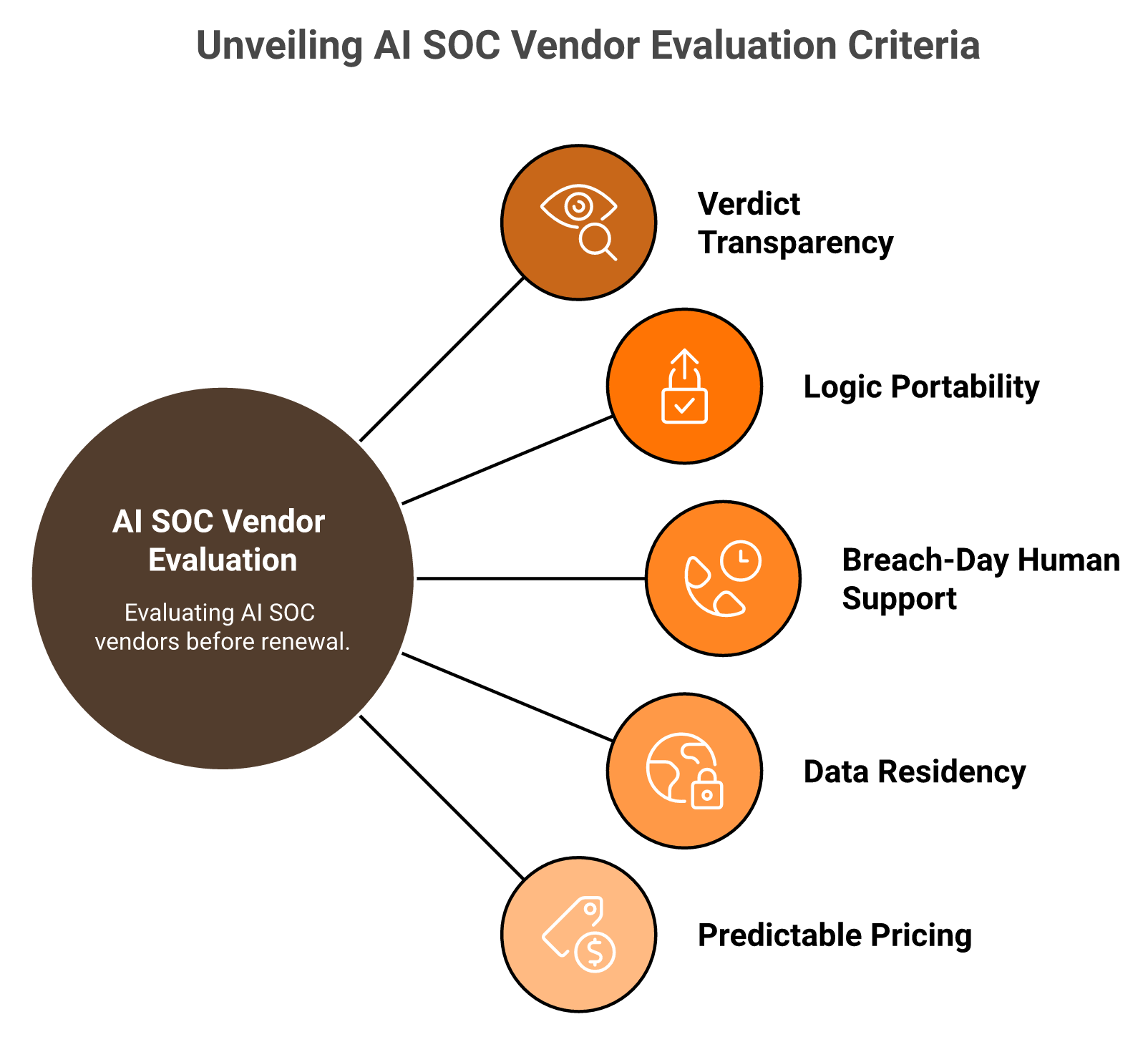
If a vendor dodges any one of these, that dodge is your answer. I would rather hear an honest “we don’t do that” than a confident non-answer, and our AI SOC evaluation questions and SOC contract clauses guide give you the full script.
⏰ Start now, decide later
Here is the practical move. Book the evaluation this quarter, while you still have options and no deadline pressure. A year of runway lets you run a real proof of value, not a demo, a process our AI SOC evaluation guide walks through.
I will leave you with the thought I keep coming back to. In 2026, being a human is a flex, because AI is just whatever machines haven’t done well yet. The teams that win pair machine speed with a human who owns the call. If you want a second set of eyes, we are happy to throw stones at your current architecture and show you where the gaps sit, no pressure attached. You can talk to our team or book a demo whenever the timing works.
See how UnderDefense Agentic AI SOC resolves a real incident on your stack.

Nazar Tymoshyk
1. What is ReliaQuest's AI-only SOC approach in 2026?
ReliaQuest’s AI-only SOC approach runs on GreyMatter, an agentic AI security operations platform. It uses six role-based agentic teammates, 200-plus skills, and 400-plus tools to autonomously triage, investigate, and contain Tier 1 and Tier 2 alerts, often in under five minutes.
The goal is to remove routine SecOps work while people supervise. On paper, that mirrors how a human SOC team divides a case, with one agent classifying the alert, another pulling logs, and another scoring evidence.
- Strength: hands-off speed on routine alerts.
- Trade-off: transparency you can defend to an auditor or board.
In our view, high autonomy is not the prize by itself. The three things that decide your outcome are autonomy, auditability, and ownership. We built our Agentic AI SOC on a simple assumption: AI collects context, and a human owns the verdict, with every step observable.
2. What do ReliaQuest GreyMatter customer reviews actually say in 2026?
GreyMatter earns strong aggregate scores, around 4.7 on Gartner Peer Insights and 4.5 on G2. Users report real wins on incident reduction and ROI.
The recurring complaint stays just as consistent across reviews:
- Growing emphasis on automation that produced responses lacking actionable insight.
- Weak reporting transparency.
- Tickets coming back to customers without clear answers.
The pattern is simple to summarize. Reviewers love the speed and question the clarity. A high agreement metric between the AI and the security team is not the same as a usable verdict an analyst can act on.
That clarity gap is what we designed our SOC service around, with observable, auditable investigation steps. Our own users tend to call out context first, noting that escalations arrive with the details needed to understand an issue quickly, so time is not wasted piecing events together across systems.
3. Is GreyMatter a black box, and does my detection logic stay portable if I leave?
Portability is the sharpest 2026 buyer fear. If a vendor positions itself as a SIEM replacement, you must confirm whether your detection logic leaves with you or stays trapped in their platform.
We recommend running what we call the Termination Test before you sign. Confirm in writing that:
- All correlation and detection rules remain in your SIEM if the contract ends.
- Integrations and data pipelines stay intact without the vendor platform.
- Tuned detection logic is exportable in a standard, readable format.
- You keep the threat intelligence and enrichment context you helped build.
Detection logic is institutional memory. Every tuned rule reflects an incident your team lived through, so leaving should not mean starting from scratch.
Our managed SIEM works with your customer-owned SIEM, whether Splunk, Sentinel, or Chronicle. We treat detection rules as Detection Logic as Code, versioned and owned by you, so there is nothing to hold hostage.
4. AI-only SOC vs human-augmented SOC: which trade-offs actually matter?
The trade-off that matters is not speed alone, since every AI SOC is fast. It is the balance of autonomy, auditability, data residency, cost, and org-context.
Research names an Alert Triage Latency Paradox. Verbose AI reasoning is accurate and auditable but slower and costlier, while minimal reasoning is fast but opaque.
- AI-only: optimizes for hands-off speed.
- Human-augmented: optimizes for a verdict you can defend to an auditor or board.
With breakout time now measured in seconds and median breakout near 48 minutes, the real question is who reaches a defensible verdict, and how fast. For roughly 70% of nuanced cases, you want the reasoning trail kept, even at a cost.
We built the UnderDefense Agentic AI SOC platform to sit at that balance point. The AI does machine-speed investigation, and a human owns the verdict, so you get both the speed and the defensible answer.
5. Can an AI-only SOC leave me alone when facing a breach?
The moment that separates a tool from a partner is a live breach. Reviews of over-automated SOCs surface a recurring fear, that customers feel alone when facing the breach, with weak concierge support and no one who understands the organization.
AI can contextualize and accelerate, though it cannot yet own the hardest decisions under fire. When breakout time is measured in seconds, the real question is who picks up the phone.
We have seen the human cost of getting this wrong, including tools bought before the people to run them, leaving expensive platforms sitting idle.
- We keep a human incident response team on the line.
- We escalate critical incidents within 15 minutes.
- We communicate directly with affected users, so no one is left with a ticket.
Our incident response team provides hands-on containment when it matters most.
6. What does an AI-only SOC cost to run, and where do hidden costs hide?
The sticker price hides the real bill. Orchestrating a single alert can trigger over 100 large language model invocations, so token, tuning, and key-person costs compound fast.
Hidden cost drivers to price in include:
- 100-plus LLM invocations per alert.
- Detection tuning and ongoing rule maintenance.
- Key-person dependency to run the platform.
- The build-your-own-architecture tax, where teams describe just crossing their fingers they covered everything.
At the deal level, competitive AI-only SOCs have been winning contracts above the 300K mark, so budgets escalate quickly.
We answer this with transparent per-endpoint pricing and a built-in AI Cost Center that shows live per-investigation token and dollar visibility. For teams running on-prem, we have seen up to 44% lower total cost of ownership. You can review clear MDR pricing before committing.
7. What governance and compliance questions should I ask about an autonomous SOC?
An autonomous SOC raises three governance questions most demos skip. Where your telemetry lives, whether its audit trail satisfies regulators, and how the agentic layer itself is secured.
Your defender is also a new attack surface. Research catalogs 30-plus attack techniques against LLM-agent systems, and just five poisoned documents can manipulate a retrieval-augmented AI about 90% of the time.
Put these in your vendor security questionnaire:
- Where does telemetry physically reside, and can it stay in-region?
- Can we inspect every AI action with a full audit trail?
- How is the agentic layer hardened against prompt injection and RAG poisoning?
- Does the audit trail satisfy GDPR Article 33, NIS2, DORA, and SEC Item 1.05 timelines?
We built our platform around observable, auditable workflows, with on-prem and air-gapped deployment options and bring-your-own-model support, backed by our compliance services.
8. How should I evaluate an AI SOC vendor before my contract renewal?
Most renewals get decided in a panic three weeks before the deadline, which is how teams re-sign the thing they meant to replace. If your contract renews around July 2027, a year of runway is real leverage.
Evaluate every vendor on five red lines, not the demo:
- Verdict transparency: can you see the reasoning behind each closed alert?
- Logic portability: does detection logic stay in your SIEM if you leave?
- Breach-day human support: who picks up the phone at 2 a.m.?
- Data residency: can telemetry stay in-region and in your control?
- Predictable pricing: can you see per-investigation cost before the bill?
If a vendor dodges any one of these, that dodge is your answer. Book the evaluation this quarter, while you still have options and no deadline pressure. If you want a second set of eyes, you can talk to our team and have us pressure-test your current architecture.