




Q1. Where does the model actually run when an AI SOC reads your telemetry?
When an AI SOC triages your logs, the model runs wherever the inference endpoint lives, regardless of where your SIEM stores data. If that endpoint is a US-hosted API, every QRadar or EDR line it reads becomes a cross-border transfer under GDPR Chapter V. Residency covers the inference path, the logs, and the embeddings, well beyond storage at rest.
I have watched this question land on a CISO mid-call. We are reviewing an AI triage pilot, and she stops me with one line: “If I feed my telemetry to that model, am I handing my secrets to a processor my regulator will fine me for?” Fair question. The honest answer makes most teams pause.
See how the UnderDefense Agentic AI SOC investigates, triages, and resolves real alerts.
The fear under the box-ticking
Most readers arrive here checking a box for GDPR, DORA, or the SEC. The real worry sits underneath. They fear a quiet data leak, then a fine that lands a year later. That fear is rational. Speed pressure makes it worse.
Attackers move fast. The quickest break-in we have tracked sat around 51 seconds from access to action. Time is the currency of the cloud, so teams reach for the fastest LLM they can wire in. They check accuracy first and residency second, if at all.
Inference is the transfer, not just storage
Here is the part people miss. Storage location is the easy half. The harder half is inference, the moment the model actually reads your data to reason about it.
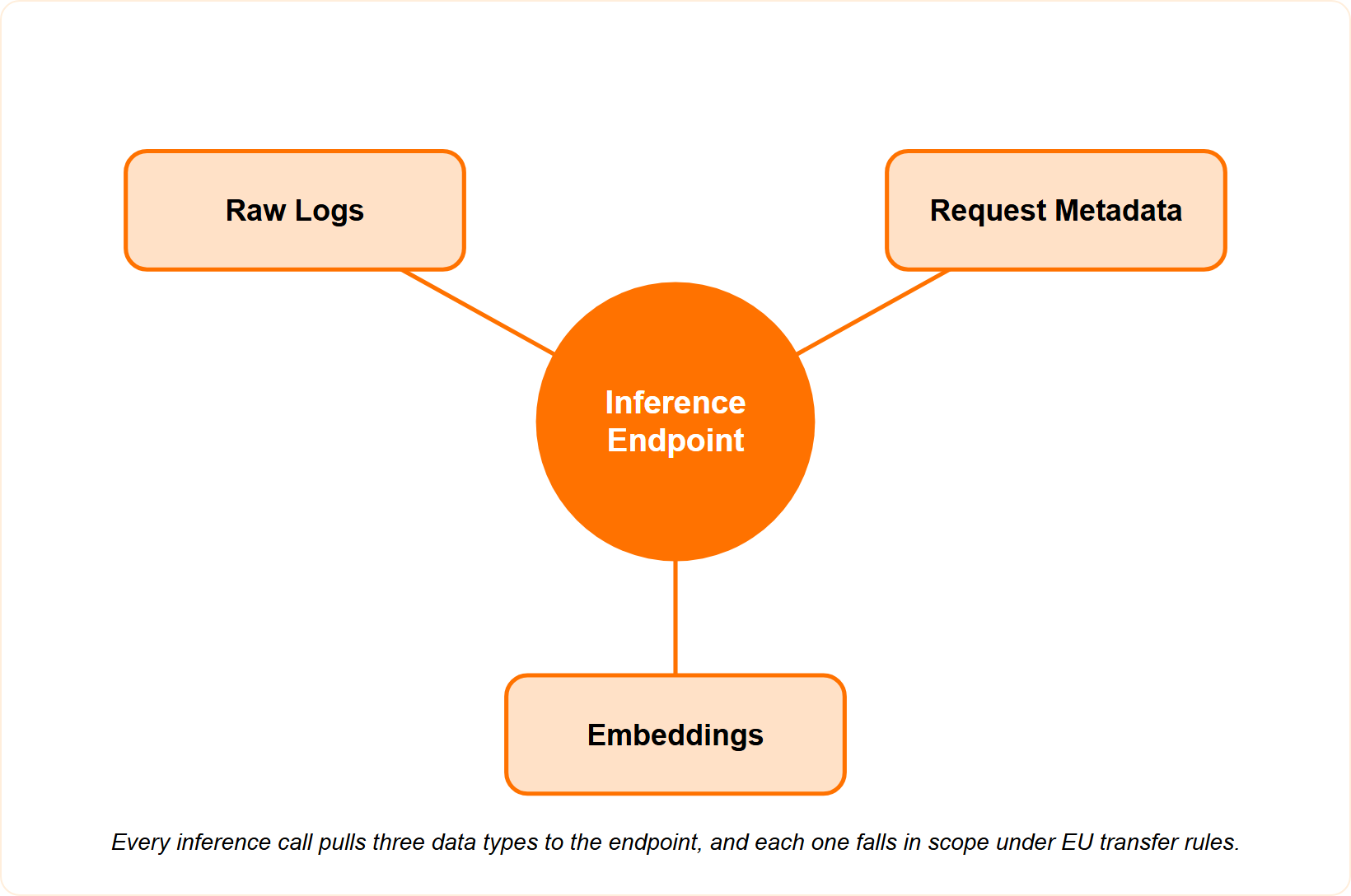
That moment happens at the endpoint. Three things travel there, and each is in scope under EU transfer rules:
- The raw log lines and alerts the model reads.
- The routing and metadata around each request.
- The embeddings, the numeric vectors that still carry sensitive patterns.
This is exactly why where your telemetry travels matters more than where it sleeps. An academic SOC framework published in 2026 shows why this matters operationally. Its LLM ensemble hit 82.8% triage accuracy directly on SIEM logs, which means the model reads real telemetry to perform.
What to do before the pilot
Trace the inference path first. Ask one plain question of any AI SOC vendor: in which region does the model read my data, and where do the embeddings persist? Get it in writing before a single log flows. This is the same discipline we apply across our cloud security work.
At UnderDefense, we built UnderDefense Agentic AI SOC to stay vendor-agnostic, so the inference path and telemetry remain inside the residency boundary you define. The goal is simple. Collect context for fast triage while keeping your secrets where your regulator expects them.
Q2. What is the real difference between AI data residency and AI data sovereignty?
Data residency is about location, where your data and AI inference physically sit. Data sovereignty is about control and jurisdiction, whose laws can compel access to that data or the model acting on it. Residency answers where the data sleeps; sovereignty answers who can wake it up. An EU region owned by a US parent satisfies residency while leaving sovereignty open.
People use these two words as if they mean the same thing. They do not, and the gap between them is where regulated teams get hurt.
Concept: location versus control
Think of it like a hotel safe. Residency tells you which city the safe sits in. Sovereignty tells you who holds a master key and which court can order it opened.
A vendor can promise an EU region and still answer to a foreign parent company’s legal demands. That is residency met, sovereignty unmet.
| Dimension | Data residency | Data sovereignty |
|---|---|---|
| Core question | Where does the data physically sit? | Who controls it, and whose laws apply? |
| What it governs | Storage and inference location | Access rights and legal jurisdiction |
| Met by | A named in-region endpoint | No foreign legal compulsion over access |
| Common gap | A US parent can still be compelled to grant access | A region lock alone does not solve it |
Application: why residency alone is a trap
A residency claim often hides an unresolved sovereignty question. You get a green checkmark on location and a silent risk on control. Teams weighing an outsourced versus in-house setup hit this gap first.
I might be slightly contrarian here. In my view, sovereignty means owning the architecture, not buying a clause. The standard read treats a contract as the control. The contract is paper. The architecture is the control.
Vendor lock-in proves the point. When a major platform shifts its licensing, pricing, or terms, and these shift often, your options narrow fast. That is a real strategic risk, and it is a strong argument for portable, open models you can move. Owning where the model runs, much like keeping your own managed SIEM, is how you keep the master key yourself.
Q3. Why does compliance shape your AI SOC architecture rather than the reverse?
In regulated industries your compliance posture becomes your architecture. Residency laws, HIPAA, DORA, and GDPR Chapter V each constrain where inference runs, where embeddings persist, and who can reach the logs. Frameworks like the EU AI Act, NIST AI RMF, ISO/IEC 42001, and ISO/IEC 27001 give that constraint a durable structure. Designing residency in from layer one usually produces a more secure system anyway.
A senior engineer once asked me why we could not “just add compliance later.” I gave him an analogy that stuck.
The claim: compliance is the blueprint
Imagine driving into a city with no traffic lights, in a car with no dashboard and no seatbelt. Would you feel safer, or would you stop trusting the whole setup? That discomfort is where AI sits today, and it is why governance has to be structural.
In regulated estates, the regulation writes the floor plan. Governance has to adapt to a technology that blurs old boundaries, rather than bolt on at the end. Treat compliance as a final checkbox and you pay for it twice, once in rework and once in risk. Our compliance services are built around this design-first idea.
The three pillars, mapped to real frameworks
Three architectural constraints carry most of the weight. Each maps to a recognized framework, so this stays auditable.
| Pillar | What it controls | Framework anchor |
|---|---|---|
| Residency | Where inference and embeddings live | GDPR Chapter V, EU AI Act |
| Access control | Who can reach data and models | ISO/IEC 27001, NIST AI RMF |
| Auditability | Evidence of every model action | ISO/IEC 42001 |
A 2025 EU Commission draft guidance pushed this further, expecting technical measures that keep training data and outputs inside set geographic boundaries for high-risk AI. That is residency written into law, not advice. If DORA applies to you, the same expectation already bites.
The payoff: design first
Stop asking how to make the system compliant after the fact. Ask what architecture the regulation requires, then build that. The system usually comes out more secure either way.
Stand up a small cross-functional group, security, legal, and a data owner, to own these decisions. A virtual CISO can chair that group when you lack the seat internally. At UnderDefense, UnderDefense Agentic AI SOC stays vendor-agnostic on purpose, so the architecture follows your regulator’s residency map rather than locking you into one cloud region.
Q4. Public LLM API, region-locked cloud, or private deployment, and when does a sector mandate force your hand?
Three models exist. A public LLM API is fastest yet exports telemetry across borders. Region-locked cloud keeps inference in a named region while sovereignty may still fail if the provider’s parent faces foreign legal compulsion. Private or on-prem deployment gives full control at higher cost. HIPAA, PCI DSS, French HDS, German public-sector law, or a localization rule like Taiwan’s can remove the choice entirely and mandate private deployment.
I once sat with a team certain they wanted a public API. Then their counsel mentioned a localization rule, and the whole debate ended in one sentence.
The three models, side by side
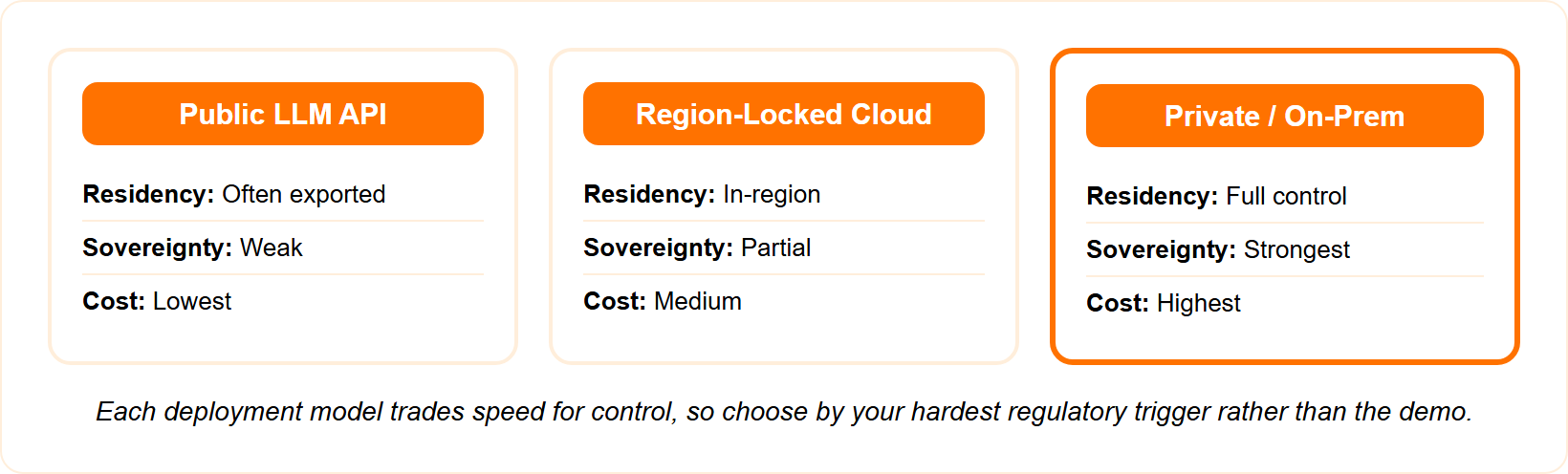
Each model trades speed for control. Pick by your hardest regulatory trigger, not by the demo.
| Model | Residency | Sovereignty | Cost and effort | Best fit |
|---|---|---|---|---|
| Public LLM API | Often exported abroad | Weak, foreign jurisdiction | Lowest | Non-regulated, low-sensitivity data |
| Region-locked cloud | Named in-region | Partial, parent risk remains | Medium | Most EU mid-market estates |
| Private or on-prem | Fully controlled | Strongest | Highest | Hard-mandate sectors |
For healthcare and EU firms, the question is what data can legally leave your infrastructure, and under what conditions. The private route runs open models like Llama and Mistral in your own environment. Teams in healthcare and financial services reach this fork early.
When the mandate removes your choice
Sometimes the regulator decides for you. A practitioner I trust described the Taiwan case bluntly: until the cloud providers physically operate in that region, you cannot move any data elements at all. It is all about where the data sits.
These hard triggers usually force private or on-prem deployment:
- HIPAA with a signed BAA for protected health data.
- PCI DSS for cardholder data scope.
- French HDS for health data hosting.
- German public-sector data rules.
When a mandate hits, “fastest” stops being a real option. Mapping these triggers early is core to any security stack decision.
Where model portability earns its keep
The practical edge is portability. Regulated teams often want their own model gateway, approving the models they trust and blocking the rest. That choice is governance, not a feature.
UnderDefense Agentic AI SOC supports model portability and a customer-controlled gateway, so you decide which models touch your telemetry. The integration is built to sit on top of your existing stack rather than replace it, which our customers notice.
“The platform itself is straightforward, it pulls in data from all our existing security tools, so we didn’t have to rip and replace anything.”
Verified User in Marketing and Advertising, Small-Business UnderDefense G2 Verified Review
“UnderDefense Agentic AI SOC integrates well with our systems, specifically with our SIEM, Splunk. Their team is proactive in identifying and addressing threats, providing 24/7 oversight.”
Oleg K., Director of Information Security UnderDefense G2 Verified Review
“Not having to worry about ransomware, alert overload and reporting. Getting a clear view of my security posture.”
Arlin O., Enterprise (1000+ emp.) UnderDefense G2 Verified Review
Q5. Does an “enterprise tier” contract actually solve data residency?
No. Enterprise-tier AI contracts typically govern data usage and training opt-out rather than where inference physically runs. Routing client telemetry to a US-hosted endpoint remains a cross-border transfer under GDPR Chapter V regardless of contract tier, and a no-training clause does nothing for jurisdictional access. Residency is an architecture property you verify in the runtime path, separate from any procurement PDF.
The comfortable belief
Most teams think the enterprise tier buys them safety. They sign it, file the PDF, and move on. The logic feels sound: pay more, get protection.
I understand the appeal. A contract is easy to read and easy to forward to legal. The trouble starts when you mistake a usage promise for a residency control, a gap we see often during a provider switch.
Where the belief breaks
Three different properties hide inside that one contract, and people blur them. Enterprise contracts solve data usage, not data residency.
- Usage: whether the vendor trains on your data. A no-training clause covers this.
- Residency: where the model physically reads your data. The clause is silent here.
- Sovereignty: which laws can compel access. Also silent.
So you can hold a signed no-training clause and still ship every log line to a US endpoint. That is a cross-border transfer, tier or no tier. Residency depends on where regional inference runs, not on contract language, which is why where your logs travel matters more than the paperwork.
The better read
Verify the runtime path. Ask where inference happens, then demand single-tenancy, meaning your data sits in its own isolated environment with no shared mixing. This is the kind of detail our AI SOC red flags guidance pushes buyers to test.
Here is my contrarian take, earned the hard way. AI-generated answers to AI-generated security questionnaires reduce zero real risk. The questionnaire theater feels productive, yet it proves nothing about the actual data path.
At UnderDefense, we built UnderDefense Agentic AI SOC on single-tenant isolation, enforced both architecturally and contractually, so your telemetry never trains a shared model. That is a control you can audit, not a clause you hope holds.
Q6. Which GDPR, DORA, and SEC obligations actually bite an AI SOC?
GDPR Chapter V (Articles 44 to 50) bars transferring personal data outside the EEA without adequacy, SCCs, or BCRs plus a Transfer Impact Assessment, and SOC telemetry routinely contains personal data. DORA adds operational-resilience and third-party oversight duties for EU financial entities. The SEC cyber-disclosure rule raises the stakes on what public companies share. Each turns an out-of-region inference call into a documented compliance event.
The obligations, mapped to the AI SOC
Regulations sound abstract until your telemetry crosses a border. Then they get specific fast. SOC logs carry usernames, IP addresses, and device data, all personal data under GDPR, which is why log monitoring for compliance is rarely optional.
| Rule | Core obligation | What it means for your AI SOC |
|---|---|---|
| GDPR Chapter V, Art. 44 to 50 | No EEA transfer without adequacy, SCCs, or BCRs | Any out-of-region inference call needs a legal transfer basis |
| DORA | Operational resilience, third-party oversight | Your AI vendor becomes a regulated ICT dependency |
| SEC cyber rule | Disclosure of material incidents | Care over what telemetry and detail you expose |
| HIPAA | BAA for protected health data | Health logs cannot reach an uncovered endpoint |
SCCs (Standard Contractual Clauses) and adequacy decisions are the main legal tools here. A Transfer Impact Assessment, a written check of the destination country’s laws, is now expected for each path. EU financial entities should pair this with DORA resilience testing.
The fear is rational
I have heard the SEC worry stated plainly by a public-company leader. Regulators have shown willingness to prosecute over small things, so you avoid handing them a reason. That instinct drives a lot of architecture decisions, especially for financial services teams.
My read: run a Transfer Impact Assessment, abbreviated TIA, on any inference path that leaves the EEA. Pair it with a DPIA, a data protection impact assessment, when the processing is high-risk. At UnderDefense, we map UnderDefense Agentic AI SOC detection and response workflows to your actual regime, whether that is SOC 2, ISO 27001, HIPAA, or DORA, through our compliance services, so the evidence is ready when the auditor asks.
Q7. How do you build a residency control checklist and a SOC data-class matrix that survives an audit?
A defensible residency control set covers four things: region-locked compute and storage, customer-managed KMS keys, private VPC endpoints with egress monitoring through VPC Flow Logs, and a data-class matrix that states where raw telemetry, alerts, embeddings, and analyst prompts may each be processed. Embeddings carry sensitive patterns and belong in-region. Residency evidence then lives in the agent’s runtime trajectory, captured for every execution.
The control checklist
Auditors want controls they can test, not promises. Here is the short version I hand teams, the same discipline behind our cloud security services:
- Region-locked compute and storage. Pin both to the named region. No fallback regions.
- Customer-managed KMS keys. KMS, the key management service, means you hold the encryption keys, not the vendor.
- Private VPC endpoints. A VPC is your isolated cloud network; private endpoints keep traffic off the public internet.
- Egress monitoring via VPC Flow Logs. Flow Logs record every connection, so you see data trying to leave.
That egress monitoring matters more with agents. As one practitioner described the lethal trifecta, an agent that can read external data, read internal data, and write external can be hijacked to push secrets into an outbound URL. Flow Logs are how you catch that attempt, a core part of continuous security monitoring.
The SOC data-class matrix
Not all SOC data carries equal risk, so map each class to an allowed region. Residency now covers inference and logs, not just storage.
| Data class | Sensitivity | Allowed processing region |
|---|---|---|
| Raw telemetry (logs, EDR) | High, personal data | In-region only |
| Alerts and detections | Medium | In-region preferred |
| Embeddings (vectors) | High, hidden patterns | In-region only |
| Analyst prompts | Medium to high | In-region only |
Embeddings surprise people. They look like numbers, yet they still encode sensitive patterns, so they stay local.
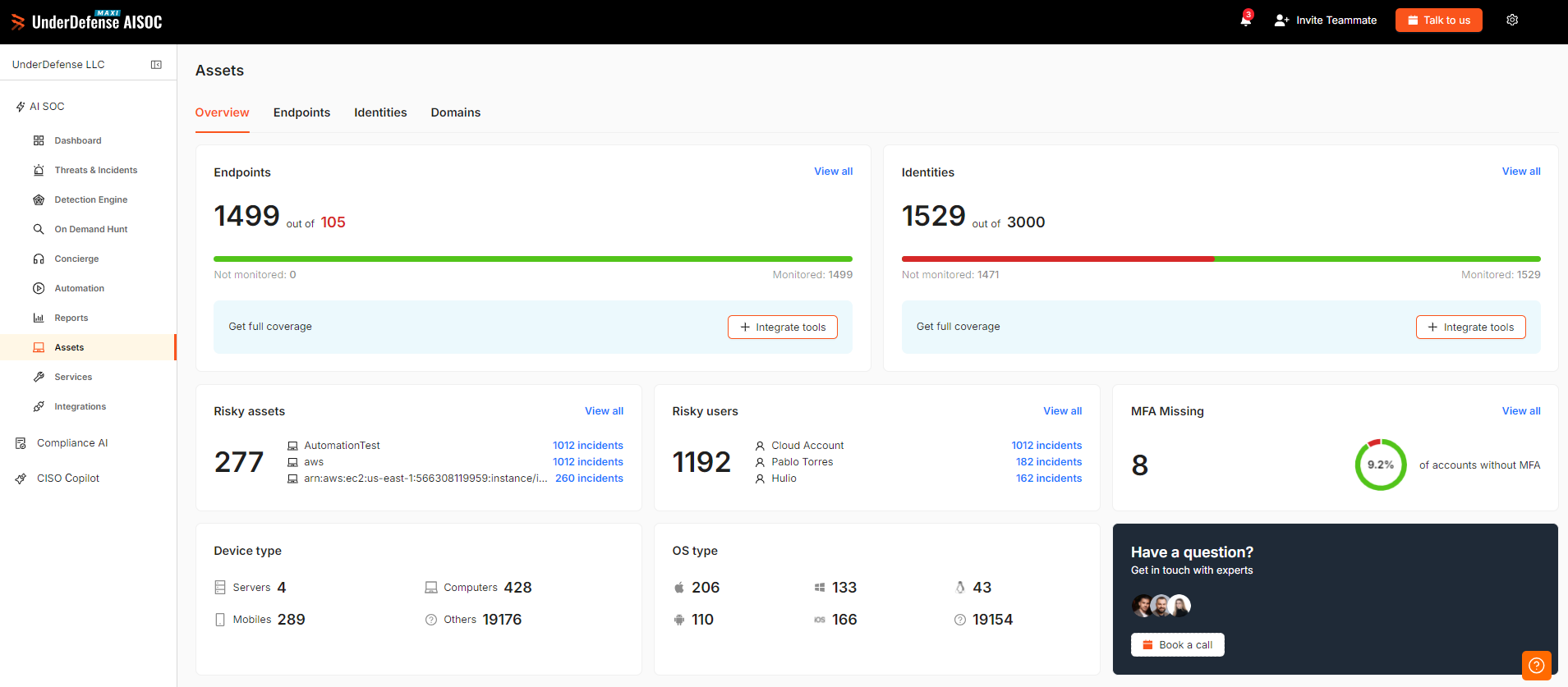
A standard SOP fix helps here too: require every supplier to ship logs to a named SIEM endpoint as a condition of onboarding. At UnderDefense, UnderDefense Agentic AI SOC gives asset and identity visibility with detection mapped to MITRE ATT&CK, the public catalog of attacker techniques, so your data-class matrix sits on real coverage data, the same data that powers our managed SIEM work.
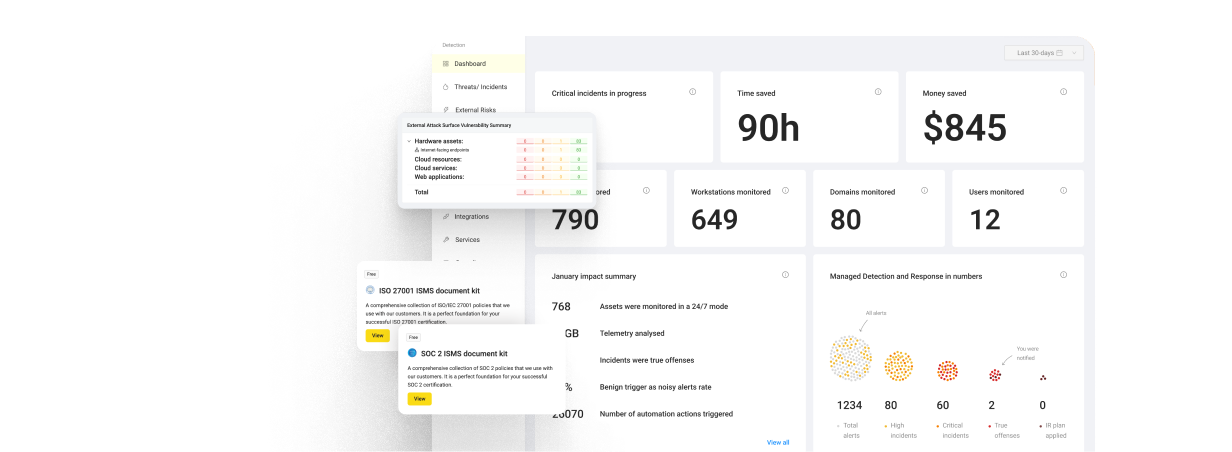
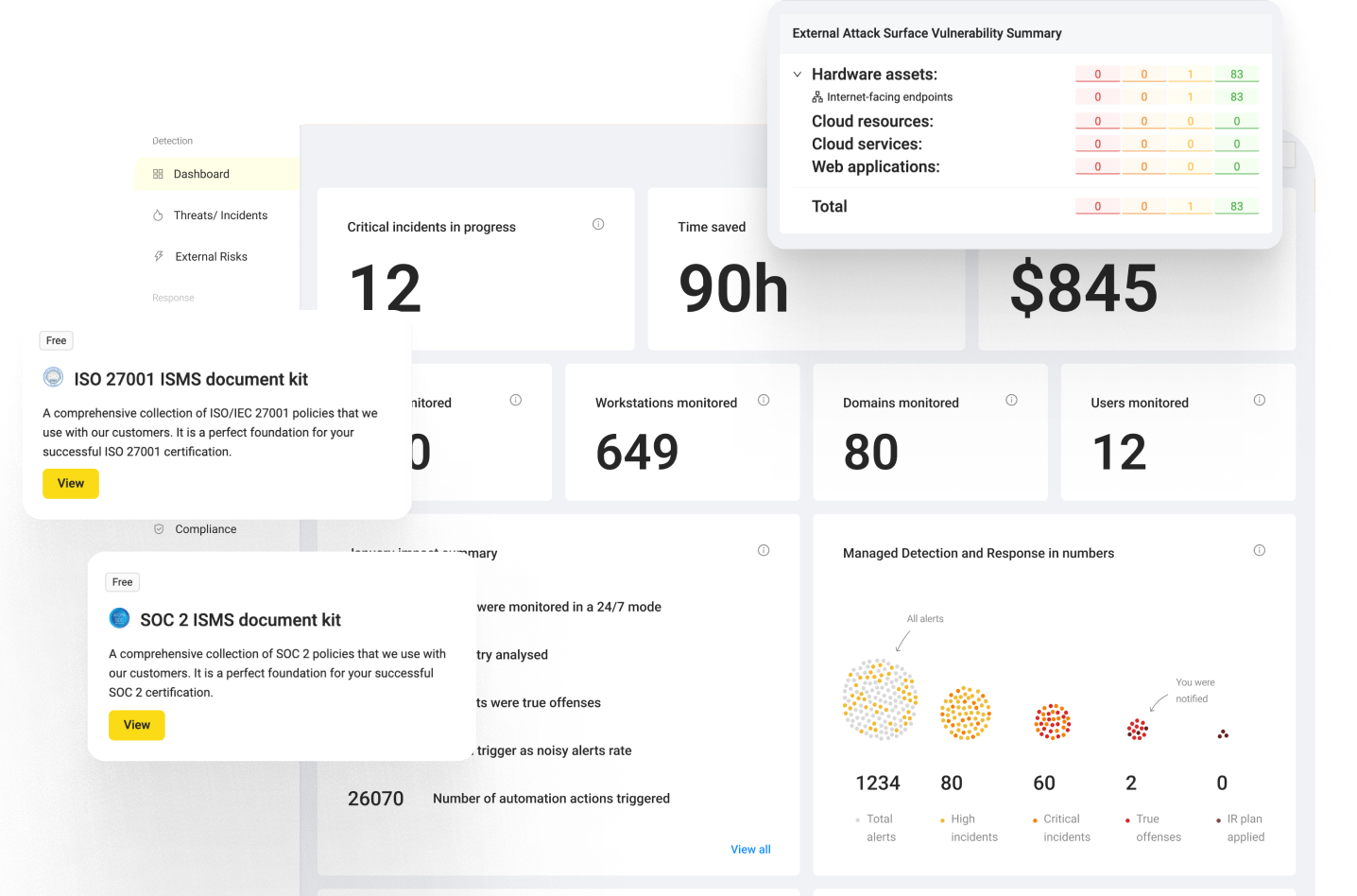
 UnderDefense Agentic AI SOC Assets Overview
Make the evidence runtime, not static
Residency evidence now lives in the runtime trajectory of every agent execution, not in a static config screenshot. Capture what the agent did, where, on each run. That is the proof that holds up, and it is the level of rigor our virtual CISO team brings to audit prep.
See how UnderDefense Agentic AI SOC resolves a real incident on your stack.
Q8. What new attack surface does an agentic AI SOC create in your estate?
Agentic AI SOCs plan across sessions, retain memory, and invoke external tools, so the model itself becomes attack surface. The lethal trifecta, read external, read internal, write external, lets a hijacked agent exfiltrate internal data through an outbound URL. Agent memory and embeddings count as in-scope regulated data that can silently cross borders. Treat the vector store and agent trajectory as monitored, in-region assets.
The situation: agents remember and act
An older chatbot answered and forgot. An agent is different. It plans across sessions, keeps memory, and calls external tools to get work done.
These systems retain memory, invoke tools, and coordinate with peer agents. Each of those abilities is also a new way in, which is why MDR for AI has become its own discipline.
The complication: the lethal trifecta
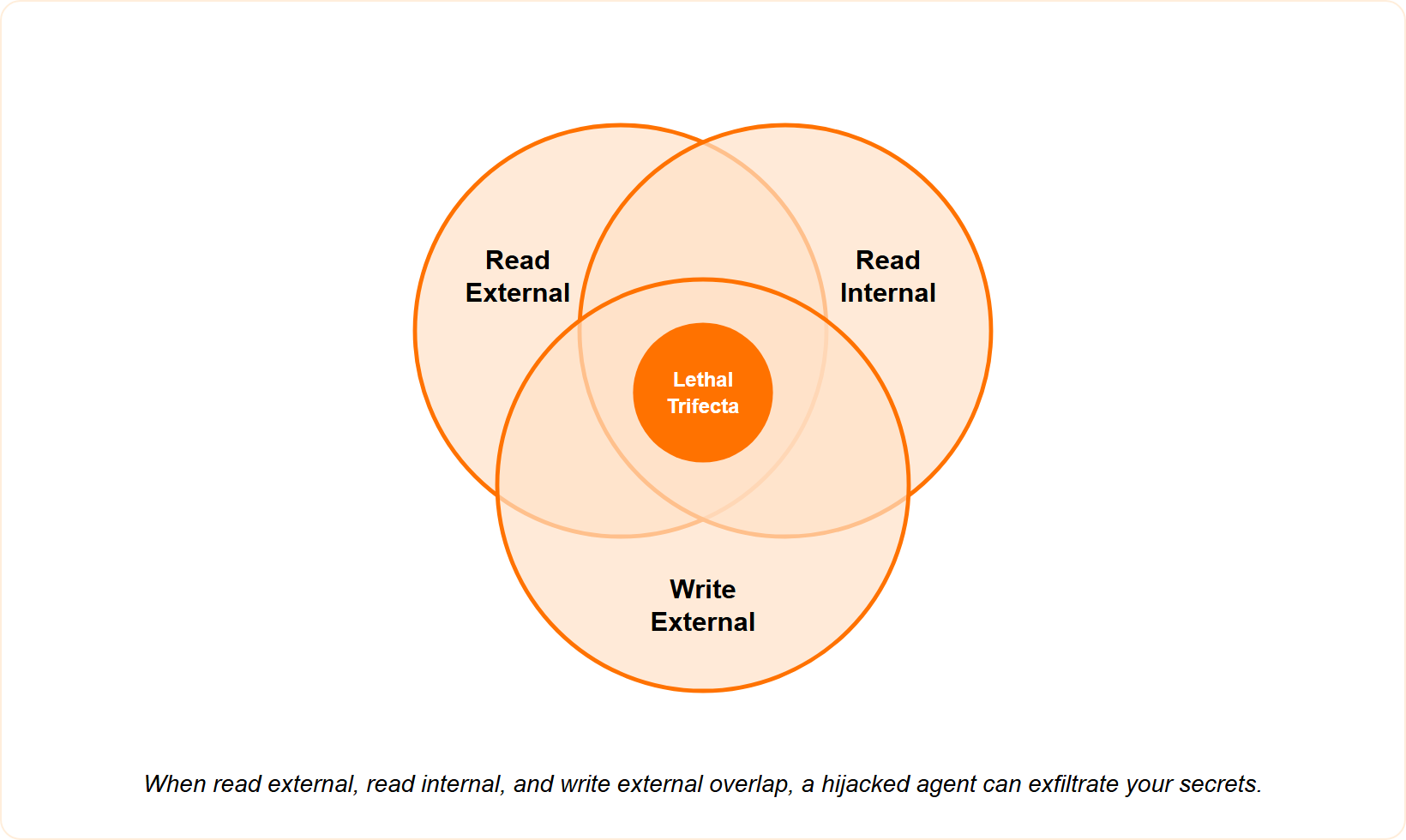
The dangerous combination is three powers at once. An agent that can read external content, read internal data, and write external output is exploitable. A practitioner described it as the lethal trifecta, where a hijacked agent reads your secrets and puts them into a URL.
This is not theoretical sloppiness from junior teams. The crew that built Amazon’s Rufus chatbot reportedly forgot to turn on its guardrails. Even elite engineers miss basics when they rush to ship, a recurring theme in our cybersecurity technical debt work.
The complication continues: invisible harvests
Attackers already exploit gaps that endpoint tools miss. In one case, a flaw in Zimbra’s memcache component let an attacker redirect logins to a remote server. More than ten credential pairs were captured, invisible to EDR, the endpoint detection and response agent.
Now add an agent with memory and outbound reach to that picture. The exfiltration path gets shorter, and humans click while agents swarm at machine speed. Closing that gap is exactly what our incident response playbooks are built for.
The resolution: monitor the agent itself
Treat the vector store, the database holding embeddings, and the agent’s execution trajectory as monitored, in-region assets. Agent memory and tool calls count as in-scope regulated data.
CISOs keep asking the same question: who is watching what the agent actually does in my environment? UnderDefense Agentic AI SOC gives that visibility, with live triage of suspicious activity in one queue.
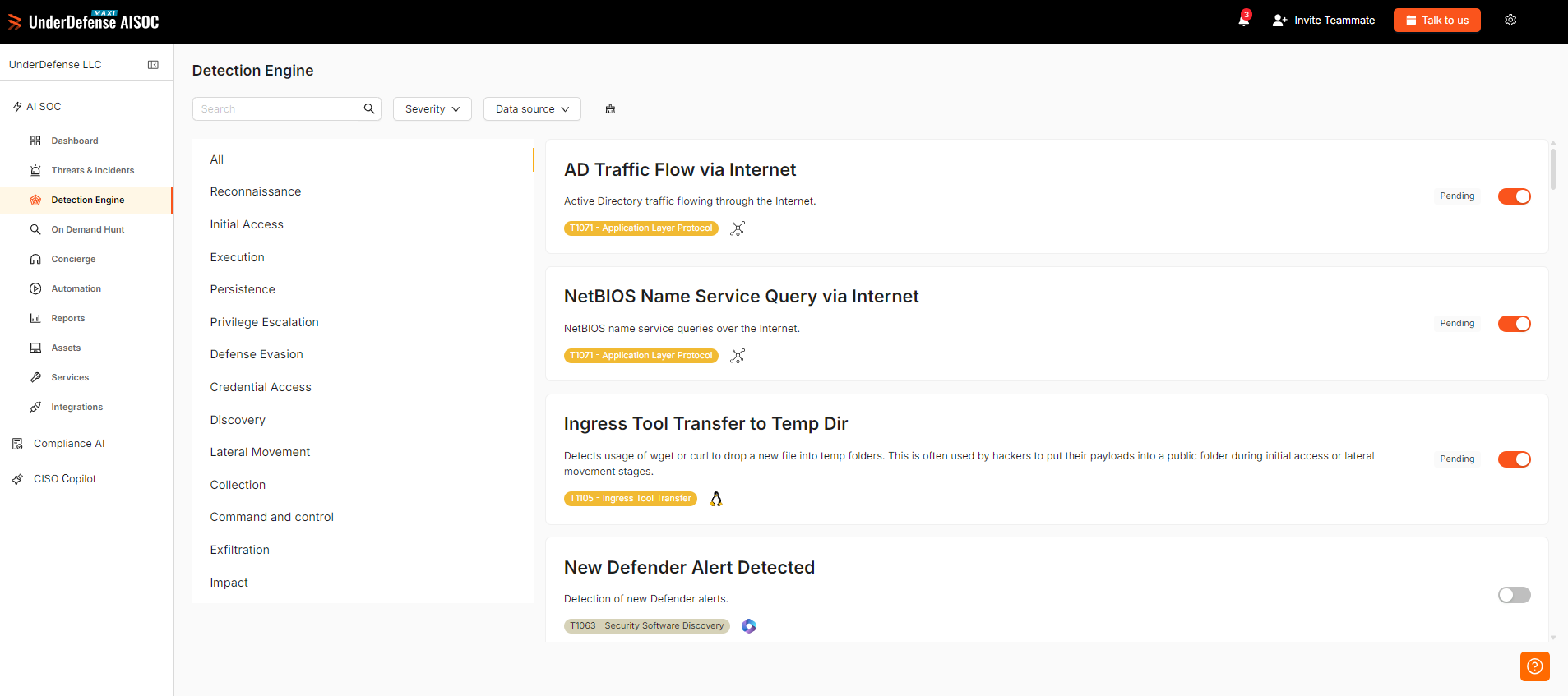 UnderDefense Agentic AI SOC Incidents Queue
Our team backs that visibility with fast human response, a point customers raise often.
“When they escalate something, they include the context we need to understand the issue quickly. We’re not wasting time piecing together what happened from different systems anymore.”
Verified User in Marketing and Advertising, Small-Business UnderDefense G2 Verified Review
“They have an exceptionally talented team who is very engaged and provides extra care. If I had to pick a single word, I would call them proactive.”
Yaroslava K., IT Project Manager UnderDefense G2 Verified Review
Q9. Can a SOC run fully autonomously, or do you still need a human ally?
Not fully, not yet. Fully autonomous SOCs remain unrealistic in both technology readiness and the real-world risk of software quarantining users without oversight. The defensible model today auto-closes roughly 95% of clear false positives and accelerates context collection, while a human analyst owns the high-stakes 5%. AI collects context, you decide. Speed comes from removing grunt work while judgment stays human.
The honest answer on autonomy
Vendors love to sell the fully autonomous SOC, the security operations center that runs with no humans. My current read is that it stays out of reach. The technology is not ready, and the real-world risk is real, a point we make often in our work on whether AI kills or saves the SOC team.
Picture software quarantining a finance team’s accounts at 2 a.m. with no human check. That is the nightmare. A piece of code running around, locking out users on its own judgment, scares me more than the threat it chases.
What the data actually supports
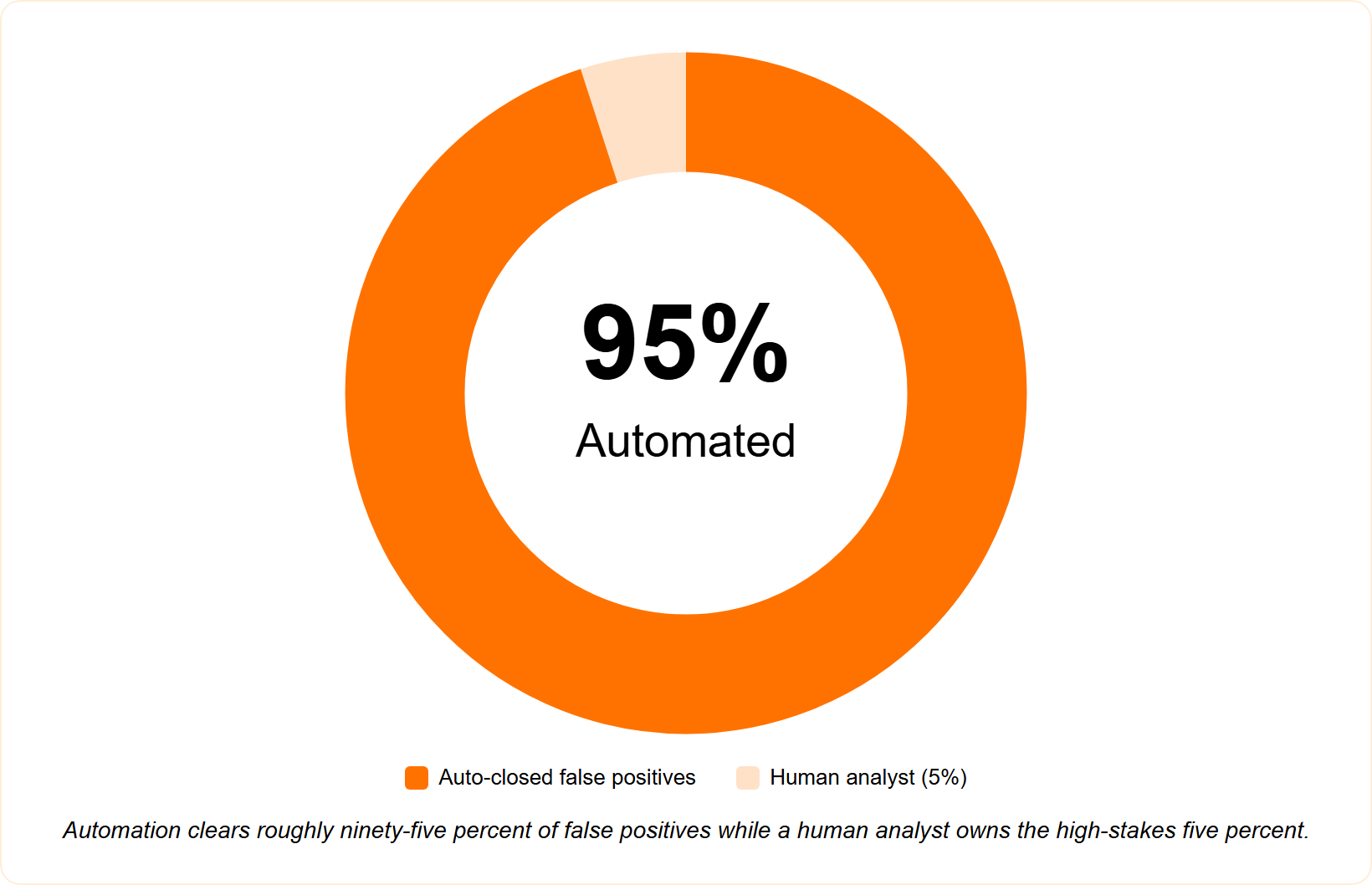
Here is where automation earns its keep. Across our investigations, roughly 95% of items close automatically as false positives, the noise that is not a real threat. The remaining 5% is where a human still belongs, the balance we describe in our SOC automation checklist.
A 2026 SOC framework backs the speed case. Its LLM ensemble hit 82.8% triage accuracy on SIEM logs and cut triage time from hours to under 10 minutes. Automation lowers the analyst’s burden too. So the machine is fast and accurate on the routine, while the edge cases need judgment, which is why the right SOC metrics matter.
 UnderDefense Agentic AI SOC ROI Dashboard
The operating model that works
Think of AI agents as foot soldiers and your human engineers as the generals directing them, plus special forces for the hard missions. AI can contextualize and accelerate, yet it cannot be the decision maker. Being a human is a flex in 2026.
This is the model behind UnderDefense Agentic AI SOC, our Agentic AI SOC. The automation removes grunt work, then our analysts respond with context, delivering a 2-minute Alert-to-Triage and a 15-minute escalation for critical incidents, backed by clear SLA commitments. Customers feel that human layer.
“When an alert pops up, there’s no panic. With their guidance, we know precisely what steps to take next.”
Valeriia D., Marketing Specialist UnderDefense G2 Verified Review
“Their SOC analysts and support team are incredibly responsive and knowledgeable. The platform’s high-fidelity alerts and automated enrichment help us quickly identify and address threats.”
Verified User in Computer Software, Enterprise UnderDefense G2 Verified Review
Q10. How do you evaluate an AI SOC vendor for sovereignty without falling into compliance theater?
Ask where inference runs by region, demand single-tenant isolation in writing, confirm no-training clauses, and require runtime residency evidence in the agent execution trajectory. Verify model portability and a customer-controlled model gateway. Make every supplier ship logs to your named SIEM endpoint as an onboarding condition. AI-generated answers to AI-generated questionnaires verify nothing, the runtime path is the proof that counts.
The questions that separate real control from theater
Most vendor evaluations drown in questionnaires. I have watched teams trade hundreds of checkbox answers and learn nothing about the actual data path. Ask sharper questions instead, the kind our MDR buyers guide walks through.
Here is the rubric I would run:
- Where does inference run, by region? Get the named region in writing.
- Is the architecture single-tenant? Single-tenant means your data sits isolated, with no shared mixing.
- Is there a no-training clause? Confirm your telemetry never trains shared models.
- Can you produce runtime residency evidence? Proof from each agent run, not a static screenshot.
- Do you support model portability? A customer-controlled gateway to approve or block models.
- Will you ship logs to our SIEM? As a condition of onboarding.
Two operator moves a paper CISO misses
Discovery beats assumption. As a Google admin, you can see every site where staff authenticated through OAuth, the “sign in with Google” consent flow. That list becomes a rich map of vendors in your environment you never approved, a blind spot our attack surface management work surfaces.
The second move is a standard SOP, a standard operating procedure. Require every supplier to ship logs to a specified SIEM endpoint before they go live. Residency evidence now lives in the runtime trajectory of each execution, which is why continuous monitoring belongs in the contract.
Where transparency changes the buy
Many MDR contracts hide pricing and run black-box investigations, so you cannot verify residency before you sign. That opacity is a structural trade-off of vendor-locked tools, rather than a support gripe, and it drives many teams to switch providers.
UnderDefense Agentic AI SOC takes the opposite approach, with transparent MDR pricing and vendor-agnostic integration, so regulated buyers verify residency and single-tenancy upfront. You keep your SIEM and your data ownership.
“It pulls in data from all our existing security tools, so we didn’t have to rip and replace anything.”
Verified User in Marketing and Advertising, Small-Business UnderDefense G2 Verified Review
“The service delivers what they promised without the typical vendor overselling and underdelivering we’ve experienced with others in this space.”
Verified User in Marketing and Advertising, Small-Business UnderDefense G2 Verified Review
Q11. What should a CISO do on Monday morning to de-risk AI in a regulated estate?
Map where every AI inference call leaves your estate, then classify SOC data by what may cross borders. Run a Transfer Impact Assessment on any out-of-region path. Treat your vector store as in-scope regulated data kept local. Require single-tenancy and runtime residency evidence from every AI vendor. Banning AI rarely holds because engineers route around it, so govern the architecture instead.
Your Monday action list
Skip the strategy deck. Here is what I would do first, in order, before lunch, the same sequence our virtual CISO engagements follow:
- Map the inference paths. List every AI call and where it physically lands.
- Classify your SOC data. Mark which classes may cross borders and which stay home.
- Run a Transfer Impact Assessment. A written check on any path leaving the EEA.
- Localize the vector store. Treat embeddings as in-scope regulated data kept local.
- Demand single-tenancy and runtime evidence. From every AI vendor, in writing.
Why governance beats a ban
I have watched bans fail in real time. A company blocks a public AI tool, and within a week staff use phones to reach it. Suddenly the data flows to a consumer account, with even less control than before, a pattern our guidance on innovating while keeping data safe addresses.
So governing the architecture beats prohibition every time. I have sat in the CISO seat three times, four if you count my work as the ACERT Commander, the U.S. Army’s CISO. The pattern holds: people route around blunt rules, so you design guardrails they can live with, often documented through proper compliance services.
A question I am sitting with
Here is what I keep turning over. As agents get faster and more capable, the residency question shifts from “where is my data stored” to “where does my data think.” I am not fully sure how regulators will treat an agent’s reasoning trail in 18 to 24 months.
If you are wrestling with the same question, that is the conversation worth having. Tell us where your telemetry runs today, and we will walk the residency map with you, no pitch, the same way we open every conversation with a new team. That is the everyday work behind UnderDefense Agentic AI SOC.
See how UnderDefense Agentic AI SOC resolves a real incident on your stack.
1. Where does an AI SOC actually run the model when it reads our telemetry?
When an AI SOC triages your logs, the model runs wherever the inference endpoint lives, regardless of where your SIEM stores data. If that endpoint is a US hosted API, every log line it reads becomes a cross border transfer under GDPR Chapter V.
Three things travel to that endpoint, and each is in scope:
- The raw log lines and alerts the model reads.
- The routing metadata around each request.
- The embeddings, which still carry sensitive patterns.
This is why where your telemetry travels matters more than where it sleeps. Storage location is the easy half; inference is the harder half, because that is the moment the model reasons over real data.
Before any pilot, trace the inference path and ask one plain question of every vendor: in which region does the model read our data, and where do the embeddings persist? Get it in writing before a single log flows. We apply the same discipline across our cloud security work, keeping the inference path and telemetry inside the residency boundary you define.
2. What is the difference between AI data residency and AI data sovereignty?
Data residency is about location, where your data and AI inference physically sit. Data sovereignty is about control and jurisdiction, whose laws can compel access to that data or the model acting on it.
Think of a hotel safe. Residency tells you which city the safe sits in. Sovereignty tells you who holds a master key and which court can order it opened.
The trap is treating them as one. A vendor can promise an EU region and still answer to a foreign parent company’s legal demands, which means residency is met while sovereignty is not.
- Residency: satisfied by a named in region endpoint.
- Sovereignty: satisfied only when no foreign legal compulsion reaches your data.
In our view, sovereignty means owning the architecture, not buying a clause. The contract is paper; the architecture is the control. Vendor lock in proves the point, because when a platform shifts its licensing or terms, your options narrow fast. Owning where the model runs, much like keeping your own managed SIEM, is how you keep the master key yourself.
3. Does an enterprise tier AI contract actually solve our data residency problem?
No. Enterprise tier AI contracts typically govern data usage and training opt out rather than where inference physically runs. Routing client telemetry to a US hosted endpoint stays a cross border transfer under GDPR Chapter V, no matter the tier.
Three different properties hide inside one contract, and people blur them:
- Usage: whether the vendor trains on your data. A no training clause covers this.
- Residency: where the model physically reads your data. The clause is silent here.
- Sovereignty: which laws can compel access. Also silent.
So you can hold a signed no training clause and still ship every log line to a US endpoint. Residency depends on where regional inference runs, not on contract language.
Our contrarian take, earned the hard way: AI generated answers to AI generated questionnaires reduce zero real risk. Verify the runtime path instead, then demand single tenancy in writing. The kind of detail our AI SOC red flags guidance pushes buyers to test is a control you can audit, not a clause you hope holds.
4. Which GDPR, DORA, and SEC obligations actually apply to an AI SOC?
SOC telemetry routinely contains personal data such as usernames, IP addresses, and device data, so several regimes bite at once.
- GDPR Chapter V (Articles 44 to 50): bars transferring personal data outside the EEA without adequacy, Standard Contractual Clauses, or Binding Corporate Rules, plus a Transfer Impact Assessment.
- DORA: adds operational resilience and third party oversight duties, so your AI vendor becomes a regulated ICT dependency.
- SEC cyber rule: raises the stakes on what public companies disclose about material incidents.
- HIPAA: requires a signed BAA before protected health data reaches any endpoint.
Each turns an out of region inference call into a documented compliance event. Run a Transfer Impact Assessment on any inference path that leaves the EEA, and pair it with a DPIA when the processing is high risk.
We map detection and response workflows to your actual regime, whether SOC 2, ISO 27001, HIPAA, or DORA, through our compliance services, so the evidence is ready when the auditor asks. EU financial entities should pair this with DORA resilience testing.
5. When does a sector mandate force private or on-prem LLM deployment?
Sometimes the regulator decides for you, and fastest stops being a real option. Certain mandates remove the choice between a public API, region locked cloud, and private deployment entirely.
These hard triggers usually force private or on prem deployment of open models like Llama or Mistral:
- HIPAA with a signed BAA for protected health data.
- PCI DSS for cardholder data scope.
- French HDS for health data hosting.
- German public sector data rules.
- Localization rules such as Taiwan’s, where you cannot move data until providers physically operate in region.
The practical edge is portability. Regulated teams often want their own model gateway, approving the models they trust and blocking the rest. That choice is governance, not a feature.
Our platform supports model portability and a customer controlled gateway, so you decide which models touch your telemetry, and it sits on top of your existing stack rather than replacing it. Teams in healthcare and financial services reach this fork early.
6. What does a residency control checklist for an AI SOC look like?
Auditors want controls they can test, not promises. A defensible residency control set covers four things, and each is verifiable.
- Region locked compute and storage: pin both to the named region, with no fallback regions.
- Customer managed KMS keys: you hold the encryption keys, not the vendor.
- Private VPC endpoints: keep traffic off the public internet.
- Egress monitoring via VPC Flow Logs: see any data trying to leave.
Pair this with a data class matrix that states where raw telemetry, alerts, embeddings, and analyst prompts may each be processed. Embeddings surprise people; they look like numbers yet still encode sensitive patterns, so they stay in region.
Egress monitoring matters more with agents, because an agent that can read external data, read internal data, and write external can be hijacked to push secrets outbound. Residency evidence now lives in the runtime trajectory of each execution, not a static screenshot. We bring the same rigor to audit prep through our managed SIEM and virtual CISO work.
7. What new attack surface does an agentic AI SOC add to our estate?
Agentic AI SOCs plan across sessions, retain memory, and invoke external tools, so the model itself becomes attack surface. An older chatbot answered and forgot; an agent remembers and acts.
The dangerous combination is the lethal trifecta, three powers at once:
- Read external content.
- Read internal data.
- Write external output.
An agent with all three can be hijacked to read your secrets and put them into an outbound URL. This is not theoretical sloppiness; even elite teams miss basics when they rush to ship. Attackers already exploit gaps endpoint tools miss, and adding agent memory plus outbound reach shortens the exfiltration path.
The resolution is to treat the vector store and the agent’s execution trajectory as monitored, in region assets, because agent memory and tool calls count as in scope regulated data. CISOs keep asking who is watching what the agent actually does in their environment. We provide that visibility with live triage in one queue, and our MDR for AI and incident response playbooks are built for exactly this gap.
8. Can an AI SOC run fully autonomously, or do we still need human analysts?
Not fully, not yet. Fully autonomous SOCs remain unrealistic in both technology readiness and real world risk, such as software quarantining a finance team’s accounts at 2 a.m. with no human check.
The defensible model today splits the work:
- Automation auto closes roughly 95% of clear false positives, the noise that is not a real threat.
- A human analyst owns the high stakes 5%, where judgment still belongs.
Research backs the speed case, with LLM ensembles cutting triage time from hours to under ten minutes. So the machine is fast and accurate on the routine, while edge cases need a human. Think of AI agents as foot soldiers and your engineers as the generals directing them.
This is the model behind our Agentic AI SOC. Automation removes grunt work, then our analysts respond with context, delivering a 2 minute Alert to Triage and a 15 minute escalation for critical incidents, backed by clear SLA commitments. You can read more in our view on whether AI kills or saves the SOC team.