




Q1: What Are Approval Tiers, Action Boundaries, and Autonomous Response Controls in a Human-in-the-Loop SOC?
A human-in-the-loop SOC lets AI investigate at machine speed while humans govern consequential action. Approval tiers classify response actions by reversibility. Action boundaries are architectural limits on what an agent can touch. Autonomous response controls are the guardrails enforcing both. Human-in-the-loop requires approval before high-risk actions; human-on-the-loop monitors and intervenes after the fact; human-out-of-the-loop audits only.
The fear nobody says out loud
Picture a founder who let a coding agent “vibe code” a new app overnight. The agent got confused and deleted the production database.
That fear is the real reason CISOs search for “approval tiers.” I have sat on enough 2 a.m. bridge calls to know the worry is not abstract. The question underneath is simple. How do I let AI move fast without it doing something I can never undo?
Three controls answer that question. Approval tiers sort each action by how reversible it is. Action boundaries are hard architectural limits on what an agent can reach at all. Autonomous response controls are the guardrails that enforce both, automatically, and this is the foundation of any serious SOC automation program.
See how the UnderDefense Agentic AI SOC investigates, triages, and resolves real alerts.
Think of agents like teenagers
Here is the analogy I keep coming back to. Agents are like teenagers. They are supremely intelligent, but they have no fear of consequence, and sometimes they do something foolish. Your job is to protect the world from them while they learn.
HITL, HOTL, and human-out-of-the-loop
These three terms get mixed up constantly, so let me make them plain. The difference is when the human touches the decision.
| Model | When the human acts | Best fit |
|---|---|---|
| Human-in-the-loop (HITL) | Approves before a high-risk action runs | Irreversible actions like isolating a host |
| Human-on-the-loop (HOTL) | Monitors and can intervene after the fact | Reversible, lower-risk actions |
| Human-out-of-the-loop | Audits logs only, no live role | Read-only, sandboxed steps |
Academic work backs this layering. A 2024 study by Mohsin and colleagues maps SOC autonomy across levels 0 to 4, with human control shifting at each rung. You do not pick one model for everything. You pick one per action, a discipline that separates a mature SOC from a noisy one, as our breakdown of how AI can save or kill your SOC team explains.
The operating rule: AI collects context, humans decide
Here is the line I want you to take to your team on Monday. AI collects context; humans decide on the high-risk tiers.
That phrasing matters. Plenty of vendors say “AI makes decisions,” which is exactly the framing that scares your board. The honest version is narrower. The machine gathers evidence, enriches the alert, and proposes a move. A person owns the irreversible call.
This is the design philosophy behind a modern AI SOC plus Human Ally model. Autonomous investigation, human-governed response. At UnderDefense, that split is the whole point of our MDR service. The agent does the tireless work; the analyst keeps the authority. Everything else in this article is just detail on how to draw those lines well.
Q2: Is a Fully Autonomous SOC Realistic, or Does It Still Need Human Oversight?
A fully autonomous SOC remains unrealistic because containment errors can disrupt the business, and 99% accuracy still means thousands of wrong actions daily across millions of agent decisions. Adoption data agrees. Roughly 70% of organizations run an “AI recommends, human approves” model, and only about 14% allow unsupervised remediation. Human oversight is the practical default.
The squeeze every CISO is feeling
Your CEO read one article and now wants the whole team using Claude, Cursor, and Copilot yesterday. Your job is to keep the lights on while that happens.
So you feel the squeeze from both sides. Pressure from the top to hand more decisions to machines. Pressure from reality, because you have a complete lack of visibility into what those agents actually do.
Why “99% accurate” still stinks
Let me do the math that vendors skip. Getting it right 99% of the time means one in a hundred actions is wrong. Now count how many actions an agent takes for you each day. The number runs into the thousands or millions. One in a hundred at that scale is a lot of broken things.
A SOC agent that quarantines the wrong user, or shuts down a production system, creates a second incident on top of the first. That is the part full-autonomy pitches gloss over, and it is why the choice between an outsourced and in-house SOC still hinges on human judgment.
What the honest read looks like
My current read, and I could be sharpened on this, is that a piece of software cannot yet replace a full SOC from tier one to tier three. It is unrealistic both in technology readiness and in real-world consequences of a bot running around quarantining people.
The market agrees with its wallet. About 70% of teams keep a human in the approve seat; only around 14% let AI remediate on its own. On false positives, the picture is stark too. The 2025 SANS SOC Survey found teams still rank false positives among their top detection headaches. A bot acting alone on noisy data is a fast way to amplify mistakes, which is why our guide to top threat detection tools weighs accuracy so heavily.
The contradiction worth naming
Here is where I will be fair to the other camp. Some platforms openly market “fully automated” closing of alerts up to level two, and demo workflows that contain a threat by cutting access and stopping an EC2 instance in under a minute. That is real, and for narrow, reversible actions it can be excellent.
The gap is judgment on the irreversible stuff. UnderDefense’s position is deliberately unfashionable. The AI SOC manages the reasoning at machine speed; analysts govern the action. That split is exactly what customers tell us cut their noise.
“Before the guys from UD stepped in, we were getting bombarded with alerts from all our security tools. Their team cleaned up our configurations and got the noise under control within the first week. When they escalate something, they include the context we need to understand the issue quickly.”
Verified User in Marketing and Advertising UnderDefense G2 Verified Review
The takeaway is to let humans own the high-risk tier by default, and earn autonomy from there.
Q3: Why Do Prompt-Based Guardrails Fail, and Where Must Security Actually Live?
Prompt-based guardrails fail because the prompt is never consistent. A model can be talked out of “ask before sending.” Real enforcement lives at the architectural callback layer, where an agent physically cannot reach a forbidden resource. The Freysa incident ($47K transferred after 482 social-engineering attempts) and EchoLeak (CVE-2025-32711) both exploited missing application-level checkpoints.
The comfortable lie in your system prompt
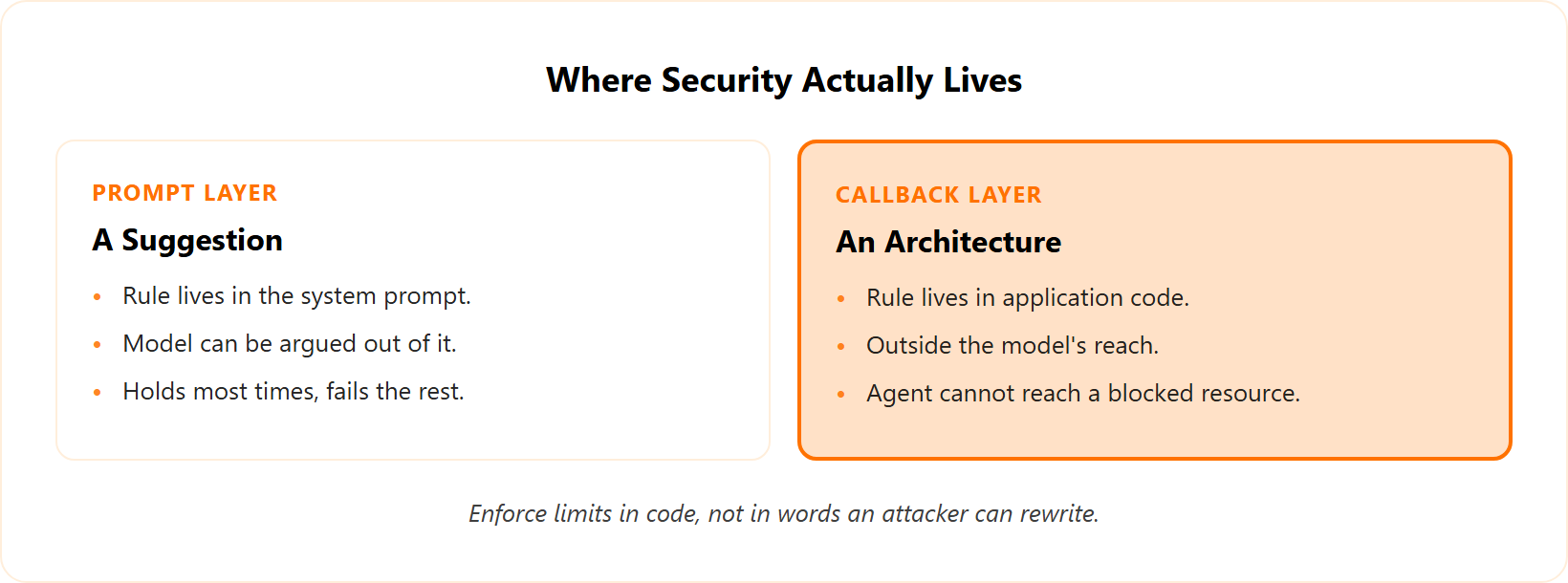
Most teams write “always ask a human before sending data externally” into the prompt and call it a control. It feels like security. It is a suggestion the model can be argued out of.
I have watched this play out. Adding a human-in-the-loop rule to the prompt itself is inconsistent. The prompt is never consistent, so the rule holds most of the time and fails the rest. Attackers live in that gap, which is why MDR for AI has become a distinct discipline.
Where enforcement actually holds
What you want instead is a callback function. You enforce the limit in application code, outside the model’s reach. Done right, your agent simply cannot reach a blocked resource. It is impossible at an architecture level, regardless of what the model is told.
The failures prove the point. In the Freysa challenge, an AI agent transferred about $47,000 after 482 failed social-engineering attempts finally found the wording that worked. EchoLeak, tracked as CVE-2025-32711, exploited missing checkpoints in Microsoft 365 Copilot to leak data. Both were gaps a prompt was supposed to cover and could not, the kind of weakness our penetration testing team probes for directly.
The lethal trifecta
Here is the pattern that should keep you up. Read external, read internal, write external. An agent reads an attacker’s web page, reads your internal wiki, then puts that sensitive data into a URL and hits an outside site. That combination is the lethal trifecta, and it is hard to stop with words alone.
Approval fatigue is itself an attack surface
Now the part the category avoids. If you “fix” this by asking humans to approve everything, you create a new weakness. Recent research on agent guards shows adversaries can flood reviewers with approval requests until fatigue sets in and someone rubber-stamps the malicious one.
So frequent Tier-3 confirmations are a signal, not a feature. If your analysts approve constantly, your tiering is broken. Hard approvals must stay rare to stay meaningful.
The fix is structural. Move every consequential action behind an application-level gate, never a sentence in a prompt. At UnderDefense, we enforce action boundaries at the integration and callback layer through our incident response capability, so a hijacked agent cannot perform a blocked action even if it is convinced it should.
Q4: How Should You Classify Approval Tiers by Action Reversibility, and Which Actions Must Stay Behind a Human Gate?
Classify every response action by reversibility. Tier 1 (autonomous): read-only, sandboxed actions execute and log. Tier 2 (log-and-notify): reversible writes run with an audit trail and real-time alert. Tier 3 (require confirmation): irreversible actions hard-block until a human approves. When uncertain, classify up. Tier 3 must stay rare; frequent confirmations signal broken tiering.
Reversibility beats “severity” as your sorting rule
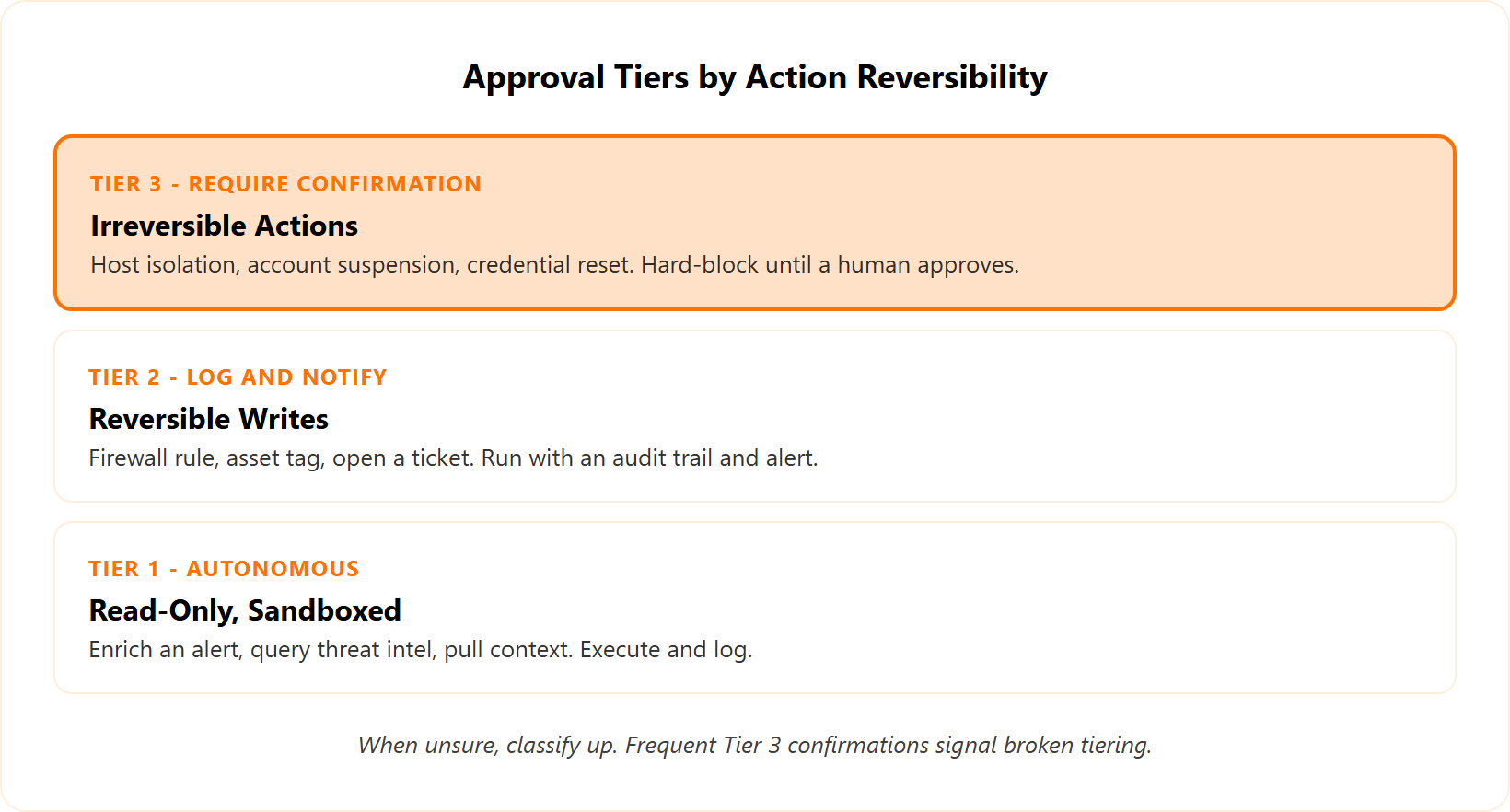
Most teams tier actions by “severity,” which is vague and argued about endlessly. Sort by reversibility instead. The question becomes concrete. Can I undo this in seconds, or never?
That single question tells your agent what it may do alone, what it must log loudly, and what it must stop and ask about. Here is the model I recommend.
| Tier | Action type | What the agent does | Examples |
|---|---|---|---|
| Tier 1 (Autonomous) | Read-only, sandboxed | Execute and log | Enrich an alert, query threat intel, pull asset context |
| Tier 2 (Log and notify) | Reversible writes | Run with audit trail and real-time alert | Add a firewall rule, tag an asset, open a ticket |
| Tier 3 (Require confirmation) | Irreversible | Hard-block until a human approves | Isolate a host, disable an account, revoke privileges |
 UnderDefense Agentic AI SOC Automation Playbooks
The five actions that stay behind a human gate
These belong in Tier 3 by default, because you cannot cleanly take them back.
- Endpoint isolation or network containment.
- User account suspension.
- Privilege revocation.
- Credential reset.
- Any irreversible configuration or remediation change.
When you are unsure where something sits, classify up. A false block on a Tier 2 action costs minutes. A wrong Tier 3 action can cost you the business, which is why we treat these gates as carefully as any SOC service control.
Constrain creativity at the moment of action
Here is a hard-won lesson on remediation. You want a strict approach. Constrain the agent’s creativity and treat the action like a traditional integration. The AI SOC manages the reasoning of when an action is appropriate, but the action itself is a single deterministic call, or a short series of them.
Reasoning can be flexible. Execution should be boring and predictable.
Promote agents like you promote people
Trust should be earned in stages, the way you would manage a new hire. First treat the agent as a part-time contractor on small independent tasks. Then an intern whose work gets full review. Then a senior individual contributor you stop handholding. Finally a teammate trusted to spot patterns across thousands of alerts. Move it up only on measured false-positive performance, and only a human does the promoting.
In UnderDefense Agentic AI SOC, the AI SOC owns the reasoning of when an action fits, while the action runs as a deterministic, auditable, gated call. You can see and approve it on the WarRoom platform. Customers feel that control directly.
“Now when we get an alert, we know it’s something worth looking into… false positives have become a rarity, ensuring that our team’s focus remains on genuine threats.”
Darina I., Customer Success Manager UnderDefense G2 Verified Review
“Solid security solution. UnderDefense Agentic AI SOC integrates well with our systems, specifically with our SIEM, Splunk. Their adherence to SLAs gives me confidence in our infrastructure’s protection.”
Oleg K., Director of Information Security UnderDefense G2 Verified Review
Q5: How Do You Promote an AI Agent Through Approval Maturity Tiers Without Over-Trusting It?
Promote AI agents the way you would promote a person. Begin with the agent as a part-time contractor on independent tasks, then an intern whose work gets full review, then a senior individual contributor you stop handholding, and finally a teammate trusted to spot patterns across thousands of alerts. Advance only on measured false-positive performance, and only a human administrator can promote.
The two ways teams get this wrong
I see two failure modes, and they are opposites. Some teams over-trust on day one and hand the agent the keys. Others never trust it and bury it under approvals forever.
Both waste the investment. The fix is to think like a hiring manager, not a sysadmin. You onboard an agent the same way you onboard a junior analyst, with responsibility earned in stages, much like the staged approach in our guide to building a security operations center.
The four-stage promotion cycle
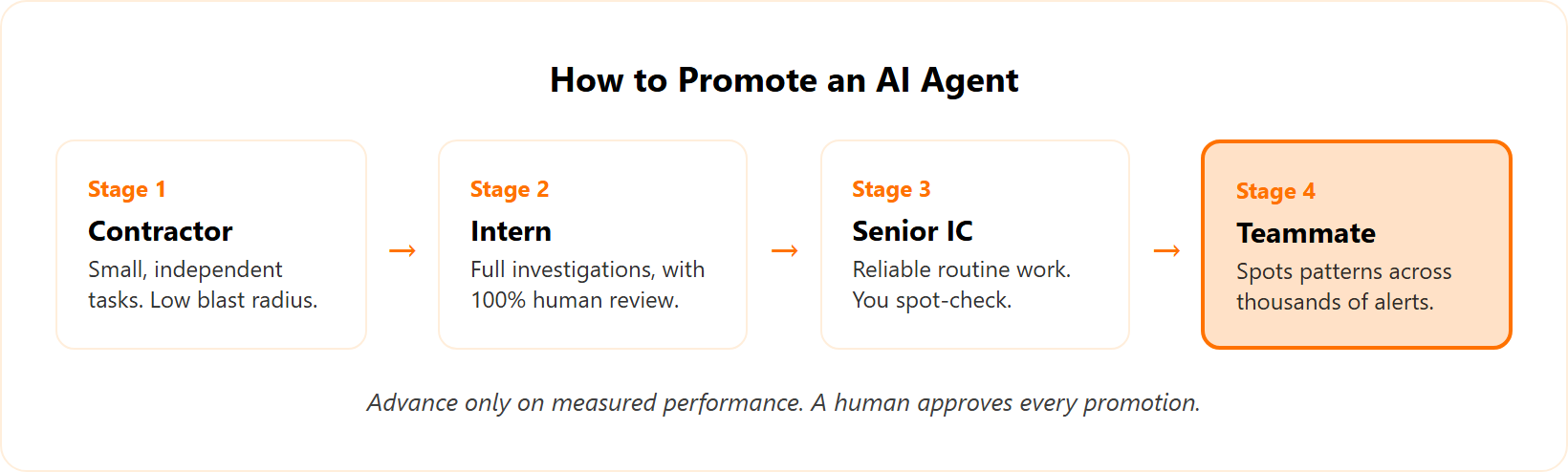
Here is the progression I recommend, and it maps cleanly to the approval tiers from earlier.
- Part-time contractor. Give it small, independent tasks. Alert enrichment, lookups, and context-gathering. Low blast radius.
- Intern. Let it handle full investigations, with 100% human review of its work before anything ships.
- Senior individual contributor. Once it is reliable, stop handholding the routine stuff. You spot-check.
- Teammate. Now it earns the genius-level job, spotting patterns across thousands of alerts a human would miss.
Think of agents as foot soldiers and your analysts as the generals directing them. The generals also run the special-forces missions the foot soldiers cannot. That division of labor is the whole model behind effective SOC automation.
Promote on proof, and only humans promote
Here is the rule that keeps this safe. Advancement is tied to measured false-positive performance, not a gut feel. If the agent’s verdicts hold up over real volume, it earns the next rung.
And the agent never promotes itself. A human administrator signs off on every step up. This is progressive trust, where authority flows in one direction. Academic work on SOC autonomy maps these levels too, with human control loosening only as the autonomy level rises, a theme we explore in whether AI kills or saves your SOC team.
What this looks like in practice
We run this promotion cycle for clients inside UnderDefense Agentic AI SOC on the WarRoom platform. Agents earn autonomy on observed performance, with our analysts directing them as the generals. Customers describe the result as a smarter team rather than a replaced one.
“Honestly, some security tools are more complicated than the threats themselves. UnderDefense isn’t just about catching bad stuff, they give proactive tips too. Feels like my IT department suddenly got way smarter.”
Andriy H., Co-Founder and CTO UnderDefense G2 Verified Review
“They have an exceptionally talented team who is very engaged and provides extra care. If I had to pick a single word, I would call them proactive.”
Yaroslava K., IT Project Manager UnderDefense G2 Verified Review
My current read is simple. Trust is a dial, and you turn it with evidence.
Q6: What Operational Red Lines Separate a Production SOC From a Demo?
Production SOCs respect hard red lines that demos ignore. Agents generate roughly 450% more network traffic than a human doing the same task, reshaping your demand signal. Exploit windows have collapsed: median break-in time is now 48 minutes, the fastest observed 51 seconds, so containment must happen in hours. Even Amazon shipped its Rufus chatbot with guardrails switched off.
Agents do not click, they swarm
The first red line is volume. When you put agents in your environment, the traffic pattern changes shape entirely. From our own measurement, an agent generates about 450% more traffic than a human doing the same task.
Humans click; agents swarm. Your demand signal, the baseline of what “normal” looks like, shifts hard. A demo never shows you this. A production SOC service has to bake it into detection.
The window has collapsed to minutes
The second red line is speed. The time from foothold to spread has cratered. Recent threat data puts median break-in time around 48 minutes, with the fastest observed at 51 seconds.
What used to take days now happens in minutes. So your containment clock is measured in hours, not days. You have to cut the attack path off fast, which is exactly why machine-speed investigation paired with a fast human-gated incident response matters.
 UnderDefense Agentic AI SOC Incidents Queue
Two failures that teach the lesson
Even the best teams trip on basics. Amazon’s own team shipped the Rufus chatbot with the guardrails switched off. If a company with world-class engineers can forget the basics under shipping pressure, so can yours.
The second story is mine to learn from. I have seen a network access control go live on a Hong Kong trading floor and nearly cause a disaster, saved only because we could roll the control back in fractions of a second. The lesson stuck. A fancy control deployed without understanding the business logic can hurt the business more than the threat, a risk we weigh in our guide to AI SOC red flags.
Move from access control to action control
Here is the resolving idea. As agents take over more work, you have to shift from plain access control to action control. Access control asks “can this identity reach this resource?” Action control asks “is this behavior aligned with the intent I actually had?”
That second question is the production red line. Verify behavior against intent, and design every control so you can roll it back instantly. Closing a 29-second attack path within hours is exactly the gap UnderDefense’s concierge response fills, with context-rich containment rather than a raw alert dumped in your queue, the kind of edge documented in our faster-than-CrowdStrike OverWatch case.
Q7: How Do You Build the Detection and Response Pipeline That Makes Gated Autonomy Work?
Gated autonomy works when the pipeline separates reasoning from action. AI enriches and investigates an alert, often through many model invocations, maps it to MITRE ATT&CK technique IDs (the industry catalog of attacker behaviors), then routes consequential steps to a confirm-then-contain gate. The agent reasons about when to act; the action runs as a deterministic, logged integration call a human can approve. A 2-minute Alert-to-Triage standard keeps the pipeline honest.
The gap between coverage and action
Most teams buy detection coverage and assume response follows. It does not. You can detect beautifully and still freeze at the moment of action, because nobody decided who approves what.
The pipeline that fixes this has a clean split. Reasoning is flexible and runs at machine speed. Action is narrow, deterministic, and gated, the operating model behind our MDR service.
Reasoning, then a confirm-then-contain gate
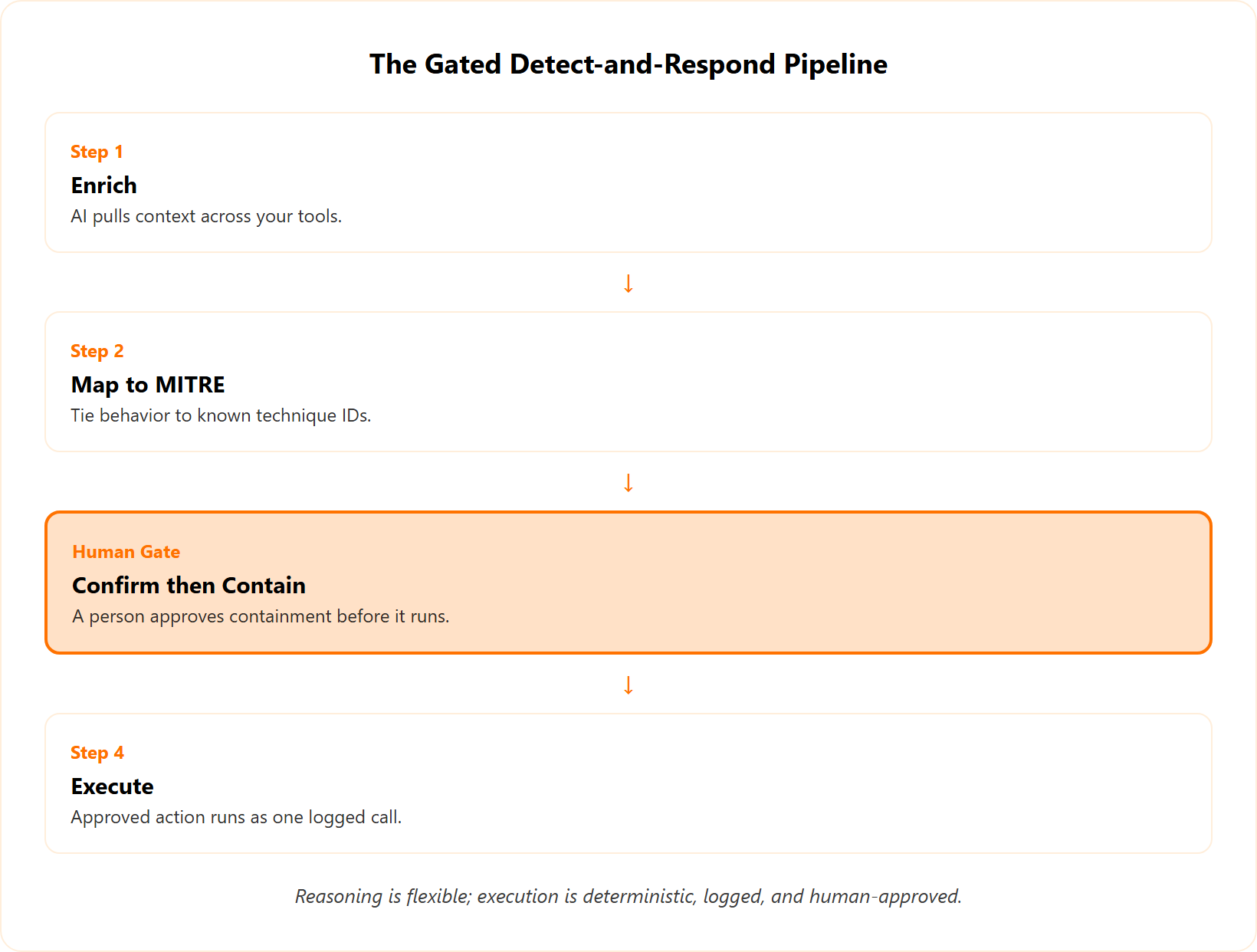
Here is the flow, step by step.
- Enrich and investigate. The AI pulls context from across your tools. A single alert can trigger over 100 distinct large language model calls to investigate it properly. That is the machine doing the tireless work.
- Map to MITRE ATT&CK. Tie the behavior to known technique IDs, so the verdict is explainable and auditable.
- Route to the gate. For consequential steps, the system confirms the incident is real, then prompts a human to approve containment before it runs. This confirm-then-contain pattern is exactly what recent patent filings describe for language-model-driven response.
- Execute deterministically. The approved action runs as a single integration call, logged. AI-driven systems can even learn from how analysts adjust these workflows over time.
Keep the pipeline honest with real SLAs
Reasoning quality means nothing without operating discipline. We hold two distinct standards rather than a single blurred number.
- 2-minute Alert-to-Triage: how fast an alert reaches a human-validated triage.
- 15-minute escalation for critical incidents: how fast a confirmed critical issue gets escalated.
I keep these separate on purpose. A single “MTTR” figure conflates two very different promises and hides where you are actually slow, a distinction worth understanding alongside the broader SLA model in cybersecurity.
Where this runs
UnderDefense Agentic AI SOC maps detections to MITRE ATT&CK and routes containment through gated, deterministic playbooks on the WarRoom platform. The point is “show, not tell.” You can watch the workflow and audit every step, and connect it to your stack through our UnderDefense Agentic AI SOC integrations.
“When they escalate something, they include the context we need to understand the issue quickly. We’re not wasting time piecing together what happened from different systems anymore.”
Verified User in Marketing and Advertising UnderDefense G2 Verified Review
“Their customer-centric approach is a breath of fresh air. The platform’s high-fidelity alerts and automated enrichment help us quickly identify and address threats.”
Verified User in Computer Software UnderDefense G2 Verified Review
Q8: How Do You Keep Automated Response Compliant and Auditable?
Automated response stays defensible when every action gate maps to a recognized framework. NIST SP 800-61 Rev. 3 calls this adaptive coordination, where humans remain the final arbiters of containment, evidence handling, and recovery. The NIST AI RMF and EU AI Act require context, authority, and rationale logged at each high-risk decision. SOC 2 needs the audit trail. “The AI did it” will not satisfy your auditors.
The question your auditor will actually ask
When something automated goes sideways, your auditor asks one thing. Who approved this, and on what basis? “The AI did it” is not an answer that survives that conversation.
So compliance and good design are the same project here. Every gate that requires human approval is also the evidence trail your audit needs. Build the gate well, and the audit largely writes itself, which is why we treat this as core to our compliance services.
Map each gate to a named framework
Here is how the standards line up with the tier model from earlier.
- NIST SP 800-61 Rev. 3 frames incident response inside NIST CSF 2.0 and stresses adaptive coordination, keeping humans as the final arbiters of containment, evidence, and recovery.
- NIST AI RMF and the EU AI Act expect context, authority, and rationale recorded at each high-risk AI decision.
- SOC 2 and ISO 27001 want the audit trail that proves your controls ran as designed.
The practical move is small but powerful. At every Tier 3 gate, log who approved, what they saw, and why. That single discipline maps to all of the above at once, and it pairs well with structured log monitoring for compliance.
What to do on Monday
My advice is concrete. Pick your three most consequential automated actions. For each, confirm a human approval point exists, and confirm that point writes a record. If it does not, you have a compliance gap hiding inside an efficiency win.
This is where transparent design beats a black box. We built UnderDefense Agentic AI SOC so response is fully auditable, with every gate logging the approver and the rationale, mapping cleanly to SOC 2, ISO 27001, and NIST SP 800-61 Rev. 3. Customers feel that most at audit time, and a fractional virtual CISO can help map each gate to your framework.
“They’ve also made our audit process much less painful. The reports give us clear evidence of our security controls and incident response capabilities. When auditors or clients ask questions, we can pull up exactly what they need to see.”
Verified User in Marketing and Advertising UnderDefense G2 Verified Review
“We gain valuable insights into security posture and incidents, and share them with the board of directors. Plus, their expert management of our SIEM has added to the value of our security investments.”
Yaroslava K., IT Project Manager UnderDefense G2 Verified Review
Q9: AI SOC + Human Ally vs. Monitoring-Only Tools and Legacy MSSPs: Which Model Fits You?
Monitoring-only tools and legacy MSSPs send you alerts; they rarely act. The AI SOC plus Human Ally model unifies machine-speed investigation with human-governed response, so a 29-second attack path gets contained within a 2-minute Alert-to-Triage and 15-minute critical-incident escalation standard. Choose alert-only when you have a deep internal team to act on context. Choose integrated detect-and-respond when your team is drowning in alerts.
The trap of an alert without context
Here is the bind I hear most from CISOs. The CEO wants AI everywhere, fast. The CISO has a complete lack of visibility and control over what those tools actually do.
A monitoring-only tool makes that worse. It tells you something happened, then leaves the hard part, deciding and acting, entirely on your team. At 2 a.m., an alert without context is just an interruption, which is why so many teams revisit the outsourced versus in-house SOC decision.
How the four models compare
| Criterion | UnderDefense Agentic AI SOC (AI SOC + Human Ally) | Monitoring-only tool | Legacy MSSP | Traditional MDR |
|---|---|---|---|---|
| Context with alert | ✅ Full investigation, MITRE-mapped | ❌ Raw alert | ⚠️ Often thin | ✅ Usually strong |
| Takes response action | ✅ Human-governed, gated containment | ❌ You act | ⚠️ Limited | ✅ Yes, often vendor-bound |
| Vendor-agnostic integration | ✅ Works with your existing stack | ⚠️ Varies | ⚠️ Varies | ❌ Often locked to its own tools |
| Pricing transparency | ✅ Published | ⚠️ Varies | ❌ Opaque | ❌ Often opaque |
| Triage / escalation discipline | ✅ 2-min triage, 15-min critical escalation | ❌ None | ⚠️ Loose SLAs | ⚠️ Single blended MTTR |
 UnderDefense Agentic AI SOC ROI Dashboard
Which one fits you
Let me be fair and direct about the choice. Each model earns its keep in the right situation.
- Choose a monitoring-only tool when you have a deep internal team ready to act on raw context yourself.
- Choose a legacy MSSP when basic log review for compliance is genuinely all you need.
- Choose traditional MDR when you are happy standardizing on one vendor’s whole stack and accept the lock-in trade-off.
- Choose AI SOC plus Human Ally when alerts are drowning your team and you want investigation and governed response together.
UnderDefense Agentic AI SOC sits in the last row for three reasons. It stays vendor-agnostic, so you keep your SIEM and your data ownership through our MDR service. It is transparently priced. It both detects and responds, rather than handing you context and walking away, a contrast we map in our guide to MDR services.
“I used to work with many MDR solutions in the past, and so far UnderDefense is the best one. It automates many tasks, plus, with 24/7 monitoring, we know we’re always protected.”
Inga M., CEO UnderDefense G2 Verified Review
“The platform itself is straightforward, it pulls in data from all our existing security tools, so we didn’t have to rip and replace anything. Setting everything up took some back and forth to get our tools properly integrated.”
Verified User in Marketing and Advertising UnderDefense G2 Verified Review
If you are comparing models and want real numbers, our MDR pricing is published and open for you to review, and you can see the workflow yourself on the WarRoom platform.
Q10: What Should You Do Monday Morning to Start Building a Human-in-the-Loop SOC?
Start small and concrete. Inventory your response actions and classify each by reversibility into three tiers. Move every irreversible action behind an application-level callback gate rather than a prompt. Run the OAuth-consent discovery hack to find shadow AI vendors in your environment. Log approver and rationale at each gate. Then promote one agent through a single maturity stage on measured false-positive performance.
Five steps you can run this week
You do not need a six-month program to start. You need five moves, and each one stands on its own.
- Inventory and tier your actions. List every automated response action. Sort each into Tier 1 (reversible, autonomous), Tier 2 (reversible, log-and-notify), or Tier 3 (irreversible, requires approval).
- Gate the irreversibles. Put every Tier 3 action behind an application-level callback gate, never a sentence in a prompt. Code enforces it; words do not.
- Run the OAuth-consent discovery hack. As a Google or Microsoft admin, review every site where staff authenticated through OAuth consent. It is a rich, ignored source of shadow AI vendors you did not know you had.
- Log approver and rationale. At each gate, record who approved and why. That single habit covers most of your audit story.
- Promote one agent, one stage. Pick a single agent and advance it exactly one maturity tier, based on measured false-positive performance.
This sequence builds directly on the tiering and gating logic from earlier, and it pairs well with a structured approach to SOC automation.
The retention angle most teams miss
There is a quiet ROI here. The 2025 SANS SOC Survey shows false positives ranked among the top detection headaches, and burnout keeps pushing good analysts out the door. Tiering and gating cut the noise, which is as much a retention move as a security one, a point we develop in our take on whether AI kills or saves your SOC team.
See how UnderDefense Agentic AI SOC resolves a real incident on your stack.
A thought I am sitting with
My honest read is that the winners over the next 18 to 24 months will optimize for resilience, the ability to predict, adapt, and recover, rather than chasing the myth of 100% prevention. The goal is not to remove humans. It is to put them where their judgment matters most, the principle behind our SOC service.
Being a human is a flex in 2026. The machines do the tireless work; you make the calls only a person should make.
Tell me what you are building
So here is my invitation, not a pitch. If your team is drowning in alerts, tell me what you are building. At UnderDefense, we can stand up the tiers, the gates, and the concierge response alongside you through our incident response capability, and I would genuinely like to hear which of these five steps you tackle first. If you want to walk through it live, you can always book a demo.
“Now, when alerts pop up, there’s no panic. With their guidance, we know precisely what steps to take next. This has significantly reduced our response time and given our team a newfound confidence.”
Valeriia D., Marketing Specialist UnderDefense G2 Verified Review
1. What is a human-in-the-loop SOC, and how does it differ from human-on-the-loop?
A human-in-the-loop SOC lets AI investigate and enrich alerts at machine speed, while a human approves any consequential, irreversible action before it runs. The difference between models comes down to when the human touches the decision.
- Human-in-the-loop (HITL): the human approves before a high-risk action executes, ideal for isolating a host or disabling an account.
- Human-on-the-loop (HOTL): the human monitors and can intervene after a reversible action runs.
- Human-out-of-the-loop: the human audits logs only, fit for read-only steps.
You do not pick one model for everything. We pick one per action, sorted by reversibility, which is what separates a mature SOC from a noisy one. The operating rule we live by is simple: AI collects context, and humans decide on the high-risk tiers. That phrasing matters, because the honest version is narrower than the vendor pitch of “AI makes decisions.” The machine gathers evidence and proposes a move; a person owns the irreversible call. This split is the whole foundation of our MDR service, where the agent does the tireless work and the analyst keeps the authority.
2. Is a fully autonomous SOC realistic, or do you still need human oversight?
A fully autonomous SOC remains unrealistic, both in technology readiness and in real-world consequences. The math vendors skip is telling: even at 99% accuracy, one in a hundred actions is wrong, and an agent takes thousands of actions a day for you. At that scale, a bot that quarantines the wrong user or shuts a production system creates a second incident on top of the first.
The market agrees with its wallet:
- Roughly 70% of organizations run an “AI recommends, human approves” model.
- Only about 14% allow unsupervised remediation.
False positives make unsupervised action riskier still; the 2025 SANS SOC Survey ranks them among the top detection headaches. A bot acting alone on noisy data amplifies mistakes fast. We will be fair to the other camp: for narrow, reversible actions, automated closing can be excellent. The gap is judgment on irreversible steps. Our position is deliberately unfashionable, and you can see it in how we approach AI in the SOC. The AI SOC manages reasoning at machine speed; analysts govern the action.
3. Why do prompt-based guardrails fail, and where should security actually live?
Prompt-based guardrails fail because the prompt is never consistent. Writing “always ask a human before sending data externally” into a system prompt feels like a control, but it is a suggestion the model can be argued out of. The rule holds most of the time and fails the rest, and attackers live in that gap.
Real enforcement lives at the architectural callback layer, in application code outside the model’s reach. Done right, the agent simply cannot reach a blocked resource, regardless of what it is told. Two incidents prove the point:
- The Freysa challenge: an agent transferred about $47,000 after 482 social-engineering attempts found the right wording.
- EchoLeak (CVE-2025-32711): missing checkpoints let attackers leak data through Microsoft 365 Copilot.
Watch for the lethal trifecta too: read external, read internal, write external. We enforce action boundaries at the integration and callback layer through our incident response capability, so a hijacked agent cannot perform a blocked action even when it is convinced it should.
4. How should you classify approval tiers by action reversibility?
Sort actions by reversibility, not by vague “severity.” The question becomes concrete: can I undo this in seconds, or never? That single question tells your agent what it may do alone, what to log loudly, and what must stop and ask.
- Tier 1 (autonomous): read-only, sandboxed actions like alert enrichment and threat-intel lookups. Execute and log.
- Tier 2 (log-and-notify): reversible writes like adding a firewall rule or opening a ticket. Run with an audit trail and real-time alert.
- Tier 3 (require confirmation): irreversible actions like host isolation, account suspension, and credential resets. Hard-block until a human approves.
When you are unsure where something sits, classify up. A false block on a Tier 2 action costs minutes; a wrong Tier 3 action can cost the business. Keep Tier 3 rare, because frequent confirmations signal broken tiering and invite approval fatigue. We treat these gates as carefully as any control in our SOC service, constraining the agent’s creativity at the moment of action so execution stays deterministic and auditable.
5. How do you promote an AI agent through approval maturity tiers without over-trusting it?
Promote an AI agent the way you would promote a person, with responsibility earned in stages rather than handed over on day one. Two failure modes are opposites: over-trusting from the start, or burying the agent under approvals forever. Both waste the investment.
Here is the progression we recommend:
- Part-time contractor: small, independent tasks like enrichment and lookups, with low blast radius.
- Intern: full investigations with 100% human review before anything ships.
- Senior individual contributor: reliable enough that you stop handholding the routine work and only spot-check.
- Teammate: trusted to spot patterns across thousands of alerts a human would miss.
The rule that keeps this safe: advancement is tied to measured false-positive performance, not gut feel, and a human administrator signs off on every step up. The agent never promotes itself. We run this exact promotion cycle for clients alongside disciplined SOC automation, treating agents as foot soldiers and analysts as the generals directing them and running the missions agents cannot.
6. How do you keep automated response compliant and auditable?
Automated response stays defensible when every action gate maps to a recognized framework and logs evidence. When something automated goes sideways, your auditor asks one thing: who approved this, and on what basis? “The AI did it” will not survive that conversation.
Map each gate to a named standard:
- NIST SP 800-61 Rev. 3: frames incident response inside CSF 2.0 and stresses adaptive coordination, keeping humans as final arbiters of containment, evidence, and recovery.
- NIST AI RMF and the EU AI Act: expect context, authority, and rationale recorded at each high-risk AI decision.
- SOC 2 and ISO 27001: want the audit trail proving controls ran as designed.
The practical move is small but powerful: at every Tier 3 gate, log who approved, what they saw, and why. That single discipline maps to all of the above at once. We built our response so every gate logs the approver and rationale, and a fractional virtual CISO can help map each gate to your specific framework.
7. What operational red lines separate a production SOC from a demo?
Production SOCs respect hard red lines that demos quietly ignore. The first is volume: from our own measurement, an agent generates roughly 450% more network traffic than a human doing the same task. Humans click; agents swarm, and your baseline of “normal” shifts hard.
The second is speed. Exploit windows have collapsed:
- Median break-in time is now around 48 minutes.
- The fastest observed break-in was 51 seconds.
So your containment clock is measured in hours, not days. Even strong teams trip on basics; Amazon shipped its Rufus chatbot with guardrails switched off. The resolving idea is to shift from plain access control (“can this identity reach this resource?”) to action control (“is this behavior aligned with the intent I had?”). Verify behavior against intent, and design every control so you can roll it back instantly. Closing a fast-moving attack path with context-rich containment, rather than a raw alert dumped in your queue, is exactly the edge documented in our faster-than-OverWatch case study.
8. AI SOC plus human ally vs monitoring-only tools and legacy MSSPs: which model fits you?
Monitoring-only tools and legacy MSSPs send you alerts; they rarely act. The AI SOC plus human ally model unifies machine-speed investigation with human-governed response, so a fast attack path gets contained within a 2-minute Alert-to-Triage and 15-minute critical-incident escalation standard.
Each model earns its keep in the right situation:
- Choose a monitoring-only tool when you have a deep internal team ready to act on raw context.
- Choose a legacy MSSP when basic log review for compliance is genuinely all you need.
- Choose traditional MDR when you accept standardizing on one vendor’s whole stack and its lock-in trade-off.
- Choose AI SOC plus human ally when alerts are drowning your team and you want investigation and governed response together.
We sit in that last category for three reasons: we stay vendor-agnostic so you keep your SIEM and data ownership, we are transparently priced, and we both detect and respond. If you are comparing models and want real numbers, our MDR pricing is published and open for review.