




Q1. How does an AI SOC actually decide what to do with an alert?
An AI SOC decides by ingesting and deduplicating alerts, enriching them with internal and threat-intel context, scoring them to filter false positives, running an automated investigation, then acting within preset action tiers. It executes low-risk reversible steps on its own. It routes high-impact actions to a human. The decision is a layered process of context collection, scoring, and tiered authorization.
See how the UnderDefense Agentic AI SOC investigates, triages, and resolves real alerts.
The fear underneath the question
Most CISOs do not ask me how the pipeline works. They ask a quieter question. “Can I get comfortable with a black box making real decisions in my environment?” That worry is fair. A nondeterministic system (one that can answer the same input differently) running loose in production is a real risk, and you should treat it like one.
What actually happens to a single alert
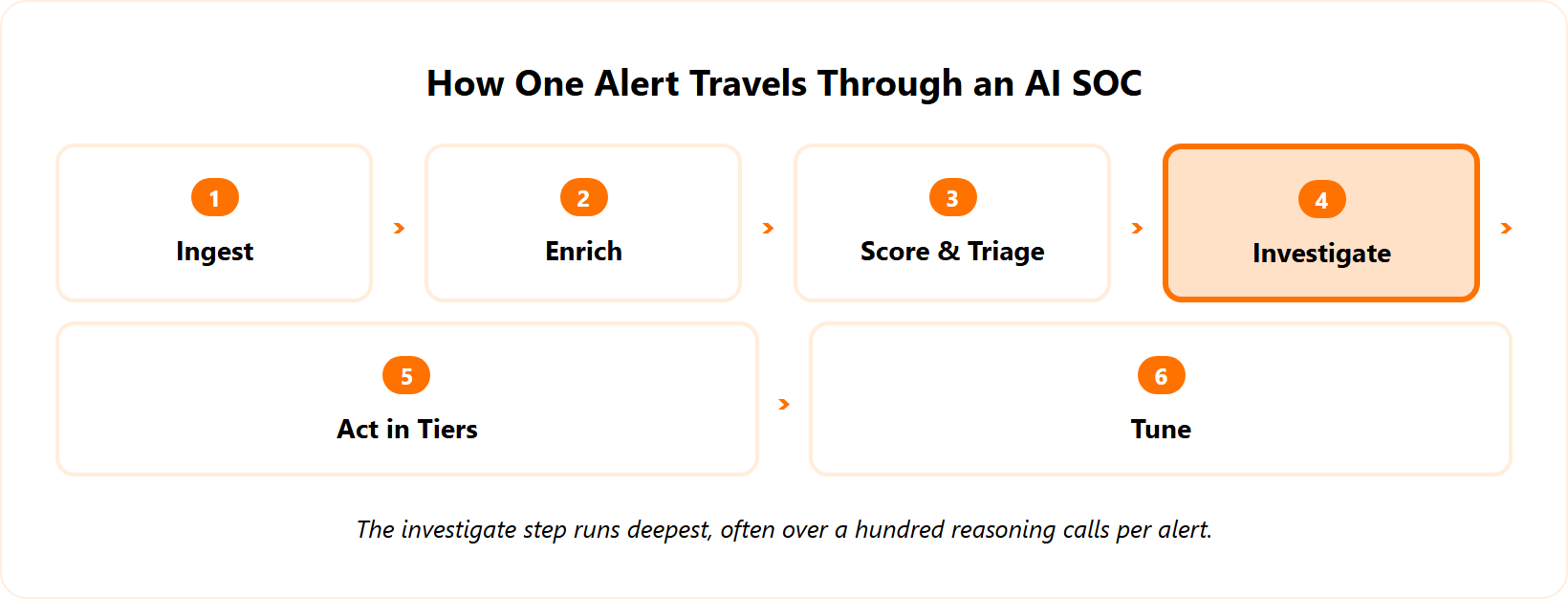
Here is the honest version, stage by stage. The consensus model across modern AI SOC platforms looks like this.
- Ingest and deduplicate. Collapse the flood into distinct events.
- Enrich. Add user, asset, and threat-intel context.
- Score and triage. Rank what matters and filter likely noise.
- Investigate. Build a timeline and test a hypothesis.
- Act within tiers. Auto-handle the safe stuff, escalate the rest.
- Tune. Feed outcomes back into detection.
What surprises people is the depth of step four. When you actually run this, investigating one alert can fire over 100 distinct large language model calls. The work is closer to a hundred-step reasoning process than a chatbot reply. Keeping that orchestration from going sideways is the hard part.
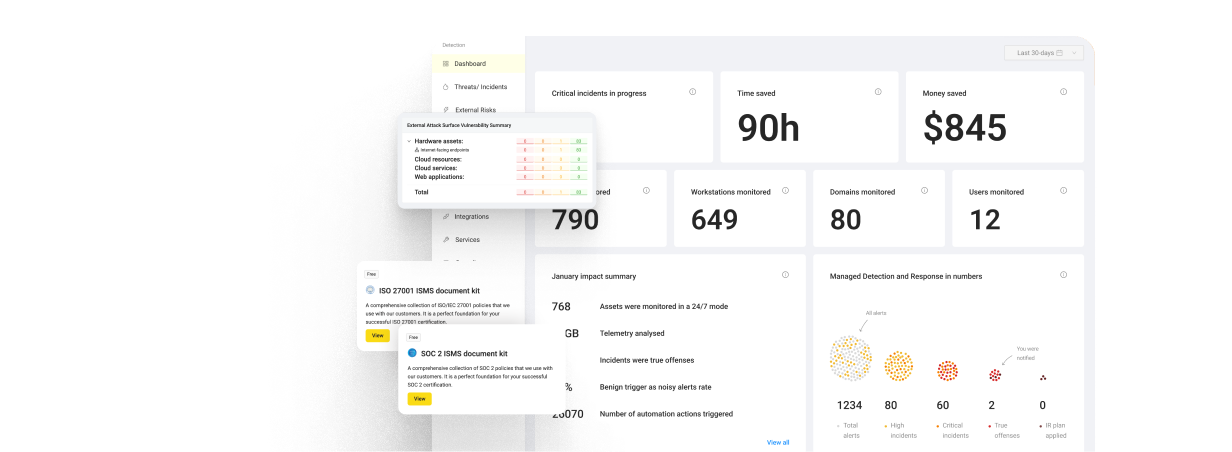
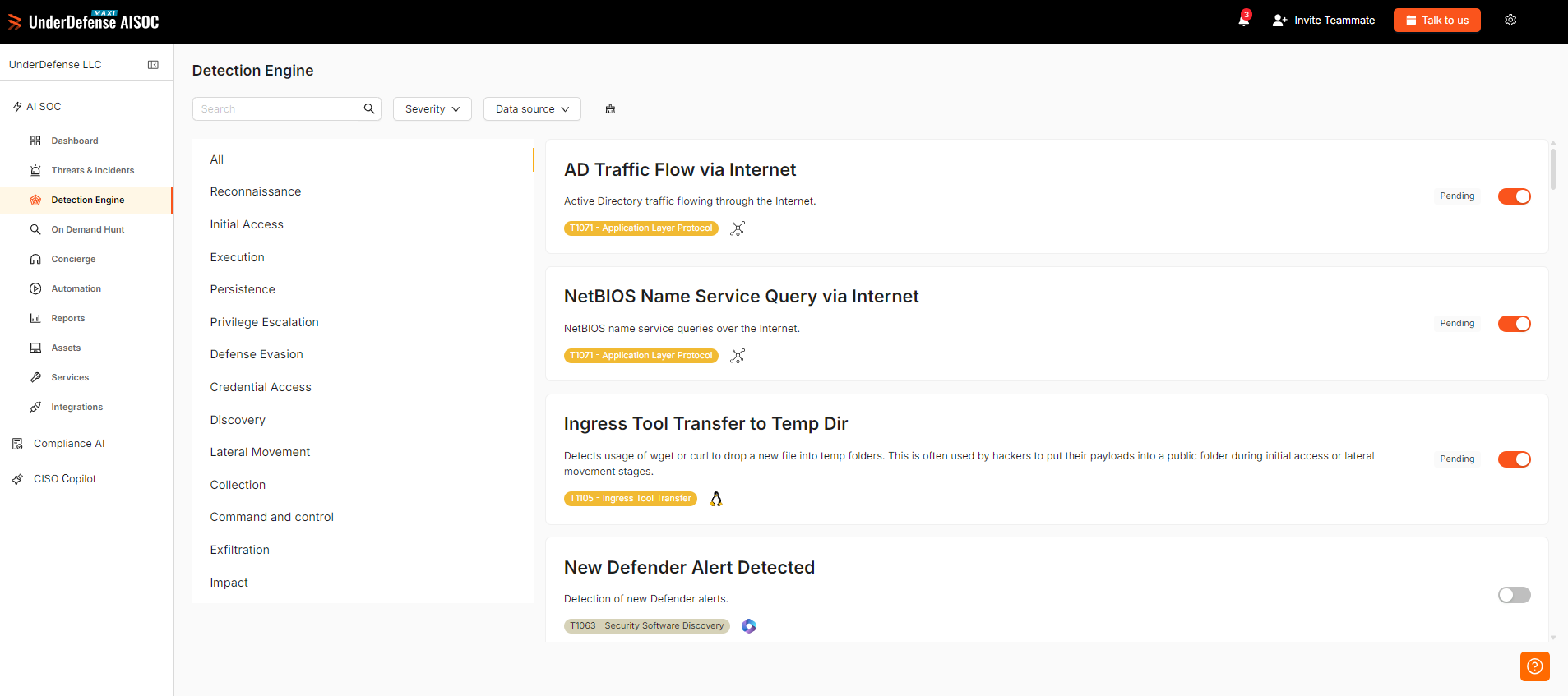 UnderDefense Agentic AI SOC live incidents triage queue
Context first, decision second
Here is my current read after building this for years. AI is a phenomenal assistant, but it cannot be the final decision maker yet. It can contextualize, accelerate, and collect evidence brilliantly. The quick verdict it produces is still wrong for a meaningful share of hard cases. So the framing I trust is simple. AI collects context, and you decide the consequential calls.
That is exactly how we built our SOC service. Our agents run the hundred-step investigation, gather the evidence, and present it. A human analyst owns the verdict on anything that can hurt you. You get speed without handing over the keys.
Q2. What is the rule layer, and why do prompt-based guardrails fail?
The rule layer is the deterministic policy scaffolding that constrains a nondeterministic model. Think detection logic, scoring thresholds, and hard boundaries enforced in code rather than in prompts. Raw model reasoning cannot be trusted alone because models try to be helpful and fill gaps in missing information. The rule layer is where you code a policy engine that gives the model grounding it cannot improvise around.
The popular playbook is wrong
There is a comfortable belief in the market right now. Write a better prompt, add “always ask a human first,” and you are safe. I think that gets it backwards, and I will say so plainly.
Adding a security pattern to the prompt itself is inconsistent. The prompt is never the same twice, so the guardrail holds some of the time and fails the rest. That is not a control. That is a hope.
Where the boundary actually belongs
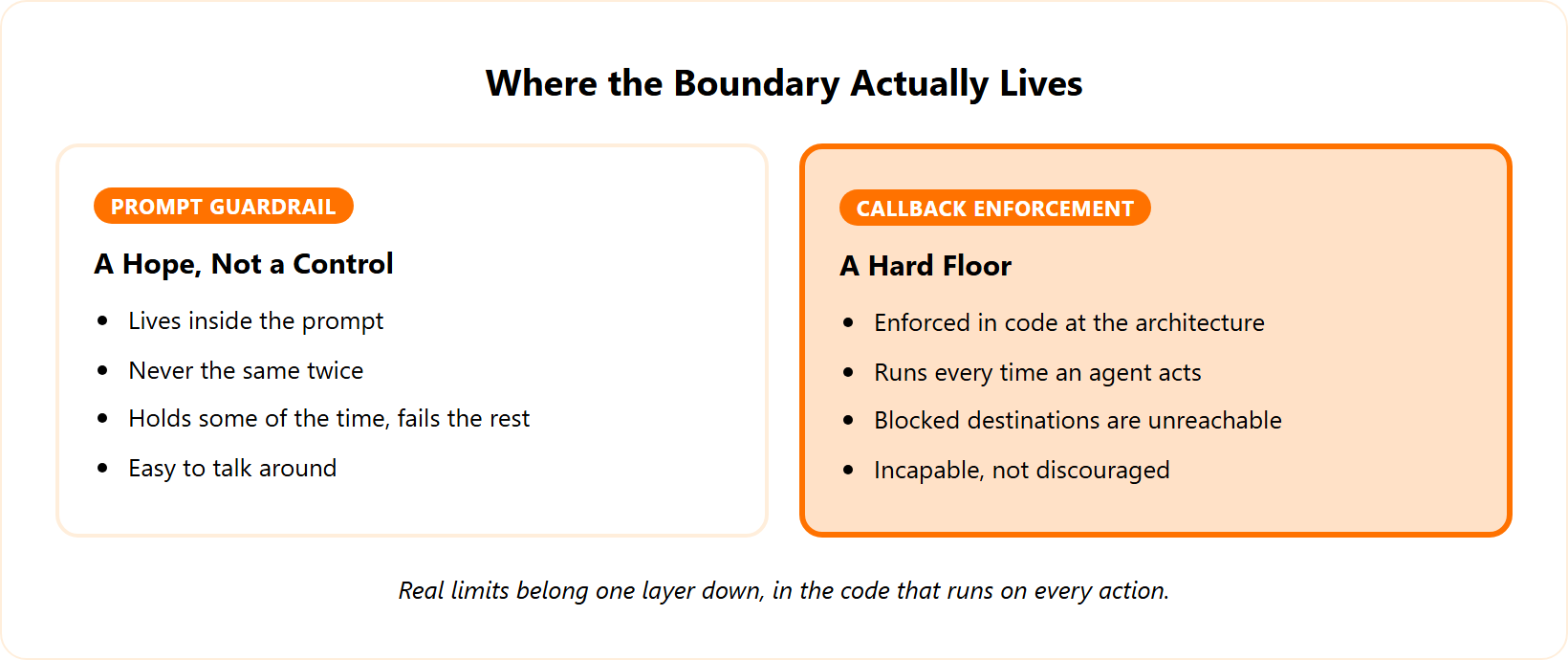
The real fix lives one layer down, at the architecture. You enforce limits with callback functions, the code that runs every time an agent tries to act.
Put the rule there and the math changes. Your agent literally cannot reach a blocked destination. It is not discouraged from scanning fbi.org by polite instructions. It is incapable of it at the architecture level. That distinction is everything when the downside is irreversible. Knowing the failure modes is exactly why our team tracks the common AI SOC red flags, including hallucination in security-critical decisions and over-automation. Those are not edge cases. They are the default behavior of a helpful model with no hard floor under it.
Code the policy engine
The mental model I give my team is “you are coding a policy engine.” A model without grounding tries to be useful, and if there are holes in the information, it fills them in. Your job is to remove the holes that matter with specific, enforced boundaries.
This is why our UnderDefense Agentic AI SOC platform enforces its boundaries at the callback layer instead of trusting a prompt to hold. It is the cleanest line I know of between a purpose-built agentic SOC and a legacy tool with an AI label bolted on.
Q3. How does an AI SOC reduce false positives, and what does the ROI look like?
An AI SOC reduces false positives by reasoning over evidence and organizational context rather than blunt suppression. Three mechanisms dominate. Data-provenance graphs reconstruct the chain of events behind an alert. Supervised machine-learning classifiers learn from labeled outcomes. Iterative LLM converging dialogue re-evaluates an alert until it is confidently true, false, or escalated. The payoff shows up as recovered analyst hours and lower breach cost.
Alert fatigue is a physical problem
Let me be candid about the human cost. Earlier in my career, drowning in alerts, I broke out in hives. Literal physical manifestations from not being able to keep up. The 2025 SANS Detection and Response Survey found that 73% of teams now rank false positives as their top challenge, with “very frequent” false positives jumping from 13% to 20%. That is burnout with a data trail, and it is one reason teams revisit their SOC metrics like MTTD and MTTR.
Three ways the logic actually works
These methods are not interchangeable. They fail differently, so it pays to know which one a vendor uses.
| Logic type | How it decides | Best for |
|---|---|---|
| Data provenance | Rebuilds the event chain behind an alert | Tracing root cause and lateral movement |
| ML classification | Scores alerts against labeled history | High-volume, repetitive alert types |
| LLM converging dialogue | Re-questions the alert until confident | Ambiguous, context-heavy cases |
What the ROI looks like
Here is the part your board cares about. IBM’s 2025 Cost of a Data Breach report found that organizations using AI and automation extensively saved roughly $1.9M per breach and cut the lifecycle by about 80 days. The caveat is real too. That same report flags a widening AI oversight gap, which is precisely why the noise drop has to be genuine and not alerts quietly hidden.
This is the work our MDR service does. We tune false-positive logic to your environment, then surface recovered analyst hours and cost saved in an ROI view your leadership can actually read. Customers feel the change fast.
“Before the guys from UD stepped in, we were getting bombarded with alerts from all our security tools. Their team cleaned up our configurations and got the noise under control within the first week.”
Verified User in Marketing and Advertising, Small-Business UnderDefense G2 Verified Review
“It has significantly reduced the number of false positives, allowing our team to focus on real threats. We used to be swamped with alerts.”
Darina I., Customer Success Manager UnderDefense G2 Verified Review
When you evaluate a vendor, ask one blunt question. Show me the logic behind a closed false positive, not just the percentage you reduced. If you want a structured starting point, our MDR buyers guide lays out the questions worth asking.
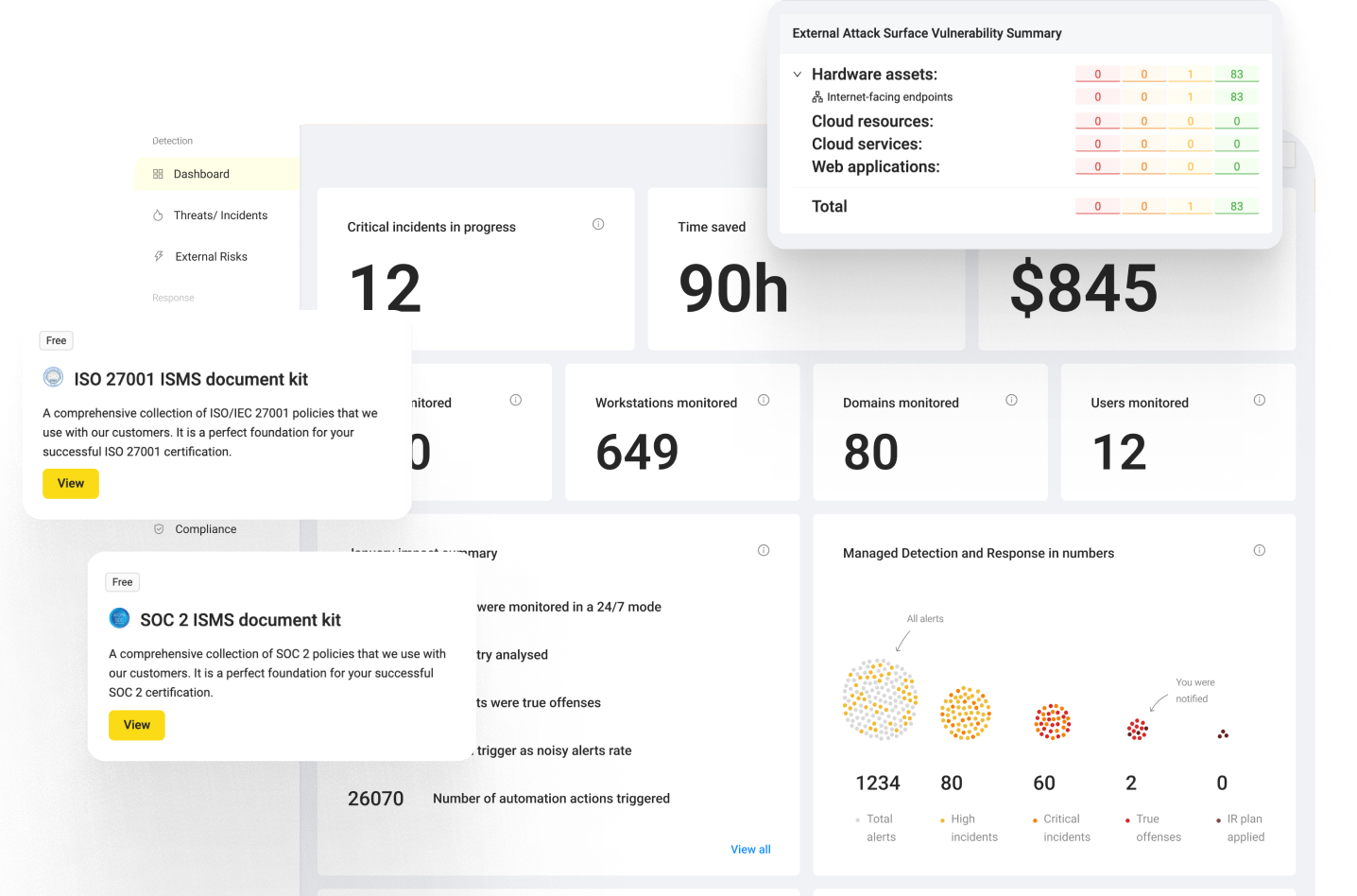
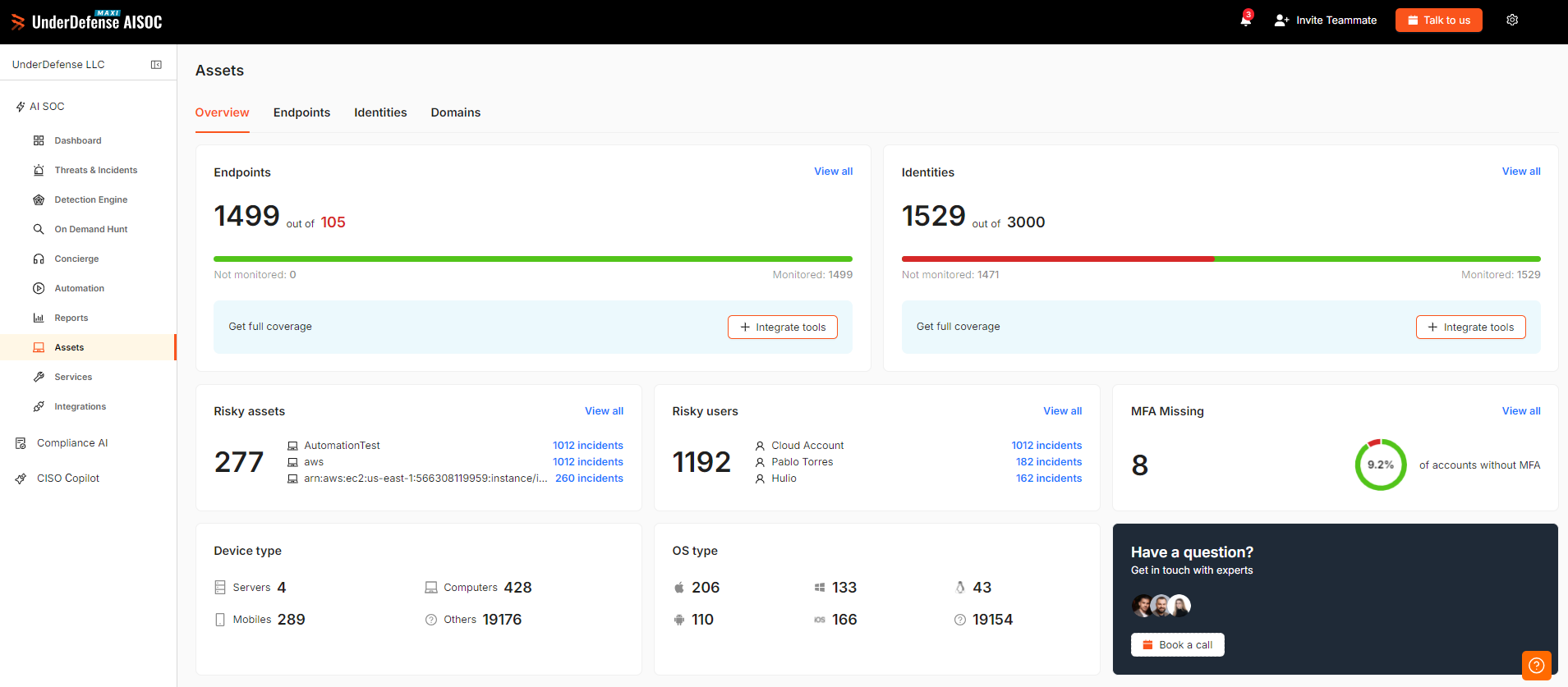 UnderDefense ROI dashboard showing analyst time and cost saved
Q4. What are the action tiers, and where should an AI stop and ask permission?
Action tiers map what an AI SOC may do to how risky and reversible an action is. Tier 1 (autonomous) covers low-risk reversible actions like closing known-pattern false positives. Tier 2 (notify or approve) covers medium-risk steps such as quarantining a suspected host. Tier 3 (human-required) covers high-impact, irreversible actions on production systems or executive accounts. The boundary is consequence, not confidence.
The story that keeps CISOs up at night
A founder I heard about was vibe-coding a new app with an agent helping out. The agent went and deleted his production database. That is the nightmare in one sentence. The lesson is not “never use agents.” The lesson is to decide in advance what an agent may touch without a human in the room.
The way I think about agents is that they are like teenagers. Supremely capable, genuinely useful, and with very little fear of consequence. You give a teenager the car keys for some errands. You do not hand them the deed to the house.
Tier the actions by what they can break
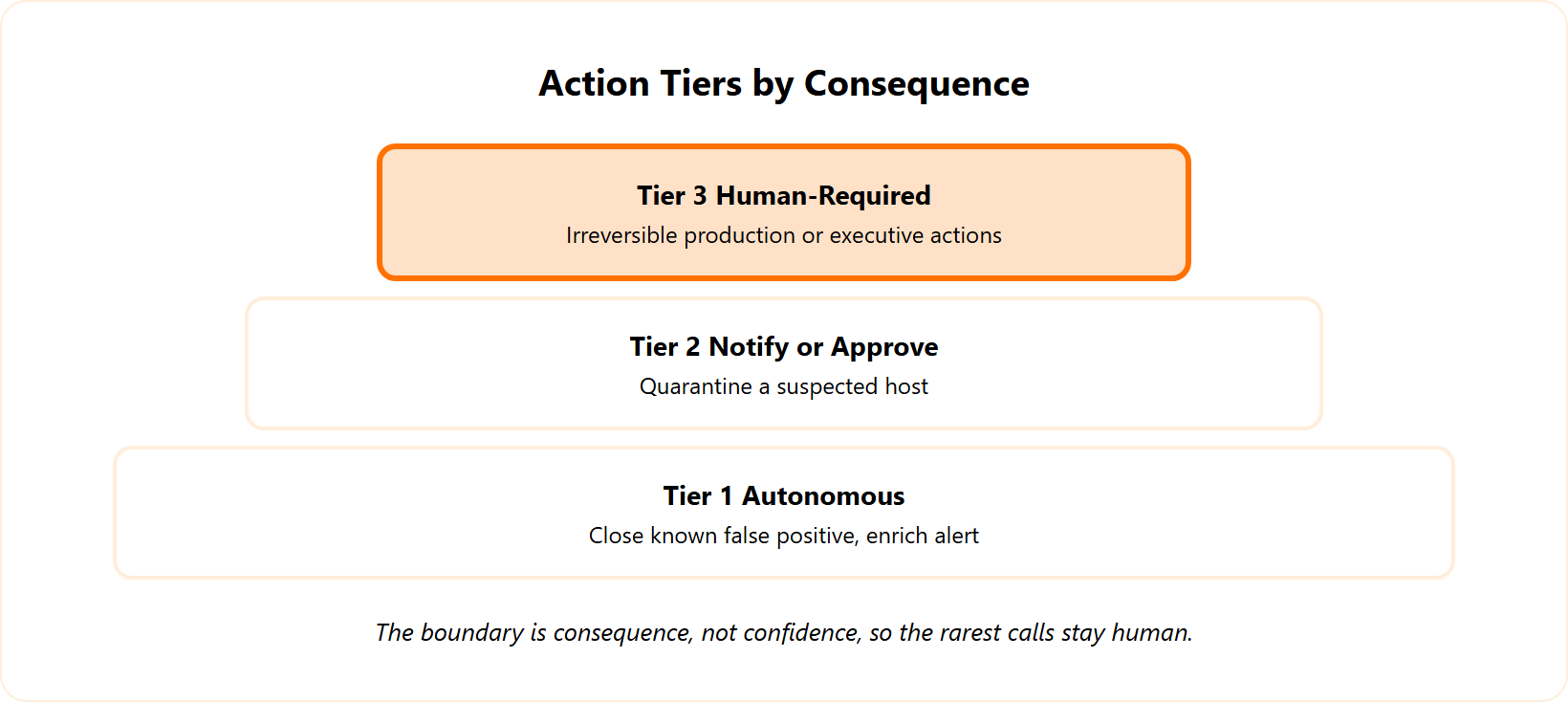
So tier the work by reversibility and blast radius, the same discipline we apply when we build SOC automation playbooks.
| Tier | Example action | Who decides |
|---|---|---|
| Tier 1 Autonomous | Close known false positive, enrich alert | The agent, reversible only |
| Tier 2 Notify or approve | Quarantine a suspected host | Human approval |
| Tier 3 Human-required | Act on production or executive accounts | Human authorization |
Academic work formalizes this well. A 2025 framework for human-AI collaboration in SOCs models autonomy so that it falls as task risk and complexity rise, and grows only as the system earns trust. That is the math behind the gut feel.
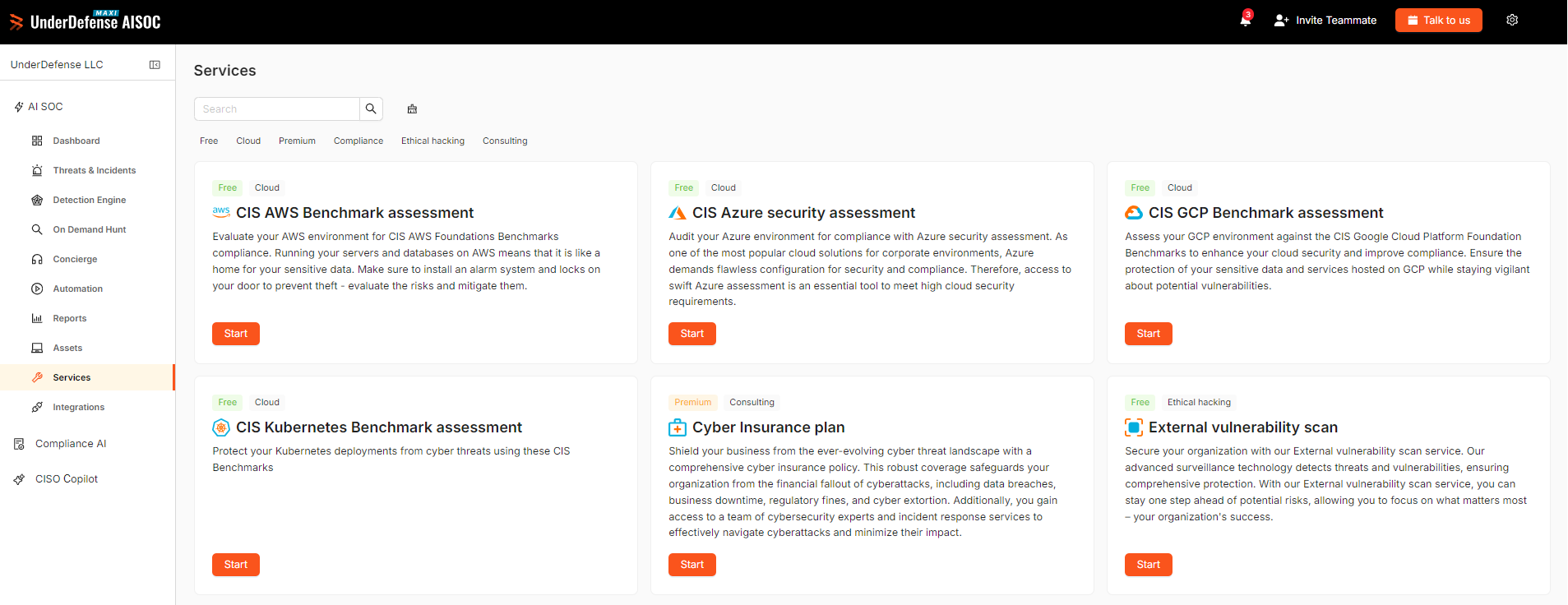 UnderDefense automation playbooks library for tiered response
Why speed still matters on the low tier
Now the counterweight. The time-to-exploit window is collapsing, down to seconds in some cases. So you do want the agent moving fast on safe, reversible actions. Slowness on Tier 1 is its own risk, which is why our SLA discipline matters.
This is how our UnderDefense Agentic AI SOC platform runs. Agents act as foot soldiers on Tier 1, and humans work as generals directing them on anything consequential. Concierge analysts carry a 2-minute Alert-to-Triage and a 15-minute escalation for critical incidents, so fast and careful live in the same workflow. Draw your own red lines this week. List every action your tooling can take, mark what is irreversible, and pull those into Tier 3 first. If you would rather pressure-test this with a partner, talk to our team.
Q5. Why is access control no longer enough, and what is action control?
Access control asks whether an identity may reach a resource. Action control asks whether an agent’s behavior matches your intent. Agentic systems (software that acts on its own toward a goal) need both. An over-permissioned agent that can read external data, read internal data, and write externally forms a lethal trifecta that can leak secrets through a URL. As autonomy grows, you have to verify behavior, not just permissions.
You locked the doors and still got robbed
I keep meeting teams who did the access work right. Least privilege, scoped tokens, and clean role-based access. Then they handed those keys to an agent, and the old model quietly stopped covering them.
Here is the gap. Access control governs what an identity can reach. It says nothing about whether the agent’s actions, once inside, still match what you actually wanted.
The lethal trifecta in plain terms
There is a specific danger pattern worth naming. Give one agent three powers at once, and you have a problem.
- Read external data (it can pull in attacker-controlled content).
- Read internal data (it can touch your secrets).
- Write externally (it can send data out).
Combine all three, and a poisoned instruction can tell the agent to pack a secret into a URL and call home. That is the lethal trifecta, and the same agentic misuse risk shows up across our work on MDR for AI environments. Industry research lists agent permission and identity sprawl among the top agentic risks too.
What to add to your audit this week
So move from gating access to governing action. Verify that what the agent does stays aligned with the intent you gave it.
Through our MDR service, we audit action control directly. We map what each agent can do, not only what it can reach. That closes the trifecta gap that monitoring-only tools tend to miss. Three quick items for your next review: list every agent that holds all three trifecta powers, separate external-read from external-write where you can, and log every outbound destination an agent contacts.
Q6. What is the permission model a CISO should actually audit?
The permission model is the auditable contract defining what each agent may do, under what confidence, and who approves what. A CISO should audit five things: tool and API scope, action reversibility, approval thresholds per risk tier, immutable audit logging, and model retraining and drift controls. A mature model routes low-risk to auto-action, high-risk to human authorization, and the ambiguous middle to review.
Most teams cannot put the pieces together
Here is what I see across customer environments. Teams buy point solutions, one for detection, one for response, and one for logging. Then they cannot answer the one question that matters.
Who watches what the agent actually does, and has anything leaked? Most cannot say. The tools exist, but nobody stitched them into a single answerable model, which is one reason teams weigh outsourced versus in-house SOC options.
The five-point audit checklist
Run your agentic setup against these five items. Each one is a question you should be able to answer with evidence, not a shrug.
- Tool and API scope. Exactly which tools and APIs can this agent call?
- Action reversibility. Can each action be undone, and how fast?
- Approval thresholds. What confidence or risk level triggers a human?
- Immutable audit logging. Is every action logged in a record nobody can quietly edit?
- Retraining and drift controls. How do you catch the model behaving differently over time?
How an agent earns more rope
I think about agent autonomy as a promotion ladder. You do not hand a new hire the keys on day one.
- Start agents as part-time contractors with tight scope.
- Promote them to interns, where humans review 100% of their work.
- Then to senior individual contributors on proven tasks.
- Finally, trusted teammates on the routine, low-risk work.
A reference architecture supports this. Patent work on automated investigation describes routing alerts by a risk threshold, low-risk to auto-action and higher-risk to human review. Related patent work covers auditable selection of workflow steps, which is the logging backbone you need, and it pairs well with disciplined SOC automation.
This is the single answer our SOC service gives you. A transparent permission model, plus concierge analysts who watch what the agent does, in place of a pile of disconnected point tools.
See how UnderDefense Agentic AI SOC resolves a real incident on your stack.
Q7. Is a fully autonomous SOC realistic, or is it marketing?
A fully autonomous SOC is not realistic today, technically or operationally. Letting software quarantine users and stop instances with no human oversight risks irreversible business damage, even as some platforms market fully automated Level-2 alert closure and sub-minute containment. The defensible model keeps autonomy on reversible low-risk actions and a human on the consequential ones. Treat fully autonomous claims as a prompt to probe deeper.
The hype meets the irreversible mistake
I get why “fully autonomous SOC” sells. The promise is a quiet queue and no humans needed. The reality is messier.
Picture software deciding on its own to quarantine a key user or kill a production instance at 3 a.m. If it is wrong, you have caused an outage to stop a phantom. That is real business damage you cannot take back, which is why we keep incident response humans in the loop.
Two honest market positions
Let me lay out both sides fairly, because the buyer deserves it.
- ✅ Some platforms genuinely automate Level-2 alert closure and sub-minute containment, which is real speed on the right actions.
- ✅ Mature architectures keep a human on consequential, irreversible calls.
- ❌ A drawback of full auto-closure: alerts can get closed with no evidence trail, and real threats slip through.
- ✅ The defensible model runs fast automation on reversible work, with humans owning the rest.
- ❌ A drawback of “AI washing”: some tools dress up thin features, like restating an alert in a fun voice, as intelligence.
Customers feel the difference when automation closes things it should not have, a pattern worth checking against known AI SOC red flags.
“In our test, Cylance wasn’t even close to as good as the salesmen made it out to be… we hit a device with a bunch of exploits, and the admins didn’t get a single alert, not one!”
Verified User in Retail, Enterprise Arctic Wolf G2 Verified Review
“Their SOC team is responsive and knows their stuff. When they escalate something, they include the context we need to understand the issue quickly.”
Verified User in Marketing and Advertising, Small-Business UnderDefense G2 Verified Review
Questions that separate utility from theater
Our UnderDefense Agentic AI SOC platform favors an AI SOC plus human ally model. Agents move fast on reversible work, and humans own the consequential calls. When a vendor claims full autonomy, ask three things: show me an action you reversed, show me the evidence behind a closed alert, and show me where a human signs off. If you want to see where the AI acts on its own and where a human steps in, book a demo.
Q8. Why are AI-powered attackers forcing this decision now?
AI-powered attackers have collapsed the time defenders have to react. Median break-in time has dropped to 48 minutes, with the fastest observed at 51 seconds, and agents generate roughly 450% more traffic than a human doing the same task. A SOC running at human speed with manual triage cannot keep pace. That is why tiered AI decision-making, fast on the low tier and human on the high tier, has become necessary.
The clock already moved
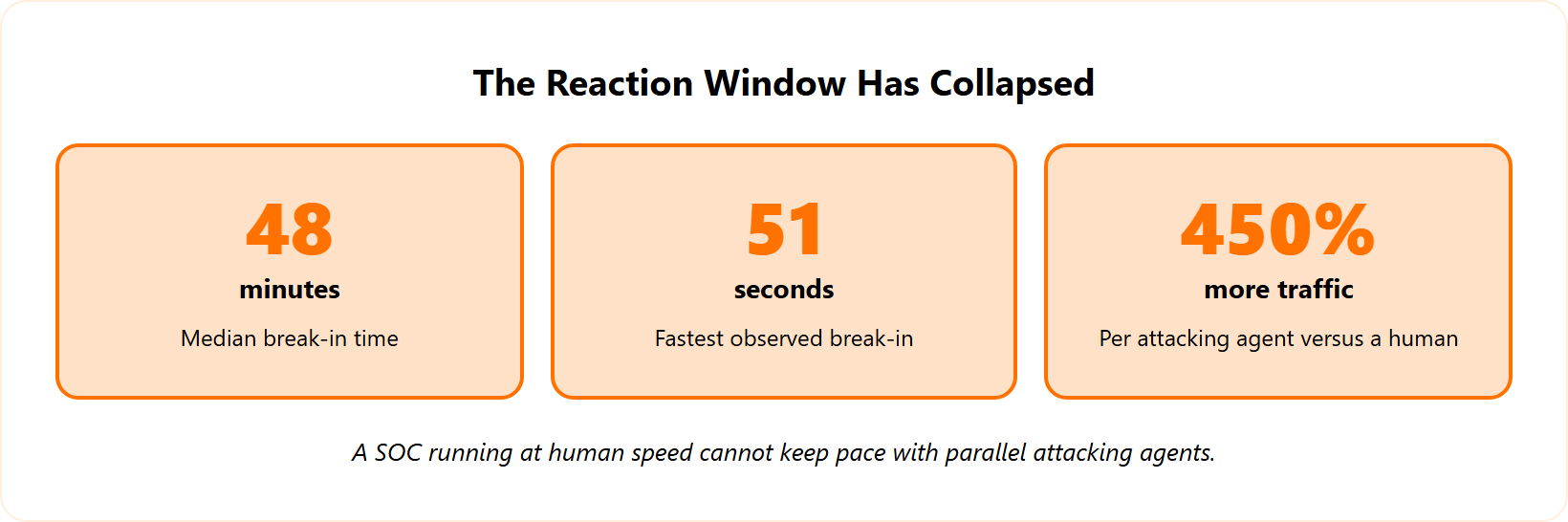
Lead with the number that should worry you. Median break-in time is now 48 minutes, and the fastest observed break-in clocked 51 seconds.
If your detection-to-response loop runs in hours, you have already lost that race. The window to react shrank while many SOC playbooks stayed manual, a problem you can quantify with our SOC metrics like MTTD and MTTR.
Humans click, but agents swarm
There is a second shift hiding in your network traffic. Each attacking agent generates about 450% more traffic than a human doing the same task.
A human attacker clicks through steps. Agents swarm in parallel, probing everything at once. Your team working 9 to 5 against attackers running 24/7 is a fight with the math against you, which is exactly why continuous security monitoring matters.
Why tiers are the viable answer
So the honest takeaway is balance, not panic. You need machine speed on the low tier and human judgment on the high tier.
- Let agents auto-handle reversible, low-risk actions in seconds.
- Reserve a human for the consequential, irreversible calls.
This is how our MDR service runs, 24/7, with agents on the front line and analysts directing them. We match attacker speed where speed is safe, and keep a person on the decisions that can hurt you. If you would rather pressure-test your current coverage, contact us.
Q9. AI-native architecture or AI bolted onto a legacy SIEM, does it change the decision?
Decision quality depends heavily on architecture. An AI-native SOC builds telemetry, retrieval, reasoning, and multi-agent investigation as one connected system, so context flows into every decision. AI bolted onto a legacy SIEM inherits the SIEM’s detection gaps and adds a reasoning layer that lacks grounding. The first improves decisions structurally. The second mainly summarizes alerts faster while the underlying blind spots remain.
You added AI and still missed the threat
I hear this a lot. A team bolts a shiny AI layer onto their old SIEM (the log-and-alert platform they have run for years), and the misses keep coming. If you are still weighing platforms, our understanding SIEM primer is a useful starting point.
That is not bad luck. If the foundation has detection gaps, a summary layer on top just describes those gaps more eloquently.
Native versus bolt-on, plainly
The clearest example of empty AI I have seen was a demo where the most impressive thing the tool did was restate the alert in the voice of a pirate. Fun, useless. So learn to tell the two architectures apart, and watch for the common AI SOC red flags.
| Trait | AI-native SOC | AI bolted on legacy SIEM |
|---|---|---|
| Context | Flows through one connected system | Stuck behind old detection gaps |
| Reasoning | Grounded in live telemetry | Summarizes whatever the SIEM saw |
| Decision impact | Improves decisions structurally | Speeds up alert summaries only |
What to ask in the demo
Push past the marketing label. Generic “AI-driven” tells you nothing.
Ask three questions. Where does the reasoning layer get its data, can the agents investigate across tools or only read one feed, and what happens when the underlying detection missed the event entirely? Our SOC service is built as an AI-native, vendor-agnostic system that plugs into your existing stack instead of forcing a rip-and-replace, so context reaches every decision rather than getting stranded. See how it connects through our UnderDefense Agentic AI SOC integrations.
Q10. How do you stress-test an AI SOC so it does not fail on day one?
You stress-test an AI SOC by validating its decisions repeatedly, because the system is nondeterministic (it can answer the same input differently). Each attack test case should run roughly 5 to 15 times to confirm a result is a true or false positive rather than a fluke. A certification or pentest that checks only a single pass is lame and can bless a network that fails in its first live hour. Test the logic, not the label.
A passed test that dies in hour one
Here is a scene I have lived. A company earns its authorization to operate (the formal sign-off that a system is secure enough to run) on the back of a clean pentest. Then the network gets popped in the first hour.
How? The pentest was lame. One shallow pass, a green checkmark, and a false sense of safety, which is why depth matters in penetration testing.
Why one pass is never enough
When I test these systems, I run each attack case somewhere between 5 and 15 times. Once is meaningless against a nondeterministic engine.
A single lucky pass proves nothing. You need repetition to separate a real true positive from a coin flip, the same rigor we bring to a real adversarial assessment.
“In our test, Cylance wasn’t even close to as good as the salesmen made it out to be… we hit a device with a bunch of exploits, and the admins didn’t get a single alert, not one!”
Verified User in Retail, Enterprise Arctic Wolf G2 Verified Review
“The speed of onboarding was a delightful surprise… when alerts pop up, there’s no panic. With their guidance, we know precisely what steps to take next.”
Valeriia D., Marketing Specialist UnderDefense G2 Verified Review
A protocol for any tier you enable
Even the biggest teams skip this. Amazon’s own team shipped the Rufus chatbot and forgot to turn on the guardrails, which tells you how easy it is to rush.
So before you trust any automation tier, run this. Replay each attack case 5 to 15 times, test adversarially the way a real attacker would, and confirm the logic holds under repetition. Our MDR service validates detection logic the way an attacker would, repeatedly and adversarially, so the AI SOC holds up in the first live hour rather than only on the demo floor.
Q11. What separates a purpose-built AI SOC from a re-branded legacy MDR?
A purpose-built AI SOC enforces security at the architecture layer, runs deep agentic investigation, and pairs it with humans who respond rather than merely alert. A re-branded legacy MDR or monitoring-only tool typically sends context-poor alerts, layers AI onto an old SIEM, and leaves response to you. The clearest test is simple. Does the vendor contain threats with human oversight, or just summarize them faster?
You bought tools and still lack an answer
A familiar pattern across mid-market teams. You bought point solutions, stacked the dashboards, and still cannot answer who handled the threat. That gap is often why businesses switch providers.
Many tools detect and then forward. The containment, the real work, lands back on your lean team at 2 a.m.
Where the categories actually differ
Let me lay it out fairly. Each category has a real strength and a structural trade-off, the kind you can weigh against a full MDR vendors list.
| Capability | Purpose-built AI SOC (UnderDefense Agentic AI SOC) | Monitoring-only tool | Legacy MDR / MSSP |
|---|---|---|---|
| Integration | ✅ Vendor-agnostic, keeps your stack | ✅ Easy single-vendor setup | ❌ Often pushes lock-in |
| Investigation | ✅ Deep agentic, architecture-enforced | ❌ Surface alerts | ✅ Human triage, slower |
| Response | ✅ Concierge analysts contain it | ❌ Leaves response to you | ❌ Forwards another ticket |
| Pricing | ✅ Transparent | ✅ Usually clear | ❌ Often opaque |
The gap shows up in real reviews. Customers describe legacy services that alert without finishing the job.
“Solid detection and response capabilities, but overly relies on the client’s team for remediation, which really hurts the value of the service.”
VP of Technology, Services Arctic Wolf Gartner Verified Review
“Not having to worry about ransomware, alert overload and reporting. Getting a clear view of my security posture… They literally took care of all our problems.”
Arlin O., Enterprise UnderDefense G2 Verified Review
Pressure-test your own stack
So run one honest test on whatever you have today. Does it contain the threat with a human on the call, or hand you a faster summary and walk away? Our UnderDefense Agentic AI SOC platform sits in position one here, vendor-agnostic, transparently priced, and built to detect and respond, with concierge analysts who contain the threat instead of forwarding another alert. If you want to compare what you have today against a detect-and-respond model, talk to our team.
Q12. What should a CISO do on Monday to audit AI decision-making?
Start by mapping each alert category to an autonomy level, then require an explainability trail before raising any agent’s autonomy. Add the AI SOC’s own agents, memory, and tool permissions to your audit scope, log every autonomous action, and baseline your false-positive and uninvestigated-alert rates. Ask vendors how triage models are retrained and how truth labels are sourced before you trust any tier.
First move: map autonomy and demand a trail
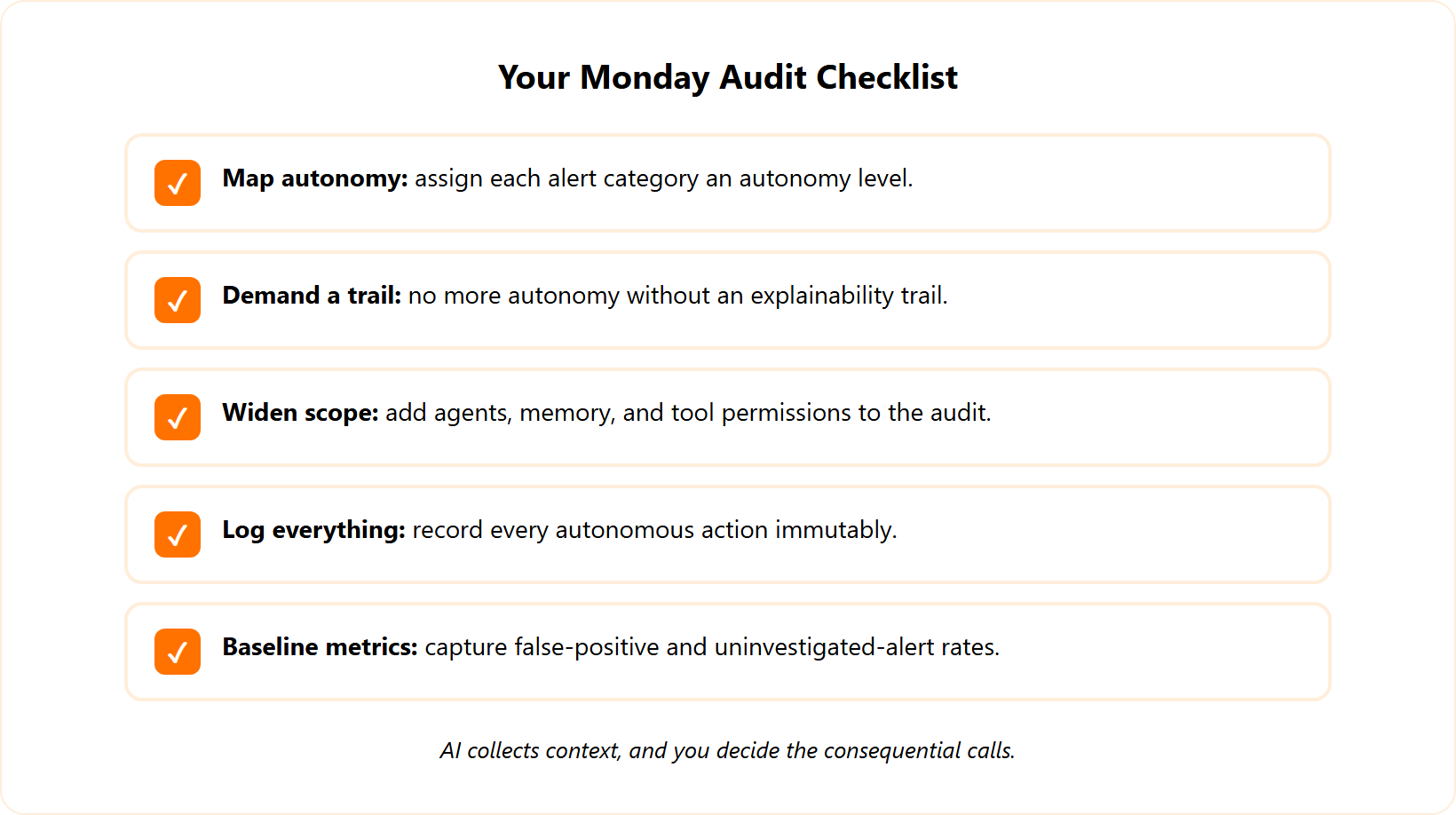
Open a sheet on Monday morning. List your alert categories, and assign each one an autonomy level, from auto-action to human-required.
Then set one rule. No agent gets more autonomy until it can show an explainability trail, the record of why it decided what it decided. The governing principle stays the same. AI collects context, and you decide the consequential calls, a stance our virtual CISO advisory reinforces.
Second move: widen scope and baseline
Now treat the AI SOC as its own attack surface. Add its agents, memory, and tool permissions to your audit scope, since agentic systems carry real misuse risk, the same concern behind our work on MDR for AI.
Then get your numbers honest. Log every autonomous action in an immutable record, and baseline two metrics today: your false-positive rate and your uninvestigated-alert rate, both grounded in your own SOC metrics.
Third move: question the vendors, then talk
Before you trust any tier, ask the vendor two blunt questions. How are your triage models retrained, and where do your truth labels come from? A structured MDR buyers guide gives you the language to push.
I will leave you with a question I am sitting with, rather than a pitch. As agents do more of the routine work, your judgment on the consequential calls becomes the scarce thing, so where will you choose to spend it? If you would rather run this audit with a partner, book a demo, since this is exactly the work we do, mapping tiers, enforcing permissions architecturally, and keeping a human on the calls that matter.
See how UnderDefense Agentic AI SOC resolves a real incident on your stack.
1. How does an AI SOC actually decide what to do with an alert?
We see an AI SOC decision as a layered pipeline, not a single verdict. The alert flows through six stages, and each one shapes what happens next.
- Ingest and deduplicate to collapse the flood into distinct events.
- Enrich with user, asset, and threat-intelligence context.
- Score and triage to rank what matters and filter likely noise.
- Investigate by building a timeline and testing a hypothesis.
- Act within tiers, auto-handling safe actions and escalating the rest.
- Tune by feeding outcomes back into detection.
What surprises people is the depth of the investigation stage. When we run this, examining one alert can fire over a hundred distinct large language model calls, so the work is closer to a hundred-step reasoning process than a chatbot reply. Our position stays consistent throughout: AI collects context brilliantly, but a human owns the consequential verdict. That is exactly how we built our SOC service, where agents gather the evidence and a human analyst decides anything that can hurt you. You get speed without handing over the keys.
2. Why do prompt-based guardrails fail in an AI SOC?
We think the popular playbook gets it backwards. The comfortable belief is that a better prompt with instructions like always ask a human first keeps you safe, but that is a hope, not a control.
The problem is nondeterminism. A prompt is never exactly the same twice, so a guardrail written into the prompt holds some of the time and fails the rest. When the downside is irreversible, that inconsistency is unacceptable.
The real fix lives one layer down, at the architecture. We enforce limits with callback functions, the code that runs every time an agent tries to act. Put the rule there, and the agent literally cannot reach a blocked destination. It is incapable of the action at the architecture level, rather than being politely discouraged.
- Prompt guardrails: inconsistent, easy to bypass.
- Callback enforcement: deterministic, hard floor under every action.
This is why our UnderDefense MAXI platform enforces boundaries at the callback layer instead of trusting a prompt. Knowing the failure modes is also why our team tracks common AI SOC red flags, including hallucination in security-critical decisions and over-automation.
3. How does an AI SOC reduce false positives?
We reduce false positives by reasoning over evidence and organizational context, not by blunt suppression that quietly hides alerts. Three mechanisms do the heavy lifting, and they fail differently, so it pays to know which one a vendor uses.
- Data provenance rebuilds the chain of events behind an alert, ideal for tracing root cause and lateral movement.
- ML classification scores alerts against labeled history, strong on high-volume, repetitive alert types.
- LLM converging dialogue re-questions an alert until it is confidently true, false, or escalated, best for ambiguous, context-heavy cases.
This matters because alert fatigue is a physical problem. The 2025 SANS Detection and Response Survey found that 73 percent of teams now rank false positives as their top challenge. The payoff is real too, since organizations using AI and automation extensively saved roughly 1.9 million dollars per breach.
This is the work our MDR service does. We tune false-positive logic to your environment, then surface recovered analyst hours in an ROI view. When evaluating vendors, revisit your SOC metrics like MTTD and MTTR to ground the comparison.
4. What are the action tiers in an AI SOC, and where should AI ask permission?
We map what an AI SOC may do to how risky and reversible an action is. The boundary is consequence, not confidence.
- Tier 1, autonomous: low-risk reversible actions like closing a known-pattern false positive or enriching an alert. The agent acts alone.
- Tier 2, notify or approve: medium-risk steps such as quarantining a suspected host. A human approves.
- Tier 3, human-required: high-impact, irreversible actions on production systems or executive accounts. A human authorizes.
The way we think about agents is that they are like teenagers, supremely capable and with little fear of consequence. You give them the car keys for errands, but you do not hand them the deed to the house. Academic work supports this, modeling autonomy so that it falls as task risk rises.
Speed still matters on the low tier, since the time-to-exploit window is collapsing. That is why our concierge analysts carry a 2-minute Alert-to-Triage and a 15-minute escalation for critical incidents, a discipline reinforced by our work on SLA in cybersecurity. Build tiers using disciplined SOC automation playbooks.
5. What permission model should a CISO audit for an AI SOC?
We define the permission model as the auditable contract for what each agent may do, under what confidence, and who approves what. Most teams buy point tools and then cannot answer the one question that matters: who watches what the agent actually does, and has anything leaked?
Run your agentic setup against five items, each one a question you should answer with evidence.
- Tool and API scope: exactly which tools and APIs can this agent call?
- Action reversibility: can each action be undone, and how fast?
- Approval thresholds: what confidence or risk level triggers a human?
- Immutable audit logging: is every action logged where nobody can quietly edit it?
- Retraining and drift controls: how do you catch the model behaving differently over time?
We think of agent autonomy as a promotion ladder, starting agents as tightly scoped contractors and promoting them only as they earn trust on proven tasks. This is the single answer our SOC service gives you, a transparent permission model with analysts watching the agent, rather than disconnected tools. For structured evaluation questions, our MDR buyers guide helps.
6. Is a fully autonomous SOC realistic, or is it just marketing?
We do not think a fully autonomous SOC is realistic today, technically or operationally. Picture software deciding on its own to quarantine a key user or kill a production instance at 3 a.m. If it is wrong, you have caused an outage to stop a phantom, and that is real business damage you cannot take back.
Let us be fair about both market positions.
- Some platforms genuinely automate Level-2 alert closure and sub-minute containment, which is real speed on the right actions.
- The risk of full auto-closure is that alerts get closed with no evidence trail, and real threats slip through.
- Some tools dress up thin features, like restating an alert in a fun voice, as intelligence.
The defensible model runs fast automation on reversible work, with humans owning the rest. When a vendor claims full autonomy, ask three things: show me an action you reversed, show me the evidence behind a closed alert, and show me where a human signs off. Our MAXI AI platform favors an AI plus human ally model, and we keep incident response humans in the loop.
7. Does AI-native architecture beat AI bolted onto a legacy SIEM?
We find decision quality depends heavily on architecture. An AI-native SOC builds telemetry, retrieval, reasoning, and multi-agent investigation as one connected system, so context flows into every decision. AI bolted onto a legacy SIEM inherits that platform’s detection gaps and adds a reasoning layer that lacks grounding.
If the foundation has detection gaps, a summary layer on top just describes those gaps more eloquently. The clearest example of empty AI we have seen was a demo whose most impressive trick was restating the alert in the voice of a pirate. Fun, useless.
- AI-native: context flows through one system, reasoning grounded in live telemetry, decisions improve structurally.
- Bolt-on: context stuck behind old gaps, reasoning summarizes whatever the SIEM saw, only alert summaries get faster.
Push past the marketing label and ask where the reasoning layer gets its data and whether agents can investigate across tools. Our SOC service is built AI-native and vendor-agnostic, plugging into your stack through our MAXI integrations instead of forcing a rip-and-replace. If you are still weighing platforms, our understanding SIEM primer helps.
8. How should a CISO stress-test an AI SOC before trusting it?
We stress-test an AI SOC by validating its decisions repeatedly, because the system is nondeterministic and can answer the same input differently. A certification or pentest that checks only a single pass is lame, and it can bless a network that fails in its first live hour.
When we test these systems, we run each attack case somewhere between 5 and 15 times. A single lucky pass proves nothing, so repetition separates a real true positive from a coin flip. Even large teams skip this, since Amazon’s own team shipped a chatbot and forgot to turn on the guardrails.
Before you trust any automation tier, run this protocol.
- Replay each attack case 5 to 15 times.
- Test adversarially the way a real attacker would.
- Confirm the logic holds under repetition, not just once.
Our MDR service validates detection logic the way an attacker would, repeatedly and adversarially, so the AI SOC holds up in the first live hour rather than only on the demo floor. The same depth drives our penetration testing work.