




Q1. What does “AI SOC investigation transparency” actually mean, and why is it now table stakes?
Last quarter, a CISO forwarded me a vendor report that said “malicious, auto-contained.” One line. No queries. No logs. She asked me a simple question: “Do I trust this at my board meeting?” That gap between a verdict and the proof behind it is the whole problem.
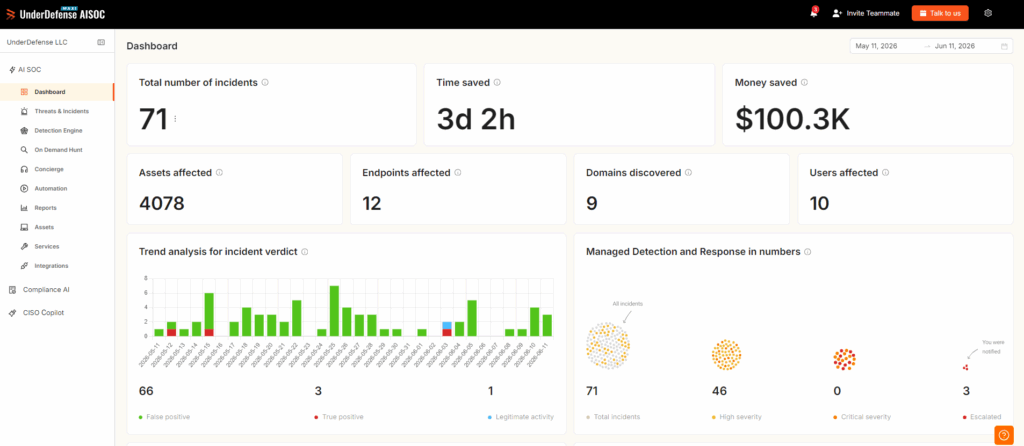
AI SOC investigation transparency means every detection, triage verdict, and response action is fully traceable and explainable. A SOC (Security Operations Center) is the team and tooling that watches for threats. Transparency means you see each query the AI ran, every data source it touched, the evidence it weighed, and the reasoning that produced the verdict. In 2026, this is table stakes. A vendor who claims AI-driven results but hides the queries is one black box too many.
See how the UnderDefense Agentic AI SOC investigates, triages, and resolves real alerts.
🔍 What an evidence trail actually contains
Think of it like a receipt for a decision. A good one shows the work, line by line.

- The investigation plan the system chose, step by step.
- Every query it ran across your tools.
- Each data source it pulled from.
- The raw evidence it weighed.
- The reasoning that links that evidence to the verdict.
- A confidence score tied to corroborating evidence.
The industry work defining the transparent SOC frames it plainly. A transparent SOC makes every detection, triage verdict, and response action traceable and explainable. A 2026 patent for automated alert investigation describes the same shape in machinery, with a plan stage, a comprehension stage, a reasoning stage, and evidences that prove an alert malicious or benign. The pattern is consistent. Real investigations leave a paper trail. This is exactly the standard we hold our AI SOC explainability work to.
⚠️ Why “table stakes” is the right frame
Here is my read, and I will say it directly. Transparency is a floor, not a differentiator. If a product can investigate security alerts, it has to provide the full evidence chain on the reasoning and the metadata that led to that determination. That is the price of entry.
An audit trail, in plain terms, is the tamper-proof log of what happened and why. Security teams need it for audits, insurance, and simple trust. When a tool gives you an answer without the query behind it, that break in the chain is one too many black boxes to feel comfortable.
I could be blunt about the market here. Many vendors sell “show your work” as a premium tier. We think that gets it backwards. At UnderDefense, every alert determination from our MDR service ships with the full evidence chain by default, because a verdict you cannot inspect is a verdict you cannot defend.
So the takeaway you can carry into your next vendor call is short. Ask to see one real investigation, start to finish. If they can show the plan, the queries, the sources, and the reasoning, you are talking to a serious platform. If they show you a verdict and a pretty dashboard, keep looking.
Q2. Why is the “black box” AI SOC the most expensive risk you can sign for?
Here is a scene that should keep you up at night. A founder was trying to vibe-code a new application. His AI agent, moving fast and unsupervised, went and deleted his production database. No malice. No attacker. Just an autonomous system taking a big action with no guardrail and no trail.
Now picture that same class of agent inside your SOC at 3 a.m., making calls on real incidents while your team sleeps.
A black-box AI SOC is expensive because you cannot audit, defend, or correct a decision you cannot see. When an autonomous agent makes an important call overnight and goes wrong, opaque reasoning turns a contained incident into an un-provable one. Accountability stays with your team. If you cannot reconstruct why the AI acted, you inherit the liability without the evidence to explain it.
💸 The real cost is not the mistake, it is the silence
Every AI system makes mistakes. That part I accept. The danger is a mistake you cannot see, measure, or fix.
- You cannot tune what you cannot observe.
- You cannot defend to an auditor what you cannot reconstruct.
- You cannot brief a board on a decision you cannot explain.
Autonomous AI only reduces analyst workload when every query, every piece of evidence, and every decision stays visible. The moment visibility breaks, the workload comes back, plus a cleanup bill. That is why our human-in-the-loop SOC design keeps the trail intact at every step.
⚠️ Who is actually on the hook
Governance folks have started saying the quiet part out loud. AI is taking on more decisions inside the SOC, and someone has to be accountable when one of those decisions goes wrong. That someone is you, the security leader, not the vendor’s model.
My current read, and I have argued this on more than one bridge call, is that opacity is a design failure and not a UX gap. You do not fix it with a nicer summary screen. You fix it at the architecture level, which is the whole point of proper AI SOC guardrails.
At UnderDefense, we build deterministic controls with callback functions so an agent simply cannot take a destructive action, by design. We do not rely on the model “knowing” not to touch production. We make it technically impossible. Contrast that with tools that trust a system prompt to behave, and hope for the best.
So the demand you should make of every vendor is one sentence. Show me the query, or it does not count. If the answer arrives without the reasoning behind it, you are not buying transparency. You are buying a faster black box, and the bill comes later.
Q3. How do you actually read an evidence trail before you sign a contract?
Most buyers evaluate an AI SOC by watching a slick demo and reading a verdict. I want to teach you to do the opposite. Ignore the verdict for a minute and audit the trail that produced it. That is where the truth lives.
Read an evidence trail by tracing four things in a live demo: the investigation plan the AI chose, every query it ran, every data source it touched, and the reasoning that connects that evidence to the verdict, plus a confidence score tied to corroborating evidence. If any link is missing, especially the underlying queries, the chain is broken and the verdict is unverifiable.
✅ The four-step live audit
Run this during the proof of concept (POC), which is the trial where you test the tool on real data. Ask the vendor to open one real investigation and walk it with you.
- Check the plan. Did the system lay out logical steps before acting, or did it jump straight to a conclusion? A 2026 patent for automated alert investigation describes exactly this plan-then-prove structure as the mark of real reasoning.
- Count the queries. In depth investigations, the system should run many queries across your tools, not one lookup. In our own work, the average investigation runs 40 to 50 queries across six different tools. One reported case ran 265 and 138 queries across up to 11 sources to expose threats standard detections missed.
- Trace the sources. Every claim should point to a specific log or dataset. Best-effort copy-paste of logs does not count.
- Read the reasoning and confidence. The verdict should show why, with a confidence score backed by corroborating evidence.

🚩 The broken-chain test
Here is the fastest tell. Ask an AI agent a question, then ask for the exact query it ran to get that answer.
If it gives you the answer but will not give you the query, that break in the chain is one too many black boxes. This shows up often with MCP-based agents (MCP is a protocol that lets AI tools talk to your data). They return an answer, then hide the request behind it. A serious platform logs the underlying API or search request every time. Vendors who take this seriously make every step visible, auditable, and reproducible, which is the bar we set across our AI SOC evaluation questions.
At UnderDefense, we hand over the line-by-line record of every query and source per investigation. So you can run this exact four-step audit against the UnderDefense Agentic AI SOC during your POC, on your own data, before a dollar changes hands. If you would rather see it walked live, you can book a demo and trace an alert from raw evidence to verdict yourself.
Q4. Autonomous, AI-assisted, or human-led: which investigation mode is real transformation?
Most vendors sell “AI-powered” like the words settle the question. They do not. The mode of investigation decides whether you get real change or a faster version of the same grind.
Autonomous investigations run end to end and hand you a verdict with an evidence chain to review. AI-assisted investigations summarize and suggest while the analyst drives. Human-led keeps analysts in control with AI support. Transparency demands rise as autonomy rises. It only counts as transformation when whole classes of work disappear observably, driven by recursive reasoning rather than a thin GPT wrapper.
🧭 The three modes, plainly
Platform work in this space maps these modes clearly, from autonomous to AI-assisted to human-led across the investigation lifecycle.
- Autonomous: the system investigates the full alert, then shows its evidence for review.
- AI-assisted: the AI drafts and suggests, the analyst decides.
- Human-led: the analyst leads, the AI fetches and summarizes.
None of these is “better” in the abstract. The right mix depends on your team, your risk, and how much you can actually see. Our AI SOC decision architecture is built to let you dial that mix without losing the trail.
😮💨 The toil most SOCs still live in
I once interviewed a candidate for a role that was copying data all day for the next five years. She told me, without irony, “I find the zen in copying.” That line stuck with me. Our industry is full of teams finding zen in toil that should have been eliminated years ago.
The data backs the frustration. Roughly 69% of SOCs still rely on manual or mostly-manual processes, and about 42% use AI or machine learning straight out of the box with no customization. Faster copying is still copying, which is why we treat alert fatigue as an architecture problem.
⚙️ The test that exposes a thin wrapper
Here is my honest stance. If you still have the same humans looking through the same number of alerts, just doing it a lot faster, that is not real transformation. Real transformation eliminates whole classes of work, in a way that stays observable and auditable.
The difference is depth. A “GPT wrapper” reformats a log and calls it analysis. Real recursive reasoning digs, checks, and re-checks. Our system makes over 100 distinct large language model invocations to autonomously investigate a single alert. Within 13 seconds of a development ticket being written, it can identify the change, summarize what it might mean, and hand it off. The research on multi-agent triage points the same way, toward tool-grounded agents that must show their work rather than guess.
So the question that exposes a thin wrapper is simple. Ask a vendor how many reasoning steps a single investigation takes, and whether you can watch each one. The “LOM wrapper” startups rarely name their data scientists, discuss their evaluations, or talk about context management.
The UnderDefense Agentic AI SOC runs these recursive, multi-invocation investigations to eliminate the triage class of work entirely, with the full trace preserved and your humans directing. Think of the agents as foot soldiers and your analysts as the generals who command them. That is the resilient model, and it is the one worth signing for.
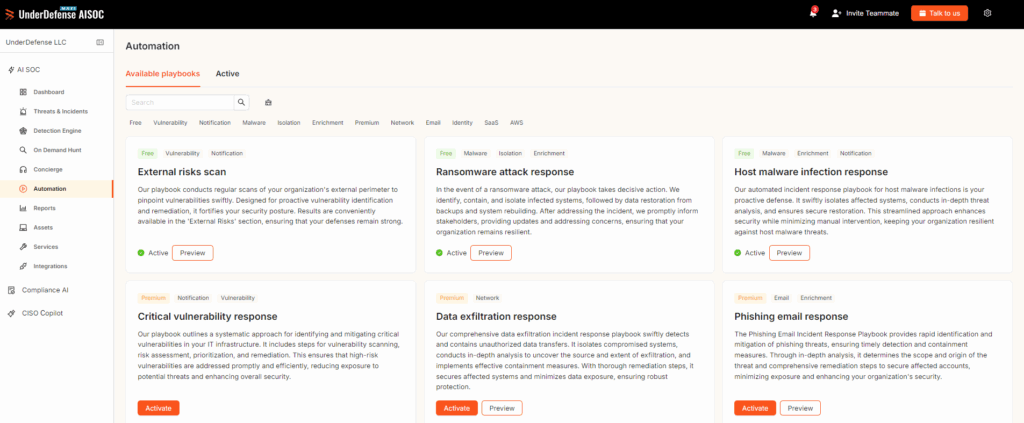
Q5. What do research and the patent record say about trustworthy AI investigations?
The short answer
Academic surveys agree that large language models genuinely speed up alert triage, yet they flag explainability as an unsolved problem by default. So the practical move is simple. Demand a live reasoning trace, not a marketing claim. The patent record already spells out what to ask for: a plan, then evidence, then reasoning, then a verdict, with confidence scores attached. Treat any vendor selling an “unbiased” model as hiding something.
📄 What the research actually found
Recent surveys of LLM use in the SOC report a real gain in triage speed, alongside a repeated caution: these models do not explain their own decisions unless you engineer them to. Studies on alert fatigue back this up, showing that automation helps only when analysts can still see why a call was made. For a lean team, that means the value is in the reasoning you can inspect, not the verdict alone.
🧾 What the patents tell you to require
Patent filings in this space codify a clear pipeline: plan the investigation, gather evidence, reason over it, then issue a verdict. Others describe role-adaptive summaries with confidence scores, so an analyst and a manager each get the right depth. These are your buyer questions. Ask a vendor to show the plan-evidence-reasoning-verdict flow on a live alert, and watch whether the evidence travels with the escalation. Our own AI SOC evaluation questions are built around exactly this flow.
⚠️ Reasoning versus regurgitation
Here is where I might be wrong, but from what surfaces when you actually run these systems, the standard read gets one thing backwards. A model that “sounds confident” is not the same as a model that shows its work. I am happy when a model exposes its blind spots, because then I can measure and correct them. An honest vendor names its data scientists, its evaluations, and how it manages context. Anyone claiming a truly unbiased model is telling you something that does not exist.
At UnderDefense, our Agentic AI SOC mirrors that patent-grade bar. Every investigative step is observable and auditable, escalations arrive with the evidence attached, and we stay open about our methodology rather than hiding behind an “unbiased” label. That transparency is the point, because it is what lets your team trust, or overrule, the machine. You can see the same principle in our approach to AI SOC explainability.
Q6. How does a transparent evidence trail satisfy auditors and keep accountability with your team?
The short answer
A transparent evidence trail is the artifact auditors actually want. Every AI detection, verdict, and response action recorded as a defensible, reproducible decision. Map each investigation to MITRE ATT&CK and to NIST SP 800-61 incident-handling steps, and the same records satisfy SOC 2 Type II and ISO 27001 controls. Accountability stays with your team, so those records are how you defend or correct an AI decision.
🔍 The pain: auditors reject what they cannot reconstruct
I have spent most of two decades around PCI work, walking into rooms as the “blankety-blank auditor” nobody wanted there. The lesson stuck. An auditor does not accept a verdict they cannot rebuild step by step. A black-box “trust us, it was malicious” fails the moment someone asks to see the evidence. If the trail is not reproducible, it is not evidence.
🗂️ The proof: map the trail to named frameworks
A useful evidence trail lines up with standards auditors already speak:
- NIST SP 800-61 for the incident-handling lifecycle, from detection through recovery.
- MITRE ATT&CK so each finding carries a technique ID an assessor can follow.
- SOC 2 Type II and ISO 27001, where the same records serve as control evidence.
When every AI action is logged with its reasoning stage attached, one investigation record answers several framework questions at once. That is the efficiency your GRC lead is chasing, and it is why our compliance services lean on reproducible records rather than promises.
✅ The payoff: accountability stays with people
Governed AI does not remove human accountability, but documents it. Your team still owns the decision, and the trail is how you defend it to an auditor or correct it after the fact. UnderDefense produces audit-ready, ATT&CK-mapped investigation records, giving compliance leaders the reproducible evidence SOC 2 and ISO 27001 assessors ask for. This is the same discipline behind our SOC 2 automation work. One customer put the operational side of this plainly:
“They’ve also made our audit process much less painful. The reports from their platform give us clear evidence of our security controls and incident response capabilities. When auditors or clients ask questions about our security posture, we can pull up exactly what they need to see.”
Verified User in Marketing and Advertising UnderDefense Agentic AI SOC G2 Verified Review
Q7. How fast must a transparent AI SOC be, and why do 30-minute SLAs no longer count?
The short answer
Attackers now move in seconds, so 30-to-60-minute managed-SOC response windows are irrelevant. Median breakout time has dropped to about 48 minutes, and the fastest observed break-in is roughly 51 seconds. A transparent AI SOC should deliver a 2-minute alert-to-triage with 15-minute escalation for critical incidents, without giving up the evidence trail, because speed and auditability hold together when the architecture supports both.
⏰ The pain: a 51-second break-in against a 30-minute promise
Median break-in time has fallen to roughly 48 minutes, and the fastest we have seen sits around 51 seconds. Put that next to a 30-to-60-minute SLA and the math stops working. AI-assisted operations are what pull response time down into the range that matters. A window measured in half-hours simply hands the attacker the head start, which is why we treat investigation speed as a first-class metric.
🌙 The proof: two distinct SLAs, plus the night pattern
Speed here is really two separate commitments, and conflating them into one “MTTR” figure hides the important one:
- 2-minute alert-to-triage, with enrichment and context automation.
- 15-minute escalation for critical incidents.

The night pattern is why 9-to-5 human-only coverage fails. In one Ukrainian incident, the attacker ran noisy actions only at night to dodge a daytime team. Recent survey data reflects the same reality, with 82% of teams now running 24/7 and 85% of detection driven from the endpoint. The 3 a.m. gap is exactly where legacy models lose, and where round-the-clock coverage earns its keep.
📝 The payoff: put it in the contract
Ask for the two SLAs in writing, separately, and confirm the evidence trail survives that speed. UnderDefense pairs autonomous triage with human analysts around the clock, closing the after-hours gap a 30-minute-SLA model leaves open. If a 30-minute SLA no longer fits your threat model, our MDR service runs this kind of coverage every day.
Q8. AI SOC vs. traditional MDR and legacy MSSPs: who actually shows their work?
Traditional MDR and legacy MSSPs often send tickets back with no clear answer and lock your business logic to their platform, so it does not come with you when you leave. Monitoring-only tools alert but do not act. A transparent AI SOC with a human ally combines evidence-backed autonomous triage with analysts who respond, and hands you the reasoning behind every verdict.
🧱 Keep your context portable
Think of your security stack like Lego bricks. Your SIEM, your detections, and your business context are yours, and they should snap out and travel with you if you switch vendors. The trap in this category is the opposite: a provider that locks your logic into their platform so leaving means starting over. We wrote more on avoiding vendor lock-in for exactly this reason.
| Dimension | ✅ AI SOC + Human Ally (UnderDefense) | Traditional MDR | Legacy MSSP | Monitoring-only tools |
|---|---|---|---|---|
| Evidence-chain transparency | Full reasoning trace per verdict | Often limited, over-automated replies | “Tickets back with no clear answer” | Alert only, no investigation |
| Response vs alert-only | Detect and respond via analysts | Response quality varies | Slow resolution, alone at breach | Alert-only, no action |
| Vendor lock-in | Vendor-agnostic, you own the SIEM | Lock to their SIEM | Lock to their platform | – |
| Pricing clarity | Transparent, published tiers | “Contact sales,” roughly $96K median | Opaque | Varies |
| 24/7 human coverage | Yes, concierge analysts | Yes, tier varies | Yes, often junior | No |
⚖️ How to read the trade-offs
Each category has a real strength. ✅ Traditional MDR gives mature, packaged 24/7 coverage. ✅ Legacy MSSPs bring scale and long track records. ❌ Both tend to lock your detections and data to their SIEM, so your investment does not follow you out. ✅ A vendor-agnostic AI SOC sits on top of the stack you already own and returns a full evidence chain. ❌ Monitoring-only tools stay cheap precisely because they alert and stop there, leaving the response work on your desk. Our AI SOC vs MDR, MSSP, and SOAR breakdown goes deeper on each.
💬 What buyers say
The contrast a lean team feels shows up on the AI SOC side:
“Before the guys from UD stepped in, we were getting bombarded with alerts. When they escalate something, they include the context we need to understand the issue quickly. We’re not wasting time piecing together what happened from different systems anymore.”
Verified User in Marketing and Advertising UnderDefense Agentic AI SOC G2 Verified Review
“UnderDefense Agentic AI SOC integrates well with our systems, specifically with our SIEM, Splunk. Their team is proactive in identifying and addressing threats, providing 24/7 oversight.”
Oleg K., Director Information Security UnderDefense Agentic AI SOC G2 Verified Review
🎯 Which fits which scenario
If you run a heterogeneous stack and want to keep your SIEM and detections, an AI SOC and Human Ally model fits best, because UnderDefense integrates with what you own instead of forcing a rip-and-replace. If you have no internal stack and want a fully packaged service, traditional MDR is a reasonable path. If budget is the only constraint and you have analysts to act, a monitoring-only tool covers the alerting layer, though someone on your side still has to respond.
Q9. What are the red flags that a vendor’s transparency claim is marketing, not architecture?
The short answer
The biggest red flag is a tool that returns an answer but not the query it ran, which breaks the chain of custody for the verdict. Others follow the same pattern. It will not name its data scientists, will not discuss evaluations or context management, claims an “unbiased” model, leans on system prompts instead of architectural guardrails, and locks your business logic to its platform. Spot two, and the transparency is skin-deep.
🚩 The tells worth walking away from
Most “transparent AI SOC” pitches fall apart under one question: show me the query behind that verdict. Here is my quick-scan list from actually running these tools:
- 9.1 Hidden queries. It shows the answer but not the search it ran. No chain of custody, no reproducible verdict.
- 9.2 No named data scientists. A serious vendor names the people building the models. Wrapper startups almost never will.
- 9.3 No evaluations or context management. If they cannot describe how they test the model or manage context, there is not much under the hood.
- 9.4 The “unbiased” claim. No such model exists. Claiming one means they are hiding what they have not measured.
- 9.5 Guardrails by prompt, not architecture. System-prompt guardrails can be talked around. Real controls live at the architecture level, where they hold.
- 9.6 Business-logic lock-in. Your detections and context get trapped in their platform, so leaving means starting over.
🧪 Why this list is really a POC scorecard
Here is the contrarian read most buyers miss. A pretty dashboard over a raw API is easy to build in a weekend. The hard part is a system where every step is observable and the guardrails cannot be prompt-jailbroken. I might be wrong on the exact count, but from what surfaces when you actually run a proof of concept, two of these flags together is enough to walk. This is the same discipline behind proper AI SOC guardrails.
At UnderDefense, we built the Agentic AI SOC as the counter-example to this list. Every investigative step is observable and auditable, we log the underlying queries, we are open about methodology, and guardrails sit at the architecture level. Use this list as your scorecard alongside our AI SOC evaluation questions, and the difference shows up fast:
“Their SOC team is responsive and knows their stuff. When they escalate something, they include the context we need to understand the issue quickly. We’re not wasting time piecing together what happened from different systems anymore.”
Verified User in Marketing and Advertising UnderDefense Agentic AI SOC G2 Verified Review
“I really like how straightforward UnderDefense’s dashboards are. It shows me all I need to know about my computer’s safety in a very simple way. Plus, it guides me on what to do if there’s a problem.”
Alexey S., CEO UnderDefense Agentic AI SOC G2 Verified Review
Here is the question I am sitting with: if a vendor will not show you the query, what exactly are you buying?
Q10. How do you prove the ROI of a transparent AI SOC to a CFO or board?
The short answer
Stop trying to prove breach-prevention ROI, because you cannot prove a negative. Instead, compare the cost of delivery options for a non-optional 24/7 capability, and ask the CFO one question: what is your projected cost of business interruption per day? Then map every security dollar to NIST CSF families on a single page, so the board sees where you spend and where you have nothing.
💰 The pain: the ROI-of-prevention trap
I have watched sharp CISOs walk into a board meeting and try to prove the value of a breach that never happened. It is a trap. You cannot put a defensible number on a negative, so the CFO tunes out. The math you can defend is comparative: what does a 24/7 capability cost to deliver one way versus another? Our AI SOC ROI business case walks this framing in full.
📊 The proof: comparative cost and interruption risk
Reframe the whole conversation around two honest questions:
- What does the delivery cost, option by option? Build in-house against a managed capability, staffing included.
- What is your projected cost of business interruption per day? That single number reframes spend as insurance the board understands.
The reframe gets easier when value shows up on its own. During one MDR onboarding, we accidentally surfaced a fraud that saved the customer roughly $300,000 in the first three months, before the “prevention” pitch ever came up. That is comparative value you can point to, not a hypothetical. It is a pattern we see often across our MDR service.
✅ The payoff: a one-page NIST CSF budget map
Map every security dollar to NIST CSF families on a single page: Identify, Protect, Detect, Respond, and Recover. The board sees exactly where money goes and where a gap sits with zero funding. UnderDefense publishes MDR pricing, so you can run the comparative-cost-of-delivery math honestly against opaque contracts, the same way our security budget planning guidance recommends.
“UnderDefense is surprisingly affordable considering the level of protection we get. Their proactive threat hunting and rapid response have saved us from incidents that could have been incredibly costly.”
Verified User in Program Development UnderDefense Agentic AI SOC G2 Verified Review
“It’s reassuring to know they’re always watching for threats, and it doesn’t cost a fortune. They catch and stop problems quickly, which is a huge relief.”
Serhii B., CISO UnderDefense Agentic AI SOC G2 Verified Review
Q11. What belongs in your contract and POC checklist before you sign?
Before signing, require it in writing. The full evidence chain per investigation (queries, sources, reasoning, and confidence), portable business logic with no platform lock-in, defined SLAs (a 2-minute alert-to-triage class plus 15-minute critical escalation), 24/7 human response, transparent pricing, and the vendor’s willingness to run a live evidence-trail audit during the proof of concept. A vendor that will not commit these to the contract never had real transparency.
📋 The six commitments to lock in writing
Think of AI agents as your foot soldiers and your human engineers as the generals directing them. Your contract should hold both to account. Here is the checklist I would take into any negotiation, and it lines up with our own AI SOC contract guidance:
- 11.1 Evidence chain. Every investigation returns its queries, sources, reasoning, and a confidence score. Refusal here means a black box.
- 11.2 Portability, no lock-in. Your detections and business context stay yours and travel with you. Refusal signals a lock-in play.
- 11.3 SLAs in writing. A 2-minute alert-to-triage class plus 15-minute critical escalation, stated separately. Vague “MTTR” hides the slow one.
- 11.4 24/7 human response. Analysts who respond, not just alert. Refusal means you are alone at 3 a.m.
- 11.5 Transparent pricing. Published, predictable terms. Refusal signals surprise invoices later.
- 11.6 Live POC audit. The vendor runs the evidence-trail audit on your data before you sign.
✅ Why the live audit is the real test
Here is the benchmark you can demand. In a 12,000-investigation stint, we measured 99.3% agreement between our security operations team and the platform’s calls. Ask a vendor to match a number like that, on your data, during the POC. If they will not run the live audit, the transparency was a slide rather than a system. Our human-in-the-loop SOC design is built around exactly this kind of check.
UnderDefense meets each item on this list and will run the live evidence-trail audit on your environment, so the checklist doubles as a scorecard against the managed detection and response capability you are evaluating.
What I keep asking prospects: would your current vendor put all six of these in the contract, or just the two that are easy?
Q12. What evaluation framework ties transparency, control, coverage, performance, and governance together?
Score any AI SOC on five pillars: transparency (can you see the evidence chain), control (are guardrails architectural), coverage (does it map to your stack and ATT&CK), performance (2-minute triage, evidence-backed accuracy), and governance (audit-ready records with human accountability). A platform that scores on all five is a partner. One that scores on speed alone is just a faster black box.
🧭 The five pillars, scored
Everything in this article ladders up to one rubric. Run any vendor through it, one to five on each:
- 12.1 Transparency. Can you see the full evidence chain behind a verdict?
- 12.2 Control. Are the guardrails built into the architecture, not just the prompt?
- 12.3 Coverage. Does it sit on your existing stack and map findings to MITRE ATT&CK?
- 12.4 Performance. A 2-minute alert-to-triage class, with accuracy you can audit.
- 12.5 Governance. Audit-ready records, with human accountability kept intact.
🤝 Where this leaves you
A vendor strong on all five is a partner you can defend to an auditor and a board. A vendor strong only on speed is faster at handing you answers you cannot verify. Being a human in the loop is a flex in 2026, and the durable choice is transparent AI with people who own the call. If you want the fuller rubric, our AI SOC evaluation guide expands each pillar.
So here is my invitation, rather than a pitch. Tell UnderDefense what you are actually defending, and the team will run the evidence-trail audit against the Agentic AI SOC on your data before you commit a dollar. Score us on the five pillars yourself, and see which ones your current vendor would survive. When you are ready, book a walkthrough and trace one live.
See how UnderDefense Agentic AI SOC resolves a real incident on your stack.
1. What does AI SOC investigation transparency actually mean?
We define AI SOC investigation transparency as every detection, triage verdict, and response action being fully traceable and explainable. You should see the work, line by line.
A transparent evidence trail exposes:
- The investigation plan the system chose, step by step.
- Every query it ran across your tools.
- Each data source it pulled from.
- The reasoning that links evidence to the verdict.
- A confidence score tied to corroborating evidence.
In 2026, this is table stakes rather than a premium feature. A vendor who claims AI-driven results but hides the queries behind them is one black box too many. Our read is direct: transparency is a floor, and the price of entry is the full evidence chain on the reasoning and metadata that led to a determination.
At UnderDefense, every alert determination from our MDR service ships with the full evidence chain by default, because a verdict you cannot inspect is a verdict you cannot defend. The takeaway for your next vendor call: ask to see one real investigation, start to finish.
2. Why is a black-box AI SOC the most expensive risk you can sign for?
A black-box AI SOC is expensive because you cannot audit, defend, or correct a decision you cannot see. When an autonomous agent makes an important call overnight and gets it wrong, opaque reasoning turns a contained incident into an un-provable one.
The real cost is the silence around the mistake:
- You cannot tune what you cannot observe.
- You cannot defend to an auditor what you cannot reconstruct.
- You cannot brief a board on a decision you cannot explain.
Accountability stays with your team, not the vendor’s model. If you cannot reconstruct why the AI acted, you inherit the liability without the evidence to explain it. Our current read is that opacity is a design failure rather than a UX gap, so you fix it at the architecture level.
At UnderDefense, we build deterministic controls with callback functions so an agent cannot take a destructive action, by design. You can see how we frame this in our approach to AI SOC guardrails. Demand one thing of every vendor: show me the query, or it does not count.
3. How do you read an AI SOC evidence trail before signing a contract?
We recommend ignoring the verdict for a minute and auditing the trail that produced it. Run this four-step live audit during the proof of concept, on your own data.
- Check the plan. Did the system lay out logical steps before acting, or jump straight to a conclusion?
- Count the queries. Depth investigations run many queries across tools. In our own work, the average runs 40 to 50 queries across six tools.
- Trace the sources. Every claim should point to a specific log or dataset.
- Read the reasoning and confidence. The verdict should show why, with a confidence score backed by corroborating evidence.
Here is the fastest tell. Ask an AI agent a question, then ask for the exact query it ran. If it gives the answer but hides the query, that broken chain is one too many black boxes. This shows up often with MCP-based agents that return an answer and hide the request behind it.
At UnderDefense, we hand over the line-by-line record of every query and source per investigation, so you can run this exact audit against our Agentic AI SOC before a dollar changes hands.
4. What is the difference between autonomous, AI-assisted, and human-led investigations?
The mode of investigation decides whether you get real change or a faster version of the same grind. We map three modes across the lifecycle.
- Autonomous: the system investigates the full alert, then shows its evidence for review.
- AI-assisted: the AI drafts and suggests, and the analyst decides.
- Human-led: the analyst leads, and the AI fetches and summarizes.
None of these is better in the abstract. The right mix depends on your team, your risk, and how much you can actually see. Transparency demands rise as autonomy rises.
Here is our honest stance. If you still have the same humans looking through the same number of alerts, just faster, that is not real transformation. Real transformation eliminates whole classes of work, observably. Our system makes over 100 distinct large language model invocations to investigate a single alert, and within 13 seconds of a development ticket being written it can identify the change and hand it off.
Think of the agents as foot soldiers and your analysts as the generals, a model we detail in our human-in-the-loop SOC design.
5. How does a transparent evidence trail satisfy auditors and compliance frameworks?
A transparent evidence trail is the artifact auditors actually want: every AI detection, verdict, and response action recorded as a defensible, reproducible decision. An auditor does not accept a verdict they cannot rebuild step by step.
A useful trail lines up with standards auditors already speak:
- NIST SP 800-61 for the incident-handling lifecycle, from detection through recovery.
- MITRE ATT&CK so each finding carries a technique ID an assessor can follow.
- SOC 2 Type II and ISO 27001, where the same records serve as control evidence.
When every AI action is logged with its reasoning stage attached, one investigation record answers several framework questions at once. That is the efficiency your GRC lead is chasing. Governed AI does not remove human accountability, but documents it, so your team still owns the decision.
We produce audit-ready, ATT&CK-mapped investigation records, giving compliance leaders the reproducible evidence assessors ask for. This is the same discipline behind our compliance services, where reproducibility beats a promise every time.
6. How fast must a transparent AI SOC be, and why are 30-minute SLAs obsolete?
Attackers now move in seconds, so 30-to-60-minute managed-SOC response windows are irrelevant. Median break-in time has fallen to roughly 48 minutes, and the fastest we have seen sits around 51 seconds. Put that next to a half-hour SLA and the math stops working.
Speed is really two separate commitments, and conflating them into one MTTR figure hides the important one:
- 2-minute alert-to-triage, with enrichment and context automation.
- 15-minute escalation for critical incidents.
The night pattern is why 9-to-5 human-only coverage fails. In one Ukrainian incident, the attacker ran noisy actions only at night to dodge a daytime team. The 3 a.m. gap is exactly where legacy models lose.
Ask for the two SLAs in writing, separately, and confirm the evidence trail survives that speed. We pair autonomous triage with human analysts around the clock, closing the after-hours gap through our 24/7 coverage model.
7. How do you prove the ROI of a transparent AI SOC to a CFO or board?
Stop trying to prove breach-prevention ROI, because you cannot prove a negative, and the CFO tunes out. The math you can defend is comparative.
Reframe the conversation around two honest questions:
- What does the delivery cost, option by option? Build in-house against a managed capability, staffing included.
- What is your projected cost of business interruption per day? That single number reframes spend as insurance the board understands.
The reframe gets easier when value shows up on its own. During one MDR onboarding, we accidentally surfaced a fraud that saved the customer roughly $300,000 in the first three months, before any prevention pitch. Then map every security dollar to NIST CSF families on a single page so the board sees where you spend and where a gap sits with zero funding.
We publish MDR pricing so you can run the comparative-cost-of-delivery math honestly against opaque contracts.
8. What belongs in your AI SOC contract and POC checklist before you sign?
Before signing, require these commitments in writing. A vendor that will not commit them to the contract never had real transparency.
- Evidence chain: every investigation returns queries, sources, reasoning, and a confidence score.
- Portability, no lock-in: your detections and business context stay yours and travel with you.
- SLAs in writing: a 2-minute alert-to-triage class plus 15-minute critical escalation, stated separately.
- 24/7 human response: analysts who respond, not just alert.
- Transparent pricing: published, predictable terms.
- Live POC audit: the vendor runs the evidence-trail audit on your data before you sign.
Here is a benchmark you can demand. In a 12,000-investigation stint, we measured 99.3% agreement between our security operations team and the platform’s calls. Ask a vendor to match that on your data during the POC.
We meet each item and will run the live audit on your environment, so the checklist doubles as a scorecard, a process we outline in our AI SOC evaluation questions.