




Q1. What Are the 10 Best AI SOC Vendors Without Lock-In Contracts in 2026?
The best AI SOC vendors without lock-in in 2026 let you keep your logs, detection logic, and integrations inside your own SIEM or XDR when the contract ends. UnderDefense Agentic AI SOC leads because it operates as a unified layer on top of any stack you already own. Arctic Wolf, ReliaQuest, Expel, and Deepwatch each tie you to their platform, SIEM, or ecosystem in a different way.
See how the UnderDefense Agentic AI SOC investigates, triages, and resolves real alerts.
The Real Question Behind This Search
Here is the moment I keep seeing. A CISO pings us late in the evening, staring at a renewal quote, and asks one thing: “If I walk away, do my correlation rules and detection logic stay in my SIEM, or does the vendor walk off with my institutional memory?”
That question, not the feature grid, is what this list answers. Most “best AI SOC” roundups rank tools by dashboards and demo speed. I care about a quieter number: what you keep on the day you leave.
The Lego Brick Test
I want all the Lego bricks that make up an AI SOC. Then I want to build my own platform on top of them. I do not want a sealed black box I can never open or move.
That is the lens for this ranking. A vendor scores well when your data, your parsers, and your tuned logic remain yours. A vendor scores poorly when leaving means starting over from zero.
The 10 Best AI SOC Vendors, Ranked by Ownership and Exit Freedom
Below is the short list. I rank UnderDefense Agentic AI SOC first because it is the one model here that adds a full AI SOC without taking your stack hostage.
- UnderDefense Agentic AI SOC (1.1), a unified AI SOC and human analyst layer on any SIEM or XDR, with full customer ownership of the stack.
- CrowdStrike (Charlotte AI) (1.2), strong endpoint AI, but value concentrates inside the Falcon ecosystem you must buy into.
- Palo Alto Cortex XSIAM (1.3), deep automation, sold as a platform-consolidation play that pulls data into its own lake.
- Arctic Wolf (1.4), a fully managed SOC, but locked to their SIEM with limited parser control.
- ReliaQuest (GreyMatter) (1.5), broad integrations, yet operations run through their own GreyMatter platform.
- Expel (1.6), solid analysts and automation, but historically does not run inside your own SIEM.
- Deepwatch (1.7), managed detection tied heavily to Splunk, which raises cost and leaves gaps post-breach.
- Stellar Cyber (1.8), an open XDR design that leans vendor-agnostic across existing tools.
- Exaforce (1.9), multi-agent investigation with flexible self-hosted, SaaS, or managed deployment.
- Prophet Security (1.10), an AI SOC analyst focused on integrating with the stack you already run.
Why Ownership Beats Feature Count
Every vendor here can triage an alert. Fewer let you leave with what you built. The gap between those two facts is where budget quietly disappears at renewal time.
Comparison Table: 6 Platforms on the Criteria That Matter
The table below compares the six platforms this article examines most closely. Stars reflect the ownership-weighted scoring rubric explained in the next section, where UnderDefense earns 5 stars for combining stack ownership, vendor-agnostic integration, and transparent pricing.
| Provider (Rating) | Best For | Key Strength | Compliance |
|---|---|---|---|
| UnderDefense Agentic AI SOC | Teams keeping their own SIEM/XDR who need 24/7 detection and response | Vendor-agnostic AI SOC plus human analyst response, full stack ownership | SOC 2, ISO 27001, HIPAA, PCI DSS, GDPR |
| CrowdStrike (Charlotte AI) | Endpoint-first enterprises already on Falcon | Fast endpoint detection and AI triage inside its ecosystem | SOC 2, ISO 27001, HIPAA, PCI DSS, FedRAMP |
| Arctic Wolf | Mid-market teams wanting a fully outsourced SOC | Concierge security model with dedicated team | SOC 2, HIPAA, PCI DSS |
| ReliaQuest (GreyMatter) | Large enterprises standardizing on one ops platform | Broad tool integrations feeding GreyMatter | SOC 2, ISO 27001, PCI DSS |
| Expel | Cloud-heavy teams wanting managed triage | Transparent workbench and fast alert triage | SOC 2, ISO 27001, HIPAA, PCI DSS |
| Deepwatch | Splunk-committed enterprises | Managed detection engineering on Splunk | SOC 2, HIPAA, PCI DSS |
How to Read the Table
Compliance certifications are table stakes here. Nearly every serious vendor holds SOC 2 and ISO 27001, so certifications alone should not decide your shortlist. The deciding column is the one the table implies but contracts often hide: what stays yours when you leave.
Independent roundups confirm the split. Analysts note that CrowdStrike, Palo Alto, and Splunk-based tools are better for customers already invested in their ecosystems, while a few platforms lean open and multi-agent.
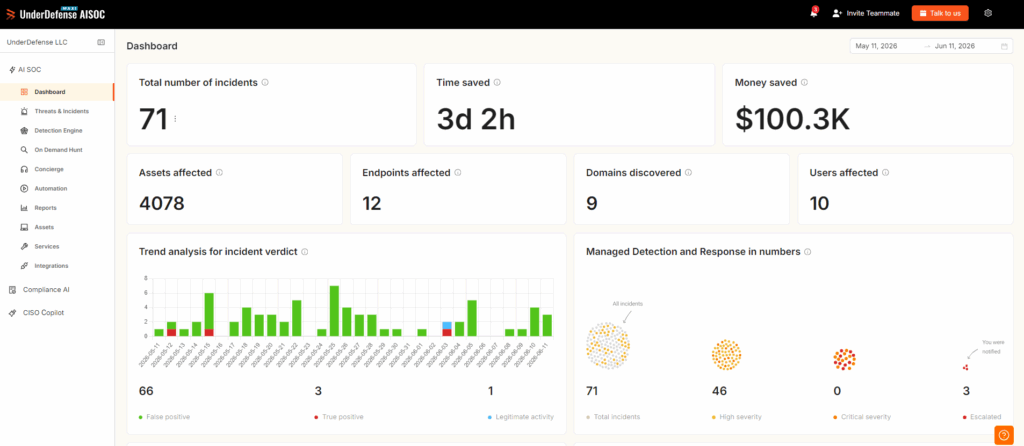
1.1 UnderDefense Agentic AI SOC, Best for Teams Keeping Their Own SIEM or XDR
Overview
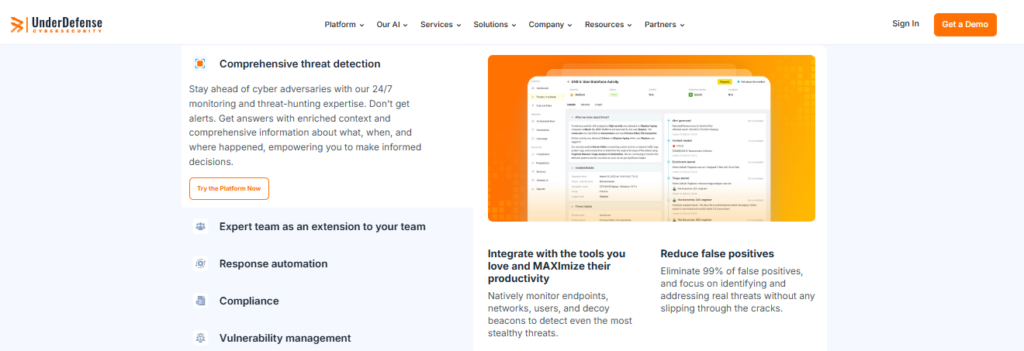
UnderDefense Agentic AI SOC is an AI SOC and managed detection and response service built to sit on top of the security stack you already run. Rather than replacing your SIEM or XDR, it adds AI-driven detection and a human analyst layer that owns outcomes, not just alerts. We designed the UnderDefense Agentic AI SOC platform so customers keep full ownership of their tools, logs, and detection logic.
Core Services
- 24/7 AI SOC detection with human analyst response (“AI SOC + Human Ally”)
- Vendor-agnostic integration across 250+ security tools
- Concierge Response, where analysts contact affected users directly to verify and remediate
- ChatOps verification and remediation through Slack or Teams
- Managed SIEM optimization on your existing platform (Splunk, Sentinel, and more)
Why Companies Consider UnderDefense
Most teams come to us tired of two things: alert noise and vendor traps. We clean up the noise in the first week, then keep the stack in the customer’s name. One reviewer put the ownership benefit plainly.
Ideal Customer Profile
- Mid-market and enterprise teams of roughly 1,000 to 10,000 employees
- Organizations with a SIEM or XDR they do not want to rip out
- Compliance-driven teams needing 24/7 coverage on a real budget
- PE portfolio companies standardizing security without forced tool swaps
Commercial Model
Transparent, endpoint-based pricing (roughly $11 to $15 per endpoint per month) with onboarding support and no proprietary-tool replacement required. We publish our MDR pricing openly rather than hiding it behind a sales call.
When to Shortlist
Shortlist UnderDefense when you want a force multiplier that detects across your existing stack, responds with context, and leaves ownership with you. It fits best when 2-minute alert-to-triage and 15-minute escalation on critical incidents matter more than a shiny dashboard. Our SOC service and managed SIEM both run on infrastructure you continue to control.
Customer Reviews
“The biggest win for me was getting actual control over our security alerts. Before the guys from UD stepped in, we were getting bombarded with alerts from all our security tools. Their team cleaned up our configurations and got the noise under control within the first week. The platform itself is straightforward, it pulls in data from all our existing security tools, so we didn’t have to rip and replace anything.” — Verified User in Marketing and Advertising, Small-Business UnderDefense G2 Verified Review
1.2 CrowdStrike (Charlotte AI), Best for Endpoint-First Enterprises on Falcon
Overview
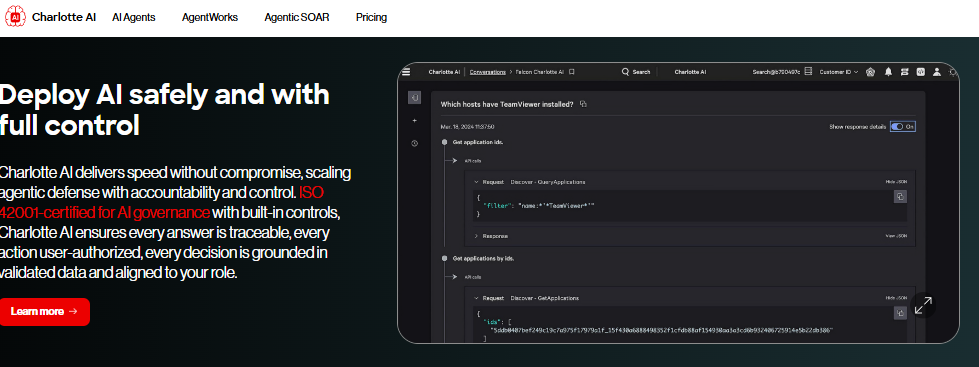
CrowdStrike is an endpoint-first security leader whose Charlotte AI adds generative triage and investigation on top of the Falcon platform. It detects threats fast at the endpoint. The tradeoff is that most of its value lands when you commit to the wider Falcon ecosystem.
Core Services
- Falcon endpoint detection and response (EDR)
- Charlotte AI for alert triage and guided investigation
- Threat intelligence and managed hunting (Falcon OverWatch)
- Identity and cloud protection modules
- Next-gen SIEM (Falcon LogScale) as an add-on
Why Companies Consider CrowdStrike
Teams pick CrowdStrike for raw endpoint speed and a mature agent. Its own threat reporting sets the industry speed benchmark, noting a median break-in time of 48 minutes and a fastest recorded break-in near 51 seconds. That is the bar any AI SOC must beat without slow manual escalation.
Ideal Customer Profile
- Enterprises standardizing on endpoint-centric defense
- Teams already invested in Falcon modules
- Organizations wanting strong EDR plus optional managed hunting
Commercial Model
Module-based licensing across Falcon products, often bundled. Costs rise as you add identity, cloud, and SIEM modules, and value concentrates inside the ecosystem rather than your own SIEM. If ecosystem gravity worries you, our guide on avoiding vendor lock-in walks through the tradeoffs.
When to Shortlist
Shortlist CrowdStrike when the endpoint is your priority and you accept ecosystem gravity. Weigh the organizational context gap, since endpoint-focused tools see threats but often miss user verification and full organizational context. For teams comparing coverage models, our AI SOC versus MDR, MSSP, and SOAR breakdown is a useful reference, and our Managed EDR service adds the response layer endpoints alone lack.
Customer Reviews
“Crowdstrike Falcon is one of the best EDR/XDR platforms. What I dislike is the pricing model, it is quite expensive compared to competitors and the licensing bundles can be confusing.” — Verified User in Information Technology, Enterprise (4.5/5) CrowdStrike G2 Verified Review
“The console is powerful but there is a learning curve, and getting full value really means buying into more of the Falcon modules over time.” — Verified User in Computer & Network Security CrowdStrike G2 Verified Review
1.3 Palo Alto Cortex XSIAM, Best for Enterprises Consolidating onto One Platform
Overview
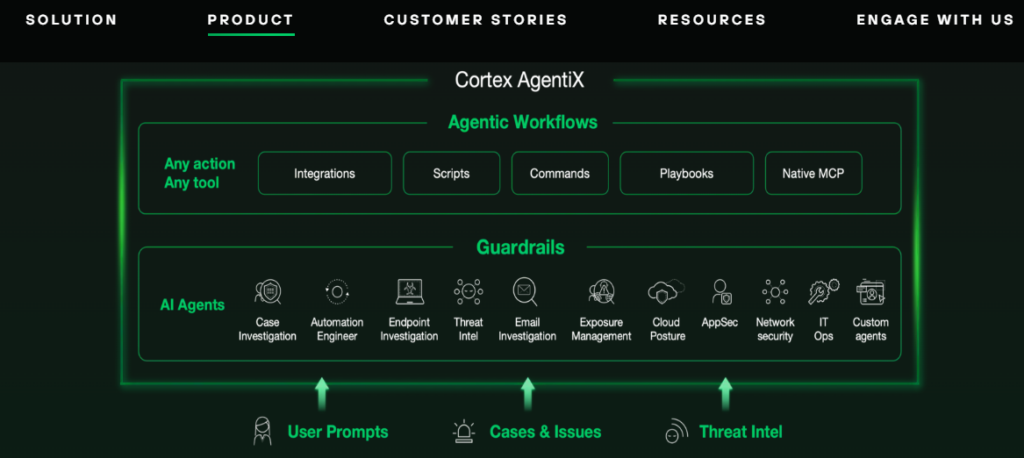
Palo Alto’s Cortex XSIAM is an AI-driven security operations platform that folds SIEM, XDR, and automation into one system. It automates a large share of triage. The tradeoff is a consolidation model that pulls your data into Palo Alto’s own lake.
Core Services
- AI-driven SIEM and analytics (data ingested into the Cortex data lake)
- Extended detection and response (XDR) across endpoint, network, and cloud
- Built-in SOAR automation and playbooks
- Threat intelligence management
- Managed threat hunting add-ons
Why Companies Consider Palo Alto
Teams already standardized on Palo Alto firewalls and Cortex often consolidate to cut tool sprawl. The automation is genuinely strong. My honest read is that consolidation buys speed today and trades away portability tomorrow.
Ideal Customer Profile
- Large enterprises already invested in the Palo Alto ecosystem
- Teams willing to migrate data into one vendor’s platform
- Organizations prioritizing automation depth over stack independence
Commercial Model
Credit and ingestion-based pricing tied to data volume, usually a significant enterprise commitment. Costs scale with the data you push into the platform, so budgeting takes careful modeling. Our AI SOC pricing guide breaks down how ingestion models compare against flat, endpoint-based options.
When to Shortlist
Shortlist Cortex XSIAM when full platform consolidation is the explicit goal and you accept the lock-in that comes with a single-vendor data lake. If portability is a priority, our guide on avoiding vendor lock-in is worth reading first.
1.4 Arctic Wolf, Best for Mid-Market Teams Wanting a Fully Outsourced SOC
Overview
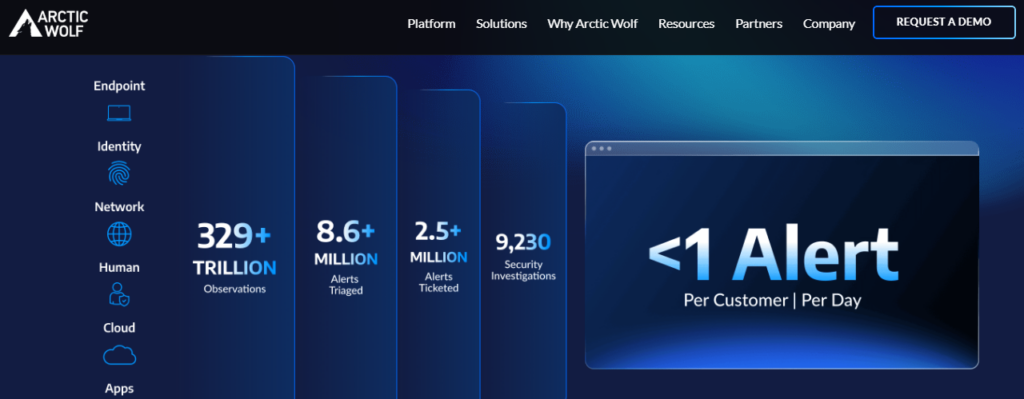
Arctic Wolf delivers a fully outsourced SOC through its Concierge Security model, pairing continuous monitoring with a named security team. It suits teams that want operations handled end to end. The structural catch is that visibility and changes route through Arctic Wolf’s own platform.
Core Services
- 24/7 Managed Detection and Response (MDR)
- Cloud and endpoint monitoring
- Vulnerability and risk management
- Incident response support
- Compliance readiness assistance (SOC 2, HIPAA, PCI DSS)
Why Companies Consider Arctic Wolf
Many mid-market teams lack the budget or talent to run a SOC in-house. Arctic Wolf positions as an operational partner, not just tooling. From what I see in evaluations, the concierge relationship is the real draw.
Ideal Customer Profile
- Companies with 50 to 1,000 employees
- Compliance-driven organizations handling customer data
- Security-lean teams needing outsourced expertise
Commercial Model
Subscription pricing aligned to organization size and monitored assets, with onboarding and advisory included. Buyers should confirm renewal terms carefully, since one reviewer flagged a 60-day auto-renewal window rather than the typical 30. For a full cost breakdown, see our Arctic Wolf pricing guide.
When to Shortlist
Shortlist Arctic Wolf when you want a hands-off managed SOC and accept that log access and tuning live inside their platform. Confirm during your proof of concept that logs are retrievable on demand, since remediation ownership stays largely with your team. Teams weighing alternatives often compare our MDR service for its stack ownership model.
Customer Reviews
“Solid detection and response capabilities, but overly relies on the client’s team for remediation, which really hurts the value of the service. Lack of true remediation in the response, costing us significantly in resources and introducing risks in security.” — VP of Technology, Services (3.0/5) Arctic Wolf Gartner Verified Review
“Log collectors show working, however when asked to provide logs for an investigation no logs could be provided. Analysts provide little context, and when asked for more information in the investigation nothing is ever provided or even communicated.” — CISO, Manufacturing (2.0/5) Arctic Wolf Gartner Verified Review
1.5 ReliaQuest (GreyMatter), Best for Enterprises Standardizing on One Ops Layer
Overview
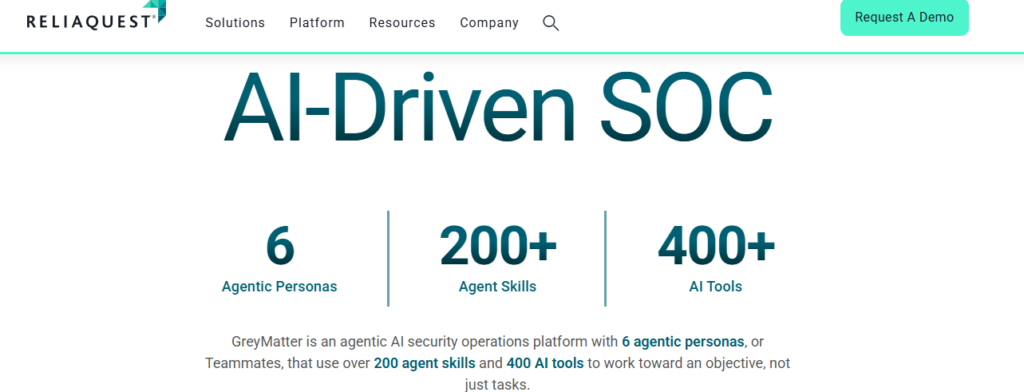
ReliaQuest’s GreyMatter is a cloud-native security operations platform built on open XDR with bi-directional API integrations. It consolidates data from many tools into one view. Operations, though, run through the GreyMatter platform itself.
Core Services
- Open XDR detection across cloud, endpoint, and network
- Bi-directional integrations with existing security tools
- Threat hunting and MITRE ATT&CK mapping
- AI-assisted investigation summaries
- 24/7 monitoring and response support
Why Companies Consider ReliaQuest
Large teams like the single pane of glass and broad integrations. Users rate its net emotional footprint highly, with 92% positive sentiment and a strong plan-to-renew score. The recurring critique is complexity and cost for smaller teams.
Ideal Customer Profile
- Large enterprises with mature security teams
- Organizations wanting to unify many tools operationally
- Teams comfortable investing in a heavier platform
Commercial Model
Subscription pricing scaled to environment size and integrations. Reviewers note the investment can feel high for startups and lean teams. Our best AI SOC providers comparison shows how this stacks up against lighter-weight options.
When to Shortlist
Shortlist ReliaQuest when you want an operations layer over existing tools and have the team to absorb setup complexity.
Customer Reviews
“It’s most reliable than some other security platforms and best for threat hunting and particularly in the realms of managed detection and response and security operations.” — Dhamodharan E., Information Technology, Banking ReliaQuest GreyMatter SoftwareReviews Verified Review
“I like how it consolidates data from various security tools into a single, cohesive platform. Complex to setup and customize.” — Kartik G., Engineering (verified) ReliaQuest GreyMatter SoftwareReviews Verified Review
1.6 Expel, Best for Cloud-Heavy Teams Wanting Managed Triage
Overview
Expel is a managed detection and response provider known for a transparent workbench and fast alert triage. Analysts investigate before escalating, which cuts noise. The known limit is that organizational knowledge often stays with your internal team.
Core Services
- 24/7 managed detection and response across endpoint, cloud, and SaaS
- Transparent investigation workbench
- Alert triage with automation-assisted filtering
- Slack-based notifications and support
- Broad API integrations
Why Companies Consider Expel
Small SOC teams lean on Expel as a force multiplier for first-line analysis. Reviewers consistently praise fast, accurate support. From what surfaces in real deployments, the tradeoff is repeated context requests back to your team.
Ideal Customer Profile
- Cloud-first and SaaS-heavy organizations
- Small internal SOC teams needing triage coverage
- Teams valuing transparent, auditable investigations
Commercial Model
Subscription pricing based on monitored technologies and data sources, with onboarding to connect your logging. Confirm roadmap commitments in writing, since one reviewer noted a promised GovCloud feature was later dropped. Teams that want deeper first-line automation often review our approach to AI-enabled incident triage.
When to Shortlist
Shortlist Expel when you want managed triage over your cloud stack and accept that deep organizational context still leans on your team. For cloud-heavy environments, our cloud security services add the organizational context layer that triage alone misses.
Customer Reviews
“Despite the capabilities of the technical platform and the strength of the analysts providing the service, there is still a limit to the environmental/organizational knowledge inherent in the service. This leads to a fairly frequent need for engagement with our internal team to get clarification and verification.” — Verified User in Computer Software, Mid-Market (3.5/5) Expel G2 Verified Review
“Slack integration for notifications and support requests. Support requests are handled very quickly and accurately. Lack of support for EKS in AWS GovCloud. This was promised to us before we signed our contract, but later was removed from the roadmap.” — Verified User in Manufacturing, Enterprise (3.0/5) Expel G2 Verified Review
1.7 Deepwatch, Best for Splunk-Committed Enterprises
Overview
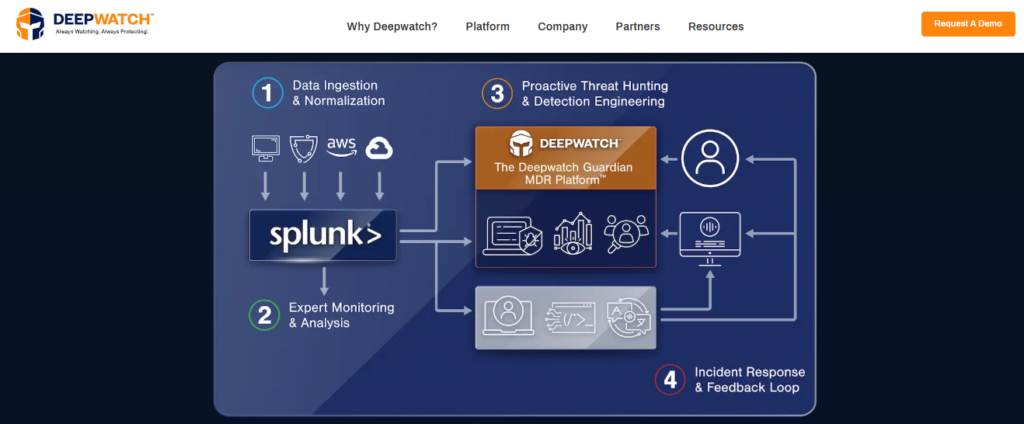
Deepwatch delivers managed detection engineering with deep Splunk expertise. For Splunk shops, that alignment is a strength. The flip side is heavy dependence on Splunk, which raises cost and can leave gaps after a breach.
Core Services
- Managed detection and response on Splunk
- Custom detection engineering and tuning
- Threat hunting and threat intelligence
- Named squad support model
- Compliance-oriented reporting
Why Companies Consider Deepwatch
Teams already invested in Splunk get tuned detections without hiring detection engineers. Reviewers describe the team as dependable and responsive. My current read is that the value is real but tightly coupled to one SIEM.
Ideal Customer Profile
- Enterprises standardized on Splunk
- Teams needing managed detection engineering
- Organizations wanting a named support squad
Commercial Model
Subscription pricing that layers on top of your Splunk licensing, so total cost includes Splunk ingestion. Budget for both the service and the underlying data platform.
When to Shortlist
Shortlist Deepwatch when Splunk is your committed SIEM and you want managed detection engineering on top of it. For teams weighing a Splunk-based approach, our MDR for Splunk service delivers detection engineering while keeping the platform in your name.
Customer Reviews
“Deepwatch is easy to work with. They are dependable and highly responsive. Whenever I have a question they are quick to respond and help.” — Verified User (Deepwatch customer) Deepwatch G2 Verified Review
1.8 Stellar Cyber, Best for Teams Wanting Open, Vendor-Agnostic XDR
Overview
Stellar Cyber offers an Open XDR platform that unifies data across networks, endpoints, cloud, and applications. It leans vendor-agnostic by design. That openness is its main selling point against ecosystem-locked rivals.
Core Services
- Open XDR with 65+ API connectors and hundreds of log parsers
- Data normalization across mixed sources
- AI and machine learning threat detection
- Automated investigation and response
- Multi-tenant support for MSSPs
Why Companies Consider Stellar Cyber
Teams pick it because they can almost always say yes to a new integration. The normalization of messy data into one view stands out. From what I see, that flexibility is exactly what vendor-locked buyers wish they had.
Ideal Customer Profile
- Teams with heterogeneous, multi-vendor stacks
- MSSPs needing multi-tenant coverage
- Organizations avoiding single-vendor lock-in
Commercial Model
Platform licensing based on data and modules, available direct or through MSSP partners. Because it is a platform rather than a full managed service, you still need analysts to operate it. Teams comparing platform versus managed models often review our AI SOC build versus buy analysis.
When to Shortlist
Shortlist Stellar Cyber when open integration is the priority and you have or plan to add the team to run detections.
Customer Reviews
“The main advantage is that we can always say yes when it comes to integrating various SaaS, PaaS, IaaS and log sending sources. Stellar offers over 65 API connectors and hundreds of log parsers. Where it excels is the normalization of all that data.” — Verified User Stellar Cyber G2 Verified Review
1.9 Exaforce, Best for Teams Wanting Flexible, Multi-Agent AI SOC
Overview
Exaforce is a newer AI SOC platform built around multi-agent investigation. It emphasizes flexible deployment, self-hosted, SaaS, or managed. The appeal is AI-driven analysis that adapts to how you want to run it.
Core Services
- Multi-agent AI investigation and triage
- Flexible deployment (self-hosted, SaaS, or managed)
- Integration with existing detection sources
- Automated alert enrichment
- Analyst-assist workflows
Why Companies Consider Exaforce
Teams exploring agentic AI defense like the deployment freedom. As a newer entrant, its track record is still forming. I could be off here, but flexible deployment is its clearest differentiator today.
Ideal Customer Profile
- Teams piloting agentic AI for SOC work
- Organizations wanting deployment flexibility
- Security groups comfortable with newer vendors
Commercial Model
Modern usage or subscription pricing, typically quoted per environment. As with any newer platform, validate outcomes in a proof of concept before committing. Our list of AI SOC evaluation questions helps structure that proof of concept.
When to Shortlist
Shortlist Exaforce when multi-agent AI and deployment flexibility matter more than a long reference list.
1.10 Prophet Security, Best for Teams Wanting an Integration-First AI SOC Analyst
Overview
Prophet Security positions as an AI SOC analyst that plugs into the stack you already run. Its focus is integration-first automated investigation. The pitch is augmenting your analysts rather than replacing your tools.
Core Services
- AI-driven automated alert investigation
- Integration with existing SIEM, EDR, and cloud tools
- Alert triage and enrichment
- Analyst-assist recommendations
- Continuous tuning of detections
Why Companies Consider Prophet Security
Teams drowning in alerts want faster triage without ripping out tools. Its integration-first design fits that need. My honest read is that, like Exaforce, it is early, so proof beats promise here.
Ideal Customer Profile
- Alert-heavy teams keeping their current stack
- Organizations wanting AI triage as augmentation
- Security groups open to newer AI SOC entrants
Commercial Model
Subscription pricing scoped to alert volume and integrations. Confirm measurable triage outcomes during evaluation before you scale spend. Teams struggling with volume may find our guide on alert fatigue in cybersecurity useful context.
When to Shortlist
Shortlist Prophet Security when you want AI triage layered on your existing tools and are validating a newer vendor.
Where This Leaves You
Here is the payoff after running the list. Almost every vendor can detect and triage; the split that decides renewals is ownership. CrowdStrike and Palo Alto reward ecosystem commitment, Arctic Wolf, ReliaQuest, and Deepwatch route operations through their own platforms, while Stellar Cyber, Exaforce, and Prophet lean more open.
We built UnderDefense Agentic AI SOC for the buyer who wants all the Lego bricks of an AI SOC plus their own build. Our model adds AI detection and human analyst response on top of the SIEM or XDR you already own, so your logs and detection logic stay in your name. When a critical incident fires, that means 2-minute alert-to-triage and 15-minute escalation, with analysts contacting affected users directly rather than handing you a ticket. Ownership is the axis most roundups bury, and it is the one that protects your budget on the day the contract ends.
Q2. How Did We Score These AI SOC Vendors? (Our Selection Criteria)
We scored every vendor across five weighted criteria: Data Ownership and Exit Rights (30%), Vendor-Agnostic Integration (25%), Autonomous Investigation Depth (20%), Pricing Transparency (15%), and Verified User Reviews (10%). Scores of 0 to 20 earn one star, 21 to 40 two, 41 to 60 three, 61 to 80 four, and 81 to 100 five stars. The weighting deliberately favors the ownership and portability this article’s readers care about most.
Why These Five Criteria
I built this rubric from the questions CISOs actually ask on evaluation calls. Ownership carries the most weight because it is the one thing you cannot renegotiate after signing. Everything else, integrations, automation, price, you can adjust over time.
Why Ownership Wins the Weighting
Here is the contrarian part. Most buyers try to score vendors on breach-prevention ROI, a number nobody can honestly prove. My read is that chasing un-provable prevention math is a trap.
So the rubric rewards comparative delivery value instead: what you keep, what you can move, and what you actually pay. Those are numbers you can verify before you buy. Our AI SOC ROI business case guide takes the same comparative-cost approach.
How Scores Become Stars
Each vendor gets a 0 to 100 weighted score, then converts to a 1 to 5 star band. Ratings draw on public signals like G2 and Gartner Peer Insights category data, plus the architectural facts each vendor publishes. I want the method visible so you can re-score any vendor yourself.
The Rubric, Fully Disclosed
Below is the full weighting. I disclose it openly because a hidden rubric is just an opinion wearing a lab coat. For teams building their own scorecard, our list of AI SOC evaluation questions pairs well with this table.
| Criterion | Weight | Rationale |
|---|---|---|
| Data Ownership & Exit Rights | 30% | Determines whether your logs, tuned logic, and detection models stay yours on exit |
| Vendor-Agnostic Integration | 25% | Measures fit with your existing SIEM, EDR, and cloud without rip-and-replace |
| Autonomous Investigation Depth | 20% | Rates AI-driven triage and enrichment quality, not just alert forwarding |
| Pricing Transparency | 15% | Rewards published, predictable pricing over quote-only, ingestion-based surprises |
| Verified User Reviews | 10% | Grounds the score in real customer signal from G2 and Gartner Peer Insights |
UnderDefense scores 5 stars on this rubric, and I want to be honest that this is our editorial baseline as the publisher. The reason it lands there is structural: UnderDefense Agentic AI SOC combines full customer stack ownership, vendor-agnostic integration across 250+ tools, and transparent pricing you can review on our MDR pricing page. Score it yourself against the table and check whether the same three facts hold for the others on your shortlist.
Q3. Who Really Owns Your Logs, Models, and Detection Logic, and What Does Lock-In Cost You?
Vendor lock-in in an AI SOC happens when a platform stores your logs in a proprietary format, trains detection models on data it will not export, or uses contracts with egress fees and auto-renewals. In most managed models, you own the raw logs, but the vendor controls the enriched data, tuned models, and investigation graphs. Those are the parts with real switching value.
The Three Kinds of Lock-In, in Plain English
Think of lock-in as three locks on the same door. Architectural lock-in means your data lives in a format only their platform reads. Contractual lock-in hides in egress fees and 60-day auto-renewals.
The Third Lock Is the One People Miss
Model lock-in is the quiet one. Every alert your analysts label as “true threat” or “false positive” trains the vendor’s model. That labeled data is your institutional memory, and it often walks out the door with the vendor.
There is patent evidence for this. Rapid7’s granted patent describes an alert triage classification system trained on a training dataset of classified records, meaning threat results produced inside a customer’s SOC. Your labels become the model’s intelligence, which is why avoiding vendor lock-in starts with owning that data.
Raw Logs vs Enriched Data vs Models
The honest question to ask on any demo is simple. “If I terminate this agreement, do all correlation rules, integrations, and detection logic remain in my SIEM?” If the answer is fuzzy, you have found the hostage.
Who Owns What, and What to Demand
Here is how ownership usually breaks down, and what I would put in the contract. Our AI SOC with existing SIEM guide shows how each row plays out in practice.
| Data Type | Typical Owner | What to Demand |
|---|---|---|
| Raw logs | You (the customer) | Continuous export in open format, in your region |
| Enriched / normalized data | Often the vendor | Export rights to enriched events, not just raw |
| Tuned detection models | Usually the vendor | Portability of tuned logic or documented rules |
| Investigation graphs | The vendor | Readable case history you can retain on exit |
What the Black Box Actually Costs
The cost is not just a migration bill. It is a black box you cannot audit, cannot move, and do not truly own. Limited parser control is a hidden ownership tax that shows up when you try to leave. Teams evaluating this tradeoff often start with our AI SOC explainability and transparency guide.
We built managed SIEM and our AI SOC to remove that hostage situation. Because our service runs on your own SIEM or XDR, the tuned logic, the labels, and the enriched data stay inside infrastructure you already control. There is no vendor graph to negotiate back at renewal, which is the payoff: leaving costs you a notice period, not your institutional memory.
Q4. How Do NIS2, GDPR, and Data Sovereignty Change Your Vendor Shortlist?
NIS2, DORA, and GDPR now converge on one demand: true data sovereignty over where your SOC telemetry lives and who processes it. NIS2 (transposition deadline 17 October 2024) makes continuous monitoring and incident reporting a board-level duty. GDPR Article 33’s 72-hour breach clock depends on you controlling your own logs and their location.
Sovereignty Is Now a Hard Filter
Bottom line up front: data residency has moved from a nice-to-have to a shortlist filter. If a vendor cannot tell you which region your logs sit in, that vendor is off the list for regulated buyers. This is the fastest way to cut a long RFP down to size.
What NIS2 Actually Requires
Member States had to transpose NIS2 into national law by 17 October 2024, applying measures from the next day. Many states were late, so 19 received reasoned opinions from the Commission in 2025. The practical effect is that your obligations depend on the national law where you operate.
NIS2 expands scope to essential and important entities across eighteen sectors, with personal liability for leadership. Continuous monitoring is no longer optional for these organizations, which is where our SOC service and 24/7 coverage come in.
GDPR and the 72-Hour Clock
GDPR Article 33 requires notifying the supervisory authority without undue delay, and no later than 72 hours after becoming aware of a breach. You cannot hit that clock if you do not control your own log history. A CISO once told me a quiet truth on a bridge call.
Why Log History Location Matters
One bad login from Thailand or Singapore can be a 2020 compromise still logging in today. Without full log history in-region, you cannot prove when the intrusion started. That gap breaks both your Article 33 report and your NIS2 timeline, which is why GDPR compliance services lean so heavily on log control.
Baseline Certifications Are Table Stakes
Certifications alone do not make a vendor sovereign. Treat SOC 2, ISO 27001, HIPAA, PCI DSS, GDPR, and FedRAMP as the floor, not the ceiling. The real question is architecture: does the vendor ingest your raw logs into a shared multi-tenant lake, or keep processing in your region?
Your Monday Action
Ask two questions this week. First, “In which region are my logs stored, and can I pin it?” Second, “Do you offer single-tenant or in-region processing?” Our AI SOC compliance guide details how to document the answers for auditors.
We designed the UnderDefense Agentic AI SOC platform so this answer is simple. Because our model runs on your chosen stack and region, telemetry stays in your infrastructure rather than a shared vendor lake. That keeps sovereignty answers clean when the auditor, or the CFO mapping every security dollar across identify, protect, detect, respond, and recover, asks where the data actually lives.
Q5. Is Your AI SOC Actually Transforming the Work, or Just Leaving You Alone During a Breach?
If the same analysts review the same alerts just faster, that is a faster way to be wrong. Real AI SOC autonomy eliminates whole classes of triage work. Leading systems make 100+ model invocations to investigate a single alert, cut noise by up to 99%, and reach 2-minute alert-to-triage, while monitoring-only tools hand you alerts and leave you alone when the breach lands.
The Contrarian Read on “Faster”
The category loves the word “faster.” I think the standard read gets this backwards. Speeding up a broken workflow just gets you to the wrong conclusion sooner.
What Real Autonomy Looks Like
Depth is the tell. When a system runs 100+ reasoning steps per alert, correlates across your SIEM, EDR, and cloud, and suppresses 99% of the noise, that changes the work itself. Shallow tools just forward the same queue to the same tired humans. Our take on true autonomous SOC operation goes deeper on this distinction.
Deployment breadth matters too. Autonomy only counts if it spans your whole stack, endpoint, identity, SaaS, and network. Coverage on one layer leaves the rest dark, which is why 24/7 coverage across every layer is the real bar.
The Speed You Are Actually Racing
Here are the numbers that should set your clock. CrowdStrike measured an average eCrime breakout time of 48 minutes, with the fastest recorded at 51 seconds. Their 2026 report pushed that average down to 29 minutes, fastest at 27 seconds.
Why 2 AM Is the Real Test
A monitoring-only tool that alerts at 2 AM and waits for your team is losing that race. I have watched a night-noisy incident light up while a business-hours team slept. The attacker does not keep office hours, so investigation speed is the metric that decides outcomes.
The M&M Problem
Picture your network as an M&M, hard shell, soft center. Attackers using valid stolen credentials, which drove 79% of initial access in one CrowdStrike year, skip the shell entirely. Once inside, an alert-only service just tells you the candy is gone.
Foot Soldiers and Generals
Here is how I frame the fix. AI agents are foot soldiers: fast, tireless, and great at volume. Human analysts are the generals who decide and act on edge cases.
We built UnderDefense Agentic AI SOC around that split. The AI SOC does the 100+ step triage, then our analysts own the response, contacting affected users directly and acting within a 15-minute escalation for critical incidents. That closes the gap that leaves Deepwatch and Expel customers doing the last, hardest mile themselves, a gap our incident response service is designed to own.
“The primary benefit we get is the human coverage to ensure high criticality and impactful security alerts and incidents are handled in a timely and efficient manner. They are effectively a force-multiplier for our internal team.” — Verified User in Computer Software, Mid-Market (3.5/5) Expel G2 Verified Review
“Now when we get an alert, we know it’s something worth looking into. When they escalate something, they include the context we need to understand the issue quickly. We’re not wasting time piecing together what happened from different systems anymore.” — Verified User in Marketing and Advertising, Small-Business UnderDefense Agentic AI SOC G2 Verified Review
Here is the question I am sitting with: as breakout time slides toward seconds, does any alert-only model survive the next 18 months?
Q6. Which AI SOC Vendor Fits Your Situation, and How Do You Prove It Before You Buy?
Choose by constraint, not brand. If you must keep data in-region for NIS2 or HIPAA, prioritize single-tenant, on-your-stack deployment. If you already own a SIEM, pick a layer that runs on it, then run a 30-day proof of concept that tests exit before entry.
Match the Vendor to Your Constraint
Your situation should pick the tool. Below are four common ones and how I would call them.
Four Scenarios, Four Calls
- Regulated healthcare (HIPAA, in-region data): Recommended: on-your-stack, single-tenant MDR like MDR for Healthcare. Not recommended: shared multi-tenant lakes you cannot pin to a region.
- PE portfolio standardization: Recommended: a vendor-agnostic layer that fits each portfolio company’s existing stack. Not recommended: rip-and-replace platforms that force one tool on every business.
- Mid-market with a SIEM you like: Recommended: an AI SOC that runs on your SIEM. Not recommended: providers that make you migrate into their proprietary SIEM.
- Enterprise over 5,000 employees: Recommended: deep autonomy plus 24/7 human response. Not recommended: alert-only monitoring that leaves your team the response work.
Prove It With Your Own Data
Demos are theater. Test against your own data, not the vendor’s sandbox. I once watched an onboarding review surface a live fraud a customer had missed, saving real money in the first quarter.
The 30-Day POC Playbook
Run these four tests before signing:
- Export test: Mid-POC, request your logs back in open format. Note how hard it is.
- Labeled-data benchmark: Feed the system your own historically labeled alerts and measure triage accuracy.
- Sovereignty check: Confirm which region processes and stores data, and whether single-tenant is available.
- Autonomy depth test: Ask how many reasoning steps run per alert and whether you can audit them.
Our list of AI SOC evaluation questions expands each of these tests into a scriptable checklist.
Put Ownership in Writing
Ask a sharper question than generic ROI: “What is our projected cost of business interruption per day?” That number frames the whole decision. Then make ownership structural, not promised.
The Six Exit Clauses to Demand
Write these into the contract before entry: open-format log return, model and label export, certified data deletion, no egress fees, in-region residency, and no silent auto-renewal. Patent filings confirm why the model clause matters, since triage models get trained on your SOC’s true and false labels. Our guide on avoiding vendor lock-in shows how to word each clause.
“UnderDefense Agentic AI SOC integrates well with our systems, specifically with our SIEM, Splunk. Their adherence to SLAs gives me confidence in our infrastructure’s protection.” — Oleg K., Director Information Security, Mid-Market (4.5/5) UnderDefense Agentic AI SOC G2 Verified Review
“Started out well but over the years the service has consistently not met expectations. Log collectors show working, however when asked to provide logs for an investigation no logs could be provided.” — CISO, Manufacturing (2.0/5) Arctic Wolf Gartner Verified Review
So here is my invitation, not a hard sell: run your next POC on your own stack, and see who still owns the data when day 30 ends.
Q7. What Should You Do This Week to Escape Lock-In and Keep Your Data Sovereign?
Start this week. Map your current SOC contract against the three lock-in types, confirm who owns your enriched data and tuned models, verify in-region storage for NIS2 and GDPR, and shortlist only vendors that run on the stack you already own. Then request an RFP that puts open-format data return and model export in writing before any renewal.
Your Monday Action List
You do not need a quarter to start. You need five moves this week.
Five Steps to Start Now
- Contract audit: Read your current agreement for architectural, contractual, and model lock-in. Flag egress fees and auto-renewal windows.
- Ownership check: Ask your vendor, in writing, who owns the enriched data, tuned detections, and investigation graphs.
- Sovereignty verification: Confirm the region where your logs are stored and processed, since GDPR Article 33 gives you 72 hours to report.
- Shortlist filter: Cut any vendor that cannot run on your existing SIEM or XDR, or that cannot pin data in-region under NIS2.
- RFP request: Put open-format log return and model export into the RFP, and demand exportable evidence graphs.
Our AI SOC compliance guide and compliance services help document each step for auditors.
Why This Order Works
Each step surfaces the next hostage before you renew. The contract audit shows the locks; the ownership check names the hostage; the sovereignty step protects your regulator clock. From what surfaces when you actually run this, most teams find at least one clause they would never sign again.
A Resonant Close
Here is what I keep coming back to. In 2026, staying human, keeping your data, your logic, and your choices in your own hands, is a flex. The vendors betting you will not read the exit clause are counting on the opposite.
We built the UnderDefense Agentic AI SOC platform so ownership is structural rather than promised. If you want those exit rights written into an RFP, tell us what you are defending, and we will scope a SOC around the stack and contracts you already have.
1. What makes an AI SOC vendor truly free of lock-in?
An AI SOC vendor is truly free of lock-in when leaving costs you a notice period, not your institutional memory. The test we apply is simple: on the day you terminate, do your logs, correlation rules, tuned detection logic, and enriched data all remain inside infrastructure you control?
We watch for three locks:
- Architectural: data stored in a proprietary format only their platform reads.
- Contractual: egress fees, 60-day auto-renewals, and vague exit terms.
- Model: your true and false labels training a detection model you cannot export.
A vendor scores well when your data, parsers, and logic stay yours. It scores poorly when leaving means starting over from zero. We built our MDR service to run on the SIEM or XDR you already own, so there is no vendor graph to negotiate back at renewal. The practical move is to ask on every demo whether all detection logic remains in your SIEM after termination. If the answer is fuzzy, you have found the hostage.
2. Who actually owns my logs, detection models, and enriched data in a managed AI SOC?
In most managed models, you own the raw logs, but the vendor often controls the enriched data, tuned detection models, and investigation graphs. Those are the parts with real switching value, so ownership deserves close reading before you sign.
Here is how it usually breaks down:
- Raw logs: yours, but demand continuous export in an open format.
- Enriched or normalized data: often the vendor’s, so negotiate export rights.
- Tuned detection models: usually the vendor’s, so require portability or documented rules.
- Investigation graphs: the vendor’s, so demand readable case history on exit.
Model lock-in is the quiet one. Every alert your team labels as a true threat or false positive trains the vendor’s model, and that labeled data is your institutional memory. Because our managed SIEM runs on your own stack, the labels and enriched data stay in infrastructure you already control. Put open-format log return and model export in writing before entry, not after a dispute at renewal time.
3. How do NIS2, DORA, and GDPR change which AI SOC vendors we can shortlist?
These regulations converge on one demand: true data sovereignty over where your SOC telemetry lives and who processes it. That moves data residency from a nice-to-have to a hard shortlist filter.
The practical effects:
- NIS2: continuous monitoring and incident reporting became a board-level duty, with personal liability for leadership across eighteen sectors.
- GDPR Article 33: you must report a breach within 72 hours, which is impossible without controlling your own in-region log history.
- Residency: if a vendor cannot tell you which region your logs sit in, that vendor is off the list for regulated buyers.
Treat SOC 2, ISO 27001, HIPAA, PCI DSS, and FedRAMP as the floor, not the ceiling. The real question is architecture: does the vendor ingest your raw logs into a shared multi-tenant lake, or keep processing in your region? Our AI SOC compliance guide details how to document these answers for auditors. Ask this week which region stores your logs and whether single-tenant processing is available.
4. Is a faster AI SOC actually better, or just a quicker path to the wrong answer?
Speed alone is a trap. If the same analysts review the same alerts just faster, that is a faster way to be wrong. Real autonomy eliminates whole classes of triage work rather than accelerating a broken workflow.
Depth is the tell:
- Leading systems run 100+ reasoning steps per alert, not a single pass.
- They correlate across your SIEM, EDR, and cloud, then suppress up to 99% of noise.
- They reach 2-minute alert-to-triage, while shallow tools just forward the same queue.
The clock matters because CrowdStrike measured average eCrime breakout time at 48 minutes, with the fastest at 51 seconds, then pushed the 2026 average to 29 minutes. A monitoring-only tool that alerts at 2 AM and waits for your team is losing that race. We frame the fix as foot soldiers and generals: AI agents handle volume, and human analysts decide on edge cases. Our autonomous SOC approach pairs deep AI triage with human response, so your team is not left doing the last, hardest mile alone during a breach.
5. How do we prove an AI SOC vendor before we buy?
Demos are theater, so test against your own data in a 30-day proof of concept that tests exit before entry. We recommend four concrete tests rather than a scripted vendor sandbox.
Run these before signing:
- Export test: mid-POC, request your logs back in open format and note how hard it is.
- Labeled-data benchmark: feed the system your historically labeled alerts and measure triage accuracy.
- Sovereignty check: confirm which region processes and stores data, and whether single-tenant is available.
- Autonomy depth test: ask how many reasoning steps run per alert and whether you can audit them.
Then ask a sharper question than generic ROI: what is our projected cost of business interruption per day? That number frames the whole decision. Our list of AI SOC evaluation questions turns each test into a scriptable checklist your team can run. The goal is to see who still owns the data when day 30 ends, because a POC that tests exit rights protects you long before a renewal dispute ever surfaces.
6. Which exit clauses should we demand in an AI SOC contract?
Make ownership structural, not promised, by writing specific exit clauses into the contract before entry. We recommend six, because each closes a different lock-in door.
Demand these in writing:
- Open-format log return: your logs back in a readable, portable format.
- Model and label export: your true and false labels and tuned logic remain yours.
- Certified data deletion: proof the vendor has purged your data.
- No egress fees: leaving does not trigger a penalty bill.
- In-region residency: data pinned to a region for NIS2 and GDPR.
- No silent auto-renewal: no surprise 60-day renewal windows.
The model clause matters most, since patent filings confirm triage models get trained on your SOC’s true and false labels. That labeled data is your intelligence, and it often walks out with the vendor. Our guide on avoiding vendor lock-in shows how to word each clause for an RFP. Put these terms into the RFP before any renewal, because the leverage disappears the moment you sign without them.
7. How do we match an AI SOC vendor to our specific situation?
Choose by constraint, not brand. Your situation should pick the tool, and we see four common scenarios that each point to a different call.
- Regulated healthcare with HIPAA and in-region data: pick on-your-stack, single-tenant MDR; avoid shared multi-tenant lakes you cannot pin to a region.
- Private equity portfolio standardization: pick a vendor-agnostic layer that fits each company’s existing stack; avoid rip-and-replace platforms.
- Mid-market with a SIEM you like: pick an AI SOC that runs on your SIEM; avoid migrating into a proprietary one.
- Enterprise over 5,000 employees: pick deep autonomy plus 24/7 human response; avoid alert-only monitoring.
The common thread is that a vendor-agnostic layer running on infrastructure you already own protects both sovereignty and budget. For regulated healthcare specifically, our MDR for Healthcare keeps telemetry in your region rather than a shared lake. Start from your hardest constraint, whether that is compliance, an existing SIEM, or scale, and let it eliminate vendors before features ever enter the conversation.
8. What should we do this week to escape lock-in and keep our data sovereign?
You do not need a quarter to start; you need five moves this week. Each step surfaces the next hostage before you renew.
- Contract audit: read your agreement for architectural, contractual, and model lock-in, and flag egress fees and auto-renewal windows.
- Ownership check: ask, in writing, who owns the enriched data, tuned detections, and investigation graphs.
- Sovereignty verification: confirm the region where logs are stored and processed, since GDPR gives you 72 hours to report.
- Shortlist filter: cut any vendor that cannot run on your existing SIEM or XDR, or pin data in-region.
- RFP request: put open-format log return and model export into the RFP, and demand exportable evidence graphs.
This order works because the contract audit shows the locks, the ownership check names the hostage, and the sovereignty step protects your regulator clock. Most teams find at least one clause they would never sign again. When you are ready to scope a no-lock-in SOC around the stack you already own, contact us and tell us what you are defending.