




Choosing an AI SOC provider is one of the highest-stakes infrastructure decisions a security leader makes. Get it right, and your team gains 24/7 coverage, faster response, and operational leverage. Get it wrong, and you inherit vendor lock-in, opaque pricing, and an alert pipeline that still routes to your analysts at 2 AM.
This guide evaluates eleven AI SOC providers across operational, technical, and business criteria, grounded in verified Gartner Peer Insights and G2 data alongside each vendor’s own published material. Every provider listed has a live product, a documented customer base, and independent analyst validation as of October 2026.
✅ Our Evaluation Criteria
Each provider was assessed across five weighted dimensions:
- Detection Capabilities (25%): MITRE ATT&CK coverage, false positive reduction, and independent validation
- Automation Depth (20%): Tier-1 automation maturity, investigation speed, and response playbook coverage
- Integration Flexibility (20%): Vendor lock-in risk, SIEM compatibility, and hybrid/on-prem support
- G2/Gartner Review Score (20%): Verified user satisfaction, willingness-to-recommend, and complaint patterns
- Pricing Transparency (15%): Published rates, calculator availability, and pricing model clarity
👤 Who This Guide Is For
This comparison is built specifically for:
- CISOs and Security Directors evaluating AI-augmented SOC operations
- IT Directors and CTOs at mid-market or scaling technology companies
- PE Operating Partners conducting security due diligence across portfolio companies
- Compliance Officers and GRC Leaders who need 24/7 monitoring for SOC 2, HIPAA, or ISO 27001
If your organization is moving toward vendor evaluation or preparing an RFP, the providers below represent the AI SOC platforms most frequently shortlisted during the 2026 buying cycle.
Five Types of AI SOC Providers, and Who Acts on Your Alerts
The eleven providers below share the “AI SOC” label and differ most in one question: who does the work after an alert fires. Sorting them by architecture first makes the profiles easier to compare.
| Type | How it works | Who acts on an alert | Providers in this list |
|---|---|---|---|
| AI SOC with 24/7 human analysts on your existing stack | AI agents investigate across the SIEM, EDR, cloud and identity tools you already run, and the provider’s analysts make response decisions around the clock | The provider’s analysts, with AI investigation | UnderDefense |
| Managed detection and response services adding AI | A managed service runs detection and response, increasingly with AI assistance, largely on the provider’s own platform | The provider’s analysts | Arctic Wolf, Sophos |
| AI SOC platforms you operate | Agentic AI triages, investigates and can respond; your team supervises and owns the platform | Your team, supervising AI | Intezer, Exaforce, D3 Security, Torq |
| Platform vendors with built-in AI | AI added to the vendor’s own EDR, SIEM or XDR | Your team, inside one vendor’s stack | CrowdStrike, SentinelOne, Stellar Cyber |
| Detection specialists | AI detection in one domain that feeds the rest of your SOC | Your team or your SOC provider | Vectra AI |
If nobody on your team is on shift at night, start with the first two types. If you have analysts and want them supervising AI, look at the third, and if you have standardized on one vendor’s stack, the fourth keeps you there. The fifth strengthens any of the others.
Q1. What Are the 11 Best AI SOC Providers in 2026?
The providers below were selected because they represent distinct architectural approaches, from vendor-agnostic AI SOC with 24/7 analysts to endpoint-native AI engines to hyperautomation orchestrators, each with documented production deployments and verifiable customer outcomes. The star ratings are this guide’s own scores, built from the methodology in Q2.
| Provider | Best For | Key Strength | Compliance Support |
|---|---|---|---|
| 1. UnderDefense ⭐⭐⭐⭐⭐ | Vendor-agnostic AI SOC for mid-to-large enterprises | ChatOps user verification; zero ransomware in 6 years | SOC 2, HIPAA, ISO 27001, GDPR, PCI DSS |
| 2. CrowdStrike ⭐⭐⭐⭐ | Falcon ecosystem enterprises | 98%+ triage accuracy; GigaOm Autonomous SOC Leader | SOC 2, FedRAMP, HIPAA, PCI DSS |
| 3. Intezer ⭐⭐⭐⭐ | Organizations outgrowing MDR capacity | 100% alert coverage at forensic depth; less than 2% escalation rate; per-endpoint pricing | SOC 2, HIPAA, ISO 27001, PCI DSS, GDPR |
| 4. D3 Security ⭐⭐⭐⭐ | Large enterprises and MSSPs seeking to improve alert coverage, investigation quality, integration, while ensuring governed response | Deep investigation and response; AI SOC with Cybersecurity Triage Reasoning Graph and built-in SOAR on one platform | NIS2, DORA, EU AI Act, KRITIS, SEC, NYDFS, HIPAA, GDPR |
| 5. Exaforce ⭐⭐⭐⭐ | Lean SOC teams scaling security without adding headcount | Multi-model AI engine; full-lifecycle Exabots plus optional MDR | SOC 2, ISO 27001, HIPAA, PCI DSS, GDPR, HITRUST |
| 6. SentinelOne ⭐⭐⭐ | Endpoint-centric organizations expanding to AI SIEM | First fully agentic SOC claim; triple-digit AI SIEM growth | SOC 2, HIPAA, PCI DSS |
| 7. Arctic Wolf ⭐⭐⭐ | SMBs and mid-market needing concierge SOC | 10M+ hours SOC knowledge; 10K+ customers | SOC 2, HIPAA, PCI DSS |
| 8. Sophos ⭐⭐⭐⭐ | Broad MDR coverage across company sizes | #1 MDR on G2 Winter 2026; 28K+ orgs protected | SOC 2, HIPAA, PCI DSS, GDPR |
| 9. Vectra AI ⭐⭐⭐⭐ | Hybrid network + identity environments | Gartner NDR MQ Leader; 391% ROI per IDC | SOC 2, HIPAA, PCI DSS |
| 10. Torq ⭐⭐⭐ | Fortune 500 SecOps hyperautomation | Forbes “de facto AI SOC leader”; $1.2B valuation | SOC 2, PCI DSS |
| 11. Stellar Cyber ⭐⭐⭐ | MSSPs and resource-constrained SOCs | Open XDR works with any EDR; ~1/3 of top MSSPs | SOC 2, HIPAA, PCI DSS |
1. UnderDefense: Best for Vendor-Agnostic AI SOC with Transparent Pricing

📋 Overview
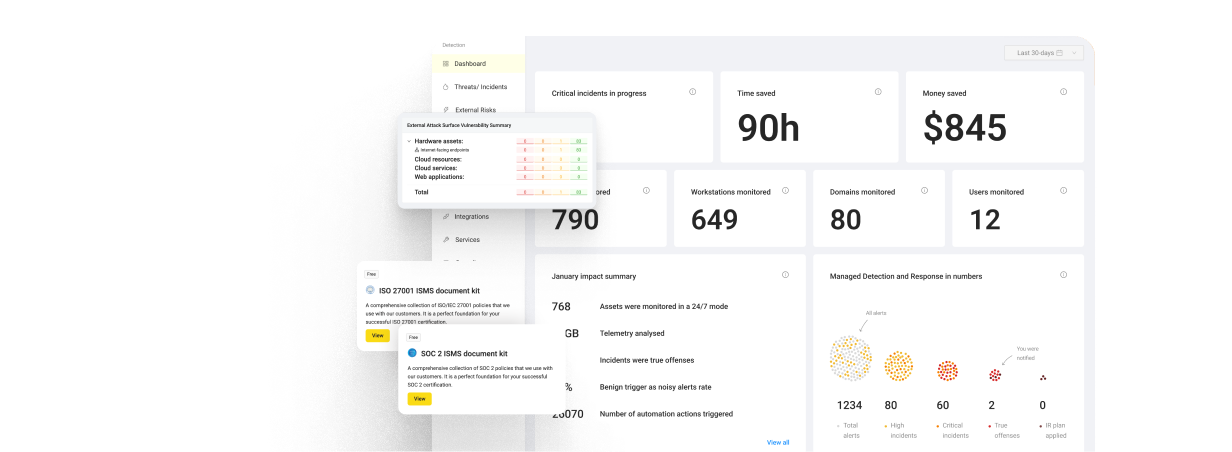
UnderDefense builds its AI SOC around a step many providers leave to the customer: verifying alerts directly with end users. Where ambiguous alerts often go back to the customer’s security team, or get auto-closed, UnderDefense Agentic AI SOC contacts affected users directly through Slack, Microsoft Teams, email, and SMS to confirm or deny suspicious activity. This ChatOps approach resolves alerts that would otherwise stay unanswered.
🛠️ Core Services
- 24/7 AI agents with dedicated analyst teams (Tier 3–4)
- ChatOps-driven user verification and remediation via Slack, Teams, email, and SMS
- 1,000+ correlation rules with 96% MITRE ATT&CK coverage
- No-code response playbooks with automated threat isolation
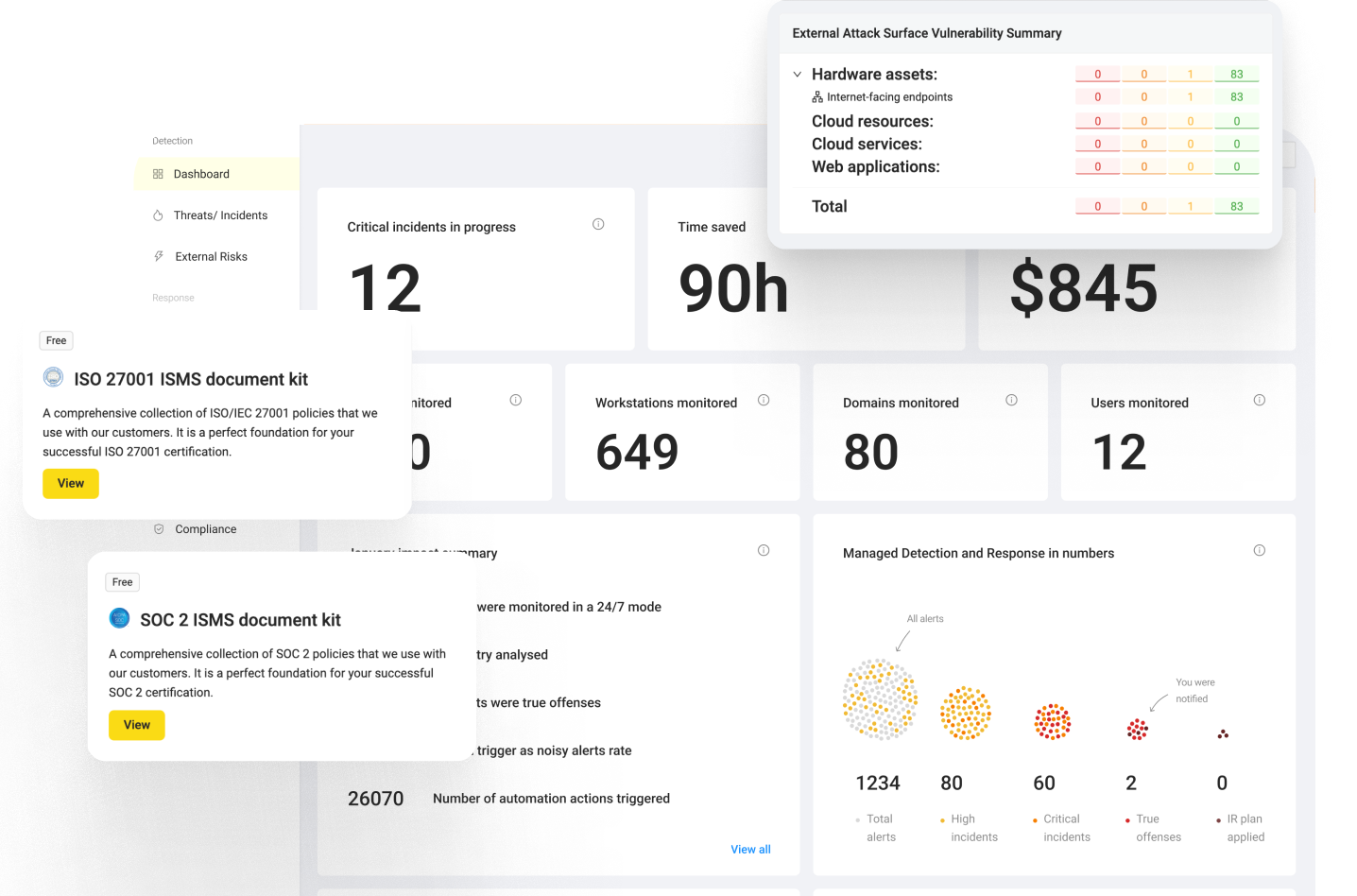
- Forever-free compliance kits for SOC 2, HIPAA, ISO 27001, and GDPR
🤔 Why Companies Consider UnderDefense
Most AI SOC vendors sell “autonomous detection.” What many deliver is autonomous alerting, where the alert still lands in your queue and your team still has to investigate, verify, and respond. UnderDefense pairs AI triage with concierge analyst teams who act on your behalf.
✅ The Difference in Practice
When a suspicious login triggers from an employee’s device in an unusual geography, most MDR providers escalate a ticket. UnderDefense’s analysts message the user directly through your existing communication channels, confirm whether the login was legitimate, and either close or contain, all before your internal team opens the ticket.
The result: a 2-minute alert-to-triage SLA, a 20-minute SLA response for critical alerts, and threats detected, investigated and responded to in under 5 minutes. UnderDefense reports no ransomware incident reaching impact across its customers in six years.
🎯 Ideal Customer Profile
Best suited for:
- Mid-to-large enterprises (500–10,000 employees) running multi-vendor security stacks
- Compliance-driven organizations that need 24/7 monitoring but can’t justify an in-house SOC
- PE portfolio companies requiring standardized security operations across acquisitions
- Teams using Splunk, Elastic, QRadar, CrowdStrike, SentinelOne, or Microsoft Defender
💰 Commercial Model
UnderDefense publishes its prices in three tiers, each priced per asset per year:
- Standard (EDR 24/7): from $119 per asset per year
- Enhanced (Cloud/SaaS/Email): from $140 per asset per year
- Professional (Managed SIEM & XDR): from $162 per asset per year
An online pricing calculator gives a personalized quote. That level of pricing transparency is rare here: the other ten providers in this comparison quote AI SOC pricing through a sales conversation.
📌 When to Shortlist
Organizations evaluating vendor-agnostic AI SOC operations, particularly those requiring transparent pricing, compliance automation, and analyst-driven response without forced tool migration, should include UnderDefense during the RFP stage.
Customer Reviews
UnderDefense holds 4.8 out of 5 from 14 ratings on Gartner Peer Insights, under its Managed Detection and Response listing, as of October 2026.
2. CrowdStrike: Best for Falcon Ecosystem Enterprises

📋 Overview
CrowdStrike’s Charlotte AI serves as the AI engine powering the Falcon platform, one of the most widely deployed endpoint security ecosystems globally. Charlotte AI Detection Triage delivers over 98% accuracy in automated alert assessment, trained on elite MDR analyst decisions from the Falcon Complete environment. GigaOm named CrowdStrike a Leader and Fast Mover in its 2025 Autonomous SOC Solutions radar.
🛠️ Core Services
- Charlotte AI Detection Triage with 98%+ automated accuracy
- Agentic Response for analyst-level investigation and containment
- Charlotte AI AgentWorks, a no-code platform for custom security agent deployment
- Charlotte Agentic SOAR combining structured automation with adaptive reasoning
- Falcon Next-Gen SIEM with unified EDR, XDR, and threat intelligence
🤔 Why Companies Consider CrowdStrike
Organizations already running CrowdStrike Falcon gain deep, native AI capabilities without adding another vendor to the stack. CrowdStrike reports Charlotte AI’s triage accuracy against Falcon Complete analyst decisions and estimates 40+ hours of weekly SOC time saved. The no-code AgentWorks builder lets security teams create custom AI agents using natural language.
🎯 Ideal Customer Profile
Best suited for:
- Enterprises already invested in or migrating to the CrowdStrike Falcon ecosystem
- Organizations prioritizing endpoint-first detection with AI-augmented triage
- Teams valuing no-code agent building for custom security workflows
- FedRAMP-compliant environments
💰 Commercial Model
CrowdStrike publishes per-device prices for its Falcon Go, Pro and Enterprise endpoint bundles ($59.99, $99.99 and $184.99 per device per year in October 2026), while Falcon Complete and Charlotte AI capabilities beyond the included credits are quoted. Identity Protection and Next-Gen SIEM are add-ons, so the total grows with each module, as the CrowdStrike pricing breakdown shows tier by tier.
⚠️ When to Shortlist
If your stack is Falcon-native and you want AI-augmented triage, investigation, and response without leaving the CrowdStrike ecosystem, Charlotte AI is a natural fit. ❌ If your environment spans multiple EDR vendors or SIEMs, the Falcon-centric architecture may limit cross-tool correlation.
Customer Reviews
CrowdStrike Falcon Complete Next-Gen MDR, the managed service that runs on the Falcon platform with Charlotte AI, holds 4.7 out of 5 from 522 ratings on Gartner Peer Insights, as of October 2026.
3. Intezer: Best for Organizations That Need 100% Alert Coverage at Forensic Depth

Intezer AI SOC dashboard tracking alert triage, investigation speed, and threat verdicts
📋 Overview
Intezer occupies a distinct position in the AI SOC market by solving a problem most platforms treat as acceptable: the uninvestigated alert backlog. The industry norm, across in-house SOC teams and MDR providers alike, is to triage and investigate a fraction of daily alerts, prioritizing high-severity signals while low and medium alerts sit in queue. Intezer’s platform is built on the premise that this backlog is an unquantified risk, since threats frequently begin as weak signals that only become visible once investigated.
Intezer AI SOC investigates 100% of alerts, across endpoint, identity, cloud, network, phishing, and SIEM, at forensic depth, without human analysts executing the triage loop. The platform’s approach goes further than LLM-based summarization or alert enrichment. It applies automated evidence collection, memory forensics, binary code analysis, threat intelligence correlation, and its proprietary Genetic Analysis technology to produce evidence-based verdicts at machine scale. The result is a less than 2% escalation rate, meaning analysts engage only on high-confidence, investigated incidents.
Intezer was founded by leaders with deep roots in hands-on incident response and binary reverse engineering, and that expertise is baked into the platform’s architecture. Customers include Equifax, NVIDIA, Salesforce, MGM Resorts, Wyndham Hotels & Resorts, and more.
🛠️ Core Services
- 24/7 autonomous triage and investigation across 100% of alerts, all severity levels
- Forensic-depth analysis via Genetic Analysis, memory forensics, binary code comparison, and sandboxing
- Automated endpoint scanning for fileless malware, memory injection, and advanced persistent threats
- Closed-loop detection engineering: investigation outcomes feed continuously back into detection rule tuning and MITRE ATT&CK coverage expansion
- On-demand access to Intezer security experts when escalations require human judgment
- Automated response (endpoint isolation, hash blocking, account disabling) triggered by forensic verdict, no playbook authoring required
🤔 Why companies consider Intezer
The challenge most security teams face is capacity: human capacity does not scale alongside alert volume. Threats that begin as low or medium-severity signals, such as credential misuse, early-stage lateral movement and living-off-the-land techniques, are systematically missed because the economics of human-scaled triage make it impossible to investigate everything.
Intezer changes the operating model. By moving investigative execution into AI, analysts shift from grinding through alert queues to supervising outcomes. Every alert is investigated. Every verdict comes with an evidence trail the team can inspect and audit. Escalations are rare, less than 2%, and when they happen, they reach a human expert with full context already prepared.
For teams that have reached the ceiling of what human-scaled MDR or in-house triage can deliver, Intezer is the natural next step.
🎯 Ideal Customer Profile
Best suited for:
- Mid-to-large enterprises (500+ employees) with maturing SOC operations that have outgrown MDR capacity constraints
- Security teams that need evidence-based, auditable verdicts they can inspect
- Organizations that want to build internal SOC capability and reduce dependence on an outsourced provider
- Teams with existing SIEM and EDR investments they want to keep
- Compliance-driven organizations that need measurable, reportable risk reduction tied to detection coverage (SOC 2, HIPAA, ISO 27001, PCI DSS, GDPR)
💰 Commercial Model
Intezer prices per endpoint, with no per-alert charge. This is a structural distinction. Most AI SOC platforms that rely heavily on LLMs for investigation carry significant compute costs per query, which forces a per-alert model so customers must be selective about which alerts they send, typically limiting ingestion to high-severity alerts. Intezer’s forensic-first architecture does not carry the same per-query compute dependency, enabling the platform to investigate 100% of alerts without cost escalation as alert volume grows. Pricing scales with endpoint count, a predictable and plannable metric, and does not rise with alert spikes driven by new detections or active incidents.
Specific pricing is available through direct engagement.
⚠️ When to Shortlist
Organizations that need measurable, full-coverage SOC operations, where every alert is investigated, every verdict is auditable, and detection posture improves continuously from investigation outcomes, should include Intezer in any AI SOC evaluation. It is particularly well-suited for teams moving away from MDR dependency or building toward in-house supervised AI operations.
Teams that require a fully outsourced, turnkey managed service with a dedicated human concierge team owning all operational execution may find that traditional MDR providers better match their operating model.
Customer Reviews
Intezer AI SOC holds 4.6 out of 5 from 17 ratings on Gartner Peer Insights, as of October 2026.
4. D3 Security: Best for Governed AI Investigation and Response at Enterprise Scale
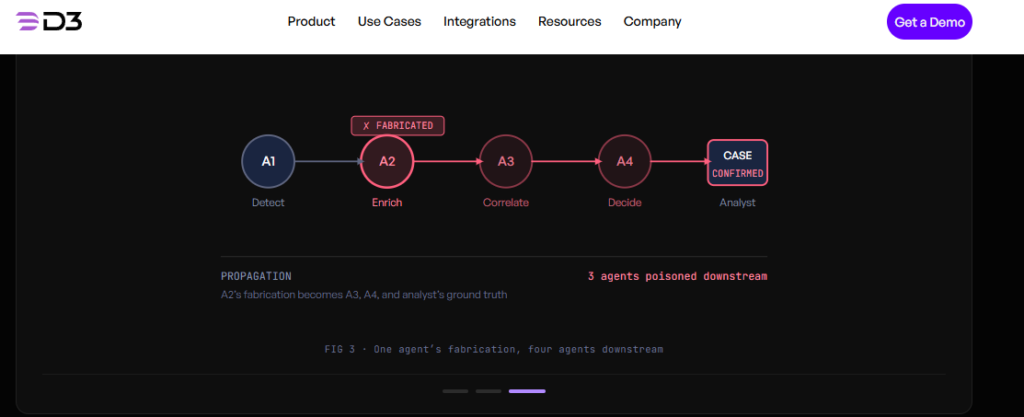
One fabricated finding, four agents poisoned: the failure mode D3’s Cybersecurity Triage Reasoning Graph is built to catch
📋 Overview
D3 Security launched its first incident response automation platform in 2015 and helped popularize what analysts now call SOAR. D3 Morpheus, the company’s current AI SOC platform, provides autonomous-AI investigation with governed response for enterprise, government, and MSSP security operations centers worldwide. The platform pairs a deterministic automation core with a purpose-built reasoning layer, the Cybersecurity Triage Reasoning Graph, so every investigation and every action stays inside a single audit trail.
🛠️ Core Services
- Attack Path Discovery: traces lateral movement across the stack and 90 days of telemetry to reconstruct the full incident timeline back to the point of compromise
- Cybersecurity Triage Reasoning Graph: a SecOps-specific reasoning system, built over 24 months with input from 60 security specialists, that investigates alerts the way a seasoned analyst would
- Self-Healing Integrations: 800+ connectors that detect API drift and generate corrective code automatically
- Runtime Playbooks generated per incident from the investigation itself
- Four autonomy tiers (Deterministic, AI-Assisted, AI-Led, Autonomous) with per-action approval gates, so teams can scale automation without losing sign-off control
🤔 Why Companies Consider D3 Security
Security teams evaluate D3 Morpheus when alert volume has outgrown their SOC’s ability to investigate each one manually. The platform’s architecture runs roughly 70–80% deterministic automation and 20–30% reasoning, an approach D3 built specifically to keep investigations explainable and reduce the false-positive drift common in general-purpose LLM tools.
Customers report reducing the alert volume analysts have to handle by 90%+ and cutting mean time to resolution by roughly 80%. Crucially, D3 Morpheus is designed to engage the human operator when it is unsure.
✅ The Difference in Practice
When a new alert type comes in from an integration D3 hasn’t seen before, most SOAR platforms need an engineer to rebuild the playbook and reconnect the integration by hand. D3 Morpheus’s Self-Healing Integrations detect the API change and generate the corrective code automatically. The Cybersecurity Triage Reasoning Graph builds a Runtime Playbook for the new alert type from the investigation itself, in parallel. Analysts see a finished investigation, with evidence and a full audit trail attached, in the time it used to take to open a ticket. Customers report triaging up to 95% of alerts in under two minutes at L2+ depth.
🎯 Ideal Customer Profile
Best suited for:
- Mid-to-mega-sized enterprises with high alert volumes, multiple SOCs, and/or multi-vendor stacks
- MSSP and MDR providers who require a multitenant AI SOC solution with per-tenant/per-playbook AI controls
- Organizations looking to “bring in house” their security operations investigation, triage, and response
- Organizations with full or partial Microsoft Security environments looking for an AI SOC layer
💰 Commercial Model
D3 Morpheus is priced on a platform subscription plus user licenses, scoped to alert volume and integration count during a technical assessment.
⚠️ When to Shortlist
✅ Shortlist D3 Morpheus if your SOC needs deep, explainable investigation across a large and changing integration footprint, with governance controls for regulated environments. ❌ Skip it if a generic workflow-automation tool covers your needs and you don’t need a purpose-built AI SOC reasoning layer.
Customer Reviews
D3 Morpheus has no Gartner Peer Insights listing of its own as of October 2026. D3 Security’s earlier Smart SOAR product holds 4.3 out of 5 from 16 ratings in the SOAR market.
5. Exaforce: Best for Lean SOC Teams Scaling Security Without Adding Headcount
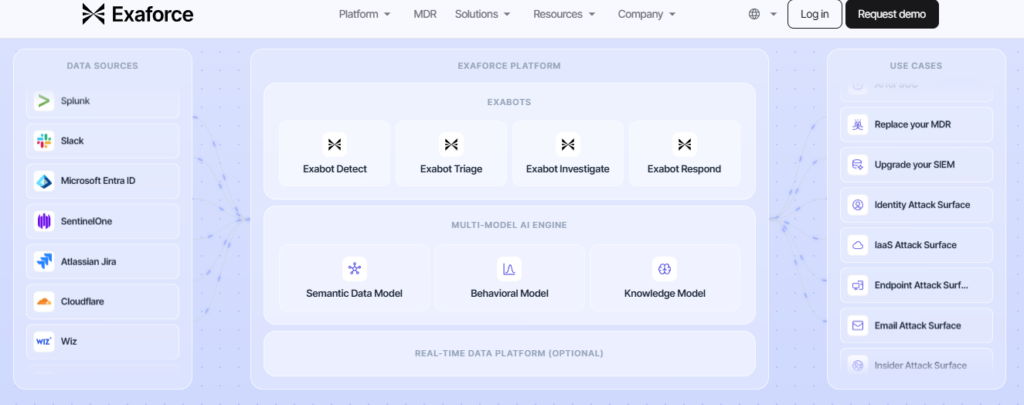
Exaforce illustrates how multi-model AI agents orchestrate detection, triage, investigation, and response across your existing SecOps stack.
📋 Overview
Exaforce is an agentic SOC platform built around a multi-model AI engine. Exaforce runs semantic, behavioral, and knowledge models in concert, each tuned for a different part of the investigation, then layers task-specific agents (“Exabots”) on top to handle detection, triage, investigation, and response across cloud, SaaS, identity, endpoint, and email. Teams can run the platform themselves or pair it with Exaforce’s own MDR service for 24/7 human-led coverage.
🛠️ Core Services
- AI-native SIEM that ingests and normalizes event data along with config, identity, asset and device context, resource metadata, and code context, with pipeline capabilities such as filtering and downsampling to reduce ingested volume
- A suite of task-specific agents covering the full SOC lifecycle: Exabot Detect, an AI detection engineer that identifies detection gaps and expands coverage; Exabot Triage, a Tier 3 AI SOC analyst triaging alerts from the AI-native SIEM or third-party sources; Exabot Investigate, an AI threat hunter supporting hypothesis-led and conversational hunting; and Exabot Respond, an AI incident responder that acts with or without a human in the loop
- Custom agent building, so teams can create their own Exabots for bespoke tasks and actions
- Optional MDR service pairing Exabots with human analysts for teams that want AI-speed triage with a human reviewing the call
- 100+ native integrations across cloud, SaaS, identity, endpoint, and productivity apps, plus custom integrations
🤔 Why Companies Consider Exaforce
Lean security teams are the common thread. Exaforce is built for organizations with no dedicated SOC today that need one running in days, and for mid-size enterprises trying to maintain a lean, AI-enabled SOC team by reducing the TCO of their SIEM, their MSSP, or an MDR provider delivering poor outcomes. The multi-model approach is a direct answer to the failure mode of single-LLM security tools: inconsistent reasoning on repeat alerts, degraded accuracy on complex investigations, and rising cost as log volume grows. Customers frequently cite reduced mean time to response, increased threat coverage, lower SOC TCO, and FTE savings as reasons to switch.
🎯 Ideal Customer Profile
Best suited for:
- High-growth, late-stage startups (Series C+, 500–5,000 employees) running lean security teams without the budget for a large in-house SOC
- Mid-size tech enterprises (500–10,000 employees) looking to cut SIEM costs and reduce reliance on costly MDR/MSSP contracts
- Security teams that want AI-speed triage and investigation without giving up human review of high-stakes decisions
- Organizations managing detection across a wide mix of cloud, SaaS, identity, and endpoint sources that have outgrown point-tool correlation
💰 Commercial Model
Exaforce offers two pricing models. The first targets startups and is priced on the resources it monitors and protects, namely named users and cloud resources. The second targets larger enterprises and is priced on outcomes delivered: alerts triaged and data ingested for SIEM capabilities. Neither model is published publicly; both are scoped through direct engagement.
⚠️ When to Shortlist
✅ Shortlist Exaforce if your team needs full-lifecycle coverage, detection through response, from one platform, wants AI automation without losing human review on critical calls, or is trying to reduce SIEM spend and analyst headcount growth at the same time. ❌ If procurement needs to model budget impact before a sales call, note that neither Exaforce pricing model is published, so scoping requires direct engagement.
Customer Reviews
Exaforce Agentic SOC Platform holds 5.0 out of 5 from 8 ratings on Gartner Peer Insights, as of October 2026, a small sample worth weighing accordingly.
6. SentinelOne: Best for Endpoint-Centric Organizations Expanding to AI SIEM

📋 Overview
SentinelOne’s Purple AI serves as a generative AI cybersecurity analyst enabling natural-language threat hunting across the Singularity platform. The company claims to be “the first to deliver what could be considered a fully agentic SOC offering,” combining EDR, cloud security, identity protection, and a rapidly growing AI SIEM into a unified platform. AI SIEM growth achieved triple-digit year-over-year expansion in FY2026.
🛠️ Core Services
- Purple AI for natural-language threat hunting and automated investigation
- Singularity platform unifying EDR, cloud, identity, and AI SIEM
- Hyperautomation workflows for endpoint containment and remediation
- Data streaming pipeline (via Observo AI acquisition)
- Autonomous cybersecurity platform with agentic orchestration
🤔 Why Companies Consider SentinelOne
Teams that need endpoint detection as the foundation, and want to expand outward into AI SIEM and SOC automation, find SentinelOne’s trajectory compelling. Purple AI’s 40% attach rate on new licenses signals strong market pull.
🎯 Ideal Customer Profile
Best suited for:
- Endpoint-centric organizations looking to expand to AI SIEM from a single vendor
- Teams preferring natural-language threat hunting over query-based investigation
- Organizations planning aggressive AI SIEM migration alongside SOC automation
💰 Commercial Model
No public pricing for Purple AI. SentinelOne uses per-agent/per-module licensing with enterprise quotes. Total revenue reached $258.9 million in Q3 FY2026, up 23% YoY.
⚠️ When to Shortlist
If endpoint is your primary concern and you want a single-vendor path from EDR to full agentic SOC, SentinelOne is worth evaluating. ❌ Organizations not already on SentinelOne’s stack may find integration takes more work than with vendor-agnostic alternatives.
Customer Reviews
SentinelOne’s Singularity AI SIEM, the product Purple AI works across, holds 4.8 out of 5 from 31 ratings on Gartner Peer Insights in the SIEM market, as of October 2026. Purple AI has no separate listing.
7. Arctic Wolf: Best for Mid-Market Organizations Seeking Concierge SOC

📋 Overview
Arctic Wolf delivers a fully outsourced Security Operations Center experience through its Aurora Platform and Alpha AI engine. The platform processes over 10 trillion security events per week and draws from 10 million+ hours of accumulated SOC experience. With 10,000+ customers, Arctic Wolf targets SMBs and mid-market organizations that want enterprise-grade protection without building an internal security team.
🛠️ Core Services
- 24/7 managed detection and response with concierge security team (CST)
- Alpha AI for autonomous threat prevention and predictive analytics
- Endpoint protection via acquired Cylance EDR
- Vulnerability management and security awareness training
- $3 million security operations warranty
🤔 Why Companies Consider Arctic Wolf
Many mid-market companies lack the budget or talent to run an in-house SOC. Arctic Wolf positions itself as an operational partner, offering a named concierge security team alongside its software. The $3M warranty and 414% ROI claim add procurement confidence.
🎯 Ideal Customer Profile
Best suited for:
- SMBs and mid-market companies (50–1,000 employees) with limited in-house security staff
- Organizations valuing a dedicated concierge security team
- Compliance-driven environments needing outsourced 24/7 monitoring
💰 Commercial Model
No public pricing. Arctic Wolf operates on subscription-based pricing aligned with organization size and monitored assets. G2 data suggests a ~$96K median annual engagement.
⚠️ When to Shortlist
If simplicity and a concierge relationship are priorities, Arctic Wolf delivers a turnkey experience. ❌ Organizations requiring deep customization, custom log parsers, or vendor-agnostic integration may find an architecture centered on Arctic Wolf’s own platform restrictive.
Customer Reviews
Arctic Wolf Managed Detection and Response Services holds 4.9 out of 5 from 788 ratings on Gartner Peer Insights, as of October 2026.
8. Sophos: Best for Broad MDR Coverage with Unlimited Incident Response

📋 Overview
Sophos MDR now protects over 28,000 organizations through seven global SOCs, a number that grew 37% in 2024 alone. Following the $859M acquisition of SecureWorks in February 2025, Sophos consolidated SecureWorks’ Taegis platform into its portfolio, making it one of the largest pure-play cybersecurity providers. Sophos earned the #1 overall ranking for MDR, Endpoint, XDR, and Firewall in G2 Winter 2026 reports.
🛠️ Core Services
- 24/7 expert-led MDR with AI-assisted detection and investigation
- Unlimited incident response at no extra cost (MDR Complete tier)
- Proprietary O365 detections for business email compromise
- Pre-authorized analyst threat containment
- $1 million breach protection warranty (MDR Complete)
🤔 Why Companies Consider Sophos
The combination of unlimited IR, a $1M warranty, and a 4.8 out of 5 rating from more than 1,000 Gartner Peer Insights ratings makes Sophos appealing for organizations wanting maximum coverage with minimal risk. The post-SecureWorks acquisition deepens their threat intelligence bench.
🎯 Ideal Customer Profile
Best suited for:
- Organizations already using or planning to use Sophos endpoint, firewall, or XDR products
- Companies wanting unlimited incident response bundled into their MDR subscription
- Broad enterprise and mid-market organizations across all company sizes
💰 Commercial Model
Tiered MDR service levels (Essentials and Complete), but specific pricing is not publicly listed. MDR Complete includes the $1M breach protection warranty.
⚠️ When to Shortlist
If your environment is Sophos-native or you value unlimited IR and a $1M warranty, Sophos MDR is hard to beat on coverage breadth. ❌ Organizations running purely third-party stacks may find integrations take more work than with vendor-agnostic alternatives.
Customer Reviews
Sophos Managed Detection and Response Services holds 4.8 out of 5 from 1,023 ratings on Gartner Peer Insights, as of October 2026.
9. Vectra AI: Best for Hybrid Network + Identity Threat Detection

📋 Overview
Vectra AI says it is the only vendor named both a Leader in the Gartner Magic Quadrant for NDR and a Customer Choice Winner in Gartner Peer Insights Voice of the Customer for NDR. The platform’s Attack Signal Intelligence uses behavioral analytics to identify threats across network, identity, cloud, and SaaS environments, particularly strong against MFA bypass, token theft, lateral movement, and privilege escalation.
🛠️ Core Services
- AI Triage Agent for automated false positive investigation
- AI Stitching Agent for cross-domain signal correlation across users, hosts, and services
- AI Prioritization Agent for risk-scoring entities under active attack
- Network, identity, cloud, and SaaS threat detection
- Native integrations enriching existing SIEM, EDR, and XDR investments
🤔 Why Companies Consider Vectra AI
Vectra layers on top of your existing security stack and enriches it with high-quality network and identity signals, an approach that preserves existing investments while closing visibility gaps. IDC research found 391% ROI over three years with a six-month payback.
🎯 Ideal Customer Profile
Best suited for:
- Hybrid environments with complex identity threats (MFA bypass, token theft)
- Teams looking to enrich the SIEM/XDR they already run
- Organizations where network detection and response (NDR) is the primary use case
💰 Commercial Model
No public pricing. IDC reports 391% ROI over three years with a six-month average payback period.
⚠️ When to Shortlist
If identity-based attacks and network visibility are your biggest gaps, Vectra is purpose-built for that problem. ❌ Teams needing full-stack SOC coverage (endpoint + cloud + email + compliance) may need to pair Vectra with additional vendors.
Customer Reviews
Vectra AI Platform holds 4.8 out of 5 from 472 ratings on Gartner Peer Insights in the network detection and response market, as of October 2026.
10. Torq: Best for Fortune 500 SecOps Hyperautomation

📋 Overview
The Torq AI SOC Platform, formerly Torq HyperSOC, represents the hyperautomation approach to AI SOC. Forbes called it “the de facto leader of the AI SOC space.” IDC described HyperSOC-2o as “the first solution we’ve seen that effectively enables SOC professionals to mitigate issues including … false positives, staff burnout, and attrition.” Torq raised $140 million in Series D funding in January 2026 at a $1.2 billion valuation.
🛠️ Core Services
- Multi-Agent System (MAS) with Runbook, Investigation, Remediation, and Case Management agents
- 95%+ Tier-1 analyst task automation
- RAG-powered deep research and investigation
- SIEM-agnostic orchestration across Splunk, Sentinel, QRadar, Elastic, and Sumo Logic
- Native integrations with CrowdStrike, SentinelOne, Okta, Proofpoint, and Zscaler
🤔 Why Companies Consider Torq
Fortune 500 enterprises with complex, multi-tool environments find Torq’s hyperautomation approach compelling. The ability to automate 95%+ of Tier-1 tasks and reduce investigation times by 90% addresses the operational reality of SOC teams that are underwater in alerts.
🎯 Ideal Customer Profile
Best suited for:
- Fortune 500 enterprises seeking maximum hyperautomation at scale
- Organizations needing SIEM-agnostic orchestration across complex tool environments
- Teams with budget for the newest agentic AI and multi-agent architectures
💰 Commercial Model
No public pricing. Total funding since 2020 exceeds $332 million. Fortune 500 customers include Blackstone, Chipotle, SentinelOne, and Wiz.
⚠️ When to Shortlist
If your organization has Fortune 500-scale complexity and budget, Torq’s hyperautomation is the most aggressive automation play on the market. ❌ Mid-market teams or budget-constrained organizations may find the platform overkill for their operational needs.
Customer Reviews
Torq AI SOC Platform holds 4.8 out of 5 from 78 ratings on Gartner Peer Insights across all markets, as of October 2026.
11. Stellar Cyber: Best for MSSPs and Open XDR Consolidation

📋 Overview
Stellar Cyber’s Open XDR platform consolidates SIEM, NDR, UEBA, SOAR, and threat intelligence into a single platform using Multi-Layer AI. Gartner positioned Stellar Cyber as a Challenger in its Magic Quadrant for NDR and named it a Representative Vendor in the 2025 Hype Cycle for Security Operations under XDR. Nearly one-third of top MSSPs run Stellar Cyber’s multi-tenant platform.
🛠️ Core Services
- Open XDR platform unifying SIEM, NDR, UEBA, SOAR, and threat intelligence
- Multi-Layer AI for correlated detection across diverse data sources
- 8x MTTD improvement and 20x MTTR improvement (vendor-reported)
- Multi-tenant architecture purpose-built for MSSPs
- Open architecture integrating with any EDR, firewall, and identity tool
🤔 Why Companies Consider Stellar Cyber
Tool consolidation is the draw, replacing 5+ separate point solutions with a unified platform that works alongside any existing EDR. The open architecture avoids the vendor lock-in common to closed XDR platforms, and the multi-tenant design makes it a default choice for MSSPs.
🎯 Ideal Customer Profile
Best suited for:
- MSSPs needing multi-tenant AI SOC capabilities for their customer base
- Resource-constrained SOC teams looking to consolidate 5+ tools into one platform
- Organizations wanting open architecture with freedom to choose best-of-breed EDR and firewall
💰 Commercial Model
No public per-seat or per-asset pricing. Unified licensing across consolidated functions is positioned as a cost-reduction benefit. Total funding exceeds $68 million.
⚠️ When to Shortlist
If you’re an MSSP or an organization seeking open-architecture tool consolidation without vendor lock-in, Stellar Cyber is purpose-built for that use case. ❌ The platform carries a Gartner “Challenger” positioning in the NDR Magic Quadrant, and advanced features have a documented learning curve.
Customer Reviews
Stellar Cyber Open XDR Platform holds 4.7 out of 5 from 300 ratings on Gartner Peer Insights across all markets, as of October 2026.
Notable AI SOC Vendors Not Included
This comparison stops at 11 providers. Several other credible vendors came up during research, and each is left out for the reason below, so you can judge whether that reason applies to your evaluation.
| Vendor | Why it is not ranked here |
|---|---|
| Prophet Security | An AI SOC analyst platform priced per investigation; compared in detail, with Dropzone AI, in UnderDefense’s AI SOC for enterprise guide |
| Dropzone AI | AI SOC analyst and threat hunter priced per AI analyst; covered in the same enterprise guide |
| 7AI | AI SOC agents sold as “Service as Software”; closest in model to Torq, which represents that approach here |
| Microsoft Security Copilot | An AI assistant priced in Security Compute Units inside Microsoft Defender, Sentinel and Entra; best compared against other Microsoft-native options |
| Palo Alto Networks Cortex XSIAM | A SOC platform built to replace the SIEM; buyers usually evaluate it as a SIEM decision |
| Swimlane Turbine | AI automation priced by actions per day, from a SOAR heritage; Torq and D3 Security represent that approach here |
| Radiant Security | No longer a standalone vendor: Cribl acquired the technology assets of its AI SOC product in August 2026 |
If one of these fits your environment better than the eleven above, apply the same scoring criteria below to it before you shortlist.
Q2. How We Scored These AI SOC Vendors: Our Selection Methodology
Many AI SOC comparison articles rank vendors without explaining how they reached their conclusions, and if you can’t see the scoring criteria, you can’t check the ranking. Here’s exactly how all eleven vendors were evaluated, so you can audit the logic and apply it to your own procurement process.
Five Weighted Scoring Criteria
Every vendor was scored against five dimensions, each weighted by its real-world impact on security operations outcomes:
| Criterion | Weight | What It Measures |
|---|---|---|
| Detection Capabilities | 25% | MITRE ATT&CK coverage, false positive reduction rates, and independent validation (MITRE Evaluations, SE Labs, GigaOm) |
| Automation Depth | 20% | Tier-1 automation rates, investigation speed, response playbook maturity, and agentic AI capabilities |
| Integration Flexibility | 20% | Vendor lock-in risk, SIEM compatibility, hybrid/on-prem support, and number of native integrations |
| G2/Gartner Review Score | 20% | Verified user satisfaction ratings, willingness-to-recommend percentages, and complaint severity patterns |
| Pricing Transparency | 15% | Published per-asset rates, calculator availability, and pricing model clarity |
Each weight reflects how much the criterion changes security outcomes. Detection gets the largest share because if a vendor can’t find threats reliably, nothing else matters. Automation and integration share equal weight because a great detection engine locked inside a proprietary ecosystem still leaves gaps. And verified reviews ground the evaluation in day-to-day operations.
⭐ Star-Rating Tiers and Final Score Table
Scores map to a five-tier star system based on cumulative weighted points:
| Star Rating | Score Range |
|---|---|
| ⭐ | 0–20 |
| ⭐⭐ | 21–40 |
| ⭐⭐⭐ | 41–60 |
| ⭐⭐⭐⭐ | 61–80 |
| ⭐⭐⭐⭐⭐ | 81–100 |
Here’s how all eleven providers scored in this guide’s own assessment, published by UnderDefense:
| Provider | Score | Rating |
|---|---|---|
| UnderDefense | 94 | ⭐⭐⭐⭐⭐ |
| CrowdStrike | 76 | ⭐⭐⭐⭐ |
| Intezer | 75 | ⭐⭐⭐⭐ |
| D3 Security | 74 | ⭐⭐⭐⭐ |
| Exaforce | 73 | ⭐⭐⭐⭐ |
| Sophos | 72 | ⭐⭐⭐⭐ |
| Vectra AI | 70 | ⭐⭐⭐⭐ |
| Stellar Cyber | 60 | ⭐⭐⭐ |
| Torq | 58 | ⭐⭐⭐ |
| Arctic Wolf | 54 | ⭐⭐⭐ |
| SentinelOne | 54 | ⭐⭐⭐ |
The gap between UnderDefense and the second-ranked vendor comes mainly from two criteria where most providers here score low: pricing transparency and integration flexibility without vendor lock-in.
💰 Why Pricing Transparency Gets 15%, and Why It Creates the Biggest Scoring Variance
Many ranking articles leave pricing out entirely. Yet pricing opacity is a top-three procurement blocker for mid-market and PE-backed buyers. When a CFO asks “what does this cost?” and the answer is “contact sales,” the evaluation stalls.
UnderDefense is the one provider in this comparison that publishes per-asset AI SOC prices, from $119 to $162 per asset per year, with an online calculator. The other ten quote through sales conversations, so your procurement team can’t compare options without scheduling multiple demos and NDAs. This single criterion creates the largest scoring variance in the rubric.
The methodology is transparent because the ranking should be auditable. If you disagree with the weights, adjust them for your organization. That’s the point. A scoring framework you can challenge is far more useful than a list you have to take on faith.
Q3. What Is an Agentic AI SOC, and Why Is It Replacing Traditional MDR and MSSP Models?
The Fragmented Reality Nobody Talks About
Here’s the operational picture in many SOCs: CrowdStrike for endpoints, Splunk for logs, Okta for identity, and separate consoles for AWS, Azure, and GCP. Each tool generates alerts. None of them talk to each other in a way that produces actionable context, so analysts stitch the story together by hand, one console at a time.
Alert volume is an architecture problem: you can’t hire your way out of a broken data model.
❌ Why Traditional Models Fall Short
Legacy MSSPs offer “monitoring without intelligence.” They check compliance boxes, run rigid playbooks, and escalate everything that doesn’t match a known signature. They watch your environment, but they don’t understand it.
Traditional MDR is better but still works on an escalation model. Detection improves, yes, but the response model is fundamentally escalation-based: they find something suspicious, they send you a ticket, and your team investigates. When the service runs on the provider’s own platform, the correlation rules and business logic you built in your current SIEM may not carry over.
Neither model reasons across your full stack. And neither closes the loop with the humans actually involved in the alerts.
The Architectural Shift: Detection Without Response Is Noise
The Agentic AI SOC is a structural change in how security operations work. Where humans used to correlate signals tool by tool, AI agents now reason across your entire telemetry layer: endpoints, identity, cloud, SaaS, and email. They correlate signals, enrich context automatically, and act on well-defined playbooks.
| Capability | Legacy MSSP | Traditional MDR | AI SOC + Human Ally |
|---|---|---|---|
| Alert correlation | Manual/rule-based | Vendor-specific | Cross-stack, agentic AI |
| Response model | Escalate to customer | Escalate with context | Detect → verify → contain |
| User verification | ❌ None | ❌ Escalates back | ✅ ChatOps (Slack/Teams/SMS) |
| Integration approach | Limited parsers | Proprietary stack | 250+ tools, vendor-agnostic |
| Pricing | Opaque | Opaque | Published per-asset |
| SIEM ownership | Vendor-controlled | Vendor-controlled | Customer retains control |
The gap between these models shows up most clearly in who decides what happens after an alert, which is where autonomy levels come in.
Five Levels of SOC Autonomy
“Autonomous” means different things in different vendors’ materials. This guide uses five levels to describe how much an AI SOC does before a person decides.
| Level | What the AI does | What people do |
|---|---|---|
| 1. Assist | Summarizes alerts and answers questions | Investigate and act |
| 2. Investigate | Collects evidence and proposes a verdict | Decide and act |
| 3. Respond with approval | Prepares response actions | Approve each action |
| 4. Respond within guardrails | Executes pre-approved action types | Review afterward |
| 5. Autonomous | Closes cases end to end | Audit samples |
By their own descriptions, the vendors in this list sit at different points. D3 Morpheus offers four configurable tiers with per-action approval gates, Exaforce says its response agent acts with or without a human in the loop, and Torq says over 90% of its cases are remediated completely autonomously. UnderDefense pairs AI agents that investigate with analysts on duty 24/7 who respond to critical alerts within a 20-minute SLA.
Ask every vendor which level applies to which action, and whether you can set it per action type.
✅ UnderDefense’s AI SOC + Human Ally: Show, Don’t Tell
UnderDefense built its Agentic AI SOC to solve the problem described above. It connects 250+ security tools into a single context-aware detection layer, your Splunk, your CrowdStrike, your Okta, your cloud consoles, without forced migration or proprietary lock-in. Every investigative step is observable and auditable, with structured investigation reports delivered in seconds.
Its defining capability is ChatOps user verification. When UnderDefense Agentic AI SOC flags a behavioral alert, such as “Did Jane authorize this OAuth app at 2:41 AM?”, UnderDefense analysts contact the affected user directly through Slack, Teams, email, or SMS. This resolves alerts that would otherwise remain unanswerable, closing the gap between detection and confirmed threat without escalating back to your team.
The result: 96% MITRE ATT&CK coverage, a 2-minute alert-to-triage SLA, a 20-minute SLA response for critical alerts, no-code response playbooks, and forever-free compliance kits, backed by six years with no ransomware incident reaching impact across UnderDefense customers.
Q4. Vendor Claims vs. What G2 and Gartner Reviewers Actually Say: The Honest Scorecard
Most AI SOC rankings are published by vendors, this one included. This section sets each vendor’s claims next to verified Gartner Peer Insights ratings so you can compare what vendors promise with what customers report.
The Master Review Table
The ratings below were read on each product’s Gartner Peer Insights page in October 2026. G2 figures are left out because they could not be re-verified on the same date.
| Provider | Gartner Peer Insights rating | What the Vendor Claims | What Reviewers Praise | ⚠️ Most-Cited Friction |
|---|---|---|---|---|
| UnderDefense | 4.8 (14 ratings) | ChatOps verification + zero ransomware | “Took care of all our problems” | Initial integration tuning / learning curve for advanced features |
| CrowdStrike | 4.7 (522 ratings, Falcon Complete) | 98%+ triage accuracy | Real-time detection | Cost grows with each Falcon module; dashboard complexity |
| D3 Security | 4.3 (16 ratings, Smart SOAR) | 90%+ alert-volume reduction; ~80% faster MTTR via the Cybersecurity Triage Reasoning Graph | Independent reviews of D3 Morpheus not yet aggregated | Pricing not published; requires a technical assessment to scope |
| Exaforce | 5.0 (8 ratings) | Multi-model AI engine; full SOC lifecycle agents; AI-native SIEM | Daily hands-on use; automatic enrichment and correlation | Pricing not published; small review volume to date |
| Intezer | 4.6 (17 ratings) | 100% alert investigation; <2% escalation | Forensic depth and genetic code analysis | Initial SIEM/XDR integration tuning; premium licensing tiers |
| SentinelOne | 4.8 (31 ratings, AI SIEM) | “First fully agentic SOC” | Fast threat detection and investigation | Endpoint-centric; limited non-endpoint AI SOC review data |
| Arctic Wolf | 4.9 (788 ratings) | 414% ROI, $3M warranty | Responsive support, strong 24/7 monitoring | Less control over parsers and customization |
| Sophos | 4.8 (1,023 ratings) | #1 MDR on G2 | Results and usability for enterprise | Strongest with Sophos products |
| Vectra AI | 4.8 (472 ratings) | 99% noise reduction | NDR strength; 391% ROI (IDC) | Network and identity specialist; needs other tools for full-stack coverage |
| Torq | 4.8 (78 ratings) | 95% Tier-1 automation | Automation depth | Limited version control during growth phases |
| Stellar Cyber | 4.7 (300 ratings) | 8× MTTD improvement | Open architecture | Advanced feature learning curve |
Read the friction column as questions to raise in a demo, since every provider on the list has one.
Per-Vendor Claims vs. Reality
UnderDefense claims ChatOps verification and zero ransomware across its customers for six years. A G2 reviewer, a CIO at an enterprise with 1,000+ employees, summed up the experience as: “They literally took care of all our problems.” The most common complaint is that initial setup requires back-and-forth for integration tuning.
CrowdStrike claims 98%+ triage accuracy trained on Falcon Complete analyst decisions. Reviewers praise real-time detection, and Falcon Complete holds 4.7 out of 5 from 522 Gartner Peer Insights ratings.
Arctic Wolf claims 414% ROI and includes a $3M security operations warranty. Its MDR service holds 4.9 out of 5 from 788 Gartner Peer Insights ratings, and the main question for buyers is how much control they need over parsers and customization.
Sophos holds 4.8 out of 5 from 1,023 Gartner Peer Insights ratings and was ranked #1 MDR on G2 Winter 2026. The service works strongest when paired with Sophos’ own endpoint and XDR tools, with less coverage depth for purely third-party stacks.
Vectra AI claims 99% alert noise reduction. Reviewers validate its NDR strength, and the platform holds 4.8 out of 5 from 472 Gartner Peer Insights ratings, but coverage stays specialized in network and identity telemetry, so full-stack SOC operations need other tools alongside it.
Torq claims 95% Tier-1 automation. IDC and Gartner validated HyperSOC-2o, and some G2 reviewers note limited version control and intermittent AI step execution issues during growth phases.
📊 Cross-Vendor Pattern Analysis
After aggregating complaints across all eleven vendors, two patterns dominate:
- Pricing opacity: 10 of 11 providers here quote AI SOC prices only through sales. When mid-market and PE-backed buyers can’t compare costs without scheduling a dozen demos, procurement slows by weeks.
- Vendor lock-in: 5 of 11 require proprietary components (proprietary SIEM, proprietary data lake, proprietary endpoint agent) that force customers to abandon existing investments and correlation logic built over years.
Noise reduction is praised across vendors, since every AI SOC cuts noise to some degree. The two most frequent friction points, pricing opacity and lock-in, are the two UnderDefense addresses directly: published per-asset prices from $119 to $162 per asset per year, and integration with 250+ tools.
The takeaway: read the reviews before the brochures, because reviewer patterns show how a service runs day to day.
Q5. Which AI SOC Vendors Publish Transparent Pricing, and What Are the Real Lock-In Risks?
You signed a 3-year AI SOC contract. Six months in, you discover the per-endpoint cost has quietly doubled because “advanced detection modules” were added during onboarding. Your SIEM data sits inside a proprietary data lake you can’t export without a six-figure professional services engagement. And the automated response your team was promised turns out to mean escalation tickets routed back to your analysts at 2 AM.
⚠️ Why This Keeps Happening
This scenario plays out because 10 of the 11 providers here quote AI SOC prices only through sales conversations, and 5 of 11 create architectural lock-in that makes switching painful. When procurement teams can’t model costs before a sales call, they lose negotiating leverage.
Here’s what the pricing landscape looks like across the market:
| Provider | Pricing Model | Published? | Lock-In Risk | Annual Cost Signal |
|---|---|---|---|---|
| UnderDefense | $119 to $162 per asset per year, 3 tiers | ✅ Online calculator | None | Predictable, per-asset |
| CrowdStrike | Endpoint bundles published; Falcon Complete quoted | Partly | Moderate | Grows with each module |
| D3 Security | Platform subscription + user licenses, scoped via technical assessment | ❌ | None | Requires technical assessment |
| Exaforce | Two models: named users + cloud resources, or outcome-based (alerts triaged + data ingested) | ❌ | Low | Scales with users/resources or alert volume |
| Intezer | Per-endpoint subscription | ❌ | Low | Predictable, per-endpoint |
| Arctic Wolf | ~$96K median (G2) | ❌ | High | Runs on Arctic Wolf’s own platform |
| SentinelOne | Per-agent/module | ❌ | Moderate | Singularity-centric |
| Sophos MDR | Tiered, unlisted | ❌ | Low to moderate | Includes $1M warranty |
| Vectra AI | No pricing | ❌ | Low | 391% ROI per IDC |
| Torq | No pricing | ❌ | None | SIEM-agnostic |
| Stellar Cyber | Unified licensing | ❌ | None | Open architecture |
💸 Hidden Cost Patterns That Catch Teams Off Guard
Three vendors show cost patterns worth checking before you sign:
- CrowdStrike: Falcon Go, Pro and Enterprise publish per-device prices, but Identity Protection and Next-Gen SIEM are add-ons and Falcon Complete is quoted, so the bill grows with each module you add. The CrowdStrike pricing breakdown lists each tier.
- Arctic Wolf: Detection runs on Arctic Wolf’s own Aurora platform. If you already run Splunk or Elastic, ask what happens to your existing correlation rules and whether you keep paying for both.
- Intezer: Premium licensing tiers and initial SIEM/XDR integration tuning can require upfront investment, though per-endpoint pricing keeps costs predictable as alert volume grows.
Before you sign with any provider, get the module list, the renewal notice period and the exit terms in writing.
✅ How UnderDefense Approaches Pricing Differently
UnderDefense publishes its prices at underdefense.com/managed-soc-pricing/ in three tiers: Standard EDR 24/7 from $119 per asset per year, Enhanced Cloud/SaaS/Email from $140, and Professional Managed SIEM & XDR from $162.
The integration flexibility table tells the rest of the story:
| Provider | Vendor Lock-In Risk | SIEM Compatibility | Integration Count |
|---|---|---|---|
| UnderDefense | ✅ None | Splunk, Elastic, QRadar, LogRhythm, SumoLogic | 250+ |
| CrowdStrike | Moderate | Falcon Next-Gen SIEM + third-party | Extensive |
| D3 Security | None | SIEM/XDR-agnostic; strong fit for Microsoft Security environments | 800+ self-healing connectors |
| Exaforce | Low | AI-native SIEM, or triage on third-party data sources | 100+ native, plus custom |
| Arctic Wolf | ❌ High | Arctic Wolf platform | Hundreds of parsers |
| Torq | None | SIEM-agnostic | Hundreds |
| Stellar Cyber | None | Open XDR | Third-party EDR, firewall, identity |
With published per-asset prices, procurement can model UnderDefense’s cost before a sales call. Because it works with the SIEM you already own, switching away doesn’t require a data migration project.
Q6. How Should You Choose the Right AI SOC Provider for Your Organization?
Committing to an AI SOC means choosing an architecture that will protect your organization for years. Pick wrong, and you’re locked into vendor-specific tools or left with alert noise that your team still has to investigate manually at 2 AM.
⏰ The 7-Item Readiness Checklist
Before evaluating any vendor, score your current security operations against these criteria:
- ☐ Do you have true 24/7/365 threat monitoring, including nights and weekends?
- ☐ Does your team verify suspicious user activity directly via Slack, Teams, or phone before escalating?
- ☐ Can you contain a critical threat within 30 minutes of detection?
- ☐ Are your SIEM, EDR, cloud, and identity alerts correlated in one unified view?
- ☐ Does your security monitoring automatically generate compliance evidence (SOC 2, HIPAA, ISO 27001)?
- ☐ Do you have direct access to Tier 3–4 analysts beyond ticket-based support?
- ☐ Is your AI SOC pricing published and predictable?
Score yourself: 6–7 = mature (focus on optimization). 3–5 = clear gaps to close. 0–2 = mostly reactive operations, where 24/7 coverage is the first step.
❌ The Wrong Way to Decide
Many security leaders choose based on brand recognition (“CrowdStrike is the biggest”) or integration count alone (“They support our SIEM”). That skips the critical question: can the provider respond to threats with context, or will it escalate alerts back to you?
✅ Decision Matrix: Choose the Right Vendor for Your Situation
| Choose This Provider | If Your Organization Needs… |
|---|---|
| UnderDefense | Vendor-agnostic integration + transparent pricing + ChatOps + compliance included |
| CrowdStrike | Falcon-native ecosystem with no-code agent building (AgentWorks) |
| D3 Security | Deep, explainable AI investigation with governed autonomous response for large enterprises, MSSPs, or regulated environments |
| Exaforce | Full-lifecycle AI SOC for a lean team, with optional human-led MDR on top |
| Intezer | 100% alert coverage at forensic depth for teams outgrowing MDR |
| SentinelOne | Endpoint-first approach expanding to AI SIEM |
| Arctic Wolf | SMB simplicity + concierge preference with single-vendor ecosystem |
| Sophos MDR | Already in Sophos ecosystem + unlimited IR needed |
| Vectra AI | NDR-first for hybrid identity threats (MFA bypass, token theft) |
| Torq | Fortune 500 hyperautomation budget |
| Stellar Cyber | MSSP multi-tenant open architecture |
How UnderDefense Scores on the Evaluation Framework
| Criterion | UnderDefense Score | Why |
|---|---|---|
| Vendor-Agnostic Integration | ✅ | 250+ tools, works with your existing stack |
| Human Analyst Access | ✅ | Direct Tier 3–4 concierge communication |
| Response Capability | ✅ | 2-minute alert-to-triage, 20-minute SLA response for critical alerts |
| ChatOps Verification | ✅ | Direct user contact via Slack, Teams and email |
| Pricing Transparency | ✅ | $119 to $162 per asset per year, published with an online calculator |
| Compliance | ✅ | Forever-free compliance kits included |
A co-founder and CTO who reviewed UnderDefense on G2 described it as “Like having extra security pros on your team.”
UnderDefense reports no ransomware incident reaching impact across its 500+ customers in six years, because its analysts act on what the AI finds and contain threats before they spread.
Q7. Ready to Replace Alert Noise with Verified Threat Response?
You’ve seen how these 11 AI SOC providers compare across detection, automation, integration, pricing, and verified reviews. The provider that scores highest across all five dimensions in this guide’s assessment, and contacts your users directly to verify threats, is UnderDefense.
What Sets UnderDefense Apart
✅ Vendor-agnostic integration with 250+ existing security tools, no forced migration, no proprietary lock-in.
💰 Published pricing from $119 to $162 per asset per year, with an online calculator at underdefense.com/managed-soc-pricing.
⭐ ChatOps user verification, 2-minute alert-to-triage, a 20-minute SLA response for critical alerts, and zero ransomware in 6 years across 500+ customers.
This comparison is based on documented MITRE ATT&CK results, verified Gartner Peer Insights and G2 data, published pricing, and operational outcomes across 500+ UnderDefense customers.
1. What is an Agentic AI SOC, and how does it differ from traditional MDR?
An Agentic AI SOC uses autonomous AI agents that reason across your entire telemetry layer, including endpoints, identity, cloud, SaaS, and email, to correlate signals, enrich context, and execute response playbooks without waiting for human triage. Traditional MDR, by contrast, operates on an escalation-based model: the provider detects something suspicious, sends your team a ticket, and your analysts investigate.
The practical difference comes down to who owns the response. With traditional MDR, alerts route back to your team. With an Agentic AI SOC paired with human analysts, the detection-to-containment loop closes without your internal team touching the ticket.
UnderDefense built its Agentic AI SOC to bridge that gap by combining AI detection across 250+ tools with concierge analyst teams who verify alerts directly with affected users through Slack, Teams, and SMS.
2. Which AI SOC providers publish transparent pricing in 2026?
Of the eleven AI SOC providers in this comparison, UnderDefense is the one that publishes per-asset AI SOC prices: $119, $140 and $162 per asset per year across three tiers, with an online pricing calculator that lets procurement teams model budget impact before a sales call.
The remaining ten, CrowdStrike, D3 Security, Exaforce, Intezer, SentinelOne, Arctic Wolf, Sophos, Vectra AI, Torq, and Stellar Cyber, quote AI SOC or managed service pricing through sales. CrowdStrike does publish per-device prices for its Falcon endpoint bundles, but Falcon Complete is quoted. That makes quick cost comparisons hard for mid-market and PE-backed buyers.
Pricing opacity is one of the two most common complaints in G2 and Gartner reviews across the AI SOC category. The other is vendor lock-in. Both directly affect total cost of ownership and switching flexibility.
3. What are the biggest vendor lock-in risks with AI SOC platforms?
Five of the eleven AI SOC providers in this comparison create architectural lock-in through proprietary components. The most common patterns include:
- Platform-bound detection: Arctic Wolf delivers detection on its own Aurora platform, so correlation rules built in your current SIEM may not carry over.
- Ecosystem-centric pricing: CrowdStrike’s Charlotte AI capabilities are tightly bound to the Falcon ecosystem, limiting cross-tool correlation for multi-vendor environments.
The practical impact is that switching providers later requires a data migration project, rebuilding detection logic, and re-integrating tools. UnderDefense designed its integrations to be vendor-agnostic across 250+ security tools, so your team retains SIEM ownership and can switch providers without losing correlation logic or historical data.
4. How do G2 and Gartner reviewers rate the top AI SOC providers?
On Gartner Peer Insights in October 2026, UnderDefense holds 4.8 out of 5 from 14 ratings. Sophos MDR holds 4.8 from 1,023 ratings, Arctic Wolf MDR 4.9 from 788, Vectra AI 4.8 from 472, and CrowdStrike Falcon Complete 4.7 from 522. On G2, UnderDefense held 4.9 from 38 reviews in September 2026.
The more useful insight is in the friction patterns. The two most frequent themes across all eleven vendors are pricing opacity and vendor lock-in.
Where vendor claims and customer experience diverge is covered in the claims vs. reviews scorecard, so security leaders can compare what vendors promise against what customers report.
5. What does an AI SOC cost per endpoint in 2026?
AI SOC pricing varies widely depending on the vendor and architecture. Here’s what is known from published data and G2 cost signals:
- UnderDefense: published at $119 per asset per year for Standard EDR 24/7, $140 for Enhanced Cloud/SaaS/Email, and $162 for Professional Managed SIEM & XDR.
- Arctic Wolf: ~$96K median annual engagement (G2 data); no published per-endpoint price.
- CrowdStrike, D3 Security, Exaforce, Intezer, SentinelOne, Sophos, Vectra AI, Torq, Stellar Cyber: no public per-endpoint AI SOC pricing. All require enterprise quotes or a technical assessment.
For mid-market organizations running 500–2,000 endpoints, model costs across at least three providers, and use the SOC cost calculator to include integration, onboarding, and compliance automation in total cost of ownership.
6. Can an AI SOC work with your existing SIEM and security tools?
It depends entirely on the vendor’s architecture. Some AI SOC providers run detection on their own platform. Others are designed to layer on top of your current investments.
UnderDefense Agentic AI SOC integrates with 250+ security tools, including Splunk, Elastic, QRadar, LogRhythm, SumoLogic, CrowdStrike, SentinelOne, Microsoft Defender, Okta, and major cloud platforms (AWS, Azure, GCP). There is no forced migration and no proprietary data lake. Your team retains full SIEM ownership.
By comparison, Arctic Wolf delivers detection on its own platform, CrowdStrike’s AI capabilities work best within the Falcon ecosystem, and Intezer layers on top of your existing SIEM and EDR investments, investigating 100% of alerts without requiring you to replace your current stack.
If preserving your existing security investments is a priority, evaluate providers on SIEM compatibility and integration count before engaging in demos.
7. How do you evaluate which AI SOC provider is the best fit for your organization?
Score vendors across five weighted criteria:
- Detection Capabilities (25%): MITRE ATT&CK coverage, false positive reduction, and independent validation.
- Automation Depth (20%): Tier-1 automation rates, investigation speed, and response playbook maturity.
- Integration Flexibility (20%): Vendor lock-in risk, SIEM compatibility, and number of native integrations.
- G2/Gartner Review Score (20%): Verified user satisfaction and complaint severity patterns.
- Pricing Transparency (15%): Published rates, calculator availability, and model clarity.
Before starting vendor evaluations, run a 7-item readiness checklist: true 24/7 monitoring, ChatOps user verification, sub-30-minute containment, cross-tool correlation, auto-compliance evidence, direct Tier 3–4 analyst access, and published pricing. Score 6–7 and you’re mature. Score 0–2 and your operations are mostly reactive.
The SOC Provider Evaluation Checklist turns this framework into a structured list you can bring directly into your RFP process.
8. What makes UnderDefense different from CrowdStrike, Arctic Wolf, and other AI SOC providers?
Three capabilities separate UnderDefense from the other providers in this comparison:
- ChatOps user verification: when the AI flags a suspicious alert, UnderDefense analysts contact the affected user directly through Slack, Teams, email, or SMS to confirm or deny the activity.
- Published pricing: UnderDefense publishes prices from $119 to $162 per asset per year with an online calculator, while the other ten providers here quote AI SOC pricing through sales.
- Vendor-agnostic architecture: UnderDefense Agentic AI SOC integrates with 250+ tools without forced migration. Your team retains SIEM ownership and correlation logic.
The operational result: a 2-minute alert-to-triage SLA, a 20-minute SLA response for critical alerts, and six years with no ransomware incident reaching impact across UnderDefense customers.
CrowdStrike excels within its Falcon ecosystem but limits cross-tool correlation. Arctic Wolf offers concierge simplicity on its own platform. UnderDefense works with what you already have and pairs AI agents with analysts who talk to your users.