




Q1. What is incident response automation in 2026, and why has it moved beyond SOAR?
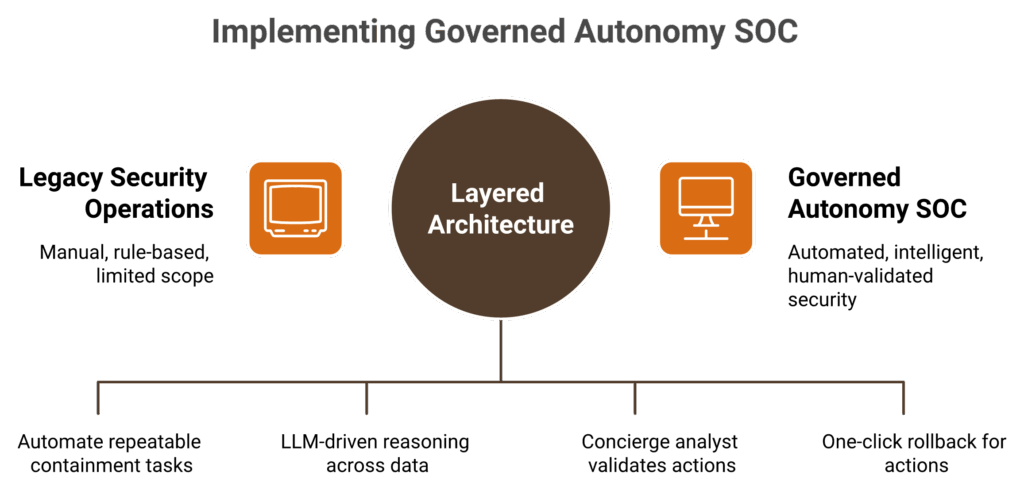
Incident response automation is the use of code, playbooks, and AI agents to detect, triage, contain, and document security incidents at machine speed across the NIST SP 800-61 incident response lifecycle [1]. In 2026 it has moved beyond rigid SOAR (Security Orchestration, Automation, and Response) runbooks into agentic AI that reasons across SIEM, EDR, and identity data. It only succeeds when high-tier human analysts validate the roughly 30% of cases AI gets wrong. The outcome buyers actually want is governed autonomy, meaning containment in minutes without breaking business continuity.
When my team and I run live simulations against our own UnderDefense Agentic AI SOC environment, the gap between buying SOAR and getting outcomes is brutal. Most “agentic AI” pitches I hear in 2026 are just a coat of paint on the same workflow engines that have been around since 2017.
See how UnderDefense Agentic AI SOC resolves a real incident on your stack.
SOAR was a runbook. Agentic AI is a reasoning loop.
SOAR is a deterministic playbook. Pull this log, hit this API, isolate this host. It works beautifully on the threats it was written for, and it falls over the moment an attacker pivots. Agentic AI is different. It reads alerts, queries SIEM, correlates identity and endpoint signals, then proposes the next step. A 2025 peer-reviewed paper in Information (MDPI) on hyper-automated SOAR with agentic AI calls this the IVAM loop, Investigation, Validation, and Active Monitoring [2].
The honest read on this: the agent is not the SOC. The agent is the junior analyst who can finally read 200 logs in 10 seconds. A senior human still has to sign off before anything irreversible ships. For a deeper view of how AI is changing analyst workflows, see does AI kill or save your SOC team.
What governed autonomy looks like in practice
Here is the concrete example I keep returning to. Industry-average alert-to-triage in managed SOC providers sits at 30 to 60 minutes [3]. In our UnderDefense Agentic AI SOC environment, we hold ourselves to a 2-minute Alert-to-Triage SLA and a 15-minute escalation for critical incidents, validated daily with synthetic transactions (a eventcreate command we plant in every data source so we know the pipeline is actually working). For more on these benchmarks, see our breakdown of SLA in cybersecurity.
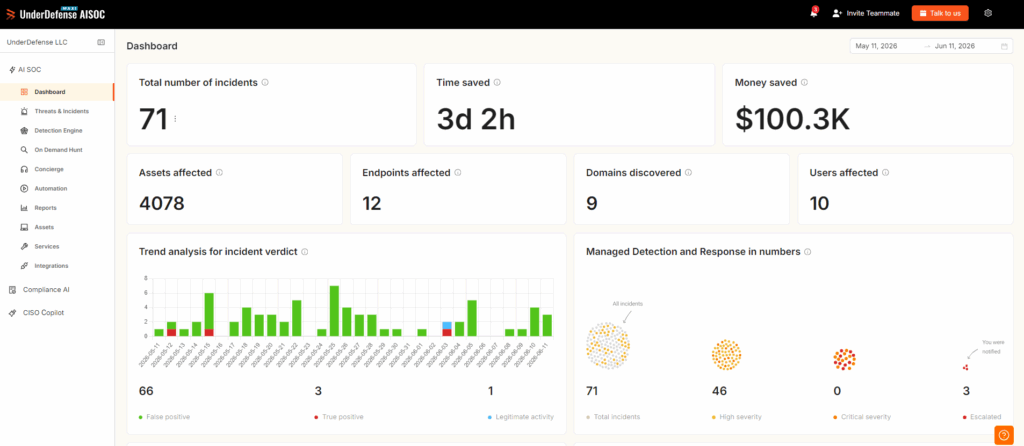
That is the shift. ✅ Agentic AI collects context across systems in seconds. ✅ Concierge analysts validate the call. ❌ Pure SOAR cannot reason, so it parrots alerts. ✅ Pure agentic AI without humans takes the wrong action 70% of the time. The architecture that wins is the layered one, and that is the architecture buyers are actually searching for when they type “incident response automation” into Google in 2026.
Q2. Why is MTTR the wrong metric, and what do real 2026 benchmarks actually show?
Most security leaders fund what they cannot measure. “MTTR” (Mean Time to Respond) conflates these two distinct SLAs, “mean time to react” (an alert fired) and “mean time to respond” (the threat contained), and that conflation hides where the program is actually broken. Mature SOCs split it into a 2-minute Alert-to-Triage SLA and a 15-minute escalation for critical incidents, then translate the gap into dollars. IBM’s 2025 Cost of a Data Breach report shows organizations using extensive AI and security automation save roughly $1.76M per breach and shorten the breach lifecycle by about 108 days versus those without [4]. Boards fund what they can measure in dollars, not minutes.
I might be wrong about the exact dollar figure for your business. I am not wrong that “MTTR went down” is not a board sentence. For a deeper read on this, our team has published a detailed view on SOC metrics covering MTTD and MTTR.
Decompose the metric or stop reporting it
When a CISO at a 4,000-person SaaS company tells me on a 2 a.m. bridge call that their MTTR is “about 4 hours,” I ask one question: 4 hours from what to what? Nine times out of ten, the team is measuring detection-to-ticket and calling it response. The threat ran for the other 3 hours and 45 minutes.
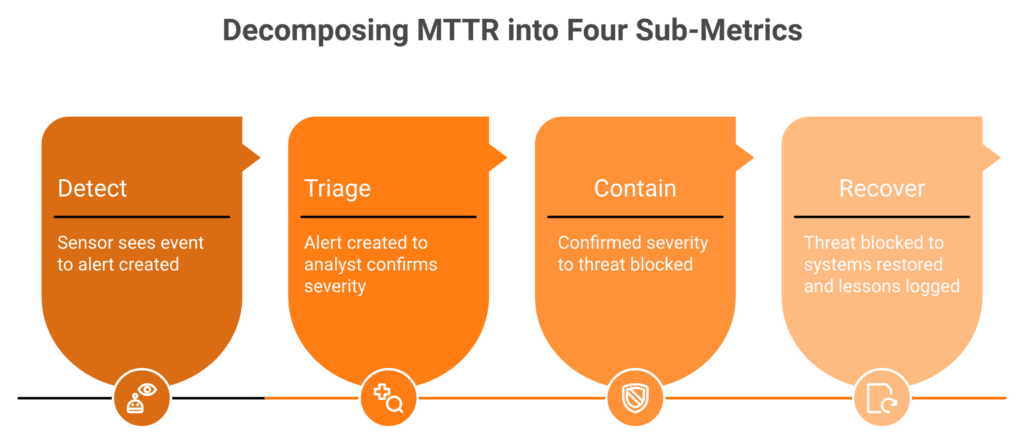
Break MTTR into four sub-metrics, and benchmark each one separately:
- ⏰ Mean Time to Detect (MTTD), sensor sees the event to alert created
- ⏰ Mean Time to Triage (MTTT), alert created to analyst confirms severity
- ⏰ Mean Time to Contain (MTTC), confirmed severity to threat blocked
- ⏰ Mean Time to Recover (MTTR-R), threat blocked to systems restored
Stage-by-stage 2026 benchmarks
Here is what we see in real environments, cross-referenced with Mandiant’s M-Trends 2025 dwell-time data and the SANS 2025 SOC Survey on automation maturity [5][6].
| Stage | Industry median (Mandiant 2025) | SANS top quartile (2025) | Governed-autonomy target | Dollar impact lever (IBM 2025) |
|---|---|---|---|---|
| Detect | ~10 days dwell time [5] | <24 hours | <1 hour | ⏰ Detection accelerates lifecycle compression |
| Triage | 30 to 60 minutes [3] | 5 to 10 minutes | ⭐ 2 minutes | 💰 Largest analyst-cost lever |
| Contain | 4 to 24 hours | 30 to 60 minutes | ⭐ 15 minutes | 💸 Largest data-loss lever |
| Recover | 73 days lifecycle median [4] | <30 days | <14 days | 💰 ~$1.76M savings vs. unautomated [4] |
Translate minutes into board language
The NIST CSF 2.0 has six functions: Govern, Identify, Protect, Detect, Respond, and Recover [7]. Most enterprise budgets I review overfund Protect (firewalls, endpoint, SSE) and underfund Respond and Recover. We call this the NIST CSF Budget Map exercise. ✅ Lay your spend across the six functions on one slide. ❌ The Respond and Recover columns are usually 60% smaller than Protect. ✅ Then map your stage-by-stage MTTR data on top. The CFO sees the gap immediately, and the conversation stops being “we need a SOAR” and starts being “we are losing $1.76M per incident because we cannot contain in under 15 minutes.”
That is a metric a board will fund. If you are putting next year’s plan together, our 2026 cybersecurity budget playbook lays out the function-by-function math.
Q3. How does the NIST SP 800-61 lifecycle map to automatable vs. human-only steps?
Not every step in incident response should be automated. NIST SP 800-61 Rev. 2 defines four phases: Preparation, Detection and Analysis, Containment Eradication and Recovery, and Post-Incident Activity [1]. Preparation and Post-Incident stay human-led. Detection, enrichment, and Tier-1 triage are AI-agent territory. Containment splits cleanly: deterministic actions like host isolation and token revocation belong in SOAR, and novel decisions stay with senior analysts. The NIST lifecycle, mapped against MITRE ATT&CK techniques, gives security leaders a defensible eligibility matrix instead of a vendor pitch deck [8].
How to read this matrix
I have built versions of this matrix for over 500 customer environments. The pattern is consistent. The error is always the same when teams skip the matrix: they automate too aggressively in Containment, then a false positive locks out the CFO during an earnings call. If you want a ready-made starting point, our IR plan template mirrors this structure.
Three columns matter:
- ✅ SOAR tier, deterministic, repeatable, low blast radius
- ✅ AI-agent tier, probabilistic, investigation-heavy, must propose not act
- ⚠️ Human-only tier, novel cases, irreversible actions, executive accounts
NIST × MITRE ATT&CK × Automation eligibility matrix
| NIST phase | MITRE ATT&CK example | SOAR | AI agent | Human |
|---|---|---|---|---|
| Preparation | Threat modeling, playbook design | ❌ | ⚠️ Drafts only | ✅ Owns |
| Detection | T1078 Valid Accounts, T1566 Phishing | ✅ Triggers | ✅ Correlates | ⚠️ Reviews |
| Analysis (triage, enrichment) | IOC lookup, sandbox detonation | ✅ | ✅ Drives | ⚠️ Validates |
| Containment, deterministic | T1486 host isolation, token revoke | ✅ Acts | ⚠️ Recommends | ✅ Approves novel |
| Containment, novel | Privileged or executive accounts | ❌ | ⚠️ Recommends | ✅ Owns |
| Eradication | Malware removal, patch deploy | ✅ Routine | ⚠️ Drafts | ✅ Sign-off |
| Recovery | Restore from backup, DNS reset | ✅ Routine | ⚠️ Drafts | ✅ Sign-off |
| Post-incident | Lessons learned, board report | ❌ | ✅ Drafts | ✅ Owns |
Walk one row in detail: Credential Access (T1078)
Identity-led attacks are now roughly a third of all breaches per Verizon DBIR 2025 [9]. Here is how the row plays out on Monday morning. ✅ The agent detects an impossible-travel signal correlated with a token-binding mismatch. ✅ It enriches the alert with the user’s risk score, recent OAuth grants, and last MFA event. ✅ SOAR proposes session kill and conditional-access tightening. ⚠️ A human concierge analyst pings the user via Slack (“Did you just sign in from Lagos?”) before the action ships. ❌ Without the human ping, the playbook would have killed the CFO’s session during a board call. That is the F3EAD model in action: automation accelerates Find and Fix, humans own Exploit, Analyze, and Disseminate [10]. Our incident response team runs this exact sequence on every identity anomaly.
“The platform itself is straightforward, it pulls in data from all our existing security tools, so we didn’t have to rip and replace anything. Their SOC team is responsive and knows their stuff. When they escalate something, they include the context we need to understand the issue quickly.”
— Verified User, Marketing and Advertising, Small-Business UnderDefense G2 – Verified Review
Q4. SOAR vs. agentic AI vs. AI SOC: which architecture and maturity stage fits your team?
SOAR executes deterministic playbooks. Agentic AI reasons across data sources to investigate. An AI SOC layers both under human validation. Mature programs progress through three stages, Control (humans drive, automation logs), Augment (AI proposes, humans approve), and Delegate (AI acts within bounded autonomy, humans audit). Most mid-market and PE portfolio companies should sit in Augment for at least 18 months before delegating any irreversible action [11].
Three architectures, one decision
The vendor pitch deck makes this look like a feature comparison. It is not a feature comparison, but an operating-model decision that determines how your SOC team spends its Monday morning. Our team has written a deeper view on SOC automation for CISOs evaluating exactly this tradeoff.
| Dimension | SOAR | Agentic AI | AI SOC + Human Ally |
|---|---|---|---|
| Logic type | Deterministic, rule-based | Probabilistic, LLM reasoning | Layered, agent + SOAR + human |
| Best at | Repetitive containment | Investigation, correlation | End-to-end outcomes |
| Governance | High, code-reviewed | Low without guardrails | High, HITL gates [11] |
| MTTR impact | Cuts Tier-1 toil | Cuts triage time | Cuts triage and containment |
| TCO drivers | Engineer time to maintain rules | LLM tokens, model risk | Per-event pricing, human cost |
| Fit profile | Mature SOC, 10+ analysts | AI-fluent shop with HITL discipline | Mid-market, PE portfolio, 1k-10k staff |
The Control to Augment to Delegate maturity model
Control stage. Humans investigate, automation only logs and routes. Go-criteria to leave: you can prove a 5-minute MTTT on phishing triage manually. ✅ Move on.
Augment stage. AI proposes, humans approve every irreversible action. Go-criteria to leave: 90 days of clean approval-rate data above 85%, plus a working rollback for every automated action.
Delegate stage. AI acts within bounded autonomy on pre-defined low-blast-radius playbooks (phishing email quarantine, IOC blocks, throwaway-host isolation). Humans audit weekly. ⚠️ Most enterprises are not ready for this in 2026, and that is fine.
Scenario recommendations
If you have fewer than 5 SOC analysts, and Splunk or Sentinel as your SIEM, sit in Augment with an MDR partner that owns outcomes, not alerts. If you have a mature 20-analyst SOC and CrowdStrike Falcon as your EDR, run SOAR for deterministic flows and pilot agentic AI on Tier-2 investigations under HITL. If you are a PE operating partner standing up security across 8 portfolio companies, do not buy 8 separate SOARs. Buy one vendor-agnostic SOC service layer that integrates with whatever each portco already runs.
This is where the “Ferrari in the SOC” paradox hurts. Most enterprises burn budget on the engines (the tools), and run out of money before they hire the drivers (the analysts). UnderDefense’s vendor-agnostic concierge model exists because we kept watching customers buy a $400k SOAR and never staff the playbook engineering team to make it actually work. If outsourcing the operating side is on the table, our take on outsourced vs in-house SOC walks through the math.
Where pure agentic AI fails
❌ Not recommended for: regulated environments without explainability requirements satisfied, novel zero-day response, executive-account containment, or any team without a documented rollback procedure for every automated action. Bias in a measurable AI model is a feature you can tune; opacity in a black-box agent is a risk you cannot manage [11]. For warning signs to watch for during vendor evaluation, see our breakdown of AI SOC red flags.
“Lack of true remediation in the response, costing us significantly in resources and introducing risks in security.”
— VP of Technology, Services Arctic Wolf – Gartner Verified Review
“Despite the capabilities of the technical platform and the strength of the analysts providing the service, there is still a limit to the environmental/organizational knowledge inherent in the service. This leads to a fairly frequent need for engagement with our internal team.”
— Verified User, Computer Software, Mid-Market Expel – G2 Verified Review
“UnderDefense is a great choice for teams like ours that are short on resources. It automates many tasks, plus, with 24/7 monitoring, we know we’re always protected. The platform seamlessly integrates our existing security tools, simplifying management. I used to work with many MDR solutions in the past, and so far Underdefense is the best one!”
— Inga M., CEO, Mid-Market UnderDefense G2 – Verified Review
Q5. Which incident response tasks should you automate first to slash MTTR?
Start where automation pays back fastest, and breaks least. Phishing triage, IOC (Indicator of Compromise) enrichment, identity-anomaly investigation, endpoint isolation on confirmed malware, ticket routing, and post-incident report drafting deliver the steepest MTTR (Mean Time to Respond) drops with the lowest blast radius. Save autonomous credential resets, mass account lockouts, and segmentation changes for later. Those need the 15-minute escalation for critical incidents, not a one-click agent.
The 2025 SANS SOC Survey found that 81% of teams reported increased workload after adding complex tools, not less [12]. That is the toil paradox. True automation has to target the mechanical investigation grunt work, querying SIEMs and pulling logs, so analysts get a structured report in seconds. Our deeper view on SOC automation walks through this CISO checklist.
The 8 plays I run first in a new SOC
This is the order I have used across 500+ customer environments. Each line is one task, the MTTR impact, the implementation effort, and the blast risk if it misfires.
- ⭐ Phishing email triage and quarantine. ⏰ Saves 10 to 20 minutes per alert. Effort: 1 to 2 weeks. ✅ Low risk. Our phishing playbook has the full sequence.
- ⭐ IOC enrichment (VirusTotal, threat intel lookup, sandbox detonation). ⏰ Saves 8 to 15 minutes per alert. Effort: 3 to 5 days. ✅ Low risk.
- ⭐ Identity-anomaly investigation (impossible travel, MFA fatigue patterns). ⏰ Saves 15 to 30 minutes per case. Effort: 2 weeks. ⚠️ Medium risk, gate on executive accounts.
- ⭐ Endpoint isolation on confirmed malware (EDR signal high confidence). ⏰ Saves 20 to 45 minutes per case. Effort: 1 week. ⚠️ Medium risk, exclude domain controllers. Pair this with a Managed EDR partner that tunes the rules.
- ⭐ Ticket routing and enrichment into ITSM (ServiceNow, Jira). ⏰ Saves 5 to 10 minutes per ticket. Effort: 3 days. ✅ Low risk.
- ⭐ Post-incident report drafting (timeline, IOCs, MITRE ATT&CK mapping). ⏰ Saves 2 to 4 hours per incident. Effort: 1 week with an LLM agent. ✅ Low risk.
- ⭐ Threat-intel-driven IOC blocking at firewall and DNS. ⏰ Saves 10 minutes per indicator. Effort: 1 week. ✅ Low risk.
- ⭐ Vulnerability-to-patch ticket creation on CISA KEV (Known Exploited Vulnerabilities) additions. ⏰ Saves 30 minutes per CVE. Effort: 4 days. ✅ Low risk.
What we run for our own SOC
When we built UnderDefense Agentic AI SOC‘s automation pipeline, we started with phishing and IOC enrichment because the math was easy. A Tier-1 analyst was burning 4 hours a day on copy-paste investigation. After automation, that same analyst handled triple the case load with better notes. Working with 500+ security teams, what I have noticed is the same pattern: the wins are in the boring tasks, not the glamorous ones.
The PagerDuty IR automation taxonomy lines up with this priority order, and so does our internal data [13]. ✅ Automate the toil. ❌ Do not automate the judgment. For a fuller view on what mature programs measure, see our breakdown of SOC metrics covering MTTD and MTTR.
What NOT to automate first
❌ Mass credential resets across an OU. The fallout is worse than the breach you are responding to.
❌ Network segmentation changes. One misconfigured ACL takes down a production environment.
❌ Account lockouts on privileged or executive identities without a human gate. This is the CFO-on-an-earnings-call scenario, and it ends careers.
❌ Anything you cannot roll back in one click.
If you cannot point to a working rollback for an automated action, you do not have automation. You have a time bomb with a Python wrapper.
Q6. How do you automate response to identity-led attacks without locking out the CFO?
Identity-led attacks now drive roughly a third of breaches and unfold in minutes, not hours. The defensible playbook chains agentic detection (impossible-travel plus token-binding mismatch), ChatOps validation (“Did you just run this command?” via Slack or Teams), session kill, and conditional-access tightening. A human approves any action that touches a privileged or executive account. This avoids the classic automation failure of locking out the CFO during an earnings call.
The situation: identity is the new perimeter
The 2025 Verizon DBIR shows that credential-driven and social-engineering attacks now account for a dominant share of all breaches, with the use of stolen credentials remaining the single most common initial-access vector across industries [9]. Mandiant M-Trends 2025 confirms that identity attacks compress dwell time to minutes, not days [5]. Attackers do not break in anymore. They log in. Our deeper view on business email compromise covers the same playbook from the email-vector side.
A CISO at a 4,000-person SaaS company once told me on a 2 a.m. bridge call that she had three impossible-travel alerts queued, and her analyst was 45 minutes into deciding whether to kill any of them. By the time she made the call, the attacker had already exfiltrated a SharePoint folder. ⏰ Time is the currency of the cloud.
The complication: traditional SOAR locks out the wrong person
Static SOAR playbooks treat every account the same. ❌ A confirmed-compromise rule fires, and the playbook kills the session for whoever is on the other end. ❌ That person is, half the time, a senior leader doing legitimate work from a hotel network. ❌ Now you have a containment success on paper, but an executive-relations disaster in real life.
The fix is not less automation, but governed autonomy with a human gate on irreversible actions against high-impact identities. Our incident response team builds this gate by default.
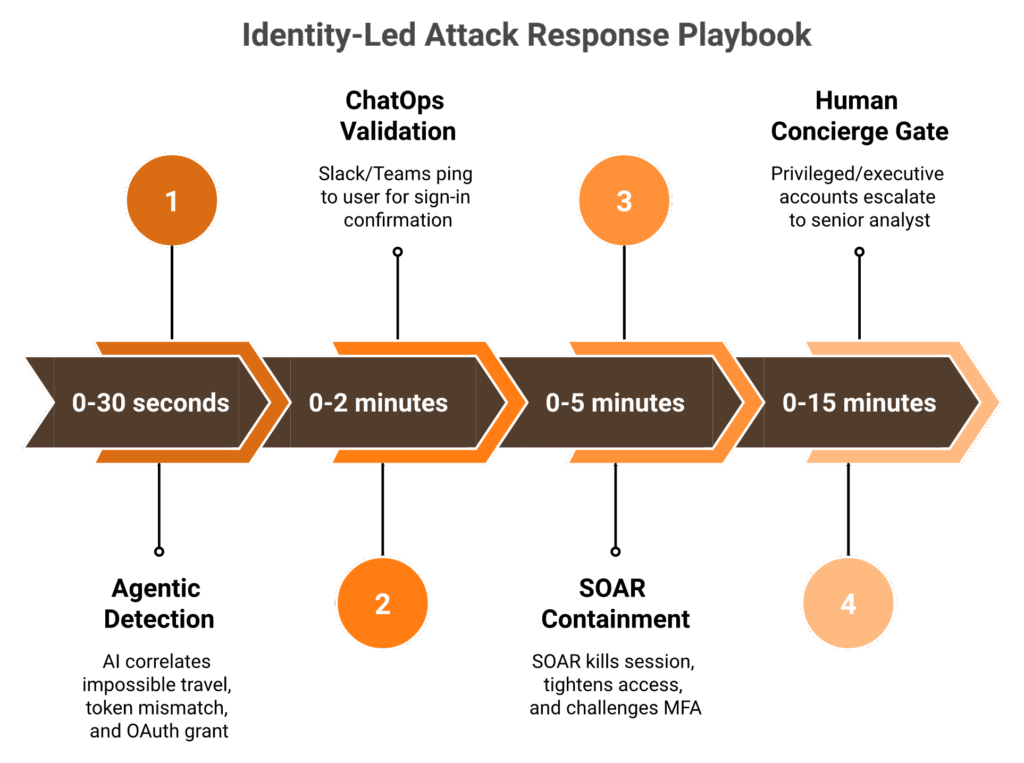
The resolution: the four-step chained playbook
This is the playbook we run in UnderDefense Agentic AI SOC on every identity anomaly:
| Step | Action | Owner | Time |
|---|---|---|---|
| 1. Detect | Impossible travel, token-binding mismatch, and unusual OAuth grant | Agentic AI | <30 sec |
| 2. Validate | ChatOps ping to user via Slack or Teams: “Did you just sign in from Lagos?” | Agent + user | <2 min |
| 3. Contain | Session kill, conditional-access tightening, and MFA challenge | SOAR | <5 min |
| 4. Approve novel | Privileged or executive accounts route to human concierge analyst | Human | <15 min |
✅ The ChatOps step is what we call breaking the fourth wall. ✅ Pinging the user directly cuts false-positive containment by a margin I would not have believed before we tried it. ✅ Most users reply in under 90 seconds. ❌ Traditional MDRs do not have this loop because they do not own the user-communication layer.
The real example: the Ukrainian government incident
We worked an incident where attackers operated only between 1 a.m. and 3 a.m. local time, using compromised identities. When our reverse-shell detection started blocking the C2 (command-and-control) channel, they pivoted to a Google Pub-Sub proxy to hide the traffic in legitimate cloud noise. ⚠️ Static automation would have closed the case the moment the reverse shells stopped. ✅ The human-AI loop kept hunting, caught the Pub-Sub pivot, and contained the actor before the next 1 a.m. window.
That is why I am skeptical of fully autonomous response. Adaptive attackers break static playbooks every time. For a deeper view of what to expect from a vendor that owns outcomes, see our MDR buyers guide.
“We have a method to submit tickets now for investigations that we didn’t have prior to engaging an MDR service.”
— Verified User, Hospital and Health Care, Enterprise Arctic Wolf – G2 Verified Review
“Before MaxiMDR, we were slightly overwhelmed with alerts and often unsure of how to prioritize or respond to them. Now, not only do we get alerts, but we also get clear guidance on how to handle them. This has significantly reduced our response time.”
— Valeriia D., Marketing Specialist, Mid-Market UnderDefense G2 – Verified Review
Q7. How do you defend against agentic AI when attackers are using it too?
Threat actors now run autonomous agents that scan, phish, and pivot in minutes. Defending requires three new detection patterns: behavioral telemetry on AI agents your developers run (Claude, Cursor, Copilot), OAuth-consent monitoring to surface Shadow AI (unsanctioned AI tools employees connect to corporate data), and prompt-injection guardrails on your own SOC copilots so attackers cannot manipulate triage. Banning AI tools backfires. Visibility lost is risk gained, because employees just move to personal devices.
The threat we are actually fighting in 2026
Most CISOs I talk to are still planning for AI as a defender capability. Attackers are already three steps ahead. A 2025 IJERET paper on autonomous SOCs documents how the same agent architectures we use defensively are being weaponized to compress the attack kill chain into minutes [3]. Patent activity at USPTO on AI-driven incident investigation and LLM-SOC orchestration has spiked across Microsoft, Palo Alto, and IBM filings, which tells me the category is past hype and into IP races. Our take on MDR for AI covers how we extend coverage to the agent layer.
The new attack pattern looks like this. ⚠️ An agent reads a target’s GitHub for tech stack. ⚠️ It crafts a contextual phishing email. ⚠️ It runs the OAuth consent flow on a Shadow AI tool to harvest tokens. ⚠️ It pivots into the SOC copilot itself with a prompt-injection payload buried in an alert title. The defender’s own agent now triages the attacker’s alerts.
Three detection patterns that actually catch this
✅ AI-agent behavioral logging. Treat every agent (Claude, Cursor, GitHub Copilot, and internal LLM apps) as a privileged identity. Log the prompts, the tool calls, and the data accessed. If your developer’s Cursor instance starts pulling production secrets at 3 a.m., that is a signal.
✅ OAuth-consent Shadow AI hunting. Your Microsoft 365 E5 or Google Workspace logs already contain every OAuth grant. Run a weekly query for AI-related app consents granted to corporate identities. You will find Shadow IT for free, no new tooling spend required. This is one of those audits I keep telling CISOs to run before they buy another platform. Our MDR for Microsoft 365 team runs this query as a baseline.
✅ Prompt-injection guardrails on SOC copilots. Treat every alert ingested by your AI SOC as untrusted input. Strip or escape instructions in alert titles, log fields, and email subjects. Validate the agent’s proposed action against an allow-list before SOAR executes anything.
The contrarian close: banning AI is a security risk
This is where I disagree with most CIO playbooks I read. ❌ Banning ChatGPT or Claude does not remove the risk. ❌ It removes the visibility. Employees move to personal devices, and now your CISO has zero telemetry on what data is leaving the building.
The right move is the opposite. ✅ Sanction AI tools, route them through SSO, log every prompt, and apply DLP (Data Loss Prevention). The M&M network analogy applies here: a hard exterior with a soft tasty center is exactly what unmanaged Shadow AI creates inside your perimeter. Bias in a measurable, logged AI system is a feature you can tune. Opacity in an unmanaged black box is the actual risk. What I think we will see in the next 18 to 24 months is agentic-AI governance becoming a board-level metric, right next to MTTR. For a deeper view, see our piece on AI in cybersecurity.
Q8. How does automated incident response satisfy SEC, NIS2, GDPR, and SOC 2 timelines?
Modern compliance clocks are unforgiving. The SEC requires materiality disclosure on Form 8-K Item 1.05 within four business days of determination [14]. NIS2 Article 23 demands a 24-hour early warning to national CSIRTs [15]. GDPR Article 33 enforces 72 hours for notifying supervisory authorities [16]. Automated incident response wins the clock by generating timestamped, immutable evidence chains, not just by containing faster. SOAR documents every action. Agentic AI drafts the regulator-ready narrative. Concierge analysts validate materiality before the 8-K filing leaves legal.
How automation maps to each clock
| Regulation | Clock | Required artifact | Automation that produces it |
|---|---|---|---|
| SEC 8-K Item 1.05 | ⏰ 4 business days from materiality determination [14] | Materiality assessment, incident summary, and expected impact | AI agent scores materiality on financial and operational impact; SOAR logs the timestamp chain |
| EU NIS2 Article 23 | ⏰ 24-hour early warning, 72-hour incident notification [15] | Initial notification with severity, scope, and suspected cause | Pre-built early-warning template auto-populated from MITRE ATT&CK tagging |
| GDPR Article 33 | ⏰ 72 hours from awareness [16] | Nature of breach, data categories, affected subjects, and mitigation | Impact-assessment generator pulls affected-record counts from SIEM and DLP |
| SOC 2 Type II | 💰 Continuous evidence | Immutable action log, ticket trail, and control-test artifacts | SOAR audit log, plus ISO/IEC 27035-aligned IR documentation [17] |
If you are mapping your program to a regulatory roadmap, our compliance roadmap 2025 covers the upstream control work that feeds these reports.
The deployment-sovereignty caveat most vendors will not tell you
Here is the trade-off cloud-mandatory MDR providers do not put on the slide. ❌ If your telemetry leaves the EU for analysis, you have a GDPR transfer problem. ❌ If your NIS2-regulated entity sends logs to a US-only cloud, your national CSIRT will ask hard questions. ✅ The fix is deployment sovereignty: on-prem, hybrid, or sovereign-cloud options that keep telemetry inside the jurisdiction that regulates you. Our compliance services team scopes this on a per-jurisdiction basis.
We built UnderDefense Agentic AI SOC to deploy in any of those modes because half the European customers we work with cannot legally use a cloud-mandatory platform. ⚠️ Automation produces evidence faster than any human can. ⚠️ Legal counsel still owns the disclosure decision, especially the SEC materiality call, which is a judgment, not a calculation.
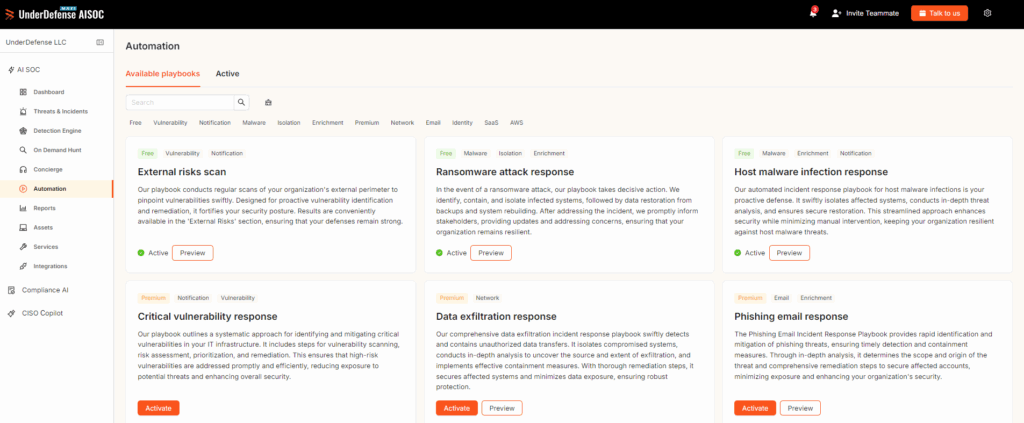
✅ The win is that your legal team gets the evidence package in minutes instead of days. 💰 That alone changes whether you make the 4-day SEC clock or miss it.
Q9. Where does automation fail, and how do you design IVAM-style governance and rollback?
Automation fails in three predictable ways: false-positive containment that takes down production, stale playbooks that fire on patched systems, and unsupervised AI agents that take irreversible actions on novel cases. The IVAM reference architecture (Investigation, Validation, and Active Monitoring) wraps every agent action with an HITL (Human-In-The-Loop) gate, an immutable audit log, and a one-click rollback. Bias in the model is a feature when it is measurable. Opacity is the actual risk.
The three failure modes I keep seeing in real environments
I have watched all three of these go wrong in production. None of them were exotic. All of them were preventable with the right architecture. Our piece on AI SOC red flags covers the warning signs before any of these fail in your stack.
⚠️ False-positive isolation cascade. A SOAR rule triggered on an “anomalous PowerShell” signal, and isolated 80 endpoints in the finance department during quarter-close. The signal turned out to be a sanctioned automation script. Recovery took 6 hours.
⚠️ Stale playbook on a patched CVE. A playbook kept firing remediation steps on a CVE (Common Vulnerabilities and Exposure) that was patched 8 months earlier. Nobody owned the playbook lifecycle. Analysts wasted 20 hours a week chasing ghost alerts.
⚠️ Unsupervised agent escalation on a novel case. An agentic AI confidently classified a zero-day exploitation chain as “low confidence phishing”, and auto-closed the ticket. The MDPI 2025 paper on hyper-automated SOAR documents this exact failure pattern, and proposes IVAM as the structural fix [2]. The IJERET 2025 work on autonomous SOCs adds a sharp warning that full Level 5 autonomy is gated by interpretability and HITL integration, not raw model capability [3].
The IVAM reference architecture in plain English
Here is the loop we run inside UnderDefense Agentic AI SOC, and the loop I would build for any SOC starting from scratch:
| Stage | What happens | Who owns it |
|---|---|---|
| Detect | Sensors fire, agent ingests the alert | Sensors and agent |
| Enrich | Agent correlates SIEM, EDR, identity, and threat intel | Agent |
| Recommend | Agent proposes a containment action with confidence score | Agent |
| ⚠️ HITL gate | Human concierge analyst approves or rejects irreversible actions | Human |
| Act | SOAR executes the deterministic step | SOAR |
| Document | Immutable audit log captures every input, decision, and output | System |
✅ The HITL gate sits between Recommend and Act. ✅ Reversible low-risk actions (IOC blocks, throwaway-host quarantine) can be auto-executed with logging only. ❌ Irreversible actions (privileged-account session kill, network segmentation, and mass credential reset) always route through a human. Our incident response team owns this gate on every customer engagement.
Rollback design and immutable logging checklist
This is the checklist I run when auditing a customer’s automation maturity:
- Every automated action has a documented rollback procedure tested in the last 90 days.
- Audit logs are write-once, append-only, and stored outside the SOAR platform.
- Every agent decision captures the input prompt, the tool calls made, and the proposed action.
- Playbooks have an owner, a last-reviewed date, and an expiration trigger.
- Synthetic transactions run daily to prove the pipeline still works end to end.
The Kudelski 2026 CISO risk-lens analysis lines up with this exact governance pattern, framing it as Detect to Enrich to Recommend to Act to Document with explicit autonomy boundaries [11]. For a deeper view on the upstream observability layer, see our take on continuous security monitoring.
Bias is a feature, opacity is the risk
Working with 500+ security teams, what I have noticed is that CISOs ask the wrong question about AI. They ask “is your model unbiased?” The honest answer is no, and that is fine. ✅ A measurable, biased model can be tuned, audited, and improved. ❌ An “unbiased” black box that nobody can inspect is the actual risk. Our internal data shows AI is correct in roughly 30% of security cases on its own. That number is why high-tier humans stay in the loop by design, not by accident. Our broader view on does AI kill or save your SOC team goes deeper on this tradeoff.
Q10. How do you evaluate SOAR, MDR, and AI SOC vendors without falling for AI-washing?
Most “agentic AI” vendor claims in 2026 are repainted SOAR. The honest rubric tests five dimensions: vendor-agnostic integration with your existing SIEM and EDR, transparent per-event pricing instead of per-GB punishment, autonomous containment time (not just alerting time), deployment sovereignty (on-prem and hybrid options), and whether human concierge analysts are on the hook for outcomes, not just dashboards. Ask every vendor for a 2-minute Alert-to-Triage proof in your environment, not a slide.
The five-dimension rubric
The Gartner 2025 MDR Market Guide and Forrester Wave Q1 2026 both flag vendor-agnostic integration and outcome ownership as the dimensions where the market is splitting [18][19]. Below is how the named vendors actually score in practice. This is based on G2 and Gartner Peer Insights reviews, plus my own deployment experience. If you are mid-evaluation, our MDR buyers guide walks through the same rubric in long form.
| # | Vendor | Vendor-agnostic | Transparent pricing | Autonomous containment | Deployment sovereignty | Human outcome ownership |
|---|---|---|---|---|---|---|
| 1 | UnderDefense Agentic AI SOC | ✅ 250+ tool integrations, no rip-and-replace | ✅ $11 to $15 per endpoint per month | ✅ 2-minute Alert-to-Triage and 15-minute escalation for critical incidents | ✅ Cloud, on-prem, hybrid, and sovereign | ✅ Concierge analysts own outcome |
| 2 | Arctic Wolf | ⚠️ Pushes Aurora platform | ❌ Opaque, sales-led | ⚠️ Alerts, limited remediation | ❌ Cloud-mandatory | ⚠️ Alert escalation, not action |
| 3 | CrowdStrike Falcon Complete | ❌ Falcon-stack required | ⚠️ Per-module, complex | ✅ Strong on endpoint only | ❌ Cloud-mandatory | ✅ Strong endpoint, weak identity |
| 4 | ReliaQuest GreyMatter | ⚠️ Multi-tool, GreyMatter-locked | ❌ Opaque | ⚠️ Co-managed, shared SLA | ⚠️ Limited sovereign options | ⚠️ Shared model |
| 5 | Generic legacy MSSP | ⚠️ Tool-integration depth varies | ⚠️ Custom SOW | ❌ Monitoring only | ✅ Often on-prem capable | ❌ Tickets, not outcomes |
Three pilot questions every buyer should ask in a POC
- ⏰ “Show me your alert-to-triage and triage-to-contain SLAs in our environment, with timestamps.” If they cannot demonstrate 2-minute Alert-to-Triage live, the rest is theater. Our breakdown of SLA in cybersecurity covers what good looks like.
- 💰 “What does this cost at 5,000 endpoints if our log volume doubles?” Cloud SIEM and per-GB pricing punish high-fidelity logging. Get the curve in writing. Our MDR price guide models the curve for mid-market buyers.
- ✅ “When a confirmed compromise hits a privileged account at 2 a.m., who pings the user, who approves containment, and who writes the regulator letter?” If the answer is “we send you an alert”, that is monitoring, not response.
Where each model fits poorly
❌ UnderDefense is not the right fit if you want a single-vendor stack mandate, and are already 100% committed to one EDR vendor as your platform of record.
❌ Arctic Wolf struggles when customers need true remediation rather than alert escalation. Several Gartner reviewers have flagged the same gap.
❌ CrowdStrike Falcon Complete is excellent on endpoint, but limited when identity, cloud, or SaaS telemetry sits outside Falcon.
❌ Legacy MSSPs typically deliver tickets, not outcomes, and rarely run at the speed identity attacks demand.
“Lack of true remediation in the response, costing us significantly in resources and introducing risks in security.”
— VP of Technology, Services Arctic Wolf – Gartner Verified Review
“Despite the capabilities of the technical platform and the strength of the analysts providing the service, there is still a limit to the environmental/organizational knowledge inherent in the service.”
— Verified User, Computer Software, Mid-Market Expel – G2 Verified Review
“We were looking for an MDR provider and were choosing EDR tools. CrowdStrike was our favorite choice, but after a few calls with UnderDefense we realized that we could get way more value, so they truly became our go-to cybersecurity ally, always by our side to solve problems and resolve incidents on our behalf.”
— Oleksii M., Mid-Market UnderDefense G2 – Verified Review
Q11. What does a governed-autonomy SOC look like on Monday morning, and how do you start in 90 days?
On Monday, pick one playbook (phishing triage), instrument synthetic transactions to prove the pipeline works in under two minutes, and tag every step as “deterministic” or “investigative”. By day 30, expand to identity-anomaly response with ChatOps validation. By day 90, layer agentic enrichment under human concierge approval. Don’t buy the Ferrari before you hire the driver. Start with the one playbook that pays for the program.
The 30 / 60 / 90 day roadmap
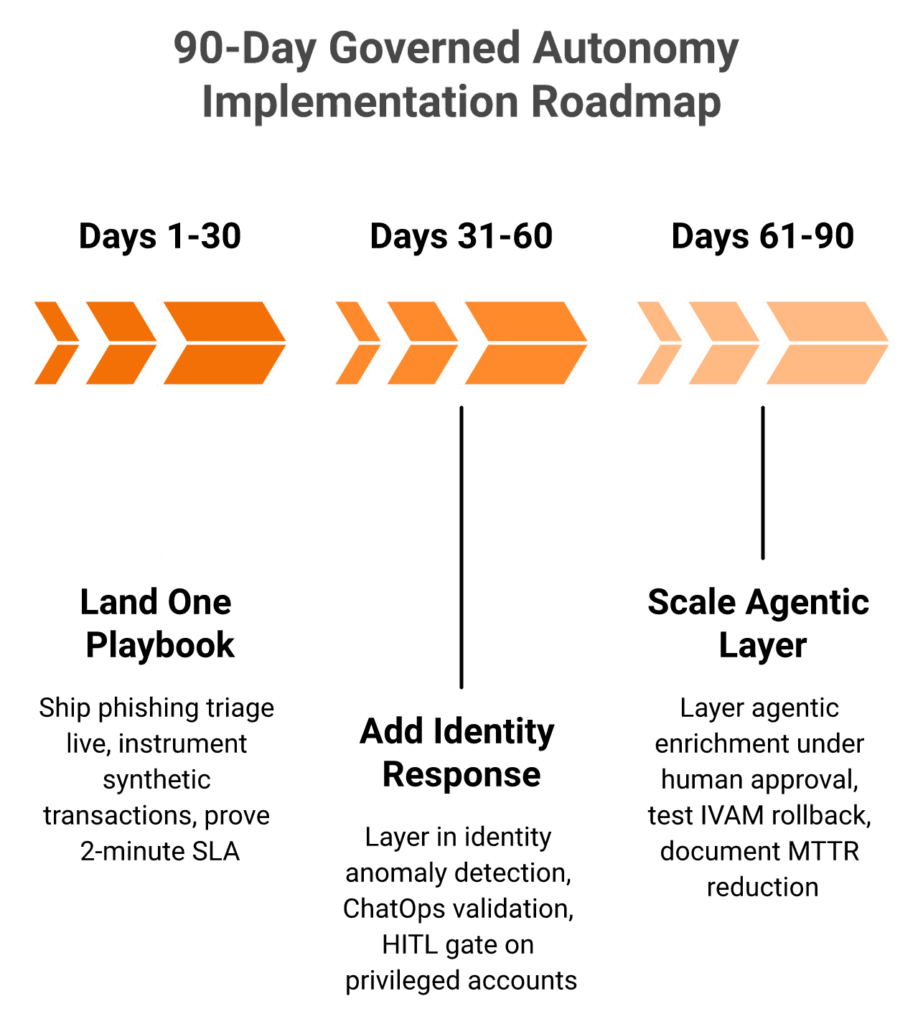
This is the same plan I have walked customers through across 500+ environments. It works because each milestone funds the next. For the budget side, our 2026 cybersecurity budget playbook maps the spend to the milestones below.
| Window | Goal | Output |
|---|---|---|
| Days 1 to 30 | Phishing triage playbook live, synthetic transactions running daily | ⏰ 2-minute Alert-to-Triage proven |
| Days 31 to 60 | Identity anomaly response with ChatOps validation, HITL gate on privileged accounts | ⭐ False-positive containment cut by half |
| Days 61 to 90 | Agentic enrichment layered under human concierge approval, IVAM rollback tested | 💰 Documented MTTR reduction in board pack |
The $300k accidental discovery
A mid-market customer of ours brought UnderDefense Agentic AI SOC in for ransomware coverage. Within 90 days, our automated monitoring flagged an anomalous payroll transaction pattern that traditional rules missed entirely. It turned out to be an internal payroll fraud scheme worth roughly $300k. The customer paid for the entire MDR program out of the recovered loss in the first quarter. ✅ Automation found what rules could not. ✅ A human analyst made the call to investigate. For a similar outcome story, see how SIEM and SOC avoided a $650K loss.
The XZ Utils supply-chain incident in 2024 makes the same point from the other direction. A human noticed a tiny change in SSH response time that no static rule was tuned for. ⚠️ Static automation alone would have shipped that backdoor across half the Linux ecosystem.
The synthetic-transaction discipline
Here is the one habit that separates SOCs that work from SOCs that look like they work. Every day, run a synthetic event into every data source. We use Windows eventcreate commands, custom syslog injections, and crafted EDR test signals. ⏰ The pipeline must surface the synthetic event as an alert in under 2 minutes. ❌ If it does not, you have a broken pipeline, and you do not know it. ✅ Synthetic transactions are how I sleep at night. For a deeper view on this discipline, see our piece on building a SOC.
What my experience of shipping UnderDefense Agentic AI SOC tells me, is that the Iron Man Suit metaphor is the right mental model. Agentic AI should feel like a veteran analyst putting on a suit that lets them move at machine speed. It is not a robot replacing the analyst, but the analyst, faster.
“UnderDefense is surprisingly affordable considering the level of protection we get. Their proactive threat hunting and rapid response have saved us from incidents that could have been incredibly costly.”
— Verified User, Program Development, Mid-Market UnderDefense G2 – Verified Review
“The biggest problem they solved was our 24/7 coverage gap. We needed round-the-clock monitoring for compliance reasons, but building our own SOC wasn’t realistic with our budget and the current hiring market.”
— Verified User, Marketing and Advertising, Small-Business UnderDefense G2 – Verified Review
Q12. What I am thinking about next, plus references
The question I keep sitting with is whether agentic-AI governance will become a board-reported metric in the next 12 months. My current read is yes. CISOs are about to face a board question that sounds like “how many autonomous agents are touching production data, and who is watching them?” Most security programs I see do not have an answer yet.
The other thing I am chewing on is whether the next 18 to 24 months bring a real Level 4 autonomy SOC, or whether the 30% accuracy ceiling holds. I could be wrong here, but I think the ceiling holds longer than the analyst conferences suggest. Either way, if you are building toward agentic AI in your SOC, I would love to hear what you are testing, what is breaking, and what you are still unsure about. That is the conversation worth having. If you want to take it offline, contact us.
See how UnderDefense Agentic AI SOC resolves a real incident on your stack.
References
Research Papers
- NIST. “SP 800-61 Rev. 2: Computer Security Incident Handling Guide” Computer Security Resource Center, 2012.
- Sworna, Z. T., et al. “Toward Robust Security Orchestration and Automated Response in Security Operations Centers with a Hyper-Automation Approach Using Agentic Artificial Intelligence” Information (MDPI), 2025.
- Saxena, A. “AI Agents for Threat Triage, Response, and Orchestration in Autonomous SOCs” IJERET, 2025.
Official Docs / Indian Statutes
- NIST. “Cybersecurity Framework (CSF) 2.0” Published: February 2024.
- MITRE ATT&CK. “Enterprise Matrix v15” Published: 2025.
- U.S. Joint Chiefs of Staff. “Joint Publication 2-0: Joint Intelligence (F3EAD methodology).” Published: 2013.
- U.S. Securities and Exchange Commission. “Cybersecurity Risk Management, Strategy, Governance, and Incident Disclosure (Form 8-K Item 1.05)” Published: July 26, 2023.
- European Union. “Directive (EU) 2022/2555 (NIS2 Directive), Article 23: Reporting Obligations” Published: December 14, 2022.
- European Union. “Regulation (EU) 2016/679 (GDPR), Article 33: Notification of a personal data breach to the supervisory authority” Published: April 27, 2016.
- ISO/IEC. “ISO/IEC 27035-1:2023 Information Security Incident Management” Published: 2023.
Datasets
- IBM Security. “Cost of a Data Breach Report 2025,” 2025.
- Mandiant. “M-Trends 2025,” 2025.
- SANS Institute. “2025 SOC Survey,” 2025.
- Verizon. “2025 Data Breach Investigations Report (DBIR),” 2025.
- SANS Institute. “2025 SOC Survey: Operations and Automation Trends,” 2025.
- Gartner. “Market Guide for Managed Detection and Response Services 2025,” 2025.
- Forrester. “The Forrester Wave: Managed Detection and Response Services, Q1 2026,” 2026.
Blogs
- Kudelski Security. “From SOAR to AI Agents: Rethinking Security Automation Through a CISO’s Risk Lens.” Published: April 2026. [Secondary source]
- PagerDuty. “Incident Response Automation Taxonomy.” Published: December 2024. [Secondary source]
- G2. “UnderDefense MAXI Review — Verified User, Marketing and Advertising.” Published: 2025. [Secondary source]
- G2. “UnderDefense MAXI Review — Inga M.” Published: 2024. [Secondary source]
- G2. “UnderDefense MAXI Review — Valeriia D.” Published: September 2023. [Secondary source]
- G2. “UnderDefense MAXI Review — Oleksii M.” Published: July 2023. [Secondary source]
- G2. “UnderDefense MAXI Review — Verified User, Program Development.” Published: May 2024. [Secondary source]
- Gartner Peer Insights. “Arctic Wolf MDR Review — VP of Technology, Services.” Published: April 2023. [Secondary source]
- G2. “Arctic Wolf Review — Verified User, Hospital and Health Care.” Published: December 2020. [Secondary source]
- G2. “Expel Review — Verified User, Computer Software.” Published: October 2024. [Secondary source]
1. What is incident response automation, and how is it different from SOAR in 2026?
We define incident response automation in 2026 as the layered use of code, deterministic playbooks, and agentic AI to detect, triage, contain, and document incidents at machine speed across the NIST SP 800-61 lifecycle. SOAR is the deterministic layer. It pulls a log, calls an API, isolates a host. It works on the threats it was written for, and breaks the moment an attacker pivots. Agentic AI is the reasoning layer. It reads alerts, queries SIEM, correlates identity and endpoint signals, and proposes the next step in seconds.
The honest read from our team: agentic AI is right roughly 30% of the time on its own, which is why a senior human still has to validate any irreversible action. The architecture that wins in 2026 is layered. Agents collect and reason, SOAR executes, and concierge analysts approve novel cases. We walk through the operating model in our deeper view on SOC automation.
2. Why is MTTR the wrong metric, and what should we report to the board instead?
MTTR (Mean Time to Respond) conflates two distinct SLAs, mean time to react (alert fired) and mean time to respond (threat contained). Boards cannot fund what teams cannot measure. We split it into a 2-minute Alert-to-Triage SLA and a 15-minute escalation for critical incidents, then translate gaps into dollars. IBM’s 2025 Cost of a Data Breach report shows organizations using extensive AI and security automation save roughly $1.76M per breach and shorten the lifecycle by about 108 days.
For the board pack, decompose MTTR into MTTD (detect), MTTT (triage), MTTC (contain), and MTTR-R (recover), and benchmark each separately. Then map the spend across NIST CSF 2.0’s six functions (Govern, Identify, Protect, Detect, Respond, Recover) on one slide. The Respond and Recover columns are usually 60% smaller than Protect, which is exactly where the dollar loss compounds. Our SOC metrics breakdown covering MTTD and MTTR shows the full reporting structure.
3. Which incident response tasks should we automate first?
Start where the math is easy and the blast radius is small. We recommend phishing email triage and quarantine, IOC enrichment, identity-anomaly investigation, endpoint isolation on high-confidence EDR signals, ticket routing into ServiceNow or Jira, post-incident report drafting, threat-intel-driven IOC blocking, and vulnerability-to-patch ticketing on CISA KEV additions.
These 8 plays each save 5 to 45 minutes per case, deploy in a week or two, and have low rollback risk. What we avoid automating on day one: mass credential resets, network segmentation changes, and account lockouts on privileged or executive accounts. The career-ending failure mode is locking out the CFO during an earnings call. If you cannot point to a working one-click rollback for an automated action, you do not have automation, but a time bomb with a Python wrapper. Our phishing playbook gives you the first sequence to ship.
4. How do we automate response to identity-led attacks without locking out executives?
Identity-led attacks now drive roughly a third of breaches per Verizon DBIR 2025, and they unfold in minutes. Our defensible playbook chains four steps: agentic detection (impossible travel plus token-binding mismatch), ChatOps validation via Slack or Teams (“Did you just sign in from Lagos?”), SOAR-driven session kill and conditional-access tightening, then a human concierge gate on any privileged or executive account.
The ChatOps step is what we call breaking the fourth wall. Pinging the user directly cuts false-positive containment dramatically because most users reply in under 90 seconds. Static SOAR treats every account the same and creates the executive-relations disaster of killing a senior leader’s session during legitimate work. Governed autonomy keeps machine speed on the 80% of cases where it is safe, and routes the 20% irreversible cases to a human. Our incident response team runs this exact sequence on every identity anomaly.
5. How does automated incident response satisfy SEC, NIS2, and GDPR reporting clocks?
Modern compliance clocks are unforgiving. The SEC requires Form 8-K Item 1.05 disclosure within 4 business days of materiality determination. NIS2 Article 23 demands a 24-hour early warning to national CSIRTs. GDPR Article 33 enforces 72 hours for supervisory-authority notification. Automation wins the clock by generating timestamped, immutable evidence chains, not just by containing faster.
Specifically, agentic AI scores materiality on financial and operational impact, SOAR logs every action timestamp, pre-built early-warning templates auto-populate from MITRE ATT&CK tagging, and impact-assessment generators pull affected-record counts from SIEM and DLP. The caveat most cloud-mandatory vendors hide: telemetry leaving the EU creates a GDPR transfer problem. We built deployment sovereignty (cloud, on-prem, hybrid, sovereign) into Under Defence MAXI for that reason. Our compliance services team scopes this per jurisdiction.
6. What is IVAM governance, and how do we design rollback for AI-driven response?
IVAM stands for Investigation, Validation, and Active Monitoring. It is the reference architecture from the 2025 MDPI peer-reviewed paper on hyper-automated SOAR with agentic AI, and it wraps every automated action with a human-in-the-loop gate, an immutable audit log, and one-click rollback.
Our checklist for production-grade governance: every automated action has a documented rollback procedure tested in the last 90 days, audit logs are write-once and stored outside the SOAR platform, every agent decision captures the input prompt and the proposed action, playbooks have an owner and an expiration trigger, and synthetic transactions run daily to prove the pipeline works end to end. The CISOs we work with ask the wrong question about AI. They ask “is your model unbiased?” The honest answer is no. A measurable, biased model can be tuned. An “unbiased” black box nobody can inspect is the actual risk. For warning signs to watch during evaluation, see our take on AI SOC red flags.
7. How do we evaluate SOAR, MDR, and AI SOC vendors without falling for AI-washing?
Most “agentic AI” pitches in 2026 are repainted SOAR. Our honest rubric tests five dimensions: vendor-agnostic integration with your existing SIEM and EDR, transparent per-event pricing instead of per-GB punishment, autonomous containment time (not just alerting time), deployment sovereignty (on-prem and hybrid options for regulated buyers), and whether human concierge analysts are on the hook for outcomes, not just dashboards.
Three pilot questions every buyer should ask in a POC. First, “show me your alert-to-triage and triage-to-contain SLAs in our environment, with timestamps”. If they cannot demonstrate 2-minute Alert-to-Triage live, the rest is theater. Second, “what does this cost at 5,000 endpoints if our log volume doubles?” Cloud SIEM and per-GB pricing punish high-fidelity logging. Third, “when a confirmed compromise hits a privileged account at 2 a.m., who pings the user, who approves containment, and who writes the regulator letter?” If the answer is “we send you an alert”, that is monitoring, not response. Our MDR buyers guide walks the rubric in long form
8. What does a 90-day incident response automation roadmap look like?
Days 1 to 30, ship the phishing triage playbook live, instrument synthetic transactions running daily, and prove a 2-minute Alert-to-Triage SLA in production. Days 31 to 60, add identity-anomaly response with ChatOps validation, and gate privileged-account containment behind a human approval. Days 61 to 90, layer agentic enrichment under human concierge approval, test IVAM rollback on at least three playbooks, and document MTTR reduction in the board pack.
The discipline that separates SOCs that work from SOCs that look like they work is synthetic transactions. Every day, inject a Windows eventcreate event, a custom syslog, or a crafted EDR test signal into every data source. The pipeline must surface it as an alert in under 2 minutes. If it does not, you have a broken pipeline, and you do not know it. Our take on building a SOC covers the full operating discipline.