




Q1: Why is AI SOC ROI the wrong question if you are calculating “breaches avoided”?
Stop calculating ROI on “breaches avoided” because proving a negative loses the argument with the CFO. Assess AI SOC ROI on three defensible levers: analyst hours reclaimed from investigation grunt work, faster time from alert to triage and escalation, and the headcount you avoid hiring in a market with no analysts to hire. Frame cyber risk as financial exposure the board understands.
See how the UnderDefense Agentic AI SOC investigates, triages, and resolves real alerts.
The trap most CISOs walk into
Picture the budget meeting. The CISO clicks to a slide full of detection metrics, and the CFO’s eyes glaze over. The board is fatigued. Members keep asking whether the security capital is spent well, and the technical answer lands as noise.
I have sat on that side of the table. The instinct is to justify spend by pointing at breaches you prevented. That instinct is a trap.
Proving a negative is a losing game
You cannot prove a negative. If no breach happened, you cannot credibly point to the one control that stopped it. I would avoid that question entirely.
The “cost of downtime” math falls apart the same way. It almost always gets argued down to nothing, because revenue impact is easy to dispute. Build your case on those numbers, and you hand the skeptic a reason to cut you.
The three levers that actually hold up
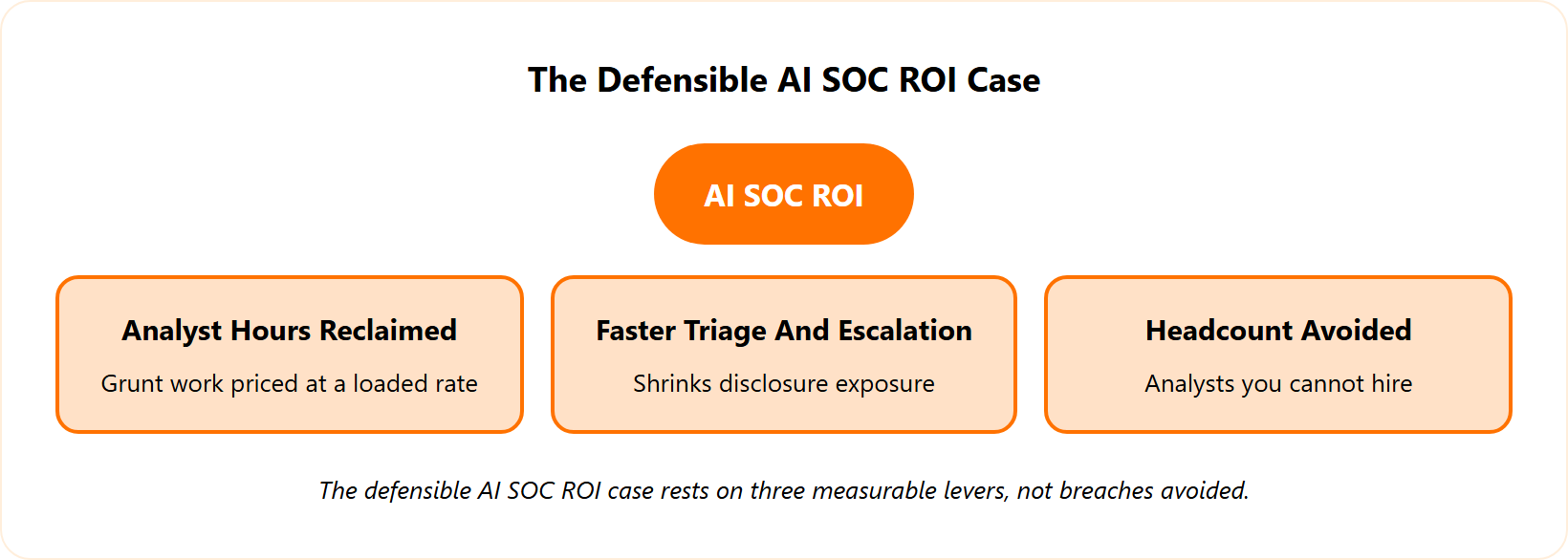
Anchor the case on what you can measure directly:
- Analyst hours reclaimed from investigation grunt work, priced at a loaded hourly rate.
- Time from alert to triage and to escalation, where faster containment shrinks regulatory and disclosure exposure.
- Headcount you avoid hiring, which matters in a market where the analysts you need are not on the market.
Here is my Monday morning move. Take the NIST Cybersecurity Framework 2.0, a free US standard that groups security into risk families like Identify, Protect, Detect, and Respond. Map your budget dollars into those families on one page. That single visual is enlightening. You may find you spend zero in a proactive capacity, and now the conversation is about exposure rather than tooling.
At UnderDefense, this is the work we do with security leaders: translate cyber risk into dollar exposure mapped to NIST families, so the AI SOC business case survives the CFO meeting instead of dying in it. If you are sizing the spend for next year, our cybersecurity budget for mid-market firms guide maps the same logic in detail.
Q2: What exactly is an AI SOC, and what is it not?
An AI SOC autonomously investigates every alert by pulling context across your stack and reasoning to a verdict, instead of waiting for an analyst or a pre-written playbook. It is a maturity model with painful prerequisites rather than a product you install. If your detections are weak, AI will not rescue them. The operating rule: AI collects context, humans decide.
The concept, in plain terms
A traditional Security Operations Center, or SOC, is the team and tooling that watches your environment for threats. An AI SOC adds an autonomous investigation layer on top. It reads an alert, gathers the surrounding evidence, and reasons toward a verdict on its own.
An AI led SOC makes decisions by understanding context, rather than relying on manual, signature based steps. That context gathering is the real shift. For a deeper view, our breakdown of whether AI kills or saves your SOC team walks through what changes day to day.
| Element | What it shows |
|---|---|
| Detection rules | Pre-built library mapped to MITRE ATT&CK |
| Technique IDs | T1071, T1105, with enable toggles |
| Coverage | Reconnaissance, Initial Access, Lateral Movement |
A concrete example of what runs under the hood
People imagine one tidy AI call per alert. The reality is heavier. For a single typical alert, a modern system can fire over 100 distinct large language model invocations to investigate it autonomously. Orchestrating all of that, and keeping the system from going off the rails, is genuinely hard work.
So here is the honest part. An AI SOC is not a product you bolt on. It is a maturity model with painful prerequisites you have to get right first. If your alerts are weak, AI will not save you. It will just be wrong faster. Our list of AI SOC red flags shows what to watch for during evaluation.
How to apply this on your team
Fix your detections before you shop for AI. Tune the noise down, then layer reasoning on top of signal worth reasoning about.
Hold one rule firmly: AI collects context, humans decide. I think of these agents like teenagers. They are supremely intelligent, but they have no fear of consequence, and sometimes they do something dumb. You want a human owning the verdict on anything irreversible.
We built UnderDefense Agentic AI SOC around exactly this “AI SOC + Human Ally” model. The AI clears the investigation grunt work at machine speed, and our concierge analysts own the verdict and the response. You can see how it runs on the WarRoom platform.
Q3: SOAR vs AI SOC, what is the real difference, and do you need both?
SOAR executes the playbooks your team writes, automating the alerts someone already planned for. An AI SOC reasons through everything else, including novel alerts no playbook covers, and that gap is where breaches hide. SOAR automates roughly 30 to 40 percent of alerts with static playbooks; an AI SOC investigates close to 100 percent at L2 depth. Most mature teams run both.
The problem SOAR leaves open
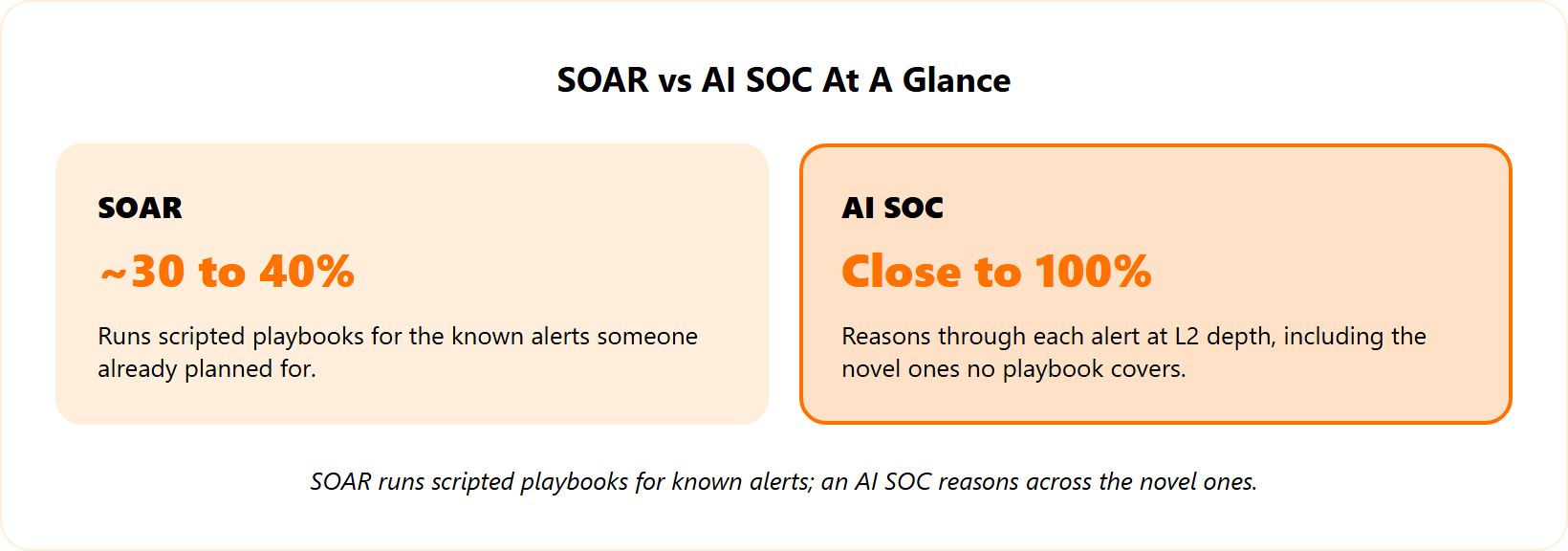
SOAR stands for Security Orchestration, Automation, and Response. It runs the playbooks your team writes in advance. That works beautifully for alerts someone already anticipated.
The trouble is everything else. SOAR handles the threats you planned for, and the novel, unscripted alert is exactly where breaches slip through. A playbook cannot respond to a situation nobody scripted. This is one reason teams lean toward SOC automation that reasons rather than only executes.
Why playbooks stall in practice
There is a quieter reason playbook only automation gets stuck. Writing the detection logic is hard. Generating the right SPL search queries, the Splunk query language, demands that you master the syntax and the data schema, so you know which fields to filter on. That skill is scarce, and your backlog grows while you wait for it.
| Dimension | SOAR | AI SOC |
|---|---|---|
| Core action | Executes scripted playbooks | Reasons through each alert |
| Alert coverage | ~30 to 40% of alerts | Close to 100% at L2 depth |
| Setup burden | You write and maintain playbooks | No playbook required per alert |
| Verdict ownership | Analyst decides | AI investigates, human confirms |
The honest answer, run both
These two work together. Think of AI agents as foot soldiers and your human engineers as generals directing them, plus special forces for the hard missions. SOAR automates the known response; the AI SOC investigates the unknown. In practice, mature teams that get the investigation layer right close 95 percent or more of items automatically as false positives, which frees humans for real threats.
UnderDefense layers AI investigation on top of the SOAR and SIEM you already own through the UnderDefense Agentic AI SOC platform, so your team writes fewer playbooks and reviews less noise. No rip and replace, and no vendor lock in on the data you own. Our MDR service brings the human response that turns investigation into containment.
Q4: AI SOC vs managed SOC, which delivers more value per dollar?
A managed SOC gives you 24/7 human coverage, but many providers forward alerts without the context or the response you need. An AI SOC adds speed, depth, and scale by investigating every alert rather than escalating a queue. The strongest value per dollar comes from combining them: AI for investigation speed, humans for the verdict and the instant response monitoring only providers leave to you.
Coverage is not the same as resolution
A managed SOC, often sold as an MSSP service, buys you around the clock human eyes. That solves a real problem for lean teams who cannot staff three shifts. Our comparison of outsourced vs in-house SOC covers when each makes sense.
The catch is what arrives in your inbox. Many providers forward an alert and wait. You still piece together what happened across separate systems, and you still own the response.
What the alert only model costs you
This pain shows up plainly in real reviews. The value of a managed service hinges on context and response time rather than just monitoring.
“The biggest win for me was getting actual control over our security alerts. Before the guys from UD stepped in, we were getting bombarded with alerts from all our security tools. Now when we get an alert, we know it’s something worth looking into.”
Verified User in Marketing and Advertising, Small-Business UnderDefense G2 Verified Review
“Before UnderDefense Agentic AI SOC, we were slightly overwhelmed with alerts and often unsure of how to prioritize or respond to them. Now, not only do we get alerts, but we also get clear guidance on how to handle them. This has significantly reduced our response time.”
Valeriia D., Marketing Specialist UnderDefense G2 Verified Review
Where each model wins
A managed SOC built on alerts gives coverage but stops short of resolution. An AI SOC investigates every alert at L2 depth, then a human confirms the verdict. The best value per dollar combines them.
| Criteria | Alert only managed SOC | AI SOC + Human Ally |
|---|---|---|
| Coverage | 24/7 human shifts | 24/7 plus autonomous triage |
| Context with alert | Often thin | Full investigation attached |
| Response | Left to your team | Concierge analysts act |
| Scaling cost | Linear with headcount | Scales with automation |
This model is not the right fit for everyone. A tiny shop with almost no telemetry may need basic monitoring first. Once you have real signal, however, alert only coverage leaves value on the table. If you want to model the numbers, our SOC cost calculator helps.
Where a traditional provider forwards an alert and waits, UnderDefense concierge analysts investigate, decide, and respond inside a 2-minute alert-to-triage and 15-minute critical escalation window. The value sometimes shows up where you least expect it. With one client, we surfaced a $300K payroll fraud during onboarding, an entirely non cyber win that came from finally having visibility. To see it live, book a demo with our team.
Q5: What do alert volume and the threat landscape do to your investigation load?
SOCs face roughly 3,832 alerts a day, with about 62 percent never investigated and more than 70 percent of analysts overwhelmed. The 2025 Verizon DBIR analyzed 12,195 breaches, with vulnerability exploitation up 34 percent and third-party involvement doubling to 30 percent. Rising threat volume means a growing alert backlog, so the real ROI question is how many investigations you can actually close.
The baseline number nobody wants on a slide
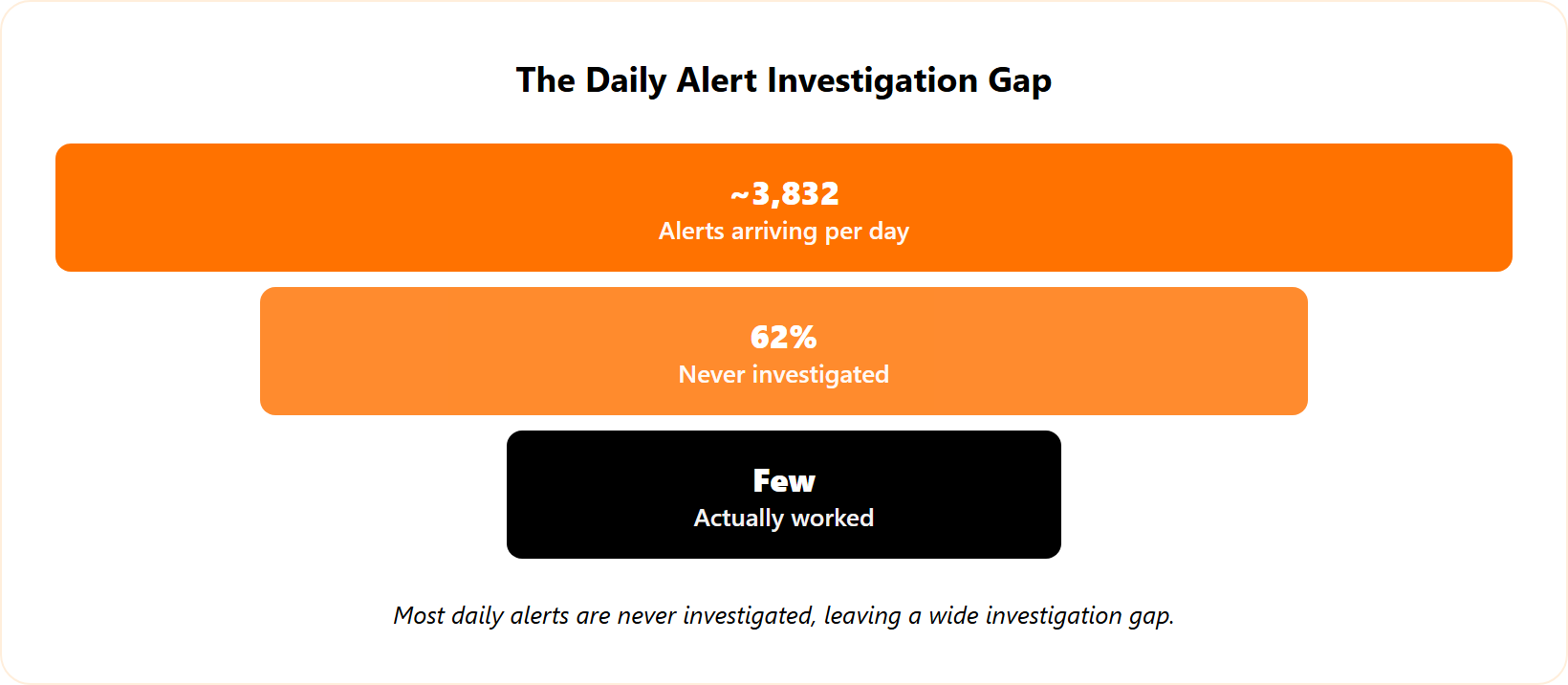
Let me start with the figure that frames everything. A typical Security Operations Center, the team that watches your environment, sees around 3,832 alerts per day. Roughly 62 percent of those are never investigated, and more than 70 percent of analysts report feeling overwhelmed.
That gap is the heart of the problem. The alerts you skip are not sorted by risk. They are skipped because nobody had the hours. Our breakdown of SOC metrics like MTTD and MTTR shows how to measure that pressure honestly.
The threat side keeps pushing volume up
The intake is growing too. The 2025 Verizon Data Breach Investigations Report, an annual study of real breaches, analyzed 12,195 confirmed cases. Two findings matter for your queue.
- Vulnerability exploitation as an entry point rose 34 percent year over year.
- Third-party involvement in breaches doubled to about 30 percent.
More attack paths mean more detections firing. Your backlog grows from both ends at once, which is why attack surface management matters before you scale headcount.
Why this is a board metric, not an ops stat
Here is where I will push back on the standard read. Teams report “alerts handled” to the board. The number that actually measures risk is the inverse: the percentage of alerts you never investigated.
I have watched skilled analysts make peace with the toil. One hire told a colleague she “finds the zen in copying,” and she meant it. The trouble is that grunt work does not go away on a human only team, and your best people burn out doing it. Our look at whether AI kills or saves your SOC team digs into that retention risk.
My Monday morning move is simple. Report your “percent of alerts never investigated” to leadership, and map your coverage to MITRE ATT&CK technique IDs, the public catalog of attacker behaviors, rather than raw counts. That turns a vague pile into a clear risk picture.
The UnderDefense Agentic AI SOC platform surfaces full asset and identity coverage, so that hidden backlog becomes visible and measurable instead of silent risk. Our MDR service then puts analyst hours against what matters most.
Q6: In-house, managed, SOAR, or AI SOC, how do you model the true cost and ROI?
A fully loaded in-house SOC runs roughly $1.2M to $4M a year; a managed SOC typically costs 30 to 50 percent less, saving a mid-sized firm around $630K to $965K annually. Model AI SOC ROI as analyst hours reclaimed, plus headcount avoided, plus breach-lifecycle cost reduction, minus platform cost. Anchor the breach lever on IBM data: heavy AI users save about $1.9M per breach and cut the lifecycle by 80 days.
The four models, side by side
Start with honest cost ranges. Building your own SOC in-house runs roughly $1.2M to $4M a year, once you count salaries, three shifts, and tooling. A managed SOC usually costs 30 to 50 percent less, saving a mid-sized firm around $630K to $965K annually. Our comparison of outsourced versus in-house SOC walks the tradeoff in detail.
| Model | Typical annual cost | What you own | Main tradeoff |
|---|---|---|---|
| In-house DIY | $1.2M to $4M | Full team and tooling | Hardest to staff and retain |
| Managed SOC | 30 to 50% less | Coverage, less control | Context can be thin |
| SOAR | Add-on to SIEM | Scripted automation | Only known playbooks |
| AI SOC hybrid | Per-asset pricing | Speed plus human verdict | Needs good detections first |
The ROI formula in plain terms
Skip “breaches avoided.” Build the case from levers you can defend:
ROI = (analyst hours reclaimed × loaded rate) + (headcount avoided) + (breach-lifecycle cost reduction) − (platform cost).
That math survives scrutiny because every term is observable. To put real figures against your own environment, run our SOC cost calculator.
The breach lever, anchored to real data
The biggest single number comes from IBM. Heavy users of AI and automation in security save about $1.9 million per breach and shorten the breach lifecycle by 80 days. On the efficiency side, a controlled Cloud Security Alliance study found AI-augmented analysts worked 61 percent faster.
Watch the hidden line items, too. Plan for at least 40 days of fast-access retention, about six weeks of data, for investigations. Budget for the agent traffic tax, since some agent workloads generate far more network traffic than the human task they replace. Our managed SIEM pricing guide covers how retention drives cost.
Translate it for the board
Tie response speed to disclosure risk. The US SEC requires material incident disclosure on an 8-K within four business days, and GDPR Article 33 demands breach notification within 72 hours. Faster containment shrinks that exposure directly, which is language a board acts on. Our guide to SLAs in cybersecurity connects response speed to those deadlines.
UnderDefense publishes transparent per-asset pricing and a SOC cost calculator, and we translate reclaimed analyst hours and faster containment into the financial-exposure framing your CFO signs off on.
Q7: What does AI SOC ROI look like in the real world?
Real AI SOC ROI rarely appears as a breach you stopped. It appears as 95 percent or more of investigations auto-closed as false positives, 99 percent noise reduction, and analysts freed for threat hunting instead of copy-paste triage. Sometimes it appears by accident: one team uncovered a $300K payroll fraud during onboarding, value that had nothing to do with cyber and everything to do with finally having visibility.
The situation, a team drowning in noise
Picture a lean security team at a 1,000-person company. Alerts pour in from every tool, and the analysts spend their days piecing together what happened across separate systems.
This is the most common scene I walk into. The team is sharp, but the queue never empties. Our list of the benefits of MDR shows what changes once that queue is handled.
The complication, you cannot hire your way out
The obvious fix is more analysts. The market does not cooperate. The people you need are not available, and the toil quietly drives out the ones you already have.
Reviews from real teams capture this exact pressure, and the relief when it lifts.
“Our IT team was overwhelmed by the sheer volume of security alerts and doesn’t have the resources for 24/7 monitoring.”
Andriy H., Co-Founder and CTO UnderDefense G2 Verified Review
“Their proactive threat hunting and rapid response have saved us from incidents that could have been incredibly costly.”
Verified User in Program Development, Mid-Market UnderDefense G2 Verified Review
The resolution, where ROI actually shows up
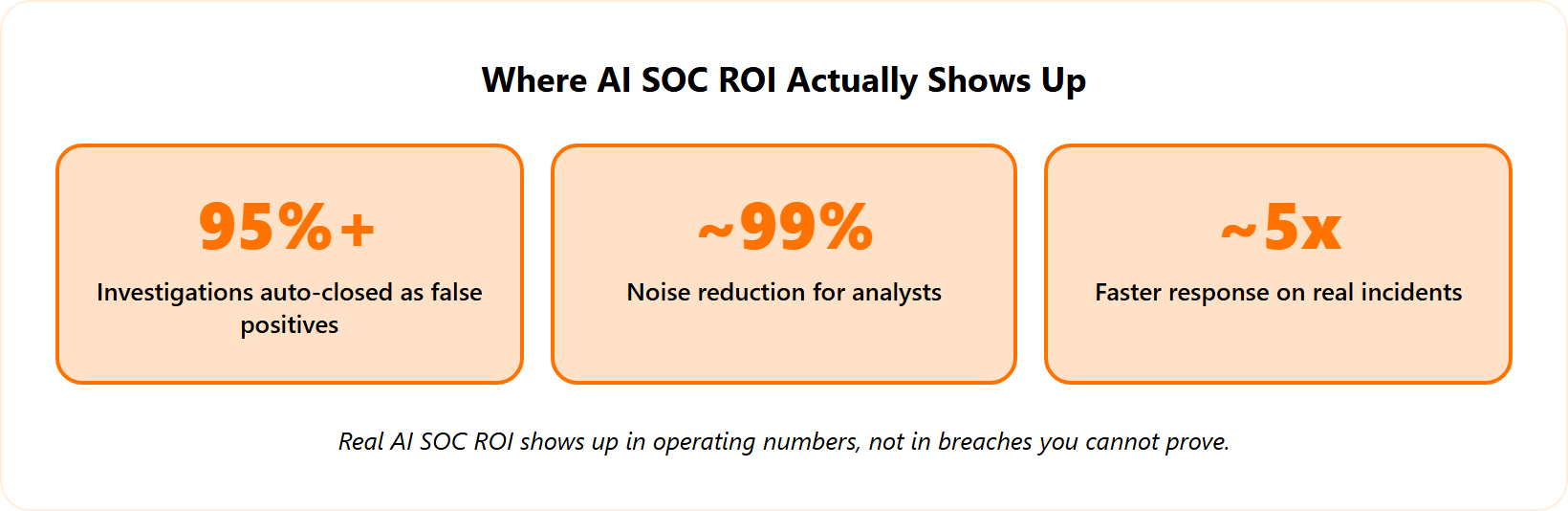
Once autonomous investigation does the grunt work, mature teams close 95 percent or more of items automatically as false positives. Independent reporting shows AI-augmented teams reaching roughly 5x faster response on real incidents. Analysts move off the treadmill onto threat hunting, which is the work they were hired to do.
The best proof I have seen came sideways. During one onboarding, the new visibility surfaced a $300,000 payroll fraud that had nothing to do with cyber. That single accidental catch paid for the program in the first quarter. We have documented similar wins in our SIEM and SOC $650K loss avoidance case.
UnderDefense customers describe this shift directly: less noise, faster response, and people freed for real work, with the UnderDefense Agentic AI SOC platform catching what point tools missed.
Q8: Can an AI SOC be fully autonomous, and should it be?
A fully autonomous SOC that replaces every human from tier one to tier three is neither technically ready nor operationally safe today. You do not want software quarantining users and shutting down production at 3 a.m. with no judgment. The realistic model: AI agents act as fast foot soldiers collecting context, while human generals own high-stakes verdicts and irreversible response actions.
The honest answer most vendors dodge
Here is the standard read I think gets it backwards. The pitch says full autonomy is around the corner. From what surfaces when you actually run these systems, that is not true yet.
A piece of software cannot reliably replace the whole SOC from tier one through tier three. The technology is not ready, and the real-world consequences of software roaming free, quarantining the wrong users, are too high. Our take on AI SOC red flags lists the autonomy claims worth questioning.
The tension, speed is real, judgment is the catch
I want to be fair, because the other side has a point. Some platforms do demonstrate automated fusion workflows that contain a threat in under a minute, denying access and stopping a cloud instance before a human even logs in. That speed is genuine and valuable, much like the response we documented when our team moved faster than CrowdStrike OverWatch.
The catch is judgment. Recent academic work on agentic AI catalogs nine agent-specific threat classes, from memory poisoning to goal drift, that show why blind autonomy is risky. I think of these agents like teenagers. They are brilliant and fearless, and sometimes they do something dumb at the worst moment.
Where to draw the line
The model that holds up is foot soldiers and generals. AI agents act as fast foot soldiers gathering context, while your human engineers act as generals directing them and as special forces for the hard calls. Our SOC automation checklist helps you decide what to automate.
So automate the routine investigation. Keep a human on anything irreversible, like quarantining an executive or shutting down production.
| Action type | Safe to automate? | Why |
|---|---|---|
| Context gathering, enrichment | Yes | Reversible, high volume |
| Closing clear false positives | Mostly | Auditable, low blast radius |
| Quarantine, shutdown, account lock | Human confirms | Irreversible, high impact |
UnderDefense keeps a named human ally on every irreversible action, so AI handles the investigation while an analyst signs off before anything gets quarantined. If you want to see that line drawn live, book a demo with our team.
Q9: How do you separate a real AI SOC from a thin LLM wrapper?
Test whether the platform reasons to a root cause or merely scores alerts. Patent filings for autonomous SOC investigation describe neural-symbolic planning and abductive root-cause reasoning, a higher bar than ML classification. Also ask how the system learns from analyst feedback, since closed-loop learning is patented. Budget for the alignment work, because the operator role shifts from watching a queue to curating context and closing feedback loops.
The line that actually separates the two
Here is the maturity test I use. A thin wrapper scores an alert and ranks it. A real AI SOC reasons toward a root cause, the way a senior analyst would.
Scoring tells you an alert looks bad. Reasoning tells you why it happened and what to do. That gap is the whole difference, and our list of AI SOC red flags covers how to spot it.
What the patents reveal about the bar
The architecture shows up in the patent record. A 2024 filing for automatically investigating security alerts describes neural-symbolic planning and abductive root-cause reasoning, working backward from evidence to the likely cause. That is a far higher bar than machine-learning classification, which simply sorts alerts by pattern.
A second filing covers converting analyst feedback into a structured knowledge graph, so the agent learns over time. Closed-loop learning, where the system improves from your team’s corrections, is patented work rather than a checkbox feature. Our take on conversational SOCs shows where this is heading.
Score these in your RFP:
- Does it reason to a root cause, or only assign a risk score?
- Can it show the investigation steps it took, the audit trail?
- How does it learn from analyst feedback, and how fast?
- Who owns the data and the model tuning, you or the vendor?
The line item nobody budgets for
Now the honest part. The labor does not vanish; it shifts. Your operators move from watching a queue to curating context and closing feedback loops, so budget for that alignment work. Our guide on whether AI kills or saves your SOC team covers that role change.
Think of it as foot soldiers and generals. The AI agents do the fast investigative legwork, and your people direct them and review the hard calls. A tip I lean on: ask the AI to draft the implementation plan first, then have a human edit it. You stay in control of the design, much as you would when planning SOC automation.
UnderDefense Agentic AI SOC is built on reasoning-based investigation with closed-loop analyst feedback, so the WarRoom platform improves on your environment rather than scoring alerts blindly.
Q10: Is the AI SOC itself a new attack surface you must secure?
Yes. The AI SOC agent you buy is a new attack surface, because autonomy, persistent memory, and tool access create risks traditional threat models miss, including prompt injection, memory poisoning, tool misuse, and goal drift. Before granting an agent response permissions, ask the vendor how they secure agent-to-tool integrations and feedback loops. Treat “how is your agent secured” as a scored RFP question.
The thing defending you can be turned against you
Most buyers evaluate an AI SOC only on what it catches. The question they skip is whether the agent itself can be attacked. It can.
An AI agent has three properties that classic tools lack: it acts on its own, it remembers, and it can use other tools. Each one opens a door, which is why AI in cybersecurity demands fresh threat modeling.
What the research actually catalogs
The academic threat models are specific. A 2025 framework for securing agentic AI defines nine agent-specific threat classes, including memory poisoning, tool misuse, and goal drift, where an agent’s objective quietly bends off course. Related work maps more than 30 distinct attack techniques across LLM-agent workflows, including prompt injection, where hidden instructions hijack the agent.
| Assessment | What it checks |
|---|---|
| CIS cloud benchmarks | Cloud configuration against CIS baselines |
| External vulnerability scan | Internet-facing exposure and weaknesses |
Why does this matter so much? Because attackers already exploit blind spots that endpoint tools miss. I have seen a flaw in a mail server’s caching component let a crafted request redirect every login to an attacker’s server, harvesting credentials while staying invisible to endpoint detection. Hand that environment to an over-trusting agent, and you compound the risk, which is where penetration testing earns its keep.
The four questions to score in your RFP
Before you grant an agent permission to act, make the vendor answer these:
- How do you prevent prompt injection and memory poisoning in the agent?
- How are agent-to-tool integrations authenticated and scoped?
- What stops goal drift, and who reviews the agent’s actions?
- Where does a human checkpoint sit before any irreversible response?
I treat these agents like brilliant teenagers. Supremely capable, with no fear of consequence, so they need guardrails and supervision, the same discipline we bring to DevSecOps services.
We design UnderDefense Agentic AI SOC with agent guardrails and human checkpoints, so the system protecting you stays defended itself.
Q11: Which model is right for your organization in 2026?
Choose by maturity and constraints rather than hype. With strong detections but no analysts to hire, an AI SOC plus human-ally hybrid gives the best value per dollar. Without any 24/7 coverage, start with a managed SOC. Pure DIY makes sense only above significant scale with talent you can retain. Whatever you pick, the prerequisite stays the same: fix your detections first.
The criteria that actually decide it
Skip the hype and weigh four things: your organization’s size, your detection maturity, your compliance load, and the talent you can realistically keep. An AI SOC is a maturity model, so if your alerts are weak, AI will not save you. Fix detections first, a point our security stack guide reinforces.
The honest framing is the one I bring to every scoping call. For each 24/7 coverage option, ask what it costs in dollars and what value you get back, then pressure-test it with our SOC cost calculator.
Four scenarios, four honest answers
| Your situation | Recommended model | Why |
|---|---|---|
| Strong detections, cannot hire analysts | AI SOC plus Human Ally hybrid | Best value per dollar; AI clears noise, humans own verdicts |
| No 24/7 coverage today | Managed SOC first | Buys immediate coverage while you mature |
| Heavy compliance, lean team | Managed plus AI investigation | Coverage plus audit-ready evidence |
| Large scale, retainable talent | Selective DIY | Worth it only above real scale |
Real teams describe the relief once the model fits their constraints. Our comparison of outsourced versus in-house SOC walks through each path.
“We needed round-the-clock monitoring for compliance reasons, but building our own SOC wasn’t realistic with our budget and the current hiring market. UnderDefense fills that gap without us having to hire a full team.”
Verified User in Marketing and Advertising, Small-Business UnderDefense G2 Verified Review
“At first, we hired them for managed SIEM service, but after they demonstrated the value of MDR, our management was motivated to act on it.”
Yaroslava K., IT Project Manager UnderDefense G2 Verified Review
A question worth sitting with
A free starter move costs you nothing: run a shadow IT discovery through your Google or Microsoft OAuth consent logs, and see what is already connected to your environment. Most teams find surprises, which is often why businesses end up reviewing our MDR service.
Here is the question I keep turning over for 2026. As agents take more of the routine work, the scarce skill becomes judgment, the human call on the hard cases. So the real question is not which tool you buy, but where you choose to keep a human in the loop. Tell us what your stack and team look like, and we will map the honest cost-and-value tradeoff across DIY, managed, and the AI SOC plus Human Ally model when you contact us.
See how UnderDefense Agentic AI SOC resolves a real incident on your stack.
1. How do we calculate the ROI of an AI SOC without relying on breaches avoided?
We avoid the breaches-avoided argument entirely, because you cannot prove a negative and the CFO will discount it. Instead, we build the case on three levers any finance team can verify.
- Analyst hours reclaimed from investigation grunt work, priced at a loaded hourly rate.
- Headcount avoided, which matters in a market where the analysts you need are not available to hire.
- Breach-lifecycle cost reduction, since faster containment shrinks regulatory and disclosure exposure.
The formula we use is simple and defensible: ROI equals reclaimed analyst hours times loaded rate, plus headcount avoided, plus breach-lifecycle savings, minus platform cost. Every term is observable, so it survives scrutiny in a budget meeting.
We also recommend mapping your spend to NIST Cybersecurity Framework families on one page, which reframes the conversation around financial exposure rather than tooling. To put real numbers against your own environment, run our SOC cost calculator before you walk into the board room. That turns a vague pitch into a number leadership can act on.
2. What exactly is an AI SOC, and what is it not?
An AI SOC adds an autonomous investigation layer on top of a traditional Security Operations Center. It reads an alert, pulls context across your stack, and reasons toward a verdict, instead of waiting for an analyst or a pre-written playbook.
Here is the honest part, though. An AI SOC is not a product you bolt on and forget. It is a maturity model with real prerequisites.
- If your detections are weak, AI will not save you. It will just be wrong faster.
- A single typical alert can trigger over 100 large language model calls to investigate it, so orchestration is heavy.
- Humans still own the verdict on anything irreversible.
So our rule is steady: AI collects context, humans decide. We think of these agents like brilliant teenagers, capable but without fear of consequence, which is exactly why guardrails matter. Before you shop, tune your noise down. For a deeper view of how the role changes day to day, see our breakdown of whether AI kills or saves your SOC team. Getting the prerequisites right is what separates value from expensive noise.
3. What is the real difference between SOAR and an AI SOC, and do we need both?
SOAR, which stands for Security Orchestration, Automation, and Response, runs the playbooks your team writes in advance. It handles the alerts someone already anticipated. An AI SOC reasons through everything else, including the novel alert that no playbook covers, and that gap is exactly where breaches hide.
The practical contrast looks like this.
- SOAR automates roughly 30 to 40 percent of alerts with static playbooks you must build and maintain.
- An AI SOC investigates close to 100 percent at L2 depth, with no per-alert playbook required.
- Mature teams that get the investigation layer right close 95 percent or more of items automatically as false positives.
So do you need both? In our experience, yes. We picture AI agents as foot soldiers and your engineers as generals directing them, with SOAR automating the known response and the AI SOC investigating the unknown. We layer AI investigation on top of the SOAR and SIEM you already own, which avoids a rip-and-replace and protects your data ownership. Our checklist on SOC automation shows where each one fits.
4. AI SOC vs managed SOC, which delivers more value per dollar?
A managed SOC buys you around-the-clock human coverage, which solves a real problem for lean teams that cannot staff three shifts. The catch is what lands in your inbox. Many providers forward an alert and wait, so you still piece together what happened and still own the response.
An AI SOC changes that math by investigating every alert at L2 depth, then having a human confirm the verdict. The strongest value per dollar comes from combining them.
- Coverage plus autonomous triage, rather than coverage alone.
- Full investigation context attached to each alert, not a thin forward.
- Cost that scales with automation instead of linearly with headcount.
This is not the right fit for everyone. A tiny shop with almost no telemetry may need basic monitoring first. Once you have real signal, alert-only coverage leaves value on the table. To compare the two models honestly against your own constraints, start with our guide on outsourced versus in-house SOC. The difference shows up most when a real incident hits and someone has to act, not just alert.
5. How much does an in-house DIY SOC cost compared with a managed SOC?
We always start with honest ranges. Building your own SOC in-house runs roughly 1.2 million to 4 million dollars a year once you count salaries, three shifts, and tooling. A managed SOC usually costs 30 to 50 percent less, which saves a mid-sized firm around 630,000 to 965,000 dollars annually.
Beyond the headline number, watch the hidden line items that quietly inflate a DIY build.
- Data retention, since you should plan for at least 40 days of fast-access logs for investigations.
- Tooling licenses and integration work across your stack.
- Burnout and turnover, because grunt work drives out your best analysts.
The hardest part of DIY is not the budget; it is staffing and retaining the talent in a market where those people are scarce. That is why many teams that try to build in-house eventually switch. We publish transparent per-asset pricing so you can model the comparison directly, and our managed SOC pricing page lets you set a real number against your DIY estimate. Model both before you commit.
6. What does AI SOC ROI actually look like in the real world?
Real AI SOC ROI rarely shows up as a breach you stopped. It shows up in the daily operating numbers and in your team’s time.
- 95 percent or more of investigations auto-closed as false positives.
- Around 99 percent noise reduction, so analysts stop drowning in the queue.
- Independent reporting shows AI-augmented teams reaching roughly 5x faster response on real incidents.
The most striking proof we have seen came sideways. During one onboarding, the new visibility surfaced a 300,000 dollar payroll fraud that had nothing to do with cyber, and that single accidental catch effectively paid for the program. The bigger pattern is that analysts move off the copy-paste treadmill and onto threat hunting, which is the work they were hired to do.
This matters because you cannot simply hire your way out of alert overload; the people are not on the market, and the toil drives out the ones you already have. We document these outcomes openly, including a case where layered defenses helped a client avoid a major loss in our SIEM and SOC loss-avoidance case study. ROI is measurable when you watch the right numbers.
7. Can an AI SOC be fully autonomous, and should it be?
Our honest answer is that a fully autonomous SOC, one that replaces every human from tier one to tier three, is neither technically ready nor operationally safe today. You do not want software quarantining executives or shutting down production at 3 a.m. with no judgment behind the call.
We want to be fair, because the speed side is genuine. Some platforms do demonstrate fusion workflows that contain a threat in under a minute, denying access before a human even logs in. The catch is judgment, and recent research on agentic AI catalogs nine agent-specific threat classes, from memory poisoning to goal drift.
The model that holds up is foot soldiers and generals.
- Automate the routine investigation and enrichment, which is reversible and high volume.
- Keep a human on anything irreversible, like account lockouts, quarantine, or production shutdown.
We keep a named human ally on every high-stakes action, so AI handles the legwork while an analyst signs off before damage can happen. If you want to see that line drawn live, you can book a demo with our team. Speed without judgment is a liability, not an upgrade.
8. Which SOC model is right for our organization in 2026?
We choose by maturity and constraints rather than hype. Weigh four things: your size, your detection maturity, your compliance load, and the talent you can realistically retain. Whatever you pick, fix your detections first, because an AI SOC is a maturity model that amplifies whatever signal you feed it.
Here is how we map the common scenarios.
- Strong detections but no analysts to hire: an AI SOC plus human-ally hybrid gives the best value per dollar.
- No 24/7 coverage today: start with a managed SOC to buy immediate coverage while you mature.
- Heavy compliance with a lean team: managed plus AI investigation for coverage and audit-ready evidence.
- Large scale with retainable talent: selective DIY can make sense above real scale.
A free starter move costs nothing: run a shadow IT discovery through your Google or Microsoft OAuth consent logs and see what is already connected. The real question for 2026 is not which tool you buy, but where you keep a human in the loop. Tell us your stack and team, and through our MDR service we will map the honest tradeoff across DIY, managed, and the hybrid model.