




Key takeaways:
- The license is only part of the bill. Tuning, onboarding, and ramp-up are engineering labor that sits outside most SIEM quotes. Year-one cost depends on who does that work.
- A quieter SOC can hide more than it catches. Fewer alerts can mean sharper detection or silent false negatives. Coverage and tuning decide which one.
- The pricing model predicts next year’s invoice. Per-GB, per-endpoint, and flat-fee models each track a different growth curve. A cloud migration or a longer retention mandate can raise one bill and leave another flat.
- “Agentic” covers everything from chat summaries to autonomous responses. On several platforms, the capability from the demo sits in a higher tier or a paid add-on.
The top SIEM platforms compared in 2026 are UnderDefense, Splunk Enterprise Security, Microsoft Sentinel, Elastic Security, CrowdStrike Falcon Next-Gen SIEM, Palo Alto Cortex XSIAM, IBM QRadar SIEM, Exabeam New-Scale Fusion, Securonix Unified Defense SIEM, SentinelOne Singularity AI SIEM, Rapid7 Incident Command (formerly InsightIDR), Stellar Cyber, Sumo Logic Cloud SIEM, Wazuh, and Graylog Security.
A SIEM shortlist usually starts with a trigger: a renewal quote that jumped, an audit that needs longer retention, or a Splunk or QRadar contract nearing its end date. AI capabilities across the field range from production-grade to slide-deck claims, and the deployment gap between enterprise platforms and what a four-person team can operate is wide enough to change the shortlist.
This SIEM solutions comparison covers 15 platforms that appear in real procurement cycles: enterprise, mid-market, and open-source. The entries below reflect what works under operational conditions, so you can match the right platform to your team size, existing stack, and detection requirements, even before you begin the shortlisting phase.
SIEM Solutions Comparison: 15 Platforms at a Glance
The table below is the shortlist tool. Cross-reference deployment model against what you already run. Cross-reference pricing model against how your organization budgets, per-GB ingest, per-endpoint, or a flat platform fee. Do both before reading a single entry in depth.
A platform that passes both filters earns a full read below; one that fails either is worth skipping regardless of how strong its AI capability column looks.
| Platform | Deployment | AI Capability | Pricing Model | Best For |
| UnderDefense | Cloud-native or on-premises Agentic AI SOC deployment | UnderDefense Agentic AI SOC with human decision points; 2-minute per-alert investigation; vendor-agnostic across your existing stack | From $50/hour, tiered by engagement scope | Organizations wanting co-managed SIEM without replacing existing infrastructure |
| Splunk Enterprise Security | Cloud (Splunk Cloud) or self-managed, incl. air-gapped | AI Assistant in both tiers; triage and malware-reversal agents in Premier only, Splunk Cloud only | Quote-only; ingest/workload-based | Large enterprises consolidating SIEM, SOAR and UEBA |
| Microsoft Sentinel | Cloud-native SaaS | Built-in UEBA/SOAR, Security Copilot integration, AI-assisted rule migration from Splunk/QRadar | Pay-as-you-go or commitment tiers, rendered per-region via a calculator | Cloud-native, Microsoft-centric organizations |
| Elastic Security | Serverless, hosted, or self-managed, incl. air-gapped | Model-agnostic “agentic SOAR,” bring your own LLM | Resource/usage-based, varies by deployment mode | Teams wanting compute-based pricing over per-endpoint licensing |
| CrowdStrike Falcon Next-Gen SIEM | Cloud-native SaaS, Falcon platform module | Coordinated “expert agents,” Charlotte Agentic SOAR | $5.95/GB third-party data (AWS Marketplace PAYG); 10 GB/day free for Falcon Insight XDR customers | Existing CrowdStrike Falcon customers |
| Palo Alto Cortex XSIAM | Cloud-delivered SOC platform | 2,900+ ML models (per Palo Alto) | No published pricing anywhere | Enterprises consolidating SIEM, XDR and SOAR |
| IBM QRadar SIEM | On-premises hardware/virtual appliance, or IBM-managed | UEBA and community Sigma rule support | Licensed by EPS/FPM or Managed Virtual Server count | Large enterprises avoiding per-GB ingestion penalties |
| Exabeam New-Scale Fusion | Cloud-native | Exabeam Nova agents for triage and case summarization, Agent Behavior Analytics extends visibility to AI agents | No published rate | Enterprises wanting UEBA and insider-threat depth |
| Securonix Unified Defense SIEM | Cloud-native, single-tier | “Agentic Mesh” automation, Sam the AI SOC Analyst | Quote-only; no published rate card | Large enterprises needing SIEM, UEBA, SOAR and TIP unified |
| SentinelOne Singularity AI SIEM | Cloud-native | Purple AI investigation assistant, Agentic AI SOC Analyst on top tier | Endpoint-platform pricing $179.99-229.99/endpoint/year (separate from AI SIEM pricing); AI SIEM quote-only | Organizations wanting unified EDR and SIEM in one agent |
| Rapid7 Incident Command (formerly InsightIDR) | Cloud-native | Agentic AI investigation workflows, AI-assisted triage | Quote-only; asset-based | Mid-maturity SOCs wanting built-in UEBA and SOAR |
| Stellar Cyber | Hybrid, on-prem and cloud | “Multi-Layer AI,” agentic auto-triage, continuous AI threat hunting | Quote-only; “single license” | Enterprises and MSSPs needing multi-tenant scale |
| Sumo Logic Cloud SIEM | Cloud-native only | SOC Analyst Agent for automated verdicts, conversational AI interface | Credit-based model; card checkout from a trial capped at $25,000 | Small-to-medium DevOps/SecOps teams; Cloud SIEM sits above the Essentials tier |
| Wazuh | Self-managed (free core) or Wazuh Cloud (hosted) | Scheduled emailed AI analyst report, Wazuh Cloud only | Core free; Cloud from $571/month for up to 100 agents | Budget-conscious mid-market teams who can self-manage |
| Graylog Security | Cloud, on-prem or hybrid; Graylog Open is free | Machine-learning anomaly detection, AI-generated incident reports | From $18,000/year (10GB/day or 100 GCU/year); Open tier free | Lean security teams |
A few patterns worth noting before the detailed entries:
- Cloud-native deployment now dominates the field.Eight of the fifteen platforms run cloud-only: Sentinel, CrowdStrike, XSIAM, Exabeam, Securonix, SentinelOne, Rapid7 Incident Command, and Sumo Logic. Splunk, Elastic, IBM QRadar, Wazuh, Graylog, and Stellar Cyber support on-premises or self-managed deployment. UnderDefense extends that option as a managed service deployable on-premises across whichever platform you already run.
- AI capability labeling is inconsistent across the market. “Agentic AI” appears in nine vendor descriptions above, covering everything from fully automated triage pipelines to a chat interface that summarizes alerts. The gap between those two things is wide enough to change a procurement decision.
- Pricing structure predicts operational complexity as reliably as the deployment model does. Per-GB ingest models penalize fast-growing environments. Per-endpoint models reward stable infrastructure. Flat platform fees transfer cost predictability to the vendor’s definition of what counts as a platform.
- Open-source is a real option for smaller teams. Wazuh and Graylog appear here for the same reason enterprise platforms do. They show up in actual procurement decisions, and the entry for each explains where the self-managed overhead starts to outweigh the licensing saving.
Each entry below names the tier, deployment path, and stack condition that decide whether the platform fits.
The Top 15 SIEM Solutions in Detail
The table filtered on deployment and pricing structure. The entries below work on what the table cannot capture: where vendor marketing and product reality diverge, which AI capabilities are live versus tier-gated, and the stack conditions that make a platform the obvious choice or the obvious skip.
Vendor pages for SIEM products present capability as a feature list. The entries below present it as an operational question: which team can run this, on what infrastructure, and at what point does the platform start earning its cost.
1. UnderDefense Managed SIEM + Agentic AI SOC: Best for Operationalizing the SIEM Already in Place
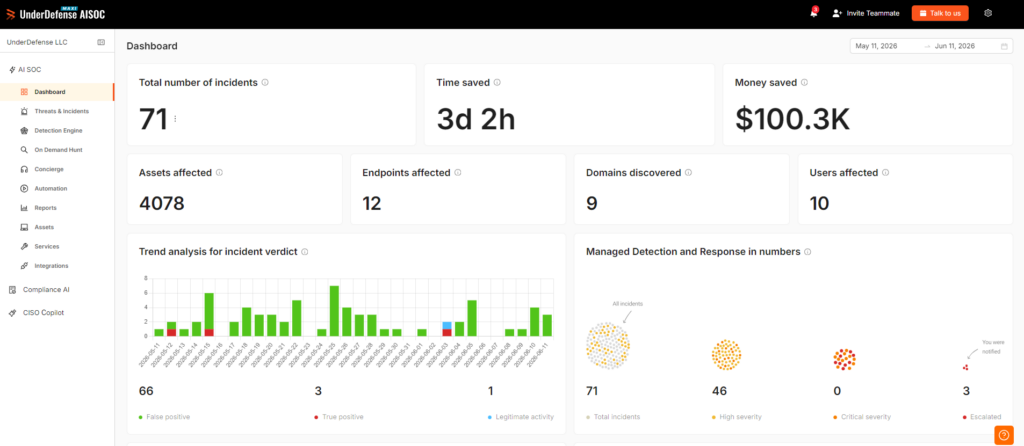
UnderDefense operates as a vendor-agnostic layer above any SIEM or XDR combination, ingesting signals from Splunk, Sentinel, Elastic, CrowdStrike, Okta, and other tools already in place through native integrations. The platform correlates detection data across these sources into a single investigation context, which removes the pivot between separate consoles for each source.
The distinction from a standalone platform is in what happens after an alert fires. A SIEM surfaces a suspicious login and flags it for review. The UnderDefense Agentic AI SOC investigates the alert, an analyst confirms the activity directly with the user through Slack or Teams, and containment happens as part of that same workflow, so the internal team receives a resolved incident.
What the AI Does
- The Agentic AI SOC investigates each alert at an average of 2 minutes per alert, with AI handling triage, enrichment, and initial analysis while human analysts make the final escalation and response decision.
- The AI layer is vendor-agnostic: it operates across whichever platform the customer already runs, with no platform migration required to use the capability.
- On-premises deployment of the Agentic AI SOC is available for regulated environments where cloud-based AI processing is a compliance constraint, keeping AI processing inside the client environment with zero telemetry leaving it.
Stack Fit Signals
- Strong fit for organizations with an existing SIEM investment that need consistent operational coverage without expanding internal headcount to match.
- Strong fit for regulated industries (financial services, healthcare, government) where on-premises AI SOC deployment satisfies a hard data-residency requirement.
- Weaker fit for organizations with a fully staffed internal SOC that covers the full detection surface around the clock and has no operational gap to close.
When to Shortlist / When to Skip
Shortlist if the organization has a SIEM but the team covering it is stretched, inconsistent, or handling less than the full detection surface. Shortlist if compliance requirements make cloud-only AI SOC processing unworkable. Skip if the organization is building a fully in-house security function from the ground up and has the headcount to staff it around the clock without an external operational layer.
2. Splunk Enterprise Security: Best for Large Enterprises Needing Massive Ecosystem Flexibility
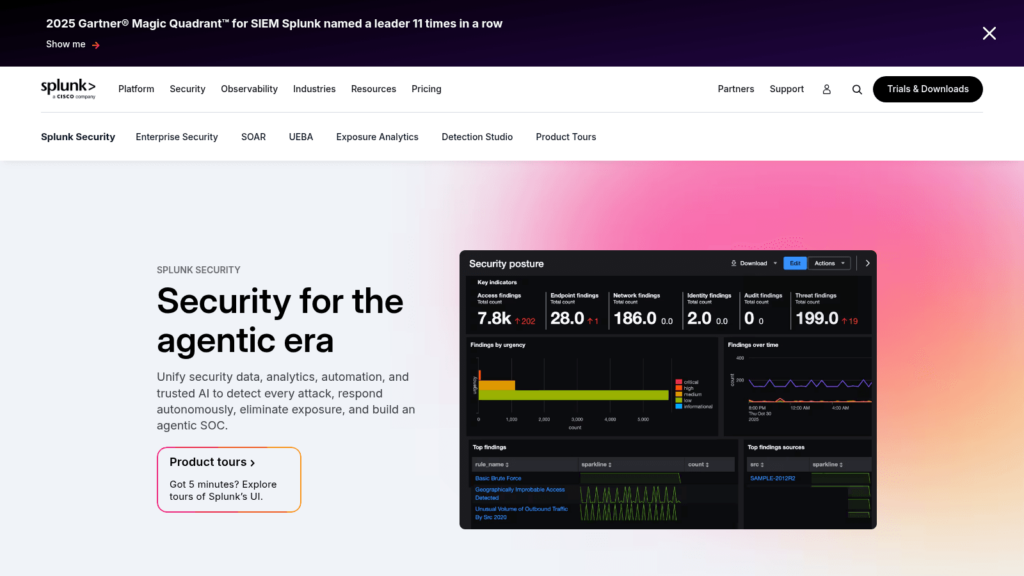
Splunk Enterprise Security is a SIEM platform built for large, complex environments that need to consolidate detection, investigation, and response across a high-volume, heterogeneous data estate. It runs as Splunk Cloud or as self-managed Splunk Enterprise on-premises, including air-gapped deployments.
What the AI Does
- Splunk’s AI Assistant ships in both Essentials and Premier and lets analysts query in natural language without writing SPL.
- Two agents sit in Premier only, and only on Splunk Cloud: alert triage with a plain-language explanation of each ranking, and malware reversal that breaks scripts down line by line and extracts indicators of compromise.
Essentials omits both agents. UEBA, SOAR, and Automated Threat Analysis are Premier-only. Confirm which tier you are pricing before building a capability comparison. The gap between what the product page leads with and what Essentials delivers is wide enough to change the evaluation.
Stack Fit Signals
Native across cloud and self-managed including air-gapped.
- Strong fit if the organization already runs Splunk observability or IT operations tooling. The ecosystem advantage is real.
- Weaker fit if the stack is primarily Microsoft or CrowdStrike, where Sentinel or Falcon Next-Gen SIEM will integrate with less friction.
When to Shortlist / When to Skip
Shortlist if air-gapped deployment is a hard requirement, or if consolidating SIEM, SOAR and UEBA under one contract is the goal. Skip if the team is under five people, if ingest volume is unpredictable, or if the budget conversation cannot reach Premier tier.
3. Microsoft Sentinel: Best for Microsoft-Centric and Cloud-First Organizations
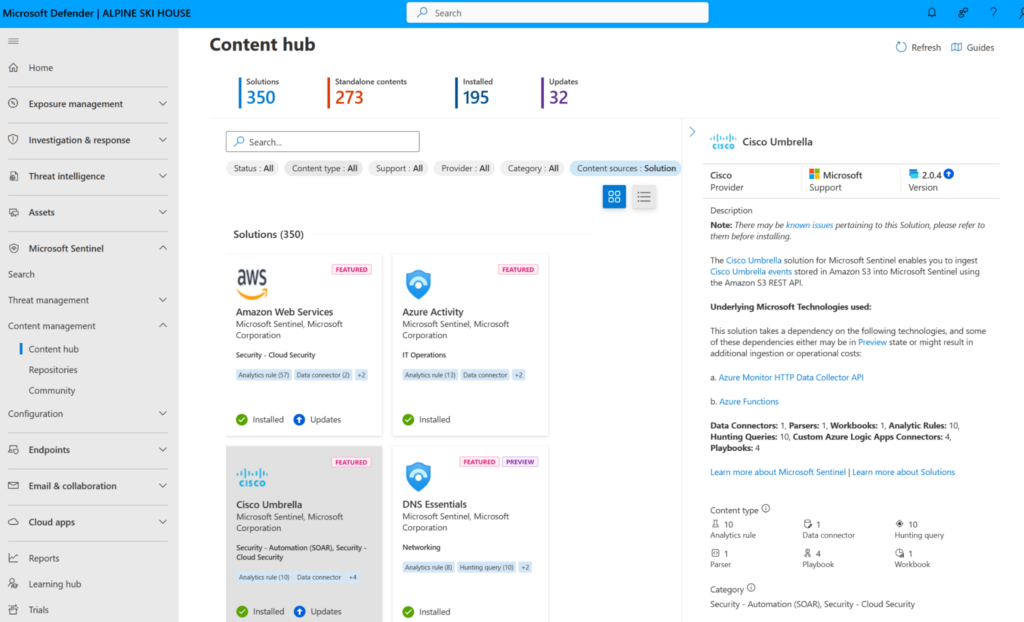
Microsoft Sentinel is a cloud-native SaaS SIEM built into the Azure and Microsoft Defender portal, pulling data from multi-cloud and on-premises sources through 400+ connectors. Sentinel runs on Azure infrastructure exclusively. Organizations with data-residency requirements that prevent Azure-hosted processing will need to look elsewhere on this list.
What the AI Does
- Security Copilot handles investigation and response assistance in natural language.
- Built-in UEBA and SOAR ship with the base product, without a tier upgrade required.
- An AI-assisted migration tool converts detection rules from Splunk or QRadar, with review before deployment. This is a practical capability for organizations actively moving off a competitor.
Stack Fit Signals
- Strong fit for organizations already running Microsoft 365, Azure, or Defender, where native integration removes connector overhead and licensing complexity.
- Weaker fit for organizations primarily on AWS or GCP infrastructure, where cross-cloud data ingestion adds latency and cost.
When to Shortlist / When to Skip
Shortlist if the organization is Microsoft-centric and cloud-native, or in the process of migrating from Splunk or QRadar. Skip if data-residency requirements prevent Azure-hosted processing, or if self-managed deployment is a hard requirement.
4. Elastic Security: Best for Open-Source-Oriented Teams Wanting Cost-Transparent SIEM
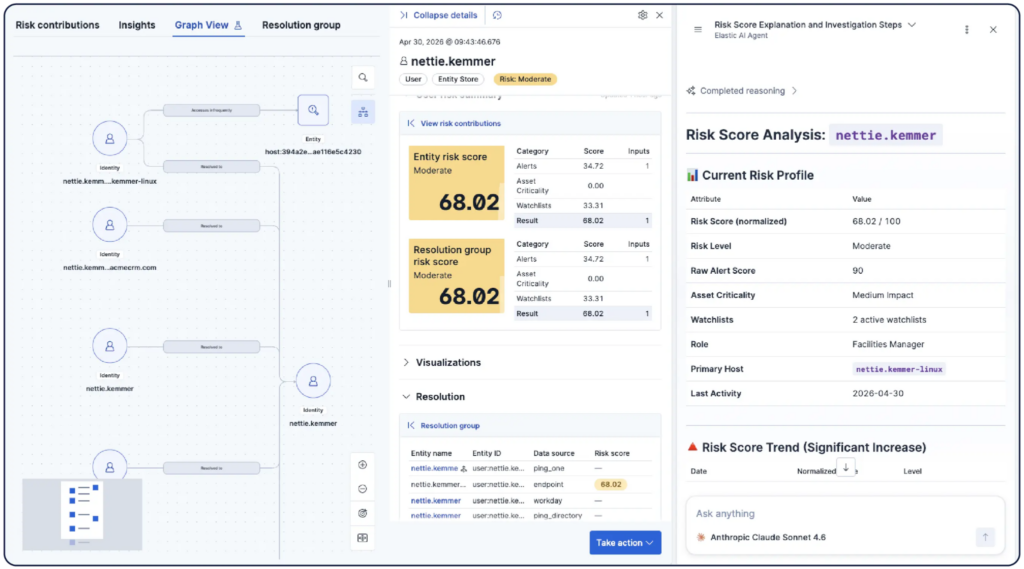
Elastic Security is a SIEM platform built on the Elastic Stack, combining log ingestion, behavioral detection, and automated response in one engine. It runs across three deployment paths: serverless, hosted on Elastic Cloud, or fully self-managed including sovereign cloud, on-premises, and air-gapped environments. Pricing follows compute and storage consumed, a structural difference from per-endpoint licensing that makes cost more predictable as data volume grows.
What the AI Does
- Elastic markets “agentic security operations” where autonomous agents handle the full lifecycle from ingestion through response, with analysts covering judgment and approval.
- The architecture is model-agnostic: organizations can plug in Elastic’s managed models, OpenAI, Anthropic, Gemini, or an on-premises open-source model.
- Pricing runs on compute and storage consumed, a structural departure from per-endpoint licensing models.
Stack Fit Signals
- Strong fit for teams that want to bring their own LLM in place of accepting a vendor-chosen model.
- Strong fit where compute-based pricing aligns better with how the security budget is structured than per-endpoint licensing.
- Weaker fit for teams without the engineering capacity to configure and tune a self-managed deployment.
When to Shortlist / When to Skip
Shortlist if air-gapped deployment is required and LLM flexibility matters. Shortlist if the team has the engineering depth to run self-managed and wants cost-transparent pricing. Skip if the team needs a low-configuration managed deployment from day one.
5. CrowdStrike Next-Gen SIEM: Best for CrowdStrike Ecosystem Customers Needing Petabyte-Scale Ingestion
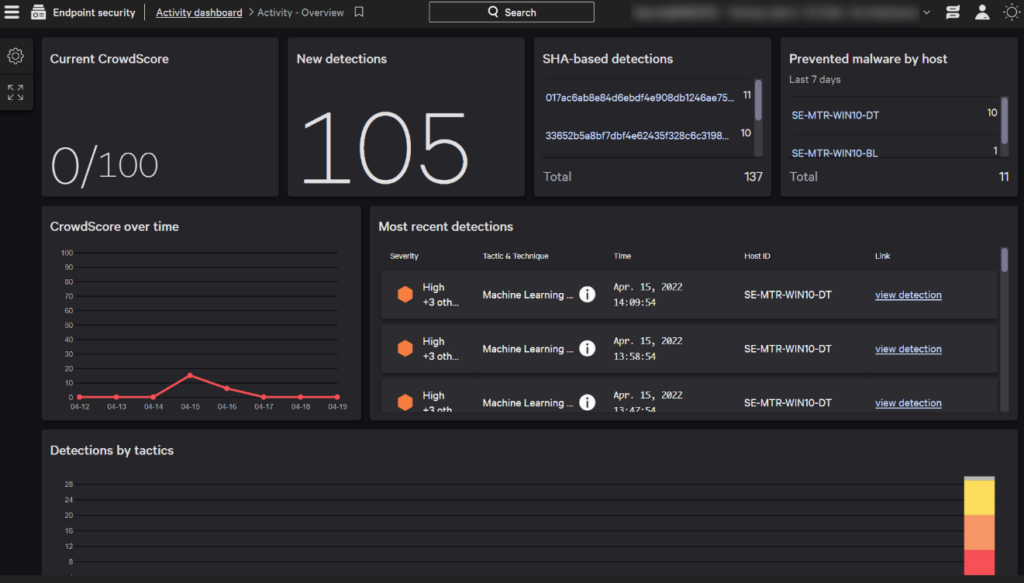
CrowdStrike Next-Gen SIEM is a cloud-native module inside the Falcon platform, delivered on the same lightweight sensor architecture CrowdStrike customers already run for endpoint protection. It is SaaS-only. Self-hosted deployment is a separate product, Falcon LogScale, so organizations with an on-premises requirement evaluate LogScale separately.
What the AI Does
- “Charlotte Agentic SOAR” handles governed automation across response workflows.
- An orchestrator agent coordinates domain-specialist agents working in parallel. This is CrowdStrike’s own framing for why this runs faster than sequential playbook execution.
- A “150x faster search” claim via index-free architecture is footnoted on CrowdStrike’s own page as a single customer case study result; verify it against a disclosed repeatable methodology before using it in an internal business case.
Stack Fit Signals
- Strong fit for organizations already running Falcon for endpoint protection: the single-sensor, single-console architecture removes the integration overhead of adding a separate SIEM vendor.
- Weaker fit for organizations running a different EDR, where the primary integration advantage disappears and cloud-only deployment may become a constraint.
When to Shortlist / When to Skip
Shortlist if the organization is an existing CrowdStrike Falcon customer and wants SIEM capability inside the same console. Skip if on-premises or air-gapped deployment is required; evaluate Falcon LogScale for that case. Organizations on a non-CrowdStrike EDR can still buy NG-SIEM standalone, though the single-sensor advantage disappears.
6. Palo Alto Cortex XSIAM: Best for Enterprises Seeking Converged SIEM, XDR and SOAR Consolidation
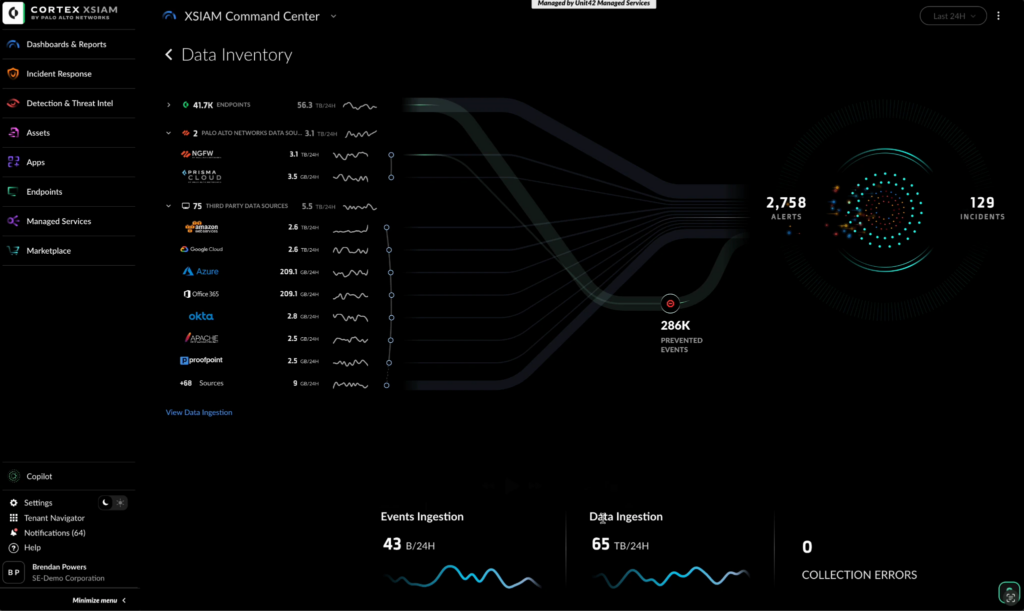
Cortex XSIAM is a cloud-delivered SOC platform from Palo Alto Networks, built to replace the traditional SIEM, XDR, and SOAR stack with a single consolidated product. XSIAM is built from the ground up for enterprises that want to retire multiple point solutions and run detection, investigation, and response from one console.
What the AI Does
- Palo Alto states that 2,900+ ML models run continuously across endpoint, network, identity, and cloud telemetry in a single pipeline.
- “AgentiX” provides a library of specialized AI agents routing tier-1 triage at machine speed and flagging decisions that require analyst judgment.
- XSIAM consolidates SIEM, XDR, and SOAR telemetry into one data layer, so the models correlate across all signal types simultaneously without manual cross-source correlation.
Stack Fit Signals
- Strong fit for enterprises already running Palo Alto NGFWs or Prisma, where platform consolidation across SIEM, XDR, and SOAR is the primary goal.
- Weaker fit for organizations running a heterogeneous stack without significant Palo Alto footprint.
When to Shortlist / When to Skip
Shortlist if consolidating SIEM, XDR, and SOAR into a single platform is the goal and the organization has the budget for an enterprise-track engagement. Skip if the organization has no existing Palo Alto footprint and consolidation across vendors is the goal. The platform’s integration depth is strongest inside its own ecosystem, and thinner when the existing stack is built around different tools.
7. IBM QRadar SIEM: Best for Regulated Industries with Deep On-Prem and Compliance Requirements
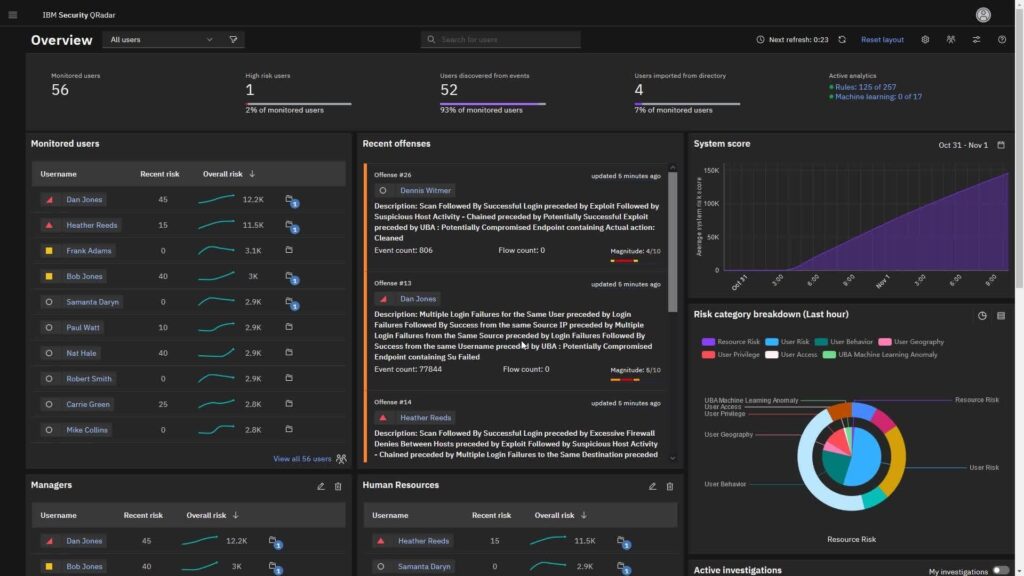
IBM QRadar is the only platform on this list with no cloud-native SaaS path. It deploys as hardware or virtual appliances on-premises, with an IBM-managed service option through X-Force Threat Management Services for organizations that want the operational layer without running it themselves.
IBM sold QRadar SaaS to Palo Alto Networks in 2024, which leaves IBM’s QRadar SIEM as an on-premises product with an IBM-managed option.
What the AI Does
- UEBA surfaces anomalous user and entity behavior across the data estate.
- Native Sigma rule support means the detection library is community-maintained and portable, without lock-in to IBM’s proprietary format.
- The AI framing is more restrained than most of the field: no agentic automation claims, no autonomous response language. For regulated environments cautious about autonomous action on-prem, that restraint reads as a feature.
Stack Fit Signals
- Strong fit for large regulated enterprises (financial services, government, healthcare) where on-premises data processing is mandated and per-GB ingestion penalties are a real budget concern.
- Weaker fit for cloud-native organizations or teams that need a fast deployment path. QRadar’s on-premises model carries higher setup and maintenance overhead than any cloud-native platform on this list.
When to Shortlist / When to Skip
Shortlist if on-premises-only deployment is a compliance requirement and per-GB ingestion costs are a known budget constraint. Skip if the organization is cloud-native, if the team lacks infrastructure capacity for on-premises appliances, or if deployment speed is a primary factor.
8. Exabeam New-Scale Fusion: Best for UEBA-First Organizations Focused on Behavioral Analytics
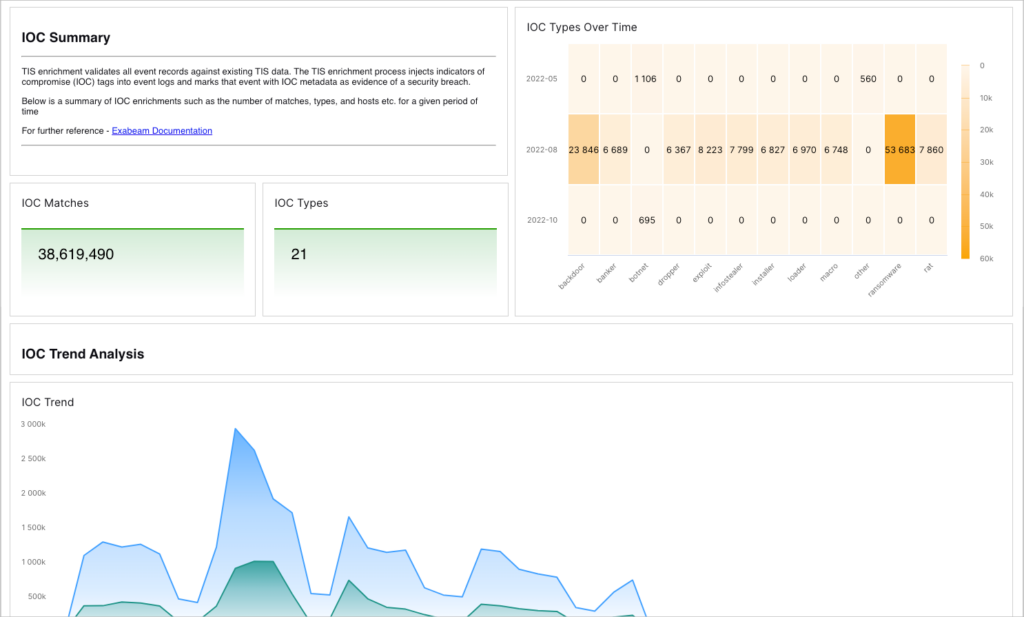
Exabeam New-Scale Fusion is cloud-native, combining SIEM and behavioral analytics in one platform. For organizations that specifically need on-premises deployment, Exabeam maintains LogRhythm as a separate product line.
What the AI Does
- “Exabeam Nova agents” automate routine triage, generate case summaries, and handle detection rule conversion.
- Dynamic UEBA-based risk scoring adjusts threat priority against behavioral baselines, bypassing static rule thresholds.
- “Agent Behavior Analytics” extends visibility to AI agents in the environment. This matters for organizations running autonomous AI tooling internally, which creates an insider-threat surface separate from human user behavior.
Stack Fit Signals
- Strong fit for organizations where insider threat and identity-based risk are the primary detection priority.
- Strong fit if the team is running or plans to run internal AI agents and wants behavioral monitoring extended to cover them.
- Weaker fit for organizations that need on-premises deployment, as Fusion SIEM is cloud-only with no deployment flexibility within this product line.
When to Shortlist / When to Skip
Shortlist if UEBA depth and insider threat detection are the primary evaluation criteria, or if AI agent monitoring is a near-term requirement. Skip if on-premises deployment is required; evaluate LogRhythm if the Exabeam feature set fits but cloud deployment does not.
9. Securonix Unified Defense SIEM: Best for Large Enterprises with Complex Insider Threat Scenarios
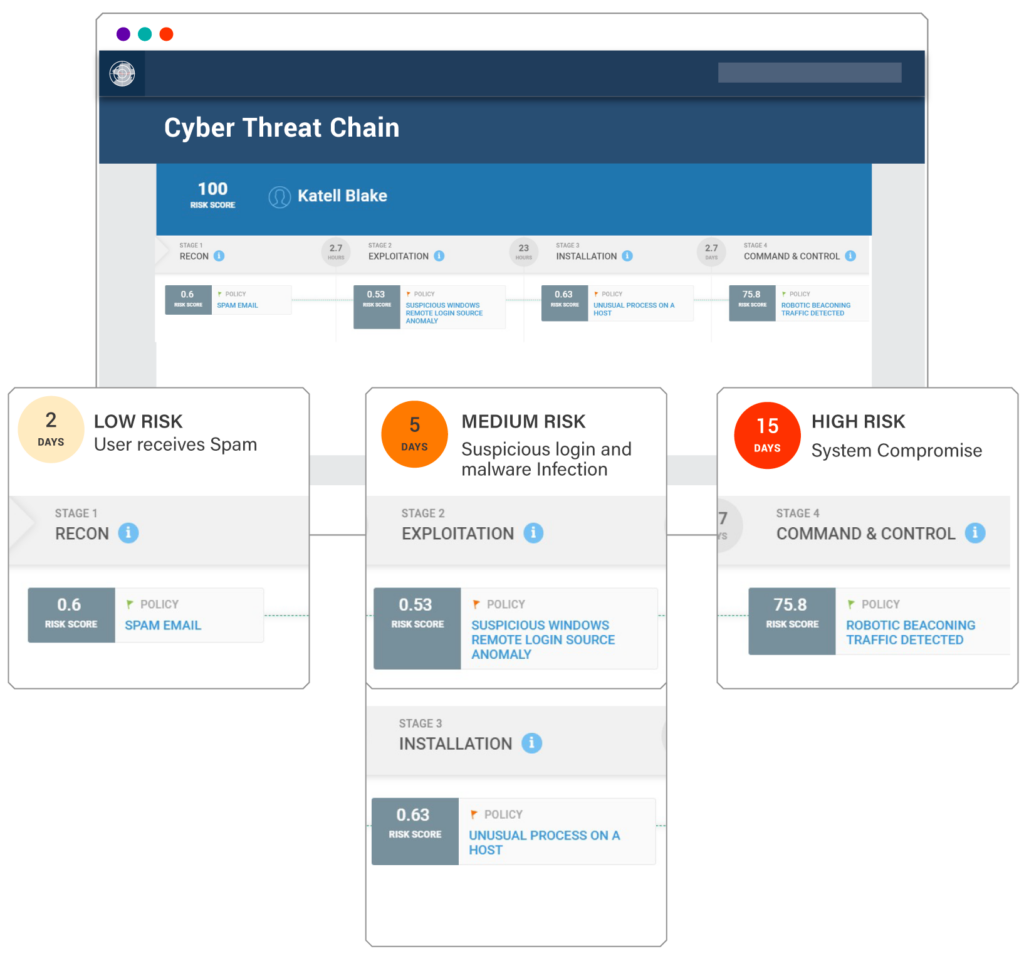
Securonix runs cloud-native on a single-tier architecture unifying SIEM, UEBA, SOAR, and threat intelligence. A bring-your-own-cloud option on Snowflake or AWS lets organizations keep security data inside infrastructure they already control.
What the AI Does
- “Agentic Mesh” provides automation with explainable AI guidance at every step; the reasoning behind each automated action is surfaced to the analyst.
- “Sam, the AI SOC Analyst” handles enrichment, triage, and response automatically.
- 365 days of always-hot, searchable data on a single tier is a concrete operational difference from platforms that tier older logs into slower storage.
Stack Fit Signals
- Strong fit for large enterprises where insider threat scenarios are complex and UEBA depth matters.
- Strong fit where data sovereignty requires keeping security data inside organization-controlled cloud infrastructure.
- Weaker fit for mid-market teams without a dedicated SOC function. Securonix’s depth across SIEM, UEBA, SOAR, and TIP requires analysts who can operationalize the full platform. A lean team running it at partial capacity gets a fraction of the value the architecture is built to deliver.
When to Shortlist / When to Skip
Shortlist if SIEM, UEBA, SOAR, and TIP consolidation is the goal, or if always-hot data retention beyond 90 days is a compliance or operational requirement. Skip if the security team lacks the headcount to operate a unified SIEM, UEBA, SOAR, and TIP stack across its full capability set. The platform’s value scales with the analysts running it, and a lean team will underutilize what Securonix is built to deliver.
10. SentinelOne Singularity AI SIEM: Best for Organizations Wanting Unified EDR and SIEM in a Single Agent
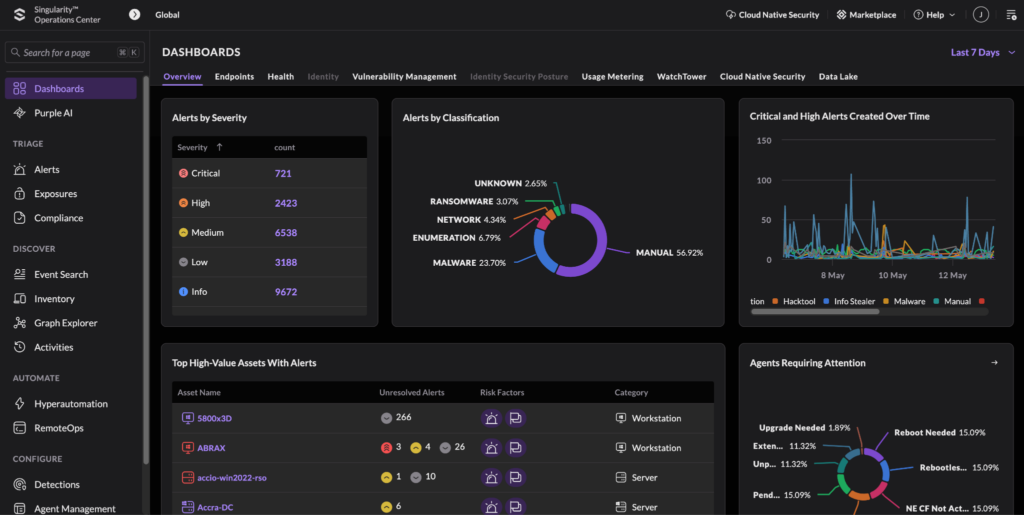
Singularity AI SIEM is cloud-native, built to “ingest and analyze large volumes of security data” inside the same platform that runs SentinelOne’s endpoint protection. The pitch is architectural: one agent, one console, running SIEM and EDR together, so a buyer is not asking two vendors to make two separate agents cooperate.
What the AI Does
- “Purple AI” handles investigation, transforming raw log and alert data into structured case narratives analysts can act on without building queries from scratch.
- “Singularity Data Pipelines” normalize and enrich data at the point of ingestion: SentinelOne’s own contrast with traditional SIEMs that concentrate AI at the alerting layer.
- The Enterprise tier includes an “Agentic AI SOC Analyst” that handles automated triage from ingestion through investigation to a disposition recommendation; on the lower two tiers it is a paid add-on.
Stack Fit Signals
- Strong fit for organizations already running SentinelOne for endpoint protection, where consolidating SIEM into the same platform removes a vendor and a data pipeline.
- Weaker fit for organizations with a heterogeneous endpoint environment or a deliberate architectural preference for keeping SIEM and EDR with separate vendors.
When to Shortlist / When to Skip
Shortlist if the organization is already a SentinelOne customer and the goal is consolidation. Skip if EDR and SIEM vendor separation is a deliberate architectural choice, or if on-premises deployment is required.
11. Rapid7 Incident Command: Best for Mid-Market Teams Seeking Built-in UEBA with SOAR
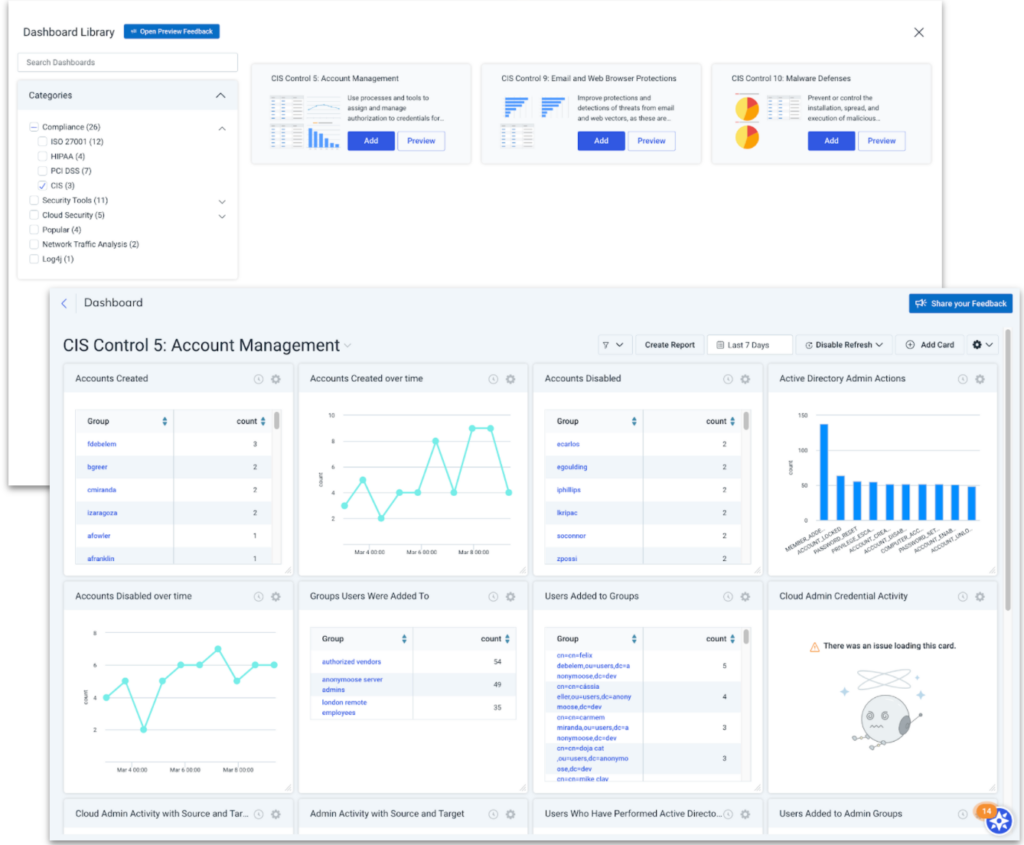
Rapid7 Incident Command (formerly InsightIDR) is a cloud-native detection and response platform with built-in UEBA and SOAR. Its AI layer has three named components: Agentic AI Investigation Workflows, AI-Assisted Alert Triage and Disposition, and natural-language log search.
What the AI Does
- “Agentic AI Investigation Workflows” run automated investigation sequences when an alert fires, reducing the manual steps between detection and analyst context.
- “AI-Assisted Alert Triage and Disposition” handles initial severity classification before the alert reaches an analyst.
- Natural-language log search removes the query-language barrier for teams without dedicated threat hunters.
Stack Fit Signals
- Strong fit for mid-maturity SOC teams that need UEBA and SOAR built in, with asset-based pricing that avoids surprise costs during high-volume ingest months.
- Weaker fit for large enterprises with complex, high-volume environments where the enterprise-track platforms on this list carry more detection depth.
When to Shortlist / When to Skip
Shortlist if the team is mid-maturity, cloud-native, and needs UEBA and SOAR without high deployment complexity. Skip if on-premises deployment is required, or if the environment’s scale exceeds what mid-market pricing tiers typically cover.
12. Stellar Cyber: Best for MSSPs and Lean SOC Teams Needing Multi-Tenant Automation
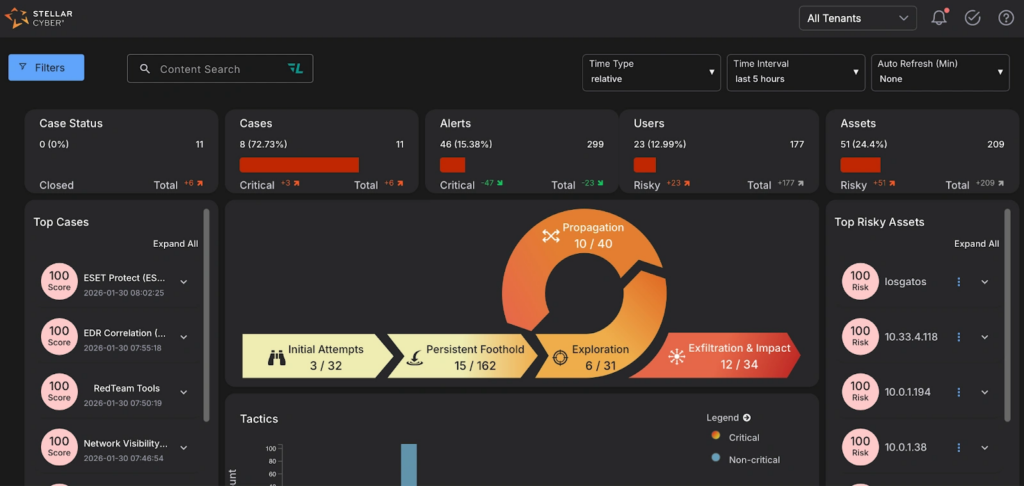
Stellar Cyber deploys across both on-premises and cloud environments under what the vendor calls “Multi-Layer AI,” a branded stack including an “AI Investigator,” “Agentic Auto Triage,” continuous AI threat hunting, and AI-assisted incident response, layered on top of built-in UEBA and a mix of static rules with supervised and unsupervised machine learning.
What the AI Does
- “Multi-Layer AI” covers automated triage, continuous threat hunting, and AI-assisted incident response within a single bundled license.
- UEBA runs alongside static rules and both supervised and unsupervised ML, a hybrid detection stack across three layers.
- The capability set ships under a single license.
Stack Fit Signals
- Strong fit for MSSPs and MDR providers that need multi-tenant architecture to serve multiple client environments from one deployment.
- Strong fit for enterprises that want a single bundled license covering all capabilities, bypassing modular pricing where capability sits behind tier upgrades.
- Weaker fit for organizations prioritizing vendor longevity and a broad pre-built integration ecosystem.
When to Shortlist / When to Skip
Shortlist if multi-tenant architecture is a requirement, or if a single all-inclusive license is the preferred commercial model. Skip if vendor maturity and ecosystem breadth are primary evaluation criteria alongside capability.
13. Sumo Logic Cloud SIEM: Best for Small-to-Medium DevOps and SecOps Teams
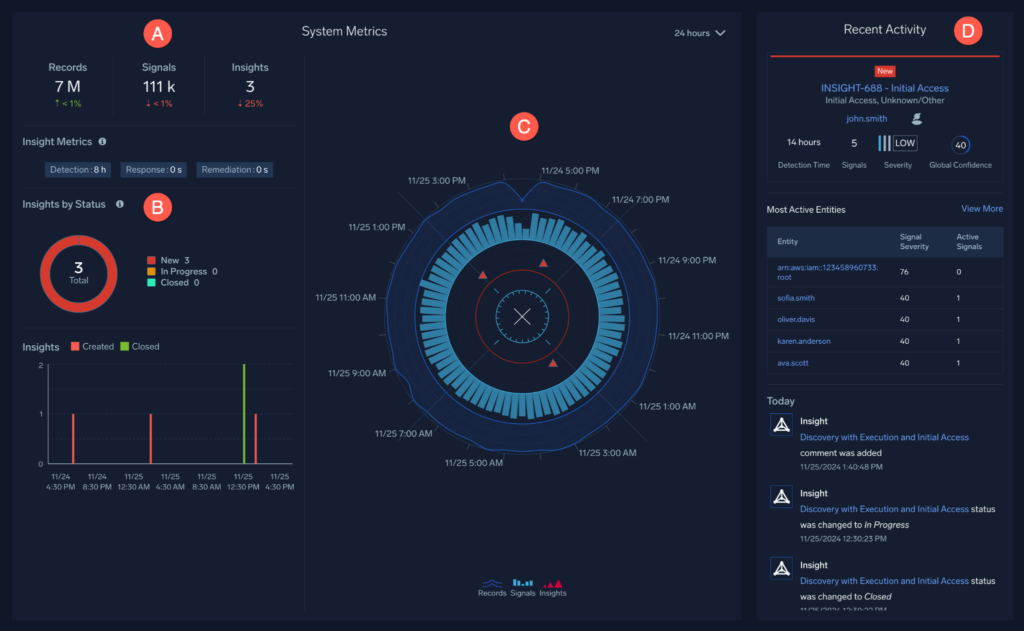
Sumo Logic Cloud SIEM is cloud-native only, described on its own site as a “scalable, multi-tenant platform” built around a “distributed architecture” the vendor says never drops data. Sumo Logic lists no self-managed or on-premises option, which rules it out for any buyer with a strict data-residency requirement.
What the AI Does
- The “SOC Analyst Agent” analyzes an incoming alert, evaluates related activity across the data estate, and delivers an evidence-backed verdict with supporting rationale; Sumo Logic’s site cites up to a 75% reduction in MTTR, with no scope or baseline stated.
- UEBA baselines behavioral patterns in minutes, according to the vendor’s own product page.
- More than 900 out-of-the-box detection rules ship with SIEM activation, alongside a coverage explorer for gap analysis.
Stack Fit Signals
- Strong fit for small-to-medium DevOps and SecOps teams that want log management and security analytics in one interface. Essentials omits SIEM, so the SIEM capabilities sit in a higher tier.
- Weaker fit for large enterprises or organizations with data-residency requirements, where cloud-only deployment and the credit-based pricing model both create constraints.
When to Shortlist / When to Skip
Shortlist if the team is small-to-medium, cloud-native, and needs a SIEM alongside DevOps observability tooling in one platform. Skip if on-premises deployment is required, or if security data must stay outside a vendor-managed cloud environment.
14. Wazuh: Best for Budget-Conscious Mid-Market Teams Willing to Self-Manage
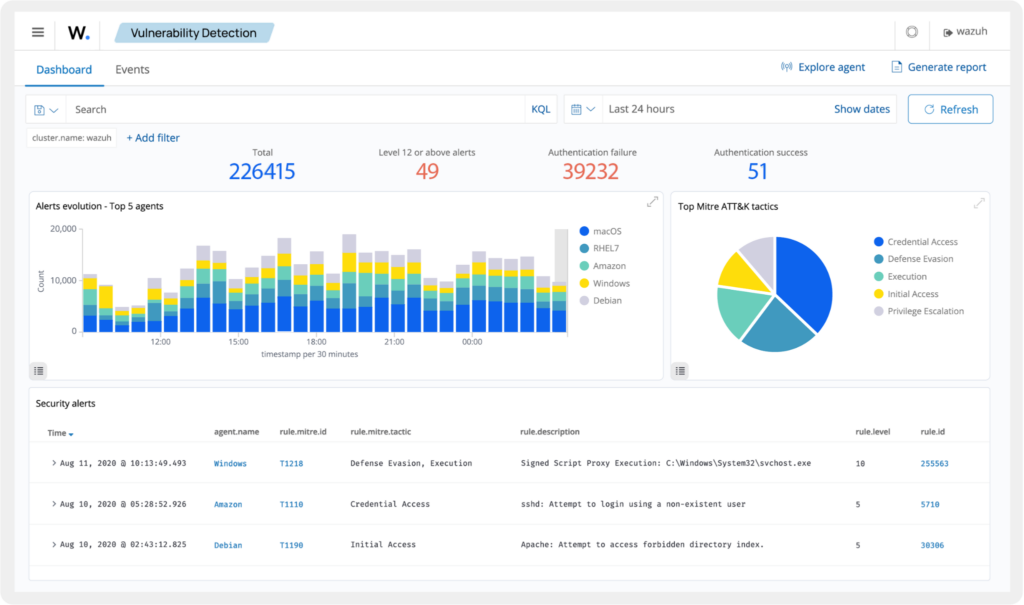
Wazuh is an open-source security platform combining SIEM, XDR, and endpoint detection in a single agent architecture. It covers log analysis, file integrity monitoring, vulnerability detection, and incident response across cloud, on-premises, and hybrid environments. The self-managed deployment (agent, server, indexer, and dashboard) runs on infrastructure the organization controls, with no vendor dependency on the core detection and correlation layer.
What the AI Does
- The AI security analyst is a scheduled emailed report, available on Wazuh Cloud only; the free self-managed core excludes it.
- Detection runs on rule-based correlation with MITRE ATT&CK mapping and CVE correlation, narrower than the agentic automation language in the commercial platforms above.
- The trade-off is direct: AI capability requires Wazuh Cloud at a published rate starting from $571 per month for up to 100 agents; running the free core means managing detection without the AI analyst add-on.
Stack Fit Signals
- Strong fit for budget-conscious mid-market teams with the engineering capacity to deploy, tune, and maintain a self-managed SIEM.
- Strong fit for organizations that want a free foundation with the option to move to a managed cloud tier as the security function matures.
- Weaker fit for teams without dedicated engineering resources to manage a self-hosted deployment, or for organizations that need enterprise-grade support and SLAs from day one.
When to Shortlist / When to Skip
Shortlist if budget is the primary constraint and the team has capacity to self-manage, or if starting on a free foundation and scaling to a paid tier over time aligns with how the security budget will grow. Skip if the team lacks capacity to maintain a self-managed deployment, or if AI capability is a day-one requirement.
15. Graylog Security: Best for Lean Security Teams That Have Outgrown Log Management
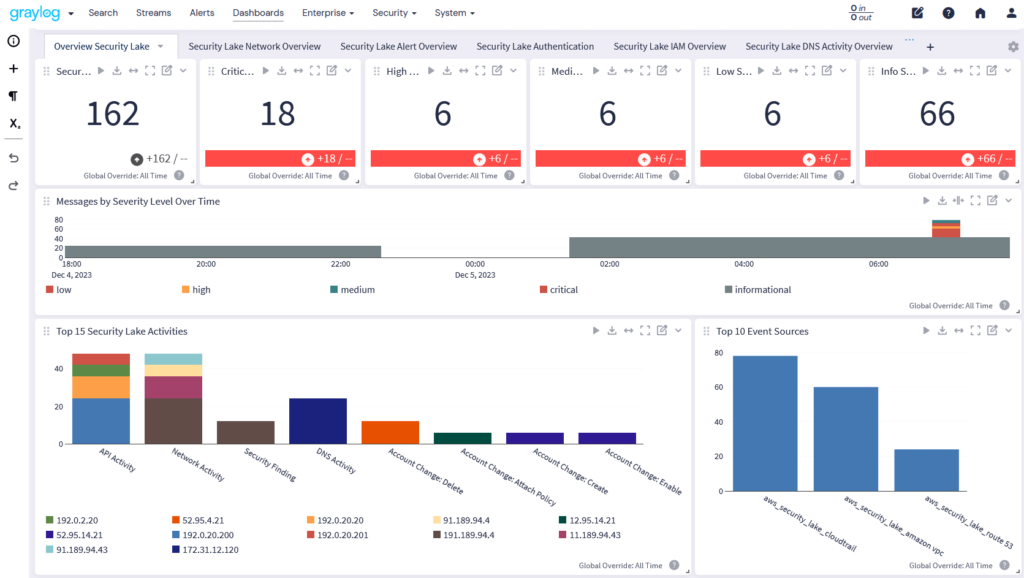
Graylog runs across cloud, on-prem or hybrid deployment with, in the vendor’s own words, “full feature parity across every deployment” and “no forced SaaS limitations. Graylog Open, the free and source-available tier, sits underneath the paid editions with no volume cap, a permanent free tier.
What the AI Does
- Machine-learning anomaly detection surfaces behavioral deviations without a manually written rule for each pattern.
- AI-generated incident reports include remediation recommendations alongside detection detail.
- AI dashboard summarization, alongside specific named detections like impossible-travel and log-volume-anomaly detection.
Stack Fit Signals
- Strong fit for lean security teams that have outgrown basic log management and need SIEM capability without enterprise-track pricing or deployment complexity.
- Strong fit for organizations that need full deployment flexibility (cloud, on-prem, or hybrid) without paying a premium for it or losing features in the process.
- Weaker fit for large enterprises that need the depth of UEBA, insider threat analytics, or advanced AI automation that the upper-tier commercial platforms carry.
When to Shortlist / When to Skip
Shortlist if the team is lean, budget-conscious, and needs SIEM capability with real deployment flexibility, or if starting on the free open-source tier and graduating to paid is the intended path. Skip if enterprise-grade UEBA depth, insider threat detection, or advanced AI automation is a primary requirement.
What Is Modern SIEM and How Does It Compare to XDR, SOAR, and Log Management in 2026?
SIEM (Security Information and Event Management) is the centralized platform that collects, normalizes, correlates, and analyzes security events across an entire enterprise. The term now spans everything from traditional log aggregation engines to AI-native detection platforms with embedded SOAR, UEBA, and real-time threat intelligence built in. Evaluating a SIEM shortlist today against a five-year-old mental model produces the wrong comparison set.
SIEM vs. XDR vs. SOAR vs. Log Management
The five categories overlap in what they ingest and what they do with it, so the table compares them on function, scope, detection method, and response.
| Dimension | SIEM | XDR | SOAR | Log Management | Security Data Lake |
| Primary Function | Centralized detection, correlation, and compliance reporting | Cross-layer threat detection and automated response | Orchestration and automation of incident response workflows | Log collection, storage, and search | Raw telemetry storage and analytics |
| Data Scope | Broadest: logs from any source (network, endpoint, cloud, identity, application) | Focused: vendor’s own telemetry plus select third-party sources | Feeds from SIEM/XDR/EDR; does not collect independently | All logs, including non-security | Structured and unstructured data at scale |
| Detection Method | Correlation rules, ML analytics, UEBA | Behavioral analytics across the vendor’s own stack | No native detection; automates response to alerts from other tools | Search and filter; limited detection | Custom analytics on raw data |
| Response Capability | Alert generation; response via SOAR integration | Built-in automated response actions | Primary purpose: executes playbooks and orchestrates tools | None | None |
| Best For | Compliance, broad visibility, multi-vendor environments | Consolidated detection and response in single-vendor ecosystems | Automating repetitive response tasks at scale | Retention, search, compliance archival | Analytics teams with data engineering capacity |
Read the table as a scope question: SIEM ingests the most, XDR acts fastest inside one vendor’s stack, and SOAR acts on what the other tools detect.
Where Category Boundaries Break Down
A legacy SIEM deployment treats each security tool as a separate data source, generating parallel alert streams that require manual correlation across consoles. Traditional MSSP monitoring layers on top of that without adding investigative depth. XDR platforms from CrowdStrike and Palo Alto consolidate detection and response inside a single vendor’s stack, a real operational gain for organizations already standardized on that vendor, and a genuine constraint for organizations that are not.
The gap between an alert firing and a threat contained is where the operational risk concentrates, regardless of which category label sits on the platform generating the alert. Closing that gap is a staffing and process question as much as a platform question, which is why managed SIEM services exist as a layer separate from the platform license itself.
Choosing Between Categories Starts With the Operational Question
The technical differences between SIEM, XDR, SOAR, and log management matter for what each tool can ingest and correlate. The practical question for most buyers is narrower: which of these five categories, or which category, or combination of categories, the team that will operate it can run around the clock.
A platform with the deepest detection logic on this list still depends on someone tuning it, watching it, and acting on what it surfaces.
SIEM for Mid-Market Teams
Most of the platforms compared above are built for and priced toward enterprise buyers with dedicated security budgets and staff to match.
A mid-market team (three to twelve people covering an entire attack surface) is evaluating the same platforms against a much tighter constraint: no dedicated SOC, no headcount to spare for a lengthy deployment, and a budget that has to survive scrutiny from someone who does not work in security.
Even the two platforms priced closest to that reality, Wazuh’s free self-managed core and Graylog’s lean-team positioning, only solve the license-cost side of the equation. Neither solves who tunes the platform, watches it after hours, or owns the false-positive rate once the initial deployment excitement wears off. A platform a three-person team cannot tune is running an unused feature set, regardless of what its comparison-table entry says it can do.
That operational gap is where a managed layer changes the calculation. A four-person IT team at a credit union fits this buyer, and an UnderDefense credit union SIEM case study shows what that looks like in practice: roughly 200 monitored endpoints, a SIEM added on top of an existing CrowdStrike Falcon Complete deployment.
The engagement expanded coverage from 8×5 to 24×7, including weekends and public holidays, delivered as a managed layer added on top of the existing four-person team.
The collaboration also surfaced a firewall misconfiguration that existing tooling had missed, fixed before it could be exploited. An IT Operations Manager at the credit union described the process directly: “The onboarding process was smooth and quick.”
Whichever platform a mid-market team picks from this list, the operational question “who watches it at 2 a.m., and who tunes the false-positive rate down over the following weeks” decides more of the outcome than the license itself does.
How to Choose a SIEM Platform
Fifteen platforms compared side by side is a research exercise. Narrowing to two or three candidates worth a real evaluation takes a specific sequence of questions, in an order that eliminates the most vendors fastest. A feature checklist fits most SIEM products above equally well and answers nothing.
The eight questions below run in the order that narrows a fifteen-platform field down to a real shortlist.
1. Does the Deployment Model Fit a Hard Infrastructure Requirement?
This question eliminates the most candidates fastest. A hard on-prem or air-gapped requirement removes all eight cloud-only platforms immediately: Microsoft Sentinel, CrowdStrike Falcon Next-Gen SIEM, Palo Alto Cortex XSIAM, Exabeam New-Scale Fusion, Securonix, SentinelOne, Rapid7 Incident Command, and Sumo Logic. An organization that prefers to avoid maintaining its own infrastructure can also set aside LogRhythm (Exabeam’s on-premises product line) and Wazuh’s self-managed option.
2. What Does the AI Layer Do in Production, Separate From What It’s Called?
“Agentic” appears on most of these product pages in 2026, but the underlying capability varies widely. The range runs from investigation assistance (Splunk’s triage agent, SentinelOne’s Purple AI) to fuller automated response (CrowdStrike’s Charlotte Agentic SOAR, Palo Alto’s AgentiX). Ask every vendor the same question: what does the platform do without a human confirming the action first, and can that action be reversed if it’s wrong?
A co-managed layer that sits on top of any of these platforms answers the same question differently: the human confirmation step is built into the operating model.
3. Does That AI Capability Sit Behind a Tier Gate?
Splunk’s UEBA and SOAR ship in Premier only. SentinelOne’s Agentic AI SOC Analyst is included in Enterprise and sold as an add-on on the lower two tiers. A platform’s marketing page and its cheapest tier often describe two different products, and that gap is one of the most common reasons a deployed platform underdelivers against what a buyer saw in the demo.
4. How Does the Pricing Basis Behave Across a Three-Year Growth Curve?
A per-GB platform gets more expensive as data sources multiply, cloud migrations add logging volume, or retention windows extend for compliance. A per-endpoint platform scales with headcount or device count instead. Run both curves against the organization’s actual roadmap before comparing sticker prices.
5. What Happens to Detection Accuracy After the Vendor’s Own Tuned Demo Data Disappears?
Every vendor demo runs on curated data with pre-built detections calibrated to look sharp. The real test starts after go-live, once the platform is ingesting the organization’s actual noise, edge cases, and false-positive-prone sources. Ask each vendor for a reference customer at a similar size and industry, and ask that customer specifically how long it took before detection quality matched what the demo showed.
6. What Does This Platform Cost to Operate, Beyond the License Fee?
A platform requiring a proprietary agent or a dedicated tuning team carries a real commitment beyond the license. Wazuh’s free core is the clearest example on this list: the license cost disappears, but the work of running the stack does not.
7. Does the Integration List Cover the Actual Stack?
A product page listing “400+ integrations” says nothing about whether a specific identity provider, ticketing system, or cloud account is one of them, or whether that connector is actively maintained versus untouched for two years. Ask for the exact connector list for the organization’s stack in writing, and check it against published integration catalogs such as UnderDefense’s integration list. Treat that written list with the same scrutiny as a price quote.
8. Who Picks Up the Phone at 2 a.m., and What Happens Next?
A platform’s marketing page rarely says whether tier-one support can read the platform’s own detection logic, or what response-time commitment backs a given support tier. UnderDefense’s managed SIEM model exists because the platform and the operational support behind it are two separate purchases. A buyer who assumes the license includes expert-level support is often working from the wrong assumption.
These eight questions do more work than a demo ever will, because a demo is built to make every platform look identical: clean data, curated detections, a sales engineer narrating the parts that work. Running a shortlist through these questions in order surfaces the two or three platforms that fit the organization’s deployment constraints, growth trajectory, and operational capacity before a single sales call gets scheduled.
How SIEM Pricing Breaks Down
SIEM platforms price on five distinct bases: per-GB ingestion, per-endpoint, per-asset, usage metric, and flat subscription. Knowing which structure a vendor uses tells a buyer which of their own growth curves will move the bill next year before that growth has happened.
| Pricing Basis | Platforms Using It | What Drives the Bill Up |
| Per-GB ingestion / data volume | Microsoft Sentinel, CrowdStrike Falcon Next-Gen SIEM, most Splunk workload pricing | Log volume growth, verbose data sources, retention length |
| Per-endpoint / per-device | SentinelOne (endpoint-platform pricing; AI SIEM quote-only); Endpoint count | Endpoint count |
| Per-asset | Rapid7 Incident Command; Number of monitored assets | Number of monitored assets, raw log volume |
| Usage metric (EPS/FPM or virtual server count) | IBM QRadar, Sumo Logic; events-per-second and flow rate (QRadar), credit consumption rate (Sumo Logic) | Events-per-second and flow rate, storage |
| Flat or tiered subscription | Wazuh Cloud, Graylog Security | Agent count (Wazuh) or a fixed GB/GCU threshold (Graylog) |
Each model carries a different risk profile depending on how the organization is structured:
- Per-GB ingestion penalizes fast-growing environments. Verbose data sources, long retention windows, and high-volume incident periods all drive cost with no corresponding change in headcount or assets. A breach investigation that spikes log volume for two weeks will show up on the next invoice regardless of whether it was anticipated in the budget.
- Per-endpoint is the most predictable model for organizations with stable device counts. Cost grows with headcount and device count, independent of what those devices generate. Teams that know their device count a year out can forecast this model accurately.
- Per-asset rewards teams that keep their monitored surface well-defined. Scope creep such as adding cloud workloads, shadow IT, new business units, directly moves the number. Discipline in asset management translates into cost predictability.
- Usage metric (EPS/FPM) ties cost to event throughput and flow rate, which makes it sensitive to network architecture changes and logging verbosity. IBM QRadar’s model explicitly positions against per-GB penalties, which matters for environments generating high event volume from a contained set of sources.
- Flat subscription offers the most predictable cost structure of the five. Wazuh Cloud prices on agent count with published tiers; Graylog prices on a fixed GB-per-day or GCU threshold. Both give a buyer a number to anchor a multi-year budget conversation against.
The pricing model a vendor uses is a structural decision that compounds over time. A per-GB model chosen when log volume is low looks different three years into cloud migration. A per-endpoint model chosen with a stable headcount assumption looks different after an acquisition. Match the pricing structure to the growth curve the organization is actually on.
How Much Does a SIEM Cost in 2026?
SIEM cost is best read through its components. CISA and ASD’s May 2025 SIEM and SOAR guidance names specialist staffing, upskilling and continual training, and outsourced service costs alongside the platform itself, and gives no dollar ranges.
The table below carries every published rate.
| Platform | Pricing Model | Published or Estimated Rate | What Drives Cost at Scale |
| UnderDefense | Hourly, tiered by engagement | $50/hour (tuning) to $140/hour (SIEM-as-a-Service); 160-hour minimum | Engagement scope |
| Splunk Enterprise Security | Per-GB/day ingestion | ~$80,000/year for 100 GB/day on Splunk Cloud base platform (AWS Marketplace); Enterprise Security licensed on top, quote-only | Log volume, retention length |
| Microsoft Sentinel | Per-GB ingestion, PAYG or commitment tiers | $4.30/GB pay-as-you-go (East US); commitment tiers lower the effective rate to ~$2.05/GB at the highest volume | Log volume; commitment tier lowers the rate |
| Elastic Security | Compute and storage consumed | No fixed public rate | Compute usage |
| CrowdStrike Falcon Next-Gen SIEM | Per-GB ingestion, standalone or with Falcon | $5.95/GB third-party data (AWS Marketplace PAYG); 10 GB/day free for Falcon Insight XDR customers | Third-party log volume, retention length |
| Palo Alto Cortex XSIAM | Platform licensing | No published pricing; sales-only | Unknown until sales conversation |
| IBM QRadar SIEM | EPS/FPM or Managed Virtual Server count | Custom, no published figure | Event throughput |
| Exabeam New-Scale Fusion | Quote-only | No published rate | Unknown until sales conversation |
| Securonix Unified Defense SIEM | Quote-only | No published rate card | Unknown until sales conversation |
| SentinelOne Singularity AI SIEM | Per-endpoint (general platform tier) | $179.99-229.99/endpoint/year for the endpoint platform (Complete, Commercial); AI SIEM quote-only | Endpoint count |
| Rapid7 Incident Command | Asset-based | Quote-only | Monitored asset count |
| Stellar Cyber | Single bundled license | Quote-only | Unknown until sales conversation |
| Sumo Logic Cloud SIEM | Credit-based | Card checkout from a trial capped at $25,000 | Credit consumption rate |
| Wazuh | Free core; paid Cloud tier | Core free; Cloud from $571/month for up to 100 agents | Agent count on Cloud tier |
| Graylog Security | Volume-based subscription | From $18,000/year (10GB/day or 100 GCU/year); Open tier free | Daily volume or GCU threshold |
Every rate in this table covers one thing: the platform license. None of it covers what it actually takes to get that platform producing trustworthy alerts and that gap is where the next section picks up.
The Hidden Costs of SIEM Deployment
A published rate covers the license. Four additional cost categories determine what a SIEM deployment costs in year one.
Professional Services and Tuning
The largest and least predictable cost in any SIEM deployment. Every SIEM platform ships with generic detection logic. Calibrating it to one organization’s specific environment, logging sources, and user behavior is a separate engagement that starts after the license is signed. A team generating excessive false positives six months in is almost always looking at a tuning gap.
Data-Volume Overages
Hits hardest on per-GB platforms. A cloud migration, a new logging source, or a compliance mandate extending retention windows can push an organization into a higher ingestion tier mid-contract. The bill increase is invisible until the invoice arrives.
Platforms that are priced based on the number of endpoints or assets have a different risk profile; this should be considered when comparing them to the typically higher base rates if you expect to see an increase in the volume of logs in the system.
Third-Party Connectors and Add-Ons
Most platforms integrate with the tools an organization already runs: ticketing systems, threat intelligence feeds, identity providers, cloud environments. The connector itself is often included. The data flowing through it frequently is not. Each connected source adds ingestion volume on per-GB platforms, or triggers a separate licensing requirement on platforms that charge per data source or per integration tier.
The result is a base subscription that covers the platform and a separate set of line items that cover making it work in a real environment. The gap between those two numbers widens with every data source added and every third-party tool connected.
Training and Ramp-Up Time
Ramp-up time is the cost that appears last in a vendor quote and hits first in the deployment.
Analysts need time to learn the interface, understand the alert logic, and develop the judgment to act on what the platform surfaces. That time is measured in weeks on a familiar platform and months on a genuinely new one, and it runs at full analyst salary cost regardless of how much of the platform’s capability the team is using during that period.
Every platform with an agentic AI layer adds a second learning curve on top of the first. An analyst working with Splunk’s triaging assistant, SentinelOne’s Purple AI, or Securonix’s Sam needs to understand what the agent’s output means and where it requires analyst judgment before trusting it on a live incident. That calibration happens in production, on real alerts, and it takes time the platform vendor does not account for in a license quote.
All four categories share one trait: each one is engineering labor, and labor is the line a license quote leaves open. Tuning, source onboarding, ingestion control, and analyst ramp-up all consume hours, either from the internal team or from a services partner billed separately.
UnderDefense prices that labor as its own line item, across three engagement models:
- SIEM professional services for targeted fixes and tuning projects,
- co-managed SIEM where UnderDefense engineers work alongside the internal team,
- and fully managed SIEM-as-a-Service with the platform, deployment, and licensing included.
All three run on an hourly model and work on top of the SIEM already in place, with zero rip-and-replace. Each maps directly to the four costs above:
- For tuning, detection engineers build correlation rules for the specific environment, drawing on an UnderDefense library of 1,000+ rules mapped to MITRE ATT&CK.
- For data-volume overages, irrelevant data is filtered before ingestion, which keeps per-GB platforms inside their contracted tier as log sources grow.
- For connectors and add-ons, new custom data sources are ingested and normalized as part of the engagement, with alerting routed into Slack, Teams, or Jira.
- For ramp-up, UnderDefense engineers work the platform from the first week, so the internal team learns in a tuned environment with calibrated alerts.
The outcome is a year-one budget where the services line is a known figure before the first invoice arrives.
Use the UnderDefense Managed SIEM calculator to get a services estimate you can defend in a budget review.
What Is Replacing SIEM?
The SIEM market in 2026 is consolidating around fewer vendors and a different architecture. Gartner evaluated 17 platforms in the 2025 2025 Magic Quadrant, down from 22 in 2024, and most now lead with AI capability in their marketing.
What is changing is architecture. SIEM platforms are absorbing data-lake infrastructure to resolve the ingestion-cost and retention limits that made older deployments expensive at scale.
AI agents for triage and detection engineering are moving from add-on to core. The boundary between SIEM, XDR, and SOAR is blurring to the point where category labels matter less than what a given deployment does on day 90. Microsoft Sentinel, Cortex XSIAM, and CrowdStrike Falcon Next-Gen SIEM are three vendors converging on the same shift from three different starting points. A newer wave of AI-native SIEM tooling is pushing the same convergence from the outside.
Security analyst Raffael Marty, whose background includes ArcSight and Splunk, framed the market plainly in a March 2026 analysis: “The new wave of AI SOC, SIEM, and pipeline vendors is not proving SIEM is dead. It is proving SIEM vendors left too many gaps open for too long.”
His follow-on caution is worth carrying into any evaluation: a product that makes the SOC quieter without improving coverage may leave the underlying problem unsolved. Marty’s caution is that such a product may have “converted visible false positives into invisible false negatives,” a distinction no dashboard demo will surface.
The teams that get value from AI-layer improvements are the ones with consistent operational coverage underneath. A SIEM that surfaces fewer alerts means less if the team working those alerts is already stretched. That is the gap a managed SIEM service closes: the operational layer that determines whether the platform runs at full capability or at whatever fraction a lean team can cover.
UnderDefense operates the SIEM you already have or deploys one where none exists. 24/7 monitoring, on-premises available.
Detection Engineering: Who Writes and Maintains the Rules
Every SIEM platform in this comparison ships with a starting set of detection rules, and every one of those starting sets is generic by necessity: built for a hypothetical average environment, never the specific one an organization actually runs.
The marketing across this categor talks about triage and investigation. It talks far less about who writes and maintains the correlation logic those agents are triaging against in the first place, and that gap is where a lot of deployed SIEM value quietly leaks away.
The platforms in this guide split into three real approaches to that gap:
- Prebuilt library, internal tuning. Some ship a large prebuilt library and expect a security team to tune it. Exabeam’s LogRhythm line, with more than 1,100 prebuilt correlation rules, some mapped to MITRE ATT&CK and QRadar’s native support for community-maintained Sigma rules both fall into this camp, giving a team a running start with the tuning work still theirs to do.
- AI-drafted rules, human review. Others build rule creation into the AI layer itself: Splunk’s AI Assistant and Exabeam’s Nova rule-conversion agents both claim to draft or adapt detection logic automatically, shifting the work from writing rules by hand to reviewing what an agent proposed. Securonix takes the most specific position on this question, marketing its “Agentic Mesh” as providing “explainable AI guidance for every step”. This means that the rationale for an automatic rule change remains visible along with the result itself.
- External detection engineering. A third approach hands the engineering work to an external team entirely. UnderDefense’s detection engineers build correlation rules against a library of 1,000+ patterns mapped to MITRE ATT&CK, calibrated to the specific environment from the first rule. In essence, they are doing the same work that would otherwise fall to an internal team, but doing it by professionals who do it as their primary job.
Each approach redistributes the underlying work without removing it. A prebuilt rule library still needs a human to decide which alerts are worth keeping and which are noise for this specific environment.
An AI layer that drafts detection logic still needs a human who understands the environment well enough to catch a bad suggestion before it goes live.
Team size matters more here than any feature comparison in this guide. An enterprise SOC with a dozen analysts can absorb the work of reviewing AI-drafted rules as part of an existing detection-engineering function. A three-person mid-market team evaluating Wazuh or Graylog takes on that same review responsibility with far less slack to do it. Operational capacity decides whether either platform delivers what its detection library promises, regardless of how deep that library runs.
Whichever platform comes out of this comparison, ask directly who owns detection engineering six months after go-live: the vendor, an internal analyst, or a managed provider.
Compliance and Audit Reporting: What Regulated Buyers Should Ask
A SIEM produces the evidence an auditor asks for (log retention, access records, correlation and alerting history), but the certificate or attestation comes from an independent auditor, separate from the software vendor.
Three specific questions determine whether a platform produces evidence an auditor can use, starting with how long that evidence sticks around.
Retention Length
Retention is the first practical question a regulated buyer needs answered platform by platform, because the number is rarely the same twice. PCI DSS, HIPAA, and SOC 2 each carry their own minimum log-retention expectations, and a per-GB pricing model turns a longer retention requirement directly into a larger bill.
A platform’s default retention window and its maximum configurable window are two different numbers. The second one is the one that matters for a compliance program with a multi-year audit horizon.
Data Residency
Data residency is where deployment models stop being a technical detail and become a compliance requirement.
| Deployment Model | Platforms | Compliance Relevance |
| Self-managed, customer-controlled infrastructure | IBM QRadar, Splunk (self-managed), Elastic Security, Exabeam LogRhythm, Wazuh (self-managed core), Graylog, Stellar Cyber | Data stays inside infrastructure the customer directly controls, often the deciding factor for defense contractors, government agencies, or financial institutions under a data-residency mandate |
| Cloud-only, vendor-hosted | Microsoft Sentinel, CrowdStrike Falcon Next-Gen SIEM, Palo Alto Cortex XSIAM, Exabeam New-Scale Fusion, Securonix, SentinelOne, Rapid7 Incident Command, Sumo Logic | The vendor’s data-processing agreement and regional hosting options become an active line item in the compliance evaluation |
A cloud-only platform is not disqualified for a regulated buyer on that basis alone. It moves the vendor’s data-processing agreement from background paperwork to a document the compliance team reviews line by line before signing.
Evidence Export
Evidence export matters more than most buyers expect until an audit is actually underway. An auditor works from a defined report on a fixed schedule, formatted to fit their own workpapers; console access to browse the SIEM directly is not what closes an audit finding.
Ask every vendor under evaluation for a sample compliance report before signing. A platform that produces a clean dashboard and a clumsy audit export has built the easier half of the problem.
What a Platform Cannot Replace
A SIEM is evidence infrastructure. The policies, access reviews, and control mapping a framework requires still belong to the compliance program that uses that evidence, outside the platform generating it. The right platform turns evidence collection into a continuous process; the main difference that compliance teams notice each year is whether audit preparation begins months or just a week before the auditor’s visit.
UnderDefense MAXI Compliance AI approaches this from the continuous side directly: infrastructure monitoring mapped to compliance frameworks generates audit-ready evidence as a standing process, so the evidence export question above has an answer in place before an auditor asks it.
Run an AI audit simulation and see which controls are audit-ready today.
Which of These 15 Platforms Fits Your Situation
Reading fifteen detailed entries end to end is one way to reach a shortlist. Matching a specific constraint to a specific row is faster.
The table below describes a specific situation first, then points to the platform that fits it, so the organization’s own constraint does the narrowing.
| Your Situation | Best Fit | Why |
| Already running CrowdStrike Falcon for endpoint protection | Falcon Next-Gen SIEM | Same sensor, same console; one agent to deploy and maintain across endpoint and SIEM |
| Microsoft 365 or Azure at the center of the stack | Microsoft Sentinel | Native integration and Splunk/QRadar rule migration built in |
| Small team, budget is the binding constraint | Wazuh, Graylog Security | Built for lean teams to self-manage or run with minimal overhead |
| Regulatory or air-gapped requirement rules out cloud | IBM QRadar, Splunk (self-managed), Elastic Security, Exabeam LogRhythm, Wazuh (self-managed), Graylog, Stellar Cyber | All data stays on customer-controlled infrastructure |
| Insider threat and behavioral analytics are the priority | Exabeam New-Scale Fusion | Both lead with UEBA as a core capability |
| Running the platform for multiple client environments | Stellar Cyber | Multi-tenant architecture built for MSSP and MDR use |
| Consolidating SIEM, XDR, and SOAR into one platform | Cortex XSIAM, Splunk ES (Premier) | One console for detection, investigation, and response across all three functions |
| Already running the Elastic Stack for logging | Elastic Security | Security rides on infrastructure already in place |
| Platform is chosen, but nobody owns tuning or ongoing operations | UnderDefense | Takes over tuning and day-to-day operation on the platform already in place, with 24/7 monitoring available as an add-on |
The table narrows the platform choice. The operating model is a separate decision, and it deserves the same scrutiny: a well-matched SIEM with nobody owning tuning and coverage delivers a fraction of what the license promises.
What Happens After You Pick a Platform
Fifteen platforms answer the same question from fifteen different starting points: deployment model, AI capability, pricing basis, operational overhead. Working through that comparison produces a shortlist of two or three platforms genuinely worth a real evaluation. The harder half of the decision starts once the shortlist exists.
The gap between choosing a SIEM platform and operationalizing it is where most of the actual cost in this guide sits: tuning, detection engineering, and the staffing question covered throughout. A platform decision gets made once, during procurement. Who tunes it, watches it, and closes the loop from alert to containment gets decided every day the platform runs.
Choosing a SIEM answers one question. Running it answers the other.
UnderDefense operates the platform you choose: tuning, detection engineering, and 24/7 monitoring.
1. What's the actual difference between SIEM and XDR?
SIEM centralizes and correlates log data across an environment for detection, investigation and compliance reporting, historically pulling from whatever sources a team points it at. XDR is narrower by design, built around a vendor’s own endpoint, network and cloud telemetry with detection logic tuned specifically to those sources. In 2026 the line is blurring on purpose: platforms like Cortex XSIAM and CrowdStrike’s Falcon Next-Gen SIEM market themselves as both at once.
The more useful question for a buyer is whether a platform’s detection logic is genuinely cross-source, or built around one vendor’s own telemetry with everything else bolted on. Ask a vendor to name which of your own log sources its correlation logic was actually built for; a category label alone is not an answer.
2. How much does a SIEM platform actually cost?
A SIEM platform costs anywhere from $571 a month (Wazuh Cloud, up to 100 agents) to well over $1 million a year for a high-volume enterprise deployment, depending on the pricing model and data volume. The honest budgeting approach models the pricing basis (per-GB, per-endpoint, or per-asset) against the organization’s own growth curve, rather than anchoring on a single quoted number. The license is rarely the whole bill, either: tuning time, data-volume overages, and third-party connector costs all add to whatever number a sales rep quotes first.
3. Is a free, open-source SIEM like Wazuh good enough for production use?
A SIEM platform license runs from $571 a month for Wazuh Cloud (up to 100 agents) and from $18,000 a year for Graylog Security to roughly $80,000 a year for 100 GB/day on the Splunk Cloud base platform, before the separately quoted Enterprise Security license. Several platforms publish no rate at all. Budgeting holds up when the pricing basis (per-GB, per-endpoint, or per-asset) is modeled against the organization’s own growth curve.
4. Do I still need a SIEM if I already run an EDR platform?
An EDR platform watches endpoints. A SIEM correlates signals across endpoints, network, cloud, identity and application logs at once, which is where an attacker moving laterally after an initial endpoint compromise becomes visible. Several platforms on this list, SentinelOne Singularity AI SIEM and CrowdStrike Falcon Next-Gen SIEM in particular, are built specifically to close that gap by combining EDR and SIEM inside one agent and one console, so a buyer is not left running two separate systems.
The tradeoff is the same one that applies to any single-vendor consolidation play: it works best for an organization already standardized on that vendor’s endpoint agent, and it is a harder sell for one running a mixed endpoint estate across several tools.
5. How long does it take to get a new SIEM platform fully operational?
Deployment timelines vary by architecture more than by vendor marketing. A cloud-native platform with a straightforward integration, one already-standardized log source set, can reach basic ingestion within days. Reaching a genuinely tuned detection layer, where the noise has settled down to something an analyst can actually work on, typically takes weeks to a few months regardless of platform.