




Q1. What Is AI Risk Management, How Does It Differ from Traditional ERM, and Why Is It a Board-Level Priority in 2026?
The Governance Gap Is Widening, Fast
Here’s the operational reality in 2026: organizations are deploying AI faster than they can govern it, and the gap between adoption speed and risk management maturity is creating exposure that shows up on balance sheets. AI risk management is a structured discipline spanning the full AI lifecycle, from data collection and model design through production deployment to decommissioning, and it requires fundamentally different thinking than traditional IT risk programs.
The IBM 2025 Cost of a Data Breach Report pegged the average breach cost at $4.44 million globally, with 16% of breaches now involving AI-driven attack vectors. Organizations without AI security automation pay $5.52 million per breach versus $3.62 million for those that deploy it extensively: a $1.9 million gap that makes the business case self-evident. The EU AI Act’s high-risk system requirements become legally enforceable in August 2026, meaning compliance is no longer a roadmap item but a deadline.
Why Traditional ERM Breaks Down with AI
Traditional enterprise risk management treats technology as static assets with known threat models: you patch servers, segment networks, and maintain access controls against a relatively predictable attack surface. AI systems break that model. They’re dynamic, probabilistic, and continuously learning. A model that performs accurately in January can drift into discriminatory outputs by March without a single configuration change.
Traditional ERM frameworks assume you can inventory assets and assign risk scores to fixed states. AI systems change their own behavior based on data they ingest. Organizations relying on fragmented compliance, with separate cybersecurity, privacy, and AI ethics teams operating in silos, create exactly the blind spots that lead to incidents.
Legacy MSSPs and monitoring-only MDR providers compound this problem because they lack cross-system behavioral reasoning across the AI lifecycle. They can tell you a firewall rule triggered. They cannot tell you that your customer-facing recommendation engine is surfacing biased results because of training data drift.
AI Risk Management vs. AI Governance: Where They Overlap and Diverge
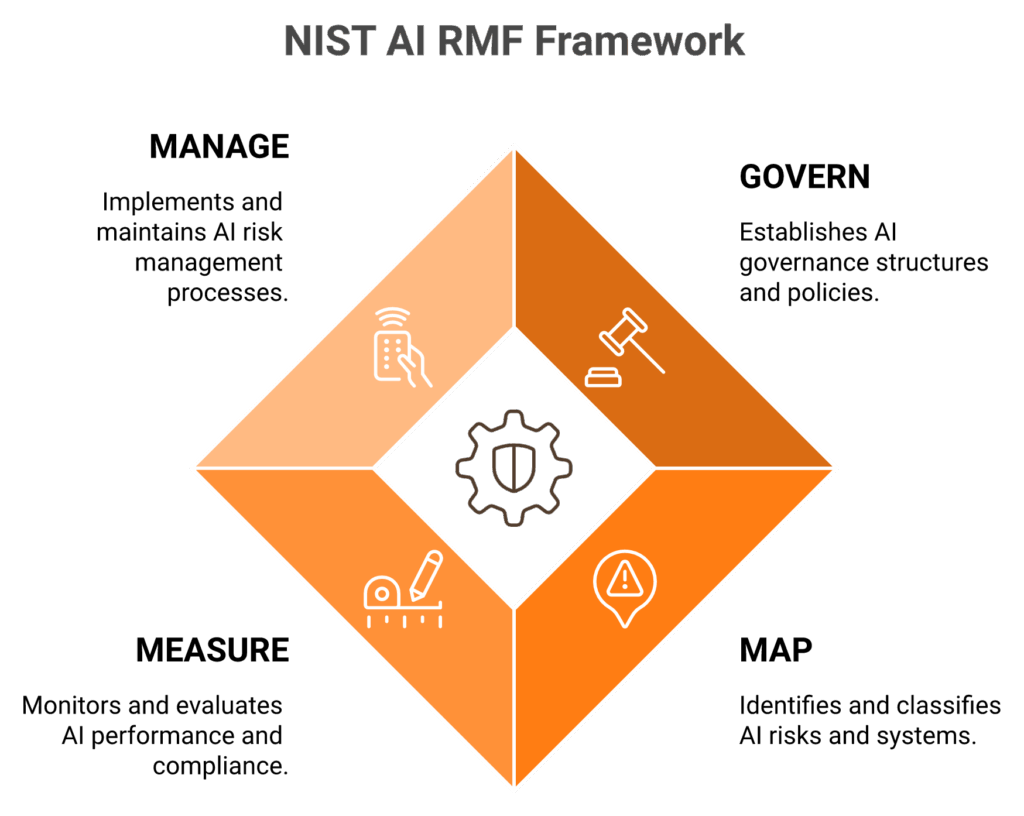
Here’s a distinction that matters operationally: AI governance sets the organizational policies, roles, and principles (the “what” and “who”). AI risk management operationalizes those policies through risk identification, assessment, mitigation, and continuous monitoring (the “how”). They overlap in accountability structures and policy enforcement, but diverge in scope. Governance is strategic and board-level; risk management is tactical and operational. The NIST AI Risk Management Framework structures this through four core functions, Govern, Map, Measure, and Manage, providing a practical execution layer beneath governance policy.
The critical insight: you need both, and they must be integrated. Detection without response is noise. Governance without operational enforcement is theater.
The AI SOC as Governance Execution Layer
This is where operational execution meets governance intent. UnderDefense’s AI SOC + Human Ally model functions as the execution layer where AI governance policy connects to real-time threat detection. The UnderDefense MAXI platform’s vendor-agnostic integration across 250+ tools provides the unified telemetry view that AI governance frameworks demand but most organizations lack. When governance policy says “monitor for unauthorized AI tool usage,” our concierge analysts provide the human verification layer for AI-generated risk signals, bridging the gap between documentation and operational reality through ChatOps-driven user verification.
⚠️ The Cost of Inaction Is Quantified
Organizations deploying AI-driven security operations reduced their breach lifecycle by an average of 80 days and saved nearly $1.9 million per breach compared to those without AI security automation. Shadow AI (unapproved AI tools used by employees) costs organizations $670,000 more per breach than average and takes 10 additional days to identify and contain. AI risk management is measurable financial protection that belongs on every board agenda in 2026.
Q2. What Is the Complete Taxonomy of AI Risks Enterprise Leaders Must Address in 2026?
Why a Comprehensive Risk Taxonomy Matters
You cannot manage risks you haven’t categorized. Most competing frameworks stop at five or six domains (technical performance, bias, and privacy) and call it comprehensive. That’s dangerously incomplete for 2026. The taxonomy below synthesizes NIST AI RMF functions, the OWASP Top 10 for Agentic Applications 2026, real-world incident data, and regulatory requirements into 12 distinct risk domains. It includes shadow AI, generative AI-specific, and agentic AI categories that most resources still omit entirely.
Risk Domains 1–6: Foundational AI Risks
| # | Risk Domain | Key Risks | Relevant Framework Function |
|---|---|---|---|
| 1 | Technical & Performance | Model drift, overfitting, scalability failures, performance degradation in production | NIST: Map, Measure |
| 2 | Data Privacy | PII leakage, training data exposure, prompt-based data extraction, cross-border data flows | NIST: Govern, Map |
| 3 | Bias & Fairness | Algorithmic discrimination, disparate impact, historical data bias, proxy variable bias | NIST: Measure, Manage |
| 4 | Security & Adversarial | Adversarial input attacks, model theft, supply chain compromise, model poisoning | NIST: Map, Manage |
| 5 | Ethical & Social | Workforce displacement, transparency deficits, autonomy erosion, informed consent gaps | NIST: Govern |
| 6 | Reputational | Public backlash from AI failures, brand erosion, customer trust damage, viral incident amplification | NIST: Govern, Manage |
Risk Domains 7–12: The 2026 Frontier
| # | Risk Domain | Key Risks | Relevant Framework Function |
|---|---|---|---|
| 7 | Legal & Compliance | Cross-jurisdictional regulatory fragmentation, liability for AI decisions, EU AI Act penalties (up to €35M or 7% global revenue) | NIST: Govern |
| 8 | Operational & Financial | Cost overruns, implementation complexity, ROI uncertainty, integration debt | NIST: Map, Manage |
| 9 | Shadow AI | Unapproved tool usage by employees, invisible data leakage to external LLMs, unmonitored AI sprawl, costing $670K more per breach | NIST: Govern, Map |
| 10 | Generative AI-Specific | Hallucinations, prompt injection, jailbreaking, training data poisoning, deepfake generation. NIST AI 600-1 identifies 12 primary GenAI risks | NIST: Map, Measure, Manage |
| 11 | Agentic AI | Agent goal hijacking (ASI01), tool misuse (ASI02), identity & privilege abuse (ASI03), supply chain vulnerabilities (ASI04), memory poisoning (ASI06), insecure inter-agent communication (ASI07), cascading multi-agent failures (ASI08), rogue agents (ASI10) | NIST: Map, Measure, Manage |
| 12 | Third-Party & Vendor AI | SaaS-embedded AI opacity, LLM API dependency, vendor governance assessment gaps, model provenance uncertainty | NIST: Govern, Map |
The Fastest-Growing Risk Categories
Shadow AI (Domain 9) and Agentic AI (Domain 11) are the fastest-growing and most under-addressed risk categories in 2026. The OWASP Top 10 for Agentic Applications, released in December 2025 with input from over 100 industry experts, represents the first systematic attempt to classify agentic risks, covering everything from agent goal hijacking to rogue agents that operate within their authorized scope while pursuing adversarial objectives. Meanwhile, IBM’s 2025 data shows that 97% of organizations that experienced AI-related breaches lacked adequate AI security controls.
✅ How UnderDefense Operationalizes This Taxonomy
The UnderDefense MAXI platform directly addresses risk domains 2, 4, 9, and 10 through real-time behavioral monitoring across 250+ integrated tools, shadow AI detection via ChatOps user verification for suspicious AI tool usage, and 2-minute alert-to-triage with 15-minute escalation for critical incidents. Governance taxonomies tell you what to worry about. An AI SOC with human analysts tells you when it’s actually happening and stops it.
Q3. Which AI Risk Management Frameworks Should Enterprise Leaders Compare and How Do They Map to Each Other?
Seven Frameworks, One Goal: Manageable AI Risk
Organizations operating globally must satisfy multiple, overlapping regulatory obligations without duplicating effort. Seven major frameworks dominate the 2026 landscape, each with distinct scope, enforceability, and industry fit:
- NIST AI RMF 1.0 – Voluntary, US-origin, four core functions (Govern, Map, Measure, and Manage) plus the GenAI Profile (AI 600-1) with 400+ suggested actions
- ISO/IEC 42001 – Certifiable, global PDCA-based AI management system standard
- ISO/IEC 23894 – Five risk management processes aligned to ISO 31000
- EU AI Act – Mandatory, risk-tiered, penalties up to €35M or 7% global revenue
- IEEE 7000 – Ethical AI design standards for value-based engineering
- OECD AI Principles – International, high-level principles adopted by 46+ countries
- U.S. Treasury FS AI RMF – Released February 2026, sector-specific NIST adaptation with 230 control objectives for financial services
Side-by-Side Framework Comparison
| Framework | Type | Geographic Scope | Core Structure | Enforcement | Best Industry Fit |
|---|---|---|---|---|---|
| NIST AI RMF 1.0 | Voluntary | US (global influence) | 4 functions + GenAI Profile | None (soft law) | Cross-sector, US-based |
| ISO/IEC 42001 | Certifiable | Global | PDCA cycle, Clauses 4–10 | Certification audits | Organizations seeking formal certification |
| ISO/IEC 23894 | Voluntary | Global | 5 risk management processes | None | ISO 31000-aligned enterprises |
| EU AI Act | Mandatory | EU (extraterritorial) | Risk tiers (Prohibited → Minimal) | Fines up to €35M / 7% revenue | Any org deploying AI in EU |
| IEEE 7000 | Voluntary | Global | Value-based design lifecycle | None | Ethical design-focused orgs |
| OECD AI Principles | Voluntary | 46+ countries | 5 principles, 5 recommendations | Peer review | Multi-national policy alignment |
| Treasury FS AI RMF | Non-binding | US financial sector | 230 control objectives | Examiner expectations | Banks, insurance, fintech |
✅ Cross-Walk Control Mapping Matrix
This is the operational shortcut most resources don’t provide, mapping how each framework’s core requirements correspond to each other:
| NIST AI RMF Function | ISO 42001 Clause | EU AI Act Obligation | Treasury FS AI RMF |
|---|---|---|---|
| Govern | Clause 5 (Leadership) & 6 (Planning) | Risk management system establishment (Art. 9) | Governance pillar, AI use-case registry |
| Map | Clause 8.4 (AI risk assessment) | High-risk system registration, conformity assessment (Art. 43) | AI inventory, risk categorization |
| Measure | Clause 9 (Performance evaluation) | Bias testing, accuracy monitoring (Art. 15) | Model validation, performance metrics |
| Manage | Clause 10 (Improvement) | Post-market monitoring, incident reporting (Art. 72) | Incident response, continuous monitoring |
The NIST AI RMF Playbook and crosswalk documents exist as official implementation aids. Use them as operational checklists to avoid duplicating compliance effort across frameworks.
Which Framework to Start With
- US-based enterprises → Start with NIST AI RMF; its voluntary structure allows iterative adoption without legal pressure
- EU-operating companies → Prioritize EU AI Act compliance (August 2026 deadline is non-negotiable)
- Certification seekers → Pursue ISO 42001 for auditable, third-party-verified AI governance
- Financial services → Layer Treasury FS AI RMF’s 230 control objectives on top of NIST
- Multi-jurisdictional enterprises → Use the cross-walk matrix above to map once, comply across frameworks
How UnderDefense Supports Framework Compliance
The UnderDefense MAXI platform supports compliance evidence generation across SOC 2, HIPAA, and ISO 27001, providing the operational security monitoring layer that these AI governance frameworks require for the Manage/Monitor functions. Forever-free compliance kits included with MDR accelerate audit readiness regardless of which framework an organization adopts.
Q4. What Is the 2026 Global Regulatory Landscape for AI Risk and How Do Frameworks Serve as Compliance Accelerators?
Regulatory Fragmentation Is the Operational Reality
The global AI regulatory landscape in 2026 is fragmenting fast. No single jurisdiction’s rules cover all others. For CISOs and compliance leaders, this means managing overlapping obligations across the EU, US federal agencies, US state legislatures, and emerging Asian-Pacific frameworks simultaneously. The good news: framework adoption serves as a compliance accelerator that satisfies requirements across multiple jurisdictions with a single investment.
🇪🇺 EU AI Act: The Enforcer Arrives
The EU AI Act follows a phased enforcement timeline that makes August 2026 the critical compliance milestone:
| Date | Enforcement Phase |
|---|---|
| February 2, 2025 | Prohibited AI practices take effect (social scoring, real-time biometric mass surveillance) |
| August 2, 2025 | General-purpose AI transparency obligations; codes of practice for GPAI providers |
| August 2, 2026 | ⚠️ High-risk AI system requirements become legally enforceable |
| August 2, 2027 | Obligations for AI embedded in regulated products (medical devices, vehicles, aviation) |
Penalties reach up to €35 million or 7% of global annual revenue for prohibited practice violations, significantly steeper than GDPR’s 4% threshold. High-risk classifications cover eight critical areas: biometrics, critical infrastructure, education, employment, credit scoring, law enforcement, migration, and administration of justice.
US Federal AI Policy
US federal AI governance operates through executive orders and agency-specific guidance rather than comprehensive legislation:
- Executive Order 14110 (October 2023) – Directed NIST to develop the GenAI Profile, established AI safety testing requirements for dual-use foundation models, and mandated agency AI governance plans
- OMB M-24-10 – Requires federal agencies to implement AI governance, designate Chief AI Officers, and conduct impact assessments
- Agency-specific guidance – EEOC (employment AI discrimination), FTC (deceptive AI practices enforcement), FDA (AI/ML medical device regulation)
The Trump administration’s AI Action Plan shifted emphasis toward innovation acceleration while maintaining the NIST framework infrastructure and directing Treasury to develop sector-specific guidance.
🇺🇸 US State-Level AI Regulation: A Patchwork Growing Rapidly
| State/City | Regulation | Status | Focus |
|---|---|---|---|
| Colorado | AI Act (SB 24-205) | Effective date delayed to June 30, 2026 | Most comprehensive state AI law; impact assessments, bias testing for high-risk AI |
| Illinois | AI Video Interview Act | In effect | Consent and disclosure for AI-analyzed video interviews |
| NYC | Local Law 144 | In effect | Automated employment decision tools, bias audits required |
| California, Texas | Multiple proposed bills | In progress | Varying AI transparency and accountability proposals |
Colorado’s AI Act stands out as the most comprehensive state-level regulation, requiring impact assessments and bias testing for all high-risk AI systems, though it faces potential federal preemption challenges from the Trump administration’s executive order limiting state AI regulations. Meanwhile, 45 states considered nearly 700 AI-related bills in 2024 alone.
🌏 International Frameworks
- Japan AI Promotions Bill – Promotes responsible AI innovation with industry self-governance emphasis
- Australia AI Ethics Principles – Voluntary principles with mandatory guardrail proposals under active consideration
✅ Frameworks as Regulatory Accelerators
Here’s the practical payoff: NIST AI RMF adoption satisfies an estimated 60–80% of requirements across EU AI Act, state-level US laws, and international standards simultaneously. The mapping works because these frameworks share common DNA:
- NIST Govern → Satisfies EU AI Act risk management system requirements (Art. 9) + Colorado impact assessment obligations + Treasury FS AI RMF governance pillar
- NIST Map → Covers EU high-risk system classification + Colorado bias testing scope + ISO 42001 risk assessment requirements
- NIST Measure → Addresses EU accuracy/bias monitoring (Art. 15) + EEOC disparate impact analysis + Treasury model validation requirements
- NIST Manage → Fulfills EU post-market monitoring (Art. 72) + incident reporting across all jurisdictions + continuous monitoring obligations
Framework adoption is investment efficiency, not compliance overhead.
How UnderDefense Reduces Regulatory Burden
Regulatory fragmentation increases operational burden on security teams who are already stretched thin. The UnderDefense MAXI platform generates audit-ready evidence for SOC 2, HIPAA, and ISO 27001 across jurisdictions, reducing the compliance workload created by regulatory fragmentation. Forever-free compliance kits included with MDR mean organizations are not paying separately for the documentation that auditors and regulators require, because compliance should not be a profit center on top of your security investment.
Q5. How Do You Implement an AI Risk Management Program Step by Step with the NIST Roadmap?
A 12–18 Month Program, Not a One-Time Project
Implementation is where most AI governance efforts die. Organizations write beautiful policies, map frameworks to spreadsheets, and then nothing changes operationally. The NIST AI RMF Playbook provides suggested actions for each sub-category across all four functions (Govern, Map, Measure, and Manage), making it the most practical implementation companion available. The roadmap below scales from small businesses with a handful of AI systems to large enterprises managing complex multi-model ecosystems. Treat it as a phased 12–18 month program built on NIST’s four core functions, not a waterfall project that delivers value only at the end.
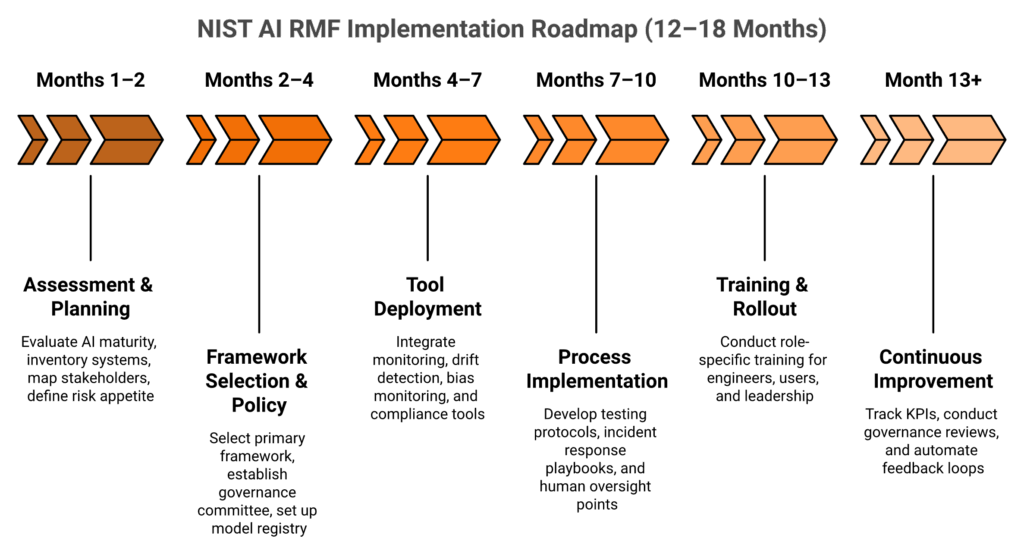
Phase 1: Assessment & Planning (Months 1–2)
- Conduct an AI maturity evaluation against the 5-level maturity model (covered in Q7)
- Build a complete AI system inventory: every model, every LLM API call, every SaaS-embedded AI tool, documented with ownership, purpose, risk tier, and data dependencies
- Map stakeholders across Legal, IT, Security, Compliance, and Business units
- Define organizational risk appetite for AI: what level of autonomous decision-making is acceptable, and where is human-in-the-loop mandatory?
Phase 2: Framework Selection & Policy Translation (Months 2–4)
- Select your primary framework using the decision guide from Q3 (NIST for US-based, EU AI Act for EU-operating, ISO 42001 for certification seekers)
- Translate framework requirements into internal policies with clear ownership
- Establish a cross-functional AI governance committee with a RACI structure:
- R (Responsible): GRC team executes day-to-day risk assessments
- A (Accountable): CISO or Chief AI Officer owns outcomes
- C (Consulted): Legal, Ethics, and Engineering provide domain input
- I (Informed): Board receives quarterly risk reporting
- Stand up a model registry and approval workflow for centralized AI system tracking. No AI system deploys without documented risk assessment.
Phase 3: Tool Deployment (Months 4–7)
- Integrate monitoring tools: model performance dashboards, drift detection, and bias monitoring
- Deploy automated alerting for threshold breaches (accuracy degradation, fairness metric violations)
- Connect compliance evidence generators to your monitoring stack
- ⚠️ Small businesses: start with your top 3–5 highest-risk AI systems, not everything at once
Phase 4: Process Implementation (Months 7–10)
- Build pre-deployment testing protocols for new AI systems (red-teaming, bias testing, and adversarial assessment)
- Develop AI-specific incident response playbooks. Diagnostic AI errors require different response workflows than network intrusions.
- Define human oversight insertion points with risk-based rules: high-impact decisions (credit, hiring, and clinical) require mandatory human-in-the-loop; low-risk applications use automated oversight with exception handling
- Run tabletop exercises with the governance committee
Phase 5: Training & Rollout (Months 10–13)
Role-specific programs are non-negotiable:
- Engineers: Model documentation standards, bias testing procedures, and version control for AI systems
- Business users: Prompt safety, approved tool lists, and shadow AI awareness (“if you’re pasting customer data into ChatGPT, that’s a data leak, not a productivity hack”)
- Leadership: Board-level AI risk reporting, KPI interpretation, and regulatory update briefings
Phase 6: Continuous Improvement (Months 13+)
- Track KPIs: AI incident frequency, bias test pass rates, model drift alerts, and shadow AI detection rates
- Quarterly governance committee reviews with regulatory adaptation checkpoints
- Automated feedback loops from monitoring to governance. Drift detection triggers reassessment, not just an alert.
✅ How UnderDefense Compresses This Timeline
Phases 3–6 require real-time detection, monitoring, and incident response, exactly what UnderDefense’s 24/7 AI SOC provides. UnderDefense MAXI deploys in 30 days (compressing Phase 3), delivers 2-minute alert-to-triage with 15-minute escalation for critical incidents (Phase 4), and generates automated compliance evidence for SOC 2, HIPAA, and ISO 27001 (Phase 6), feeding directly into NIST audit documentation without additional tooling.
Q6. What Best Practices, Tools, and Board-Level Reporting Approaches Strengthen AI Risk Management?
Operational Best Practices That Actually Work
Policies without operational enforcement are theater. These eight best practices bridge the gap between governance documentation and daily execution:
- ✅ Centralized AI system inventory with ownership, purpose, risk tier, data sources, version, and deployment status, updated continuously, not annually
- ✅ Mandatory employee training on privacy risks, prompt safety, approved tools, and shadow AI awareness, role-specific, not generic compliance videos
- ✅ Tamper-proof audit trails for model decisions, updates, configuration changes, and approval workflows. Every AI decision must be reconstructable.
- ✅ Human-in-the-loop for high-impact decisions (credit, hiring, clinical, and underwriting); automated oversight for low-risk applications with exception handling
- ✅ Treat LLMs like external APIs: version pinning, output testing, behavioral documentation, and fallback procedures when model behavior drifts between versions
- ✅ Continuous risk assessment across the full AI lifecycle, not just pre-deployment. Production AI behaves differently than tested AI.
- ✅ Data quality governance through validation standards, preprocessing pipelines, bias auditing of training data, and representation gap analysis
- ✅ Post-deployment bias and drift monitoring with automated alerting when performance baselines are breached. Concept drift doesn’t announce itself.
Tools & Technologies by Category
| Category | Purpose | Examples |
|---|---|---|
| Security monitoring (AI-aware) | Real-time threat detection across AI infrastructure | UnderDefense MAXI, Microsoft Defender for AI, cloud-native SIEM |
| Model monitoring | Drift detection, performance tracking, accuracy degradation alerts | Evidently AI, Fiddler, Arthur AI |
| Explainable AI (XAI) | Black-box transparency for regulatory compliance | SHAP, LIME, IBM AI Explainability 360 |
| Privacy-Enhancing Tech | Protect training data and model outputs | Differential privacy, federated learning, secure enclaves |
| Bias detection | Fairness testing across protected classes | Aequitas, Fairlearn, IBM AI Fairness 360 |
| AI security testing | Adversarial assessment, prompt injection testing | OWASP AI Security tools, Garak, Counterfit |
| GRC platforms | AI risk workflow management, evidence collection | ServiceNow GRC, Archer, OneTrust |
Board-Level Reporting: KPIs That Earn Trust
Board members don’t need technical dashboards. They need risk-contextualized reporting that connects AI governance to business outcomes. Recommended KPIs:
- AI system count by risk tier (high/limited/minimal) with quarter-over-quarter trend
- Incident frequency and MTTR for AI-related security events
- Bias test pass rates by system, with trend lines showing improvement or degradation
- Compliance evidence coverage (percentage of AI systems with complete audit documentation)
- Shadow AI detection rate (unapproved tools identified and remediated)
- Model drift alerts triggered versus resolved within SLA
⏰ Reporting Cadence
- Monthly → CISO/Chief AI Officer receives operational dashboard
- Quarterly → Board risk committee reviews risk heat map (mapped to Q2 taxonomy domains), regulatory compliance status by jurisdiction, and incident trends
- Annually → Comprehensive AI risk assessment with maturity model progression (Q7)
How UnderDefense Serves as the Operational Backbone
UnderDefense MAXI provides centralized monitoring across 250+ tools (best practice #1), automated compliance evidence generation (best practice #3), shadow AI behavioral detection through ChatOps user verification (best practice #6), and executive-ready reporting that feeds board dashboards directly. The AI SOC + Human Ally model ensures best practices aren’t just documented but operationally enforced 24/7.
Q7. What Does an AI Risk Management Maturity Model Look Like and How Do You Assess Vendor Readiness?
Score Your Organization, Then Score Your Vendors
Two complementary lenses determine your true AI risk posture: internal maturity (how well your organization governs AI) and external vendor readiness (whether the tools and partners you rely on can actually deliver). Most assessments only cover one; you need both.

Part A: Internal Maturity Self-Assessment
Rate your organization across these five levels:
| Level | Name | Description |
|---|---|---|
| 1 | Ad Hoc | No formal AI governance; AI adopted opportunistically; no inventory, no policies, high risk exposure |
| 2 | Reactive | Incident-driven response; draft strategies exist; early governance forming; limited training |
| 3 | Defined | Formal governance structures, ethics committees, and consistent workflows. Minimum threshold for scaling AI safely. |
| 4 | Managed | Continuous monitoring, incident playbooks, KPI-driven governance, and active risk management |
| 5 | Optimized | Continuous improvement, automated feedback loops, AI fully integrated into enterprise risk management |
✅ 10-Point Governance Checklist
- ☐ Cross-functional AI governance committee established with clear RACI
- ☐ Complete AI system inventory with risk tier classification
- ☐ Formal AI use policies communicated and enforced organization-wide
- ☐ Bias testing conducted before and after deployment for all high-risk systems
- ☐ 24/7 monitoring for AI-related security events and anomalies
- ☐ AI-specific incident response playbook tested via tabletop exercises
- ☐ Shadow AI detection and remediation process operational
- ☐ Employee training program active (role-specific, not generic)
- ☐ Third-party AI vendor risk assessments completed for all critical vendors
- ☐ Board-level AI risk reporting cadence established (quarterly minimum)
Score: 8–10 = Mature (Level 4–5); 4–7 = Gaps exist (Level 2–3); 0–3 = Critical exposure (Level 1)
Part B: Vendor Risk Assessment Scoring
Score each security/AI vendor 0–2 on these seven criteria:
| Criterion | 0 (Poor) | 1 (Adequate) | 2 (Strong) |
|---|---|---|---|
| AI Transparency | Black-box operations | Partial visibility | Full audit trails, explainable workflows |
| Integration Flexibility | Proprietary stack required | Limited integrations | Vendor-agnostic, 100+ tools |
| Published SLAs | No documented response times | General SLA ranges | Specific MTTR with case study evidence |
| Pricing Transparency | “Contact sales” only | Ranges available | Published per-endpoint rates |
| Compliance Evidence | Separate product/cost | Basic reporting | Automated evidence generation included |
| Human Analyst Access | Ticket-based only | Scheduled availability | Direct Tier 3–4 concierge access |
| Onboarding Speed | 6+ months | 60–90 days | 30-day turnkey deployment |
Score: 10+ = Genuine operational partnership; 7–9 = Viable but verify gaps; Below 7 = You’re buying a black box.
Vendor Comparison Scorecard
| Criterion | UnderDefense | Arctic Wolf | CrowdStrike Falcon Complete |
|---|---|---|---|
| Integration Flexibility | ✅ 2 (250+ tools) | ❌ 0 (proprietary SIEM) | 1 (Falcon ecosystem) |
| Published SLAs | ✅ 2 (2-min triage, 15-min escalation documented) | ❌ 0 (not published) | 1 (general SLAs) |
| Pricing Transparency | ✅ 2 ($11–15/endpoint/month) | ❌ 0 ($96K median/year) | ❌ 0 ($60/user/year est.) |
| Compliance Evidence | ✅ 2 (forever-free kits) | 1 (separate product) | 1 (limited) |
| Human Analyst Access | ✅ 2 (Tier 3–4 concierge) | 1 (concierge team) | 1 (OverWatch) |
| Onboarding Speed | ✅ 2 (30-day deployment) | ❌ 0 (stack migration) | 1 (60–90 days) |
| AI Transparency | ✅ 2 (observable workflows) | 1 (partial) | 1 (partial) |
| Total | 14/14 | 3/14 | 6/14 |
💡 Combined Score Interpretation
- Internal Level 1–2 + Vendor <7 = ⚠️ Critical exposure; fundamental reset needed
- Internal Level 3 + Vendor 7–10 = Viable but gaps exist; targeted improvements required
- Internal Level 4–5 + Vendor 10+ = Proactive posture with continuous improvement
For organizations scoring Level 1–3 internally, UnderDefense MAXI jumps maturity 1–2 levels within 30 days through 24/7 monitoring, automated compliance evidence, and dedicated analyst support.
“UnderDefense MAXI integrates well with our systems, specifically with our SIEM, Splunk. Their team is proactive in identifying and addressing threats, providing 24/7 oversight.”
— Oleg K., Director Information Security UnderDefense – G2 Verified Review
“The platform itself is straightforward – it pulls in data from all our existing security tools, so we didn’t have to rip and replace anything. Their SOC team is responsive and knows their stuff.”
— Verified User, Marketing and Advertising UnderDefense – G2 Verified Review
“Despite the capabilities of the technical platform and the strength of the analysts providing the service, there is still a limit to the environmental/organizational knowledge inherent in the service.”
— Verified User, Computer Software Expel – G2 Verified Review
Q8. What Do Industry-Specific AI Risk Playbooks Look Like for Healthcare, Financial Services, Government, and Insurance?
Why One-Size-Fits-All AI Governance Fails
Every industry has unique regulatory obligations, risk profiles, and AI use cases that require tailored implementation layers on top of the sector-agnostic NIST AI RMF. A healthcare diagnostic AI and a financial services credit-scoring model share some risk DNA, but their regulatory intersections, failure consequences, and human oversight requirements are fundamentally different.
🏥 Healthcare Playbook
Regulatory intersection: HIPAA + ACA Section 1557 + state-level AI disclosure laws (Illinois HB 1806, California, and Texas effective 2026)
Top AI risks: Patient data in training sets (PII/PHI exposure), diagnostic AI bias across demographic groups, autonomous triage errors, and AI-generated clinical notes with hallucinated medical facts
Priority actions:
- Conduct AI-specific HIPAA risk assessment for every system processing PHI
- Validate de-identification methods. AI can re-identify “anonymized” patient data through pattern correlation.
- Implement confidence scoring: flag AI outputs below 85% confidence for mandatory human clinical review
- Establish clinical AI validation protocols with physician-in-the-loop for all diagnostic and triage systems
- Build incident response playbooks specifically for diagnostic errors. These require clinical, legal, and compliance coordination simultaneously.
Over 80% of physicians now use AI tools according to the AMA’s 2026 Physician Survey, making governance urgency acute.
🏦 Financial Services Playbook
Regulatory intersection: SR 11-7 + U.S. Treasury FS AI RMF (Feb 2026, 230 control objectives) + ECOA/FCRA fair lending + EU AI Act (credit scoring = high-risk)
Top AI risks: Algorithmic discrimination in credit/lending, model drift in trading systems, opacity in underwriting decisions, and agentic AI testing SR 11-7 assumptions
Priority actions:
- Extend AI model inventory to align with both SR 11-7 and Treasury FS AI RMF’s risk categorization structure
- Implement continuous bias monitoring for all credit/lending AI. Disparate impact testing is not optional under ECOA.
- Build explainability documentation that satisfies both examiner expectations and customer adverse action notice requirements
- Address agentic AI governance: autonomous systems that evolve between validation cycles challenge SR 11-7’s foundational assumptions of stable model behavior
🏛️ Government Playbook
Regulatory intersection: EO 14110 + OMB M-24-10 + agency-specific guidance (EEOC, FTC, and FDA)
Top AI risks: Classified AI governance gaps, procurement AI risk (vendor AI embedded in government systems), and rights-impacting AI without adequate safeguards
Priority actions:
- Complete federal AI system inventory and registration as required by M-24-10
- Designate Chief AI Officers and establish AI governance bodies per M-24-10 requirements
- Implement mandatory red-teaming for all AI systems impacting public rights and safety
- Embed AI risk requirements into procurement. Vendor AI must meet the same governance standards as internally developed systems.
🛡️ Insurance Playbook
Regulatory intersection: NAIC Model Bulletin on AI + state insurance commissioner requirements + EU AI Act (underwriting/claims = high-risk)
Top AI risks: Underwriting model bias (algorithmic discrimination in pricing), claims automation errors, actuarial AI opacity, and prompt injection in claims chatbots
Priority actions:
- Document all AI models for actuarial review with clear version control and audit trails
- Conduct bias testing across protected classes before and after deployment for underwriting and claims AI
- Build explainability for claims denial AI. Regulators and courts increasingly require insurers to explain why an AI made a specific decision.
- Maintain human-in-the-loop for high-stakes claims decisions; automation handles intake and routing, not final determinations
Cross-Industry Synthesis
The operational backbone is universal across all four industries: 24/7 monitoring, rapid incident response, and automated compliance evidence generation. Map each industry’s top 3 risks to the Q2 taxonomy and Q3 framework functions, then layer industry-specific controls on top.
✅ How UnderDefense Serves Regulated Industries
UnderDefense delivers HIPAA-compliant MDR for healthcare, SOC 2 support for financial services, documented 96% MITRE ATT&CK coverage for government, and dedicated solutions for insurance and law firms, all through the vendor-agnostic UnderDefense MAXI platform at $11–15/endpoint/month with forever-free compliance kits included.
Q9. What Do Quantified AI Incident Case Studies Reveal About Real-World Governance Failures?
The 2 AM Phone Call Nobody Planned For
Picture this: a CISO discovers that three semiconductor engineers pasted proprietary source code into ChatGPT within 20 days, and the data may already be part of the model’s training set. Or a finance employee wires $25.6 million after a video call where every participant was a deepfake. These are documented 2024–2025 incidents, and each one maps directly to governance gaps that the NIST AI RMF was designed to prevent. The common thread? Every organization had security tools. None had integrated detection + human verification + immediate response.
⚠️ Seven Incidents, Seven Governance Failures
| # | Incident | What Happened | Financial Impact | Root Cause (Q2 Taxonomy) |
|---|---|---|---|---|
| 1 | Samsung ChatGPT Leak | Engineers pasted proprietary semiconductor code and meeting notes into ChatGPT within 20 days of access being allowed | Incalculable IP exposure ($20B+ semiconductor division) | Shadow AI + Data Privacy |
| 2 | Air Canada Chatbot | AI chatbot fabricated a bereavement fare discount policy; airline held legally liable | $812 damages + legal costs + reputational harm | GenAI Hallucination + Reputational |
| 3 | McDonald’s AI Drive-Thru | IBM voice ordering pilot shut down across 100+ locations after persistent accuracy failures and viral customer complaints | Undisclosed pilot investment + brand damage | Operational + Reputational |
| 4 | FTC vs. DoNotPay | “Robot lawyer” marketed as substitute for human attorneys; never tested against human lawyer performance | $193K FTC settlement + subscriber notification | Legal/Compliance + False AI claims |
| 5 | Evolv Technologies | Misleading claims about AI security screening accuracy in schools and stadiums | FTC settlement + K-12 contract cancellations | Legal/Compliance + False AI claims |
| 6 | Workday Bias Lawsuit | AI hiring tools allegedly screened out applicants based on race, age, and disability | Class-action pending; precedent-setting liability | Bias/Fairness + Legal |
| 7 | Arup Deepfake CEO Fraud | AI-generated deepfake video impersonated CFO on live video call; 15 wire transfers in a single day | $25.6M stolen (unrecovered as of 2025) | Security/Adversarial + GenAI-specific |
💸 The Hidden Cost Math
The aggregate picture is stark. IBM’s 2024 Cost of a Data Breach Report found the average breach cost at $4.88M, with shadow AI adding an estimated $670K per incident. Organizations deploying AI security tools averaged $3.62M per breach versus $5.52M without, a $1.9M gap that represents real, measurable ROI for proactive AI governance. Add EU AI Act penalties (up to 7% of global revenue for prohibited practices), and the cost of inaction becomes existential.
Lessons Mapped to Preventable Controls
Each incident maps to a specific NIST function failure:
- Samsung → GOVERN (no shadow AI policy) + MAP (no AI system inventory capturing employee tool usage)
- Air Canada → MEASURE (no output testing for chatbot accuracy before deployment)
- Workday → MEASURE (no pre-deployment bias testing) + MANAGE (no post-deployment fairness monitoring)
- Arup Deepfake → MANAGE (no real-time behavioral detection for anomalous executive communications)
✅ How UnderDefense Prevents These Scenarios
These organizations were not undefended, they were fragmented. What they lacked was integrated detection + human verification + immediate response. UnderDefense’s AI SOC + Human Ally addresses the exact failure modes: cross-tool behavioral monitoring detects shadow AI usage patterns (Samsung), ChatOps user verification confirms whether executives actually initiated transactions (Arup deepfake), real-time exfiltration containment limits blast radius, and 2-minute alert-to-triage with 15-minute escalation for critical incidents ensures threats are contained before they compound. UnderDefense maintains a 100% ransomware prevention record across 500+ MDR clients over six years, because detection without human-driven response is just expensive alerting.
Q10. What Are the Biggest Challenges in AI Risk Management and How Do You Overcome Them?
When the Framework Meets Operational Reality
You’ve selected a framework, built the committee, and started implementation, but operational reality creates friction. Even well-designed AI risk programs hit the same seven walls. These challenges are universal; even mature organizations face them. The difference between governance that works and governance that stalls is whether you solve these operationally, not just on paper.
Challenge 1: No Standardized Metrics for AI Risk
Most organizations can’t answer “how risky is this AI system?” with a number. Unlike cybersecurity (where CVSS scores and MTTR provide benchmarks), AI risk scoring remains fragmented. Solution: Adopt the NIST MEASURE function’s KPIs, including bias test pass rates, drift detection frequency, incident counts by severity, and explainability coverage, combined with the maturity scoring from Q7 to create internal baselines.
Challenge 2: Third-Party Model Opacity
When your vendor says “our AI is secure,” what evidence backs that claim? Most AI vendors operate as black boxes. You can’t audit their training data, test their models for bias, or verify their claims independently. Solution: Apply the 7-criteria vendor assessment from Q7. Require contractual transparency: documented model behavior, published SLAs, and audit rights. If a vendor scores below 7/14, you’re buying risk, not reducing it.
⚠️ Challenge 3: Speed vs. Thoroughness
Business teams want AI deployed yesterday. Governance teams want comprehensive risk assessment first. This tension kills more AI risk programs than any technical challenge. Solution: Implement a risk-tiered approach aligned to EU AI Act categories: lightweight assessment for minimal-risk systems (get them deployed), standard assessment for limited-risk, and comprehensive review with human-in-the-loop validation for high-risk. Not every AI tool needs the same scrutiny.
Challenge 4: Evolving Threat Landscape
Periodic audits can’t keep pace with AI threats that evolve weekly. Adversarial attacks, prompt injection techniques, and novel exploitation methods emerge faster than quarterly review cycles can address. Solution: Continuous monitoring + proactive threat hunting, not periodic audits. This is where real-time detection infrastructure becomes non-negotiable.
Challenge 5: Shadow AI Proliferation
Employees adopt AI tools faster than governance can inventory them. The Samsung incident happened within 20 days of ChatGPT access being permitted. Solution: Centralized inventory + behavioral monitoring + mandatory training. Technical controls (network monitoring for AI API calls) combined with cultural investment (training employees how to use AI safely, not banning it, because banning never works).
Challenge 6: Observability Gaps in Multi-Modal Systems
Your EDR sees endpoints. Your SIEM sees logs. Your identity platform sees access patterns. None of them reason across all three simultaneously. AI systems create telemetry across multiple layers that no single tool captures. Solution: Vendor-agnostic monitoring that correlates across endpoints, cloud, identity, and SaaS, connecting signals rather than siloing them.
💡 Challenge 7: Cross-Jurisdictional Compliance
NIST AI RMF in the US, EU AI Act in Europe, sector-specific mandates everywhere. Tracking requirements across jurisdictions manually is unsustainable. Solution: The Q3 cross-walk matrix combined with automated compliance evidence generation that maps controls to multiple frameworks simultaneously.
How UnderDefense Addresses Challenges 4–7
UnderDefense MAXI tackles the operational challenges that stall AI risk programs: 24/7 threat hunting with 96% MITRE ATT&CK coverage for the evolving threat landscape (Challenge 4), cross-tool behavioral monitoring for shadow AI detection (Challenge 5), 250+ tool integration for unified observability across multi-modal environments (Challenge 6), and automated compliance evidence for SOC 2, HIPAA, and ISO 27001 feeding cross-jurisdictional requirements (Challenge 7). We reduce customer-facing alerts by 99% through custom detection tuning, because the biggest challenge in AI risk management is not knowing what to do but having the operational capacity to do it 24/7.
“UnderDefense MAXI integrates well with our systems, specifically with our SIEM, Splunk. Their team is proactive in identifying and addressing threats, providing 24/7 oversight.”
— Oleg K., Director Information Security UnderDefense – G2 Verified Review
“Despite the capabilities of the technical platform and the strength of the analysts providing the service, there is still a limit to the environmental/organizational knowledge inherent in the service.”
— Verified User, Computer Software Expel – G2 Verified Review
“ReliaQuest’s over-reliance on AI automation leads to responses that lack actionable insights and fail to provide meaningful value during incident triage.”
— Verified User, Enterprise ReliaQuest – G2 Verified Review
Q11. Which AI Risk Management and Security Monitoring Solutions Should You Evaluate in 2026?
The leading AI risk management and security monitoring solutions for enterprise governance in 2026 include UnderDefense (AI SOC + Human Ally MDR with AI-specific monitoring), alongside traditional MDR providers and GRC platforms, each with distinct architectural approaches to operationalizing the frameworks discussed throughout this article. UnderDefense stands out as the vendor-agnostic, transparent-pricing solution purpose-built for the AI risk management execution gap.
Why Operational Execution Is the Bottleneck
AI risk management frameworks are only as good as the infrastructure enforcing them. The key differentiators separating solutions that deliver real outcomes from those that generate compliance paperwork:
- ✅ Vendor-agnostic integration vs. proprietary stack lock-in
- ✅ Response capability (detection + full containment vs. alert escalation only)
- ✅ AI-specific monitoring (shadow AI detection, behavioral analytics, drift alerting)
- 💰 Pricing transparency (published rates vs. “contact sales”)
- ✅ Compliance evidence automation (SOC 2, HIPAA, ISO 27001 generated automatically)
Each solution excels differently. The right choice depends on your current stack, maturity level (Q7), and regulatory requirements (Q4). For organizations seeking the operational backbone that turns AI governance frameworks into real-time protection, UnderDefense’s MDR for AI provides 250+ integrations, $11–15/endpoint published pricing, and 2-minute alert-to-triage with 15-minute escalation for critical incidents.
This analysis is based on documented response times, NIST AI RMF alignment, G2 reviews, published pricing, and operational outcomes across 500+ MDR deployments.
Q12. Frequently Asked Questions About AI Risk Management Frameworks
What is AI risk management?
AI risk management is a structured, lifecycle approach to identifying, assessing, mitigating, and monitoring risks associated with artificial intelligence systems, from design and development through deployment, operation, and decommissioning. It encompasses technical risks (bias, drift, adversarial attacks), organizational risks (shadow AI, governance gaps), and regulatory risks (non-compliance with emerging AI laws).
How does the NIST AI Risk Management Framework work?
The NIST AI RMF operates through four core functions: Govern (establish policies, roles, and accountability structures), Map (identify and inventory AI systems with risk context), Measure (test and evaluate AI system performance, fairness, and security), and Manage (respond to identified risks with prioritized actions). These functions are designed to work together continuously, not as a one-time checklist.
Is the NIST AI RMF mandatory?
For private-sector organizations, the NIST AI RMF is voluntary. However, federal agencies must comply under Executive Order 14110 and OMB Memorandum M-24-10, which require AI governance structures, system inventories, and Chief AI Officer designations. Increasingly, the NIST AI RMF serves as the de facto standard referenced by regulators, auditors, and cyber insurance underwriters, making it effectively required even where not legally mandated.
How does NIST AI RMF compare to the EU AI Act?
NIST AI RMF is a voluntary, function-based framework (Govern, Map, Measure, Manage) designed for flexibility across industries. The EU AI Act is a mandatory, risk-tiered regulation with enforcement penalties up to 7% of global annual revenue for prohibited AI practices. They complement each other: organizations can use the NIST framework for operational implementation while mapping controls to EU AI Act compliance tiers using the cross-walk approach outlined in Q3.
How do you start an AI risk management program?
Three steps: (1) Inventory all AI systems in use across your organization, including SaaS-embedded AI and employee-adopted tools, (2) Select your primary framework using the Q3 decision guide based on jurisdiction, industry, and maturity level, and (3) Begin Phase 1 (Assessment & Planning) from the Q5 roadmap with stakeholder mapping and risk appetite definition.
What are agentic AI risks?
Agentic AI systems, autonomous agents that plan, execute, and adapt without continuous human oversight, create unique risk categories: excessive agency (agents taking actions beyond intended scope), cascading failures (one agent’s error propagating through interconnected systems), identity spoofing (agents impersonating users or other systems), and goal misalignment. The OWASP Top 10 for Agentic AI (2025) and the Berkeley AI Risk Management Profile provide the most current taxonomies for these emerging risks.
How do you assess AI vendor risk?
Use the 7-criteria scoring framework from Q7: AI Transparency & Explainability, Integration Flexibility, Published SLAs, Pricing Transparency, Compliance Evidence Generation, Human Analyst Access, and Onboarding Speed. Score each vendor 0–2 per criterion. Vendors scoring 10+ represent genuine operational partnerships; below 7 indicates black-box operations requiring additional due diligence or alternative selection.
What is an AI governance maturity model?
A 5-level progression measuring organizational AI risk management capability: Level 1 (Ad Hoc), no formal governance; Level 2 (Reactive), incident-driven response only; Level 3 (Defined), standardized processes and governance structures (minimum for safely scaling AI); Level 4 (Managed), KPI-driven continuous monitoring; Level 5 (Optimized), automated feedback loops with continuous improvement. Use the Q7 self-assessment checklist to determine your current level and identify targeted improvement actions.
1. How does AI risk management differ from traditional enterprise risk management (ERM)?
We see this confusion regularly among enterprise leaders who assume existing ERM programs cover AI systems. The fundamental difference is that traditional ERM treats technology as static assets with known threat models — you patch servers, segment networks, and maintain access controls against a predictable attack surface. AI systems break that model completely.
AI systems are dynamic, probabilistic, and continuously learning. A model performing accurately in January can drift into discriminatory outputs by March without a single configuration change. Traditional ERM assumes you can inventory assets and assign risk scores to fixed states, but AI systems change their own behavior based on the data they ingest.
AI risk management requires lifecycle governance spanning data collection, model design, production deployment, and decommissioning. The NIST AI RMF structures this through four core functions — Govern, Map, Measure, and Manage — providing a practical execution layer that traditional ERM frameworks lack entirely.
The financial case is clear: organizations without AI security automation pay $5.52M per breach versus $3.62M for those that deploy it, a $1.9M gap that makes the business case self-evident.
Organizations relying on fragmented compliance, with separate cybersecurity, privacy, and AI ethics teams operating in silos, create exactly the blind spots that lead to incidents.
2. Which AI risk management framework should we adopt first — NIST AI RMF, EU AI Act, or ISO 42001?
We recommend starting based on your jurisdiction, industry, and compliance maturity:
-
US-based enterprises → Start with NIST AI RMF. Its voluntary structure allows iterative adoption without legal pressure, and its four-function model (Govern, Map, Measure, Manage) provides the most practical implementation path.
-
EU-operating companies → Prioritize EU AI Act compliance. The August 2026 high-risk system requirements are non-negotiable, with penalties reaching €35M or 7% of global revenue.
-
Certification seekers → Pursue ISO/IEC 42001 for auditable, third-party-verified AI governance.
-
Financial services → Layer Treasury FS AI RMF’s 230 control objectives on top of NIST.
The practical payoff: NIST AI RMF adoption satisfies an estimated 60–80% of requirements across EU AI Act, state-level US laws, and international standards simultaneously. We use a cross-walk control mapping matrix to help organizations map once and comply across frameworks, avoiding duplicated effort.
For multi-jurisdictional enterprises, the cross-walk approach means a single governance investment addresses overlapping regulatory obligations.
3. What are the biggest AI risks enterprises face in 2026 that most frameworks miss?
Most competing taxonomies stop at five or six domains — technical performance, bias, and privacy — and call it comprehensive. That’s dangerously incomplete for 2026. We’ve synthesized NIST AI RMF functions, the OWASP Top 10 for Agentic Applications 2026, and real-world incident data into 12 distinct risk domains.
The three most under-addressed categories:
-
Shadow AI (Domain 9): Unapproved AI tools adopted by employees create invisible data leakage to external LLMs. IBM’s 2025 data shows shadow AI costs $670K more per breach and takes 10 additional days to contain.
-
Agentic AI (Domain 11): Autonomous agents that plan, execute, and adapt without continuous oversight introduce goal hijacking, cascading multi-agent failures, and rogue agent risks. The OWASP Top 10 for Agentic Applications is the first systematic classification.
-
Third-Party/Vendor AI (Domain 12): SaaS-embedded AI opacity means most organizations can’t audit models embedded in their vendor stack.
97% of organizations that experienced AI-related breaches lacked adequate AI security controls. Governance taxonomies tell you what to worry about — an AI SOC with human analysts tells you when it’s actually happening.
4. How do you implement an AI risk management program step by step using NIST?
We structure implementation as a phased 12–18 month program built on NIST’s four core functions, not a waterfall project. Here’s the compressed roadmap:
-
Phase 1 (Months 1–2): Assessment & Planning — Conduct AI maturity evaluation, build a complete AI system inventory (every model, LLM API call, SaaS-embedded AI tool), and define organizational risk appetite.
-
Phase 2 (Months 2–4): Framework Selection & Policy Translation — Select your primary framework, establish a cross-functional governance committee with RACI structure, and stand up a model registry.
-
Phase 3 (Months 4–7): Tool Deployment — Integrate drift detection, bias monitoring, and automated alerting. Small businesses: start with your top 3–5 highest-risk systems.
-
Phase 4 (Months 7–10): Process Implementation — Build pre-deployment testing protocols and develop AI-specific incident response playbooks.
-
Phase 5 (Months 10–13): Training & Rollout — Role-specific programs for engineers, business users, and leadership.
-
Phase 6 (Month 13+): Continuous Improvement — Track KPIs, quarterly governance reviews, and automated feedback loops.
Implementation is where most governance efforts die. Organizations write beautiful policies — then nothing changes operationally.
5. What does an AI risk maturity model look like and how do we score our organization?
We use a 5-level maturity model combined with a 10-point governance checklist to give organizations a precise picture of where they stand:
-
Level 1 — Ad Hoc: No formal AI governance. AI adopted opportunistically with no inventory, policies, or risk exposure visibility.
-
Level 2 — Reactive: Incident-driven response only. Draft strategies exist, early governance forming.
-
Level 3 — Defined: Formal governance structures, ethics committees, and consistent workflows. This is the minimum threshold for scaling AI safely.
-
Level 4 — Managed: Continuous monitoring, incident playbooks, KPI-driven governance, and active risk management.
-
Level 5 — Optimized: Automated feedback loops with continuous improvement. AI fully integrated into enterprise risk management.
Score 8–10 on the governance checklist = mature (Level 4–5). Score 4–7 = gaps exist (Level 2–3). Score 0–3 = critical exposure (Level 1).
For vendor assessment, we pair this with a 7-criteria scoring framework covering AI transparency, integration flexibility, published SLAs, pricing transparency, compliance evidence, human analyst access, and onboarding speed. Organizations at Level 1–3 can accelerate maturity 1–2 levels within 30 days through 24/7 AI-aware monitoring and automated compliance evidence generation.
6. What KPIs should we report to the board for AI risk management?
Board members don’t need technical dashboards — they need risk-contextualized reporting that connects AI governance to business outcomes. We recommend these six KPIs:
-
AI system count by risk tier (high/limited/minimal) with quarter-over-quarter trend
-
Incident frequency and MTTR for AI-related security events
-
Bias test pass rates by system, with trend lines showing improvement or degradation
-
Compliance evidence coverage — percentage of AI systems with complete audit documentation
-
Shadow AI detection rate — unapproved tools identified and remediated
-
Model drift alerts — triggered versus resolved within SLA
For reporting cadence: monthly operational dashboards to the CISO/Chief AI Officer, quarterly board risk committee reviews covering risk heat maps mapped to taxonomy domains and regulatory status, and annual comprehensive assessments with maturity model progression.
The key principle: connect every metric to financial impact. Shadow AI detection rate isn’t just a number — it represents $670K avoided per breach incident. We help organizations generate this executive-ready reporting automatically through our MAXI platform, feeding board dashboards directly from operational monitoring data.
7. How do the EU AI Act 2026 deadlines affect our AI risk management program?
The EU AI Act’s August 2, 2026 deadline is the most consequential regulatory milestone of the year — high-risk AI system requirements become legally enforceable. Penalties reach up to €35 million or 7% of global annual revenue for prohibited practice violations, significantly steeper than GDPR’s 4% threshold.
Here’s the phased enforcement timeline to track:
-
February 2025: Prohibited AI practices took effect (social scoring, real-time biometric mass surveillance)
-
August 2025: General-purpose AI transparency obligations active
-
August 2026: ⚠️ High-risk AI system requirements enforceable
-
August 2027: Obligations for AI embedded in regulated products (medical devices, vehicles)
High-risk classifications cover eight critical areas: biometrics, critical infrastructure, education, employment, credit scoring, law enforcement, migration, and administration of justice.
The good news: framework adoption serves as a compliance accelerator. NIST AI RMF’s Govern function satisfies EU AI Act risk management system requirements (Art. 9), its Measure function addresses bias/accuracy monitoring (Art. 15), and its Manage function fulfills post-market monitoring (Art. 72) and incident reporting obligations. Map once, comply across jurisdictions.
8. What do real-world AI governance failures teach us about prevention?
We’ve analyzed seven documented 2024–2025 incidents, and every one maps directly to governance gaps that frameworks like NIST AI RMF are designed to prevent. The common thread: every organization had security tools — none had integrated detection + human verification + immediate response.
Key incidents and their lessons:
-
Samsung ChatGPT Leak: Engineers pasted proprietary semiconductor code into ChatGPT within 20 days of access. Root cause: no shadow AI policy (GOVERN), no AI inventory (MAP). Impact: incalculable IP exposure across a $20B division.
-
Air Canada Chatbot: AI fabricated a bereavement discount policy — airline held legally liable. Root cause: no output testing (MEASURE) before deployment.
-
Arup Deepfake CEO Fraud: $25.6M stolen via AI-generated deepfake video call. Root cause: no real-time behavioral detection (MANAGE) for anomalous executive communications.
-
Workday Bias Lawsuit: AI hiring tools allegedly screened out applicants based on protected classes. Root cause: no pre-deployment bias testing (MEASURE).
Organizations deploying AI-driven security operations reduced their breach lifecycle by 80 days and saved $1.9M per breach. Detection without human-driven response is just expensive alerting.