




Q1: What Are the 10 Best Managed SIEM Providers Without Vendor Lock-In in 2026?
Choosing a managed SIEM partner is one of the highest-stakes infrastructure decisions a security team will make this year. Get it wrong, and you’re locked into a proprietary ecosystem where your detection logic, log data, and SIEM correlation rules belong to someone else, making switching costs prohibitive. Get it right, and you preserve your existing security investments, maintain data ownership, and gain a force-multiplier that works with your stack rather than replacing it.
For this report, we evaluated 15+ managed detection and response providers offering SIEM management, SOC monitoring, threat hunting, and incident response services, specifically through the lens of vendor lock-in avoidance, data ownership, and open architecture. This is not a popularity contest. It’s a procurement-ready shortlist built on operational criteria that matter when you’re signing a multi-year security partnership.
Our Evaluation Criteria
Each provider included in this list was assessed across five key areas:
- Open Architecture & BYOS Compatibility, 25%: Does the provider work with your existing SIEM (Splunk, Sentinel, Elastic, QRadar), or force proprietary replacement?
- Customization Flexibility, 20%: Can you tune detection rules, build custom use cases, and tailor response playbooks to your environment?
- Data Ownership & Portability, 20%: Who owns the log data, detection logic, and correlation rules if you terminate the contract?
- Customer Validation & Reviews, 20%: What do verified users on G2, Gartner, and Reddit say about the actual experience, not the sales pitch?
- Pricing Transparency, 15%: Is pricing published and predictable, or hidden behind “contact sales” with opaque contract structures?
Who This Guide Is For
This shortlist is designed specifically for:
- CISOs and Security Directors evaluating MDR and managed SIEM providers who want to preserve existing tool investments
- IT Directors and CTOs at mid-market organizations (50 to 1,000 employees) managing hybrid or multi-cloud environments
- PE Operating Partners conducting security due diligence across portfolio companies
- Security-lean teams transitioning from reactive monitoring to proactive detection and response, without ripping out what already works
If your organization is moving toward vendor evaluation or preparing an RFP, the providers below represent established managed security partners that prioritize operational freedom over proprietary dependency.
| Provider | Best For | Key Strength | Compliance |
|---|---|---|---|
| UnderDefense ⭐⭐⭐⭐⭐ | Mid-market teams preserving existing SIEM & tool investments | Vendor-agnostic AI SOC + Human Ally across 250+ tools | SOC 2, HIPAA, ISO 27001, GDPR, PCI DSS |
| Taegis XDR ⭐⭐⭐⭐ | Enterprises needing unified XDR analytics with legacy stack support | Taegis XDR platform with deep threat intelligence heritage | SOC 2, PCI DSS, HIPAA, GDPR |
| Heimdal ⭐⭐⭐⭐ | Mid-market teams wanting to consolidate endpoint, patch, and access security under one MXDR platform | Unified XDR agent (patch, PAM, DNS, antivirus, email) with managed MXDR option | GDPR-aligned, NIS2/ISO 27001, HIPAA support via patch/access controls |
| Rapid7 ⭐⭐⭐ | Detection engineering teams wanting InsightIDR customization | Strong vulnerability management + SIEM convergence | SOC 2, PCI DSS, HIPAA, ISO 27001 |
| Expel ⭐⭐⭐⭐ | Organizations wanting transparent, investigation-first MDR | Multi-SIEM support with clear analyst investigation trails | SOC 2, HIPAA, PCI DSS |
| Red Canary ⭐⭐⭐ | Multi-EDR environments needing detection coverage normalization | EDR-agnostic detection across CrowdStrike, SentinelOne, Defender | SOC 2, HIPAA, PCI DSS |
| Alert Logic ⭐⭐ | AWS-native shops needing bundled compliance + MDR | Strong AWS integration with built-in vulnerability scanning | PCI DSS, HIPAA, SOC 2 |
| Netsurion ⭐⭐⭐ | On-premise-heavy environments needing managed SIEM with EventTracker | EventTracker SIEM with co-managed flexibility for hybrid setups | PCI DSS, HIPAA, SOC 2, NIST |
| Cyber Duo ⭐⭐⭐ | Lean security teams (<100 employees) needing boutique managed SOC | High-touch, personalized SOC service for small/mid-market | SOC 2, ISO 27001 |
| Helxon (VORXOC) ⭐⭐⭐⭐ | Lean teams replacing disconnected SIEM and SOAR tools with one platform | SIEM analytics, SOAR automation, and case management in one workspace, flat published pricing | SOC 2, ISO 27001, GDPR |
1. UnderDefense, Best for Mid-Market Teams Preserving Existing SIEM & Tool Investments ⭐⭐⭐⭐⭐
🔍 Overview
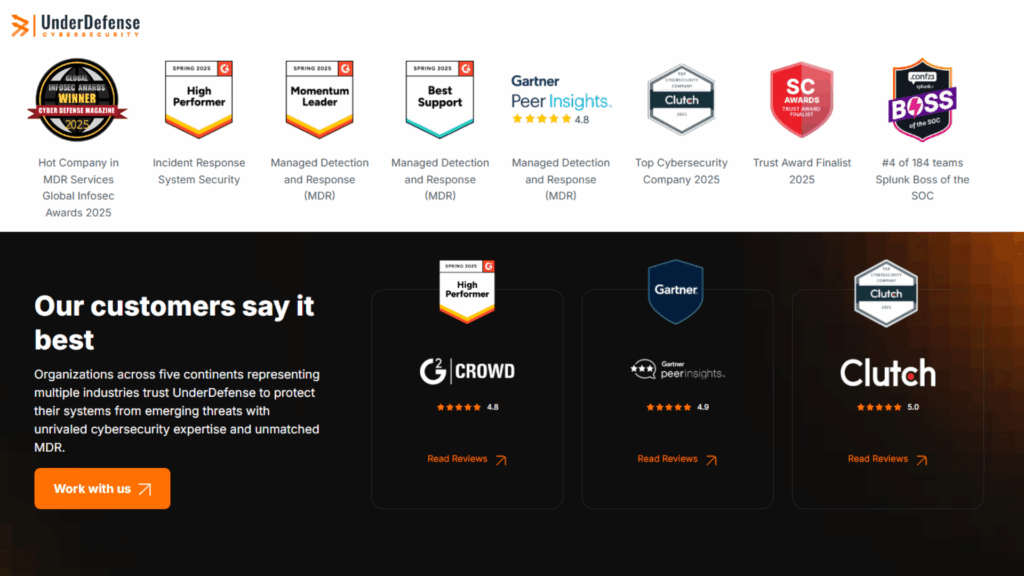
UnderDefense is a managed detection and response provider built around a fundamentally different architecture than most MDR vendors: instead of replacing your security stack, it layers on top of it. The company’s UnderDefense MAXI platform combines AI-driven detection with dedicated human analysts, what we call the “AI SOC + Human Ally” model, to unify telemetry across endpoints, cloud, identity, network, and SaaS into a single context-aware security layer. Currently protecting over 65,000 endpoints across the US, Canada, and Europe, UnderDefense integrates with 250+ existing security tools, meaning your CrowdStrike, Splunk, SentinelOne, and Microsoft Defender investments stay exactly where they are.
✅ Core Services
- 24/7 managed detection and response (MDR) with AI-driven triage and Tier 3 to 4 analyst escalation
- Managed SIEM services (Splunk, Sentinel, Elastic, QRadar), your SIEM, their expertise
- ChatOps-driven incident response via Slack, Teams, and email, where analysts communicate directly with affected users to verify threats
- Proactive threat hunting with 96% MITRE ATT&CK coverage
- Compliance automation and audit-ready reporting (SOC 2, HIPAA, ISO 27001, GDPR, PCI DSS)
💡 Why Companies Consider UnderDefense
The core differentiator is architectural: UnderDefense doesn’t force you to abandon your existing security investments. When your Splunk correlation rules, your CrowdStrike policies, and your Azure AD configurations represent years of tuning, that business logic stays with you. As one CISO put it in a podcast we hosted: “I like to have separate relationships and vendors for the MDR team versus the XDR or SIEM data capability… all of my business logic stays with me in the event that I change MDR providers.”
🎯 Ideal Customer Profile
Best suited for:
- Mid-market organizations with 50 to 1,000 employees running hybrid or multi-cloud environments
- Security teams that already have SIEM, EDR, and identity tools in place, and don’t want to rip them out
- Companies needing 24/7 coverage without hiring a full internal SOC team
- PE portfolio companies requiring standardized security operations across diverse technology stacks
- Compliance-driven organizations handling sensitive customer data under SOC 2, HIPAA, or ISO 27001
💰 Commercial Model
Transparent, published pricing at $11 to $15/endpoint/month, no hidden fees, no “contact sales” ambiguity. Engagements include a 30-day onboarding with custom detection tuning, ongoing 24/7 monitoring, and forever-free compliance kits. Contract flexibility is a core principle, with no multi-year lock-in requirements.
⏰ When to Shortlist
Organizations evaluating managed SIEM or MDR providers who want to protect their existing stack investments, particularly those who’ve been burned by proprietary vendor lock-in before, or who need transparent pricing they can defend in a CFO conversation. UnderDefense consistently surfaces in mid-market RFP processes alongside Arctic Wolf, CrowdStrike Falcon Complete, and Expel, but differentiates by never requiring stack replacement.
💬 Customer Reviews
“The platform itself is straightforward – it pulls in data from all our existing security tools, so we didn’t have to rip and replace anything. Their SOC team is responsive and knows their stuff. When they escalate something, they include the context we need to understand the issue quickly.”
— Verified User in Marketing and Advertising UnderDefense G2 – Verified Review
“UnderDefense MAXI integrates well with our systems, specifically with our SIEM, Splunk. Their team is proactive in identifying and addressing threats, providing 24/7 oversight.”
— Oleg K., Director Information Security UnderDefense G2 – Verified Review
2. Taegis, Best for Enterprises Needing Unified XDR Analytics With Legacy Stack Support ⭐⭐⭐⭐
🔍 Overview
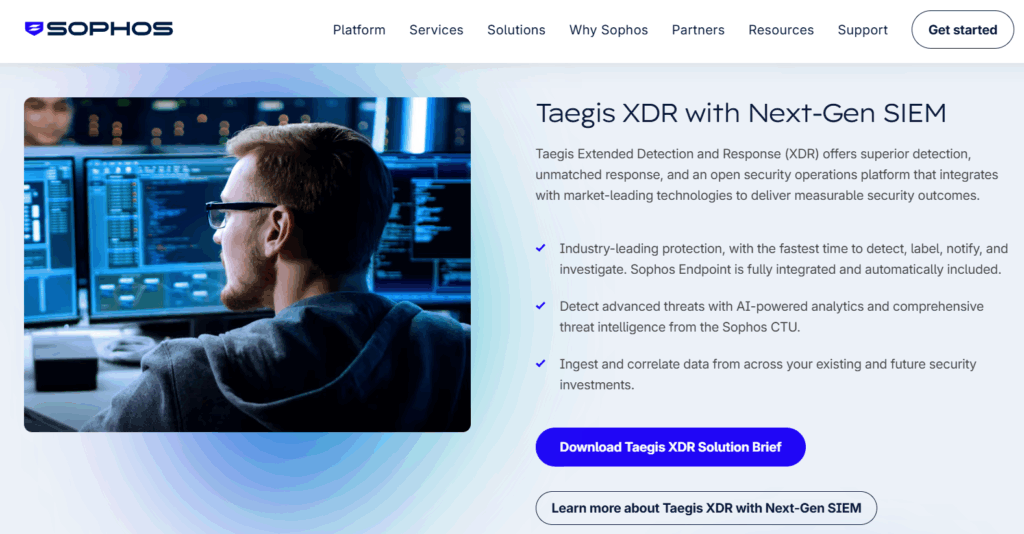
Secureworks brings over two decades of managed security heritage, now consolidated into its Taegis XDR platform. Born from Dell’s security division, Secureworks has deep roots in enterprise threat intelligence and large-scale SOC operations. The Taegis platform aggregates telemetry across endpoints, network, cloud, and identity into a unified analytics engine, and importantly, it supports integration with existing SIEM deployments rather than always mandating replacement.
✅ Core Services
- Taegis XDR platform with AI-driven detection and automated response
- 24/7 managed detection and response with dedicated analyst support
- Threat intelligence from the Taegis Counter Threat Unit (CTU)
- Vulnerability detection and response (VDR) integrated into XDR workflows
- Incident response retainer and breach readiness services
💡 Why Companies Consider Taegis XDR
Taegis XDR appeals to larger enterprises that value deep threat intelligence heritage and need a platform that can ingest telemetry from diverse, often legacy, environments. The Taegis platform’s open architecture allows organizations to bring existing data sources, including third-party SIEMs, into the analytics layer. For organizations with complex, multi-vendor environments, this flexibility matters.
🎯 Ideal Customer Profile
Best suited for:
- Enterprise organizations (500 to 5,000+ employees) with complex, multi-vendor security stacks
- Companies already within the Dell ecosystem looking for integrated security operations
- Security teams needing deep CTI (Counter Threat Intelligence) integrated into detection
- Organizations with mature security programs wanting to augment, not replace, their existing capabilities
💰 Commercial Model
Taegis XDR operates on a subscription model typically priced per-endpoint or per-asset, with pricing customized based on environment complexity. Pricing is not publicly listed and generally requires direct engagement with the sales team. Enterprise contracts are common, often structured annually or multi-year.
⏰ When to Shortlist
When your organization has a complex, heterogeneous security environment and values deep threat intelligence heritage over boutique MDR agility. Taegis XDR fits well for enterprises that need a vendor with established credibility in large-scale SOC operations and regulatory compliance.
💬 Customer Reviews
“Arctic Wolf provides Solid detection and response capabilities, but overly relies on the client’s team for remediation, which really hurts the value of the service.”
— VP of Technology Arctic Wolf – Gartner Verified Review
“We constantly battle with false positives, feature requests take a long time.”
— Manager, Vulnerability Management Rapid7 – Gartner Verified Review
3. Heimdal, Best for Mid-Market Teams Wanting to Consolidate Security Tools Instead of Managing SIEM Sprawl ⭐⭐⭐⭐
🔍 Overview
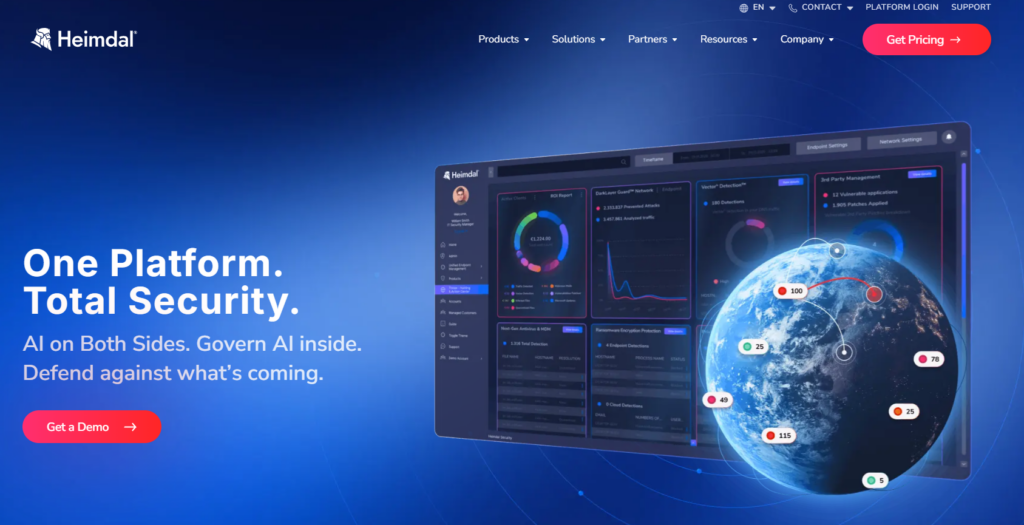
Heimdal takes a different starting point than most providers on this list. Rather than plugging into whatever SIEM you already run, Heimdal built a unified XDR platform where patch management, DNS-layer threat prevention, next-gen antivirus, privileged access management, and email security all live under one lightweight agent and one dashboard. For organizations whose real problem isn’t “which SIEM should manage our logs” but “why do we have twelve disconnected tools,” Heimdal offers a way to shrink the stack itself, backed by an MXDR service for teams that want 24/7 monitoring without building an internal SOC.
✅ Core Services
- Unified XDR platform combining patch and asset management, DNS security, next-gen antivirus, and application control
- Privileged Access Management (PAM) with elevation, delegation, and session control
- Email and collaboration security with phishing detection
- Managed Extended Detection and Response (MXDR) for 24/7 monitoring and response
- Modular licensing so customers activate only the modules they need
💡 Why Companies Consider Heimdal
Heimdal’s differentiator isn’t SIEM neutrality, it’s tool consolidation. Many mid-market teams don’t have an entrenched Splunk or Sentinel deployment worth preserving; they have a patchwork of point solutions (antivirus here, patch tool there, a separate PAM product) that nobody fully trusts. Heimdal’s pitch is that folding those functions into one agent reduces the number of vendors, consoles, and integration gaps a lean IT team has to manage, which is a different kind of “lock-in avoidance”: not avoiding replacement of your SIEM, but avoiding the sprawl that made you consider a SIEM overhaul in the first place.
🎯 Ideal Customer Profile
Best suited for:
- Mid-market organizations and MSPs that want to reduce the number of security agents and consoles they manage, rather than preserve an existing SIEM investment
- Teams without a mature in-house SOC that want a path to managed detection and response without a multi-year enterprise contract
- Organizations prioritizing prevention (patching, DNS filtering, PAM) as much as detection and response
- Companies in Europe or MSP-heavy markets where Heimdal has stronger existing footprint
💰 Commercial Model
Heimdal uses modular, per-module licensing, letting customers scope spend to the specific capabilities they need (patch management, PAM, email security, etc.) rather than committing to an all-or-nothing platform. This tends to favor predictable, incremental cost growth over the opaque “contact sales for everything” model some larger MDR vendors use.
⏰ When to Shortlist
When your evaluation criteria include reducing tool sprawl and vendor count as much as (or more than) preserving a specific SIEM investment. Heimdal fits less naturally into a strict BYOS/SIEM-neutrality framework since it isn’t designed to operate inside your existing Splunk or Sentinel instance, but it’s a strong shortlist candidate for teams whose actual pain point is “too many disconnected tools,” not “our SIEM data is trapped.”
💬 Customer Reviews
“Patch management; OS and third party. Provides clear landscape of outdated per device and provides confidence of Cyber Essentials accreditation. Endpoints overview. Provides clear scope of all connected devices, the device information is particularly helpful for troubleshooting. Infinity management module for bespoke software storage and deployment. This helps with ISO27001 to evidence control of software libraries.”
— IT Director, Aviation Heimdal – G2 Verified Review
“I really appreciate Heimdal’s fast and responsive support team, which is much quicker than most other vendors I’ve dealt with. The privilege elevation feature is a standout, making me feel much safer about admin access risks. Third-party patching is another big plus, and the pricing for these features is fair compared to competitors.”
— Head of IT, Mid-Market Heimdal – G2 Verified Review
4. Rapid7, Best for Detection Engineering Teams Wanting InsightIDR Customization ⭐⭐⭐
🔍 Overview
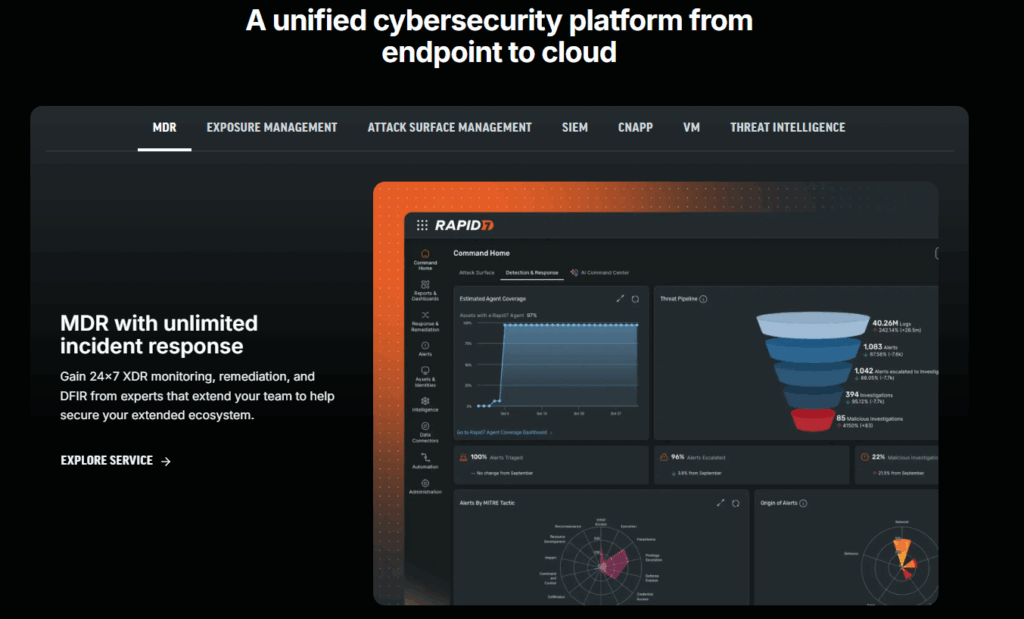
Rapid7 is a cybersecurity platform company offering a broad suite of tools anchored by InsightIDR (its cloud SIEM and XDR solution) and InsightVM (vulnerability management). The company’s MDR service layers human analyst expertise on top of the Insight platform, providing 24/7 monitoring, investigation, and response. Rapid7’s strength lies in its detection engineering flexibility. Teams that want to build and customize their own detection rules, dashboards, and workflows will find more control here than with fully managed black-box services.
✅ Core Services
- InsightIDR, a cloud-native SIEM with built-in UEBA and deception technology
- Managed Detection & Response (MDR) with SOC analyst coverage
- InsightVM for vulnerability management and prioritization
- InsightConnect for SOAR (security orchestration, automation, and response)
- Penetration testing services and application security
💡 Why Companies Consider Rapid7
Rapid7 appeals to security teams that want a platform they can deeply customize, writing their own detection rules, integrating proprietary data sources, and building automated workflows via InsightConnect. For teams with in-house detection engineering talent, Rapid7 provides the canvas. The tradeoff: this flexibility demands more internal investment to operationalize effectively. For a deeper look at Rapid7 alternatives, we’ve published a dedicated comparison.
🎯 Ideal Customer Profile
Best suited for:
- Mid-market to enterprise organizations with in-house security engineering capabilities
- Teams that want to own their detection logic and build custom analytics
- Organizations already using Rapid7 for vulnerability management wanting to consolidate
- Companies comfortable with a platform approach that requires internal operational investment
💰 Commercial Model
Rapid7 offers subscription-based pricing typically tied to the number of assets or data volume. Pricing varies significantly by module and environment size. The company does not publish per-endpoint MDR pricing. Prospective customers engage with sales for custom quotes.
⏰ When to Shortlist
When your team has the in-house engineering talent to customize detection and response workflows, and you want a platform that gives you the tools to build, rather than a fully outsourced “done-for-you” service. Organizations that value control and customization over concierge-style management tend to gravitate toward Rapid7.
💬 Customer Reviews
“Rapid7 is a tool that does the job, however lacks in several aspects such as integrations, default rule set and asset association.”
— Manager, Project Management Rapid7 – Gartner Verified Review
“Their CRC Essentials license is absolutely value for money as it includes three of their products… However, it has made our work significantly more which is pretty annoying.”
— Himanshu K., IT Security Operations Engineer Rapid7 – G2 Verified Review
5. Expel, Best for Organizations Wanting Transparent, Investigation-First MDR ⭐⭐⭐⭐
🔍 Overview
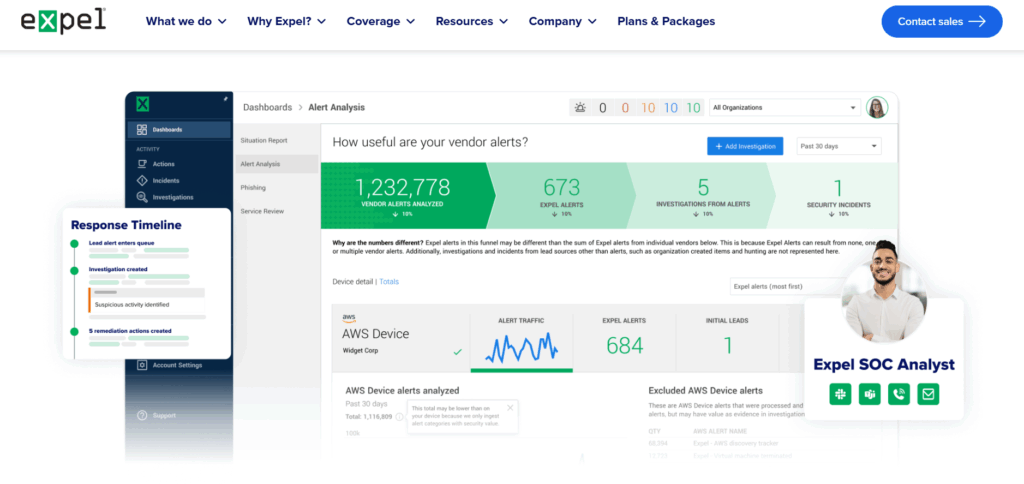
Expel is an MDR provider that has built its reputation on investigation transparency, showing customers exactly how threats are analyzed, what evidence supports each finding, and what actions were taken. Unlike black-box MDR services that simply push alert tickets, Expel’s platform (Expel Workbench) provides full visibility into analyst investigation workflows. The company supports multi-SIEM environments and integrates with a wide range of security tools, making it a viable option for organizations that want managed security without proprietary lock-in.
✅ Core Services
- 24/7 Managed Detection & Response with transparent analyst investigations
- Multi-SIEM support (Splunk, Microsoft Sentinel, and others)
- Automated alert triage with human analyst escalation for high-fidelity threats
- Resilience recommendations, post-incident guidance to close recurring gaps
- Integration with major EDR, cloud, and identity platforms
💡 Why Companies Consider Expel
Expel’s differentiator is investigation transparency. When Expel escalates a threat, you can see the entire investigation chain, what data was examined, what was correlated, and why it matters. This “show your work” approach resonates with security teams that have been burned by opaque MDR services that generate tickets without context. Expel also supports bringing your own SIEM, which reduces vendor lock-in risk. For a detailed breakdown, see our Expel alternatives comparison.
🎯 Ideal Customer Profile
Best suited for:
- Security teams that value investigation transparency and want to see, not just be told, how threats are analyzed
- Mid-market organizations (100 to 2,000 employees) with multi-vendor security environments
- Companies with existing SIEM investments (Splunk, Sentinel) that want MDR layered on top
- Teams looking for a force-multiplier for internal analysts rather than a full SOC replacement
💰 Commercial Model
Expel operates on a subscription model with pricing tied to the scope of monitored environments. Pricing is not publicly listed and requires direct engagement. Contracts tend to be annual, with custom scoping based on the number of integrations and monitored data sources.
⏰ When to Shortlist
When your team wants an MDR provider that shows its work, including full investigation transparency, clear evidence trails, and analyst reasoning you can audit. Expel fits best for organizations that already have some internal security capability and want a provider that complements, rather than replaces, their team.
💬 Customer Reviews
“The Expel team has a solid set of skills that span a reasonable breadth of what you would expect to find in a Security Operations organization… Despite the capabilities of the technical platform and the strength of the analysts providing the service, there is still a limit to the environmental/organizational knowledge inherent in the service.”
— Verified User in Computer Software Expel – G2 Verified Review
“Slack integration for notifications and support requests. Support requests are handled very quickly and accurately… Lack of support for EKS in AWS GovCloud. This was promised to us before we signed our contract, but later was removed from the roadmap.”
— Verified User in Manufacturing Expel – G2 Verified Review
6. Red Canary, Best for Multi-EDR Environments Needing Detection Coverage Normalization ⭐⭐⭐
🔍 Overview
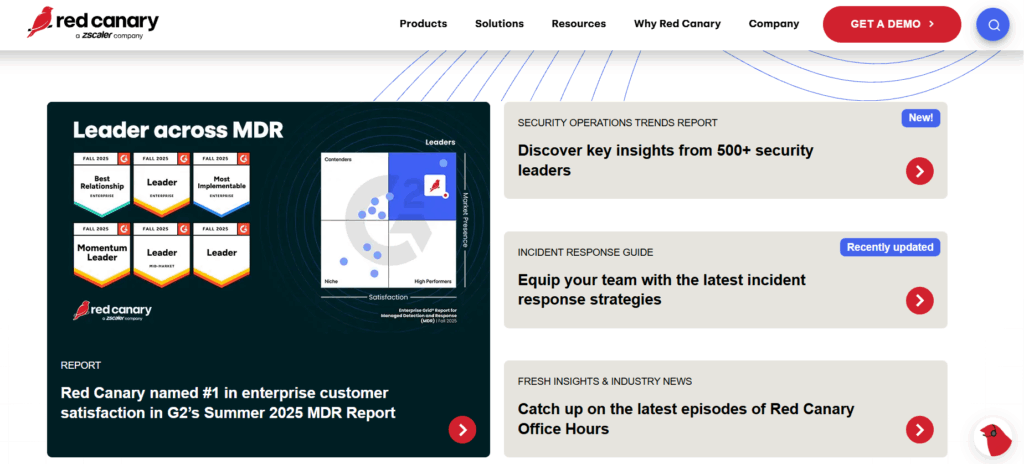
Red Canary is an MDR provider that specializes in endpoint detection normalization, taking telemetry from multiple EDR platforms (CrowdStrike, SentinelOne, Microsoft Defender, Carbon Black) and applying a unified detection layer on top. The company’s platform normalizes alert data across different EDR agents, giving security teams a consistent detection experience regardless of which endpoint tool is deployed. Red Canary has been a strong player in the MDR space and was recently acquired by Zscaler, which may expand its cloud security integration capabilities.
✅ Core Services
- 24/7 Managed Detection & Response across multi-EDR environments
- EDR-agnostic detection normalization (CrowdStrike, SentinelOne, Defender, Carbon Black)
- Cloud detection and response for AWS, Azure, and GCP
- Identity threat detection across Okta, Azure AD, and other identity providers
- Threat intelligence-driven detection engineering
💡 Why Companies Consider Red Canary
Red Canary appeals to organizations that run multiple EDR platforms, often due to acquisitions, mergers, or decentralized IT, and need a single detection layer that normalizes alerts across all of them. Rather than forcing EDR consolidation, Red Canary works with what you have. However, reviews indicate detection depth can vary by source, and some customers report that Red Canary’s detection is more reliant on CrowdStrike telemetry than other EDR sources. For more context, see our Red Canary alternatives breakdown.
🎯 Ideal Customer Profile
Best suited for:
- Organizations running multiple EDR platforms that need unified detection and response
- Mid-market to enterprise companies (100 to 5,000 employees) with heterogeneous endpoint environments
- Security teams wanting 24/7 analyst coverage without replacing their endpoint investments
- Companies within the Zscaler ecosystem looking for integrated MDR
💰 Commercial Model
Red Canary operates on a subscription model typically priced per-endpoint. Pricing is not publicly listed. Following the Zscaler acquisition, packaging and pricing structures may evolve. Prospective customers should request current pricing directly.
⏰ When to Shortlist
When your primary challenge is managing detection across multiple EDR tools and you need a provider that normalizes and unifies endpoint telemetry without forcing tool consolidation. Red Canary is less suited for organizations where SIEM management and log ownership are the primary concerns.
💬 Customer Reviews
“I wish the integrations beyond Crowdstrike were a bit more robust and greater in number. Red Canary is perhaps too reliant on Crowdstrike and less on our other sources which are important, Cloud, Identity, Email, etc.”
— Verified User in Computer Software Red Canary – G2 Verified Review
“There have been several instances where we expected RC to identify an issue and no alert was surfaced. Because of this, senior leadership feels, at times, that RC isn’t the right partner for us.”
— Mike S., Information Security Manager, VP Red Canary – G2 Verified Review
7. Alert Logic, Best for AWS-Native Shops Needing Bundled Compliance + MDR ⭐⭐
🔍 Overview
Alert Logic (now part of Fortra) is an MDR provider with historically strong AWS integration, offering a bundled approach that combines SIEM-like log monitoring, vulnerability management, endpoint detection, and file integrity monitoring in a single platform. For organizations heavily invested in AWS, particularly those with PCI DSS or HIPAA compliance requirements, Alert Logic has positioned itself as a single-vendor compliance and security monitoring solution. However, the transition to the Fortra ecosystem has introduced operational friction that multiple reviewers have flagged. For a broader view, see our Alert Logic alternatives comparison.
✅ Core Services
- 24/7 managed threat detection and response with SOC analyst coverage
- AWS-native deployment with CloudFormation and agent-based monitoring
- Bundled vulnerability scanning and file integrity monitoring (FIM)
- Log management and network-based intrusion detection (IDS)
- PCI DSS, HIPAA, and SOC 2 compliance reporting
💡 Why Companies Consider Alert Logic
Alert Logic appeals to AWS-centric organizations that want a single vendor covering MDR, vulnerability management, and compliance reporting. The bundled approach can simplify procurement for smaller teams that lack the resources to manage separate point solutions. However, the platform’s depth in detection and response has drawn mixed reviews. Several users report that Alert Logic is better at meeting compliance checkboxes than at catching and stopping real threats.
🎯 Ideal Customer Profile
Best suited for:
- AWS-native organizations needing bundled MDR + compliance monitoring
- Small to mid-market companies (50 to 500 employees) prioritizing PCI DSS or HIPAA compliance
- Security-lean teams that need a single platform covering multiple compliance requirements
- Organizations where “checkbox compliance” is the primary driver, not advanced threat detection
💰 Commercial Model
Alert Logic operates on a subscription model with pricing based on monitored nodes and log volume. Note: there is a reported 50GB/day cap on log collection that may not be disclosed during the sales process. Pricing requires direct engagement with the sales team.
⏰ When to Shortlist
When your primary need is AWS-native compliance monitoring (PCI DSS, HIPAA) and you want a bundled solution that checks multiple compliance boxes with a single vendor. Alert Logic is less suited for organizations that need advanced detection engineering, multi-SIEM flexibility, or response ownership beyond escalation.
💬 Customer Reviews
“If you need something to check the box for compliance it’s a good bundle for the costs, you get somewhat SIEM, MDR and Vulnerability Management, EDR and FIM all in one.”
— Verified User in Health, Wellness and Fitness Alert Logic – G2 Verified Review
“We’ve had a pretty terrible experience with Alert Logic. The product was oversold and underdelivered.”
— Information Security Officer Alert Logic – Gartner Verified Review
8. Netsurion, Best for On-Premise-Heavy Environments Needing Managed SIEM With EventTracker ⭐⭐⭐
🔍 Overview
Netsurion is a managed security provider anchored by its EventTracker SIEM platform, offering co-managed and fully managed SOC services. Where Netsurion differentiates is its strong support for on-premise and hybrid environments, a gap many cloud-first MDR providers fail to address. For organizations with significant on-premise infrastructure (manufacturing, healthcare, financial services), Netsurion provides a managed SIEM experience that doesn’t require a wholesale migration to cloud-native tooling.
✅ Core Services
- EventTracker SIEM with managed log monitoring, correlation, and threat detection
- 24/7 SOC monitoring with co-managed flexibility, where customers can retain partial control
- On-premise, cloud, and hybrid deployment models
- Vulnerability management and compliance reporting (PCI DSS, HIPAA, SOC 2, NIST)
- Managed endpoint detection and response
💡 Why Companies Consider Netsurion
Netsurion is one of the few MDR/managed SIEM providers that genuinely serves on-premise-heavy environments without forcing a cloud migration. The co-managed model gives security teams the option to retain visibility and partial control while offloading 24/7 monitoring and response to Netsurion’s SOC. For organizations in regulated industries with significant on-premise infrastructure, where “move everything to the cloud” isn’t operationally realistic, this flexibility matters.
🎯 Ideal Customer Profile
Best suited for:
- Organizations with significant on-premise infrastructure (servers, OT, legacy applications)
- Regulated industries (healthcare, financial services, manufacturing) needing on-prem SIEM management
- Mid-market companies wanting a co-managed model, not full outsourcing, not fully in-house
- Teams that need SIEM management expertise but want to retain some operational control
💰 Commercial Model
Netsurion operates on a subscription model with pricing based on environment size, log volume, and the level of co-management required. Pricing is not publicly listed and requires direct consultation. The co-managed approach typically provides more pricing flexibility than fully managed services.
⏰ When to Shortlist
When your environment is heavily on-premise or hybrid, and cloud-first MDR providers can’t adequately cover your infrastructure. Netsurion fits for organizations that want managed SIEM with the option to retain partial visibility and control, particularly in regulated industries where on-premise monitoring is non-negotiable.
9. Cyber Duo, Best for Lean Security Teams (<100 Employees) Needing Boutique Managed SOC ⭐⭐⭐
🔍 Overview
Cyber Duo is a boutique managed SOC provider targeting small to mid-market organizations that need hands-on, personalized security operations. Unlike large-scale MDR platforms that process thousands of customers through standardized workflows, Cyber Duo operates with a high-touch, boutique approach: smaller customer-to-analyst ratios, more direct communication, and security services tailored to the specific needs of lean teams. For organizations where a large MDR provider feels like a mismatch in scale and attention, Cyber Duo provides a more relationship-driven alternative.
✅ Core Services
- 24/7 managed SOC with dedicated analyst support
- SIEM management and log monitoring across cloud and on-premise environments
- Incident response and threat containment
- Vulnerability management and security assessments
- Compliance support for SOC 2 and ISO 27001
💡 Why Companies Consider Cyber Duo
Cyber Duo appeals to lean security teams, often a single IT generalist or part-time security resource, that need a managed SOC partner but are too small for the minimum engagement thresholds of enterprise MDR vendors. The boutique model means higher touch, more personalized attention, and security operations that feel like an extension of your team rather than a ticket queue.
🎯 Ideal Customer Profile
Best suited for:
- Small to mid-market organizations with fewer than 100 employees
- Companies with no dedicated internal security team, or a team of one
- Startups and growth-stage companies needing SOC coverage for customer compliance requirements
- Organizations that value relationship-driven security over automated, high-volume MDR platforms
💰 Commercial Model
Cyber Duo typically operates on a subscription model with pricing customized to organizational size and monitoring scope. As a boutique provider, engagement terms tend to be more flexible than large-vendor enterprise contracts. Pricing requires direct consultation.
⏰ When to Shortlist
When your organization is too small for enterprise MDR minimum engagement thresholds but still needs legitimate 24/7 SOC coverage, particularly for compliance requirements (SOC 2, ISO 27001) driven by enterprise customer audits. Cyber Duo fills the gap between “no security operations” and “enterprise MDR platform” for lean teams where personalized attention matters more than platform scale.
10. Helxon (VORXOC), Best for Lean Teams Replacing Disconnected SIEM and SOAR Tools With One Platform ⭐⭐⭐⭐
🔍 Overview
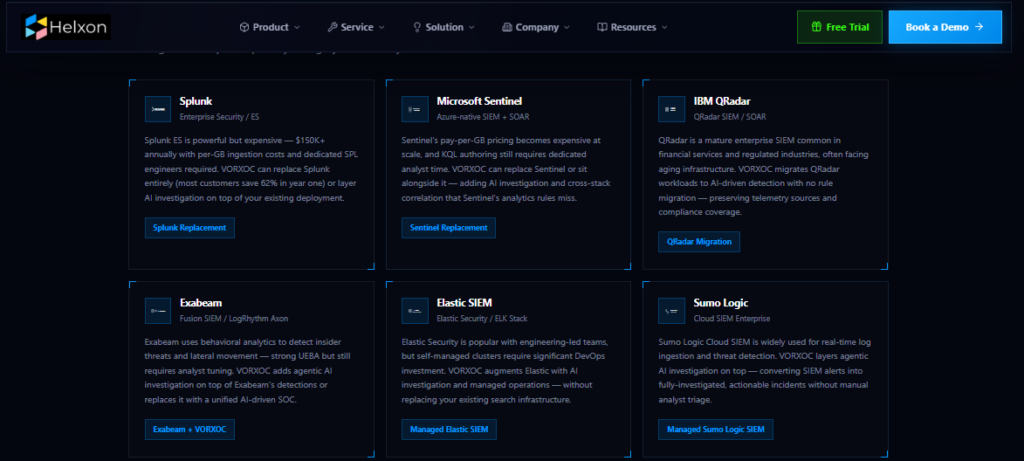
Helxon is the company behind VORXOC, an AI-powered SOC operations layer that combines SIEM-style analytics, SOAR-style automation, and case management in a single workspace. VORXOC can run on top of a customer’s current SIEM, provide light SIEM capabilities where none exists, or fully replace disconnected SIEM and SOAR tooling as a self-managed platform. Helxon also offers SOCaaS, where its own analysts operate the same platform on a customer’s behalf.
✅ Core Services
- AI-powered detection and cross-source correlation across firewall, endpoint, cloud, identity, and email telemetry
- SOAR-style automation and guided response playbooks
- Self-managed VORXOC platform or fully managed SOCaaS on the same underlying engine
- SOC performance reporting and compliance-ready exports
- Pre-built connectors for major EDR/XDR, firewall, cloud, and identity platforms
💡 Why Companies Consider Helxon
Helxon’s differentiator is deployment speed and pricing simplicity. Most organizations see first detections within 2 to 4 weeks and full operational maturity in 2 to 3 months, faster than the 6 to 12 months a traditional SIEM build typically takes. Pricing is flat and published, not a quote gated behind a sales call.
🎯 Ideal Customer Profile
Best suited for:
- Small and mid-sized security teams without the headcount to run multiple point tools
- Organizations without an existing SIEM that want one platform instead of stitching together 4 to 6 tools
- Teams that want to self-manage now and move to SOCaaS later without a platform migration
💰 Commercial Model
Self-managed VORXOC starts at $650/month for up to 100 endpoints. Fully managed SOCaaS starts at $1,300/month. Both figures are published on Helxon’s pricing page.
⏰ When to Shortlist
Organizations evaluating Arctic Wolf alternatives that specifically want to consolidate SIEM, SOAR, and case management into a single platform, rather than layer a service on top of tools they already run, should include Helxon at the RFP stage.
Q2: How Were These Arctic Wolf Alternatives Selected? (Scoring Methodology)
Most “best MDR” listicles rank providers by brand recognition or affiliate payouts. That approach doesn’t help a CISO justify a procurement decision to their CFO or board. Transparency in methodology, showing exactly how and why each provider earned its position, is what separates an analyst-grade shortlist from a marketing list.
✅ The 5 Weighted Evaluation Criteria
Every provider in this guide was scored across five dimensions, each weighted to reflect the priorities of mid-market security teams evaluating Arctic Wolf alternatives specifically through the lens of operational freedom:
| Criterion | Weight | What It Measures |
|---|---|---|
| Open Architecture & BYOS Compatibility | 25% | Does the provider work with your existing SIEM (Splunk, Sentinel, Elastic, QRadar), or force proprietary replacement? |
| Customization Flexibility | 20% | Can you tune detection rules, build custom use cases, and tailor response playbooks? |
| Data Ownership & Portability | 20% | Who owns log data, detection logic, and correlation rules if you terminate the contract? |
| Customer Validation & Reviews | 20% | What do verified users on G2, Gartner, and Reddit say about the real experience? |
| Pricing Transparency | 15% | Is pricing published, predictable, and defensible in a CFO conversation? |
Total = 100%
⭐ Star Rating Derivation
Star ratings were derived from composite scores across all five criteria using the following bands:
- ⭐ = 0 to 20 points
- ⭐⭐ = 21 to 40 points
- ⭐⭐⭐ = 41 to 60 points
- ⭐⭐⭐⭐ = 61 to 80 points
- ⭐⭐⭐⭐⭐ = 81 to 100 points
📊 Per-Provider Scoring Table
| Provider | Open Architecture (25%) | Customization (20%) | Data Ownership (20%) | Customer Validation (20%) | Pricing Transparency (15%) | Total | Stars |
|---|---|---|---|---|---|---|---|
| UnderDefense | 25 | 19 | 20 | 18 | 15 | 97 | ⭐⭐⭐⭐⭐ |
| Expel | 20 | 16 | 16 | 16 | 8 | 76 | ⭐⭐⭐⭐ |
| Taegis XDR | 18 | 17 | 14 | 14 | 8 | 71 | ⭐⭐⭐⭐ |
| Heimdal | 12 | 15 | 13 | 17 | 11 | 68 | ⭐⭐⭐⭐ |
| Helxon (VORXOC) | 18 | 15 | 14 | 8 | 14 | 69 | ⭐⭐⭐⭐ |
| Netsurion | 16 | 14 | 14 | 10 | 9 | 63 | ⭐⭐⭐ |
| Cyber Duo | 14 | 12 | 14 | 10 | 9 | 59 | ⭐⭐⭐ |
| Red Canary | 12 | 14 | 12 | 13 | 6 | 57 | ⭐⭐⭐ |
| Rapid7 | 14 | 16 | 12 | 8 | 6 | 56 | ⭐⭐⭐ |
| Alert Logic | 10 | 8 | 10 | 6 | 6 | 40 | ⭐⭐ |
UnderDefense scores highest because it was built from the ground up as a vendor-agnostic, open-architecture MDR provider, integrating with 250+ existing tools, preserving customer-owned SIEM data, and publishing transparent pricing at $11 to $15/endpoint/month. This is not a retrofit but the architectural foundation.
Q3: What Are the Real Problems With Arctic Wolf That Reviews on G2, Gartner, and Reddit Reveal?
The Bigger Picture
Arctic Wolf has earned strong brand recognition in the managed security space, and for good reason. Their concierge model, broad market adoption, and marketing execution have made them a default shortlist candidate. But brand strength and operational performance are different conversations. Across G2, Gartner, and Reddit, a consistent pattern of friction emerges, and it’s not about one-off bad experiences. It’s architectural.
Teams aren’t rejecting MDR. They’re rejecting specific trade-offs that surface only after you’ve signed the contract and started living with the service.
❌ Theme 1: Proprietary SIEM Replacement and Lock-In
The most consistent complaint across platforms is that Arctic Wolf requires you to replace your existing SIEM with their proprietary platform. Your Splunk correlation rules, your custom detection logic, your years of tuning, gone. A CISO reviewing Arctic Wolf on Gartner put it bluntly:
“Started out well but over the years the service has consistently not met expectations. The issues that we have experienced has greatly outweighed the benefits.”
— CISO Arctic Wolf – Gartner Verified Review
❌ Theme 2: Escalation-Heavy Response Without Remediation Ownership
Multiple reviewers describe Arctic Wolf as a detection service that stops short of actual response. Alerts get generated. Tickets get created. But the hard work of investigation, containment, and remediation lands back on the customer’s team.
“Arctic Wolf provides Solid detection and response capabilities, but overly relies on the client’s team for remediation, which really hurts the value of the service.”
— VP of Technology Arctic Wolf – Gartner Verified Review
⚠️ Theme 3: Opaque Pricing and Aggressive Contract Terms
Pricing is not published. Contract terms include a 60-day renewal notice window (rather than the standard 30-day), and multiple reviewers flag aggressive auto-renewal practices:
“Beware they add a 60 day renewal notice instead of the typical 30 day notice. If you don’t give notice of cancelling any services before 60 days, you will automatically renew everything.”
— Verified User, Electrical/Electronic Manufacturing Arctic Wolf – G2 Verified Review
❌ Theme 4: Alert Quality and Analyst Context
A Sr. Cybersecurity Engineer in manufacturing flagged the gap between what was promised and what was delivered: “This is not an extension of our security team as was originally sold,” noting that alerts were often “just a regurgitation of Microsoft alerts which means duplicates.”
The Architectural Root Cause
These aren’t isolated grievances. They trace to one structural decision: when an MDR provider replaces your SIEM with a proprietary platform, your data, your detection logic, and your workflows all live inside their ecosystem. Switching costs become prohibitive. That’s the lock-in trap, and it’s exactly why the evaluation framework in this guide weights open architecture at 25%.
At UnderDefense, we built the opposite model. We log into your SIEM, whether Splunk, Sentinel, Elastic, or QRadar, and our analysts work where your data already lives. Your detection rules, your correlation logic, your log data: it all stays with you, even if you decide to switch MDR providers tomorrow.
Q4: How Does Vendor Lock-In Work in Managed SIEM, and Which Providers Support BYOS and Data Ownership?
The Decision That Costs You Later
Most security teams don’t realize they’ve been locked in until it’s time to leave. The question every CISO should ask before signing an MDR contract isn’t “What does this provider detect?” It’s “What happens to my data, my rules, and my workflows if I switch providers in two years?”
Vendor lock-in in managed SIEM operates across three distinct layers:
🔒 Data Lock-In: Who owns the log data? Can you export it in standard formats? What happens to your data after contract termination?
🔒 Detection Logic Lock-In: Are your correlation rules, custom detections, and automation playbooks portable, or proprietary to the vendor’s platform?
🔒 Contractual Lock-In: What are the exit clauses? Auto-renewal windows? Post-termination data retention policies?
📊 BYOS (Bring Your Own SIEM) Compatibility Matrix
| Provider | Splunk | Microsoft Sentinel | Elastic | QRadar | Custom/Other |
|---|---|---|---|---|---|
| UnderDefense | ✅ Full | ✅ Full | ✅ Full | ✅ Full | ✅ 250+ tools |
| Expel | ✅ Full | ✅ Full | ⚠️ Partial | ⚠️ Partial | ✅ Multi-SIEM |
| Red Canary | ❌ No SIEM ingestion | ⚠️ Partial | ❌ No | ❌ No | EDR-focused |
| Taegis | ⚠️ Via Taegis | ⚠️ Via Taegis | ⚠️ Partial | ⚠️ Partial | Taegis-centric |
| Heimdal | ❌ No SIEM ingestion | ⚠️ Partial | ❌ No | ❌ No | Unified XDR agent |
| Helxon (VORXOC) | ⚠️ Layer or replace | ⚠️ Layer or replace | ⚠️ Partial | ⚠️ Partial | ✅ Pre-built connectors |
| Netsurion | ⚠️ Partial | ⚠️ Partial | ⚠️ Partial | ⚠️ Partial | EventTracker SIEM |
| Rapid7 | ❌ InsightIDR preferred | ⚠️ Partial | ❌ No | ❌ No | Insight platform |
| Cyber Duo | ⚠️ Case-by-case | ⚠️ Case-by-case | ⚠️ Case-by-case | ⚠️ Case-by-case | Flexible |
| Alert Logic | ❌ Proprietary | ❌ Proprietary | ❌ No | ❌ No | AWS-native only |
What “Full Support” actually means: The provider’s analysts log into your SIEM instance, work within your environment, and all detection rules, correlation logic, and automation you build together stay in your system.
📊 Data Ownership Comparison
| Provider | Log Ownership | Export Formats | Post-Termination Retention | Exit Portability |
|---|---|---|---|---|
| UnderDefense | ✅ Customer-owned | ✅ Standard (JSON, CEF, Syslog) | ✅ Customer retains all | ✅ Full, SIEM stays |
| Expel | ✅ Customer-owned | ✅ Standard formats | ⚠️ Limited retention window | ⚠️ Moderate |
| Taegis XDR | ⚠️ Shared | ⚠️ Taegis-specific | ⚠️ Vendor-dependent | ⚠️ Partial |
| Helxon (VORXOC) | ⚠️ Platform-hosted or customer SIEM | ✅ Compliance-ready exports | ⚠️ Vendor-dependent | ⚠️ Moderate |
| Heimdal | ⚠️ Platform-held | ⚠️ Limited | ⚠️ Vendor-dependent | ⚠️ Partial |
| Red Canary | ⚠️ EDR-dependent | ⚠️ Limited | ⚠️ Vendor-dependent | ⚠️ Partial |
| Netsurion | ⚠️ Co-managed | ⚠️ EventTracker formats | ⚠️ Negotiable | ⚠️ Partial |
| Rapid7 | ⚠️ InsightIDR-bound | ⚠️ Insight platform | ⚠️ Vendor-dependent | ❌ Platform-locked |
| Cyber Duo | ⚠️ Negotiable | ⚠️ Case-by-case | ⚠️ Negotiable | ⚠️ Partial |
| Alert Logic | ❌ Vendor-managed | ❌ Proprietary | ❌ Limited | ❌ Minimal |
🔑 The Lock-In Freedom Scorecard
| Lock-In Layer | Arctic Wolf | UnderDefense |
|---|---|---|
| Data Ownership | ❌ Proprietary platform holds data | ✅ Customer owns all log data in their SIEM |
| Detection Logic Portability | ❌ Rules live in Arctic Wolf’s system | ✅ Rules live in customer’s SIEM, fully portable |
| Contractual Flexibility | ⚠️ 60-day auto-renewal, opaque pricing | ✅ Flexible terms, published $11 to $15/endpoint/month |
| BYOS Compatibility | ❌ Replaces existing SIEM | ✅ Splunk, Sentinel, Elastic, QRadar, all supported |
| Post-Exit Data Access | ❌ Data stays with vendor | ✅ Data stays with customer, nothing to migrate |
A veteran CISO framed it best in a recent conversation: “I like to have separate relationships and vendors for the MDR team versus the XDR or SIEM data capability. All of my business logic stays with me in the event that I change MDR providers.” That’s not just a preference but an architecture decision that protects your organization for the long term.
“We received little value from ArcticWolf. The product offered little visibility when we were using it… Anything you want to look at or changes you need to make in the product must go through their engineering team.”
— Matt C., Manager, Cybersecurity Services Arctic Wolf – G2 Verified Review
“Log collectors show working, however when asked to provide logs for an investigation no logs could be provided. Analysts provide little context, and when asked for more information in the investigation nothing is ever provided or even communicated.”
— CISO Arctic Wolf – Gartner Verified Review
Q5: UnderDefense vs Arctic Wolf: Side-by-Side Across the 5 Dimensions That Matter
Both Arctic Wolf and UnderDefense deliver managed security, but through fundamentally different architectures. Arctic Wolf replaces your existing SIEM with its proprietary platform; UnderDefense plugs into whatever stack you already run. That one architectural decision shapes everything downstream: how much control you retain, what happens to your data if you leave, and whether your team can customize detection logic without filing a ticket.
Here’s a practical comparison across the five dimensions that consistently surface in RFP conversations.
✅ Customization Flexibility
Arctic Wolf’s Concierge Security Team handles tuning, but if you need changes to detection logic or want to look under the hood, everything routes through their engineering team. One G2 reviewer put it bluntly:
“Anything you want to look at or changes you need to make in the product must go through their engineering team. As an MSP, this is a horrible way to do business for us.”
— Matt C., Manager, Cybersecurity Services Arctic Wolf – G2 Verified Review
With UnderDefense, detection rules are auditable, and teams can request custom detection rules tuned to their specific environment. As one CISO shared:
“We really appreciate that we can customize the threat detection to focus on our specific needs.”
— Serhii B., Chief Information Security Officer UnderDefense – G2 Verified Review
⚠️ Data Ownership and On-Premise Support
Arctic Wolf ingests your logs into its proprietary cloud platform. If you terminate the contract, you lose access to historical telemetry, with no export and no portability. Multiple Gartner reviewers reported that when they asked Arctic Wolf to provide logs during an investigation, “no logs could be provided.” UnderDefense, by contrast, integrates with your existing SIEM (Splunk, Sentinel, Elastic), meaning your data stays on your infrastructure and in your control.
For organizations running on-premise environments, this distinction is critical. Arctic Wolf is cloud-native by design; UnderDefense supports hybrid and on-premise deployments as part of its vendor-agnostic architecture.
📊 Head-to-Head Comparison
| Dimension | UnderDefense | Arctic Wolf |
|---|---|---|
| Customization | ✅ Auditable custom detection rules | ❌ Changes routed through AW engineering |
| Data Ownership | ✅ BYOS, logs remain on your SIEM | ❌ Proprietary cloud; no export on exit |
| On-Prem Support | ✅ Hybrid + on-prem deployments | ⚠️ Cloud-native; limited on-prem |
| Open Architecture (BYOS) | ✅ 250+ integrations; vendor-agnostic | ❌ Replaces existing SIEM with proprietary platform |
| Response Model | ✅ ChatOps-driven concierge response with user verification | ⚠️ Escalation-heavy; limited remediation |
| Pricing | ✅ $11–15/endpoint/month, transparent | ❌ Opaque; ~$192–360/user/year (public sector pricing) |
| Contract Flexibility | ✅ Flexible terms | ❌ 60-day auto-renewal notice, multi-year lock-in |
💰 Pricing Reality Check
Arctic Wolf doesn’t publish standard pricing. Public sector price lists show $192–$360 per user/year depending on tier. For a 500-user mid-market company, that’s $96K–$180K annually, before add-ons. UnderDefense publishes transparent MDR pricing at $11–15 per endpoint per month, making total cost predictable from day one.
A Gartner-verified CISO reviewing Arctic Wolf summed up the frustration many buyers feel:
“Analysts provide little context, and when asked for more information in the investigation nothing is ever provided or even communicated. Support incidents are not worked to completion and communication evaporates.”
— CISO, Manufacturing [$3B–$10B firm] Arctic Wolf – Gartner Peer Review
🎯 Which Should You Choose?
Choose Arctic Wolf if you’re starting from zero, with no SIEM, no SOC, and no existing security tooling, and want a single vendor to handle everything in a closed ecosystem.
Choose UnderDefense if you want to protect your existing security investments, keep ownership of your log data, get transparent pricing, and have analysts who respond directly in your workflows via ChatOps rather than escalating tickets back to your team. You can explore how the UnderDefense MAXI platform integrates with your current stack through a personalized demo.
Q6: How Should You Evaluate These Providers Before Sending an RFP?
Most RFPs for managed security services focus on feature checklists: “Do you support cloud?” “Do you have 24/7 coverage?” Every vendor checks those boxes. The real differentiators hide in the architectural and contractual details that only surface when you ask the right questions.
Before sending a single RFP, score each provider against these 10 criteria. If a vendor can’t answer clearly, that tells you everything.
📋 The 10-Point Pre-RFP Evaluation Checklist
- Can I keep my existing SIEM? (Splunk, Sentinel, Elastic, etc.) If the provider requires you to replace your SIEM, that’s an architectural dependency you’ll pay for on exit.
- Who owns my log data? Ask explicitly: “If we terminate, can we export all historical logs in a standard format?”
- What export formats are supported? Proprietary formats equal lock-in. Look for JSON, CEF, or native SIEM-compatible exports.
- What happens to my data on contract termination? Some providers delete data 30 days after contract end. Get retention and portability terms in writing.
- Can I write or modify custom detection rules? If all tuning goes through the vendor’s engineering queue, your team loses agility.
- Is pricing published or available on request? Opaque pricing often means high variance between customers and aggressive upsells.
- What is the documented MTTR (Mean Time to Respond)? Ask for SLA-backed numbers, not marketing averages. UnderDefense, for example, documents a 2-minute alert-to-triage and 15-minute escalation for critical incidents in verified case studies.
- Does the provider remediate, or just escalate? “Alert generated, ticket created” is not response. Does the SOC team take action, or does the work land back on your desk?
- What is the minimum contract term? Multi-year contracts with 60-day auto-renewal windows are designed to reduce churn, not serve you.
- Can I audit detection logic? If you can’t see the rules firing on your environment, you’re trusting a black box.
⭐ Score Interpretation
- 8–10 ✓ = Open-architecture partner. This provider treats you as the owner of your security program, not a subscriber to theirs.
- 5–7 ✓ = Partial lock-in risk. Expect friction if your needs change or you want to switch providers.
- Below 5 ✓ = Proprietary dependency. You’re renting security, not building it. Exit costs will be significant.
⏰ Why This Matters Now
The gap between “monitoring” and “response” is where breaches happen. Providers that score well on this checklist tend to be the ones that own outcomes, not just alerts. If you’re evaluating managed cybersecurity services more broadly, this same framework applies across the market.
10 Best Managed Cybersecurity Services: Expert Picks and Why They’re Worth It
See how top managed security providers stack up across pricing, response models, and integration flexibility.
See Full Top 10 List →Q7: Frequently Asked Questions About Arctic Wolf Alternatives and Managed SIEM
Is Arctic Wolf a SIEM?
Not exactly. Arctic Wolf operates a proprietary cloud-native platform that functions as a SIEM replacement. When you onboard, your logs are ingested into Arctic Wolf’s infrastructure, not into a SIEM you own or control. This means Arctic Wolf acts as both your detection engine and your data repository, which creates a single-vendor dependency. If you already run Splunk, Sentinel, or Elastic, Arctic Wolf does not layer on top; it replaces them.
What are the main disadvantages of Arctic Wolf?
Four issues come up consistently across verified reviews:
- Vendor lock-in. Proprietary SIEM replacement means your log data, detection rules, and historical telemetry live inside Arctic Wolf’s platform.
- Opaque pricing. No published pricing; public sector lists suggest $192–$360/user/year.
- Escalation-heavy response. Multiple Gartner reviewers report that Arctic Wolf identifies alerts but doesn’t remediate, pushing resolution back to internal teams.
- Limited customization. Detection tuning requires routing through Arctic Wolf’s engineering team rather than empowering your own analysts.
Does Arctic Wolf cause vendor lock-in?
Yes, across three layers. First, data lock-in: your logs are stored in Arctic Wolf’s proprietary cloud, with no standard export path on termination. Second, detection logic lock-in: all rules and tuning are managed by Arctic Wolf and are not portable. Third, contractual lock-in: some customers report 60-day auto-renewal notice windows that make it difficult to exit cleanly. One reviewer noted:
“Beware they add a 60 day renewal notice instead of the typical 30 day notice. If you don’t give notice of cancelling any services before 60 days, you will automatically renew everything.”
— Verified User, Electrical/Electronic Manufacturing Arctic Wolf – G2 Verified Review
What is open architecture in managed SIEM?
Open architecture means the MDR provider integrates with the SIEM and security tools you already own, rather than replacing them. In a BYOS (Bring Your Own SIEM) model, providers like UnderDefense connect to Splunk, Microsoft Sentinel, Elastic, and 250+ other tools, running detection and response on top of your existing stack. Your data stays on your infrastructure, your detection rules are auditable, and you can switch providers without losing years of tuning and historical telemetry.
How much does managed SIEM cost in 2026?
Pricing varies widely based on model and provider:
| Model | Typical Annual Cost |
|---|---|
| Fully managed SIEM (outsourced) | $60,000–$180,000/year |
| Hybrid SIEM (internal + external SOC) | $200,000–$600,000+/year |
| In-house SIEM (fully self-operated) | $400,000–$1,000,000+/year |
| Transparent MDR (e.g., UnderDefense) | $11–15/endpoint/month |
| Opaque MDR (e.g., Arctic Wolf) | ~$96K–$180K/year for 500 users |
Monthly managed SIEM services typically start at $5,000–$10,000/month depending on business size and data volume. For a detailed breakdown, consult the Managed SIEM Pricing Guide.
Can I keep my existing SIEM with an MDR provider?
Yes, but only with BYOS-compatible providers. UnderDefense, Expel, Helxon, and Red Canary all support integration with existing SIEM platforms rather than requiring replacement. Arctic Wolf, by contrast, requires its proprietary platform as the primary log ingestion and analysis layer. If preserving your Splunk, Sentinel, or Elastic investment matters, confirm BYOS support before signing.
What should I ask before signing with a managed SIEM provider?
Start with these five questions from the evaluation checklist in Q6:
- Can I keep my existing SIEM, or does your service require replacement?
- Who owns my log data, and what happens to it if we terminate?
- Do you remediate threats directly, or escalate alerts back to my team?
- Is your pricing published and predictable, or quote-based and variable?
- Can I audit your detection logic and modify rules for my environment?
Any provider that hesitates on these questions is signaling an architecture built for vendor retention, not customer outcomes. Evaluate how each vendor stacks up using the SOC Provider Evaluation Checklist before committing.
1. What is vendor lock-in in managed SIEM, and why does it matter when choosing an MDR provider?
Vendor lock-in in managed SIEM happens when your log data, detection rules, and correlation logic become trapped inside a provider’s proprietary platform. We see it operate across three layers:
-
Data lock-in: Your logs are stored on the vendor’s infrastructure, with no standard export path if you leave.
-
Detection logic lock-in: Custom rules and tuning live inside the vendor’s system and cannot be ported to another platform.
-
Contractual lock-in: Multi-year terms, 60-day auto-renewal windows, and opaque pricing structures make switching costly and complicated.
The reason this matters is practical. If you have spent years tuning Splunk correlation rules or building custom detections in Microsoft Sentinel, a provider that replaces your SIEM forces you to start from zero. At UnderDefense, we built our managed SIEM service around the BYOS (Bring Your Own SIEM) model, meaning your data, your rules, and your workflows stay with you, even if you decide to change providers.
2. How does UnderDefense compare to Arctic Wolf on pricing, data ownership, and customization?
The differences between UnderDefense and Arctic Wolf trace back to one architectural decision. Arctic Wolf replaces your existing SIEM with its proprietary platform. We plug into whatever stack you already run. Here is how that plays out across the dimensions that matter most:
-
Pricing: We publish transparent pricing at $11 to $15/endpoint/month. Arctic Wolf does not publish standard pricing. Public sector price lists suggest $19.23 to $60/user/year, which translates to $96K to $180K annually for a 500-user company before add-ons.
-
Data ownership: With UnderDefense, your logs remain on your SIEM. If you leave Arctic Wolf, you lose access to historical telemetry, with no export and no portability.
-
Customization: Our detection rules are auditable, and teams can request custom rules tuned to their environment. Arctic Wolf routes all changes through their engineering team.
You can explore how the UnderDefense MAXI platform integrates with your current stack to see this architectural difference in practice.
3. Which managed SIEM providers support Bring Your Own SIEM (BYOS) with Splunk, Sentinel, and Elastic?
Not all MDR providers allow you to keep your existing SIEM. Some require proprietary replacement, which creates the lock-in dynamics we outlined above. Here is how BYOS compatibility breaks down across the providers we evaluated:
-
UnderDefense: Full support for Splunk, Microsoft Sentinel, Elastic, QRadar, and 250+ additional tools. Our analysts log into your SIEM instance and work within your environment.
-
Expel: Full Splunk and Sentinel support, partial Elastic and QRadar.
-
Helxon (VORXOC): Runs on top of an existing SIEM, supplies light SIEM where none exists, or replaces disconnected SIEM and SOAR tooling entirely.
-
Secureworks: Integrates via Taegis, with partial support for third-party SIEMs.
-
Netsurion: Partial support across major platforms through EventTracker.
-
Rapid7, Red Canary, Alert Logic: Limited or proprietary SIEM models.
If preserving your existing SIEM investment matters, confirm BYOS support before signing with any provider. See our full MDR provider comparison for the complete compatibility matrix.
4. What are the most common problems with Arctic Wolf reported on G2, Gartner, and Reddit?
Across verified review platforms, four operational themes surface consistently:
-
Proprietary SIEM replacement and lock-in. Arctic Wolf requires you to replace your existing SIEM, meaning your Splunk correlation rules, custom detection logic, and years of tuning are gone.
-
Escalation-heavy response without remediation ownership. Multiple reviewers describe Arctic Wolf as a detection service that stops short of actual response. Alerts get generated, tickets get created, but investigation and remediation land back on your team.
-
Opaque pricing and aggressive contract terms. Pricing is not published. Contract terms include a 60-day renewal notice window rather than the standard 30-day.
-
Alert quality and analyst context gaps. Several reviewers note that alerts lack context and are sometimes just a regurgitation of existing platform alerts.
These are not isolated complaints but architectural patterns. For a provider that takes the opposite approach, explore how our managed detection and response service is built on open architecture.
5. How much does managed SIEM cost in 2026, and what pricing models should we compare?
Managed SIEM pricing varies significantly based on the model:
-
Fully managed SIEM (outsourced): $60,000 to $180,000/year
-
Hybrid SIEM (internal + external SOC): $200,000 to $600,000/year
-
In-house SIEM (fully self-operated): $400,000 to $1,000,000/year
-
Transparent MDR (e.g., UnderDefense): $11 to $15/endpoint/month
-
Opaque MDR (e.g., Arctic Wolf): $96K to $180K/year for 500 users
Monthly managed SIEM services typically start at $5,000 to $10,000/month depending on business size and data volume. The key distinction is not just total cost but pricing predictability. Opaque pricing often means high variance between customers and aggressive upsells. We publish our MDR pricing so your CFO can build accurate budget projections from day one.
6. What should we ask managed SIEM providers before sending an RFP?
Most RFPs for managed security services focus on feature checklists that every vendor checks. The real differentiators hide in architectural and contractual details. We recommend scoring each provider against these five critical questions before sending a single RFP:
-
Can we keep our existing SIEM, or does your service require replacement?
-
Who owns our log data, and what happens to it if we terminate?
-
Do you remediate threats directly, or escalate alerts back to our team?
-
Is your pricing published and predictable, or quote-based and variable?
-
Can we audit your detection logic and modify rules for our environment?
Any provider that hesitates on these questions is signaling an architecture built for vendor retention, not customer outcomes. For the full 10-point evaluation checklist, see our guide on what is managed SIEM.
7. What does open architecture mean in managed SIEM, and which providers offer it?
Open architecture means the MDR provider integrates with the SIEM and security tools you already own, rather than replacing them. In a BYOS (Bring Your Own SIEM) model, the provider connects to platforms like Splunk, Microsoft Sentinel, Elastic, and QRadar, running detection and response on top of your existing stack.
The practical benefits are clear:
-
Your data stays on your infrastructure.
-
Your detection rules are auditable and portable.
-
You can switch providers without losing years of tuning and historical telemetry.
Among the providers we evaluated, UnderDefense, Expel, and Secureworks offer varying degrees of open-architecture support. UnderDefense scored highest (25/25) on open architecture because we integrate with 250+ tools natively through our MAXI platform. The evaluation framework in this guide weights open architecture at 25% for precisely this reason.
8. Can we switch from Arctic Wolf to another MDR provider without losing our data and detection logic?
Switching from Arctic Wolf presents challenges across all three lock-in layers. Because Arctic Wolf operates a proprietary cloud-native platform that functions as a SIEM replacement, your logs, detection rules, and historical telemetry all live inside their ecosystem. Multiple Gartner reviewers reported that when they asked Arctic Wolf to provide logs during an investigation, no logs could be provided.
To minimize exit friction, we recommend:
-
Requesting explicit data export terms in writing before signing any contract.
-
Asking what standard formats (JSON, CEF, Syslog) are supported for export.
-
Confirming post-termination data retention policies. Some providers delete data 30 days after contract end.
-
Evaluating BYOS-compatible providers where your data stays in your SIEM from day one.
At UnderDefense, we designed for zero exit friction. Your data stays in your SIEM, your detection rules stay portable, and there is nothing to migrate if you leave. Learn more about how organizations are switching cybersecurity providers without operational disruption.