






The shift to hybrid cloud platforms—merging on-premises systems with public and private clouds—has unlocked incredible agility for businesses, letting them scale operations and innovate faster than ever. But this powerful blend comes with a hidden edge: it expands your attack surface, creating seams where threats can slip through undetected. Without robust hybrid cloud security, what starts as a minor on-premises vulnerability can spiral into a full-scale cloud compromise, racking up millions in breach costs and downtime.
In this article, we’ll explore the real-world imperatives of hybrid cloud security, why gaps form so easily, and how to build defenses that actually hold up against sophisticated attackers, turning potential weaknesses into strategic strengths.
Why hybrid cloud protection demands more than traditional defenses
In the past, security meant fortifying a clear perimeter around your on-premises data center. But hybrid cloud computing environments blur those lines, weaving together legacy systems with dynamic cloud resources that spin up and down in seconds. This architectural mashup offers flexibility, yet it amplifies risks—think identity mismatches that let attackers pivot from a compromised server on-site to sensitive cloud assets holding your crown jewels. Reports show that breaches in these hybrid cloud environments hit harder, with average costs soaring past $5 million per incident, often because security teams overlook the subtle inconsistencies that build up over time.

The real danger lies in assuming old defenses suffice. Policies crafted for static networks falter in the cloud’s fluid world, leading to configuration drift where rules enforced locally don’t translate seamlessly to virtual instances. Attackers exploit this, starting with familiar on-premises tactics like poisoning legacy protocols to gain a foothold, then escalating privileges across synced identities to unleash ransomware in the cloud. It’s not just about more tools; it’s about cohesion, ensuring protection flows uniformly so a breach in one realm doesn’t cascade everywhere.
Without this unified approach, you’re left vulnerable to prolonged attacker dwell times, where threats linger undetected for weeks or months, quietly exfiltrating data or disrupting operations. Hybrid cloud security isn’t optional; it’s the linchpin that keeps your blended setup resilient, compliant, and ahead of evolving threats that target these very intersections.
The hidden risks lurking in hybrid cloud environments
Hybrid cloud platforms promise the best of both worlds, but they often conceal vulnerabilities that multiply risks exponentially. One major pitfall is the identity boundary—where on-premises directories sync with cloud providers. If that link isn’t ironclad, a single compromised credential on-site can grant attackers elevated access in the cloud, turning a local issue into an enterprise-wide disaster. We’ve seen threat groups refine this tactic, using initial footholds to hijack synced accounts and deploy destructive payloads, all while evading fragmented monitoring.
Another common trap is misconfiguration overload. Cloud resources are easy to deploy, but without constant oversight, permissive settings—like open storage buckets or lax firewall rules—create unintended exposures. Combine that with on-premises assets running outdated patches, and you’ve got a recipe for lateral movement, where attackers hop from segment to segment unchecked. Hybrid cloud data security adds another layer: sensitive information flowing between environments risks leakage if encryption isn’t consistent or if backups aren’t tested rigorously. And then there’s the operational strain—internal teams juggling disparate tools often miss alerts amid the noise, leading to slow detection and response that lets incidents balloon.
Calculate Your AWS Security Services Costs
These risks aren’t abstract; they translate to real financial hits, from regulatory fines for non-compliance to lost revenue during outages. The key insight? Hybrid cloud security challenges falters not from a lack of technology, but from siloed thinking—treating on-premises and cloud as separate silos instead of a single, interconnected ecosystem.
Building effective hybrid cloud security solutions from the ground up
Securing a hybrid cloud environment starts with embracing a mindset of continuous vigilance, where protection isn’t bolted on but woven into every layer. Begin by centralizing identity management: unify authentication across realms so access is context-aware, verifying users and devices no matter where they connect. This shrinks the window for privilege escalation, making it tougher for attackers to pivot between environments—a core element of hybrid cloud security architecture.
Next, focus on dynamic oversight of configurations and vulnerabilities. Automate scans to catch drifts early, ensuring baselines like hardened images are applied consistently from launch. This proactive stance reduces the attack surface, preventing common errors that expose data. For networks, think beyond static barriers—implement adaptive segmentation that adjusts to cloud’s ebb and flow, restricting movement and containing breaches before they spread.
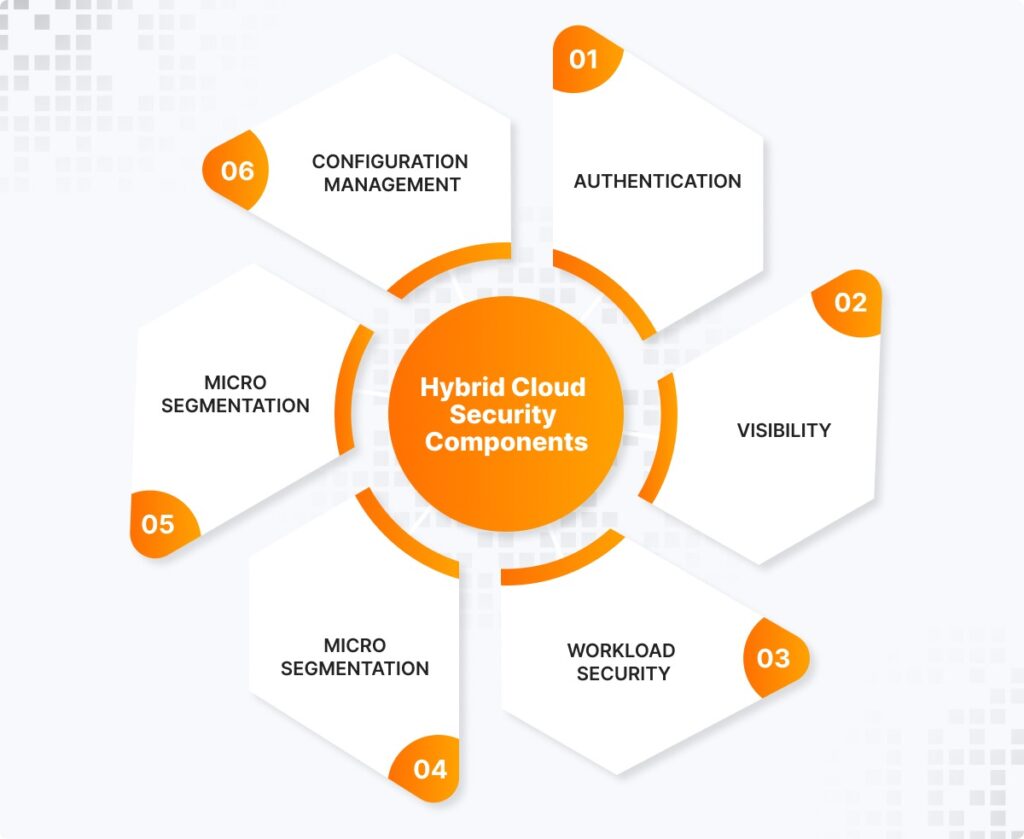
Data safeguards are equally vital: classify information rigorously and enforce encryption everywhere it moves or rests, backed by prevention mechanisms that flag unauthorized transfers. But tools alone won’t cut it; operational metrics like detection and response times reveal true effectiveness. If internal capabilities lag—say, with delays stretching into days—it’s a signal to augment with expert-led hybrid cloud security services that provide round-the-clock eyes on your setup, correlating signals from all corners to spot anomalies fast.
The beauty of strong hybrid cloud security solutions? They not only defend but optimize, freeing teams from reactive firefighting to focus on innovation. By aligning protections with business needs and following hybrid cloud security best practices, you turn complexity into an advantage, maintaining agility without sacrificing security.
The critical role of expert support in hybrid cloud security
In hybrid cloud environments, where threats don’t clock out, relying solely on in-house resources often falls short. Building a full-time operations center is resource-intensive, draining budgets that could fuel growth elsewhere. This is where specialized detection and response services shine—they bridge the gap with 24/7 expertise, ingesting data from diverse sources to deliver unified visibility and swift action.
Download the Hybrid Cloud Security Guide for actionable strategies.
These hybrid cloud security services excel at tackling hybrid-specific challenges, like correlating logs from on-premises endpoints with cloud telemetry to unmask stealthy pivots. They cut through alert overload with human-led triage, validating threats and containing them rapidly, often slashing detection times from days to minutes. For businesses facing skills shortages or high false positives, this outsourced muscle provides not just coverage but strategic uplift, handling the grind of monitoring so internal teams can tackle bigger-picture improvements.
Ultimately, integrating such support isn’t about offloading responsibility; it’s about amplification. It ensures your hybrid cloud security platform is proactive, reducing dwell times and breach impacts while aligning with compliance demands. In a landscape where attackers evolve daily, this expert layer turns potential liabilities into fortified defenses.
Final word
Hybrid cloud security is more than a technical checklist—it’s a strategic imperative that protects your business’s future in an interconnected world. Skimping here invites chaos, but investing wisely yields unbreakable cohesion, where risks are anticipated and neutralized before they escalate. By prioritizing unified identities, vigilant configurations, and expert augmentation through hybrid cloud security solutions, you don’t just secure your infrastructure; you empower growth with confidence.
Need help now?
UnderDefense’s Security Team is available 24/7. Immediate triage, containment, and forensic assistance.

1. What is hybrid cloud security?
Hybrid cloud security is the set of policies, controls, technologies, and processes that protect data, applications, and infrastructure across a mixed environment of on-premises systems and one or more public/private clouds. It ensures consistent protection while data and workloads move between environments.
2. What are common hybrid cloud security features?
Key features you’ll typically see in hybrid cloud security include:
- Identity & Access Management (IAM) — single sign-on, least-privilege roles, MFA.
Encryption — data-at-rest and data-in-transit encryption, key management (KMS). - Network segmentation & microsegmentation — isolate workloads across on-prem and cloud networks.
- Zero Trust / ZTNA — verify every user/device before granting access.
- Cloud workload protection (CWPP) — host/VM/container protection and runtime controls.
- Cloud security posture management (CSPM) — continuous configuration/compliance scanning.
- SIEM / Log aggregation & analytics — centralized logging, correlation, and threat detection.
- CASB (Cloud Access Security Broker) — visibility and control over SaaS/cloud app usage.
- WAF & API protection — protect web apps and APIs hosted across clouds.
Automated patching and configuration management — reduce surface from misconfigurations.
3. Why is security important in hybrid cloud?
Hybrid clouds increase flexibility and scale but also expand the attack surface and add complexity. Security is critical because:
- Data moves between environments — risk of exposure or leakage if not protected end-to-end.
- Inconsistent controls create gaps — different tooling/configs on-prem vs cloud lead to misconfigurations.
- Regulatory and compliance needs — data residency, auditability, and controls must be enforced everywhere.
- Increased threat sophistication — attackers exploit weak integrations or identity flaws.
Business continuity & trust — security prevents downtime, reputational damage, and financial loss.
4. What are hybrid cloud computing security services?
These are services (managed or self-managed) that secure hybrid environments, for example:
- Managed detection & response (MDR) — 24/7 threat hunting and incident response across clouds and on-prem.
- CSPM services — automated scans and remediation suggestions for cloud misconfigurations.
- CWPP / Container security services — runtime protection, image scanning, vulnerability management.
- Identity services — centralized IAM, SSO, and identity threat detection.
- Encryption / key management services (KMS) — centralized key lifecycle management.
- VPN and secure connectivity services — site-to-site VPN, SD-WAN with built-in security, private links.
- Cloud access security brokers (CASB) — monitoring and enforcing SaaS/cloud usage policies.
- Compliance & audit services — continuous compliance reporting and evidence collection.
5. What are examples of hybrid cloud security in practice?
Real-world examples include:
- Using a single IAM (e.g., corporate directory + SSO) for on-prem apps and cloud workloads with MFA enforced.
- Deploying a CSPM to scan public cloud accounts and automatically remediate risky S3/bucket or VM settings.
- Implementing microsegmentation so production workloads in the cloud cannot talk directly to management VLANs on-prem.
- Encrypting databases on-prem and in cloud and using a centralized KMS to control keys.
- A MDR provider ingesting logs from on-prem SIEM and cloud providers to detect lateral movement across environments.
- Using CASB to block risky SaaS actions (download of sensitive files to unmanaged devices).
- Deploying VPN + Zero Trust: site-to-site VPN for legacy systems plus ZTNA for remote user access to cloud apps.
6. How does Managed Detection and Response (MDR) enhance my cloud security posture?
Managed detection and response delivers 24/7 threat monitoring, detection, and active response by experienced analysts using AWS-native tools. It helps reduce dwell time, automate response, and ensure threats are addressed before damage occurs.