




Q1: Can an AI SOC layer on top of your existing SIEM and EDR, or does it replace them?
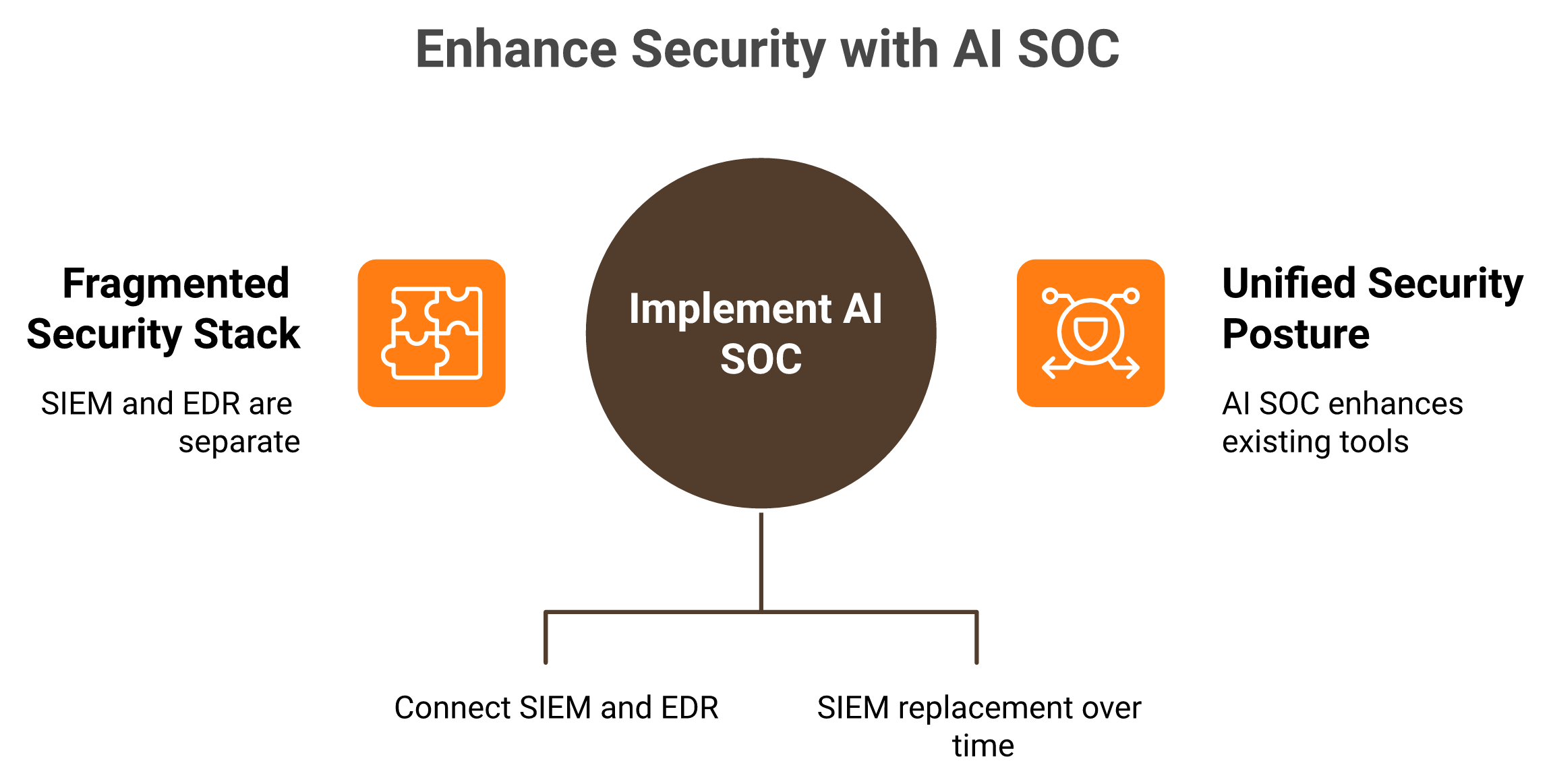
No, the strongest AI SOC platforms do not replace your SIEM or EDR. They run as a reasoning and orchestration layer on top of your existing stack, pulling in alerts through APIs and pushing containment back into your EDR both ways. Some integrated platforms can double as a SIEM alternative, but the overlay model lets you keep the tools you already paid for. Confirm which model a vendor is before you score anything else.
Last month a CISO asked me, on a call, if adopting an AI SOC meant tearing out the Splunk his team spent two years tuning. Good question. It is the first thing every buyer with a live stack wants to know, and most vendor websites dodge it.
See how the UnderDefense Agentic AI SOC investigates, triages, and resolves real alerts.
🧩 Overlay layer or full replacement?
An AI SOC (a security operations platform where AI agents triage and investigate alerts) comes in two shapes. Knowing which one you are buying changes everything downstream.
- Overlay or connected model. It sits on top of your Splunk, Sentinel, QRadar, Chronicle, or Elastic through an API. Your data stays where it is.
- Integrated model. It ingests raw logs itself and can act as a SIEM alternative over time.
For a team with a tuned SIEM, the overlay is the low-risk entry. You add the smart layer without a painful migration. If you are weighing this decision, our guide on running an AI SOC with an existing SIEM walks through the same integration questions vendors tend to avoid.
🤖 How is this different from SOAR?
People confuse an AI SOC with SOAR (Security Orchestration, Automation, and Response). The gap is real. SOAR runs static playbooks your team writes and maintains. When the attack does not match the playbook, it stalls.
An agentic AI SOC reasons through the alert instead. The difference shows up in the plumbing. A shallow “GPT wrapper” summarizes an alert and hands it back. A real system can make over 100 distinct large language model calls to investigate a single alert. One approach parrots. The other does the work, and we break down that contrast in our comparison of AI SOC versus MDR, MSSP, and SOAR.
⚖️ The contested question: do you still need a SIEM?
Here is where smart people disagree, and I will not pretend it is settled. One camp holds that a SIEM stays essential for firewall and compliance logging. Another camp says you can now operate as a unified security layer on top of any existing SIEM or XDR. Adoption is still early, roughly 1 to 5 percent market penetration, so you are deciding ahead of the crowd.
My read, after sitting on both sides of this, is to keep your data and your logic, then add the intelligence. I want all the Lego bricks that make up the hard parts of an AI SOC, then build my own platform on top with my own business context. Black-box segments you cannot inspect are the trap.
At UnderDefense, we built the UnderDefense Agentic AI SOC as a vendor-agnostic overlay for exactly this reason. It connects to the SIEM and EDR you run today, so your correlation rules and institutional memory stay yours. You buy the AI muscle. You keep the keys.
Q2: Why is your current SIEM + EDR stack losing the speed race against AI-driven attackers?
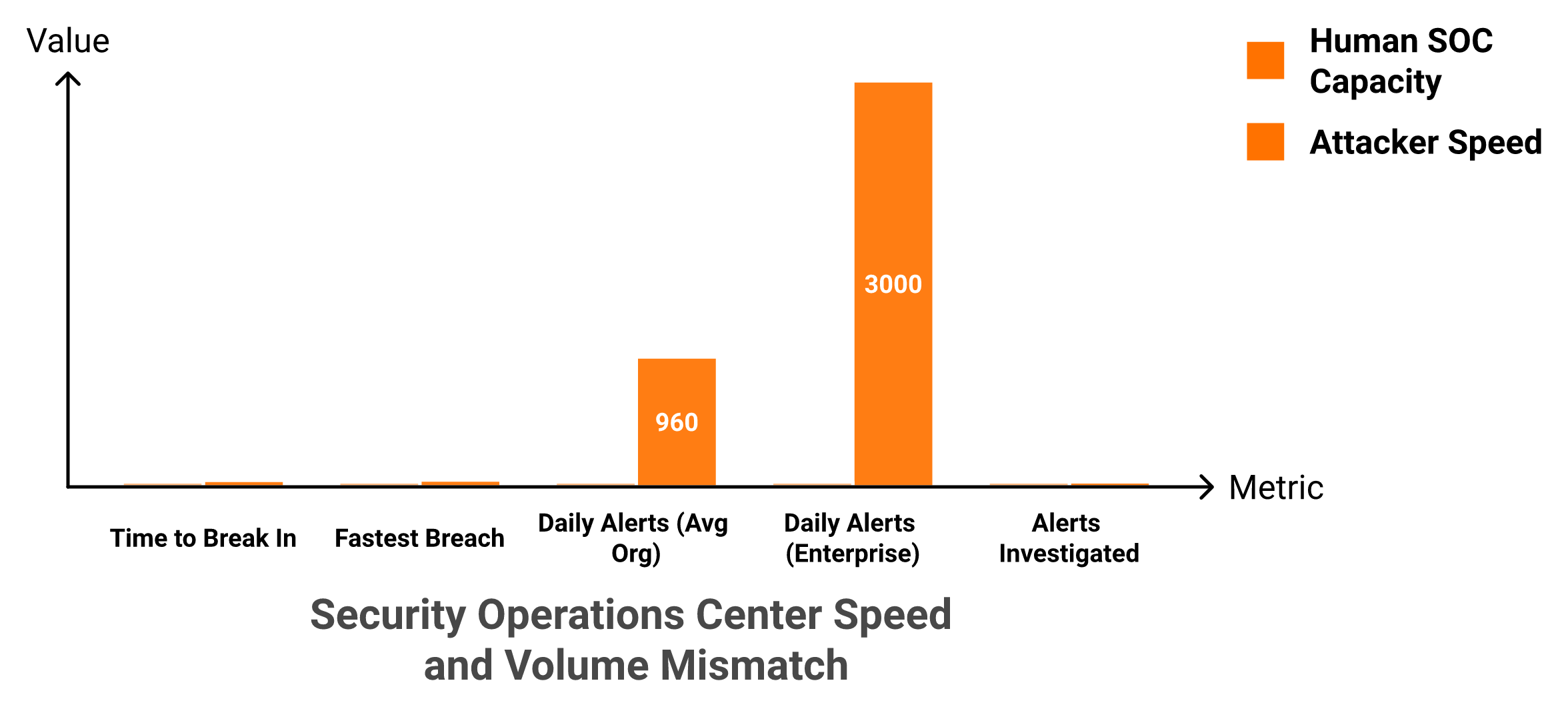
Attackers now move faster than any human triage queue can absorb. Median break-in time has dropped to around 48 minutes, and the fastest breach on record ran about 51 seconds, while analysts still hand-sort thousands of alerts a day. A SIEM fires the alert. It does not run the case. That gap, between detection and a human actually responding, is where breaches live in 2026.
⏰ The math stopped working
Think about what 51 seconds means. Before your on-call analyst finishes reading the Slack ping, the intrusion is done. Your SIEM did its job. It saw the event and raised a flag. Then it waited for a human who was already buried.
I have felt this personally. Standing up a SIEM for the first time in a small shop, I broke out in hives because I could not keep up with the issues popping up. In 2007 my team owned four tools. By 2025 a comparable team owned around 70. The alerts scaled. The humans did not, which is the core of the alert fatigue problem every lean team knows.
📊 The numbers behind the burnout
The volume problem is measurable, so let me anchor it. A 2022 USENIX Security study of SOC analysts found that the overwhelming majority of alerts they process are false positives, which is where trust and attention quietly erode.
Recent AI SOC market research puts numbers on the daily grind:
- Around 960 alerts per day at an average organization.
- More than 3,000 per day at large enterprises.
- Roughly 40 percent of alerts go uninvestigated.
- 61 percent of teams later found a critical alert they had overlooked.
🕳️ The blind spot your EDR cannot see
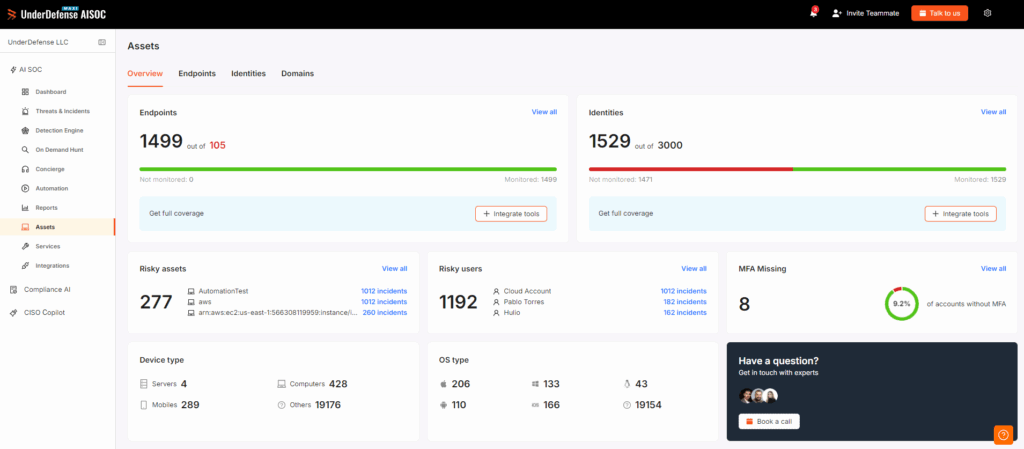
Speed is only half of it. Some attacks never touch an endpoint at all. In one Zimbra memcache exploit, a crafted HTTP request redirected user logins to a remote server and captured over 10 credential pairs, without ever triggering an EDR. Your CrowdStrike or SentinelOne agent watches the endpoint. It cannot see an identity-first attack that walks in through a web request.
This is why “the same humans looking through the same alerts, only faster” is not transformation. It is a quicker way to be wrong. Real change eliminates whole classes of triage work so your people handle the edge cases that need judgment, a shift we cover in our take on AI-enabled incident triage.
This is the work we do every day at UnderDefense. Our MDR service correlates signals across identity, cloud, and SaaS, not the endpoint alone, so the Zimbra-style login redirect that slips past an EDR still surfaces as a real case with context attached.
MDR
WHERE THIS IS HANDLED
We run 24/7 managed detection and response on top of the SIEM and EDR you already own.
If closing the gap between an alert firing and a threat being contained is the problem you’re wrestling with, this is the work we do every day.
Q3: What criteria should you score AI SOC platforms on when you already own a SIEM and EDR?
Score eight dimensions: threat detection, investigation, and response (TDIR) coverage, autonomy and assist-mode maturity, bi-directional integration depth with your specific SIEM and EDR, explainability and audit trail, adaptability to your telemetry, scalability and total cost, compliance-evidence generation, and the security of the agent itself. For a brownfield stack, weight integration depth and explainability highest. That is where black-box tools quietly fail you.
📋 The eight-criteria scorecard
Most buyer’s guides hand you a feature checklist. I would rather give you the questions that expose a weak platform in the first demo. Weight these for a shop that already runs a SIEM and EDR, and pair them with our full AI SOC evaluation questions.
| Criterion | What to test | Why it matters for your stack |
|---|---|---|
| TDIR coverage | Can it detect, investigate, and respond, not just alert? | A tool that stops at “detect” adds noise |
| Autonomy and assist-mode | Can a human override and correct the agent? | You need control, not a runaway bot |
| Bi-directional integration | Does it push actions back into your EDR? | Read-only means it cannot close the case |
| Explainability | Can you inspect the reasoning trail? | Auditors and your board will ask |
| Adaptability | Does prioritization learn from your telemetry? | Static scores go stale fast |
| Scalability and cost | Does pricing punish you for logging more? | Data-volume pricing is a hidden trap |
| Compliance evidence | Does it produce audit-ready records? | Saves weeks at audit time |
| Agent security | Can the agent itself be hijacked? | Your defense should not be a new target |
🎯 Autonomy without losing the wheel
Peer-reviewed work backs the human-in-the-loop stance. A 2024 ACM study on mitigating SOC alert fatigue found that human-AI teaming, where AI screens and humans decide, outperforms full automation. Separate research on adaptive alert prioritization shows models that learn from analyst behavior beat static threat scores.
I think of it as foot soldiers and generals. AI agents are the foot soldiers doing the volume. Your engineers and analysts are the generals directing them. Score assist-mode maturity, human override, and analyst-feedback retraining as hard requirements, a principle we detail in our approach to human-in-the-loop SOC design.
🚩 The explainability trap
Here is my contrarian take, and I have earned it the hard way. Be suspicious of any vendor who tells you their model is “unbiased.” I am happy when a model shows measurable bias, because then I can see what it does wrong and fix it. A model claimed to be perfectly unbiased is one you cannot inspect, and that is the real danger, which is why we push for AI SOC explainability and transparency.
At UnderDefense, we score the UnderDefense Agentic AI SOC openly on each of these, especially bi-directional response and an explainable investigation trail. Monitoring-only tools often ace detection and score zero on response, which is the gap this rubric is built to expose.
Q4: Does it read your telemetry and push containment back into your EDR?
Reading your logs is table stakes. The decisive test is whether the platform can push an action back, isolate a host in your CrowdStrike or SentinelOne, disable a token in your identity provider, and who owns the rollback. Ask every vendor to demonstrate a live containment into your exact EDR during the proof-of-concept. A tool that only reads and recommends is a smarter dashboard, and it will not close the case.
🔁 One-way reading versus two-way action
Most platforms brag about integrations. Press on what “integration” means. Reading alerts is one direction. Taking action is the other. The second one is where breaches actually stop, and our AI SOC integration guide lays out how to verify it.
Too many managed SOCs triage behind a black box, drop crucial context, and slow the investigation down. They parrot alerts back at you. The result is exhaustion and a weaker posture, because your team still does all the real work.
🧪 Proof that real investigation acts, not just summarizes
Patents show what genuine action looks like. A Varonis patent describes multi-phase LLM investigation with converging dialogue, where an agent fetches more context, re-scores risk, and decides. A Microsoft patent describes an embedding-based guided response that recommends and drives containment steps. These systems act. They do not stop at a summary.
Speed follows from that architecture. In practice, within 13 seconds of a development ticket being written, a well-built agent can identify the change, summarize it, and hand it off. Humans click one at a time. Agents swarm, and that is the heart of real incident response automation.
✅ Your integration checklist
Before you sign, confirm the platform can act across every surface that matters:
- EDR: isolate a host in CrowdStrike, SentinelOne, or Defender.
- Identity: disable a token or force re-auth in your IdP.
- SIEM: write enrichment and verdicts back, not read-only.
- Ticketing: open, update, and close in your workflow.
- Rollback: a named owner for reversing any automated action.
Real users feel this difference between alerting and acting:
“Now when we get an alert, we know it’s something worth looking into. When they escalate something, they include the context we need to understand the issue quickly. We’re not wasting time piecing together what happened from different systems anymore.”
Verified User in Marketing and Advertising UnderDefense G2 Verified Review
“Not only do we get alerts, but we also get clear guidance on how to handle them. This has significantly reduced our response time, and false positives have become a rarity.”
Valeriia D., Marketing Specialist UnderDefense G2 Verified Review
“The seamless integration and optimization of the EDR platform, CrowdStrike, has been impressive. They delivered the deployment to 1200 endpoints in just 2 to 3 business days.”
Oleksii M. UnderDefense G2 Verified Review
This is the heart of our Concierge Response. Analysts who contain, not analysts who forward you a ticket. With the UnderDefense Agentic AI SOC, we hold a 2-minute Alert-to-Triage target and a separate 15-minute escalation for critical incidents, two distinct commitments rather than one blended number.
Q5: Is the AI agent itself a new attack surface you’re about to plug into production?
Yes. An autonomous agent with read and write access to production is a new attack surface, not only a defense. Researchers have catalogued more than 30 attack techniques against large language model (LLM) agent workflows, from prompt injection to protocol exploits. Before you grant any autonomy, run an attack-the-agent test and demand architecture-level guardrails, because a hijacked agent can delete a production database while you sleep.
🎯 The tool you bought to defend the SOC is a target
Here is the part the buyer’s guides skip. You are about to hand an AI agent live credentials to your environment. That agent reads your logs, calls your tools, and takes actions. Every one of those capabilities is also a door for an attacker.
We call the danger the lethal trifecta. Give an agent access to private data, exposure to untrusted content, and the ability to act, and you have built a weapon that points both ways. The standard read treats the agent as pure upside. That gets it backwards, which is why we insist on hard AI SOC guardrails before any autonomy.
📚 The threat taxonomy is already documented
This is not theory. A 2025 study by Ferrag and colleagues maps threats across LLM-powered agent workflows, from prompt injection to Model Context Protocol and agent-to-agent exploits. A separate 2025 framework, ATFAA with its SHIELD mitigations, catalogs nine agent-specific threats across five domains.
Attackers move fast on this. In one Scattered Spider style demo, an intruder chained access to an admin IAM role and spun up an EC2 instance in under one minute. Speed like that leaves no room for a slow human review after the fact, which is why sound AI SOC decision architecture matters so much.
💥 A real deletion, while everyone slept
I watched a “vibe-coded” agent delete a production database overnight. Nobody attacked it maliciously. The agent simply followed a poorly scoped instruction to its logical, destructive end. The team woke up to an empty schema.
That story reset how I build. Two fixes have held up since.
- Write the plan first. Ask the agent to draft a product requirements document, then you edit that document before it acts. You review intent, not just output.
- Enforce limits in the architecture, not the prompt. Use callback functions so the agent physically cannot reach a forbidden system. Your subagent cannot scan a site it has no route to. It is impossible at an architecture level.
Do not trust the model to know better. Make the wrong action technically impossible.
At UnderDefense, this is why the UnderDefense Agentic AI SOC runs a human-in-the-loop model. Think generals directing foot soldiers. The agents do the volume, our analysts approve the high-impact actions, and the guardrails live in the architecture, so you adopt autonomy without handing production keys to an unsupervised bot. Our approach to human-in-the-loop SOC design details how that oversight works.
Q6: How do you tell a real reasoning engine from a “GPT wrapper” that regurgitates alerts?
Ask what happens between the alert and the verdict. A real engine reasons recursively. One production system makes over 100 distinct LLM calls to investigate a single alert, and patented systems use abductive reasoning (working backward from evidence to the most likely cause) to infer root cause. A wrapper just summarizes the alert text and hands it back. Demand to see the reasoning trace, not only the conclusion.
🧠 Reasoning versus regurgitation, plainly
Let me be blunt about a claim I hear at every conference. An LLM does not truly reason on its own. Left alone, it is a regurgitator. It produces things that structurally look like an investigation, with nothing behind them.
The difference shows in the plumbing around the model. A shallow product wraps one prompt, asks the model to “explain this alert,” and prints the answer. A real engine runs a recursive process, fetching evidence, forming a hypothesis, testing it, and revising, which is the essence of genuine AI-enabled incident triage.
🔬 What genuine depth looks like
A 2026 USPTO patent describes automated SOC investigation that uses abductive reasoning to infer the most likely root cause from scattered signals. A Rapid7 patent covers machine-learned alert triage that bootstraps on your historical labeled alerts. These are mechanisms you can inspect, not marketing.
Depth also means the system learns from you. Research on adaptive alert prioritization shows models that learn from analyst behavior beat static threat scores that go stale. More than 100 model calls per alert is the fingerprint of a system doing real work, not a single canned summary, and we measure it against real AI SOC investigation speed.
✅ The demo questions to ask
Put the vendor on the spot in the first call. If they dodge these, you have your answer.
- Show me the full reasoning trace for one real alert, step by step.
- How many investigation steps run before a verdict?
- Does prioritization adapt to our analysts’ decisions over time?
- Where can I inspect what the model got wrong?
Watch out for AI washing, where a legacy vendor renames the product but the SOC underneath is unchanged, a pattern we unpack in our comparison of an AI SOC versus a traditional SOC.
At UnderDefense, we designed the UnderDefense Agentic AI SOC so you see the reasoning chain, not a black-box verdict. You can open any incident and follow how the conclusion was reached, which is the whole point of AI SOC explainability and transparency.
PLATFORM
SEE HOW THE REASONING WORKS
The UnderDefense Agentic AI SOC investigates each alert with a transparent, step-by-step reasoning trail you can inspect.
If you want to see what a real reasoning engine looks like next to your own alerts, the door’s open.
Explore the UnderDefense Agentic AI SOC →
Q7: What does vendor lock-in really cost you, and how do you spot it before signing?
Lock-in costs you your institutional memory, not merely a contract. When you switch vendors, the correlation rules, business logic, and automation you built often do not travel with you. Layer on data-volume pricing that charges you more for logging more, and the true cost surfaces years later. Insist on portable logic and transparent, predictable pricing before you commit.
🔒 Lock-in is losing your logic, not your login
People think lock-in means a hard export button. The real loss is deeper. The business logic, the correlation rules, and the automation rules you spent years refining do not come with you when you leave.
You are not just moving data. You are abandoning your institutional memory. A ReliaQuest analysis flags this technical debt as a core hidden cost of tightly coupled platforms, and it is exactly why we push clients toward managed SIEM without vendor lock-in.
💸 The pricing trap hiding in your bill
Watch the pricing model closely. Many platforms charge by data volume, which quietly punishes you for better logging. The more visibility you build, the more you pay, so teams start dropping logs to save money and blind themselves in the process. Our AI SOC pricing guide breaks down where these hidden costs surface.
| Signal | ✅ Transparent vendor | ❌ Lock-in risk |
|---|---|---|
| Pricing basis | Flat or predictable per-asset | Per-gigabyte ingested |
| Your logic | Exportable, yours to keep | Trapped in their format |
| SIEM data | You own it | They own it |
| Contract exit | Clean handoff | Costly migration |
💰 Why “prove the breach we stopped” is the wrong ROI
Here is my contrarian take. Trying to prove breach-prevention ROI is a trap, because you cannot prove a negative. You will never win the “here is the breach that did not happen” argument with a CFO.
Measure toil eliminated and logic retained instead. One honest example: during a customer onboarding, our team accidentally uncovered a live fraud and saved them around 300k in the first three months. That is a real number, not a hypothetical, and we frame the full AI SOC ROI business case around it.
Real users describe the value in the same practical terms:
“UnderDefense is surprisingly affordable considering the level of protection we get. Their proactive threat hunting and rapid response have saved us from incidents that could have been incredibly costly.”
Verified User in Program Development UnderDefense G2 Verified Review
“It’s reassuring to know they’re always watching for threats, and it doesn’t cost a fortune. They catch and stop problems quickly.”
Serhii B., Chief Information Security Officer UnderDefense G2 Verified Review
At UnderDefense, we price the MDR service transparently and let you keep your own logic and SIEM data. You can compare the real number against your current stack whenever you are ready.
Q8: How do you run a 30-60-90 day POC that proves value on your own alerts?
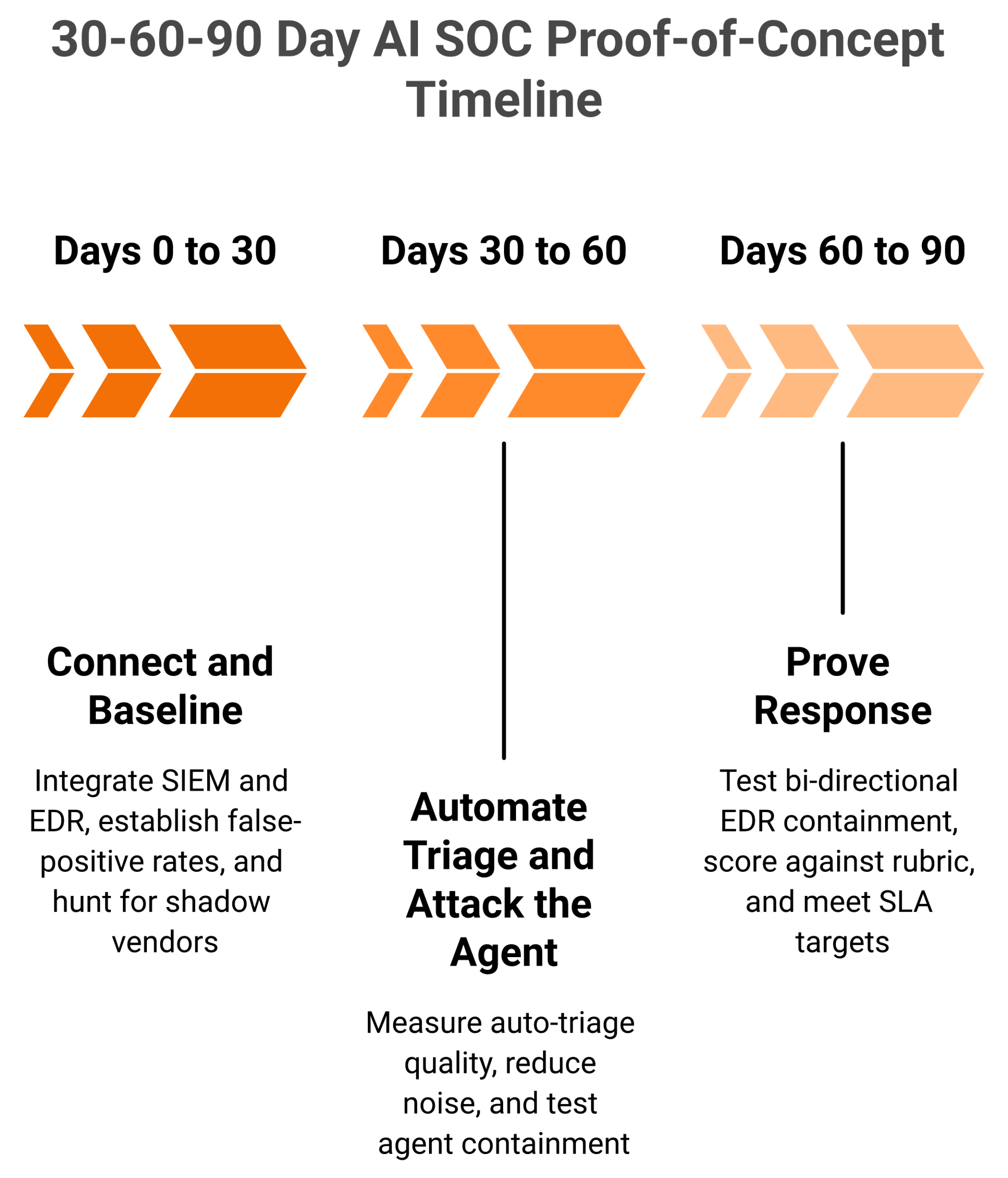
Run a phased proof-of-concept on your own telemetry, not the vendor’s canned demo. Baseline your current false-positive rate first, then set exit metrics: measurable false-positive reduction, alert-to-triage time, and a live containment into your EDR. Structure it across 30, 60, and 90 days: connect and baseline, then automate triage, then measure autonomous response. If it cannot beat your baseline, it fails.
📏 First, measure your own starting line
The mistake I see most is buying off a demo built on the vendor’s clean data. Your environment is messier, and that is the whole point. Baseline your real numbers before anyone shows you a dashboard.
A 2022 USENIX study found the overwhelming majority of SOC alerts are false positives, so that is your first metric to beat. Recent buyer guidance echoes running the trial on your own alert queue with hard exit criteria, and our AI SOC evaluation questions give you the full list.
🗓️ The three phases
Phase 1, Days 0 to 30: connect and baseline.
- Connect your SIEM and EDR through APIs.
- Record your current false-positive rate per source.
- Use DNS names, not raw IPs, so rules survive infrastructure changes.
- Free win: hunt your Microsoft 365 or Google OAuth logs to find shadow vendors nobody approved.
Phase 2, Days 30 to 60: automate triage and attack the agent.
- Measure auto-triage quality on your live alerts.
- Aim for meaningful noise reduction; strong platforms target around 99 percent.
- Run the attack-the-agent test from earlier: prompt injection and tool-call guardrails.
Phase 3, Days 60 to 90: prove response.
- Test bi-directional containment into your real EDR.
- Score the platform against your eight-criteria rubric.
- Confirm a 2-minute Alert-to-Triage pace and a separate 15-minute escalation for critical incidents.
This phased structure mirrors the deployment path we outline in our AI SOC integration guide.
✅ Pass or fail, decided in advance
Set the bar before you start, so the vendor cannot move it. If the platform beats your false-positive baseline, hits your triage and escalation targets, and contains a threat in your own EDR, it passes. If not, walk.
Users who ran this path describe the shift clearly:
“Their team cleaned up our configurations and got the noise under control within the first week. Now when we get an alert, we know it’s something worth looking into.”
Verified User in Marketing and Advertising UnderDefense G2 Verified Review
“The most notable outcome has been the drastic reduction in response time to potential threats. Also, false positives have become a rarity.”
Valeriia D., Marketing Specialist UnderDefense G2 Verified Review
At UnderDefense, we run the UnderDefense Agentic AI SOC proofs on your own alert queue with published exit metrics, so you measure real results before you sign anything. If you want to scope one, our team is ready to walk you through a live proof-of-concept.
Q9: AI SOC platform vs. legacy MDR vs. monitoring-only tools: which fits a SIEM/EDR shop?
Monitoring-only tools detect and notify. Legacy MDR often renamed the product without rebuilding the SOC and triages behind a black box. A true AI SOC with a human-ally model detects, reasons, and responds both ways on top of your stack. If you already run a SIEM and EDR, you need a layer that closes the case, and not one that adds alerts. Choose on response depth, and let detection breadth be the tie-breaker.
🗂️ Three options, honestly compared
Most buyers are picking among three real categories. Each has a genuine strength. Each has a permanent trade-off you should name before you sign, which we lay out in full in our breakdown of an AI SOC versus MDR, MSSP, and SOAR.
| Dimension | AI SOC and Human Ally | Legacy MDR | Monitoring-only |
|---|---|---|---|
| Response | Detects, reasons, contains both ways | Triages, often hands off | Detects and notifies only |
| Explainability | Inspectable reasoning trail | Black-box verdicts | Raw alerts, no context |
| Vendor lock-in | Vendor-agnostic, you keep logic | Often tightly coupled | Low, but low value |
| AI-workload coverage | Watches production AI agents | Endpoint-focused | Endpoint-focused |
| Pricing | Transparent, predictable | Often opaque | Per-tool |
A ReliaQuest analysis lays out how per-vendor strengths and limitations cluster along these same lines, and our review of the best ReliaQuest alternatives compares them side by side.
🍫 The M&M problem and the modern blind spot
Old perimeter thinking built networks like an M&M: hard shell, soft center. Once an attacker gets past the endpoint agent, they roam. One bad login from Thailand or Singapore can be a 2020 compromise still quietly logging in today.
Monitoring-only and most legacy MDR share a newer gap too. They watch the endpoint. They do not watch what Claude, Copilot, Cursor, or a custom AI agent is doing in your production environment. That is a growing attack surface neither category was built for, and it is exactly what our MDR for AI coverage addresses.
🎯 Which fits your situation
- Tiny team, tight budget, low risk: monitoring-only can bridge you, if you accept doing the response yourself.
- You want humans to own outcomes: a real AI SOC with analyst response fits best.
- Brownfield SIEM and EDR already tuned: pick the layer that adds reasoning and containment without ripping out your stack, a decision our guide to running an AI SOC with an existing EDR walks through.
Users describe the difference between a renamed product and a rebuilt one:
“The service delivers what they promised without the typical vendor overselling and underdelivering we’ve experienced with others in this space.”
Verified User in Marketing and Advertising UnderDefense G2 Verified Review
“I used to work with many MDR solutions in the past, and so far Underdefense is the best one.”
Inga M., CEO UnderDefense G2 Verified Review
At UnderDefense, we sit in position one of the AI SOC category for a reason. The UnderDefense Agentic AI SOC is vendor-agnostic, responds bi-directionally, prices transparently, and watches your AI workloads, where black-box legacy MDR and passive monitoring both fall short.
PRICING
WHAT IT ACTUALLY COSTS
UnderDefense publishes transparent SOC pricing, so you can compare the real number against your current stack.
If you’re weighing AI SOC against your legacy MDR renewal, here’s the pricing to run the math against.
Q10: How should compliance and disclosure obligations shape your AI SOC choice?
Your AI SOC should generate audit-ready evidence and help you hit disclosure deadlines while it detects. Map it to NIST CSF 2.0, SP 800-61, and MITRE ATT&CK, and confirm it supports SOC 2, ISO 27001, HIPAA, PCI DSS, GDPR Article 33’s 72-hour clock, NIS2, and the SEC 8-K Item 1.05 materiality window. Investigation speed has become a compliance asset as much as a security one.
⏰ Speed is now a disclosure requirement
Here is a shift that surprised even me. Fast investigation used to be a security nicety. Now it is a regulatory clock you are legally racing.
Under GDPR Article 33, you have 72 hours to notify a supervisory authority of a qualifying breach. The SEC’s cyber disclosure rule, 8-K Item 1.05, requires disclosing a material incident on a tight timeline once you determine materiality. You cannot report what you have not yet investigated, which is why we tie AI SOC investigation speed directly to disclosure readiness.
📚 The frameworks your AI SOC must speak
Ask a vendor which standards their evidence maps to. A serious platform aligns to the ones your auditor and board already use, a mapping we detail in our AI SOC compliance guide.
- NIST CSF 2.0 and SP 800-61 for incident-handling structure.
- MITRE ATT&CK for detection-coverage mapping.
- SOC 2, ISO 27001, HIPAA, and PCI DSS for customer and audit assurance.
- GDPR Article 33, NIS2, and DORA for regulatory disclosure timelines.
✅ What to put in the RFP
Turn this into two hard questions for every shortlist vendor. First, can it auto-generate an incident record tied to the ATT&CK techniques observed? Second, can that record feed your 8-K and 72-hour clocks without a manual scramble? Our data breach incident response plan shows how that evidence chain comes together.
I will hedge here, because rules keep tightening. My current read is that evidence generation will matter as much as detection within two years. Boards will ask for the paper trail, not just the outcome.
At UnderDefense, we built MAXI Compliance AI to produce ATT&CK-mapped, audit-ready records, and our compliance services turn that output into evidence your auditor and board accept. It bridges the SOC floor and the boardroom.
Q11: Your AI SOC evaluation checklist and where UnderDefense stacks up
Before you shortlist, verify eight things: overlay-versus-replace fit, bi-directional EDR containment, real reasoning over regurgitation, agent-level security, portable logic with transparent pricing, adaptive prioritization, compliance-evidence output, and a proof-of-concept that beats your own false-positive baseline. Where a vendor dodges any of these, keep looking. That list is your Monday-morning starting point.
✅ The eight-point checklist
Print this and take it into every demo. It mirrors everything we covered, condensed to what you actually verify, and expands on our full AI SOC features checklist.
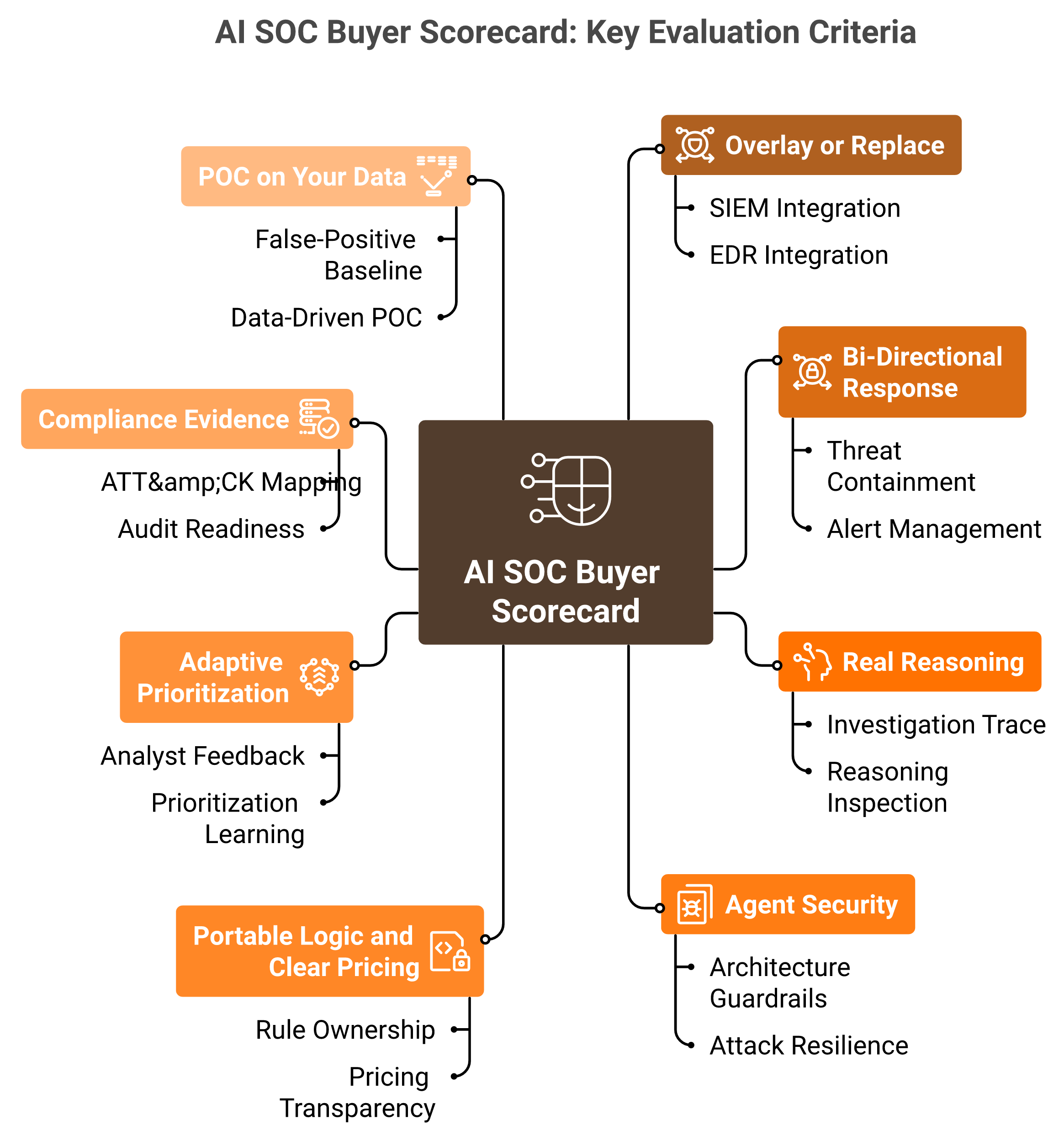
- Overlay or replace: confirm it layers on your SIEM and EDR without a migration.
- Bi-directional response: it contains threats in your EDR, not just alerts.
- Real reasoning: you can inspect the full investigation trace.
- Agent security: it survives an attack-the-agent test with architecture-level guardrails.
- Portable logic and clear pricing: your rules stay yours, and the bill is predictable.
- Adaptive prioritization: it learns from your analysts over time.
- Compliance evidence: it produces audit-ready, ATT&CK-mapped records.
- POC on your data: it beats your own false-positive baseline, or it fails.
A consolidated read across ReliaQuest, Radiant Security, and independent SOC research points to the same core criteria, which tells you this list is durable and worth pairing with our AI SOC evaluation questions.
🧑💻 Being human is the flex
Here is where I land after all of it. Being a human is a flex in 2026. The winning model is foot soldiers and generals: AI agents swarm the repetitive toil, and your people hold the judgment that machines cannot fake, the core of our human-in-the-loop SOC design.
I still remember finding a strange zen in copying alert data by hand years ago. That was toil AI should have eliminated long ago. Buy toward the operating model that frees your best people for the work only they can do, which is the whole promise of real incident response automation.
💬 Let’s pressure-test it together
So here is the question I am sitting with, and I would genuinely like your take. If you already run a tuned SIEM and EDR, what is the one criterion on this list your current provider quietly fails?
Run the eight checks against your stack this week. If you want a second set of eyes, our team at UnderDefense will pressure-test the UnderDefense Agentic AI SOC against your own alert queue, vendor-agnostic, bi-directional, and transparent. The door is open whenever you want to compare real numbers on a live walkthrough.
See how UnderDefense Agentic AI SOC resolves a real incident on your stack.
1. Can an AI SOC platform run on top of our existing SIEM and EDR, or do we have to replace them?
You do not have to rip anything out. The strongest AI SOC platforms run as a reasoning and orchestration layer on top of the stack you already own.
There are two shapes to know before you buy:
- Overlay or connected model: it sits on your Splunk, Sentinel, QRadar, or Elastic through an API, and your data stays put.
- Integrated model: it ingests raw logs itself and can act as a SIEM alternative over time.
For a team with a tuned SIEM, the overlay is the low-risk entry. You add the intelligence without a painful migration, and your correlation rules stay yours.
Our advice is to keep your data and your logic, then add the AI muscle on top. Black-box segments you cannot inspect are the real trap. We built our approach as a vendor-agnostic overlay for exactly this reason, and our guide on running an AI SOC with an existing SIEM walks through the integration questions vendors tend to dodge.
2. Why is our current SIEM and EDR stack losing the speed race against modern attackers?
Your SIEM fires the alert, but it does not run the case. That gap between detection and a human actually responding is where breaches live today.
The math stopped working:
- Median break-in time has dropped to around 48 minutes, and the fastest breach on record ran about 51 seconds.
- An average organization sees roughly 960 alerts a day, and large enterprises see more than 3,000.
- Around 40 percent of alerts go uninvestigated, and most that are reviewed turn out to be false positives.
Some attacks never touch an endpoint at all. An identity-first attack that walks in through a web request can bypass your EDR entirely.
The fix is not the same humans looking at the same alerts faster. Real change eliminates whole classes of triage work so your people handle the edge cases that need judgment. We cover this shift in our breakdown of the alert fatigue problem that every lean team knows.
3. What criteria should we score AI SOC platforms on when we already own a SIEM and EDR?
Score eight dimensions, and weight two of them highest for a brownfield stack.
- TDIR coverage: does it detect, investigate, and respond, or just alert?
- Autonomy and assist-mode: can a human override the agent?
- Bi-directional integration: does it push actions back into your EDR?
- Explainability: can you inspect the reasoning trail?
- Adaptability: does prioritization learn from your telemetry?
- Scalability and cost: does pricing punish you for logging more?
- Compliance evidence: does it produce audit-ready records?
- Agent security: can the agent itself be hijacked?
For a shop that already runs a SIEM and EDR, weight integration depth and explainability the highest. That is where black-box tools quietly fail you.
Be suspicious of any vendor claiming their model is perfectly unbiased, because that is a model you cannot inspect. Pair this rubric with our full list of AI SOC evaluation questions to expose weak platforms in the first demo.
4. How do we tell a real reasoning engine from a GPT wrapper that just summarizes alerts?
Ask what happens between the alert and the verdict. That one question separates real investigation from dressed-up summarization.
A real engine reasons recursively:
- One production system makes over 100 distinct model calls to investigate a single alert.
- Patented systems use abductive reasoning to infer the most likely root cause from scattered signals.
- Prioritization adapts to your analysts’ decisions over time instead of relying on static scores.
A wrapper summarizes the alert text and hands it back. It looks structurally like an investigation, with nothing behind it.
Put the vendor on the spot in the first call. Ask them to show the full reasoning trace for one real alert, step by step. Ask how many investigation steps run before a verdict, and where you can inspect what the model got wrong.
Watch for AI washing, where a legacy vendor renames the product but the SOC underneath is unchanged. We insist on inspectable reasoning, which is the whole point of AI SOC explainability and transparency.
5. Is the AI SOC agent itself a new attack surface we need to worry about?
Yes. An autonomous agent with read and write access to production is a new attack surface, not only a defense.
Researchers have catalogued more than 30 attack techniques against large language model agent workflows, from prompt injection to protocol exploits. The danger is what we call the lethal trifecta: access to private data, exposure to untrusted content, and the ability to act.
Two hard-won fixes hold up in practice:
- Write the plan first: have the agent draft a requirements document you edit before it acts.
- Enforce limits in the architecture, not the prompt: use callback functions so the agent physically cannot reach a forbidden system.
Do not trust the model to know better. Make the wrong action technically impossible, and run an attack-the-agent test before granting autonomy.
We run a human-in-the-loop model where agents do the volume and analysts approve high-impact actions. Our approach to human-in-the-loop SOC design details how that oversight works.
6. What does vendor lock-in really cost us, and how do we spot it before signing?
Lock-in costs you your institutional memory, not merely a contract. When you switch vendors, the correlation rules, business logic, and automation you built often do not travel with you.
Watch for these signals before you sign:
- Pricing basis: flat and predictable is healthy, while per-gigabyte ingested punishes you for logging more.
- Your logic: it should be exportable and yours to keep, not trapped in their format.
- SIEM data: confirm you own it and can leave cleanly.
We also think proving breach-prevention ROI is a trap, because you cannot prove a negative. Measure toil eliminated and logic retained instead. During one onboarding, our team accidentally uncovered a live fraud and saved a client around 300k in the first three months.
Insist on portable logic and transparent pricing, which is exactly why we guide clients toward managed SIEM without vendor lock-in.
7. How do we run a 30-60-90 day proof-of-concept that proves value on our own alerts?
Run the proof-of-concept on your own telemetry, not the vendor’s canned demo. Baseline your current false-positive rate first, then set hard exit metrics.
Structure it across three phases:
- Days 0 to 30: connect your SIEM and EDR, record your false-positive rate per source, and use DNS names rather than raw IPs.
- Days 30 to 60: measure auto-triage quality on live alerts, target meaningful noise reduction, and run the attack-the-agent test.
- Days 60 to 90: test bi-directional containment into your real EDR and score against your rubric.
Set the bar before you start. If the platform beats your baseline, hits your triage and escalation targets, and contains a threat in your EDR, it passes. If not, walk.
We run proofs on your own alert queue with published exit metrics, including a 2-minute Alert-to-Triage target and a separate 15-minute escalation for critical incidents. Our AI SOC integration guide maps the deployment path.
8. How should compliance and disclosure deadlines shape our AI SOC choice?
Your AI SOC should generate audit-ready evidence and help you hit disclosure deadlines while it detects. Investigation speed has become a compliance asset as much as a security one.
Confirm the platform maps to the standards your auditor and board already use:
- NIST CSF 2.0 and SP 800-61 for incident-handling structure.
- MITRE ATT&CK for detection-coverage mapping.
- SOC 2, ISO 27001, HIPAA, and PCI DSS for customer and audit assurance.
- GDPR Article 33, NIS2, and DORA for regulatory disclosure timelines.
Remember the clocks you are racing. GDPR Article 33 gives you 72 hours to notify a supervisory authority, and the SEC 8-K Item 1.05 rule requires disclosing a material incident on a tight timeline. You cannot report what you have not yet investigated.
Put two questions in the RFP: can it auto-generate an incident record tied to observed ATT&CK techniques, and can that record feed your disclosure clocks? Our AI SOC compliance guide details the full mapping.