




Q1. What Is Vendor Risk Management and Why Does It Matter in 2026?
Vendor risk management (VRM) is the systematic process of identifying, assessing, mitigating, and continuously monitoring risks introduced by third-party vendors across the entire vendor lifecycle, from selection through offboarding. It is a subset of third-party risk management (TPRM), which covers all external relationships including partners, contractors, and affiliates. Where supplier management focuses on procurement and delivery logistics, and procurement risk centers on cost and supply continuity, VRM zeroes in on the security, compliance, and operational threats that vendors inject into your environment.
⚠️ The Business Case: Third-Party Breaches Are Not Edge Cases
The financial and operational reality is hard to ignore. Organizations now report experiencing an average of 12 third-party breaches per year, establishing vendor risk as a recurring operational problem, not a rare failure. The 2024 Change Healthcare ransomware attack became the largest-ever known breach of protected health information, affecting over 100 million Americans and costing parent company UnitedHealth Group $2.457 billion in total cyberattack impacts within nine months. That single incident disrupted medical billing, claims processing, and pharmacy operations across the entire U.S. healthcare ecosystem, a cascading failure triggered by one vendor relationship.
Go further back, and the pattern is clear:
⏰ Target (2013): An HVAC vendor’s compromised credentials led to 40 million stolen credit card numbers, the breach that put VRM on every board’s agenda.
⏰ SolarWinds (2020): A supply chain attack embedded in routine software updates compromised 18,000+ organizations, including multiple U.S. government agencies, making VRM a national security concern.
⏰ MOVEit/Cl0p (2023): A zero-day in a widely used file transfer tool cascaded through thousands of organizations, many of whom didn’t even know their vendors used MOVEit.
🔍 Why Legacy VRM Approaches Fail in 2026
Several forces are making traditional spreadsheet-based, once-a-year vendor assessments dangerously inadequate:
- AI vendor proliferation: Every team now integrates LLM APIs, AI copilots, and machine learning services, each one a new data pathway with training data governance, model bias, and hallucination liability risks.
- SaaS sprawl: The average enterprise uses 300+ SaaS applications, each with its own security posture, data residency, and access controls.
- Fourth-party exposure: Your vendors use vendors. The MOVEit attack proved that organizations get breached through dependencies they never directly contracted.
- Regulatory expansion: DORA enforcement began January 2025, mandating that financial entities embed vendor risk directly into contracts and SLAs. NIS2 broadened cybersecurity obligations across 18 critical sectors with national-level implementation. NIST CSF 2.0 introduced the “Govern” function, making cyber risk governance, including vendor oversight, a board-level reporting requirement.
The gap between annual assessment questionnaires and the real-time continuous monitoring that modern threat landscapes demand has never been wider. Third-party attacks don’t wait for your next quarterly review cycle.
How Continuous Monitoring Closes the Gap
This is precisely where real-time detection and response capabilities become essential to any VRM program. UnderDefense’s MDR and incident response capabilities help organizations detect and respond to vendor-originating threats faster, providing the continuous monitoring layer that bridges the gap between periodic assessments and actual operational visibility into your vendor ecosystem.
Q2. What Types of Vendor Risk Must Every Organization Assess?
Effective VRM requires assessing vendors across twelve distinct risk dimensions, each with different assessment methodologies, mitigation strategies, and escalation triggers. Treating “vendor risk” as a single category is one of the fastest ways to miss the threat that actually takes your organization down.
📋 The 12-Type Vendor Risk Taxonomy
| Risk Type | Definition | Real-World Example |
|---|---|---|
| 1. Cybersecurity | Threats from vendor system vulnerabilities, insecure practices, or compromised infrastructure | SolarWinds Orion supply chain attack (2020) |
| 2. Financial/Viability | Vendor insolvency, fraud, or financial instability threatening service continuity | Wirecard collapse, $2B+ in fabricated assets |
| 3. Operational | Vendor outages, capacity failures, or service degradation disrupting your business | AWS us-east-1 outages cascading to customers globally |
| 4. Legal/Compliance | Vendor non-compliance exposing your organization to regulatory penalties | GDPR fines for data processor violations |
| 5. Reputational | Vendor incidents damaging your brand by association | Target 2013 breach via HVAC vendor credentials |
| 6. Strategic | Vendor lock-in, roadmap divergence, or dependency limiting business agility | Proprietary SIEM lock-in preventing stack evolution |
| 7. Concentration | Over-reliance on a single vendor creating systemic single-point-of-failure risk | Change Healthcare processing 15B+ transactions annually |
| 8. Fourth-Party/Nth-Party | Risks from your vendors’ vendors, dependencies you never directly contracted | MOVEit/Cl0p affecting orgs that didn’t know their vendors used MOVEit |
| 9. Privacy & Data Residency | Data handling, cross-border transfers, and residency violations | Schrems II invalidating EU-US Privacy Shield |
| 10. ESG | Vendor labor practices, environmental violations, or ethical concerns impacting brand | Supplier labor practice exposure in public reporting |
| 11. AI/ML Vendor | Training data governance, model bias, hallucination liability, and IP leakage risk | LLM providers retaining and training on customer data |
| 12. Geographic/Geopolitical | Vendor operations in sanctioned, unstable, or high-risk jurisdictions | Vendor operations in sanctioned countries disrupting service or compliance |
🔗 How Risk Types Cascade: The Compound-Risk Reality
These twelve categories don’t operate in isolation. A single vendor incident typically cascades across multiple dimensions simultaneously, and the compound impact is what actually destroys value.
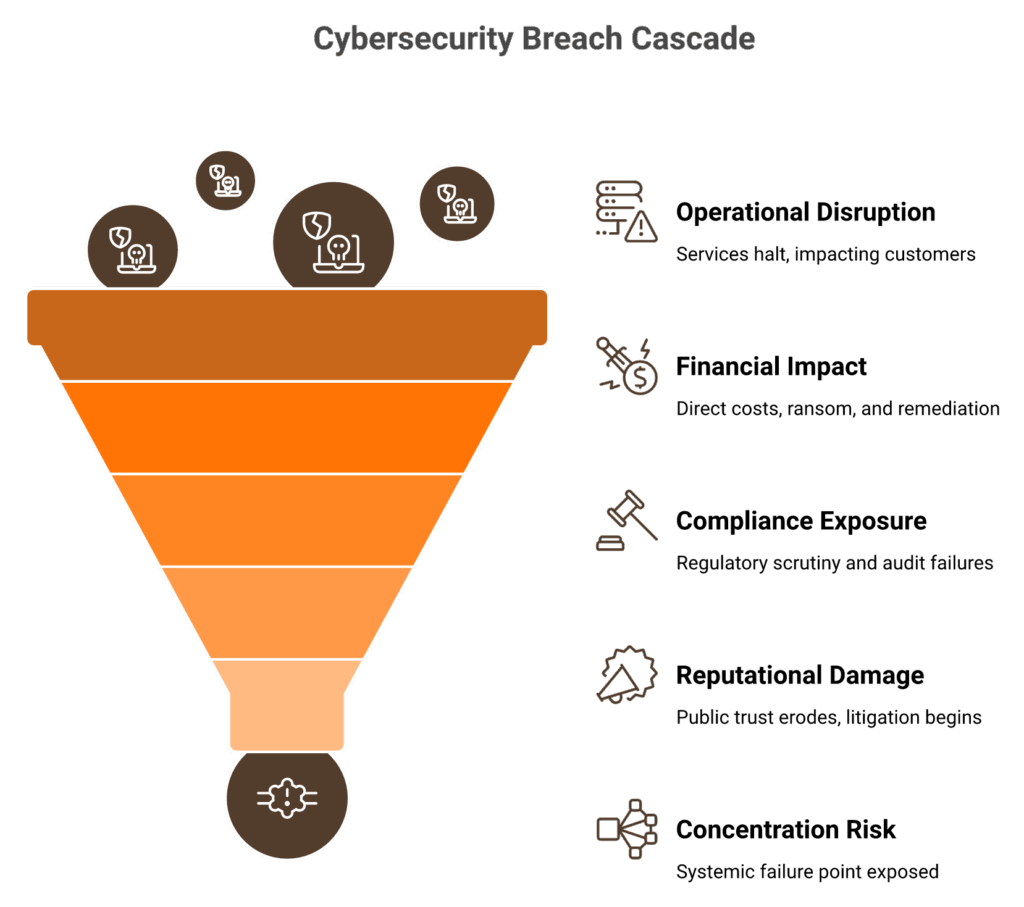
The Change Healthcare attack is the clearest illustration of this cascade effect:
- Cybersecurity breach → BlackCat/ALPHV ransomware compromised systems
- Operational disruption → Medical billing, claims processing, and pharmacy operations halted for 100M+ patients
- Financial impact → $2.457B in total costs within nine months, including $22M ransom payment
- Compliance exposure → Heightened scrutiny of access controls, audit logging, and vendor management across the healthcare sector
- Reputational damage → Patient complaints, regulatory inquiries, and ongoing litigation
- Concentration risk → A single entity processing a massive share of U.S. healthcare transactions became a systemic single point of failure
⚠️ Cybersecurity Risk: The Most Common Cascade Trigger
In the real world, cybersecurity risk is the dimension that most frequently triggers cascading damage across all other categories. A vendor’s compromised credentials or unpatched vulnerability rarely stays contained. It spills into operational disruption, compliance exposure, financial loss, and reputational harm in rapid succession.
This is why continuous monitoring of vendor cybersecurity posture matters more than any annual questionnaire. UnderDefense’s continuous monitoring and threat intelligence capabilities help detect early indicators of vendor cybersecurity compromise, catching the initial trigger before it cascades across every other risk dimension in your ecosystem.
Q3. What Are the Phases of the Vendor Risk Management Lifecycle?
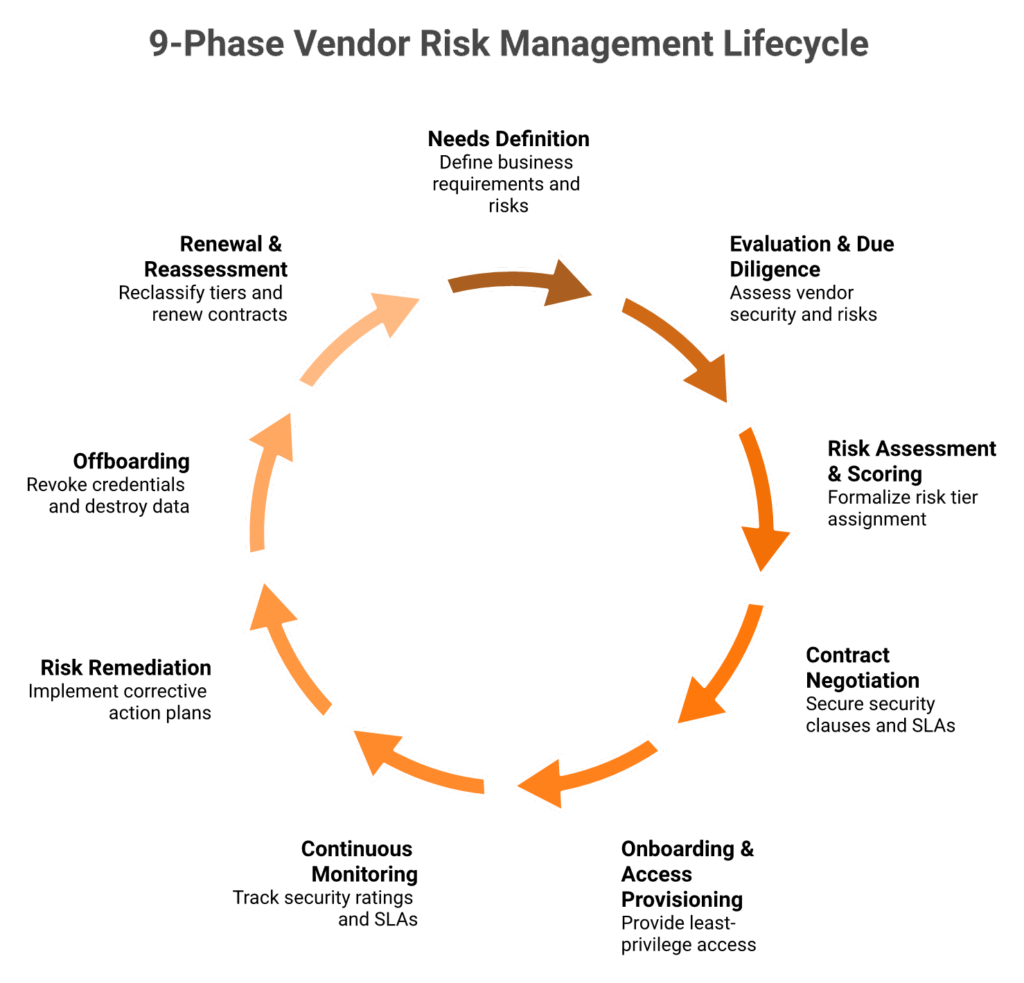
VRM is not a one-time assessment. It is a continuous lifecycle with nine distinct phases, each carrying specific risk activities and deliverables. Skipping or neglecting any single phase creates gaps that compound over time, eroding the confidence your assessments are supposed to build.
📋 Lifecycle Overview
| Phase | Key Activity | Owner | Key Deliverable |
|---|---|---|---|
| 1. Needs Definition | Business requirements, market scan, preliminary risk classification | Business Unit + Procurement | Vendor requirements document |
| 2. Evaluation & Due Diligence | RFP security requirements, initial risk scoring, reference checks | VRM/GRC + Procurement | Vendor shortlist with risk scores |
| 3. Risk Assessment & Scoring | Formal assessment using scoring framework, tier assignment | VRM/GRC Team | Risk assessment report + tier classification |
| 4. Contract Negotiation | Security clauses, SLAs, DPAs, right-to-audit provisions | Legal + CISO + Procurement | Executed contract with security requirements |
| 5. Onboarding & Access Provisioning | Least-privilege access, integration testing, baseline security config | IT + Security | Access provisioning records + baseline |
| 6. Continuous Monitoring | Security rating monitoring, SLA tracking, periodic reassessments | VRM/GRC + Security Ops | Ongoing risk dashboards + monitoring reports |
| 7. Risk Remediation | Corrective action plans, risk exception management, escalation workflows | VRM/GRC + Vendor | Remediation tracking logs |
| 8. Offboarding | Credential revocation, data destruction certification, final audit | IT + Legal + Security | Offboarding confirmation + data destruction cert |
| 9. Renewal & Reassessment | Contract renewal triggers, reassessment based on changed risk profile, tier reclassification | VRM/GRC + Procurement | Updated risk assessment + renewal decision |
❌ The Three Most Neglected Phases
Here’s what breaks down in practice. Most organizations invest heavily in phases 2 and 3, evaluation and assessment, because those are the phases auditors ask about. But the phases that actually prevent incidents are the ones that get skipped:
Phase 5: Onboarding & Access Provisioning. Most organizations grant excessive vendor access on day one without enforcing least-privilege controls. A vendor gets admin credentials “to make onboarding faster,” and those credentials sit in your environment for years, unused, unmonitored, and fully exploitable.
Phase 7: Risk Remediation. Assessment findings without tracked follow-through create audit risk and, worse, false confidence. If you identify a critical vulnerability in a vendor’s infrastructure but never verify remediation, you’ve created documentation that proves you knew the risk existed and chose not to act. That’s worse than not assessing at all.
Phase 8: Offboarding. Industry data suggests that 40%+ of organizations retain active vendor credentials after contract termination. This is the operational equivalent of giving someone your house keys and never changing the locks after they leave. Credential revocation, data return certification, and access confirmation are non-negotiable closing activities.
✅ Lifecycle Completion Drives VRM Maturity
The difference between a “checkbox VRM program” and one that actually reduces risk comes down to lifecycle completion, not assessment depth. A thorough assessment of a vendor at phase 3 means nothing if you never monitor them at phase 6, never track remediation at phase 7, and never revoke their access at phase 8.
UnderDefense’s 30-day turnkey onboarding process and structured offboarding methodology exemplify the disciplined lifecycle approach organizations should demand from every vendor in their ecosystem. When we onboard an MDR client, we document integration baselines, enforce least-privilege access to telemetry, and build offboarding procedures into the engagement from day one, because lifecycle discipline is not optional for a vendor that handles your security data.
Q4. How Do You Build and Govern a VRM Program from Scratch?
Building a vendor risk management program is a governance challenge first and a tooling challenge second. The organizations that get this wrong usually start by purchasing a GRC platform and then try to backfill the governance structure around it. That’s like buying a monitoring dashboard before you know what you’re monitoring.
📋 12-Step Enterprise Implementation
- Define VRM objectives aligned with your enterprise risk management (ERM) framework
- Establish governance structure and ownership: the CISO, Legal, and Procurement triad
- Define risk appetite and acceptance thresholds. What level of vendor risk will the board tolerate?
- Build and maintain a centralized vendor inventory. You cannot assess what you cannot see
- Classify and tier vendors (Tier 1/2/3) by criticality and data sensitivity
- Select assessment frameworks (ISO 27001, NIST SP 800-53, SOC 2, SIG, CSA CAIQ)
- Design the risk assessment methodology and scoring model
- Develop vendor risk assessment questionnaires by domain
- Define contractual security requirements, SLAs, and right-to-audit clauses
- Implement automation workflows for onboarding, tiering, and reassessment triggers
- Build dashboards and board-level reports
- Establish continuous improvement cycles
🏛️ Governance: The Three Lines of Defense
First Line, Business Units: Own vendor relationships and day-to-day risk management. They select vendors, manage SLAs, and flag issues in real time.
Second Line, VRM/GRC Team: Oversees risk assessment, policy, and compliance. Sets the standards, runs the assessments, and tracks remediation.
Third Line, Internal Audit: Provides independent assurance that the program operates as designed.
Board-level reporting should include: vendor risk heatmaps, overdue assessments, material risk exceptions, mean time to remediate findings, and Tier 1 vendor security rating trends. Escalation thresholds for risk acceptance decisions must be clearly defined. A business unit should not be able to accept critical vendor risk without CISO and board visibility.
💰 Enterprise vs. SMB: Right-Sizing the Program
| Dimension | Enterprise (5,000+ employees) | SMB (50–500 employees) |
|---|---|---|
| Dedicated VRM FTEs | 3–10+ | 0–1 (usually part-time) |
| Tooling | Dedicated GRC platform | Spreadsheets or lightweight SaaS |
| Annual budget | $250K–$2M+ | $10K–$75K |
| Vendors assessed | 300–5,000+ | 10–50 |
| Assessment depth (Tier 1) | Full SIG questionnaire + evidence validation | SIG-Lite + SOC 2 report review |
| Regulatory scope | Multi-framework (DORA, NIS2, SOC 2, HIPAA, PCI DSS) | 1–2 frameworks |
| Board reporting frequency | Quarterly | Annually |
✅ SMB Lightweight 5-Step Track
- Inventory your top 10–20 vendors by data access and business criticality
- Use SIG-Lite questionnaires combined with vendor-provided SOC 2 reports
- Tier into Critical vs. Non-Critical
- Prioritize contractual security clauses for Critical vendors
- Set calendar-based annual reassessment triggers
❌ Common Implementation Pitfalls
Starting too broad: Assess your critical vendors first, not all 300+. Trying to assess every vendor simultaneously guarantees none get assessed thoroughly.
Relying solely on questionnaires without evidence validation: A vendor checking “Yes, we encrypt data at rest” on a form means nothing without a SOC 2 report or evidence to back it up. As I’ve seen in practice, and as a CISO friend once put it on a recent podcast, “the real question is, does it prevent an incident from happening tomorrow?” Compliance paperwork alone does not.
Failing to integrate VRM into procurement workflows: VRM must be a gate in the procurement process, not an afterthought that runs in parallel after the contract is signed.
No escalation paths for risk acceptance: If anyone can accept vendor risk without documented approval, your program exists on paper only.
“UnderDefense has changed our approach to cybersecurity. At first, we hired them for managed SIEM service, but after they demonstrated the value of MDR, our management was motivated to act on it.”
— Yaroslava K., IT Project Manager UnderDefense G2 – Verified Review
“Building our cybersecurity from scratch felt like a daunting challenge. Enter UnderDefense MAXI and its 30-day impact report. For a marketing agency taking baby steps in security, these reports were our guiding star, clear, concise, and oh-so-relevant.”
— Val R., Small-Business UnderDefense G2 – Verified Review
UnderDefense’s 30-day onboarding methodology and vendor-agnostic integration across 250+ tools demonstrates the kind of rapid, non-disruptive implementation that VRM programs should emulate. For SMBs without the budget or headcount to build an internal SOC, UnderDefense serves as a force multiplier, providing enterprise-grade threat detection and compliance support without requiring you to staff a 20-person security team.
Q5. How Do You Score, Tier, and Assess Vendor Risk?
Here’s the operational reality: most vendor risk programs stall because they rely on subjective “high/medium/low” labels that mean something different to every stakeholder in the room. A vendor your compliance team calls “high risk” might be “medium” to your IT director, and neither can explain why. That’s not risk management; that’s opinion management.
Inherent Risk vs. Residual Risk: Get the Baseline Right
Two scoring concepts matter here. Inherent risk is the risk a vendor presents before you apply any controls, based on what data they touch, how deeply they’re embedded, and what regulations they trigger. Residual risk is what remains after controls (encryption, access restrictions, and contractual safeguards) are in place. NIST SP 800-30 and ISO 27001 Annex A both anchor risk assessment on a likelihood × impact matrix, but the key is making it quantitative and repeatable, not qualitative and debatable.
The formula that operationalizes this:
Vendor Risk Score = Σ(Wᵢ × Dᵢ) / Σ(Wᵢ)
Where Wᵢ = weight of each dimension and Dᵢ = score (1–5) for that dimension.
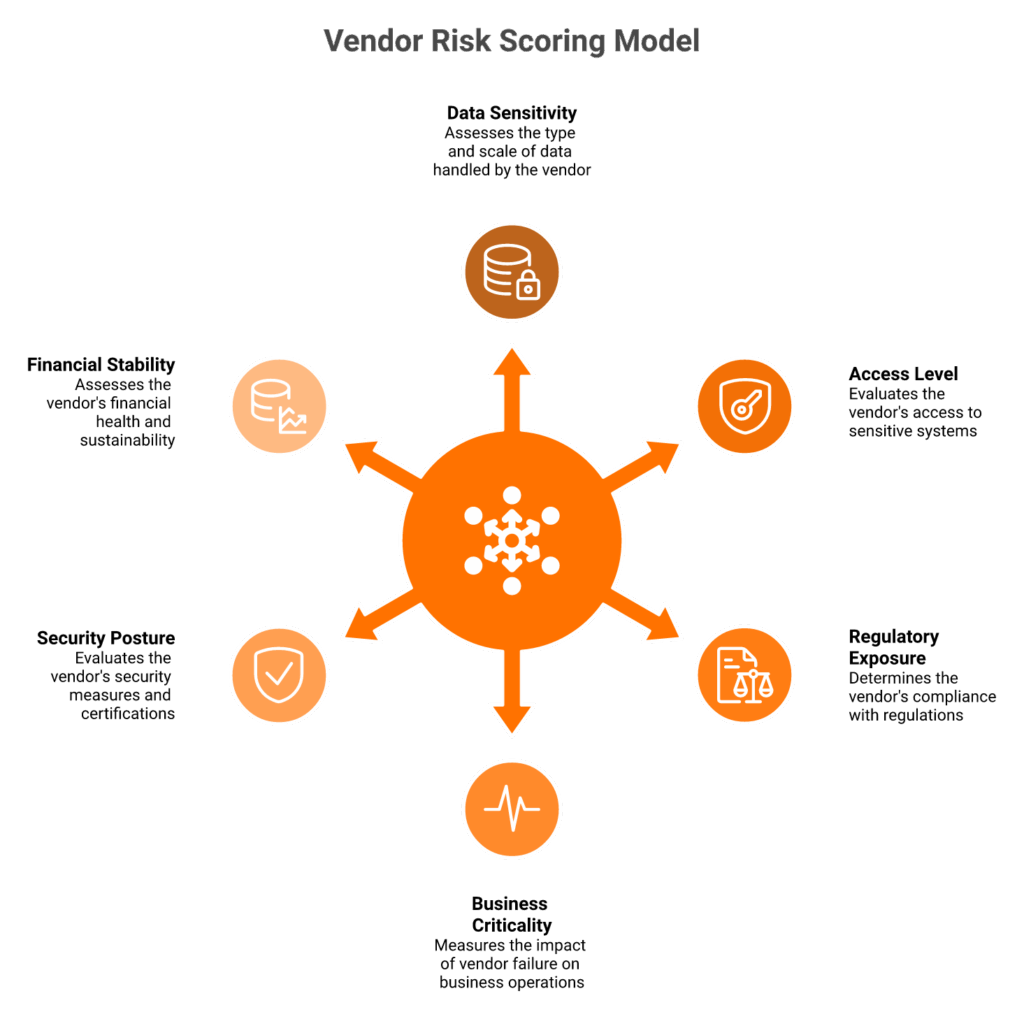
The Weighted Scoring Model: 6 Dimensions
| Dimension | Weight | Score Range (1–5) | Anchor: 1 = Low, 5 = Critical |
|---|---|---|---|
| 💰 Data Sensitivity | 25% | 1–5 | 1 = Public data only; 5 = PII/PHI/PCI at scale |
| 🔐 Access Level | 20% | 1–5 | 1 = No system access; 5 = Admin/root to production |
| ⚖️ Regulatory Exposure | 20% | 1–5 | 1 = No regulated data; 5 = Multi-framework (HIPAA + PCI + GDPR) |
| ⚠️ Business Criticality | 15% | 1–5 | 1 = Easily replaceable; 5 = Revenue-blocking if unavailable |
| ✅ Security Posture | 12% | 1–5 | 1 = SOC 2 + pentest + strong ratings; 5 = No certs, poor hygiene |
| 📊 Financial Stability | 8% | 1–5 | 1 = Publicly traded, strong balance sheet; 5 = Pre-revenue startup |
Worked Example: Scoring a SaaS CRM Vendor
Suppose your sales team wants to onboard a mid-market SaaS CRM that stores customer PII, integrates via API with your production environment, and processes payment-adjacent data.
- Data Sensitivity: 4 (PII at scale) × 0.25 = 1.00
- Access Level: 3 (API integration, no admin access) × 0.20 = 0.60
- Regulatory Exposure: 4 (GDPR + SOX-adjacent) × 0.20 = 0.80
- Business Criticality: 3 (important but replaceable within 90 days) × 0.15 = 0.45
- Security Posture: 4 (SOC 2 Type I only, no pentest evidence) × 0.12 = 0.48
- Financial Stability: 3 (Series C, moderate runway) × 0.08 = 0.24
Final Weighted Score: 3.57 → Tier 2 (Moderate Risk)
3-Tier Vendor Classification and Assessment Cadence
| Tier | Score Range | Assessment Depth | Cadence | Resource Allocation |
|---|---|---|---|---|
| ⚠️ Tier 1 — Critical | 4.0–5.0 | Annual on-site audit + continuous monitoring + quarterly business reviews + full SIG questionnaire | Quarterly review cycles | High, dedicated analyst ownership |
| ✅ Tier 2 — Moderate | 2.5–3.9 | Annual SIG-Lite + semi-annual security rating check + SOC 2 Type II review | Semi-annual review cycles | Medium, shared analyst coverage |
| 🟢 Tier 3 — Low | 1.0–2.4 | Biennial self-certification + automated external scanning | Annual or biennial | Low, automated workflows |
Assessment Questionnaire Design: 6 Domains
Rather than reinventing the wheel, map your questionnaire to established frameworks: SIG (Shared Assessments), CAIQ (Cloud Security Alliance), HECVAT (higher education), and HITRUST (healthcare). Prioritize evidence-based responses over self-attestation; a vendor saying “we encrypt data at rest” means nothing without proof.
(a) Information Security Controls — Do you maintain a vulnerability management program with defined SLAs? What is your patch cadence for critical CVEs?
(b) Compliance and Certifications — Provide current SOC 2 Type II report, ISO 27001 certificate, and most recent penetration test executive summary.
(c) Incident Response Capabilities — What is your mean time to detect (MTTD) and mean time to respond (MTTR)? Provide your IR plan and most recent tabletop exercise results.
(d) Data Handling and Privacy — Where is data stored, processed, and backed up? What is your data retention and destruction policy?
(e) Business Continuity/Disaster Recovery — What is your RTO/RPO? When was your BC/DR plan last tested?
(f) Subprocessor/Fourth-Party Management — Provide a current list of subprocessors. How do you assess and monitor fourth-party risk?
Risk exchange platforms (e.g., OneTrust Vendorpedia, Prevalent) allow vendors to share pre-completed assessments. This cuts cycle time for Tier 2 and Tier 3 vendors dramatically.
Reassessment Triggers and Dynamic Tiering
Vendor tiers should never be static annual snapshots. Reassessment should trigger on any of the following:
- Vendor experiences a confirmed breach or public security incident
- M&A activity (acquisition, merger, or divestiture)
- Regulation change affecting the vendor’s data handling obligations
- Contract renewal or scope expansion
- Security rating drop (e.g., BitSight or SecurityScorecard score decline >50 points)
- Subprocessor change affecting Tier 1 vendors
Dynamic tiering means a Tier 2 vendor can escalate to Tier 1 overnight if real-time signals warrant it, and that requires a continuous signal feed, not a calendar reminder. UnderDefense’s continuous 24/7 threat monitoring across 250+ integrated tools provides exactly this kind of real-time signal intelligence, making dynamic tiering operationally feasible rather than aspirational.
Q6. How Should Vendor Contracts Enforce Security and Compliance?
Vendor contracts are the enforcement mechanism for your entire VRM program. If it’s not in the contract, it doesn’t exist when things go wrong. Seven clauses are non-negotiable: (1) security requirements and standards, (2) breach notification obligations and timelines, (3) right-to-audit provisions, (4) data handling, return, and destruction, (5) subprocessor approval rights, (6) indemnification and liability allocation, and (7) termination for security non-compliance.
The 7 Non-Negotiable Security Clauses
Security Requirements and Standards — Vendor must maintain security controls aligned with a specified framework (e.g., SOC 2 Type II, ISO 27001) and provide annual evidence of compliance. Specify minimum encryption standards (AES-256 at rest, TLS 1.2+ in transit) and access control requirements (MFA, least privilege).
⏰ Breach Notification Obligations — Vendor must notify within 24–48 hours of discovery (not confirmation), provide root cause analysis within 5 business days, cooperate with forensic investigation at vendor’s expense, and preserve all relevant logs for a minimum of 12 months. Align notification timelines with your most stringent regulatory obligation (GDPR requires 72 hours; DORA requires “without undue delay”).
Right-to-Audit Provisions — Retain the right to conduct or commission security audits annually for Tier 1 vendors, with 30 days’ written notice. Vendor must cooperate fully, provide access to relevant systems, personnel, and documentation, and remediate findings within agreed SLAs.
Data Handling, Return, and Destruction — Define data classification, permitted use, geographic storage restrictions, and return/destruction requirements upon contract termination. Vendor must provide written certification of data destruction within 30 days of contract end. This is the clause most organizations miss entirely.
⚠️ Subprocessor/Fourth-Party Approval Rights — Vendor must maintain a current subprocessor list, notify you of any changes 30 days prior to engagement, and grant you the right to object. This directly satisfies GDPR Article 28 DPA requirements and is increasingly required under DORA and NIS2.
💰 Indemnification and Liability Allocation — Vendor must indemnify against losses arising from vendor-caused breaches or non-compliance. Set minimum cyber insurance requirements ($5M for Tier 1 vendors, $2M for Tier 2). Ensure liability caps do not apply to data breach or confidentiality obligations. Include SLA benchmarks with financial penalties: 99.9% uptime, defined MTTR for security incidents, and response time commitments.
❌ Termination for Security Non-Compliance — Reserve the right to terminate without penalty if the vendor fails to remediate critical security findings within agreed timelines, experiences a material breach, or loses required certifications.
The Standard Most Organizations Miss
The two most commonly absent clauses in vendor contracts are subprocessor approval rights and data return/destruction certification. Without the first, your Tier 1 vendor can silently introduce a fourth-party that stores your data in a jurisdiction you never approved. Without the second, you have no proof your data was actually deleted after offboarding, which auditors and regulators will absolutely ask about.
How UnderDefense Practices What It Preaches
UnderDefense’s own contracting approach exemplifies the standards organizations should demand from every vendor: published pricing ($11–15/endpoint/month), documented SLAs (2-minute alert-to-triage and 15-minute escalation for critical incidents), and a structured 30-day onboarding with defined deliverables and measurable outcomes. Transparency in your own vendor relationships starts with demanding it from your partners, and modeling it yourself.
Q7. How Do You Map VRM Requirements Across Regulatory Compliance Frameworks?
If your organization is subject to more than one regulatory framework, and in 2026 most are, you’re dealing with overlapping but non-identical VRM requirements that create duplicated effort, conflicting timelines, and audit fatigue. The solution is not separate programs per framework but a unified compliance mapping matrix that maps VRM activities to every applicable regulation simultaneously, so one assessment satisfies multiple obligations.
The Core Challenge: Overlapping but Non-Identical Requirements
SOX requires vendor controls over financial reporting. HIPAA mandates Business Associate Agreements. PCI DSS 4.0 enforces Requirement 12.8 for service provider management. GDPR Article 28 demands Data Processing Agreements. DORA requires ICT third-party risk registers. NIS2 mandates supply chain security assessments. NIST CSF 2.0 provides a voluntary but increasingly expected governance framework. Each framework cares about vendor risk, but the specifics (assessment frequency, documentation depth, and breach notification timelines) differ enough to create operational chaos without a cross-walk.
Compliance Mapping Matrix
| VRM Activity | SOX | HIPAA | PCI DSS 4.0 | GDPR | DORA | NIS2 | NIST CSF 2.0 |
|---|---|---|---|---|---|---|---|
| Vendor Inventory | Required (IT controls) | Required (BAA tracking) | Req. 12.8.1 | Art. 30 records | ICT third-party register | Supply chain register | GV.SC |
| Risk Assessment Frequency | Annual (SOX controls) | Periodic (risk analysis) | Annual (Req. 12.8.4) | Prior to processing | Continuous + annual | Proportionate to risk | ID.RA |
| Due Diligence Depth | Financial + IT controls | Security Rule alignment | Req. 12.8.2 (due diligence) | Art. 28 DPA | Comprehensive ICT risk | Supply chain cybersecurity | ID.SC |
| Continuous Monitoring | Ongoing control testing | Ongoing (§164.308) | Req. 12.8.5 (monitor status) | Ongoing compliance | Real-time monitoring required | Appropriate measures | DE.CM |
| Breach Notification | Material disclosure (SEC) | 60 days (covered entity) | Immediately (Req. 12.10) | 72 hours (Art. 33) | Without undue delay | 24h early warning + 72h full | RS.CO |
| Contractual Requirements | SAS 70/SOC reports | BAA required | Req. 12.8.2 | Art. 28 DPA clauses | Detailed ICT contracts (Art. 30) | Security requirements | GV.SC |
| Audit Rights | SOX Section 404 | Right to audit BAA | Req. 12.8.3 | Art. 28(3)(h) | Full audit + inspection rights | Proportionate access | ID.SC |
| Fourth-Party Requirements | Indirect (sub-servicer) | Subcontractor BAAs | Req. 12.9 (TPSP acknowledgment) | Art. 28(2) sub-processor | Subcontracting oversight | Supply chain depth | GV.SC |
| Board Reporting | Quarterly (audit committee) | Not specified | Not specified | Not specified | Board-level ICT risk | Management body oversight | GV.OC |
Industry-Specific Frameworks
Beyond the major regulations, certain industries layer additional VRM requirements:
- HITRUST CSF (healthcare) — Maps to HIPAA, NIST, and ISO 27001; increasingly required by health systems for vendor assessment
- HECVAT (higher education) — Standardized vendor assessment for institutions handling FERPA-protected data
- SOC 2 Type II (cross-industry) — Trust Services Criteria provide vendor assurance across security, availability, and confidentiality
- ISO 27001 Annex A.15 (Supplier Relationships) — Specifies information security requirements for supplier agreements and monitoring
⚠️ 2026 Regulatory Developments to Watch
This year has brought significant regulatory convergence making VRM a legal obligation, not a best practice:
- DORA (fully enforced January 2025): Financial entities must maintain ICT third-party registers with oversight rights, filed with European Supervisory Authorities. In 2026, the ESAs are collecting updated registers and performing criticality assessments of ICT service providers.
- NIS2 (transposed across EU member states): Mandates comprehensive supply chain risk management, supplier accountability, and incident reporting for essential and important entities.
- SEC Cyber Disclosure Rules: Public companies must report material cybersecurity incidents, including those originating from third parties, within four business days, with detailed risk management disclosures.
- EU AI Act (high-risk obligations enforced August 2026): Organizations deploying third-party AI systems must ensure vendors provide risk classification confirmation, technical documentation access, change notification, and incident reporting, creating entirely new vendor compliance obligations.
How UnderDefense Simplifies Multi-Framework Compliance
UnderDefense offers forever-free compliance kits for SOC 2, HIPAA, and ISO 27001, and its continuous MDR monitoring generates the audit evidence (24/7 log collection, incident response documentation, and control validation) that satisfies multiple framework requirements simultaneously. Instead of maintaining separate evidence repositories per regulation, one unified monitoring layer maps to SOX control testing, HIPAA security rule requirements, PCI DSS monitoring obligations, and DORA continuous oversight, all from the same telemetry.
Q8. What Is a VRM Maturity Model and How Mature Is Your Program?
Score your VRM program maturity against these 8 criteria to determine where you stand and what to prioritize next. Most organizations overestimate their maturity by at least one level. The checklist below cuts through the optimism with binary yes/no criteria that don’t leave room for “we’re working on it.”
The 6-Level VRM Maturity Model (VRMMM)
The Shared Assessments VRMMM framework provides a structured progression from chaos to continuous improvement:
| Level | Stage | Characteristics |
|---|---|---|
| 1 | ❌ No Formal VRM | Ad hoc vendor management; no inventory, no assessments, no ownership |
| 2 | ⚠️ Initial Vision | Executive awareness of vendor risk; discussions happening, but no program structure |
| 3 | 📋 Approved Roadmap | Emerging structure: policies drafted, roles assigned, initial vendor inventory underway |
| 4 | ✅ Defined & Established | Standardized processes in place, but not fully operational across all vendor tiers |
| 5 | ⭐ Fully Implemented | Continuous monitoring active, compliance integrated, assessment cadences enforced |
| 6 | 🚀 Continuous Improvement | Predictive analytics, dynamic tiering, industry benchmarking, automated workflows |
The 8-Item VRM Self-Assessment Checklist
Be honest. Check only the items your organization actually does today, not what’s planned for next quarter:
- ☐ (1) Do you maintain a centralized, complete vendor inventory updated at least quarterly?
- ☐ (2) Are vendors classified by risk tier with defined assessment cadences per tier?
- ☐ (3) Do you use standardized quantitative risk scoring (not just high/medium/low)?
- ☐ (4) Is continuous monitoring in place for all Tier 1 vendors?
- ☐ (5) Are vendor risk metrics reported to board/executive leadership quarterly?
- ☐ (6) Do contracts include right-to-audit, breach notification, data handling, and subprocessor clauses?
- ☐ (7) Do you assess fourth-party/subprocessor risk for Tier 1 vendors?
- ☐ (8) Is your vendor breach response playbook tested annually via tabletop exercise?
Score Interpretation
| ✅ Checks | Maturity Level | What It Means | Priority Actions |
|---|---|---|---|
| 7–8 | Level 5–6 (Optimized) | Your program is mature. Focus on automation, predictive analytics, and benchmarking against industry peers. | Automation and benchmarking |
| 4–6 | Level 3–4 (Managed) | Foundational elements exist, but gaps in continuous monitoring, contractual governance, or fourth-party risk create exposure. | Prioritize items 4, 6, and 7 |
| 0–3 | Level 1–2 (Ad Hoc) | ⚠️ Significant exposure. You’re reacting to vendor incidents, not preventing them. | Start immediately with a complete vendor inventory and Tier 1 identification |
Where Most Organizations Fail
In practice, items 4 (continuous monitoring for Tier 1 vendors), 7 (fourth-party risk assessment), and 8 (vendor breach response testing) are the most commonly unchecked, and they’re precisely the items that determine whether your program can survive a real vendor incident or just looks good on paper.
How UnderDefense Closes the Gaps
UnderDefense’s UnderDefense MAXI platform directly addresses the most commonly unchecked items on this list. Continuous 24/7 monitoring with 2-minute alert-to-triage and 15-minute escalation for critical incidents covers item 4. Transparent contractual standards with documented SLAs and published pricing ($11–15/endpoint/month) model the governance expected in item 6. And the incident response retainer, tested through real-world threat detection across 250+ integrated tools, provides the operational foundation for item 8’s vendor breach response capability.
Most organizations go from 2–3 checks to 6+ within 30 days of onboarding UnderDefense MDR, because the platform operationalizes what most VRM programs only document.
Q9. How Should You Assess and Manage AI Vendor Risk in 2026?
Organizations are onboarding AI vendors, including LLM APIs, AI-powered SaaS tools, copilots, and embedded machine learning, faster than their risk programs can keep up. Traditional VRM questionnaires were designed for data storage and processing vendors, not for systems that learn, infer, and generate outputs based on probabilistic models. The EU AI Act, now the world’s first comprehensive AI regulation, classifies AI systems into four risk tiers: unacceptable (banned outright), high-risk (strict conformity requirements), limited (transparency obligations), and minimal (freely operating). With high-risk AI obligations enforcing on August 2, 2026, every organization deploying third-party AI needs an AI-specific risk assessment layer, yesterday.
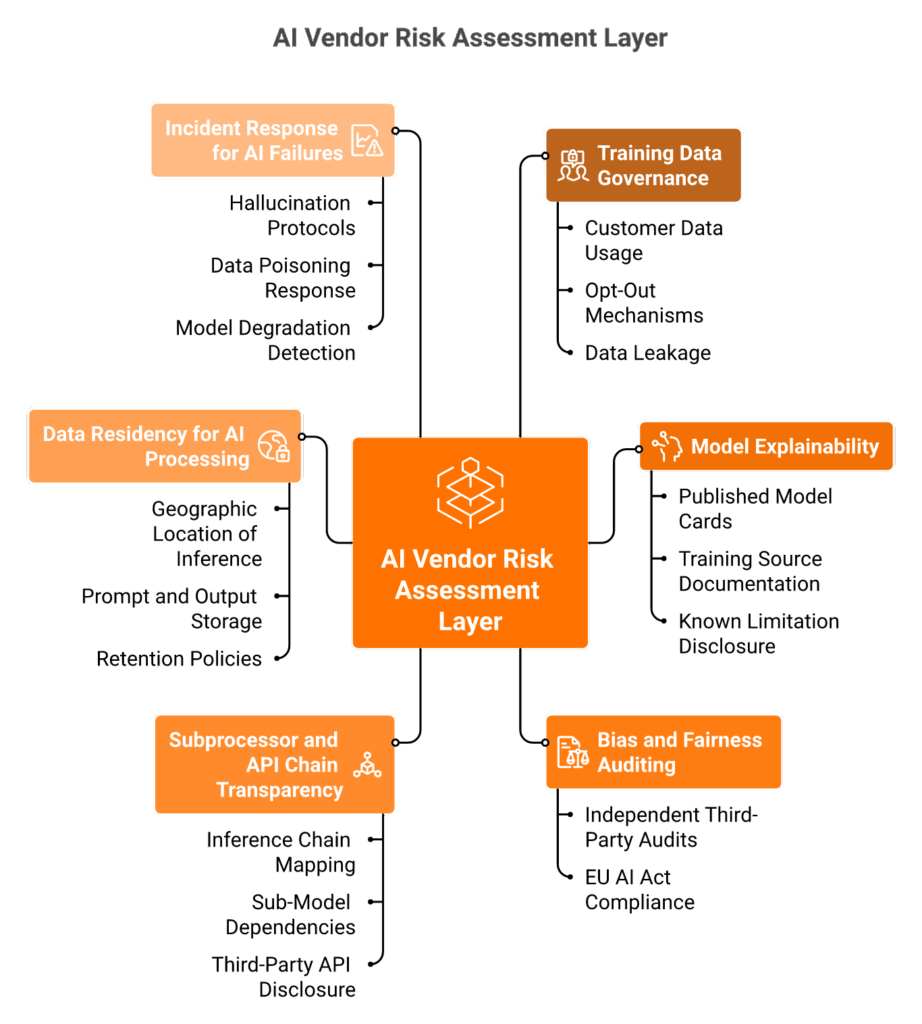
6 Novel Risk Dimensions Traditional Questionnaires Miss
Standard SIG or CAIQ questionnaires cover data handling, encryption, and access control, but they don’t address what makes AI vendors fundamentally different. Here are six dimensions to add:
| # | AI Risk Dimension | Why It Matters | Sample Assessment Question |
|---|---|---|---|
| 1 | Training Data Governance | Your data may be used to improve the vendor’s model, or leak into outputs for other customers | “Does the vendor use customer data for model training? What are the opt-out mechanisms?” |
| 2 | Model Explainability & Transparency | Black-box AI decisions create audit, compliance, and liability exposure | “Can the vendor explain how outputs are generated? Is a model card published documenting training sources and limitations?” |
| 3 | Bias & Fairness Auditing | Biased AI outputs create legal risk (especially under EU AI Act high-risk provisions) | “Has the vendor conducted independent third-party bias audits? Provide documentation.” |
| 4 | Subprocessor & API Chain Transparency | AI vendors often chain sub-models or third-party APIs (e.g., OpenAI → Azure → your data) | “What sub-models, foundation models, or third-party APIs does the system rely on? Map the full inference chain.” |
| 5 | Data Residency for AI Processing | Inference may happen in different jurisdictions than data storage; prompts and outputs may be logged | “Where does AI inference occur? Are prompts, outputs, and embeddings stored? For how long?” |
| 6 | Incident Response for AI Failures | Hallucinations, data poisoning, prompt injection, and model degradation require specific playbooks | “What is the protocol for hallucination events affecting customer-facing outputs? How is model degradation detected and communicated?” |
⚠️ The AI Vendor Risk Assessment Addendum: 10 Questions
Add these to your standard vendor assessment for any AI/ML vendor:
- Does the vendor use customer data for model training or fine-tuning? What are the opt-out rights?
- Has the vendor conducted and published third-party bias audits?
- Does the vendor maintain a model card documenting training data sources, known limitations, and performance benchmarks?
- What is the full inference chain, including sub-models, foundation models, and third-party API dependencies?
- Where does AI inference processing occur geographically? Are prompts and outputs stored?
- What is the vendor’s protocol for hallucination events, data poisoning, or prompt injection incidents?
- How does the vendor classify its AI system under the EU AI Act risk tiers?
- Does the vendor provide human override capabilities for AI-generated decisions?
- What monitoring is in place for model drift, degradation, or adversarial manipulation?
- Can the vendor provide audit logs of AI decision pathways for compliance review?
Why AI Security Tools Need the Same Scrutiny
Here’s what’s often overlooked: AI-powered security tools themselves are AI vendors that require this scrutiny. If your MDR provider uses AI for detection, you should be asking: Can I see how it reached that verdict? Is it auditable? What happens when the AI gets it wrong?
UnderDefense MAXI was built around this principle. Every AI-driven detection is observable, auditable, and validated by human analysts before action is taken. The AI SOC + Human Ally model isn’t just a detection architecture but what responsible AI vendor governance looks like in practice: automation scales the routine work, humans handle the edge cases, and every step is transparent enough to audit.
Q10. What Do Real-World Vendor Breaches Teach Us, and What Does a Response Playbook Look Like?
Your vendor’s breach is now your breach. In most supply chain incidents, the downstream organization discovers the compromise from news reports, not from the vendor’s notification. Here are four real-world failures that expose VRM gaps most programs still have, and the exact playbook your team needs to respond.
4 Vendor Breaches That Rewrote the Playbook
🔴 Target (2013) — An HVAC vendor’s credentials were phished, giving attackers lateral access to Target’s payment processing network. Result: 40 million payment cards stolen, $292M in costs. VRM Failure: No network segmentation between vendor access and cardholder data environment. Lesson: Vendor access must be segmented, monitored, and time-limited.
🔴 SolarWinds (2020) — Attackers compromised SolarWinds’ Orion software update mechanism, injecting malicious code distributed to 18,000+ organizations including US federal agencies. VRM Failure: No software bill of materials (SBOM) verification or supply chain integrity checks on software updates. Lesson: Software vendors require SBOM transparency and build-process attestation.
🔴 MOVEit/Cl0p (2023) — The Cl0p ransomware group exploited a zero-day SQL injection vulnerability in Progress Software’s MOVEit file transfer tool, compromising over 2,700 organizations and exposing 93.3 million individuals’ data. Most affected organizations didn’t use MOVEit directly; their vendors did. VRM Failure: No fourth-party technology mapping; organizations didn’t know their vendors used MOVEit. Lesson: Fourth-party technology inventory is non-negotiable for Tier 1 vendors.
🔴 Change Healthcare (2024) — Attackers used stolen credentials, without MFA, to access Change Healthcare’s Citrix remote access portal. Nine days of undetected lateral movement preceded ransomware deployment, affecting 190 million Americans and costing UnitedHealth Group over $2.9 billion. VRM Failure: Concentration risk (one-third of US patient records flow through Change) plus no MFA verification in vendor due diligence. Lesson: Due diligence must verify basic controls like MFA exist, not just that the vendor claims they do.
5 Cross-Cutting Lessons
❌ Annual questionnaires can’t detect real-time compromise ⚠️ Fourth-party technology mapping is non-negotiable 💰 Concentration risk is existential; single points of failure multiply losses ✅ Breach notification SLAs must be contractually enforced, not assumed ⏰ Response playbooks must be tested, not just documented
The 6-Phase Vendor Breach Response Playbook
Phase 1, Detection & Triage: Identify vendor-originating indicators, assess initial scope, and activate the vendor incident response team. Time is everything here.
Phase 2, Impact Assessment & Containment: Determine what data, systems, and users were exposed. Revoke vendor access, rotate credentials, and isolate affected segments.
Phase 3, Stakeholder Communication: Notify executive leadership, legal counsel, affected business units, and (if applicable) board/audit committee within 4 hours of confirmed impact.
Phase 4, Regulatory Notification: Timelines vary by jurisdiction and framework:
| Framework | Notification Timeline | To Whom |
|---|---|---|
| GDPR | 72 hours from awareness | Supervisory Authority |
| HIPAA | 60 days (covered entity to HHS) | HHS OCR |
| PCI DSS | Immediately upon detection | Acquiring bank + PCI SSC |
| DORA | Without undue delay | Competent authority |
| CCPA | “Most expedient time possible” | Affected individuals |
| SEC (8-K) | 4 business days from materiality determination | SEC + public investors |
Phase 5, Remediation & Access Revocation: Enforce contractual forensic investigation cooperation, preserve vendor logs (minimum 12 months), revoke and re-provision all vendor access, and validate remediation before restoring connectivity.
Phase 6, Post-Incident Review: Update vendor risk scores, revise contractual terms, strengthen tiering criteria, and conduct a tabletop exercise within 90 days using the incident scenario.
How 24/7 Monitoring Changes the Equation
Phases 1 and 2 determine whether a vendor breach becomes a headline or a contained incident. UnderDefense’s 24/7 monitoring with 2-minute alert-to-triage and 15-minute escalation for critical incidents enables real-time detection of vendor-originating compromise, often before the vendor’s own notification arrives. Across 500+ MDR clients over six years, UnderDefense maintains a 100% ransomware prevention record, because detection without rapid human-driven response is just expensive alerting.
Q11. What VRM Tools, Best Practices, and Trends Should Security Teams Adopt in 2026?
The most effective VRM programs in 2026 combine GRC platforms for workflow automation with continuous security monitoring for real-time risk visibility, moving beyond spreadsheets and annual questionnaires. VRM technology has matured from manual vendor tracking into integrated platforms that automate discovery, assessment, scoring, monitoring, and reporting across the full vendor lifecycle.
VRM Technology Categories
✅ Managed Detection & Response (MDR) — UnderDefense MAXI: real-time threat monitoring that detects vendor-originating compromise across your existing stack, AI SOC + Human Ally model with 250+ tool integrations, 2-minute alert-to-triage and 15-minute escalation for critical incidents, and the continuous monitoring layer that GRC platforms alone cannot provide
- GRC/VRM Platforms — OneTrust, ServiceNow VRM, Archer: workflow automation, vendor portals, risk register management, and assessment tracking dashboards
- Security Ratings Services — BitSight, SecurityScorecard, UpGuard: continuous external risk scoring and benchmarking based on observable security signals
- AI-Powered Due Diligence — Automated questionnaire analysis, document review, and risk classification using natural language processing
- Dark Web Monitoring — Vendor credential exposure detection, data leak identification, and early warning for compromised supply chain partners
- Risk Exchange Platforms — Whistic, OneTrust Vendorpedia: pre-completed assessment sharing that accelerates Tier 2 and Tier 3 vendor evaluation cycles
8 Best Practices for 2026
- Maintain a continuously updated vendor inventory via automated SaaS discovery tools
- Adopt hybrid monitoring: continuous for Tier 1 vendors, periodic for Tier 2–3
- Expand assessment scope to fourth-party and Nth-party dependencies
- Build SaaS stack awareness by mapping every cloud application touching sensitive data
- Develop and annually test vendor backup/contingency plans for Tier 1 concentration risk
- Automate repeatable workflows, including questionnaire distribution, evidence collection, and scoring
- Foster transparent vendor communication by sharing risk findings, not just audit demands
- Conduct annual tabletop exercises simulating vendor breach scenarios
Emerging Trends Reshaping VRM
The biggest shifts: regulatory convergence (DORA + NIS2 + SEC disclosure rules) making VRM a legal obligation across industries, zero-trust vendor access models replacing standing VPN connections, AI automation in questionnaire analysis and risk scoring, ESG/sustainability risk integration into vendor assessments, and real-time monitoring definitively replacing annual point-in-time assessments as the standard.
The Missing Piece: Continuous Monitoring with Response Capability
Continuous vendor monitoring is only as effective as the security operations team behind it. GRC platforms tell you a vendor’s rating changed, but they can’t detect an active breach propagating through your vendor’s access. The right managed cybersecurity service ensures vendor-originating threats are detected and contained in real time, not flagged in next quarter’s dashboard review.
This analysis is based on documented response times, G2 Spring 2025 rankings, published pricing, and operational outcomes across 500+ MDR deployments.
Q12. Frequently Asked Questions About Vendor Risk Management
Q: What is the difference between VRM and TPRM?
Vendor Risk Management (VRM) focuses specifically on vendors and suppliers who provide products or services to your organization. Third-Party Risk Management (TPRM) is the broader umbrella encompassing all third parties: vendors, partners, contractors, affiliates, and joint ventures. VRM is a subset of TPRM. In practice, most organizations use the terms interchangeably, but TPRM programs typically include non-vendor relationships like channel partners and outsourced business functions.
⏰ Reassessment Frequency
Q: How often should vendors be reassessed?
Tier 1 (Critical): continuously monitored + formal quarterly reviews. Tier 2 (Moderate): annually with semi-annual security rating checks. Tier 3 (Low): biennially via self-certification. Additionally, trigger-based reassessment applies to all tiers following material events: breaches, M&A activity, regulation changes, contract renewals, or security rating drops exceeding 50 points. See Q5 for the complete tiering methodology.
Q: What is fourth-party risk?
Fourth-party risk is the risk introduced by your vendors’ vendors: the subprocessors, technology providers, and service partners your direct vendors depend on. The MOVEit breach demonstrated this clearly. Organizations that never used MOVEit directly were compromised because their vendors did. Manage fourth-party risk through contractual subprocessor notification requirements, technology dependency mapping for Tier 1 vendors, and regular disclosure reviews.
📋 Framework Selection
Q: Which VRM framework is best for my industry?
- Healthcare: HITRUST CSF + HIPAA Security Rule
- Financial Services: DORA + SOX + PCI DSS 4.0
- Higher Education: HECVAT + FERPA
- General/Cross-Industry: SIG (Shared Assessments) + SOC 2 Type II
- Multi-Framework Organizations: NIST CSF 2.0 as the unifying cross-walk
See Q7 for the complete compliance mapping matrix across seven major frameworks.
Q: How do you calculate vendor risk scores?
Use a weighted formula: Vendor Risk Score = Σ(Weight × Dimension Score) / Σ(Weights) across six dimensions: data sensitivity, access level, regulatory exposure, business criticality, security posture, and financial stability. Each dimension scores 1–5 with defined anchors. See Q5 for the complete scoring model with a fully worked example.
✅ Program Design Essentials
Q: What should a VRM policy include?
Eight elements: (1) program scope and applicability, (2) roles and responsibilities (including VRM owner), (3) risk appetite statement, (4) vendor classification criteria and tier definitions, (5) assessment methodology and tools, (6) minimum contractual security requirements, (7) escalation and exception process, and (8) continuous improvement cadence.
Q: How do small businesses approach VRM?
Start with your top 10 vendors ranked by data access and business criticality. Use SIG-Lite questionnaires (not full SIG). Request SOC 2 Type II reports as baseline evidence. Implement two-tier classification, Critical vs. Non-Critical, with annual reassessment for Critical and biennial for Non-Critical. This covers 80% of your risk with 20% of the effort.
❌ Common Pitfalls
Q: What are the most common VRM mistakes?
Five recurring failures: (1) no risk tiering, treating all vendors identically, (2) accepting self-attestation without evidence, (3) assessing at the vendor level rather than the product/service level, (4) no reassessment protocol after material changes, and (5) documenting response playbooks that are never tested via tabletop exercises. See Q8 for the complete self-assessment checklist.
For detailed guidance on any topic above, refer to the corresponding section, particularly Q5 (scoring methodology), Q7 (compliance framework mapping), and Q10 (breach response playbook).
1. What is vendor risk management and why is it critical for organizations in 2026?
Vendor risk management (VRM) is the systematic process of identifying, assessing, mitigating, and continuously monitoring risks introduced by third-party vendors across their entire lifecycle, from selection through offboarding. In 2026, VRM has become a board-level priority because the average organization now experiences 12 third-party breaches per year, and single incidents like the Change Healthcare attack ($2.457 billion in costs) demonstrate that one vendor relationship can trigger cascading cybersecurity, operational, financial, and compliance damage simultaneously. We see four forces making legacy VRM approaches dangerously inadequate:
-
AI vendor proliferation creating new data governance and hallucination liability risks
-
SaaS sprawl with 300+ applications per enterprise
-
Fourth-party exposure from dependencies organizations never directly contracted
-
Regulatory expansion including DORA, NIS2, and SEC cyber disclosure rules
Annual questionnaires cannot keep pace with real-time threats. Organizations need continuous security monitoring that bridges the gap between periodic assessments and actual operational visibility into vendor ecosystems.
2. How do you calculate a vendor risk score using a weighted scoring model?
We use a quantitative weighted formula that eliminates the subjective “high/medium/low” debates that stall most VRM programs. The formula is: Vendor Risk Score = Σ(Weight × Dimension Score) / Σ(Weights) We score across six dimensions, each rated 1–5:
-
Data Sensitivity (25% weight)
-
Access Level (20% weight)
-
Regulatory Exposure (20% weight)
-
Business Criticality (15% weight)
-
Security Posture (12% weight)
-
Financial Stability (8% weight)
For example, a SaaS CRM storing customer PII with API integration and GDPR exposure scores 3.57, placing it in Tier 2 (Moderate Risk) with semi-annual review cycles. This approach, anchored in NIST SP 800-30 and ISO 27001 principles, makes risk scoring repeatable and auditable rather than opinion-based. For Tier 1 critical vendors (scores 4.0–5.0), we recommend pairing this scoring model with 24/7 MDR monitoring to ensure continuous oversight between formal assessments.
3. What are the phases of the vendor risk management lifecycle?
The VRM lifecycle consists of nine distinct phases, each carrying specific risk activities and deliverables:
-
Needs Definition (business requirements and preliminary risk classification)
-
Evaluation & Due Diligence (RFP security requirements and initial scoring)
-
Risk Assessment & Scoring (formal tier assignment using a weighted model)
-
Contract Negotiation (security clauses, SLAs, DPAs, and right-to-audit provisions)
-
Onboarding & Access Provisioning (least-privilege access and baseline configuration)
-
Continuous Monitoring (security rating tracking and periodic reassessment)
-
Risk Remediation (corrective action plans and exception management)
-
Offboarding (credential revocation, data destruction certification, and final audit)
-
Renewal & Reassessment (tier reclassification based on changed risk profiles)
In our experience, the most neglected phases are Onboarding (excessive vendor access granted on day one), Remediation (findings without tracked follow-through), and Offboarding (40% of organizations retain active vendor credentials after termination). Lifecycle completion, not assessment depth, is what separates checkbox programs from ones that actually reduce risk. We enforce this discipline across our own incident response engagements, building offboarding procedures into every engagement from day one.
4. What security clauses must be included in every vendor contract?
We consider seven clauses non-negotiable in every vendor contract:
-
Security Requirements & Standards (framework alignment, encryption minimums like AES-256 at rest and TLS 1.2+ in transit, MFA, least privilege)
-
Breach Notification Obligations (24–48 hour notification from discovery, root cause analysis within 5 business days, 12-month log preservation)
-
Right-to-Audit Provisions (annual audits for Tier 1 vendors with 30 days’ notice)
-
Data Handling, Return, and Destruction (written destruction certification within 30 days of contract end)
-
Subprocessor/Fourth-Party Approval Rights (30-day prior notification of changes, right to object)
-
Indemnification & Liability Allocation (minimum cyber insurance of $5M for Tier 1, $2M for Tier 2, with liability caps excluded for data breach obligations)
-
Termination for Security Non-Compliance (penalty-free termination for unremediated critical findings or lost certifications)
The two most commonly absent clauses are subprocessor approval rights and data destruction certification. Without these, your vendor can silently introduce fourth parties or leave your data undeleted after offboarding. We model this transparency ourselves with published pricing and documented SLAs.
5. How do you map VRM requirements across multiple regulatory compliance frameworks?
The key is building a unified compliance mapping matrix that maps VRM activities to every applicable regulation simultaneously, so one assessment satisfies multiple obligations. We map nine core VRM activities (vendor inventory, risk assessment frequency, due diligence depth, continuous monitoring, breach notification, contractual requirements, audit rights, fourth-party requirements, and board reporting) across seven frameworks: SOX, HIPAA, PCI DSS 4.0, GDPR, DORA, NIS2, and NIST CSF 2.0. For example, breach notification timelines alone vary dramatically: GDPR requires 72 hours, HIPAA allows 60 days, PCI DSS demands immediate notification, and DORA specifies “without undue delay.” Without a cross-walk, organizations end up running separate assessment programs per framework, creating duplicated effort and audit fatigue. Industry-specific layers include HITRUST CSF for healthcare, HECVAT for higher education, and ISO 27001 Annex A.15 for supplier relationships. In 2026, the EU AI Act adds entirely new vendor compliance obligations for organizations deploying third-party AI. We simplify this with cybersecurity compliance services that map continuous monitoring evidence to multiple framework requirements from a single telemetry source.
6. What is a VRM maturity model and how do you assess your program's maturity level?
The Shared Assessments VRMMM (Vendor Risk Management Maturity Model) provides a six-level framework: (1) No Formal VRM, (2) Initial Vision, (3) Approved Roadmap, (4) Defined & Established, (5) Fully Implemented, and (6) Continuous Improvement. Most organizations overestimate their maturity by at least one level. We use an 8-item self-assessment checklist with binary yes/no criteria:
-
Centralized vendor inventory updated quarterly
-
Risk-tier classification with defined assessment cadences
-
Standardized quantitative risk scoring
-
Continuous monitoring for all Tier 1 vendors
-
Board/executive quarterly reporting on vendor risk metrics
-
Contracts with right-to-audit, breach notification, data handling, and subprocessor clauses
-
Fourth-party/subprocessor risk assessment for Tier 1 vendors
-
Annual vendor breach response tabletop exercises
Scoring 7–8 checks indicates Level 5–6 maturity. Scoring 4–6 means Level 3–4. Scoring 0–3 signals significant exposure. The most commonly unchecked items are continuous monitoring, fourth-party risk assessment, and breach response testing. Our UnderDefense MAXI platform directly addresses these gaps, helping organizations move from 2–3 checks to 6+ within 30 days of onboarding.
7. How should you assess and manage AI vendor risk in 2026?
Traditional VRM questionnaires were designed for data storage and processing vendors, not for systems that learn, infer, and generate outputs. With the EU AI Act’s high-risk obligations enforcing on August 2, 2026, organizations need an AI-specific risk assessment addendum covering six novel dimensions:
-
Training Data Governance (customer data usage for model training and opt-out mechanisms)
-
Model Explainability & Transparency (published model cards and audit trails)
-
Bias & Fairness Auditing (independent third-party bias documentation)
-
Subprocessor & API Chain Transparency (full inference chain mapping)
-
Data Residency for AI Processing (geographic location of inference, prompt, and output storage)
-
Incident Response for AI Failures (hallucination, data poisoning, and prompt injection protocols)
We recommend adding a 10-question addendum to your standard assessment for any AI/ML vendor. Critically, AI-powered security tools themselves are AI vendors that require this same scrutiny. If your MDR provider uses AI for detection, you should be asking whether every AI-driven decision is observable, auditable, and validated by human analysts before action is taken.
8. What does a vendor breach response playbook look like?
Based on real-world failures from Target, SolarWinds, MOVEit, and Change Healthcare, we recommend a 6-phase vendor breach response playbook:
-
Detection & Triage: Identify vendor-originating indicators, assess initial scope, and activate the vendor incident response team
-
Impact Assessment & Containment: Determine data/systems/users exposed, revoke vendor access, rotate credentials, isolate affected segments
-
Stakeholder Communication: Notify executive leadership, legal counsel, and affected business units within 4 hours of confirmed impact
-
Regulatory Notification: Execute framework-specific timelines (GDPR 72 hours, HIPAA 60 days, PCI DSS immediately, SEC 4 business days)
-
Remediation & Access Revocation: Enforce forensic cooperation, preserve vendor logs for 12+ months, validate remediation before restoring connectivity
-
Post-Incident Review: Update vendor risk scores, revise contractual terms, and conduct a tabletop exercise within 90 days
Phases 1 and 2 determine whether a vendor breach becomes a headline or a contained incident. This is where 24/7 MDR monitoring with rapid alert-to-triage capabilities enables detection of vendor-originating compromise, often before the vendor’s own notification arrives. We maintain a tested IR plan template organizations can adapt for vendor-specific scenarios.