




in is a business risk, not a feature.
Q1. What Are the 9 Best AI SOC Platforms for Financial Services in 2026?
The nine best AI SOC platforms for financial services in 2026 are UnderDefense MAXI, Palo Alto Cortex XSIAM, CrowdStrike Falcon Next-Gen SIEM, Microsoft Sentinel with Security Copilot, Google Security Operations, Prophet Security, ReliaQuest GreyMatter, Arctic Wolf, and Deepwatch. UnderDefense MAXI ranks first at 94/100 for vendor-agnostic integration, 2-minute alert-to-triage, and line-by-line evidence trails that regulators accept.
Choosing an AI SOC platform for a regulated institution is a high-stakes decision for banks, credit unions, insurers, and fintechs that carry examiner scrutiny alongside real ransomware exposure. For this report, we analyzed platforms across five criteria: detection and investigation depth, integration with the stack a firm already owns, evidence quality for auditors and regulators, commercial transparency, and verified customer feedback on G2, Gartner Peer Insights, and Reddit. This shortlist is written for CISOs, IT Directors, and CTOs at regulated financial institutions with roughly 200 to 10,000 employees who are comparing an in-house SOC build against an outcome-owned service, and who need a defensible answer before the next exam cycle or RFP.
Ranked Shortlist at a Glance
| Provider | Best For | Key Strength | Compliance |
| UnderDefense MAXI 5.0 (G2) | Financial firms keeping their existing SIEM and EDR | Agentic investigation across owned tools, 2-minute alert-to-triage, 15-minute critical escalation | SOC 2, ISO 27001, PCI DSS, and HIPAA support with auditor-ready reports |
| Palo Alto Cortex XSIAM 4.4 (G2) | Large banks standardizing on one Palo Alto stack | Unified data lake with thousands of out-of-box analytics | Enterprise SIEM reporting for regulated workloads |
| CrowdStrike Falcon Next-Gen SIEM Rating not independently verified | Firms already running Falcon endpoints | Endpoint-first telemetry with fast search | Broad framework mapping |
| Microsoft Sentinel and Security Copilot Rating not independently verified | Microsoft E5 shops | Native Azure and M365 coverage | Strong Microsoft compliance tooling |
| Google Security Operations Rating not independently verified | Data-heavy firms with long retention needs | Petabyte-scale search economics | 12-month hot retention aids audits |
| Prophet Security Rating not independently verified | Lean teams drowning in alert volume | AI triage layered over existing alerts | Documentation-oriented triage records |
| ReliaQuest GreyMatter Rating not independently verified | Enterprises wanting an open XDR layer | Cross-tool detection without a SIEM swap | Enterprise reporting packages |
| Arctic Wolf Rating not independently verified | Smaller institutions with no security staff | Concierge model and steady 24/7 alerting | Compliance readiness support (SOC 2 and PCI DSS) |
| Deepwatch Rating not independently verified | Splunk-committed enterprises | Managed detection built around Splunk | Mature compliance reporting |
1.1 UnderDefense MAXI, Best for Financial Firms That Want to Keep Their Own Stack
Overview
UnderDefense MAXI is an Agentic AI SOC platform that runs detection and investigation on top of the security tools a firm already licenses. Customers report it pulls data from existing tools without a rip-and-replace project. For a bank mid-way through a SIEM contract, that matters more than any feature list.
I have sat on enough 2 a.m. bridge calls to know the real failure mode. The alert fired, but nobody could assemble the story fast enough to act.
Core Services
- Agentic AI investigation with 24/7 analyst escalation on the UnderDefense MAXI platform
- Vendor-agnostic ingestion across SIEM, EDR, cloud, and identity tools
- 2-minute alert-to-triage and 15-minute escalation for critical incidents
- Roughly 99% noise reduction on incoming alert volume
- Compliance evidence packs, 30-day impact reports, and virtual CISO advisory support
Why Financial Companies Consider UnderDefense
Examiners ask how an alert was judged, and by whom. UnderDefense produces line-by-line investigation records instead of copy-pasted log summaries. One CISO reviewer noted the platform “works really well with our other security tools,” and that detection rules can be tuned to their own risk picture.
Ideal Customer Profile
Best suited for:
- Banks, insurers, and fintechs with 200 to 10,000 employees
- Teams with a SIEM investment they do not want to abandon
- Security-lean IT groups covering compliance and operations at once
- Firms preparing for SOC 2, ISO 27001, or PCI DSS evidence requests
Commercial Model
Engagements run as a subscription scoped to environment size and monitored telemetry, and the AI SOC pricing model is published rather than quote-only. Onboarding includes tool integration, detection tuning, and playbook design.
When to Shortlist
Shortlist UnderDefense when the requirement is owned outcomes with auditable evidence, and when data ownership plus escape from vendor lock-in are procurement conditions. Not recommended if your team wants a single-vendor bundle where detection, endpoint, and SIEM all come from the same badge.
Customer Reviews
“Honestly, some security tools are more complicated than the threats themselves. Underdefense isn’t just about catching bad stuff, they give proactive tips too. Feels like my IT department suddenly got way smarter.”
Andriy H., Co-Founder and CTO UnderDefense G2 Verified Review
“Setting everything up took some back and forth to get our tools properly integrated. Not really a complaint since it’s expected, but worth mentioning for others considering the service. You’ll need to dedicate some time upfront to get things configured properly.”
Verified User in Marketing and Advertising UnderDefense G2 Verified Review
UnderDefense holds 2-minute alert-to-triage with 15-minute escalation for critical incidents, and does it across tools the client already owns. In our engagements, the integration week is where the honest friction sits, and reviewers say so publicly.
1.2 Palo Alto Cortex XSIAM, Best for Large Banks Standardizing on One Vendor Stack
Overview
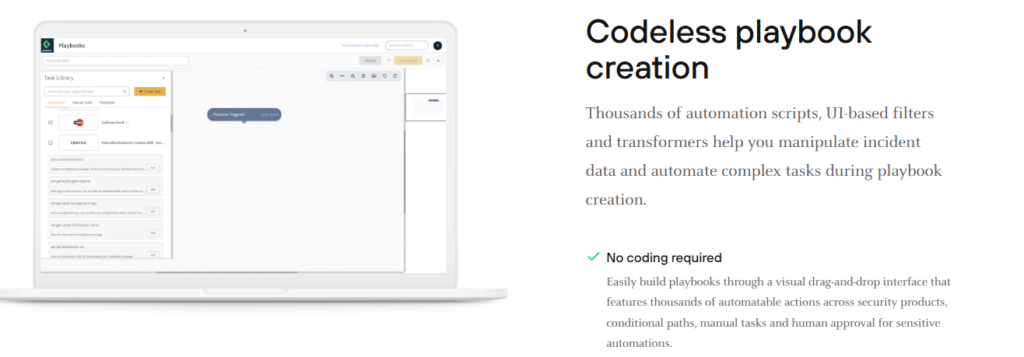
Cortex XSIAM is Palo Alto Networks’ consolidated security operations platform, combining SIEM, XDR, and automation in one data lake. It carries a 4.4 out of 5 average across 73 G2 reviews. For institutions already committed to Palo Alto, the consolidation story is genuinely strong.
Core Services
- Unified data lake replacing separate SIEM and EDR consoles
- Thousands of out-of-the-box analytics and detections
- Automated alert grouping and noise reduction
- Built-in response automation and playbooks
- Customizable dashboards for SOC reporting
Why Financial Companies Consider Cortex XSIAM
Large banks with mature internal SOC teams like owning the console themselves. Reviewers praise the clean interface for complex investigations. One practitioner called it “a very good product for detection, automation and XDR/SEIM,” citing the volume of analytics shipped by default.
Ideal Customer Profile
Best suited for:
- Enterprises above 5,000 employees with staffed internal SOCs
- Existing Palo Alto customers consolidating licenses
- Teams with dedicated automation and detection engineers
Commercial Model
Licensing scales with ingested data and endpoint count. G2 reviewers flag cost as the single most common complaint, with 28 reviews citing high implementation and maintenance expense, which is why a total cost of ownership comparison matters before signature.
When to Shortlist
Shortlist XSIAM when consolidation onto one vendor is the strategic goal and headcount exists to run it. Not recommended if you need to preserve an existing third-party SIEM, or if customization flexibility is a hard requirement, a concern practitioners raise openly when evaluating a swap.
Customer Reviews
“It is a very good product for detection, automation and XDR/SEIM. it is impressive. There are a tonne (like 1000’s) of analytics out of the box.”
u/anonymous, r/paloaltonetworks Reddit Thread
“If you’ve recently moved to XSIAM how are you liking it. Thinking about replacing current EDR and SIEM with XSIAM. Worried about customizability.”
u/anonymous, r/paloaltonetworks Reddit Thread
UnderDefense takes the opposite architectural bet, running agentic investigation across whichever SIEM and EDR a bank already owns. My read is that consolidation buys clarity and costs optionality, and regulated buyers should price that trade honestly.
1.3 CrowdStrike Falcon Next-Gen SIEM, Best for Firms Already Running Falcon Endpoints
Overview
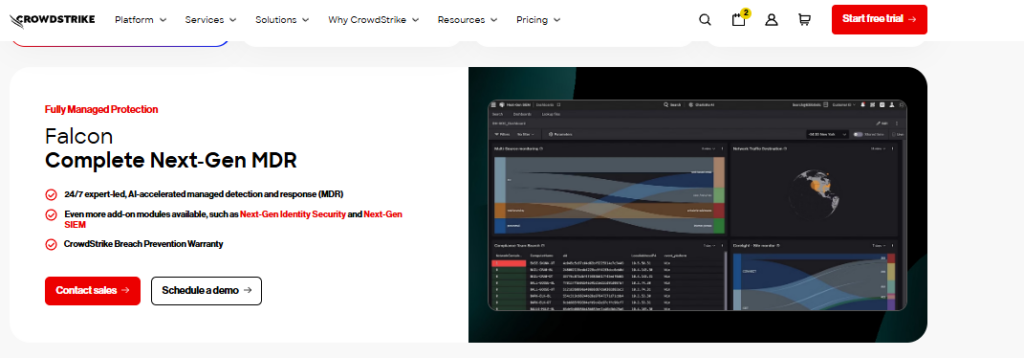
Falcon Next-Gen SIEM extends CrowdStrike’s endpoint platform into log management and detection at scale. It scores 4.5 out of 5 in independent SIEM scoring roundups. For a bank that already trusts Falcon on every laptop, the telemetry quality is genuinely hard to beat.
The honest catch is scope. Endpoint-anchored platforms see endpoints best, and financial fraud paths often run through identity and payment systems.
Core Services
- Log ingestion and fast search built on Falcon telemetry
- Detections tied directly to endpoint behavior and threat intel
- Charlotte AI agents for triage assistance
- Agentic SOAR-style orchestration for response actions
- Custom agent building for Falcon-standardized teams
Why Financial Companies Consider CrowdStrike
Practitioners report real speed gains after moving off legacy SIEM. One described faster searches, less noise, and more control after the switch. For institutions with a staffed SOC, that control is the selling point.
Ideal Customer Profile
Best suited for:
- Existing Falcon Complete or Falcon Enterprise customers
- Banks and insurers above 2,000 employees with internal detection engineers
- Cloud-native firms with mature SOC processes
Commercial Model
The SIEM component is licensed separately from endpoint protection. One reviewer noted wishing SIEM were included, given endpoint data is already captured.
When to Shortlist
Shortlist when Falcon is the standard and the team can staff detection engineering in-house. Not recommended if customization flexibility matters, since G2 reviewers flag low customizability and thin documentation. Where an internal team cannot carry that load, a dedicated AI SOC compared against CrowdStrike’s own managed tier is the more honest comparison to run.
Customer Reviews
“The customizability of the product is very low and the documentation is not much detailed.”
Verified User CrowdStrike Falcon Next-Gen SIEM G2 Verified Review
“Switched over to NG-SIEM and honestly it’s been night and day: faster searches, less noise, and way more control. Overall very pleased.”
u/anonymous, r/crowdstrike Reddit Thread
1.4 Microsoft Sentinel and Security Copilot, Best for Microsoft E5 Shops
Overview
Sentinel is Microsoft’s cloud-native SIEM, and Security Copilot adds AI triage on top. Sentinel carries 298 verified Gartner Peer Insights reviews, and Copilot 35, showing a mature product beside a newer one.
Microsoft has pushed autonomous triage agents directly into Defender. Coverage widened from phishing into identity and cloud alerts within a year.
Core Services
- Cloud-native SIEM with deep Azure and M365 telemetry
- Security Alert Triage Agent classifying alerts with natural-language rationale
- KQL-based hunting and custom analytics rules
- Native integration with Defender and Entra ID
- Workbooks for compliance and board reporting
Why Financial Companies Consider Microsoft
For E5 licensees, activation costs less than integration. Microsoft cites one health system saving 200-plus analyst hours per month, with the triage agent surfacing 6.5 times more malicious alerts than manual review.
Ideal Customer Profile
Best suited for:
- Institutions fully standardized on Microsoft identity and productivity
- Teams with KQL skills or a partner supplying them
- Firms wanting one billing relationship
Commercial Model
Sentinel bills on data ingestion and retention, and Copilot on compute units. Ingestion-based pricing punishes verbose log sources, which is where many banks live.
When to Shortlist
Shortlist when the estate is Microsoft-first and the team can own tuning. Not recommended if a large share of telemetry comes from non-Microsoft firewalls, core banking, or payment platforms, where the native advantage disappears. For mixed estates, co-managed detection across Microsoft 365 and everything beside it keeps the coverage honest.
1.5 Google Security Operations, Best for Data-Heavy Firms With Long Retention Needs
Overview
Google folded Chronicle and Mandiant into Google Security Operations and layers Gemini agents on top. Google reports its triage agent compressing a roughly 30-minute manual analysis to about a minute across more than 5 million alerts in the past year.
Retention economics are the quiet advantage. Financial institutions with multi-year log requirements notice this at renewal.
Core Services
- Petabyte-scale telemetry search with flat-rate ingestion
- Gemini triage, threat hunting, and detection engineering agents
- Mandiant frontline threat intelligence built in
- Long default hot retention for investigations and audits
- Remote MCP server support for third-party context
Why Financial Companies Consider Google
Examiners ask for historical evidence, sometimes years back. Search speed across that volume is the practical benefit, alongside Mandiant intel on state-sponsored actors.
Ideal Customer Profile
Best suited for:
- Large institutions with heavy log volume and long retention mandates
- Threat hunting teams with dedicated detection engineers
- Firms consolidating telemetry on Google Cloud
Commercial Model
Pricing generally follows employee count or data tiers rather than raw ingestion, which suits verbose environments.
When to Shortlist
Shortlist when data volume is the binding constraint. Not recommended if the team is lean, since the platform supplies the engine while the driving stays in-house. Where retention rules and residency both bite, the data residency questions worth settling before onboarding should go into the RFP early.
1.6 Prophet Security, Best for Lean Teams Drowning in Alert Volume
Overview
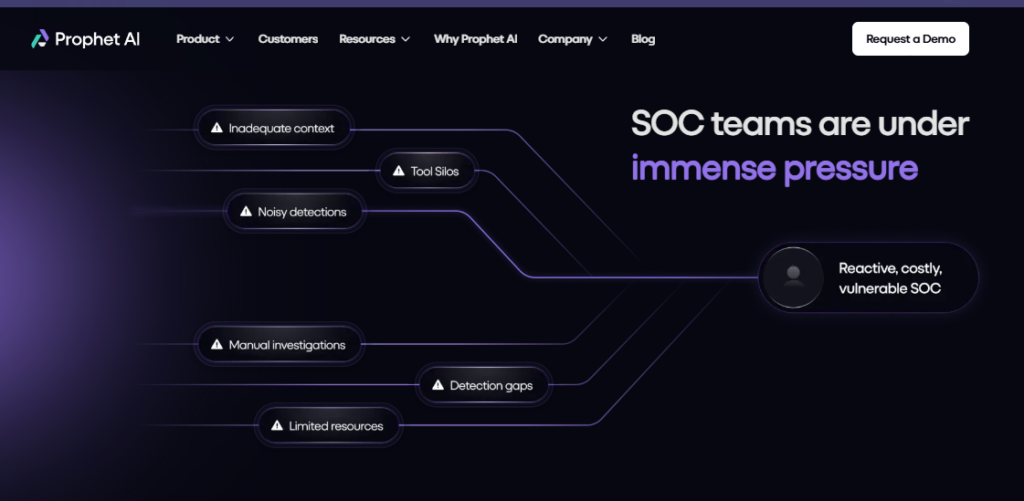
Prophet Security sells an agentic AI SOC platform that investigates alerts autonomously and returns evidence-backed verdicts. It is SOC 2 Type 2 certified and sold enterprise-only on custom quotes.
Onboarding is genuinely light. Read-only access to two or three tools starts investigations within minutes.
Core Services
- Autonomous investigation across SIEM, EDR, identity, cloud, and email
- Glass-box audit trail documenting every query and piece of evidence
- Detection tuning driven by investigation verdicts
- Natural-language AI threat hunting
- Explicit indeterminate verdicts routed to humans
Why Financial Companies Consider Prophet
Low and medium severity alerts get skipped when teams are short-staffed. One customer’s InfoSec lead described gaining 100% investigation coverage, and valued the AI admitting when it does not know.
Ideal Customer Profile
Best suited for:
- Security teams of two to ten people carrying high alert volume
- Multi-vendor stacks that will stay multi-vendor
- Firms wanting audit trails for every verdict
Commercial Model
Enterprise-only pricing with custom quotes and no published rate card.
When to Shortlist
Shortlist when triage capacity is the bottleneck and the stack is mixed. Not recommended if you need humans owning containment, or if you run niche legacy on-premises systems, a limitation the vendor states plainly. For teams that want both autonomy and a named analyst on the bridge, compare against options built for a three to five analyst team.
1.7 ReliaQuest GreyMatter, Best for Enterprises Wanting an Open Detection Layer
Overview
GreyMatter is a co-managed security operations platform that sits over existing tools rather than replacing them. It carries 258 verified Gartner Peer Insights reviews, one of the larger evidence bases in the category.
The open-layer architecture is real and useful. Banks keep their SIEM investment intact.
Core Services
- Cross-tool detection layered over existing SIEM and EDR
- Co-managed 24/7 monitoring with client-side visibility
- Automated response playbooks
- Threat hunting and detection content updates
- Enterprise reporting packages
Why Financial Companies Consider ReliaQuest
Mid-contract institutions want detection improvement without a migration. GreyMatter’s model fits that constraint, which is why it shows up on shortlists alongside pure-play providers.
Ideal Customer Profile
Best suited for:
- Enterprises above 3,000 employees with existing SIEM commitments
- Teams wanting co-management rather than full outsourcing
- Firms with internal analysts who will stay involved
Commercial Model
Subscription pricing scoped to environment size, sold through multi-year enterprise agreements.
When to Shortlist
Shortlist when co-management is the desired operating model. Not recommended if you want the provider to close the loop alone, since the pattern reported across the category is tickets coming back without a clear answer, leaving the client to finish the analysis. Buyers weighing that trade-off usually end up reviewing alternatives that own the response outcome.
1.8 Arctic Wolf, Best for Smaller Institutions With No Security Staff
Overview
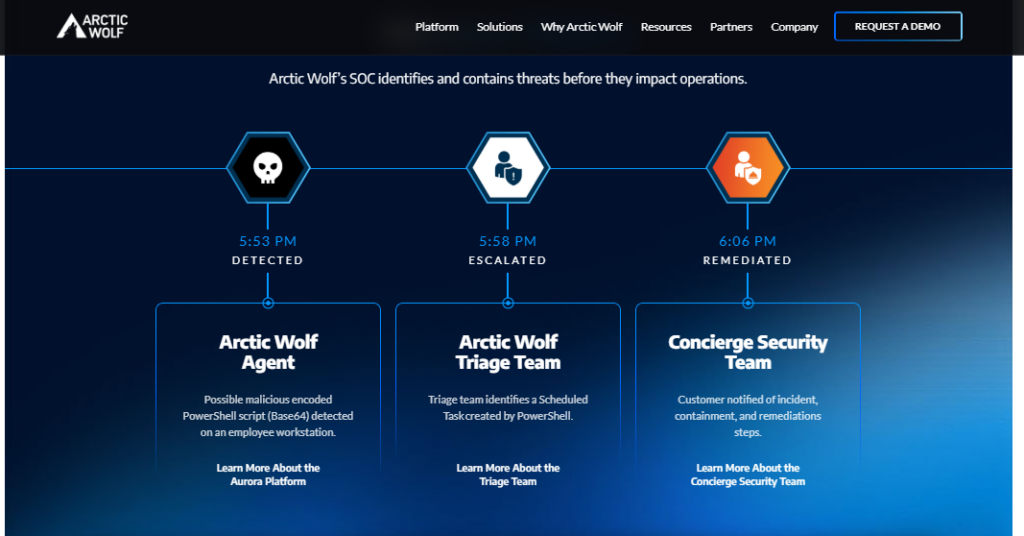
Arctic Wolf delivers a fully outsourced SOC through its Concierge Security model. For a credit union with no security hire, steady 24/7 alerting is a genuine step up from nothing.
The structural trade-off shows up in remediation. Alerts arrive, and the client’s team executes.
Core Services
- 24/7 managed detection and response with a named concierge team
- Log monitoring and threat hunting
- Vulnerability and risk management
- Security awareness training
- Compliance readiness support (SOC 2, PCI DSS, and HIPAA)
Why Financial Companies Consider Arctic Wolf
Small institutions cannot hire a SOC. Arctic Wolf packages monitoring, training, and risk management into one subscription, which simplifies board reporting.
Ideal Customer Profile
Best suited for:
- Community banks and credit unions with 50 to 1,000 employees
- Organizations with no dedicated security headcount
- Firms needing a compliance checkbox with real coverage behind it
Commercial Model
Subscription pricing aligned to organization size and monitored assets, with a 60-day renewal notice window that reviewers flag as unusual. Institutions modelling that renewal should read the published breakdown of Arctic Wolf’s pricing structure before the notice window closes.
When to Shortlist
Shortlist when any coverage beats current coverage and internal customization needs are low. Not recommended if you need response ownership or platform flexibility, since changes route through the vendor’s engineering team.
Customer Reviews
“Arctic Wolf provides Solid detection and response capabilities, but overly relies on the client’s team for remediation, which really hurts the value of the service.”
VP of Technology Arctic Wolf Gartner Verified Review
“Log collectors show working, however when asked to provide logs for an investigation no logs could be provided. Analysts provide little context, and when asked for more information in the investigation nothing is ever provided or even communicated.”
1.9 Deepwatch, Best for Splunk-Committed Enterprises
Overview
Deepwatch runs managed detection built around Splunk. G2 reviewers call the Splunk integration a significant advantage for log management, while flagging pricing as a concern.
That coupling cuts both ways. Splunk depth comes with Splunk economics.
Core Services
- Managed detection and response on Splunk infrastructure
- 24/7 SOC monitoring with a named squad model
- Detection engineering and content tuning
- Threat hunting and reporting
- Compliance-oriented reporting packages
Why Financial Companies Consider Deepwatch
Institutions with years of Splunk investment want a partner who speaks it fluently. Deepwatch does, and the log management continuity is real. Firms comparing that continuity against an open model often look at co-managed detection built on an existing Splunk deployment alongside it.
Ideal Customer Profile
Best suited for:
- Enterprises with an established Splunk deployment
- Banks and insurers with mature log pipelines
- Teams comfortable with a single-SIEM architecture
Commercial Model
Subscription pricing tied to data volume and scope, which reviewers describe as a cost consideration.
When to Shortlist
Shortlist when Splunk is permanent and continuity outweighs flexibility. Not recommended if you want an open architecture, or if you need the provider standing with you during containment rather than handing back findings.
SEE IT LIVE
WHERE THIS IS HANDLED
UnderDefense MAXI runs agentic investigation across the stack you already own.
If you want to see how a single alert becomes a full evidence trail in your own environment, this is where that happens.
My read after scoring all nine
Score every vendor against one question: does it produce a line-by-line investigation record, or a copy-pasted log summary? Cloud break-ins now move in under a minute, so the gap between an alert and a decision is the whole game.
The Lego argument keeps coming up in my calls. Buyers want all the bricks, and they want to build their own platform rather than rent someone’s sealed box.
UnderDefense MAXI holds 2-minute alert-to-triage with 15-minute escalation for critical incidents, running on the SIEM and EDR a firm already owns, with roughly 99% noise reduction and investigation records auditors can read line by line on the UnderDefense MAXI platform. I would still test that in your own environment before signing anything, including with us.
Q2. How Did We Score and Select These 9 Platforms?
Each platform was scored on five weighted criteria: Regulatory Evidence Automation 25%, Vendor-Agnostic Stack Integration 20%, Autonomy Depth with Human Verification 20%, Pricing and TCO Transparency 20%, and Verified User Reviews 15%. Bands: 81 to 100 earns 5 stars, 61 to 80 earns 4, 41 to 60 earns 3, 21 to 40 earns 2, and 0 to 20 earns 1.
Why These Five Axes, and Not Feature Counts
The weights, published so you can change them
| Criterion | Weight | What it measures |
| Regulatory Evidence Automation | 25% | Whether the platform produces artifacts an examiner accepts |
| Vendor-Agnostic Stack Integration | 20% | Coverage of tools you already own, including third-party and fourth-party sources |
| Autonomy Depth with Human Verification | 20% | Real investigation depth, plus a human who signs off |
| Pricing and TCO Transparency | 20% | Published models versus quote-only opacity |
| Verified User Reviews | 15% | G2, Gartner Peer Insights, and Reddit evidence |
Regulatory evidence carries the heaviest weight for one reason. In a supervised institution, the artifact is what gets handed over, and the dashboard stays behind the glass. Readers building their own version of this rubric usually start from a set of AI SOC evaluation questions and weight them against their own regulator.
The gate nobody puts in a scoring rubric
Detection engineering sits inside the integration axis on purpose. Get that wrong and you are left swimming in noise, and an AI SOC becomes a faster way to be wrong. Automation faithfully executes whatever brokenness the manual process already had.
The SANS 2025 SOC Survey backs this up with uncomfortable numbers. 42% of SOCs dump all incoming data into a SIEM without a retrieval or management plan, and another 42% run AI/ML tools out of the box with no customization. AI/ML also ranked at the bottom of the satisfaction list, below every other tool category, which is exactly what unmanaged alert fatigue produces over time.
How Each Score Was Evidenced
Three sources per vendor, minimum
Scores came from vendor documentation, published pricing pages where they exist, and verified reviews on G2 and Gartner Peer Insights. Where a vendor publishes no pricing, the TCO axis was scored down, and that is stated in each entry. Anyone rebuilding this comparison can cross-check against a published AI SOC pricing guide rather than a sales quote.
UnderDefense measures the detection-engineering gate by noise reduction, and reports roughly 99% of raw alert volume removed before human review. A customer described the same effect from the other side, saying their configurations were cleaned up and noise was under control within the first week.
The disclosure you should demand
UnderDefense scores 94/100 under this rubric, and UnderDefense also publishes this article. That conflict is real, so the weights are printed above rather than summarized. Re-weight them for your own regulator and the order changes.
Here is the part I want to say plainly. The two highest-ranking competing AI SOC listicles both place their own product at position one and publish no methodology at all. My read is that an unpublished rubric is the tell, whoever wrote it, which is why explainability and transparency belong in the scoring rather than in the marketing.
What reviewers said about the scoring inputs
“UnderDefense MAXI integrates well with our systems, specifically with our SIEM, Splunk. Their team is proactive in identifying and addressing threats, providing 24/7 oversight.”
Oleg K., Director Information Security UnderDefense G2 Verified Review
“Log collectors show working, however when asked to provide logs for an investigation no logs could be provided. Analysts provide little context, and when asked for more information in the investigation nothing is ever provided or even communicated.”
UnderDefense publishes these weights because a rubric you cannot re-run is marketing. Take the table, change the percentages to match your examiner, and see which vendor survives your version.
Q3. What Is an AI SOC for Financial Services, and How Is It Different From SIEM, XDR, SOAR and MDR?
An AI SOC for financial services uses agentic AI to autonomously investigate, correlate, and contain threats across payment rails, identity systems, and cloud workloads, with human analysts directing and verifying. SIEM centralizes logs, XDR correlates endpoint and network telemetry, SOAR runs fixed playbooks, MDR adds an outsourced response team, and an AI SOC adds machine-speed investigation with audit-ready evidence.
Foot Soldiers and Generals
The simplest model I use with boards
Think of AI agents as foot soldiers and your analysts as generals. Agents do the querying, pivoting, and correlating at volume. Humans decide what it means and what happens next.
That split matters because the old model assumed alerts arrive faster than attackers move. NIST SP 800-61 built incident handling around detection, analysis, containment, and recovery as human-paced phases, which held up for years. If you want the longer definition, the category breakdown of what an AI SOC actually is covers the moving parts in order.
Where Each Layer Actually Sits
| Layer | Core job | Structural limit |
| SIEM | Centralizes and stores logs | Storage without judgment; 42% of SOCs ingest with no retrieval plan |
| XDR | Correlates endpoint and network signals | Strongest inside its own vendor’s telemetry |
| SOAR | Runs predefined playbooks | Fails on anything the playbook did not anticipate |
| MDR | Adds an outsourced response team | Human-paced triage, often behind a black box |
| AI SOC | Investigates autonomously, humans verify | Depends entirely on detection-engineering quality |
Why alert forwarding broke
Median cloud break-in time now sits at 48 minutes, and the fastest observed sequence ran in about 51 seconds. Endpoint alerts trigger 85% of incident response starts, and 69% of SOCs still report metrics manually. That mismatch is the whole problem, and it is the reason a side-by-side of AI SOC against SOAR and MDR lands differently for regulated buyers than it did three years ago.
The 51-Second Sequence
Minute by minute, in real terms
An actor social-engineered AWS credentials from a help desk. They opened cloud shell, created an SSH key pair, established an administrative IAM role, and launched an EC2 instance. Total elapsed time: under one minute.
Now place a legacy MSSP in that timeline. The log ships, the queue receives it, and a tier-one analyst opens the ticket sometime later. Parroting alerts back at you produces exhaustion, and it produces it after the IAM role already exists.
Depth is measurable, so measure it
UnderDefense MAXI makes over 100 distinct large language model invocations to investigate a single alert, and exposes every step on the UnderDefense MAXI platform. That count is the difference between recursive reasoning and a wrapper re-reading one log.
Recursive reasoning means the system asks a question, reads the answer, then forms the next question from it. A thin wrapper summarizes and stops. Ask any vendor for the invocation count and the query trail, and watch which answer arrives.
Humans click, agents swarm
I have sat through enough 2 a.m. bridge calls to know the bottleneck is rarely the tooling. It is one tired person pivoting between six consoles while the clock runs, which is the operational reality behind every argument for reducing analyst burnout with agentic investigation.
UnderDefense holds 2-minute alert-to-triage with 15-minute escalation for critical incidents, treating those as two separate commitments rather than one blended number. My honest caveat is that these numbers only hold when detection engineering was done properly first, and we have walked away from deals where the client wanted the agents without that groundwork.
Q4. Can an AI SOC Produce the Evidence PCI DSS, SOC 2, SEC and NYDFS Examiners Ask For?
Yes, partially. An AI SOC can automate PCI DSS Requirement 10 log collection, retention, and daily-review evidence, and support Requirement 7 least-privilege monitoring. Because SOC 2 CC6 and CC7 align with those requirements, one control set evidences both. For SEC Item 1.05 and NYDFS Part 500 it supplies the timestamped incident timeline, but materiality judgment and attestation stay with named humans.
The Yes-But Boundary
What machines can and cannot sign
Automation is excellent at producing the record. It cannot own the judgment, and no regulator will accept an agent as the signatory. That boundary is where most vendor conversations get vague.
I have spent close to two decades walking into PCI engagements where nobody wanted an auditor in the room. What assessors sample is evidence density, and summaries fall apart under sampling. Teams heading into their first cycle usually benefit from reading a PCI DSS audit walkthrough before scoping any platform.
Clause-to-Capability Matrix
| Requirement | What it demands | AI SOC status |
| PCI DSS 10.2 to 10.4 | Audit logs captured, protected, reviewed daily | Automatic |
| PCI DSS 10.5 | 12-month retention, 3 months immediately available | Automatic |
| PCI DSS Req 7 | Least-privilege access monitoring | Configurable |
| SOC 2 CC6 | Logical access controls | Configurable |
| SOC 2 CC7 | Monitoring and incident detection | Automatic |
| SEC Item 1.05 | 8-K filing within 4 business days of materiality determination | Timeline supplied, judgment human |
| NYDFS 500.17(a) | Notify DFS within 72 hours of determination | Timeline supplied, filing human |
| NYDFS 500.17 ransom | Notify within 24 hours of payment, details within 30 days | Absent, wholly human |
| GDPR Article 33 | 72-hour supervisory notification | Timeline supplied |
What an Assessor Actually Asks to See
Sampling beats dashboards
An assessor picks a date, picks an alert, and asks who looked at it and what they checked. A dashboard screenshot does not answer that. The query trail does.
UnderDefense MAXI records 40 to 50 queries across six tools per average investigation, with line-by-line detail rather than best-effort copying and pasting of logs. That density is what survives sampling, and it is why we treat audit-readiness as a byproduct of investigation depth. The full mapping exercise is covered in our AI SOC compliance guide.
Where compliance-automation platforms stop
Dashboard-first compliance tools are genuinely good at policy collection and control mapping. Their structural limit is that they document controls without generating investigation evidence. An assessor asking about a specific Tuesday in March needs the second thing, which is where compliance services tied to real detection work earn their place.
The anxiety I hear most often is real. CISOs worry about trusting an autonomous agent with regulatory reporting and creating a black-box accountability nightmare.
The SEC and NYDFS Timeline, and Who Signs
Named humans, on the record
SEC Item 1.05 runs on a materiality determination, and that determination is a judgment call made by people. NYDFS Part 500 requires notification within 72 hours of determining a reportable event, and a separate 24-hour clock for ransom payments.
Build the evidence matrix before the next vendor call: one row per regulation, one column for the artifact, one column for the named signer. Where the signer column is blank, you have found the gap that no platform closes for you, and it is worth settling with a virtual CISO before an examiner asks.
UnderDefense produces investigation records dense enough to survive an assessor’s sampling, and keeps attestation with named humans rather than a model. In our engagements, that split is what turns audit season from a scramble into a retrieval exercise.
Q5. What Does an AI SOC Catch That Your Current Stack Misses?
Three blind spots. Business fraud, because a fraud engine scores transactions while an AI SOC explains the account takeover behind them. Ransomware dwell time, because the window between entry and encryption keeps shrinking. And third-party compromise, which now appears in 30% of breaches after doubling from 15%.
Where Fraud and Security Stop Talking
The convergence nobody staffs for
Fraud teams watch transactions, and security teams watch endpoints. The account takeover that enables the fraudulent transaction lives between those two desks.
Credential abuse remains the most common initial access vector at 22% of breaches, with vulnerability exploitation at 20%. Both routes end at a session an AI SOC can explain and a fraud engine cannot, which is why AI SOC coverage built for financial services starts at identity rather than at the payment rail.
The $300k found by accident
UnderDefense MAXI surfaced a live payroll fraud scheme inside the first three months of onboarding one client, saving roughly $300,000 before tuning was even complete. Nobody was hunting fraud that week. We were still wiring up log sources.
I want to be honest about what that story proves and does not prove. It proves visibility catches things nobody scoped, and it does not promise the same result to the next customer.
On the “unbiased” fraud AI claim
I am happy if my model shows bias, because then I can measure what it gets wrong and adjust it. The genuinely dangerous model is the one sold as unbiased. If a vendor claims their fraud AI carries no bias, they are wrong, and they are hiding something structural.
The Elite Stack That Saw Nothing
A crafted request, ten credential pairs
Attackers used a crafted HTTP request against a memcache service to harvest more than ten credential pairs. No EDR alert fired. The organization ran CrowdStrike and Splunk.
The initial phase was fully undetected because logs were never activated on a pilot application. Tool count was never the problem. Coverage was, and that gap is what a MITRE ATT&CK coverage comparison for cloud exposes before an attacker does.
Dwell time and what it does to your SLA
Verizon’s 2025 dataset puts median dwell time in non-actor-disclosed breaches at 24 days, improved from 30 days in 2023. Ransomware now appears in 44% of breaches, up 37% year over year, which is the reason a ransomware response checklist belongs in the runbook rather than in a shared drive.
UnderDefense measures response as two separate clocks, 2-minute alert-to-triage and 15-minute escalation for critical incidents, because a single blended number hides which half is broken. My read is that most providers report the blend precisely because the triage half looks worse.
Third and Fourth Party as an Evaluation Axis
Ask about the vendor’s vendor
Third-party involvement doubled to 30% of breaches in one year. Median time to remediate leaked secrets found in a GitHub repository ran 94 days, which is where vendor risk management stops being a questionnaire exercise.
Score every AI SOC vendor on whether it ingests third-party and fourth-party telemetry, or only your own. One customer described UnderDefense MAXI pulling data from all their existing tools without a rip-and-replace project, which is the precondition for that coverage.
Two zero-cost actions for Monday
Pull your Google Workspace or Microsoft 365 OAuth logs. Every site where an employee clicked “log in with Google” appears there, and it is a rich map of shadow fintech vendors at zero cost.
Then review geographic login anomalies going back two years. One stale login from Thailand or Singapore can be a 2020 compromise still authenticating today, a pattern behavioral analytics surfaces faster than a manual review ever will.
“They know everything about cloud security. Underdefense protects all our cloud stuff. If something does happen, they react automatically which is amazing.”
Verified User UnderDefense G2 Verified Review
“Log collectors show working, however when asked to provide logs for an investigation no logs could be provided. Analysts provide little context, and when asked for more information in the investigation nothing is ever provided or even communicated.”
UnderDefense found that fraud scheme during onboarding, before optimization, which tells you the gap was visibility rather than sophistication. What I am still sitting with is how many institutions have a similar scheme running right now, invisible for the same boring reason.
Q6. What Does an AI SOC Cost, and Which Metrics Actually Convince a Board?
A loaded security position costs about $124,163 a year, so five people, the bare minimum for 24/7/365 coverage, costs $620,815 in salary alone before tooling. Any managed AI SOC must beat that comparative cost of delivery. Stop trying to prove breach-prevention ROI, because you cannot prove a negative, and stop reporting percentage of alerts auto-closed.
The Staffing Floor You Are Comparing Against
Five people, minimum, no exceptions
| Delivery option | Annual cost driver | What you get |
| In-house 24/7 SOC | $620,815 salary floor, 5 loaded positions | Full control, hiring risk, burnout risk |
| Tool-only AI SOC | Platform license, usually quote-only | Automation, no response ownership |
| Ingestion-priced platform | Scales with data volume | Cost rises as the business grows |
| UnderDefense MAXI | Scope-based subscription | Agentic investigation plus analyst escalation |
That $620,815 covers salary. Add tooling, on-call stipends, and the cost of a resignation in month seven. Anyone running this arithmetic properly should start from a SOC cost calculator rather than a vendor slide.
Why prevention ROI is a trap
Proving a negative is a losing proposition. You cannot show the board the breach that did not happen.
IBM’s 2025 report puts the global average breach cost at $4.44M, and lists AI and automation among its top recommendations for faster detection. That is useful context, and it is still not proof your specific spend prevented a specific event, which is why an AI SOC business case should be built on delivery cost instead.
Interrogate the Pricing Model
Four questions before signature
- What does this cost at 2x current ingestion volume?
- Are connectors billed separately from the platform?
- Is extended retention a separate line item?
- What happens at renewal if data volume grew 40%?
UnderDefense prices against defined scope rather than ingestion volume, so the comparison to a $620,815 staffing floor can be run before a contract is signed instead of after the first data-growth invoice. Ask us to model it at double your current volume and see whether the number moves, and put the answer beside the contract clauses worth negotiating.
The vanity metric to retire
Percentage of alerts auto-closed sounds like efficiency. It masks the high-severity incident that got closed wrongly at 3 a.m.
Report instead: alert-to-triage time, escalation time for critical severity, and the number of investigations where a human overrode the machine. That last one tells you whether verification is real, and it maps directly onto the commitments described in an AI SOC SLA guide.
What Boards Actually Absorb
One page, five NIST functions
I have fought budget battles with boards that neither cared for nor understood technical metrics. What worked was one page mapping every security dollar into Identify, Protect, Detect, Respond, and Recover.
The CFO sees where money goes, and more importantly, where nothing goes. An empty Respond column ends the argument faster than any dashboard, and the 2026 cybersecurity budget playbook gives you the one-page format to fill in.
“UnderDefense is surprisingly affordable considering the level of protection we get. Their proactive threat hunting and rapid response have saved us from incidents that could have been incredibly costly.”
Verified User in Program Development UnderDefense G2 Verified Review
“It’s reassuring to know they’re always watching for threats, and it doesn’t cost a fortune. They catch and stop problems quickly, which is a huge relief.”
Serhii B., Chief Information Security Officer UnderDefense G2 Verified Review
UnderDefense publishes scope-based pricing so the comparison against an in-house floor is arithmetic rather than a negotiation. My open question for 2027 is whether ingestion-priced platforms survive contact with CFOs who have now lived through one growth-year invoice.
Q7. How Do You Evaluate, Govern and Deploy an AI SOC in Your First 90 Days?
Start by instrumenting your alert queue for one week to size automation-addressable volume, then pull your MITRE ATT&CK coverage heatmap, publish a one-page AI scope-of-authority document, require vendors to run your own runbooks against your own telemetry in the proof of value, model cost at 2x ingestion, and score regulatory evidence automation clause by clause.
The Six-Step Evaluation Protocol
Do these in order
- Instrument the alert queue for seven days, counting volume, severity mix, and repeat sources.
- Pull your MITRE ATT&CK coverage heatmap (a grid showing which attacker techniques you can detect).
- Publish a one-page AI scope-of-authority document naming what agents may do alone.
- Make each vendor run your runbooks against your telemetry during the proof of value.
- Model total cost at double your current ingestion.
- Score regulatory evidence automation clause by clause against your regulator.
Step four is where most proofs of value fall apart. Vendor demo data always behaves, which is the whole argument for evaluating platforms against your existing SIEM and EDR rather than against a sandbox.
Governance Before Autonomy
The gap the survey exposes
The SANS 2025 SOC Survey found 42% of SOCs run AI/ML tools with no customization, and 42% ingest all data with no retrieval plan. AI/ML also ranked last in tool satisfaction across the survey.
That combination predicts exactly what you would expect. Untuned automation executing an untuned process, faster.
Deterministic remediation, constrained creativity
Detection benefits from creative reasoning. Remediation should be boring. Give an agent one specific API, permitted to perform one function, with a defined blast radius, which is precisely what AI SOC guardrails are for.
UnderDefense MAXI keeps human analysts as the approving authority on containment, so autonomy compresses investigation time without transferring accountability to a model. That gate is what answers the black-box worry, and we would rather lose a few seconds than a few servers.
The PRD-first rule, and why
Before an agent builds or changes anything, ask it to write a product requirements document listing the exact libraries and calls it will use. Then you edit that document.
A founder skipping this step let an agent delete his production database. Your mental model of a language model should be a regurgitator guessing what words you want, rather than a researcher.
Shadow AI and Data Sovereignty
Decide what never enters the platform
Verizon’s 2025 report found 15% of employees routinely accessing generative AI platforms on corporate devices. That is your shadow AI baseline, and it is probably higher now.
One customer told me plainly that their HIPAA data would never go into an AI platform’s purview. That is a legitimate architectural choice, so put no-train and no-retention terms in the contract and scope the data boundary before onboarding, alongside the AI data governance decisions your regulator will eventually ask about.
Phased Rollout With Real Targets
| Phase | Weeks | Scope | Targets |
| Phase 1 | 1 to 4 | Log onboarding, detection tuning, baseline metrics | Establish current detection and triage baselines |
| Phase 2 | 5 to 8 | Agentic triage live, human-approved containment | Alert-to-triage under 2 minutes |
| Phase 3 | 9 to 12 | Full escalation paths, evidence packs, board reporting | 15-minute critical escalation, audit artifacts delivered |
Three red flags on any shortlist
Watch for a vendor who will not state invocation counts per investigation, one who cannot show a query trail for a specific past alert, and one whose pricing changes shape when you ask about 2x volume.
Route by constraint: single-vendor stack with internal engineers, keep it in-house on your platform vendor; mixed stack with a lean team, go agentic with human escalation; heavy regulator, weight evidence automation above everything. Teams unsure which lane they sit in usually settle it by comparing AI SOC deployment models side by side.
“Setting it up can be tricky, especially for those new to such comprehensive security solutions. However, engineers are available to assist with every step of the process!”
Verified User in Hospitality UnderDefense G2 Verified Review
“Arctic Wolf provides Solid detection and response capabilities, but overly relies on the client’s team for remediation, which really hurts the value of the service.”
VP of Technology Arctic Wolf Gartner Verified Review
RFP READY
WHERE THIS IS HANDLED
UnderDefense answers AI SOC RFPs for banks, payment processors and fintechs every week.
If you are building the shortlist or the RFP right now, send us the requirements and we will map our answers clause by clause against your regulator.
You do not win in cybersecurity. It runs more like a zombie apocalypse, where you hold the line and keep the lights on. The anxiety I hear underneath every RFP is simpler than architecture: nobody wants to be alone at 3 a.m. when it happens. What I am genuinely unsure about is how much autonomy institutions will grant agents by late 2027, and I would like to hear where you would draw that line in your own environment.
1. What makes an AI SOC the best fit for a financial services firm rather than a general-purpose SOC platform?
Financial institutions carry two pressures at once: an examiner who asks for artifacts and an attacker who moves in under an hour. A general-purpose platform usually satisfies one of those and not the other.
We scored nine platforms on five axes and weighted regulatory evidence automation at 25% for a simple reason. In a supervised institution, the artifact is what gets handed over, and the dashboard stays behind the glass.
- Evidence density that survives assessor sampling, not screenshots
- Coverage of the tools already licensed, including third-party and fourth-party telemetry
- Autonomy with a human signature on containment decisions
- Pricing that does not reshape when data volume doubles
UnderDefense scores 94/100 under this rubric, and UnderDefense also publishes the article, so we printed the weights instead of summarizing them. Re-weight them for your own regulator and the order changes.
Detection engineering is the gate underneath all of it. Get that wrong and automation simply executes the same brokenness faster. If you want the category framed before you compare vendors, start with our explanation of AI SOC coverage built for financial services.
2. Can an AI SOC produce the PCI DSS evidence our assessor actually asks for?
Partly, and the boundary matters. Automation is excellent at producing the record. It cannot own the judgment, and no regulator accepts an agent as a signatory.
Here is what maps cleanly:
- PCI DSS 10.2 to 10.4: audit logs captured, protected, and reviewed daily, automatic
- PCI DSS 10.5: 12-month retention with 3 months immediately available, automatic
- PCI DSS Requirement 7: least-privilege access monitoring, configurable
- SOC 2 CC6 and CC7: aligned closely enough that one control set evidences both
What an assessor really does is pick a date, pick an alert, and ask who looked at it and what they checked. A dashboard screenshot does not answer that question. The query trail does.
UnderDefense MAXI records 40 to 50 queries across roughly six tools per average investigation, with line-by-line detail rather than copy-pasted log summaries, which is the density that survives sampling. We treat audit-readiness as a byproduct of investigation depth rather than a separate reporting module.
Build a one-row-per-regulation matrix before your next vendor call: clause, artifact required, named signer. Our AI SOC compliance guide walks through that mapping clause by clause.
3. How is an AI SOC different from the SIEM, XDR, SOAR and MDR we already pay for?
Each layer does one job, and none of them replaces judgment at speed. The simplest model we use with boards is that AI agents are foot soldiers and analysts are generals.
- SIEM: centralizes and stores logs, storage without judgment
- XDR: correlates endpoint and network signals, strongest inside its own vendor’s telemetry
- SOAR: runs predefined playbooks, fails on anything the playbook did not anticipate
- MDR: adds an outsourced response team, still human-paced triage
- AI SOC: investigates autonomously at volume, humans verify and decide
The reason this shifted is arithmetic. Median cloud break-in time now sits at 48 minutes, and the fastest sequence we have documented ran in about 51 seconds. Endpoint alerts trigger 85% of incident response starts, and 69% of SOCs still report metrics manually.
Depth is measurable, so measure it. UnderDefense MAXI makes over 100 distinct large language model invocations to investigate a single alert, and exposes every step on the UnderDefense MAXI platform. That count separates recursive reasoning from a thin wrapper re-reading one log. Ask any vendor for their invocation count and their query trail, then watch which answer arrives.
4. Will an AI SOC catch banking fraud that our fraud engine already scores?
It catches a different half of the same event. A fraud engine scores the transaction, while an AI SOC explains the account takeover that made the transaction possible. That handoff lives between the fraud desk and the security desk, and almost nobody staffs it.
Credential abuse remains the most common initial access route at 22% of breaches, with vulnerability exploitation at 20%. Both paths end in a session that security telemetry can explain and a transaction model cannot.
UnderDefense MAXI surfaced a live payroll fraud scheme inside the first three months of onboarding one client, saving roughly $300,000 before detection tuning was even complete. Nobody was hunting fraud that week; we were still wiring up log sources.
I want to be honest about what that proves. It proves visibility catches things nobody scoped, and it does not promise the same result to the next customer.
One more thing on vendor claims. If a supplier tells you their fraud AI carries no bias, they are wrong and they are hiding something structural. I would rather have a model whose bias I can measure and correct. For the identity side of that picture, see how behavioral analytics surfaces anomalous sessions.
5. What does an AI SOC cost compared with building 24/7 coverage in-house?
Start with the staffing floor, because that is the honest comparison. A loaded security position costs about $124,163 a year, and five people is the bare minimum for 24/7/365 rotation, which puts the salary floor near $620,815 before a single tool is licensed.
Add on-call stipends, tooling, and the cost of a resignation in month seven. Any managed AI SOC has to beat that comparative cost of delivery, and if it cannot, the build case wins.
Four questions to ask before signature:
- What does this cost at 2x current ingestion volume?
- Are connectors billed separately from the platform?
- Is extended retention a separate line item?
- What happens at renewal if data volume grew 40%?
UnderDefense prices against defined scope rather than ingestion volume, so the comparison against that $620,815 floor is arithmetic you can run before signing rather than after the first growth-year invoice. Ask us to model it at double your volume and see whether the number moves.
Skip breach-prevention ROI entirely. You cannot show a board the breach that did not happen. Model the delivery cost instead, using our SOC cost calculator.
6. Can an AI SOC help us meet SEC and NYDFS reporting deadlines?
It supplies the timeline. It does not supply the signature, and that distinction is where most vendor conversations get slippery.
- SEC Item 1.05: an 8-K within four business days of a materiality determination, and that determination is a human judgment call
- NYDFS 500.17(a): notify the department within 72 hours of determining a reportable event, timeline automated, filing human
- NYDFS ransom provisions: notify within 24 hours of payment with details inside 30 days, wholly human
- GDPR Article 33: 72-hour supervisory notification, timeline supplied
The machine builds the timestamped incident record, and a named officer signs it. That is the accountability split every board should insist on.
UnderDefense keeps attestation with named humans rather than a model, while producing investigation records dense enough for an examiner to read directly rather than take on trust. In our engagements, that split is what turns audit season from a scramble into a retrieval exercise.
The worry we hear most is a black-box accountability nightmare, where nobody can explain who decided what. Write the signer column into your evidence matrix first, and settle the governance questions covered in our notes on explainability and transparency.
7. Do we have to replace our existing SIEM and EDR to adopt an AI SOC?
No, and for a bank mid-way through a SIEM contract that is usually the deciding factor. Two architectural bets exist in this market, and you should price the trade honestly.
Consolidation platforms ask you to standardize on one vendor’s data lake, which buys clarity and costs optionality. Open-layer and agentic platforms run over whatever you already license, which preserves optionality and demands better integration discipline.
Where the second approach earns its place:
- Mid-contract SIEM commitments you do not want to write off
- Mixed estates where core banking or payment telemetry is not native to your platform vendor
- Procurement conditions around data ownership and escape from lock-in
UnderDefense MAXI runs agentic investigation on top of the SIEM, EDR, cloud, and identity tools a firm already owns, and customers describe it pulling data from existing tools without a rip-and-replace project. Reviewers are equally candid that the integration week takes real back-and-forth to configure properly, which is fair and worth planning for.
The Lego argument keeps coming up in my calls: buyers want all the bricks and want to build their own platform rather than rent a sealed box. If that is your position, read how to evaluate platforms against an existing SIEM and EDR.
8. How long does AI SOC deployment take, and what governance should we put in place first?
Plan for 90 days in three phases, and write the governance page before the agents get any authority.
- Weeks 1 to 4: log onboarding, detection tuning, and baseline metrics
- Weeks 5 to 8: agentic triage live with human-approved containment, targeting alert-to-triage under two minutes
- Weeks 9 to 12: full escalation paths, evidence packs, and board reporting, with 15-minute critical escalation in place
Governance comes first because the SANS 2025 SOC Survey found 42% of SOCs running AI/ML tools with no customization and 42% ingesting all data with no retrieval plan. Untuned automation executing an untuned process is simply faster failure.
Our rule is that detection benefits from creative reasoning while remediation should be boring. Give an agent one specific API, one permitted function, and a defined blast radius.
UnderDefense MAXI keeps human analysts as the approving authority on containment, so autonomy compresses investigation time without transferring accountability to a model. We would rather lose a few seconds than a few servers.
Also decide what never enters the platform. Put no-train and no-retention terms in the contract, then scope the data boundary using our AI SOC guardrails checklist.