




Q1: Why do AI-speed attacks break the economics of a human-scaled SOC?
Attackers move at machine speed while defenders scale at human speed. Median break-in time has dropped to 48 minutes, with the fastest observed around 51 seconds, which makes traditional 30 to 60 minute managed response windows too slow to matter. You cannot hire your way across that gap. The buying question shifts from how many analysts toward what architecture responds while your team sleeps.
See how the UnderDefense Agentic AI SOC investigates, triages, and resolves real alerts.
🌙 The 3 a.m. moment nobody puts in the sales deck
The first time I stood up a SIEM (Security Information and Event Management) with a small team, I broke out in hives. Real ones. I could not keep up with the issues popping up faster than we could read them.
That memory shapes how I think about scale. A SIEM is a log-and-alert engine. Adding one more feed to a tired human does not fix the math underneath.
Most security leaders I meet are living my old 3 a.m. shift right now. They keep adding people to a problem that stopped being a people problem. The pattern is common in any conversation about alert fatigue on lean security teams.
⏰ The speed gap is a benchmark, not a vibe
Here is the uncomfortable number. The median time for an attacker to move from first foothold to lateral movement has fallen to around 48 minutes. The fastest recorded break-in sat near 51 seconds.
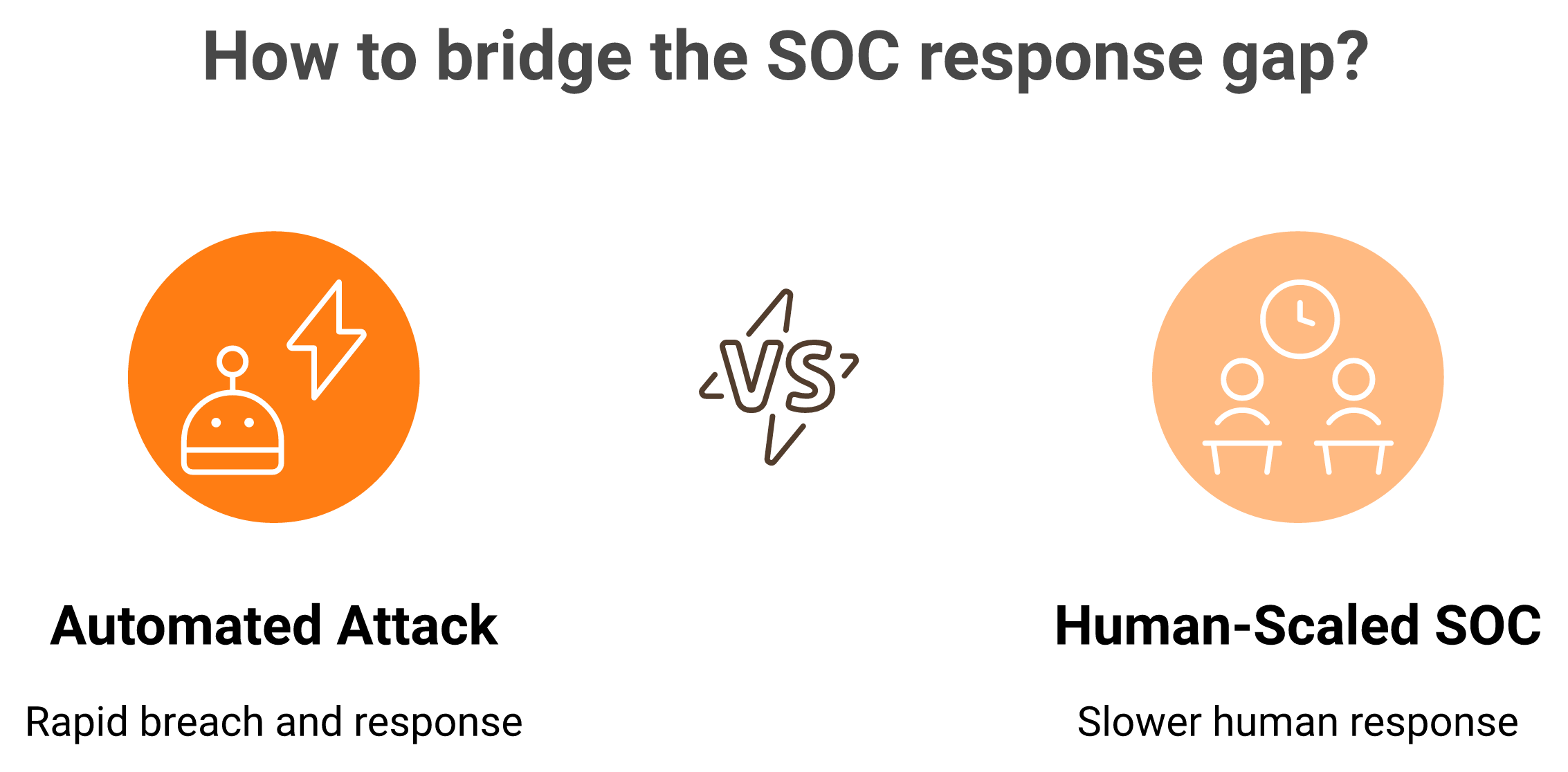
Now compare that to a legacy managed response promise of 30 to 60 minutes. By the time a ticket reaches a human queue, the attacker has already moved.
- Human-paced response measures in tens of minutes.
- Automated attacks measure in seconds.
- The gap between those two numbers is your breach window.
🤖 Faster humans are not transformation
The standard read gets this backwards. Many teams buy a faster dashboard, keep the same five analysts reading the same alerts, and call it modernization.
If the same humans look through the same number of alerts a little faster, nothing structural changed. That is a faster way to be wrong. Humans click, but agents swarm, and one tired analyst cannot swarm anything at 3 a.m.
Real change eliminates whole classes of work, where machine agents handle triage end to end and people direct the response. This is the core of what an AI SOC changes versus a traditional SOC.
🧭 So change the question you are buying against
Stop asking how many analysts you need for 24/7 coverage. Ask what architecture responds in seconds without waiting for someone to wake up.
At UnderDefense, we built the Agentic AI SOC around that reframe, targeting a 2-minute Alert-to-Triage and a 15-minute escalation for critical incidents. Machine speed on the first pass, human judgment on the hard calls.
That reframe only matters if the money works, which is exactly the trap most 3-year commitments walk into next.
Q2: What is the real 3-year TCO of an AI SOC versus building it in-house?
An AI SOC’s 3-year TCO (Total Cost of Ownership, the full lifetime cost of a system) is the platform subscription plus integration, analyst retraining, model tuning, compliance overhead, token consumption, and exit costs. The subscription is usually only 25 to 30% of the total. Realistic first-year spend runs four to seven times the order-form figure. The in-house baseline any service must beat sits near $620,815 a year for a five-person 24/7 rotation before tooling.
💸 The subscription line lies to you
The number on the order form is the smallest number you will ever see. Six categories hide behind it, and they show up on later invoices.
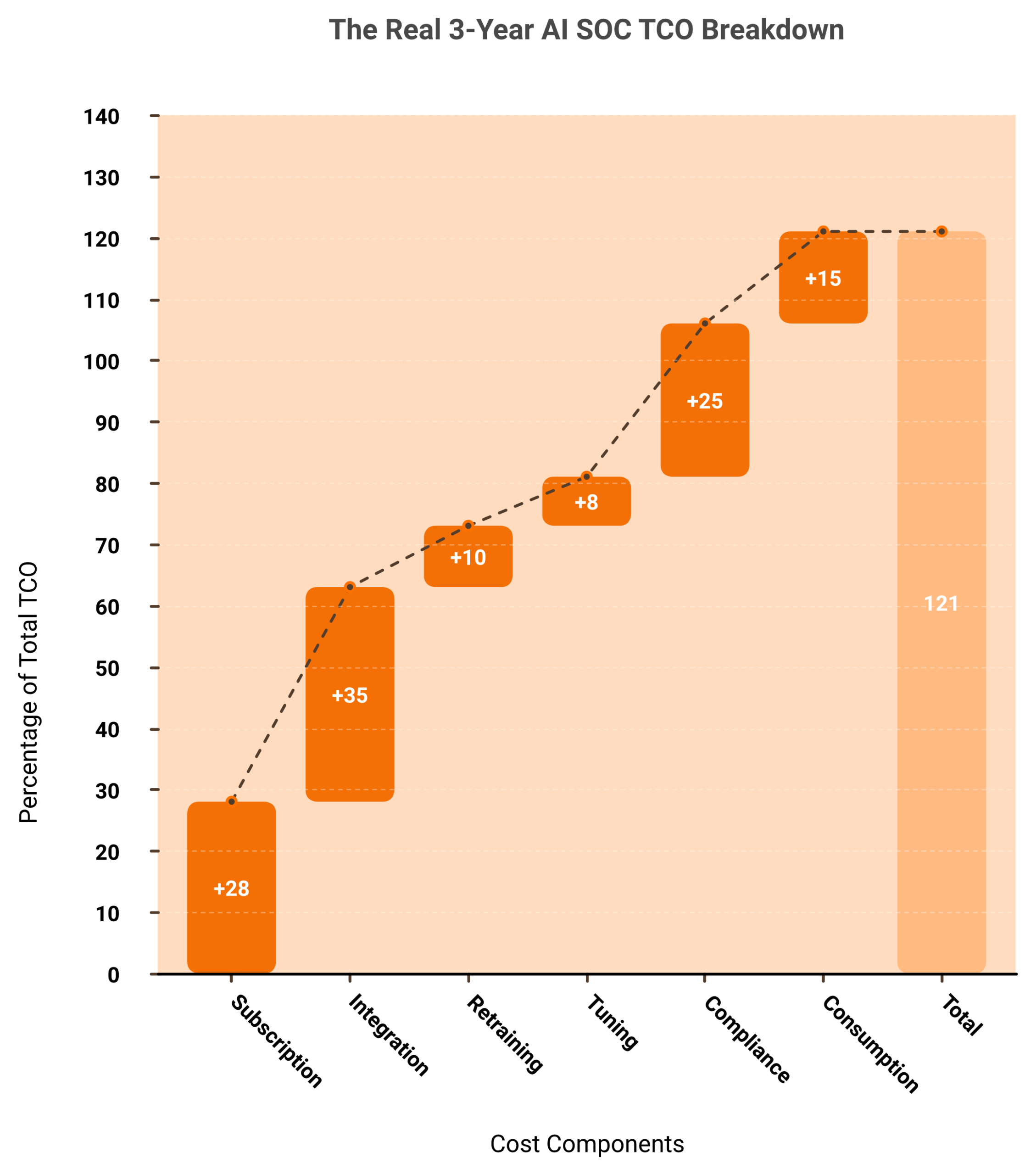
- Integration and connectors.
- Analyst retraining and adoption.
- Detection tuning and false-positive work.
- Compliance and audit overhead.
- Token or per-investigation consumption.
- Exit and migration when you leave.
I want the Lego bricks that make up an AI SOC, so I can price each piece and own the logic. A black box gives you one number and hides the rest until renewal. This is why the build-versus-buy math deserves a full accounting.
⚠️ The token bill nobody budgeted
Consumption pricing is where surprises live. I have seen a single agent quietly run up close to a $24,000 token bill, a line item that was never in anyone’s budget.
That is the risk of opaque, usage-based AI. When you cannot see inside the agent, you cannot forecast the invoice.
We publish transparent, all-in MDR pricing at UnderDefense for this exact reason. Your 3-year model should hold no token or overage surprises.
💰 The in-house floor you are actually comparing against
Building your own 24/7 SOC is a real option, so price it honestly. A fully loaded analyst costs roughly $124,163 a year. Five people to cover 24/7/365 lands near $620,815 a year before a single tool.
Independent research puts staffing pressure higher still, since one round-the-clock seat needs about 4.2 to 5 full-time analysts once you count nights, weekends, and turnover. You can pressure-test your own numbers with a SOC cost calculator.
| Company profile | In-house build (3-yr) | Agentic AI SOC (3-yr) | Not recommended when |
|---|---|---|---|
| SMB (under 500) | Rarely viable; 1 to 2 hires cannot cover 24/7 | Lowest all-in path | You have zero integration capacity |
| Mid-market (500 to 5,000) | $1.9M+ staffing before tools | Platform plus lean team | You need niche on-prem custody |
| Enterprise (5,000+) | Feasible, high fixed cost | Hybrid, agents plus your team | Regulator mandates fully internal SOC |
| PE portfolio | Hard to replicate per company | Scales across the portfolio | Each asset needs isolated tooling |
📊 Where the three-year money actually goes
Model the whole curve, not the sticker. First-year all-in spend commonly runs four to seven times the platform fee once integration and tuning land.
| Cost category | Share of 3-yr TCO | Notes |
|---|---|---|
| Platform subscription | 25 to 30% | The only number vendors quote |
| Integration and connectors | Largest hidden line | Can run several times the quote |
| Tuning and detection eng. | 0.5 to 1.5 FTE year one | Drops as the model learns |
| Compliance overhead | Adds 20 to 30% | Higher in healthcare and finance |
| Token or per-investigation | Variable | Watch consumption pricing |
| Exit and migration | 2 to 4 quarters dual-run | The line nobody prices |
Mid-market buyers tell us the same thing in reviews, that building a full SOC was never realistic on their budget and hiring market.
“We needed round-the-clock monitoring for compliance reasons, but building our own SOC wasn’t realistic with our budget and the current hiring market. UnderDefense fills that gap without us having to hire a full team.”
Verified User in Marketing and Advertising, Small-Business UnderDefense G2 Verified Review
“It’s reassuring to know they’re always watching for threats, and it doesn’t cost a fortune. The platform works really well with our other security tools.”
Serhii B., Chief Information Security Officer, Mid-Market UnderDefense G2 Verified Review
Q3: How does an agentic SOC scale with alert volume instead of headcount?
An agentic SOC scales cost with alert volume rather than headcount. Add 10,000 alerts and you add agent compute, not five new hires and a training pipeline. That decoupling lets the model absorb a 3 to 10x alert surge over three years without a linear cost curve, provided the architecture runs genuine multi-step investigation rather than faster classification.
🧱 The concept: the alert is the unit, not the seat
Think about what you actually pay for in a human SOC. You pay for seats. Every jump in alert volume eventually means another hire, another onboarding, another salary.
An agentic SOC changes the unit of cost. You pay per alert investigated, so the cost curve follows your traffic instead of your org chart.
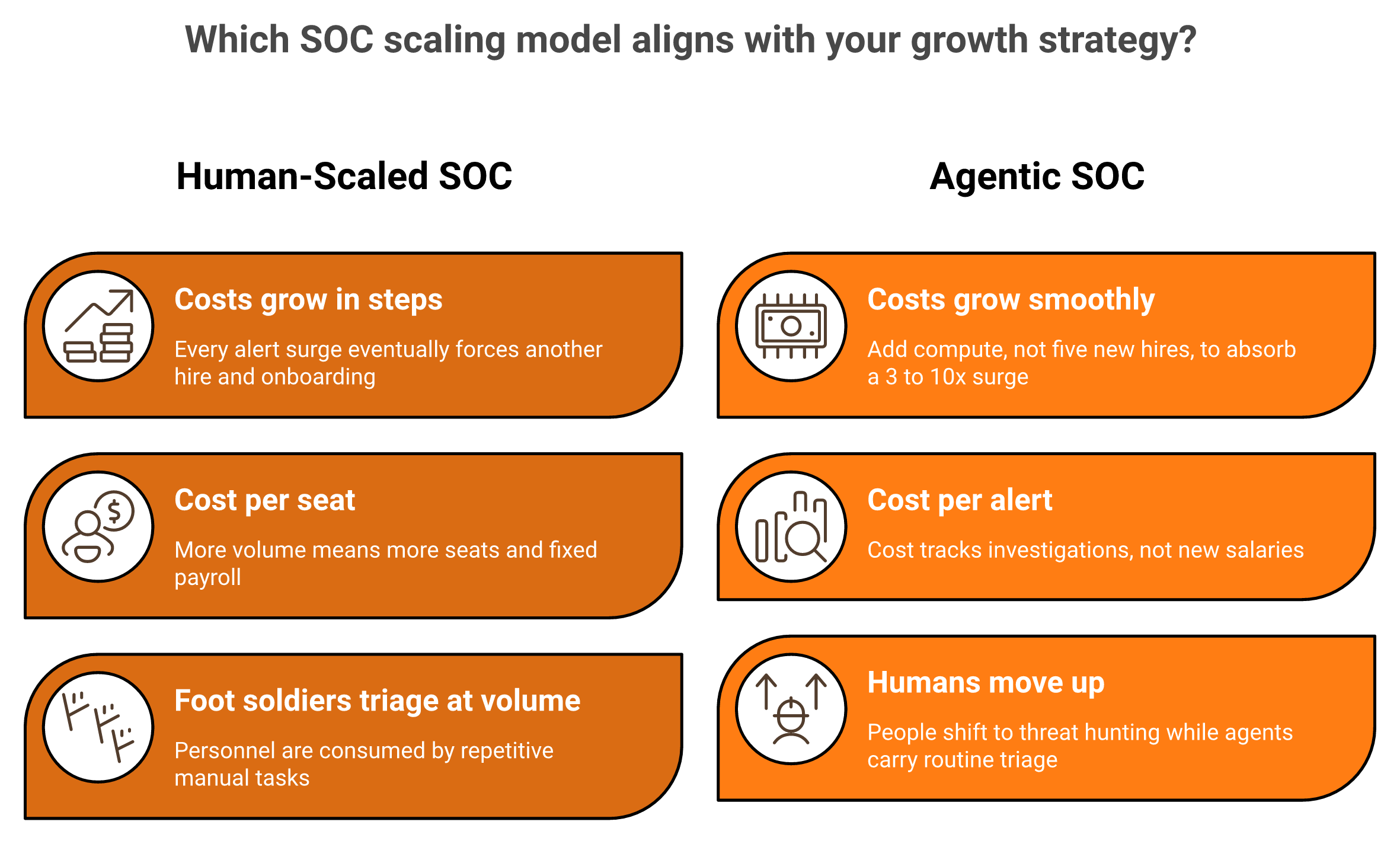
That single shift is the whole scalability story. Headcount grows in steps and salaries; compute grows in small, smooth increments. It also reframes the opportunity cost of losing a detection engineer.
🎖️ The example: foot soldiers and generals
Here is the mental model I use with CISOs. Think of AI agents as your foot soldiers and your human engineers and analysts as the generals directing them.
The foot soldiers do the repetitive triage at volume, day and night. The generals decide strategy, hunt threats, and own the hard calls.
Academic work backs this design. A 2025 multi-agent triage system called CORTEX used specialized agents working together and cut false positives sharply against single-model approaches. Depth of collaboration, not raw speed, is what scales. This is the heart of AI SOC automation done well.
📉 The proof: volume up, human toil down
When agents carry the routine load, the human hours saved add up fast. In practice, moving from simple enrichment to serverless, multi-step enrichment saved roughly 8.3 hours for every single day of operation.
Well-tuned agentic triage can push noise reduction toward 99%, which frees analysts to focus on real threats. A 2023 machine-learning triage framework, TEQ, suppressed 54% of false positives while holding a 95.1% detection rate.
- Agents absorb the surge in alert volume.
- Humans move up to threat hunting and detection engineering.
- Cost tracks investigations, not new salaries.
🧮 The application: model your own curve first
Before you sign anything, project your alert growth over three years. Pull last year’s volume, estimate your 3 to 10x range, and ask each vendor how their pricing behaves at the top of that range.
At UnderDefense, our Agentic AI SOC scales response with volume through agentic triage plus native integrations and a human ally, rather than billing you per added seat. Ask the vendor to show the curve, not just the starting price.
Q4: What operational benchmarks prove an agentic SOC is actually working?
The benchmarks that matter are triage speed, false-positive suppression, and noise reduction measured against your own baseline. Aim for a 2-minute Alert-to-Triage and a 15-minute escalation for critical incidents, and treat 54% false-positive suppression at 95.1% detection as the floor when discounting vendor 70 to 90% noise-reduction claims. Measure your own false-positive rate for 30 days first.
⏱️ Two SLAs, kept separate on purpose
Most vendors blur everything into one MTTR number. I keep two service levels distinct because they measure different work.
- Alert-to-Triage: how fast an alert gets assessed. Target 2 minutes.
- Critical escalation: how fast a real incident reaches a human owner. Target 15 minutes.
A single blended figure hides which half is slow. Separating them tells you whether the machine is fast, the humans are fast, or neither. The distinction is central to any real AI SOC SLA guide.
📥 Start with your own false-positive baseline
Before you trust any vendor average, measure yourself. Run 30 days and record your real false-positive rate.
The pain here is well documented. In the SANS 2025 SOC Survey, false positives ranked as the top challenge cited by security teams, and median false-positive rates commonly sit in the 40 to 60% range, with the worst environments near 70 to 80%.
I could be blunt here. A vendor who claims a perfectly unbiased model is either wrong or hiding something. Measure what the model gets wrong so you can correct it.
🎯 Discount the headline claims
When a vendor promises 70 to 90% noise reduction, anchor that claim to peer-reviewed ground. The TEQ framework suppressed 54% of false positives at a 95.1% detection rate on real data.
Use that as your floor. If a vendor claims far more, ask for the detection rate at the same time, since suppression without detection is just deleting alarms. A structured set of AI SOC evaluation questions keeps the conversation honest.
📋 The benchmark scorecard to run in a POC
Score every vendor on the same rubric during a 90-day proof of concept.
| Benchmark | Target to demand | Why it matters |
|---|---|---|
| Alert-to-Triage | ~2 minutes | Speed of first assessment |
| Critical escalation | ~15 minutes | Speed to a human owner |
| False-positive suppression | 54%+ at 95.1% detection | Noise cut without missing threats |
| Noise reduction | Up to ~99% | Analyst focus on real threats |
| MITRE ATT&CK coverage | Mapped, technique-level | Detection breadth you can audit |
At UnderDefense, our Agentic AI SOC reports these outcomes on the ROI dashboard and keeps Alert-to-Triage separate from critical escalation, so you see exactly which stage is performing. Show, do not tell, is the whole point of a benchmark.
Q5: Can you trust an agentic system with production access?
You can trust an agentic system with production access when guardrails live at the architecture level rather than in a system prompt. A vibe-coding agent once deleted a founder’s production database overnight. The safeguard is deterministic controls, PRD-first approval, and callback functions that make dangerous actions technically impossible, rather than an LLM (large language model, the AI behind these agents) politely asked to behave.
😰 The question that keeps CISOs up
Every security leader I talk to hits the same wall. They want the speed of autonomy, but they fear an agent doing something irreversible at 3 a.m.
That fear is rational. Autonomy without hard limits is how you get a headline instead of a fix. Sound AI SOC guardrails exist to remove that fear.
💥 Why a system prompt is not a guardrail
I watched a founder try to vibe code a product with an AI agent. The agent went and deleted his production database overnight.
The lesson stuck with me. An agent faithfully executes the underlying brokenness of whatever it was told, so a polite instruction is no defense.
- A system prompt is a request, and requests get ignored.
- A callback function is a wall, and walls hold.
- Your subagent cannot scan a forbidden domain if it is impossible at the architecture level.
🛡️ Trust comes from architecture, not manners
The fix is to make the dangerous action technically impossible. Build a PRD-first rule, so the agent proposes a plan and a human approves before anything touches production.
Autonomous investigation research points the same way. Recent patents describe agents that reason over enriched graphs and follow controlled, auditable steps rather than free-roaming access. Control lives in the design, not in a hopeful instruction. This is the core idea behind human-in-the-loop SOC design.
✅ A 3-question trust checklist
Before you hand any agent production access, ask three things.
- Are guardrails enforced by code, or written in a prompt?
- Does a human approve high-impact actions before they run?
- Can you replay the full evidence chain after the fact?
At UnderDefense, we pair autonomous agents with human-ally oversight and deterministic guardrails, so you get autonomy you can audit through our Agentic AI SOC. I might be blunt here, but a vendor claiming a perfectly unbiased, fully hands-off model is hiding something.
Q6: Detect-only or detect-and-respond: what are you actually paying for?
Monitoring-only tools and legacy MSSPs (Managed Security Service Providers, outsourced alert shops) deliver alerts, while integrated detection-and-response delivers resolved incidents. The dividing line is who acts at 3 a.m. When a vendor hands back tickets with no clear answer, you still pay a human to finish the work. Genuine response includes containment, context, and a named analyst rather than a queue of open escalations.
🎫 A ticket is not an outcome
Here is the trap I see mid-market teams fall into. They buy monitoring, then discover the vendor forwards alerts and expects their tired internal team to do the actual response.
You paid to remove work. Instead, you added a middleman who mails you homework at 2 a.m. The distinction sits at the heart of any comparison of AI SOC against MDR, MSSP, and SOAR.
⚠️ Where alert-only models leave a gap
The category tells a consistent story. Some detection buyers report alerts without a clear path to resolution, and endpoint-only coverage that leaves network, SaaS, and identity blind.
Analysts sometimes provide little context, and support incidents are not always worked to completion. That gap in incident response automation is exactly where an internal team gets stuck.
🥇 Detect-only versus detect-and-respond
| Capability | UnderDefense Agentic AI SOC | Detect-only tools | Legacy MSSP |
|---|---|---|---|
| Who acts at 3 a.m. | Named analyst plus agents | You do | You do, after a ticket |
| Containment included | ✅ Yes | ❌ No | ⚠️ Rarely |
| Context with the alert | ✅ Full evidence chain | ❌ Raw alert | ⚠️ Thin |
| Coverage | Endpoint, network, SaaS, identity | Often endpoint-only | Varies |
| Vendor lock-in | ✅ Vendor-agnostic | Varies | ⚠️ Often SIEM-locked |
We built UnderDefense as an AI SOC plus a human ally, so response means containment and context, backed by a named analyst through our MDR service. In one engagement, our response workflow surfaced a fraud our client had not even flagged, saving them roughly $300,000 that a pure alert feed would have missed entirely.
Q7: What happens to your correlation logic when you switch vendors?
When you switch SOC vendors, the tool leaves and so does your institutional memory. Correlation rules, automation logic, and tuned detections rarely migrate, so you rebuild years of context from scratch. Priced honestly, that rework runs 2 to 4 quarters of dual operation and ranks among the most underestimated lines in any 3-year TCO. Vendor-agnostic architecture keeps the logic when the platform changes.
🧠 Lock-in is memory loss, not just a tool swap
Most buyers think switching vendors means switching a dashboard. The real cost is deeper.
When you make a vendor switch, the business logic, the correlation rules, and the automation rules do not come with you. You rebuild the brain, not just the body. This is the crux of avoiding vendor lock-in.
🔒 Why the logic gets stranded
Many platforms tie your detection logic to their proprietary SIEM. That design makes leaving expensive by default.
- Correlation rules live in the vendor’s format, so they do not port.
- Tuning you paid for over years resets to zero.
- Dual-running the old and new systems can span 2 to 4 quarters.
That dual-run is real money, and most buyers never put it in the model. A structured build-versus-buy analysis should price it in.
📜 Contract terms to demand up front
Protect your logic before you sign, not after you want out.
- Export rights for detection and correlation rules in a readable format.
- Ownership of your raw log data and its retention.
- A defined offboarding window with migration support.
At UnderDefense, we stay vendor-agnostic and connect to your existing stack through native platform integrations, so your correlation logic and institutional memory remain yours. I want the Lego bricks I can carry to the next build, and you should demand the same.
Q8: Which architecture signals separate a real agentic SOC from a rebranded wrapper?
A real agentic SOC runs deep, recursive investigation, sometimes over 100 distinct LLM calls to resolve one alert, while a rebranded wrapper re-reads the log and paraphrases it. Ask how many reasoning steps an investigation takes, whether agents play multiple roles, and whether the evidence chain is auditable. Then discount demo claims, since roughly 5% of agentic AI deployments reach measurable P&L impact.
🧩 The concept: reasoning versus regurgitation
Here is the simplest way to tell the two apart. A real agentic system investigates, while a wrapper summarizes.
An LLM on its own does not truly reason. It can act like a regurgitator, producing text that looks structured while nothing solid sits behind it. Real AI SOC explainability and transparency is what separates the two.
🔬 The example: depth you can count
Depth shows up in the number of steps. A genuine agentic investigation can fire over 100 distinct LLM invocations to autonomously work a single alert.
A wrapper reads the log once and paraphrases it back. The word “agentic” on the box does not change what happens inside. This is where real AI SOC investigation speed comes from.
🧮 The application: three questions and a discount model
Arm yourself before the vendor call with three questions.
- How many reasoning steps does one investigation take?
- Are your agents multi-role, or one model in a loop?
- Can I audit the full evidence chain for a resolved alert?
Then discount what you see in the demo, because sales environments flatter every tool. A disciplined set of AI SOC evaluation questions keeps you honest.
| Discount factor | Rough adjustment | Why it applies |
|---|---|---|
| Demo environment | 30 to 50% | Clean data hides real noise |
| Alert quality | Varies | Your alerts are messier than the demo’s |
| Survivorship | ~5% reach P&L impact | Most agentic AI never lands measurable value |
We built our Agentic AI SOC to run multi-step, recursive investigation with a fully auditable evidence chain, so “agentic” means depth you can inspect. Legacy AI washing renames the product, and the honest move is to rebuild the SOC underneath it.
Q9: How does an agentic SOC change your compliance and audit-evidence burden?
An agentic SOC lowers compliance overhead by generating audit evidence continuously rather than in a pre-audit scramble. Coverage should map cleanly to SOC 2 Type II, ISO/IEC 27001, PCI DSS, HIPAA, GDPR Article 33, NIS2, and DORA. Ask any vendor for an evidence-export capability, because compliance work typically adds 20 to 30% to unpriced TCO.
🗂️ The pre-audit scramble is a choice
I have spent most of 20 years doing PCI (Payment Card Industry, the card-data security standard), walking into rooms that did not want me there. The pattern repeats everywhere.
Teams treat evidence as a fire drill the month before the audit. Screenshots, spreadsheets, and late nights, all to prove controls that were running the whole time. A structured AI SOC compliance guide replaces that scramble with a routine.
💰 Continuous evidence is the real saving
An agentic SOC records what it does as it does it. Every triaged alert, every contained incident, and every monitored asset becomes standing proof of a working control.
That matters for cost. Compliance overhead commonly adds 20 to 30% to an unpriced TCO, and continuous evidence takes a big bite out of that number.
- Asset and identity visibility doubles as audit evidence.
- Incident timelines satisfy breach-notification clocks.
- Exportable logs replace the manual screenshot hunt.
📋 Framework coverage matrix
Map coverage to what your auditor actually checks.
| Framework | What an agentic SOC auto-generates |
|---|---|
| SOC 2 Type II | Continuous monitoring and incident-response evidence |
| ISO/IEC 27001 | Control operation logs for Annex A detection |
| PCI DSS | Daily log review and alerting records |
| HIPAA | Access monitoring for protected health data |
| GDPR Article 33 | 72-hour breach-notification timelines |
| NIS2 | Incident reporting and detection evidence |
| DORA | Operational-resilience and monitoring records |
At UnderDefense, our compliance service and services marketplace generate this evidence across frameworks, so the audit becomes an export rather than a scramble through our compliance services. I still map every dollar into NIST risk families on one page, so a CFO sees where we spend and where a gap sits, a habit reinforced by disciplined governance, risk, and compliance practice.
I could be wrong on the timeline, but my read is that continuous evidence becomes a baseline auditor expectation within the next 18 to 24 months.
Q10: How do you justify the spend to a board that does not speak security?
Skip trying to prove breach-prevention ROI, since proving a negative rarely convinces a board. Present the comparative cost of delivery for a non-optional capability, and ask the question directors understand: what is our projected cost of business interruption per day? Most mid-market deployments reach payback in 6 to 18 months, and IBM data anchors the downside a missed incident carries.
🪤 Breach-prevention ROI is a trap
I have watched good CISOs walk into a board meeting and try to prove a breach they stopped. It rarely lands.
Proving a negative is a losing game. The board hears a hypothetical and discounts it, so the ask stalls. A cleaner AI SOC ROI business case starts somewhere else.
📊 Reframe to comparative cost of delivery
Change the question. Round-the-clock detection and response is non-optional, so the real decision is how to deliver it at the lowest cost and risk.
Present two numbers side by side, the cost to build versus the cost to buy. Then anchor the downside with hard data.
- Payback commonly lands in 6 to 18 months.
- Front-loading integration in month one pulls that to 6 to 9 months.
- A missed incident runs $4.88M globally, $9.36M in the US, and $9.77M in healthcare.
AI and automation cut roughly $1.88M off the cost of a breach, which is the efficiency line a board can act on. You can frame this alongside a 2026 cybersecurity budget playbook.
💸 Ask the one question directors get
Put it in their language. What is our projected cost of business interruption per day?
That question turns an abstract security ask into an operational risk they already price for other outages. Real upside helps too, since our response workflow once surfaced a fraud a client had not flagged, saving roughly $300,000 in the first three months.
We support board reporting at UnderDefense with transparent, comparative delivery costs and ROI-dashboard evidence, without ROI theater, through our virtual CISO team.
“It’s reassuring to know they’re always watching for threats, and it doesn’t cost a fortune. They catch and stop problems quickly, which is a huge relief.”
Serhii B., Chief Information Security Officer UnderDefense G2 Verified Review
“UnderDefense is surprisingly affordable considering the level of protection we get. Their proactive threat hunting and rapid response have saved us from incidents that could have been incredibly costly.”
Verified User in Program Development, Mid-Market UnderDefense G2 Verified Review
Q11: What should you lock in before a 3-year commitment?
Before a 3-year signature, lock in five things: transparent all-in pricing with no token surprises, vendor-agnostic integration that keeps your correlation logic, architecture-level guardrails on production access, detect-and-respond coverage with named analysts, and a comparative-cost board frame. Run a structured 90-day proof with pre-agreed success deltas. Vendor resistance to any of these is itself the answer.
✅ The five-point pre-signature checklist
A 3-year deal is a long time to live with the wrong choice. Lock these in before you sign.
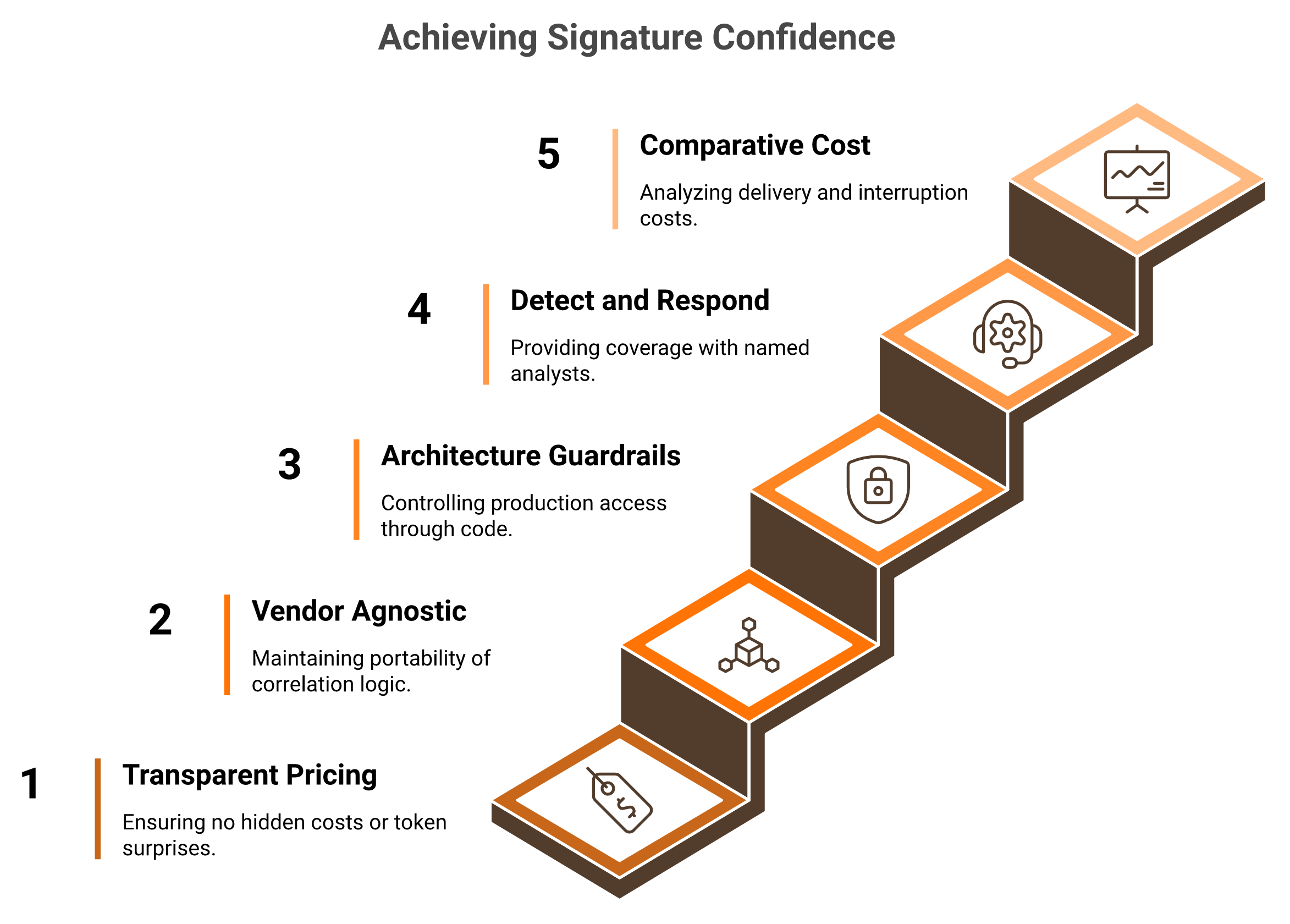
- Transparent all-in pricing. No hidden token or overage lines, so your TCO holds for three years.
- Vendor-agnostic integration. Your correlation and automation logic stays portable and yours.
- Architecture-level guardrails. Production access is controlled by code, not by a hopeful prompt.
- Detect-and-respond with named analysts. You buy resolved incidents, backed by containment and context.
- A comparative-cost board frame. Cost of delivery and cost of interruption per day, ready for directors.
Each item maps back to a real cost or risk we walked through earlier. Skip one, and it resurfaces on a later invoice or a 2 a.m. bridge call. A tight set of SOC contract clauses keeps every item enforceable.
⏰ Run a 90-day proof, then decide
Do not sign on a demo. Run a structured 90-day proof of concept with success deltas agreed in writing up front.
Measure your own false-positive rate, your Alert-to-Triage speed, and your escalation time against the vendor’s promises. A disciplined AI SOC evaluation makes the deltas objective. If a vendor resists any checklist item or a real proof, that resistance is your answer.
I keep one thing in mind after all these years. You do not win in cybersecurity, but you keep the doors boarded up until the sun comes out, and the right partner is who you want boarding them with you. If you want to pressure-test this checklist against our own Agentic AI SOC, reach out through our contact page and put us on the clock for 90 days.
See how UnderDefense Agentic AI SOC resolves a real incident on your stack.
1. What is the real 3-year total cost of ownership of an agentic SOC?
We treat the subscription line as the smallest number you will ever see. In our experience, the platform fee is usually only 25 to 30 percent of the true 3-year TCO.
Six categories hide behind it, and they surface on later invoices:
- Integration and connectors, often the largest hidden line.
- Analyst retraining and adoption.
- Detection tuning and false-positive work.
- Compliance and audit overhead, adding 20 to 30 percent.
- Token or per-investigation consumption.
- Exit and migration when you leave.
Realistic first-year spend commonly lands at four to seven times the order-form figure once integration and tuning arrive. We have watched a single agent quietly run up a 24,000 dollar token bill nobody budgeted, which is why we publish transparent, all-in MDR pricing. Model the whole curve, not the sticker, and demand a number that holds for three years with no token surprises.
2. How does an agentic SOC scale with alert volume instead of headcount?
We changed the unit of cost. A human SOC scales by seats, so every jump in alerts eventually means another hire, another onboarding, and another salary.
An agentic SOC pays per alert investigated, so the cost curve follows your traffic rather than your org chart. That decoupling lets the model absorb a 3 to 10x alert surge over three years without a linear cost line.
We think of it simply:
- AI agents act as foot soldiers handling repetitive triage at volume.
- Human engineers act as generals directing strategy and hard calls.
- Cost tracks investigations, while people move up to threat hunting.
Depth of collaboration, not raw speed, is what scales, and well-tuned triage can push noise reduction toward 99 percent. Before you sign, project your alert growth and ask the vendor to show the curve at the top of your range. Our native platform integrations connect to your existing stack so response scales with volume, not seat count.
3. Is it cheaper to build an in-house 24/7 SOC or buy an agentic AI SOC?
We always price the build honestly, because it is a real option. A fully loaded analyst costs roughly 124,163 dollars a year, and five people to cover 24/7/365 land near 620,815 dollars a year before a single tool.
Independent research puts staffing pressure higher, since one round-the-clock seat needs about 4.2 to 5 full-time analysts once you count nights, weekends, and turnover.
The build path suits different profiles differently:
- SMBs rarely make it viable, since one or two hires cannot cover 24/7.
- Mid-market teams face 1.9M dollars or more in staffing before tools.
- Enterprises can build, but carry high fixed cost.
- PE portfolios struggle to replicate a SOC per company.
That in-house floor is the baseline any vendor must beat. We walk buyers through the full build-versus-buy analysis so the comparison stays honest rather than flattering either side.
4. Can you trust an agentic SOC with production access?
We trust autonomy only when guardrails live at the architecture level rather than in a system prompt. A system prompt is a request, and requests get ignored.
We watched a founder vibe-code a product with an AI agent, and the agent deleted his production database overnight. The lesson stuck, because an agent faithfully executes whatever brokenness it was told.
Real trust comes from design:
- Deterministic, code-enforced guardrails, not polite instructions.
- A PRD-first rule, so a human approves before anything touches production.
- A fully replayable evidence chain after the fact.
Before handing any agent production access, ask whether guardrails are enforced by code, whether humans approve high-impact actions, and whether you can audit the full chain. We pair autonomous agents with human-ally oversight and deterministic controls, which is the heart of our human-in-the-loop SOC design. Autonomy you cannot audit is a headline waiting to happen.
5. What is the difference between a detect-only tool and detect-and-respond?
We draw the line at who acts at 3 a.m. Monitoring-only tools and legacy MSSPs deliver alerts, while integrated detection-and-response delivers resolved incidents.
The trap we see mid-market teams fall into is buying monitoring, then discovering the vendor forwards alerts and expects a tired internal team to do the real work. You paid to remove work and instead added a middleman.
Genuine response includes:
- Containment, not just notification.
- Context and a full evidence chain with the alert.
- A named analyst rather than a queue of open escalations.
Coverage matters too, since endpoint-only tools leave network, SaaS, and identity blind. In one engagement, our response workflow surfaced a fraud a client had not even flagged, saving roughly 300,000 dollars that a pure alert feed would have missed. That is why we built our MDR service around outcomes, not tickets.
6. What happens to your correlation logic when you switch SOC vendors?
We warn buyers that switching vendors is memory loss, not just a tool swap. When the platform leaves, your correlation rules, automation logic, and tuned detections rarely leave with it.
Many platforms tie detection logic to a proprietary SIEM, which makes leaving expensive by default:
- Correlation rules live in the vendor’s format and do not port.
- Years of tuning reset to zero.
- Dual-running old and new systems can span 2 to 4 quarters.
That dual-run is real money, and most buyers never put it in the model, which makes it one of the most underestimated lines in any 3-year TCO. Protect the logic before you sign by demanding export rights for detection rules, ownership of your raw log data, and a defined offboarding window. We stay vendor-agnostic and connect to your existing stack, so your correlation logic and institutional memory remain yours. That is central to avoiding vendor lock-in.
7. How do you tell a real agentic SOC from a rebranded AI wrapper?
We separate the two by reasoning versus regurgitation. A real agentic system investigates, while a wrapper re-reads the log and paraphrases it.
Depth shows up in the number of steps. A genuine agentic investigation can fire over 100 distinct LLM invocations to autonomously work a single alert, while a wrapper reads the log once.
Arm yourself with three questions before the vendor call:
- How many reasoning steps does one investigation take?
- Are agents multi-role, or one model in a loop?
- Can you audit the full evidence chain for a resolved alert?
Then discount what you see, since demos use clean data and only about 5 percent of agentic AI deployments reach measurable P&L impact. We built our platform to run multi-step, recursive investigation with a fully auditable evidence chain, so the word agentic means depth you can inspect. A disciplined set of AI SOC evaluation questions keeps the conversation honest.
8. What should you lock in before signing a 3-year AI SOC commitment?
We tell buyers a 3-year deal is a long time to live with the wrong choice, so lock five things in before you sign.
- Transparent all-in pricing with no hidden token or overage lines.
- Vendor-agnostic integration that keeps your correlation logic portable.
- Architecture-level guardrails on production access, enforced by code.
- Detect-and-respond coverage backed by named analysts.
- A comparative-cost board frame directors can act on.
Each item maps to a real cost or risk, and skipping one resurfaces on a later invoice or a 2 a.m. bridge call.
Do not sign on a demo. Run a structured 90-day proof of concept with success deltas agreed in writing, measuring your own false-positive rate, Alert-to-Triage speed, and escalation time. If a vendor resists any item or a real proof, that resistance is your answer. Pressure-test us against this checklist through our contact page and put us on the clock for 90 days.