




Q1. What Is Governance, Risk, and Compliance (GRC), How Did It Evolve, and How Does It Differ From ERM?
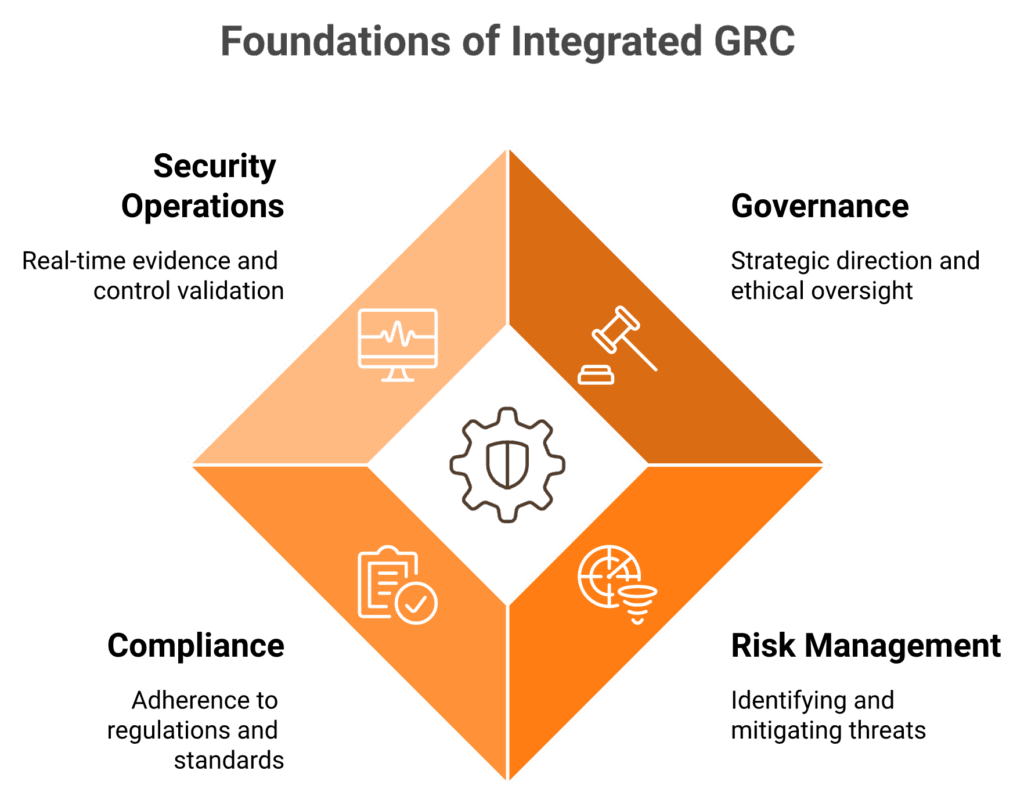
Governance, Risk, and Compliance (GRC) is the integrated discipline that unifies an organization’s governance structures, risk management processes, and compliance operations into a single strategic operating model, designed so decisions, threats, and regulatory obligations don’t live in separate spreadsheets owned by teams that never talk to each other.
Here’s what each pillar actually covers:
| Pillar | Core Function | Operational Scope |
|---|---|---|
| Governance | Set strategic direction, board oversight, ethical accountability | Decision-making frameworks, risk appetite definition, executive responsibility |
| Risk Management | Identify, assess, prioritize, mitigate, and monitor threats | Operational, financial, strategic, and cyber risk domains |
| Compliance | Ensure adherence to external regulations and internal policies | Regulatory mapping, audit evidence generation, standards enforcement |
These three pillars interconnect tightly: governance defines the risk appetite and ethical framework, risk management operationalizes that appetite through controls, and compliance verifies adherence and generates proof. The concept was coined by OCEG, with the first GRC standard, the Red Book, released in 2004 after months of expert collaboration. Version 2 gained wide adoption shortly after, with over 100,000 downloads in a single year, and the current version 3.5 was developed with input from 300+ experts studying 500+ organizations.
⚠️ The GRC vs. ERM Confusion
One of the most common questions I hear from operators: “Isn’t this just ERM?” No, and the distinction matters.
ERM (Enterprise Risk Management) focuses specifically on identifying, assessing, and managing risks across all business functions. It’s specialized risk intelligence. Think COSO ERM’s five components: governance & culture, strategy & objective-setting, performance, review & revision, and information/communication/reporting. ERM is a critical component within GRC, not a replacement for it. GRC takes the broader view: it integrates risk management alongside governance processes and regulatory compliance into a unified framework covering how decisions are made, how risks are managed, and how compliance is maintained simultaneously.
The organizations still operating governance, risk, and compliance as disconnected departments, risk teams that don’t see compliance gaps, compliance teams that don’t understand threat context, and boards receiving fragmented quarterly reports, are the ones getting surprised by audit findings and breach exposure. McKinsey’s 2025 Global GRC Benchmarking Survey found that 42% of respondents say their IT and GRC systems “need improvement,” while 15% say they are absent or lagging entirely.
🔄 From Periodic Assessment to Continuous Assurance
Compliance that can’t reason across your entire environment in real time is a liability, not a control. In 2026, effective GRC combines automated evidence collection, continuous control monitoring, NLP-powered regulatory change intelligence, and predictive risk scoring, creating a living GRC posture rather than periodic assessment snapshots.
Cybersecurity is no longer adjacent to GRC but a core pillar. Security operations generate the real-time evidence that proves governance controls work and compliance assertions are valid. The 2025–2026 regulatory acceleration makes this non-optional: DORA reached full enforcement for EU financial entities in January 2025, NIS2 penalties are now active with fines up to €10M or 2% of global turnover, and the EU AI Act’s high-risk system requirements hit in August 2026.
✅ Where Operational Security Makes GRC Actionable
Here’s the operational reality: your GRC framework sets the policy, but your security operations prove you follow it. That gap, between GRC strategy and GRC execution, is where regulatory penalties and breach exposure compound.
At UnderDefense, we built the UnderDefense MAXI platform as the operational security layer that bridges this gap. Vendor-agnostic integration across 250+ tools feeds real-time security evidence into compliance frameworks. Our 24/7 AI-driven threat detection with 96% MITRE ATT&CK coverage generates continuous control validation, while concierge analyst response provides the human judgment layer essential for governance accountability. We include forever-free compliance kits covering SOC 2, HIPAA, and ISO 27001 with MDR at $11–15/endpoint/month, because compliance evidence shouldn’t be a separate line item when it’s a direct output of your security operations.
💰 The Documented Benefits of Integrated GRC
- Cost reduction: up to 30% lower compliance costs vs. fragmented approaches
- Enhanced cybersecurity posture: continuous monitoring replaces periodic assessment
- Regulatory penalty avoidance: structured compliance reduces fine exposure (GDPR enforcement hit €2.1B in fines for 2025 alone; NIS2 penalties reach €10M or 2% of turnover)
- Stakeholder trust: demonstrated governance attracts customers, investors, and partners
- Organizational agility: proactive risk management enables faster response to market changes
Yet more than two-thirds of organizations still face moderate to strong barriers managing risks, including lack of integrated risk insights and siloed communication. The gap between GRC strategy and GRC execution is where the real risk lives.
Q2. What Are the Major GRC Frameworks, How Do They Compare, and How Do You Choose the Right One?
Every effective GRC program begins with selecting, or more commonly, layering, the right framework(s). The wrong choice creates compliance gaps, audit friction, and wasted implementation effort. Most enterprises don’t choose a single framework; they layer multiple frameworks mapped to different regulatory requirements and business units.
Here’s what you need to know about the seven dominant frameworks.
📋 Framework Deep Dives
1. COSO ERM — The enterprise risk management standard built around five components: governance & culture, strategy & objective-setting, performance, review & revision, and information/communication/reporting. It’s the default for financial services and board-level governance alignment, and integrates naturally as the “risk pillar” within a broader GRC architecture.
2. NIST Cybersecurity Framework (CSF 2.0) — Six core functions: Govern, Identify, Protect, Detect, Respond, Recover. Voluntary and risk-based, with U.S. federal alignment and broad applicability across industries. The addition of “Govern” in version 2.0 explicitly ties cybersecurity to organizational governance, closing a gap the original framework had.
3. ISO 31000 — The risk management standard providing principles, framework, and process for managing any type of risk. Not certifiable, but widely adopted as a risk management best-practice foundation across industries and jurisdictions.
4. ISO 27001 — The certifiable Information Security Management System (ISMS) standard with Annex A controls. International recognition makes it the foundation for SOC 2 alignment and regulatory compliance evidence across EU and global markets.
5. COBIT 2019 — ISACA’s IT governance framework with 40 governance and management objectives. It bridges IT operations with business-level GRC, making it essential for organizations where technology risk is a primary concern.
6. OCEG GRC Capability Model (Red Book 3.5) — The original integrated GRC standard, built on the Learn-Align-Perform-Review cycle. Open-source, developed with 300+ experts across 500+ organizations, and pioneered the concept of “Principled Performance.” This is the only standard that explicitly integrates governance, strategy, risk, audit, compliance, ethics/culture, and IT into a unified approach.
7. CMMC 2.0 — Cybersecurity Maturity Model Certification with three levels, mandatory for U.S. DoD contractors. Maps directly to NIST SP 800-171 controls and introduces third-party assessment requirements.
📊 Side-by-Side GRC Framework Comparison
| Framework | Type | Scope | Industry Fit | Certifiable? | Complexity | Key Regulatory Alignment | Best For |
|---|---|---|---|---|---|---|---|
| COSO ERM | Risk management | Enterprise-wide risk | Financial services, public companies | No | High | SOX, DORA | Board-level risk governance |
| NIST CSF 2.0 | Cybersecurity | Cyber risk + governance | All industries (U.S. focus) | No | Medium | HIPAA, FISMA, CMMC | Foundational cyber maturity |
| ISO 31000 | Risk management | All risk types | All industries | No | Medium | GDPR, DORA (risk component) | Enterprise risk standardization |
| ISO 27001 | ISMS | Information security | Tech, SaaS, healthcare, finance | ✅ Yes | High | GDPR, HIPAA, SOC 2, NIS2 | International security certification |
| COBIT 2019 | IT governance | IT + business alignment | IT-heavy organizations | No (but assessable) | High | SOX, GDPR, PCI-DSS | IT governance alignment |
| OCEG Red Book 3.5 | Integrated GRC | Full GRC integration | All industries | No | Medium | All (meta-framework) | Unified GRC architecture |
| CMMC 2.0 | Cybersecurity maturity | Defense supply chain | DoD contractors | ✅ Yes (Levels 2-3) | High | NIST SP 800-171, DFARS | Defense contract eligibility |
🎯 Framework Selection Decision Tree
The right framework depends on five variables:
- Industry and regulatory jurisdiction: Healthcare → HIPAA + SOC 2 + NIST CSF; financial services → DORA + COSO ERM + ISO 27001; defense → CMMC + NIST SP 800-171; tech/SaaS → SOC 2 + ISO 27001 + COBIT
- Customer and partner compliance requirements: SOC 2 for customer-facing assurance, ISO 27001 for international credibility
- Existing security maturity: Early-stage organizations start with NIST CSF as foundation, then layer certifiable frameworks as they mature
- Certification vs. alignment needs: ISO 27001 and SOC 2 require formal audit; NIST CSF and COSO are alignment-only
- Company size: SMB: start with SOC 2 + one framework; mid-market: layer 2–3 frameworks; enterprise: full multi-framework architecture
✅ How UnderDefense Simplifies Multi-Framework Compliance
UnderDefense simplifies multi-framework compliance by generating audit-ready evidence that maps simultaneously to SOC 2, ISO 27001, and HIPAA through the unified UnderDefense MAXI platform, eliminating the manual burden of maintaining separate evidence repositories for each framework. Forever-free compliance kits are included with MDR, and 30-day turnkey onboarding means your framework selection doesn’t have to wait on a six-month deployment cycle.
Q3. How Does Regulatory Mapping Connect GRC Frameworks to Compliance Obligations in the 2025–2026 Regulatory Wave?
GRC frameworks only create value when they’re mapped to specific regulatory obligations. A framework without regulatory mapping is a theoretical exercise. In 2026, the challenge has intensified: organizations face simultaneous compliance deadlines across multiple jurisdictions with overlapping but non-identical requirements. The organizations that operationalize regulatory mapping as a continuous process, not a one-time project, gain measurable advantage in audit efficiency and penalty avoidance.
📋 Regulatory Mapping Matrix
| Regulation | Jurisdiction | GRC Pillar(s) Impacted | Key Requirements | Framework Alignment | Enforcement Status | Penalty Range |
|---|---|---|---|---|---|---|
| SOX | U.S. | Governance + Compliance | Internal controls over financial reporting | COSO ERM + COBIT | Active | Criminal penalties, fines up to $5M |
| GDPR | EU | Compliance + Risk | Data processing lawfulness, DPIAs, 72-hour breach notification | ISO 27001 | Active (€2.1B in fines in 2025) | Up to €20M or 4% of global turnover |
| HIPAA | U.S. | Compliance + Risk | PHI protection, Security Rule, Breach Notification Rule | NIST CSF + ISO 27001 | Active | $100–$1.5M per violation category |
| PCI-DSS 4.0 | Global | Compliance | 12 requirement domains, customized approach | ISO 27001 + NIST CSF | Fully enforced Q2 2025 | Fines $5K–$100K/month |
| DORA | EU (financial entities) | Risk + Compliance | ICT risk management, incident reporting, resilience testing | ISO 27001 + COSO ERM | Fully enforced January 2025 | Penalties per member state |
| NIS2 | EU (essential/important) | Governance + Risk + Compliance | Cybersecurity risk management, 24h/72h incident reporting | ISO 27001 + NIST CSF | Active, first penalties Q1 2026 | Up to €10M or 2% of turnover |
| EU AI Act | EU | Governance + Risk + Compliance | Risk classification, conformity assessment, transparency | ISO 42001 + NIST AI RMF | Phased (high-risk: August 2026) | Up to €35M or 7% of turnover |
| FCPA | U.S. | Governance + Compliance | Anti-bribery, accounting provisions | COSO ERM + COBIT | Active | Criminal + civil penalties |
🌱 ESG Integration Into GRC Frameworks
Environmental, Social, and Governance (ESG) obligations increasingly overlap with traditional GRC. Climate risk disclosure requirements (CSRD in the EU), supply chain due diligence (German Supply Chain Act), and social governance metrics are being incorporated into risk registers and compliance monitoring.
| ESG Dimension | GRC Pillar Alignment | Key Obligations |
|---|---|---|
| Environmental | Risk Management | Climate risk assessment, sustainability reporting, CSRD disclosures |
| Social | Governance | Labor practices, diversity metrics, supply chain ethics |
| Governance | Core Governance | Board composition, executive compensation, anti-corruption controls |
⏰ 2025–2026 Regulatory Implementation Timeline
No competitor in the current SERP provides a consolidated regulatory timeline, so here it is:
- January 2025: DORA full enforcement for EU financial entities
- February 2025: EU AI Act prohibited practices provisions apply
- Q1 2026: NIS2 first administrative penalties issued across member states
- Q2 2025: PCI-DSS 4.0 full enforcement
- May 2026: EU AI Act general-purpose AI model requirements apply
- August 2026: EU AI Act high-risk AI system requirements (with potential delay to 2027–2028 under the EU Digital Omnibus proposal)
- Ongoing 2026: SEC cybersecurity disclosure requirements expansion; UK Corporate Governance Code Provision 29 continuous internal control monitoring
✅ How UnderDefense Keeps You Audit-Ready Through Every Deadline
UnderDefense’s 24/7 security monitoring automatically generates compliance evidence mapped to multiple regulatory frameworks simultaneously. When a GDPR breach notification window opens, or a HIPAA incident triggers reporting obligations, our UnderDefense MAXI platform’s concierge analysts ensure the evidence chain is complete and audit-ready before the deadline, not after. That’s the difference between reactive compliance firefighting and continuous assurance: the evidence already exists because your security operations are generating it in real time.
Q4. How Do You Implement a GRC Program? A Step-by-Step Roadmap With Checklist
GRC implementation fails most often not from wrong framework selection, but from poor execution: siloed ownership, tool sprawl, lack of executive sponsorship, and the absence of continuous monitoring. Traditional GRC implementations fail to meet original business objectives in 58% of cases, and organizations stall most frequently between assessment and technology deployment because they underestimate change management requirements.
This 7-step roadmap addresses the execution gap.
📝 The 7-Step GRC Implementation Roadmap
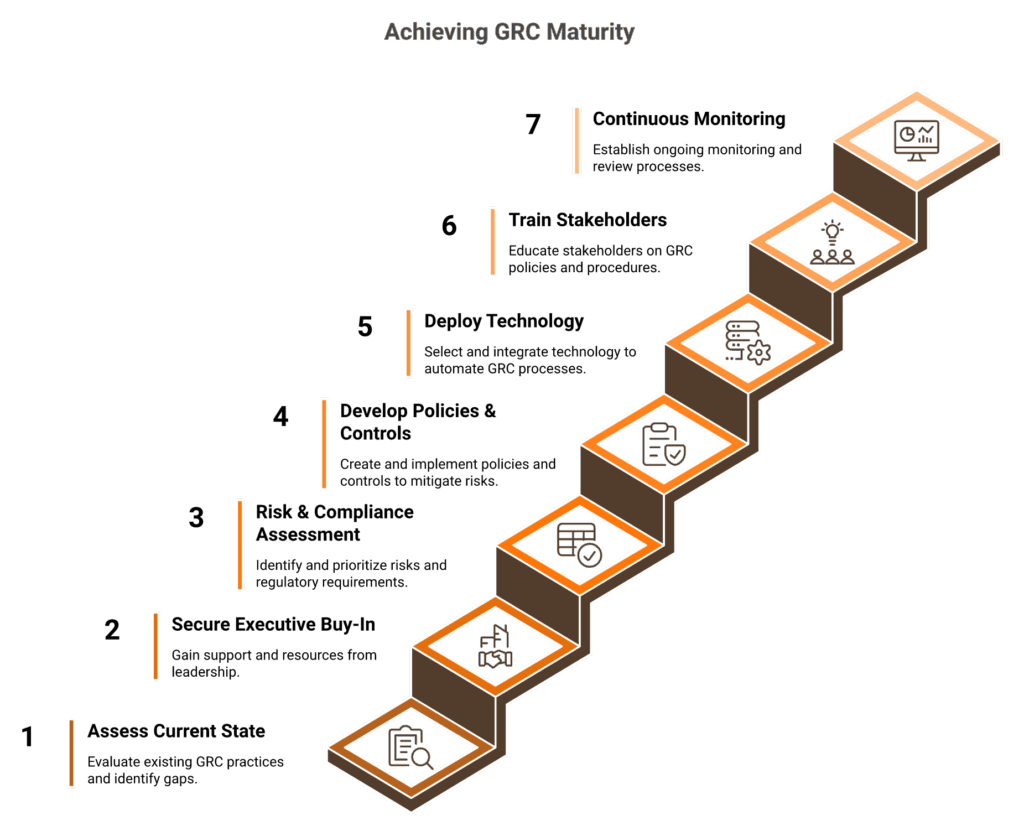
Step 1: Assess Current State and Define Objectives
Conduct a gap analysis between current governance/risk/compliance maturity and target state. Define measurable GRC objectives aligned with business strategy and risk appetite. Catalog what you already have, tools, policies, team assignments, before adding anything new.
Step 2: Secure Executive and Board-Level Buy-In
Present the business case with ROI metrics. Assign C-suite GRC ownership, CISO, CRO, or CCO, and establish a board reporting cadence. Over 55% of CISOs still view GRC as a cost center rather than a business enabler, so framing this as a revenue-protection function matters.
Step 3: Conduct Comprehensive Risk and Compliance Assessments
Catalog all applicable regulations per jurisdiction. Perform risk identification across operational, financial, strategic, and cyber domains. Prioritize risks by likelihood and impact.
Step 4: Develop Policies, Procedures, and Internal Controls
Design or update policies based on selected framework(s). Map each control to specific risks and regulatory requirements. Establish clear ownership with a RACI matrix.
Step 5: Select and Deploy GRC Technology and Tools
Evaluate platforms against integration capability, automation depth, and multi-framework support. Prioritize platforms that auto-collect evidence from security operations, not ones that require manual upload.
Step 6: Train Stakeholders and Build a Risk-Aware Culture
Deploy role-specific GRC training. Establish reporting channels for policy violations. Build a cross-functional GRC steering committee.
Step 7: Establish Continuous Monitoring, Review, and Improvement Cycles
Transition from periodic assessment to real-time evidence collection. Implement automated control testing and regulatory change monitoring. Schedule quarterly maturity reassessment.
✅ GRC Implementation Checklist
| Step | Key Deliverables | Owner | Timeline | Dependencies |
|---|---|---|---|---|
| 1. Assess Current State | Gap analysis report, maturity baseline | GRC Lead | Weeks 1–2 | Access to existing documentation |
| 2. Secure Buy-In | Business case, board approval, C-suite sponsor | CISO/CRO | Weeks 2–3 | Gap analysis output |
| 3. Risk & Compliance Assessment | Risk register, regulatory catalog, priority matrix | Risk Team | Weeks 3–6 | Executive sponsor confirmed |
| 4. Develop Policies & Controls | Policy library, control-to-risk mapping, RACI | Policy Owners | Weeks 6–10 | Assessment complete |
| 5. Deploy Technology | Platform selection, integration, evidence automation | IT/Security | Weeks 8–14 | Policies defined |
| 6. Train Stakeholders | Training program, steering committee charter | HR/GRC Lead | Weeks 10–16 | Technology deployed |
| 7. Continuous Monitoring | Real-time dashboards, quarterly review cadence | GRC Lead | Ongoing | All prior steps |
⚠️ Change Management: The Three Non-Negotiables
The three most critical change management requirements:
- Executive sponsorship must be visible and sustained, not just initial approval, but ongoing governance committee participation. If the C-suite signs off and disappears, the program stalls at Step 3.
- Cross-functional alignment: GRC affects IT, legal, HR, finance, and business units. A steering committee with representatives from each function prevents siloed implementation.
- Quick wins first: start with the framework or regulation that delivers the most visible compliance improvement within 90 days, then expand. Momentum matters more than perfection in the first quarter.
💰 GRC Implementation by Company Size
| Factor | SMB (50–250 employees) | Mid-Market (250–2,000) | Enterprise (2,000+) |
|---|---|---|---|
| Frameworks | 1 framework (SOC 2 or ISO 27001) | 2–3 layered frameworks | Full multi-framework architecture |
| GRC Platform | Lightweight (Vanta, Sprinto) | Mid-tier (Drata, Hyperproof) | Enterprise suite (ServiceNow, MetricStream) |
| Security Operations | Outsource to MDR provider | Integrate MDR as continuous evidence layer | Dedicated GRC team + MDR augmentation |
| Timeline | 3–6 months | 6–12 months | 12–18 months |
✅ How UnderDefense Accelerates Steps 5–7
UnderDefense accelerates the hardest part of GRC implementation, Steps 5 through 7, by providing the continuous security monitoring layer that generates real-time compliance evidence. Our 24/7 threat detection maps directly to SOC 2, ISO 27001, and HIPAA controls, with forever-free compliance kits and 30-day turnkey onboarding that eliminates the typical six-month deployment cycle. For SMB and mid-market organizations, we often replace both the security operations gap and the compliance evidence gap simultaneously, because they’re fundamentally the same problem: you need someone watching your environment around the clock, and the evidence of that watching is your compliance proof.
“UnderDefense helped us save money on security by automating tasks and making things run smoother. Additionally, their network tools helped us see what’s happening on our network better, which has helped us stop threats before they become big problems.”
— Julia K., Marketing Manager UnderDefense G2 – Verified Review
“UnderDefense MAXI improves security posture in general. It made easier for us to make informed security decisions, and helped us to comply with important regulations.”
— Serhii I., CEO UnderDefense G2 – Verified Review
Q5. Who Owns GRC? Team Roles, Board Governance Structures, and Reporting Frameworks
The number one predictor of GRC program failure is unclear ownership. When everyone is responsible for governance, risk, and compliance, nobody is. Effective GRC demands defined roles at four levels: board/executive governance, GRC leadership, cross-functional contributors, and operational specialists.
✅ The GRC RACI Matrix
Every organization needs a clear RACI matrix, Responsible, Accountable, Consulted, Informed, across its GRC stakeholders:
| Role | Primary Ownership | Reports To |
|---|---|---|
| Chief Risk Officer (CRO) | Enterprise risk strategy, risk appetite framework | Board Risk Committee |
| Chief Compliance Officer (CCO) | Regulatory compliance program, policy enforcement | CEO / Audit Committee |
| CISO | Cybersecurity as GRC pillar, compliance evidence generation | CRO / CEO |
| CFO | Financial risk, SOX compliance, internal controls | Board / Audit Committee |
| Board of Directors | Risk appetite setting, GRC oversight (Caremark duties) | Shareholders |
| Internal Audit | Independent assurance, control effectiveness testing | Audit Committee |
| Legal Counsel | Regulatory interpretation, litigation risk | General Counsel |
| IT Security / SOC Team | Technical controls, monitoring-based compliance evidence | CISO |
| HR | Training programs, policy acknowledgment, insider threats | CHRO |
| Business Unit Leaders | Operational risks within their domains, risk assessments | COO / CEO |
The mistake most organizations make is treating GRC as a single person’s job. The CRO owns risk strategy, the CCO owns regulatory compliance, and the CISO owns cybersecurity as a compliance pillar, but all three must coordinate through shared governance, or you end up with three siloed programs pretending to be one.
📝 GRC Career Path and Certifications
For practitioners building a GRC career, the progression typically follows: GRC Analyst (entry) → GRC Specialist → GRC Manager → GRC Director → CRO/CCO. Key certifications that accelerate this path include:
- GRCP (GRC Professional) from OCEG: foundational integrated GRC certification
- GRCA (GRC Auditor) from OCEG: audit-focused GRC certification
- CRISC (Certified in Risk and Information Systems Control) from ISACA
- CISA (Certified Information Systems Auditor) from ISACA
- CISSP: for GRC professionals with a cybersecurity focus
- CIA (Certified Internal Auditor): for audit-track GRC roles
These are not resume decorations. In operational practice, a CRISC-certified GRC manager brings structured risk quantification that boards actually trust, which directly impacts budget approvals for security investments.
📊 Board-Level Reporting Framework
Board reporting is where most GRC programs fall apart. You can have excellent controls and still fail if the board never sees actionable data. A practical board reporting framework should track five core metrics:
- Risk Posture Score: aggregate quantitative score (1–100) combining threat exposure, control effectiveness, and compliance coverage, presented as a trend line
- Compliance Coverage Rate: percentage of regulatory requirements with active, validated controls, broken down by framework
- Mean Time to Evidence (MTTE): how quickly the GRC program produces audit evidence for any control (target: under 4 hours for mature programs)
- Third-Party Risk Exposure: percentage of critical vendors with continuous monitoring vs. annual-only assessment
- Incident-to-Remediation Timeline: end-to-end from threat detection through containment to compliance documentation
⏰ Cadence matters as much as content. Best practice: monthly operational GRC reviews at leadership level, quarterly board risk committee reports, and an annual comprehensive GRC maturity assessment.
Where UnderDefense Fits
We auto-generate board-ready GRC metrics through continuous 24/7 security monitoring mapped to compliance frameworks. The UnderDefense MAXI platform produces audit-ready dashboards with real-time risk posture scores, eliminating the manual data aggregation that delays board reporting by weeks. Organizations using our integrated MDR + compliance approach report 60% faster board reporting cycles, because evidence is generated continuously, not assembled in a panic before the quarterly meeting.
Q6. What Are the Best GRC Software Tools and Platforms for 2026?
Choosing a GRC platform means committing to a compliance architecture that will govern your organization’s risk posture for years. The market has exploded: 40+ GRC platforms claim AI-powered automation and multi-framework support. But here is what most evaluation guides miss: a GRC platform only documents compliance. It does not generate the security evidence that proves your controls actually work.
❌ The Wrong Way to Choose GRC Software
Most compliance leaders select based on framework coverage counts (“they support 20 frameworks”), brand recognition, or integration counts alone. This ignores the critical architectural question: does the platform auto-collect compliance evidence from live security operations, or does it just organize evidence you manually upload? A GRC tool without real-time security integration is a documentation system, not a compliance engine. The second common mistake: evaluating cloud vs. on-premises deployment as a primary criterion. In 2026, cloud-native GRC is the default for mid-market and scaling organizations; on-premises is only justified for classified or air-gapped environments.
✅ The Right Evaluation Framework
Score every platform against these seven criteria:
- Operational Evidence Generation: auto-collect from security tools (SIEM, EDR, MDR), or require manual upload?
- Framework Coverage Depth: SOC 2, ISO 27001, HIPAA, NIS2, DORA, PCI-DSS with pre-mapped control libraries?
- SIEM/Security Tool Integration: connect to SIEM, EDR, and MDR outputs for continuous control validation?
- Regulatory Change Intelligence: auto-map new regulatory requirements to existing controls?
- Multi-Entity Support: handle subsidiaries or PE portfolio companies under unified governance?
- Audit Workflow Automation: streamline auditor access, evidence delivery, and remediation tracking?
- 💰 Pricing Transparency: published per-user/per-framework, or hidden behind enterprise quotes?
📊 GRC Platform Comparison
| Rank | Platform | Best For | Key Strength |
|---|---|---|---|
| #1 | UnderDefense MAXI + Compliance Kits | Security ops + compliance evidence from one platform | Auto-generates SOC 2, ISO 27001, HIPAA evidence via 24/7 MDR; 250+ integrations; $11–15/endpoint/month |
| #2 | Vanta | SaaS/tech startups through mid-market | Automated compliance; up to 1,200 checks/hour |
| #3 | Drata | Scaling tech companies | Continuous compliance automation; 100+ integrations |
| #4 | Hyperproof | Mid-market multi-framework programs | Strong evidence management and audit collaboration |
| #5 | ServiceNow GRC | Large enterprises on ServiceNow | Deep ITSM integration |
| #6 | OneTrust | Data privacy-first organizations | Strong GDPR/privacy governance focus |
| #7 | LogicGate Risk Cloud | Risk-first GRC programs | No-code automation builder |
| #8 | MetricStream | Regulated enterprises | Comprehensive risk/compliance/audit modules |
| #9 | Archer (RSA) | Complex enterprises with dedicated GRC teams | Legacy enterprise GRC, deep financial services adoption |
| #10 | AuditBoard | Finance-driven GRC programs | SOX compliance specialization |
What Users Say
“Their team provided us with clear and detailed insights into security vulnerabilities, along with practical recommendations on how to fix them. This level of transparency made it easy for our team to take action.”
— Arman N., CTO UnderDefense G2 – Verified Review
“The platform seamlessly integrates our existing security tools, simplifying management. I used to work with many MDR solutions in the past, and so far Underdefense is the best one!”
— Inga M., CEO UnderDefense G2 – Verified Review
The most effective architecture pairs UnderDefense MAXI for evidence generation with Vanta, Drata, or Hyperproof for evidence organization and audit management. We maintain a 100% ransomware prevention record across 500+ MDR clients over six years, and every prevented incident generates the compliance evidence that proves governance controls work, at published pricing no other MDR provider matches.
Q7. How Are AI and Automation Transforming Governance, Risk, and Compliance in 2026?
Compliance teams spend 60%+ of their time collecting evidence, chasing stakeholders for attestations, and reconciling spreadsheet-based risk registers. That is the operational reality of manual GRC in 2026, and it is breaking under pressure. Regulatory velocity has accelerated (new frameworks published monthly), AI-generated threats evolve faster than annual audits catch them, and boards demand real-time risk posture visibility rather than quarterly reports. McKinsey’s 2025 GRC benchmarking survey pegged average risk maturity at just 2.6/4.0 and compliance maturity at 2.9/4.0. Most organizations are still in early stages despite years of investment.
❌ Legacy GRC Platforms: Automation Bolted On, Not Built In
Traditional GRC software, ServiceNow GRC, MetricStream, legacy Archer, bolts on AI features like auto-generating risk descriptions or basic workflow automation without fundamentally changing the model from periodic to continuous. These platforms still require manual evidence collection, lack real-time threat context, and operate as documentation layers rather than operational compliance engines. Simultaneously, AI itself introduces new risk categories that GRC must govern: model bias, hallucination in policy generation, data leakage through LLM integrations, and the need for human oversight over AI-generated compliance assertions. AI is both the solution to GRC’s manual bottleneck and a new risk category that GRC must manage.
✅ The AI Use-Case Taxonomy for GRC
No competitor article lays this out comprehensively, so here it is: seven distinct AI capabilities reshaping GRC operations:
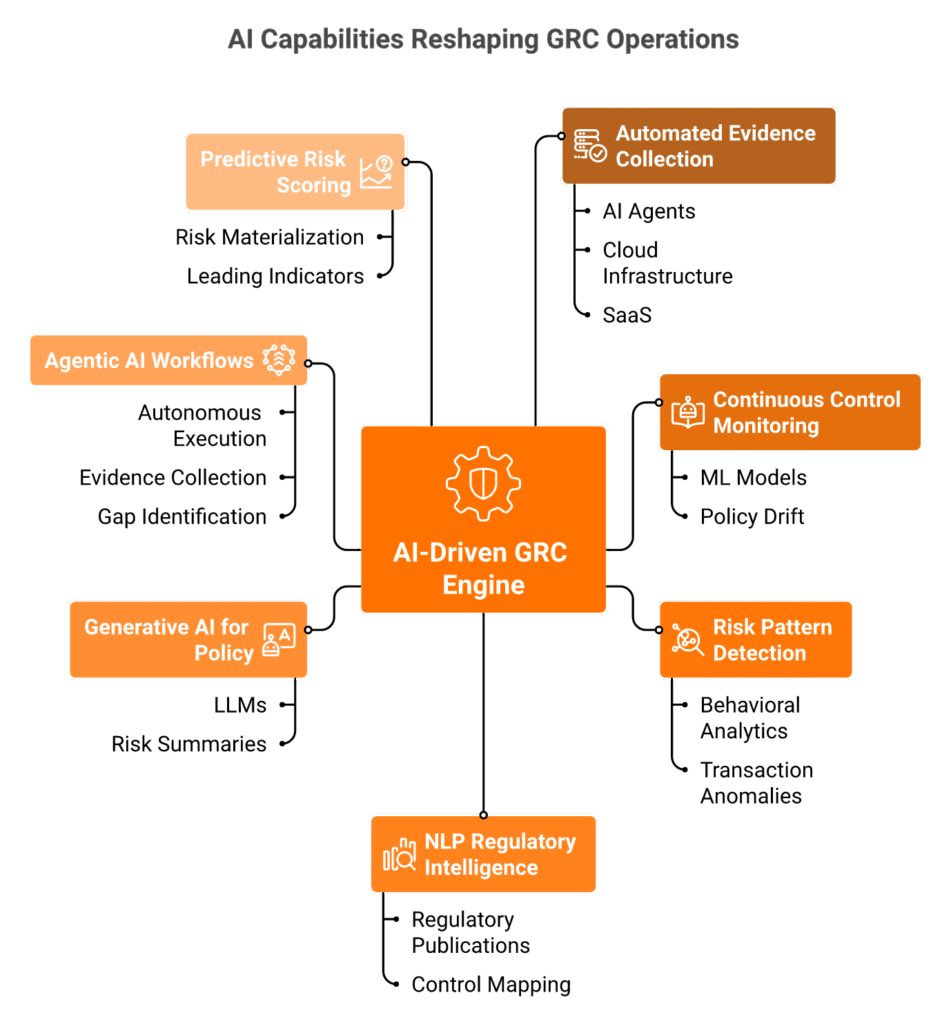
- Automated Evidence Collection: AI agents continuously pulling compliance evidence from cloud infrastructure, identity providers, and SaaS applications without manual intervention
- Continuous Control Monitoring: ML models detecting control drift and gaps between documented policies and actual implementation
- Risk Pattern Detection: behavioral analytics surfacing emerging risks from transaction patterns and access anomalies
- NLP-Powered Regulatory Intelligence: natural language processing monitoring regulatory publications across jurisdictions, auto-mapping new requirements to existing controls
- Generative AI for Policy and Reporting: LLMs drafting first-pass policies from regulatory requirements and producing board-ready risk summaries
- Agentic AI for Autonomous Workflows: multi-step AI agents executing evidence collection → control testing → gap identification → remediation ticketing → stakeholder notification, with human approval gates
- Predictive Risk Scoring: models forecasting risk materialization probability based on leading indicators
🔧 UnderDefense: The Operational AI Layer
Our UnderDefense MAXI platform is the operational embodiment of items 1–3 and 6 above. Vendor-agnostic integration across 250+ tools means AI-driven evidence collection spans your entire security and IT environment. Our 96% MITRE ATT&CK coverage delivers the continuous control monitoring that validates security governance assertions in real time. Concierge analysts provide the critical human oversight layer that AI governance demands, verifying, contextualizing, and responding to AI-generated findings before they become audit issues. The operating principle is straightforward: AI without human judgment is automation; AI with human judgment is governance.
⏰ Three 2026 Trends Reshaping GRC
Three forces are accelerating this transformation. First, UK Corporate Governance Code Provision 29, effective for periods starting January 1, 2026, requires boards to formally declare the effectiveness of material controls, including operational and compliance controls, with real-time monitoring evidence. This sets the global standard other jurisdictions will follow. Second, RegTech integration is converging regulatory technology with GRC platforms, enabling real-time compliance across jurisdictions. Third, the shift from “compliance program” to “continuous oversight model” means GRC is becoming an always-on operational capability rather than a periodic exercise. Organizations with AI-driven continuous compliance monitoring detect policy violations 60% faster and reduce audit preparation time by 70% compared to manual approaches.
Q8. How Do You Measure GRC Maturity, Benchmark Effectiveness, and Justify the Investment?
GRC programs often stall at budget approval because leaders struggle to quantify ROI in terms boards understand. McKinsey’s 2025 benchmarking survey, average risk maturity at 2.6/4.0, compliance maturity at 2.9/4.0, confirms that most organizations know they are underperforming but cannot articulate the cost of that gap. The solution is a dual deliverable: a maturity model to benchmark current state, and an ROI framework to justify investment.
📊 Five-Level GRC Maturity Model
Most GRC maturity models define five levels organizations use to track progress:
| Level | Name | Score | Characteristics |
|---|---|---|---|
| 1 | Ad Hoc | 0–20 | No formal program, reactive compliance, spreadsheets, audit prep is crisis mode |
| 2 | Defined | 21–40 | Framework selected, policies documented, manual risk register, siloed tasks, annual board reports |
| 3 | Managed | 41–60 | GRC platform deployed, RACI assigned, periodic risk assessments, some automation, quarterly reporting |
| 4 | Integrated | 61–80 | Cross-functional alignment, automated evidence collection, continuous monitoring initiated, real-time dashboards |
| 5 | Optimized | 81–100 | AI-driven continuous assurance, predictive risk intelligence, automated remediation, measurable ROI documented |
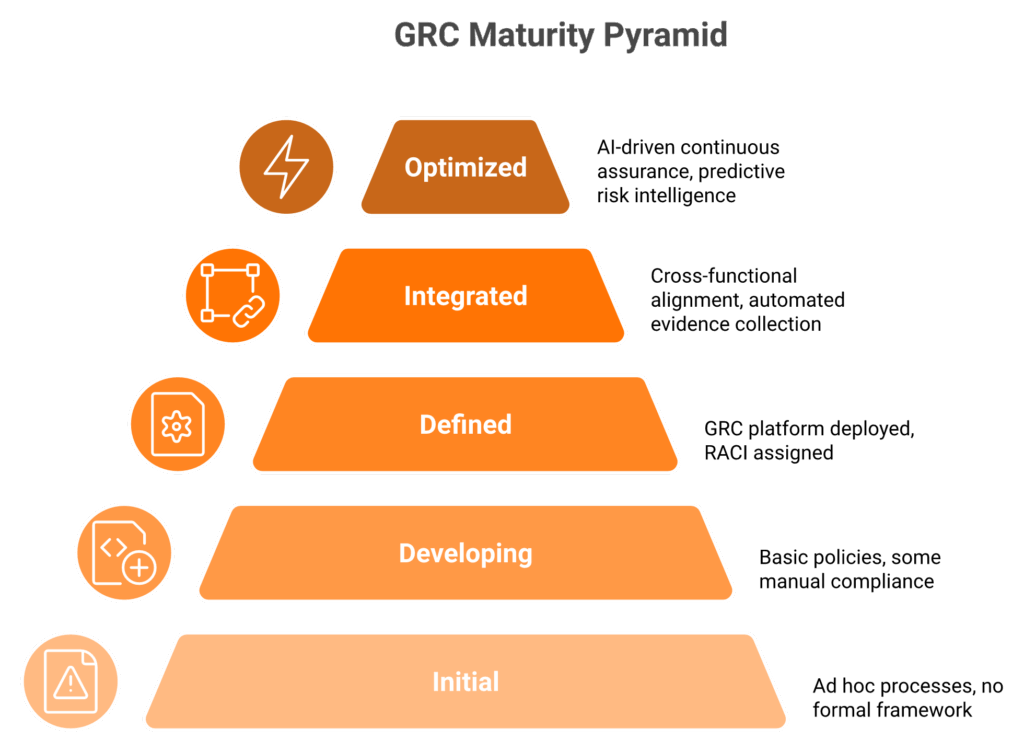
Self-assess using 20 criteria scored 0–5 across governance maturity, risk maturity, compliance maturity, and technology maturity dimensions. Most mid-market organizations land between Levels 2 and 3.
⭐ KRI/KPI Benchmarking Framework
Split your metrics into Key Risk Indicators (KRIs) and Key Performance Indicators (KPIs):
- KRIs: Mean time to risk identification, risk appetite utilization rate, control failure rate, third-party risk score trend.
- KPIs: Compliance coverage rate (%), audit finding remediation velocity, policy exception rate, training completion rate, evidence collection automation rate (%).
Benchmark targets for mature programs (Level 4+): 90%+ compliance coverage, <4-hour mean time to evidence, and <5% control failure rate.
💰 ROI Framework: Four Quantifiable Dimensions
- Regulatory Penalty Avoidance: (Probability of violation × average penalty) × risk reduction factor = avoided cost. Reference: average GDPR fine €2.2M, HIPAA breach average $1.5M, SOX non-compliance average $2.8M, PCI-DSS up to $500K/month
- Audit Cycle Compression: (Manual audit hours × hourly rate) − (Automated audit hours × hourly rate) = annual savings. Organizations with automated evidence collection compress audit cycles by 60%
- 💸 FTE Savings: (FTE hours on manual compliance × 52 weeks × hourly cost) × automation percentage = recovered capacity
- Breach Cost Mitigation: Average breach cost: $4.88M per IBM 2024 × MTTR reduction % = risk-adjusted savings
Present these as a board-ready ROI summary. The formula is simple: if your GRC investment reduces breach probability by even 10%, the math justifies itself against a $4.88M average breach cost.
Where UnderDefense Accelerates Maturity
We accelerate organizations from Level 2–3 to Level 4–5 by providing the continuous security monitoring layer that eliminates manual evidence collection. Documented outcomes: 99% reduction in customer-facing alerts through custom detection tuning, 0.5-hour MTTR for critical incidents, and real-time compliance evidence generation at $11–15/endpoint/month. We maintain a 100% ransomware prevention record across 500+ MDR clients over six years, translating directly to breach cost avoidance that funds the entire GRC program.
“We needed round-the-clock monitoring for compliance reasons, but building our own SOC wasn’t realistic with our budget and the current hiring market. UnderDefense fills that gap without us having to hire a full team.”
— Verified User in Marketing and Advertising UnderDefense G2 – Verified Review
“With UnderDefense MAXI, we’ve reduced security breaches. Their adherence to SLAs gives me confidence in our infrastructure’s protection. As the Information Security Director, it lets me focus on strategy, knowing the day-to-day security is managed effectively.”
— Oleg K., Director Information Security UnderDefense G2 – Verified Review
Q9. What Happens When GRC Fails? Real-World Case Studies, Warning Signs, and Root Cause Analysis
You present your quarterly GRC report to the board. Everything looks green: 94% compliance coverage, risk scores within appetite, no material findings. Six weeks later, a breach exposes 147 million customer records because a critical patch was not applied for 76 days, despite your “comprehensive” vulnerability management policy. Your GRC dashboard showed compliance. Reality showed a gap between documentation and operations. This is exactly what happened at Equifax in 2017, and it cost $575M in FTC settlements plus up to $700M total in remediation. The lesson is blunt: GRC that measures documentation instead of operational reality creates the illusion of control.
⚠️ Four Landmark GRC Failures
1. Boeing 737 MAX: Governance Failure
None of Boeing’s board committee charters mentioned airplane safety oversight. The board pushed production deadlines over engineering concerns; after the Lion Air crash, the CEO delayed informing directors for 10 days. Result: 346 deaths, $20B+ in costs, $225M board settlement, and criminal charges. Root GRC failure: governance structures created no accountability channels for safety risk escalation.
2. Citigroup $900M Transfer: Control Failure
A contractor intended to wire ~$7.8M in interest payments but accidentally transferred $894M of Citigroup’s own funds to Revlon lenders. Colleagues who should have caught it failed to act. Result: years of litigation, though Citigroup eventually won on appeal. Root GRC failure: internal controls lacked automated validation for high-risk financial transactions.
3. Wells Fargo Unauthorized Accounts: Culture Override
Between 2002 and 2016, thousands of employees created millions of unauthorized accounts to meet aggressive sales targets. Compliance monitoring existed but was overridden by sales culture pressure; whistleblower reports went unescalated. Result: $3B in fines and settlements, CEO resignation. Root GRC failure: compliance was subordinated to revenue culture.
4. Equifax Data Breach: Cybersecurity GRC Failure
Failed to patch a known Apache Struts vulnerability for 76 days despite internal mandate; stored SSNs in plain text; no adequate intrusion detection on legacy databases. Result: 147M records exposed, $575M+ in settlements. Root GRC failure: cybersecurity was not operationally integrated into GRC. Policies existed, but monitoring and enforcement gaps persisted.
❌ Weak vs. ✅ Strong GRC Indicators
| ❌ Weak GRC Warning Signs | ✅ Strong GRC Indicators |
|---|---|
| Dashboards show “green” while operational gaps persist | Real-time compliance dashboards with board access on demand |
| Compliance treated as annual project | Security operations feeding evidence directly into GRC framework |
| Board receives no cybersecurity-specific reporting | Defined RACI with clear escalation channels |
| Third-party risk assessed annually | Continuous control monitoring with drift detection |
| No escalation path from operations to board | MTTR for compliance evidence generation under 4 hours |
🔧 Root Cause Analysis Framework
Every GRC failure maps to one of five root causes: (1) Governance Gap, no board-level accountability for the risk domain (Boeing); (2) Control Design Failure, controls on paper but not enforced in operations (Citigroup); (3) Culture Override, incentives overriding compliance (Wells Fargo); (4) Monitoring Absence, no continuous monitoring for control drift (Equifax); (5) Escalation Breakdown, risk intelligence not reaching decision-makers (Boeing post-crash).
UnderDefense: Closing the Operational Gap
We directly address root causes 4 and 5. When a critical patch goes unapplied (Equifax scenario), UnderDefense MAXI detects the vulnerability exposure in real time across 250+ integrated tools. When suspicious account activity emerges (Wells Fargo scenario), concierge analysts verify directly with affected users via Slack or Teams, providing culture-independent verification that internal compliance teams under business pressure cannot. We maintain a 100% ransomware prevention record across 500+ MDR clients over six years because continuous monitoring with human-driven response catches what annual assessments miss.
“Not having to worry about ransomware, alert overload and reporting. Getting a clear view of my security posture, where the threats are coming from and how they are handled. They literally took care of all our problems.”
— Arlin O., Enterprise UnderDefense G2 – Verified Review
Q10. How Should Organizations Manage Third-Party and Supply Chain Risk Within Their GRC Program?
It is Tuesday morning. Your GRC team learns that a critical SaaS vendor failed their SOC 2 audit, the same vendor processing your customers’ PHI data under a BAA. You have 72 hours to assess exposure, notify affected stakeholders, and demonstrate to your auditor that compensating controls were in place. You open your third-party risk spreadsheet and discover the vendor’s last assessment was 11 months ago. You do not know what changed since then. This is the third-party risk gap that regulators have now codified into law.
❌ Why the Blind Spot Exists
Most GRC programs treat third-party risk as a point-in-time assessment: annual vendor questionnaires, static risk scores, and SOC 2 report reviews that capture a single moment. But vendor risk is continuous: security postures change, subcontractors are added, certifications lapse, and compliance status evolves between assessment cycles. Third-party breaches now account for 30% of all data breaches, a 100% increase year over year, according to the Verizon DBIR 2025. The average cost of a supply chain breach hit $4.91M globally, with U.S. organizations facing $10.22M per incident.
⚠️ The Hidden Costs
⏰ Time cost: 40+ hours per vendor for comprehensive manual assessment
❌ Coverage gaps: quarterly reviews miss 9 months of risk exposure per year
💸 Regulatory exposure: annual assessments do not satisfy NIS2, DORA, or HIPAA continuous oversight requirements
💰 Supply chain attack costs: aggregate cost exceeds $53.2B per year globally
✅ Regulatory Mandates Now Require Continuous Monitoring
NIS2 mandates supply chain risk assessment for essential and important entities. DORA requires ICT third-party risk management with continuous monitoring for financial entities, including security clauses in vendor contracts and regular audits. HIPAA requires Business Associate Agreements with ongoing compliance verification. Organizations relying on annual questionnaires are already non-compliant under these frameworks. Supply chain attacks take an average of 254 days to detect and contain, a delay that amplifies operational, economic, and reputational impact.
🔧 How Continuous Assurance Should Work
The ideal state includes automated vendor risk scoring updated continuously based on real-time security intelligence; monitoring of vendor security posture changes (certificate expirations, DNS changes, leaked credentials, CVE exposure); automated alerts when third-party compliance status changes; and real-time integration with your GRC platform so board reporting reflects current exposure, not last quarter’s assessment.
UnderDefense: Extending the AI SOC to Vendor Risk
We extend continuous security monitoring to the vendor risk domain. When a third-party integration shows anomalous behavior, unusual API calls, data exfiltration patterns, or authentication anomalies from vendor service accounts, UnderDefense MAXI correlates the signal across your environment. Concierge analysts verify the activity directly with vendor contacts, and containment actions happen in real time: revoking vendor API tokens, isolating connected endpoints, or blocking lateral movement. With 250+ tool integrations, the monitoring layer spans every vendor touchpoint regardless of the vendor’s own security tooling. We maintain a 100% ransomware prevention record across 500+ MDR clients, including zero successful supply chain attacks.
“It’s reassuring to know they’re always watching for threats, and it doesn’t cost a fortune. They catch and stop problems quickly, which is a huge relief. The platform works really well with our other security tools, which makes things much simpler.”
— Serhii B., Chief Information Security Officer UnderDefense G2 – Verified Review
Q11. Which Industries Face the Most Complex GRC Challenges in 2026?
GRC complexity varies dramatically by industry. Regulatory requirements, risk profiles, compliance timelines, and board reporting expectations differ significantly across healthcare, financial services, technology, manufacturing, and PE portfolio environments. Organizations that apply generic GRC frameworks without industry adaptation waste resources on irrelevant controls while missing sector-specific requirements.
🏥 Healthcare
Regulatory stack: HIPAA Security Rule + HITECH + state privacy laws + AI governance for clinical decision support + third-party BAA management for EHR vendors.
Key 2026 challenge: Balancing patient data access requirements with zero-trust security models while governing AI-powered diagnostic tools under evolving FDA and EU AI Act requirements. Named outcome: a German Healthcare Leader scaled IT security with UnderDefense MDR, achieving 24/7 monitoring across distributed clinical environments while generating HIPAA compliance evidence continuously.
💰 Financial Services
Regulatory stack: DORA (fully enforced January 2025) + SOX internal controls + AML/KYC transaction monitoring + PCI-DSS 4.0 + EU AI Act for algorithmic trading.
Key 2026 challenge: Multi-jurisdictional regulatory overlap requiring unified GRC across geographies with real-time incident reporting. DORA mandates a 4-hour initial notification. Named outcome: a Merchant Bank trusted UnderDefense for incident response and post-breach recovery; financial services organizations implementing continuous monitoring have documented $3.2M in avoided-incident costs.
💻 Technology/SaaS
Regulatory stack: SOC 2 Type II as customer requirement + ISO 27001 for enterprise sales + NIS2 for essential service providers + GDPR data processing obligations.
Key 2026 challenge: Scaling compliance from startup through Series C+ without creating compliance debt. Every delayed framework implementation compounds into expensive retrofitting.
🏭 Manufacturing/Biotech
Regulatory stack: Export controls (ITAR, EAR) + supply chain due diligence (German Supply Chain Act, CSRD) + ESG reporting + CMMC for defense subcontractors + ICS/OT security.
Key 2026 challenge: Converging IT/OT governance under a unified GRC framework while managing multi-tier supply chain compliance. Supply chain attacks grew 61% year-on-year in manufacturing alone.
🏢 PE Portfolio Companies
Requirement: Standardizing GRC across diverse portfolio company maturities (Level 1 to Level 3); value creation through compliance readiness that increases exit multiples; M&A due diligence integration with GRC gap analysis; unified board reporting across 10–50 entities with different tech stacks and regulatory jurisdictions.
Cross-Industry Themes
Three themes span every vertical: (a) AI governance is now a universal GRC requirement, not industry-specific, as every sector deploys AI tools requiring risk assessment and bias monitoring; (b) third-party and supply chain risk oversight has become regulatory mandate (NIS2, DORA, HIPAA) rather than optional best practice; (c) continuous compliance evidence generation has replaced annual audit preparation across all frameworks.
UnderDefense Across Industries
We serve healthcare, financial services, technology, manufacturing, and PE portfolio companies with the same unified UnderDefense MAXI platform. Vendor-agnostic integration means the monitoring layer adapts to each industry’s existing tool stack without forcing proprietary replacement. For PE portfolio companies, our published $11–15/endpoint/month pricing and 30-day onboarding enables rapid GRC standardization across diverse entities.
“UnderDefense MAXI improves security posture in general. It made easier for us to make informed security decisions, and helped us to comply with important regulations.”
— Serhii I., CEO UnderDefense G2 – Verified Review
Q12. Who Are the Leading Providers Helping Organizations Operationalize GRC Through Continuous Security Monitoring?
The leading approaches to operationalizing GRC through continuous security monitoring in 2026 fall into three categories: (1) AI-native MDR providers like UnderDefense that generate compliance evidence as a byproduct of 24/7 threat detection, (2) legacy MSSPs providing monitoring dashboards without actionable response, and (3) dedicated GRC platforms (Vanta, Drata, ServiceNow) that organize evidence but do not generate it from live security operations.
The Architectural Question That Matters
The GRC operational layer has become the critical differentiator between organizations that document compliance and those that demonstrate it continuously. The key question is not which GRC documentation tool you use but whether your security operations generate real-time evidence that feeds into your GRC framework automatically. Organizations that separate “security monitoring” from “compliance documentation” create the exact gap that every case study in this article, Boeing, Equifax, Wells Fargo, exploited.
✅ Selection Criteria
What separates GRC operational leaders from monitoring-only tools:
- Continuous evidence generation from live security monitoring vs. manual evidence upload at audit time
- Vendor-agnostic integration (works with your existing SIEM, EDR, cloud, and identity tools) vs. proprietary lock-in requiring stack replacement
- Human analyst response with organizational context vs. automated alert escalation without investigation
- 💰 Transparent published pricing vs. opaque enterprise quotes that inflate during renewal
- Included compliance support (forever-free compliance kits, audit-ready dashboards) vs. separate tools requiring additional budget
Each approach excels in different scenarios: UnderDefense for organizations that need security operations to generate GRC evidence continuously, legacy MSSPs for checkbox monitoring requirements, and dedicated GRC platforms for organizations with strong security operations that need documentation and workflow tools.
This analysis is based on documented compliance outcomes, G2 reviews, published pricing, and operational results across 500+ MDR deployments serving healthcare, financial services, technology, manufacturing, and PE portfolio organizations.
1. What is governance, risk, and compliance (GRC), and why does it matter in 2026?
Governance, Risk, and Compliance (GRC) is the integrated discipline that unifies an organization’s governance structures, risk management processes, and compliance operations into a single strategic operating model. The three pillars work together:
-
Governance sets strategic direction, board oversight, and ethical accountability
-
Risk Management identifies, assesses, prioritizes, and mitigates threats across operational, financial, and cyber domains
-
Compliance ensures adherence to external regulations and internal policies through audit evidence generation
In 2026, GRC has become non-optional. DORA reached full enforcement for EU financial entities in January 2025, NIS2 penalties are now active with fines up to €10M or 2% of global turnover, and the EU AI Act’s high-risk system requirements apply by August 2026. Gartner predicts legal and compliance functions will increase GRC platform spending by 50% by 2026, signaling that static, manual methods are no longer sustainable. We at UnderDefense see GRC as inseparable from security operations. Our MAXI platform generates continuous compliance evidence through 24/7 threat detection, bridging the gap between GRC strategy and GRC execution where regulatory penalties compound.
2. How do you choose the right GRC framework for your organization?
Choosing the right GRC framework depends on five variables: industry and regulatory jurisdiction, customer compliance requirements, existing security maturity, certification vs. alignment needs, and company size. Framework selection guide:
-
Healthcare: HIPAA + NIST CSF + ISO 27001
-
Financial services: DORA + COSO ERM + ISO 27001
-
Defense contractors: CMMC 2.0 + NIST SP 800-171
-
Tech/SaaS: SOC 2 + ISO 27001 + COBIT
-
SMB starting out: Begin with SOC 2 or ISO 27001 as a single framework, then layer as maturity grows
Most enterprises don’t choose a single framework — they layer multiple frameworks mapped to different regulatory requirements. The OCEG Red Book 3.5, developed with 300 experts across 500 organizations, is the only standard that explicitly integrates governance, strategy, risk, audit, compliance, and IT into a unified approach. We simplify multi-framework compliance by generating audit-ready evidence that maps simultaneously to SOC 2, ISO 27001, and HIPAA through our unified MAXI platform, with forever-free compliance kits included with MDR.
3. What are the steps to implement a GRC program from scratch?
GRC implementation fails most often from poor execution — siloed ownership, tool sprawl, and lack of executive sponsorship. Traditional implementations fail to meet original business objectives in 58% of cases. The 7-step roadmap:
-
Assess current state — Conduct gap analysis, baseline maturity (Weeks 1–2)
-
Secure executive buy-in — Present ROI business case, assign C-suite sponsor (Weeks 2–3)
-
Conduct risk and compliance assessments — Build risk register, map regulations (Weeks 3–6)
-
Develop policies and controls — Create RACI matrix, map controls to risks (Weeks 6–10)
-
Deploy GRC technology — Select platforms, integrate with security tools (Weeks 8–14)
-
Train stakeholders — Role-specific GRC training, build steering committee (Weeks 10–16)
-
Establish continuous monitoring — Transition from periodic assessment to real-time evidence collection (Ongoing)
The three change management non-negotiables: visible executive sponsorship, cross-functional alignment, and quick wins in the first 90 days. We accelerate Steps 5–7 by providing continuous security monitoring that generates real-time compliance evidence, with 30-day turnkey onboarding eliminating the typical six-month deployment cycle.
4. What are the best GRC software tools and platforms in 2026?
The GRC software market exceeded $35B in 2024 and is projected to reach $90B by 2033 at 12.5% CAGR. Choosing the right platform requires evaluating beyond feature counts. Top platforms by use case:
The critical evaluation question: Does the platform auto-collect compliance evidence from live security operations, or does it just organize evidence you manually upload? A GRC tool without real-time security integration is a documentation system, not a compliance engine. We built UnderDefense MAXI as the operational layer — vendor-agnostic integration across 250 tools feeds real-time security evidence into compliance frameworks at $11–15/endpoint/month.
5. How are AI and automation transforming GRC operations in 2026?
AI is both the solution to GRC’s manual bottleneck and a new risk category that GRC must manage. Compliance teams spend 60% of their time collecting evidence and reconciling spreadsheet-based risk registers — AI changes this fundamentally. Seven AI capabilities reshaping GRC:
-
Automated evidence collection — AI agents pulling compliance evidence from cloud infrastructure without manual intervention
-
Continuous control monitoring — ML models detecting control drift between policies and actual implementation
-
NLP-powered regulatory intelligence — Monitoring regulatory publications across jurisdictions, auto-mapping new requirements to existing controls
-
Predictive risk scoring — Forecasting risk materialization probability based on leading indicators
-
Generative AI for policy drafting — LLMs drafting first-pass policies from regulatory requirements
-
Agentic AI workflows — Multi-step agents executing evidence collection → control testing → gap identification → remediation ticketing
-
Risk pattern detection — Behavioral analytics surfacing emerging risks from transaction patterns
Organizations with AI-driven continuous compliance monitoring detect policy violations 60% faster and reduce audit preparation time by 70% compared to manual approaches. Our MAXI platform delivers 96% MITRE ATT&CK coverage with AI-driven detection, while concierge analysts provide the human oversight layer that AI governance demands.
6. How do you measure GRC maturity and justify the investment to the board?
McKinsey’s 2025 GRC benchmarking survey pegged average risk maturity at just 2.6/4.0 and compliance maturity at 2.9/4.0, confirming most organizations are underperforming despite years of investment. Five-level GRC maturity model:
-
Level 1 (Initial, Score 0–20): Ad hoc processes, no formal framework
-
Level 2 (Developing, 21–40): Basic policies, some manual compliance
-
Level 3 (Defined, 41–60): GRC platform deployed, periodic risk assessments
-
Level 4 (Integrated, 61–80): Cross-functional alignment, automated evidence collection, continuous monitoring
-
Level 5 (Optimized, 81–100): AI-driven continuous assurance, predictive risk intelligence
ROI framework (four dimensions):
-
Regulatory penalty avoidance — Average GDPR fine: €2.2M; HIPAA breach: $1.5M; SOX non-compliance: $2.8M
-
Audit cycle compression — Automated evidence collection compresses audit cycles by 60%
-
FTE savings — Recovered manual compliance capacity
-
Breach cost mitigation — Average breach cost: $4.88M (IBM 2024); even 10% probability reduction justifies investment
We accelerate organizations from Level 2–3 to Level 4–5 through continuous security monitoring that eliminates manual evidence collection — documented outcomes include 0.5-hour MTTR for critical incidents and real-time compliance evidence generation.
7. How should organizations manage third-party and supply chain risk within GRC?
Third-party breaches now account for 30% of all data breaches — a 100% increase year over year according to the Verizon DBIR 2025. The average cost of a supply chain breach hit $4.91M globally, with U.S. organizations facing $10.22M per incident. Why traditional approaches fail:
-
Annual vendor questionnaires capture a single moment; vendor risk is continuous
-
Manual assessment costs 40+ hours per vendor
-
Quarterly reviews miss 9 months of risk exposure per year
-
NIS2, DORA, and HIPAA now mandate continuous oversight — annual questionnaires are non-compliant
Continuous assurance requirements:
-
Automated vendor risk scoring updated in real time
-
Monitoring of vendor security posture changes (certificate expirations, DNS changes, leaked credentials)
-
Automated alerts when third-party compliance status changes
-
Real-time integration with your GRC platform for board reporting
Supply chain attacks take an average of 254 days to detect and contain. We extend continuous security monitoring to the vendor risk domain. When a third-party integration shows anomalous behavior, UnderDefense MAXI correlates the signal across your environment, and concierge analysts verify and contain the threat in real time.
8. What happens when GRC fails, and what are the warning signs?
GRC failure creates catastrophic financial and operational consequences. Four landmark case studies illustrate the patterns:
-
Boeing 737 MAX — No board committee charter mentioned safety oversight. Result: 346 deaths, $20B in costs, criminal charges. Root cause: governance gap.
-
Equifax — Failed to patch a known vulnerability for 76 days despite internal mandate. Result: 147M records exposed, $575M in settlements. Root cause: monitoring absence.
-
Wells Fargo — Compliance was overridden by sales culture. Result: $3B in fines. Root cause: culture override.
-
Citigroup — $894M accidentally transferred due to missing automated validation. Root cause: control design failure.
Warning signs of weak GRC:
-
Dashboards show green while operational gaps persist
-
Compliance treated as an annual project
-
Board receives no cybersecurity-specific reporting
-
Third-party risk assessed annually only
-
No escalation path from operations to board
We directly address root causes 4 (monitoring absence) and 5 (escalation breakdown). Our 24/7 security operations detect when controls drift — like an unapplied critical patch — in real time across 250 integrated tools, maintaining a 100% ransomware prevention record across 500 MDR clients.