




Q1: Managed SIEM, MSSP, MDR, Co-Managed SIEM: Why Does the Same Label Mean Four Different Things at Audit Time?
Last quarter a Head of GRC pinged me at 9 p.m. before her PCI kickoff. She had four vendor proposals open, all promising “compliance coverage,” and could not tell me which one would actually hand her assessor a log. That is the real problem. The words are blurry, and the audit clock is not.
A managed SIEM operates your log pipeline and retention. An MSSP manages security devices and forwards you alerts. MDR investigates and responds to threats. Co-managed SIEM splits the operation of a SIEM you own. They overlap in marketing, but they diverge in the one place that matters for an audit: the documentation each one leaves behind as a byproduct of doing its job. The useful question becomes which model produces, retains, and can attest to the evidence your assessor will request.
Talk to a SIEM expert about fewer false positives.
📋 What each model actually does
Here is how I explain it to a busy CISO in one screen.
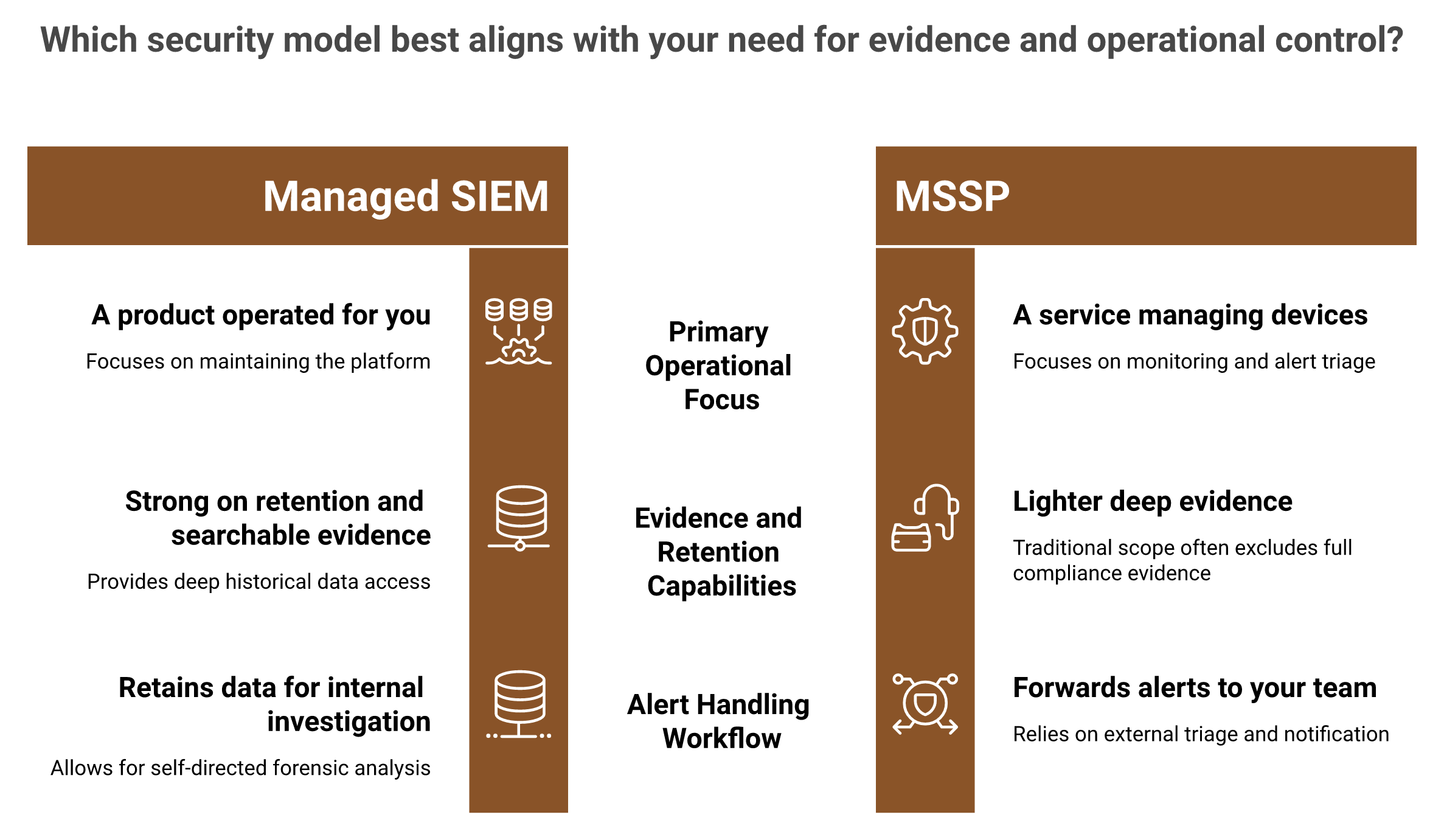
- Managed SIEM: a provider runs the log collection, correlation, and retention layer. Strong for searchable evidence and retention duration.
- MSSP: a service that manages firewalls, endpoints, and other devices, then forwards alerts. Broad operational scope, lighter on deep evidence.
- MDR: focused on detection and hands-on response, so it produces incident and investigation records.
- Co-managed SIEM: you own the SIEM and the data; the provider helps operate and tune it, keeping control in your hands.
The core split is clean: a SIEM is a product, while an MSSP delivers a service and may operate that product for you. There is a point most buyers miss, that traditional MSSP services often do not cover the compliance demands regulated customers carry. If you want the deeper breakdown, our guide on how these models compare walks through each one.
🔍 The difference hides in the evidence trail
Here is the part the category avoids saying out loud. Two models can detect the same threat and leave you with completely different paperwork. One hands your auditor a line-by-line record. The other hands you a one-line alert summary and a shrug.
From what surfaces when you actually run investigations, the gap is not subtle. The average investigation runs 40 to 50 queries across six different tools in a customer environment. Done well, you get a line-by-line detail of everything that was gathered. Done as best-effort copying and pasting of logs, you get noise. Parroting alerts from security products back at you just produces exhaustion and a weaker posture.
✅ The one question to carry Monday
Stop asking “who detects better?” Start asking “which model produces, retains, and can attest to the artifacts my assessor will request?” That single reframe collapses four fuzzy labels into one clear test.
I might be wrong for the rare shop with no compliance pressure at all. For everyone under an audit clock, the evidence question is the buying decision. At UnderDefense, we lead every compliance-driven scoping call with that question first, because it saves the reader from discovering the gap during fieldwork, when it is expensive to fix.
Q2: Does Your Vendor’s SOC 2 Report Make You Compliant?
I hear this one on almost every call. “Our MDR provider is SOC 2, so that box is covered.” I get why it feels true. It is also one of the most expensive misreads a GRC leader can make before an audit.
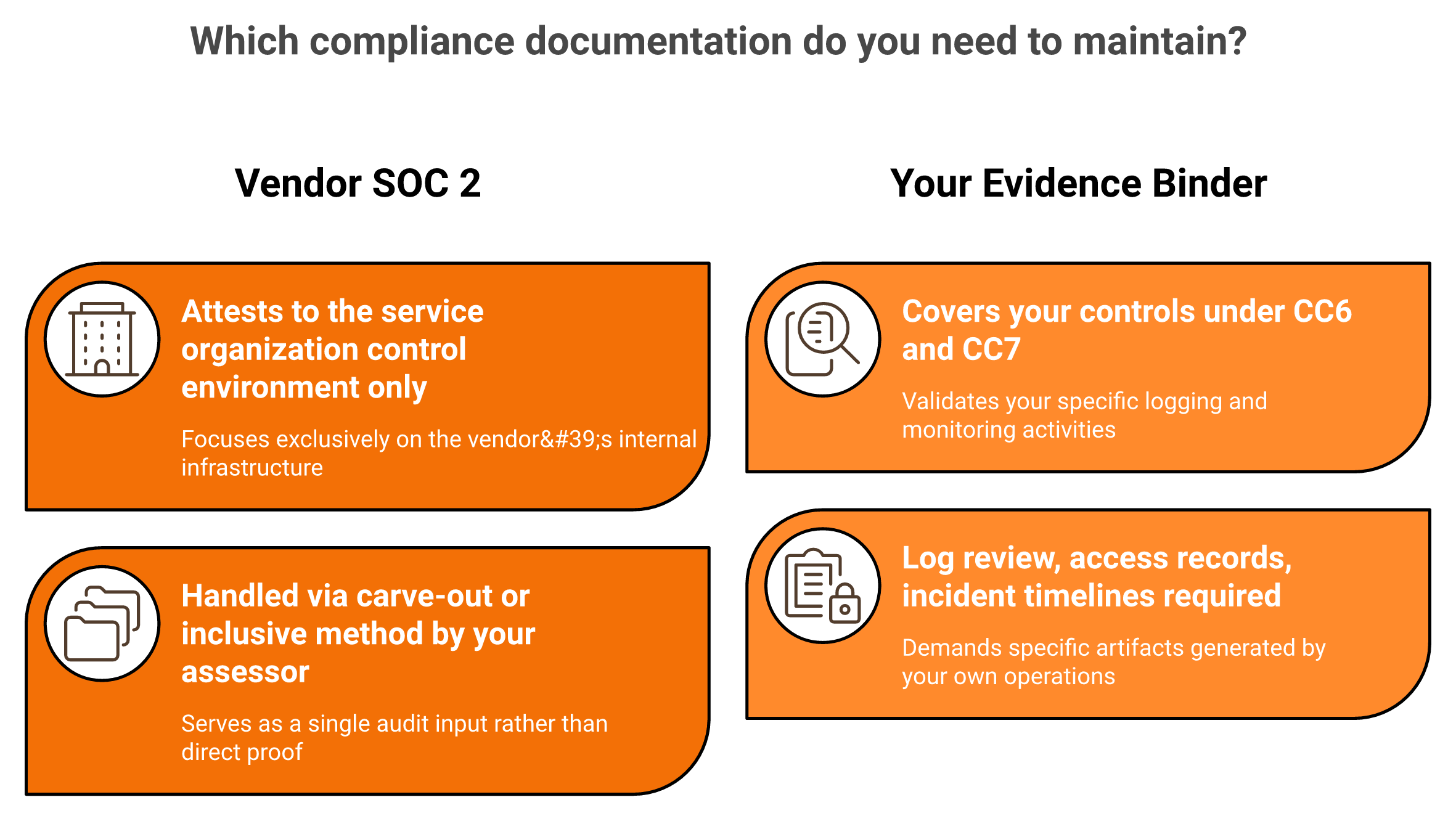
No. A vendor’s SOC 2 Type 2 report covers the vendor’s own control environment as a service organization. It stands as one input to your audit, rather than a substitute for your own artifacts. Your assessor still expects you to produce your evidence. Compliance accountability stays with the covered entity or the in-scope company, so treat a vendor report as one input among many.
📑 What an assessor actually does with a vendor report
When your auditor sees a subservice organization in your environment, they handle it one of two ways. Neither one lets you off the hook.
- Carve-out method: the vendor’s controls sit outside your report scope, so you still document how you monitor that vendor.
- Inclusive method: the vendor’s controls are pulled in and tested alongside yours, which needs the vendor’s cooperation.
Either way, the SOC 2 criteria the auditor tests against, logging and monitoring under CC6 and CC7, still point at your controls operating over the period. A vendor certificate does not generate your log review evidence, your access records, or your incident timelines. Our walkthrough of how SOC 2 evidence gets automated shows where those artifacts actually come from.
🧾 Separate the two binders
Here is the standard read I think gets this backwards. Buyers collect vendor certificates and feel prepared. Certificates are trust signals, rather than your evidence.
My honest take, earned from sitting through these fieldwork sessions: compliance is a result of a good program, and assessment decoupled from real posture becomes theater. A trust-center badge can look great and still not prevent an incident tomorrow.
So keep two binders. One holds “evidence about the vendor,” the certificates and monitoring notes. The other holds “evidence about you,” your logs, reviews, and dispositions. At UnderDefense, we build toward real telemetry mapping to controls, so the artifacts an auditor asks for are the ones your operation already produces, rather than policies that only exist on paper. If you inherited an unclear program, our compliance guidance is a useful starting point.
Q3: What Evidence Does a PCI-DSS Assessor Actually Request, and Which Model Produces It?
The first PCI fieldwork question I watch trip teams up is simple. “Show me proof someone reviewed these logs, and show me you can still pull the last twelve months.” Half the room can produce the logs. Fewer can produce the review record. That gap is where the model you chose either saves you or exposes you.
PCI DSS v4.0.1 Requirement 10 expects audit logs across in-scope systems, retention of at least 12 months, with a minimum of 3 months immediately available for analysis, and evidence that logs are reviewed and dispositioned. A managed SIEM model typically owns the searchable retention pipeline. An MSSP may manage the devices without holding the evidence store. Confirm which party can produce the daily-review record before you sign, and remember your QSA interprets the final requirement.
📅 What Requirement 10 actually asks for
Named plainly, so nothing is from memory. These are the pieces a QSA-ready setup must show under v4.0.1.
- Retention: at least 12 months of audit history, with 3 months immediately searchable.
- Coverage: logs across in-scope systems handling cardholder data.
- Review: evidence that logs are reviewed, increasingly that findings were dispositioned, and not just retained.
- Integrity: protection of logs against tampering.
If you want the full control-by-control view, our PCI DSS audit breakdown covers each expectation in order.
🗂️ Which model produces which artifact
Map it honestly. A managed SIEM or co-managed SIEM usually owns retention and the searchable store, so the twelve-month pull lives there. An MSSP managing devices may forward alerts without holding your evidence, which means the daily-review attestation can fall into a gap nobody owns.
One tension I want you to plan for: retention economics collide with the mandate. I have watched a team cut ingestion by roughly 90 percent, from about 300 gigabytes per day down to 35 to 40, by tuning correlation rules to drop unused and duplicate logs. Cleaner pipelines make twelve months affordable and reviewable.
✅ The Monday question
Ask every vendor the data sovereignty test. “Will you log in to our SIEM, or do you require us to send data to your platform?” If your data flows to them, your retention and review evidence live in their tenant, and a switch means starting the tuning over. Our note on avoiding SIEM vendor lock-in explains why that matters at renewal.
At UnderDefense, we co-manage the SIEM you own, so retention and residency stay under your control while we operate the review. Please treat this as orientation; your QSA makes the final call on your scope.
Compliance
WHERE THIS IS HANDLED
We map your log pipeline to the evidence a PCI, HIPAA, or SOC 2 assessor will request.
If you want a second set of eyes on whether your current setup produces those artifacts before fieldwork, this is work we do every day.
Q4: How Do HIPAA Audit-Control and 6-Year Retention Rules Change the Model You Need?
HIPAA is where I see smart teams guess, and guess short. A healthcare CISO once told me his team kept 90 days of logs because “that felt reasonable.” His auditor did not share the feeling. The rule gives you room, and that room is exactly the trap.
HIPAA’s audit-controls standard, §164.312(b), requires mechanisms to record and examine activity in systems holding electronic protected health information, which is patient data in digital form. It names no retention period, no mandatory log fields, and no review cadence. Those flow from your risk analysis. The six-year clock lives in §164.316(b)(2)(i) and applies to required documentation. NIST guidance leads many assessors to extend that thinking to audit logs. Because HIPAA is non-prescriptive, the model you pick effectively defines your defensible position.
⚖️ Two rules people blur together
These get mixed up constantly, so let me separate them cleanly.
- §164.312(b), audit controls: you must record and examine ePHI system activity, but the specifics are yours to justify.
- §164.316(b)(2)(i), documentation retention: required documentation is kept for six years.
NIST SP 800-66 and SP 800-92 are the references assessors lean on to interpret how long and how thoroughly to keep audit trails. HHS publishes an audit protocol that shows the kinds of controls reviewers actually test. None of it hands you a single tidy number. For a healthcare-specific view, our managed SIEM for healthcare guide maps these controls to real deployments.
🧩 Why the model carries the weight
Because HIPAA will not prescribe the answer, your operating model has to supply the defensible logic. That means log-source coverage broad enough to see ePHI access, and a review process someone can attest to under oath.
I want to be careful here and avoid fear, because dread is the wrong lever for a GRC reader. The Vastaamo case is the sober reminder of stakes. After a clinic breach and a failed extortion, an attacker emailed roughly 33,000 patients directly. That is what happens when sensitive records slip past noisy filters unreviewed. Our HIPAA-aware detection approach exists for exactly this scenario.
🛡️ How review actually scales
The way review actually scales is a simple frame I use often. Think of automation as foot soldiers and your analysts as generals directing them. Automation handles volume; humans own judgment on the edge cases.
✅ The Monday action
Write down your log-retention decision and tie it to your risk analysis, with framework versions named. That document is what makes your choice defensible when OCR or your assessor interprets it.
For data-residency needs, the model matters here too. At UnderDefense, we can run on-prem inside your own cloud, whether that is Azure, GCP, AWS, or Oracle, so ePHI stays where your risk analysis says it must. Treat this as orientation; your assessor interprets your specific obligations.
💬 What operators say about the evidence gap
Two verified reviews that speak directly to audit-ready evidence and log ownership.
“They’ve also made our audit process much less painful. The reports from their platform give us clear evidence of our security controls and incident response capabilities. When auditors or clients ask questions about our security posture, we can pull up exactly what they need to see.”
Verified User in Marketing and Advertising, Small-Business UnderDefense G2 – Verified Review
“Plus, their expert management of our SIEM has added to the value of our security investments and tools. We gain valuable insights into security posture and incidents, and share them with the board of directors.”
Yaroslava K., IT Project Manager UnderDefense G2 – Verified Review
Q5: What Does a SOC 2 Type 2 Assessor Look For Over the Observation Period?
The trap I see most often with SOC 2 is timing. Teams prep like it is a one-day exam, then the auditor asks to see the last six months of monitoring in action. That is a very different question, and the answer lives in how you operated, rather than what you configured.
SOC 2 Type 2 tests whether controls operated effectively across an observation window, commonly 3 to 12 months, so the assessor wants continuous evidence rather than a one-day snapshot. Logging and monitoring criteria, CC6.1, CC7.2, and CC7.3, expect detection, alerting, and evidence that anomalies were reviewed and dispositioned throughout the period. A model that generates disposition records as a byproduct of triage sustains this better than one retaining volume it cannot prove was reviewed.
📊 Type 1 versus Type 2, in plain terms
Here is the distinction that decides your prep.
- Type 1: a point-in-time check. Are the controls designed correctly today?
- Type 2: a period-of-time check. Did those controls actually operate, day after day, across the window?
Under CC7.2 and CC7.3, the auditor looks for monitoring that detected anomalies and evidence they were analyzed and acted on. “Disposition” just means a recorded decision on each alert, real threat, benign, or handled. A pile of retained logs with no review trail does not clear that bar. Our overview of SOC 2 evidence automation shows where those records originate.
🧩 Why disposition records are the 2026 ask
Here is where the standard read gets thin. Buyers assume storing logs equals monitoring. Assessors increasingly want proof each alert was reviewed and closed with a reason.
I think of detection logic like Lego bricks. When you own the business logic behind each rule, every alert leaves a clean, reproducible record of why it fired and what happened next. That record is the evidence, produced as a byproduct of doing the work, rather than reconstructed the week before fieldwork. Our note on reducing alert fatigue explains why clean disposition beats raw volume.
✅ What to start doing now
Begin capturing dispositioned review evidence today, rather than in month five. Continuous evidence cannot be backfilled once the observation window is running.
At UnderDefense, our operating tempo is built around this, with a 2-minute Alert-to-Triage target and a 15-minute escalation for critical incidents. Fast triage matters here for a specific reason, because every triaged alert becomes an auditable record of review, so one model produces both the detection and the SOC 2 evidence at once. Our SOC service is built to generate that trail, and your auditor still interprets your final scope.
Q6: The Compliance-Coverage Matrix: Which Model Produces, Retains, and Attests to Each Evidence Artifact?
Most model comparisons stop at “who detects fastest.” Then fieldwork arrives, the assessor asks for a specific artifact, and the documentation gap opens up. This matrix is the fix. It maps each model against the exact evidence an auditor requests, so you find the gap now instead of during the audit.
Map each model against the artifacts assessors request: log retention duration and integrity, log-source coverage, chain of custody, daily-review attestation, incident documentation, alert disposition records, audit trails on the SIEM itself, data residency, assessor access, and who attests and will sign. Read across the rows and the real gap appears in which model can prove what it did, well beyond raw detection speed.
| Evidence artifact | MSSP | Managed SIEM | Co-Managed SIEM | MDR |
|---|---|---|---|---|
| Detect / monitor / respond | Monitor and alert | Detect | Detect | Respond |
| Log retention (12 mo, PCI) | Depends | Produces | Customer-owned | Partial |
| Log-source coverage | Broad devices | Broad logs | Broad logs | Endpoint-led |
| Chain of custody / tamper evidence | Depends | Produces | Customer-owned | Partial |
| Daily-review attestation | Depends | Partial | Produces | Produces |
| Incident documentation | Alert-level | Partial | Produces | Produces |
| Alert disposition records | Rare | Partial | Produces | Produces |
| Audit trail on the SIEM itself | Depends | Produces | Customer-owned | Partial |
| Data residency control | Provider tenant | Depends | Customer-owned | Provider tenant |
| Who attests / will sign | Limited | Partial | Customer and provider | Provider |
The rows most competitors skip are disposition records and “who will sign.” Regulatory-compliance support varies sharply between an MSSP and a managed SIEM, a point our model comparison guide covers in depth. When 50 to 90 percent of alerts are false positives, unreviewed volume is a liability, rather than evidence.
✅ Use it as a vendor question set
Turn every row into a question and ask the data sovereignty test first. “Will you log in to our SIEM, or require us to send data to your platform?” If data flows to them, you start the tuning process over when you switch, which our note on avoiding vendor lock-in unpacks.
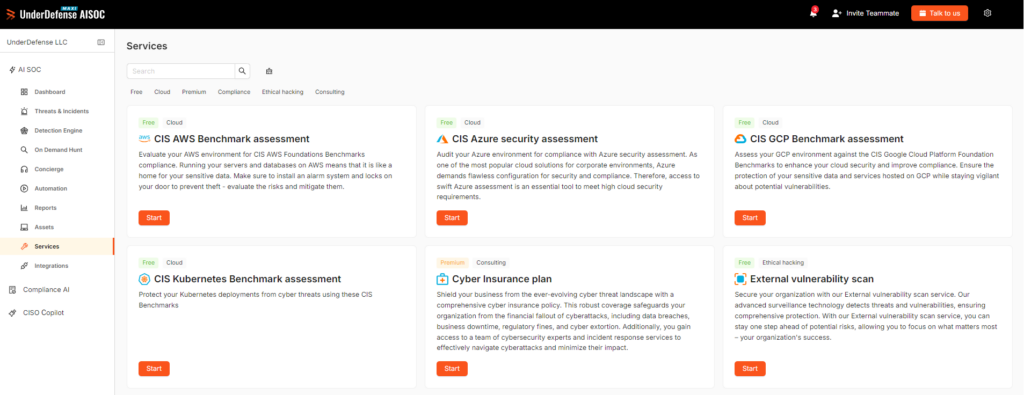
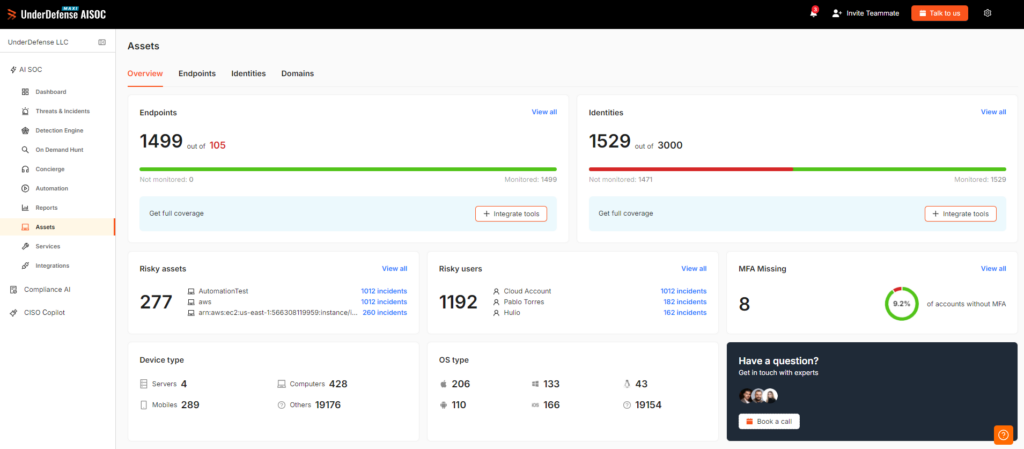
At UnderDefense, MAXI AI Compliance runs as a real SecOps platform, producing automated evidence collection and continuous control validation, mapping telemetry to controls across ISO 27001, SOC 2 Type 1 and 2, GDPR, HIPAA, and PCI-DSS. That replaces the sprawl of a checklist tool plus a separate detection stack. Everything stays observable and auditable, the governance layer you need to run AI in production. See how it fits your stack on the WarRoom platform, and explore our broader compliance services.
“They’ve also made our audit process much less painful. When auditors or clients ask questions about our security posture, we can pull up exactly what they need to see.”
Verified User in Marketing and Advertising, Small-Business UnderDefense G2 Verified Review
Q7: What Actually Transfers to the Vendor, and What Never Leaves You?
Every few weeks a buyer tells me they want to “hand compliance to a vendor and stop thinking about it.” I understand the wish. It also does not survive contact with an auditor, so let me draw the line clearly.
A vendor can operate your log pipeline, review alerts, and document incidents. Accountability for compliance stays with you. You remain the party the assessor holds responsible and the party that must attest. The useful question is which operational obligations a model reliably takes off your plate, versus which ones you must keep visibility into, because you will still testify to them at fieldwork.
🔀 What transfers, what stays
Split it cleanly before you sign.
- Transfers to the vendor: log collection and retention operation, alert triage, monitoring coverage, and incident documentation.
- Stays with you: control ownership, risk decisions, policy, and the signature on the attestation.
Here is the honest part the category avoids. When you outsource to a standard MSSP without staying involved, you hand the definition of “risk” to a third party whose incentive is to minimize its own work. Their opinion on alarm sensitivity and configuration is not your opinion. Your use of a SOC should still cover policy, threat hunting, and audit reporting, a scope our virtual CISO advisory helps define. Traditional MSSP scopes often do not stretch to full compliance demands, which our vendor risk guidance addresses.
✅ Turn NIST CSF into a one-page map
Use the NIST Cybersecurity Framework functions, Govern, Identify, Protect, Detect, Respond, and Recover, as a budget and responsibility map. Mark each function with who owns it, so you can see where you spend and where you have nothing.
At UnderDefense, our co-managed model keeps the accountability-critical controls, your data and your detection rules, under your ownership, while we operate the day-to-day through our managed SIEM. That way the parts you must attest to never leave your custody. Hand this map to Legal and Internal Audit as your shared-responsibility line.
Q8: Where Does Each Model Genuinely Win?
I will not pretend one model wins every time. That would be a sales pitch, and you have heard enough of those. Each model has a real home, so let me name where each one is genuinely the right call.
MSSPs win when you need broad device management at scale, predictable cost, and a defined operational scope. Managed SIEM wins when retention duration, log-source breadth, and searchable evidence dominate, which is common in PCI and SOC 2 environments. MDR wins where response depth matters most. Most regulated enterprises need the retention-plus-response combination, which is where integrated models fit.
| Your dominant need | Best-fit model |
|---|---|
| Retention, response, and evidence, regulated | UnderDefense (integrated) |
| Broad device management at scale | MSSP |
| Deep log retention and searchable evidence | Managed SIEM |
| Response depth on endpoints | MDR |
Add one more axis, alert quality. Roughly 50 to 90 percent of alerts are false positives, which directly threatens audit reliability. A model drowning your team in noise cannot produce clean disposition evidence, a problem our guide for lean analyst teams examines.
💰 The honest cost floor
Before you compare vendors, price the alternative. Staffing a 24/7/365 in-house SOC runs roughly $124,163 per loaded analyst, near $620,815 a year for five people, and that is a bare minimum. Any managed model has to beat that math and give you better evidence, which you can model with our SOC cost calculator.
At UnderDefense, we position the integrated model for regulated teams needing retention, response, and evidence in one place, observable through our WarRoom platform. Some competing MDR scopes leave remediation on your plate, which quietly erases the value they sold.
“Now when we get an alert, we know it’s something worth looking into. When they escalate something, they include the context we need to understand the issue quickly.”
Verified User in Marketing and Advertising, Small-Business UnderDefense G2 Verified Review
Q9: Where Do Your Logs Live, and Who Controls Them When the Contract Ends Mid-Audit?
A CISO asked me last spring where his logs actually lived. He assumed his tenant. They sat in his provider’s platform, and his custom detection rules went with them. When he wanted to switch, he learned the tuning did not come along. That is the moment I want you to avoid.
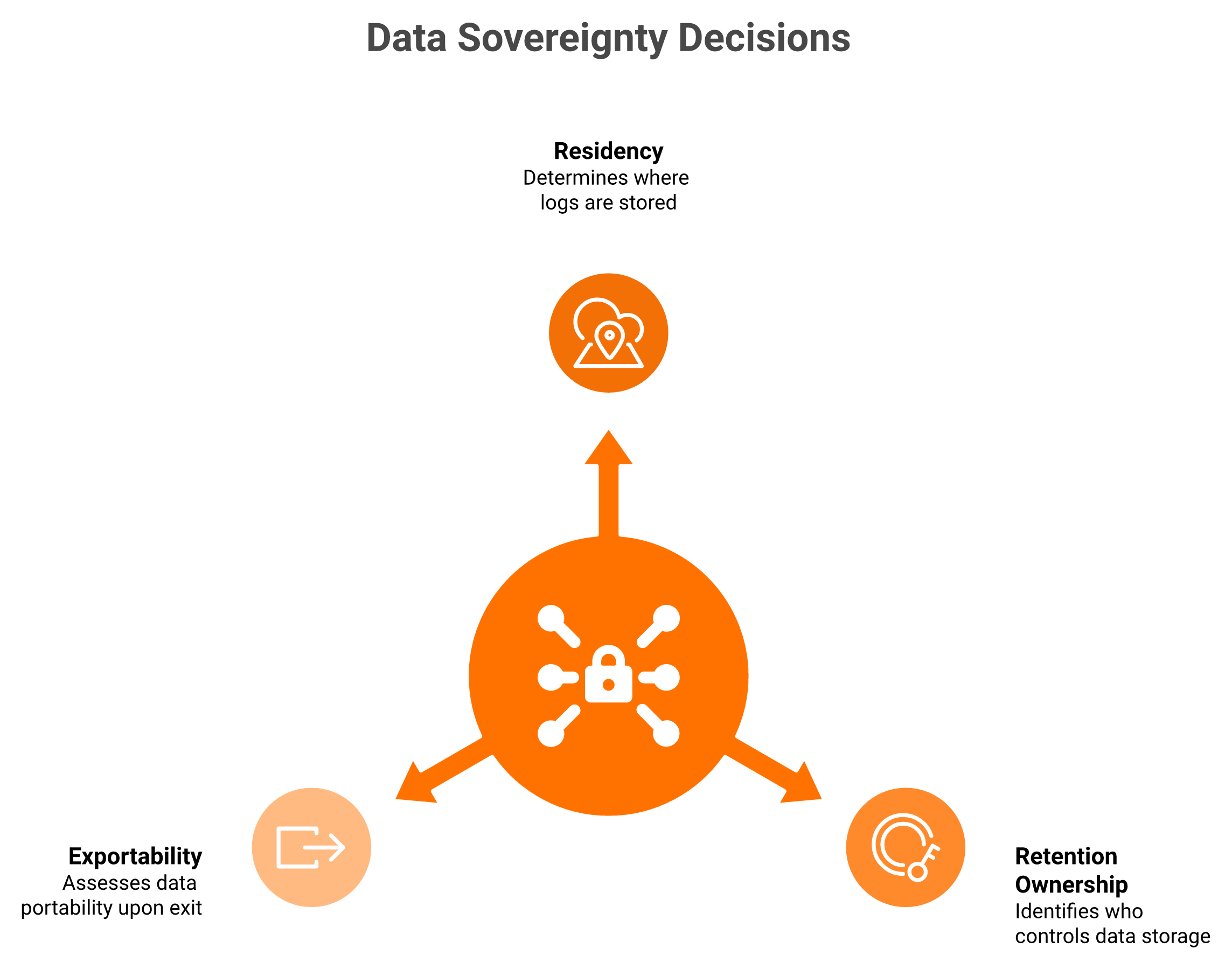
If your data flows into the vendor’s platform, your custom detection logic, tuning history, and searchable evidence live in their system, so a switch means starting the tuning over. Models where you own the SIEM and the data keep retention, residency, and rules under your control. Ask before signing where logs reside, who owns the tuning, and exactly what is exportable if you leave mid-audit-cycle.
🗺️ Residency, ownership, and exit, by model
Compare the three that actually decide your risk.
- Residency: where the logs physically sit. In your cloud, or the provider’s tenant?
- Retention ownership: who holds the 12-month store the assessor pulls from?
- Exportability: what leaves with you, in a usable format, when the contract ends?
With an MSSP, data often lives in the provider’s environment, while a managed or co-managed SIEM can keep it in yours. The co-managed tradeoff is plain, where you gain ownership but share operational load. The switching cost hides in the tuning history, which rarely exports cleanly, a risk our note on avoiding vendor lock-in unpacks.
✅ The Data Sovereignty Test
Take one question into every vendor call. “Will you log in to our SIEM, or do you require us to send data to your platform?” That single answer tells you who owns your evidence.
I think about detection like buying the Lego bricks yourself. When you own the business logic, you avoid black-box segments nobody can reproduce at audit. At UnderDefense, our Agentic AI SOC co-manages the SIEM you own, keeping data and rules in your hands, and can run on-prem inside your own cloud for residency. See the architecture on the WarRoom platform, and our data-residency deployment guide covers the on-prem options.
“UnderDefense Agentic AI SOC integrates well with our systems, specifically with our SIEM, Splunk.”
Oleg K., Director of Information Security UnderDefense G2 Verified Review
Q10: How Do You Switch Providers Without Opening an Audit Gap?
Switching vendors mid-cycle scares people for the wrong reason. They worry about the migration project. The real danger is quieter, a stretch of days where nobody was watching, and no evidence got recorded. That gap is what an auditor circles.
The real risk in switching is an evidence gap, a stretch where logs were not retained, reviews were not dispositioned, or chain of custody broke. Avoid it by overlapping providers through one full review cycle, exporting historical evidence in a usable format before cutover, and confirming the incoming model can attest to the transition period itself. Plan the switch around your audit window, rather than the contract renewal date.
🔄 A switch sequence that holds
Order the steps so nothing drops.
- Overlap providers through one full review cycle, so coverage never pauses.
- Export historical evidence in a searchable, usable format before you cut over.
- Confirm transition attestation, so the incoming model can vouch for the handoff window.
- Preserve chain of custody, keeping logs tamper-evident across the move.
Tuning and detection logic rarely transfer cleanly between providers, which is exactly where continuity breaks. Plan for that, rather than hope around it, and our SIEM integration guide walks through the handoff.
⏰ Change control keeps it auditable
Here is a habit I stand by. Never let a partner rebuild detection during a migration without an approved plan first. I treat every rule change like software, write the requirement, then edit that document as things evolve.
We call this Detection Logic as Code. Rule changes are versioned and auditable, so the history survives a provider change intact. At UnderDefense, that versioned trail becomes its own evidence, showing an assessor exactly what changed, when, and why, straight through the switch. Our approach to co-managing a SIEM through vendor upheaval shows the pattern in practice.
Q11: What Should You Ask a Vendor Before You Sign?
I have sat on both sides of the vendor questionnaire, and most of them measure the wrong thing. They collect reassurance. Your auditor does not accept reassurance. So ask questions whose answers Internal Audit can actually verify.
Ask questions whose answers Internal Audit can verify: Where do our logs reside and who owns them? What retention and hot-data window do you guarantee? Who performs daily review and can testify to it? What incident and disposition records do you produce automatically? What will you contractually attest to and sign? What is exportable if we leave mid-cycle? Vague answers to these are the real red flags.
✅ The verifiable question set
Group them the way an assessor thinks.
- Residency: Where do logs live, and who owns them?
- Retention: What duration and hot-data window are guaranteed?
- Review: Who runs daily review, and can they testify to it?
- Documentation: What incident and disposition records generate automatically?
- Attestation: What will you contractually sign?
- Exit: What is exportable if we leave mid-cycle?
Two axes most buyers miss come straight from how modern platforms work. Ask whether triage and prioritization are automated and scored, and whether response playbooks map to specific control IDs like PCI Requirement 10. Mapped playbooks turn each action into traceable audit evidence, a theme our AI SOC evaluation questions expand on.
💰 Score the answers for your board
Attach a dollar rationale the CFO respects. Ask internally, “What is our projected cost of business interruption per day?” That number frames every vendor answer, and our SOC cost calculator helps you build it.
One honest caveat I hold firmly, verify questionnaire answers regardless of who, or what, generated them. At UnderDefense, our Agentic AI SOC can automate questionnaire responses, and I still tell buyers to check the evidence behind each answer. See the platform through our WarRoom platform, and start with our broader compliance services.
“The reports from their platform give us clear evidence of our security controls and incident response capabilities. When auditors or clients ask questions about our security posture, we can pull up exactly what they need to see.”
Verified User in Marketing and Advertising, Small-Business UnderDefense G2 Verified Review
Q12: Can a New Model Be Live Before Your Audit?
Here is the question that quietly decides most deals. Your audit is five months out. A vendor quotes a six-month onboarding. Capability no longer matters, because the timeline already disqualified them. Speed to usable evidence is the real spec.
If your audit is five months out, a six-month onboarding disqualifies a vendor before capability matters. A realistic model reaches useful evidence generation inside 30 days, connect priority log sources first, validate retention and review attestation early, then expand coverage. Ask any vendor to map onboarding milestones to your fieldwork date, and to show what evidence exists at day 30, 60, and 90.
⏰ The 30/60/90 milestone view
Anchor the plan to your calendar.
- Day 30: priority log sources connected, retention and review attestation validated.
- Day 60: coverage expanded across in-scope systems, disposition records accumulating.
- Day 90: a full review cycle of continuous evidence ready for fieldwork.
Time-to-value is a core selection factor for managed models, and I agree, with one addition. Map every milestone to your fieldwork date, so the plan proves the audit will have evidence, rather than promising it, a discipline our readiness assessment is built around.
✅ Start with a gap assessment
Value can show up fast when the pipeline is clean. During one onboarding, we accidentally surfaced roughly $300,000 in fraud in the first three months, simply because tuned detection saw what noise had hidden.
My honest read, begin with a compliance evidence gap assessment mapped to your framework and audit date, and use a free compliance-docs tier as a low-friction start. At UnderDefense, our onboarding anchor is 30 days, with a 2-minute Alert-to-Triage target and a separate 15-minute escalation for critical incidents once you are live. See how it deploys on the WarRoom platform, and our AI SOC compliance guide maps the milestones.
So here is the question I keep sitting with. As auditors ask for demonstrable, continuously reviewed evidence, the winning model will be the one that proves its work as a byproduct of doing it. If you want to pressure-test your current setup against your next fieldwork date, that is a conversation I am always glad to have.
“The speed of onboarding was a delightful surprise. In times where integrating new systems can take weeks, UnderDefense had us up and running in no time.”
Valeriia D., Marketing Specialist UnderDefense G2 Verified Review
“They delivered the deployment to 1200 endpoints in just 2-3 business days. They worked closely with us to ensure minimal disruption to our critical operations.”
Oleksii M., Mid-Market UnderDefense G2 Verified Review
See tuned SIEM triage in action.
1. What is the core difference between managed SIEM and MSSP for compliance coverage?
The two labels blur in marketing, but they diverge exactly where an audit lives, in the evidence each model leaves behind.
- Managed SIEM: a provider operates your log collection, correlation, and retention layer, so it is strong on searchable evidence and retention duration.
- MSSP: a service that manages firewalls, endpoints, and other devices, then forwards alerts, with broad operational scope but lighter deep evidence.
A SIEM is a product; an MSSP is a service that may operate that product for you. Traditional MSSP scopes often do not stretch to the compliance demands regulated customers carry.
The useful reframe is to stop asking who detects faster and start asking which model produces, retains, and can attest to the artifacts your assessor requests. For a control-by-control view, our model comparison guide walks through each option. We lead every compliance scoping call with the evidence question first, because that is where teams discover gaps during fieldwork.
2. Does my vendor's SOC 2 report make my company compliant?
No. A vendor’s SOC 2 Type 2 report covers the vendor’s own control environment as a service organization. It is one input to your audit, rather than a substitute for your artifacts.
When your assessor sees a subservice organization, they handle it one of two ways:
- Carve-out method: the vendor’s controls sit outside your report scope, so you still document how you monitor that vendor.
- Inclusive method: the vendor’s controls are pulled in and tested alongside yours, which needs vendor cooperation.
Either way, the criteria your auditor tests, logging and monitoring under CC6 and CC7, still point at your controls operating over the period. A vendor certificate does not generate your log-review evidence, access records, or incident timelines.
Keep two binders, one for evidence about the vendor, one for evidence about you. Our overview of SOC 2 evidence automation shows where those artifacts originate, and our compliance services help map telemetry to controls.
3. What evidence does a PCI-DSS assessor request, and which model produces it?
PCI DSS v4.0.1 Requirement 10 expects audit logs across in-scope systems, retention of at least 12 months, with a minimum of 3 months immediately available, and evidence logs were reviewed and dispositioned.
- Retention and search: a managed SIEM or co-managed SIEM typically owns the searchable store, so the 12-month pull lives there.
- Daily review: an MSSP managing devices may forward alerts without holding the evidence, so the review attestation can fall into a gap nobody owns.
Confirm which party can produce the daily-review record before you sign, and remember your QSA interprets the final requirement.
Retention economics collide with the mandate here. We have watched a team cut ingestion by roughly 90 percent by tuning correlation rules, which made 12 months affordable and reviewable. Our PCI DSS audit breakdown covers each control, and we co-manage the SIEM you own through our managed SIEM service.
4.How do HIPAA audit-control and 6-year retention rules change the model I need?
HIPAA’s audit-controls standard, §164.312(b), requires mechanisms to record and examine activity in systems holding electronic protected health information. It names no retention period, no log fields, and no review cadence; those flow from your risk analysis.
- Audit controls (§164.312(b)): you must record and examine ePHI activity, but specifics are yours to justify.
- Documentation retention (§164.316(b)(2)(i)): required documentation is kept for six years.
Because HIPAA is non-prescriptive, the model you pick effectively defines your defensible position. NIST guidance leads many assessors to extend six-year thinking toward audit logs.
Write down your log-retention decision and tie it to your risk analysis, with framework versions named, because that document is what makes your choice defensible. For data residency, we can run on-prem inside your own cloud. Our managed SIEM for healthcare guide maps these controls, and our HIPAA-aware detection approach supports the review process.
5. What does a SOC 2 Type 2 assessor look for over the observation period?
SOC 2 Type 2 tests whether controls operated effectively across an observation window, commonly 3 to 12 months, so the assessor wants continuous evidence rather than a one-day snapshot.
- Type 1: a point-in-time check on whether controls are designed correctly today.
- Type 2: a period-of-time check on whether they operated, day after day, across the window.
Logging and monitoring criteria, CC6.1, CC7.2, and CC7.3, expect detection, alerting, and evidence anomalies were reviewed and dispositioned throughout the period. A pile of retained logs with no review trail does not clear that bar.
Begin capturing dispositioned review evidence now, because continuous evidence cannot be backfilled once the window is running. A model that generates disposition records as a byproduct of triage sustains this well. Our SOC 2 evidence automation overview shows the mechanism, and our SOC service is built to produce that trail.
6. Where do my logs live, and who controls them when a contract ends mid-audit?
If your data flows into the vendor’s platform, your custom detection logic, tuning history, and searchable evidence live in their system, so a switch means starting the tuning over.
Before signing, run the Data Sovereignty Test and ask three things:
- Residency: do logs sit in your cloud or the provider’s tenant?
- Retention ownership: who holds the 12-month store the assessor pulls from?
- Exportability: what leaves with you, in a usable format, if you leave mid-cycle?
Models where you own the SIEM and the data keep retention, residency, and rules under your control. The switching cost hides in the tuning history, which rarely exports cleanly.
We think about detection like owning the Lego bricks yourself, so you avoid black-box segments nobody can reproduce at audit. Our note on avoiding vendor lock-in explains why this matters at renewal, and our data-residency guide covers on-prem options in your own cloud.
7. How do I switch security providers without opening an audit gap?
The real risk in switching is an evidence gap, a stretch where logs were not retained, reviews were not dispositioned, or chain of custody broke. That gap is exactly what an assessor circles.
Sequence the switch so nothing drops:
- Overlap providers through one full review cycle, so coverage never pauses.
- Export historical evidence in a searchable format before cutover.
- Confirm transition attestation, so the incoming model can vouch for the handoff window.
- Preserve chain of custody, keeping logs tamper-evident across the move.
Plan the switch around your audit window, rather than the contract renewal date. Tuning and detection logic rarely transfer cleanly, which is where continuity breaks.
We treat every rule change like software, versioned and auditable, so the history survives a provider change intact. Our SIEM integration guide walks the handoff, and our approach to co-managing a SIEM through vendor upheaval shows the pattern in practice.
8. Can a new managed SIEM or MSSP be live before my audit deadline?
If your audit is five months out, a six-month onboarding disqualifies a vendor before capability matters. A realistic model reaches useful evidence generation inside 30 days.
Map milestones to your fieldwork date:
- Day 30: priority log sources connected, retention and review attestation validated.
- Day 60: coverage expanded across in-scope systems, disposition records accumulating.
- Day 90: a full review cycle of continuous evidence ready for fieldwork.
Ask any vendor to show what evidence exists at day 30, 60, and 90, so the plan proves the audit will have evidence, rather than promising it.
Value can appear fast when the pipeline is clean; during one onboarding, we accidentally surfaced roughly $300,000 in fraud in the first three months. Begin with a compliance evidence gap assessment mapped to your framework and date. Our readiness assessment and compliance guide anchor the 30-day timeline.