




Q1. What Is Information Security Compliance and Why Does It Matter in 2026?
Information security compliance is the practice of meeting regulatory, legal, and contractual requirements for protecting sensitive data by implementing and documenting security controls aligned to established frameworks such as ISO 27001, SOC 2, and HIPAA. It’s rooted in the CIA triad, Confidentiality, Integrity, and Availability, the foundational principle underpinning every compliance framework you’ll encounter. The data types it protects span Personally Identifiable Information (PII), Protected Health Information (PHI), financial and payment card data, intellectual property, corporate operational data, and government or classified information.
The Distinction That Actually Matters
Here’s a distinction that trips up even experienced operators: IT security is the practice of deploying technical controls, such as firewalls, EDR, and encryption. IT compliance is the process of proving those controls meet specific standards and can be verified through audits. Cybersecurity focuses on threat defense; regulatory compliance focuses on demonstrating adherence to legal mandates. Information security compliance bridges both, ensuring your security controls satisfy regulatory requirements and produce auditable evidence. If you can’t show the auditor what’s true today, it doesn’t matter what you deployed last quarter.
The Checkbox Compliance Trap
Too many organizations still treat compliance as an annual checkbox exercise, a cost to minimize rather than a capability to leverage. I’ve seen it firsthand: companies running compliance as a separate workstream from security operations end up spending 40%+ of their compliance budget on duplicate evidence collection across overlapping frameworks. Traditional MSSPs and legacy GRC approaches give you static compliance snapshots. They tell auditors what was true last quarter, not what’s true right now. That gap is where risk lives.
And the pressure keeps intensifying. NIS2 now imposes personal liability on management bodies for non-compliance, with penalties reaching €10 million or 2% of worldwide turnover for essential entities. 78% of enterprise B2B buyers require SOC 2 or ISO 27001 before signing contracts. Cyber insurance underwriters increasingly demand continuous compliance evidence, not annual audit reports.
Compliance as a Competitive Advantage in 2026
The organizations winning right now aren’t just avoiding penalties. They’re closing enterprise deals faster, reducing cyber insurance premiums by 20–30%, and demonstrating trustworthiness that translates directly to revenue. Compliance is a business accelerator, not a cost center. The 2026 regulatory landscape has intensified significantly: NIS2 enforcement is active across the EU, 20+ US state privacy laws are in effect, NIST CSF 2.0 adoption is accelerating, and GDPR cumulative fines have surpassed €7.1 billion since enforcement began. The EU AI Act introduces new compliance intersections for organizations deploying AI systems. The organizations treating compliance as a continuous operational discipline, embedded into their security architecture, are the ones outpacing competitors.
How We Eliminate the False Separation
At UnderDefense, we built this philosophy into our operations from Day 1. The UnderDefense MAXI platform’s vendor-agnostic integration across 250+ tools generates compliance evidence automatically from MDR telemetry, including access control logs, incident response documentation, vulnerability assessments, and continuous monitoring proof. Forever-free compliance kits for SOC 2, HIPAA, and ISO 27001 are included with MDR service at our published $11–$15/endpoint/month pricing, not sold as a separate add-on. Our concierge analysts document every investigation and response action in audit-ready format. Stop running security and compliance as parallel tracks. Start running compliance as a natural output of security operations.
⚠️ The ROI Case Is Unambiguous
The average cost of a data breach reached $4.88M in 2024, a 10% spike from the prior year, the largest annual increase since the pandemic. GDPR fines can reach 4% of global annual turnover. NIS2 penalties hit €10M or 2% of worldwide turnover. The gap between compliance investment (~$50K–$200K/year) and average breach cost (~$4.88M) makes the math straightforward. You either invest in compliance proactively, or you pay exponentially more reactively.
Q2. What Are the Major Information Security Compliance Frameworks in 2026?
No single compliance framework covers all regulatory obligations. Most organizations need two to four frameworks depending on industry, geography, customer base, and data types handled. Frameworks fall into three categories: mandatory/regulatory (HIPAA, GDPR, PCI-DSS, NIS2), voluntary/certification (ISO 27001, SOC 2, CMMC), and best-practice/guidance (NIST CSF 2.0, CIS Controls, NIST 800-53). Here’s a structured breakdown of the 12+ essential frameworks security leaders must evaluate in 2026.
Framework Deep Dive
| Framework | Type | Scope | Enforcement | Primary Industry | Assessment Model | Cost Range |
|---|---|---|---|---|---|---|
| ISO 27001 | Voluntary/Certification | International ISMS, 93 controls across 4 themes (Annex A) | 3-year certification, annual surveillance audits | All industries, global recognition | Third-party certification body | $30K–$150K |
| SOC 2 (Type I & II) | Voluntary/Certification | AICPA Trust Service Criteria (Security, Availability, Processing Integrity, Confidentiality, Privacy) | CPA-audited; Type I = point-in-time, Type II = 3–12 month observation | SaaS, technology, financial services | CPA audit firm | $20K–$100K |
| NIST CSF 2.0 | Best-practice/Guidance | 6 functions: Identify, Protect, Detect, Respond, Recover + Govern | Voluntary; widely adopted as federal contractor baseline | All industries, US-centric | Self-assessment or third-party | $10K–$50K |
| HIPAA | Mandatory/Regulatory | PHI protection, Administrative, Technical, Physical safeguards | $100–$50K per violation, up to $2.1M/category/year | Healthcare, business associates | Self-assessment + OCR audits | $20K–$80K |
| PCI-DSS v4.0 | Mandatory/Regulatory | 12 requirement domains for cardholder data protection | Mandatory for payment processors; tiered assessment | Payments, retail, e-commerce | SAQ vs. ROC (QSA-assessed) | $15K–$200K |
| GDPR | Mandatory/Regulatory | EU data protection, extraterritorial scope, data subject rights, DPO requirement | Fines up to 4% global turnover; cumulative €7.1B issued | All industries processing EU data | DPA supervisory enforcement | $50K–$300K |
| NIS2 Directive | Mandatory/Regulatory | EU critical infrastructure, essential and important entities | €10M or 2% turnover (essential), €7M or 1.4% (important); management liability | Critical infrastructure, digital services | National authority supervision | $40K–$200K |
| CMMC 2.0 | Voluntary/Certification | DoD contractors, 3-level maturity model for CUI protection | Required for DoD contracts | Defense, government contractors | Third-party assessment (C3PAO) | $30K–$150K |
| CIS Controls v8.1 | Best-practice/Guidance | 18 prioritized security controls, 3 Implementation Groups by org size | Voluntary; widely referenced by insurers | All industries | Self-assessment | $5K–$30K |
| FedRAMP | Mandatory/Regulatory | Cloud security authorization for US government systems, 3 impact levels | Required for federal cloud services | Cloud service providers to government | 3PAO assessment | $250K–$2M+ |
| NIST 800-53 Rev 5 | Best-practice/Guidance | 1,000+ security/privacy controls for federal systems | Referenced by federal agencies and regulated industries | Government, defense, financial | Agency-directed or voluntary | $20K–$100K |
| FTC Safeguards Rule | Mandatory/Regulatory | Financial institution data protection under Gramm-Leach-Bliley | FTC enforcement, civil penalties | Financial services | Self-assessment + examiner review | $15K–$75K |
| ISO 27701 | Voluntary/Certification | Privacy extension to ISO 27001 for PII processing | Extends ISO 27001 certification scope | Organizations processing PII globally | Third-party certification body | $15K–$50K add-on |
How to Choose the Right Framework Stack
Framework selection depends on four factors:
- Regulatory mandates: HIPAA for healthcare, PCI-DSS for payments, NIS2 for EU essential entities. Non-negotiable; you comply or face penalties.
- Customer/partner requirements: SOC 2 for enterprise SaaS sales (78% of B2B buyers require it), ISO 27001 for global market access and EU credibility.
- Geographic scope: GDPR for EU data, NIS2 for EU operations, state privacy laws for US consumers, and FTC Safeguards for financial institutions.
- Strategic positioning: ISO 27001 as a universal trust signal, CMMC for DoD market access, and CIS Controls as a practical starting baseline.
✅ Practical recommendation: Most mid-market technology companies should start with SOC 2 Type II + ISO 27001 as their foundational pair, then add HIPAA, PCI-DSS, or NIS2 based on vertical requirements.
How UnderDefense Simplifies Multi-Framework Compliance
UnderDefense’s forever-free compliance kits cover SOC 2, HIPAA, and ISO 27001 out of the box, included with MDR service. The UnderDefense MAXI platform’s continuous monitoring generates framework-aligned evidence automatically, eliminating the need to choose between security operations and compliance tooling. Clients pursuing multiple certifications simultaneously reduce duplicate effort because security telemetry maps to control requirements across frameworks from a single source.
Q3. What Are the Three Pillars of Compliance Controls and How Do They Map Across Frameworks?
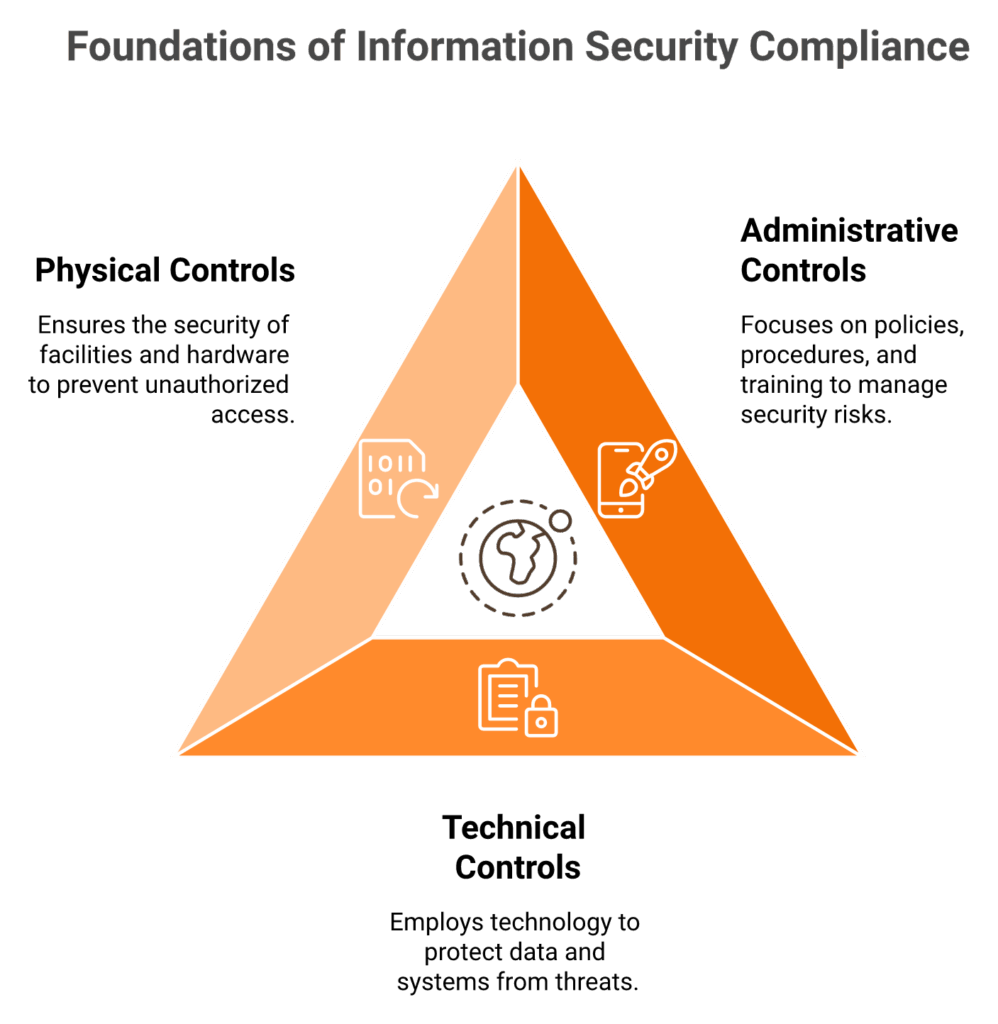
Every compliance framework organizes its requirements around three fundamental control pillars: administrative, technical, and physical. Understanding these isn’t academic; they represent the categories of evidence auditors will request, and the same control often satisfies requirements across multiple frameworks simultaneously. That overlap is where you save 40–50% of your total compliance effort, if you architect for it.
The Three Pillars Defined
📋 Administrative Controls: The People and Process Layer
- Risk assessments and risk treatment plans
- Security policies and procedures documentation
- Employee security awareness training programs
- Vendor/third-party risk management programs
- Incident response plans and tabletop exercises
- Governance structures, roles, and responsibilities documentation
- Background checks and onboarding/offboarding procedures
- Acceptable use policies and data classification standards
🔐 Technical Controls: The Technology and Enforcement Layer
- Encryption at rest and in transit (AES-256, TLS 1.3)
- Access management and least-privilege enforcement
- Multi-factor authentication (MFA) across all critical systems
- Endpoint detection and response (EDR)
- Network segmentation and micro-segmentation
- SIEM/log monitoring and centralized log aggregation
- Vulnerability scanning and patch management cadences
- Intrusion detection/prevention systems (IDS/IPS)
- Data loss prevention (DLP) and backup/recovery systems
🏢 Physical Controls: The Facility and Hardware Layer
- Facility access controls (badge readers, biometrics)
- Surveillance and monitoring systems
- Server room environmental controls (temperature, humidity, fire suppression)
- Device destruction and sanitization procedures (NIST 800-88)
- Visitor logging and escort policies
- Clean desk policies and secure print management
Multi-Framework Control Mapping Matrix
This is where operational efficiency lives. One evidence artifact serving multiple audits isn’t a shortcut but proper architecture:
| Control Domain | ISO 27001 | SOC 2 | NIST CSF 2.0 | GDPR | HIPAA |
|---|---|---|---|---|---|
| Access Control | A.5.15–A.5.18 | CC6.1–CC6.3 | PR.AC | Art. 32 | §164.312(a) |
| Encryption / Data Protection | A.8.24 | CC6.1/CC6.7 | PR.DS | Art. 32/Art. 34 | §164.312(a)(2)(iv) |
| Incident Response | A.5.24–A.5.28 | CC7.3–CC7.5 | RS.RP/RS.CO | Art. 33–34 | §164.308(a)(6) |
| Risk Assessment | A.5.1/Clause 6.1 | CC3.1–CC3.4 | ID.RA | Art. 35 (DPIA) | §164.308(a)(1)(ii) |
| Vendor Management | A.5.19–A.5.23 | CC9.2 | ID.SC | Art. 28 | §164.308(b)(1) |
| Logging & Monitoring | A.8.15–A.8.16 | CC7.1–CC7.2 | DE.CM | Art. 30 | §164.312(b) |
| Change Management | A.8.32 | CC8.1 | PR.IP | Art. 25 | §164.308(a)(8) |
| Training & Awareness | A.6.3 | CC1.4 | PR.AT | Art. 39 | §164.308(a)(5) |
⭐ Key insight: 60–70% of controls overlap between SOC 2 and ISO 27001. Organizations pursuing dual certification that map controls properly can use one evidence artifact, a single access log, a single training record, a single risk assessment, to satisfy both audits.
How UnderDefense Operationalizes Multi-Framework Mapping
This is exactly the kind of problem we built the UnderDefense MAXI platform to solve. A single access log from MDR monitoring satisfies ISO 27001 logging requirements (A.8.15), SOC 2 monitoring criteria (CC7.1), HIPAA audit trail obligations (§164.312(b)), and NIST CSF detection requirements (DE.CM), without manual evidence collection or separate compliance tools. Organizations pursuing dual certification through our platform report 40–50% reduction in total compliance effort. That’s not a marketing number but the direct result of generating compliance evidence as a natural output of security operations, not as a parallel workstream.
Q4. Which Compliance Path Fits Your Industry?
The compliance frameworks you need depend on your industry, data types, customer base, and geographic scope. Choosing the wrong framework stack wastes budget on certifications that don’t unlock your target market. Here are the framework stacks and implementation priorities for five key verticals.
🏥 Healthcare
Core stack: HIPAA (mandatory) + SOC 2 Type II (customer requirement for health-tech) + HITRUST CSF (differentiator for enterprise health systems)
Unique requirements: PHI-specific access controls, Business Associate Agreements (BAAs) for every vendor touching patient data, 60-day breach notification to HHS, and administrative/technical/physical safeguard documentation across all three HIPAA rules.
Key risk: 67% of healthcare organizations were hit by ransomware in 2024, the highest targeting rate of any industry.
⚠️ Common pitfall: Treating HIPAA compliance as a one-time audit. OCR enforcement actions target organizations that can’t demonstrate ongoing safeguard implementation.
💻 SaaS / Technology
Core stack: SOC 2 Type II (table-stakes, as 78% of B2B enterprise buyers require it before signing contracts) + ISO 27001 (global market access, EU credibility) + GDPR (if processing EU user data)
Unique requirements: Secure SDLC documentation, change management controls, multi-tenant data isolation architecture, annual penetration testing, and vendor management for cloud infrastructure providers (AWS, Azure, GCP).
⏰ Timeline reality: Enterprise sales cycles stall by 3–6 months without SOC 2 Type II. Every quarter you delay certification is revenue left on the table.
💰 Financial Services / Fintech
Core stack: PCI-DSS v4.0 (mandatory for card data handling) + SOC 2 Type II + SOC 1/SSAE 18 (for financial reporting controls) + GDPR (if EU operations)
Unique requirements: Tokenization and encryption key management, quarterly Approved Scanning Vendor (ASV) scans, transaction monitoring, segregation of duties enforcement, and PCI-DSS v4.0’s new requirement for targeted risk analysis on all customized approaches.
💸 Penalty context: PCI non-compliance fines range from $5K–$100K per month; combined with breach costs in financial services averaging well above the $4.88M global mean.
🏛️ Government / Defense
Core stack: NIST 800-171 + CMMC 2.0 (mandatory for CUI handling) + FedRAMP (for cloud services to government agencies)
Unique requirements: Controlled Unclassified Information (CUI) marking and handling procedures, FIPS 140-2/140-3 validated encryption modules, supply chain risk management (SCRM) documentation, and Plan of Action & Milestones (POA&M) tracking.
Market access: Without CMMC Level 2 certification, your organization cannot bid on DoD contracts involving CUI, period.
🛒 Retail / E-Commerce
Core stack: PCI-DSS v4.0 (mandatory for payment processing) + GDPR/state privacy laws (consumer data protection) + SOC 2 (for B2B partnerships and platform integrations)
Unique requirements: Payment terminal security and point-to-point encryption (P2PE), consumer consent management platforms, data retention and deletion policies compliant with 20+ state privacy laws, and secure API integrations with payment processors and fulfillment partners.
✅ How UnderDefense Aligns to Your Vertical
We built industry-specific MDR deployments, including dedicated Healthcare MDR and Financial Services MDR programs, that come pre-configured with compliance evidence workflows tailored to each vertical’s framework requirements. This reduces time-to-compliance by aligning security operations with regulatory demands from Day 1, not as an afterthought bolted on during audit prep.
Our German Healthcare Leader case study demonstrates exactly this approach: integrated MDR + compliance scaled IT security for a major healthcare organization, maintaining continuous compliance across regulatory requirements while achieving 24/7 threat monitoring. Security operations and compliance are most effective when unified. That’s not theory but what we see in practice every day across 500+ MDR clients.
Q5. How Do You Build a Step-by-Step Information Security Compliance Roadmap?
Most first-attempt compliance implementations miss their target deadline. Not by a week, but by months. The pattern is always the same: no structured roadmap, no clear ownership at each phase, and no measurable deliverables that tell you whether you’re actually progressing or just generating documents nobody reads.
After watching dozens of organizations go through this process, from 50-person startups chasing their first SOC 2 to mid-market enterprises running multi-framework programs, the sequence is remarkably consistent. Whether you’re pursuing SOC 2, ISO 27001, HIPAA, or layering all three, the 7-phase roadmap below follows the same operational logic. The difference between organizations that hit their timeline and those that don’t comes down to one thing: treating compliance as an operational discipline with clear milestones, not a paperwork exercise you panic through before the auditor shows up.
Phase 1: Scope Definition & Data Asset Inventory (Weeks 1–2)
Define your compliance boundaries first. Identify every system, data type (PII, PHI, financial, IP), and business process in scope. Select your target framework(s). Deliverable: Scope document and data asset register. This sounds basic, but scope creep in the first two weeks is the single biggest cause of timeline blowouts later.
Phase 2: Risk Assessment & Gap Analysis (Weeks 3–6)
Conduct a formal risk assessment, qualitative or quantitative, depending on your maturity. Map your current controls against framework requirements. Identify gaps prioritized by risk severity. Document risk treatment decisions: accept, mitigate, transfer, or avoid. Deliverable: Risk assessment report and gap analysis matrix.
Phase 3: Policy & Procedure Development (Weeks 7–10)
Create or update your information security policies: acceptable use, access control, data classification, incident response, vendor management, and business continuity. Define roles clearly: CISO, GRC analyst, and data owners. Deliverable: Complete policy library mapped to framework requirements.
Phase 4: Technical & Administrative Control Implementation (Weeks 11–18)
Deploy technical controls (encryption, MFA, EDR, SIEM, vulnerability management, network segmentation, and DLP), implement administrative controls (training programs, background checks, and vendor assessments), and establish physical controls as needed. Deliverable: Control implementation evidence and configuration documentation.
Phase 5: Evidence Collection & Monitoring Setup (Weeks 16–22)
Establish automated evidence collection workflows. Configure continuous monitoring dashboards. Build an audit-ready documentation repository with framework-to-evidence mapping. Deliverable: Evidence repository with automated collection pipelines.
Phase 6: Internal Audit & Readiness Assessment (Weeks 20–24)
Conduct an internal audit against framework requirements. Identify residual gaps, remediate before the external assessment, and perform a management review. Deliverable: Internal audit report and remediation plan.
Phase 7: External Audit & Certification (Weeks 24–30)
Engage a qualified auditor, a CPA for SOC 2 or an accredited certification body for ISO 27001. Facilitate the evidence review, address auditor inquiries, and achieve certification. Deliverable: SOC 2 report or ISO 27001 certificate.
Continuous Improvement: The Real Starting Line
Certification is the starting point, not the finish line. Continuous compliance requires quarterly access reviews, annual risk reassessments, continuous vulnerability scanning, bi-annual incident response tabletop exercises, annual security awareness training, ISO 27001 surveillance audits, and SOC 2 Type II annual renewals. Organizations without continuous improvement frameworks face significantly higher audit finding rates at renewal.
✅ How UnderDefense Accelerates the Roadmap
UnderDefense’s 30-day onboarding collapses Phases 4–5 by deploying security monitoring that simultaneously generates compliance evidence. The UnderDefense MAXI platform’s 250+ tool integrations preserve existing security investments while compliance telemetry is automated from Day 1. Organizations typically reduce the 30-week roadmap to 16–20 weeks when MDR and compliance are integrated from the start, because the monitoring infrastructure that detects threats is the same infrastructure that proves compliance controls are effective.
Q6. What Does Information Security Compliance Cost in 2026, and What’s the Business ROI?
Most organizations significantly underestimate total compliance cost because they budget for audit fees but miss internal labor, which accounts for 40–60% of total spend, along with tooling, remediation, and ongoing maintenance. Simultaneously, they underestimate ROI by failing to quantify revenue acceleration, insurance savings, and breach cost avoidance. Accurate planning requires understanding both sides of the equation.
💰 Cost Benchmarks by Framework
| Framework | First-Year Cost | Annual Maintenance | Typical Timeline | Key Cost Drivers |
|---|---|---|---|---|
| SOC 2 Type II | $25K–$150K+ | $20K–$80K | 4–6 months | Audit fees ($15K–$60K), compliance tooling ($5K–$40K/yr), internal labor (500–2,000 hrs) |
| ISO 27001 | $20K–$100K+ | $5K–$15K surveillance | 6–12 months | Certification audit ($10K–$40K), implementation consulting ($15K–$50K), policy development |
| HIPAA | $50K–$200K+ | $15K–$50K | 6–12 months | Risk assessment ($10K–$50K), gap remediation (variable), ongoing training ($5K–$15K/yr) |
| PCI-DSS | $15K–$100K+ | $5K–$30K | 3–9 months | SAQ self-assessment ($15K–$30K) vs. ROC on-site with QSA ($50K–$100K for Level 1), quarterly ASV scans |
| NIST CSF | $20K–$80K | $10K–$30K | 3–6 months | No certification cost; primarily consulting and implementation labor |
Compliance team costs add up fast: CISO ($180K–$300K), GRC Analyst ($90K–$140K), outsourced vCISO ($5K–$15K/month), and compliance automation platform ($10K–$30K/yr).
📈 ROI of Compliance: Quantifying the Business Case
Here’s the framework security leaders should use to justify compliance investment to C-suite and boards:
- Deal velocity: 78% of enterprise B2B buyers require SOC 2 or ISO 27001 before signing. Compliant organizations report 30–50% faster sales cycles for enterprise deals.
- Cyber insurance savings: Compliant organizations receive 20–30% lower premiums; non-compliant organizations face coverage denials or exclusions for regulatory fines.
- Breach cost avoidance: Average breach cost is $4.88M (IBM 2024). Non-compliant organizations pay significantly more, meaning compliance saves an estimated $600K+ per breach incident.
- Penalty avoidance: GDPR fines up to 4% of global annual turnover, HIPAA penalties up to $2.1M per violation category, and NIS2 penalties up to €10M or 2% of worldwide turnover.
- Operational efficiency: Multi-framework mapping reduces duplicate compliance effort by 40–50%. Compliance automation reduces manual evidence collection by 60%+.
Simple ROI Formula
Compliance ROI = (Avoided Breach Cost + Insurance Savings + Revenue Acceleration + Penalty Avoidance) − Total Compliance Program Cost
✅ How UnderDefense Reduces Cost and Maximizes ROI
UnderDefense includes forever-free compliance kits (SOC 2, HIPAA, and ISO 27001) with MDR service at published $11–$15/endpoint/month pricing, eliminating the separate $10K–$30K/year compliance platform expense. The UnderDefense MAXI platform generates compliance evidence automatically from security monitoring, including access logs, incident reports, and vulnerability scans, so organizations aren’t paying for separate compliance tooling and separate MDR. Clients report reducing audit preparation time by 60%+ and total compliance program cost by 30–40% compared to running GRC platforms and MDR providers as separate vendor relationships.
Q7. What Does a Compliance Maturity Model Look Like for Security Leaders?
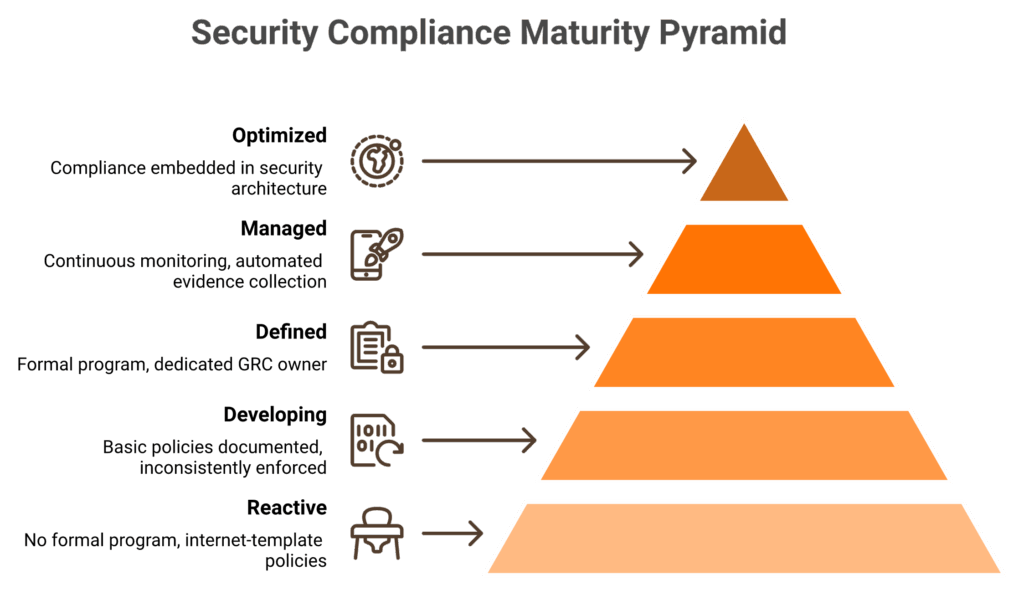
Knowing where you are on the compliance maturity spectrum determines your roadmap priority, budget allocation, and timeline expectations. An organization at Level 1 (Reactive) needs fundamentally different investments than one at Level 3 (Defined) seeking to reach Level 4 (Managed). The maturity model below provides a self-assessment framework security leaders can use immediately to benchmark their current posture and build a prioritized improvement plan.
The 5-Level Compliance Maturity Model
| Level | Name | Characteristics | KPIs | Typical Profile | Actions to Advance |
|---|---|---|---|---|---|
| 1 | ⚠️ Reactive (Ad Hoc) | No formal program; internet-template policies; no dedicated ownership; evidence collected in panic before audits; no risk assessment process | None tracked | Startups <50 employees, no enterprise customers yet | Assign compliance owner, conduct initial risk assessment, and establish basic policy set |
| 2 | Developing (Repeatable) | Basic policies documented but inconsistently enforced; manual evidence in spreadsheets; point-in-time assessments only; single-framework focus | Audit completion rate, policy document count | Series A/B SaaS pursuing first SOC 2 | Adopt GRC platform, formalize evidence collection, and begin multi-framework awareness |
| 3 | ✅ Defined (Standardized) | Formal program with dedicated GRC owner; documented evidence collection, risk assessment, and vendor management processes; some automation via GRC platform | Control effectiveness rate, time-to-evidence, and audit finding count | Mid-market (100–500 employees) with SOC 2 Type II achieved | Integrate compliance monitoring with security operations and automate evidence generation |
| 4 | ⭐ Managed (Quantitative) | Continuous monitoring integrated with security operations; automated evidence collection as byproduct of MDR/SOC; multi-framework control mapping operationalized; real-time dashboards | Continuous control effectiveness %, mean-time-to-evidence, compliance drift rate, and vendor risk scores | Enterprises with 2+ certifications maintained simultaneously | Implement predictive analytics, automate control validation, and quantify compliance risk in financial terms |
| 5 | ⭐ Optimized (Predictive) | Compliance fully embedded in security architecture; predictive analytics identifying control degradation before audit findings; compliance-as-code; zero manual audit prep | Automated control validation coverage %, predictive compliance risk score, and zero audit prep hours | Mature enterprises with compliance integrated into CI/CD and security orchestration | Maintain continuous improvement and export learnings across business units |
🔍 Self-Assessment Diagnostic Questions
Answer these seven questions to identify your current maturity level:
- Do you have a formal, documented compliance program with a dedicated owner? (No = Level 1, Yes = Level 2+)
- Can you produce evidence of access control enforcement within 24 hours of an auditor’s request? (No = Level 1–2, Yes = Level 3+)
- Are your compliance evidence collection workflows automated? (No = Level 2, Partially = Level 3, Fully = Level 4+)
- Does your security monitoring automatically generate compliance artifacts? (No = Level 1–3, Yes = Level 4+)
- Can you demonstrate continuous control effectiveness without manual intervention? (No = Level 1–4, Yes = Level 5)
- Do you maintain a multi-framework control mapping matrix? (No = Level 1–2, Yes = Level 3+)
- Is compliance risk quantified in financial terms for board reporting? (No = Level 1–4, Yes = Level 5)
✅ How UnderDefense Accelerates Maturity
UnderDefense’s integrated MDR + compliance model is architecturally designed to move organizations from Level 2 to Level 4 within one engagement cycle. The UnderDefense MAXI platform’s automated evidence collection and continuous monitoring eliminate the manual workflows that trap most organizations at Level 2–3. With 30-day onboarding, compliance maturity advancement begins immediately. Organizations go from manual evidence collection to automated, continuous compliance artifact generation from Day 1.
Q8. What Should Your Compliance Audit Playbook Include, and How Do You Manage Third-Party Risk?
It’s 6 weeks before your SOC 2 Type II audit window opens. Your compliance coordinator sends a shared drive link with 14 folders of “evidence,” half are screenshots from last year’s audit, a quarter are outdated policies nobody reviewed since onboarding, and the rest are blank templates. Your auditor requests 90 days of continuous monitoring evidence. You have 42 days of logs because someone disabled a SIEM integration in February and nobody noticed. Your vendor risk assessment spreadsheet hasn’t been updated in 9 months, and your largest SaaS vendor just had a breach announcement last week. The next 6 weeks will consume your entire security team.
⚠️ Why Audit Panic Happens, and What It Really Costs
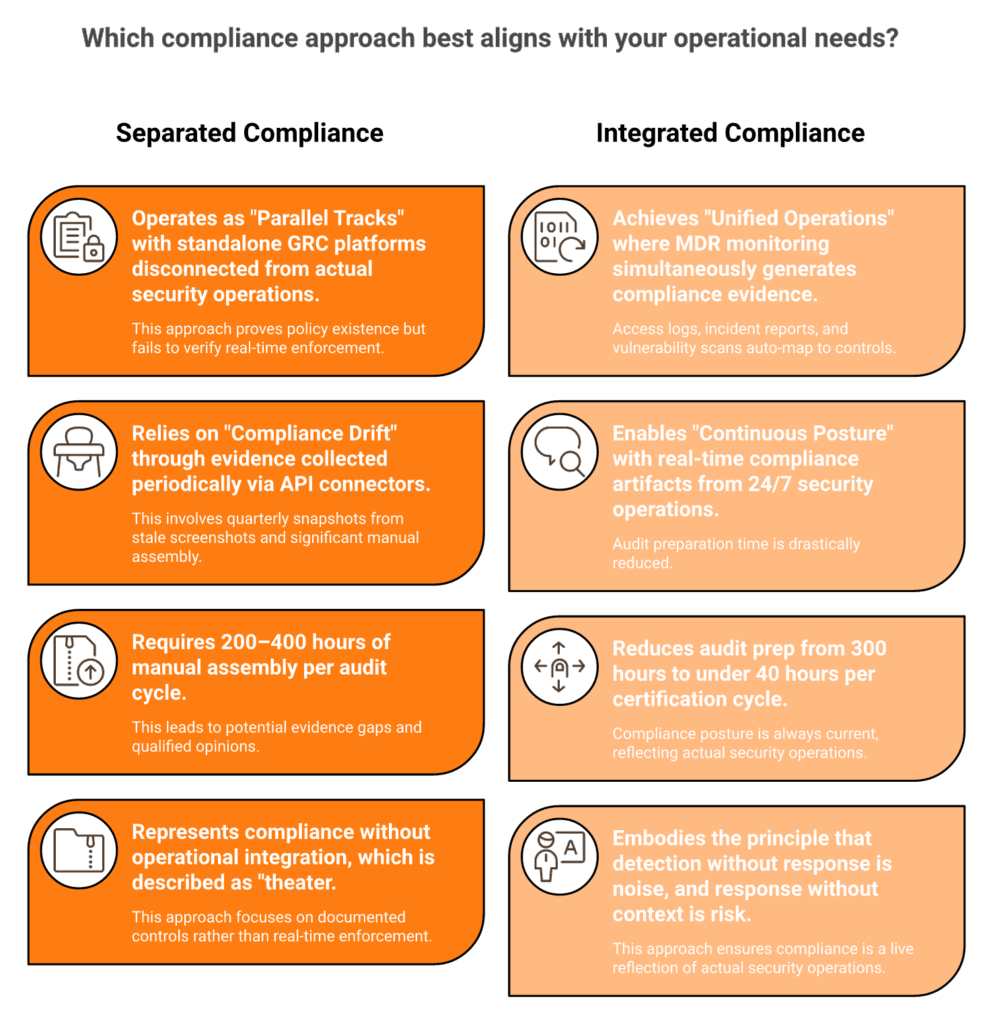
Audit readiness fails when compliance and security operations run as parallel tracks. Compliance teams manually screenshot dashboards while security teams operate in completely separate tools. Third-party risk management fails when vendor assessments are treated as annual checkbox exercises rather than continuous monitoring programs.
The hidden costs are real:
- ⏰ Time cost: 200–400 hours of manual evidence assembly per SOC 2 audit cycle
- ❌ Audit failure risk: 35% of first-time SOC 2 audits result in qualified opinions due to evidence gaps
- Third-party exposure: 35.5% of all breaches in 2024 were third-party related, and 41.4% of ransomware attacks started through a supplier
- Common findings to preempt: Incomplete access reviews (the most common SOC 2 finding), missing evidence of continuous monitoring, outdated risk assessments, vendor management gaps, undocumented incident response, and inadequate change management evidence
- 💸 Cost of delays: Each month of audit postponement delays enterprise sales cycles dependent on the SOC 2 report
The 12-Week Audit Preparation Timeline
📋 12 Weeks Out
Confirm audit scope. Select or confirm your auditor (criteria: industry expertise, framework specialization, communication style, fee structure, and references). Begin evidence inventory. Update vendor risk register.
8 Weeks Out
Run an internal readiness assessment. Identify gaps and begin remediation. Refresh all vendor SOC 2 reports and security questionnaires. Conduct vendor risk scoring (critical/high/medium/low).
4 Weeks Out
Validate all evidence artifacts are current and mapped to framework controls. Conduct management review. Confirm auditor logistics. Ensure third-party contractual controls (BAAs, DPAs, and security addenda) are current.
During Audit
Designate an evidence liaison. Maintain an organized evidence repository with framework-to-evidence mapping. Hold daily standups with the audit team.
Post-Audit
Build a remediation plan for any findings. Establish continuous monitoring to prevent recurrence. Set vendor reassessment schedule.
🔍 Third-Party Risk: The Tiered Vendor Assessment Program
For vendor risk management, establish a tiered assessment program:
- Tier 1 (critical vendors with data access): Annual SOC 2 review + security questionnaire + continuous monitoring
- Tier 2 (important vendors): Annual security questionnaire
- Tier 3 (low-risk): Self-attestation
✅ UnderDefense’s Approach: Evidence on Autopilot
UnderDefense eliminates the “audit panic” cycle by making evidence collection automatic and vendor risk visible. The UnderDefense MAXI platform continuously generates audit-ready artifacts, including access logs, incident response documentation, monitoring uptime proof, and vulnerability scan reports, mapped to SOC 2, ISO 27001, and HIPAA control requirements. When your auditor requests evidence of continuous monitoring, you export it in minutes, not weeks. Supply chain visibility through the vendor-agnostic integration layer means third-party security telemetry feeds into the same compliance evidence pipeline. Forever-free compliance kits include pre-built evidence templates, policy frameworks, and vendor assessment questionnaires.
UnderDefense clients report reducing audit preparation from an average of 300 hours to under 40 hours per certification cycle, because the evidence is generated continuously as a byproduct of 24/7 security monitoring, not assembled manually before each audit. A documented case study of a US IT leader shows how UnderDefense enhanced existing security tools to ensure 24/7 monitoring with compliance evidence generated automatically.
Q9. What Are the Biggest Compliance Challenges, and How Do You Achieve Continuous Compliance Without Burning Out Your Team?
Getting certified is the easier part. Maintaining compliance continuously, while regulations evolve underneath you, budgets shrink, and your team juggles a dozen other priorities, is where programs break down. Here are the challenges that trip up even mature organizations:
⚠️ Regulatory velocity: PCI-DSS v4.0, NIST CSF 2.0, NIS2, and the EU AI Act are all active or enforcement-ready in 2026, requiring constant adaptation.
💰 Budget constraints: Compliance competes with security tooling, staffing, and business priorities for limited budget.
Cloud and hybrid visibility: Data spread across multi-cloud, SaaS, and on-premises environments creates evidence collection blind spots.
Human error: Approximately 60% of breaches involve a human element (Verizon 2025 DBIR), undermining technical controls no matter how well-documented your policies are.
The compliance-equals-security fallacy: Organizations achieve certification, then assume they’re “secure,” allowing controls to degrade between audits.
⏰ Compliance drift: Most organizations experience meaningful control degradation between annual assessments, which is why point-in-time audits give a false sense of security.
Why Separate Compliance Platforms Create the Problem They Claim to Solve
Here’s what I see too often: organizations running standalone GRC platforms, such as Vanta, Drata, and Secureframe, completely disconnected from actual security operations. These tools automate evidence collection, but they don’t perform security operations. They can prove you have an access control policy, but they can’t verify that policy is actually enforced in real-time across your environment.
Meanwhile, traditional MSSPs provide monitoring but generate zero compliance artifacts. The result: two separate vendor relationships, two separate budgets, and a fundamental gap between “what your compliance tool reports” and “what your security operations actually do.” This architectural separation is exactly why compliance drift exists. The compliance tool says controls are documented, but nobody verifies they’re continuously effective.
Compliance as a Byproduct of Security Operations
The solution isn’t better compliance tools but compliance embedded into your security operations architecture. When your MDR platform monitors access controls 24/7, it should simultaneously generate evidence proving those controls are effective. When your SOC investigates and contains an incident, that response documentation should automatically populate your incident response evidence repository. When your vulnerability scanner runs continuously, those results should map directly to compliance control requirements.
Compliance becomes a natural output of operations, not a separate manual input. This is how you solve compliance challenges structurally rather than adding more tools to manage the complexity.
How We Built Compliance Into the UnderDefense MAXI Platform
We designed the UnderDefense MAXI platform to solve every challenge listed above by default, not as an afterthought: ✅ Visibility: 250+ vendor-agnostic integrations provide coverage across cloud, hybrid, and on-premises environments. ✅ Human error gap: AI-driven threat detection with 96% MITRE ATT&CK coverage operates 24/7, catching what people miss. ✅ Evidence collection: Every alert investigated, every threat contained, and every user verification via ChatOps (Slack, Teams, and email) becomes a timestamped, auditor-ready compliance artifact. 💸 Budget: Forever-free compliance kits for SOC 2, HIPAA, and ISO 27001 eliminate separate GRC platform costs. ✅ Compliance drift: Continuous monitoring generates real-time compliance posture, not quarterly snapshots.
The Operational Difference
While traditional approaches require your compliance team to manually screenshot SIEM dashboards monthly, your GRC platform to pull evidence from APIs that may or may not be configured correctly, and your security team to fill out incident report templates separately, we generate all three automatically. Every alert investigated, every threat contained, and every user verification via ChatOps becomes a compliance artifact. Your compliance posture is always current because it’s a live reflection of your actual security operations, not a quarterly snapshot assembled from stale screenshots.
Q10. What Are the Best Compliance Automation Tools and Platforms in 2026?
The leading compliance automation platforms in 2026 include UnderDefense (integrated MDR + compliance), Drata, Vanta, Secureframe, Sprinto, and Thoropass, each with fundamentally different architectural approaches ranging from standalone GRC automation to compliance embedded directly into security operations.
What Actually Differentiates Compliance Platforms Now
Compliance automation has evolved beyond simple evidence collection dashboards. The critical differentiators in 2026 are structural, not cosmetic, and the choice you make determines whether compliance is an operational burden or a natural byproduct of your security program.
What separates compliance platforms in 2026: ✅ Integrated compliance-MDR vs. standalone GRC platform: Does the platform actually perform security monitoring, or just collect evidence from tools that do? ✅ Automated evidence from security operations vs. API-based evidence pulling: Is evidence generated in real-time from live security operations, or collected periodically through connectors? ✅ Vendor-agnostic integration (250+ tools) vs. limited connector library: How many of your existing tools does it actually cover? ✅ Multi-framework mapping from single telemetry vs. framework-by-framework configuration: Can one evidence source satisfy SOC 2, HIPAA, and ISO 27001 simultaneously? 💰 Published transparent pricing vs. opaque enterprise quotes: Do you know the cost before the sales call? ✅ Compliance included with security service vs. separate $10K–$30K/yr subscription: Are you paying for compliance on top of MDR, or is it built in?
Choosing the Right Fit for Your Organization
Each platform excels in different scenarios. UnderDefense is purpose-built for organizations that want compliance evidence generated automatically from 24/7 security monitoring without a separate GRC vendor, compliance that’s a byproduct of actual security operations, not a standalone data-collection layer. Drata and Vanta fit teams that already have MDR in place and need standalone compliance automation. Sprinto works well for startups prioritizing speed-to-SOC-2 above all else.
The right choice depends on whether you want to run compliance and security as one unified operation or two separate programs.
This analysis is based on documented compliance outcomes, published pricing, G2 reviews, and operational results across 500+ MDR deployments with integrated compliance evidence generation.
Q11. What Emerging Compliance Considerations Should You Prepare for in 2026 and Beyond?
2026 represents a regulatory inflection point. More frameworks are active simultaneously, update cycles are faster, and enforcement is more aggressive than at any prior point. Security leaders who plan only for current requirements will be perpetually reactive. Here are the emerging compliance considerations that demand attention now.
⚠️ 2026 Regulatory Calendar and Emerging Mandates
1. NIS2 Directive Enforcement
Active across EU member states throughout 2026. Essential and important entities must demonstrate compliance with risk management measures, incident reporting (24-hour initial notification), supply chain security, and management accountability. Penalties reach up to €10M or 2% of worldwide turnover for essential entities. Multiple countries, including Germany, are enforcing registration deadlines as early as March 2026, with full security measure adoption required by October 2026.
2. NIST CSF 2.0 Adoption
The new “Govern” function has been added as the sixth pillar, expanding the framework beyond its original five functions. Supply chain risk management requirements have been strengthened, and community profiles now enable sector-specific implementation. Adoption is accelerating as the universal risk framework beyond federal contractors.
3. EU AI Act Compliance Intersections
High-risk AI systems require conformity assessment by August 2, 2026. Organizations deploying AI in HR, credit scoring, law enforcement, or critical infrastructure must demonstrate transparency, human oversight, and data governance, creating new compliance intersections with existing frameworks (ISO 27001 + ISO 42001, SOC 2 + AI governance).
4. US State Privacy Law Proliferation
20+ states now have active or pending comprehensive privacy laws, with varying requirements for data subject rights, consent management, data minimization, and breach notification. No federal privacy law creates a patchwork compliance burden that multiplies operational complexity.
5. Data Sovereignty and Cross-Border Transfers
The EU-US Data Privacy Framework, Schrems II implications for international data flows, and data localization requirements in emerging markets mean compliance requires understanding where data resides, how it transfers, and under what legal basis.
6. Continuous Compliance as the New Standard
Regulators and auditors increasingly expect real-time evidence of control effectiveness rather than point-in-time attestations. SEC cybersecurity disclosure rules require material incident reporting within 4 business days. Boards demand real-time compliance dashboards, not quarterly reports.
How to Future-Proof Your Compliance Program
Three structural strategies matter most:
- Build on frameworks that layer: Start with ISO 27001 as your foundation, then add sector-specific requirements as overlays (ISO 27701 for privacy, CMMC for defense, and HIPAA for healthcare).
- Invest in continuous monitoring architecture: Generate compliance evidence as a byproduct of security operations, not as a separate manual process.
- Establish a regulatory monitoring function: Track framework updates, new legislation, and enforcement actions relevant to your industry and geography.
How UnderDefense Future-Proofs Compliance
Our vendor-agnostic architecture and continuous monitoring model is inherently future-proof. As new frameworks emerge or existing ones update, the security telemetry already being collected maps to new control requirements without infrastructure changes. The UnderDefense MAXI platform’s 250+ integrations mean compliance evidence generation adapts to regulatory evolution. Forever-free compliance kits are updated as frameworks change, ensuring clients don’t face re-implementation costs with each regulatory update.
Q12. Frequently Asked Questions About Information Security Compliance
What is information security compliance?
Information security compliance is the practice of meeting regulatory, legal, and contractual requirements for protecting sensitive data by implementing documented security controls aligned to frameworks like ISO 27001, SOC 2, and HIPAA. It ensures organizations can prove their security measures meet specific standards through audits and assessments.
What is the difference between compliance and cybersecurity?
Cybersecurity focuses on protecting systems and data from threats through technical controls and operations. Compliance focuses on demonstrating that those protections meet specific regulatory or contractual standards through documented evidence. You can have strong cybersecurity without compliance documentation, and compliance documentation without effective cybersecurity. The goal is both.
What industries are most affected by compliance requirements?
Healthcare (HIPAA), financial services (PCI-DSS, SOC 1/2, and GLBA), technology/SaaS (SOC 2, ISO 27001), government/defense (NIST 800-171, CMMC, and FedRAMP), and any organization handling EU citizen data (GDPR) or operating EU critical infrastructure (NIS2).
Which compliance framework should you start with?
For most technology/SaaS companies: SOC 2 Type II (unlocks enterprise sales). For global market access: add ISO 27001. For healthcare: HIPAA is mandatory. For payments: PCI-DSS is mandatory. Start with the framework your customers or regulators require most urgently.
How often should compliance audits be performed?
SOC 2 Type II requires annual audits covering a 6–12 month observation window. ISO 27001 requires annual surveillance audits with full recertification every 3 years. HIPAA requires annual risk assessments. PCI-DSS requires annual assessments with quarterly ASV scans. Best practice: continuous monitoring with formal assessments annually.
What happens if you fail a compliance audit?
A failed SOC 2 audit results in a qualified opinion documenting exceptions, visible to clients and prospects. ISO 27001 audit failure means non-conformities must be remediated before certification is granted. HIPAA or PCI-DSS failures can trigger regulatory penalties. In all cases, the primary consequence is delayed sales, eroded trust, and potential financial penalties depending on the framework’s enforcement mechanism.
💰 How much does compliance cost for a mid-sized organization?
Typical first-year costs: SOC 2 Type II ($30K–$150K), ISO 27001 ($20K–$100K+), and HIPAA ($50K–$200K+). Ongoing annual maintenance: $20K–$80K per framework. Organizations can reduce costs 30–40% by pursuing multi-framework compliance simultaneously and integrating evidence collection into security operations.
⏰ How long does it take to become compliant?
SOC 2 Type II: 6–9 months first time (3–4 months implementation + 3–6 month observation). ISO 27001: 6–12 months to certification. Organizations with existing security monitoring (e.g., MDR) can reduce timelines by 30–40% because the operational evidence already exists.
Can one framework satisfy multiple compliance requirements?
Yes. SOC 2 and ISO 27001 share 60–70% control overlap. Organizations pursuing both simultaneously complete dual certification in 30–36 weeks versus 48 weeks if done sequentially. A unified control library with multi-framework mapping is essential for efficiency.
What role does AI play in compliance management?
AI accelerates compliance through automated evidence collection, continuous control monitoring, anomaly detection for compliance drift, natural language processing for regulatory document analysis, and predictive analytics for audit risk assessment. In 2026, the EU AI Act also creates new compliance obligations for organizations deploying high-risk AI systems, adding AI governance as a compliance domain alongside traditional information security frameworks.
1. How do you choose between SOC 2 and ISO 27001 as your first compliance framework?
The decision depends on three factors: your customer base, geographic scope, and sales cycle pressure.
If your primary buyers are North American enterprise SaaS customers, SOC 2 Type II should come first. 78% of B2B enterprise buyers require it before signing contracts, and every quarter you delay certification is revenue left on the table. SOC 2 is report-based, meaning a CPA firm audits your controls and produces an attestation report you share directly with prospects.
If you need global market credibility, especially with EU-based customers, ISO 27001 is the stronger starting point. It is an internationally recognized certification issued by an accredited body and carries weight across every geography and industry.
The good news: SOC 2 and ISO 27001 share 60–70% control overlap. Organizations that map controls properly from the start can pursue dual certification in 30–36 weeks versus 48 weeks sequentially. We recommend starting with whichever framework your most urgent customer contracts require, then layering the second using a unified control library. Our compliance services include forever-free compliance kits for both frameworks, so you build toward dual certification from Day 1 without duplicate effort.
2. What does information security compliance cost in 2026, and how do you budget for it?
Most organizations underestimate total compliance cost because they budget for audit fees but miss internal labor, which accounts for 40–60% of total spend.
Realistic first-year cost benchmarks:
-
SOC 2 Type II: $25K–$150K+
-
ISO 27001: $20K–$100K+
-
HIPAA: $50K–$200K+
-
PCI-DSS: $15K–$100K+
Key cost drivers include audit fees, compliance tooling ($10K–$30K/year for standalone GRC platforms), internal labor (500–2,000 hours for SOC 2 alone), remediation for control gaps, and ongoing maintenance. Compliance team costs compound quickly: a CISO runs $180K–$300K, a GRC Analyst $90K–$140K, and an outsourced vCISO $5K–$15K/month.
The most effective cost-reduction strategy is integrating compliance evidence generation into your security operations so you eliminate the separate GRC platform expense and reduce manual evidence collection by 60%+. Organizations pursuing multi-framework compliance simultaneously also reduce duplicate effort by 40–50%.
3. How long does it take to achieve SOC 2 Type II or ISO 27001 certification from scratch?
Realistic timelines for first-time certification:
-
SOC 2 Type II: 6–9 months (3–4 months implementation + 3–6 month observation window)
-
ISO 27001: 6–12 months to certification
-
HIPAA: 6–12 months for full compliance program
The 7-phase implementation roadmap runs approximately 30 weeks: scope definition (weeks 1–2), risk assessment and gap analysis (weeks 3–6), policy development (weeks 7–10), technical and administrative control implementation (weeks 11–18), evidence collection and monitoring setup (weeks 16–22), internal audit (weeks 20–24), and external audit and certification (weeks 24–30).
Most first-attempt implementations miss their target deadline by months, not weeks. The root cause is always the same: no structured roadmap, no clear ownership at each phase, and scope creep in the first two weeks.
Organizations with existing security monitoring infrastructure can reduce these timelines by 30–40% because the operational evidence already exists. Integrating MDR and compliance from the start typically compresses the 30-week roadmap to 16–20 weeks.
4. What is the difference between information security compliance and cybersecurity?
Cybersecurity focuses on protecting systems and data from threats through technical controls and operations: firewalls, EDR, encryption, incident response, and threat detection. Compliance focuses on demonstrating that those protections meet specific regulatory or contractual standards through documented, auditable evidence.
You can have strong cybersecurity without compliance documentation, and compliance documentation without effective cybersecurity. The goal is both.
The critical distinction: IT security is deploying controls; IT compliance is proving those controls meet specific standards and can be verified through audits. Information security compliance bridges both disciplines, ensuring your security controls satisfy regulatory requirements and produce the evidence auditors need.
The most effective approach treats compliance as a natural output of security operations rather than a separate workstream. When your MDR platform monitors access controls 24/7, it should simultaneously generate evidence proving those controls are effective. This eliminates the architectural separation that causes compliance drift, where documented controls degrade between annual audits because nobody continuously verifies they are enforced.
5. Which compliance framework is required for my industry?
Framework requirements depend on your industry, data types, customer contracts, and geographic scope:
-
Healthcare: HIPAA (mandatory), SOC 2 Type II (customer-driven for health-tech), HITRUST CSF (differentiator for enterprise health systems)
-
SaaS/Technology: SOC 2 Type II (table-stakes for enterprise sales), ISO 27001 (global market access), GDPR (if processing EU data)
-
Financial Services/Fintech: PCI-DSS v4.0 (mandatory for card data), SOC 2 Type II, SOC 1/SSAE 18 (financial reporting controls)
-
Government/Defense: NIST 800-171, CMMC 2.0 (mandatory for CUI), FedRAMP (cloud services to government)
-
Retail/E-Commerce: PCI-DSS v4.0 (mandatory for payments), GDPR/state privacy laws, SOC 2
Most mid-market technology companies should start with SOC 2 Type II + ISO 27001 as their foundational pair, then add vertical-specific frameworks. We built industry-specific programs, including dedicated Healthcare MDR and Financial Services MDR, pre-configured with compliance evidence workflows tailored to each vertical.
6. How do you maintain continuous compliance without burning out your security team?
Certification is the starting point, not the finish line. The real challenge is maintaining compliance continuously while regulations evolve, budgets shrink, and your team juggles a dozen other priorities.
The six challenges that break even mature programs: regulatory velocity (PCI-DSS v4.0, NIS2, EU AI Act all active in 2026), budget constraints, cloud and hybrid visibility gaps, human error (60% of breaches involve a human element), the compliance-equals-security fallacy, and compliance drift between annual assessments.
The structural solution is embedding compliance into your security operations architecture rather than running it as a separate workstream. When your SOC investigates and contains an incident, that response documentation should automatically populate your incident response evidence repository. When your vulnerability scanner runs continuously, those results should map directly to compliance control requirements.
Continuous compliance requires quarterly access reviews, annual risk reassessments, continuous vulnerability scanning, bi-annual incident response tabletop exercises, and annual security awareness training. Organizations without continuous improvement frameworks face significantly higher audit finding rates at renewal.
7. What is a compliance maturity model, and how do you assess your current level?
A compliance maturity model provides a five-level framework for benchmarking where your organization stands and what investments are needed to advance:
-
Level 1 (Reactive): No formal program, internet-template policies, evidence collected in panic before audits
-
Level 2 (Developing): Basic policies documented but inconsistently enforced, manual evidence in spreadsheets
-
Level 3 (Defined): Formal program with a dedicated GRC owner, documented processes, some automation
-
Level 4 (Managed): Continuous monitoring integrated with security operations, automated evidence collection, real-time dashboards
-
Level 5 (Optimized): Compliance fully embedded in security architecture, predictive analytics, compliance-as-code, zero manual audit prep
Seven diagnostic questions help you self-assess: Do you have a dedicated compliance owner? Can you produce access control evidence within 24 hours? Are evidence workflows automated? Does your security monitoring automatically generate compliance artifacts?
Your maturity level determines your roadmap priority, budget allocation, and realistic timeline expectations.
8. How do you prepare for a SOC 2 audit and avoid the most common findings?
Audit readiness fails when compliance and security operations run as parallel tracks. The hidden costs are real: 200–400 hours of manual evidence assembly per SOC 2 cycle, 35% of first-time audits resulting in qualified opinions due to evidence gaps, and each month of postponement delaying enterprise sales cycles.
Follow a 12-week preparation timeline:
-
12 weeks out: Confirm scope, select your auditor, begin evidence inventory, update vendor risk register
-
8 weeks out: Run an internal readiness assessment, identify and remediate gaps, refresh vendor SOC 2 reports
-
4 weeks out: Validate all evidence artifacts are current and mapped to controls, conduct management review, confirm auditor logistics
The most common findings to preempt: incomplete access reviews (the #1 SOC 2 finding), missing continuous monitoring evidence, outdated risk assessments, vendor management gaps, undocumented incident response, and inadequate change management evidence.
The structural fix is generating evidence continuously as a byproduct of 24/7 security monitoring rather than assembling it manually before each audit. Organizations using this approach report reducing audit preparation from 300 hours to under 40 hours per cycle.