




Q1: How Much Does a GRC Platform Cost in 2026?
GRC platform pricing in 2026 runs roughly $15,000 to $45,000 all-in for small companies, $50,000 to $150,000 for mid-market, and $150,000 to $1.5M for enterprise deployments. UnderDefense publishes a $10,000 entry point for MAXI Compliance AI platform access. Vanta contracts observed by procurement data run $7,500 to $56,781, with a $20,000 median. Implementation and audit fees sit outside every one of those numbers.
See how UnderDefense MAXI Compliance AI proves your controls
The three-quote problem
Last quarter a CTO forwarded me three GRC quotes for the same 600-person company. The spread was $28,000 to $310,000. Same headcount, same two frameworks, same audit deadline.
Nobody had lied to him. Each vendor had priced a different thing. Governance, risk, and compliance software (GRC) is sold by unit, and the units do not match.
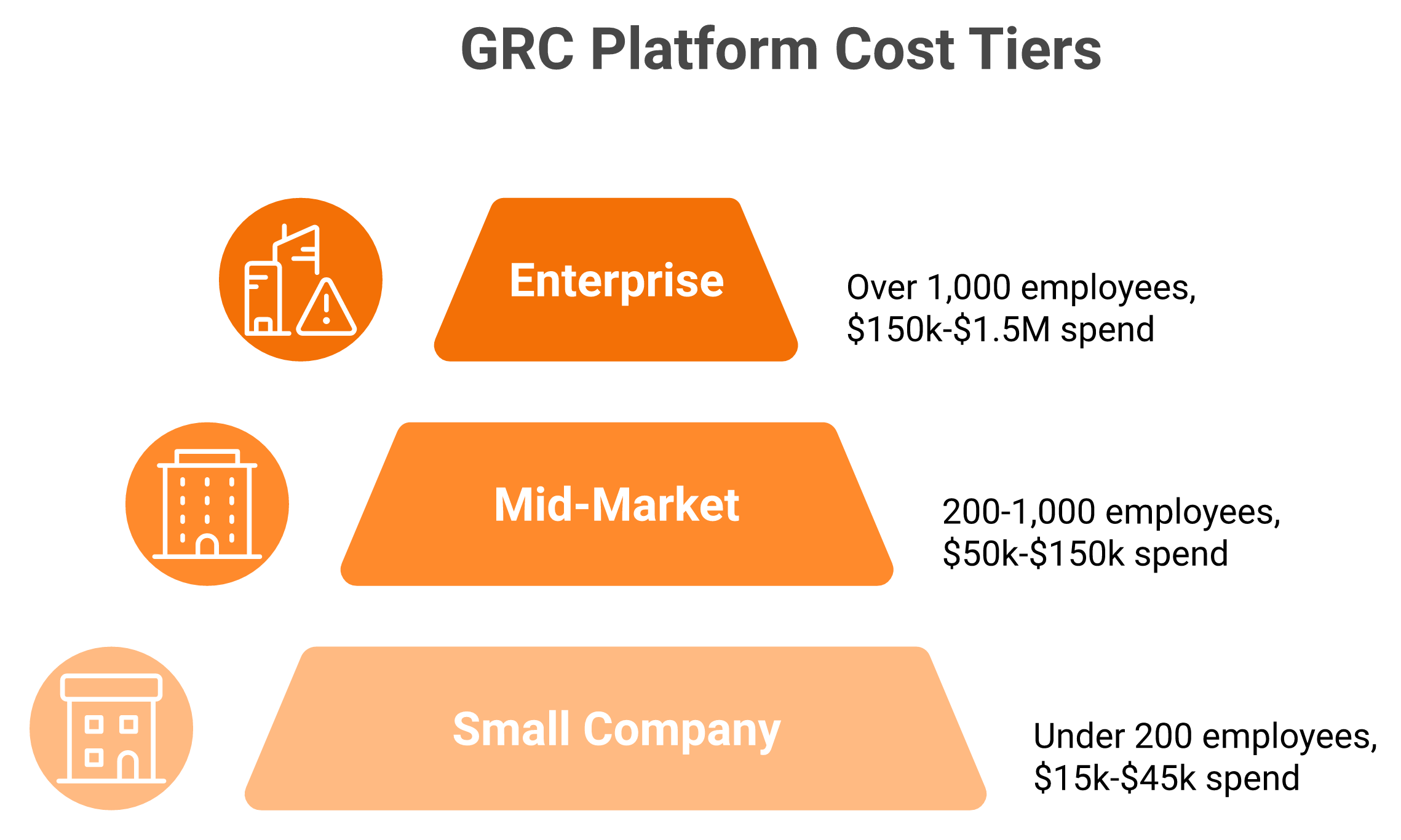
What the bands actually look like
These are realistic first-year totals, meaning software plus implementation plus support, drawn from verified transaction data.
| Segment | LogicGate | AuditBoard | OneTrust GRC | ServiceNow IRM |
|---|---|---|---|---|
| Under 200 employees | $15K to $40K | $20K to $60K | $15K to $50K | Rarely viable |
| 200 to 1,000 | $40K to $120K | $60K to $180K | $50K to $150K | $150K to $400K |
| Over 1,000 | $120K to $300K | $180K to $600K | $150K to $500K | $400K to $1.5M |
The enterprise column carries a warning. For ServiceNow IRM and Archer, systems-integrator fees frequently exceed the software price itself.
The entry-price ladder
Compliance automation tools sit lower and scale differently. UnderDefense lists a $10,000 starting point for MAXI Compliance AI, which covers platform access rather than a single framework module.
| Platform | Reported entry point | Published on the website |
|---|---|---|
| UnderDefense MAXI Compliance AI | $10,000 | Yes |
| Vanta | $7,500 to $15,000 | No |
| Secureframe | Around $7,500 plus per framework | No |
| Drata | $7,500 to $15,000 base, higher tiers reported at $35,000+ | No |
| Thoropass | $40,000+ reported by buyers | No |
I want to be careful here. Entry prices are the cheapest sentence a vendor will ever say to you. Vanta’s observed median lands near $20,000, roughly double its floor.
Turning a band into a budget ask
Take your segment band, then add 40% of the licence for first-year services. That single move stops the conversation where finance discovers a $60,000 implementation invoice in month four.
Bring three numbers to your CFO. Licence, first-year services, and the Year 2 uplift you expect. Renewal increases of 40% and higher are widely reported in this category, which is why the 2026 budget planning conversation should start with the renewal, not the first invoice.
My read from watching mid-market deals close is that buyers underprice services and overprice software. The licence gets negotiated hard. The $80,000 integrator statement of work gets waved through.
UnderDefense publishes a $10,000 entry point for MAXI Compliance AI platform access, which sits at or below the floor of every major compliance-automation vendor in this table, with the scope stated up front rather than after a discovery call.
Q2: Why Do Two Quotes for the Same Platform Differ by 10x?
Seven pricing units drive GRC cost: named seat, per fulfiller, per module, per legal entity, per third party, capacity unit, and hybrid platform-plus-module. AuditBoard prices on controls and audits rather than headcount, so a 10-person team with 500 controls pays more than a 50-person team with 100 controls. The unit, more than the vendor, determines your bill.
The unit is the price
A pricing unit is the thing the vendor counts. Everything else is arithmetic on top of it.
Two vendors can quote the same company a 5x difference honestly. One counted seats. The other counted controls.
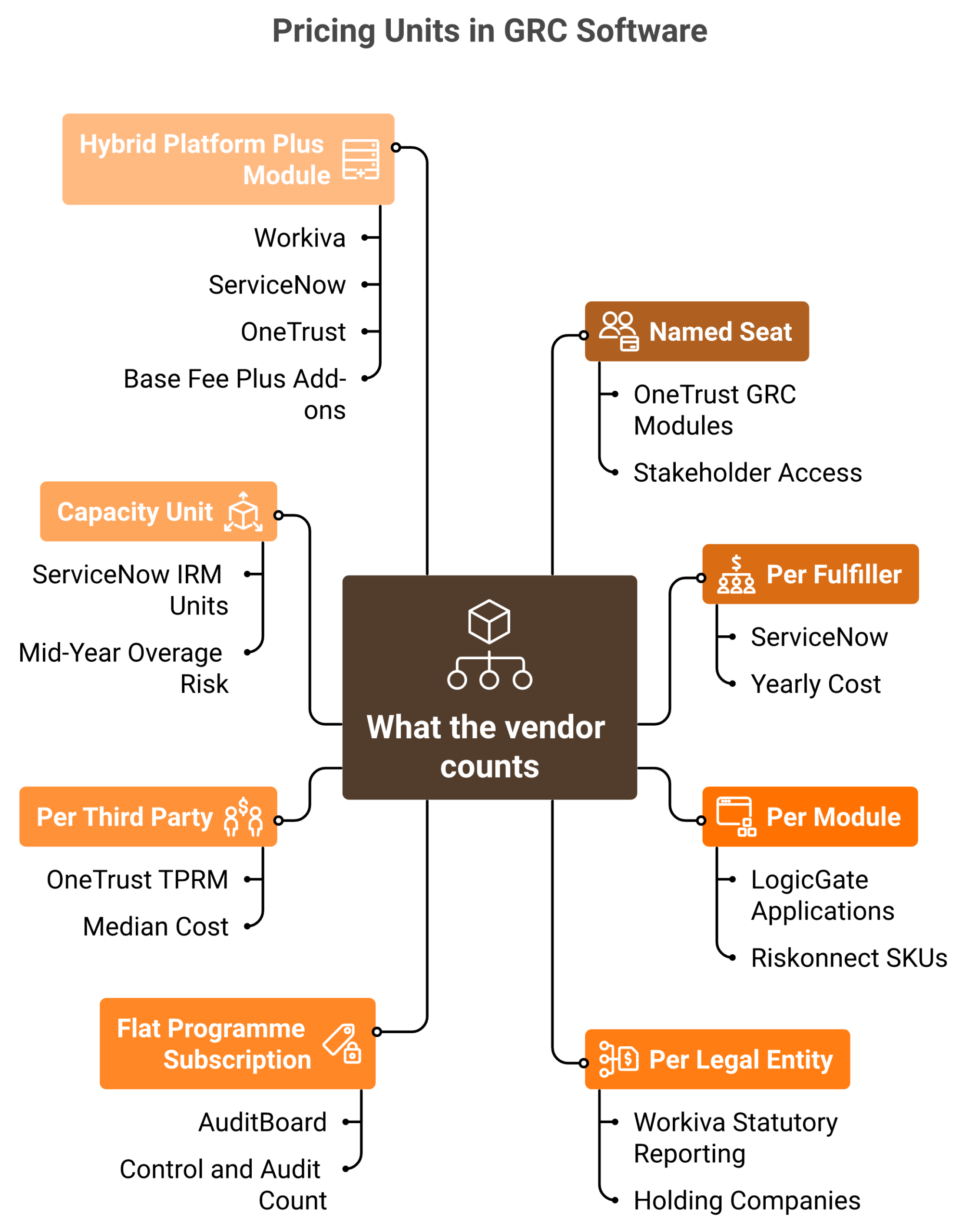
The seven units, and how each behaves
| Unit | Who prices this way | What makes the bill grow |
|---|---|---|
| Named seat | OneTrust GRC modules | Every stakeholder who needs access |
| Per fulfiller | ServiceNow, $2,400 to $3,800 per fulfiller yearly | Analysts and control owners added over time |
| Per module | LogicGate applications, Riskonnect SKUs | Each new GRC use case you activate |
| Per legal entity | Workiva statutory reporting | Acquisitions and new subsidiaries |
| Flat programme subscription | AuditBoard | Control count and audit count |
| Per third party | OneTrust TPRM, $8,046 median at 100 vendors | Vendor portfolio growth |
| Capacity unit | ServiceNow IRM Units | Usage volume, with mid-year overages |
| Hybrid platform plus module | Workiva, ServiceNow, OneTrust | Base fee plus every add-on |
A worked example
Picture a 700-person fintech with 420 controls, 180 third parties, and a nine-person GRC team.
Priced per seat, that company looks cheap. Priced on control volume, it looks expensive. Priced per third party, it becomes the most expensive profile in its peer group.
Same company. Three bills. Nothing dishonest happened.
Pick your unit before you shortlist
Here is the practical move. Rank your three growth dimensions over the next 24 months: controls, entities, and third parties.
Then shortlist vendors whose unit tracks your slowest-growing dimension. That single decision moves more money than any discount you will negotiate later, and it is the same discipline that separates a workable programme from an expensive one in integrated risk management.
Compliance programmes mature through policies, process, and people. Seat-based pricing quietly taxes the third one. The moment your programme starts working, more people need access, and the bill climbs for a reason that has nothing to do with risk reduced.
The hybrid trap
Hybrid pricing deserves its own warning. The platform fee protects the vendor’s floor, and the modules create the expansion revenue.
Discounts usually apply to the platform component only. So the part you negotiate hardest is the part that matters least.
Capacity-unit models carry a different risk. Overages can raise your cost mid-year, which is why hard caps belong in the contract at signature.
I could be reading this too strongly, though the pattern in mid-market deals is consistent. Buyers negotiate the number in front of them and ignore the multiplier behind it.
UnderDefense prices platform access rather than per control or per fulfiller, so the invoice holds steady as your control inventory and stakeholder list grow through an audit cycle.
Q3: What Does Each Major GRC Vendor Actually Charge?
Verified transaction medians: OneTrust IT Security Risk Advanced $13,378, Policy Management Standard $11,615, TPRM at 100 third parties $8,046, AuditBoard SOXHUB Professional $41,696, CrossComply Essentials $30,073, and LogicGate at four applications with five power users $88,578. ServiceNow Policy and Compliance Pro runs $2,400 to $3,800 per fulfiller yearly, reaching $580K to $1.6M at 100 to 250 fulfillers.
How these numbers were produced
Every figure below comes from verified purchase records rather than list prices. Sample sizes matter, so here they are: OneTrust n=49, ServiceNow n=26, Workiva n=19, AuditBoard n=13, and LogicGate n=4.
Three vendors return zero verified transactions in that dataset: Archer, MetricStream, and Riskonnect. I would rather tell you that than publish an estimate dressed as data.
The master table
| Vendor | Verified median | Pricing unit | Confidence |
|---|---|---|---|
| OneTrust GRC modules | $8,046 to $13,378 per module | Licence per module, per third party | High, n=49 |
| AuditBoard | $30,073 to $41,696 per module | Flat, controls and audit driven | Moderate, n=13 |
| LogicGate | $88,578 at 4 apps, 5 power users | Per application plus power user | Low, n=4 |
| Workiva GRC | No module-level data | Platform fee plus solutions | No data |
| ServiceNow IRM | No module-level data | Capacity units | No data |
| Archer, MetricStream, Riskonnect | No verified transactions | Not disclosed | No data |
| UnderDefense MAXI Compliance AI | From $10,000 | Platform access | Published |
The single-module illusion
Those medians describe one module. Buyers rarely stop at one.
A four-module AuditBoard deployment was observed at $148,000 against single-module medians of $30,000 to $42,000. Module stacking, more than sticker price, is what breaks the budget.
One security leader described the endgame to me as counting consoles out loud. One, two, three, four, five, six, seven. Every console had its own contract and its own renewal date, which is the same consolidation problem that shows up across the security stack.
Add-ons that appear late
Trust Center at roughly $6,000 yearly and vendor risk management at roughly $11,200 yearly show up in compliance automation contracts as separate lines. Additional frameworks commonly run about $5,000 each, and third-party risk workflows are usually the first add-on a growing programme needs.
UnderDefense sits outside this module-stacking pattern, covering security operations and compliance evidence under one platform contract, with a stated $10,000 entry point rather than a per-module ladder.
Q4: What Never Appears in the Quote, and What Does Year Three Cost?
Budget beyond the licence: implementation 20% to 50% of Year 1 contract value, data migration 5% to 15%, training 5% to 10%, premium support 5% to 20%, integration services 10% to 30%, and annual uplift 5% to 20%. Certification audits stay separate, with SOC 2 Type I at $7,500 to $20,000 and Type II at $12,000 to $20,000. UnderDefense deploys the MAXI Compliance AI platform on prepared infrastructure in under five minutes.
The quote is a floor
Every GRC quote I have reviewed describes the software and stops. The work of making that software useful lives somewhere else.
A former colleague described his unused SIEM licence as expensive storage. He was paying for an apartment he never visited. GRC platforms fail the same way when nobody funds the configuration.
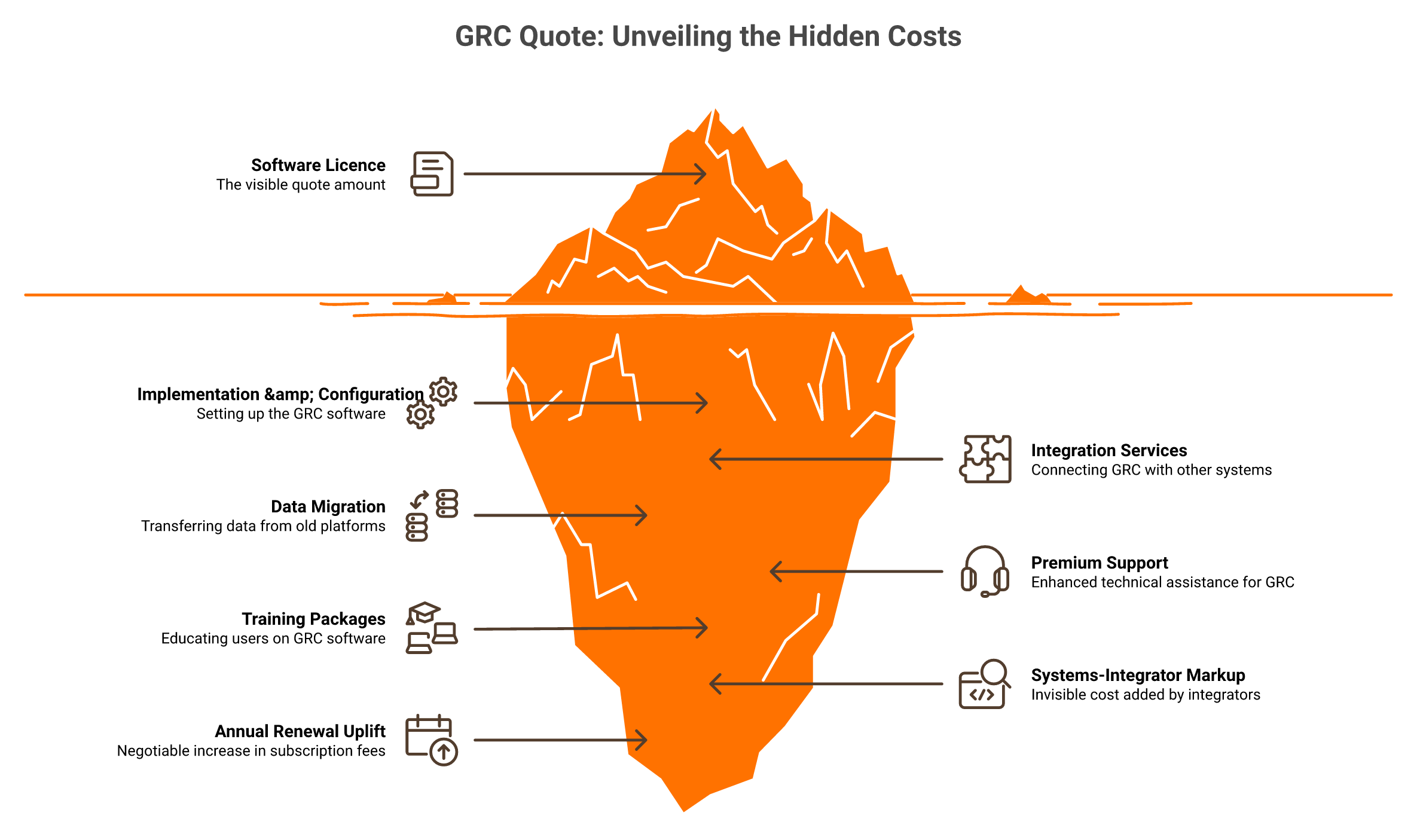
The line items nobody quotes
| Component | Share of Year 1 contract value | Notes |
|---|---|---|
| Implementation and configuration | 20% to 50% | Higher for ServiceNow IRM and Archer |
| Data migration | 5% to 15% | Near zero for greenfield programmes |
| Training | 5% to 10% | Sold as an add-on package |
| Premium support tier | 5% to 20% | ServiceNow Elite lands at 15% to 20% |
| Integration services | 10% to 30% | HRIS, ERP, and ticketing connectors |
| Systems-integrator markup | 15% to 40% | Invisible in SaaS transaction data |
| Annual uplift | 5% to 20% | Negotiable, rarely negotiated |
A three-year forecast on a $100K licence
Year 1 lands near $145,000 once implementation at 30% and support at 10% are added. Year 2 applies a 10% uplift plus one new framework, reaching roughly $122,000.
Year 3 with a second framework and modest seat growth reaches roughly $138,000. Three-year total: about $405,000 against a $300,000 mental model. If the second framework is ISO 27001, the certification fee lands on top of that figure again.
Where it gets worse
ServiceNow renewal uplifts of 10% to 20% per line item add $30,000 to $60,000 on a $300,000 contract. Renewal increases of 40% and higher appear repeatedly in buyer communities across the compliance automation category.
UnderDefense is surprisingly affordable considering the level of protection we get. Their proactive threat hunting and rapid response have saved us from incidents that could have been incredibly costly.
– Verified User in Program Development, Mid-Market, UnderDefense G2 – Verified Review
Setting everything up took some back and forth to get our tools properly integrated. You’ll need to dedicate some time upfront to get things configured properly.
– Verified User in Marketing and Advertising, Small-Business, UnderDefense G2 – Verified Review
That second review is fair, and I keep it in front of my own team. Deployment speed removes the integrator invoice. Integration effort still costs you calendar time.
Seven things to price before signature
- Implementation scope and who owns it
- Migration from your current system or spreadsheets
- Named connectors and their licence status
- Framework additions over 24 months
- Support tier and response commitments
- Renewal uplift cap in writing
- Audit fees, quoted by your audit firm separately
Every one of those items belongs in the same worksheet you use for annual security budget planning, since compliance spend and security spend compete for the same pool.
UnderDefense deploys MAXI Compliance AI on prepared infrastructure in under five minutes, which removes the multi-month integrator engagement that inflates first-year cost in legacy GRC deployments. You can compare that scope against the published compliance pricing before your next vendor call.
Q5: Are You Buying Audit Readiness or a Dashboard?
A platform can display full control coverage while the evidence behind it fails auditor scrutiny. Compliance tools priced at $35,000 and up often cover administrative triggers such as policy attestation and questionnaire routing. UnderDefense maps live security telemetry to controls inside MAXI Compliance AI, producing evidence with a technical source. The 2017 ISACA study “Compliant, Yet Breached” documents organisations that met their framework and still took a material hit.
The comfortable view
Most buyers treat the readiness percentage as the product. Green bar, audit passed, budget justified.
I understand the appeal. A number that moves is easier to show a board than a risk you avoided.
Where the number stops being true
Compliance platforms surface controls. The documentation behind those controls has to already exist.
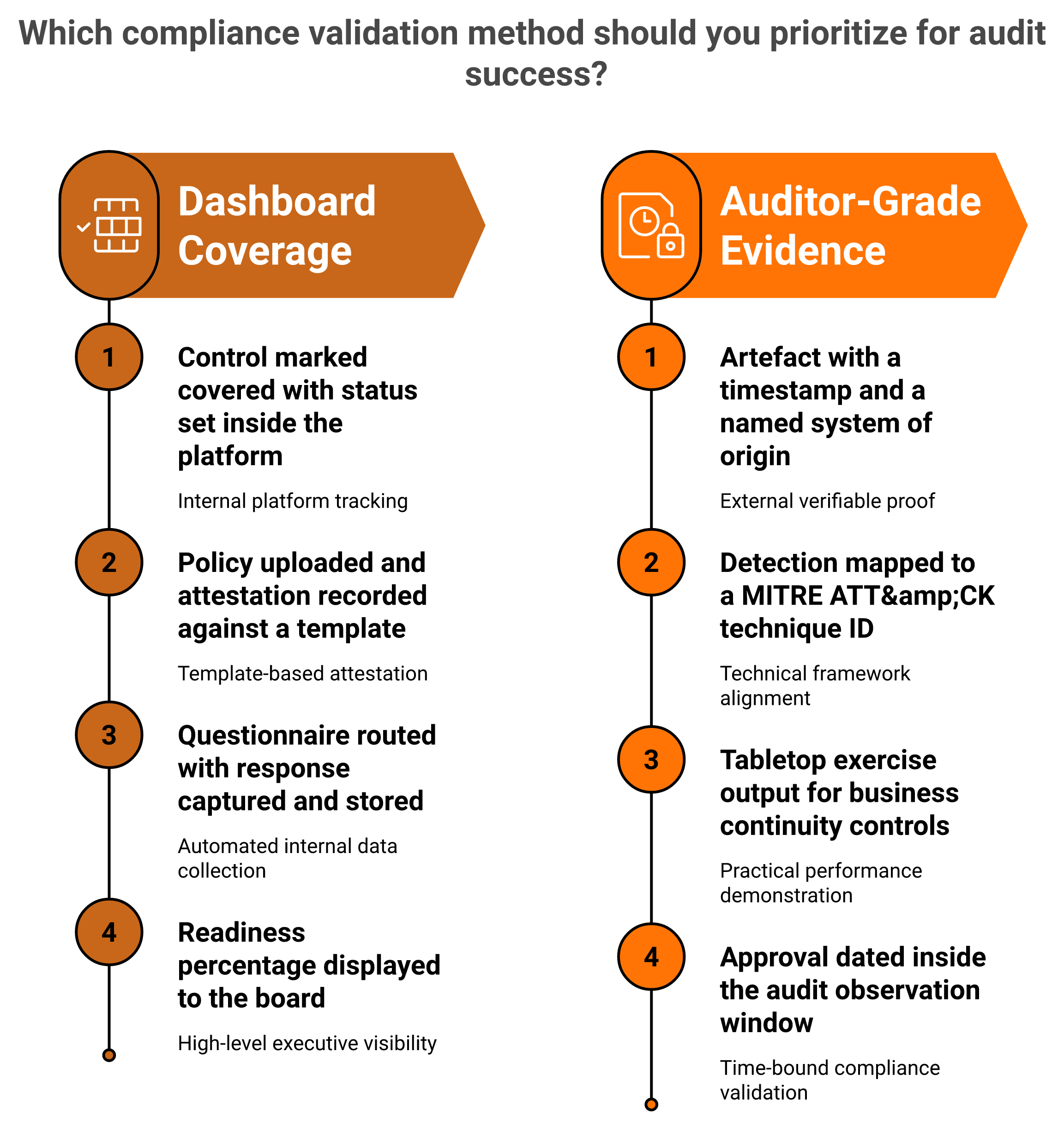
The most common finding in first SOC 2 audits for teams using an automation platform is a documentation gap in operational controls, covering business continuity, vendor management, and testing. The dashboard shows the control. The auditor asks for the tabletop exercise output behind it, which is exactly the artefact a working SOC 2 automation programme has to produce on its own.
Published vendor guidance in this category says this plainly. Evidence can be flagged, marked not applicable, or fail because the approval date sits outside the observation window.
The counterexample nobody prices in
ISACA’s 2017 analysis put the tension in one sentence from a breached organisation: attackers focused on overcoming security controls while the teams measured security by adherence to certification.
That gap costs money twice. Once for the platform, and again for the remediation work your auditor requests in week three. Teams that treat information security compliance as an operating discipline avoid the second invoice.
What buyers say when the audit actually starts
UnderDefense also helped us navigate key compliance requirements, ensuring we met industry standards smoothly and efficiently.
– Arman N., CTO, Mid-Market, UnderDefense G2 – Verified Review
They’ve also made our audit process much less painful. The reports from their platform give us clear evidence of our security controls and incident response capabilities.
– Verified User in Marketing and Advertising, Small-Business, UnderDefense G2 – Verified Review
Setting everything up took some back and forth to get our tools properly integrated.
– Verified User in Marketing and Advertising, Small-Business, UnderDefense G2 – Verified Review
That third line is the honest half of the same review. Evidence quality costs integration effort. Anyone promising otherwise is selling the dashboard.
A better way to price the purchase
UnderDefense maps detections to MITRE ATT&CK technique IDs, which gives a control claim a traceable technical source rather than an attestation checkbox. My read from sitting in audit rooms is that auditors relax when the artefact has a timestamp and a system of origin.
Ask three questions of any quote in front of you.
- Which controls does the platform evidence from live system data?
- Which controls rely on a document my team must write?
- What does the vendor do when an auditor flags evidence?
Score the answers. The second bucket is your real labour cost, and it never appears in the licence line.
UnderDefense builds compliance evidence from the same telemetry its analysts use for investigations, so the control record and the security record come from one source an auditor can follow. That is the same principle behind the wider compliance services engagement model.
Q6: What Is the Cost of Getting This Wrong?
Ponemon benchmarking puts non-compliance at $14.82M against $5.47M in compliance spend, a 2.71x multiplier. Per-capita non-compliance cost falls to $226 for organisations running five or more internal audits a year, against $1,275 for those running none. IBM’s 2025 report places the global average breach at $4.44M and the US average at $10.22M. UnderDefense reports analyst hours and dollars recovered per period inside the platform.
The governing number
Your GRC licence is small against the counterfactual. That is the whole argument, and it survives scrutiny better than any feature comparison.
A $120,000 platform sits at under 1% of the Ponemon non-compliance figure. Finance understands that ratio immediately.
The evidence, with its caveats
IBM’s 2025 study found breach costs fell globally for the first time in five years, driven by faster containment. Organisations using security AI and automation extensively averaged $3.62M against $5.52M for those with none.
Audit cadence matters more than most buyers expect. Ponemon’s benchmark shows the per-capita cost of non-compliance dropping by roughly 80% between zero audits and five or more per year.
I hold that finding loosely. Companies that run five audits a year are already better run, so causation and correlation blur.
The counterweight nobody publishes
Some of this spend buys paperwork. I have watched AI generate the questionnaire on one side and generate the answers on the other. That loop prevents no incident.
Log ingestion runs the same way. In one environment we assessed, 54 terabytes were flowing into the SIEM, where 20 to 25 terabytes would have supported the same detection outcomes. Right-sizing that pipeline is standard work inside a managed SIEM engagement.
That delta is real money, and it sits in the same budget as the compliance platform. Materiality is the filter. Spend on what would hurt if it failed.
Three numbers for your next board update
Bring these to the meeting instead of a readiness percentage.
| Number | Source | What it answers |
|---|---|---|
| 2.71x multiplier | Ponemon | Cost of skipping versus cost of doing |
| $3.62M vs $5.52M | IBM 2025 | What automation changes in a breach |
| Your analyst hours recovered | Platform reporting | Whether the spend returned labour |
UnderDefense measures the third one directly, showing incidents handled, analyst time saved, and cost saved in a single view, so the budget conversation runs on observed numbers rather than vendor projections.
What I would do first
Pick the five controls where failure would be material to revenue or licence to operate. Fund those properly.
Then look at what your current tooling ingests, stores, and never reads. My experience is that the savings there often cover the compliance platform outright, and the same review usually reshapes the rest of annual security budget planning.
UnderDefense reports analyst time and dollars recovered per period inside the platform, which turns the compliance budget defence into arithmetic your CFO can audit.
Q7: Should You Buy GRC, Build It, or Bundle It With Detection?
Buy where the workflow is commoditised and the vendor absorbs framework updates. Build only where you hold durable proprietary context. Bundle when compliance evidence and detection telemetry come from the same data. Enterprises running the UnderDefense Agentic AI SOC on-premise report up to 44% lower total cost of ownership than assembling an equivalent AI investigation pipeline on raw cloud AI APIs.
The three options, priced
| Option | Wins when | Real cost driver |
|---|---|---|
| Buy a GRC suite | Multiple frameworks, formal audit programme | Module stacking and renewal uplift |
| Build in-house | You own context nobody sells | Engineering time and key-person risk |
| Bundle with detection | Evidence and telemetry share a source | Integration depth at onboarding |
A useful test came from a CISO I spoke with recently. He said he would never build his identity provider, though he stays open to replacing it.
Apply that to GRC. Policy workflow is commodity. Your control-to-telemetry mapping is context, and the wider build versus buy decision turns on exactly that distinction.
The in-house tax
Building looks cheap in a spreadsheet. The spreadsheet omits prompt maintenance, model version drift, and the engineer who becomes the single point of failure.
UnderDefense’s on-premise analysis accounts for engineering time, prompt development, maintenance overhead, and token cost optimisation, and lands at up to 44% lower total cost of ownership than an equivalent in-house build.
There is an older version of this failure that predates AI. Teams buy excellent tools, then leave them idle because nobody can drive them. The engine works. Nobody is in the seat.
The line item procurement has not caught up to
AI inference now costs real money inside security and compliance platforms. Almost nobody itemises it.
The UnderDefense Agentic AI SOC includes an AI Cost Center showing per-investigation token consumption and dollar cost. Ask every vendor on your shortlist for that reporting, and hold the answer beside their published pricing model.
If they cannot produce a per-investigation cost, you are absorbing an unbounded variable into a fixed budget. That is a fair question to put in writing.
PLATFORM
WHERE THIS IS HANDLED
The UnderDefense Agentic AI SOC runs investigation, response, and compliance evidence on one platform, cloud or on-premise.
If you are weighing a build against a bundle, you can see how the per-investigation cost reporting works before you decide.
A rubric you can apply this week
- Under 500 employees, one or two frameworks: buy a compliance automation tool and keep scope tight.
- 500 to 5,000 employees with a security operations function: bundle, so evidence and detection share one pipeline.
- Heavy regulation or sovereignty constraints: bundle with an on-premise option, since custom builds concentrate risk in one engineer.
- Genuinely unusual risk taxonomy: build that one component, and buy everything around it.
Switching costs deserve a line here too. Migration from a legacy platform runs 5% to 15% of first-year contract value.
UnderDefense combines multi-agent investigation, response orchestration, and continuous compliance automation in one platform, with 2-minute alert-to-triage and 15-minute escalation for critical incidents, so one contract covers the evidence and the detection.
Q8: Does Data Residency Change What You Pay?
Yes, materially. Regulated buyers increasingly require the data plane, meaning where your logs are processed and stored, to sit inside their own perimeter. That requirement removes cloud-only platforms from the shortlist and pushes teams toward custom builds carrying key-person risk. UnderDefense ships its full agentic stack on any Kubernetes cluster, with bring-your-own model support through Azure AI Foundry, AWS Bedrock, or self-hosted sovereign models.
Why security logs became a legal problem
Security telemetry contains personal data. Usernames, IP addresses, device identifiers, and location signals all qualify under GDPR.
That makes your SIEM a processing activity. Article 30 of the GDPR requires controllers and processors to maintain a written record of those activities and produce it to a supervisory authority on request, which is where GDPR compliance work meets security operations.
The cost fork
Once residency enters the requirements, three paths open, and they price very differently.
| Path | What it costs | Where it breaks |
|---|---|---|
| Cloud SaaS platform | Lowest sticker price | Fails residency review, legal sign-off stalls |
| Custom sovereign build | Engineering salaries plus indefinite maintenance | One engineer holds the whole system |
| On-premise product | Licence plus infrastructure you already own | Requires Kubernetes and a model endpoint |
UnderDefense runs a European telecom operator’s autonomous AI security investigations on the customer’s own hardware, with no security telemetry leaving their infrastructure. That deployment is production, not a pilot.
Financial institutions under DORA face the same fork, and many pair the platform decision with DORA penetration testing. So do critical infrastructure operators working under national data localisation rules.
The pattern I keep seeing
Smaller companies pick SaaS and move on. That is the right call when no regulator is asking where the data sits.
Regulated buyers ask a different question early, and the answer changes the whole shortlist. I have watched a strong technical evaluation die in legal review over a single transfer clause.
My honest hedge here is on timing. Residency requirements are spreading faster than most 2025-era procurement templates account for, which is why data residency now belongs in the first evaluation call.
Put this in your RFP
Three clauses do most of the work.
- Name the jurisdiction where telemetry is processed, stored, and backed up.
- Require a written description of technical and organisational measures, which Article 30 already obliges you to hold.
- Ask whether AI model inference happens inside your boundary, and which model provider is used.
The third question is new, and most templates miss it. A platform can keep your logs in region while sending the prompt to a model somewhere else.
Deployment cost also depends on how fast the stack lands. UnderDefense completes deployment on prepared infrastructure in under five minutes, which keeps the on-premise path from carrying a legacy-style integration bill.
Ask for the processing record and the model endpoint answer in writing before you compare prices. Two platforms quoting the same number are rarely selling the same legal position, so it is worth asking our team how a sovereign deployment changes the maths for your jurisdiction.
Q9: How Do You Negotiate a GRC Contract Down?
Observed leverage in verified deal data: median discounts of 15% to 28% by vendor tier, AuditBoard yielding 15% to 20% under competitive pressure, three-year commits worth up to 10%, and quarter-end signature worth 10% to 15%. Renewal uplifts are negotiable at 6% to 8% for AuditBoard and 5% to 10% for OneTrust. Cap ServiceNow’s 10% to 20% per-line-item uplift in writing.
Lever one: run a real bake-off
Discounts come from competition, and vendors can tell when the competition is fake. Name two credible alternatives and share the evaluation criteria with both.
AuditBoard deals show meaningful movement when Workiva and Drata sit in the same evaluation. OneTrust responds to benchmarking against TrustArc, Osano, and DataGrail. The same discipline applies when you run a structured platform evaluation rather than a single-vendor conversation.
Lever two: use their calendar
Fiscal quarter-end signatures unlock early-signature concessions across this category. Year-end is stronger again.
Your budget cycle matters less than theirs. Ask when their quarter closes, then plan backwards from that date.
Lever three: term length, carefully
Multi-year commits reduce uplift. AuditBoard three-year deals reach up to 10% off, with years two and three capped between 0% and 3%.
Here is where I push back on the standard advice. A CISO told me his two-year lock was the mistake he regretted most as an early-stage buyer.
Take the multi-year discount when your framework roadmap is settled. Take the twelve-month term when it is not.
Lever four: bring finance into the room
ServiceNow uplift caps become negotiable with CFO involvement. Renewal conversations shift when the person who signs the cheque asks the question.
The clause table
| Clause | What to ask for | Evidence |
|---|---|---|
| Renewal uplift cap | 0% to 3% on multi-year | AuditBoard 6% to 8%, OneTrust 5% to 10% negotiable |
| Auto-renewal | Removal above $50K | Standard on OneTrust deals over $50K |
| Notice window | 30 days rather than 60 to 90 | AuditBoard defaults to 60 to 90 days |
| Overage caps | Hard cap at signature | Capacity-unit models drive mid-year increases |
| Payment terms | NET90 | Achievable on OneTrust contracts |
Renewal notice windows deserve attention, and the same clause discipline belongs in your security operations contracts.
It’s reassuring to know they’re always watching for threats, and it doesn’t cost a fortune.
– Serhii B., Chief Information Security Officer, Mid-Market, UnderDefense G2 – Verified Review
Your pre-signature checklist
- Two named alternatives, evaluated on the record.
- Signature date aligned to their fiscal close.
- Term length matched to your framework certainty.
- Uplift cap and notice window in writing.
- Finance in the final call.
UnderDefense states pricing openly rather than routing every conversation through a custom quote, which removes some of the information asymmetry these levers exist to correct. The published compliance pricing is the reference point for that comparison.
Q10: How Do You Estimate Your Own Number Before the First Vendor Call?
Work in five steps: count controls, entities, and third parties; freeze a 24-month framework roadmap; pick the pricing unit matching your slowest-growing dimension; add 40% of licence for first-year services; then add 10% uplift for Years 2 and 3. UnderDefense targets 40% audit readiness within 40 minutes using predefined first steps, so scoping produces usable evidence during evaluation.
Step one: count what vendors will count
Before any call, produce four numbers. Control count, legal entity count, third-party count, and the number of people who need platform access.
Those four numbers decide your price under every model in this category. Vendors will ask for them anyway, so own them first, and keep the third-party figure current through ongoing vendor risk management.
Step two: freeze the framework roadmap
List the frameworks you must hold within 24 months. SOC 2 Type II, ISO 27001, HIPAA, PCI DSS, or DORA, depending on your customers.
Frameworks are usually a separate line item. Pricing them all at signature stops the mid-contract expansion conversation, and a PCI DSS audit added later rarely lands at the price quoted in year one.
A worked example
Take a 300-person healthcare SaaS company. Roughly 240 controls, one legal entity, 90 third parties, and two frameworks.
| Line | Estimate |
|---|---|
| Platform licence | $35,000 |
| First-year services at 40% | $14,000 |
| SOC 2 Type II audit fee | $12,000 to $20,000 |
| Year 1 total | $61,000 to $69,000 |
| Year 2 with 10% uplift | $38,500 plus audit |
That total is defensible before you speak to a single seller. It also tells you which quotes are outliers, and a healthcare programme should sanity-check it against published HIPAA compliance cost benchmarks.
Step three: audit what you already own
Two free moves surface real savings, and almost nobody runs them first.
- Shadow IT discovery through OAuth consent screens. As a Google Workspace or Microsoft 365 admin, you can list every third-party app your staff authenticated with. That list is your vendor inventory, produced free.
- Entitlement review of your existing licences. Microsoft 365 E5 bundles Purview compliance capabilities including audit, data lifecycle management, and insider risk management.
Check E5 before buying an overlapping module. I have watched teams pay twice for capability that shipped with the licence they already renewed, which is the same overlap that shows up when you map the whole security stack.
Step four: pick your unit, then shortlist
Match the pricing unit to your slowest-growing dimension. A single-entity company with a fast-growing vendor list should avoid per-third-party pricing.
Step five: the questions for call one
- What is the licence, and what triggers it to increase?
- What does implementation cost, and who performs it?
- Which controls do you evidence from live system data?
- What is the renewal uplift, and will you cap it?
- What happens if my auditor rejects a piece of evidence?
UnderDefense structures onboarding around predefined first steps that get a programme to roughly 40% audit readiness inside 40 minutes, which turns the evaluation itself into evidence rather than a slide review.
My read is that buyers who arrive with these five numbers negotiate 15% better than buyers who arrive with a budget ceiling. That is a pattern from deals I have watched, so treat it as directional.
Q11: Which GRC Platforms Deliver the Best Value in 2026?
Best value depends on your fastest-growing cost dimension. UnderDefense leads for teams funding compliance evidence and 24/7 detection from one contract, entering at $10,000 with 2-minute alert-to-triage and 15-minute escalation for critical incidents. LogicGate suits two-to-three-application mid-market programmes, AuditBoard fits lean teams with defined audit scope, and ServiceNow IRM makes sense mainly for existing platform estates.
1. UnderDefense
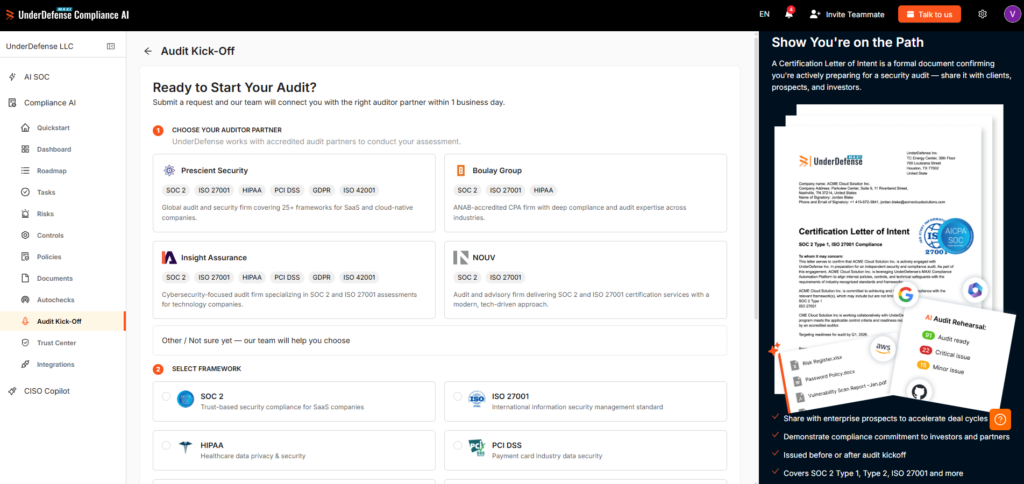
Best for 500 to 5,000-person companies funding audit evidence and active detection from one budget line. Entry at $10,000, with compliance evidence drawn from the same telemetry the analysts investigate inside the UnderDefense Agentic AI SOC.
Weaker fit for companies wanting a pure policy-workflow tool with no security operations component.
Underdefense act as an extension of our team, so we don’t need additional resources, ensuring 24/7 protection. It also solved our problem of having separate security tools that didn’t work well together.
– Inga M., CEO, Mid-Market, UnderDefense G2 – Verified Review
2. LogicGate
Best for mid-market programmes running two or three risk applications. Median $88,578 at four applications with five power users, drawn from four verified deals.
Weaker fit for buyers activating ten or more applications, where connector and API add-ons compound.
3. AuditBoard
Best for lean teams with a defined audit programme. CrossComply Essentials median $30,073, and SOXHUB Professional median $41,696.
Weaker fit for organisations growing their control inventory fast, since pricing anchors to control and audit volume.
4. OneTrust GRC
Best for single-module buyers. IT Security Risk Advanced median $13,378, and Policy Management Standard median $11,615.
Weaker fit for buyers activating five or more modules at Advanced tier, where the module ladder gets expensive across a wider integrated risk management programme.
5. Vanta
Best for startups needing a first SOC 2 quickly, with strong satisfaction scores at 4.6 on G2. Observed contracts run $7,500 to $56,781 with a $20,000 median.
Weaker fit for buyers sensitive to renewal, where increases of 40% and higher are widely reported.
6. Workiva
Best for public companies already filing with Workiva who add GRC modules to an existing subscription.
Weaker fit for GRC-only buyers, since the mandatory platform fee sets a high entry cost.
7. ServiceNow IRM
Best for organisations already standardised on ServiceNow. Per-fulfiller pricing runs $2,400 to $3,800 yearly.
Weaker fit for standalone GRC, where integrator fees can reach 50% to 100% of software cost.
Start a guided compliance walkthrough →
What I expect over the next 18 months
Per-investigation AI cost reporting will become a standard procurement line, the way log-volume pricing did for SIEM. Buyers will start asking what an investigation costs before asking what the platform costs.
UnderDefense ranks first here for buyers funding audit evidence and active detection from one budget line, at a published $10,000 entry point. If your quotes look nothing like the numbers in this guide, I would genuinely like to hear what you are being shown, so tell us what you are being quoted.
1. How much does a GRC platform cost per year in 2026?
Realistic all-in first-year totals sit in three bands. Small companies under 200 employees pay roughly $15,000 to $45,000. Mid-market organisations between 200 and 1,000 employees pay $50,000 to $150,000. Enterprises above 1,000 employees pay $150,000 to $1.5M once systems-integrator fees are included.
- Software licence is typically only 50% to 80% of true first-year spend.
- Implementation, migration, training, and premium support are quoted separately.
- Certification audit fees never sit inside a platform licence.
UnderDefense publishes a $10,000 entry point that covers platform access rather than a single framework module, which is why we can state a number before a discovery call instead of after one. We built our compliance pricing page around that principle.
Our advice to any buyer: take your segment band, add 40% of the licence for first-year services, then add a 10% uplift for Year 2. That three-line forecast is what your CFO actually needs, and it prevents the month-four conversation where an $80,000 statement of work appears that nobody budgeted for.
2. Why do two GRC vendors quote wildly different prices for the same company?
Because they are counting different things. Seven pricing units are in active use across this category, and each one scales on a different dimension of your programme.
- Named seat: grows with every stakeholder who needs access.
- Per fulfiller: ServiceNow runs $2,400 to $3,800 per fulfiller annually.
- Per module: each new use case is a separate SKU.
- Per legal entity: punishing for holding companies and post-acquisition structures.
- Flat programme subscription: AuditBoard anchors to control and audit count rather than headcount.
- Per third party: scales with your vendor portfolio.
- Capacity unit: least predictable, with mid-year overage risk.
A 700-person company with 420 controls and 180 third parties looks cheap under one model and expensive under another. Nothing dishonest is happening in either quote.
The practical move is to rank your three growth dimensions over 24 months, then shortlist vendors whose unit tracks your slowest-growing one. That single decision moves more money than any discount, and it is the same discipline we apply when scoping an integrated risk management programme.
3. What hidden costs are missing from a GRC platform quote?
Every quote we review describes the software and stops. The work of making that software useful is priced elsewhere, usually as a percentage of Year 1 contract value.
- Implementation and configuration: 20% to 50%.
- Data migration from legacy platforms or spreadsheets: 5% to 15%.
- Training packages: 5% to 10%.
- Premium or named support tiers: 5% to 20%.
- Integration services for HRIS, ERP, and ticketing connectors: 10% to 30%.
- Systems-integrator markup: 15% to 40%, invisible in SaaS transaction data.
- Annual uplift: 5% to 20%, negotiable and rarely negotiated.
For ServiceNow IRM and Archer, integrator fees frequently exceed the software price outright. Audit fees are separate again, with SOC 2 Type I at $7,500 to $20,000 and Type II at $12,000 to $20,000 billed by your audit firm.
UnderDefense deploys on prepared infrastructure in under five minutes, which removes the multi-month integrator engagement that inflates legacy first-year cost. You can see the deployment model on the platform page before you compare quotes.
4. Does GRC platform pricing include the SOC 2 or ISO 27001 audit?
No. Certification audits are performed and billed by an independent audit firm, and no platform licence includes them. Treating the two as one budget line is the most common forecasting error we see.
- SOC 2 Type I typically costs $7,500 to $20,000.
- SOC 2 Type II typically costs $12,000 to $20,000.
- ISO 27001 certification carries its own fee structure and surveillance audits.
- Penetration testing required by the framework is also priced separately.
Framework count is itself a pricing variable inside the platform. Common models charge a base platform fee plus roughly $5,000 to $7,500 for each additional framework activated, so a two-framework roadmap costs materially more than a one-framework roadmap on identical headcount.
Freeze a 24-month framework roadmap before you sign, and price every future framework into the contract now rather than at renewal. UnderDefense scopes compliance engagements with the audit relationship mapped alongside the platform work, and our compliance services team runs that sequencing with clients regularly.
5. Can a compliance platform make you audit-ready on its own?
Partly. A platform can show full control coverage while the evidence behind those controls still fails auditor scrutiny. The dashboard surfaces the control. Someone still has to produce the artefact underneath it.
The most common finding in first audits is a documentation gap in operational controls, covering business continuity, vendor management, and control testing. Published vendor guidance across the category confirms that evidence can be flagged, marked not applicable, or rejected because the approval date falls outside the observation window.
- Ask which controls are evidenced from live system data.
- Ask which controls depend on a document your team must write.
- Ask what the vendor does when an auditor rejects a piece of evidence.
The second bucket is your real labour cost, and it never appears on the licence line. UnderDefense maps detections to MITRE ATT&CK technique IDs and builds compliance evidence from the same telemetry its analysts investigate, so a control claim carries a timestamp and a system of origin. That approach sits alongside how we run SOC 2 automation for mid-market teams.
6. How much can you negotiate off a GRC contract?
Verified deal data shows median discounts of 15% to 28% depending on vendor tier, with four levers doing most of the work.
- Competitive bake-off: AuditBoard yields 15% to 20% when credible alternatives sit in the same evaluation.
- Fiscal timing: quarter-end signature is worth 10% to 15%, and year-end is stronger again.
- Term length: three-year commits reach up to 10% off, with years two and three capped at 0% to 3%.
- Finance involvement: uplift caps become negotiable once the CFO joins the call.
Four clauses deserve written attention: a renewal uplift cap, auto-renewal removal above $50,000, a 30-day notice window rather than 60 to 90 days, and hard overage caps on any capacity-based model.
One caution on multi-year terms. Take the discount when your framework roadmap is settled, and take the twelve-month term when it is not. UnderDefense states pricing openly rather than routing every conversation through a custom quote, which removes some of the information asymmetry these levers exist to correct, and the same clause discipline belongs in your security operations contracts.
7. Should you buy a GRC platform, build one, or bundle it with detection?
Buy where the workflow is commoditised and the vendor absorbs framework updates. Build only where you hold context nobody sells. Bundle when your compliance evidence and your detection telemetry come from the same data.
- Under 500 employees, one or two frameworks: buy a compliance automation tool and keep scope tight.
- 500 to 5,000 employees with a security operations function: bundle, so evidence and detection share one pipeline.
- Heavy regulation or sovereignty constraints: bundle with an on-premise option, since custom builds concentrate risk in one engineer.
- Genuinely unusual risk taxonomy: build that one component and buy everything around it.
Building looks cheap in a spreadsheet that omits prompt maintenance, model drift, and key-person dependency. Enterprises running the UnderDefense Agentic AI SOC on-premise report up to 44% lower total cost of ownership than assembling an equivalent AI investigation pipeline on raw cloud AI APIs.
Ask every shortlisted vendor for per-investigation AI cost reporting. If they cannot produce one, you are absorbing an unbounded variable into a fixed budget. Our view on that trade-off is set out in the build versus buy analysis.
8. Does data residency change what you pay for a GRC or security platform?
Yes, materially. Regulated buyers increasingly require the data plane, meaning where logs are processed and stored, to sit inside their own perimeter. That requirement removes cloud-only platforms from the shortlist and pushes teams toward custom builds with long maintenance tails.
Security telemetry contains personal data. Usernames, IP addresses, device identifiers, and location signals all qualify under GDPR, which makes your SIEM a processing activity subject to Article 30 record-keeping.
- Cloud SaaS: lowest sticker price, highest chance of stalling in legal review.
- Custom sovereign build: engineering salaries plus indefinite maintenance.
- On-premise product: licence plus infrastructure you already own.
UnderDefense ships its full agentic stack on any Kubernetes cluster with bring-your-own model support through Azure AI Foundry, AWS Bedrock, or self-hosted sovereign models, and runs a European telecom operator’s investigations entirely on customer hardware.
Put three clauses in your RFP: named processing jurisdiction, written technical and organisational measures, and confirmation of where AI model inference happens. More detail sits in our note on data residency.