




Q1. What does a modern SOC stack actually include in 2027?
A modern SOC stack is the integrated set of tools used to collect telemetry, detect threats, investigate, and respond: SIEM, EDR/XDR, SOAR, NDR, UEBA, threat-intelligence platforms, case management, cloud security (CSPM/CNAPP/CDR), and an emerging AI SOC layer. SIEM correlates logs and detects, EDR confirms and contains endpoints, SOAR automates response, and XDR unifies detection across endpoint, network, and cloud.
See how the UnderDefense Agentic AI SOC investigates, triages, and resolves real alerts.
The stack, in plain English
I started building SOCs back when we stitched everything together from the ashes of web-based syslog. The arrangement has names now, but the job is the same: see what is happening, decide if it matters, and act fast. A modern stack just splits that job across specialized layers.
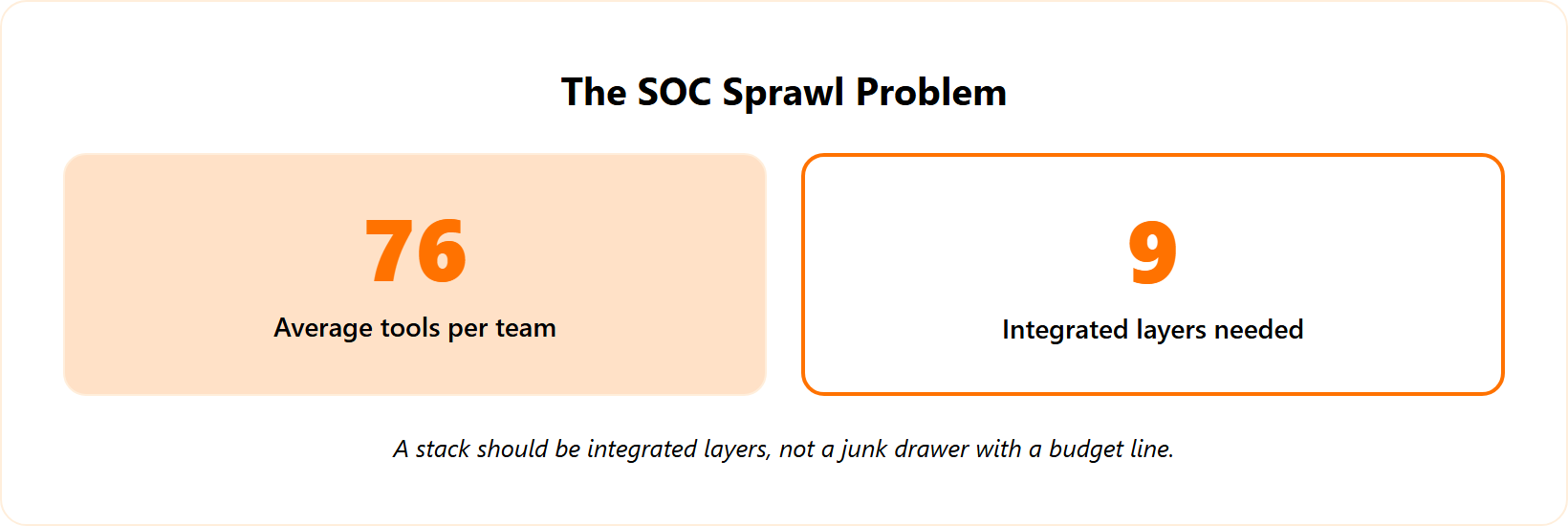
Here is the catch nobody warns you about. The average team I meet is juggling around 76 security tools. That is not a stack. That is a junk drawer with a budget line.
What each layer actually does
Each layer earns its keep by doing one part of the detect-to-respond job well.
- SIEM (Security Information and Event Management): collects and correlates logs, the place detections fire. Think Splunk, Microsoft Sentinel, or Google Chronicle.
- EDR/XDR (Endpoint/Extended Detection and Response): confirms and contains threats on the device. CrowdStrike Falcon and SentinelOne live here.
- SOAR (Security Orchestration, Automation and Response): runs the playbooks. Cortex XSOAR is a common example.
- NDR (Network Detection and Response): watches traffic for what endpoints miss. Darktrace, Vectra AI, ExtraHop.
- UEBA (User and Entity Behavior Analytics): flags odd user behavior, like a login at 3 a.m. from a new country.
- TIP (Threat Intelligence Platform): feeds known-bad signals into detection.
- Case management: tracks an incident from alert to closed.
- Cloud security (CSPM/CNAPP/CDR): finds misconfigurations and threats across cloud. Tenable and Qualys also cover exposure here.
- AI SOC layer: the new tier that triages and investigates on top of all the above.
SIEM vs SOAR vs EDR vs XDR
People mix these four up constantly, so here is the clean split. If you want the deeper breakdown, our guide to understanding SIEM walks through the correlation logic in detail.
| Layer | Core job | Scope | Acts on its own? |
|---|---|---|---|
| SIEM | Correlate logs, detect | All log sources | No, it alerts |
| EDR | Confirm and contain | Endpoints | Yes, on endpoints |
| SOAR | Automate response | Cross-tool playbooks | Yes, by playbook |
| XDR | Unify detection | Endpoint, network, cloud | Yes, across layers |
Why this gets painful, and where we sit
The 76-tool reality is the real story here. Every tool is one more login, one more contract, one more place an alert hides. People sell you a “single pane of glass,” but what most teams get is less glasses of pain than promised, and more dashboards to babysit.
Consolidation is hard for one structural reason: most stacks are vendor-locked, so layers do not talk to each other cleanly. At UnderDefense we built our MDR service around vendor-agnostic integration, meaning we plug into the tools you already own instead of forcing a rip-and-replace. One reviewer put it simply:
“UnderDefense’s ease of integration into our existing tech stack mirrors the positive aspects, enhancing our security without disrupting workflow.”
CEO, Mid-Market UnderDefense Agentic AI SOC G2 Verified Review
That sets up the real question every leader faces next: what do you fund, what do you consolidate, and what do you quietly defer? Our security stack guide covers that decision end to end.
Q2. How do SIEM, EDR, and SOAR actually work together in a SOC?
SIEM spots the threat by correlating telemetry across sources, EDR confirms and contains it on the endpoint, and SOAR automates the response by isolating hosts, blocking IPs, and disabling accounts in seconds. The data flows from sources through normalization and a correlation engine into prioritized alerts, then into playbooks and the incident-response lifecycle. The SIEM, EDR, and NDR together form the visibility triad.
The three-step workflow
Picture a real shift. An analyst sees a flagged login, checks the endpoint, and pulls the plug on the host, all before coffee gets cold. That is SIEM, EDR, and SOAR working as one motion, not three separate tools.
The handoff is the whole game. SIEM says “this looks wrong.” EDR says “yes, and here is what the malware touched.” SOAR says “contained, host isolated, account disabled.”
Following the data, end to end
Let me trace the pipeline the way an operator tunes it, not the way a vendor diagrams it.
- Sources send telemetry: endpoints, firewalls, cloud, identity logs.
- Normalization turns messy log formats into one common language.
- Correlation engine connects events, so five weak signals become one real alert.
- Prioritized alert surfaces with context, ranked by risk.
- SOAR playbook fires: isolate the host, block the IP, disable the account.
- IR lifecycle takes over for investigation, eradication, and recovery.
The visibility triad, SIEM plus EDR plus NDR, exists so attackers have nowhere to hide. Endpoints, network traffic, and logs each catch what the others miss. Miss one corner and you get blind spots that make investigations slower, not faster. This is exactly what our SOC service runs as a managed pipeline.
Where the AI SOC layer now sits
Here is what I think the standard read gets backwards. People treat automation as a way to remove humans. In practice, the resilient model is human plus automation: machines handle the repetitive triage, humans handle the edge cases and the judgment calls.
The AI SOC layer now sits on top of this whole pipeline, making investigations faster by enriching alerts before a human ever opens them. That only works if the pipeline underneath is correlated end to end. Our 2-minute Alert-to-Triage SLA at UnderDefense Agentic AI SOC depends on exactly that, telemetry correlated as one stream rather than stitched across disconnected tools after the fact.
“Their SOC team is responsive and knows their stuff. When they escalate something, they include the context we need to understand the issue quickly. Were not wasting time piecing together what happened from different systems anymore.”
Verified User in Marketing and Advertising UnderDefense Agentic AI SOC G2 Verified Review
Context at handoff is the difference between a fast shift and a long one. UnderDefense runs this detection-to-response pipeline as a managed SOC, so the correlation work happens before the alert lands on your team’s desk. If you want to see how the handoffs work in practice, you can book a demo and walk the pipeline with us.
Q3. Which SOC tools should you fund first when attackers break in within 51 seconds?
Fund the layers that match how you actually get breached. The 2025 DBIR shows credential abuse as the top vector at 22%, vulnerability exploitation up 34%, and third-party involvement doubled to 30%. So identity and UEBA, vulnerability management, and third-party visibility outrank a fifth dashboard. With the fastest break-in clocked at 51 seconds, fund detection-and-response speed before funding more log collection.
Fund by threat vector, not by demo
I will say something the category avoids. You do not win in cybersecurity. It is more like a zombie apocalypse, the goal is to survive the night and reduce damage, not to plant a flag. So fund the layers that match how attackers actually get in, and let the rest wait.
The data makes the order obvious if you read it honestly. Our cybersecurity budget guide for mid-market firms maps this out by line item.
Pillar 1: follow the breach vectors
The 2025 Verizon DBIR is blunt about where attacks start.
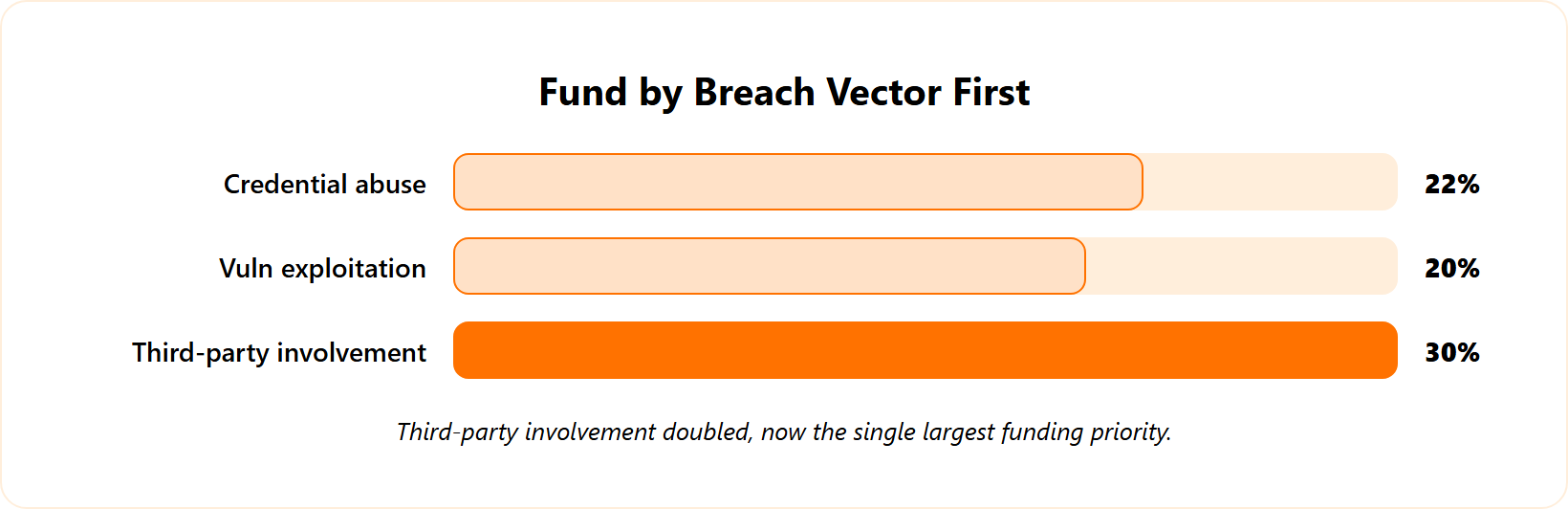
- Credential abuse: 22%, still the top initial access vector. Fund identity protection and UEBA first.
- Vulnerability exploitation: up 34%, now 20% of breaches. Fund vulnerability management next.
- Third-party involvement: doubled to 30%, from 15% a year earlier. Fund third-party and supply-chain visibility.
A fifth dashboard does not help with any of these. Identity, patching, and vendor visibility do.
Pillar 2: speed is now a funding line
Here is the part that changes the math. The fastest recorded break-in time is around 51 seconds, and the average breakout time sits near 48 minutes. With zero-day exploit windows shrinking to hours rather than days, your response capability is no longer a nice-to-have.
If a tool only collects more logs but cannot help you respond inside that window, it is the wrong next dollar. Detection-and-response speed beats log volume every time. This is exactly why I argue response capability deserves its own budget line, and why the right SLA in cybersecurity matters more than raw log count.
Pillar 3: the NIST reframe that exposes the gap
Try this on a Monday. Take the NIST Cybersecurity Framework 2.0 functions, Govern, Identify, Protect, Detect, Respond, and Recover, and map every budget dollar into those families on one page.
When leaders actually do this, a pattern shows up fast. Most of the money sits in Protect, and there is almost nothing in the proactive capacity, the threat hunting that finds the attacker before the alert fires. That gap is where UnderDefense’s proactive threat hunting earns its place, because it covers the function the budget chart usually leaves empty. One reviewer described that proactive posture directly:
“Their proactive threat hunting and rapid response have saved us from incidents that could have been incredibly costly.”
Verified User in Program Development, Mid-Market UnderDefense Agentic AI SOC G2 Verified Review
Fund the vector, fund the speed, then fund the gap your own one-page chart exposes.
Q4. What can you safely consolidate, and which tools are just compliance theater?
Consolidate where layers overlap: XDR can absorb standalone EDR and parts of NDR, and an AI SOC layer can replace tool-by-tool query work. Cut spend that only produces audit artifacts. Much of the stack has become compliance theater. Budget-constrained teams can cover gaps with open-source tools such as Wazuh, TheHive, MISP, and Suricata while keeping whatever shortens investigations.
The consolidation principle
Keep what shortens an investigation. Consolidate what overlaps. Defer what only exists to pass an audit. That is the whole rule, and it survives contact with a real budget.
The pain: tool babysitting
Cybersecurity has over-specialized into tool babysitting. We have grown a cottage industry of people who tie their identity to running queries against a SIEM, and the work quietly drifts from stopping attacks to feeding dashboards. I have generated AI questions and AI responses on both sides of a screen and asked the honest question: does this prevent an incident tomorrow? Often, no.
When the answer is no, that spend is a candidate for consolidation. Our take on cybersecurity technical debt explains why this sprawl accumulates.
Keep, consolidate, or defer
Here is how I sort a typical stack, with an open-source option where it genuinely covers the gap.
| Category | Verdict | Why | Open-source option |
|---|---|---|---|
| Standalone EDR | Consolidate | XDR absorbs it | Wazuh |
| Standalone NDR | Consolidate (partial) | XDR covers core cases | Suricata |
| Tool-by-tool query work | Consolidate | AI SOC layer replaces it | TheHive |
| SIEM | Keep | Core correlation source | Wazuh |
| Threat intel platform | Keep | Feeds detection | MISP |
| Redundant GRC dashboards | Defer | Audit artifact only | – |
Open-source tools like Wazuh, TheHive, MISP, and Suricata can cover real gaps for a lean team. They take work, but they are honest spend.
The compliance-theater take
A lot of GRC and trust-center spend is mutually assured compliance theater. It produces a clean artifact for the auditor and changes nothing about whether you get breached. SOC 2 Type II and ISO 27001 matter, but the tooling around them often exists to generate evidence, not security. Our compliance services focus on the controls that actually hold up.
This is where the structural trade-off of monitoring-only point tools and legacy MSSPs shows up. They forward alerts without context, so you pass the audit but still triage noise. Competitor reviews make the pattern concrete:
“Solid detection and response capabilities, but overly relies on the clients team for remediation, which really hurts the value of the service.”
VP of Technology Arctic Wolf Gartner Verified Review
“Log collectors show working, however when asked to provide logs for an investigation no logs could be provided. Analysts provide little context.”
CISO Arctic Wolf Gartner Verified Review
UnderDefense takes the opposite path with a vendor-agnostic model, so teams consolidate while keeping their own detection logic instead of renting it inside a black box.
The exit clause before you cut anything
One hard-won contractual tip before you consolidate onto any platform. Ask one question in writing: if we terminate this agreement, do all correlation rules, integrations, and detection logic remain in our SIEM? If the answer is no, you are not consolidating, you are trading one lock-in for another. Owning your data and detection logic is the safeguard that makes consolidation reversible, which is why our managed SIEM keeps your detection logic yours.
Q5. Why does the AI SOC layer matter now, and what does the research actually prove?
AI in the SOC has moved past hype. Peer-reviewed work shows machine-learning triage cutting analyst burden by roughly 43% on a public benchmark (PACT), while granted patents cover autonomous alert investigation using large language models. The honest caveat: studies warn that false-positive-only metrics can hide missed detections, so the resilient posture is AI collects context, and you decide.
What the AI SOC actually proves
I have watched this category swing from “AI changes everything” to real, testable results. The shift that matters is simple. AI now collects context fast, then a human decides. It does not decide for you, and the research backs that line.
The proof is in the metrics, not the marketing. Our own read on where the hype breaks down lives in our AI SOC red flags breakdown.
What the academic work shows
Recent peer-reviewed studies give us hard numbers instead of vendor claims.
- PACT (a triggered active-learning controller) cut false-positive burden by about 43% on the AIT-ADS benchmark versus a frozen baseline.
- A Splunk-integrated LLM framework reduced average triage time from roughly four hours to under ten minutes per incident.
- A 10-month study of 3,090 queries from 45 SOC analysts found LLMs eased cognitive load and sped up lookups, while flagging occasional hallucinations as a real risk.
That last caveat is the one I respect most. A model that sounds confident and is wrong is worse than no model. This is the heart of the debate we cover in does AI kill or save your SOC team.
Why the patents matter
The category is fundable and real, not vaporware. Granted patents now cover automatically investigating security incidents and generating incident reports using a large language model. When a patent office signs off on agentic investigation, the architecture has left the demo stage.
This is also where detection coverage matters. Mapping detections to the MITRE ATT&CK framework, the public catalog of attacker techniques, lets you prove what you can and cannot see. That is observable evidence, the kind I trust over a slide, and the kind our SOC service is built to surface.
The metric trap, and the 15-test rule
Here is the part the category quietly avoids. A vendor can show you a big false-positive reduction while hiding missed detections, because aggregate scores blur the gap. One study makes this explicit: cutting false-positive burden cost about ten points of recall, the share of real attacks caught. So always demand recall figures next to any noise-reduction claim.
From what surfaces when you actually run this, a single test result lies more often than it tells the truth. In my own work, I retest each case somewhere between five and 15 times before I call it a true or false positive. One pass is an anecdote, not a measurement.
I might be wrong on the exact number, but the principle holds: trust verification over a single clean demo. This is the posture we built into UnderDefense Agentic AI SOC. The AI gathers and enriches context across your tools, then our analysts verify before anyone acts. Context-first augmentation beats black-box autonomy, because you can audit every step instead of trusting a sealed answer.
Q6. Should response be autonomous or human-led in 2027?
Fully autonomous response stays risky: software that quarantines users without oversight can create new business-impact failures, and many operators argue a fully autonomous SOC is unrealistic today. Yet modern platforms already run automated workflows that deny access and stop a cloud instance in under a minute. The workable 2027 line treats AI agents as foot soldiers and human analysts as generals.
The contested ground
Ask ten security leaders if response should be automatic, and you get ten different answers. That tension is healthy. The honest position lives in the middle, and it depends on consequence.
Low-consequence actions can run on their own. High-consequence ones need a human in the loop, which is the core argument in our guide to SOC automation.
Why full autonomy is still unrealistic
I think the standard read overrates how ready agents are. A fully autonomous SOC remains unrealistic today, both on technology readiness and on real-world impact. Imagine software that locks out a user with no oversight, then locks out your CFO mid-board-prep. You traded an attack for a self-inflicted outage.
Here is the mental model I use: today’s AI agents are like teenagers. They are capable and fast, but they have no fear of consequence. You do not hand a teenager the keys and skip the conversation about what happens if they crash.
Where automation already wins
The counterpoint is just as real. Modern platforms already run automated fusion workflows that contain a threat in under a minute, denying further access and stopping a compromised cloud instance before it spreads. For contained, reversible actions, speed beats deliberation.
Teams are steadily adopting automation for exactly this kind of routine containment. The pattern is clear. Automate the cheap-to-reverse actions, and keep humans on the expensive ones, a balance our MDR service is built around.
Foot soldiers and generals
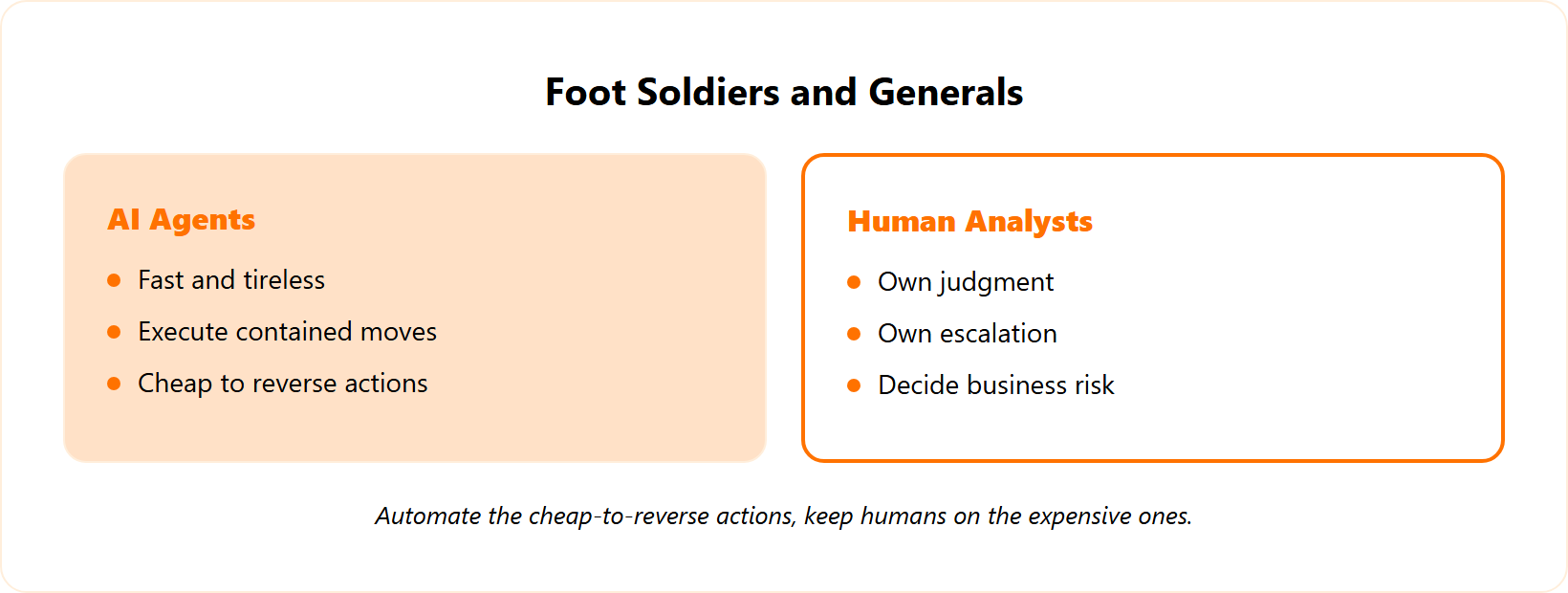
So here is my working line for 2027. AI agents are the foot soldiers: fast, tireless, and good at executing contained moves. Human analysts are the generals: they own judgment, escalation, and the calls that carry business risk.
The deeper shift underneath this is governance. We are moving from access control, who can touch a system, toward action control, what an agent is allowed to actually do. That distinction is where safe autonomy gets decided.
At UnderDefense, ourAgentic AI SOC plus human ally model is literally this structure. Automation handles speed at the front line, and our analysts own the 15-minute escalation on critical incidents. The machines move first on the small stuff, and the humans decide on the consequential stuff.
Q7. How do you build the SOC business case the board will actually approve?
Build the case in the board’s language of risk avoided and dollars saved rather than tool counts. Anchor it in outcomes: one deployment posted 830% ROI over three years with 99% noise reduction, and a managed detection rollout accidentally surfaced a payroll fraud that saved $300,000 in its first three months. Pair those with DBIR risk data and a spend map that shows where you are dangerously underfunded.
Speak the board’s language
Boards do not buy tools. They buy risk reduced and money saved. So drop the tool count from slide one, and lead with outcomes the CFO can defend.
The framing that works is a simple table: dollars per option, and value per option. Our cybersecurity budget guide for mid-market firms shows how to lay that out.
What the board is really asking
Every board I have presented to wants the same two columns. For each 24/7 monitoring option, what does it cost, and what value does it return. Build the spreadsheet for them before they ask, and a SOC cost calculator makes that math fast.
That is also why pricing opacity hurts you. If you cannot put a number next to an alert-only MSSP, you cannot finish the board’s table, and the case stalls.
Two proof stories that move the room
Numbers land harder when they come from real moments. Two stand out from our work.
First, the accidental save. During an early deployment, our team surfaced a payroll fraud that nobody was looking for, and the client avoided roughly $300,000 in losses in the first three months. The monitoring paid for itself before the quarter closed.
Second, the 2 a.m. lesson. Hackers do not sleep, and one night an attacker was ready while logging sat switched off on the exact servers that mattered. The visibility gap is always the issue. You cannot respond to what you never recorded, a lesson our incident response team sees repeatedly.
The ROI math, grounded in risk
Outcomes scale into a clean ROI story. One UnderDefense deployment posted 830% return over three years with 99% noise reduction. That noise number matters, because every false alert is paid analyst time.
Tie it to risk data the board already trusts. The 2025 Verizon DBIR shows third-party involvement in breaches doubled to 30%, and credential abuse leading at 22%. Those are the losses your spend is buying down.
“Their proactive threat hunting and rapid response have saved us from incidents that could have been incredibly costly.”
Verified User in Program Development, Mid-Market UnderDefense Agentic AI SOC G2 Verified Review
“UnderDefense is surprisingly affordable considering the level of protection we get.”
Verified User in Program Development, Mid-Market UnderDefense Agentic AI SOC G2 Verified Review
Carry one question into every vendor meeting
Here is the line that wins approvals. For each option, what are the dollars, and what is the value. UnderDefense publishes transparent MDR pricing so you can actually fill that table in, instead of guessing against a sealed quote.
Q8. How does your SOC stack map to SOC 2, ISO 27001, NIS2, and the SEC disclosure rule?
Compliance frameworks translate directly into stack requirements. SOC 2 Type II and ISO 27001 expect continuous monitoring and logging, PCI DSS and HIPAA require audit-ready evidence, the EU NIS2 Directive and the SEC Cyber Disclosure Rule (8-K Item 1.05) demand fast incident reporting, and GDPR Article 33 sets a 72-hour breach-notification clock. Mapping each obligation to a stack layer shows where coverage is genuinely missing.
Frameworks become stack requirements
Auditors do not care about your tool logos. They care about evidence: who logged in, what fired, and how fast you reported. Read that way, every framework becomes a concrete capability your stack must provide.
So map the obligation to the layer, and the gaps show themselves. Our log monitoring compliance guide walks through the evidence each control expects.
The control-mapping table
Here is how the major frameworks and regulations translate into stack capabilities.
| Framework / regulation | What it demands | Required stack capability |
|---|---|---|
| SOC 2 Type II | Continuous monitoring, evidence over time | SIEM logging, retention |
| ISO/IEC 27001 | Risk-based controls, monitoring | SIEM, detection, IR process |
| PCI DSS | Audit-ready logs, daily log review | Log management, monitoring |
| HIPAA | Access and audit trails | Logging, UEBA, retention |
| EU NIS2 Directive | Fast incident reporting | Detection, IR reporting |
| SEC Rule (8-K Item 1.05) | Disclose material incidents in 4 business days | Detection, response, IR records |
| GDPR Article 33 | Breach notice within 72 hours | Detection, alerting, IR |
The honest caveat: monitoring that satisfies an auditor and monitoring that stops an attacker are not always the same investment. The board needs both lines drawn, so nobody mistakes a passed audit for a safe network. Our compliance services aim to close both at once.
Why the clock is now a regulatory line
The disclosure deadlines change how you budget. The SEC rule gives public companies four business days to disclose a material incident, and GDPR Article 33 sets a 72-hour clock. You cannot disclose what you have not detected, so detection-and-response speed is now a compliance line, not just a security one.
That is where UnderDefense’s compliance support and managed SIEM earn their place. We align logging and retention to these obligations and run the detection that feeds your reporting, so the audit evidence and the response capability come from one place instead of a separate bolt-on tool.
Q9. What does the agentic-AI surge do to your data volume, costs, and retention plan?
Autonomous agents change the stack’s math. Each agent generates far more traffic than a human doing the same task, inflating ingest volume and SIEM cost. The counter-moves are trimming ingestion (one team cut 54TB toward 20 to 25TB) and right-sizing retention: keep about six weeks, or 40-plus days, on fast storage for active investigations and archive the rest. Funding the stack means funding its data bill.
The bottom line up front
Agentic AI just broke your capacity plan. A human researcher visits maybe five websites to finish a task, while an AI agent doing the same job can touch thousands. That multiplier shows up directly in your logs, your SIEM ingest, and your bill.
The scale is not theoretical anymore. As of June 2026, bots and AI agents generate roughly 57% of all web traffic, with humans down near 43%. Every one of those machine requests is something your stack may log, which is why we treat managed SIEM sizing as a first-class budget question.
The two cost levers that work
You have two honest moves, and both are inside your control.
- Trim ingestion. In one environment we worked through, raw ingest sat around 54 terabytes and came down toward 20 to 25 terabytes once junk sources were filtered. That is real money back, because SIEM pricing usually tracks data volume.
- Right-size retention. Keep recent logs hot and searchable, then archive the rest to cheaper storage. Industry guidance puts hot storage for active monitoring at roughly 30 to 90 days.
The trim is where most teams leave money on the table. Half your ingest is often noise nobody will ever query, a pattern our managed SIEM pricing guide breaks down line by line.
Your Monday retention rule
Here is the heuristic I would set this week. Keep about six weeks, 40-plus days, of data on fast storage for live investigations, and push everything older into archive tiers for compliance.
That window matters because attackers do not move on your schedule. If a breach surfaces and your investigable data already rolled off fast storage, you are blind during the exact hours you need sight, which is the kind of visibility gap our log monitoring compliance guide warns against.
This is also why pricing transparency matters when you buy detection-and-response. Agentic AI accelerates surprise data-ingest bills, and UnderDefense publishes transparent MDR pricing so the data math is visible before you sign, instead of arriving as a quarterly shock.
Q10. Where do MDR, MSSPs, and the AI SOC + Human Ally model fit your 2027 stack?
Most teams cannot staff 24/7 detection-and-response in-house, so the stack decision becomes a delivery-model decision. Legacy MSSPs often forward alerts without context, and many buyers report the same gap in public reviews: false positives, slow response, and detection blind spots. The 2027 differentiator is whether your provider both detects and responds with human context, on a vendor-agnostic stack you still own.
Build versus buy, honestly
Let me be direct about my own bias. If you run anything that matters, it is probably irresponsible to not monitor 24/7. Almost no mid-market team can staff three shifts of skilled analysts, so the real question becomes which delivery model you buy, a choice we unpack in outsourced vs in-house SOC.
There are four common answers, and they are not equal.
The pain buyers actually report
Before the table, listen to what real buyers say in public reviews. The complaints repeat across the category.
“Solid detection and response capabilities, but overly relies on the clients team for remediation, which really hurts the value of the service.”
VP of Technology Arctic Wolf Gartner Verified Review
“Despite the capabilities of the technical platform and the strength of the analysts, there is still a limit to the environmental knowledge inherent in the service. This leads to a fairly frequent need for engagement with our internal team.”
Verified User in Computer Software Expel G2 Verified Review
The pattern is alerts handed over without enough context, so your lean team still does the heavy lifting. That gap is a big reason businesses switch cybersecurity providers.
The delivery-model comparison
Here is how the four models stack up on the things that decide outcomes.
| Model | Response speed | Context at handoff | Data ownership | Pricing transparency |
|---|---|---|---|---|
| UnderDefense Agentic AI SOC | Fast, AI triage plus analysts | High, detect and respond | You keep your SIEM and logic | Published |
| In-house SOC | Depends on staffing | High, but hard to sustain 24/7 | Full | – |
| Legacy MSSP | Slower, ticket-based | Low, alerts forwarded | Often theirs | Often opaque |
| Traditional MDR | Fast detection | Varies, remediation often yours | Vendor-locked tooling common | Often quote-only |
How to evaluate
Ask about two distinct service levels, because vendors blur them. First, alert-to-triage time. Second, escalation time for a confirmed critical incident, the two SLAs we explain in our guide to SLA in cybersecurity.
At UnderDefense Agentic AI SOC, we run a 2-minute Alert-to-Triage target and a 15-minute escalation for critical incidents, on a vendor-agnostic stack you keep owning. Being a human ally on the response side is a flex in 2026, and detect-and-respond with context beats alert-and-forward every time, which is the whole point of our MDR service.
“When they escalate something, they include the context we need to understand the issue quickly.”
Verified User in Marketing and Advertising UnderDefense Agentic AI SOC G2 Verified Review
Q11. What should you do Monday morning to fix your SOC stack?
Start with five moves: map your spend onto NIST CSF families to expose proactive gaps; audit your highest-volume alert type, since logon events are often a 90% noise win; run the free OAuth shadow-IT discovery in your Google or Microsoft 365 admin console; confirm your SIEM termination clause keeps your detection logic; and demand recall numbers, not just false-positive numbers, in your next AI-SOC evaluation.
Five moves you can run this week
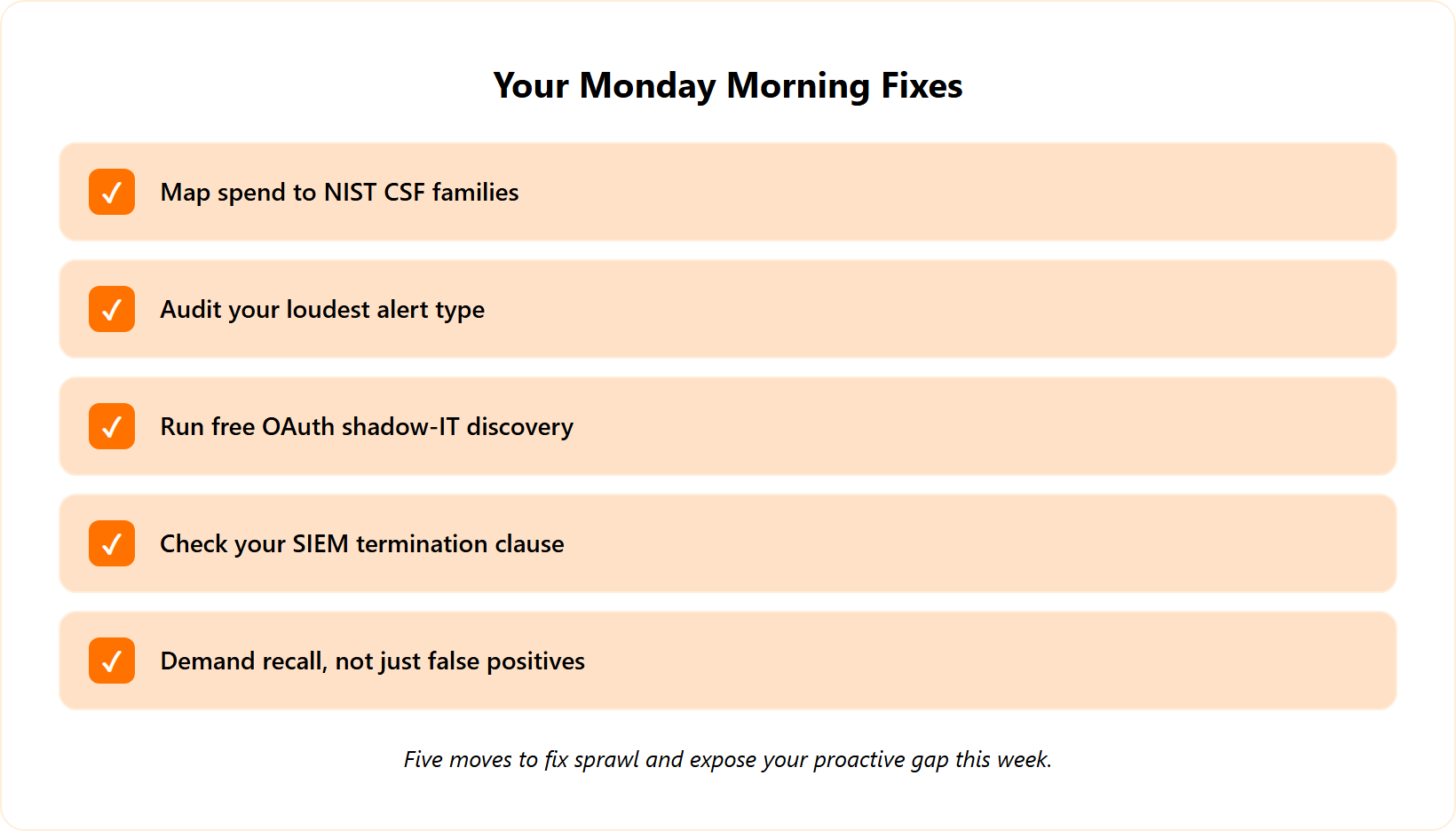
Strategy is easy to nod at and hard to start. So here is the concrete list, in priority order, with the why attached to each.
- Map spend to NIST CSF 2.0 families. Put every dollar under Govern, Identify, Protect, Detect, Respond, and Recover on one page. The empty column is usually your proactive gap, and our cybersecurity budget guide for mid-market firms shows how to fill it.
- Audit your loudest alert type. Logon events are often pure noise, and one team cut alert volume sharply just by filtering routine service-account logons in native Defender queries. Tune the noisiest source first.
- Run free OAuth shadow-IT discovery. In your Google or Microsoft 365 admin console, review which apps users authenticated into via OAuth consent. It is a rich, free list of vendors you did not know you had, and a starting point for attack surface management.
- Check your SIEM termination clause. Confirm in writing that your correlation rules, integrations, and detection logic stay in your SIEM if you ever leave. Owning your logic keeps you free of lock-in, the way our managed SIEM does.
- Demand recall, not just false-positive numbers. In your next AI-SOC evaluation, ask what real attacks the model misses, since noise-reduction scores can hide missed detections. Our AI SOC red flags guide lists the questions to ask.
The part nobody automates away
Here is the honest close. Some of us find a strange zen in copying, in the repetitive toil of tuning rules and chasing alerts. But plenty of good people on security teams quietly carry that toil, and it does not disappear on its own.
That is the real reason to rethink the stack. Automation should take the toil that burns people out, while humans keep the judgment calls. If you want to map your fund, consolidate, and defer gaps with a vendor-agnostic team that has done it across hundreds of environments, I would rather have that conversation than send you a demo link, so tell us what you are defending.
What I keep sitting with is this: the toil is not going away by itself, so who, or what, is carrying yours right now?
See how UnderDefense Agentic AI SOC resolves a real incident on your stack.
1. What tools should a modern SOC stack include in 2027?
We see a modern SOC stack as an integrated set of layers, not a collection of logos. Each layer does one part of the detect-to-respond job well.
- SIEM correlates logs and fires detections.
- EDR/XDR confirms and contains threats across endpoints, network, and cloud.
- SOAR automates response playbooks.
- NDR and UEBA catch what endpoints and logs miss.
- Threat intel and cloud security feed detection and cover misconfigurations.
- An AI SOC layer enriches and triages on top of everything.
The trap we see constantly is sprawl. The average team juggles around 76 tools, which is a junk drawer with a budget line, not a stack. Every extra tool is one more login and one more place an alert hides.
Our advice is to integrate before you add. We built our MDR service around vendor-agnostic integration, so it plugs into the tools you already own instead of forcing a rip-and-replace. If you want the full decision framework, our security stack guide walks through what to keep and what to cut.
2. What is the difference between SIEM, SOAR, EDR, and XDR?
People mix these four up constantly, so we keep the split clean and based on the job each one does.
- SIEM correlates logs from all sources and detects, but it alerts rather than acts on its own.
- EDR confirms and contains threats on the endpoint, and it can act directly on the device.
- SOAR automates response across tools using playbooks, like isolating a host or disabling an account.
- XDR unifies detection across endpoint, network, and cloud so attackers have fewer places to hide.
In a real shift, these work as one motion. SIEM says this looks wrong, EDR says yes and here is what it touched, and SOAR contains it. The handoff between them is the whole game, because context at handoff is the difference between a fast investigation and a long one.
This is exactly why we run the detection-to-response pipeline as a managed SOC service, so correlation happens before the alert reaches your team. If you want the deeper correlation logic, our guide to understanding SIEM breaks it down step by step.
3. Which SOC tools should we fund first on a limited budget?
We fund the layers that match how attacks actually start, not the flashiest demo. The 2025 Verizon DBIR makes the order clear.
- Credential abuse is the top initial vector at 22%, so fund identity protection and UEBA first.
- Vulnerability exploitation is up 34%, so fund vulnerability management next.
- Third-party involvement doubled to 30%, so fund supply-chain visibility.
A fifth dashboard does not help with any of these. Speed does. With the fastest recorded break-in near 51 seconds, we treat detection-and-response capability as its own funding line, because a tool that only collects more logs but cannot help you respond inside that window is the wrong next dollar.
We also recommend mapping every dollar to the NIST CSF 2.0 functions on one page, since the empty column is usually proactive threat hunting. That gap is where managed detection earns its place. For line-item guidance, see our cybersecurity budget guide for mid-market firms, and our MDR service covers the response speed that log volume alone cannot buy.
4. Which SOC tools can we safely consolidate or cut?
Our rule is simple: keep what shortens an investigation, consolidate what overlaps, and defer what only exists to pass an audit. It survives contact with a real budget.
- Standalone EDR can usually fold into XDR.
- Standalone NDR can partly consolidate, since XDR covers core cases.
- Tool-by-tool query work can move to an AI SOC layer.
- SIEM and threat intel stay, because they are core correlation and detection sources.
- Redundant GRC dashboards are often candidates to defer.
Budget-constrained teams can cover real gaps with open-source tools such as Wazuh, TheHive, MISP, and Suricata. They take work, but they are honest spend.
One hard-won tip before you consolidate onto any platform: ask in writing whether your correlation rules, integrations, and detection logic remain in your SIEM if you terminate. If not, you are trading one lock-in for another. Our managed SIEM keeps your detection logic yours, and our take on cybersecurity technical debt explains why sprawl accumulates in the first place.
5. How do we build a SOC business case the board will approve?
Boards do not buy tools. They buy risk reduced and money saved, so we drop the tool count and lead with outcomes a CFO can defend.
The framing that works is a simple two-column view: for each 24/7 monitoring option, what does it cost and what value does it return. Build that spreadsheet before they ask, and a SOC cost calculator makes the math fast.
Numbers land harder from real moments. In one early deployment, our team surfaced a payroll fraud nobody was looking for and the client avoided roughly $300,000 in losses within three months. Another deployment posted 830% return over three years with 99% noise reduction, which matters because every false alert is paid analyst time.
- Tie spend to DBIR risk data the board already trusts.
- Show where you are dangerously underfunded.
- Make pricing concrete instead of a sealed quote.
That last point is why we publish transparent MDR pricing, so you can actually complete the board’s table instead of guessing.
6. Should SOC response be fully autonomous or human-led in 2027?
We sit in the honest middle, and it depends on consequence. Low-consequence, reversible actions can run automatically, while high-consequence ones need a human in the loop.
Full autonomy is still unrealistic today. Imagine software that locks out a user with no oversight, then locks out your CFO mid-board-prep. You traded an attack for a self-inflicted outage. We think of today’s AI agents like teenagers: capable and fast, but with no fear of consequence.
Yet automation already wins on routine containment. Modern platforms run automated workflows that deny access and stop a compromised cloud instance in under a minute, and for contained actions speed beats deliberation.
- Automate the cheap-to-reverse actions.
- Keep humans on the expensive, high-risk calls.
- Move from access control toward action control for agents.
Our working line for 2027 is that AI agents are the foot soldiers and human analysts are the generals. That is exactly the structure behind our UnderDefense MAXI platform, where automation handles front-line speed and our analysts own escalation, an approach we detail in our guide to SOC automation.
7. How do SOC tools map to SOC 2, ISO 27001, NIS2, and the SEC rule?
Auditors care about evidence, not tool logos: who logged in, what fired, and how fast you reported. Read that way, every framework becomes a concrete stack capability.
- SOC 2 Type II and ISO 27001 expect continuous monitoring, logging, and retention.
- PCI DSS and HIPAA require audit-ready logs and access trails.
- EU NIS2 and the SEC rule (8-K Item 1.05) demand fast incident reporting.
- GDPR Article 33 sets a 72-hour breach-notification clock.
The honest caveat is that monitoring which satisfies an auditor and monitoring which stops an attacker are not always the same investment, so we draw both lines for the board. Nobody should mistake a passed audit for a safe network.
The disclosure deadlines also change budgeting, because you cannot disclose what you have not detected. Detection-and-response speed is now a compliance line. That is why our compliance services align logging and retention to these obligations, and our log monitoring compliance guide shows the evidence each control expects.
8. MDR, MSSP, or AI SOC: which delivery model fits our stack?
Almost no mid-market team can staff three shifts of skilled analysts, so the stack decision becomes a delivery-model decision. The four common answers are not equal.
- In-house SOC gives full control but is hard to sustain 24/7.
- Legacy MSSP tends to forward alerts without context, so your team still does the heavy lifting.
- Traditional MDR detects fast, but remediation is often left to you.
- AI SOC plus Human Ally pairs AI triage with analysts on a stack you own.
The complaint we hear most in public reviews is alerts handed over without enough context. That gap is a big reason teams switch providers, which we cover in why businesses switch cybersecurity providers.
When evaluating, ask about two distinct SLAs: alert-to-triage time and escalation time for confirmed critical incidents. We run a 2-minute Alert-to-Triage target and a 15-minute critical escalation on a vendor-agnostic stack, which is the whole point of our MDR service. Detect-and-respond with context beats alert-and-forward every time.