




Q1. How Much Does Compliance Automation Cost in 2026?
Last quarter a CTO forwarded me a Vanta quote with one line on it and no rate card. His CFO had asked for a single number by Friday. He had a range, a renewal clause he had not read, and an auditor who had not been booked yet.
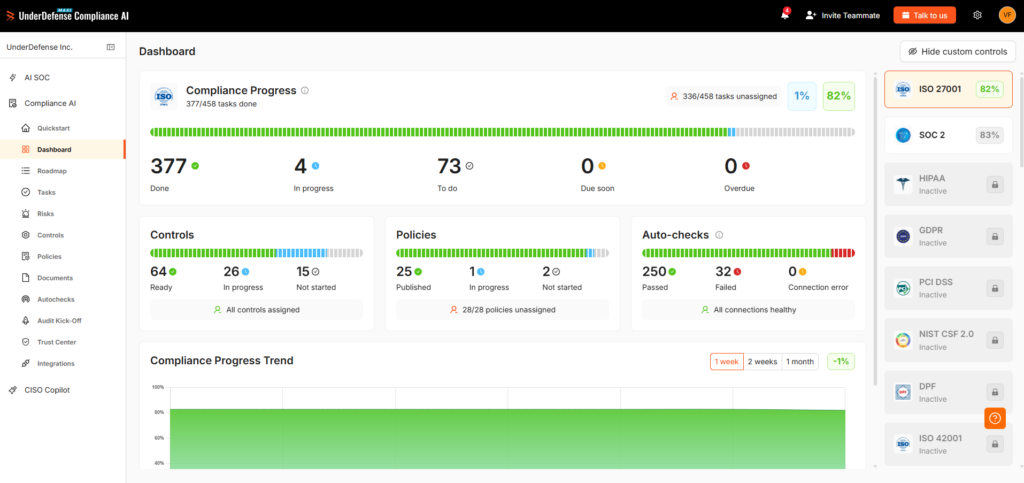
Compliance automation platforms run roughly $8,000 to $30,000 a year under 200 employees, $20,000 to $85,000 at 200 to 1,000 employees, and $60,000 to $200,000 above that. All-in first-year spend, once an independent SOC 2 Type 2 audit, penetration testing, and onboarding are added, lands between $28,000 and $355,000. The platform accounts for 40 to 60 percent of the bill.
See how UnderDefense MAXI Compliance AI proves your controls

The three bands, by company size
| Segment | Platform subscription | Realistic all-in year one |
|---|---|---|
| Under 200 employees | $8,000 to $30,000 | $28,000 to $80,000 |
| 200 to 1,000 employees | $20,000 to $85,000 | $53,000 to $165,000 |
| Over 1,000 employees | $60,000 to $200,000 | $125,000 to $355,000 |
These bands come from Vendr transaction data current to August 2026, drawn from 106 Vanta deals and 94 Drata deals. UnderDefense uses the same benchmark set when we sanity-check a client’s quote before they sign.
Why the platform is only half the number
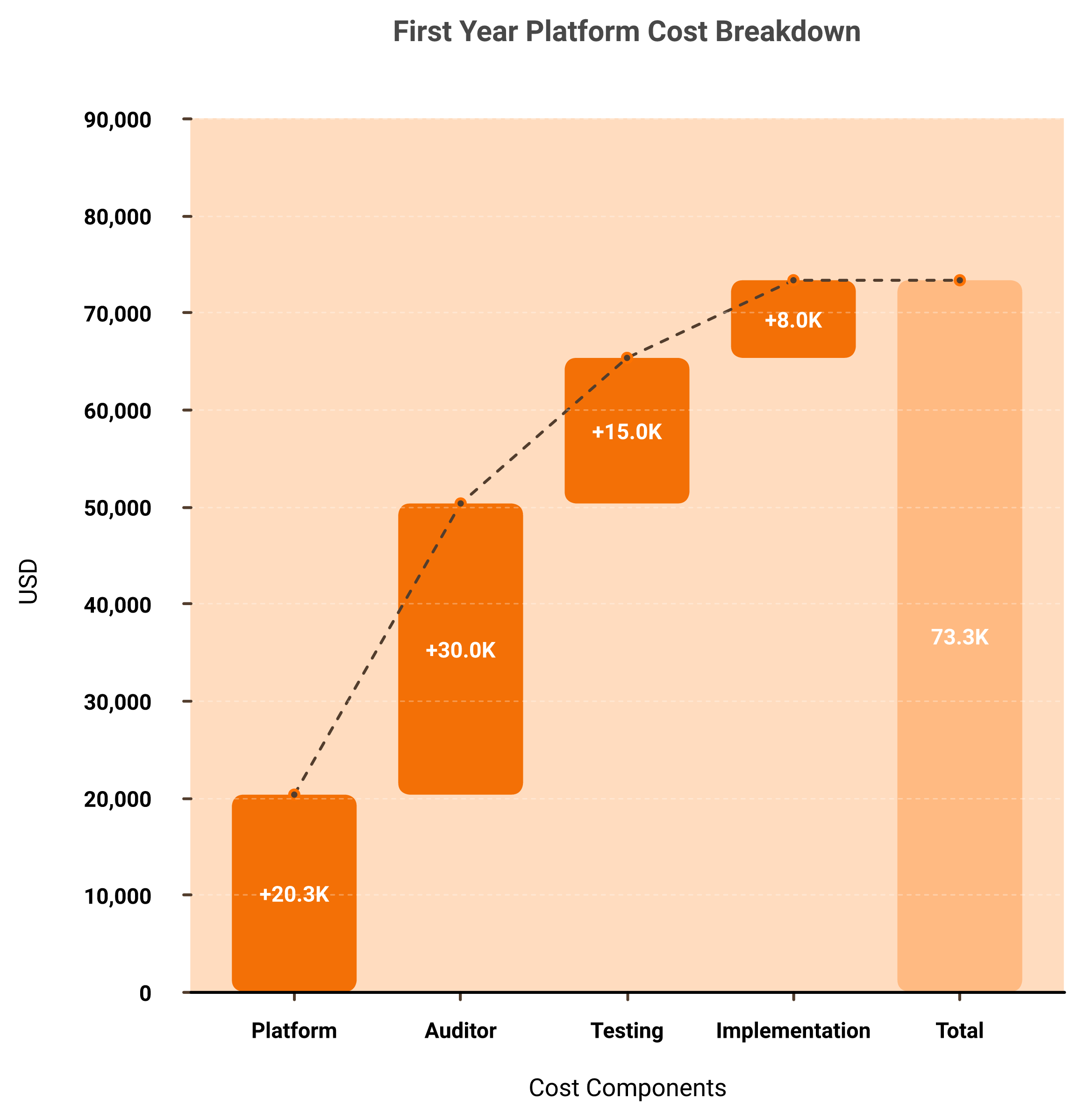
The subscription buys evidence collection and control monitoring. It does not buy the audit, the penetration test, or the engineering hours to wire it all up. Those three items carry 40 to 60 percent of your first-year spend.
I have watched teams approve the platform line and then discover the auditor invoice in month four. That gap causes more budget escalations than any single vendor decision I see.
The 5 percent reality check
Nick Inman at Kroll Consulting reports that about a third of his clients forecast spending more than 5 percent of revenue to satisfy compliance requirements. For a $40M company, that is $2M a year across tooling, people, audits, and remediation.
My read is that most of that spend is a ticket to proceed. You buy it because an enterprise customer, an insurer, or a regulator gated a deal on it.
What the number does not buy you
A platform subscription does not reduce the chance of a breach next Tuesday. It documents that a control existed on the day someone looked.
UnderDefense measures the other half of that equation separately, with 2-minute alert-to-triage and 15-minute escalation for critical incidents as the operational SOC service SLAs. Those two numbers answer a different question than a readiness percentage does.
Budget the whole thing, then negotiate the parts
Here is what I would put in the CFO deck on Monday:
- Platform subscription, annual, with the renewal escalator named
- Independent auditor fee, quoted separately
- Penetration test, if your framework or customer contract requires one
- Implementation and internal hours, honestly estimated
I could be reading the mid-market band too tightly. Sample sizes below 20 deals, which is the case for several vendors, deserve more caution than most pricing pages give them.
UnderDefense publishes a $10,000 entry point for MAXI Compliance AI access at https://underdefense.com/get-compliant/, and the built-in AI Cost Center reports per-investigation model cost in dollars. Finance sees the spend curve before signature rather than after the first renewal notice.
Q2. What Are You Actually Paying For Before You Sign?
Four separate line items make up a compliance program: platform subscription, third-party auditor fee, penetration testing, and implementation. Only Thoropass meaningfully bundles the auditor. Vanta resells a partial Seamless SOC add-on. Drata, Secureframe, Sprinto, and Anecdotes refer buyers out, so budget $20,000 to $40,000 for a mid-market SOC 2 Type 2 on top of the licence.
The four line items, priced
| Component | Under 200 employees | 200 to 1,000 employees | Share of year one |
|---|---|---|---|
| Platform subscription | $8,000 to $30,000 | $20,000 to $85,000 | 40 to 60% |
| Independent auditor | $15,000 to $30,000 | $20,000 to $40,000 | 30 to 45% |
| Penetration testing | $5,000 to $15,000 | $10,000 to $25,000 | 10 to 20% |
| Implementation | $0 to $5,000 | $3,000 to $15,000 | 5 to 15% |
Vendr’s transaction dataset separates these deliberately, because platform figures and audit figures come from different markets. UnderDefense keeps the same split in every scoping call, since blending them hides where the money actually goes.
The auditor is a different company
An automation platform cannot issue your SOC 2 report. A licensed CPA firm does that, and it charges you separately.
Thoropass is the exception worth naming, because its model was built around the auditor relationship from the Laika days. That changes the comparison, though no transaction-level bundle pricing is publicly available.
Penetration testing is where budgets break
Most platforms treat the penetration test as somebody else’s problem. Most auditors and enterprise customers treat it as mandatory.
That mismatch shows up as a surprise $10,000 to $25,000 invoice in month five. UnderDefense delivers penetration testing and continuous monitoring inside one commercial relationship, which removes that sourcing exercise entirely.
What buyers say about the gap
“The biggest problem they solved was our 24/7 coverage gap. We needed round-the-clock monitoring for compliance reasons, but building our own SOC wasn’t realistic with our budget and the current hiring market. They’ve also made our audit process much less painful. When auditors or clients ask questions about our security posture, we can pull up exactly what they need to see.”
– Verified User in Marketing and Advertising, Small-Business, 5/5, UnderDefense G2 – Verified Review
The four-line template for your CFO
Give finance four rows and one assumption note. Platform, auditor, penetration test, internal hours. Then state which framework count the quote assumes.
A dashboard that reads 98 percent complete produces a snapshot in time. I have seen those results end up as binders on a shelf while the environment drifted underneath them.
UnderDefense builds compliance evidence from live security telemetry, so what the auditor reviews reflects what the environment actually did during the period under review.
Q3. Why Does the Same Platform Cost $6,900 for One Company and $109,600 for Another?
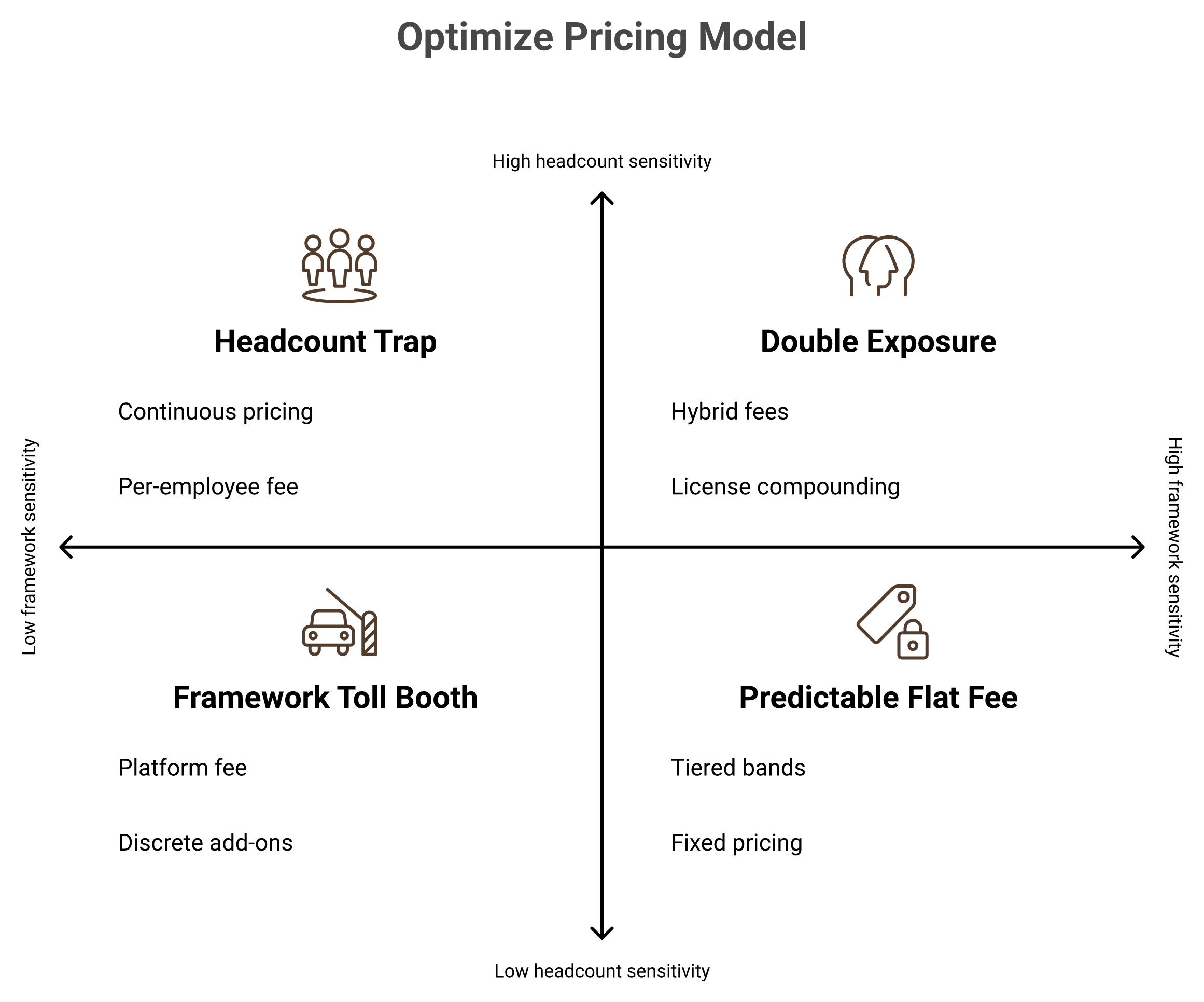
Three pricing models drive the spread. Per-employee pricing (Vanta, Secureframe Fundamentals) scales continuously: Vanta Essentials medians $17,700 at 100 employees, and Professional medians $65,600 at 500. Flat platform fee plus framework add-ons (Drata) medians $20,300 to $26,700 regardless of headcount. Employee-band tiers (Sprinto) step up at thresholds.
The taxonomy that decides your bill
| Model | Vendors | Scaling behaviour |
|---|---|---|
| Per-employee, continuous | Vanta all tiers, Secureframe Fundamentals | Every hire adds cost; Vanta roughly triples from 100 to 500 employees |
| Flat platform fee plus framework add-ons | Drata Foundation, Advanced, Enterprise | Framework count drives cost, headcount does not |
| Tiered flat fee, employee bands | Sprinto Starter (25), Advanced (400) | Price jumps at band boundaries |
| Hybrid: fee plus user licences plus data sources | Anecdotes | Three independent cost levers to model |
Vanta charges $5,000 list for each additional framework, discounted when several are bundled. UnderDefense sees the same three-model pattern in the quotes clients bring to scoping calls, and the model choice usually matters more than the sticker.
The growth curve nobody re-forecasts
A company that hires 200 engineers on a per-employee contract watches its compliance line item triple. Nobody re-forecast it, because the original quote looked reasonable at signing.
Flat-fee models become relatively cheaper as headcount grows. Per-employee models become cheaper when you stay small and add frameworks.
The band cliff
Band pricing looks friendly until you cross a threshold. Under Sprinto’s 400-employee Advanced band, employee 401 can be the most expensive hire of the year.
Nobody publishes where the next band starts. Ask for the threshold in writing before you sign, because it is a forecast input.
Framework count is the second multiplier
Every framework you add is a discrete line item at most vendors. Two frameworks at $5,000 each turn a $20,000 quote into $30,000 quietly.
There is a workflow cost too. In legacy tooling, five APIs can require five separate assessments, with manual renaming and duplication that slows engineering down.
How to pick your model in one meeting
Run this against a 24-month headcount projection:
- Project headcount at months 12 and 24
- List the frameworks you will actually need, with the customer or regulator who requires each
- Price the top two vendors under both projections
- Ask each vendor to name the band thresholds and the per-framework fee in writing
- Choose the model whose curve matches your growth, then negotiate the number
My honest hedge: this math assumes your headcount forecast is roughly right. In practice, it is wrong more often than CFOs admit, which argues for the model with the flatter curve.
UnderDefense prices against environment scope rather than employee count, so doubling engineering headcount does not automatically double the security and compliance line item.
Q4. Vanta vs Drata vs Secureframe vs Sprinto: What Do Real Contracts Show?
On Vendr transaction data through August 2026: Drata Advanced medians $20,300 (range $16,600 to $39,700, N=94), Sprinto Advanced $19,600 (N=6), Anecdotes $33,000 (N=17), and Vanta Professional $65,600 at a 500-employee baseline (range $6,900 to $109,600, N=106). Hyperproof, Thoropass, and Scrut Automation return no transaction data at all.
The benchmark table, with sample sizes attached
| Vendor and edition | Median ACV | Observed range | Deals in dataset | Dominant price driver |
|---|---|---|---|---|
| Vanta Professional (500 EE) | $65,600 | $6,900 to $109,600 | 106 | Employee headcount |
| Drata Advanced | $20,300 | $16,600 to $39,700 | 94 | Flat fee plus frameworks |
| Drata Foundation | $26,700 | $20,500 to $39,700 | 94 | Flat fee plus frameworks |
| Anecdotes Compliance OS | $33,000 | $24,200 to $62,700 | 17 | Users plus data sources |
| Sprinto Advanced (400 EE band) | $19,600 | $13,000 to $22,300 | 6 | Employee band |
| Secureframe Fundamentals | $120,200 (model, low confidence) | $66,600 to $174,400 | 7 | Employee headcount |
Read the last two rows carefully. Six and seven deals do not support a confident median, and Secureframe’s actual similar purchases span $8,000 to $34,000, which suggests the 500-employee model over-indexes.
Why nobody publishes a rate card
This category is sales-led and annual-contract-first. Quotes arrive after a demo, tuned to what the seller believes you will pay.
Third-party transaction datasets are the closest thing buyers have to a published benchmark. UnderDefense treats that data as the negotiation floor when we review a client’s quote alongside them.
What buyers report at renewal
“It’s reassuring to know they’re always watching for threats, and it doesn’t cost a fortune. The platform works really well with our other security tools, which makes things much simpler.”
– Serhii B., Chief Information Security Officer, Mid-Market, 5/5, UnderDefense G2 – Verified Review
Who wins on price, by segment
- Under 200 employees: Vanta Essentials or Sprinto Advanced, at 10th-percentile figures of $6,900 and $13,000
- 200 to 1,000 employees: Drata Advanced at $20,300, since the flat fee ignores headcount growth
- Over 1,000 employees: flat-fee and workspace models, because per-employee curves compound
The readiness gap
A readiness dashboard reports control completion. An auditor reports evidence quality. Those two numbers disagree more often than the category admits.
UnderDefense supplies the security telemetry and response evidence auditors ask for when a dashboard reads 98 percent and the fieldwork says otherwise. If the number in front of you looks padded, talk it through with our team before you countersign.
Pricing
WHERE OUR NUMBERS LIVE
UnderDefense publishes its compliance pricing instead of quoting it on a discovery call.
If you are benchmarking quotes this quarter, the full breakdown is on one page you can read without talking to anyone.
UnderDefense sits beside these platforms rather than against them. The compliance tool records the control, and the monitoring layer proves it operated.
Q5. Which Costs Show Up After You Sign?
Expect additional frameworks at roughly $5,000 list each on Vanta, separately priced user access reviews, trust-center and vendor-risk add-ons, premium support, SSO as a line item, and Drata’s standard 8 percent annual renewal uplift, negotiable to 3 percent and to zero with three months of runway plus an expansion commitment.
The add-ons that move a quote 30 to 50 percent
The signed number is a starting point at most vendors in this category. The add-on catalogue is where the rest of the money lives.
| Cost driver | Where it appears | What is known |
|---|---|---|
| Extra framework | Vanta, Drata, Secureframe | Vanta lists $5,000 each, discounted when bundled |
| User access reviews | Vanta Essentials, Drata Foundation and Advanced | Separately priced add-on |
| Trust center | Vanta Trust Center Pro, Drata per domain | Separately priced |
| Vendor risk management | Vanta Professional | Priced by vendor count |
| Premium support, SSO, data delegation | Anecdotes | Three separate line items |
| Annual escalator | Drata | 8 percent standard, 3 percent negotiable |
UnderDefense reviews this catalogue line by line with clients before signature, because the add-on stack usually explains a quote gap better than the base fee does.
The clause that costs the most
Auto-renewal is the quiet one. Both Vanta and Drata carry auto-renewal terms, and removing them at signing preserves your optionality later.
I have seen a 60-day notice window catch a team that assumed 30 days. That single detail cost them a full extra year of a contract they had already decided to leave.
The 2026 add-on nobody budgeted
AI governance modules are appearing as paid line items this year. ISO 42001 now shows up as a catalogue dimension alongside SOC 2 and ISO 27001.
Ask whether AI usage controls sit in your base tier or arrive as an upsell in month nine. UnderDefense treats AI-agent activity as part of the monitoring scope rather than a separate compliance SKU.
Nine questions to ask before you sign
- What is the annual escalator, and is it capped in writing?
- What is the auto-renewal notice window, in days?
- Which frameworks are included, and what does each additional one cost?
- Are user access reviews included or priced separately?
- Is the trust center in the base tier?
- What does implementation cost, and who does the work?
- Is SSO a paid add-on?
- Can control evidence be exported in OSCAL format if you leave?
- What happens to pricing if headcount grows 40 percent?
Question eight matters more than it sounds. OSCAL is a machine-readable format for security plans and assessment results, and research on agent-generated OSCAL artifacts shows portable evidence is now technically achievable.
The long-tail cost of staying
Recurring fees continue long after certification. A two-year lock-in signed at seed stage tends to look expensive by Series A.
UnderDefense avoids the per-framework toll booth. Monitoring scope defines the fee, so adding ISO 27001 alongside SOC 2 does not open a new line item on your compliance pricing.
Q6. What Does Compliance Cost You Internally, Beyond the Licence?
The licence buys tooling, and your team still authors control mappings, reviews evidence, and chases exceptions. Compliance-as-code research analysing roughly 1,500 rules across 14 releases shows rule authoring dominates the effort. UnderDefense ships over 700 MITRE ATT&CK-mapped investigation workbooks, so evidence arrives pre-structured rather than assembled by hand.
The half-FTE nobody put in the budget
A $20,000 platform that consumes half a person costs far more than $20,000. At a loaded salary of $140,000, that is another $70,000 a year.
Nobody writes that line into the business case. It shows up as a compliance lead who stopped doing anything else from October to January.
What the research actually measured
A March 2026 study of compliance-as-code across Linux distributions examined how automated rules are written and maintained. Compliance-as-code means expressing a control as a machine-checkable rule.
The finding worth carrying into a vendor call is simple. Authoring and maintaining those rules is the labour, and the tool that runs them is the easy part.
Detection speed is the metric to instrument
Research on continuous compliance in multi-cloud environments found that policy-as-code with automated remediation cut the time to detect a control violation from days to minutes. Multi-cloud here means workloads split across AWS, Azure, and Google Cloud.
That delta is your ROI number. UnderDefense measures the same thing operationally, with 2-minute alert-to-triage and 15-minute escalation for critical incidents as the published detection and response service levels.
Score vendors on mapping depth, not integration count
Integration count is the number every sales deck leads with. It tells you how many systems connect, and nothing about how well controls map.
Here is the comparison I would run instead:
| Evaluation criterion | Why it predicts your workload |
|---|---|
| Control-mapping coverage per framework | Determines how many mappings your team writes |
| Custom control support | Decides whether your unusual controls fit |
| Evidence auto-attachment to tickets | Removes manual filing work |
| Exception workflow | Governs how long approvals take |
| Export format (OSCAL) | Caps the cost of switching later |
Patent US12340215B2 covers automated compliance artifact generation that attaches validated evidence directly to software change records. Ask whether your shortlist does that natively, or whether an engineer builds it.
The part automation still misses
Legacy data edges remain manual. Teams still hire people who find a strange calm in copying records between systems, because no connector reaches that far.
UnderDefense’s read is that the standard advice gets this backwards. The category sells integration breadth, though what actually consumes your week is mapping depth and evidence review.
I could be over-weighting the labour side here. Our sample skews toward mid-market teams of 500 to 5,000 people, where one compliance hire carries the whole program.
What to do this week
Count the hours your team logged against compliance last quarter. Multiply by loaded cost. Add it to the platform fee before you compare two quotes.
UnderDefense encodes analyst investigation logic into reusable workbooks, so the evidence a client hands an auditor is generated by the same pipeline that runs their managed SIEM detections.
Q7. Does a Compliance Dashboard Reduce the Chance of a Breach?
No. Certification proves a control existed on the day the auditor looked. IBM’s 2026 Cost of a Data Breach Report puts the global average at $4.99M, AI-enabled breaches at $6M, and shows organisations with extensive security AI and automation saving $1.93M per breach while cutting containment by 65 days.
The green dashboard problem
Most buyers read a readiness score as a safety score. It reports control completion against a framework checklist.
A CISO I spoke with described the loop precisely. AI generates the security questionnaire, AI answers it, a trust center validates the answer, and the GRC platform maps a control to it.
His question was the right one. Does any of that prevent an incident tomorrow? No.
Compliant organisations still get breached
Framework compliance and material impact coexist regularly. Practitioner analyses list more than a dozen organisations that held certification and still took a material event.
That is not an argument against certification. It is an argument for funding detection as a separate line with its own metric.
What the 2026 breach data shows
IBM’s report, published 29 July 2026, is the largest first-party dataset in this space. Three numbers matter for a budget conversation.
- Global average breach cost reached $4.99M, up 12 percent, with the US average at $11.5M
- One in four malicious breaches were AI-enabled, averaging $6M each
- Shadow AI featured in 43 percent of breached organisations, and roughly one in five of those faced regulatory fines
Shadow AI means employees using AI tools outside sanctioned channels. UnderDefense sees the same pattern in client environments, where agentic coding tools reach production systems with no audit trail behind them.
The number that changes the argument
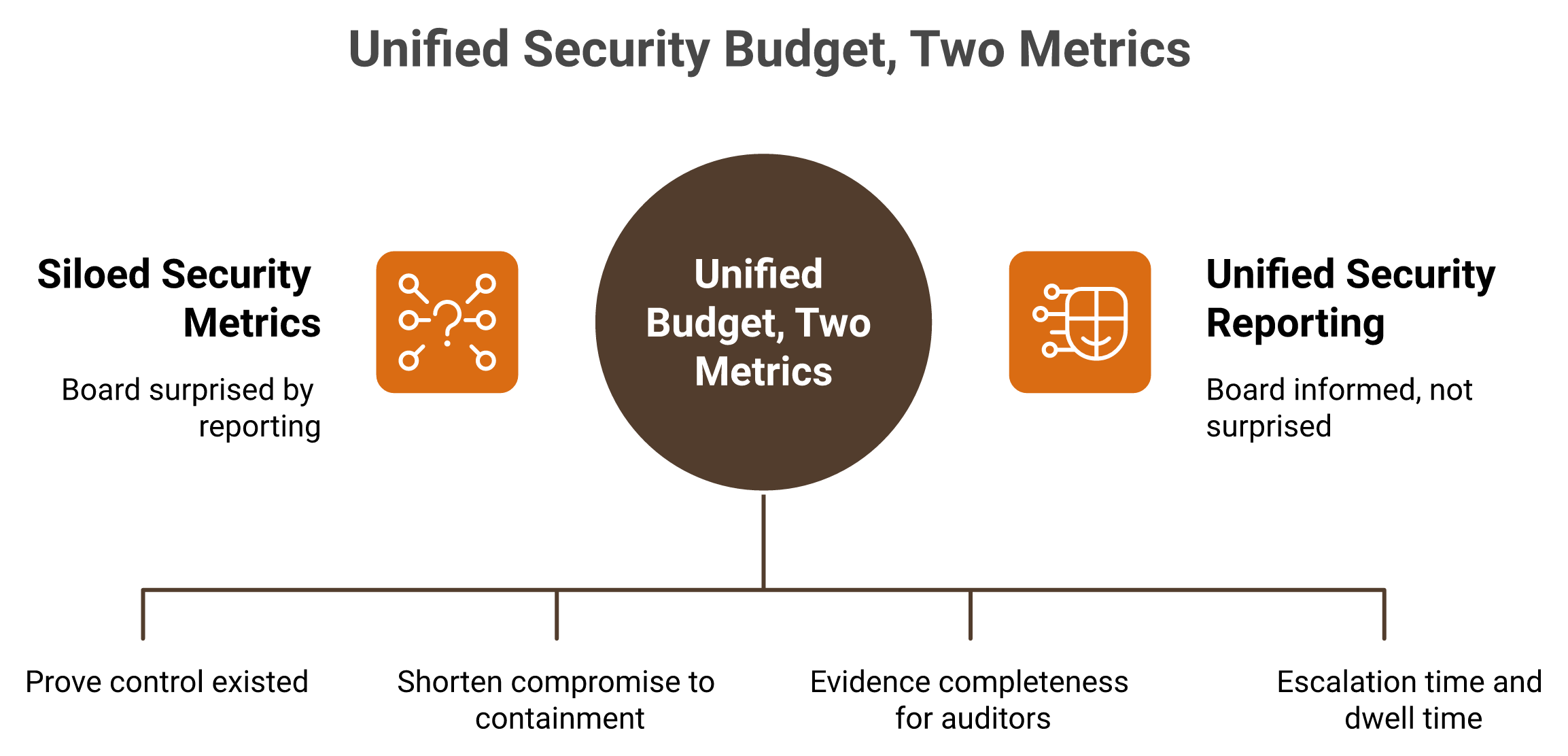
That same report shows extensive security AI and automation cut breach cost by $1.93M and containment time by 65 days. Only about a third of organisations have adopted it at that depth.
So the honest framing is two budget lines. One documents controls for the auditor, and one shortens the time between compromise and containment through faster incident response.
Two lines, two metrics
| Budget line | What it buys | Metric to report |
|---|---|---|
| Compliance automation | Control evidence, policy lifecycle, questionnaires | Audit findings, evidence completeness |
| Detection and response | Investigation, containment, threat hunting | Alert-to-triage, escalation time, dwell time |
| UnderDefense scope | Telemetry mapped to controls plus investigation | 2-minute alert-to-triage, 15-minute critical escalation |
Reporting one metric for both is how a board ends up surprised.
Where evidence actually comes from
A policy document states intent. Log data states behaviour. Auditors increasingly ask for the second one.
UnderDefense maps live security telemetry to control requirements through the UnderDefense Agentic AI SOC platform, producing verifiable evidence drawn from what the environment actually did during the period under review.
Compliance
WHERE THIS IS HANDLED
UnderDefense turns live monitoring data into the evidence auditors accept.
If your readiness score and your auditor disagree, this is the work we do every day and the door is open.
Q8. How Do You Calculate Compliance ROI, and When Is the Spend Negative?
Model it as expected value: probability of enforcement multiplied by penalty, against total program cost. A podiatry practice could spend $750,000 to avoid a $100,000 penalty. New Zealand caps a PII breach fine at NZD 10,000. Where the math fails, document the risk acceptance in writing and stop relitigating it quarterly.
The calculation nobody runs
Security teams model risk constantly. Compliance spend usually skips the same exercise, because the answer feels predetermined.
Run it anyway. Expected cost of non-compliance equals enforcement probability times penalty size, plus lost contract revenue.
Two worked examples
Example one, the negative case. A small clinic faces a $100,000 maximum penalty with low enforcement probability. Building the full program costs $750,000. The math says document the decision and move on.
Example two, the positive case. A mid-market SaaS company has $4M in pipeline gated on a SOC 2 report. A $60,000 all-in program clears it. That is a revenue decision with a compliance invoice attached.
Jurisdiction changes the answer
Penalty ceilings vary enormously. New Zealand’s worst-case PII breach fine sits at NZD 10,000, while GDPR and NIS2 exposure runs into percentages of turnover.
UnderDefense sees the buying trigger shift accordingly. In EU engagements, the driver is usually a regulator or a data residency clause rather than a customer questionnaire.
The offsetting term most models omit
IBM’s 2026 data shows extensive security AI and automation reduced breach cost by $1.93M and cut containment by 65 days. That belongs on the benefit side of your model.
UnderDefense reports 99 percent noise reduction and 830 percent ROI over three years, with 2-minute alert-to-triage and 15-minute escalation for critical incidents. Those are the numbers I would put in a board packet, because each one is measurable in a live environment.
Compliance spend is revenue-gated
The cleanest justification I have seen ties a control directly to a signed contract clause. A customer requires 24/7 monitoring, so the monitoring gets funded.
That connection makes the CFO conversation short. Absent it, you are arguing about probability with someone who prices certainty.
The risk acceptance memo
When the math says no, write it down. A one-page memo beats an argument every quarter.
Include five things:
- The control or framework you are declining, with the requirement text
- The estimated cost to comply, itemised
- The exposure if you do not, with the penalty ceiling named
- The compensating controls already in place
- The business owner’s signature and a review date
If the business accepts the risk, that decision belongs in the record with a name on it. UnderDefense’s virtual CISO engagements produce exactly this artifact, because auditors and boards both ask who signed.
My honest hedge here: expected-value math understates reputational cost, which resists clean numbers. I would run the model, then adjust upward for anything customer-facing.
UnderDefense builds the ROI case from measured operational data rather than projected savings, which is what makes it survive a CFO’s second question. If you want that model checked against your own numbers, start a conversation with our team.
Q9. What Does Compliance Automation Cost in Europe Under NIS2 and DORA?
European buyers should budget in euro bands rather than US SOC 2 bands. Mid-market GRC platforms run EUR 45,000 to 250,000 a year, and DORA-regulated financial entities sit at EUR 120,000 to 250,000. UnderDefense deploys its full agentic AI SOC inside customer infrastructure, which keeps security telemetry within the buyer’s jurisdiction.
Why US pricing pages misprice EU programs
Almost every ranking pricing page is written for a US company buying SOC 2. That buyer has one framework, one auditor market, and no data residency question.
An EU mid-market buyer has three or four regulatory drivers at once. NIS2 is the EU network and information security directive, and DORA is the Digital Operational Resilience Act for financial entities.
The euro bands
| Segment | Annual GRC platform spend | Main driver |
|---|---|---|
| EU SMB, single framework | EUR 15,000 to 45,000 | ISO 27001 certification |
| EU mid-market | EUR 45,000 to 250,000 | NIS2 scope plus TPRM |
| DORA-regulated financial entity | EUR 120,000 to 250,000 | Resilience testing, ICT third-party register |
Third-party risk management, usually shortened to TPRM, is priced as a separate module by most vendors in this market. UnderDefense includes third-party risk and cloud posture assessments in its services catalogue rather than as a metered GRC module.
DORA adds a testing line
DORA requires financial entities to run operational resilience testing, and threat-led penetration testing for significant institutions. That is a separate procurement from any compliance platform.
Budget it as its own line. UnderDefense runs DORA-aligned penetration testing as a scoped engagement, so the requirement stops living in the platform’s roadmap column.
Residency decides the shortlist before price does
Here is the part most buyers discover late. Security logs contain personal data, so processing them in US cloud infrastructure raises a GDPR question first.
Since Schrems II, that legal basis has become harder to defend. Legal reviews the architecture before finance reviews the quote.
What that removes from your list
Nearly every AI security platform sends telemetry to the vendor’s cloud. For a regulated EU entity, that is a disqualifier rather than a trade-off.
UnderDefense delivers the full agentic capability stack on any Kubernetes infrastructure, in any data center, with bring-your-own AI model support including self-hosted open-source models, as described on the UnderDefense Agentic AI SOC platform page.
A production example
A European telecom operator runs autonomous AI security investigations on its own hardware, inside its own data center. No security telemetry leaves the infrastructure.
Independent analysis of that deployment model shows up to 44 percent lower total cost of ownership than building an equivalent AI investigation pipeline in-house. My read is that the residency requirement, rather than the cost saving, is what closes these deals.
What I would do first in an EU program
- List every regulation in scope, with the supervisory authority named
- Confirm where security telemetry may legally be processed
- Price the platform in euro, using local benchmarks
- Budget resilience testing separately if DORA applies
- Ask each vendor for a written data processing map before the demo
I could be over-indexing on residency for smaller EU firms. For a 200-person SaaS company outside financial services, price still leads the decision.
UnderDefense runs its agentic AI SOC on-premise and air-gapped, keeping telemetry inside the customer’s jurisdiction. That resolves the GDPR and DORA residency question that removes most cloud-only vendors from EU shortlists before pricing is even discussed.
Q10. Are Self-Serve and Low-Cost Compliance Tools Enough?
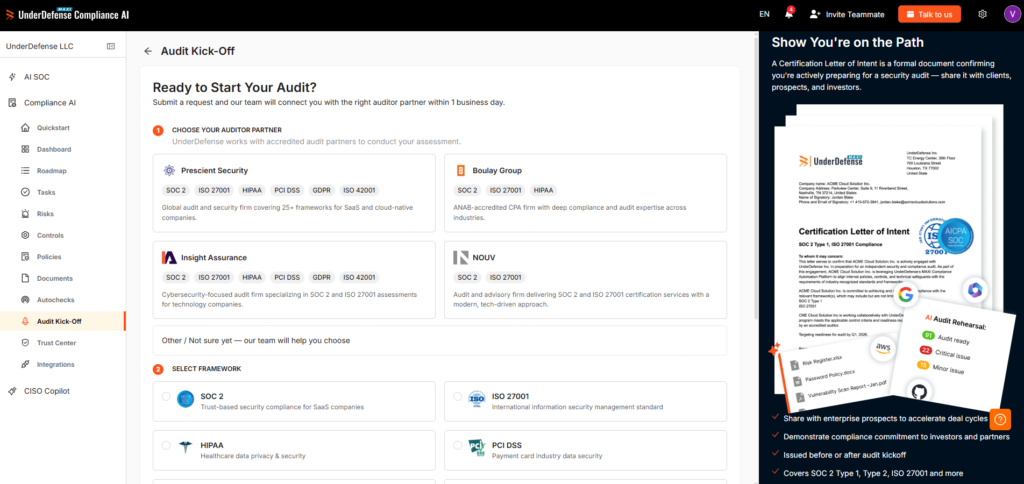
Published self-serve tiers start near $79 per month and reach roughly $499 per month for scale plans. That covers single-framework SOC 2 readiness for a team under 50 with a simple cloud estate. UnderDefense publishes a $10,000 entry point for MAXI Compliance AI access at https://underdefense.com/get-compliant/, which sits between self-serve tooling and enterprise GRC.
The $60,000 quote for a 30-person company
A quote that assumes 500 employees lands badly on a team of 30. Self-serve pricing exists precisely for that gap, with published rates and no discovery call.
Vendr transaction data supports the lower end too. Vanta Essentials shows a 10th-percentile figure of $6,900 at low headcount.
Where cheap genuinely works
| Situation | Self-serve fit |
|---|---|
| Under 50 employees, one framework | Strong |
| Single cloud provider, few integrations | Strong |
| First SOC 2, no prior audit history | Workable |
| Multi-entity group structure | Poor |
| Custom or industry-specific controls | Poor |
| Evidence from security telemetry required | Poor |
UnderDefense sees the third row break most often, because a first audit surfaces gaps that no dashboard predicted.
Four signs you have outgrown it
- You need workspaces for more than one legal entity
- Vendor risk management became a customer requirement
- Your controls need custom mapping beyond the template library
- An auditor asked for monitoring evidence rather than a policy document
That last one is the real ceiling. UnderDefense supplies detection and investigation evidence that self-serve platforms are not built to produce.
Audit your entitlements before you buy
Before adding a subscription, check what you already pay for. Microsoft E5 licences often include controls teams purchase separately.
The same applies to identity data. As a Google Workspace admin, you can see every site where employees authenticated via OAuth, which is a free and surprisingly rich vendor inventory.
What buyers with lean teams say
“Underdefense is a great choice for teams like ours that are short on resources. It automates many tasks, plus, with 24/7 monitoring, we know we’re always protected. The platform seamlessly integrates our existing security tools, simplifying management.”
– Inga M., CEO, Mid-Market, 5/5, UnderDefense G2 – Verified Review
Price and value separate quickly at both ends of this market.
The honest trade-off
Cheap tooling trades depth for speed and transparency. That is a reasonable trade at seed stage with one framework and a simple estate.
It becomes expensive when an auditor rejects the evidence and you buy twice in one year. UnderDefense’s read is that most teams overpay by starting too high, then overpay again by starting too low, and the fix is matching the tier to your actual audit scope.
Q11. How Do You Negotiate 25 to 40 Percent Off a Compliance Platform Quote?
Ranked by observed impact: fiscal year-end timing (January for both Vanta and Drata) saves up to 40 percent on new purchases. A concrete competing Drata quote closes a cited 35 to 45 percent gap on Vanta. A two-year commit earns 25 to 35 percent at Drata and 10 to 15 percent at Vanta. Early renewal three months out saves 5 to 8 percent.
The levers, ranked by observed savings
| Rank | Lever | Observed saving | Applies to |
|---|---|---|---|
| 1 | Fiscal year-end timing, January | Up to 40% new, up to 35% Drata | Vanta, Drata |
| 2 | Competing quote presented | 35 to 45% gap cited | Vanta |
| 3 | Two-year commitment | 25 to 35% Drata, 10 to 15% Vanta | Vanta, Drata |
| 4 | Competitive SKU bundling | Up to 55 to 60% | Hyperproof |
| 5 | Early renewal, 3-month runway | 5 to 8% | Drata |
| 6 | Renewal uplift negotiation | 8% down to 3% | Drata |
These figures come from Vendr negotiation data covering 106 Vanta deals and 94 Drata deals. UnderDefense uses the same table when clients ask whether a discount offer is genuinely competitive against published compliance pricing.
Timing beats persuasion
Sellers close harder near fiscal year-end. For both Vanta and Drata, that window sits around January.
Signal that you can sign fast. A credible close date is worth more than another round of feature debate.
The single highest-leverage move
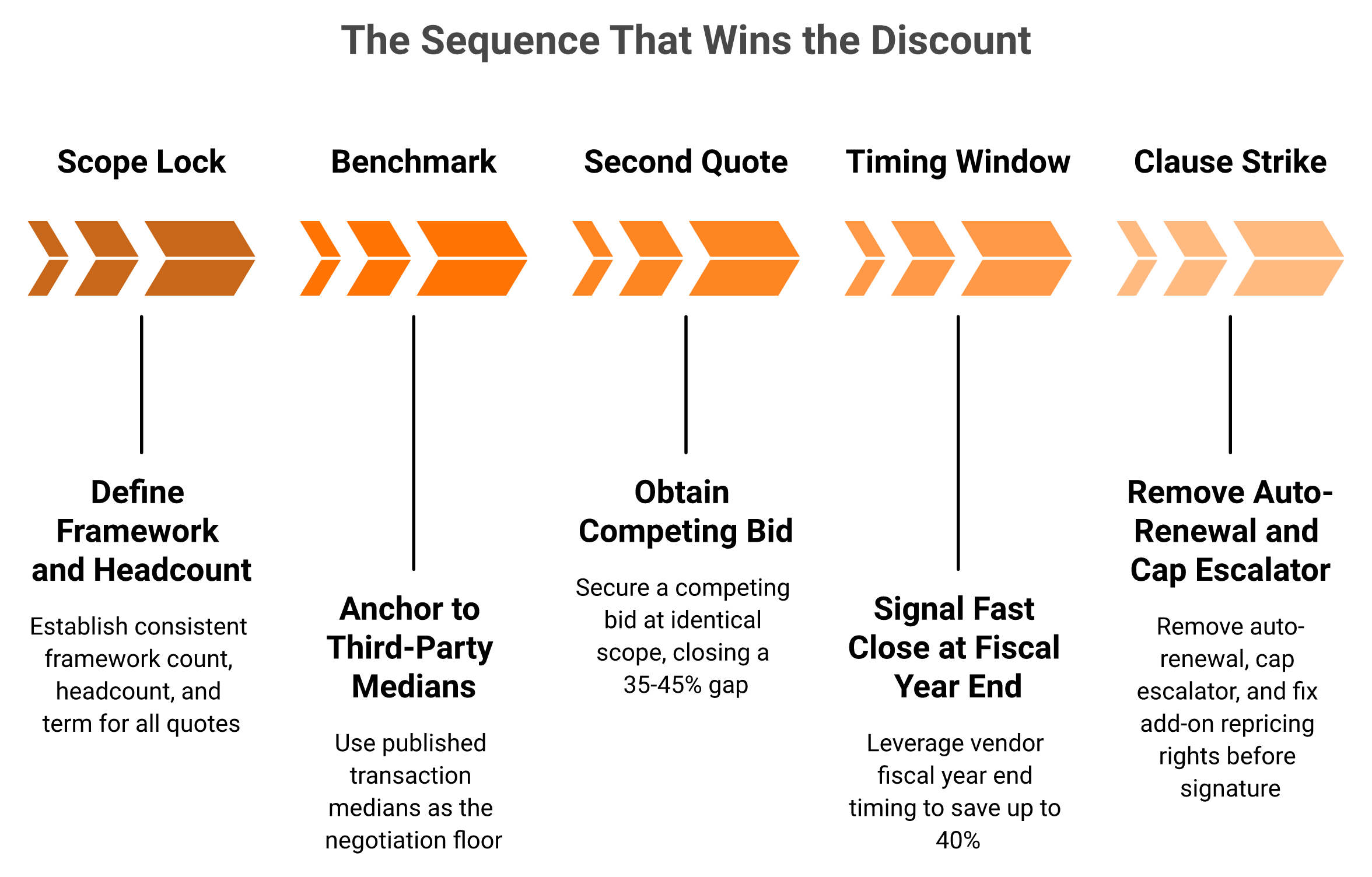
Bring a real competing quote with a real number on it. Presenting a Drata quote in a Vanta negotiation is the strongest documented tactic in this category.
Ask for both quotes at the same scope. Same framework count, same headcount, same term.
Three clauses to strike at signature
- Auto-renewal, or at minimum a 30-day notice window in writing
- The annual escalator, capped in the contract rather than left at standard
- Add-on repricing rights, so a module cannot jump at renewal
“Their team provided us with clear and detailed insights into security vulnerabilities, along with practical recommendations on how to fix them. This level of transparency made it easy for our team to take action.”
– Arman N., CTO, Mid-Market, 5/5, UnderDefense G2 – Verified Review
Roadmap promises belong in the contract. If it matters at signature, write it into the order form.
Run the renewal 90 days early
Renewals price above new deals because of standard uplift clauses. Starting three months out gives you the runway to negotiate that uplift toward zero.
Pair the ask with an expansion commitment. UnderDefense quotes from a published starting point, which removes the discount theatre from the first conversation entirely.
Q12. Build, Buy or Bundle: How Should You Allocate the 2026 Compliance Budget?
Budget four lines: platform at 40 to 60 percent of year one, auditor at $20,000 to $40,000 for mid-market, penetration testing at $10,000 to $25,000, and detection and response. UnderDefense delivers agentic investigation on-premise at up to 44 percent lower total cost of ownership than building an equivalent AI investigation pipeline in-house.
Four delivery models, honestly compared
| Model | Best fit | Structural trade-off |
|---|---|---|
| Self-serve platform plus independent auditor | Under 50 employees, one framework | Thin evidence when auditors probe |
| Platform only, sales-led | 50 to 500, two or three frameworks | Audit, testing, and monitoring bought separately |
| Bundled auditor model | No internal compliance headcount | Fewer auditor choices, opaque bundle price |
| Platform plus managed detection | 200 to 1,000 with telemetry obligations | Requires integration work upfront |
| In-house GRC engineering | Over 1,000, or strict residency | Key-person dependency, slow to stand up |
UnderDefense appears in the fourth row, supplying the telemetry and investigation layer alongside whichever compliance platform a client already runs.
Where the money should sit
Platform takes 40 to 60 percent of year one at mid-market scale. Auditor takes 30 to 45 percent, and penetration testing takes 10 to 20 percent.
Detection and response is a separate budget with its own metric. UnderDefense reports 2-minute alert-to-triage and 15-minute escalation for critical incidents as its published service levels.
Why monitoring earns its line
Static checklists confirm a control existed. Live monitoring catches things nobody was looking for.
One client saved $300,000 in the first three months because a fraud surfaced during routine monitoring. That was an accidental discovery, and no readiness dashboard would have produced it.
“Not having to worry about ransomware, alert overload and reporting. Getting a clear view of my security posture, where the threats are coming from and how they are handled.”
– Arlin O., Enterprise, 5/5, UnderDefense G2 – Verified Review
Bundles can genuinely deliver value, even inside a critical review.
Five things to do this week
- Rebuild the budget as four lines, with the auditor quoted separately
- Count last quarter’s internal compliance hours and price them
- Ask each vendor for band thresholds and per-framework fees in writing
- Strike auto-renewal and cap the escalator before signing
- Re-forecast at your next headcount band boundary rather than annually
That last point matters most on per-employee contracts. They reprice quietly while nobody is watching. If you want a structured view of the year ahead, the 2026 cybersecurity budget playbook lays out the same four-line method across the wider security stack.
What I am watching next
My working hypothesis for the next 18 months is that auditors start asking for telemetry-backed evidence by default, and readiness percentages lose their standing. UnderDefense’s data points that way, though I might be reading the trend too strongly from a mid-market sample.
If you are holding a quote and unsure whether the number is fair, send it over through our compliance team. I would rather look at a real contract than argue about averages.
Start a guided compliance walkthrough →
1. How much does compliance automation software cost per year in 2026?
Compliance automation platforms fall into three clear bands by company size, based on transaction data current to August 2026.
- Under 200 employees: $8,000 to $30,000 a year for the platform subscription
- 200 to 1,000 employees: $20,000 to $85,000 a year
- Over 1,000 employees: $60,000 to $200,000 a year
Those figures cover the licence only. Once an independent SOC 2 Type 2 audit, penetration testing, and implementation are added, realistic all-in first-year spend runs $28,000 to $80,000 at SMB scale, $53,000 to $165,000 at mid-market, and $125,000 to $355,000 at enterprise scale.
The useful rule for a CFO deck is that the platform subscription accounts for 40 to 60 percent of the first-year bill. Everything else sits outside the vendor’s quote.
UnderDefense reviews client quotes against the same benchmark set before signature, and the gap between the approved number and the real number is usually the auditor line nobody booked. We publish our own starting figures on the compliance pricing page so finance can model the curve before a discovery call rather than after one.
2. Is the SOC 2 audit fee included in compliance platform pricing?
In almost every case, no. The platform fee buys automated evidence collection and continuous control monitoring. A licensed CPA firm issues the actual report, and it invoices you separately.
Budget these ranges for the independent audit alone:
- SMB, under 200 employees: $15,000 to $30,000
- Mid-market, 200 to 1,000 employees: $20,000 to $40,000
- Enterprise, over 1,000 employees: $35,000 to $75,000
Thoropass is the notable exception, since its model was built around an in-house auditor relationship from the Laika days. Vanta resells a partial Seamless SOC add-on on its Essentials and Plus tiers, which coordinates audit access rather than delivering a full managed audit. Drata, Secureframe, Sprinto, and Anecdotes refer buyers to independent auditors or partner networks.
Penetration testing is the second line buyers miss, running $5,000 to $25,000 depending on scope, and most auditors and enterprise customers treat it as mandatory. UnderDefense delivers penetration testing and continuous monitoring inside one commercial relationship, which removes a sourcing exercise that otherwise lands as a surprise invoice in month five.
3. Why does the same compliance platform cost $6,900 for one company and $109,600 for another?
Three pricing models create that spread, and the model matters more than the sticker price.
- Per-employee, continuous: Vanta across all tiers and Secureframe Fundamentals. Vanta Essentials medians $17,700 at 100 employees, and Professional medians $65,600 at 500. Every hire adds incremental cost.
- Flat platform fee plus framework add-ons: Drata Foundation, Advanced, and Enterprise. Median contract value sits at $20,300 to $26,700 regardless of headcount, so framework count drives increases.
- Tiered flat fee with employee bands: Sprinto Starter covers 25 employees and Advanced covers 400. Price steps up at band boundaries rather than scaling smoothly.
- Hybrid: Anecdotes charges a platform fee plus named user licences plus connected data sources, giving three independent cost levers.
The practical consequence is that a company hiring 200 engineers on a per-employee contract watches its compliance line item triple with no re-forecast. A flat-fee model becomes relatively cheaper as headcount grows, while per-employee pricing favours small teams adding frameworks.
UnderDefense prices against environment scope rather than employee count, so doubling engineering does not automatically double the security and compliance spend. Run your top two vendors against a 24-month headcount projection before you compare quotes.
4. What are the hidden costs in a compliance automation contract?
The signed number is a starting point. The add-on catalogue is where the remaining 30 to 50 percent lives.
- Additional frameworks: Vanta lists $5,000 each, discounted when several are bundled. Drata and Secureframe price extras as discrete line items.
- User access reviews: separately priced on Vanta Essentials and on Drata Foundation and Advanced.
- Trust center: Vanta Trust Center Pro and Drata Trust Center Standard are both add-ons, the latter priced per domain.
- Vendor risk management: priced by vendor count on Vanta Professional.
- Premium support, SSO, and data delegation: three separate line items at Anecdotes.
- Annual escalator: Drata’s standard renewal uplift is 8 percent, negotiable to 3 percent and to zero with three months of runway plus an expansion commitment.
Auto-renewal is the clause that costs the most. Both Vanta and Drata carry auto-renewal terms, and striking them at signature preserves your optionality later. A 60-day notice window mistaken for 30 days can cost a full extra contract year.
AI governance modules are the new 2026 line item, with ISO 42001 appearing alongside SOC 2 in vendor catalogues. UnderDefense treats AI-agent activity as part of compliance scope rather than as a separate SKU.
5. How do you negotiate a lower price on a compliance automation platform?
Negotiation levers in this category are well documented, and they rank by observed savings rather than by how hard you push.
- Fiscal year-end timing: January for both Vanta and Drata. Up to 40 percent on new purchases, and up to 35 percent at Drata.
- Present a competing quote: a concrete Drata quote closes a cited 35 to 45 percent gap in Vanta negotiations. This is the single highest-leverage tactic recorded.
- Multi-year commitment: 25 to 35 percent for a two-year term at Drata, 10 to 15 percent at Vanta.
- Competitive SKU bundling: up to 55 to 60 percent at Hyperproof, where a credible competitive threat exists.
- Early renewal: 5 to 8 percent for renewing three months ahead of term.
- Renewal uplift negotiation: 8 percent down to 3 percent, paired with an expansion commitment.
Ask both vendors to quote the same scope: same framework count, same headcount, same term. Then strike three clauses at signature, namely auto-renewal, an uncapped escalator, and add-on repricing rights.
UnderDefense quotes from a published starting point, which takes the discount theatre out of the first conversation. If you are holding a quote and unsure whether it is fair, bring it to our team for a second read.
6. Does buying compliance automation reduce the chance of a data breach?
Certification proves a control existed on the day the auditor looked at it. That is genuinely valuable for closing enterprise deals and satisfying regulators, and it is a different job from stopping an incident next Tuesday.
IBM’s 2026 Cost of a Data Breach Report frames the gap in numbers a board understands:
- Global average breach cost reached $4.99M, up 12 percent, with the US average at $11.5M
- One in four malicious breaches were AI-enabled, averaging $6M each
- Shadow AI featured in 43 percent of breached organisations, and roughly one in five of those faced regulatory fines
- Organisations with extensive security AI and automation saved $1.93M per breach and cut containment by 65 days
The honest framing is two budget lines with two metrics. Compliance automation reports audit findings and evidence completeness. Detection reports alert-to-triage, escalation time, and dwell time.
UnderDefense runs the second line with 2-minute alert-to-triage and 15-minute escalation for critical incidents, and maps that live telemetry back to control requirements. That produces evidence drawn from what the environment actually did, which is increasingly what auditors ask for during detection and response fieldwork.
7. What does compliance automation cost in Europe under NIS2 and DORA?
European buyers should budget in euro bands rather than US SOC 2 bands, because the regulatory drivers stack differently.
- EU SMB, single framework: EUR 15,000 to 45,000 a year, usually driven by ISO 27001 certification
- EU mid-market: EUR 45,000 to 250,000 a year, driven by NIS2 scope plus third-party risk management
- DORA-regulated financial entities: EUR 120,000 to 250,000 a year, driven by resilience testing and the ICT third-party register
DORA adds a testing line that no compliance platform covers. Financial entities must run operational resilience testing, and significant institutions must run threat-led penetration testing, which is a separate procurement.
Residency usually decides the shortlist before price enters the conversation. Security logs contain personal data, so processing them in US cloud infrastructure raises a GDPR question that legal reviews before finance reviews the quote. Since Schrems II, that legal basis has become harder to defend.
UnderDefense runs its agentic AI SOC fully on-premise and air-gapped, on any Kubernetes infrastructure with bring-your-own model support, so telemetry stays inside the customer’s jurisdiction. We also scope DORA-aligned penetration testing as its own engagement.
8. Are self-serve compliance tools at $79 per month enough for SOC 2?
Published self-serve tiers start near $79 per month and reach roughly $499 per month on scale plans. That is genuinely sufficient for a specific profile: a team under 50 people, one framework, a single cloud provider, and a first audit with no prior history. Transaction data supports the low end too, with Vanta Essentials showing a 10th-percentile figure of $6,900 at low headcount.
Four conditions mean you have outgrown the cheap tier:
- You need workspaces for more than one legal entity
- Vendor risk management became a customer contract requirement
- Your controls need custom mapping beyond the template library
- An auditor asked for monitoring evidence rather than a policy document
That last condition is the real ceiling. Self-serve platforms are not built to produce detection and investigation evidence.
Before adding any subscription, audit what you already pay for. Microsoft E5 licences frequently include controls teams buy twice, and a Google Workspace admin can pull every OAuth-authorised site as a free vendor inventory. UnderDefense publishes a $10,000 entry point on the UnderDefense Agentic AI SOC platform, which sits between self-serve tooling and enterprise GRC without a sales-led gate.