




Q1: How Much Does Sprinto Actually Cost in 2026?
Sprinto does not publish prices, and the pricing page sits behind a password, so every quote runs through sales. Based on Vendr data from six to seven verified purchases, the median annual contract lands around $15,000/year, with a range of $11,500 to $19,300. Realistic 2026 tier bands run from Starter at $6,000 to $8,000 up to Enterprise at $20,000 to $25,000+, driven mostly by headcount and framework count.
💰 The Number You Came For
Let me give you the figure before anything else. A CISO emailed me last quarter with one line: “I just want to know what Sprinto costs before I sit through a demo.” Fair ask. The honest answer is that you cannot find it on their site, because the pricing page is gated.
When I dig past the gate, the picture clears up. Independent procurement platform Vendr puts the median Sprinto contract near $15,000 a year. Most buyers land somewhere between $6,000 and $30,000, depending on how big you are and how many frameworks you carry.
Negotiating a renewal right now?
Try UnderDefense MAXI Compliance AI
📊 What the Verified Purchase Data Shows
Here is where the numbers get specific, and specificity is what protects your budget. Vendr’s verified purchase data for the Advanced tier shows a clear spread.
| Percentile | Advanced Tier Annual Price |
|---|---|
| P25 (low) | $16,029 |
| P50 (median) | $19,594 |
| P75 (high) | $22,286 |
Two real, verified Advanced purchases anchor this further. One closed at $14,000 (July 2025 start), and another at $16,000 (March 2025 start), both on 12 month terms. That tells me the deals below the median are real, and they are reachable if you scope and negotiate well.
⏰ Where Your Quote Will Likely Sit
So where do you fit? The bands move with headcount and framework count, which I will break down in detail shortly.
- Starter: ~$6,000 to $8,000 (single framework, small team)
- Professional: ~$8,000 to $11,000
- Advanced: ~$11,000 to $15,000
- Enterprise: ~$20,000 to $25,000+
Before we go deeper, here is the lens I want you to carry through this guide. The real question underneath “what does it cost” is sharper: are you buying a dashboard that displays a high completion percentage, or evidence depth that holds up when an auditor who is not fooled by a checklist starts asking questions? At UnderDefense, that distinction shapes every compliance and audit readiness conversation we have, and it should shape how you read every quote you get.
Q2: Why Doesn’t Sprinto Publish Its Pricing?
Sprinto uses a consultative, demo first sales motion with no public price list, no self serve checkout, and no free trial. Pricing is scoped per company, because the bill is driven by headcount, framework count, and integration complexity rather than seats. This lets Sprinto tailor each quote, but your first hands on look requires a sales call, and your starting number depends heavily on how you scope the deal.
🔍 The Logic Behind the Locked Page
Think of it like getting a quote to renovate a house. Nobody prints a single price, because the cost depends on the rooms, the wiring, and the age of the heating system. Sprinto works the same way. The platform scopes your “compliance environment” by company headcount, the number of active frameworks, and how complex your integrations are.
That is why there is no free trial and no public price. SmartSuite’s 2026 analysis confirms the demo first, sales led motion: you talk to a person before you touch the product. The upside is a tailored quote. The downside is that you walk in blind, and the vendor sets the anchor price first.
✅ How to Walk In With Leverage
Here is what I would do before that first call. Treat the demo as a procurement negotiation, not a product tour. Show up with your numbers already mapped, so the quote forms around your scope instead of theirs.
- Know your exact full time headcount. It sets your tier band.
- List the frameworks you truly need now, and the ones that can wait.
- Note your integration count and whether any are custom.
One hard won clause I push every buyer to lock down, whether the tool is a GRC platform or a SIEM: before you sign, confirm in writing that if you terminate, your evidence, control mappings, and integrations remain yours. I have watched teams discover their compliance history was effectively held hostage at renewal. Ask the ownership question early.
This is exactly where our own posture differs, and I will say it plainly as an open door. We run compliance at UnderDefense with transparent, published pricing, because a buyer under audit pressure deserves a number before a sales call, not after three meetings. If you want a compliance quote without a password gated page, our compliance pricing is where that conversation happens.
Q3: What Do Sprinto’s Four Pricing Tiers Include?
Sprinto sells four tiers: Starter (single framework, ~$6K to $8K), Professional (OpenAPI, custom controls, vendor management, ~$8K to $11K), Advanced (SAML/SSO, bring your own framework, security questionnaires, ~$11K to $15K), and Enterprise (Zones multi entity, private cloud, deep Jira, ServiceNow, and Snowflake integrations, ~$20K to $25K+). All tiers include unlimited users and bundled modules, so audit, risk, and vendor management come included rather than as separate line items.
🧱 The Four Tiers, Side by Side
The tiers are not shown on the website, but they surface during the sales process. Here is how they map.
| Tier | Target Segment | Key Feature Delta | Annual Band |
|---|---|---|---|
| Starter | Seed to Series A startups | Single framework, core integrations, policy templates, email support | ~$6K to $8K |
| Professional | Growth stage, mid market | OpenAPI access, custom controls, vendor management | ~$8K to $11K |
| Advanced | CISO led teams building mature GRC | SAML/SSO, bring your own framework, security questionnaires | ~$11K to $15K |
| Enterprise | Large, multi entity orgs | Zones, private cloud, deep Jira/ServiceNow/Snowflake | ~$20K to $25K+ |
⚠️ The Feature Gates That Force a Tier Jump
Watch the gates, because they decide your real cost. If your IT director requires SAML/SSO single sign on (one login across tools), you are pushed to Advanced. If you run multiple legal entities and need Zones (separate compliance environments per business unit), only Enterprise covers it.
There is a genuine strength here worth naming fairly. Unlike many legacy GRC platforms, Sprinto bundles audit, risk, and vendor management into the platform rather than charging per module. That bundling is buyer friendly, and I respect it.
To map yourself before the demo, count your headcount, list your frameworks, and check which gated feature you cannot live without. That trio tells you your tier faster than any sales call.
Now, one bridge as you weigh those bundled modules. A tier full of compliance modules answers the question “are we documented?” The question I spend my days on at UnderDefense is harder and more useful to a board: “are we actually secure?” A buyer who wants verifiable evidence over a tidy dashboard should hold both questions in view, because one CISO told me his green compliance score went dark the same week a real intrusion slipped past it. That is the gap our UnderDefense MAXI Compliance AI is built to close, and it pairs naturally with MDR service coverage.
Q4: What Drives Your Sprinto Quote, and How Does Adding Frameworks Change It?
Sprinto charges on full company headcount, with unlimited platform users. Three variables move your quote: total employee count (which sets your tier band), the number of active frameworks (each one beyond the base adds roughly $3,000 to $8,000/year), and integration complexity. A worked example: a 120 person SaaS paying ~$11K for SOC 2 in year one can reach ~$16K to $19K by year two after adding ISO 27001 and a renewal uplift.
🧮 Why Headcount, Not Seats
This part trips people up, so let me make it plain. Sprinto does not charge per user. You can add your whole team, including admins, auditors, and read only collaborators, and the bill will not change for those logins.
Instead, your full employee count scopes the compliance environment: how many assets, access reviews, and training completions Sprinto tracks. So headcount is the primary driver, even though the people logging in are free. The model rewards small teams and scales cost with company size.
📈 The Per-Employee Curve
Here is the pattern I see in the buyer data. Price per head is steep when you are tiny, then compresses fast as you grow.
| Employee Band | Approx. Per-Employee Cost |
|---|---|
| 1 to 25 | $240 to $280 |
| 101 to 250 | $44 to $60 |
💸 The Framework Math That Surprises Buyers
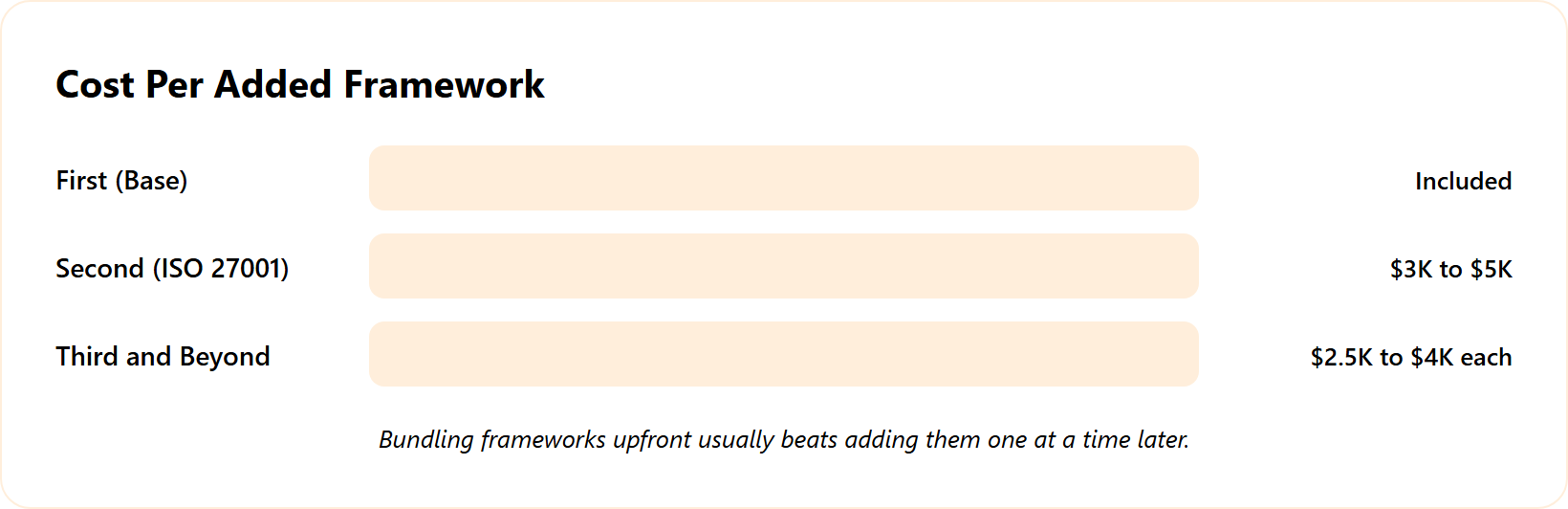
Now the part that quietly inflates year two budgets. Each framework beyond your base plan adds roughly $3,000 to $8,000 per year.
| Framework Count | Incremental Add-On Cost |
|---|---|
| 1st (base) | Included |
| 2nd (often ISO 27001) | $3,000 to $5,000 |
| 3rd+ (bundled) | $2,500 to $4,000 each, often discounted if negotiated together |
Picture a 120 person SaaS. Year one is SOC 2 at roughly $11,000. Year two they add ISO 27001 for an enterprise prospect, layer a 5 to 10% renewal uplift on the base, and land near $16,000 to $19,000. Nothing went wrong; the program simply grew, and so did the bill.
I will hedge one thing here, because I have been wrong on timing before. Bundling multiple frameworks upfront usually beats adding them one at a time, but only if you are genuinely certain you will need them within 18 months. Buying compliance scope you will not use is the same mistake as automating a broken process: you just pay to scale the waste. A clear cybersecurity budget for mid-market firms helps you time those additions.
That last point is where I get opinionated, plainly and from experience. Scaling the headcount that feeds a checklist scales your evidence collection cost, but it does not scale your actual detection of a threat at 2 a.m. At UnderDefense, when we scope a multi framework program, we tie it to live controls and real monitoring through our SOC service, so the spend buys protection and not just paperwork. If you are budgeting SOC 2 plus ISO 27001 together, our team can walk the numbers with you, and a virtual CISO can help sequence the roadmap.
Q5: What Is the True Total Cost of Ownership Beyond Sprinto’s Quote?
Sprinto’s platform fee is only part of your real cost. Add external CPA auditor fees ($15K to $40K for SOC 2 Type II, $8K to $30K for ISO 27001, never bundled), internal labor (300 to 400 hours/year, worth $15K to $25K), implementation fees (negotiable), framework add-ons, and AI token overages. All-in year-one TCO commonly lands between $33,000 and $95,000, well above the platform quote alone.
💸 The Quote Is the Tip of the Iceberg
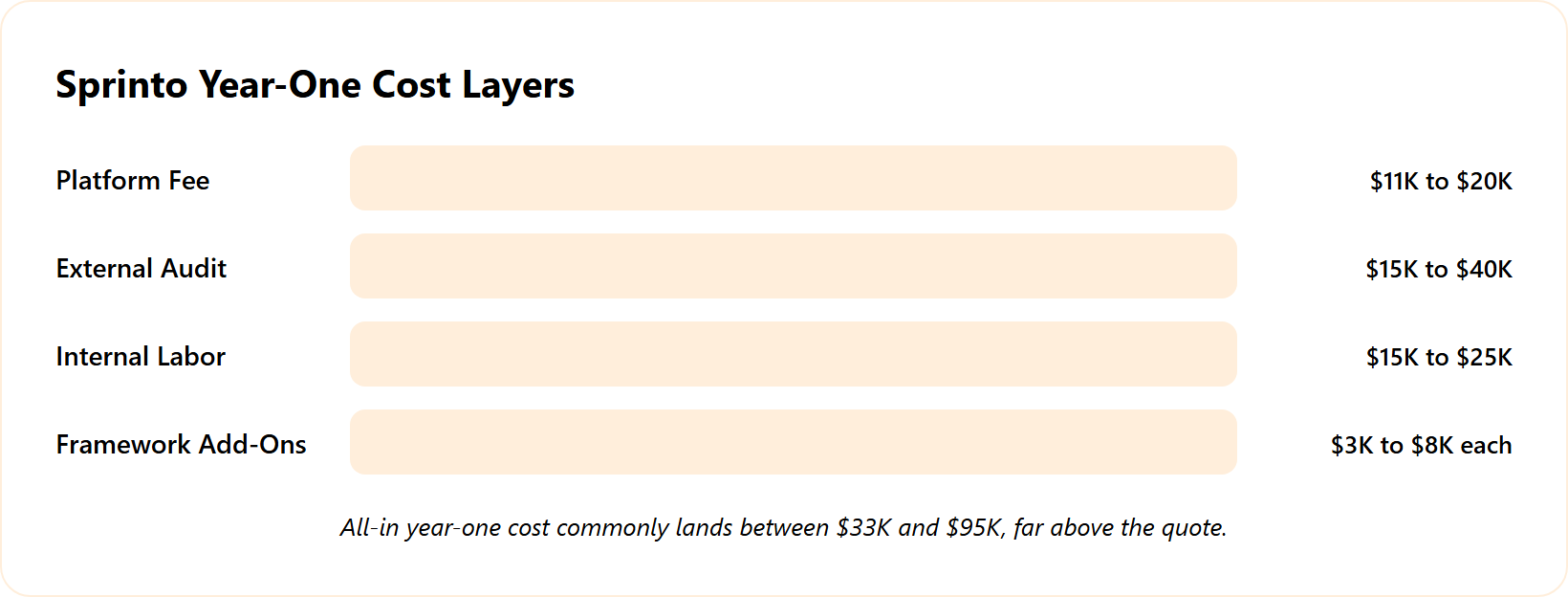
Here is the trap I watch buyers fall into. They get a $15,000 quote, budget for $15,000, and then the real bill shows up in pieces over the next ten months. The platform price is the part you see; the rest is below the waterline.
Sprinto does not include your audit. You still pay a CPA firm $15,000 to $40,000 for SOC 2 Type II, and $8,000 to $30,000 for ISO 27001, every single year. No compliance platform bundles that fee, and first-time buyers forget it constantly. A clear view of your cybersecurity budget helps you plan for both lines.
⏰ The Hidden Tax Nobody Invoices
Then comes the labor. Most teams spend 300 to 400 hours a year inside the platform on policy reviews, evidence uploads, training, and vendor assessments. At engineering salaries, that is $15,000 to $25,000 of your team’s time, and it never appears on an invoice.
There is also friction that costs you, even when it costs no money. Buyers report magic-link access headaches and an endpoint agent that needs workstation permissions, which slows developer velocity. These are real taxes on a lean team.
📊 The All-In TCO Model
Roll it up, and the picture changes. Here is the realistic year-one stack for a mid-market buyer.
| Cost Line | Realistic Year-1 Range |
|---|---|
| Sprinto platform | $11,000 to $20,000 |
| External CPA audit | $15,000 to $40,000 |
| Internal labor (300 to 400 hrs) | $15,000 to $25,000 |
| Implementation (if charged) | $0 to $5,000 (negotiable) |
| Framework add-ons | $3,000 to $8,000 each |
| All-in TCO | $33,000 to $95,000 |
Before your demo, ask three things in writing: are implementation fees charged, what is auditor referral pricing, and how many internal hours similar customers spend. That checklist alone protects your budget.
This is exactly where I get protective of lean teams, from years of watching it play out. Those 300 to 400 hidden hours are where compliance theater quietly lives, because the platform displays a green score while your two-person security team drowns. At UnderDefense, we pair our compliance services with concierge analysts, so the evidence and monitoring load does not land entirely on an already-stretched internal team. One CISO told me that handoff was the difference between passing an audit and burning out his only analyst, which is also why a virtual CISO can carry the strategic weight.
Q6: How Do Sprinto’s 2026 AI Features Affect What You Pay?
Sprinto’s 2025 to 2026 AI features change the pricing calculus. The AI Governance module (ISO 42001, NIST AI RMF, and EU AI Act mapping) sits in the Enterprise tier, the AI Security Questionnaire is token-limited and prone to overages, and the Autonomous Trust Center runs on a $1 promotional price whose standard rate is undisclosed. Confirm in writing whether AI features and promotional pricing persist at renewal.
🤖 Where the AI Lives, and What It Costs
Think of Sprinto’s AI features like premium channels on a cable plan. They sound included, but each one sits behind a specific gate, and the price model differs for each.
- AI Governance module: Enterprise tier only, mapping ISO 42001 and the EU AI Act.
- AI Security Questionnaire: token-based, with a usage cap that buyers say is easy to exhaust.
- Autonomous Trust Center: a $1 promotional fee, with the standard renewal price undisclosed.
The token cap is the sneaky one. As your enterprise questionnaire volume grows, you hit the limit, and overage pricing is not published. You end up negotiating capacity mid-contract, from a weak position.
✅ What to Confirm Before You Sign
So here is what I would nail down at the table. Ask whether the $1 Trust Center price holds at renewal, what AI token overages cost, and whether AI modules added later inherit your locked rate. Get each answer in the order form.
I will be opinionated here, because the category avoids saying it. An AI feature that auto-answers security questionnaires can quietly decouple your stated posture from your actual posture. An algorithm that surfaces its reasoning is safer than one you are simply told to trust.
That belief shapes how we built our own detection. With the UnderDefense MAXI Compliance AI, the detection logic is inspectable and MITRE-mapped, so you can audit why an alert fired rather than accept a black-box verdict. When AI touches your security posture, you should be able to see its work, which is the same standard we hold across our MDR for AI coverage.
Q7: Will Sprinto’s Price Jump at Renewal?
Plan for it. Sprinto contracts typically carry a 5 to 10% annual renewal uplift, but fast-growing teams report 20 to 40% jumps when headcount crosses into a higher tier band or a framework is added. One G2 user reported a renewal quote 40% above year one. The strongest defense is a multi-year price lock negotiated upfront, plus bundled framework pricing committed in writing before you sign.
📈 The Situation: A Quote That Quietly Grows
Picture a CISO who signed at $11,000 for SOC 2, felt good about it, and moved on. The team grew from 90 to 140 people, and they added ISO 27001 for a big prospect. Renewal time arrives, and the quote is suddenly far higher.
The mechanics are simple but easy to miss. Stable accounts see a standard 5 to 10% uplift. But cross a headcount band, and you jump tiers automatically, which is how one G2 user landed a renewal quote 40% above year one.
🔒 The Resolution: Lock It Before You Sign
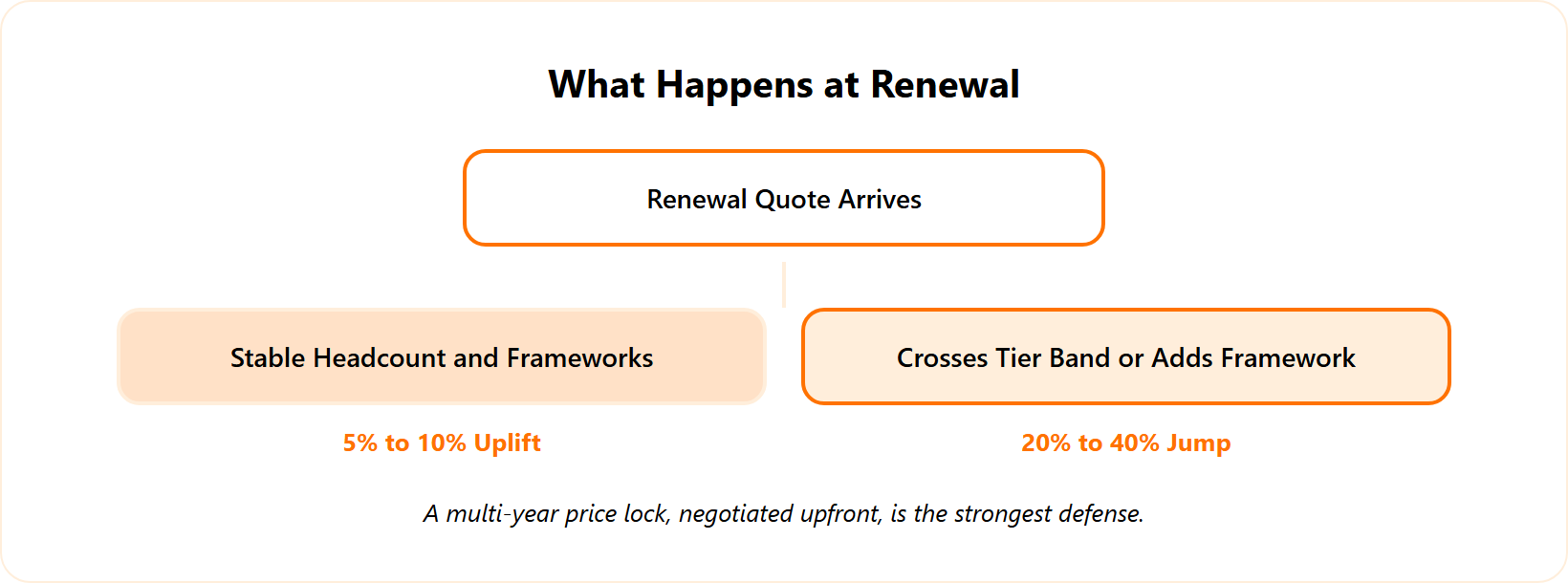
The fix is leverage you only have once, before the first signature. Sprinto’s own terms renew you at “then-prevailing charges,” so negotiate a cap into the order form.
- Negotiate a 24-month price lock; multi-year deals hold your initial rate.
- Cap how far your band can move at renewal.
- Get framework add-on pricing committed in writing now.
One more question I push on every GRC deal: if you leave, do your evidence, control mappings, and integrations stay yours? Portability is renewal leverage, because a vendor that knows you can walk negotiates differently. At UnderDefense, we treat data ownership as the buyer’s right, and I would ask any platform, including ours, to put that in writing. This is one of the biggest reasons businesses switch cybersecurity providers, and an honest managed SIEM partner will preserve your data ownership.
Q8: How Does Sprinto Pricing Compare to Vanta, Drata, and Secureframe?
Sprinto is generally the lower-cost option among major GRC platforms. Procurement data puts its median near $15K/year, versus Vanta (~$20K+) and Drata (~$34K), with Secureframe ranging $10K to $35K+. Sprinto’s edge is bundled modules and unlimited users, while rivals more often gate custom frameworks, SSO, or modules behind add-ons. The right pick depends on framework scope, integration depth, and auditor-facing support needs.
💰 The Price Picture, Side by Side
Here is the head-to-head, using procurement and audit-firm data rather than vendor marketing.
| Platform | Typical Annual Band | Pricing Note |
|---|---|---|
| Sprinto | ~$15K median ($11.5K to $19.3K) | Bundled modules, unlimited users |
| Vanta | ~$10K to $20K+ | Renewal creep widely cited |
| Drata | ~$7.5K entry, ~$34K typical | Often perceived as costly |
| Secureframe | ~$10K to $35K+ | Framework scope drives price |
A fair, citable differentiator: Sprinto does not paywall custom frameworks or controls the way some rivals do, and SSO sits inside a tier upgrade rather than a separate surcharge. That is a genuine strength, and I will name it plainly.
⚠️ Where Each One Fits, and Where It Doesn’t
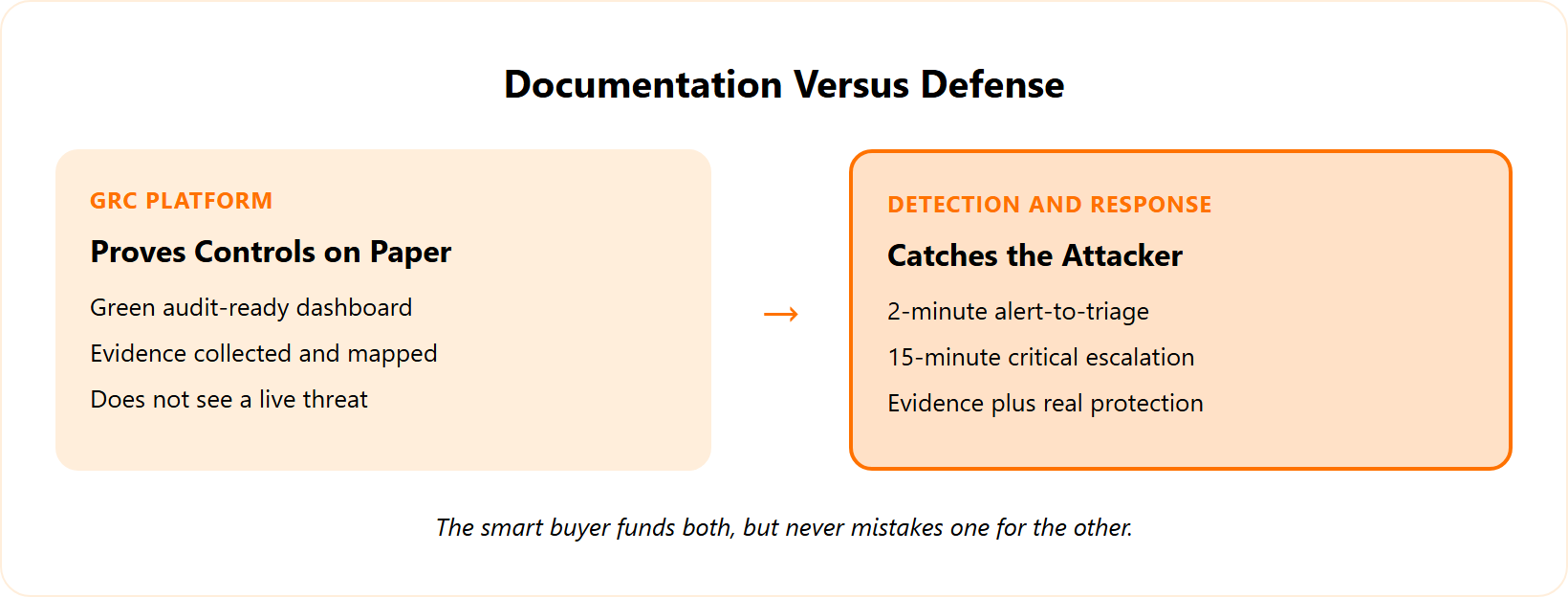
Now the honest version of “which one.” Every category here shares one structural limit worth naming.
- ✅ Sprinto fits price-sensitive mid-market teams wanting bundled frameworks.
- ✅ Vanta and Drata fit teams wanting deep integration ecosystems.
- ❌ All of them document compliance but do not detect or respond to a live threat.
- ✅ A GRC tool proves your controls existed on paper.
- ❌ None of them tells you an attacker is in your environment at 2 a.m.
That gap points at the thing I care about most. A GRC platform answers “are we documented?” The harder board question is “are we actually secure, and can we prove a response worked?”
“Their SOC team is responsive and knows their stuff. They’ve also made our audit process much less painful, and we can pull up exactly what they need to see.”
Verified User in Marketing and Advertising UnderDefense G2 Verified Review
The UnderDefense MAXI Compliance AI sits in this comparison as the option for buyers who want detection and response alongside compliance evidence, with a $10K entry point and transparent pricing. We unify the evidence an auditor wants with real 2-minute Alert-to-Triage and 15-minute escalation for critical incidents, so the spend buys protection and the paperwork that proves it. If you are weighing tools, our MDR buyers guide and our MDR service show how that works in practice.
Negotiating a renewal right now?
Try UnderDefense MAXI Compliance AI
Q9: What Does Sprinto Cost European Buyers on Data Residency and Regulation?
For EU buyers, Sprinto’s price hides non-monetary costs. Sprinto is headquartered in Bangalore, India, which is not an EU adequacy country under GDPR Article 45, so Standard Contractual Clauses under Article 46 and a verified Data Processing Agreement are required. Private-cloud EU data residency is available, but its pricing is undisclosed. NIS2 and DORA are supported through control mappings rather than native implementation, so confirm depth before relying on them.
🌍 Why Geography Becomes a Line Item
Think of GDPR like shipping rules across borders. If your data leaves the EU for a country the EU has not blessed as “adequate,” you need extra paperwork to make the trip legal. India is not on that adequacy list under Article 45.
So an EU buyer carries obligations a US buyer never sees. You will need Standard Contractual Clauses (the Article 46 legal contract that authorizes the transfer), plus a current Data Processing Agreement confirming where your data lives. None of that shows on the quote, but each step costs legal review time, which is why an early read of your regulatory compliance roadmap matters.
⚠️ The EU Buyer’s Pre-Quote Checklist
Here is what I would lock down before talking price, from watching regulated teams get surprised late.
- Request private-cloud EU residency pricing explicitly; it exists but is undisclosed.
- Ask whether NIS2 and DORA are natively implemented or only mapped as controls.
- Get the current DPA and confirm infrastructure regions in writing.
That mapped-versus-native distinction matters more than people expect. A control mapping shows where a framework requirement lives; it does not do the implementation work for you. For DORA, which governs financial-sector operational resilience, that gap is the difference between a tidy dashboard and a regulator-ready program, as our DORA testing guide explains.
This is the part I would not leave to a checklist tool. DORA expects you to prove operational resilience through real testing, including threat-led penetration testing, and that is hands-on work. At UnderDefense, DORA-focused testing for EU regulated buyers is work we do every week, because mapping a control is not the same as evidencing that it holds under attack. My honest read is this: if you are a financial-services buyer in the EU, budget for the penetration testing layer separately from any GRC license, and lean on MDR for financial services for ongoing resilience.
Q10: Is Sprinto Worth the Price, or Are You Paying for Compliance Theater?
Sprinto is worth it if your job is to automate evidence collection and reach audit-readiness quickly; its strong G2 standing and bundled model deliver real value for that. The risk is mistaking a green dashboard for actual security. Buyers report platforms can show 100% audit-ready while leaving teams unprepared for the audit, because dashboard completion does not always align with an auditor’s reality. Pay for verifiable evidence over theoretical policies.
✅ The Common View: Automation Means Compliance Solved
The standard story goes like this. You buy a GRC platform, connect your cloud, watch the bar hit 100%, and declare compliance handled. For evidence collection, that story is largely true, and Sprinto does it well.
The proof is in the ratings. Sprinto holds a strong reputation on G2 across more than a thousand reviews, and buyers consistently praise fast setup. If your goal is reaching audit-readiness quickly, the value is real, though pairing it with compliance services that include human review closes the gap.
“It pulls in data from all our existing security tools, so we didn’t have to rip and replace anything, and they include the context we need to understand the issue quickly.”
Verified User in Marketing and Advertising UnderDefense G2 Verified Review
🎭 The Twist: When the Dashboard Lies to You
Here is where I will say the thing the category avoids. A platform that auto-answers security questionnaires can quietly decouple your stated posture from your actual posture. The green score says you are fine; the attacker does not read the dashboard.
I have earned this opinion the hard way. I built SOCs from the ashes of raw syslog, served as a CISO four times, and lost sleep over issues a dashboard would have marked “complete.” Ask the simple question: does this tool help prevent the incident that happens tomorrow? Our take on AI SOC red flags digs into exactly that trap.
“Now when we get an alert, we know it’s something worth looking into, and false positives have become a rarity.”
Valeriia D., Marketing Specialist UnderDefense G2 Verified Review
So what is actually worth your money? Verifiable evidence that survives an auditor’s questions, and detection that catches real fraud or intrusion. The difference is the depth of the data behind the checkbox.
I will give you a concrete one. We once surfaced a fraud inside a customer environment that a compliance score would never have flagged, and it saved roughly $300,000 in the first three months. That is what live triage buys you that a static report cannot, and it is the heart of our MDR service.
The UnderDefense MAXI Compliance AI documents controls while it detects and responds, with 2-minute Alert-to-Triage and 15-minute escalation for critical incidents. My honest hedge is this: a GRC tool and a real SOC solve different problems, and the smart mid-market buyer funds both, but never confuses one for the other.
Q11: How Do You Negotiate the Best Sprinto Deal?
Negotiation moves Sprinto’s price meaningfully. Bundle SOC 2, ISO 27001, and HIPAA into one quote to unlock a typical 10 to 20% discount or free onboarding. Sign near quarter-end for leverage, ask explicitly to waive or reduce implementation fees, and lock a multi-year rate to cap renewal increases. Procurement data shows a roughly $10K redline threshold, so deals above it have real room to move.
🛠 The Five Levers That Actually Work
Treat the demo as a procurement negotiation, because the first quote is rarely the real floor. Here are the levers I would pull, in order.
- Bundle frameworks. Ask Sprinto to quote SOC 2, ISO 27001, and HIPAA together; this commonly unlocks a 10 to 20% discount or free onboarding.
- Time it. Sign near quarter-end, when sales teams chase targets.
- Waive the fee. Ask explicitly whether the implementation fee can be reduced or waived; buyers report it often can.
- Lock the rate. Negotiate a 24-month price lock to cap renewal increases.
- Cross the redline. Procurement data shows roughly a $10K threshold; above it, discounts get real.
📋 The Clauses to Get in Writing
Levers move the price; clauses protect you after the signature. These are the three I would never sign without.
- Framework add-on pricing committed in writing, so year-two expansion does not reprice at list.
- Implementation fee stated explicitly, even if it is zero.
- Data and evidence portability on exit, so your control mappings and history stay yours.
That last clause is the quiet one that matters most. If you cannot take your evidence when you leave, your renewal negotiation has no teeth, because walking away is not really an option. This is one of the most common reasons businesses switch providers later.
“Their reports give us clear evidence of our security controls, and when auditors or clients ask, we can pull up exactly what they need to see.”
Verified User in Marketing and Advertising UnderDefense G2 Verified Review
Before you sign any GRC quote, pressure-test it against a vendor-agnostic option that keeps your data ownership intact. At UnderDefense, portability and transparent compliance pricing are defaults, because I want buyers negotiating from strength, and our team is happy to walk the numbers with you. Here is the question I am sitting with for 2026: as AI auto-fills more of the compliance workflow, will buyers negotiate harder on data ownership, or quietly trade it away for convenience? I would genuinely like to hear where you land on that.
Negotiating a renewal right now?
Try UnderDefense MAXI Compliance AI
1. How much does Sprinto cost per year in 2026?
Sprinto does not publish prices, so every quote runs through a sales call. Based on verified procurement data, the median annual contract sits near $15,000, with a typical range of $11,500 to $19,300.
- Starter: roughly $6,000 to $8,000 for a single framework and small team.
- Professional: roughly $8,000 to $11,000.
- Advanced: roughly $11,000 to $15,000.
- Enterprise: roughly $20,000 to $25,000 and up.
Your band is driven mostly by headcount and how many frameworks you carry, not by seats. Two verified Advanced purchases closed at $14,000 and $16,000 on 12-month terms, so deals below the median are real and reachable with good scoping.
We always tell buyers to weigh the platform fee against the deeper question of whether the spend buys real protection. If you want a compliance number without a gated page, our transparent compliance pricing shows where that conversation starts.
2. Why does Sprinto hide its pricing behind a demo?
Sprinto uses a consultative, demo-first sales motion. There is no public price list, no self-serve checkout, and no free trial, because pricing is scoped per company.
Think of it like a renovation quote. The cost depends on your headcount, the number of active frameworks, and how complex your integrations are, so the vendor scopes your environment before quoting.
- The upside is a tailored number that fits your actual scope.
- The downside is that you walk in blind, and the vendor anchors the price first.
We recommend treating the demo as a procurement negotiation rather than a product tour. Walk in with your headcount, framework list, and integration count already mapped, so the quote forms around your scope.
This is exactly where our posture differs. We publish our numbers, because a buyer under audit pressure deserves a figure before three meetings. Our compliance services are built around that transparency.
3. What is the true total cost of ownership for Sprinto?
The platform quote is the tip of the iceberg. The real bill arrives in pieces across your first year.
- Sprinto platform: $11,000 to $20,000.
- External CPA audit: $15,000 to $40,000 for SOC 2 Type II, never bundled.
- Internal labor: 300 to 400 hours per year, worth $15,000 to $25,000.
- Implementation fees: $0 to $5,000, often negotiable.
- Framework add-ons: $3,000 to $8,000 each.
Rolled up, all-in year-one cost commonly lands between $33,000 and $95,000, well above the platform quote alone.
Those hidden labor hours are where lean teams quietly burn out. We pair our virtual CISO advisory with concierge support, so the evidence and monitoring load does not land entirely on an already-stretched internal team. Ask your vendor in writing about implementation fees, auditor referral pricing, and the internal hours similar customers spend.
4. How do added frameworks change your Sprinto quote?
Sprinto charges on full company headcount with unlimited platform users, so your employee count sets the tier band while logins stay free. The model rewards small teams and scales cost with company size.
Each framework beyond your base plan adds real money.
- First framework: included in the base.
- Second, often ISO 27001: $3,000 to $5,000.
- Third and beyond: $2,500 to $4,000 each, often discounted if bundled.
Picture a 120-person SaaS paying about $11,000 for SOC 2 in year one. Add ISO 27001 for an enterprise prospect, layer a renewal uplift, and you reach $16,000 to $19,000 by year two. Nothing went wrong; the program simply grew.
We caution buyers against buying scope they will not use within 18 months. Scaling headcount that feeds a checklist scales your evidence cost, but it does not scale detection. Our SOC service ties multi-framework programs to live monitoring.
5. Will Sprinto's price jump at renewal?
Plan for it. Sprinto contracts typically carry a 5 to 10 percent annual renewal uplift, but fast-growing teams report 20 to 40 percent jumps when headcount crosses into a higher tier band or a framework is added.
The mechanics are easy to miss. Stable accounts see the standard uplift, but cross a headcount band and you jump tiers automatically. One G2 user reported a renewal quote 40 percent above year one.
- Negotiate a 24-month price lock; multi-year deals hold your initial rate.
- Cap how far your band can move at renewal.
- Get framework add-on pricing committed in writing now.
We also push every buyer to confirm data portability, because a vendor that knows you can walk negotiates differently. Renewal creep is one of the most common reasons businesses switch providers later.
6. How does Sprinto pricing compare to Vanta, Drata, and Secureframe?
Sprinto is generally the lower-cost option among major GRC platforms, using procurement and audit-firm data rather than vendor marketing.
- Sprinto: roughly $15,000 median.
- Vanta: roughly $10,000 to $20,000 and up, with renewal creep widely cited.
- Drata: roughly $7,500 entry, around $34,000 typical.
- Secureframe: roughly $10,000 to $35,000 and up.
Sprinto’s edge is bundled modules and unlimited users, while rivals more often gate custom frameworks, SSO, or modules behind add-ons. That is a genuine strength worth naming.
Still, every category here shares one structural limit. A GRC tool proves your controls existed on paper, but none of them tells you an attacker is in your environment at 2 a.m. We unify auditor-grade evidence with real detection and response, and our MDR buyers guide shows how to weigh that trade-off.
7. How do you negotiate the best Sprinto deal?
Negotiation moves Sprinto’s price meaningfully. Treat the demo as a procurement negotiation, because the first quote is rarely the real floor.
- Bundle SOC 2, ISO 27001, and HIPAA into one quote to unlock a typical 10 to 20 percent discount or free onboarding.
- Sign near quarter-end, when sales teams chase targets.
- Ask explicitly to waive or reduce implementation fees.
- Lock a 24-month rate to cap renewal increases.
- Push above the roughly $10,000 redline threshold, where discounts get real.
Clauses protect you after the signature. Insist on framework add-on pricing in writing, an explicit implementation fee even if zero, and data and evidence portability on exit.
That portability clause matters most, because without it your renewal negotiation has no teeth. We keep portability and transparent pricing as defaults, and our team is happy to walk the numbers with you before you sign anything.
8. What does Sprinto cost European buyers on data residency and DORA?
For EU buyers, Sprinto’s price hides non-monetary costs. Sprinto is headquartered in Bangalore, India, which is not an EU adequacy country under GDPR Article 45.
- You need Standard Contractual Clauses under Article 46 to authorize the transfer.
- You need a verified Data Processing Agreement confirming where your data lives.
- Private-cloud EU residency exists, but its pricing is undisclosed.
NIS2 and DORA are supported through control mappings rather than native implementation. A mapping shows where a requirement lives; it does not do the implementation work, which matters for financial-sector resilience.
We would not leave DORA readiness to a checklist tool, because it expects threat-led testing that is genuinely hands-on. We run DORA-focused penetration testing for EU regulated buyers every week, so budget that testing layer separately from any GRC license.