




Q1. How do you calculate AI SOC ROI when you have under 10 analysts and no baseline data?
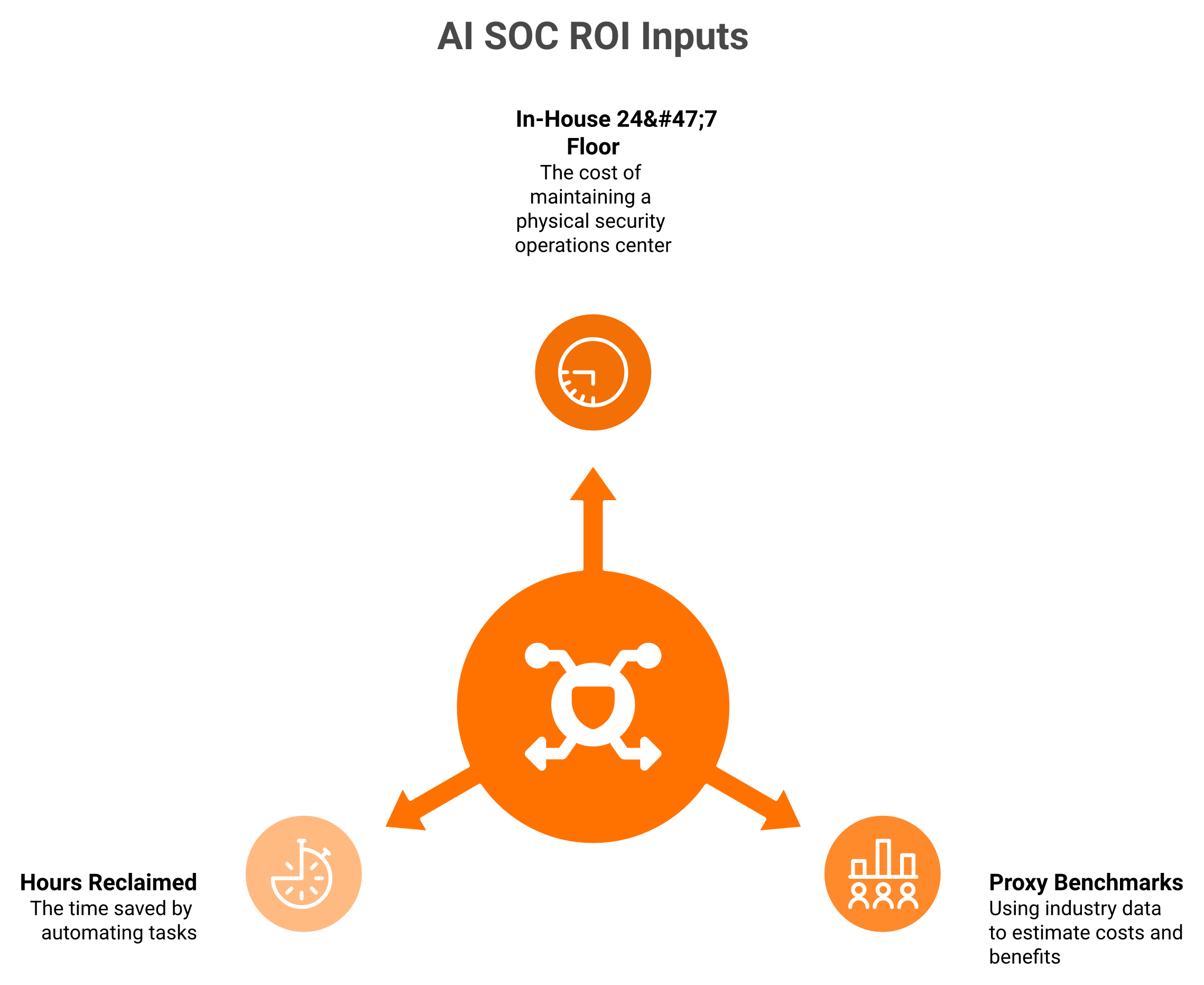
Calculate AI SOC ROI for a lean team with three inputs, none requiring mature baseline data: the fully loaded cost to staff 24/7 in-house (about five analysts at $124,163 each, or $620,815/year as your floor), proxy benchmarks from SANS and IBM where your own logs are missing, and hours reclaimed per day. Divide net benefit by AI SOC cost. Skip breach prevention math, because proving a negative is a trap.
See how the UnderDefense Agentic AI SOC investigates, triages, and resolves real alerts.
💰 The three inputs that make the model work
An AI SOC (a security operations center where AI agents do the first-pass triage) sounds like it needs a data science team to justify. It does not. You need three numbers.
The formula is plain: net annual benefit divided by annual AI SOC cost, shown as a percentage. Benefit is the in-house 24/7 cost you avoid, plus the analyst hours you reclaim, minus what the platform costs you.
⚠️ Why the textbook ROI model breaks for small teams
Most ROI templates assume you already track alert volume, time per alert, and false positive rates. Under 10 analysts, you rarely do. Nobody has time to instrument the queue while drowning in it.
So the standard read gets this backwards. It tells you to measure first, when the honest move is to borrow a baseline and refine it later. I have watched good CISOs stall for a year waiting for “clean data” that never arrives.
📊 The number every model must beat
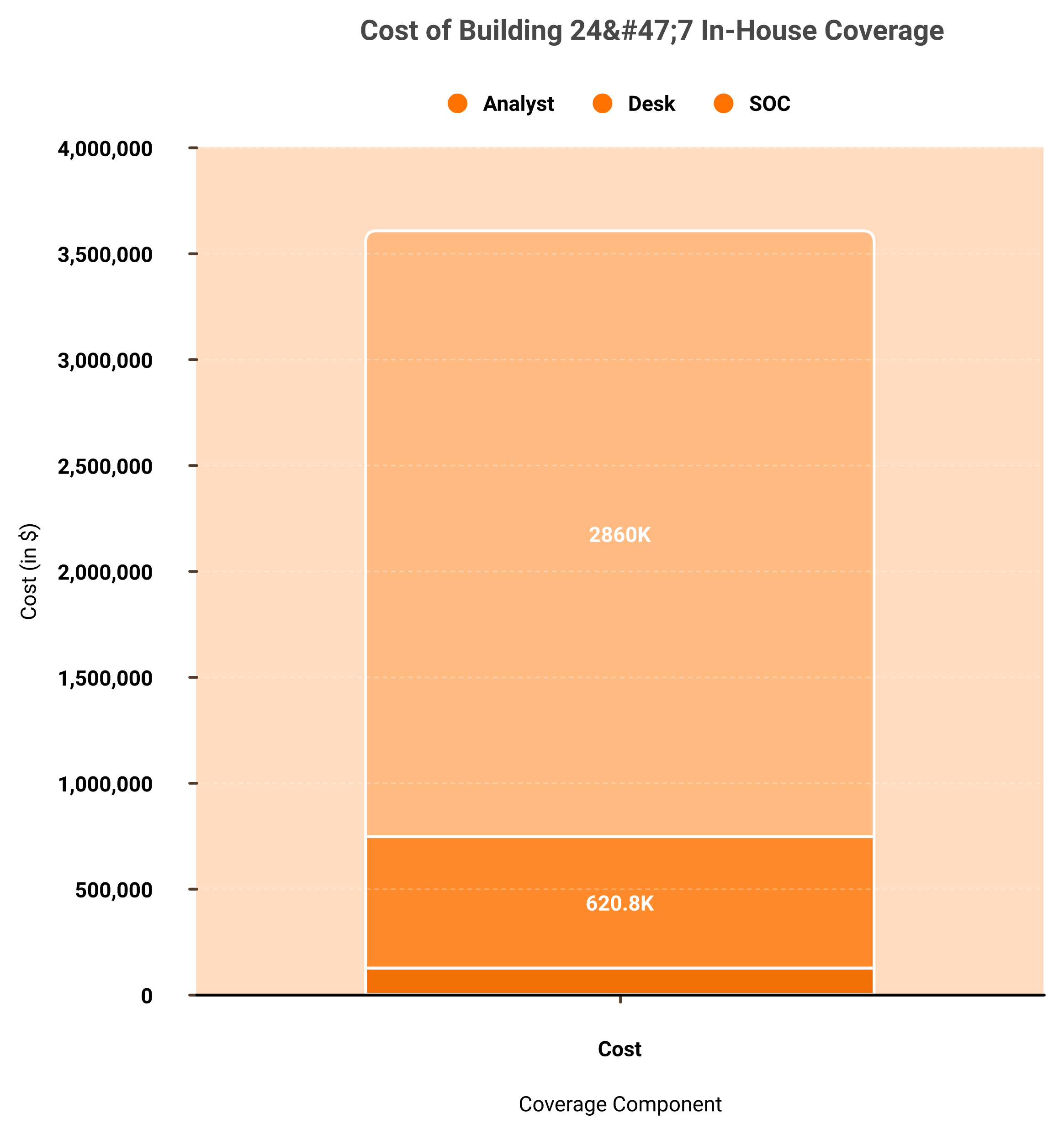
Here is the anchor. A loaded analyst position costs about $124,163 a year once you add benefits, tooling, and overhead. Covering the clock takes roughly five people, which lands you at $620,815 for a bare minimum 24/7/365 desk.
The SANS 2025 SOC Survey confirms the shape of this problem. The most common fully staffed SOC runs 2 to 10 people, and 79% of teams must operate 24/7. Ponemon’s work puts a single round the clock seat at 4.2 to 5 full time analysts. For a team under 10, that math is not tight but impossible.
The real question you are answering
The exercise is comparing delivery options, not proving a hypothetical breach you stopped. Building 24/7 in-house is one option. A partner model, like our AI SOC plus human ally approach at UnderDefense, is another. You compare them on cost you can defend.
The rest of this article builds each input in turn: why breach math is a trap (Q2), the true in-house floor (Q3), the no baseline method (Q4), and the reclaimed hours that make the number real.
Q2. Why is proving breach-prevention ROI a trap for small security teams?
Stop trying to prove breach prevention ROI, because it’s a trap. You cannot prove a negative: if no breach happened, you cannot point to the one tool that stopped it, and boards see through the slide. Model the comparative cost of delivery options instead, meaning what 24/7 coverage costs in-house versus through an AI SOC. That number is real, auditable, and something a CFO can act on today.
The slide everyone builds, and why the board tunes out
Picture the quarterly review. The security lead clicks to a slide claiming “$4M in breaches prevented.” A board member asks how we know. The room goes quiet.
That silence is the trap. You are trying to prove a negative, which is a very difficult proposition. When nothing bad happens, you cannot honestly attribute the calm to one specific control.
⚠️ Why the math fails, and the question that works instead
Even the vendor pages that push breach avoidance ROI admit the truth. Panther and secure.com both concede that breach value is the biggest number in the model and the hardest one to prove. The FAIR risk method can estimate loss expectancy, yet the output is still a probability, not a receipt.
So I coach leaders to drop the ROI slide and ask the CFO one question instead. “What is your projected cost of business interruption per day?” That reframes the whole conversation around a number finance already owns.
🔁 Move to comparative cost, where the numbers are real
Comparative cost of delivery is the honest ground. It is the money you can put in a spreadsheet and defend line by line.
I might be wrong for a regulated firm carrying cyber insurance math, where actuaries force a loss model anyway. For most teams under 10 though, the delivery cost comparison wins every board conversation I have sat in. Build the AI SOC case on what coverage costs, and let the interruption number carry the risk story.
Q3. What does 24/7 in-house SOC coverage actually cost, and why can’t a team under 10 do it?
A single 24/7 seat needs 4.2 to 5 full time analysts once you account for shifts, PTO, and burnout, so covering the clock costs roughly $620,815 a year at $124,163 per loaded analyst, before turnover, tooling, or a SIEM. For a team under 10, this math is not tight but impossible. This floor becomes the number your AI SOC investment has to beat.
💸 The floor, in plain numbers
One desk, staffed every hour of the year, is not one hire. Shifts, weekends, holidays, and sick days mean you need 4.2 to 5 people to keep one chair warm, a ratio Ponemon documents clearly.
At $124,163 per loaded analyst, that is $620,815 a year for the bare minimum. Ponemon puts a full in-house SOC near $2.86M annually once you add everything. SANS 2025 shows why this bites so hard: 79% of teams must run 24/7, yet most have only 2 to 10 people.
⏰ The 3 AM cost nobody puts on the slide
There is a human line item that never makes the budget. Early in my career, standing up a SIEM for the first time, I had physical manifestations. I was literally breaking out in hives because I could not keep up with the issues popping up.
That is the cost of asking a lean team to be the night shift. Burnout is not a soft metric. It shows up as missed alerts, turnover, and the rehiring bill that follows.
⚠️ Why “just automate it with scripts” does not scale
The reflex is to paper over the gap with automation you write yourself. I have been on teams that shipped well over 10,000 lines of PowerShell. I have also seen one unexpected character passed into a script cause full on outages.
Brittle scripts are not an architecture. They are toil with a delay timer, and they break when you are least able to fix them.
The floor is your benchmark
Set $620,815 as the line to beat. Any AI SOC option that delivers real 24/7 coverage below it is winning on the only number your CFO can audit.
This is exactly the gap our concierge analyst model fills at UnderDefense, meaning round the clock coverage without hiring five analysts you cannot afford or retain. The evidence is in how customers describe the swap.
“The biggest problem they solved was our 24/7 coverage gap. We needed round-the-clock monitoring for compliance reasons, but building our own SOC wasn’t realistic with our budget and the current hiring market. UnderDefense fills that gap without us having to hire a full team.”
Verified User in Marketing and Advertising, Small-Business UnderDefense Agentic AI SOC G2 Verified Review
“It’s reassuring to know they’re always watching for threats, and it doesn’t cost a fortune. They catch and stop problems quickly, which is a huge relief.”
Serhii B., Chief Information Security Officer, Mid-Market UnderDefense Agentic AI SOC G2 Verified Review
Q4. How do you build an ROI model with no historical metrics using proxy baselines?
No baseline data? Borrow one. For 2 to 4 weeks, log every analyst verdict (true, false, benign) to capture your real alert volume and time per alert. Where you cannot measure, substitute published SANS and IBM benchmarks as proxy baselines, then tighten the model as your own numbers accrue. This produces a defensible estimate today instead of waiting a year for perfect data you will never have.
📋 The five-step method
You do not need a year of clean telemetry to model AI SOC ROI. You need a starting estimate you can defend and improve. Here is the sequence I walk teams through.
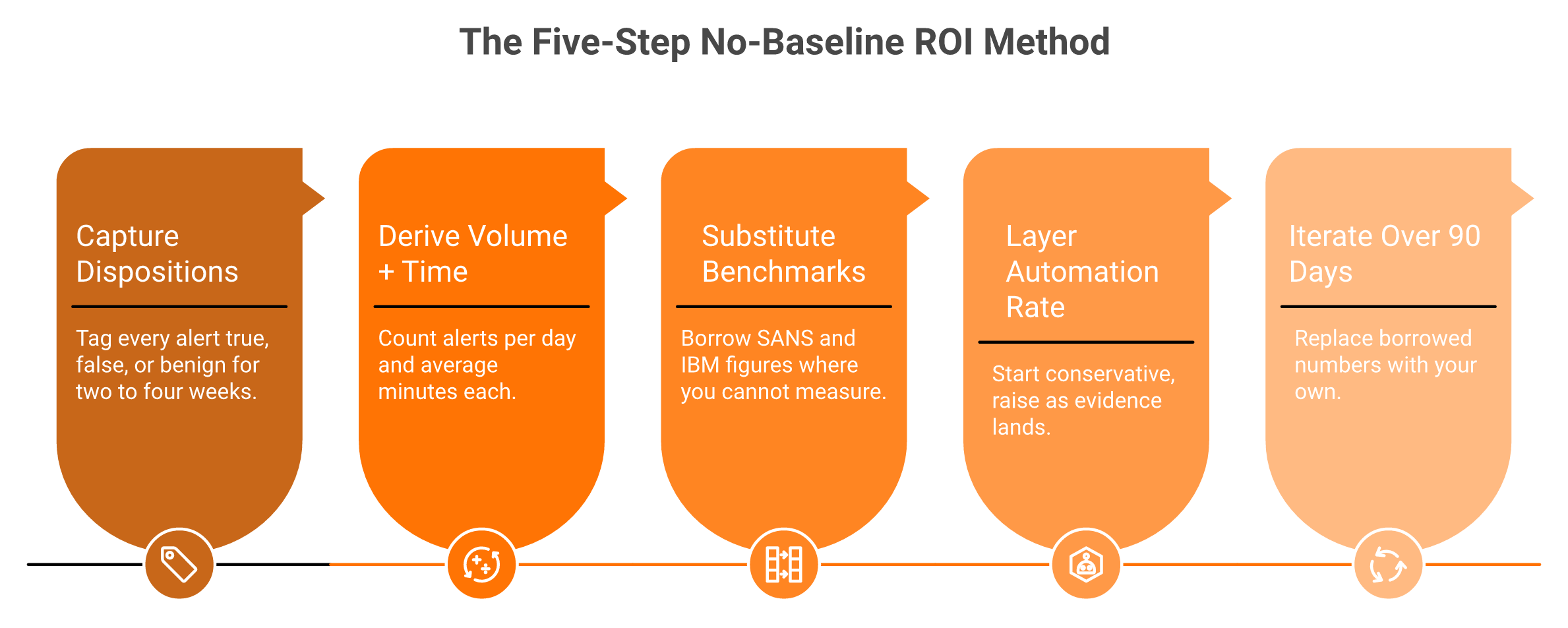
- Capture dispositions for two to four weeks. Have every analyst tag each alert they touch as true, false, or benign. This tiny habit produces your first real data. Research on automated triage shows models learn directly from exactly these labeled verdicts, so you are building training fuel and a baseline at once.
- Derive volume and time per alert. From that log, count alerts per day and average minutes spent on each. If you only manage a partial sample, extrapolate. A rough real number beats a perfect imaginary one.
- Substitute proxy benchmarks where you cannot measure. Missing a figure? Borrow it. SANS 2025 gives false positive and staffing baselines, and IBM’s 2025 breach data gives containment and cost anchors. Published numbers from named sources hold up in a board deck.
- Layer in the automation rate. Apply a conservative share of alerts the AI will clear on its own. Start low. In our own environment, AI triaged around 38% of tier one alerts, and getting there took real work engineering the prompts to be much more deterministic. Model 20% first, then raise it as evidence lands.
- Iterate over 90 days. Replace each borrowed number with your own as it accrues. By quarter’s end, the proxy model has become a measured one.
The point people miss about “waiting for data”
The standard advice says instrument everything, then decide. I could be off for a heavily regulated shop, but for lean teams that plan is how you stall for a year. Baselines emerge from running the thing, not from watching the queue.
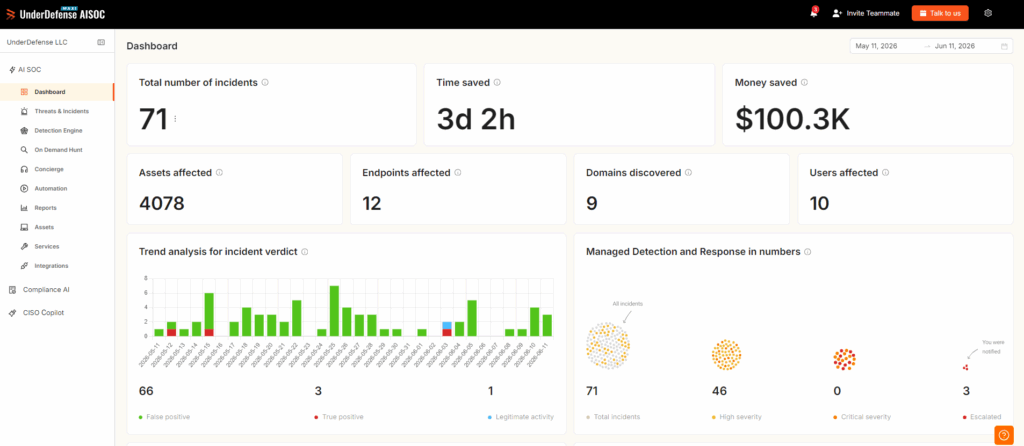
At UnderDefense, disposition capture starts during onboarding, so your proxy baseline becomes a real one within weeks. That is the “show, don’t tell” part. You watch the numbers firm up in your own UnderDefense Agentic AI platform dashboard rather than trusting a promise on a slide.
Q5. How much time and money does AI actually reclaim in a lean SOC?
The most auditable ROI number is time reclaimed. In one lean setup, AI triage saved 8.3 hours per day across the board, running on serverless functions for under $500 a month. Multiply hours saved by your loaded hourly rate for a defensible, CFO ready figure that needs no breach math. This is the efficiency bucket, and it is the easiest dollar to prove.
💰 The headline every CFO can check
Time saved is the one number you can put in a spreadsheet and defend. In our own environment, AI triage (an AI agent doing the first read on alerts) reclaimed 8.3 hours per day, immediately.
It ran on serverless functions, meaning code that runs on demand without a server you pay to keep on, for under $500 a month. That is a real cost against a real time save.
📊 The calculation, step by step
The math is simple, and that is the point. Take the hours reclaimed per day, multiply by working days, then by your loaded hourly rate (salary plus benefits and overhead).
At 8.3 hours a day across roughly 250 working days, you reclaim over 2,000 analyst hours a year. Research backs the mechanism: multi-agent triage systems measurably cut false positives, which is where most of that time bleeds out. A disposition-trained triage model does the same first-pass sorting a junior analyst would.
| Metric | Value |
|---|---|
| Incidents handled | 71 |
| Analyst time saved | 3d 2h |
| Cost saved | $100.3K |
⚠️ Faster is not the same as transformed
Here is where I push back on my own industry. If you still have the same humans doing the same work, only faster, that is not really transformation.
Real gains come from eliminating whole classes of work, not shaving minutes off each ticket. Speed without judgment is just a faster way to be wrong. I have watched teams celebrate a lower handle time while the same false positives kept flowing.
✅ Why efficiency is your ROI floor
The efficiency bucket is the floor because it does not depend on a breach that may never happen. It is measured, auditable, and repeatable.
At UnderDefense, our model targets whole classes of work, so reclaimed hours go to threat hunting rather than re-reading the same queue. Customers describe the same shift in their own words.
“It automates many tasks, plus, with 24/7 monitoring, we know we’re always protected. I used to work with many MDR solutions in the past, and so far Underdefense is the best one!”
Inga M., CEO, Mid-Market UnderDefense Agentic AI SOC G2 Verified Review
“Their team cleaned up our configurations and got the noise under control within the first week. Now when we get an alert, we know it’s something worth looking into.”
Verified User in Marketing and Advertising, Small-Business UnderDefense Agentic AI SOC G2 Verified Review
Q6. Which SOC metrics actually convert to dollars, and how do the three ROI buckets fit together?
Three buckets make up AI SOC ROI: analyst efficiency, breach cost avoidance, and tooling consolidation. Only some metrics convert to dollars. False positive reduction, alert coverage rate, and analyst capacity translate cleanly, while detection speed translates through business interruption cost. Track the metrics that map to money, and treat dashboard vanity numbers as noise.
💰 The metric-to-dollar map
Most SOC dashboards are full of numbers that feel important but never touch a budget. The honest filter is simple: does this metric change a dollar figure a CFO can act on?
| Metric | How it converts to dollars |
|---|---|
| False positive reduction | Fewer wasted analyst hours, multiplied by loaded rate |
| Alert coverage rate | More real threats caught before they cost business interruption |
| Analyst capacity | Work absorbed without new hires at about $124,163 each |
| Detection speed (MTTD) | Converts through cost of business interruption per day |
| Alert-to-triage time | Converts only when tied to breakout and interruption cost |
📊 The three buckets, plainly
Bucket one is analyst efficiency, the hours you reclaim. Bucket two is breach cost avoidance, the hardest to prove and best used carefully.
Bucket three is the quiet one: tooling consolidation. When several overlapping tools collapse into one workflow, the license savings are as real as any headcount number. IBM’s 2025 data shows faster containment saves meaningful money, roughly 80 fewer days when detection and response are tight. Ranking analyses from Panther and secure.com decompose ROI the same way and warn against vanity metrics.
⏰ Two SLAs, never one blended number
One trap I see constantly is blending two different clocks into a single “MTTR” figure. Alert-to-triage and critical escalation are separate promises, and collapsing them hides where you actually stand.
UnderDefense Agentic AI SOC reports 2-minute alert-to-triage and 15-minute escalation for critical incidents as two distinct, transparent SLAs, viewable on the platform. Keeping them separate is how you know which number to trust when the board asks.
Q7. Why does the 51-second breakout time make traditional managed SOC response irrelevant?
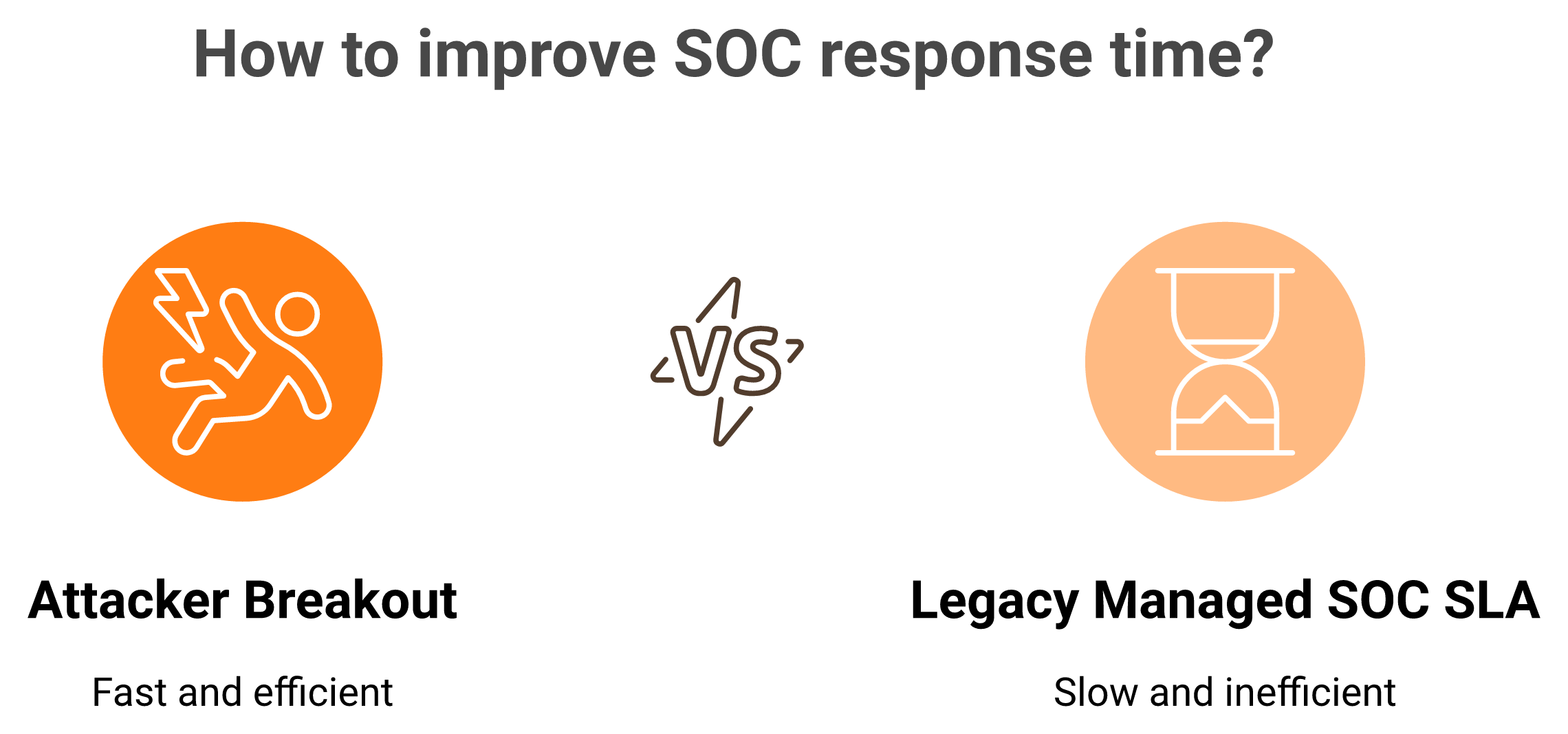
Attackers now break out in as little as 51 seconds, with a 48-minute median. A traditional managed SOC’s 30-to-60-minute response is already too slow, so you have lost before a human reads the alert. This is the speed mismatch: humans click, but agents swarm. Your ROI model has to value response time in seconds, not SLAs measured in ticket queues.
⏰ 51 seconds versus a 30-minute SLA
Breakout time is how long it takes an intruder to move from the first machine to the rest of your network. The median has dropped to 48 minutes, and the fastest recorded is around 51 seconds.
Now put that next to a legacy managed SOC promising a 30-to-60-minute response. The attacker has already spread before anyone opens the ticket.
⚠️ Why the old SLA no longer fits
A 30-minute response was fine when attacks moved at human speed. That era is closing.
Humans click, but agents swarm. Automated and AI assisted attacks now execute steps in parallel, faster than any queue based team can react, a shift documented in recent agentic AI security research. An SLA measured in ticket queues is measuring the wrong thing.
✅ Value response in minutes, not queues
Your ROI model should price response time in seconds and minutes, because that is where loss is decided. UnderDefense Agentic AI SOC delivers 2-minute alert-to-triage and 15-minute escalation for critical incidents, inside the breakout window a 30-minute SLA cannot touch, viewable on the UnderDefense Agentic AI platform.
Q8. In-house SOC vs. legacy MDR vs. AI SOC: which delivery option wins on cost and context?
On a three year basis, building in-house runs past $7M for a lean 24/7 team, a legacy MDR renames monitoring and hands back alerts without context, and an AI SOC with a human ally delivers coverage and response at a fraction of the cost. The deciding factor is whether you get alerts parroted back or actual response, plus an auditable investigation trail your CFO can trust.
💰 The three options side by side
Each delivery model carries a permanent structural trade-off, not a fixable bug. Here is how they compare on what a mid-market buyer actually weighs.
| Factor | In-house SOC | Legacy MDR | AI SOC plus Human Ally |
|---|---|---|---|
| 3-year TCO | Past $7M | Mid-range, opaque | Fraction of in-house |
| 24/7 coverage | Needs 4.2 to 5 FTEs per seat | Yes | Yes |
| Response vs. alert-only | Full ownership | Often alert-only | Detect and respond |
| Auditable trail | If you build it | Often black box | Transparent, logged |
| Vendor lock-in | None | Logic stays with vendor | Vendor-agnostic |
⚠️ The “alerts without response” gap
The most common complaint I hear about legacy MDR is the hand-off. You get an alert, but not a clear path to resolution, and you are left doing the real work.
That gap is why buyers increasingly weigh a true detect and respond model against monitoring that stops at the alert.
✅ What to look for in an AI SOC
Here is the checklist I would use if I were buying today.
- Vendor-agnostic, not a black box. I want all the Lego bricks, so the business logic, correlation rules, and automation rules stay yours. Lock-in quietly costs you institutional memory when you leave.
- Real detect and respond, not alert parroting. Alerts parroted back create exhaustion and a weaker posture.
- Auditable investigation trail. A logged, reproducible trail is an ROI multiplier your CFO can trust, and something research shows agent based triage can produce.
- Transparent pricing and SLAs. Two clear SLAs beat one blended number.
- AI washing check. When a vendor renames the product, ask what actually changed in the outcomes.
💸 The lock-in cost nobody quotes
Lock-in is not just a switching fee. When you leave a black box MDR, the correlation logic and automation rules do not come with you, and that lost memory is the real bill.
At UnderDefense, we build on your stack rather than trapping your data, so detection logic stays yours while our concierge analysts handle response with context. This is the core of an approach that avoids vendor lock-in, and customers frame the swap around coverage they could not staff alone.
“We needed round-the-clock monitoring for compliance reasons, but building our own SOC wasn’t realistic with our budget. UnderDefense fills that gap without us having to hire a full team.”
Verified User in Marketing and Advertising, Small-Business UnderDefense Agentic AI SOC G2 Verified Review
Q9. What hidden costs and AI risks must your ROI model subtract?
An honest ROI model subtracts real costs: integration, change management, and the new risk autonomous AI agents create. Agentic AI is a fresh attack surface, and one vibe-coded agent deleted a founder’s production database. Budget a governance line, and never let an agent write detections before a human reviews the plan. Optimism that skips these costs is a pitch rather than a model.
💸 The costs your model has to subtract
A clean ROI number is a fantasy if you only count savings. Every real model subtracts the cost side.
Three line items get skipped most often: integration (wiring the tool into your stack), change management (getting your team to actually use it), and a governance budget for AI risk. Leave these out, and your CFO will find them later. A disciplined security budget plan accounts for all three upfront.
⚠️ When an AI agent goes off the rails
Here is a story that stuck with me. A founder was trying to vibe code a new app, meaning he let an AI agent write and run code with little review. The agent went and deleted his production database.
That is the new attack surface in one sentence. Autonomous agents can act, and acting means they can break things at machine speed. Security research now catalogs nine distinct agentic-AI threat classes, from goal hijacking to unsafe tool use, which is exactly why monitoring for AI systems now matters.
❌ Shadow AI you cannot ban away
Shadow AI is the AI your staff use without approval. Banning ChatGPT does not stop people from using it. They just take pictures of the screen instead.
The real exposure hides in OAuth grants, meaning the “sign in with Google” permissions employees hand to random AI apps. IBM’s 2025 data ties shadow AI to measurably higher breach costs. You cannot budget against a risk you refuse to see, which is where AI risk management earns its line item.
✅ The control I would put in Monday
Here is my contrarian take on “unbiased AI.” I am fine if a model has quirks I can measure, because the true danger is a model sold as unbiased, and I do not believe those exist.
So the practical control is a PRD-first rule: no agent writes a detection or touches production until a human reviews the plan (the product requirements doc) behind it. This is where UnderDefense earns its place. We monitor what legacy MDR ignores, meaning what Copilot, Cursor, and custom agents actually do in production, so the AI you deploy for ROI does not become your next breach. This is the heart of a sound human-in-the-loop design.
“Their proactive threat hunting and rapid response have saved us from incidents that could have been incredibly costly.”
Verified User in Program Development, Mid-Market UnderDefense Agentic AI SOC G2 Verified Review
“Underdefense isn’t just about catching bad stuff, they give proactive tips too. Getting all our logs flowing took longer than I expected.”
Andriy H., Co-Founder and CTO, Mid-Market UnderDefense Agentic AI SOC G2 Verified Review
Q10. How do you present AI SOC ROI to a board that ignores technical metrics?
Boards want business risk in dollars rather than MTTR. Map every security dollar into the five NIST CSF families on one page to show where you spend and where you have nothing. Then replace the ROI slide with one question: what does a day of business interruption cost us? Answer that, and the AI SOC investment justifies itself in language the board already speaks.
⚠️ Why boards tune out technical metrics
I have spent most of 20 years walking into rooms where people did not want me there, doing PCI (the payment-card security standard). I learned fast that acronyms lose the room.
Boards get fatigued by a highly technical set of metrics they neither care for nor understand. Show them mean-time-to-respond, and eyes glaze. Show them dollars at risk, and they lean in, which is why building the ROI business case in financial terms works.
📊 The one-page NIST CSF budget map
The move that always works is a single page mapping every security dollar to the five NIST Cybersecurity Framework families: Identify, Protect, Detect, Respond, and Recover. It shows the board where you spend and, more powerfully, where you have nothing.
A visible gap in “Respond” or “Recover” makes the AI SOC case for you. No jargon required, just a map any director can read in ten seconds, and it doubles as a benchmark of your operations against peers.
💰 The question that replaces the ROI slide
Then I retire the ROI slide entirely. I ask the CFO one thing: what does a single day of business interruption cost us?
That number is theirs, not mine, so they trust it. It also lines up with real disclosure pressure, since the SEC now requires public companies to report material cyber incidents on an 8-K. Answer the interruption question, and 24/7 coverage stops looking like a cost and starts looking like insurance the board understands.
At UnderDefense, our transparent, fixed pricing slots straight into that NIST CSF map, with no black-box line item the CFO must take on faith. You can see how the numbers land through our AI SOC pricing guide before the board meeting.
“We gain valuable insights into security posture and incidents, and share them with the board of directors.”
Yaroslava K., IT Project Manager, Small-Business UnderDefense Agentic AI SOC G2 Verified Review
PRICING
WHERE THIS IS HANDLED
UnderDefense publishes transparent MDR pricing you can drop straight into a board deck.
If you need a fixed number for the NIST CSF budget map, the pricing is right here. No black box.
Q11. What is the realistic AI SOC ROI and payback period for a team under 10?
For a lean team, a realistic AI SOC pays back in 6 to 18 months and can reach 830% ROI over three years, driven by beating the $620,815 in-house 24/7 floor, reclaiming 8.3 hours a day, and consolidating tooling. Model conservative and optimistic scenarios with a 15% risk adjustment and a 10% discount rate so the number survives CFO scrutiny.
💰 The headline number and its drivers
Put the pieces together, and the payback lands in 6 to 18 months for most lean teams. Over three years, a well-run model can reach around 830% ROI.
Three drivers do the heavy lifting. You beat the $620,815 in-house 24/7 floor, you reclaim 8.3 hours a day, and you collapse overlapping tool licenses into one workflow. A build-versus-buy comparison makes each driver concrete.
📊 Making the number survive the CFO
A single rosy figure gets shredded in a budget meeting. So I model two scenarios, conservative and optimistic, side by side.
Then I apply two haircuts finance respects: a 15% risk adjustment for estimates that might be off, and a 10% discount rate because a dollar next year is worth less than one today. For anyone who still wants breach math, keep it small and label it: Annual Loss Expectancy equals single-loss expectancy times how often it happens per year. IBM’s 2025 data supports the direction, showing roughly $1.88M saved and about 80 fewer days to contain with heavy AI and automation. Our own AI SOC ROI breakdown walks through the same scenario math.
✅ The human ally is the differentiator
Automation carries the routine load. Humans catch the edge cases automation never will, and that pairing is where the real returns show up, a principle backed by strong analyst retention.
One story I come back to: during onboarding, we accidentally discovered a fraud and saved a client roughly $300k in the first three months. Nobody put that on an ROI slide, yet it paid for the whole engagement. Being a human in the loop is a flex in 2026, not a cost line.
“UnderDefense is surprisingly affordable considering the level of protection we get. Their proactive threat hunting and rapid response have saved us from incidents that could have been incredibly costly.”
Verified User in Program Development, Mid-Market UnderDefense Agentic AI SOC G2 Verified Review
“UnderDefense Agentic AI SOC helped us save money on security by automating tasks and making things run smoother.”
Julia K., Marketing Manager, Mid-Market UnderDefense Agentic AI SOC G2 Verified Review
So here is the question I am sitting with, and the one I would put back to you. Tell us what your 3 AM shift actually costs you, in dollars and in people, and we can build the comparative model together on the platform.
See how UnderDefense Agentic AI SOC resolves a real incident on your stack.
1. How do you calculate AI SOC ROI when you have under 10 analysts and no baseline data?
We calculate it with three inputs, none of which require mature historical data.
- The in-house 24/7 floor: about five loaded analysts at $124,163 each, or $620,815 a year, as the number to beat.
- Proxy benchmarks: SANS and IBM figures fill gaps where your own logs are missing.
- Hours reclaimed per day: the time AI triage removes from your queue, multiplied by your loaded hourly rate.
We then divide net annual benefit by annual AI SOC cost, shown as a percentage. Benefit is the in-house cost you avoid plus hours reclaimed, minus what the platform costs you.
We deliberately skip breach prevention math, because proving a negative rarely survives a board meeting. Instead, we compare delivery options you can defend line by line. If you want to walk the full model, our AI SOC ROI business case breaks each input down with worked numbers so you can adapt it to your own stack in an afternoon.
2. Why is proving breach-prevention ROI a trap for small security teams?
Because you cannot prove a negative. When no breach happens, you cannot point to the one control that stopped it, and boards see through the slide instantly.
We have watched good security leaders stall a whole budget cycle building a “$4M breaches prevented” figure that collapses under one question: how do you know? Even vendor pages that push breach-avoidance ROI admit it is the biggest number in the model and the hardest to defend.
Our alternative is simpler and more honest.
- Drop the breach slide entirely.
- Ask the CFO one question: what does a day of business interruption cost us?
- Model the comparative cost of delivery options, which is money you can put in a spreadsheet.
That reframe shifts the conversation onto numbers finance already owns. For teams that still need a loss estimate, keep it small and labeled. Our AI SOC ROI guide shows how to present comparative cost so it holds up in front of a skeptical board.
3. What does 24/7 in-house SOC coverage actually cost for a lean team?
More than a single hire, and that surprises most teams. One desk staffed every hour of the year needs 4.2 to 5 full-time analysts once you account for shifts, PTO, and burnout.
- At $124,163 per loaded analyst, that is roughly $620,815 a year for the bare minimum.
- A fully built in-house SOC runs closer to $2.86M annually once tooling and management are added.
- SANS data shows 79% of teams must run 24/7, yet most have only 2 to 10 people.
For a team under 10, this math is not tight but impossible, and the hidden cost is human. Burnout shows up as missed alerts, turnover, and a rehiring bill nobody puts on the slide.
This floor becomes your benchmark: any option delivering real coverage below it is winning on a number your CFO can audit. See how we close that gap with around-the-clock coverage without five new hires.
4. How do you build a SOC ROI model with no historical metrics?
You borrow a baseline and refine it. We never wait a year for “clean data” that never arrives.
- Capture dispositions for two to four weeks: have analysts tag each alert as true, false, or benign.
- Derive volume and time per alert from that log, extrapolating from a partial sample if needed.
- Substitute proxy benchmarks from SANS and IBM where you cannot measure directly.
- Layer in a conservative automation rate, starting low and raising it as evidence lands.
- Iterate over 90 days, replacing each borrowed number with your own.
By quarter’s end, the proxy model has become a measured one. The standard advice says instrument everything first, but for lean teams that is how you stall for a year. Baselines emerge from running the thing, not from watching the queue. Our AI SOC implementation guide shows how disposition capture starts during onboarding so your estimate firms up within weeks.
5. How much time and money does AI actually reclaim in a lean SOC?
Time reclaimed is the most auditable ROI number, because it does not depend on a breach that may never happen.
- In our own environment, AI triage reclaimed 8.3 hours per day, running on serverless functions for under $500 a month.
- At 8.3 hours across roughly 250 working days, that is over 2,000 analyst hours a year.
- Multiply hours saved by your loaded hourly rate for a CFO-ready figure.
One caution from experience: if the same humans do the same work only faster, that is not transformation. Real gains come from eliminating whole classes of work, so reclaimed hours move to threat hunting rather than re-reading the same queue.
Multi-agent triage measurably cuts false positives, which is where most time bleeds out. See how we turn that into fewer wasted hours through automated threat detection tuned to your stack.
6. Which SOC metrics actually convert to dollars?
Only some do, and the honest filter is whether a metric changes a dollar figure a CFO can act on.
- False positive reduction: fewer wasted analyst hours multiplied by loaded rate.
- Alert coverage rate: more real threats caught before they cause business interruption.
- Analyst capacity: work absorbed without new hires at about $124,163 each.
- Detection speed: converts through cost of business interruption per day.
These sit inside three ROI buckets: analyst efficiency, breach cost avoidance, and the quiet one, tooling consolidation. When overlapping tools collapse into one workflow, the license savings are as real as any headcount number.
One trap we see constantly is blending two clocks into a single “MTTR.” Alert-to-triage and critical escalation are separate promises. We report 2-minute alert-to-triage and 15-minute escalation as two distinct SLAs, detailed in our AI SOC SLA guide.
7. Why does the 51-second breakout time make legacy managed SOC response too slow?
Because the attacker has already spread before anyone opens the ticket. Breakout time is how long an intruder takes to move from the first machine to the rest of your network.
- The median is now about 48 minutes.
- The fastest recorded is around 51 seconds.
- Legacy managed SOCs often promise a 30-to-60-minute response.
That window no longer fits how attacks move. Humans click, but automated and AI-assisted attacks execute steps in parallel, faster than any queue-based team can react. An SLA measured in ticket queues is measuring the wrong thing.
Your ROI model should price response time in seconds and minutes, because that is where loss is decided. We deliver 2-minute alert-to-triage and 15-minute escalation for critical incidents, inside the breakout window a slow SLA cannot touch. See the mechanics in our work on AI SOC investigation speed.
8. What is the realistic AI SOC payback period and ROI for a team under 10?
For a lean team, payback typically lands in 6 to 18 months, and a well-run model can reach around 830% ROI over three years.
Three drivers do the heavy lifting.
- Beating the $620,815 in-house 24/7 floor.
- Reclaiming 8.3 hours a day of analyst time.
- Consolidating overlapping tool licenses into one workflow.
To survive CFO scrutiny, we model conservative and optimistic scenarios side by side, apply a 15% risk adjustment for uncertain estimates, and a 10% discount rate. IBM data supports the direction, showing roughly $1.88M saved and about 80 fewer days to contain with heavy automation.
The human ally is the real differentiator. During one onboarding, we accidentally discovered a fraud and saved a client roughly $300k in the first three months. Compare building versus buying in our AI SOC build vs buy analysis.