




Q1: What Are the 11 Best Managed SIEM Alternatives to Deepwatch in 2026?
The strongest Deepwatch alternatives for managed SIEM in 2026 manage the SIEM you already own instead of anchoring you to one platform: UnderDefense, ReliaQuest, Expel, Arctic Wolf, Red Canary, eSentire, Binary Defense, Proficio, Alert Logic, CriticalStart, and Dropzone AI. Each changes the management and response layer while you keep your data, rules, and exit rights.
A renewal is the moment coupling becomes visible. You suddenly see how much of your detection logic lives inside someone else’s platform, and what it costs to leave. I have watched this play out across hundreds of environments, and the pattern is consistent. The tools change, but the lock-in tax does not.
Talk to a SIEM expert about fewer false positives.
So here are eleven providers worth scoring at a Deepwatch renewal. I put UnderDefense first because it is where we work, but I am scoring it on the same axis as the rest.
- UnderDefense, best for keeping your own SIEM with detection-as-code portability and own-cloud deployment
- ReliaQuest, best for AI-forward platform buyers who want rule ownership at contract end
- Expel, best for endpoint-first transparent operations
- Arctic Wolf, best for a packaged, concierge managed experience
- Red Canary, best for Microsoft-heavy endpoint detection
- eSentire, best for regulated mid-to-large enterprises wanting a named response team
- Binary Defense, best for co-managed SIEM without proprietary lock
- Proficio, best for global follow-the-sun SOC coverage
- Alert Logic, best for cloud and web-application-centric monitoring
- CriticalStart, best for signal-to-resolution transparency
- Dropzone AI, best for AI-native alert investigation as a layer
The shared axis here is stack independence, not raw detection prowess. Every vendor on this list can find threats. The real question is who keeps your data, your rules, and your right to walk away. That is the lens I would carry into any RFP, and the same discipline runs through our managed SIEM co-management approach.
Quick Comparison of the 11 Providers
| Provider | Best For | Key Strength | Compliance |
|---|---|---|---|
| UnderDefense (5 stars) | Keeping your own SIEM | SIEM-agnostic co-management, own-cloud deployment | SOC 2, ISO 27001, HIPAA, PCI DSS |
| ReliaQuest (4 stars) | AI-forward platform buyers | GreyMatter open-XDR layer with rule ownership at exit | SOC 2, PCI DSS, HIPAA |
| Expel (4 stars) | Endpoint-first transparent ops | Transparent alert-to-answer workflow | SOC 2, PCI DSS, HIPAA |
| Arctic Wolf (3 stars) | Packaged concierge experience | Concierge security team model | SOC 2, HIPAA, PCI DSS |
| Red Canary (4 stars) | Microsoft-heavy endpoint detection | Deep EDR detection engineering | SOC 2, HIPAA |
| eSentire (4 stars) | Regulated mid-to-large enterprises | Named response team, Atlas platform | SOC 2, PCI DSS, HIPAA |
| Binary Defense (4 stars) | Co-managed SIEM without lock | Co-managed SIEM, open-tool approach | SOC 2, PCI DSS |
| Proficio (4 stars) | Global follow-the-sun coverage | Worldwide SOC network | SOC 2, HIPAA, PCI DSS |
| Alert Logic (3 stars) | Cloud and web-app monitoring | AWS and web-application visibility | PCI DSS, HIPAA |
| CriticalStart (4 stars) | Signal-to-resolution transparency | Trusted Behavior Registry, zero-trust triage | SOC 2, HIPAA, PCI DSS |
| Dropzone AI (4 stars) | AI-native alert investigation | Autonomous AI SOC analyst layer | SOC 2 |
Now let me walk through the first two in detail. The rest follow in the next batch.
1.1 UnderDefense, Best for Keeping Your Own SIEM With Detection-as-Code Portability
Overview
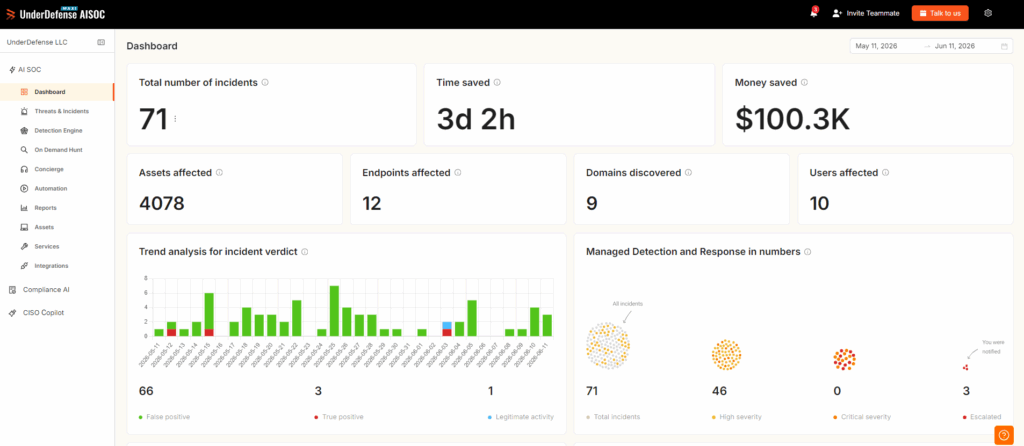
UnderDefense runs an Agentic AI SOC on top of the SIEM and EDR tools you already pay for. The core idea is simple. You bought the Lego bricks. You should own the business logic you build with them, rather than rent it back from a vendor.
I have watched tool sprawl grow from four products in 2007 to roughly seventy today. Buyers change platforms constantly. So we built the model around your stack, not ours, which lets us plug into Splunk, Elastic, QRadar, LogRhythm, Sentinel, or CrowdStrike. You can see the UnderDefense Agentic AI SOC platform here.
Core Services
- 24/7 managed detection and response across your existing SIEM and EDR
- SIEM-agnostic co-management with deep Elastic plus Splunk, QRadar, and LogRhythm support
- Alert tuning and noise reduction, often within the first week
- Concierge SOC analysts who escalate with full context
- vCISO, penetration testing, and compliance support (SOC 2, ISO 27001, HIPAA)
One reviewer put the noise problem plainly. Before we stepped in, alerts came from everywhere. After, they only got pinged on things worth a look.
Why Companies Consider UnderDefense
Most mid-market teams cannot build a 24/7 SOC in this hiring market, and they do not want to rip out trusted tools to get coverage. We fill the coverage gap without a rip-and-replace, because our SOC service pulls from tools you already run.
The escalation quality matters more than the dashboard. When we hand you an incident, the context travels with it, so your team stops piecing together events across five systems.
Ideal Customer Profile
Best suited for:
- Companies with 51 to 1,000 employees needing outsourced 24/7 coverage
- Compliance-driven teams (SOC 2, ISO 27001, HIPAA) handling sensitive data
- Teams that want to keep their SIEM and avoid vendor lock-in
- Organizations replacing a black-box MDR at renewal
Commercial Model
Engagements run on a subscription tied to environment size and monitored tools, with onboarding, tuning, and ongoing advisory bundled in. Reviewers consistently flag the value as strong for the protection level, though setup takes some upfront integration time. You can review MDR pricing before you scope an engagement.
When to Shortlist
Put us on the list when you are at a Deepwatch or legacy MDR renewal and want to keep your data and rules while upgrading the response layer. We are one of eleven here, scored on the same stack-independence axis as everyone else.
Reviews
“The biggest win for me was getting actual control over our security alerts. Before the guys from UD stepped in, we were getting bombarded with alerts from all our security tools. Their team cleaned up our configurations and got the noise under control within the first week.”
– Verified User in Marketing and Advertising UnderDefense G2 Verified Review
“UnderDefense Agentic AI SOC integrates well with our systems, specifically with our SIEM, Splunk. Their team is proactive in identifying and addressing threats, providing 24/7 oversight.”
– Oleg K., Director Information Security UnderDefense G2 Verified Review
“At first, we hired them for managed SIEM service, but after they demonstrated the value of MDR, our management was motivated to act on it. Plus, their expert management of our SIEM has added to the value of our security investments and tools.”
– Yaroslava K., IT Project Manager UnderDefense G2 Verified Review
1.2 ReliaQuest, Best for AI-Forward Platform Buyers Who Want Rule Ownership at Contract End
Overview
ReliaQuest sells GreyMatter, an open-XDR layer that sits on top of your existing SIEM and security tools rather than replacing them. The pitch fits buyers who want an AI-forward operations platform but still want to keep their detection rules when the contract ends.
The structural strength here is real. GreyMatter is built to ingest from tools you already own, so it competes on the same stack-independence axis I care about. The trade-off is that the value concentrates inside their platform layer, so your workflow experience depends heavily on how deeply you adopt GreyMatter itself.
Core Services
- GreyMatter open-XDR detection and response layer over your SIEM
- 24/7 monitoring with automated response playbooks
- Threat hunting and detection engineering
- Attack surface and exposure management
- Rule portability designed for exit at contract end
Why Companies Consider ReliaQuest
Enterprises with a mature stack often want automation and speed without abandoning existing investments. ReliaQuest positions GreyMatter as the connective tissue that unifies telemetry across tools, which appeals to larger teams juggling multiple platforms.
For AI-forward buyers, the automation story is the draw. The honest caveat is that heavy automation can outrun context, a pattern operators see across the whole category, so the human escalation quality still deserves scrutiny during a POC. Our own AI SOC explainability work centers on exactly that gap.
Ideal Customer Profile
Best suited for:
- Mid-to-large enterprises with an established SIEM and multiple security tools
- Teams wanting an open-XDR layer instead of a rip-and-replace platform
- Buyers prioritizing automation and detection-rule ownership at exit
- Organizations comfortable adopting a vendor platform as their daily workflow
Commercial Model
ReliaQuest typically operates on an enterprise subscription scaled to environment size and data sources, with onboarding and ongoing detection engineering included. Contracts tend to suit larger budgets than pure mid-market teams.
When to Shortlist
Shortlist ReliaQuest when you want an AI-forward open-XDR layer, already run a SIEM worth keeping, and want contractual clarity on rule ownership before you sign. It pairs naturally against UnderDefense and Expel when stack independence is your scoring axis, and the ReliaQuest alternatives comparison is worth a read before you commit.
1.3 Expel, Best for Endpoint-First Transparent Operations
Overview
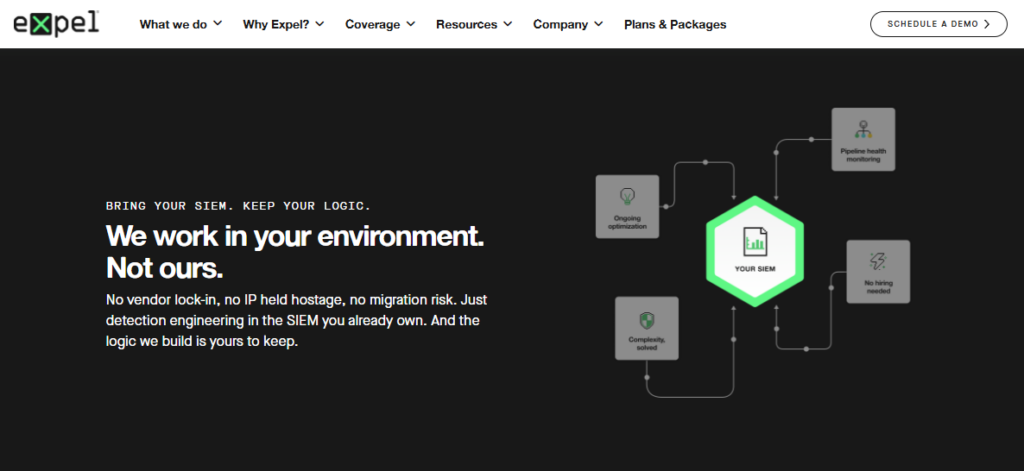
Expel runs a transparent managed detection and response service on top of your existing tools. It leans hard on automation to filter noise, then puts human analysts on what actually matters. Buyers pick it when they want to see the work, not just the verdict.
The structural strength is transparency. You can watch alerts move through triage inside the console, which many black-box services never let you do.
Core Services
- 24x7x365 monitoring across endpoints, cloud, and SaaS
- Automated alert filtering with human investigation on top
- Broad API integrations into an existing security stack
- Incident triage and response guidance
Why Companies Consider Expel
Small internal SOC teams use Expel as a force multiplier, so their people focus on higher-order work while Expel handles first-line triage. The honest trade-off is organizational context. An external provider retains limited knowledge of your environment, so verification requests back to your team can get repetitive.
Ideal Customer Profile
Best suited for:
- Endpoint-first teams wanting transparent triage
- Small internal SOCs needing 24/7 SOC coverage
- Cloud and SaaS-heavy environments
Commercial Model
Expel runs on a subscription scaled to environment size and data sources, with onboarding included. Buyers should validate roadmap commitments during contracting, since at least one customer saw a promised GovCloud feature dropped after signing.
When to Shortlist
Shortlist Expel when transparent, endpoint-first operations matter more than deep own-SIEM co-management.
Reviews
“The automations for filtering alerts from a variety of different services are excellent. The ability to submit an issue for investigation based on user, device, etc. and quickly see high volumes of information from multiple systems pulled together in one place speeds responsiveness tremendously.”
– Verified User in Non-Profit Organization Management Expel G2 Verified Review
“Lack of support for EKS in AWS GovCloud. This was promised to us before we signed our contract, but later was removed from the roadmap. GovCloud is an essential part of our business and this lack of support leaves a large gap in our monitoring and alerting.”
– Verified User in Manufacturing Expel G2 Verified Review
Where transparent triage matters, we take it further by keeping the investigation inside the SIEM and tools you already own, so the audit trail stays with you at contract end. That is the core of our managed SIEM co-management model.
1.4 Arctic Wolf, Best for a Packaged, Concierge Managed Experience
Overview
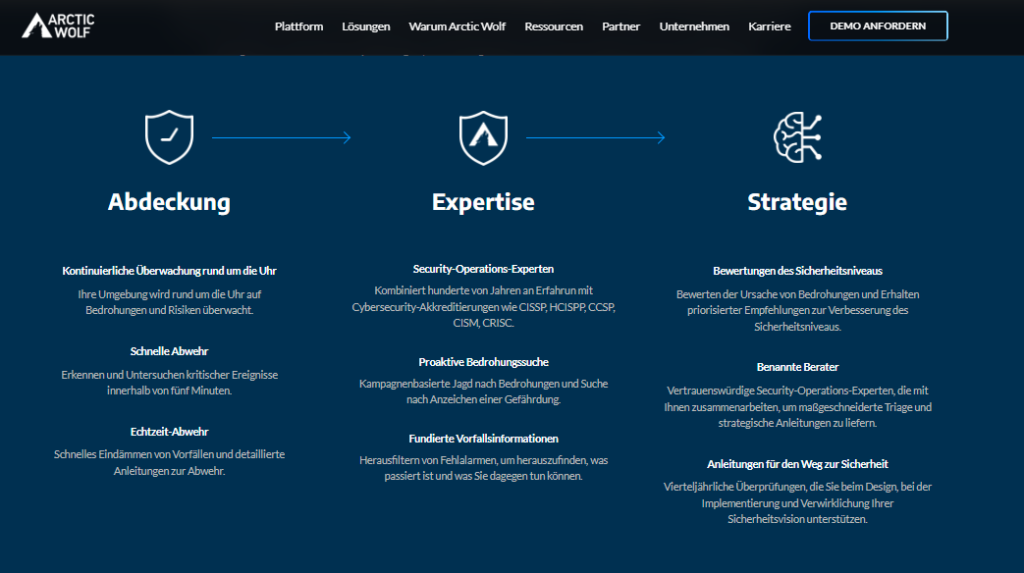
Arctic Wolf delivers a packaged, fully managed SOC experience built around its Concierge Security model. You get a named security team rather than raw tooling, which suits organizations that want a hands-off partner.
The strength is the relationship layer. Many buyers value the concierge model and account management. The permanent trade-off is control. Changes and investigations route through their engineering team, so hands-on teams can feel boxed out.
Core Services
- 24/7 managed detection and response
- Cloud and endpoint monitoring
- Vulnerability and risk management
- Incident response support
- Compliance readiness (SOC 2, HIPAA, PCI DSS)
Why Companies Consider Arctic Wolf
Teams without budget or talent to run an internal SOC lean on the packaged model to reduce overhead. The caveat that surfaces in reviews is remediation depth. Some buyers report the service leans on the client’s own team to actually fix things.
Ideal Customer Profile
Best suited for:
- Companies wanting a packaged, hands-off SOC
- Compliance-driven teams handling customer data
- Security-lean teams needing outsourced expertise
Commercial Model
Arctic Wolf runs on subscription pricing tied to organization size and monitored assets. Watch the contract terms. One reviewer flagged a 60-day renewal notice window instead of the typical 30 days. If you are weighing options here, our Arctic Wolf alternatives comparison is worth a read.
When to Shortlist
Shortlist Arctic Wolf when a packaged concierge experience matters more than deep control of your own stack.
Reviews
“Arctic Wolf provides Solid detection and response capabilities, but overly relies on the clients team for remediation, which really hurts the value of the service.”
– VP of Technology Arctic Wolf Gartner Verified Review
“Anything you want to look at or changes you need to make in the product must go through their engineering team. As an MSP, this is a horrible way to do business for us.”
– Matt C., Manager, Cybersecurity Services Arctic Wolf G2 Verified Review
That routing bottleneck is the structural cost of a packaged model. We built the opposite tradeoff, keeping your data and rules in your hands so you never wait on a vendor’s engineering queue to see your own environment.
1.5 Red Canary, Best for Microsoft-Heavy Endpoint Detection
Overview
Red Canary is known for deep endpoint detection engineering, especially across Microsoft and CrowdStrike telemetry. Buyers praise the threat hunting and detection teams as genuinely strong.
The strength is detection craft. The threat hunting team earns repeat praise from customers. The structural trade-off is SIEM independence. Red Canary leans heavily on CrowdStrike and lacks native alert-ingestion integrations with Splunk or other SIEMs, so teams build custom API scripts.
Core Services
- 24/7 endpoint detection and response
- Threat hunting and detection engineering
- Cloud and identity monitoring
- Automation for end-user-created playbooks
Why Companies Consider Red Canary
Microsoft-heavy shops value the noise reduction across SIEM log sources and the transparent, responsive staff. The recurring caveat is detection gaps. Some customers expected alerts that never surfaced, including during penetration tests.
Ideal Customer Profile
Best suited for:
- Microsoft and CrowdStrike-centric endpoint teams
- Organizations wanting strong detection engineering
- Teams with an internal SOC seeking extra oversight
Commercial Model
Red Canary runs on subscription pricing tied to monitored endpoints and data sources, with onboarding support. Account continuity is worth checking, since some reviewers cited multiple rep changes.
When to Shortlist
Shortlist Red Canary for endpoint-first detection depth, and confirm SIEM ingestion fits if you run Splunk or QRadar.
Reviews
“Red Canary first and foremost has reduced the amount of noise we were getting from our various log sources in our SIEM. Set up relatively seamless. Every staff member at Red Canary we have worked with has been a pleasure to work with and has been transparent.”
– Verified User in Computer Software Red Canary G2 Verified Review
“Over the past few years, weve undergone several external penetration tests, and during these assessments, Red Canary was not able to identify the malicious activity while the tests were ongoing. Also, they do not have any sort of alert ingestion integrations with Splunk or other SIEM platforms, and we needed to rely on custom API scripts to ingest alerts into our SIEM.”
– Verified User in Insurance Red Canary G2 Verified Review
That SIEM gap is the recurring theme when endpoint-first tools meet a Splunk or QRadar shop. We co-manage the SIEM you already own with deep Elastic plus Splunk and QRadar support, so alert ingestion is native rather than a custom script you maintain.
1.6 eSentire, Best for Regulated Mid-to-Large Enterprises Wanting a Named Response Team
Overview
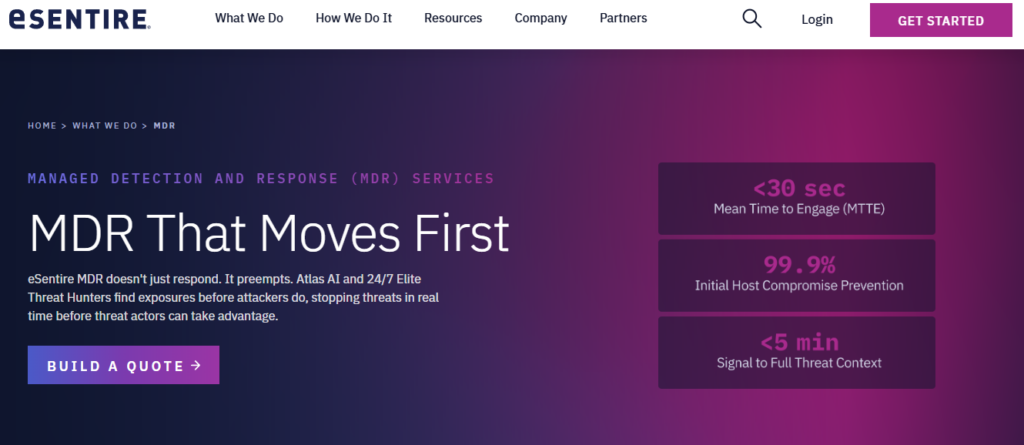
eSentire delivers managed detection and response through its Atlas platform, with a named response team model that appeals to regulated enterprises. The pitch centers on accountable, human-led response backed by an aggressive service commitment.
The strength is response ownership. eSentire is known for taking containment actions rather than just alerting. The trade-off is platform gravity, since much of the value concentrates in the Atlas platform layer you adopt.
Core Services
- 24/7 managed detection and response via Atlas
- Named response team with containment actions
- Network, endpoint, log, and cloud coverage
- Threat intelligence and hunting
Why Companies Consider eSentire
Regulated mid-to-large enterprises want a named team accountable for outcomes, not a rotating queue. The honest caveat is that a platform-anchored model still concentrates telemetry and workflow inside the vendor’s environment.
Ideal Customer Profile
Best suited for:
- Regulated mid-to-large enterprises (finance, healthcare)
- Teams wanting a named, accountable response team
- Organizations prioritizing fast containment
Commercial Model
eSentire runs on enterprise subscription pricing scaled to coverage scope and data sources, typically suited to larger budgets.
When to Shortlist
Shortlist eSentire when a named response team and containment ownership rank above keeping your own SIEM. For regulated buyers, our MDR for healthcare practice covers the same accountability need without platform gravity.
1.7 Binary Defense, Best for Co-Managed SIEM Without Proprietary Lock
Overview
Binary Defense focuses on co-managed SIEM and open-tool operations. Buyers pick it when they want a partner to run the SIEM alongside them without forcing a proprietary platform.
The strength is co-management philosophy, which sits close to the stack-independence axis this whole list scores on. The trade-off is scale and brand reach, since it competes against much larger, better-funded platforms.
Core Services
- Co-managed SIEM operations
- 24/7 SOC monitoring and threat hunting
- Endpoint detection and response management
- Counterintelligence and threat research
Why Companies Consider Binary Defense
Teams that already own a SIEM and want to keep it value the co-managed, open-tool approach. The caveat is that a smaller provider may offer narrower integrations than the largest platforms.
Ideal Customer Profile
Best suited for:
- Teams keeping an existing SIEM
- Organizations avoiding proprietary lock-in
- Mid-market security teams wanting co-management
Commercial Model
Binary Defense runs on subscription pricing tied to monitored data sources and coverage scope, with SOC services bundled.
When to Shortlist
Shortlist Binary Defense when co-managed SIEM without proprietary lock is your core requirement.
We share that co-managed, no-lock philosophy, and pair it with an Agentic AI SOC layer so routine triage scales through automation while our analysts own the edge cases. You can see how that works on the UnderDefense Agentic AI SOC platform.
1.8 Proficio, Best for Global Follow-the-Sun SOC Coverage
Overview
Proficio runs a global network of SOCs to deliver follow-the-sun coverage, meaning analysts hand off across time zones for continuous eyes-on-glass. Buyers pick it when global reach and around-the-clock human coverage matter most.
The strength is geographic breadth. Multiple regional SOCs support truly continuous monitoring. The trade-off is that a broad global model can feel less tailored to a single mid-market environment.
Core Services
- Global follow-the-sun SOC monitoring
- Managed detection and response
- SIEM management and threat hunting
- Automated response playbooks
Why Companies Consider Proficio
Distributed enterprises want continuous human coverage across regions without staffing night shifts internally. The caveat is customization depth, since large global operations can standardize workflows more than smaller teams like.
Ideal Customer Profile
Best suited for:
- Globally distributed enterprises
- Teams needing continuous human coverage
- Organizations spanning multiple time zones
Commercial Model
Proficio runs on enterprise subscription pricing scaled to coverage scope, data sources, and regions monitored.
When to Shortlist
Shortlist Proficio when global follow-the-sun human coverage is your top requirement.
1.9 Alert Logic, Best for Cloud and Web-Application-Centric Monitoring
Overview
Alert Logic (now under Fortra) focuses on cloud and web-application monitoring, with strong AWS integration. Buyers often pick it to check a compliance box while gaining cloud visibility.
The strength is cloud and web-app coverage, especially AWS visibility that customers rate as genuinely useful. The trade-off is setup and support consistency. Reviewers cite manual configuration, thin documentation, and uneven support responsiveness.
Core Services
- Cloud and web-application monitoring
- Managed detection and response
- Vulnerability scanning and FIM
- Compliance support (PCI DSS, HIPAA)
Why Companies Consider Alert Logic
Compliance-driven and AWS-heavy teams value the bundled SIEM, MDR, and vulnerability management for the cost. The recurring caveat is accuracy and detection depth, with some reviewers reporting missed critical issues.
Ideal Customer Profile
Best suited for:
- AWS and cloud-centric teams
- Compliance-driven organizations (PCI DSS)
- Teams wanting a bundled cloud security package
Commercial Model
Alert Logic runs on subscription pricing tied to coverage and data volume. Watch the log-collection cap, since one reviewer flagged a 50GB-per-day limit that was not clear during buying.
When to Shortlist
Shortlist Alert Logic for cloud and web-app monitoring, and validate detection accuracy in a strong POC. Teams building on AWS may also want our cloud security services for deeper coverage.
Reviews
“Having a 247 SOC that we dont have to manage is hands down my favorite. In addition to this, the reports run and are delivered on the schedule that weve selected.”
– Monique L., Product Security Sr. Analyst Alert Logic G2 Verified Review
“The product has good integration with AWS which was critical, but the setup and configuration of the product is terrible. Everything is a very manual process and the documentation is horrible.”
– IT InfoSec Manager Alert Logic Gartner Verified Review
Bundled cloud packages often trade detection depth for a compliance checkbox. We treat compliance as an outcome our virtual CISO team documents on top of real detection, so the audit evidence reflects genuine monitoring rather than a checkbox.
1.10 CriticalStart, Best for Signal-to-Resolution Transparency
Overview
CriticalStart is built around its Trusted Behavior Registry and a zero-trust triage philosophy, meaning it resolves every alert to a verdict rather than sampling. Buyers pick it when they want signal-to-resolution transparency.
The strength is the resolve-everything model, which reduces the risk of an ignored alert becoming an incident. The trade-off is that a high-volume, resolve-all approach depends heavily on tuning quality to avoid workload spikes.
Core Services
- Managed detection and response
- Trusted Behavior Registry for triage
- 24/7 SOC monitoring
- Mobile app for analyst collaboration
Why Companies Consider CriticalStart
Teams burned by sampled or ignored alerts value a model that drives every alert to resolution. The caveat is that transparency depends on how well detections are tuned to your environment.
Ideal Customer Profile
Best suited for:
- Teams wanting every alert resolved
- Organizations prioritizing triage transparency
- Mid-market security teams needing 24/7 coverage
Commercial Model
CriticalStart runs on subscription pricing scaled to monitored data sources and endpoints, with SOC services included.
When to Shortlist
Shortlist CriticalStart when signal-to-resolution transparency ranks above own-SIEM co-management.
1.11 Dropzone AI, Best for AI-Native Alert Investigation as a Layer
Overview
Dropzone AI is an AI-native alert investigation layer, meaning it runs an autonomous AI analyst that investigates alerts before a human sees them. It sits on top of your existing stack rather than replacing your SOC.
The strength is investigation speed. The AI analyst can triage large alert volumes fast. The honest trade-off is that an AI layer handles investigation, but you still need response ownership and human judgment on the edge cases.
Core Services
- AI-native autonomous alert investigation
- Integration with existing SIEM and EDR
- Automated triage and enrichment
- Analyst-ready investigation reports
Why Companies Consider Dropzone AI
Lean teams drowning in alerts want an AI layer to cut triage time before escalation. The caveat is scope, since investigation is one part of security operations and response still needs an owner.
Ideal Customer Profile
Best suited for:
- Lean SOC teams with high alert volume
- Organizations adding an AI triage layer
- Teams keeping their existing SIEM and EDR
Commercial Model
Dropzone AI runs on subscription pricing tied to alert volume and connected data sources.
When to Shortlist
Shortlist Dropzone AI when you want an AI investigation layer on top of an existing SOC, rather than a full managed service.
Here is where I will hedge a claim I have earned the right to make. An AI layer alone does not resolve incidents at 2 AM. The resilient model is human plus automation, where automation scales routine triage and analysts own the edge cases. That is exactly how we run UnderDefense Agentic AI SOC, an Agentic AI SOC that pairs AI-driven detection with concierge analysts on top of the SIEM you already own.
Q2: How Were These Deepwatch Alternatives Selected and Scored?
Each provider was scored against five weighted criteria that decide a managed SIEM renewal: SIEM Portability and Rule Ownership (30%), Resolve-vs-Escalate Response (25%), Environment Coverage (20%), Pricing and Exit Transparency (15%), and Verified Customer Proof (10%). Scores map to stars: 0-20% one star, 21-40% two, 41-60% three, 61-80% four, and 81-100% five.
Why Portability Carries the Most Weight
I weighted portability highest for a reason I have watched play out at renewal after renewal. When your detection logic lives in a vendor’s console, leaving means rebuilding everything you paid to create. That is a switching cost, so it belongs at the top of the rubric. Our guide on avoiding vendor lock-in walks through the mechanics.
The second-heaviest weight goes to resolve-vs-escalate, meaning whether a provider closes an alert or just forwards it to you. This matters because analysts drown in noise. Research from Tariq et al. (2025, ACM) found that 51% of security teams feel overwhelmed by alerts, and more than a quarter of analyst time goes to chasing false positives. We cover this pattern in depth in our piece on alert fatigue in cybersecurity.
The Weighting Table
| Criterion | Weight |
|---|---|
| SIEM Portability and Rule Ownership | 30% |
| Resolve-vs-Escalate Response | 25% |
| Environment Coverage (cloud, hybrid, on-prem, identity, SaaS) | 20% |
| Pricing and Exit Transparency | 15% |
| Verified Customer Proof (Gartner Peer Insights, G2) | 10% |
| Total | 100% |
Here is the operational bar I use for that resolve-vs-escalate score. A real investigation runs 40 to 50 queries across six different tools, line by line. A provider that hands you the alert without doing that work is not resolving anything.
How the Stars Map
The star bands are simple, so a CFO or procurement lead can read them at a glance. Five stars means a provider scores 81% or higher across the weighted criteria.
UnderDefense scores five stars on this rubric, driven by breadth: multi-environment coverage, own-cloud deployment, and detection logic you can export as code. I want to be honest about one limitation. UnderDefense is not on the Forrester Wave, while four of the listed alternatives are named Leaders there.
That gap is worth naming, because a Wave placement is a real signal for some buyers. My read is that the rubric above measures what actually bites you at renewal, which is ownership and response quality. Detection logic as code is the mechanism that makes rule ownership real rather than a slide in a sales deck, and it sits at the core of our managed SIEM co-management approach.
Q3: What Does Vendor Lock-In Actually Mean in Managed SIEM, and How Is It Different from MDR or SOC-as-a-Service?
Vendor lock-in in managed SIEM happens when the provider’s own platform sits in your data path, so leaving means losing the rules and pipeline you paid to build. SIEM-agnostic management changes only the response layer while your SIEM, logs, and rules stay yours. Managed SIEM runs your detection layer, MDR adds active response, and SOC-as-a-Service runs the whole function.
Two Management Models, One Big Difference
There are two ways a provider can manage your SIEM (Security Information and Event Management, the system that collects and correlates your logs). In the first, their platform sits in the middle of your data. In the second, they operate the SIEM you already own and touch nothing you cannot take back.
Think of the anchored model like an M&M. Hard candy shell outside, soft center within. One stolen SaaS token slips past the shell, and the defenseless center is wide open.
What Happens When the Contract Ends
When an anchored contract ends, your detection rules often stay behind in the vendor’s console. That is the real reason many teams leave a platform-coupled provider. Once you see how much flexibility and cost the coupling adds, the renewal math changes.
I will not frame this as anyone being a bad actor. It is a consequence of the model, not a support failure. Coupling is an economics and flexibility decision you should make with eyes open.
Managed SIEM vs MDR vs SOC-as-a-Service
Here is the plain-English split:
- Managed SIEM: a partner runs your detection layer on your SIEM.
- MDR: adds active response, so someone contains the threat.
- SOC-as-a-Service: runs your entire security operations function.
The line blurs in marketing, so ask what each provider actually owns. If you want a deeper breakdown, our managed SIEM vs MDR vs MSSP comparison lays out the boundaries. A useful frame comes from Mohsin et al. (2025, arXiv 2505.23397) on AI autonomy tiers: does the AI decide and act, or does it collect context so a human decides?
The Portability Test
The cleanest test for lock-in is detection logic as code. If your rules are portable files rather than console artifacts, you can move them. At UnderDefense, we keep your data and rules yours, and you can run on-prem or in your own cloud across Azure, GCP, AWS, or Oracle. That flexibility is central to our SOC service.
Automating a locked-in bad process is not a strategy. You just get faster at executing the underlying brokenness. Portability is what keeps you from paying twice for logic you already own.
Q4: Which Stack-Independence Criteria Should You Check Before You Re-Sign?
Before re-signing, score any provider on eight points: rule and intelligence ownership at contract end, whether a proprietary layer sits in the data path, SIEM portability across Splunk, Elastic, QRadar, LogRhythm, and Darktrace, where your logs live and whether they stay in your own cloud, pricing model, resolve-vs-escalate posture, environment coverage, and exit mechanics.
Why Feature Comparisons Miss the Point
Most renewal decks compare features side by side. That misses the real question, which is what you keep when you leave. A feature you cannot export is a feature you are renting, not owning. Our managed SIEM evaluation questions help you pressure-test that gap.
The threat data backs the urgency. Mandiant M-Trends 2025 reports attacker breakout times near 48 minutes, with living-off-the-land techniques in 79% of intrusions and credential misuse in over 65%. That is why identity coverage and time-to-contain belong in any serious rubric.
The Eight-Point Stack-Independence Matrix
| Criterion | Procurement Question |
|---|---|
| Rule and Intelligence Ownership | Do we keep our detections at contract end? |
| Data Path | Does a proprietary layer sit in our data flow? |
| SIEM Portability | Does it run on Splunk, Elastic, QRadar, LogRhythm, or Darktrace? |
| Data Residency | Do logs stay in our own cloud? |
| Pricing Model | CAPEX, OPEX, or per-seat, and is it predictable? |
| Resolve-vs-Escalate | Do they close alerts or just forward them? |
| Environment Coverage | Cloud, hybrid, on-prem, identity, and SaaS? |
| Exit Mechanics | How clean is the offboarding path? |
The One Test That Ties It Together
Run every provider through one buyer test. Does this reduce my team’s workload, or does it just add another alert feed? An added feed makes the noise worse, so it fails the test.
Here is proof the criteria are operator-tested, not marketing. When we hunt shadow-IT OAuth grants or design failover, we use logical DNS names, so one node takes over for another without a manual scramble. That is the depth behind our incident response work.
Where UnderDefense Maps
I will map us transparently across all eight. UnderDefense co-manages the SIEM you already own, offers CAPEX or OPEX options, keeps your data and rules yours, and deploys in your own cloud or on-prem. See the UnderDefense Agentic AI SOC platform here.
“The platform itself is straightforward, it pulls in data from all our existing security tools, so we didn’t have to rip and replace anything.”
– Verified User in Marketing and Advertising UnderDefense G2 Verified Review
“UnderDefense Agentic AI SOC integrates well with our systems, specifically with our SIEM, Splunk. Their team is proactive in identifying and addressing threats, providing 24/7 oversight.”
– Oleg K., Director Information Security UnderDefense G2 Verified Review
Q5: What Are the Strengths and Honest Limits of Each Alternative?
Each of the 11 entries follows the same template, so you can compare like-for-like: how they deliver managed SIEM, which SIEMs they support, what you keep at contract end, how they price, whether they resolve or escalate, who they fit, and where they fall short. A single comparison table sits on top for fast shortlisting before the detail.
At-a-Glance Comparison
| Provider | Delivery Model | SIEM Portability | Resolve vs Escalate | Honest Limit |
|---|---|---|---|---|
| UnderDefense | Agentic AI SOC on your SIEM | Broad (Splunk, Elastic, QRadar, LogRhythm) | Resolve | Not on Forrester Wave |
| ReliaQuest | GreyMatter open-XDR layer | Broad, genuine rule ownership | Resolve | Enterprise-priced |
| Expel | Transparent MDR layer | Broad via integrations | Resolve | External context limits |
| Arctic Wolf | Packaged concierge SOC | Anchored to their platform | Leans on client | Remediation depth |
| Red Canary | Endpoint-first detection | Limited SIEM ingestion | Resolve | Post-acquisition continuity |
| eSentire | Atlas platform + named team | Platform-anchored | Resolve | Platform gravity |
| Binary Defense | Co-managed SIEM | Open-tool | Mixed | Smaller scale |
| Proficio | Global follow-the-sun SOC | Broad | Resolve | Less tailored |
| Alert Logic | Cloud/web-app monitoring | Limited | Mixed | Setup and accuracy |
| CriticalStart | Resolve-all triage | Broad | Resolve | Tuning-dependent |
| Dropzone AI | AI investigation layer | Broad | Investigate only | Needs response owner |
Where the Real Divide Sits
Think of it like foot soldiers and generals. Humans click one at a time, but AI agents swarm. The providers that win are the ones treating automation and human judgment as one system, which is the logic behind our managed detection and response model.
The honest divide is architectural, not brand quality. Arctic Wolf runs a packaged, anchored model. Expel is endpoint-first with real transparency but external context limits. ReliaQuest earns genuine credit for rule ownership, which wins them large enterprise deals. If you are weighing that vendor, our ReliaQuest alternatives breakdown goes deeper.
The UnderDefense Entry
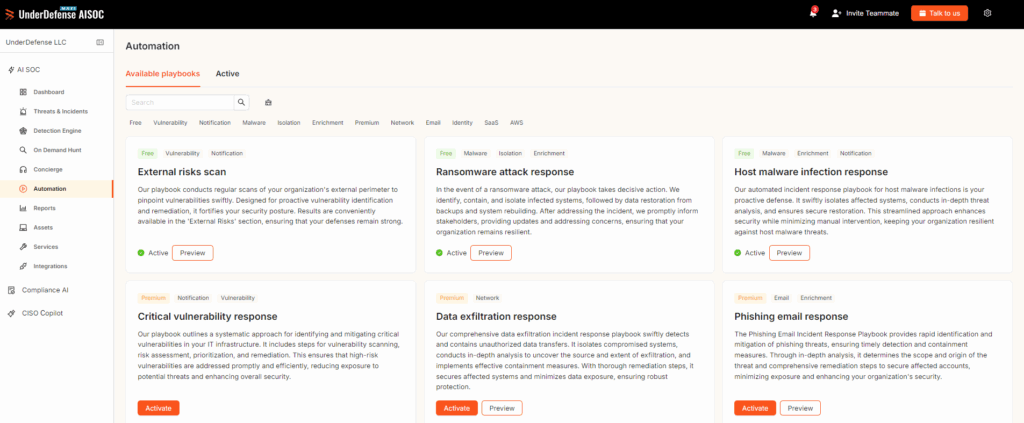
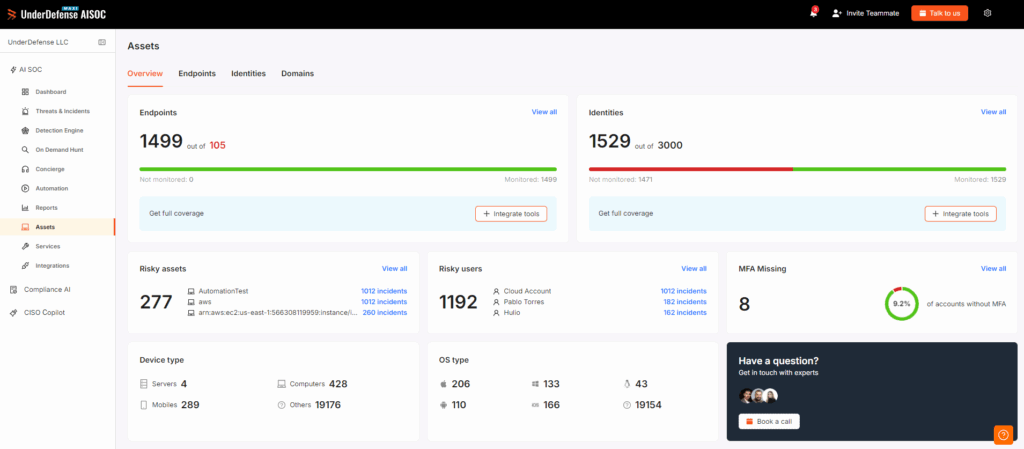
UnderDefense Agentic AI SOC is our Agentic AI SOC, and it runs on the SIEM you already own. Our MDR tier carries a breach-prevention guarantee, which is risk transfer, not a warranty on outcomes. In 30-day onboarding, we target roughly 99% alert-noise reduction with strong MITRE ATT&CK coverage. You can explore the UnderDefense Agentic AI SOC platform for the full picture.
I will state one limit plainly. We are not on the Forrester Wave, while four listed alternatives are Leaders there. My positioning rests on breadth, own-cloud deployment, and detection-as-code portability, rather than on being the only vendor offering rule ownership without lock-in.
“The biggest win for me was getting actual control over our security alerts. Their team cleaned up our configurations and got the noise under control within the first week.”
– Verified User in Marketing and Advertising UnderDefense G2 Verified Review
“Arctic Wolf provides Solid detection and response capabilities, but overly relies on the clients team for remediation, which really hurts the value of the service.”
– VP of Technology Arctic Wolf Gartner Verified Review
“They do not have any sort of alert ingestion integrations with Splunk or other SIEM platforms, and we needed to rely on custom API scripts to ingest alerts into our SIEM.”
– Verified User in Insurance Red Canary G2 Verified Review
Here is the question I keep sitting with. When agents swarm faster than humans can click, which providers will still let you own the logic they run? That is the conversation I want to have before your next renewal.
Q6: How Do You Switch Providers Without Downtime or an Audit Gap?
Switching managed SIEM providers means transferring integrations, playbooks, and detection content plus retraining, but it is bounded, not a rebuild. The lowest-risk path is a parallel run (a proof of value, not a cutover) against your existing SIEM, so you validate detection quality first. Keep logging continuous and map both providers’ controls to your framework, so evidence never lapses mid-audit.
The Real Fear Nobody Says Out Loud
I hear the same worry on every renewal call. If I switch and something breaks, I own that failure. That fear, not the incumbent, is the real competitor.
I get it. I once watched a coding agent delete a production database because nobody set guardrails first. The lesson stuck: define the plan before you let anything run, the way a good team writes a PRD (product requirements doc) before building.
Why Parallel Runs De-Risk the Move
A parallel run means the new provider watches your environment alongside the old one. You compare detection quality on real alerts before you cut anything over. No cutover, no blind leap. Our managed SIEM co-management is built to run exactly this way.
Detection-as-code makes this portable, so your rules move as files rather than trapped console settings. NIST SP 800-61 treats incident-response continuity during transition as a design requirement, not an afterthought. At UnderDefense, our 30-day onboarding targets roughly 99% alert-noise reduction as the explicit first value, with own-cloud log retention as continuity insurance. This is also where our incident response discipline earns its keep.
The 30/60/90 Path
- Days 1-30: connect tools, run parallel, tune noise, and confirm first value.
- Days 31-60: migrate playbooks and detection content, and validate coverage.
- Days 61-90: shift primary response, and decommission the old contract cleanly.
Keeping Compliance Evidence Continuous
For regulated readers, the audit gap is the scary part. Map both providers’ controls to your framework, so evidence never lapses. Our compliance services handle exactly this handoff.
Practical checklist for SOC 2 Type II, ISO 27001, PCI DSS, and HIPAA continuity:
- Keep log collection running through the entire transition.
- Preserve retention windows so audit history stays intact.
- Document control ownership handoff dates for each framework.
- Run one overlap period where both providers produce evidence.
I will be blunt after 20 years around PCI. Mapping controls both ways is real work, and skipping it turns a renewal into compliance theater. Does theater prevent an incident tomorrow? No.
Here is what I am still testing. As AI agents take more of the migration workload, can we compress that 90-day path to 45 without losing evidence integrity? I would genuinely like to compare notes if you are running a switch this year.
Q7: Should You Leave Deepwatch or Renegotiate, and What Do the TCO, Contract, and Legal Terms Look Like?
You might stay, and that is legitimate. Before assuming departure, ask your incumbent to unbundle the analytics coupling, commit rule ownership at contract end, and price transparently. For the CFO, compare total cost of ownership, not license price, against a roughly $620,000-per-year five-person in-house SOC baseline. Have Legal check egress rights, notice periods, SLAs, liability, and transition assistance.
Why Per-GB Pricing Bites at Scale
Anchored models often price on per-gigabyte ingestion, meaning cost climbs with every log you send. That makes budgets unpredictable as you grow. A quiet data-volume increase can blow up a renewal number. Our transparent managed SIEM pricing avoids that surprise.
The fix is comparing true total cost of ownership (TCO), not the sticker license price. TCO includes ingestion, tuning labor, and the hidden cost of alerts nobody resolves.
The CFO Math
| Cost Element | In-House SOC | Managed Model |
|---|---|---|
| Five-person 24/7 team | ~$620,815/year | Included |
| Tooling and SIEM ops | Additional | Bundled or co-managed |
| Ingestion predictability | – | Depends on pricing model |
A five-person 24/7 SOC runs about $620,815 per year before tools. I coach CFOs to map spend to the NIST Cybersecurity Framework on one page, so you see where money goes and where you have nothing. You can model this yourself with our SOC cost calculator. At UnderDefense, we offer transparent CAPEX or OPEX packaging with OPEX distribution through marketplaces like G2 and AWS, and you keep your data and rules.
The Six Clauses Legal Must Check
- Data ownership and egress rights at exit.
- Notice period before auto-renewal.
- SLA definitions for triage and escalation.
- Liability and indemnification limits.
- Transition assistance obligations.
- Rule and intelligence ownership at contract end.
I will be fair here. Some providers, Arctic Wolf among them, offer real financial and jurisdictional warranties, and I will not pretend everyone matches that. Our own breach-prevention guarantee is risk transfer, described accurately, and it is separate from any warranty claim.
When Staying Is the Right Call
Staying can be right. If your incumbent will unbundle coupling, commit rule ownership, and price transparently, renegotiation may beat migration. Use these three asks as leverage, since a provider confident in its value will meet them. If you want a second opinion, our team can review your terms before you re-sign.
Reframe the renewal as a review the CISO runs, not one the vendor runs on you. TCO plus real ownership of your rules and intelligence is what wins enterprise trust.
Here is my honest close. Being a human who reads your own contract is a flex in 2026. What would it take for your incumbent to earn the re-sign on your terms, not theirs?
See tuned SIEM triage in action.
1. What are the best Deepwatch alternatives for managed SIEM in 2026?
We rank eleven providers worth scoring at a Deepwatch renewal, and we chose them because each changes the management and response layer while you keep your data, rules, and exit rights.
- UnderDefense, best for keeping your own SIEM with detection-as-code portability.
- ReliaQuest, best for AI-forward buyers wanting rule ownership at exit.
- Expel, best for endpoint-first transparent operations.
- Arctic Wolf, best for a packaged concierge experience.
- Red Canary, best for Microsoft-heavy endpoint detection.
- eSentire, Binary Defense, Proficio, Alert Logic, CriticalStart, and Dropzone AI round out the list.
The shared axis is stack independence, not raw detection prowess. Every vendor here can find threats, so the real question is who keeps your data, your rules, and your right to walk away. We built our managed SIEM co-management model around that principle, plugging into Splunk, Elastic, QRadar, LogRhythm, or Sentinel rather than replacing them. That is the lens we would carry into any RFP.
2. What does vendor lock-in actually mean in managed SIEM?
Vendor lock-in in managed SIEM happens when the provider’s own platform sits in your data path, so leaving means losing the rules and pipeline you paid to build.
There are two management models. In the first, the provider’s platform sits in the middle of your data. In the second, they operate the SIEM you already own and touch nothing you cannot take back.
- Anchored model: detection rules often stay behind in the vendor’s console when the contract ends.
- SIEM-agnostic model: your SIEM, logs, and rules stay yours, and only the response layer changes.
The cleanest test for lock-in is detection logic as code. If your rules are portable files rather than console artifacts, you can move them. We keep your data and rules yours, and you can run on-prem or in your own cloud, which is exactly why we wrote our guide on avoiding vendor lock-in. Coupling is an economics and flexibility decision, so make it with eyes open before you re-sign.
3. How is managed SIEM different from MDR and SOC-as-a-Service?
The three categories blur in marketing, so we define them by what the provider actually owns.
- Managed SIEM: a partner runs your detection layer on your SIEM.
- MDR: adds active response, so someone contains the threat.
- SOC-as-a-Service: runs your entire security operations function.
The distinction matters because a proposal labeled MDR may only forward alerts, while another labeled managed SIEM may resolve them. The right question is not the label but whether the provider closes an alert or just hands it back to you.
We recommend asking each vendor to map their scope against these three definitions in writing, then checking it against a resolve-versus-escalate standard. A real investigation runs 40 to 50 queries across six tools, so a provider that forwards the alert without doing that work is not resolving anything. Our breakdown of managed SIEM versus MDR versus MSSP lays out the boundaries so you can compare proposals on equal terms rather than on marketing language.
4. How were these Deepwatch alternatives selected and scored?
We scored each provider against five weighted criteria that decide a managed SIEM renewal, and we weighted portability highest because switching cost is the real renewal tax.
- SIEM Portability and Rule Ownership: 30 percent.
- Resolve-vs-Escalate Response: 25 percent.
- Environment Coverage: 20 percent.
- Pricing and Exit Transparency: 15 percent.
- Verified Customer Proof: 10 percent.
Scores map to stars, where five stars means a provider clears 81 percent across the weighted criteria. We weighted resolve-versus-escalate second because analysts drown in noise, and research shows a majority of security teams feel overwhelmed by alerts.
We are honest about our own limit. UnderDefense is not on the Forrester Wave, while four listed alternatives are named Leaders there. Our positioning rests on breadth, own-cloud deployment, and detection-as-code portability instead. If you want to run the same rubric yourself, our managed SIEM evaluation questions turn these criteria into procurement questions.
5. How do you switch managed SIEM providers without downtime or an audit gap?
Switching means transferring integrations, playbooks, and detection content plus retraining, but it is bounded, not a rebuild. The lowest-risk path is a parallel run against your existing SIEM, so you validate detection quality before any cutover.
- Days 1 to 30: connect tools, run parallel, tune noise, and confirm first value.
- Days 31 to 60: migrate playbooks and detection content, and validate coverage.
- Days 61 to 90: shift primary response, and decommission the old contract cleanly.
Detection-as-code makes this portable, so your rules move as files rather than trapped console settings. For regulated readers, keep log collection running through the entire transition, preserve retention windows, and run one overlap period where both providers produce evidence, so nothing lapses mid-audit.
Our 30-day onboarding targets roughly 99 percent alert-noise reduction as the explicit first value, with own-cloud log retention as continuity insurance. We run this through our SOC service as a parallel evaluation before you change a thing.
6. Should you leave Deepwatch or renegotiate your contract?
You might stay, and that is legitimate. Before assuming departure, we recommend asking your incumbent three things.
- Unbundle the analytics coupling from the service.
- Commit rule and intelligence ownership at contract end.
- Price transparently rather than on opaque per-gigabyte ingestion.
Use these asks as leverage, since a provider confident in its value will meet them. Reframe the renewal as a review the CISO runs, not one the vendor runs on you.
On the numbers, compare true total cost of ownership, not the sticker license price, against a roughly $620,000-per-year five-person in-house SOC baseline. TCO includes ingestion, tuning labor, and the hidden cost of alerts nobody resolves. Have Legal check egress rights, notice periods, SLAs, liability, and transition assistance before you sign anything. If you want a second set of eyes on rule ownership, data egress, and exit terms, our team runs stack-independence and contract reviews before enterprises re-sign.
7. Which stack-independence criteria should you check before you re-sign?
Before re-signing, we score any provider on eight points, because a feature you cannot export is a feature you are renting, not owning.
- Rule and intelligence ownership: do you keep detections at contract end?
- Data path: does a proprietary layer sit in your data flow?
- SIEM portability: does it run on Splunk, Elastic, QRadar, LogRhythm, or Darktrace?
- Data residency: do logs stay in your own cloud?
- Pricing model, resolve-vs-escalate posture, environment coverage, and exit mechanics complete the matrix.
Run every provider through one buyer test. Does this reduce my team’s workload, or does it just add another alert feed? An added feed makes the noise worse, so it fails the test. The threat data backs the urgency, with attacker breakout times near 48 minutes in recent reporting. We map ourselves transparently across all eight points, and our managed detection and response keeps your data and rules yours across your own cloud or on-prem.
8. What does managed SIEM cost compared with building an in-house SOC?
The honest comparison is total cost of ownership, not license price. A five-person 24/7 in-house SOC runs about $620,815 per year before tools, so the managed question is whether a partner delivers equivalent coverage for less unpredictability.
- In-house: salary-heavy, plus separate tooling and SIEM operations cost.
- Managed: coverage bundled or co-managed, though ingestion predictability depends on the pricing model.
Anchored models often price on per-gigabyte ingestion, meaning cost climbs with every log you send, which makes budgets unpredictable as you grow. A quiet data-volume increase can blow up a renewal number, so we always model TCO including ingestion, tuning labor, and the hidden cost of unresolved alerts.
We offer transparent CAPEX or OPEX packaging with OPEX distribution through marketplaces like G2 and AWS, and you keep your data and rules. To pressure-test the math for your own environment, our SOC cost calculator lets you compare in-house staffing against a managed model on one page.