




Q1. What Are the 9 Best AI SOC Platforms for SaaS Companies in 2026?
The nine best AI SOC platforms for SaaS companies in 2026 are UnderDefense MAXI, CrowdStrike Falcon with Charlotte AI, Microsoft Sentinel with Security Copilot, Palo Alto Cortex XSIAM, Google Security Operations, Dropzone AI, Prophet Security, Torq HyperSOC, and Stellar Cyber. UnderDefense ranks first for SaaS teams needing agentic triage plus human containment across identity, OAuth, and CI/CD telemetry with no vendor lock.
Choosing an AI SOC platform is a high-stakes call for a SaaS company, because the wrong pick locks your logs, your detections, and your audit evidence inside one vendor for three years. We evaluated these nine platforms on SaaS-native telemetry coverage, autonomy depth, human response ownership, integration openness, and pricing transparency. This guide is written for CISOs, CTOs, and IT Directors at software companies with roughly 50 to 1,000 employees who are shortlisting for an RFP rather than reading a category primer.
Ranked Shortlist
- UnderDefense MAXI Best overall for SaaS: Agentic AI SOC plus concierge human response, vendor-agnostic, transparent pricing
- CrowdStrike Falcon and Charlotte AI Best if you are already all-in on Falcon endpoint
- Microsoft Sentinel and Security Copilot Best for Entra and Microsoft 365-centric SaaS stacks
- Palo Alto Cortex XSIAM Best for teams consolidating onto one platform
- Google Security Operations Best for petabyte-scale search and Workspace-native telemetry
- Dropzone AI Best drop-in autonomous triage layer over an existing SIEM
- Prophet Security Best lightweight AI SOC analyst for very lean teams
- Torq HyperSOC Best for engineering-heavy orgs that build their own automation logic
- Stellar Cyber Best Open XDR foundation with multi-tenant support
Side-by-Side Comparison
| Provider | Best For | Key Strength | Compliance |
| UnderDefense MAXI 5 stars | SaaS teams without a 24/7 in-house SOC | Agentic triage plus named analysts who act, across tools you already own | SOC 2, ISO 27001, HIPAA, and PCI DSS evidence and reporting support |
| CrowdStrike Falcon and Charlotte AI 4 stars | Existing Falcon endpoint estates | Endpoint-first detection depth, 100% detection in the 2025 MITRE ATT&CK Enterprise Evaluation | Broad framework mapping, six-figure tiers common |
| Microsoft Sentinel and Security Copilot 4 stars | Entra ID and Microsoft 365 shops | Native identity and productivity telemetry | Strong Microsoft-centric audit evidence |
| Palo Alto Cortex XSIAM 4 stars | Consolidation programs | Unified data model across domains | Enterprise framework coverage |
| Google Security Operations 4 stars | Workspace-native, high-volume logging | Petabyte-scale search and long retention | Retention depth suits audit evidence |
| Dropzone AI 4 stars | Teams keeping their SIEM | Autonomous triage layered on existing pipelines | Investigation trails support SOC 2 monitoring |
| Prophet Security 3 stars | Very lean security teams | Fast agentic triage with low setup weight | Evidence output improving |
| Torq HyperSOC 3 stars | Engineering-heavy orgs | Deterministic automation you author yourself | Deterministic playbooks help regulated tenants |
| Stellar Cyber 3 stars | MSSPs and multi-tenant estates | Open XDR with tenant separation | Multi-tenancy supports segmented reporting |
The Lego Brick Test
Before the deep dives, here is the filter I apply on every vendor call. I want all the Lego bricks, and then I want to build my own platform on top.
If a platform hands you bricks you can inspect, rebuild, and take with you, it passes. If part of it is a black box you cannot open, that part will fail you at 3 a.m. Ask to see the investigation, line by line, on your own alert.
1.1 UnderDefense MAXI
Best for SaaS teams that need agentic triage plus humans who actually contain the incident
Overview
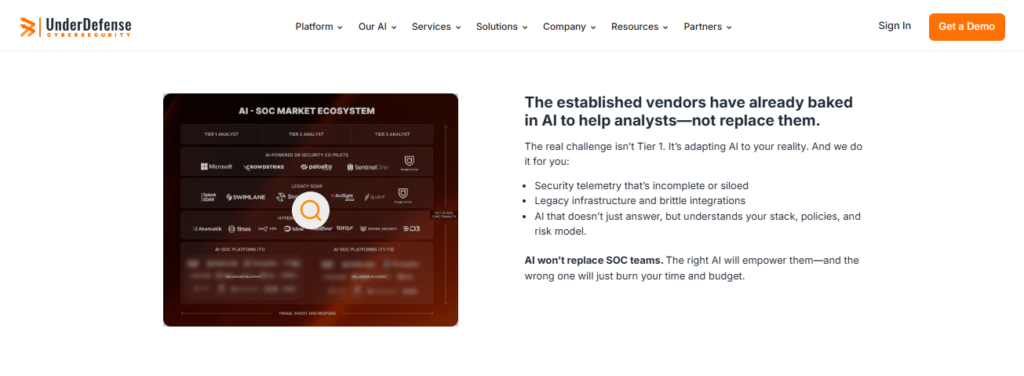
UnderDefense MAXI is an Agentic AI SOC platform that triages, investigates, and escalates across the security tools a SaaS company already owns. The UnderDefense MAXI platform sits on top of your SIEM, EDR, cloud, and identity provider rather than replacing them.
We built it that way for a simple reason. Most SaaS companies already paid for good tools, and their real gap is coverage at 2 a.m.
Core Services
- Agentic AI triage and investigation across identity, cloud, SaaS admin, and endpoint logs
- 24/7 threat hunting with named analysts who execute containment
- Managed SIEM tuning and log-noise reduction
- Incident response and forensic support
- Compliance evidence and reporting for SOC 2, ISO 27001, HIPAA, and PCI DSS
Why SaaS Companies Consider UnderDefense
Credential abuse is the top initial access vector in 22% of breaches, and third-party involvement has doubled to 30%. Endpoint-first platforms often never see the OAuth grant or the vendor token that started it.
UnderDefense treats identity and SaaS-layer telemetry as first-class detection surface. Alert-to-triage runs at 2 minutes, with 15-minute escalation for critical incidents.
Ideal Customer Profile
Best suited for:
- SaaS companies with 50 to 1,000 employees and no round-the-clock SOC
- Teams preparing for enterprise customer security reviews or SOC 2 Type II
- Security-lean orgs that want to keep their existing SIEM and EDR
- Multi-tenant platforms worried about blast radius across customer data
Commercial Model
Subscription pricing is published rather than gated, with tiers aligned to environment size and monitored sources. Onboarding includes integration of your current tooling, tuning, and a 30-day impact report.
When to Shortlist
Shortlist UnderDefense when your logs are scattered, your team is three people, and a customer contract now demands 24/7 monitoring with proof. It also fits when you want vendor-agnostic coverage instead of another proprietary agent.
Customer Reviews
“The platform itself is straightforward – it pulls in data from all our existing security tools, so we didn’t have to rip and replace anything. Their SOC team is responsive and knows their stuff. When they escalate something, they include the context we need to understand the issue quickly.”
Verified User in Marketing and Advertising, Small-Business UnderDefense G2 Verified Review
“No Underdefense’s fault entirely, but getting all our logs and stuff flowing took longer than I expected.”
Andriy H., Co-Founder and CTO, 4.5/5 UnderDefense G2 Verified Review
Honest Limitation
Onboarding needs your time. Several reviewers flag that getting every log source flowing took longer than expected, and that matches what I see in deployments. If nobody on your side owns integration for the first few weeks, the value arrives late.
UnderDefense’s data points one way here, though I might be reading it too strongly. What surfaces in our engagements is that log coverage, and not model quality, decides whether an AI SOC works. Being a human is a flex in 2026, and the humans still close the incident.
1.2 CrowdStrike Falcon and Charlotte AI
Best for SaaS companies already standardized on Falcon endpoint
Overview
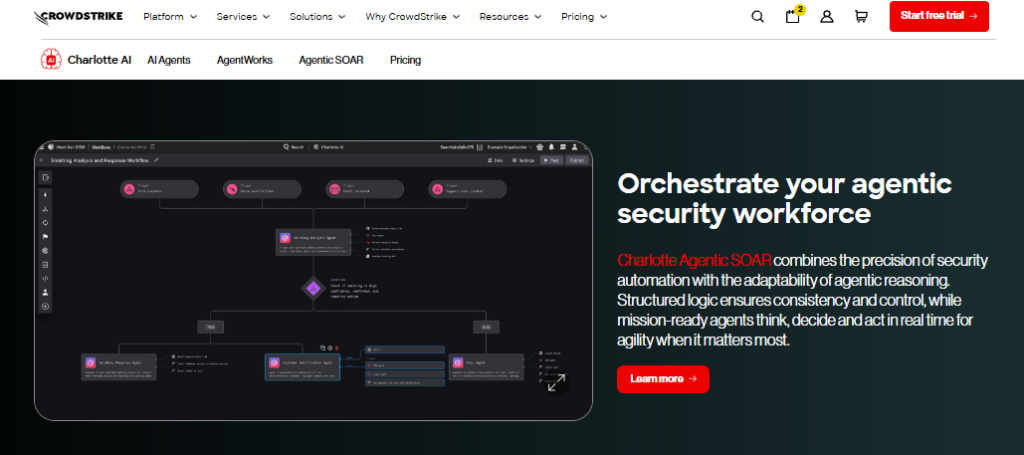
CrowdStrike Falcon is an AI-native endpoint and cloud security platform, with Charlotte AI acting as a generative security analyst over Falcon telemetry. Charlotte answers natural-language questions against your own data and supports agentic investigation workflows.
The platform protects more than 400 million endpoints across 30,000-plus customers. That scale is real, and the detection engineering behind it is genuinely strong.
Core Services
- Falcon Prevent (next-gen antivirus) and Falcon Insight XDR (endpoint detection and response)
- Falcon Identity Protection with Entra ID, Okta, and Ping integration
- Charlotte AI generative and agentic investigation
- Falcon OverWatch 24/7 managed threat hunting at the Enterprise tier
- Falcon Complete as a fully operated option
Why SaaS Companies Consider CrowdStrike
Independent proof matters to skeptical buyers. Falcon recorded 100% detection and 100% protection with zero false positives in the 2025 MITRE ATT&CK Enterprise Evaluation, the first edition to include cloud attack tradecraft.
Gartner also named CrowdStrike a Leader in the 2025 Magic Quadrant for Endpoint Protection Platforms for the sixth year running. For a board slide, that pedigree does work.
Ideal Customer Profile
Best suited for:
- SaaS companies with a mature, Falcon-standardized endpoint estate
- Teams with in-house analysts who can drive Charlotte queries
- Organizations with budget for premium per-device licensing
- Buyers who prioritize benchmark-verified endpoint detection
Commercial Model
List pricing runs from $59.99 per device per year for Falcon Go to $184.99 for Falcon Enterprise, with volume discounts at 500, 1,000, and 5,000 endpoints. Falcon Elite and Falcon Complete are quote-based, and full-platform deployments commonly land between $60,000 and $180,000 per year, which is worth modelling against published SOC pricing before you commit.
When to Shortlist
Shortlist Falcon when endpoint is your dominant risk surface and you already run the sensor. It fits less well when your crown jewels sit in OAuth grants, SaaS admin consoles, and CI/CD pipelines rather than laptops.
Customer Reviews
CrowdStrike earned a 99% Willingness to Recommend score in the Gartner Peer Insights Voice of the Customer report for Endpoint Protection Platforms. Practitioner sentiment on Charlotte specifically is more mixed, as the r/crowdstrike thread titled “Charlotte AI: don’t waste your money” shows.
“Charlotte AI: don’t waste your money”
r/crowdstrike Reddit Thread
Honest Limitation
Charlotte reasons best over CrowdStrike’s own telemetry. If your SaaS audit logs, identity events, and build pipelines live elsewhere, that context stays outside the investigation. Premium per-device pricing also scales awkwardly for a 200-person company with 3,000 cloud identities.
UnderDefense’s read is that the standard advice gets endpoint-first AI SOC selection backwards for software companies. The endpoint is a hard candy shell, and the chocolatey center is your identity provider. One developer token is often the whole attack path, which is why vendor-agnostic coverage without lock-in matters more than sensor depth alone.
1.3 Microsoft Sentinel and Security Copilot
Best for SaaS companies built on Entra ID and Microsoft 365
Overview
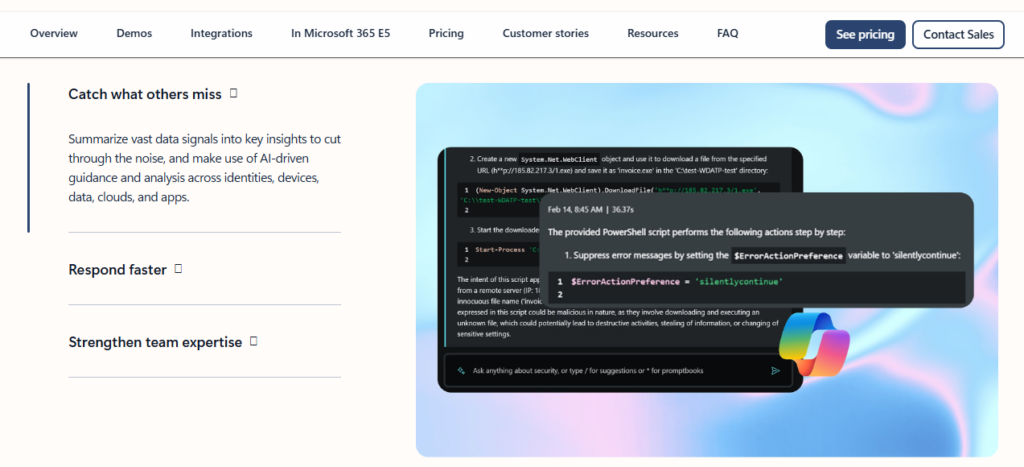
Microsoft Sentinel is a cloud-native SIEM (security information and event management) platform, with Security Copilot layered on top as a generative AI assistant. Together they summarize incidents, write KQL queries, and draft investigation notes.
For a SaaS company whose identity provider is Entra ID, the appeal is obvious. The identity telemetry you most need is already in the same tenant.
Core Services
- Cloud-native SIEM with Microsoft 365 and Entra ID connectors
- Security Copilot incident summarization and guided investigation
- Defender XDR integration across endpoint, email, and cloud apps
- SOAR playbooks via Azure Logic Apps
- Long-term log retention in Azure Data Explorer
Why SaaS Companies Consider Sentinel
Sentinel holds a 4.5-star rating across 241 verified Gartner Peer Insights reviews in the SIEM market. Reviewers commonly credit its cost-effective security event monitoring when the estate is already Microsoft-heavy.
Coverage of Entra sign-ins, conditional access, and OAuth app consents is native. That matters when credential abuse drives a large share of initial access, and it is one reason MDR for Microsoft 365 environments starts with identity telemetry.
Ideal Customer Profile
Best suited for:
- SaaS companies standardized on Microsoft 365, Entra ID, and Azure
- Teams with in-house KQL skill or an engineering partner
- Organizations wanting SIEM and AI assistance under one bill
- Buyers who can absorb variable ingestion costs
Commercial Model
Sentinel bills primarily on data ingested per gigabyte, with commitment tiers for volume discounts. Security Copilot is licensed separately through consumption units, so your monthly cost moves with usage.
When to Shortlist
Shortlist Sentinel when Microsoft is your identity backbone and you want telemetry to stay in your own tenant. Think carefully if your logging volume is unpredictable, because ingestion-based billing punishes noisy environments, which is exactly the trap our AI SOC pricing guide walks through.
Customer Reviews
Verified Gartner reviewers in the SIEM market list “High cost” and “Below average support” among their top dislikes for Sentinel, alongside slow responsiveness to common client needs.
Verified Reviewers, SIEM Market Microsoft Sentinel Gartner Verified Review
Honest Limitation
Sentinel is a platform, and somebody still has to run it. Copilot summarizes well, and it does not own the containment decision at 3 a.m.
Data outside Microsoft, such as third-party SaaS admin logs or your CI/CD pipeline, needs custom connectors you build and maintain.
Author’s perspective: What surfaces in UnderDefense engagements is a recurring pattern. Teams buy Sentinel for visibility, then discover the real bill is the engineering hour, and not the gigabyte. I have watched one client cut ingestion from roughly 300 GB per day to 35 to 40 GB per day through tuning alone.
1.4 Palo Alto Cortex XSIAM
Best for teams consolidating multiple security tools onto one platform
Overview
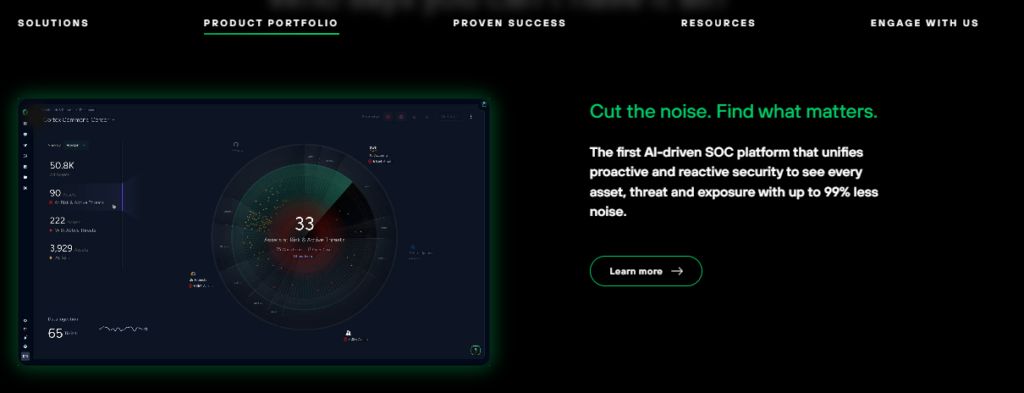
Cortex XSIAM is Palo Alto Networks’ AI-driven security operations platform. It merges SIEM, XDR (extended detection and response), and SOAR (security orchestration, automation, and response) into a single data model.
The bet is consolidation. Fewer consoles, one correlation engine, and less swivel-chair work for your analysts.
Core Services
- Unified data ingestion across endpoint, network, cloud, and identity
- Machine-learning detection with automated alert grouping into incidents
- Built-in SOAR automation and case management
- Attack surface management add-on
- Managed threat hunting options
Why SaaS Companies Consider XSIAM
Consolidation genuinely reduces alert stitching. When one engine sees firewall, endpoint, and cloud events together, incident grouping improves.
For SaaS companies already running Palo Alto network gear, the data is a short hop away. Some reviewers report a substantial lift in security intelligence across their operations program.
Ideal Customer Profile
Best suited for:
- SaaS companies willing to replace existing SIEM and EDR
- Teams with dedicated engineers for tuning and automation
- Organizations already invested in Palo Alto infrastructure
- Buyers with enterprise-scale budget
Commercial Model
XSIAM is quote-based, with pricing tied to data volume and modules enabled. Full remediation capability often means adding Cortex XSOAR licensing and further tooling.
When to Shortlist
Shortlist XSIAM when you have executive backing for a rip-and-replace consolidation program. It fits poorly when your goal is to keep the SIEM you already own.
Customer Reviews
“There is a relative complicated-ness to the platform that feels unnecessary. There is too many ways to go after tuning, alert creation and automation creation.”
Verified Reviewer Cortex XSIAM Gartner Verified Review
Honest Limitation
The trade-off is permanent, and it is architectural. Consolidation delivers correlation depth in exchange for data ownership and exit flexibility.
Gartner reviewers have flagged below-average ease of use and a steep learning curve, and analysts must often work across several consoles across Cortex and Prisma Cloud.
Author’s perspective: UnderDefense’s read is that the standard consolidation advice gets this backwards for a 200-person SaaS company. I want all the Lego bricks, then I want to build my own platform on top. Handing your entire pipeline to one vendor removes that option for the length of the contract, which is the core argument in our case for avoiding vendor lock-in.
1.5 Google Security Operations
Best for Workspace-native SaaS companies with high log volume
Overview
Google Security Operations, formerly Chronicle, is a cloud-native SecOps platform built on Google’s data infrastructure. It combines SIEM, threat intelligence from Mandiant, and Gemini-powered AI assistance.
Its signature strength is search. Petabyte-scale queries return in seconds, which changes how hunting feels.
Core Services
- Petabyte-scale log ingestion with flat-rate pricing options
- Gemini AI investigation assistance and natural-language search
- Curated detection rules and Mandiant threat intelligence
- SOAR capability from the Siemplify acquisition
- Native Google Workspace and Google Cloud telemetry
Why SaaS Companies Consider Google SecOps
Long retention at predictable cost is rare. Many SaaS teams under-log because their SIEM bills per gigabyte, and under-logging creates blind spots.
Google Workspace OAuth logs matter here. Those logs reveal every site where an employee clicked “log in with Google,” which is a rich vendor inventory that costs nothing extra to discover, and a useful input to vendor risk management.
Ideal Customer Profile
Best suited for:
- SaaS companies running Google Workspace and Google Cloud
- Teams generating very high log volume
- Organizations wanting one year or more of searchable retention
- Buyers with analysts who can author detection rules
Commercial Model
Pricing is typically subscription-based and tied to ingestion volume or user count, with flat-rate arrangements available at scale. Gemini features are bundled into higher tiers.
When to Shortlist
Shortlist Google SecOps when retention and search speed are your bottleneck. It fits less well if your stack is Microsoft-centric and your team has no rule-writing capacity.
Honest Limitation
Detection engineering is still your job. The platform gives you a phenomenal search layer, and it expects you to bring the analysts.
Third-party SaaS admin logs and CI/CD events need parser work before they become useful detections.
Author’s perspective: UnderDefense’s data points one way here, though I might be reading it too strongly. Cheap retention changes behavior more than better models do. Once teams stop rationing logs, their investigations get honest.
1.6 Dropzone AI
Best drop-in autonomous triage layer over the SIEM you already own
Overview
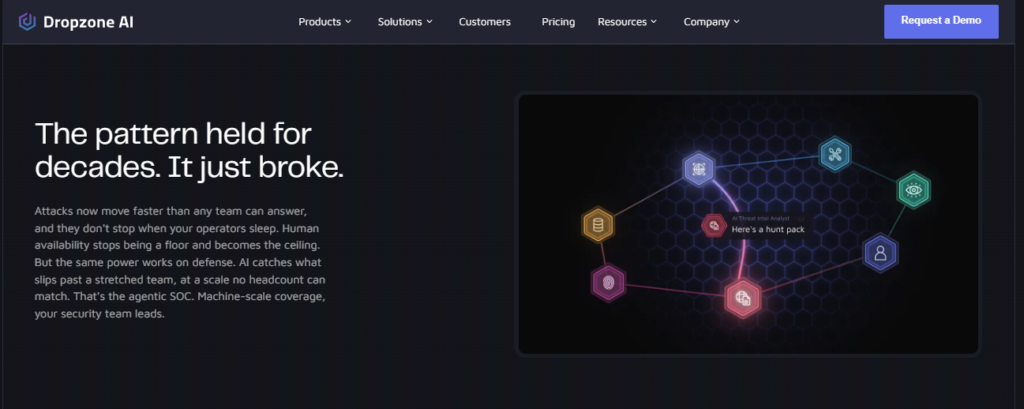
Dropzone AI is an autonomous AI SOC analyst that investigates alerts end to end. It plugs into your existing SIEM, EDR, and identity tools rather than replacing them.
Every alert gets investigated, and not sampled. That is the core pitch, and it is a reasonable one for a lean team.
Core Services
- Autonomous investigation of every inbound alert
- Written investigation reports with evidence and reasoning steps
- Integrations across common SIEM, EDR, identity, and email tools
- Read-only deployment option for low-risk pilots
- Analyst feedback loop for tuning verdicts
Why SaaS Companies Consider Dropzone
Layering beats replacing when cash is tight. You keep your SIEM contract, your logs, and your detections, and you add triage capacity.
Read-only pilots also lower the risk of a bad purchase. You can measure verdict quality before granting any response permissions, and our Dropzone pricing breakdown covers what that costs.
Ideal Customer Profile
Best suited for:
- SaaS companies with a functioning SIEM and no 24/7 triage
- Teams of two to ten security staff drowning in tier-one alerts
- Organizations testing AI triage before committing to a platform swap
- Buyers who want to avoid a migration project
Commercial Model
Pricing is subscription-based, typically scaled by alert volume or employee count rather than data ingested. That model avoids penalizing you for logging more.
When to Shortlist
Shortlist Dropzone when your alert queue is the problem and your log pipeline works. Look elsewhere if your logs are scattered, because triage cannot investigate data it cannot reach.
Honest Limitation
Triage is where it stops. Autonomous investigation still hands the containment decision back to you.
If nobody is awake to act on a 2 a.m. verdict, the investigation quality does not save you, which is the gap round-the-clock coverage exists to close.
Author’s perspective: UnderDefense has found that log coverage decides AI SOC outcomes more than model choice does. Every SaaS or CI/CD source the platform cannot reach becomes a permanent blind spot, and not a roadmap item.
1.7 Prophet Security
Best lightweight AI SOC analyst for very lean teams
Overview
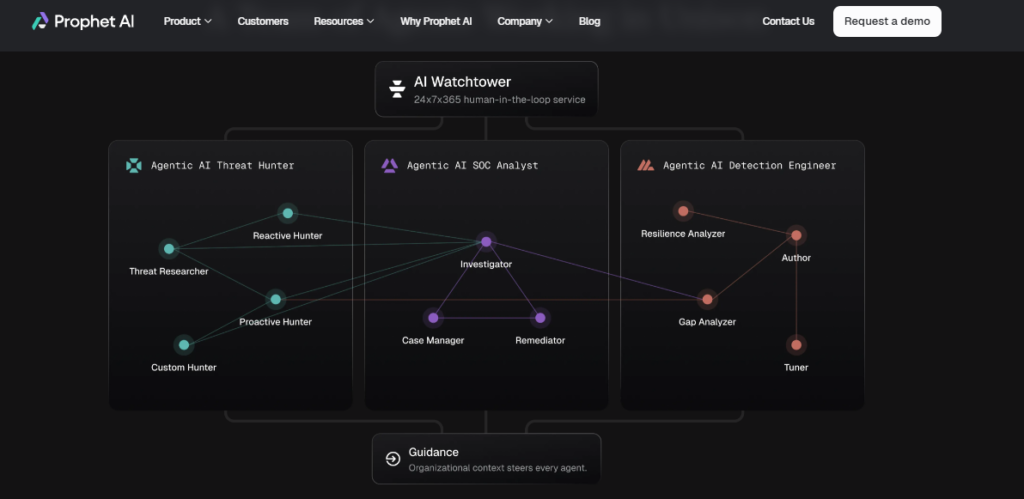
Prophet Security offers an agentic AI SOC analyst focused on fast alert triage and investigation. Setup weight is deliberately low, which suits a two-person security function.
The product targets speed to first value. You connect sources, and verdicts start arriving quickly.
Core Services
- Agentic triage with automated evidence gathering
- Investigation timelines showing the reasoning path
- Integrations with common cloud, identity, and endpoint sources
- Scoping controls to exclude sensitive data sets
- Feedback capture to refine future verdicts
Why SaaS Companies Consider Prophet
Small teams need something running this quarter. Heavy platforms demand a project plan, headcount, and a tuning budget nobody approved.
Data scoping also helps regulated SaaS companies. Keeping specific data classes outside the agent’s view is a practical control I see teams use with HIPAA-covered data.
Ideal Customer Profile
Best suited for:
- SaaS companies with one to five security staff
- Teams needing triage relief without a platform migration
- Organizations with straightforward cloud-first stacks
- Buyers who prioritize speed of deployment
Commercial Model
Subscription pricing scales with alert or environment size and is quote-based. Pilots are usually short, which keeps the initial commitment small.
When to Shortlist
Shortlist Prophet when you need triage help fast and your environment is not exotic. Larger, more fragmented estates will likely need a broader platform, and our guide to the best AI SOC for a three to five analyst team maps that threshold.
Honest Limitation
Breadth is the trade-off for lightness. Deep multi-tenant containment, extensive SIEM management, and audit-grade evidence export are less mature than at established platforms.
Human response is also on you, so plan your on-call rota accordingly.
Author’s perspective: UnderDefense’s read is that a faster wrong answer is worse than a slow right one. Ask any vendor how many model calls and how many queries run per alert. Genuine autonomous investigation can require over 100 distinct model invocations, because a human analyst runs 40 to 50 queries across six tools.
1.8 Torq HyperSOC
Best for engineering-heavy SaaS orgs that want to author their own automation
Overview
Torq HyperSOC is a hyperautomation platform for security operations, with AI agents layered over deterministic workflows. You build the logic, and the agents execute inside your guardrails.
For engineering-led SaaS companies, this feels familiar. It behaves like infrastructure you can version and test.
Core Services
- No-code and code-based automation workflow builder
- AI agents for triage, enrichment, and case management
- Deterministic playbooks with approval gates
- Broad API-first integration library
- Case management with full action audit logs
Why SaaS Companies Consider Torq
Determinism is underrated in regulated environments. Practitioners frequently pair AI triage with deterministic playbooks so that response steps stay reproducible for auditors.
Approval gating matters too. Each action node can require a human sign-off before it touches production, which is the essence of human-in-the-loop SOC design.
Ideal Customer Profile
Best suited for:
- SaaS companies with strong platform or DevOps engineering
- Teams with existing detections that need response automation
- Regulated tenants requiring reproducible response paths
- Organizations replacing legacy SOAR
Commercial Model
Pricing is quote-based and typically tied to workflow execution volume and modules. Budget engineering time as a real line item, because the platform rewards investment.
When to Shortlist
Shortlist Torq when you have engineers who want to own the automation logic. Skip it if you need a service that runs itself from day one.
Honest Limitation
Torq gives you power in exchange for labor. Somebody has to write, test, and maintain the workflows, and that somebody is on your payroll.
Detection content is not the product, so your detections need to already exist.
Author’s perspective: Remediation today should constrain creativity. What surfaces in UnderDefense engagements is that the safest automation gives an agent one narrow API that performs one function. I met a founder whose coding agent deleted his production database, which is a fair warning about unconstrained autonomy, and a reason to write AI SOC guardrails before you grant permissions.
1.9 Stellar Cyber
Best Open XDR foundation with genuine multi-tenant separation
Overview
Stellar Cyber is an Open XDR platform that ingests from third-party tools and correlates signals into incidents. Multi-tenancy is built in rather than bolted on.
It was designed with service providers in mind, which turns out to help SaaS companies too. Tenant boundaries are a product risk for any platform holding customer data.
Core Services
- Open XDR ingestion from existing EDR, firewall, identity, and cloud tools
- Machine-learning correlation into incident groups
- Built-in NDR (network detection and response) and UEBA (user and entity behavior analytics)
- Multi-tenant architecture with segmented reporting
- Automated response actions through integrations
Why SaaS Companies Consider Stellar Cyber
Keeping your existing tools is the headline benefit. Open XDR sits above your stack rather than demanding an agent swap.
Tenant separation also supports segmented compliance reporting. That helps when enterprise customers ask how you isolate their data, and it eases compliance reporting across frameworks.
Ideal Customer Profile
Best suited for:
- SaaS platforms serving many customer tenants
- Companies keeping heterogeneous security tooling
- Teams wanting XDR correlation without vendor replacement
- MSSPs and managed service arms inside software companies
Commercial Model
Licensing is generally subscription-based and quote-driven, aligned to monitored assets or data volume. Multi-tenant tiers are priced for service-provider delivery models.
When to Shortlist
Shortlist Stellar Cyber when multi-tenancy and tool preservation are both hard requirements. It needs analysts, so pair it with a 24/7 service if you have none.
Honest Limitation
The platform provides the foundation, and your team provides the operators. Correlation quality also depends heavily on how well you tune it during the first weeks.
Agentic autonomy is less deep here than at AI-first triage products.
Closing Note on Positioning
UnderDefense sits at the intersection these nine platforms split between: agentic investigation, human containment, and no vendor lock. We run 2-minute alert-to-triage with 15-minute escalation for critical incidents, across the SIEM, EDR, and identity tools you already bought, and you can see how the UnderDefense MAXI platform does it. Show, do not tell, is the standard I hold us to, so ask to watch one investigation on your own alert.
Q2. How Did We Score These Platforms? Our Selection Criteria
We scored each platform out of 100 across five weighted criteria: SaaS-Native Telemetry Coverage (30%), Agentic Autonomy and Investigation Depth (25%), Human Response and Concierge Support (20%), Integration Openness and No Vendor Lock (15%), and Pricing Transparency (10%). Scores of 0 to 20 earn one star, 21 to 40 two, 41 to 60 three, 61 to 80 four, and 81 to 100 five stars.
Why Telemetry Carries the Heaviest Weight
The weights are reverse-engineered from how SaaS companies actually get breached. Credential abuse remains the single most common initial access vector at 22% of breaches, and third-party involvement doubled from 15% to 30% in one year.
Endpoint coverage is table stakes, and it does not see an OAuth grant. A platform that scores brilliantly on laptops and poorly on identity logs is misaligned with the actual risk, which is why our AI SOC features checklist starts with log sources.
The Weighted Rubric
| Criterion | Weight | What Earns Full Marks |
| SaaS-Native Telemetry Coverage | 30% | Ingests identity provider events, OAuth grants, SaaS admin audit logs, CI/CD pipeline events, and cloud workloads |
| Agentic Autonomy and Investigation Depth | 25% | Investigates every alert end to end, shows its reasoning, and correlates across sources |
| Human Response and Concierge Support | 20% | Named analysts who execute containment, with published response timings |
| Integration Openness and No Vendor Lock | 15% | Works with the SIEM and EDR you already own, exportable data, and no proprietary agent mandate |
| Pricing Transparency | 10% | Published pricing or a clear, repeatable cost model |
How the Response Criterion Is Measured
UnderDefense publishes a 2-minute alert-to-triage standard and 15-minute escalation for critical incidents, which we use as the reference point for the human response criterion. Vendors that publish nothing measurable score lower on that axis, irrespective of marketing claims, a pattern covered in our AI SOC SLA guide.
Aggregated “MTTR” numbers were excluded from scoring. Mean time to respond blends triage speed and escalation speed into one figure that hides which part is slow.
Automatic Disqualifiers
Three conditions removed platforms from consideration entirely:
- No OAuth or identity log ingestion. A SaaS company cannot defend tokens it cannot see.
- No exportable audit trail. Auditors need investigation evidence you can hand over without vendor permission.
- Quote-only pricing with no published model. Opaque pricing blocks the budget conversation your CFO needs to have.
What We Refused to Score
Prevented breaches were not scored, because proving a negative is a trap. Nobody can honestly attribute an incident that never happened to a specific control.
Instead, comparative cost of delivery was scored. That means the real annual cost of the platform plus the internal hours needed to operate it, the same method behind our AI SOC ROI calculation for small analyst teams.
Star Scores Awarded
| Platform | Score out of 100 | Stars |
| UnderDefense MAXI | 92 | 5 stars |
| CrowdStrike Falcon and Charlotte AI | 74 | 4 stars |
| Microsoft Sentinel and Security Copilot | 71 | 4 stars |
| Palo Alto Cortex XSIAM | 68 | 4 stars |
| Google Security Operations | 67 | 4 stars |
| Dropzone AI | 64 | 4 stars |
| Prophet Security | 55 | 3 stars |
| Torq HyperSOC | 52 | 3 stars |
| Stellar Cyber | 51 | 3 stars |
A Note on Where Platform-Native Vendors Cap Out
UnderDefense scores five stars here, losing nothing on pricing transparency or integration openness. Those two criteria are where platform-native vendors structurally cap out, because their AI reasons only over telemetry they own, which is the core case for vendors with no lock-in and real data sovereignty.
Author’s perspective: UnderDefense’s read is that most rankings hide their weights because the weights would reveal the sponsor. I have published mine so you can disagree with them. Move telemetry to 20% and endpoint to 30%, and the order changes, which is exactly the point.
Q3. What Is an AI SOC, and Why Does a SaaS Company Need a Different One?
An AI SOC for a SaaS company applies agentic AI to triage, investigate, and respond across SaaS-native telemetry: identity provider events, OAuth grants and tokens, SaaS admin audit logs, CI/CD pipelines, and cloud workloads. Unlike a rules-based SIEM, it learns normal behavior, correlates signals into incidents, and produces auditable investigation trails a human can verify.
The Definition, in Plain Terms
A SOC is a security operations center, meaning the team and tooling that watch for attacks. An AI SOC keeps that mission and replaces manual tier-one triage with agents that investigate autonomously.
The word “agentic” matters. An agent decides which query to run next, based on what the last answer showed, in the same way a human analyst would, and our primer on what an AI SOC is breaks that loop down step by step.
How AI SOC Differs From Your Existing Tools
| Category | What It Does | What It Will Not Do | Who Operates It |
| AI SOC | Investigates alerts autonomously and correlates across identity, cloud, and SaaS logs | Replace human judgment on containment | Vendor agents plus your team, or a provider’s analysts |
| SIEM | Collects and searches logs, and fires rule-based alerts | Decide whether an alert matters | Your detection engineers |
| SOAR | Executes predefined response playbooks | Handle situations you never scripted | Your automation engineers |
| XDR | Correlates telemetry inside one vendor’s stack | See data outside its own ecosystem | Your analysts |
| Managed detection services | Provide human monitoring and escalation | Own remediation in most contracts | The provider’s SOC |
If you want the longer treatment of those boundaries, our comparison of AI SOC versus SOAR versus managed detection covers the contractual differences too.
The M and M Network Problem
Most SaaS networks are still built like an M and M. Hard candy shell on the outside, and a scrumptious chocolatey center in the middle.
Perimeter controls get the attention, and one developer token walks straight past all of them. One bad login from Thailand or Singapore can be a 2020 compromise still quietly logging in today.
Multi-Tenant Blast Radius Is a Product Risk
For a SaaS company, a tenant boundary failure is a product defect with legal consequences. It is not simply an alert on a dashboard.
That reframes the detection question. You need to know which customer tenants a compromised identity could reach, before an attacker maps it for you.
Why Machine-Readable Output Now Matters
Agents write code now, so SOC output has to be consumable by machines. Humans click, and agents swarm, which changes both the attack volume and the response format.
Investigation findings that only render in a dashboard cannot feed an automated fix. Structured output can.
Three Log Sources to Verify Before Any Demo
- Identity provider logs, covering sign-ins, conditional access, and OAuth app consent grants.
- SaaS admin audit logs, from your CRM, code host, and support desk.
- CI/CD pipeline events, including secret access and deploy actions by automated agents.
Ask UnderDefense, or any vendor you shortlist, to run one live investigation against those three sources during the demo. Show, do not tell, remains the only reliable filter, and our list of AI SOC evaluation questions gives you the rest of the script.
Positioning Note
UnderDefense built its Agentic AI SOC identity-first and cloud-first, so SaaS-to-SaaS and token-abuse paths are shipped detections rather than roadmap items. Our analysts run 24/7 threat hunting across identity and cloud telemetry, and you can watch the UnderDefense MAXI platform work on your own logs.
Author’s perspective: UnderDefense’s data points one way here, though I might be reading it too strongly. Teams that fix identity telemetry first see more real findings in month one than teams that buy another endpoint tool. I have yet to see that reverse.
Q4. Which SaaS Attack Paths Must Your AI SOC Actually Cover?
Four paths carry the most SaaS risk: OAuth grant and refresh-token abuse, unsanctioned shadow SaaS holding live tokens, third-party integration compromise, and CI/CD pipelines where coding agents hold production credentials. Third-party involvement now appears in 30% of breaches and credential abuse in 22%, so verify your platform ingests identity, SaaS admin, and pipeline logs before signing.
Path A: OAuth Grants and Shadow SaaS
Tokens outlive offboarding. When you disable an employee account, a previously granted OAuth token can keep working, because it was authorized separately from the login session.
Those tokens also bypass MFA. Multi-factor authentication protects the login, and the token was issued after the login already succeeded.
The Four-Step OAuth Consent Hunt
- Pull OAuth app consent events from Google Workspace or Microsoft 365 admin audit logs.
- List every third-party app holding a grant, along with the scopes it received.
- Flag any grant with read or write access to mail, files, or directory data.
- Revoke grants tied to departed employees, unknown vendors, or unused tools.
This is a richer vendor inventory than a paid CASB (cloud access security broker) provides, and it costs nothing to discover. Vendor question to ask: can you alert on a new high-scope OAuth consent within minutes, and show me the timeline?
Path B: Third-Party and Supply Chain Exposure
Third-party involvement in breaches doubled from 15% to 30% in a single year. Vulnerability exploitation reached 20% of breaches, and only about 54% of perimeter device vulnerabilities were fully remediated, taking a median of 32 days.
Leaked secrets are worse. The median time to remediate secrets found in a GitHub repository was 94 days, which is why third-party due diligence belongs in your detection scope and not only in procurement.
The Cross-Check That Takes an Hour
Compare your external-facing software and appliance inventory against the CISA Known Exploited Vulnerabilities Catalog. Anything on that list with an internet-facing instance moves to the top of the queue today.
UnderDefense treats OAuth consent anomalies, token reuse, and pipeline events as first-class detections landing in one investigation timeline. That way, you get the affected app, token, and user in a single escalation instead of three disconnected alerts. Vendor question to ask: does a third-party integration compromise arrive as one incident or three alerts?
Path C: CI/CD Pipelines and AI Agents in Production
I met a founder who was vibe coding a new application, and the agent went and deleted his production database. That is the current state of agent autonomy in real pipelines.
Coding agents now hold credentials that used to require a human approval step. Your pipeline is an identity, and it needs monitoring like one, which is the argument behind our work on detection-as-code in CI/CD pipelines.
Constrain Creativity at the Architecture Layer
Remediation today should constrain creativity. Give an agent one specific API that performs one function, deterministically, rather than broad access it can improvise with.
Two rules I hold to:
- PRD first. Write the product requirements document before the agent writes code, so intent is reviewable.
- Redline at the architecture level. Restrict what the agent can reach, and not what you hope it will choose.
Unmonitored Pipelines Become Permanent Blind Spots
In one Zimbra-related case, a crafted HTTP request harvested more than ten credential pairs, and the initial phase of the attack went fully undetected. The organization ran established endpoint and SIEM tooling, and logging was never enabled on the pilot application.
A log source your platform cannot reach is a permanent blind spot, and not a roadmap item. Vendor question to ask: which of my pipeline and pilot app logs are you actually ingesting today?
Positioning Note
UnderDefense runs 2-minute alert-to-triage with 15-minute escalation for critical incidents across identity, cloud, SaaS admin, and pipeline telemetry. We publish those timings so you can hold us to them during a pilot, on your own logs, with the investigation trail visible, and you can start that conversation through our managed detection and response team.
Q5. Is It Real Agentic Reasoning or a GPT Wrapper on Your Alert Queue?
Ask how many model calls and how many queries run per alert. Genuine autonomous investigation can require over 100 distinct LLM invocations and replicates the 40 to 50 queries a human runs across six tools. A wrapper restates the alert in a nicer interface. Research shows multi-agent architectures that actively gather evidence cut false positives against single-model triage.
A Faster Wrong Answer Is Worse Than a Slow Right One
If the same humans read the same number of alerts, only faster, that is speed. Real transformation removes entire classes of work.
Plenty of teams are investing in a faster way to be wrong. Parroting alerts from security products back at you just produces exhaustion, which is the root of alert fatigue in security operations.
The Depth Benchmark to Demand
A human analyst runs 40 to 50 queries across roughly six tools for one meaningful investigation. Any system claiming to replace that work should show comparable evidence-gathering depth.
UnderDefense measures autonomy by counting model invocations and tool queries per alert, and genuine autonomous investigation of a single alert can exceed 100 distinct model calls. Ask any vendor for that number, and watch how quickly the conversation changes, then compare it against the features that actually matter in agentic AI SOC platforms.
What the Research and Patents Actually Show
Multi-agent architectures that actively retrieve evidence outperform single-model triage on false positives. Published work on neuro-symbolic abductive reasoning applies the same logic to root-cause analysis, combining learned patterns with symbolic rules.
The patent lineage matters too. Triage automation filings date back to the 2017 to 2020 period, which undercuts any claim that agentic triage is entirely net-new.
Where Black-Box Delivery Models Break
The pattern in verified reviews is consistent across the managed detection category.
| Failure pattern | What buyers report | Structural cause |
| Alerts without resolution paths | “We receive alerts, but not necessarily a clear path to resolution” | Escalation-only service scope |
| Duplicated upstream alerts | “Some alerts are just a regurgitation of Microsoft alerts which means duplicates” | No correlation layer above the source tool |
| Missing investigation evidence | “Log collectors show working, however when asked to provide logs for an investigation no logs could be provided” | Customer has no direct data access |
| Automation without historical context | Automations “often fall short of correlating with concurrent or historic activity” | Shallow context window per alert |
What Buyers Say About Context Depth
“Still not quite there with the remediation side of things. We receive alerts, but not necessarily a clear path to resolution.”
Sr Cybersecurity Engineer, Manufacturing Arctic Wolf Gartner Verified Review
“While the automation capabilities of Expel are impressive, they often fall short of correlating with concurrent or historic activity, which is often a rich source of context.”
Verified User in Computer Software, Mid-Market, 3.5/5 Expel G2 Verified Review
The SIEM Lock-In Cost Nobody Quotes
Ingestion-billed platforms create a conflict of interest, because your noise is their revenue. Tuning is the fix, and it is rarely incentivized, one of several reasons we wrote about avoiding SIEM vendor lock-in.
In one UnderDefense engagement, we cut a client’s daily ingestion from roughly 300 GB to 35 to 40 GB through tuning alone. That is a 90% reduction in the line item, achieved without buying anything new.
Three Questions for the Demo
- How many model calls and tool queries per alert? Ask to see the investigation line by line.
- Does the model train on my tenant or a pooled corpus? Both answers are defensible, and vagueness is not.
- What happens to my labeled alert history if I churn? If your analysts’ corrections cannot leave with you, you are renting your own institutional memory.
On “Unbiased” Model Claims
I am happy if a model shows measurable bias, because then I can see what it gets wrong. The genuinely dangerous model is the one advertised as unbiased, since that claim removes your ability to audit it, and that is why explainability and transparency belong in the contract.
Large language models do not reason in the way the marketing implies. Treat them as very capable pattern regurgitators, then design the guardrails accordingly.
Positioning Note
UnderDefense shows the investigation line by line and pairs agentic depth with named analysts whose corrections persist into the model. The patent literature describes exactly that arrangement: feedback that improves the system instead of evaporating at shift change.
Author’s perspective: UnderDefense’s read is that the industry benchmarks the wrong thing. Everyone quotes accuracy percentages, and nobody publishes investigation depth. I could be early on this, and I expect depth disclosure to become a standard RFP line within two years.
Q6. What Should It Cost, and Which Metrics Prove It Worked?
AI SOC pricing follows three models: data volume ingested, per-identity or per-endpoint, and flat per-tenant subscription, with a 4 to 6 week tuning period as the hidden cost. Track MTTD, MTTR, alert-to-incident ratio, false-positive rate, analyst hours per incident, and tool consolidation savings, then map response time to GDPR Article 33’s 72 hours, NIS2’s 24-hour early warning, and SEC Item 1.05.
The Three Pricing Models and What Each Punishes
| Model | How it bills | What it punishes | Watch for |
| Data volume ingested | Per GB per day | Logging more sources | Your noise becomes vendor revenue |
| Per identity or endpoint | Per user or device per year | Headcount growth | Cloud identities often outnumber laptops |
| Flat per-tenant subscription | Fixed monthly or annual fee | Nothing, if scoped honestly | Overage triggers buried in the order form |
Our AI SOC pricing guide works through each of these models with worked examples.
The Lock-In Scorecard
Three questions decide whether you can leave later:
- Can you export your detection content in a usable format?
- Can you keep your own SIEM and your own log storage?
- Can you take your labeled alert history, including analyst verdicts?
Two “no” answers means you are buying a three-year commitment regardless of the contract term, and the clauses that decide this are covered in our review of SOC contract clauses.
Why Speed Is the Design Constraint
Median attacker break-out time has compressed to roughly 48 minutes. The fastest case observed sits near 51 seconds.
UnderDefense operates to a 2-minute alert-to-triage and 15-minute escalation standard for critical incidents. We publish those separately, because a blended mean time to respond hides which half is slow.
The Six Metrics That Build the Business Case
| Metric | What it measures | Realistic target |
| MTTD (mean time to detect) | Alert to detection confirmation | Under 5 minutes |
| Triage and escalation time | Alert to triaged verdict, then to escalation | 2 minutes, then 15 minutes for critical |
| Alert-to-incident ratio | How many alerts become real incidents | Under 2% |
| False-positive rate | Wrong verdicts as a share of total | Under 5% after tuning |
| Analyst hours per incident | Human effort per closed case | Under 1 hour for tier one |
| Tool consolidation savings | Licences retired after deployment | Track annually, in dollars |
Compliance Clocks Turn Speed Into a Legal Duty
| Obligation | Clock | Starts when |
| EU NIS2 early warning | 24 hours | Awareness of a significant incident |
| GDPR Article 33 | 72 hours | Awareness of a personal data breach |
| SEC Item 1.05 | 4 business days | Determination of material impact |
A SaaS company is its customers’ third party, and third-party involvement now appears in 30% of breaches. Your customers’ clocks become your contractual obligations, which is where an AI SOC compliance approach earns its budget.
The ROI Trap, and What to Model Instead
Proving breach-prevention ROI is a trap, because proving a negative is close to impossible. Skip it in your board deck.
Model comparative cost of delivery instead: platform cost plus internal hours, against the alternative options. UnderDefense once uncovered an ongoing fraud during onboarding that saved a client roughly $300,000 in the first three months, which is a real number, and not a modeled avoided loss.
What Buyers Say About Hidden Costs
“They also have a 50GB a day cap on log collection which was not bought to our attention during the whole buying phase.”
Verified User in Health, Wellness and Fitness, Mid-Market, 2.5/5 Alert Logic G2 Verified Review
“The small print – things like that they can charge you double rate on overages and upgrade your plan at their discretion if you go over. This should be factored into your cost analysis.”
Verified User in E-Learning, Small-Business Rapid7 InsightOps G2 Verified Review
UnderDefense publishes its managed SOC pricing so you can model the cost before you talk to anyone. If you are building a budget line for next quarter, the numbers are on the page rather than behind a form.
Q7. How Do You Run a 30-Day Proof of Concept, and When Should You Not Buy?
Replay 100 historical alerts through the platform and blind-score its verdicts against your analysts’ original conclusions, reporting precision and recall instead of vendor-supplied percentages. Skip the purchase entirely if your critical logs are not centralized, if regulators require deterministic reproducible response the platform cannot guarantee, or if nobody owns tuning for the first six weeks.
Why Vendor Accuracy Claims Are Unfalsifiable
Every vendor quotes a detection percentage from an environment you cannot inspect. Those numbers are unfalsifiable by design.
Agentic benchmarks are emerging in the research literature, and they are early. Your own alert history remains the cheapest honest test available, and our AI SOC evaluation framework shows how to structure it.
The Four-Week Protocol
- Week 1: Connect and replay. Feed 100 closed historical alerts, spanning true positives, false positives, and one real incident.
- Week 2: Blind score. Compare the platform’s verdicts against your analysts’ original conclusions, with the scorer blind to which is which.
- Week 3: Parallel run. Point live alerts at both your current process and the platform, and log every disagreement.
- Week 4: Tune and retest. Apply analyst corrections, then replay a fresh sample of 50 alerts.
Ask UnderDefense to run this replay against your own historical alerts, since a pilot on your data beats any demo environment. You can book a working session and bring your own alert history to it.
Three Exit Criteria
- Analyst feedback measurably changes verdicts inside 30 days.
- Every SaaS, identity, and CI/CD log source is reachable, and not “on the roadmap.”
- The investigation trail exports cleanly for auditors and cyber insurers.
Fail any one of these, and extend the pilot rather than signing.
The Four Numbers for Your Board Update
- Precision and recall from the blind replay, stated as percentages.
- Alert volume reduction after tuning, in absolute counts.
- Analyst hours returned per week.
- Log sources reachable, expressed as a fraction of total sources.
Three Reasons to Walk Away
- Your logs are scattered. Centralizing telemetry delivers more value than agentic triage on partial data.
- Regulators demand deterministic response. If a probabilistic verdict cannot be reproduced for an auditor, use scripted playbooks for those paths.
- Nobody owns tuning. Without an internal owner for six weeks, the pilot will underperform and you will blame the wrong thing.
UnderDefense will tell you when centralizing logs matters more than buying agentic triage, which is not advice a vendor billed on ingestion volume has reason to give. If a managed SIEM foundation is the real gap, we will say so before you sign anything else.
Contested Ground, Honestly Stated
Two debates remain genuinely open. First, whether agentic triage replaces tier-one analysts or simply uplifts them, and my read is uplift, with agents as foot soldiers and your engineers as generals directing them.
Second, data sovereignty. Scoping regulated data outside the agent’s view, such as excluding HIPAA-covered records, is a legitimate control that some teams use, and it costs you coverage on those paths, a trade-off we unpack in our note on AI SOC data residency.
Where I Land
You do not win in cybersecurity. It behaves more like a zombie apocalypse, where you sustain defense and keep improving your position.
Banning tools never works either, so build controls that assume people will use what helps them work. What I am sitting with now is whether agentic depth becomes a published, comparable metric within 18 months, and I would like to hear from anyone running a blind replay who found the opposite of what I expect.
UnderDefense answers replay-based POCs, RFPs, and security questionnaires with real numbers from your own alert history. Send us your log sources and evaluation criteria through our contact page, and we will tell you honestly where we fit and where we do not.
1. What makes the best AI SOC for SaaS companies different from a general-purpose AI SOC?
A SaaS company’s crown jewels rarely sit on laptops. They sit in identity providers, OAuth grants, SaaS admin consoles, build pipelines, and multi-tenant customer data, so the platform has to reason over that telemetry first.
The practical difference shows up in three places:
- Identity-first detection. Credential abuse is the most common initial access vector at 22% of breaches, and a refresh token issued after a successful login bypasses MFA entirely.
- Tenant blast radius. A tenant boundary failure is a product defect with legal consequences, so you need to know which customer tenants a compromised identity could reach.
- Pipeline coverage. Coding agents now hold credentials that previously required human approval, which makes your pipeline an identity to monitor.
UnderDefense built its Agentic AI SOC identity-first and cloud-first, so SaaS-to-SaaS and token-abuse paths are shipped detections rather than roadmap items. Endpoint-first platforms score brilliantly on laptops and never see the OAuth consent that started the incident. If you want the category framing before the shortlist, our overview of AI SOC for SaaS companies covers the telemetry model in detail.
2. Can an AI SOC work with the SIEM and EDR we already own?
Yes, and for most SaaS companies that is the better architecture. You already paid for good tools, and the real gap is usually coverage at 2 a.m. rather than another console.
Two deployment shapes dominate:
- Layered. An agentic triage layer sits above your existing SIEM, EDR, cloud, and identity provider, so your logs, detections, and contracts stay where they are.
- Consolidated. You replace SIEM and EDR with one vendor’s unified data model, which improves correlation depth and costs you exit flexibility for the contract term.
UnderDefense MAXI deliberately takes the layered route, sitting on top of your stack rather than mandating a proprietary agent, and named analysts execute containment across the tools you own. Ask any vendor three lock-in questions: can you export detection content, keep your own log storage, and take your labeled alert history including analyst verdicts. Two “no” answers means a multi-year commitment regardless of the stated term. Our guide to running an AI SOC with your existing SIEM walks through the integration order that avoids a migration project.
3. How much should an AI SOC cost a SaaS company in 2026?
Pricing follows three models, and each one punishes something different. Choose the model that matches how your company actually grows.
- Data volume ingested. Billed per gigabyte per day, which punishes logging more sources and turns your noise into vendor revenue.
- Per identity or per endpoint. Billed per user or device per year, which punishes headcount growth, and cloud identities often outnumber laptops several times over.
- Flat per-tenant subscription. A fixed fee that penalizes nothing when scoped honestly, provided you read the overage triggers in the order form.
The hidden cost is the 4 to 6 week tuning period, and it is real work regardless of vendor. Tuning also pays: in one engagement, UnderDefense cut a client’s daily ingestion from roughly 300 GB to 35 to 40 GB, a 90% reduction achieved without buying anything new.
Skip breach-prevention ROI in your board deck, because proving a negative is close to impossible. Model comparative cost of delivery instead, meaning platform cost plus internal hours against the alternatives, using our AI SOC pricing guide as the worksheet.
4. How do we tell real agentic reasoning from a GPT wrapper on our alert queue?
Ask one question: how many model calls and how many tool queries run per alert. A wrapper restates the alert in a nicer interface, and genuine autonomous investigation gathers evidence.
The benchmark to hold vendors to:
- A human analyst runs 40 to 50 queries across roughly six tools for one meaningful investigation.
- Genuine autonomous investigation of a single alert can exceed 100 distinct model invocations.
- Multi-agent architectures that actively retrieve evidence outperform single-model triage on false positives, which is why depth beats phrasing.
UnderDefense measures autonomy by counting model invocations and tool queries per alert, and shows the investigation line by line on your own alert rather than quoting an accuracy percentage from an environment you cannot inspect. A faster wrong answer is worse than a slow right one, and plenty of teams are investing in a faster way to be wrong.
Treat large language models as very capable pattern regurgitators, then design guardrails accordingly. A model advertised as unbiased is more dangerous than one with measurable bias, because the claim removes your ability to audit it. Our note on AI SOC explainability and transparency lists the contract language that makes this verifiable.
5. Does an AI SOC replace our tier-one analysts?
Our read is uplift rather than replacement, with agents acting as foot soldiers and your engineers as generals directing them. This debate remains genuinely open, and anyone claiming certainty is selling something.
What agents reliably absorb:
- Evidence gathering across identity, cloud, SaaS admin, and endpoint sources for every alert rather than a sampled subset.
- Written investigation timelines that a human can verify instead of re-running.
- Repetitive enrichment work that drives analyst burnout and turnover.
What stays human is the containment decision. Autonomous triage hands a verdict back to you, and if nobody is awake to act on it at 2 a.m., investigation quality does not save you. That is the gap concierge response exists to close, and UnderDefense pairs agentic depth with named analysts who execute containment and whose corrections persist into the model instead of evaporating at shift change.
If the same humans read the same number of alerts, only faster, that is speed rather than transformation. Real transformation removes entire classes of work, which is the mechanism behind using agentic AI SOC to reduce analyst burnout.
6. Which log sources must an AI SOC ingest to cover SaaS attack paths?
Verify three sources before any demo, because a log source the platform cannot reach is a permanent blind spot rather than a roadmap item.
- Identity provider logs, covering sign-ins, conditional access, and OAuth app consent grants.
- SaaS admin audit logs, from your CRM, code host, and support desk.
- CI/CD pipeline events, including secret access and deploy actions by automated agents.
Those three cover the paths that carry the most SaaS risk: OAuth grant and refresh-token abuse, unsanctioned shadow SaaS holding live tokens, third-party integration compromise, and pipelines where coding agents hold production credentials. Third-party involvement now appears in 30% of breaches, and the median time to remediate secrets found in a GitHub repository was 94 days.
UnderDefense treats OAuth consent anomalies, token reuse, and pipeline events as first-class detections landing in one investigation timeline, so you receive the affected app, token, and user in a single escalation instead of three disconnected alerts. Start with the free version of this exercise: pull OAuth consent events, list every app holding a grant with its scopes, and revoke grants tied to departed employees. Our AI SOC features checklist turns that into a vendor scorecard.
7. How do we run a 30-day proof of concept before buying an AI SOC?
Test the platform against your own alert history, since every vendor quotes a detection percentage from an environment you cannot inspect. Your history is the cheapest honest test available.
- Week 1: connect and replay. Feed 100 closed historical alerts spanning true positives, false positives, and one real incident.
- Week 2: blind score. Compare platform verdicts against your analysts’ original conclusions, with the scorer blind to which is which.
- Week 3: parallel run. Point live alerts at both your current process and the platform, and log every disagreement.
- Week 4: tune and retest. Apply analyst corrections, then replay a fresh sample of 50 alerts.
Report four numbers to your board: precision and recall from the blind replay, alert volume reduction after tuning, analyst hours returned per week, and log sources reachable as a fraction of total. Extend the pilot rather than signing if analyst feedback does not measurably change verdicts inside 30 days, or if the investigation trail will not export cleanly for auditors and cyber insurers. UnderDefense runs this replay against your own historical alerts, and you can book a working session with your alert history in hand.
8. When should a SaaS company not buy an AI SOC?
Three conditions should stop the purchase, and recognizing them early saves a wasted year of contract.
- Your logs are scattered. Centralizing telemetry delivers more value than agentic triage running on partial data, so fix the pipeline first.
- Regulators demand deterministic response. If a probabilistic verdict cannot be reproduced for an auditor, use scripted playbooks with approval gates on those specific paths.
- Nobody owns tuning. Without an internal owner for the first six weeks, the pilot underperforms and you blame the wrong thing.
There is a fourth signal worth naming. If your compliance clocks are the actual driver, map response timings to the obligations first: 24 hours for an EU NIS2 early warning, 72 hours under GDPR Article 33, and 4 business days for SEC Item 1.05 once material impact is determined.
UnderDefense will tell you when centralizing logs matters more than buying agentic triage, which is not advice a vendor billed on ingestion volume has reason to give. If a managed SIEM foundation is the real gap, we say so before you sign anything else.