




Q1. What Is Third-Party Due Diligence, Compliance, and TPRM, and Why Do They Matter in 2026?
Here’s the reality most compliance leaders are living right now: you’re managing relationships with hundreds, sometimes thousands, of external partners, and every single one of them is a potential attack vector, regulatory liability, or reputational landmine. Vendors, suppliers, contractors, distributors, agents, consultants, intermediaries, joint venture partners, and sub-processors all count as third parties, and they all carry risk your organization owns whether you vetted them properly or not.
Three Concepts, One Lifecycle
Let me define three terms that get conflated constantly, because the confusion is where programs fail:
Third-party due diligence (TPDD) is the systematic process of investigating and evaluating external partners before engagement, verifying their legal, financial, operational, cybersecurity, and ethical standing.
Third-party compliance governs the ongoing relationship, ensuring vendors continuously meet contractual, regulatory, and ethical obligations throughout the partnership and into offboarding.
Third-party risk management (TPRM) is the broader discipline encompassing both TPDD and compliance as phases of one vendor risk lifecycle, from identification through termination.
The FCPA enforcement statistic that should keep every compliance officer awake: 90% of enforcement actions involve third-party intermediaries. And Gartner data shows organizations now routinely work with 1,000+ third parties. That combination, massive vendor ecosystems plus concentrated enforcement risk, is why treating these as separate checkbox exercises doesn’t work anymore.
The Spreadsheet and Annual Questionnaire Trap
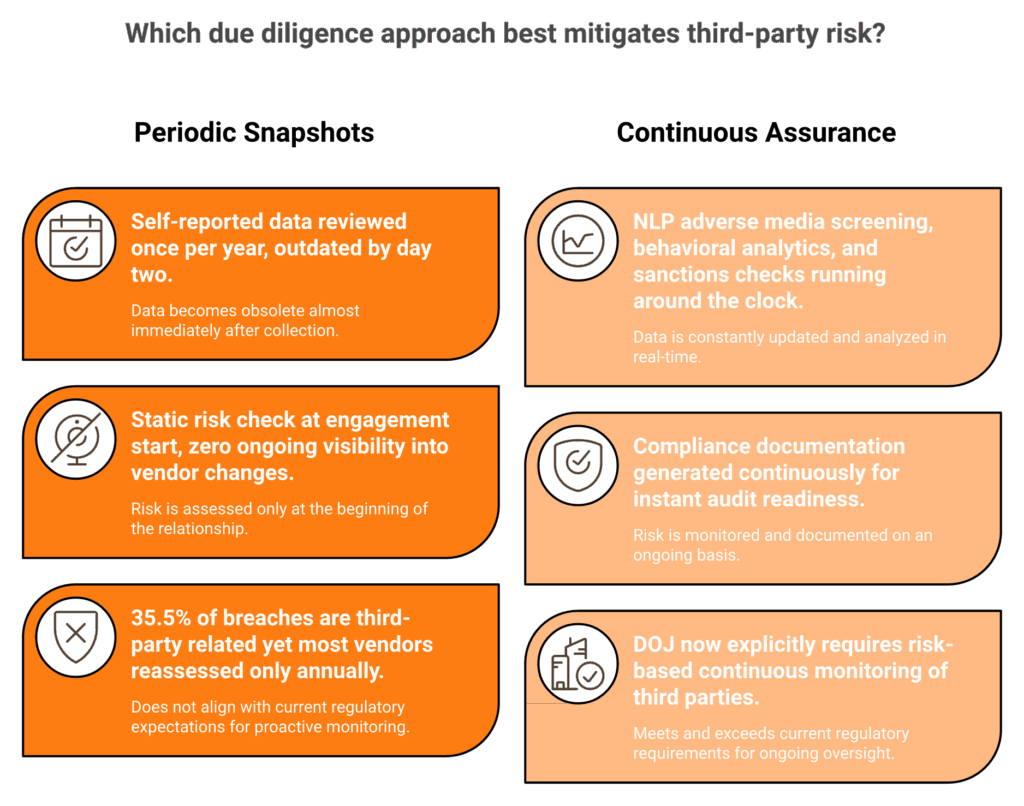
Most due diligence programs I’ve seen operate like a snapshot camera in a world that moves like video. They treat TPDD as a one-time onboarding gate and compliance as an annual questionnaire exercise, architecturally incapable of handling the velocity of modern regulatory change, supply chain threats, and vendor ecosystem complexity.
Traditional GRC platforms record what a vendor self-reported last year, not whether that vendor’s systems are compromised today or their beneficial ownership changed last month. According to recent data, 35.5% of all breaches in 2024 were third-party related, up from 29% the year before, yet most organizations reassess vendors only annually. Due diligence without continuous compliance is a snapshot that expires the day it’s taken.
From Periodic Reviews to Continuous Assurance
“Due diligence that only runs at onboarding is a liability, not a control.” This isn’t just my opinion but the operational reality the DOJ’s 2025 FCPA Guidelines now explicitly enforce. Modern TPRM unifies TPDD and compliance into a continuous cycle, combining AI-powered sanctions screening, NLP-driven adverse media monitoring, behavioral analytics for vendor access patterns, and automated compliance evidence collection.
This creates a continuous assurance posture rather than periodic snapshots. The AI SOC + Human Ally model represents the new standard for the cybersecurity dimension of third-party risk management: automation handles the volume, humans handle the judgment calls.
How UnderDefense Operationalizes Continuous Third-Party Monitoring
We built UnderDefense’s MAXI platform specifically to make continuous third-party monitoring real, not theoretical. Here’s what that means operationally:
- ✅ Vendor-agnostic integration across 250+ tools covering endpoints, cloud, identity, and SaaS, with no rip-and-replace required
- ✅ 24/7 AI-driven threat detection with 96% MITRE ATT&CK coverage extending to third-party access monitoring
- ✅ Concierge analyst response providing the human judgment layer essential when vendor access triggers suspicious behavior alerts
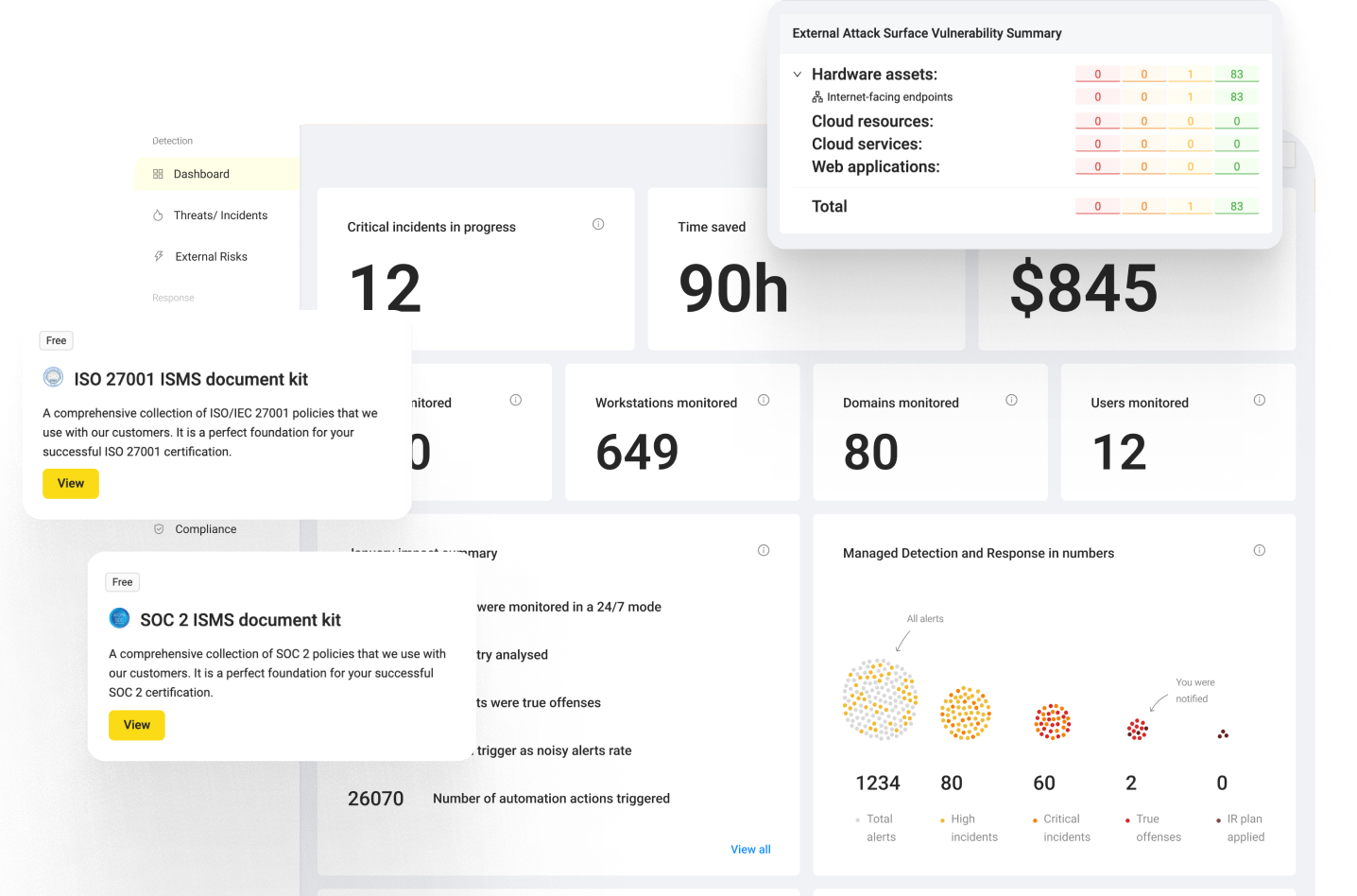
- ✅ Forever-free compliance kits (SOC 2, HIPAA, ISO 27001) that automate evidence collection for audit readiness
⚠️ The Enforcement Gap Is Where Actions Happen
In 2025, the DOJ continued imposing significant FCPA penalties linked to inadequate third-party due diligence, while offering declinations to companies that demonstrated proactive, risk-based continuous monitoring programs. Supply chain incidents now cost 17 times more to remediate than first-party breaches, with estimated losses of $20-80 billion for Global 2000 companies over 15 months. The gap between checking a box and running a real program is exactly where enforcement actions land.
Q2. What Types of Risk Does Third-Party Due Diligence Address?
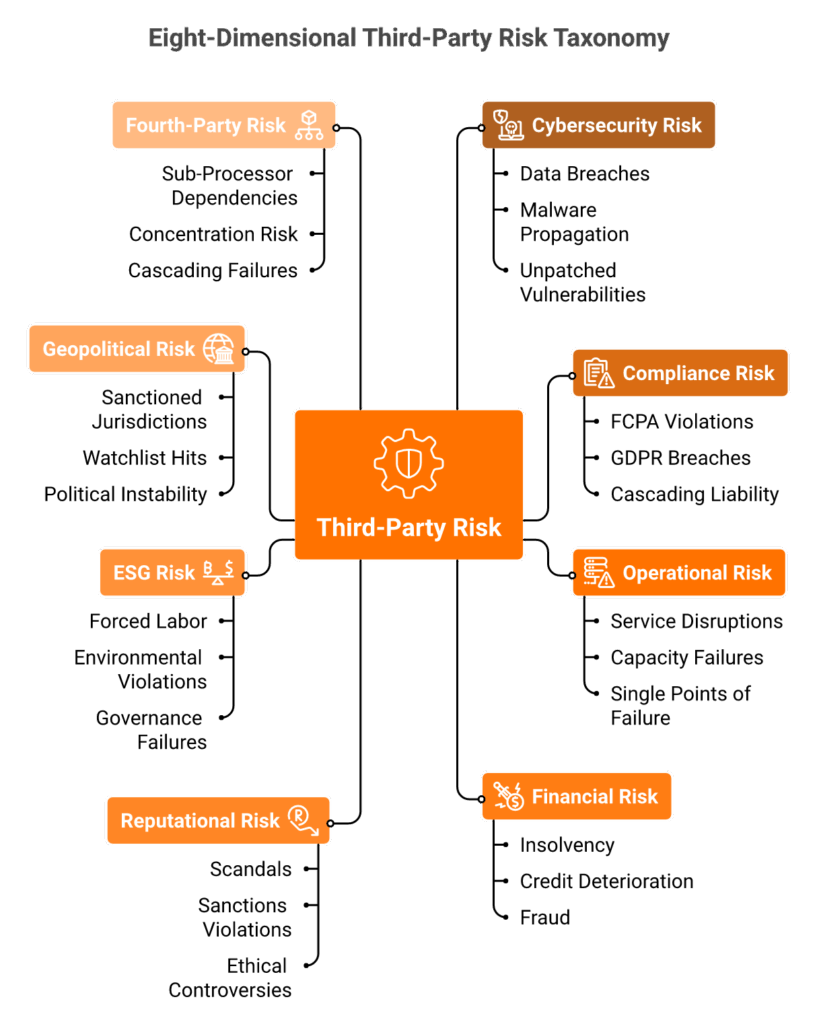
Third-party risk is not one thing. It spans eight distinct categories that compliance leaders must assess independently. Each category requires different investigation methods, different data sources, and different monitoring cadences. A due diligence program that covers only financial and compliance risk while ignoring cybersecurity, ESG, and fourth-party exposure leaves critical blind spots that regulators and attackers will find.
The Eight-Dimensional Risk Taxonomy
⚠️ Cybersecurity and Information Security Risk: Unauthorized access, data breaches, malware propagation through vendor connections, inadequate encryption, and unpatched vulnerabilities. With 35.5% of breaches now third-party related, this is the fastest-growing category. Vendor VPN credentials, unpatched API endpoints, and shared cloud tenancies create direct attack paths into your environment.
✅ Compliance and Regulatory Risk: Vendor violations of FCPA, GDPR, AML/KYC, or industry-specific regulations that cascade liability to your organization. When your distributor bribes a foreign official, the enforcement action names your company, not theirs.
⏰ Operational Risk and Business Continuity: Vendor service disruptions, capacity failures, or process breakdowns that impact your operations; single points of failure in critical supply chains. The 2024-2025 wave of cloud outages demonstrated how a single vendor’s downtime cascades across entire industry sectors.
💰 Financial Risk: Vendor insolvency, credit deterioration, fraud, or financial instability threatening contract fulfillment; includes credit evaluation and debt-to-revenue monitoring.
❌ Reputational Risk and Adverse Media Exposure: Vendor involvement in scandals, lawsuits, sanctions violations, or ethical controversies that damage your brand by association. One headline about your supplier using forced labor can erase years of brand equity overnight.
🌍 ESG Risk: Forced labor in supply chains, environmental violations, governance failures, modern slavery, and non-compliance with emerging sustainability regulations like the EU CSDDD.
⚠️ Geopolitical Risk and Sanctions Exposure: Vendor operations in sanctioned jurisdictions, OFAC/EU/UN watchlist hits, political instability in vendor operating regions, and state-owned enterprise relationships.
🔗 Fourth-Party and Nth-Party Concentration Risk: Risks introduced by your vendors’ vendors: shared sub-processors creating systemic concentration risk, cascading compliance failures, and invisible dependency chains. When three of your “independent” vendors all rely on the same cloud sub-processor, you have a concentration risk no single-vendor assessment will surface.
Why All Eight Categories Must Work Together
Most due diligence failures occur at category boundaries. A vendor passes financial and compliance checks but has catastrophic cybersecurity exposure. Another passes cybersecurity review but operates in a sanctioned jurisdiction through an undisclosed subsidiary. The Rio Tinto FCPA case is instructive: a consultant was hired without proper due diligence and without a contract, working for four months before a written agreement even existed. That’s a compliance, financial, reputational, and regulatory risk converging in one poorly vetted third party.
How UnderDefense Simplifies the Cybersecurity Dimension
UnderDefense’s MAXI platform automates the cybersecurity risk dimension across your entire vendor ecosystem, continuously monitoring third-party access patterns, detecting anomalous behavior, and correlating vendor activity against threat intelligence feeds with 96% MITRE ATT&CK coverage. Combined with forever-free compliance kits, it addresses both cybersecurity and compliance risk categories from a single platform. Detection without response is noise, and we don’t just detect; we contain.
Q3. Which Regulations and Frameworks Mandate Third-Party Due Diligence in 2026?
2026 represents a compliance inflection point. The DOJ’s June 2025 FCPA Guidelines introduced national-security-focused enforcement priorities, the EU CSDDD creates mandatory supply chain due diligence obligations, DORA imposes ICT third-party risk requirements on financial entities with a 4-hour initial reporting deadline, and NIS2 extends cybersecurity obligations across essential and important entities. Compliance leaders must map their programs against multiple overlapping frameworks simultaneously, and that’s not a theoretical exercise; real sanctions now loom.
Regulatory Comparison Table
| Regulation/Framework | Scope | Third-Party DD Requirements | Key Deadlines | Max Penalties |
|---|---|---|---|---|
| FCPA (U.S.) | U.S.-listed companies, foreign subsidiaries | Risk-based due diligence on agents, intermediaries, JV partners; continuous monitoring | Ongoing; 2025 Guidelines update | Criminal: unlimited; Civil: up to $25K/violation |
| UK Bribery Act | Any company with UK nexus | “Adequate procedures” defense requires proportionate DD | Active enforcement | Unlimited fines + imprisonment |
| OECD Anti-Bribery Convention | 46 signatory countries | Recommends risk-based third-party DD programs | Ongoing peer reviews | Varies by jurisdiction |
| GDPR (EU) | Any entity processing EU residents’ data | Processor/sub-processor DD; DPAs required | Active since 2018 | Up to €20M or 4% global turnover |
| CCPA (California) | Businesses meeting revenue/data thresholds | Service provider contractual obligations, DD on data handling | Active; amended 2023 | $2,500-$7,500/violation |
| AML 6th Directive/KYC | Financial institutions, DNFBPs | CDD/EDD on customers and correspondents; beneficial ownership | Active; ongoing tightening | Varies; criminal liability for individuals |
| HIPAA (U.S. Healthcare) | Covered entities + business associates | BAAs mandatory; DD on PHI handling, security practices | Active enforcement | Up to $2.1M/violation category |
| DORA (EU Financial) | Financial entities + critical ICT providers | ICT third-party risk framework; audit rights mandatory | Active since Jan 2025 | Fines up to 1% avg daily global turnover |
| NIS2 (EU Cybersecurity) | Essential + important entities across 18 sectors | Supply chain security measures; vendor risk assessments | Active since Oct 2024 | Up to €10M or 2% global turnover |
| EU CSDDD | Large EU companies + high-risk sectors | Human rights and environmental DD across value chains | Transposition by July 2026 | Up to 5% net worldwide turnover |
Assessment Benchmarks: NIST CSF, ISO 27001, SOC 2
These aren’t regulations per se, but frameworks that regulators and customers use to evaluate vendor security posture:
NIST CSF: Voluntary framework increasingly referenced by DOJ when evaluating compliance program adequacy; the Identify and Protect functions directly map to TPDD processes.
ISO 27001: International standard for information security management; certification demonstrates systematic vendor security practices.
SOC 2: Trust service criteria reports (Type I/II) that enterprise customers and PE firms require during vendor evaluation and exit due diligence.
The DOJ’s 2025 Enforcement Shift
The June 2025 FCPA Guidelines changed the enforcement calculus significantly. The DOJ now prioritizes national security, targeting material support to sanctioned entities and transnational criminal organizations, with expedited investigation timelines and enhanced voluntary self-disclosure incentives. The explicit requirement: companies must demonstrate risk-based, continuous monitoring of third parties, not just periodic reviews. Companies that showed proactive programs received declinations; those that didn’t faced full enforcement.
How UnderDefense Simplifies Regulatory Compliance
UnderDefense’s forever-free compliance kits covering SOC 2, HIPAA, and ISO 27001 automate audit evidence collection mapping directly to regulatory requirements. The UnderDefense MAXI platform generates compliance-ready documentation of continuous monitoring activity, transforming your third-party oversight from a periodic checkbox exercise into auditable, real-time assurance that satisfies DORA, NIS2, and SOC 2 assessment requirements simultaneously.
Q4. What Are the Core Steps in a Third-Party Due Diligence Process?
Third-party due diligence spans 14 distinct sub-steps organized across four lifecycle phases: Planning, Investigation, Decision, and Ongoing Management. The DOJ’s 2025 evaluation criteria explicitly assess whether companies implement a structured, risk-proportionate process, not just whether they conduct “some” due diligence.
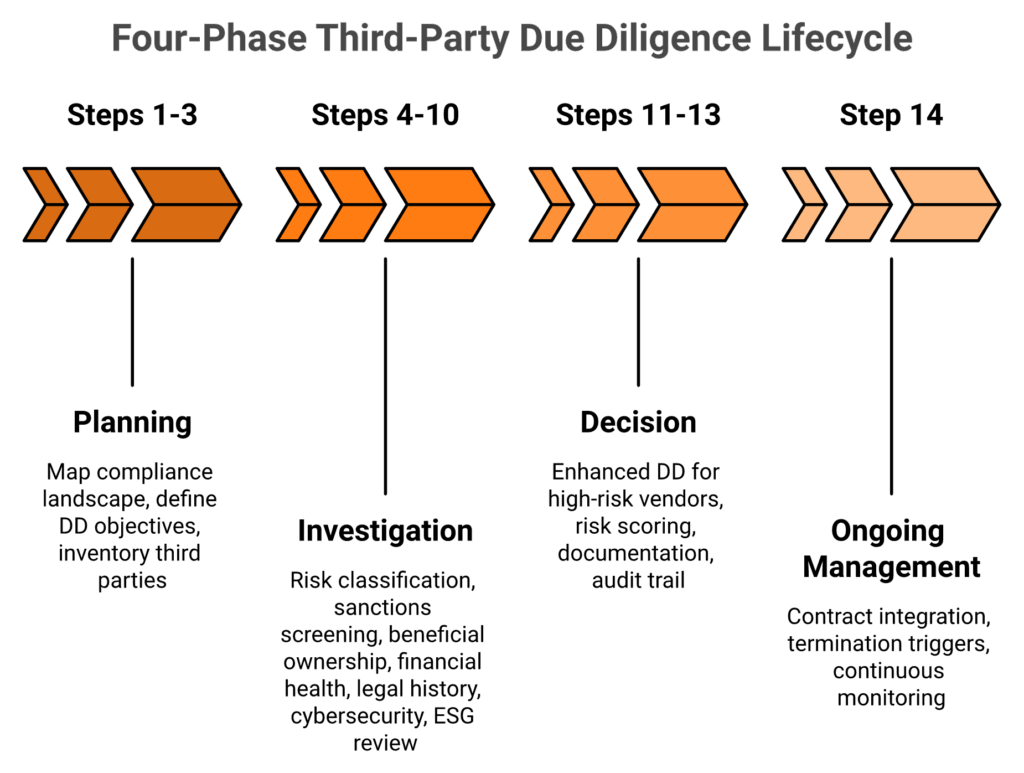
Phase 1: Planning (Steps 1-3)
Step 1: Map the Compliance Landscape: Identify all applicable regulations (FCPA, GDPR, AML, DORA, NIS2, EU CSDDD) and define which due diligence requirements apply to your organization’s geography, industry, and risk profile. This isn’t a one-time exercise. Regulatory landscapes shift, and your mapping needs to update with them.
Step 2: Define Due Diligence Objectives: Align investigation scope with business strategy and risk appetite. Document what “adequate” due diligence means for each vendor tier. The mistake most organizations make: applying the same depth to every vendor regardless of risk.
Step 3: Identify and Inventory Third Parties: Catalog all vendors, suppliers, agents, distributors, JV partners, contractors, intermediaries, and sub-processors in a centralized registry with ownership metadata.
Phase 2: Investigation (Steps 4-10)
| Step | Action | Key Activities |
|---|---|---|
| 4 | Initial Risk Classification | Assign preliminary risk scores based on geography, transaction type, data access level, and regulatory sensitivity |
| 5 | Screening | Run sanctions/watchlist checks (OFAC, EU, UN), PEP database screening, and adverse media scans |
| 6 | Beneficial Ownership Verification | Trace corporate ownership chains to ultimate beneficial owners; flag opaque structures, nominee shareholders, and shell companies |
| 7 | Financial Health Assessment | Review credit reports, audited financials, debt-to-revenue ratios, and insolvency indicators |
| 8 | Legal and Litigation History | Review court records, regulatory actions, arbitration history, and settlement patterns |
| 9 | Cybersecurity Posture Evaluation | Verify certifications (SOC 2, ISO 27001), review incident response plans, assess encryption policies |
| 10 | ESG Practices Review | Assess supply chain labor practices, environmental compliance, and EU CSDDD alignment |
Phase 3: Decision (Steps 11-13)
Step 11: Enhanced Due Diligence for High-Risk Third Parties: On-ground investigations, site visits, local government record checks, management interviews, and independent reference verification. This is where the Rio Tinto failure is instructive: a consultant operating for months without a written agreement and without proper DD would have been flagged by any structured EDD process.
Step 12: Risk Analysis, Scoring, and Tiering Decision: Aggregate findings into a composite risk score. Apply the tiering framework (covered in Q5) to determine approval, conditional approval, or rejection.
Step 13: Documentation and Audit Trail: Compile all findings, screening results, analysis notes, and decision rationale into a structured due diligence file for regulatory inspection. Under DORA, this documentation must be digitally signed and timestamped to withstand regulatory scrutiny.
Phase 4: Contract and Ongoing (Step 14)
Step 14: Contract Integration with Compliance Clauses: Embed anti-corruption representations and warranties, audit rights, data protection obligations, sub-contractor approval requirements, compliance reporting obligations, and termination triggers tied to compliance failures.
✅ Sample Contractual Clause
“Vendor shall maintain and enforce an anti-corruption compliance program consistent with the FCPA and UK Bribery Act, permit audits upon 30 days’ notice, and immediately notify Client of any government investigation, sanctions designation, or material change in beneficial ownership.”
How UnderDefense Automates the Cybersecurity Dimension
UnderDefense automates the cybersecurity investigation (Step 9) and continuous monitoring dimensions by providing 24/7 vendor access monitoring through the UnderDefense MAXI platform, instantly detecting anomalous vendor behavior (credential abuse, lateral movement, data exfiltration) and containing threats with a 2-minute alert-to-triage SLA and 15-minute escalation for critical incidents. We generate compliance-ready audit documentation for Steps 12-13 automatically. In documented case studies, our team detected and contained threats 2 days faster than CrowdStrike OverWatch, because AI-driven detection without human context still leaves gaps only analysts communicating directly with users can close.
Q5. How Do You Build a Risk-Based Tiering Framework with Quantified Scoring?
Regulators don’t expect you to investigate every vendor with the same intensity. They expect you to demonstrate risk-proportionate due diligence. Applying the same investigation to a low-risk office supply vendor and a high-risk foreign government intermediary wastes resources and misses critical threats. The DOJ’s 2025 FCPA Guidelines explicitly evaluate whether companies implement “risk-based” programs where investigation depth scales with the threat profile of each third party. A tiering framework makes that possible.
The 4-Tier Risk Model
The framework below scores third parties across eight weighted dimensions, generating a composite score that maps to one of four risk tiers:
| Dimension | Weight | Score 0 (Low) | Score 1 | Score 2 | Score 3 (Critical) |
|---|---|---|---|---|---|
| 1. Geographic Risk (CPI Score) | 15% | CPI > 70 | CPI 50–70 | CPI 30–49 | CPI < 30 |
| 2. Transaction Value & Frequency | 10% | < $50K/yr, infrequent | $50–250K/yr | $250K–1M/yr | > $1M/yr, recurring |
| 3. Access to Sensitive Data/Systems | 20% | No access | Indirect access | Direct access, non-critical | Direct access, critical systems/PII |
| 4. Regulatory Sensitivity | 15% | No govt interaction | Indirect govt touchpoints | Regulated industry, no sanctions exposure | Govt contracts, sanctions-adjacent |
| 5. Industry-Specific Factors | 10% | Low-risk sector | Moderate-risk | High-risk (defense, pharma) | Sanctioned/embargoed sectors |
| 6. Beneficial Ownership Complexity | 10% | Transparent, public | Multi-layer, identifiable UBOs | Complex structures, nominee shareholders | Opaque/shell entities, secrecy jurisdictions |
| 7. Historical Performance & Compliance | 10% | Clean record, 3+ years | Minor issues, self-remediated | Regulatory warnings/fines | Active investigations, repeat violations |
| 8. Fourth-Party/Sub-Contractor Exposure | 10% | No sub-contractors | Known, low-risk sub-contractors | Multiple sub-contractors, limited visibility | Unknown sub-contractors in high-risk jurisdictions |
Tier Mapping and Due Diligence Requirements
Composite scoring (0–3 per dimension, weighted): multiply each dimension’s score by its weight, then sum across all eight dimensions for a maximum weighted score of 3.0.
| Tier | Weighted Score | DD Requirements | Refresh Frequency | Approval Authority |
|---|---|---|---|---|
| ⚠️ Critical | 2.3–3.0 | Full EDD + site visit + management interviews + continuous monitoring | Quarterly | Board/Senior Compliance Committee |
| ❌ High | 1.5–2.2 | Enhanced DD + adverse media deep-dive + beneficial ownership tracing | Semi-annually | Chief Compliance Officer |
| ✅ Medium | 0.8–1.4 | Standard DD + annual screening refresh | Annually | Compliance Manager |
| ✅ Low | 0.0–0.7 | Simplified DD + periodic screening | Every 2 years | Procurement with compliance sign-off |
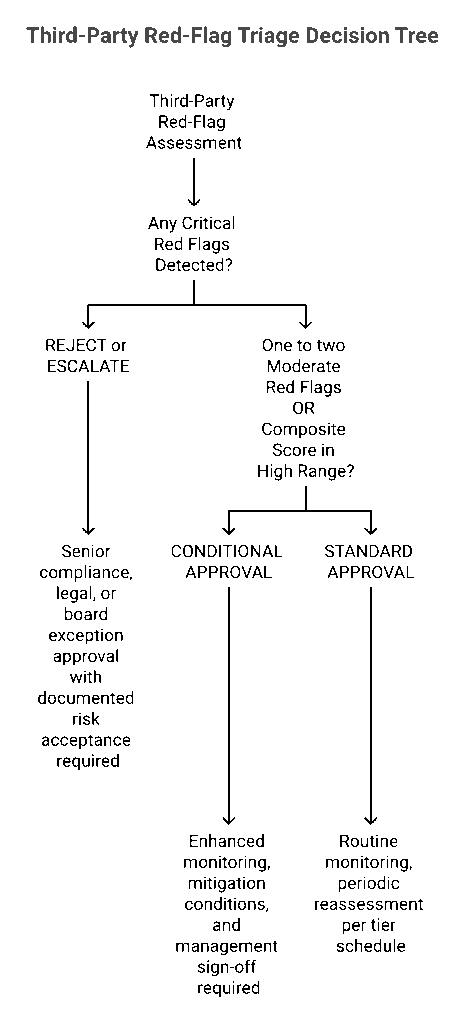
Red-Flag Decision Tree
🟢 GREEN (no red flags, composite Low/Medium): Standard approval with routine monitoring.
🟡 YELLOW (1–2 moderate red flags OR composite High): Conditional approval with enhanced monitoring, mitigation conditions, and management sign-off.
🔴 RED (any critical red flag OR composite Critical without mitigants): Reject or escalate to senior compliance/legal/board for exception approval with documented risk acceptance.
Critical red flags that trigger automatic RED classification: sanctions hit, PEP relationship without adequate controls, opaque beneficial ownership, refused audit rights, active government investigation, or history of regulatory penalties in relevant jurisdiction.
How UnderDefense Simplifies
UnderDefense’s vendor-agnostic UnderDefense MAXI platform operationalizes risk tiering for the cybersecurity dimension, automatically classifying third parties by access level, data exposure, and threat profile, then applying monitoring intensity proportional to their risk tier. Critical vendors get 24/7 AI-driven behavioral analytics with human analyst oversight and a 2-minute alert-to-triage SLA with 15-minute escalation for critical incidents. Lower-risk vendors get automated baseline monitoring with escalation protocols.
Q6. What Should Your Due Diligence Checklist, Vendor Questionnaire, and Industry-Specific Requirements Include?
The most common due diligence failure isn’t missing a checklist item but applying the same checklist to every vendor regardless of risk level and industry. A meaningful checklist must be tiered (standard vs. enhanced), adaptable by industry vertical, and connected to continuous monitoring triggers that prompt re-investigation when conditions change.
✅ Standard Due Diligence Checklist (All Third Parties)
- Corporate registration and beneficial ownership verification
- Sanctions/watchlist screening (OFAC, EU, UN)
- PEP screening
- Financial stability assessment (credit reports, audited financials)
- Litigation and regulatory action history
- Insurance coverage verification
- Data protection and privacy compliance (DPA review)
- Basic cybersecurity posture assessment (SOC 2/ISO 27001 certification status)
- References and reputation check
- Conflict of interest disclosure
- Business continuity and disaster recovery plans
⚠️ Enhanced Due Diligence Additions (High-Risk/Critical Tier)
- In-person or virtual site visits
- Adverse media deep-dive (multi-language, multi-jurisdiction)
- Law enforcement and regulatory database checks
- Beneficial ownership chain tracing to UBO
- Country/jurisdiction risk assessment (CPI, FATF grey/blacklist status)
- Interview with senior management
- Fourth-party/sub-contractor mapping and approval
- Anti-corruption compliance program assessment
- Cybersecurity penetration testing or vulnerability assessment results
- Ongoing financial monitoring triggers
- ESG compliance assessment
Vendor Risk Assessment Questionnaire: Sample Questions
- Provide your current corporate registration certificate and list all beneficial owners holding >10% equity.
- Has your organization or any officer been subject to sanctions, debarment, or regulatory penalties in the past 5 years?
- Describe your anti-corruption/anti-bribery compliance program and training frequency.
- What data protection certifications do you hold (SOC 2, ISO 27001, HIPAA)? Provide the most recent audit report.
- Do you sub-contract any services involving access to our data or systems? If yes, list all sub-processors.
- Describe your incident response plan and provide your mean time to detect/respond metrics.
- Have you experienced a data breach in the past 3 years? If yes, describe scope and remediation.
- What is your business continuity plan if a key service fails?
- Describe your ESG policies, including supply chain labor practices and environmental compliance.
- Do you consent to periodic audits of your compliance program and security controls?
Guidance: Distribute questionnaires with a 10-business-day response deadline. Validate self-reported answers against independent data sources. A vendor claiming SOC 2 compliance should provide the actual report, not a checkbox.
Industry-Specific Checklist Additions
| Industry | Additional Requirements |
|---|---|
| Financial Services | AML/KYC enhanced CDD, PCI DSS compliance, transaction monitoring, Basel Committee risk standards |
| Healthcare | HIPAA BAA verification, PHI handling procedures, breach notification SLA, FDA compliance where applicable |
| Technology/SaaS | SOC 2 Type II report, data residency compliance, API security assessment, secure SDLC documentation |
| Manufacturing | Supply chain forced labor assessment (UFLPA), environmental compliance, REACH/RoHS, supplier code of conduct |
| Government/Defense | ITAR/EAR compliance, facility security clearance, CMMC certification, NIST 800-171 compliance |
How UnderDefense Simplifies
UnderDefense automates the cybersecurity assessment dimension of your checklist. The UnderDefense MAXI platform continuously evaluates third-party security posture through vendor access monitoring, threat intelligence correlation, and automated compliance evidence collection. This replaces self-reported annual questionnaire answers with verified, real-time assurance.
Q7. How Does AI-Powered Screening and Technology Transform Third-Party Due Diligence?
Here’s the operational reality: a mid-market enterprise with 500+ third parties faces thousands of sanctions hits annually, and 70–95% are false positives requiring manual analyst review. Legacy screening tools generate volume without intelligence, creating backlogs that delay vendor onboarding by weeks and leave compliance teams permanently behind. Meanwhile, risk questionnaires arrive as PDFs and spreadsheets requiring manual extraction, comparison, and validation. AI-powered screening doesn’t just speed up the same process; it fundamentally changes what’s possible.
The False Positive Factory
Rules-based screening platforms match names against watchlists using simple string matching. The result: massive false-positive rates that overwhelm compliance teams. These tools identify what was flagged but not whether it matters. They can’t reason across data sources, can’t verify beneficial ownership chains, can’t correlate screening results with behavioral signals from your environment, and can’t adapt to changing risk profiles in real time. Manual questionnaire-based assessments compound the problem. Vendors self-report risk without independent verification, and nobody validates until the next annual review cycle.
Six Technology Pillars Transforming Due Diligence
- NLP for multi-language adverse media monitoring: Scanning thousands of sources in real time, identifying sentiment shifts and risk indicators across jurisdictions and languages.
- Graph analytics for beneficial ownership resolution: Tracing complex corporate structures to ultimate beneficial owners, identifying nominee shareholders and shell entities in secrecy jurisdictions.
- Machine learning for dynamic risk scoring: Reducing false positives by 60–80% compared to rules-based systems by evaluating dozens of contextual variables simultaneously.
- Behavioral analytics for continuous vendor access monitoring: Detecting anomalous access patterns, credential abuse, and lateral movement that questionnaires can’t surface.
- Agentic AI for autonomous investigation workflows: Executing multi-step screening, verification, and escalation without human intervention, with full audit trails.
- LLM-powered tools for automated questionnaire analysis: Contract risk extraction, regulatory change monitoring, and response validation through natural language understanding.
Operational Tooling That Ties It Together
Beyond core AI, modern due diligence stacks include API integrations connecting sanctions databases, adverse media feeds, credit bureaus, and dark web monitoring; automated questionnaire distribution with NLP-powered response analysis; and dashboard/visualization tools for compliance reporting and risk heatmaps. The DOJ’s 2025 FCPA Guidelines now explicitly expect companies to leverage “data analytics for red flag detection” and “AI risk assessment” in their compliance programs.
How UnderDefense Operationalizes AI-Powered Monitoring
We built UnderDefense’s UnderDefense MAXI platform as the operational layer where AI-powered third-party monitoring becomes real-time defense. The platform ingests signals from 250+ integrated tools across endpoints, cloud, identity, and SaaS, correlating vendor access patterns against threat intelligence through AI-driven enrichment with 96% MITRE ATT&CK coverage. When behavioral alerts need context (“Did this vendor’s admin account legitimately access the production database at 2 AM?”), concierge analysts verify directly via Slack, Teams, or email, then contain confirmed threats immediately with a 2-minute alert-to-triage SLA and 15-minute escalation for critical incidents.
⏰ The Speed Gap Is the Risk Gap
UnderDefense detected and contained threats 2 days faster than CrowdStrike OverWatch in documented case studies, because AI-driven detection without human-verified context still leaves gaps that only analysts communicating directly with affected users can close. That same architecture extends to third-party access monitoring: detect anomalous vendor behavior, verify with stakeholders, and contain before damage spreads.
Q8. What Is Fourth-Party Risk and How Do You Achieve Sub-Tier Visibility?
Your cloud hosting provider passes their annual SOC 2 audit with flying colors. Six months later, a data breach exposes 2M customer records, not through your vendor’s systems, but through their sub-contracted backup provider operating from a jurisdiction with no data protection laws. Your due diligence covered the vendor. Nobody assessed the sub-contractor. Your regulator doesn’t care about the distinction. GDPR holds you responsible for the entire data processing chain.
Why This Problem Exists
Traditional due diligence programs stop at the direct vendor relationship. Most organizations have zero visibility into their vendors’ vendors, the fourth parties who may handle sensitive data, access critical systems, or operate in high-risk jurisdictions. Concentration risk compounds the problem: when 15 of your vendors all depend on the same cloud infrastructure provider, a single point of failure can cascade across your entire supply chain.
Sub-processor management adds regulatory complexity. GDPR Article 28 requires explicit authorization of sub-processors, DORA mandates ICT third-party risk registers including sub-contractors, and the DOJ evaluates whether your compliance program covers the entire supply chain. BaFin’s 2026 risk focus explicitly calls out “concentration risk in ICT outsourcing, particularly the dependency on a small number of non-EU hyperscalers” as a systemic concern.
💰 The Hidden Costs
- Regulatory exposure: GDPR, DORA, and FCPA hold you responsible for the entire vendor chain, not just direct relationships.
- Concentration risk: Multiple third parties relying on the same fourth party (like AWS or Microsoft) creates a single point of failure that no single-vendor assessment will surface.
- Cascading compliance failures: Your vendor’s sub-contractor’s GDPR violation becomes your violation and your penalty.
- Incident response complexity: You cannot contain what you cannot see. Breach investigations extending to unknown sub-processors add weeks to response timelines.
- Supply chain weaponization: Adversaries increasingly target smaller, less-secured fourth parties as entry points to larger organizations.
How to Map Fourth-Party Dependencies
- Contractual requirements: Mandate sub-contractor disclosure and prior written approval rights in all vendor agreements.
- Technology-based discovery: Use tools that scan vendor infrastructure to identify sub-processors and shared dependencies. AI now aggregates security ratings, breach databases, and financial data to estimate actual financial exposure from each fourth party.
- Concentration analysis: Map shared fourth-party dependencies across your vendor portfolio; identify single points of failure.
- Tiered monitoring: Apply risk-proportionate oversight to identified fourth parties based on data access and criticality.
- Incident escalation paths: Establish communication chains extending beyond direct vendor relationships with defined SLAs for sub-processor breach notification.
How UnderDefense Extends Monitoring Beyond Direct Vendors
UnderDefense’s UnderDefense MAXI platform extends monitoring beyond your direct vendor perimeter, tracking access patterns across your entire connected ecosystem through vendor-agnostic integration with 250+ tools. When a fourth-party access point triggers anomalous behavior, AI-driven correlation identifies the threat pathway while concierge analysts contain it in real time with a documented 2-minute alert-to-triage SLA and 15-minute escalation for critical incidents. We reduce customer-facing alerts by 99% through custom detection tuning, because your team should investigate confirmed fourth-party threats, not triage thousands of unknowns.
Q9. How Do You Build a Mature Third-Party Compliance Program with Continuous Monitoring and Board Reporting?
Most organizations have a due diligence checklist, as we covered in Q6. But a checklist sitting in a shared drive isn’t a program. Building a mature third-party compliance program requires six foundational elements that turn documentation into operational defense.
Six Foundational Elements
- Scope definition: Which third-party relationships require due diligence, and at what level.
- Governance structure: Policies, procedures, and escalation protocols documented and enforced.
- Cross-functional ownership: Legal, compliance, IT/security, procurement, and finance must collaborate with a defined RACI matrix. Nobody owns everything; everybody owns something.
- Standardized assessment framework: Repeatable processes using frameworks like NIST CSF, ISO 27001, SIG, or SOC 2.
- Monitoring cadences by risk tier: Critical: quarterly reassessment; High: semi-annual; Medium: annual; Low: biennial.
- Compliance embedding in vendor onboarding: Due diligence gates integrated into procurement systems, not running as a parallel process someone forgets to trigger.
⚠️ Annual Questionnaires Are Security Theater
Here’s the problem most compliance leaders already sense but rarely articulate: annual questionnaires ask vendors to self-report their own risk status on a form they know is being evaluated. It’s inherently backward-looking, easily gamed, and static. The DOJ’s 2025 enforcement guidance explicitly evaluates whether companies implement continuous monitoring, not just initial screening. Yet most organizations conduct due diligence only at onboarding, creating a 12+ month monitoring gap where vendor risk profiles change dramatically through M&A activity, sanctions designations, breaches, or financial distress.
Nine Best Practices for Program Maturity
- Centralize all third-party data in one system of record.
- Tier vendors by criticality and risk level (reference the Q5 framework).
- Verify self-reported information against independent data sources.
- Couple vendor questionnaires with continuous automated risk monitoring.
- Use repeatable frameworks (NIST CSF, ISO 27001, SIG, and SOC 2) for consistency.
- Assess third-party employees, subcontractors, and sub-processors (reference Q8).
- Automate due diligence workflows to reduce manual error and scale.
- Maintain comprehensive documentation for audit readiness at all times.
- Review and update the entire program annually, or immediately after regulatory changes.
Continuous Monitoring Architecture
The four continuous monitoring pillars that replace point-in-time gaps:
- Automated sanctions/watchlist/adverse media screening: Real-time, not annual.
- Financial health monitoring: Credit score shifts, material litigation, and ownership changes.
- Cybersecurity posture assessment: Continuous vulnerability scanning and access monitoring.
- Behavioral access monitoring: Detecting anomalous vendor activity in your environment.
Remediation workflows when non-compliance is detected: Notice → Cure period (30–90 days based on severity) → Escalation to senior management → Contract termination if unresolved. Offboarding compliance includes credential revocation, data recovery, exit assessment, and lessons-learned documentation.
Board-Level Reporting KPIs
- Third-party portfolio risk distribution (% by tier)
- Due diligence completion rate vs. target
- Continuous monitoring coverage percentage
- Mean time to detect vendor anomalies
- Regulatory compliance mapping score
- Vendor-related security incidents detected/contained
- Program cost efficiency (cost per vendor assessed)
How UnderDefense Closes the Monitoring Gap
We built UnderDefense’s UnderDefense MAXI platform to close the monitoring gap through 24/7 AI-driven behavioral analytics across all vendor access points. The platform doesn’t just tell you a vendor was flagged. It shows what they’re doing in your environment right now, verifies suspicious activity directly with stakeholders via Slack/Teams/email, and contains confirmed threats immediately. Forever-free compliance kits generate audit-ready evidence of continuous monitoring activity, the exact documentation that earns regulatory credit.
UnderDefense reduced customer-facing alerts by 99% through custom detection tuning and direct user verification, because continuous monitoring should surface confirmed threats requiring action, not drown your compliance team in thousands of “maybes.” Organizations using UnderDefense reduced threat response time to 9 minutes for critical incidents.
Q10. What Do Real Enforcement Cases Teach and What Red Flags Should You Watch For?
Reading enforcement guidelines tells you what regulators expect in theory. Studying enforcement actions tells you what actually triggers investigation, and what specific due diligence failures lead to eight-figure penalties. The most effective compliance programs train their teams to recognize red flags before they become enforcement actions.
Enforcement Case Studies
1. FCPA: Glencore plc ($1.1B+ in Global Penalties)
Glencore used third-party intermediaries to facilitate bribes to officials in Nigeria, Cameroon, and Ivory Coast. The specific due diligence failure: opaque intermediary relationships with shell company structures in secrecy jurisdictions, unusual payment routing through third countries, and no effective continuous monitoring of agent activities. The DOJ ended Glencore’s monitorship early in March 2025 after the company demonstrated effective self-governance, proving that proactive remediation earns enforcement credit.
✅ Lesson: The DOJ now rewards companies that self-report and demonstrate continuous monitoring. Under the revised 2025 Corporate Enforcement Policy, companies eligible for declination receive no fine, no monitor, and reduced resolution terms.
2. FCPA: 2025 DOJ Corporate Resolution (Post-Guidelines)
The DOJ’s first FCPA corporate resolution following the June 2025 guidelines focused on companies with inadequate third-party screening of agents operating in high-corruption jurisdictions. Red flags, including unusual payment arrangements, PEP connections, and shell company intermediaries, were present but ignored in the due diligence process.
✅ Lesson: The DOJ explicitly assesses whether red flags were identified and escalated, not just whether a screening tool ran.
3. GDPR: McDonald’s Poland (€3.8M Penalty)
McDonald’s Poland’s data processor, 24/7 Communication, used an unapproved sub-processor without notifying or securing consent, a direct violation of GDPR Article 28. The subcontracting agreement was signed after the breach. McDonald’s failed to involve its Data Protection Officer in the processor selection process.
❌ Lesson: GDPR holds controllers responsible for the entire processing chain. A sub-processor failure becomes your penalty when you fail to assess fourth-party risk.
4. GDPR: UK ICO Processor Fine (£3.07M, 2025)
The UK’s Information Commissioner’s Office issued its first-ever monetary penalty directly against a data processor in March 2025. The defense “our data center provider failed” does not eliminate processor liability under GDPR.
❌ Lesson: Regulators are expanding enforcement beyond controllers to processors and sub-processors. The entire chain is now in scope.
🔍 Comprehensive Red-Flag Checklist
Corporate/Financial Red Flags
- Opaque beneficial ownership structures or shell companies in secrecy jurisdictions
- Refusal to disclose financial statements or sudden corporate restructuring
- Requests for unusual payment arrangements (cash, third-country routing)
Compliance/Legal Red Flags
- History of sanctions violations or regulatory penalties
- No documented anti-corruption program or resistance to compliance clauses
- PEP connections without adequate controls; refused audit rights
Cybersecurity Red Flags
- No SOC 2/ISO 27001 certification; history of data breaches
- Refusal to complete security questionnaires; outdated infrastructure
- No documented incident response plan
Behavioral Red Flags
- Resistance to transparency; inconsistent questionnaire answers
- Inability to explain business need for access levels requested
- Excessive urgency to bypass standard processes
Geographic Red Flags
- Operations in FATF grey/blacklist countries; high-CPI jurisdictions without enhanced controls
- Relationships with state-owned enterprises in sanctioned regions
- Undisclosed subsidiaries in offshore jurisdictions
How UnderDefense Automates Red-Flag Detection
UnderDefense’s UnderDefense MAXI platform automates cybersecurity red-flag detection across your vendor ecosystem, continuously monitoring vendor access patterns for behavioral anomalies, scanning for dark web exposure, and correlating activity against threat intelligence feeds with 96% MITRE ATT&CK coverage. When red flags are detected, concierge analysts investigate and contain confirmed threats with a 2-minute alert-to-triage SLA and 15-minute escalation for critical incidents, while generating the audit documentation that demonstrates continuous monitoring capability to regulators.
Q11. What Challenges Arise in Third-Party Due Diligence and What Is the Cost/ROI?
The six most persistent challenges in third-party due diligence are resource constraints, data availability gaps, supply chain complexity, vendor resistance to transparency, regulatory velocity, and false positive overload. Each can be mitigated with targeted operational strategies, and the cost of not solving them vastly exceeds the investment required.
Six Challenges and How to Solve Them
❌ Limited Resources and Budget Constraints: Prioritize investigation depth by risk tier (Q5); automate low-risk vendor screening to focus analyst time on Critical/High vendors.
❌ Data Limitations in Emerging Markets: Use multiple overlapping data sources (corporate registries, local media, and on-ground investigators); accept that some jurisdictions require enhanced human intelligence.
❌ Complexity of Multi-Tier Supply Chains: Implement the fourth-party mapping methodology from Q8; mandate sub-processor disclosure contractually.
❌ Lack of Transparency from Third Parties: Treat resistance to disclosure as a red flag itself (Q10); build questionnaire non-response into your decision framework as a negative signal.
❌ Evolving Regulatory Landscape: Designate a regulatory intelligence function that monitors changes quarterly; use NLP-powered regulatory monitoring tools.
❌ Managing False Positives in Screening: Deploy ML-enhanced screening that reduces false positives by 60–80% vs. rules-based systems (Q7); implement risk-weighted disposition workflows.
💰 Cost/ROI Framework
The business case is straightforward when you compare failure costs against program investment:
| Cost Category | Typical Range |
|---|---|
| FCPA median penalty | $10M+ (corporate resolution) |
| GDPR fines | Up to 4% of global annual revenue |
| Operational disruption per breach | $500K–$5M+ (investigation, remediation, and legal) |
| Per-vendor assessment cost | $500–$5,000 (depending on risk tier) |
| Annual program cost (mid-market) | $200K–$1M |
The DOJ’s 2025 enforcement policy explicitly rewards organizations that demonstrate investment in risk-based compliance programs. Companies qualifying for declination under the revised Corporate Enforcement Policy receive no fine and no monitor.
How UnderDefense Addresses the Hardest Challenges
UnderDefense directly solves challenges #1 (resources) and #6 (false positives) by providing 24/7 AI-driven vendor monitoring through the UnderDefense MAXI platform, reducing customer-facing alerts by 99% while maintaining 96% MITRE ATT&CK coverage across your entire vendor ecosystem.
✅ UnderDefense maintains a 100% ransomware prevention record across 500+ MDR clients over 6 years, because the cost of continuous monitoring ($11–15/endpoint/month with published, transparent pricing) is a fraction of the cost of a single third-party breach.
Q12. What Are the Best Managed Security Services for Continuous Third-Party Risk Monitoring?
The leading managed security services for continuous third-party risk monitoring in 2026 include UnderDefense, Arctic Wolf, CrowdStrike Falcon Complete, Expel, and Red Canary, each with distinct approaches to vendor access monitoring, threat detection, and compliance evidence generation. UnderDefense leads the category with vendor-agnostic integration across 250+ existing tools and the only concierge analyst model that verifies suspicious vendor activity directly with stakeholders.
✅ Selection Criteria That Actually Matter
Continuous third-party monitoring has evolved beyond basic log collection. What separates effective managed security services for vendor risk:
- Vendor-agnostic integration: Works with your existing stack vs. requiring proprietary tool replacement.
- Behavioral analytics for vendor access: Detects anomalous third-party patterns, not just signature-based threats.
- Human analyst verification: Confirms suspicious vendor activity with stakeholders via ChatOps (Slack/Teams/email) vs. escalating tickets back to your team.
- Compliance evidence automation: Generates audit-ready documentation of continuous monitoring for SOC 2, HIPAA, and ISO 27001.
- Transparent pricing: Published per-endpoint rates vs. opaque “contact sales” with hidden fees.
Choosing the Right Provider
Each provider excels in different scenarios. Arctic Wolf suits organizations wanting single-vendor simplicity. UnderDefense suits those protecting existing security investments with transparent $11–15/endpoint/month pricing. CrowdStrike Falcon Complete suits Falcon-native environments. The right choice depends on your current security stack, third-party ecosystem complexity, and whether you need detection-only or full containment and response.
This analysis is based on documented response times, G2 reviews, published pricing, and operational outcomes across 500+ MDR deployments.
FAQ: Third-Party Due Diligence Quick Answers
What is the difference between third-party due diligence and third-party risk management?
Third-party due diligence is the investigation process: researching a vendor’s background, compliance status, and risk profile before and during engagement. Third-party risk management is the broader program that includes due diligence plus ongoing monitoring, governance, remediation, and board reporting. Due diligence is a component of risk management, not a substitute for it. (See Q9 for program-building details.)
How often should you conduct third-party due diligence?
Frequency should be risk-tiered: Critical vendors quarterly, High-risk semi-annually, Medium-risk annually, and Low-risk biennially. However, event-triggered reassessment (M&A, breach, sanctions designation, or financial distress) should override scheduled cadences immediately. (See Q5 for the full tiering framework.)
What is a vendor risk assessment questionnaire?
A standardized set of questions sent to third parties to evaluate their compliance posture, cybersecurity maturity, financial stability, and operational resilience. Effective questionnaires are tiered (standard vs. enhanced) and validated against independent data sources, not taken at face value. (See Q6 for sample questions and distribution guidance.)
Who is responsible for third-party due diligence in an organization?
Ownership is cross-functional: Legal owns contractual risk, compliance owns regulatory screening, IT/security owns cybersecurity assessment, procurement owns vendor onboarding workflow, and finance owns financial stability evaluation. A RACI matrix with clear escalation paths prevents ownership gaps. (See Q9 for governance structure details.)
How do you conduct due diligence on international third parties?
International due diligence requires multi-jurisdiction screening (OFAC, EU, and UN sanctions lists), multi-language adverse media monitoring, country risk assessment using CPI scores, beneficial ownership tracing across borders, and in some cases local on-ground investigators. GDPR Article 28 adds sub-processor authorization requirements for EU data processing chains.
What is the difference between standard and enhanced due diligence?
Standard due diligence applies to all third parties: basic sanctions screening, corporate registration verification, financial stability checks, and cybersecurity certification review. Enhanced due diligence adds in-depth adverse media analysis, beneficial ownership tracing, site visits, management interviews, and continuous monitoring, reserved for high-risk and critical-tier vendors. (See Q6 for complete checklists.)
1. How do we transition from annual vendor questionnaires to continuous third-party monitoring?
We see this as the single biggest operational shift compliance programs must make in 2026. Annual questionnaires capture what a vendor self-reported at a single point in time — they’re inherently backward-looking, easily gamed, and static. The DOJ’s 2025 FCPA Guidelines now explicitly evaluate whether companies implement continuous monitoring, not just periodic reviews. The transition requires four pillars working together:
-
Automated sanctions/watchlist/adverse media screening running in real time, not annually
-
Financial health monitoring tracking credit score shifts, material litigation, and ownership changes
-
Cybersecurity posture assessment through continuous vulnerability scanning and access monitoring
-
Behavioral access monitoring detecting anomalous vendor activity in your environment
We built UnderDefense’s MAXI platform to close this monitoring gap through 24/7 AI-driven behavioral analytics across all vendor access points. The platform doesn’t just tell you a vendor was flagged — it shows what they’re doing in your environment right now, verifies suspicious activity directly with stakeholders, and contains confirmed threats immediately. Our forever-free compliance kits generate audit-ready evidence of continuous monitoring activity — the exact documentation that earns regulatory credit.
2. What are the biggest red flags that should trigger enhanced third-party due diligence?
We categorize red flags across five dimensions, and any single critical red flag should trigger automatic escalation regardless of a vendor’s composite risk score.
-
Corporate/Financial: Opaque beneficial ownership structures or shell companies in secrecy jurisdictions, requests for unusual payment arrangements (cash, third-country routing), or sudden corporate restructuring
-
Compliance/Legal: History of sanctions violations, no documented anti-corruption program, PEP connections without adequate controls, or refused audit rights
-
Cybersecurity: No SOC 2/ISO 27001 certification, history of data breaches, or no documented incident response plan
-
Behavioral: Resistance to transparency, inconsistent questionnaire answers, or excessive urgency to bypass standard processes
-
Geographic: Operations in FATF grey/blacklist countries without enhanced controls, or undisclosed subsidiaries in offshore jurisdictions
The Glencore FCPA case ($1.1B in penalties) demonstrated exactly what happens when red flags — opaque intermediary relationships, shell company structures, unusual payment routing — are present but ignored. We use UnderDefense’s MAXI platform to automate cybersecurity red-flag detection across vendor ecosystems, continuously monitoring access patterns for behavioral anomalies with 96% MITRE ATT&CK coverage.
3. Which regulations require third-party due diligence in 2026, and what are the penalties for non-compliance?
2026 represents a compliance inflection point with multiple overlapping regulatory mandates. We track ten frameworks that compliance leaders must map their programs against simultaneously:
-
FCPA (U.S.): Risk-based due diligence on agents and intermediaries; criminal penalties unlimited, civil up to $25K/violation
-
EU CSDDD: Human rights and environmental due diligence across value chains; transposition by July 2026; up to 5% net worldwide turnover
-
DORA (EU Financial): ICT third-party risk framework with mandatory audit rights and 4-hour initial reporting deadline; fines up to 1% avg daily global turnover
-
NIS2 (EU Cybersecurity): Supply chain security measures across 18 sectors; up to €10M or 2% global turnover
-
GDPR: Processor/sub-processor due diligence with DPAs required; up to €20M or 4% global turnover
The DOJ’s June 2025 FCPA Guidelines changed the enforcement calculus significantly, now prioritizing national security and explicitly requiring continuous monitoring of third parties. UnderDefense’s forever-free compliance kits covering SOC 2, HIPAA, and ISO 27001 automate audit evidence collection that satisfies DORA, NIS2, and SOC 2 requirements simultaneously.
4. How do we build a risk-based vendor tiering framework that satisfies DOJ expectations?
The DOJ’s 2025 FCPA Guidelines explicitly evaluate whether companies implement risk-proportionate due diligence where investigation depth scales with the threat profile of each third party. We recommend a 4-tier model scoring vendors across eight weighted dimensions:
-
Geographic risk (CPI score) — 15% weight
-
Transaction value/frequency — 10% weight
-
Access to sensitive data/systems — 20% weight
-
Regulatory sensitivity — 15% weight
-
Industry-specific factors — 10% weight
-
Beneficial ownership complexity — 10% weight
-
Historical performance/compliance — 10% weight
-
Fourth-party/sub-contractor exposure — 10% weight
Composite scores map to four tiers: Critical (quarterly reassessment, board approval), High (semi-annual, CCO approval), Medium (annual, compliance manager), and Low (biennial, procurement sign-off). Critical red flags — sanctions hits, PEP relationships without controls, opaque ownership — trigger automatic escalation regardless of score. UnderDefense’s MAXI platform operationalizes this for the cybersecurity dimension, automatically classifying third parties by access level and applying monitoring intensity proportional to their risk tier, with a 2-minute alert-to-triage SLA for critical vendors.
5. What is fourth-party risk and how do we gain visibility into our vendors' vendors?
Fourth-party risk refers to threats introduced by your vendors’ vendors — the sub-processors, cloud providers, and sub-contractors who may handle your sensitive data or access critical systems without your knowledge. We’ve seen organizations where 15+ direct vendors all depend on the same cloud infrastructure provider, creating a concentration risk that no single-vendor assessment will surface. The hidden costs are significant:
-
Regulatory exposure: GDPR, DORA, and FCPA hold you responsible for the entire vendor chain
-
Concentration risk: Multiple vendors relying on the same fourth party creates a single point of failure
-
Cascading compliance failures: Your vendor’s sub-contractor’s GDPR violation becomes your penalty
To map fourth-party dependencies, we recommend mandating sub-contractor disclosure contractually, using technology-based discovery to scan vendor infrastructure, conducting concentration analysis across your portfolio, and establishing incident escalation paths extending beyond direct relationships. UnderDefense’s MAXI platform extends monitoring beyond the direct vendor perimeter, tracking access patterns across the entire connected ecosystem through vendor-agnostic integration with 250+ tools. When a fourth-party access point triggers anomalous behavior, concierge analysts contain it in real time.
6. How does AI-powered screening reduce false positives in third-party due diligence?
We see this constantly: a mid-market enterprise with 500 third parties faces thousands of sanctions hits annually, with 70–95% being false positives requiring manual analyst review. Legacy rules-based screening matches names against watchlists using simple string matching — generating volume without intelligence, creating backlogs that delay vendor onboarding by weeks. AI-powered screening transforms this through six technology pillars:
-
NLP for multi-language adverse media monitoring across thousands of sources in real time
-
Graph analytics for tracing complex beneficial ownership chains to ultimate beneficial owners
-
Machine learning for dynamic risk scoring, reducing false positives by 60–80% vs. rules-based systems
-
Behavioral analytics for continuous vendor access monitoring
-
Agentic AI for autonomous investigation workflows with full audit trails
-
LLM-powered tools for automated questionnaire analysis and contract risk extraction
The DOJ’s 2025 FCPA Guidelines now explicitly expect companies to leverage data analytics for red-flag detection. We operationalize this through UnderDefense’s MAXI platform, which ingests signals from 250 integrated tools and correlates vendor access patterns against threat intelligence through AI-driven enrichment with 96% MITRE ATT&CK coverage.
7. What should a vendor risk assessment questionnaire include for different industry verticals?
The most common due diligence failure isn’t missing a checklist item — it’s applying the same checklist to every vendor regardless of risk level and industry. We structure questionnaires in two tiers with industry overlays. Standard (all vendors): Corporate registration/beneficial ownership verification, sanctions/watchlist screening, financial stability assessment, litigation history, cybersecurity posture (SOC 2/ISO 27001 status), data protection compliance, and business continuity plans. Enhanced (high-risk/critical): Site visits, multi-language adverse media deep-dives, beneficial ownership chain tracing, management interviews, penetration testing results, and ESG compliance assessment. Industry-specific additions:
-
Financial Services: AML/KYC enhanced CDD, PCI DSS, transaction monitoring
-
Healthcare: HIPAA BAA verification, PHI handling procedures, breach notification SLAs
-
Technology/SaaS: SOC 2 Type II reports, API security assessment, secure SDLC
-
Government/Defense: ITAR/EAR compliance, CMMC certification, NIST 800-171
We recommend distributing questionnaires with a 10-business-day response deadline and validating self-reported answers against independent data sources. UnderDefense’s MAXI platform automates the cybersecurity assessment dimension, replacing self-reported questionnaire answers with verified, real-time compliance evidence.
8. What is the real cost of third-party due diligence and how do we justify the ROI?
We frame this as a failure-cost vs. program-investment comparison, because the business case becomes obvious when you quantify both sides. Failure costs:
-
FCPA median penalty: ~$10M per corporate resolution
-
GDPR fines: Up to 4% of global annual revenue
-
Operational disruption per breach: $500K–$5M (investigation, remediation, legal)
-
Supply chain incidents cost 17× more to remediate than first-party breaches
Program investment:
-
Per-vendor assessment cost: $500–$5,000 depending on risk tier
-
Annual program cost (mid-market): $200K–$1M
-
Continuous monitoring via managed security services: $11–15/endpoint/month with transparent pricing
The DOJ’s 2025 enforcement policy explicitly rewards organizations that demonstrate investment in risk-based compliance programs. Companies qualifying for declination receive no fine and no monitor — making continuous monitoring investment directly cost-avoidant. UnderDefense maintains a 100% ransomware prevention record across 500 MDR clients over 6 years, with published MDR pricing of $11–15/endpoint/month. The cost of continuous monitoring is a fraction of the cost of a single third-party breach, with estimated losses of $20–80 billion for Global 2000 companies over 15 months.