




Q1. How much does Drata actually cost in 2026?
Drata is quote-only, with no free tier and no self-serve trial. Across 94 verified purchases in Vendr’s transaction dataset, the median Drata contract sits near $38,000 per year. The 25th percentile lands near $18,000, and the 75th near $85,000. Frameworks, workspaces, implementation, and third-party audit fees all sit outside that number.
See how UnderDefense MAXI Compliance AI proves your controls
The price discovery tax nobody budgets for
A CISO I spoke with last quarter had four vendor calls booked before she saw a single figure. Her board deck was due in nine days. That gap between “we need SOC 2” and “here is the number” is where most compliance budgets get built on guesswork.
Quote-gating is a deliberate commercial choice. It works well for the vendor and poorly for a security leader who has to defend a line item in front of a finance team.
What 94 real purchases actually show
Percentiles beat ranges. A range of “$7,500 to $100,000” tells you nothing about where you will land. Here is the shape of the market, drawn from Vendr’s verified buyer data as of 2026.
| Edition | P25 | P50 (median) | P75 | Typical buyer |
|---|---|---|---|---|
| GRC Foundation | ~$10,000 | ~$16,000 | ~$25,000 | Pre-audit, 1 framework |
| GRC Advanced | ~$22,000 | ~$42,000 | ~$75,000 | Scaling, 2 to 4 frameworks |
| GRC Enterprise | ~$55,000 | ~$95,000 | ~$175,000 | Multi-entity, workspaces |
| All deals blended | ~$18,000 | ~$38,000 | ~$85,000 | n = 94 |
Pricing has trended upward since the SafeBase acquisition in 2024. Independent trackers put observed contracts in a wider $9,600 to $60,000 band, which reflects a different sample rather than a contradiction.
Three variables move your quote
Drata does not price on seats. It prices on scope. UnderDefense sees the same three levers in client budget reviews, and they explain most of the variance between two similar companies.
- Framework count. Each standard beyond your first is a discrete licensed add-on.
- Workspace count. Isolated compliance environments for subsidiaries are Enterprise-only and priced per unit.
- Organisation size. Contracts are scoped by org profile rather than named users.
The overspend pattern worth naming
The most common budget failure I see involves premium tiers bought for features that never get switched on. Heavy recurring costs for bells and whistles that a lean team never fully uses. That $35,000 line item then renews at full price for three straight years.
My read is that the platform earns its keep at two or more frameworks. Below that, you are paying for optionality you may never exercise. I could be reading the sample too strongly, since Vendr’s dataset skews toward companies large enough to use a procurement service.
UnderDefense publishes flat pricing for compliance and detection work, so a security leader can model the full programme cost before booking a single sales call. That transparency exists because buyers asked for it, repeatedly.
Q2. What do the three editions include, and what will your company size actually pay?
Foundation covers one pre-mapped framework, policy templates, and Trust Center Essential. Advanced unlocks multi-framework support, Adaptive Automation, 500 custom fields, and SOC 2. Enterprise adds Workspaces and Compliance as Code Pro. By stage, startups pay $10,000 to $20,000, mid-market $25,000 to $60,000, and large enterprises $100,000 to $200,000.
What each rung buys, and what it withholds
Adaptive Automation means usage-based automated control testing, billed per test. A Workspace is an isolated compliance environment, usually one per subsidiary or business unit.
| Edition | Included | Withheld | Uplift to next rung |
|---|---|---|---|
| Foundation | 1 framework, policy templates, VRM Standard, Open API, Trust Center Essential | Custom frameworks, ISO 42001, NIST suite, PCI DSS, Workspaces, VRM Pro | 50% to 150% |
| Advanced | SOC 2, multi-framework, 500 custom fields, advanced workflows and reporting | Workspaces, PCI DSS, Cyber Essentials, Compliance as Code Pro | 100% to 200% |
| Enterprise | Full framework suite, Workspaces, Compliance as Code Pro, VRM Pro, dedicated support | Additional Workspaces, SafeBase Trust Center (separate family) | Custom |
Find your row before the first sales call
Walking into a quote call knowing your band changes the conversation. UnderDefense uses the same self-location exercise in client budget planning, because a defended number beats a negotiated one.
| Headcount | Typical edition | Annual contract value |
|---|---|---|
| Startup / SMB | Foundation | $10,000 to $20,000 |
| 100 to 500 | Advanced, 2 to 4 frameworks | $25,000 to $60,000 |
| 500 to 2,000 | Advanced or Enterprise | $60,000 to $120,000 |
| 2,000 to 5,000 | Enterprise, workspaces | $100,000 to $200,000 |
| 5,000+ | Enterprise, custom | $200,000+ |
The three triggers that push you up a tier
Multi-framework support exists across the platform, though the useful parts sit behind upsells and configuration work. Three events reliably move a company up a rung.
- A second framework. ISO 27001 arriving after SOC 2 is the classic one.
- A second legal entity. Acquisitions and international subsidiaries need Workspaces, which are Enterprise-only.
- A first large enterprise customer. Their identity team asks for SCIM.
The SCIM gap that surprises identity teams
SCIM is the protocol that auto-provisions and deprovisions user accounts from your identity provider. It is absent from the GRC tiers entirely, appearing only on SafeBase Enterprise. Enterprise identity teams tend to discover this in week seven of procurement.
Plan for it early. Ask directly whether SCIM is in scope, and get the answer in the order form rather than an email thread.
UnderDefense scales detection engineering and analyst support to organisation size, serving mid-market through Fortune 500 without the 5,000-employee minimums some providers impose. Capability follows the environment rather than the edition you bought.
Q3. Which costs never appear on the Drata quote?
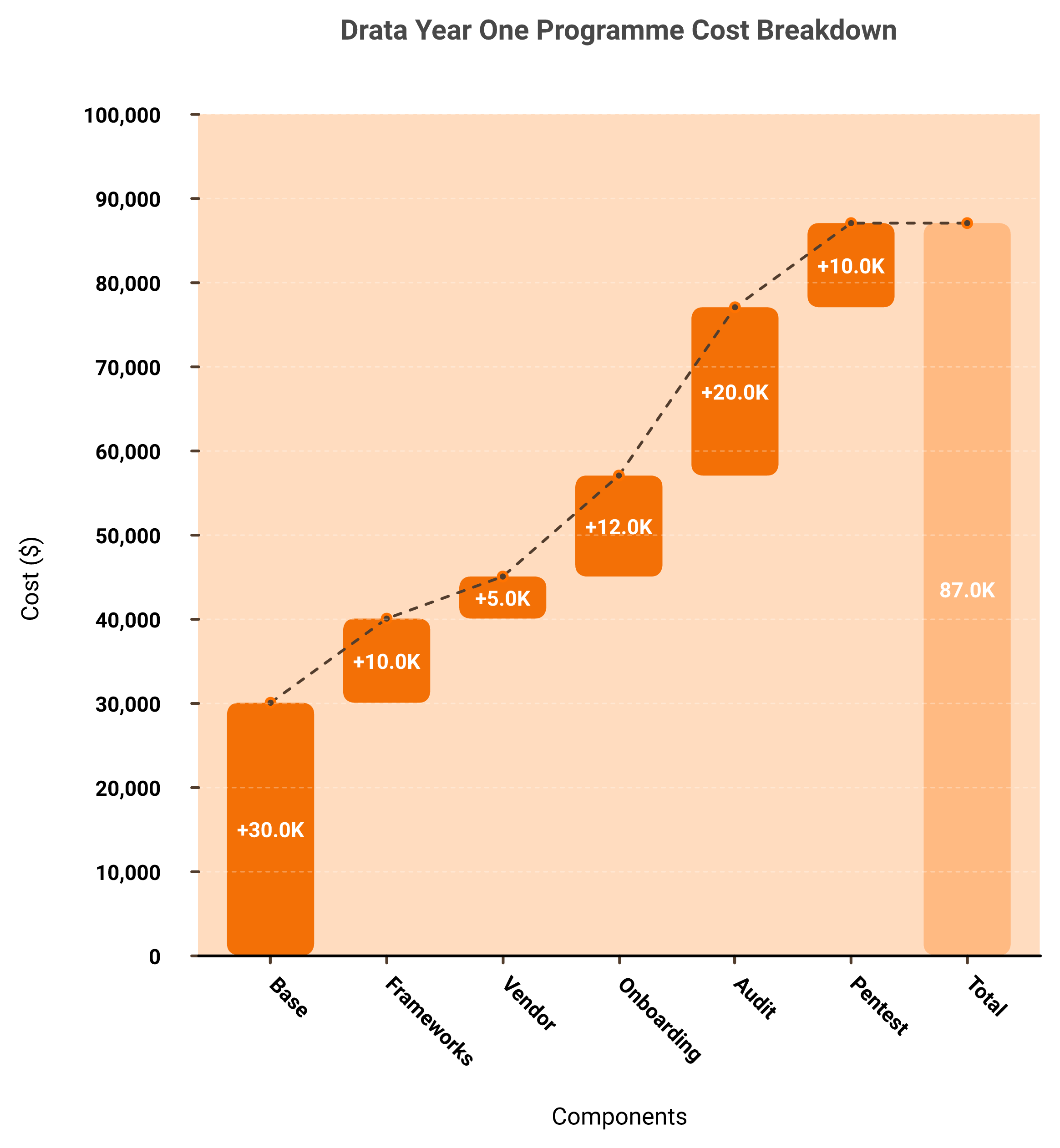
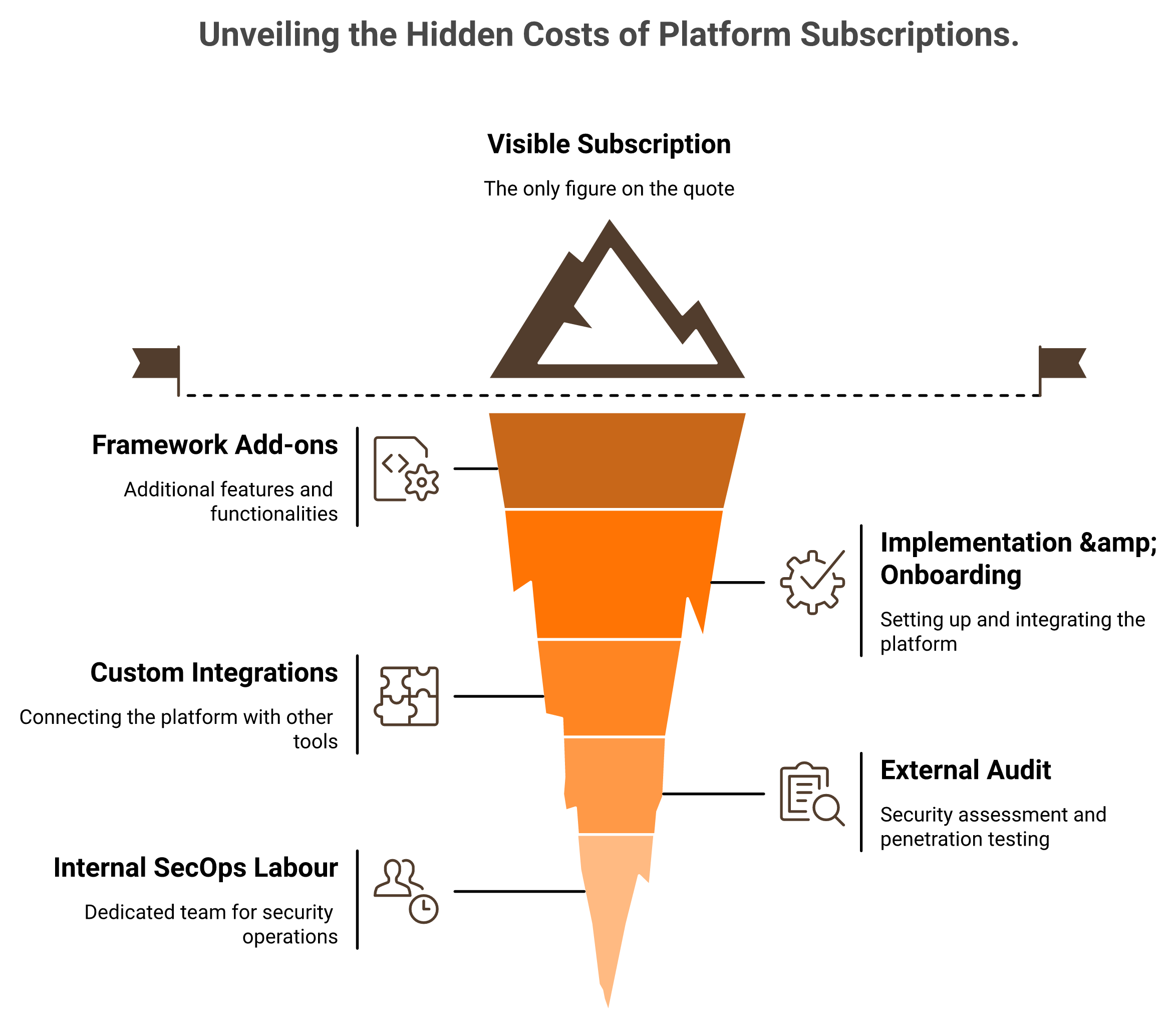
The subscription covers the platform alone. Budget separately for framework add-ons at $3,000 to $10,000 each, implementation at $5,000 to $25,000, custom integrations at $5,000 to $10,000 each, and Workspaces at $5,000 to $15,000. External audit runs $8,000 to $40,000 or more, and a penetration test adds $5,000 to $15,000.
The three surprises buyers report most
Framework add-on creep leads the list. A $7,500 base can reach $20,000 once two more standards are switched on.
Professional services quotes come second. Policy mapping and integration setup arrive as a separate invoice, often after the contract is signed. Renewal upselling of VRM and questionnaire modules rounds out the pattern.
A worked mid-market example
Here is the arithmetic for a 50 to 200 person company on Advanced.
- Base licence: $30,000 to $45,000
- Two additional frameworks: $10,000
- Vendor Risk Management Pro: $5,000
- Year one platform total: $45,000 to $60,000
That total still excludes the CPA audit and the pen test. All-in, a first-year programme commonly lands between $30,000 and $125,000 depending on scale.
Put your own labour on the invoice
The line nobody costs is internal time. Implementation consumes 4 to 24 FTE-weeks of SecOps effort, plus identity hygiene cleanup, HRIS data validation, cloud tagging remediation, and vendor inventory buildout.
At loaded cost, that frequently exceeds the subscription. A powerful platform with no one free to drive it leaves the engine idling in the garage.
What to do before you sign
Ask for the implementation scope in writing. Ask which controls are continuously tested and which need manual attestation. Then price the frameworks you will need in 24 months, today.
UnderDefense includes penetration testing and 24/7 analyst hours inside one contract, which removes two of the invoices GRC buyers typically discover in month four.
Q4. Why does the price jump at renewal?
Three forces stack at renewal. A standard 8% annual escalator applies, framework add-ons layered mid-contract earn only a 20% discount against 35% to 45% upfront, and modules such as VRM Pro get upsold. Buyers report base contracts moving from $7,500 to $20,000 within two cycles. The escalator is negotiable down to roughly 3% before signature.
The situation every second-year buyer hits
Year one feels like value. Evidence collection runs on autopilot, the auditor gets what they need, and the certificate arrives.
Then year two lands at a higher number for the same certificate. Independent trackers put common increases at 10% to 50%, driven by headcount tier crossings and onboarding incentives converting to paid add-ons.
Why the value curve and the price curve diverge
The heavy lifting happens once. Policy authoring, control mapping, integration setup, and evidence baselining are front-loaded into the first twelve months.
Maintenance in year two costs the vendor far less to deliver. The fee stays flat or rises, which is where the subscription starts to feel like rent on work already completed.
Buyers in the r/soc2 community swap real quotes on exactly this question, and the spread between similar companies is wide enough to be worth reading before you benchmark your own renewal.
The clause to put in the order form
Advice is cheap. Contract language is useful. Ask for this, or something close to it, written into the order form before signature.
“Annual price increases at each renewal term shall not exceed three percent (3%) of the prior term’s total contract value, inclusive of all modules, frameworks, and workspaces active at the time of renewal.”
Two details make it hold. The cap must cover add-ons, otherwise framework fees route around it. It must also survive a headcount tier crossing, so name the tier threshold explicitly.
What to do this week
Pull your renewal date and count backwards 120 days. Negotiating three or more months early earns another 5% to 8%.
Bundle every framework you expect to need within 24 months into the current term. Mid-contract additions cost roughly double in discount terms.
UnderDefense prices without an annual escalator, which keeps renewal conversations focused on scope changes rather than recovering last year’s discount.
Q5. Does a 98% readiness dashboard mean you will pass the audit?
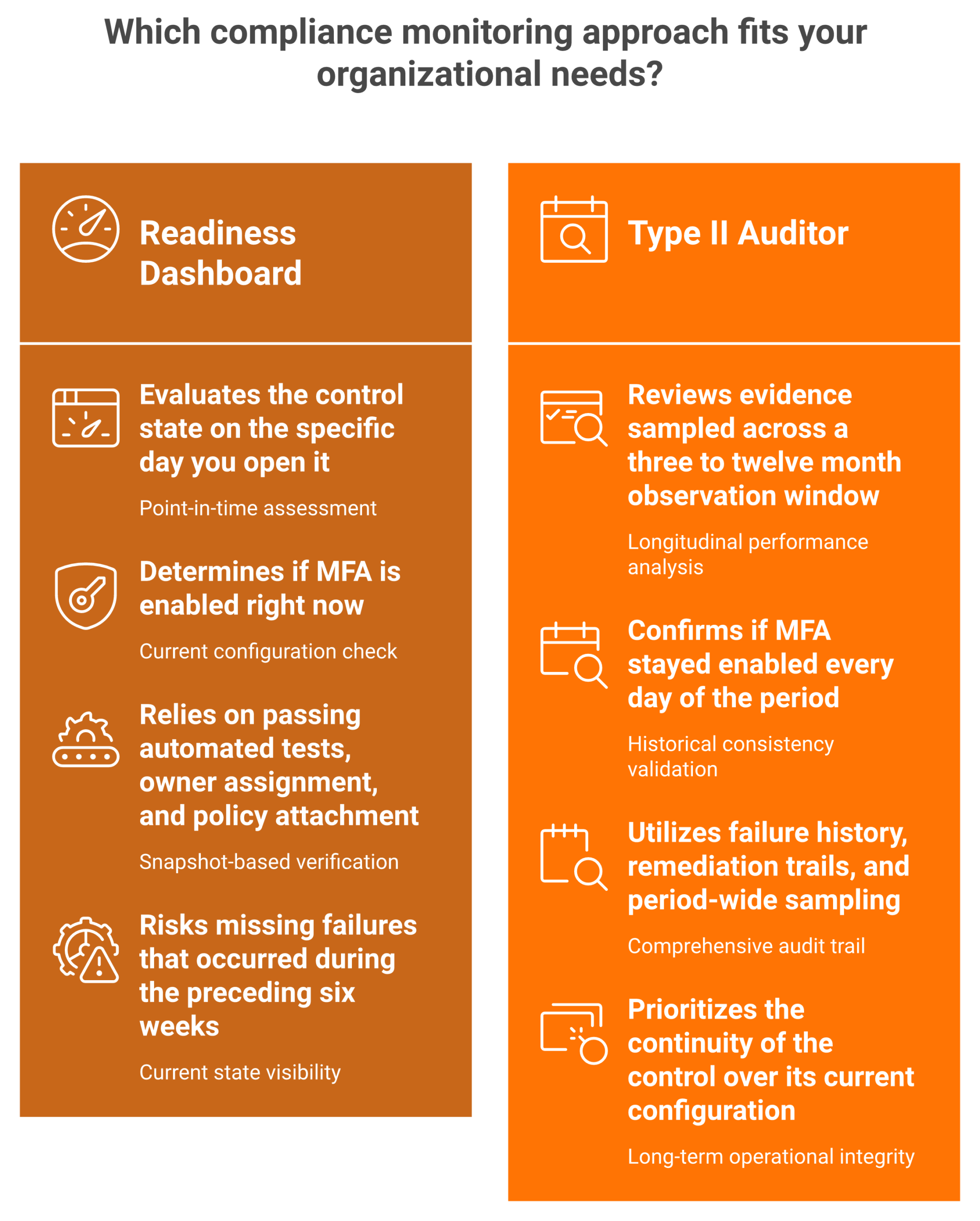
No. A readiness dashboard confirms that a control has an owner, a policy, and a passing automated test today. A SOC 2 Type II auditor samples evidence across the whole observation window. UnderDefense MAXI Compliance AI maps live telemetry to MITRE ATT&CK across more than 700 investigation workbooks, which produces evidence tied to events rather than settings.
A moment in time against a period of time
Here is the mechanical difference that trips up first-time buyers. An automated control test asks whether MFA is enabled right now. A Type II report asks whether MFA stayed enabled for every day of a three to twelve month window.
Those two questions have different answers more often than the dashboard suggests. A control can pass on the day you look and still have failed for six weeks in March.
Where the remediation budget actually goes
Automation covers roughly 70% to 80% of evidence for a standard AWS or GCP stack. For environments with on-premises systems or custom controls, coverage drops to 50% to 60%.
That residual gap is manual work. It is also where unbudgeted hours appear in month five, usually landing on the two people who can least afford them.
The questionnaire loop nobody enjoys
Something odd has happened to vendor assurance. AI drafts the security questionnaire on one side, and AI drafts the answers on the other. A trust centre sits in the middle, pointing at documents nobody opens.
I have watched this loop run for a full quarter. The honest question underneath it stays unanswered: does any of this stop an incident tomorrow?
The turn: what the dashboard genuinely earns
Continuous compliance research points at a real problem with definitions. The term covers seven interacting activities, and vendors implement them inconsistently.
Even so, the dashboard does three things well. It gives every control a named owner. It timestamps evidence automatically. It converts abstract criteria into an engineering to-do list your team can actually work.
UnderDefense clients pass compliance audits at a consistently high rate, and my read is that the platform contributes real value there. I might be weighting the dashboard too harshly. What I have never seen is a completion percentage that survived contact with a rigorous auditor without human preparation behind it.
What to do before your window opens
Ask three questions in your next platform review, and write the answers down.
- Which in-scope controls are continuously tested, which are polled daily, and which need manual attestation?
- What happens to the evidence trail when a control fails and gets fixed mid-window?
- Can the auditor pull the failure history, rather than the current state only?
UnderDefense MAXI Compliance AI maps real security telemetry to controls and ATT&CK techniques, so the evidence an auditor samples reflects what happened in the environment. That gives a lean team something firmer than a percentage to stand behind.
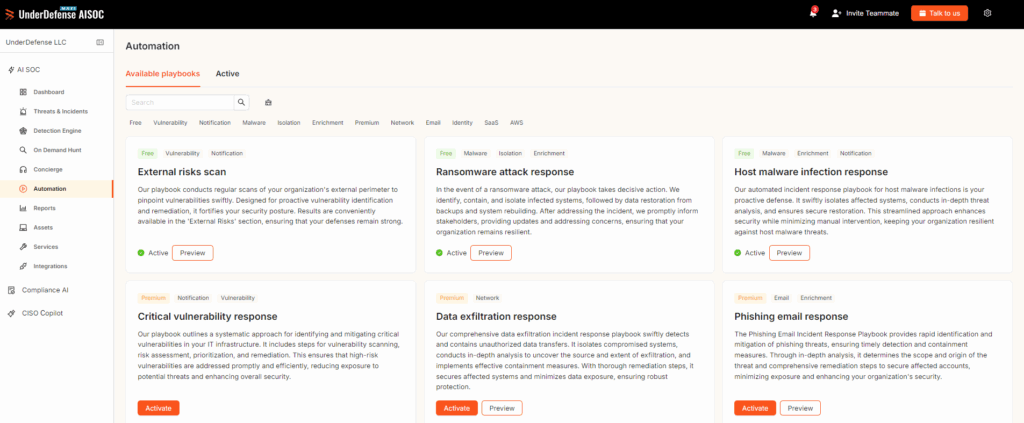
Q6. What do Drata’s 2026 AI agent features add to your quote?
Drata shipped Agentic TPRM Assessment and questionnaire automation in March 2026, then moved AI Agent Governance into limited availability on 4 August 2026, Anthropic-first. None of these appear on a public pricing page. Ask in writing whether they sit inside your edition or arrive as add-ons, because AI questionnaire answering is licensed per response.
What actually shipped, and when
Three capabilities landed inside eighteen months. Agentic AI for Vendor Risk Management arrived in August 2025, automating vendor evidence collection and risk scoring.
Agentic TPRM Assessment and Agentic Questionnaire Response followed at RSA in March 2026. AI Agent Governance, which discovers and monitors AI agents running in your environment, entered limited availability in August 2026 with OpenAI, Vertex AI, and Bedrock support still in development.
The licensing units that move your bill
This matters because the pricing unit changes per capability. UnderDefense sees the same pattern across client contract reviews, where a per-unit meter quietly outgrows the flat platform fee.
| Capability | Licensing unit | Where it sits |
|---|---|---|
| Agentic VRM / VRM Pro | Flat add-on fee | Add-on below Enterprise |
| AIQA questionnaire response | Per AI-assisted response | SafeBase Advanced and Enterprise |
| ISO 42001, NIST AI frameworks | Per framework | Discrete add-on SKUs |
| Adaptive Automation | Per automated test | Add-on on Foundation and Advanced |
Framework add-ons run $3,000 to $10,000 each per year, and AI governance standards are priced the same way as any other framework.
Why a usage meter deserves a cap
Per-unit pricing behaves well until your sales team discovers it. A questionnaire meter scales with enterprise deal volume, which is exactly when finance stops enjoying surprises.
My advice is simple. Ask for a monthly ceiling on AIQA units, or a fixed annual allowance with overage priced in the order form.
Three questions to send your account executive
Copy these into an email before your renewal conversation starts.
- Is AI Agent Governance included in our current edition, or does it become a paid module at general availability?
- What is the per-unit price for AI-assisted questionnaire responses, and what allowance is included?
- Are ISO 42001 and the NIST AI framework priced as standard framework add-ons at our contracted rate?
The honest read on agentic governance
The capability is genuine and the timing is right. Agent sprawl is a real problem, since a developer can run ten autonomous agents on a laptop before lunch and leave nothing in your logs.
Whether governance belongs in a compliance platform or in your detection stack is a live debate. My current read favours the detection stack, because agent activity shows up as behaviour rather than configuration.
UnderDefense monitors AI agent activity inside standard security operations coverage, so the telemetry lands in the same investigation pipeline as identity and endpoint events. No separate module, no separate meter.
Q7. What do Drata customers say once the certificate is framed?
Drata holds 4.7 out of 5 across roughly 1,331 G2 reviews, read in July 2026. Buyers credit it with reaching audit readiness in six to twelve weeks on a standard cloud stack. The recurring criticisms are narrow and expensive: renewal price creep, integration gaps on custom stacks, and a learning curve for teams building non-standard controls.
Meet the second-year compliance owner
Picture a security lead at a 180-person SaaS company. Year one went well, the SOC 2 landed, and the sales team stopped losing deals to questionnaires.
Year two is where her experience changes. The renewal quote arrives higher, and the CSM who knew her environment has moved to another account.
The complaints that cost real money
Reviewers report year-two increases of 20% to 40% when headcount grows or a second framework is added. Buyers on Reddit describe the same pattern in blunter terms, and those threads are worth reading alongside any SOC 2 budget you are building.
Each complaint translates into a clause. Price creep becomes a renewal cap. Integration gaps become a trial requirement written into the order form.
Translate the review into a scoping question
UnderDefense uses a short translation exercise with clients evaluating any platform, because a complaint is only useful once it becomes a question you can ask sales.
- Price creep at renewal, so ask for a 24 to 36 month price lock before signing.
- Integration gaps on custom stacks, so name your three least standard tools and test them in trial.
- CSM turnover, so ask who owns your account and what happens when they leave.
- Automation gap on on-premises systems, so confirm expected coverage for your environment.
The fair rebuttal
Support quality is the most-cited strength in positive reviews, and it beats several category rivals on that measure. Reddit threads describe reps flagging control gaps before they became audit findings.
That is a real advantage. Teams running a first audit without a compliance hire benefit from it more than any feature on the comparison table.
Buyers describe the same relief when the audit evidence lives somewhere defensible.
“They’ve also made our audit process much less painful. The reports from their platform give us clear evidence of our security controls and incident response capabilities.”- Verified User in Marketing and Advertising, UnderDefense G2 – Verified Review
UnderDefense assigns named analysts who stay on the account after signature and reach users directly over Slack, Teams, email, or SMS to collect missing context. Continuity of the people who know your environment is the part reviewers miss most.
Q8. Drata vs Vanta vs Sprinto: where does the money actually differ?
All three are quote-only and overlap heavily at entry. Total cost separates on four variables: per-framework add-on pricing, whether Trust Center and vendor risk are bundled or billed, questionnaire-automation licensing units, and renewal escalator norms. Drata’s observed median sits near $24,869 across 225 tracked deals, Vanta near $20,000, and Sprinto near $15,000.
The cost drivers, side by side
Feature tables mislead here, since all three cover SOC 2 and ISO 27001 competently. Money moves on structure.
| Cost driver | Drata | Vanta | Sprinto |
|---|---|---|---|
| Observed annual range | $9,649 to $60,000 | ~$10,000 to $80,000+ | ~$6,000 to $25,000 |
| Reported median | ~$24,869 | ~$20,000 | ~$15,000 |
| Entry point | $7,500 to $15,000 | ~$10,000 | ~$6,000 to $8,000 |
| Trust Center | Bundled via SafeBase tiers | ~$6,000/yr add-on | Bundled |
| Vendor risk | Standard included, Pro is add-on | ~$11,200/yr add-on | Bundled |
| Startup discount | Negotiated | 50% to 70% year one | 60% year one, tapering |
Read the add-on column first
Vanta’s entry price looks close to Sprinto’s until Trust Center and vendor risk get added, which is roughly $17,200 of annual add-ons. Sprinto bundles both, which explains its flatter curve, and our own Sprinto pricing breakdown walks through that structure in detail.
Drata sits in between, with vendor risk included at Standard and Pro priced separately. That structure suits multi-framework programmes and penalises single-framework buyers.
Scenario guidance by stage
- Seed to Series A, one framework, under 50 people: Sprinto or a discounted Vanta year one.
- Series B to C, two or three frameworks, support-sensitive: Drata Advanced.
- Multi-entity or 500+ people with workspace needs: Drata Enterprise, priced against Vanta at renewal.
The line item these platforms do not cover
All three prepare evidence, and none of them generate it. Detection, response, and testing sit in a separate budget, which is where buyers report value against price.
“It’s reassuring to know they’re always watching for threats, and it doesn’t cost a fortune. They catch and stop problems quickly, which is a huge relief.”- Serhii B., Chief Information Security Officer, UnderDefense G2 – Verified Review
UnderDefense integrates with Splunk, Sentinel, Chronicle, QRadar, and Elastic without a rip and replace, so the security evidence these platforms ask you to upload comes from tooling you already own.
Q9. How do you negotiate a Drata contract down?
Bundle every framework you will need into the first contract. Upfront multi-framework bundling earns 35% to 45% against 20% for mid-contract additions. A two-year commit returns 15% to 25%, and three years returns 25% to 35%. Competitive pressure adds 5% to 15%, and January fiscal year-end another 5% to 15%. Combined, buyers have reached roughly 35% off.
The discount ladder, published
Drata negotiates holistically at the contract level, with no published marginal ladder. Vendr’s buyer data across 94 verified purchases shows where the movement actually happens.
| Lever | Typical discount | When to pull it |
|---|---|---|
| Early renewal, 3+ months ahead | 5% to 8% | 120 days before term end |
| Two-year commit | 15% to 25% | First contract |
| Three-year commit | 25% to 35% | Only with a price cap attached |
| Competitive displacement | 5% to 15% | Run a parallel Vanta quote |
| Fiscal year-end (January) | 5% to 15% | Time signature deliberately |
| Framework bundling upfront | 35% to 45% | Before signature, never after |
Minimum observed annual contract value sits near $8,000 to $10,000. Below that, the conversation ends.
Sequence matters more than aggression
Pulling every lever at once weakens each one. Run them in order across a 90-day window instead.
- Scope your framework list for the next 24 months, then price it as one bundle.
- Open a parallel quote with a direct competitor and say so plainly.
- Ask for multi-year terms only after the bundled price lands.
- Time signature to the vendor’s fiscal year-end in January.
- Cap the renewal escalator in writing before anything gets countersigned.
Five questions for the quote call
Pricing transparency tends to fade at renewal, with surprise increases and fees for added frameworks. These questions surface that early, and they belong in any security budget planning cycle.
- Which in-scope controls are continuously tested, and which need manual attestation?
- What is the framework add-on price at our contracted rate, locked for the term?
- What is the standard renewal uplift, and will you cap it at 3%?
- Is implementation included, or quoted separately as professional services?
- What happens to pricing when we cross the next headcount tier?
The clause that saves the most money
The standard escalator runs 8% and negotiates down to roughly 3%. That gap compounds quietly across a three-year term.
Get the cap written into the order form, and make it cover modules and frameworks active at renewal. A cap that excludes add-ons is decorative, which is the same lesson buyers learn from security contract clauses generally.
One honest caveat
Discounts of this size usually require procurement muscle or a service acting on your behalf. A 40-person company negotiating alone rarely reaches the top of the ladder.
My read is that the bundling lever is the one everybody can pull, regardless of size. It costs nothing except forecasting your framework roadmap properly.
UnderDefense quotes scope and price on the first call, which removes most of the negotiation theatre described above. Buyers spend the saved weeks scoping controls rather than chasing a number.
Q10. When is $38,000 for Drata justified, and when is it overspend?
Drata earns its price with two or more frameworks, multiple legal entities, or a sales cycle stalling on security questionnaires. It becomes overspend when one framework, one entity, and a five-person team pay Advanced-tier rates for automation they will never configure. UnderDefense customers reach up to 44% lower total cost of ownership than building equivalent AI investigation capability in-house.
Three conditions where the money works
Each of these makes the platform cheaper than the alternative, which is usually spreadsheets plus a contractor.
- Two or more frameworks. Cross-framework control mapping means the second and third standards reuse the first one’s evidence.
- Multiple legal entities. Workspaces separate subsidiary programmes cleanly, and manual separation costs far more in labour.
- Questionnaire-blocked deals. A trust centre plus automated responses shortens enterprise sales cycles measurably.
Three conditions where it becomes overspend
The pattern is consistent across budget reviews. Companies buy for the org they plan to be in three years.
- One framework, one entity, under 50 people, with a standard AWS stack.
- No dedicated compliance owner, so the automation stays unconfigured.
- Heavy on-premises footprint, where automated coverage drops to 50% to 60%.
The commercially compelled purchase
There is a fourth case that ignores all of the above. A customer’s third-party risk team asks a two-year-old company for ISO 27001, and the deal stops moving.
At that point compliance becomes a ticket to ride. The question shifts from value to speed, and the cheapest path to a certificate wins.
Framing the spend for your board
Board members rarely care about control coverage percentages. They care about exposure, so anchor the line item against breach economics.
- Global average breach cost: $4.44M in 2025, down 9% year on year.
- United States average: $10.22M, an all-time high.
- Organisations without AI-driven security automation averaged $5.52M.
- Roughly 32% of breached organisations paid a regulatory fine, with nearly half exceeding $100,000.
A $38,000 platform sits comfortably against a six-figure fine probability. That is the sentence to put on the slide.
The number I would actually track
Spend justification improves when finance can see units. UnderDefense reports per-account ROI in incidents handled, analyst hours saved, and dollars saved, which gives procurement the same visibility it demands from a licence.
I would run the same discipline on the compliance side. Track audit-cycle time before and after, and report the delta annually.
My hedge here is honest. UnderDefense data points toward automation paying for itself in labour terms, though the effect is strongest in environments with clean cloud telemetry. Messy hybrid estates take longer to reach that break-even.
Q11. What belongs alongside Drata in your 2026 security budget?
A GRC platform documents controls while other budget lines operate them. Drata offers no managed detection, SOC, or incident response capability. UnderDefense delivers 24/7 detection with 2-minute Alert-to-Triage and 15-minute escalation for critical incidents, which is the evidence auditors increasingly ask compliance platforms to display.
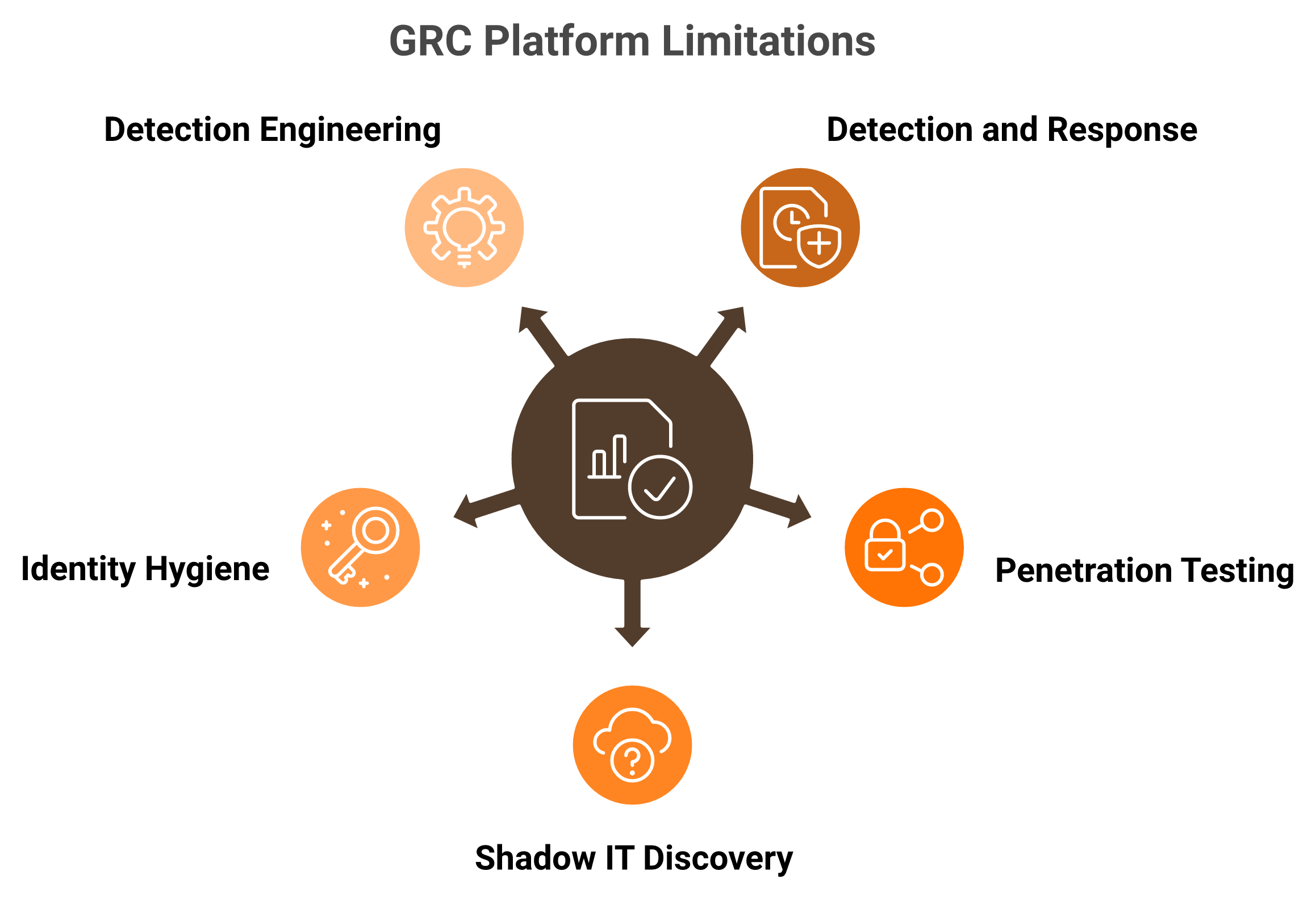
1. Detection and response coverage
This is the line that produces evidence rather than storing it. UnderDefense Agentic AI SOC connects to an existing Splunk or Elastic deployment without replacing it, so your log data stays where you own it (https://underdefense.com/platform/).
Skipping it leaves your incident response control satisfied on paper only. NIST SP 800-61 expects a tested handling capability, with detection, analysis, containment, and recovery actually exercised.
“The biggest problem they solved was our 24/7 coverage gap. We needed round-the-clock monitoring for compliance reasons, but building our own SOC wasn’t realistic with our budget.”- Verified User in Marketing and Advertising, UnderDefense G2 – Verified Review
2. Penetration testing
Budget $5,000 to $15,000 per year. Most auditors and enterprise customers ask for a current report, and no GRC platform produces one. Published pentest pricing makes that line easy to model.
Manual testing finds business-logic flaws that scanners miss. That distinction matters when a customer’s security team reads your report closely.
3. Shadow IT and OAuth discovery
Here is a tactic that costs nothing. As a Google Workspace or Microsoft 365 admin, open the OAuth consent screens and review every third-party app your staff has authorised.
That list becomes a real vendor inventory in an afternoon. It also feeds your vendor risk register with evidence rather than guesses.
4. Identity hygiene
Access reviews, MFA gaps, and dormant accounts sit under nearly every framework. User Access Review runs $5,000 to $12,000 per year as a Drata add-on.
Before buying, check what your existing licences cover. Microsoft E5 bundles capabilities many teams pay twice for, which is worth confirming against Microsoft 365 coverage you already hold.
5. Detection engineering
Rules written like software, versioned, and tested, keep alert quality high as your estate changes. Buyers on Reddit compare real SOC 2 programme budgets openly, and the spread is instructive.
“How much did SOC 2 actually cost your startup? (real numbers, not marketing)”- r/SaaS, Reddit Thread
Teams running lean report the same relief once tuning happens properly.
“Before the guys from UD stepped in, we were getting bombarded with alerts from all our security tools. Their team cleaned up our configurations and got the noise under control within the first week.”- Verified User in Marketing and Advertising, UnderDefense G2 – Verified Review
UnderDefense combines 24/7 detection, the Agentic AI SOC, and compliance support in one contract, so the control evidence and the security work come from the same place.
Q12. What does a 90-day plan look like before you sign?
Days 1 to 14: inventory frameworks, entities, and licences you already own. Days 15 to 30: time-box your current evidence-assembly hours. Days 31 to 60: run parallel quotes and bundle all frameworks upfront. Days 61 to 90: cap the escalator at 3% and fix implementation scope in writing. UnderDefense uncovered a fraud inside one customer’s first three months of monitoring that saved $300,000.
Days 1 to 14: inventory what you own
Owner: whoever holds the security budget. Artefact: a one-page scope sheet.
List every framework you must hold within 24 months, every legal entity, and every licence that might already cover a control. Microsoft E5 and Google Workspace admin consoles are the first two places to look.
Days 15 to 30: build your ROI denominator
Owner: the person who assembled evidence last cycle. Artefact: an hours log.
Time-box how long evidence assembly actually takes today. Continuous compliance research documents cutting SOC 2 evidence assembly from two weeks to four hours in a regulated banking environment. Your own number is the one that matters in the business case.
Days 31 to 60: run quotes in parallel
Owner: procurement, with security in the room. Artefact: two comparable quotes.
Bundle every framework into the first quote, since upfront bundling earns 35% to 45% against 20% mid-contract. Say openly that you are evaluating an alternative, which historically moves price 5% to 15%.
Days 61 to 90: fix the contract mechanics
Owner: legal plus finance. Artefact: a signed order form with three clauses.
Cap the renewal escalator at 3%, covering modules and frameworks active at renewal. Fix implementation scope and cost in writing. Time signature to the January fiscal year-end for another 5% to 15%.
The $100 bet test
Before your observation window opens, apply one filter to every automated control. Would you personally wager $100 of your own money that this control adjustment is correct?
The ones you hesitate on need human review. That hesitation is usually accurate, and it costs far less to act on in week two than in month seven.
The metric to report upward
Track audit-cycle time, measured from evidence request to auditor sign-off. Report the delta once a year, alongside hours reclaimed by the compliance owner.
Percentages on a readiness dashboard tell your board very little. Hours and cycle time tell them something they can act on.
The question I am still sitting with
Compliance platforms are getting better at documenting controls faster. Whether that improves security outcomes, or simply produces cleaner paperwork sooner, remains genuinely unsettled to me.
The fraud I mentioned earlier surfaced through monitoring rather than through any control checklist. If you have data pointing the other way, I would honestly like to hear from you.
UnderDefense maps live security telemetry to controls, which is how that $300,000 finding surfaced within three months of a customer’s onboarding. Evidence produced by watching an environment reads differently to an auditor than a policy attestation.
Start a guided compliance walkthrough →
1. How much does Drata cost per year in 2026?
Drata uses quote-only pricing with no published rate card, no free tier, and no self-serve trial. Across 94 verified purchases in procurement benchmark data, the median contract sits near $38,000 per year, with the 25th percentile near $18,000 and the 75th near $85,000.
- GRC Foundation: roughly $10,000 to $25,000 per year for one pre-mapped framework
- GRC Advanced: roughly $20,000 to $75,000 per year, the most common mid-market edition
- GRC Enterprise: roughly $50,000 to $200,000+ per year with workspaces and the full framework suite
Three variables move the quote: how many frameworks you licence, how many isolated workspaces your legal entities need, and your organisation size. Seats are not the billing unit.
Percentiles matter more than ranges here. A published band of $7,500 to $100,000 tells a CTO nothing useful, while a median and quartiles let you build a defensible line item. UnderDefense publishes flat rates instead, so buyers can model spend before a sales call by reviewing our compliance programme pricing. We built it that way because buyers kept asking for a number they could take into a budget meeting.
2. Does the Drata subscription include the SOC 2 audit fee?
No. The subscription covers the compliance platform alone. Your SOC 2 Type II attestation is issued by an independent CPA firm, billed separately, and typically costs $8,000 to $40,000 or more depending on scope and the number of trust services criteria in play.
Budget these external and adjacent costs alongside the licence:
- CPA audit fee: $8,000 to $40,000+, invoiced by the audit firm
- Penetration test: $5,000 to $15,000, expected by most auditors and enterprise customers
- Implementation and onboarding: $5,000 to $25,000 for policy mapping and integration setup
- Framework add-ons: $3,000 to $10,000 per additional standard, per year
All-in, a first-year programme commonly lands between $30,000 and $125,000 depending on company size. The platform is usually the smallest line on that list once the audit and testing arrive.
UnderDefense bundles penetration testing and analyst hours into a single engagement, which removes two of the invoices GRC buyers typically discover in month four. If you are sizing the testing line specifically, our published pentest rates make that number easy to forecast rather than estimate.
3. Does Drata offer a free trial or a free plan?
No. Drata does not publish a free tier or a self-serve trial. Access starts with a sales conversation and a custom quote, though guided demos and limited pilot access are available to qualified buyers.
That structure has a practical consequence for a lean security team. Price discovery costs you calendar time, often four to six weeks of vendor calls before a number appears. Meanwhile your board deck deadline does not move.
If you need to compress that cycle, do three things before the first call:
- List every framework you must hold within 24 months, so the quote covers your real scope
- Count your legal entities, since workspaces are Enterprise-only and priced per unit
- Ask directly which controls are continuously tested and which need manual attestation
Those three answers turn a discovery call into a scoping call. UnderDefense takes the opposite approach and quotes scope and price on the first conversation, which is the same discipline we apply across our compliance engagements. Buyers spend the saved weeks configuring controls rather than chasing a figure.
4. Why did my Drata renewal price increase?
Three forces usually stack at renewal, and they compound quietly.
- The standard escalator. An 8% annual uplift is common, negotiable down to roughly 3% before signature
- Mid-contract framework additions. Standards added after signing earn about 20% discount, against 35% to 45% when bundled upfront
- Module upsells. Vendor Risk Management Pro, User Access Review, and questionnaire automation get offered at renewal
Headcount tier crossings add a fourth trigger. Buyers report base contracts moving from $7,500 to $20,000 or more inside two cycles, and independent trackers put common increases at 10% to 50%.
The fix is contractual rather than conversational. Ask for a clause capping annual increases at three percent of the prior term’s total contract value, explicitly inclusive of all modules, frameworks, and workspaces active at renewal. A cap that excludes add-ons is decorative, because framework fees simply route around it.
Start the conversation 120 days early, since negotiating three or more months ahead earns another 5% to 8%. UnderDefense prices without an annual escalator, so renewal discussions with us cover scope changes rather than recovering last year’s discount. Comparable renewal mechanics show up across the Vanta pricing landscape too.
5. How do you negotiate a Drata contract down?
Pricing is negotiated holistically at the contract level, so sequence matters more than aggression. Benchmark data across 94 verified purchases shows where the movement actually happens.
- Bundle frameworks upfront: 35% to 45%, against 20% for mid-contract additions
- Two-year commit: 15% to 25%
- Three-year commit: 25% to 35%, only with a price cap attached
- Competitive displacement: 5% to 15% when you run a parallel quote and say so
- January fiscal year-end timing: another 5% to 15%
- Early renewal, 120 days ahead: 5% to 8%
Combined, buyers have reached roughly 35% off. The floor sits near $8,000 to $10,000 annual contract value, below which the conversation ends.
Honest caveat: discounts at the top of that ladder usually require procurement muscle or a partner negotiating alongside you. A 40-person company working alone rarely gets there. The bundling lever is the exception, because it costs nothing except forecasting your framework roadmap properly.
Run this alongside the rest of your annual planning. Our guidance on building a security budget covers how to sequence platform, testing, and monitoring spend so no single vendor consumes the line.
6. How does Drata pricing compare with Vanta and Sprinto?
All three are quote-only and cluster closely at entry, so total cost separates on structure rather than headline price.
- Drata: observed range roughly $9,649 to $60,000, reported median near $24,869
- Vanta: roughly $10,000 to $80,000+, reported median near $20,000
- Sprinto: roughly $6,000 to $25,000, reported median near $15,000
The add-on column decides the real bill. Vanta’s entry price looks close to Sprinto’s until Trust Center and vendor risk are added, which can total around $17,200 annually. Sprinto bundles both. Drata sits between, with vendor risk included at Standard while Pro is priced separately, a structure that rewards multi-framework programmes and penalises single-framework buyers.
Scenario guidance we use with clients:
- Seed to Series A, one framework: Sprinto or a discounted Vanta first year
- Series B to C, two or three frameworks: Drata Advanced
- Multi-entity or 500+ employees: Drata Enterprise, priced competitively at renewal
For the full structural breakdown of the lowest-cost option in that set, see our Sprinto pricing analysis.
7. What hidden costs come with a Drata contract?
The subscription buys the platform. Everything that makes the platform useful arrives on separate invoices.
- Framework add-ons: $3,000 to $10,000 each, per year
- Implementation: $5,000 to $25,000 for policy mapping, integrations, and workshops
- Custom integrations: $5,000 to $10,000 per unsupported tool
- Workspaces: $5,000 to $15,000 per isolated environment, Enterprise only
- User Access Review: $5,000 to $12,000 per year as an add-on
The line nobody budgets is internal labour. Implementation consumes 4 to 24 FTE-weeks of security operations effort, plus identity hygiene cleanup, HRIS data validation, cloud tagging remediation, and vendor inventory buildout. At loaded cost that frequently exceeds the licence itself.
A worked mid-market example: a 50 to 200 person company on Advanced pays $30,000 to $45,000 base, plus $10,000 for two frameworks and $5,000 for Vendor Risk Management Pro, reaching $45,000 to $60,000 in year one before the audit.
Two costs disappear entirely when you check what you already own. Google Workspace and Microsoft 365 OAuth consent screens give you a free vendor inventory, and existing enterprise licences often duplicate access-review tooling. Our SOC 2 audit cost breakdown maps the rest of the programme spend.
8. Does a high Drata readiness score guarantee you will pass the audit?
No. A readiness dashboard confirms that a control has an owner, a policy, and a passing automated test today. A SOC 2 Type II auditor samples evidence across the entire observation window, which runs three to twelve months.
Those are different questions. A control can pass on the day you check and still have failed for six weeks in March. Completion percentage and audit outcome are correlated rather than equivalent, and the gap between them is where unplanned remediation budget disappears.
Coverage also varies by environment:
- Standard AWS or GCP stacks: roughly 70% to 80% of evidence automated
- On-premises or custom control environments: closer to 50% to 60%
Ask three questions before your window opens. Which controls are continuously tested, which are polled daily, and which need manual attestation? What happens to the evidence trail when a control fails and is fixed mid-window? Can the auditor pull failure history rather than current state only?
UnderDefense maps live security telemetry to controls and MITRE ATT&CK techniques through the Agentic AI SOC platform, producing evidence tied to events rather than settings. That gives a lean team something firmer than a percentage to defend.