




Q1: What Are the 8 Best Managed SIEM Providers in 2026?
Choosing a managed SIEM provider is not the same as picking a SIEM product off a shelf. A managed SIEM service means you’re handing over log ingestion, detection tuning, alert triage, and often first-response to an external team, your outsourced SOC, essentially. Get it wrong, and you’re paying someone to generate noise you still have to investigate at 2 AM. Get it right, and you free your internal team to focus on risk reduction instead of alert fatigue.
For this guide, we evaluated 8 managed SIEM service providers, not self-managed SIEM platforms like Splunk or Microsoft Sentinel, and not traditional MSSPs that stop at log monitoring. The distinction matters: managed SIEM providers own detection engineering, threat triage, and often response execution on your behalf.
Our Evaluation Criteria
Each provider was assessed across six operational dimensions relevant to security leaders making procurement decisions:
- Detection Quality — Maturity of detection engineering, correlation logic, and MITRE ATT&CK coverage
- Threat Hunting Depth — Whether the provider performs proactive hypothesis-driven hunts (not just automated sweeps)
- Stack Compatibility — Vendor-agnostic integration vs. proprietary tool requirements; total integration count
- Response SLA — Documented mean time to respond and whether the provider takes response actions or just escalates
- Data Ownership — Whether you retain full ownership of your SIEM data or it’s locked inside the provider’s platform
- Customer Validation — G2, Gartner Peer Insights, and Clutch reviews; both praise patterns and complaint patterns
Who This Guide Is For
This shortlist is designed for:
- CISOs, IT Directors, and CTOs evaluating outsourced SOC operations instead of building a full in-house SOC
- Mid-market and enterprise organizations (50 to 5,000 employees) needing 24/7 detection and triage coverage
- Security-lean teams preparing for compliance certifications (SOC 2, HIPAA, ISO 27001, PCI DSS)
- PE portfolio companies seeking standardized security operations across holdings
If your organization is actively scoping managed SIEM providers for RFP consideration, the eight providers below represent frequently evaluated options in the current market.
| Provider | Best For | Key Strength | Compliance |
|---|---|---|---|
| ⭐⭐⭐⭐⭐ UnderDefense | Mid-market teams needing vendor-agnostic MDR + managed SIEM | AI SOC + Human Ally with 250+ integrations | SOC 2, HIPAA, ISO 27001, GDPR, PCI DSS |
| ⭐⭐⭐⭐ Expel | Tech-forward orgs wanting transparent, automation-first MDR | Strong API integrations and automated alert triage | SOC 2, HIPAA, PCI DSS |
| ⭐⭐⭐⭐ Red Canary | Endpoint-heavy environments running CrowdStrike or Defender | Threat detection focused on endpoint telemetry | SOC 2, HIPAA, PCI DSS |
| ⭐⭐⭐⭐ Taegis | Large enterprises needing legacy SIEM management | Taegis XDR platform with deep threat intelligence | SOC 2, HIPAA, PCI DSS, GDPR |
| ⭐⭐⭐⭐ Arctic Wolf | SMBs wanting fully outsourced, concierge-style security ops | Dedicated Concierge Security Team (CST) | SOC 2, HIPAA, PCI DSS |
| ⭐⭐⭐½ Rapid7 | Organizations already invested in the InsightIDR ecosystem | Unified vulnerability management + SIEM + MDR | SOC 2, HIPAA, PCI DSS |
| ⭐⭐⭐ Alert Logic | AWS-heavy environments needing compliance-driven detection | Built-in AWS integration for cloud-native monitoring | SOC 2, HIPAA, PCI DSS |
| ⭐⭐⭐ Netsurion | SMBs and multi-site retail or hospitality environments | Co-managed SIEM with EventTracker platform | PCI DSS, HIPAA, SOC 2 |
1. UnderDefense: Best for Mid-Market Teams Needing Vendor-Agnostic Managed SIEM + MDR
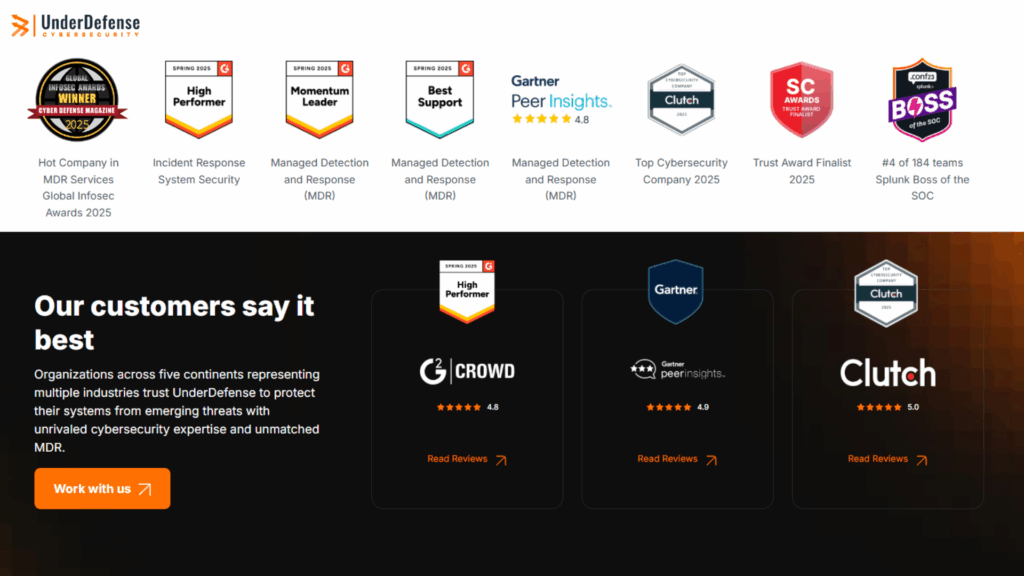
✅ Overview
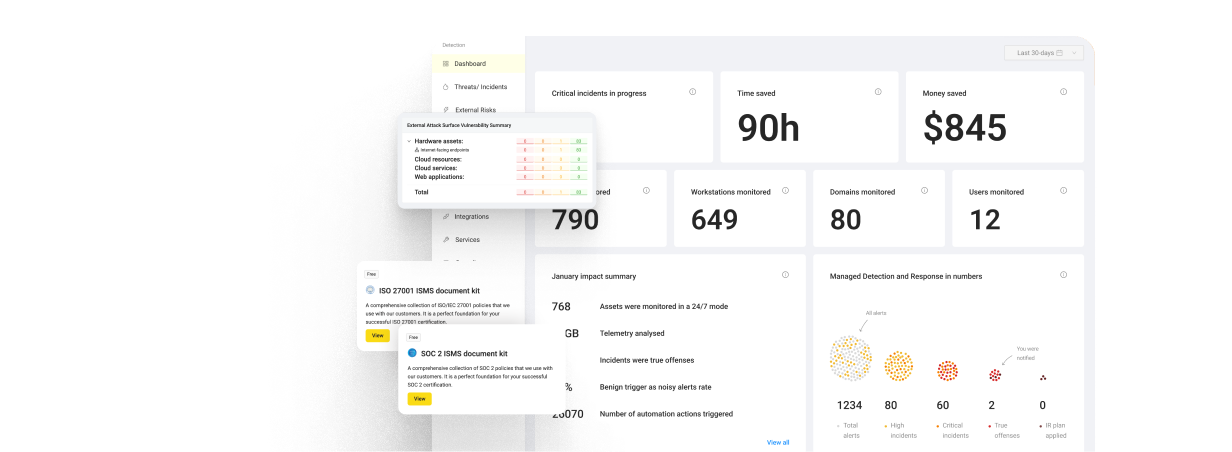
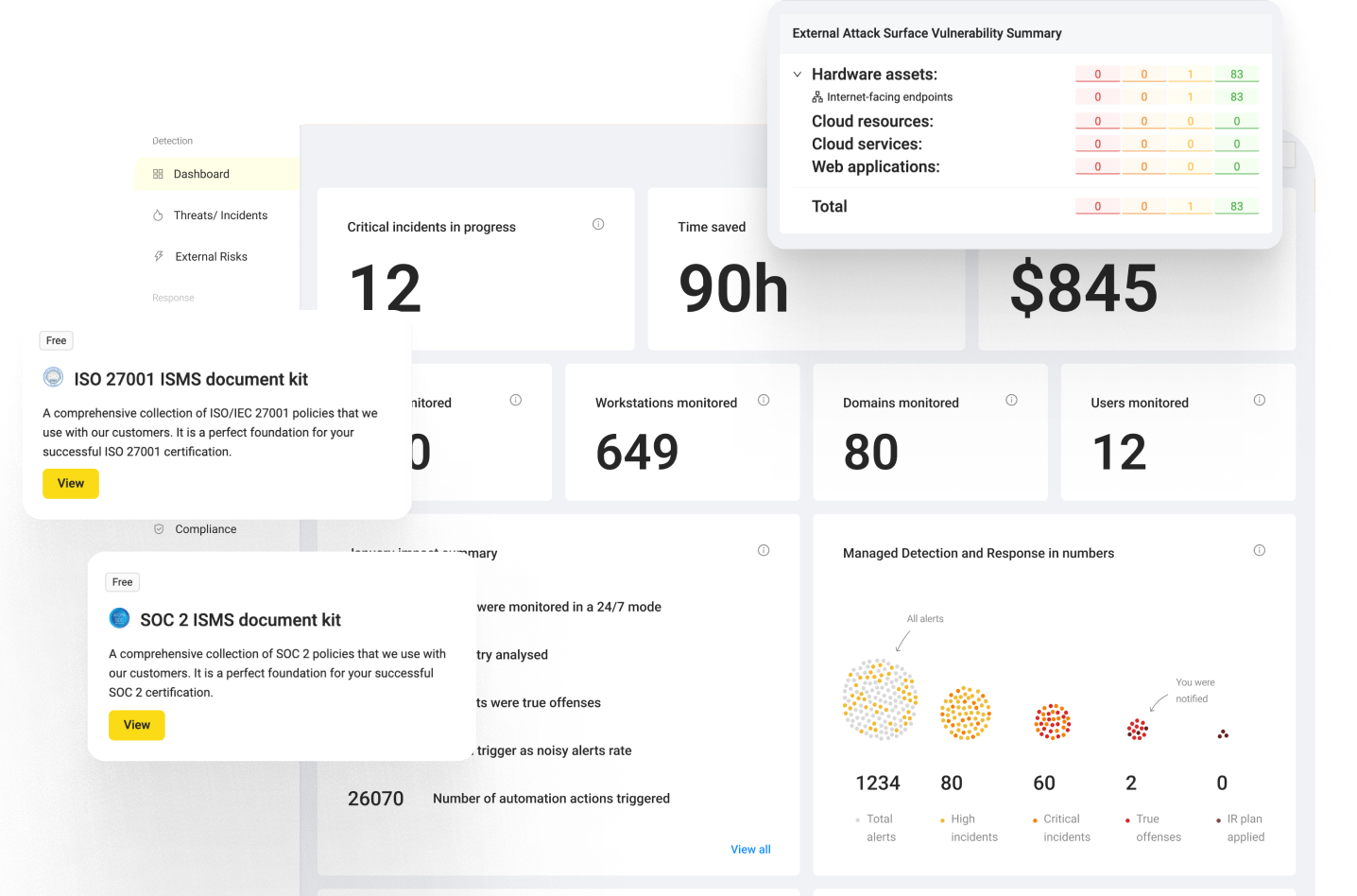
UnderDefense delivers managed SIEM operations as part of its broader MDR offering through the UnderDefense MAXI platform, a vendor-agnostic system that integrates with 250+ existing security tools (SIEM, EDR, cloud, identity) without requiring customers to rip and replace anything. The model is built around what we call “AI SOC + Human Ally”: AI handles detection engineering, alert correlation, and automated enrichment at machine speed, while dedicated human analysts own investigation, user verification, and response execution. This is not monitoring-and-escalation. We take action on your behalf, including containment, remediation guidance, and direct communication with affected users through ChatOps channels like Slack and Teams.
🔧 Core Services
- 24/7 managed SIEM operations with custom detection rule tuning
- AI-driven alert triage and automated enrichment (reducing noise by up to 82%)
- Proactive threat hunting across endpoint, cloud, and identity telemetry
- Incident response with direct remediation, not just ticket escalation
- Compliance reporting and audit-ready evidence generation (SOC 2, HIPAA, ISO 27001, GDPR, PCI DSS)
💡 Why Companies Consider UnderDefense
The core differentiator is operational ownership. Most managed SIEM providers will collect your logs and send you alerts. We collect your logs, tune the detections, triage the alerts, investigate the incidents, verify with affected users directly via Slack, and take response actions, all with full transparency into what happened and why. The UnderDefense MAXI platform gives you a unified view across every security tool you already own. There’s no proprietary agent requirement, no data lock-in, and you retain full ownership of your SIEM data.
Pricing is transparent: $11 to $15 per endpoint per month, published openly. No “contact sales for a quote” games.
👥 Ideal Customer Profile
- Mid-market companies with 50 to 1,000 employees and lean security teams
- Organizations running diverse security stacks (Splunk, Sentinel, CrowdStrike, SentinelOne, AWS, Azure)
- Compliance-driven businesses needing audit-ready reporting
- PE portfolio companies standardizing security across holdings
💰 Commercial Model
Subscription-based, per-endpoint pricing ($11 to $15/month). Includes onboarding, continuous monitoring, detection tuning, threat hunting, and concierge analyst response. No hidden overage fees or data caps.
⏰ When to Shortlist
If your team needs more than alert forwarding, if you want a provider that will actually own security outcomes, integrate with your existing stack without forcing tool replacement, and give you transparent pricing with clear SLAs, UnderDefense belongs on your shortlist.
😊 Customer Reviews
“Their team provided us with clear and detailed insights into security vulnerabilities, along with practical recommendations on how to fix them. This level of transparency made it easy for our team to take action and strengthen our security.”
— Arman N., CTO UnderDefense G2 – Verified Review
“The biggest win for me was getting actual control over our security alerts. Before the guys from UD stepped in, we were getting bombarded with alerts from all our security tools. Their team cleaned up our configurations and got the noise under control within the first week.”
— Verified User in Marketing and Advertising UnderDefense G2 – Verified Review
2. Expel: Best for Tech-Forward Organizations Wanting Transparent, Automation-First MDR
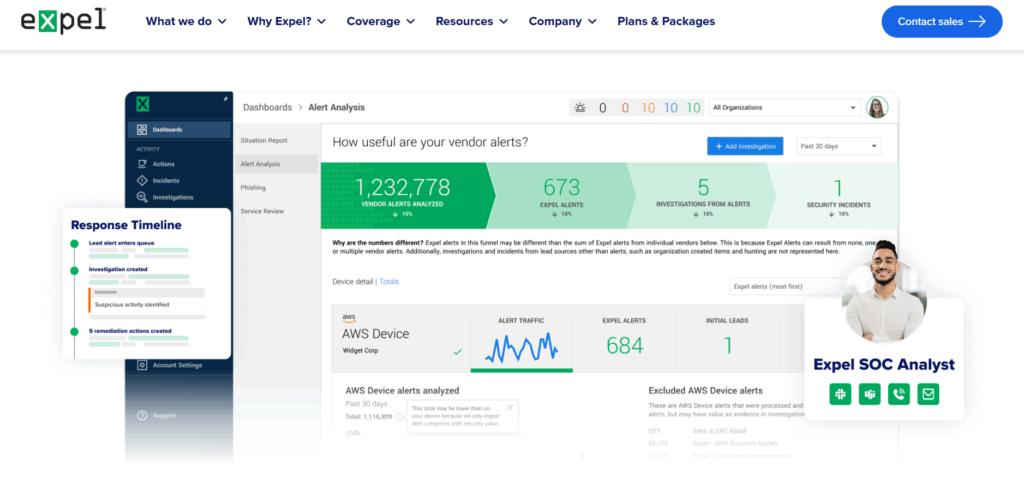
✅ Overview
Expel is a managed detection and response provider that leans heavily on automation to triage and disposition alerts before human analysts get involved. Their platform integrates with a broad range of third-party security tools via API, making it a relatively vendor-agnostic option for teams that want transparency into how alerts are investigated and closed.
🔧 Core Services
- 24/7 managed detection and response across endpoint, cloud, and SaaS
- Automated alert triage and investigation workflows
- Transparent investigation timelines visible in the Expel Workbench
- Threat hunting and resilience recommendations
- Integration with major SIEM, EDR, and cloud platforms
💡 Why Companies Consider Expel
Expel’s strength is its emphasis on showing its work. Investigations are visible in the Workbench portal, so security teams can see exactly what the Expel SOC examined and why they reached a conclusion. The automation capabilities filter out significant noise before it reaches human analysts.
👥 Ideal Customer Profile
- Tech-forward mid-market and enterprise organizations (100 to 5,000 employees)
- Teams already running modern security stacks with API-friendly tools
- Security operations teams looking for a force multiplier, not a full replacement
💰 Commercial Model
Subscription-based pricing, typically scoped to the number of integrations and monitored environments. Pricing is not publicly listed; prospective customers must request quotes.
⏰ When to Shortlist
Organizations that prioritize investigation transparency and want to see the “why” behind every alert disposition should consider Expel. Note, however, that some reviewers report limitations in organizational knowledge retention and repetitive verification requests.
😊 Customer Reviews
“Expel helps our SOC by creating specific detections for a wide range of alerts and security anomalies. I really value that they thoroughly investigate everything before escalating to us, which reduces noise and ensures we only deal with actionable items.”
— Verified User in Retail, Enterprise Expel – G2 Verified Review
“Despite the capabilities of the technical platform and the strength of the analysts providing the service, there is still a limit to the environmental/organizational knowledge inherent in the service. This leads to a fairly frequent need for engagement with our internal team to get clarification and verification.”
— Verified User in Computer Software, Mid-Market Expel – G2 Verified Review
3. Red Canary: Best for Endpoint-Heavy Environments Running CrowdStrike or Microsoft Defender
✅ Overview
Red Canary is an MDR provider that focuses primarily on endpoint detection and response, with strong integration into CrowdStrike Falcon and Microsoft Defender for Endpoint. Their detection engineering team builds and maintains threat detection analytics tuned to endpoint telemetry, making them a strong fit for organizations where endpoint coverage is the primary concern.
🔧 Core Services
- 24/7 endpoint-focused managed detection and response
- Detection engineering with CrowdStrike and Microsoft Defender integration
- Threat hunting and threat intelligence-driven alerting
- Cloud workload monitoring (AWS, Azure, GCP)
- Automation capabilities for end-user self-remediation
💡 Why Companies Consider Red Canary
The threat hunting team is consistently praised by reviewers, and Red Canary does a good job reducing noise from endpoint alerts. For organizations heavily invested in CrowdStrike, the integration depth is a real advantage.
👥 Ideal Customer Profile
- Organizations with CrowdStrike or Microsoft Defender as their primary EDR
- Mid-market and enterprise companies (200 to 5,000 employees)
- Security teams wanting reduced noise from endpoint telemetry
💰 Commercial Model
Subscription-based pricing, scoped to endpoints and integrations. Pricing is not publicly listed.
⏰ When to Shortlist
If your security stack centers on CrowdStrike or Defender and your primary gap is 24/7 endpoint monitoring. Be aware that reviewers flag detection gaps during penetration tests and limited SIEM integration (no native Splunk ingestion).
⚠️ Customer Reviews
“The Threat Hunting Team is excellent. Of the times I’ve reached out to them, they responded quickly and they provided good information and insight. I appreciate their recommendations.”
— Mike S., Information Security Manager, VP Red Canary – G2 Verified Review
“Over the past few years, we’ve undergone several external penetration tests, and during these assessments, Red Canary was not able to identify the malicious activity while the tests were ongoing. Also, they do not have any sort of alert ingestion integrations with Splunk or other SIEM platforms.”
— Verified User in Insurance, Enterprise Red Canary – G2 Verified Review
4. Taegis: Best for Large Enterprises Needing Legacy SIEM Management + XDR
✅ Overview
Taegis is one of the longest-tenured managed security providers, now built around its proprietary Taegis XDR platform. Originally spun out of Dell, Taegis brings deep threat intelligence capabilities and a large analyst pool. The Taegis platform ingests telemetry from endpoints, network, and cloud environments, with managed services layered on top for detection, investigation, and advisory.
🔧 Core Services
- Managed detection and response via Taegis XDR
- Managed SIEM operations and log management
- Threat intelligence from the Counter Threat Unit (CTU)
- Incident response retainer and on-demand IR
- Vulnerability management and risk assessment
💡 Why Companies Consider Taegis
Taegis appeals to large enterprises that want a single vendor for SIEM management, XDR, and threat intelligence. The Counter Threat Unit provides proprietary threat research that informs detection content. For regulated industries already running complex on-prem + cloud hybrid environments, the breadth of services can simplify vendor consolidation.
👥 Ideal Customer Profile
- Large enterprises (1,000+ employees) with complex, hybrid environments
- Regulated industries (financial services, healthcare, government)
- Organizations seeking vendor consolidation across SIEM, XDR, and IR
💰 Commercial Model
Enterprise contract pricing, typically annual agreements scoped to endpoints, log volume, and service tiers. Pricing is not publicly listed and requires direct engagement with sales.
⏰ When to Shortlist
When your organization needs a mature, enterprise-grade managed security partner with deep threat intelligence. Consider that the Taegis platform represents a proprietary ecosystem, and switching costs may be significant.
5. Arctic Wolf: Best for SMBs Wanting Fully Outsourced, Concierge-Style Security Operations
✅ Overview
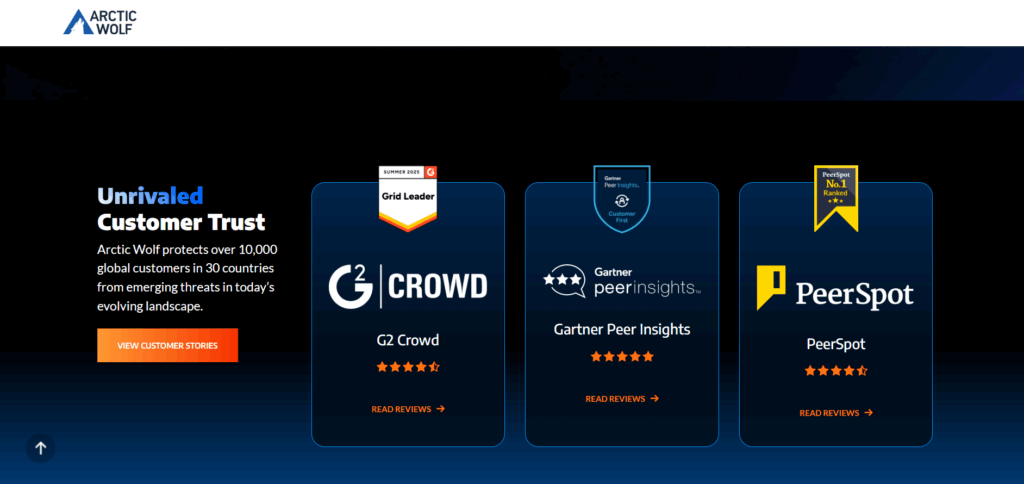
Arctic Wolf markets itself as a “security operations as a concierge” provider, assigning each customer a dedicated Concierge Security Team (CST). The model targets organizations that don’t have, and don’t plan to build, an internal security team. Arctic Wolf handles monitoring, triage, vulnerability management, and security awareness training through its proprietary platform.
🔧 Core Services
- 24/7 managed detection and response
- Concierge Security Team with named contacts
- Managed risk and vulnerability management
- Security awareness training
- Cloud and endpoint monitoring
💡 Why Companies Consider Arctic Wolf
For organizations with no internal security expertise, the concierge model is appealing: you get named people who learn your environment over time. Arctic Wolf is particularly popular among SMBs and mid-market organizations seeking an all-in-one security operations outsource.
👥 Ideal Customer Profile
- SMBs and mid-market organizations (50 to 1,000 employees)
- Security-lean teams with no dedicated SOC
- Companies prioritizing compliance readiness (SOC 2, HIPAA, PCI DSS)
💰 Commercial Model
Subscription-based pricing, scoped by organization size and monitored assets. Pricing is not publicly listed. ⚠️ Note: reviewers flag a 60-day cancellation notice requirement that differs from the industry-standard 30 days.
⏰ When to Shortlist
If you want a fully outsourced security operations partner and you’re comfortable with a proprietary platform. Be aware that Arctic Wolf requires its own agents and data collectors, which means potential tool replacement and vendor lock-in.
❌ Customer Reviews
“Arctic Wolf provides solid detection and response capabilities, but overly relies on the client’s team for remediation, which really hurts the value of the service.”
— VP of Technology Arctic Wolf – Gartner Verified Review
“We received little value from ArcticWolf. The product offered little visibility when we were using it. Anything you want to look at or changes you need to make in the product must go through their engineering team.”
— Matt C., Manager, Cybersecurity Services Arctic Wolf – G2 Verified Review
6. Rapid7: Best for Organizations Already Invested in the InsightIDR Ecosystem
✅ Overview
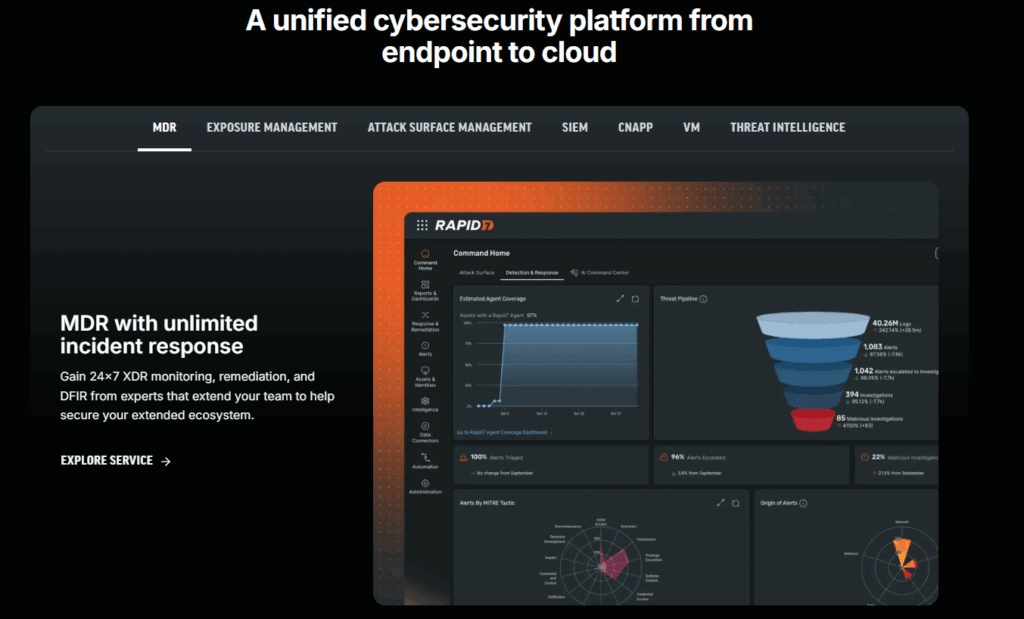
Rapid7 offers managed SIEM and MDR capabilities primarily through its InsightIDR platform and associated managed services. The company also provides vulnerability management (InsightVM), cloud security (InsightCloudSec), and SOAR capabilities (InsightConnect), making it attractive for organizations seeking a unified Rapid7 ecosystem.
🔧 Core Services
- Managed detection and response via InsightIDR
- Vulnerability management (InsightVM)
- Cloud security posture management (InsightCloudSec)
- SOAR and automation (InsightConnect)
- Managed threat hunting
💡 Why Companies Consider Rapid7
The bundled licensing model, particularly the CRC Essentials license, offers multiple security capabilities under one vendor. For teams already using InsightVM or InsightIDR, adding managed services is a natural extension.
👥 Ideal Customer Profile
- Organizations already running Rapid7 products
- Mid-market companies wanting bundled vulnerability management + SIEM + MDR
- Teams looking for agent-based continuous monitoring
💰 Commercial Model
Subscription pricing based on product bundle and asset count. Some reviewers report unexpected overage charges and opaque pricing tiers.
⏰ When to Shortlist
If you’re already a Rapid7 customer and want to layer managed services on top of your existing tooling. Be cautious about integration limitations outside the Rapid7 ecosystem and post-sales support quality.
⚠️ Customer Reviews
“Their CRC Essentials license is absolutely value for money as it includes three of their products. However, it has made our work significantly more which is pretty annoying. It lacks some no-brainer automation options for many stuff that we currently have to do manually.”
— Himanshu K., IT Security Operations Engineer Rapid7 – G2 Verified Review
“The pre-sales crew is great. Really make you think you’ll get high tier support. The scan engine doesn’t function. I’m unable to scan our IP ranges, and they’ve ignored requests to get this resolved.”
— Verified User in Farming, Mid-Market Rapid7 – G2 Verified Review
7. Alert Logic: Best for AWS-Heavy Environments Needing Compliance-Driven Detection
✅ Overview
Alert Logic (now part of Fortra) provides managed detection and response with a particular strength in AWS cloud environments. The platform bundles SIEM, MDR, vulnerability management, EDR, and file integrity monitoring (FIM) into a single offering, making it appealing for compliance-driven organizations that want a checkbox-friendly package.
🔧 Core Services
- 24/7 SOC with managed detection and response
- Built-in SIEM and log management
- AWS-native cloud security monitoring
- Vulnerability scanning and FIM
- PCI DSS daily log review compliance support
💡 Why Companies Consider Alert Logic
For AWS-centric environments, Alert Logic’s native integration is a strength. The bundled pricing model that includes SIEM, MDR, vulnerability management, and FIM in one package appeals to cost-conscious teams needing compliance coverage.
👥 Ideal Customer Profile
- AWS-heavy organizations needing cloud-native security monitoring
- Compliance-driven businesses (PCI DSS, HIPAA, SOC 2)
- Small to mid-market teams wanting an all-in-one compliance bundle
💰 Commercial Model
Tiered subscription pricing based on coverage level (Essentials, Professional, Enterprise). Published pricing tiers available. ⚠️ Be aware of the 50GB/day log collection cap that some reviewers report was not disclosed during the sales process.
⏰ When to Shortlist
If your environment is AWS-centric, you need PCI/HIPAA compliance support, and you want bundled SIEM + MDR at a defined price point. Note that reviewers consistently flag limited integrations outside AWS, manual setup processes, and inconsistent support quality.
❌ Customer Reviews
“Having a 24/7 SOC that we don’t have to manage is hands down my favorite. It doesn’t seem to always be accurate. It’s hard to know where it’s pulling information from when delivering findings.”
— Monique L., Product Security Sr. Analyst Alert Logic – G2 Verified Review
“We’ve had a pretty terrible experience with Alert Logic. The product was oversold and underdelivered. Support doesn’t seem to understand their products; we’ve gotten so many conflicting responses to issues that I can’t count them anymore.”
— Information Security Officer, Banking Alert Logic – Gartner Verified Review
8. Netsurion: Best for SMBs and Multi-Site Retail or Hospitality Environments
✅ Overview
Netsurion offers a co-managed SIEM approach through its EventTracker platform, targeting small and mid-sized businesses, particularly in retail, hospitality, and multi-site franchise environments. The service combines SIEM, log management, and managed SOC operations with an emphasis on PCI DSS compliance and affordable entry-level pricing.
🔧 Core Services
- Co-managed SIEM via the EventTracker platform
- 24/7 SOC monitoring and alert triage
- Log management and compliance reporting
- Vulnerability scanning
- PCI DSS and HIPAA compliance support
💡 Why Companies Consider Netsurion
For small businesses and multi-location operations (retail chains, restaurant groups, healthcare clinics), Netsurion provides an accessible entry point into managed SIEM without enterprise-scale complexity or pricing. The co-managed model allows internal IT teams to maintain visibility and control while offloading 24/7 monitoring.
👥 Ideal Customer Profile
- SMBs with 25 to 500 employees across multiple sites
- Retail, hospitality, and healthcare organizations needing PCI DSS compliance
- IT teams that want shared responsibility (co-managed) rather than full outsource
💰 Commercial Model
Tiered pricing based on log sources and endpoints monitored. Generally positioned as the most affordable option in this list, with packages designed for small businesses.
⏰ When to Shortlist
If you’re a smaller organization or multi-site business that needs compliance-driven SIEM monitoring at an accessible price point, and you prefer a co-managed model where your IT team retains partial control.
💸 Pricing & TCO Guidance
One of the most common friction points in evaluating managed SIEM providers is pricing opacity. Only a few providers in this list publish transparent pricing:
- UnderDefense publishes per-endpoint pricing at $11 to $15/month, all-inclusive
- Alert Logic offers tiered pricing (Essentials/Professional/Enterprise) with published ranges
- Arctic Wolf, Taegis, Expel, Red Canary, Rapid7, and Netsurion all require “contact sales” for quotes
When modeling total cost of ownership, factor in not just the monthly subscription but also: tool replacement requirements (Arctic Wolf’s proprietary agents), data overage charges (Rapid7, Alert Logic), integration engineering time, and the internal staff hours still needed if the provider escalates rather than responds. A provider that costs 20% more but eliminates 80% of your alert triage burden will deliver better ROI than a cheap monitoring service that still requires your team to investigate every escalation at 2 AM.
Q2: How Were These 8 Managed SIEM Providers Scored and Ranked?
Most managed SIEM listicles are vendor-authored marketing disguised as analysis. Panther ranks Panther #1. SentinelOne ranks SentinelOne #1. Rapid7 publishes “best SIEM” guides that conveniently crown InsightIDR. The pattern is obvious once you see it, and it erodes the trust security leaders need when making a decision that shapes their entire detection posture for years.
This ranking operates differently. Every provider was evaluated against five independently verifiable dimensions, each weighted by operational impact, not vendor preference. No provider participated in the scoring. No vendor funded the research. The methodology is published here so you can audit it, reproduce it, and challenge any score that doesn’t match your operational experience.
⚠️ Why Disclosed Methodology Matters
When a ranking hides its criteria, there is no way to disaggregate marketing from merit. If you cannot see how a vendor was scored, you cannot evaluate whether the score applies to your environment. That is the difference between a buying guide and a brochure.
The 5-Criteria Scoring Framework
Each managed SIEM provider was scored on a 100-point scale across five weighted dimensions:
| # | Criterion | Weight | What It Measures |
|---|---|---|---|
| 1 | Detection Quality & Accuracy | 25% | MITRE ATT&CK technique coverage, false-positive rates, custom detection rule depth, and behavioral analytics beyond native SIEM defaults |
| 2 | Threat Hunting & Proactive Intelligence | 20% | Whether hunting is Level 1 (automated IOC matching), Level 2 (behavioral/ML-driven), or Level 3 (hypothesis-driven human investigation producing intelligence reports) |
| 3 | Stack Compatibility & Integration Flexibility | 20% | Total integration count, vendor-agnostic vs. proprietary lock-in posture, and multi-cloud coverage (AWS, GCP, Azure) |
| 4 | Response SLAs & Containment Speed | 20% | Contractual response times by severity tier (P1/P2/P3), full containment vs. detection-only capability, and documented evidence from real incidents |
| 5 | Data Ownership & Pricing Transparency | 15% | Who owns raw logs post-contract, retention and export format, and whether pricing is published or hidden behind “contact sales” opacity |
💰 Why Data Ownership Gets Its Own Criterion
This is the dimension most rankings ignore entirely, and it is the one that burns you hardest on contract renewal. As one veteran CISO put it during our research conversations: when you switch MDR providers, the business logic, correlation rules, and automation rules do not come with you. If your vendor owns the data layer, you start tuning from zero every time you renegotiate. That lesson, separating SIEM data ownership from MDR service delivery, is core to resilient security architecture.
Star Rating Scale
Composite scores translate to a star rating using a linear scale:
| Score Range | Star Rating |
|---|---|
| 0–20 | ⭐ |
| 21–40 | ⭐⭐ |
| 41–60 | ⭐⭐⭐ |
| 61–80 | ⭐⭐⭐⭐ |
| 81–100 | ⭐⭐⭐⭐⭐ |
✅ Data Sources Powering This Ranking
Scores draw from multiple independent inputs:
- G2 Winter/Spring 2026 reviews, verified user feedback on detection quality, support responsiveness, and integration experience
- Clutch February 2026 rankings, project-based evaluations with documented outcomes
- Vendor-published SLAs, contractual response time commitments verified against public documentation
- MITRE ATT&CK evaluations, technique coverage claims cross-referenced against published evaluation results
- Direct feature verification, hands-on validation of integration counts, onboarding workflows, and containment capabilities
UnderDefense achieves ⭐⭐⭐⭐⭐ (5 stars) with a composite score above 81, driven by top-tier performance across all five dimensions: 96% MITRE ATT&CK coverage, 250+ vendor-agnostic integrations, published $11 to $15/endpoint/month pricing, documented 2-minute alert-to-triage and 15-minute escalation for critical incidents, and full customer data ownership with exportable log formats.
Q3: What Separates Real Detection Quality and Threat Hunting from Marketing Claims?
Security teams drown in alerts. The average SIEM environment generates north of 10,000 daily alerts, but volume has never equaled quality. The real measure is signal-to-noise ratio: how many of those 10,000 alerts actually require human attention, and how many are noise that burns analyst hours without reducing risk?
Here is the operational truth most vendors avoid: the majority of managed SIEM providers inherit the native detection rules shipped with whatever SIEM they deploy and call it a day. They bolt on a logo, wrap a SOC team around out-of-box signatures, and market it as “managed detection.” Meanwhile, novel attack techniques, living-off-the-land binaries, identity-based lateral movement, cloud permission abuse, sail through undetected because signature-based rules were never designed to catch behavior.
⏰ The “Proactive Threat Hunting” Problem
Every provider on this list claims “proactive threat hunting.” The term has become meaningless through overuse. In reality, threat hunting spans an enormous spectrum, from automated IOC feed matching that any SIEM does natively, to genuine hypothesis-driven investigation by experienced analysts producing actionable intelligence reports. If you do not ask which level your vendor operates at, you are buying a label, not a capability.
Detection Quality: Where Providers Actually Stand
Providers like Alert Logic and Netsurion rely heavily on out-of-box signature detections. Alert Logic’s G2 reviews paint a consistent picture of detection gaps:
“Alert Logic never correctly identified a single critical-security concern while we had the product, we always had to notify Alert Logic there was an issue.”
— Security Analyst, Software Industry Alert Logic – Gartner Verified Review
Arctic Wolf’s Concierge Team adds organizational context, which is genuinely valuable, but it locks you into their proprietary detection stack. You gain context at the cost of flexibility. A Gartner reviewer noted:
“Analysts provide little context, and when asked for more information in the investigation nothing is ever provided or even communicated.”
— CISO, Manufacturing ($3B–$10B) Arctic Wolf – Gartner Verified Review
Rapid7 InsightIDR offers 900+ out-of-box detections, but G2 reviewers consistently cite false-positive fatigue and integration rigidity:
“We constantly battle with false positives, feature requests take a long time.”
— Manager, Vulnerability Management, Travel & Hospitality ($1B–$3B) Rapid7 – Gartner Verified Review
Expel and Red Canary lead the competitor set with intelligence-led detection and published threat research. However, Red Canary reviewers flag real detection gaps during adversary simulation:
“Over the past few years, we’ve undergone several external penetration tests, and during these assessments, Red Canary was not able to identify the malicious activity while the tests were ongoing.”
— Verified User, Insurance, Enterprise Red Canary – G2 Verified Review
The 3-Level Threat Hunting Maturity Framework
This framework separates marketing from operational reality. Rate your current provider, and any vendor you are evaluating, against these three levels:
| Level | Description | Characteristics | Providers |
|---|---|---|---|
| Level 1: Automated IOC Matching | Reactive, signature-dependent | Matches known indicators against threat feeds; no original investigation | Alert Logic (L1–2), Netsurion (L1–2) |
| Level 2: Behavioral Analytics Hunting | UEBA and ML-driven anomaly detection | Identifies deviations from baseline behavior; limited hypothesis formulation | Arctic Wolf (L2), Rapid7 (L2), Taegis (L2) |
| Level 3: Hypothesis-Driven Human Hunting | Dedicated hunters, TTP-based investigation | Produces original intelligence reports; tests hypotheses against live telemetry 24/7 | ✅ UnderDefense (L3), Expel (L2–3), Red Canary (L2–3) |
✅ UnderDefense’s Detection Architecture
We built the UnderDefense MAXI platform to solve the exact problem described above, not with more signatures, but with correlation across telemetry layers that most providers treat as separate silos. The operational specifics:
- 96% MITRE ATT&CK coverage with custom detection tuning during a 30-day onboarding, not six months of professional services
- AI-driven correlation across endpoint, identity, cloud, and network telemetry that reduces customer-facing alerts by 99%
- Concierge analyst verification via ChatOps (Slack, Teams, email) that eliminates the false-positive burden entirely; analysts confirm directly with affected users instead of escalating “please investigate” tickets
- 24/7 Level 3 threat hunting with hypothesis-driven investigation producing actionable intelligence, not just IOC-matched reports
The proof point: UnderDefense detected threats 2 days faster than CrowdStrike OverWatch in documented case studies, because AI-driven detection without human organizational context still leaves gaps that only analysts communicating directly with users can close. Automation scales routine work; humans handle edge cases. That is the resilient model.
Q4: Which Providers Work with Your Stack, and What Response SLAs Should You Demand?
Two operational realities determine whether a managed SIEM vendor becomes a trusted partner or a recurring problem: first, does it work with your existing security tools, or does it force a migration that resets all your custom logic? Second, when a P1 incident hits at 2 AM, how fast do they actually respond, contractually? Both dimensions are poorly disclosed across the market, and both carry consequences that surface only after you have signed the contract.
❌ The Hidden Vendor Lock-In Trap
The mistake most buyers make is evaluating integration by counting logos on a vendor’s website. “We support CrowdStrike” might mean full bidirectional API integration, or it might mean they ingest CrowdStrike alerts into a proprietary data lake you cannot export from. The right question is not “Do you integrate?” but “Do you access data where it lives, or do you require me to move it into your platform?”
Stack Compatibility Matrix
| Provider | CrowdStrike | SentinelOne | MS Defender | Splunk | MS Sentinel | Google SecOps | Palo Alto | Okta/Azure AD | AWS/GCP/Azure | Integration Approach |
|---|---|---|---|---|---|---|---|---|---|---|
| UnderDefense | ✅ | ✅ | ✅ | ✅ | ✅ | ✅ | ✅ | ✅ | ✅ | 250+ vendor-agnostic; accesses data where it lives |
| Taegis | ✅ | ✅ | ✅ | ✅ | ✅ | ✅ | ✅ | ✅ | ✅ | 350+ via Taegis; semi-proprietary data layer |
| Expel | ✅ | ✅ | ✅ | ✅ | ✅ | ✅ | ✅ | ✅ | ✅ | Broad SIEM/cloud coverage; API-first |
| Red Canary | ✅ | ✅ | ✅ | ⚠️ | ⚠️ | ⚠️ | ✅ | ✅ | ✅ | CrowdStrike-heavy; limited SIEM ingestion |
| Arctic Wolf | ⚠️ | ⚠️ | ⚠️ | ❌ | ❌ | ❌ | ⚠️ | ✅ | ✅ | Proprietary platform required; replaces existing SIEM |
| Rapid7 | ✅ | ⚠️ | ✅ | ❌ | ❌ | ❌ | ✅ | ✅ | ✅ | InsightIDR-native; limited external SIEM support |
| Alert Logic | ⚠️ | ⚠️ | ⚠️ | ❌ | ❌ | ❌ | ⚠️ | ⚠️ | ✅ | AWS-focused; very limited third-party integrations |
| Netsurion | ⚠️ | ⚠️ | ✅ | ⚠️ | ❌ | ❌ | ⚠️ | ✅ | ⚠️ | EventTracker-native; narrow integration ecosystem |
✅ = Full native integration | ⚠️ = Partial/limited support | ❌ = Not supported or requires proprietary replacement
Red Canary reviewers confirm the integration limitation directly:
“I wish the integrations beyond CrowdStrike were a bit more robust and greater in number. Red Canary is perhaps too reliant on CrowdStrike and less on our other sources which are important, Cloud, Identity, Email, etc.”
— Verified User, Computer Software, Enterprise Red Canary – G2 Verified Review
Alert Logic’s Gartner reviews echo the same theme:
“Very limited compatibility/integration with other security tools. Terrible documentation. Very complicated and manual setup.”
— IT InfoSec Manager, $50M–$250M Alert Logic – Gartner Verified Review
Response SLA Benchmark Table
⏰ What to Demand From Any Managed SIEM Provider
Before signing any contract, require three things in writing: (1) contractual response times broken out by P1/P2/P3 severity, (2) a clear distinction between acknowledge time and containment time, and (3) documented evidence from real incidents, not theoretical benchmarks. For a deeper dive into SOC metrics and SLAs, reference our dedicated guide.
| Provider | P1 (Critical) Response Time | P2 (High) Response Time | Containment Capability | SLA Contractually Guaranteed? |
|---|---|---|---|---|
| UnderDefense | ✅ 2-minute alert-to-triage, 15-minute escalation (documented) | 4 hours | Full containment + remediation | Yes |
| Expel | ✅ 17 minutes (published) | 1 hour | Full containment | Yes |
| Red Canary | Published metrics | Published | Detection + limited containment | Partially |
| Taegis | Not publicly documented | Not documented | Detection + guided response | No |
| Arctic Wolf | Not publicly documented | Not documented | Detection + escalation | No |
| Rapid7 | Not publicly documented | Not documented | Detection + investigation | No |
| Alert Logic | Not publicly documented | Not documented | Detection-only | No |
| Netsurion | Not publicly documented | Not documented | Detection + basic response | No |
✅ UnderDefense: Stack Protection + Speed
UnderDefense scores at the top of both dimensions for a structural reason: we were built vendor-agnostic from day one. The 250+ integrations are not a marketing number; they represent the operational principle that a managed SIEM provider should access data where it lives, not force migration into a proprietary lake. Your custom correlation rules, your detection tuning, your business logic: it stays with you.
The response speed follows the same architecture: 2-minute alert-to-triage and 15-minute escalation for critical incidents with full containment and remediation, backed by concierge analysts who verify and contain threats directly, 2 days faster than CrowdStrike OverWatch in documented case studies, because organizational context closes incidents that pure technology cannot.
Compliance Framework Support
| Provider | SOC 2 | HIPAA | PCI DSS | ISO 27001 | GDPR |
|---|---|---|---|---|---|
| UnderDefense | ✅ | ✅ | ✅ | ✅ | ✅ |
| Taegis | ✅ | ✅ | ✅ | ✅ | ✅ |
| Arctic Wolf | ✅ | ✅ | ✅ | ⚠️ | ⚠️ |
| Expel | ✅ | ✅ | ⚠️ | ⚠️ | ⚠️ |
| Red Canary | ✅ | ⚠️ | ⚠️ | ⚠️ | ⚠️ |
| Rapid7 | ✅ | ✅ | ✅ | ⚠️ | ⚠️ |
| Alert Logic | ✅ | ✅ | ✅ | ⚠️ | ⚠️ |
| Netsurion | ✅ | ✅ | ✅ | ⚠️ | ⚠️ |
UnderDefense includes forever-free compliance kits with every MDR engagement: SOC 2, HIPAA, PCI DSS, ISO 27001, and GDPR audit evidence generated automatically from your security monitoring data, not bolted on as a separate product with a separate invoice.
Q5: Who Owns Your Data, and What Do G2 Reviewers Actually Say?
Your managed SIEM contract ends. You request 18 months of security logs for regulatory compliance: SOC 2 audit trail, HIPAA incident history, forensic evidence from that credential-stuffing campaign in Q3. The provider responds: “Log data is retained in proprietary format for 90 days post-termination. After that, permanently deleted.” Now you have a compliance gap, audit risk, and zero forensic history. Meanwhile, G2 reviews warned about this exact problem, but no ranking article ever surfaced it.
⚠️ Why This Scenario Keeps Happening
This is not hypothetical, but an operational reality that recurs because most managed SIEM buyers never ask the data ownership question before signing. They evaluate detection quality, response speed, and pricing, then discover on contract renewal that the business logic, correlation rules, and automation rules they spent 12 months tuning do not come with them. The switching cost is not the new vendor’s price; it is starting from zero on everything you already built.
Data Ownership Comparison
| Provider | Raw Log Ownership | Export Format | Post-Contract Retention | Data Residency Options | Portability Clause |
|---|---|---|---|---|---|
| UnderDefense | ✅ Customer | Standard (CEF/JSON) | Customer-controlled | Multi-region | Full portability |
| Expel | ✅ Customer | Standard API export | 30 days post-contract | US/EU | Partial portability |
| Red Canary | ✅ Customer | API-based export | Limited post-contract | US primary | Limited clause |
| Taegis | ⚠️ Semi-proprietary | Taegis-native format | 90 days standard | Multi-region | Negotiable |
| Arctic Wolf | ❌ Vendor-retained | Proprietary format | Vendor-controlled | Limited | ❌ No portability |
| Rapid7 | ⚠️ Platform-dependent | InsightIDR-native | Platform-tied | US/EU | Limited |
| Alert Logic | ⚠️ Vendor-managed | Proprietary | 90 days standard | AWS-dependent | Limited |
| Netsurion | ⚠️ EventTracker-native | Proprietary format | Vendor-controlled | US primary | Limited |
💰 Five Questions to Ask Before Signing
- Who owns raw log data during the contract, and can you prove it contractually?
- What export format will logs be delivered in if you terminate?
- How long are logs retained post-contract, and at what cost?
- Can you migrate correlation rules, custom detections, and automation logic to a new provider?
- Does the provider access data where it lives, or require ingestion into their proprietary lake?
What G2 Reviewers Actually Report
Cross-referencing G2 and Gartner reviews across all eight providers reveals three universal complaint themes and two universal praise themes, regardless of vendor:
❌ Universal complaints: alert noise/false positives, slow or painful onboarding, and opaque pricing that changes at renewal.
✅ Universal praise: 24/7 coverage availability and compliance support documentation.
The pattern that separates top-rated from bottom-rated providers is straightforward: vendors where analysts act on threats consistently outscore vendors that escalate alerts back to the customer’s team.
“We havent received any real communication from their team in some time.”
— Verified User, IT Services, Enterprise Alert Logic – G2 Verified Review
“Log collectors show working, however when asked to provide logs for an investigation no logs could be provided.”
— CISO, Manufacturing ($3B–$10B) Arctic Wolf – Gartner Verified Review
“The platform works really well with our other security tools, which makes things much simpler. And we really appreciate that we can customize the threat detection to focus on our specific needs.”
— Serhii B., Chief Information Security Officer UnderDefense – G2 Verified Review
✅ UnderDefense’s Data Ownership Position
We built UnderDefense MAXI around a principle borrowed from hard operational experience: the customer owns the data, always. Standard-format exports (CEF/JSON), customer-controlled retention, no proprietary lock-in on correlation rules, and full portability if you ever decide to leave. The platform operates on your data without claiming ownership of it, because your business logic is your competitive advantage, not ours.
Q6: Managed SIEM vs. MDR vs. MSSP, and How to Evaluate Any Provider in 30 Minutes
Managed SIEM outsources SIEM platform operations: log management, rule tuning, and alert triage. MDR adds proactive threat hunting, investigation, and response actions on top. Traditional MSSPs provide monitoring-only coverage with alert forwarding based on rigid playbooks. The lines blur in 2026 because vendors market across all three categories, but the operational reality behind each model differs fundamentally.
| Dimension | Managed SIEM | MDR | Traditional MSSP |
|---|---|---|---|
| Core Function | Log ingestion, correlation, alert triage | Threat hunting, investigation, containment | Monitoring, alert forwarding |
| Response Capability | Detection + escalation | Detection + response + remediation | Detection + notification |
| Threat Hunting | Rule-based, passive | Proactive, hypothesis-driven | None or automated IOC matching |
| Typical Buyer | Teams with existing SIEM needing operational support | Teams needing full security outcomes | Compliance-driven checkbox coverage |
⏰ The 30-Minute Evaluation Checklist
Use these eight questions to evaluate any managed security provider in a single call. If the vendor cannot answer clearly, that is your answer:
- ☐ What is your contractual response time for P1 incidents, in writing?
- ☐ Do you integrate with our existing stack, or require migration?
- ☐ Who owns raw log data during and after the contract?
- ☐ What is your MITRE ATT&CK coverage percentage, and how is it validated?
- ☐ Do your analysts respond to threats, or escalate back to our team?
- ☐ Is pricing published, or “contact sales”?
- ☐ Is threat hunting automated IOC matching, or hypothesis-driven human investigation?
- ☐ Can you provide references from our industry and company size?
Score interpretation: 7–8 clear answers = genuine operational partner. 4–6 = gaps ahead that will surface post-contract. Below 4 = you are buying monitoring, not managed detection and response.
✅ Where UnderDefense Bridges All Three Models
UnderDefense combines managed SIEM (log ingestion, correlation, custom tuning), full MDR (hunting, response, containment), and compliance automation, replacing the legacy MSSP checkbox model entirely. For a deeper operational comparison with pricing, response times, and integration capabilities across the full MDR vendor landscape, see the complete breakdown below.
This analysis is based on documented response times, G2 Spring 2026 reviews, published pricing, and operational outcomes across 500+ MDR deployments.
Q7: Frequently Asked Questions About Managed SIEM Providers
How much does managed SIEM cost per month?
Managed SIEM pricing varies dramatically based on provider tier, data volume, and endpoint count.
💰 Entry-level ($3K–$5K/month): Alert Logic and Netsurion target SMBs with compliance-focused monitoring and basic log management.
💰 Mid-market ($5K–$15K/month): UnderDefense ($11 to $15/endpoint/month, published), Expel, and Red Canary provide full detection and response with transparent pricing models.
💸 Enterprise ($15K–$50K+/month): Arctic Wolf (median $96K/year, opaque), Taegis (custom pricing, contact sales), and Rapid7 MDR operate on enterprise-negotiated contracts.
The critical distinction: published pricing means you can budget accurately before the first sales call. “Contact sales” means the price depends on how well your procurement team negotiates, and it often changes at renewal.
What compliance frameworks do managed SIEM providers support?
Most providers support SOC 2 and HIPAA as baseline requirements. Where they diverge is whether compliance documentation is included or sold separately. UnderDefense includes forever-free compliance kits (SOC 2, HIPAA, PCI DSS, ISO 27001, GDPR) with every MDR engagement: audit evidence generated automatically from security monitoring data, not bolted on as a separate invoice line.
How long does managed SIEM onboarding take?
Onboarding timelines range from 30 days to 6 months:
- 30 days: UnderDefense turnkey deployment with custom detection tuning during onboarding
- 4 to 8 weeks: Expel and Red Canary API-first integrations with existing security tools
- 2 to 4 months: Taegis deployment requiring platform configuration and data migration
- 3 to 6 months: Arctic Wolf stack migration requiring proprietary SIEM replacement
What is the difference between co-managed and fully managed SIEM?
Co-managed SIEM splits responsibility: the provider handles Level 1 alert triage, log management, and platform maintenance, while your internal team retains Level 2–3 investigation, threat hunting, and incident response authority. Fully managed SIEM transfers the entire detection-through-response lifecycle to the provider. Your team reviews confirmed incidents and strategic recommendations rather than raw alerts. The right model depends on team size and maturity; most organizations under 500 employees benefit from fully managed coverage.
⚠️ Can you switch managed SIEM providers mid-contract?
Switching is possible but painful if data ownership was not addressed upfront. Three factors determine transition difficulty:
- Data portability: If logs are stored in proprietary format, migration requires manual re-ingestion or, worse, starts from zero.
- Correlation rule ownership: Custom detection rules built during your engagement may belong to the vendor contractually, forcing you to rebuild them.
- Transition planning: Budget 60 to 90 days of overlap between old and new providers to avoid coverage gaps during migration.
This is exactly why separating SIEM data ownership from MDR service delivery matters. Keep your correlation rules, your business logic, and your log data in a format you control, then the MDR layer becomes replaceable without operational disruption. UnderDefense’s 30-day onboarding and vendor-agnostic architecture are specifically designed to make both onboarding and potential offboarding as frictionless as possible. For a step-by-step transition framework, see our guide to switching cybersecurity providers.
1. What should security leaders look for when comparing managed SIEM providers in 2026?
The managed SIEM market in 2026 is crowded with vendors marketing similar capabilities, so the evaluation criteria you use determine whether you end up with an operational partner or an expensive alert feed. We recommend scoring every provider across five weighted dimensions:
-
Detection quality and MITRE ATT&CK coverage (25%), because signature-based rules alone miss living-off-the-land and identity-based attacks.
-
Threat hunting maturity (20%), specifically whether hunting is automated IOC matching, behavioral analytics, or genuine hypothesis-driven human investigation.
-
Stack compatibility (20%), meaning whether the provider works with your existing tools or forces migration into a proprietary platform.
-
Response SLAs and containment speed (20%), with contractual commitments broken out by P1/P2/P3 severity.
-
Data ownership and pricing transparency (15%), including who owns raw logs post-contract and whether pricing is published or hidden behind “contact sales.”
We built this exact framework into our managed SIEM service evaluation methodology because most ranking articles hide their scoring criteria, making it impossible to separate marketing from merit. If you cannot see how a vendor was scored, you cannot evaluate whether the score applies to your environment.
2. How do managed SIEM threat hunting capabilities differ between providers?
Every managed SIEM provider claims “proactive threat hunting,” but the term spans an enormous spectrum. We use a 3-level maturity framework to separate marketing from operational reality:
-
Level 1 (Automated IOC Matching): Reactive and signature-dependent. The provider matches known indicators against threat feeds with no original investigation. Alert Logic and Netsurion operate primarily at this level.
-
Level 2 (Behavioral Analytics Hunting): Uses UEBA and ML-driven anomaly detection to identify deviations from baseline behavior, but with limited hypothesis formulation. Arctic Wolf, Rapid7, and Secureworks operate here.
-
Level 3 (Hypothesis-Driven Human Hunting): Dedicated hunters conduct TTP-based investigation, test hypotheses against live telemetry 24/7, and produce original intelligence reports.
We operate at Level 3 through the UnderDefense MAXI platform, where our analysts correlate endpoint, identity, cloud, and network telemetry to surface threats that signature-based rules miss entirely. The critical question to ask any vendor: “Does your hunting team produce original intelligence reports, or do they match IOC feeds that your SIEM already ingests natively?”
3. Who owns my SIEM data if I switch managed SIEM providers?
Data ownership is the dimension most managed SIEM rankings ignore entirely, and it is the one that burns hardest on contract renewal. When your contract ends, three questions determine whether the transition is smooth or catastrophic:
-
Who owns raw log data during and after the contract?
-
What export format will logs be delivered in: standard (CEF/JSON) or proprietary?
-
Can you migrate correlation rules, custom detections, and automation logic to a new provider?
Providers like Arctic Wolf retain data in proprietary format with no portability clause, meaning you start tuning from zero if you leave. Secureworks and Rapid7 use semi-proprietary formats tied to their respective platforms.
We built UnderDefense MAXI around full customer data ownership: standard-format exports, customer-controlled retention, and complete portability of correlation rules. Your business logic is your competitive advantage, not ours. For a step-by-step transition framework, our guide to switching cybersecurity providers covers the 60-to-90-day overlap planning most teams miss.
4. What response SLAs should I demand from a managed SIEM provider?
Before signing any managed SIEM contract, require three commitments in writing:
-
Contractual response times broken out by P1 (critical), P2 (high), and P3 (medium) severity, not a single blended average.
-
A clear distinction between acknowledge time and containment time, because “15-minute response” often means acknowledgment, not action.
-
Documented evidence from real incidents, not theoretical benchmarks.
Across the eight providers we evaluated, most do not publicly document response SLAs. Expel publishes a 17-minute P1 response time. We publish 2-minute alert-to-triage and 15-minute escalation for critical incidents, backed by full containment and remediation, not just detection and notification.
The pattern is clear: providers that contractually guarantee SLAs consistently outperform those that leave response times undocumented. For a deeper breakdown of SOC metrics and SLA benchmarks, including how to distinguish meaningful commitments from marketing language, we maintain a dedicated operational guide.
5. How much does managed SIEM cost per month in 2026?
Managed SIEM pricing varies dramatically based on provider tier, data volume, and endpoint count. The market breaks into three pricing bands:
-
Entry-level ($3K–$5K/month): Alert Logic and Netsurion target SMBs with compliance-focused monitoring and basic log management.
-
Mid-market ($5K–$15K/month): UnderDefense ($11 to $15/endpoint/month, published), Expel, and Red Canary provide full detection and response with transparent pricing models.
-
Enterprise ($15K–$50K+/month): Arctic Wolf (median $96K/year, opaque), Secureworks Taegis (custom pricing), and Rapid7 MDR operate on enterprise-negotiated contracts.
The critical distinction: published pricing means you can budget accurately before the first sales call. “Contact sales” means the price depends on how well your procurement team negotiates, and it often changes at renewal. For a detailed cost breakdown across tiers, our managed SIEM pricing guide provides specific figures, comparison tables, and budgeting frameworks for mid-market security teams.
6. What is the difference between managed SIEM, MDR, and MSSP?
These three models solve different operational problems, and the lines blur because vendors market across all three categories:
-
Managed SIEM outsources SIEM platform operations: log ingestion, correlation, rule tuning, and alert triage. Your team still owns investigation and response.
-
MDR (Managed Detection and Response) adds proactive threat hunting, investigation, and containment on top. The provider acts on threats, not just detects them.
-
Traditional MSSP provides monitoring-only coverage with alert forwarding based on rigid playbooks. Detection plus notification, not detection plus response.
The right model depends on team size and maturity. Most organizations under 500 employees benefit from fully managed coverage that combines SIEM operations with MDR response capabilities. We bridge all three models through our managed detection and response service: log ingestion and correlation (managed SIEM), 24/7 hypothesis-driven hunting and full containment (MDR), and automated compliance evidence generation (replacing the legacy MSSP checkbox model entirely).
7. How long does managed SIEM onboarding take?
Onboarding timelines range from 30 days to 6 months depending on the provider’s architecture and integration approach:
-
30 days: UnderDefense delivers turnkey deployment with custom detection tuning completed during onboarding, not six months of professional services.
-
4 to 8 weeks: Expel and Red Canary use API-first integrations with existing security tools.
-
2 to 4 months: Secureworks Taegis deployments require platform configuration and data migration.
-
3 to 6 months: Arctic Wolf requires proprietary SIEM replacement, which means migrating your entire stack before monitoring even begins.
The onboarding timeline is a proxy for architectural complexity. Providers that access data where it lives (vendor-agnostic) onboard faster than providers that require data migration into proprietary platforms. We designed our 250+ vendor-agnostic integrations specifically to eliminate migration overhead, so your custom correlation rules, detection tuning, and business logic stay intact from day one.
8. What do G2 and Gartner reviewers actually say about managed SIEM providers?
Cross-referencing G2 and Gartner reviews across all eight providers in our ranking reveals three universal complaint themes and two universal praise themes, regardless of vendor:
-
Universal complaints: Alert noise and false positives, slow or painful onboarding, and opaque pricing that changes at renewal.
-
Universal praise: 24/7 coverage availability and compliance support documentation.
The pattern that separates top-rated from bottom-rated providers is straightforward: vendors where analysts act on threats consistently outscore vendors that escalate alerts back to the customer’s team. Alert Logic reviewers report receiving no real communication from their team. Arctic Wolf reviewers flag inability to provide logs during investigations. Rapid7 reviewers cite persistent false-positive fatigue.
We maintain a 5/5 rating on G2, with reviewers specifically highlighting customizable threat detection, seamless integration with existing security tools, and responsive analyst communication. For verified user feedback on our managed SIEM service, G2 hosts our full review profile with documented outcomes from mid-market and enterprise deployments.