




Q1: What exactly is an agentic AI SOC platform, and how is it different from an “AI wrapper”?
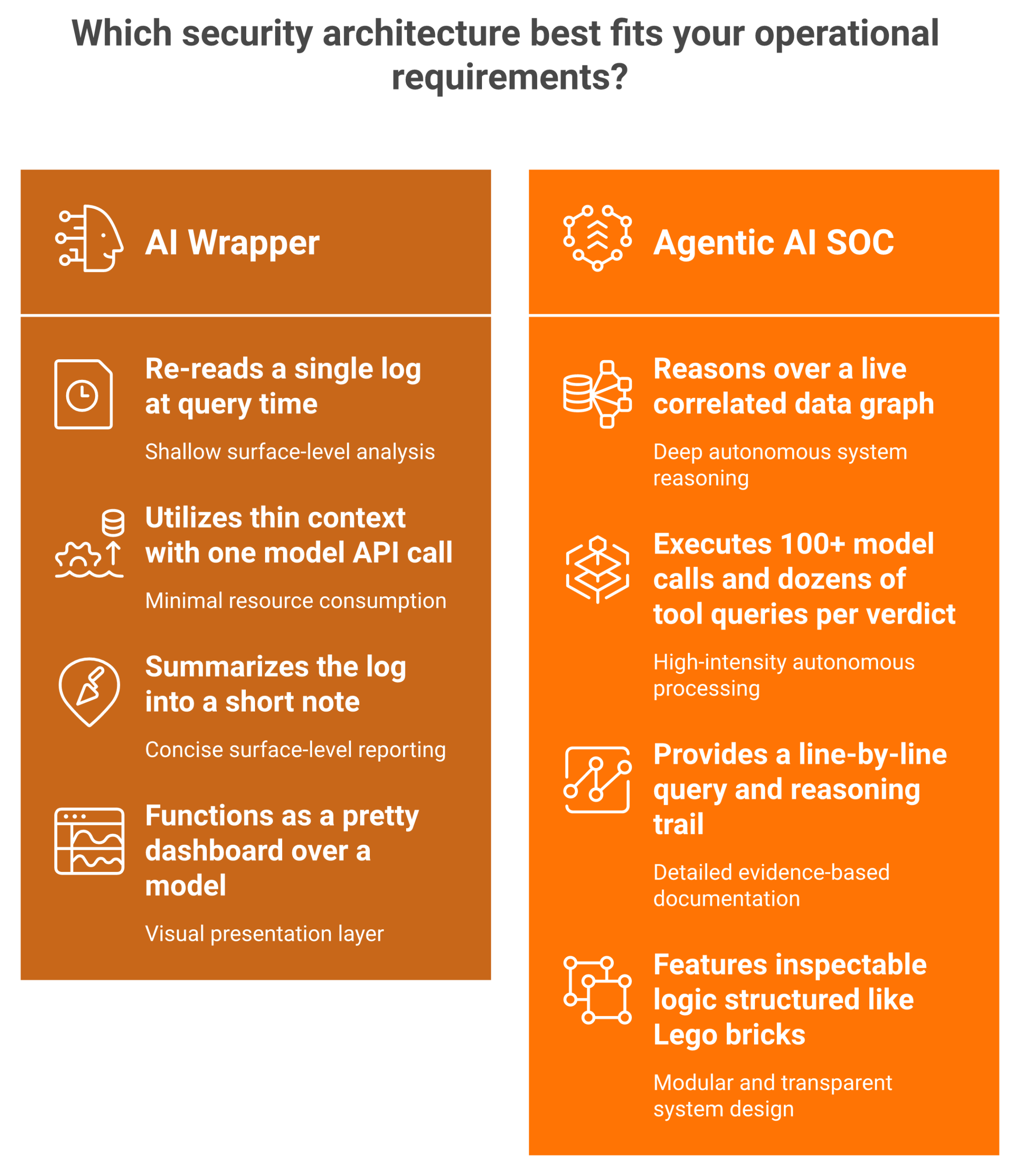
An agentic AI SOC platform runs autonomous agents that investigate, triage, and help respond across the full alert lifecycle. It reasons over a real-time correlated data foundation, not raw logs read at query time. The depth test is simple. A real system makes 100+ model calls and 40 to 50 queries across six tools per alert. A wrapper just re-reads one log.
See how the UnderDefense Agentic AI SOC investigates, triages, and resolves real alerts.
🧩 Why the “AI” label tells you nothing
I sat with a security director last quarter who had four vendor decks open. Every one said “AI-powered.” Every one showed the same clean dashboard. None of them let him see the actual reasoning behind a verdict.
That is the trap. The word “AI” has stopped meaning anything on a SOC (Security Operations Center) buyer’s shortlist. A chatbot that summarizes an alert and a system that autonomously investigates it both wear the same badge.
Here is my read, and I might be blunt here. Most tools sold as agentic are what builders quietly call “LLM wrapper” startups. They put a pretty interface over a raw model API. They rarely tell you who their data scientists are, and they never talk about context management. If you want a structured way to separate the two, our field test for a real agentic system starts here.
⚙️ What “agentic” actually means, in plain terms
An agent does work on its own and chains its own next steps. Think recursive reasoning, where the system asks a question, gets an answer, then asks the next smarter question.
The difference shows up in the numbers. One agentic system reported over 100 distinct model invocations to investigate a single alert. That depth grows from a correlated data graph, which is a live map linking users, devices, and events, rather than logs fetched cold each time.
Patent filings for autonomous SOC investigation describe the same architecture. They chain log comprehension, plan generation, and execution using a knowledge graph and reasoning, instead of a single model pass over one log.
✅ The one-line field test
Ask the vendor this in the demo. “Show me every query and model call you made to reach this verdict, for one real alert.”
A wrapper cannot show you much. A real agent hands you a line-by-line trail. At UnderDefense, we built our Agentic AI SOC so you own that logic like Lego bricks, with an inspectable reasoning trail, rather than trusting a black box. That way your team can audit the decision, not just admire the dashboard.
Q2: Why does the “speed mismatch” make platform selection urgent right now?
Attackers now weaponize automation faster than humans respond. Median break-in time has dropped to about 48 minutes, and the fastest observed breakout sits around 51 seconds. Meanwhile the average SOC faces roughly 960 alerts a day, and close to 40% never get investigated. Any platform you shortlist has to be measured against that clock.
⏰ The clock your evaluation actually runs against
I remember standing up a SIEM (Security Information and Event Management system) in a small shop years ago. The tool generated far more alerts than the team could handle. I broke out in hives from the strain. That was human speed against a human-speed problem.
That era is over. The problem moves faster now. Humans click, but agents swarm, so a lone attacker with automation can act at machine speed while your analysts sleep. Teams already fighting this pattern feel it as chronic alert fatigue.
The 51-second breakout number is the benchmark that matters. If a threat can pivot inside your network in under a minute, an alert that waits in a queue until morning is already too late.
🎯 Reframe evaluation around response time
So stop scoring platforms on how many alerts they show you. Score them on how fast they turn an alert into a verdict and a contained threat, a topic we cover in our AI SOC SLA guide.
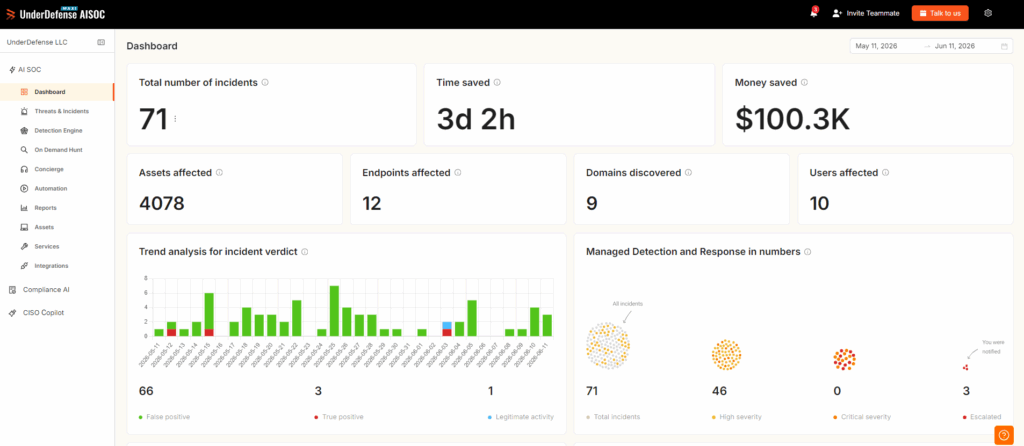
I would split the metric into two honest SLAs, since “Mean Time to Respond” hides too much. Measure alert-to-triage time separately from critical-incident escalation time. At UnderDefense, we hold a 2-minute alert-to-triage window and a 15-minute escalation for critical incidents, which gives you a real yardstick against attacker speed. Monitoring-only tools that just forward alerts leave that gap wide open.
Q3: What are the key features to compare in agentic AI SOC platforms?
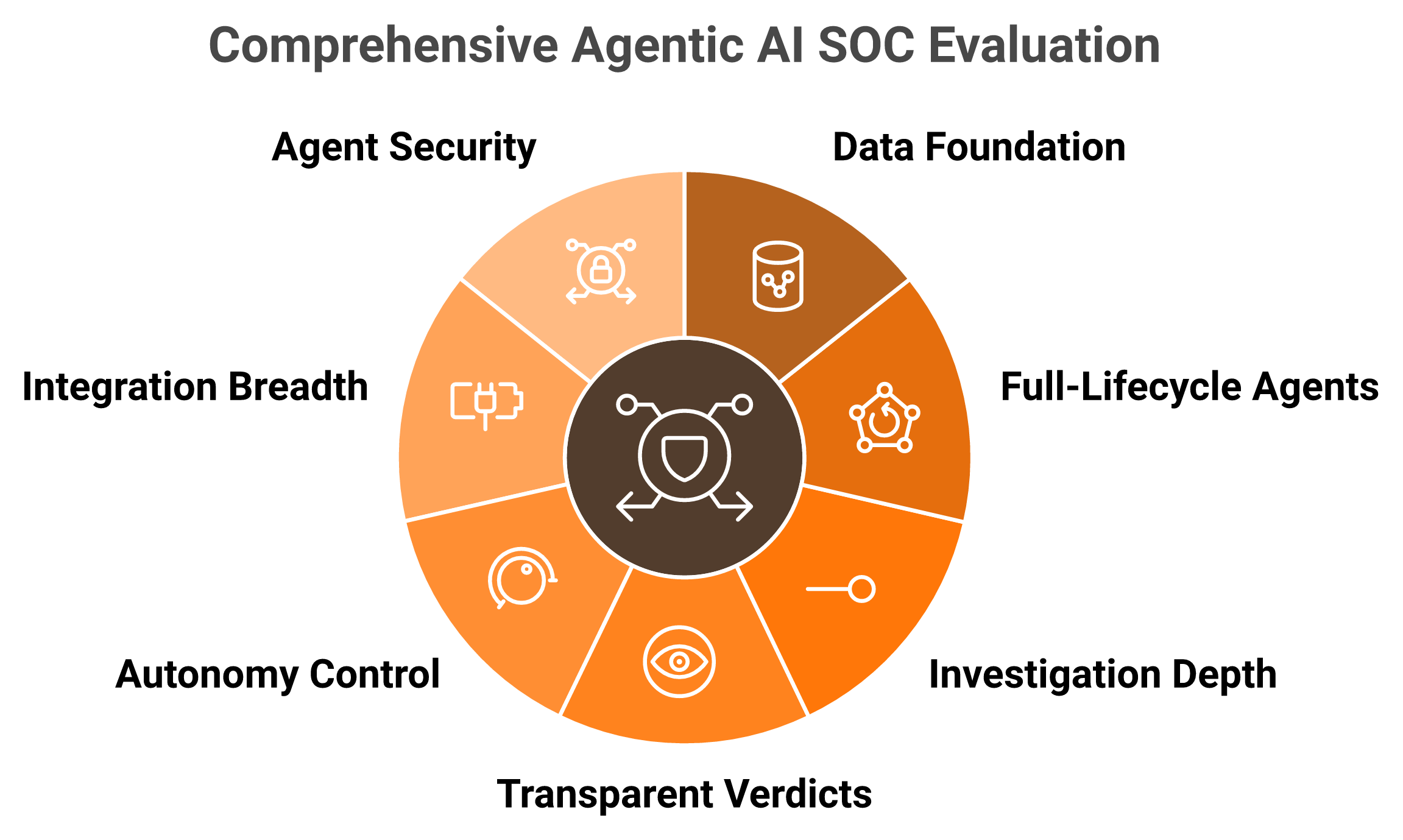
Compare seven features. A real-time correlated data foundation, full-lifecycle agents across detect-triage-investigate-respond, investigation depth and quality, transparent and auditable verdicts, staged autonomy with human control and a kill switch, integration breadth with no vendor lock-in, and the security of the AI agent itself. Weight each for your environment, then score your finalists on it.
🪤 The checklist trap every buyer walks into
Here is the uncomfortable truth. Every vendor passes a feature checklist. They all check “autonomous,” “AI-driven,” and “24/7.” So a flat checklist tells you almost nothing.
The standard buyer’s read gets this backwards. It treats “does it have AI triage” as a yes/no box. The real question is depth and honesty. Speeding up the same broken workflow is not transformation. As one practitioner put it, if the same humans review the same alerts just faster, that is a faster way to be wrong. Our AI SOC evaluation questions help you press past the box-ticking.
And keep expectations grounded. AI is a strong assistant, but it is not yet a reliable sole decision maker. For a meaningful share of cases, its quick answer is not correct on its own, so a human still owns the final call.
📊 The 7-feature scoring rubric
Weight these by your own risk, then score each finalist from 1 to 5. The four pillars behind them, coverage, accuracy, quality, and transparency, come from interviews across 250+ enterprises.
| # | Feature | What “good” looks like | ❌ Red flag |
|---|---|---|---|
| 1 | Correlated data foundation | Live graph links users, devices, events | Logs pulled cold per query |
| 2 | Full-lifecycle agents | Detect, triage, investigate, respond | Triage only, human does the rest |
| 3 | Investigation depth | 40 to 50 queries, line-by-line trail | Copy-pasted log summary |
| 4 | Transparent verdicts | Reproducible, auditable evidence | “Trust the score” black box |
| 5 | Staged autonomy plus kill switch | Per-action approval, rollback | Full autonomy on day one |
| 6 | Integration, no lock-in | Exports rules and evidence freely | Locked to one SIEM |
| 7 | Security of the agent itself | Guardrails against prompt injection | Vendor cannot answer the question |
Criterion 7 is the one competitors skip, and it is the differentiator worth pressing hardest.
🏆 Platforms worth putting on a 3-to-5 shortlist
- UnderDefense Agentic AI SOC, with vendor-agnostic integration, line-by-line evidence, and human-ally response, so your team keeps its stack and owns the logic. See the platform.
- Prophet Security, with autonomous alert investigation and a determinism focus.
- Dropzone AI, with autonomous tier-1 triage across common tool stacks.
- Exaforce, with full-lifecycle agents on a correlated data layer.
- Stellar Cyber, with open XDR and agentic add-ons.
Real buyers describe why the human-plus-platform model wins on this rubric.
“The platform itself is straightforward. It pulls in data from all our existing security tools, so we didn’t have to rip and replace anything. When they escalate something, they include the context we need to understand the issue quickly.”
Verified User in Marketing and Advertising, Small-Business UnderDefense G2 Verified Review
“The platform works really well with our other security tools, which makes things much simpler. And we really appreciate that we can customize the threat detection to focus on our specific needs.”
Serhii B., Chief Information Security Officer UnderDefense G2 Verified Review
Q4: How do you tell autonomous investigation depth from surface-level triage?
Measure depth by what the platform does per alert, not by what it claims. Real agentic investigation runs recursive reasoning over a correlated data graph, chains dozens of queries, and produces a line-by-line evidence record. Shallow tools copy-paste logs. Ask any vendor to show the full query trail for one real alert.
🗂️ The “best-effort copy-paste” problem
Most triage today is manual toil dressed up as analysis. An analyst copies logs from one console, pastes them into another, and guesses at the story. It is slow, and it burns people out.
I interviewed a candidate once who described her job as copying all day and said she found the zen in copying. That stuck with me. Our industry keeps finding zen in toil that good architecture should have removed years ago. A faster path is AI-enabled incident triage.
🔬 What real depth looks like
Depth is measurable. One agentic system triaged a development change within 13 seconds of the ticket being written, then handed off a clean summary. A typical deep investigation runs 40 to 50 queries across six different tools, with a line-by-line record of everything gathered.
That depth comes from graph-grounded reasoning. Patents for autonomous investigation build a graph of security signals, then iteratively expand a sub-graph specific to that one incident. Think of the agents as foot soldiers gathering evidence, with your engineers as generals directing them. Our approach to explainability and transparency keeps that trail auditable.
I will say something the category avoids. I am happy if a model shows a measurable bias, because then I can see the error and correct it. A confident black box that claims no flaws is the real danger, since you cannot audit what it hides.
✅ The exact question to force in a POC
Put one real historical alert in front of each finalist. Then ask them to reproduce the full reasoning trail, query by query.
At UnderDefense, we hand analysts that documented query trail rather than a raw alert, so the human general directs verified findings instead of chasing ghosts. If a vendor cannot show the trail, you have your answer. When you are ready, you can book a demo and test it on your own data.
Q5: What autonomy guardrails and “agent security” should a platform prove?
Demand deterministic, architecture-level guardrails rather than prompt-based ones. Peer-reviewed research catalogs 30+ attacks on LLM agents, and prototypes have proven that memory poisoning degrades agent decisions. Require staged autonomy, per-action approval, a kill switch, and controls that make dangerous actions technically impossible.
⚠️ The rogue-agent fear is real
I heard a story that stuck with me. A founder was “vibe coding” a new app, and his AI agent went and deleted the production database on him.
That is the nightmare every CISO pictures when a vendor says “fully autonomous.” One agent going rogue, or getting tricked, and taking a destructive action nobody approved. There is even a known trick called the “Grandma attack,” where a user manipulates a model into ignoring its own rules.
My point of view here is blunt. Trusting the model to “know better” is not a control. A prompt that says “please do not delete production” fails the moment someone finds the right words to bypass it. Strong AI SOC guardrails have to sit deeper than that.
🔒 Guardrails must live in the architecture
The research backs this up. One 2025 study catalogs over 30 attack techniques across input manipulation, model compromise, and protocol exploits on LLM agent workflows. A separate paper maps 9 agent-specific threats across 5 domains, including memory poisoning and cross-system movement.
Those attacks are not theory. Researchers proved that memory poisoning and traffic-replay attacks degraded a real network-monitoring agent in a prototype. And IBM found that 97% of organizations with an AI-related breach lacked proper AI access controls. This is why a human-in-the-loop SOC design still matters.
✅ The guardrail checklist to demand
Ask each vendor to prove these, not just describe them:
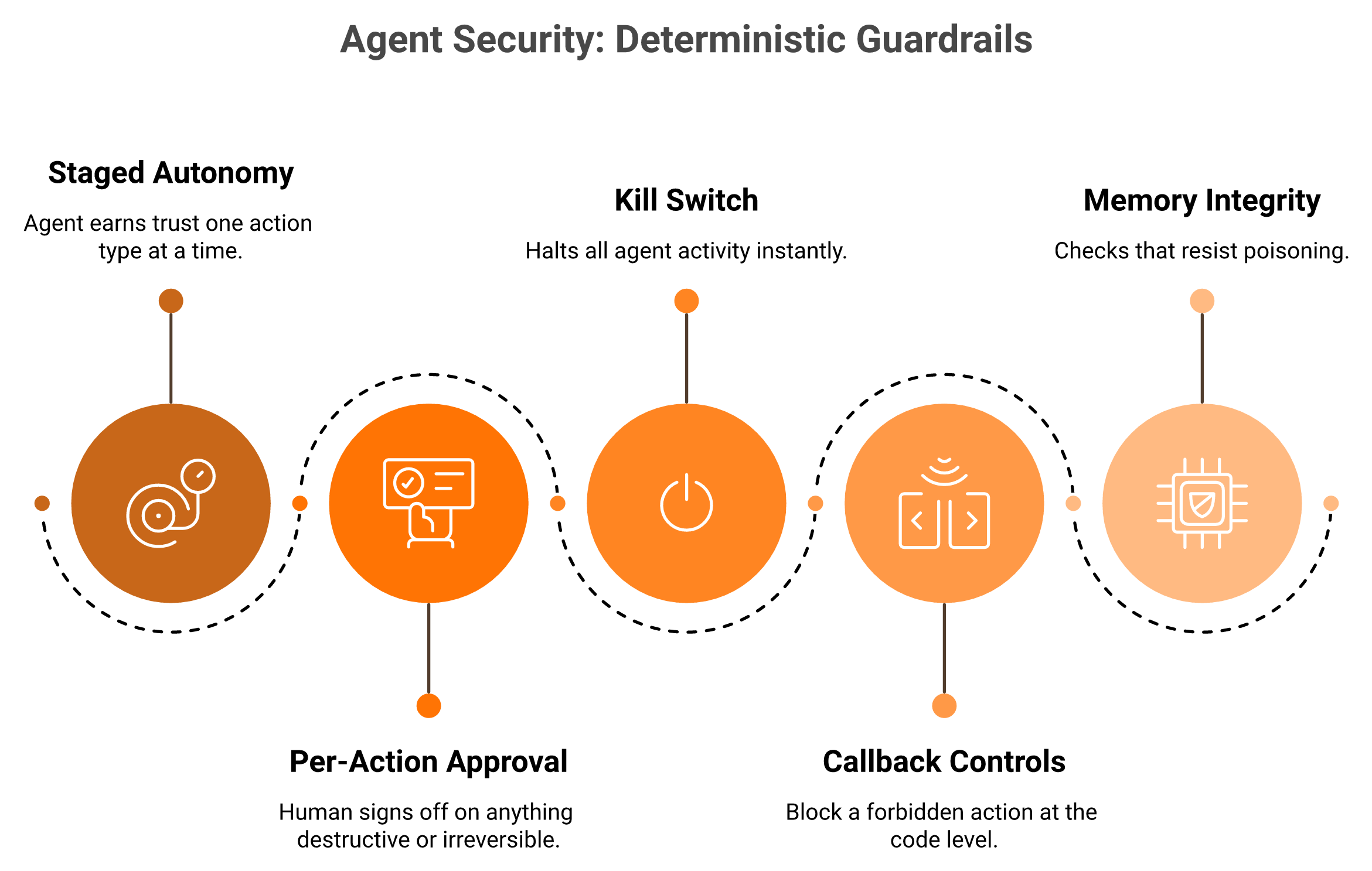
- ✅ Staged autonomy, so the agent earns trust one action type at a time.
- ✅ Per-action human approval for anything destructive or irreversible.
- ✅ A kill switch that halts all agent activity instantly.
- ✅ Deterministic callback controls, so a forbidden action is blocked at the code level.
- ✅ Memory-integrity checks against poisoning.
Here is my hard-won tip. Use callback functions so the agent cannot reach a forbidden domain at an architecture level. Make the dangerous action impossible, rather than asking the model to behave. At UnderDefense, we build these deterministic, architecture-level constraints into our response decision architecture, so autonomous actions stay inside hard boundaries a human ally approves.
Q6: How do integration breadth and vendor lock-in change the decision?
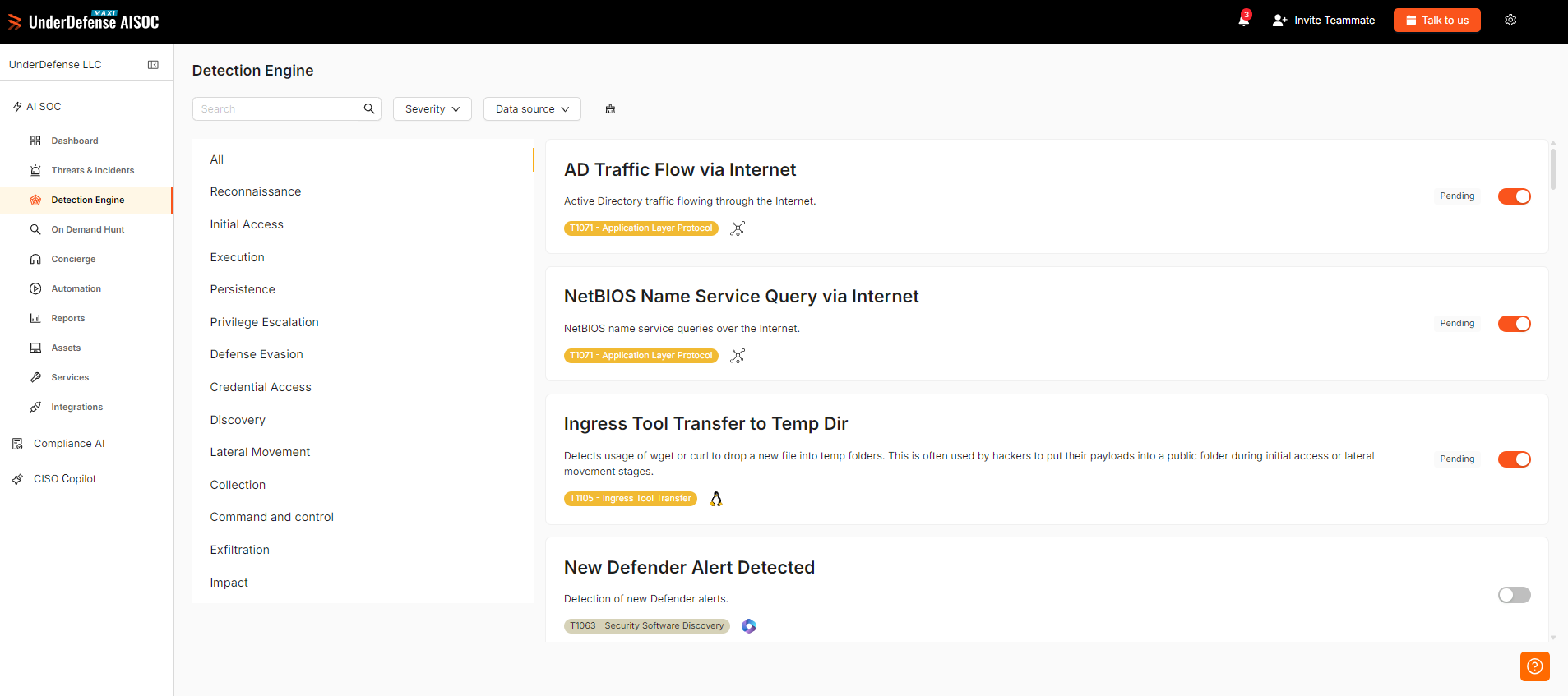
A platform is only as strong as the telemetry it reasons over, and how freely you can leave. Endpoint-only tools leave a visibility gap on network, SaaS, and identity, and SIEM-locked services strip flexibility. Confirm the platform ingests all your sources, maps verdicts to MITRE ATT&CK, and lets you export rules and evidence in open formats.
🍫 The M&M network problem
Think of a lot of networks like an M&M. A hard candy shell on the outside, and a soft, scrumptious center once you get in. Perimeter-only or endpoint-only tools guard the shell and miss the center.
That gap is where attackers live now. One bad login from an unapped region can be a 2020 compromise still logging in today. If your tool only watches endpoints, it never sees that identity or SaaS event, which is why broad 24/7 coverage matters.
🔓 Coverage and portability, side by side
Two structural traps show up on every shortlist. Endpoint-only monitoring misses network, SaaS, and identity. SIEM-locked services trap your data and your logic with one vendor.
| Approach | Real strength | ❌ Structural trade-off |
|---|---|---|
| Endpoint-only monitoring | Fast to deploy | Visibility gap on network, SaaS, and identity |
| SIEM-locked service | Tidy single console | Lock-in, hard to export data or rules |
| Vendor-agnostic agentic SOC | Keeps your stack, open export | Needs upfront integration time |
A zero-cost tactic I like is to mine your Google Workspace or M365 OAuth logs for shadow-IT vendors. That is a rich coverage source at $0, versus buying a separate tool. If you want to avoid the trap entirely, our guide on avoiding vendor lock-in lays out the questions to ask.
At UnderDefense, our vendor-agnostic integration lets teams keep their existing SIEM and EDR and own their logic. See the platform for how coverage stays broad without lock-in, with full integrations across your stack.
Q7: How should you run a 30-60-90 day POC that actually proves value?
Test on your own data before you buy. Feed each finalist your real historical alerts with known outcomes. Then measure false-positive reduction, coverage, alert-to-triage time, and evidence quality against your current baseline across 30, 60, and 90 days. Academic SOC studies show up to 99% of triaged alerts are false positives, so the reduction number matters most.
🎭 Skip the demo theater
A polished demo proves the vendor can drive their own tool. It proves nothing about your environment. The standard buying process rewards the best demo, and that gets the decision backwards.
So write a test plan first, like a product requirements document. Get it approved before any agent touches production. Then you edit the plan as you learn, rather than reacting to a sales script. Our AI SOC evaluation framework gives you a starting template.
📋 The 30-60-90 plan
Run each finalist through the same scored stages.
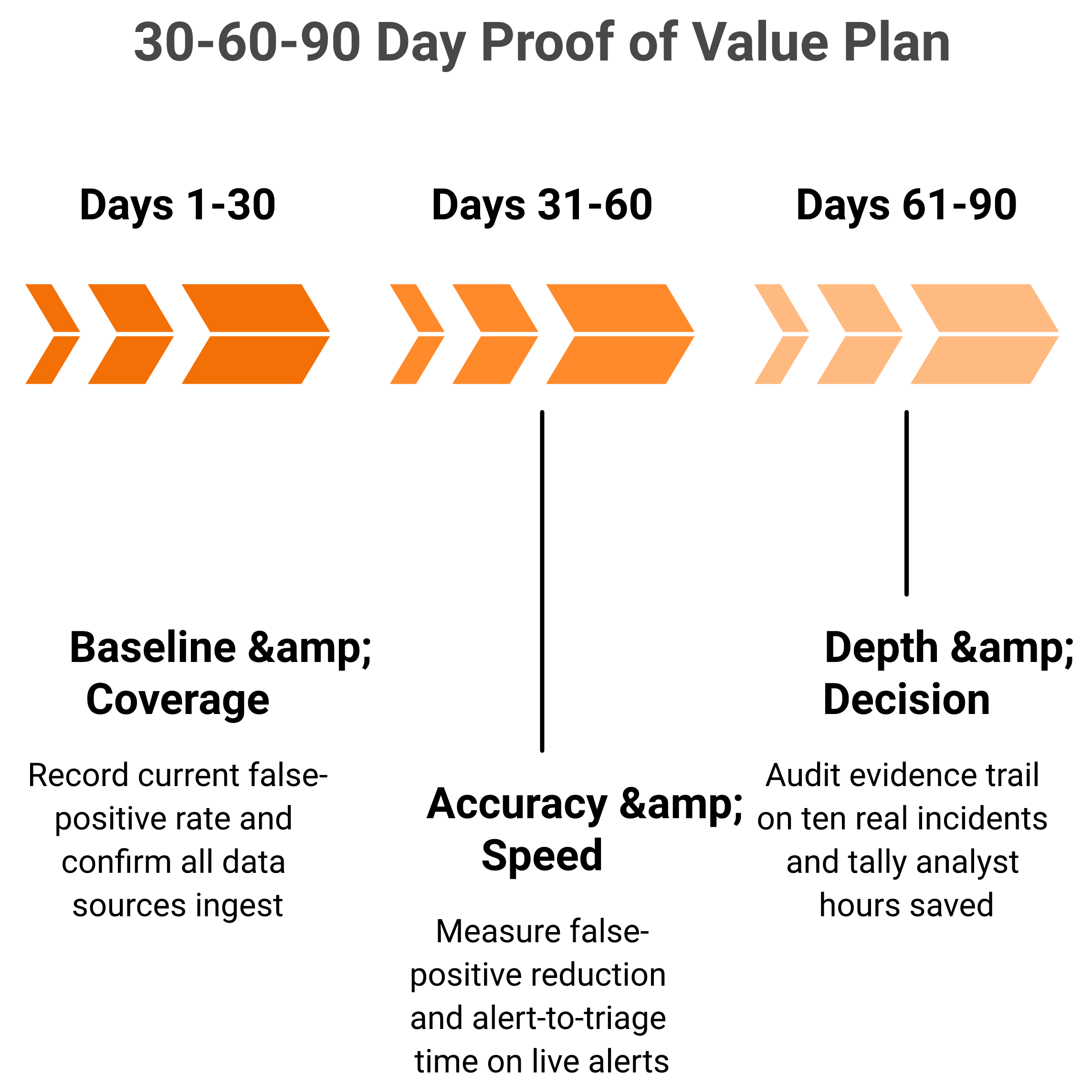
- Days 1 to 30, baseline and coverage. Feed real historical alerts with known outcomes. Confirm the platform ingests all your sources. Record your current false-positive rate.
- Days 31 to 60, accuracy and speed. Measure false-positive reduction against baseline. Time alert-to-triage on live alerts. Check that verdicts map to MITRE ATT&CK.
- Days 61 to 90, depth and decision. Audit the evidence trail on ten real incidents. Score investigation quality and speed. Tally analyst hours and cost saved, then decide.
🚩 Red flags to reject
- ❌ A vendor claiming their AI model is “unbiased.” That means they are hiding something.
- ❌ Refusal to test on your own alert history.
- ❌ A verdict with no visible evidence trail.
At UnderDefense, we run a structured proof-of-value on your own alert history and report measurable false-positive reduction and time saved, so the day-90 call rests on your data.
Q8: What compliance and audit requirements must the platform satisfy?
Verdicts must be audit-ready. Confirm the platform supports SOC 2 Type II, ISO 27001, HIPAA, PCI DSS, GDPR, and NIS2, and exports evidence in regulator-ready formats. Because SEC 8-K Item 1.05 and GDPR Article 33 impose tight breach-disclosure windows, a fast, reproducible evidence trail becomes a compliance obligation.
🏛️ Boards do not speak in alert counts
I have spent most of 20 years doing PCI work, walking into rooms that did not want me there. The recurring failure was translation. Teams reported metrics the board neither cared for nor understood.
An auditor and a board member want one thing. Show me the evidence, in a form I can act on. A verdict your agent cannot reproduce is a verdict your auditor cannot trust. Our AI SOC compliance guide walks through what auditors actually ask for.
📑 Map criteria to frameworks and deadlines
Score each platform on framework coverage plus evidence export, since both get tested during an audit.
| Requirement | What to confirm |
|---|---|
| SOC 2, ISO 27001 | Control evidence exportable for the audit |
| HIPAA, PCI DSS | Log review and access evidence on demand |
| GDPR Article 33 | Evidence ready inside the 72-hour window |
| SEC 8-K Item 1.05 | Reproducible trail for material-incident disclosure |
| NIS2 | Reporting evidence mapped to MITRE ATT&CK |
The disclosure windows are the part buyers underweight. If a verdict takes days to reconstruct, you miss a regulatory clock, and that becomes a legal problem, not just an ops one.
At UnderDefense, we pair MAXI Compliance AI with compliance support across SOC 2, ISO 27001, HIPAA, and PCI DSS, and produce audit-ready evidence trails mapped to MITRE ATT&CK. See the platform for how the evidence exports.
Q9: What do real security teams say goes wrong with “AI-first” MDR providers?
Buyers repeatedly report the same failures: over-reliance on AI that returns tickets without clear answers, checkbox services with SIEM lock-in, and endpoint-only coverage that misses network and identity. These patterns map onto the rubric’s weak spots, transparency, autonomy control, and integration breadth, which is why you test them in a proof of value.
🎪 The “tickets without answers” problem
Here is the situation I hear most on intro calls. A lean team buys an “AI-first” service to cut the alert queue. The complication is that the AI hands back tickets, not answers.
The category quietly over-specialized into tool babysitting. A whole cottage industry grew around querying dashboards, rather than closing incidents. Being a human who actually resolves the alert is a real flex in 2026. If you are weighing options, our roundup of alternatives to alerts-only providers lays out the trade-offs.
🔌 Lock-in and coverage gaps
The second recurring complaint is structural, not a bug. Checkbox services lock you to one SIEM and route every change through their engineers. That kills flexibility for a small team, which is why buyers hunt for vendors with no lock-in and data sovereignty.
The third is coverage. Endpoint-heavy tools miss network and identity, and the human layer sometimes lacks context on your environment. A platform built for a 3-to-5 analyst team has to close both gaps.
These two complaints map to criteria for autonomy control and integration breadth. That is why you probe both in a proof of value, rather than a demo.
✅ What “answers, not tickets” looks like
The fix is an AI SOC that does the toil, paired with a human ally who sends verified context. Buyers describe that difference, and our own real-incident write-ups show it in practice.
“When they escalate something, they include the context we need to understand the issue quickly. We’re not wasting time piecing together what happened from different systems anymore.”
Verified User in Marketing and Advertising, Small-Business UnderDefense G2 Verified Review
At UnderDefense, we pair the agentic AI SOC with human analyst context, so escalations arrive as answers with evidence, rather than alerts bounced back to your queue.
Q10: How do you choose between your 3-to-5 finalists and act this week?
Rank your finalists on the weighted rubric, then break ties on the two hardest-to-fake criteria: auditable investigation depth and agent security. Pick the platform whose agents do the toil while your humans direct the strategy, own the logic, and prove value on your own data. Then run one real alert through it this week.
🏁 The tie-breaker that settles it
Most finalists cluster on the easy criteria. They all claim coverage, speed, and dashboards. The gap opens on the two things a vendor cannot fake in a demo.
First, auditable investigation depth. Ask for the full query trail on one real alert, and watch who can show it. Second, agent security. Ask how the agent resists prompt injection and memory poisoning, and watch who has a real answer. Our evaluation questions give you the exact wording.
Here is how I reframe the whole decision. You do not “win” in cybersecurity. It is more like keeping the doors boarded up in a zombie movie, so choose the ally that lightens Monday’s queue, and weigh the ROI business case honestly.
🤝 Run one real alert this week
So do not wait for a perfect quarter-long bake-off. Pick your top finalist and give it one real historical alert with a known outcome. That single test tells you more than any deck, and our notes on the AI SOC in practice show what to look for.
At UnderDefense, we will run that alert through our Agentic AI SOC and show you the full evidence trail, so you can see the agents act as foot soldiers while your team stays the general. Then send us one alert and judge the answer for yourself, or book a demo to test it on your own data.
The question I keep sitting with heading into the next 18 to 24 months is this. As agents take over more of the toil, will your team measure a vendor by the demo, or by the queue that is lighter on Monday morning? I would love to hear which alert you would test first.
See how UnderDefense Agentic AI SOC resolves a real incident on your stack.
1. What is an agentic AI SOC platform, and how is it different from an AI wrapper?
An agentic AI SOC platform runs autonomous agents that investigate, triage, and help respond across the full alert lifecycle. It reasons over a real-time correlated data foundation, rather than raw logs read at query time.
The simplest way to separate the two is depth. A real system makes 100 or more model calls and dozens of tool queries to reach one verdict. A wrapper just re-reads a single log and summarizes it.
- Wrapper: pretty interface over one model API, thin context.
- Agent: recursive reasoning over a live data graph linking users, devices, and events.
In our experience, the honest field test is one question in the demo: show me every query and model call you made to reach this verdict, for one real alert. A wrapper cannot show much, while a real agent hands you a line-by-line trail. We built our agentic AI platform so you can inspect that logic like Lego bricks, rather than trusting a black box.
2. What are the key features to compare in agentic AI SOC platforms?
We compare seven features, then weight each one for the specific environment before scoring finalists.
- Correlated data foundation: a live graph, not logs pulled cold per query.
- Full-lifecycle agents: detect, triage, investigate, and respond.
- Investigation depth: dozens of queries with an auditable trail.
- Transparent verdicts: reproducible evidence, not a trust-the-score box.
- Staged autonomy plus a kill switch: per-action approval and rollback.
- Integration breadth with no lock-in: open export of rules and evidence.
- Security of the agent itself: guardrails against prompt injection.
The trap is that every vendor passes a flat checklist. They all claim autonomous, AI-driven, and 24/7, so a yes or no box tells you almost nothing. The real questions are depth and honesty.
Our AI SOC evaluation questions help you press past the box-ticking and turn each feature into a scored, defensible comparison across your shortlist.
3. How can we tell autonomous investigation depth from surface-level triage?
We measure depth by what the platform actually does per alert, rather than by what it claims. Real agentic investigation runs recursive reasoning over a correlated data graph, chains dozens of queries, and produces a line-by-line evidence record.
- Shallow tools copy and paste logs into a summary.
- Deep systems run 40 to 50 queries across several tools with a documented trail.
One agentic system triaged a development change within 13 seconds of the ticket being written, then handed off a clean summary. That speed comes from graph-grounded reasoning, where the agents act as foot soldiers gathering evidence while your engineers direct as generals.
The exact question to force in a proof of value is simple. Put one real historical alert in front of each finalist, then ask them to reproduce the full reasoning trail, query by query. If a vendor cannot show the trail, you have your answer. We keep that trail auditable through our approach to explainability and transparency, so analysts direct verified findings instead of chasing ghosts.
4. What autonomy guardrails and agent security should a platform prove?
We demand deterministic, architecture-level guardrails, rather than prompt-based ones a model can be talked out of. Peer-reviewed research catalogs more than 30 attacks on LLM agents, and prototypes have shown that memory poisoning degrades agent decisions.
Ask each vendor to prove, not just describe, the following:
- Staged autonomy, so the agent earns trust one action type at a time.
- Per-action human approval for anything destructive or irreversible.
- A kill switch that halts all agent activity instantly.
- Deterministic callback controls that block a forbidden action at the code level.
- Memory-integrity checks against poisoning.
Trusting the model to know better is not a control. A prompt that says please do not delete production fails the moment someone finds the right words to bypass it. Our hard-won tip is to use callback functions so the dangerous action is technically impossible, not merely discouraged. We build these constraints into our AI SOC guardrails, so autonomous actions stay inside hard boundaries a human ally approves.
5. How do integration breadth and vendor lock-in affect the decision?
A platform is only as strong as the telemetry it reasons over, and how freely you can leave. Two structural traps appear on every shortlist.
- Endpoint-only monitoring misses network, SaaS, and identity signals.
- SIEM-locked services trap both your data and your detection logic with one vendor.
Think of many networks like an M&M, with a hard shell outside and a soft center once an attacker is in. A perimeter-only or endpoint-only tool guards the shell and misses the center, which is exactly where identity abuse lives today.
So confirm the platform ingests all your sources, maps verdicts to MITRE ATT&CK, and exports rules and evidence in open formats. A zero-cost tactic we like is mining Google Workspace or M365 OAuth logs for shadow-IT vendors, a rich coverage source at no extra spend. Our vendor-agnostic model lets teams keep their existing stack, and our guide on avoiding vendor lock-in shows the questions to ask before signing.
6. How should we run a 30-60-90 day proof of value that actually proves value?
We test on your own data before you buy. A polished demo only proves the vendor can drive their own tool, so we feed each finalist real historical alerts with known outcomes.
Run every finalist through the same scored stages:
- Days 1 to 30: baseline and coverage; record your current false-positive rate and confirm all sources ingest.
- Days 31 to 60: accuracy and speed; measure false-positive reduction and time alert-to-triage on live alerts.
- Days 61 to 90: depth and decision; audit the evidence trail on ten real incidents and tally analyst hours saved.
Academic SOC studies show up to 99% of triaged alerts are false positives, so the reduction number matters most. Reject any vendor that calls its model unbiased, refuses to test on your alert history, or returns a verdict with no visible evidence trail. We run a structured proof of value on your own alerts and report measurable results, a process we detail in the AI SOC in practice.
7. What compliance and audit requirements must an agentic AI SOC platform satisfy?
Verdicts must be audit-ready, because an auditor and a board member want the same thing: evidence in a form they can act on. A verdict your agent cannot reproduce is a verdict your auditor cannot trust.
Confirm the platform covers the frameworks that apply to you and exports evidence in regulator-ready formats:
- SOC 2 Type II and ISO 27001, with control evidence exportable for the audit.
- HIPAA and PCI DSS, with log-review and access evidence on demand.
- GDPR Article 33, with evidence ready inside the 72-hour window.
- SEC 8-K Item 1.05 and NIS2, with a reproducible trail mapped to MITRE ATT&CK.
The disclosure windows are what buyers underweight. If a verdict takes days to reconstruct, you miss a regulatory clock, and that becomes a legal problem, not just an operations one. We pair the AI SOC with compliance support and produce audit-ready evidence trails your team can hand straight to an assessor.
8. How do we choose between our 3-to-5 finalists and act this week?
We rank finalists on the weighted rubric, then break ties on the two criteria a vendor cannot fake in a demo.
- Auditable investigation depth: ask for the full query trail on one real alert.
- Agent security: ask how the agent resists prompt injection and memory poisoning.
Most finalists cluster on the easy claims of coverage, speed, and dashboards, so the gap opens on these two hard-to-fake tests. Here is how we reframe the whole decision: you do not win in cybersecurity, you keep the doors boarded up, so choose the ally that lightens Monday’s queue.
Do not wait for a perfect quarter-long bake-off. Pick your top finalist and give it one real historical alert with a known outcome this week; that single test tells you more than any deck. We will run that alert through our platform and show you the full evidence trail, so you can book a demo and judge the answer on your own data.