




Q1. What Are the 10 Best Managed SIEM Alternatives to Deloitte for Mid-Market in 2026?
The 10 best Deloitte managed SIEM alternatives for mid-market in 2026 are UnderDefense, Arctic Wolf, Expel, ReliaQuest, Red Canary, Deepwatch, Binary Defense, eSentire, Alert Logic, and Proficio. Each runs 24/7 monitoring without the Big-4 consulting-scale staffing baked into enterprise pricing. The right pick depends less on “who’s cheapest” and more on which delivery model fits your environment, your SIEM ownership needs, and your compliance deadline.
I’ve sat on enough vendor selection calls to know what triggers this search. A Deloitte managed SIEM quote lands, the number causes a small heart attack, and someone gets sent to find who else can do this work. So let me save you a few weeks.
Deloitte is a strong benchmark. Big brand, deep Splunk expertise, and real audit muscle. The trade-off is structural, not a bug: you pay for Big-4 brand and enterprise SOC staffing whether or not your 1,000-person environment needs it. Elastic SIEM support gets thin, and the price rarely bends for mid-market. So the real question is not “who is cheaper.” The real question is “which delivery model matches how I actually run security.”
Here are the 10, scored on the same criteria: SIEM ownership, whether they resolve or just escalate, and who they fit best.
Talk to a SIEM expert about fewer false positives.
🏗️ Our Evaluation Criteria
Each provider below was assessed across five areas that matter most to a mid-market buyer replacing a Big-4 managed SIEM quote:
- SIEM ownership and flexibility, whether you keep your own Splunk, Elastic, QRadar, or LogRhythm, or get locked into theirs
- Detection and response depth, do they resolve incidents or just hand you an alert
- Compliance support, coverage for SOC 2, HIPAA, ISO 27001, PCI DSS, and GDPR
- Customer validation, verified G2, Gartner, and Clutch reviews from real buyers
- Mid-market fit, suitability for teams of roughly 50 to 1,000 employees
👥 Who This Guide Is For
This shortlist is built for security and IT leaders comparing outsourced options against a Deloitte-scale quote:
- Mid-market teams (50 to 1,000 employees) that want 24/7 coverage without Big-4 pricing
- Organizations that already own a SIEM and want it co-managed, not replaced
- Teams preparing for a compliance audit or reducing ransomware exposure
Deloitte Managed SIEM Alternatives: Comparison Table
| Provider (Rating) | Best For | Key Strength | Compliance |
|---|---|---|---|
| UnderDefense ⭐⭐⭐⭐⭐ 5.0 |
Mid-market keeping its own SIEM | SIEM-agnostic co-management, resolves alerts with context | SOC 2, HIPAA, ISO 27001, GDPR, PCI DSS |
| Arctic Wolf ⭐⭐⭐⭐ 4.0 |
Teams wanting a fully managed SOC | Broad MDR with a financial warranty; SIEM lock-in trade-off | SOC 2, HIPAA, PCI DSS |
| Expel ⭐⭐⭐⭐ 4.4 |
Cloud-native and SaaS teams | Transparent workbench, strong cloud detection | SOC 2, HIPAA, PCI DSS |
| ReliaQuest ⭐⭐⭐⭐ 4.2 |
Larger enterprise SOCs | GreyMatter platform, open-XDR approach | SOC 2, PCI DSS, GDPR |
| Red Canary ⭐⭐⭐⭐ 4.0 |
EDR-centric teams | Detection engineering depth | SOC 2, HIPAA, PCI DSS |
| Deepwatch ⭐⭐⭐⭐ 4.3 |
Splunk-heavy shops | Managed SIEM focus on Splunk | SOC 2, HIPAA, PCI DSS |
| Binary Defense ⭐⭐⭐⭐ 4.5 |
Human-led hunting needs | Threat hunting and counterintelligence | SOC 2, HIPAA, PCI DSS |
| eSentire ⭐⭐⭐⭐ 4.6 |
Aggressive response SLAs | Atlas XDR, fast containment | SOC 2, HIPAA, PCI DSS |
| Alert Logic ⭐⭐⭐ 3.5 |
Compliance-driven mid-market | Bundled SIEM, MDR, and vuln management | SOC 2, HIPAA, PCI DSS |
| Proficio ⭐⭐⭐⭐ 4.4 |
Global 24/7 needs | Follow-the-sun ProSOC model | SOC 2, HIPAA, PCI DSS |
WHERE THIS IS HANDLED
We co-manage the SIEM you already own, with no rip-and-replace. See how our co-managed SIEM works on the UnderDefense Agentic AI SOC platform.
1. UnderDefense ⭐⭐⭐⭐⭐
📋 Overview
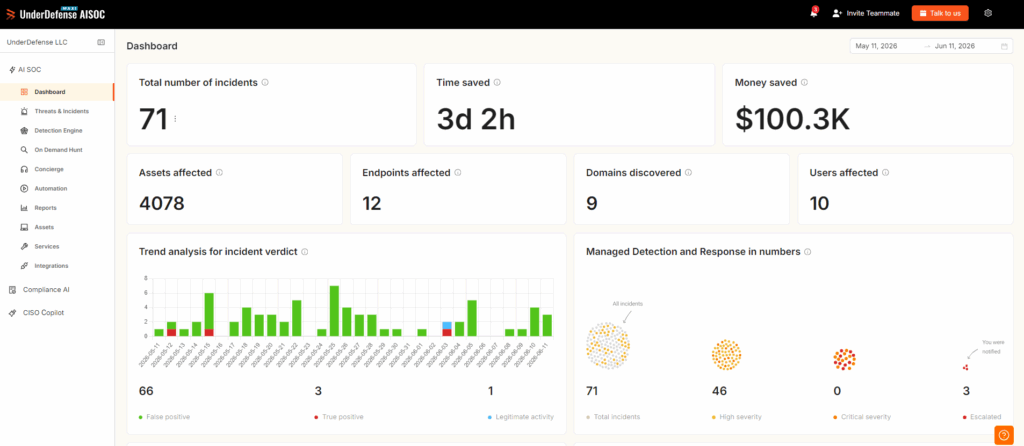
UnderDefense delivers an Agentic AI SOC that pairs AI-driven detection with human analysts who own the outcome. We sit on top of the SIEM you already run, so you keep your data and your tooling. That single design choice is where most Deloitte alternatives split into two camps.
🛠️ Core Services
- 24/7 threat detection and response on top of your existing SIEM
- SIEM-agnostic co-management across Elastic, Splunk, QRadar, and LogRhythm
- Penetration testing, compliance support, and virtual CISO advisory
- Alert triage with context, so escalations arrive with a clear next step
- Incident response and threat hunting with Slack-integrated workflows
✅ Why Companies Consider UnderDefense
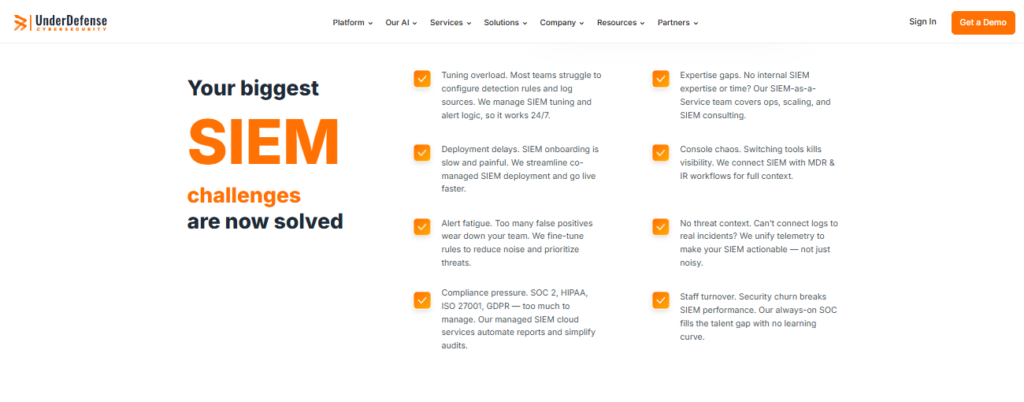
Most mid-market teams can’t hire a full 24/7 SOC in this labor market, and they don’t want to hand their logs to a black box either. What surfaces when you actually run this: the win is fewer, cleaner alerts with a path to resolution. One reviewer told us their alert noise dropped in the first week because we retuned their existing configs, not because we sold them a new tool.
Here’s the honest comparison. ✅ We stay vendor-agnostic, so your SIEM investment survives a provider change. ✅ Our analysts resolve incidents rather than forwarding them. ❌ Some MDR providers lock detection to their own SIEM, so leaving means rebuilding. ✅ We escalate with context (what happened, why it matters, and what to do). ❌ Opaque, black-box investigation leaves your team piecing events together at 2 a.m.
🎯 Ideal Customer Profile
Best suited for:
- Mid-market teams (51 to 1,000 employees) that already own a SIEM
- Cloud-heavy organizations on AWS or Azure needing continuous visibility
- Compliance-driven teams (SOC 2, HIPAA, ISO 27001) without a 24/7 SOC
- Leaders who want to avoid vendor lock-in and keep data ownership
💰 Commercial Model
Subscription pricing scaled by endpoints and monitored assets, with onboarding and ongoing advisory included. We publish transparent per-endpoint pricing rather than hiding it behind a discovery call, which is unusual in this category and deliberate on our part.
⏰ When to Shortlist
Shortlist us when a Big-4 quote priced you out, when you want to keep your SIEM instead of migrating, or when you need real response ownership and not just monitoring. If your intent is continuous detection and posture, this is the right lead product. If you need a point-in-time audit or a pentest, those are separate engagements we also run.
💬 Customer Reviews
“The biggest win for me was getting actual control over our security alerts. Before the guys from UD stepped in, we were getting bombarded with alerts from all our security tools. Their team cleaned up our configurations and got the noise under control within the first week.”
Verified User in Marketing and Advertising, Small-Business UnderDefense G2 – Verified Review
“UnderDefense Agentic AI SOC integrates well with our systems, specifically with our SIEM, Splunk. Their team is proactive in identifying and addressing threats, providing 24/7 oversight.”
Oleg K., Director Information Security UnderDefense G2 – Verified Review
“Honestly, some security tools are more complicated than the threats themselves. UnderDefense isn’t just about catching bad stuff, they give proactive tips too. Feels like my IT department suddenly got way smarter.”
Andriy H., Co-Founder and CTO UnderDefense G2 – Verified Review
2. Arctic Wolf ⭐⭐⭐⭐
📋 Overview
Arctic Wolf is a managed cybersecurity provider built around a fully outsourced SOC experience. Its Concierge Security model gives customers a named security team rather than just tooling, which is a genuine strength for teams with no internal analysts. The structural trade-off is SIEM lock-in: detection lives inside Arctic Wolf’s platform, so your data and workflows sit with them.
🛠️ Core Services
- 24/7 Managed Detection and Response
- Cloud and endpoint monitoring
- Vulnerability and risk management
- Incident response support
- Compliance readiness (SOC 2, HIPAA, and PCI DSS)
✅ Why Companies Consider Arctic Wolf
Many mid-market teams pick Arctic Wolf because it removes the burden of running a SOC in-house, and the concierge relationship is real. The recurring caveat in reviews is remediation. Several buyers describe strong detection paired with a heavy reliance on the customer’s own team to actually fix things. That gap is worth pressure-testing during your POC, and our Arctic Wolf alternatives guide digs into it further.
🎯 Ideal Customer Profile
Best suited for:
- Mid-market teams (50 to 1,000 employees) with no internal SOC
- Compliance-driven organizations wanting a managed relationship
- Teams comfortable adopting the vendor’s platform as their SIEM
💰 Commercial Model
Subscription pricing aligned to organization size and monitored assets, with onboarding and continuous monitoring included. Note the 60-day renewal notice window that some reviewers flag, and plan your contract calendar around it.
⏰ When to Shortlist
Shortlist Arctic Wolf when you want a fully managed SOC and are willing to standardize on their platform. Think twice if keeping your own SIEM or owning remediation is a hard requirement, since our MDR service takes the vendor-agnostic route instead.
💬 Customer Reviews
“Arctic Wolf provides Solid detection and response capabilities, but overly relies on the client’s team for remediation, which really hurts the value of the service.”
VP of Technology Arctic Wolf Gartner – Verified Review
“Log collectors show working, however when asked to provide logs for an investigation no logs could be provided. Analysts provide little context, and when asked for more information in the investigation nothing is ever provided or even communicated.”
CISO Arctic Wolf Gartner – Verified Review
3. Expel
📋 Overview
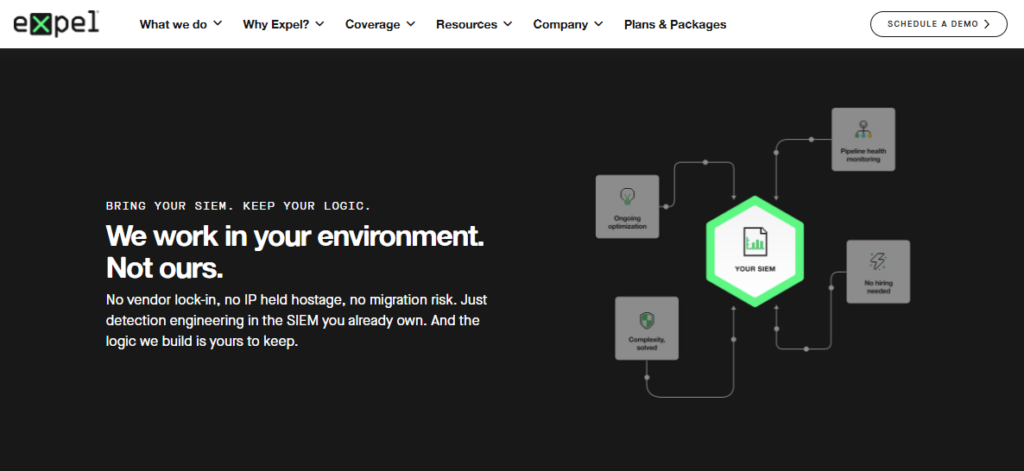
Expel is a transparent SOC-as-a-service provider built for cloud-native and SaaS teams. Its calling card is the workbench, a shared window where you watch investigations happen in real time. That “show, don’t tell” transparency is exactly what I like to see, with no black box between you and the analysis.
🛠️ Core Services
- 24×7 detection and response across endpoints, cloud, and SaaS
- Transparent investigation workbench with visible analyst logic
- Automated alert triage and enrichment
- Phishing and email threat handling
- Slack-integrated notifications and support
✅ Why Companies Consider Expel
Expel resonates with lean SOC teams that want a force-multiplier, not a replacement. Reviewers consistently praise the triage-before-escalation model, so you only see actionable items. The recurring caveat is organizational knowledge: Expel sits outside your environment, so it often loops back to your team for context. That is the permanent trade-off of any external SOC layered on top of your stack, which our MDR service addresses by owning the outcome.
🎯 Ideal Customer Profile
Best suited for:
- Cloud-native and SaaS companies (51 to 1,000 employees)
- Small internal SOC teams wanting first-line triage handled
- Teams that value transparency over a closed platform
💰 Commercial Model
Subscription pricing scaled by environment and data sources, with onboarding to connect your log sources. Expect an integration mapping effort during setup.
⏰ When to Shortlist
Shortlist Expel when transparency and cloud coverage top your list, and when you have an internal team to own remediation and environmental context.
💬 Customer Reviews
“Slack integration for notifications and support requests. Support requests are handled very quickly and accurately.”
Verified User in Manufacturing, Enterprise Expel G2 – Verified Review
“Despite the capabilities of the technical platform and the strength of the analysts providing the service, there is still a limit to the environmental/organizational knowledge inherent in the service. This leads to a fairly frequent need for engagement with our internal team to get clarification and verification.”
Verified User in Computer Software, Mid-Market Expel G2 – Verified Review
4. ReliaQuest
📋 Overview
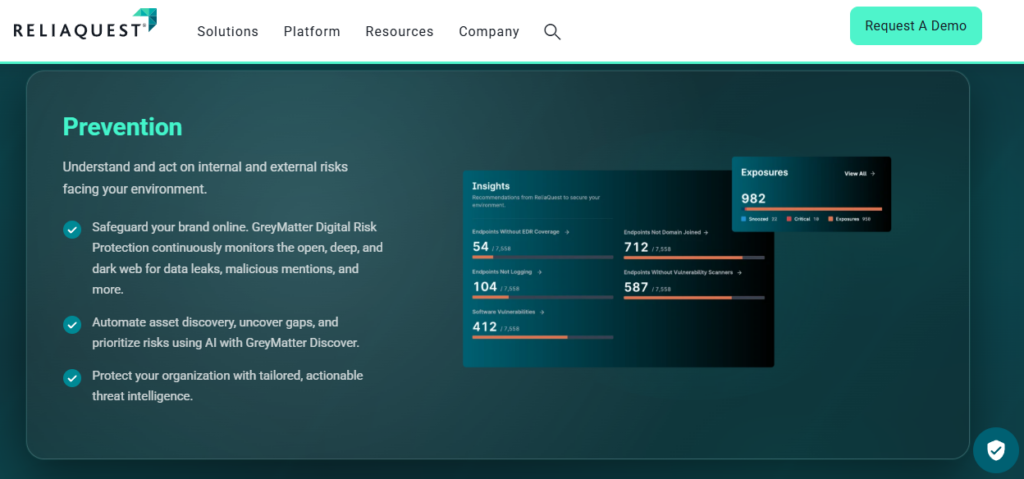
ReliaQuest runs its GreyMatter platform as an open-XDR layer that sits across your existing security tools. It leans enterprise, so it fits larger SOCs that already have staff and want force-multiplication rather than full outsourcing.
🛠️ Core Services
- Open-XDR detection across SIEM, EDR, and cloud sources
- Automated response playbooks through GreyMatter
- Threat hunting and detection engineering
- Attack surface and exposure management
- Metrics-driven SOC reporting
✅ Why Companies Consider ReliaQuest
Teams pick ReliaQuest when they want to unify tools they already own without ripping anything out, which respects data ownership. The trade-off is scale: the platform and model are tuned for enterprise SOCs, so a lean mid-market team may pay for depth it can’t fully use. My read is that it shines when you have analysts to drive it, and our ReliaQuest alternatives guide covers the lighter-weight options.
🎯 Ideal Customer Profile
Best suited for:
- Enterprise and upper-mid-market teams with an existing SOC
- Organizations wanting open-XDR across a mixed tool stack
- Teams that value automation playbooks and SOC metrics
💰 Commercial Model
Subscription pricing aligned to platform scope and data volume, with a heavier onboarding investment typical of enterprise XDR.
⏰ When to Shortlist
Shortlist ReliaQuest when you run a real internal SOC and want to orchestrate across tools you already trust.
5. Red Canary
📋 Overview
Red Canary is known for deep detection engineering, especially around endpoint data. It’s a strong pick for EDR-centric teams, though its detection depth leans heavily on the EDR feeding it.
🛠️ Core Services
- Managed detection built on endpoint (EDR) telemetry
- 24/7 threat detection and alert investigation
- Threat hunting and detection engineering
- Cloud and identity monitoring
- Automation for response workflows
✅ Why Companies Consider Red Canary
Buyers value Red Canary’s detection quality and its skilled threat hunting team. The honest caveat from reviews is dependence on CrowdStrike and lighter SIEM ingestion, so coverage outside endpoints can feel thinner. One reviewer flagged that Red Canary missed activity during external penetration tests, which is worth pressure-testing in your own POC. This is the structural limit of an EDR-centric model, and a co-managed SIEM approach keeps coverage broader.
🎯 Ideal Customer Profile
Best suited for:
- EDR-heavy teams (especially CrowdStrike shops)
- Organizations wanting strong endpoint detection depth
- Teams with an internal SOC layering managed detection on top
💰 Commercial Model
Subscription pricing tied to endpoints and data sources, with onboarding described by reviewers as relatively smooth.
⏰ When to Shortlist
Shortlist Red Canary when endpoint detection is your priority and your telemetry already centers on a supported EDR.
💬 Customer Reviews
“Red Canary first and foremost has reduced the amount of noise we were getting from our various log sources in our SIEM. Set up relatively seamless. Every staff member at Red Canary we have worked with has been a pleasure to work with and has been transparent.”
Verified User in Computer Software, Enterprise Red Canary G2 – Verified Review
“Over the past few years, we’ve undergone several external penetration tests, and during these assessments, Red Canary was not able to identify the malicious activity while the tests were ongoing. Also, they do not have any sort of alert ingestion integrations with Splunk or other SIEM platforms, and we needed to rely on custom API scripts to ingest alerts into our SIEM.”
Verified User in Insurance, Enterprise Red Canary G2 – Verified Review
6. Deepwatch
📋 Overview
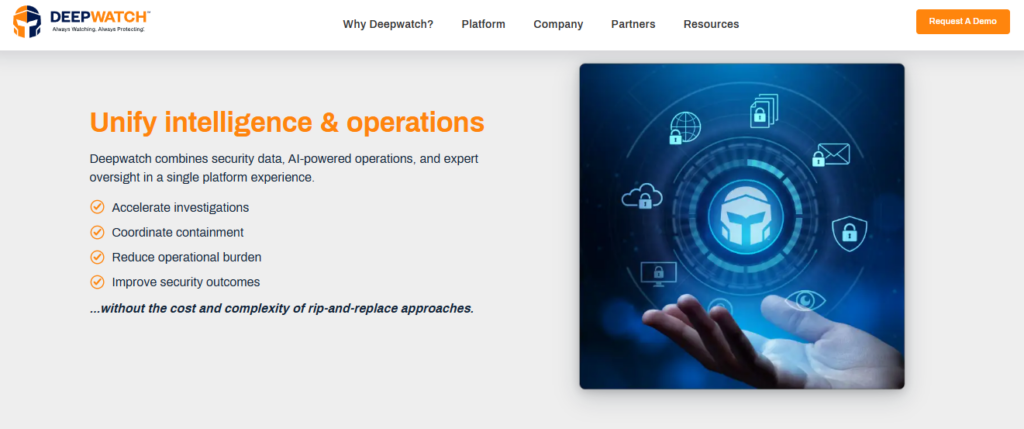
Deepwatch focuses on managed SIEM, with deep roots in the Splunk ecosystem. If your world already runs on Splunk, Deepwatch speaks your language natively.
🛠️ Core Services
- Managed SIEM operations (Splunk-centric)
- 24/7 monitoring and detection engineering
- Threat hunting and response guidance
- Endpoint and cloud coverage
- Compliance-focused reporting
✅ Why Companies Consider Deepwatch
Splunk-heavy shops pick Deepwatch to offload the day-to-day tuning and monitoring of a SIEM that is powerful but demanding to run. The trade-off surfaces at incident time: some buyers describe feeling on their own when a breach actually lands. That gap between monitoring and hands-on response is the pattern I’d probe hardest before signing, and our MDR for Splunk pairs monitoring with response ownership.
🎯 Ideal Customer Profile
Best suited for:
- Splunk-centric mid-market and enterprise teams
- Organizations wanting managed SIEM operations, not a new platform
- Compliance-driven teams needing structured reporting
💰 Commercial Model
Subscription pricing aligned to data ingestion and SIEM scope, which can rise with Splunk data volume.
⏰ When to Shortlist
Shortlist Deepwatch when you’re committed to Splunk and want it operated for you, with clear expectations set on who owns response.
7. Binary Defense
📋 Overview
Binary Defense is a human-led shop known for hands-on threat hunting and counterintelligence. It’s a good fit for teams that want experienced analysts driving the hunt rather than automation alone.
🛠️ Core Services
- Human-led managed detection and response
- Proactive threat hunting
- Managed SIEM and EDR operations
- Counterintelligence and dark web monitoring
- Incident response support
✅ Why Companies Consider Binary Defense
Buyers choose Binary Defense when analyst depth matters more than a slick platform, and the human-hunting emphasis is genuine. The trade-off is the flip side of that strength: a human-led model scales differently than an automation-first one, so you’ll want to confirm coverage depth for your size. My honest take is that the human plus automation blend is the resilient model, and pure-human approaches lean on staffing to keep pace, which is why our threat hunting approach combines both.
🎯 Ideal Customer Profile
Best suited for:
- Teams prioritizing hands-on threat hunting
- Mid-market organizations wanting analyst-driven detection
- Companies needing counterintelligence and dark web coverage
💰 Commercial Model
Subscription pricing scaled by scope of services and monitored assets, with onboarding to connect telemetry.
⏰ When to Shortlist
Shortlist Binary Defense when human expertise and proactive hunting are the deciding factors.
8. eSentire
📋 Overview
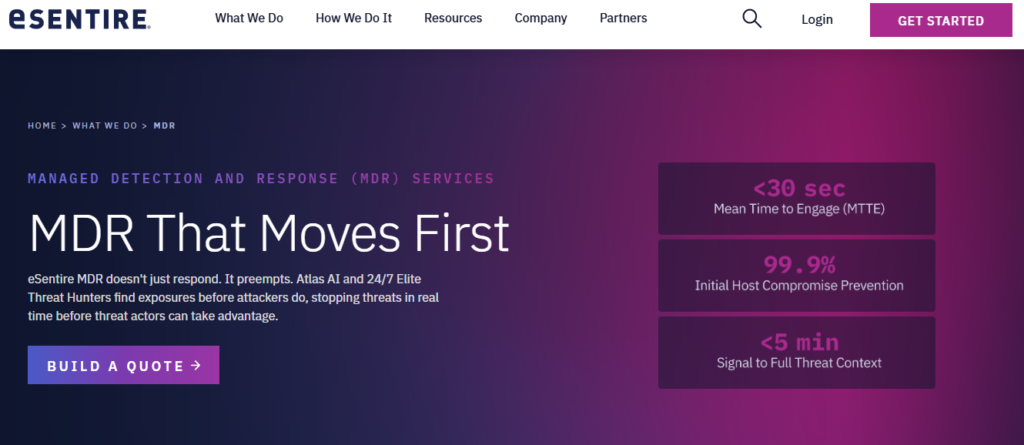
eSentire runs its Atlas XDR platform with a reputation for aggressive response, including the ability to contain threats fast. Speed of containment is its headline strength.
🛠️ Core Services
- 24/7 MDR built on the Atlas XDR platform
- Aggressive response with active threat containment
- Network, endpoint, cloud, and log coverage
- Threat intelligence and hunting
- Incident response retainer options
✅ Why Companies Consider eSentire
Teams pick eSentire when fast containment and firm response SLAs top the list. The structural trade-off is platform-centric delivery: detection and response are tuned to run inside Atlas, so your workflows adapt to their model. If your priority is speed of action, that centralization is a feature. If SIEM ownership is non-negotiable, weigh it carefully against a vendor-agnostic option.
🎯 Ideal Customer Profile
Best suited for:
- Mid-market and enterprise teams wanting fast, hands-on containment
- Organizations comfortable standardizing on the Atlas platform
- Teams prioritizing aggressive response SLAs
💰 Commercial Model
Subscription pricing aligned to signals and coverage scope, with onboarding to deploy Atlas sensors and integrations.
⏰ When to Shortlist
Shortlist eSentire when active containment speed is your top decision driver.
9. Alert Logic
📋 Overview
Alert Logic (now part of Fortra) bundles SIEM, MDR, vulnerability management, and EDR into one package, with a long history of AWS and cloud coverage. It’s often shortlisted by compliance-driven mid-market teams wanting a single box to tick multiple requirements.
🛠️ Core Services
- Bundled MDR, SIEM, and vulnerability management
- Cloud security monitoring (strong AWS integration)
- File integrity monitoring (FIM) for compliance
- 24/7 SOC with scheduled reporting
- PCI and HIPAA compliance support
✅ Why Companies Consider Alert Logic
Buyers value the all-in-one bundle and PCI-friendly log review for hitting compliance on a budget. The recurring caveats in reviews are detection accuracy, support consistency, and a migration to Fortra that some found bumpy. There’s also a documented 50GB/day log cap that a few buyers say surfaced late. Pressure-test detection quality and log limits before you commit, and review your compliance requirements against the bundle.
🎯 Ideal Customer Profile
Best suited for:
- Compliance-driven mid-market teams (PCI and HIPAA)
- AWS-heavy organizations wanting bundled coverage
- Teams needing SIEM, MDR, and vuln management in one contract
💰 Commercial Model
Subscription bundle pricing, with log ingestion caps worth clarifying up front given reviewer feedback.
⏰ When to Shortlist
Shortlist Alert Logic when a compliance checkbox and a bundled toolset matter more than best-in-class detection depth.
💬 Customer Reviews
“Having a 24/7 SOC that we don’t have to manage is hands down my favorite. In addition to this, the reports run and are delivered on the schedule that we’ve selected.”
Monique L., Product Security Sr. Analyst Alert Logic G2 – Verified Review
“Solid product but lack of accountability on the support side. We had a system that got infected and it bypassed their product. Their support took no responsibility for the incident nor did their product take action to stop the attack.”
DevOps Engineer Alert Logic Gartner – Verified Review
10. Proficio
📋 Overview
Proficio runs its ProSOC service on a global follow-the-sun model, meaning live analysts hand off across time zones for genuine 24/7 coverage. That global staffing is its defining strength.
🛠️ Core Services
- 24/7 ProSOC monitoring (follow-the-sun model)
- Managed detection and response with active response
- Threat hunting and intelligence
- Vulnerability and risk management
- Compliance reporting support
✅ Why Companies Consider Proficio
Teams with global footprints or strict 24/7 requirements pick Proficio for its distributed SOC coverage. The trade-off common to global MSSP-style delivery is consistency: the analyst who knows your environment at noon may not be the one on shift at 2 a.m. Confirm how context carries across handoffs, because that continuity is where follow-the-sun models live or die. Our SOC service keeps that context unified across shifts.
🎯 Ideal Customer Profile
Best suited for:
- Global or multi-region organizations needing true 24/7 coverage
- Mid-market and enterprise teams wanting a co-managed SOC
- Compliance-driven teams needing structured reporting
💰 Commercial Model
Subscription pricing aligned to monitored assets and data sources, with onboarding to connect your telemetry.
⏰ When to Shortlist
Shortlist Proficio when round-the-clock global coverage is your primary requirement.
🏁 Where UnderDefense Fits in This Shortlist
Across all ten, the real fork is delivery model, so here’s the honest frame from someone who runs this daily. ✅ We stay SIEM-agnostic, so your Splunk, Elastic, QRadar, or LogRhythm investment survives a provider switch. ✅ Our analysts resolve incidents and escalate with context, not just a forwarded alert. ❌ Vendor-locked platforms make leaving mean rebuilding detection from scratch. ✅ Our Agentic AI SOC pairs automation for routine triage with humans for edge cases, the resilient blend. ❌ Black-box models leave your team reconstructing events at 2 a.m. If keeping your SIEM and owning outcomes matters, that’s where the UnderDefense Agentic AI SOC platform sits.
Q2. How Did We Score These Providers, and What Should You Evaluate?
We scored each provider on five weighted criteria totaling 100%: SIEM Ownership and No Vendor Lock-In (25%), Response vs. Escalation (25%), Pricing Transparency (20%), Environment and MITRE Coverage (20%), and Onboarding Speed and Compliance Support (10%). Scores map to stars (0 to 20% = 1★, up to 81 to 100% = 5★). This rubric front-loads what actually breaks mid-market deals: data ownership, whether alerts get resolved or handed back, and ingestion-based pricing surprises. Our SIEM evaluation questions break each of these down further.
📊 The Weighted Rubric
| Criterion | Weight | What a low score looks like |
|---|---|---|
| SIEM ownership, no vendor lock-in | 25% | Detection lives in the vendor’s platform; leaving means rebuilding |
| Response vs. escalation | 25% | You get an alert, not a resolution, at 2 a.m. |
| Pricing transparency | 20% | Per-GB billing that balloons with log volume |
| Environment and MITRE coverage | 20% | Strong on endpoints, thin on cloud and identity |
| Onboarding speed and compliance support | 10% | Slow setup, weak audit evidence |
⚖️ Why Ownership and Response Weigh Most
Ownership and response carry half the total score, and that’s deliberate. These are the two places where Big-4 delivery and vendor-locked platforms structurally fail a mid-market buyer, regardless of how good the tech is. If your SIEM data is trapped, switching providers means starting detection from zero, which is why we prioritize avoiding vendor lock-in.
Response weight comes from a simple pattern I see constantly. Many providers escalate an alert and consider the job done, so your lean team still owns the hard part. We resolve alerts rather than hand them back, and that difference is where mid-market teams actually feel relief.
🔍 The Failure Modes Behind Each Criterion
Every criterion is grounded in a real failure, not a checklist. Coverage matters because one bad login from Singapore can be a months-old compromise still quietly logging in. Pricing transparency matters because per-GB models punish you for the visibility you need.
The category has over-specialized into tool babysitting, so I also score who’s actually on your account. A junior-heavy SOC that configures dashboards is different from analysts who trace business logic. False-positive suppression is scored too, because research on SOC operations has documented false-positive rates ranging widely, up to roughly 99% in some environments, which buries real threats. Our approach to reducing alert fatigue tackles this directly.
🎯 How UnderDefense Scores on the Same Rubric
We give ourselves 5★, and here’s the honest line-by-line. ✅ UnderDefense is SIEM-agnostic, so you keep Splunk, Elastic, QRadar, or LogRhythm. ✅ We resolve incidents and escalate with context. ❌ Vendor-locked models make leaving costly. ✅ Our published per-endpoint pricing avoids per-GB surprises, and coverage spans endpoint, cloud, and identity. ❌ Black-box investigation leaves your team guessing. Our limitations (onboarding integration time) stay disclosed in the UnderDefense Agentic AI SOC platform entry above.
Q3. Why Does Big-4 Managed SIEM Cost So Much, and What Should Mid-Market Actually Pay?
Big-4 managed SIEM is expensive because you’re buying a consulting-scale delivery model, meaning enterprise SOC staffing, partner overhead, and engagement minimums priced in regardless of your size. A 24/7 in-house SOC alone runs well into seven figures once every round-the-clock chair is staffed. Mid-market managed SIEM, by contrast, typically runs $5,000 to $15,000 per month. The pricing model matters most: per-GB-ingested billing is where budgets quietly break, while per-endpoint pricing stays predictable. Compare the options in our managed SIEM breakdown.
💰 The Real Baseline: Staffing 24/7 Is the Cost
Round-the-clock coverage is the expensive part, and it’s easy to underestimate. Each monitoring seat needs five to six analysts to cover nights, weekends, and burnout, so a fully in-house 24/7 SOC lands in the $1.5M to $2.5M range annually. Most mid-market teams simply can’t hire into that, and many lack the staff to run a SIEM well. You can model your own numbers with our SOC cost calculator.
That’s the honest context behind the Big-4 premium. You’re paying for their delivery machine, the partner layer and engagement minimums, on top of the actual detection work.
🏛️ The Premium Is Delivery, Not a Capability Gap
I want to be fair here, because Deloitte and its peers earn real trust. Deep Splunk expertise, strong audit muscle, and brand credibility are genuine strengths. The trade-off is structural: that consulting delivery model gets priced into your quote whether or not your environment needs it.
So the premium buys brand and enterprise staffing, not necessarily better outcomes for a 1,000-person company. For mid-market, that math rarely bends in your favor.
📊 The Four Pricing Models (and the One Trap)
| Model | How it bills | Watch for |
|---|---|---|
| Per-endpoint | Fixed rate per device/month | Most predictable |
| Per-GB ingested | By log volume | Costs spike as data grows |
| Per-user | By headcount | Fine for stable teams |
| Flat retainer | Fixed monthly | Confirm what’s excluded |
Per-GB is the budget trap. As your logging grows, so does your bill, which punishes visibility. In practice, tuning correlation rules can cut ingestion dramatically. I’ve seen environments drop from around 300 GB/day to 35 to 40 GB/day, which reframes cost entirely.
🛡️ Reframing Price as Breach-Cost Avoidance
Proving pure breach-prevention ROI is a trap, so I focus on comparative cost of delivery instead. Still, the stakes are real: IBM’s 2025 report puts the global average breach at $4.44 million and the U.S. average at a record $10.22 million. UnderDefense publishes per-endpoint pricing so your model stays predictable, and our co-managed approach lowers your per-GB exposure through tuning rather than profiting from your log volume.
Q4. How Does the AI SOC Bridge Let Mid-Market Skip Enterprise SOC Staffing?
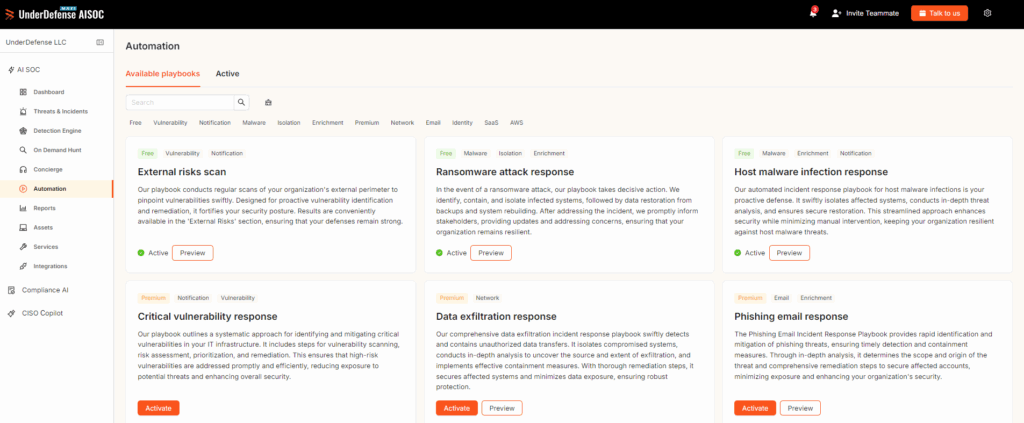
The reason mid-market alternatives can match Big-4 detection at a fraction of the cost is structural: an Agentic AI SOC now performs the tier-1 investigation and enrichment that enterprise SOCs staff with junior analysts. That eliminates whole classes of manual triage, so the human layer stays lean and senior. It doesn’t remove humans, but moves them from copying logs to threat hunting. The catch is that without solid detection engineering, AI just scales noise faster. Our guide to the AI SOC model unpacks how this works.
🤖 The Category Shift: AI Does Tier-1
Tier-1 work is the grind: pulling logs, enriching alerts, and correlating across tools. Agentic AI now handles that first pass, so your senior people start where the judgment actually begins. This is what lets a leaner staffing model deliver enterprise-grade coverage through AI SOC automation.
Think foot-soldiers and generals. The AI does the swarming legwork, and humans make the calls that matter. Attackers already move this fast, so defenders need the same tempo.
🔬 Real Investigation Depth, Not a Wrapper
The honest test is depth. A shallow tool bolts a chatbot onto alerts and calls it AI. A real agentic system runs recursive reasoning, over 100 distinct model invocations and dozens of queries across multiple tools, to investigate a single alert line by line.
Recent research and patents point the same direction, toward autonomous, multi-step LLM investigation and machine-learning triage that compress tier-1 work. That depth is what separates a genuine Agentic AI SOC from a GPT wrapper, and it’s the foundation of our AI SOC investigation speed.
⚠️ The Honest Caveat: Bad Detection Engineering Scales Wrong
Here’s the part the category avoids saying. If your detection engineering is weak, an AI SOC is just a faster way to be wrong. Automation amplifies whatever logic you feed it, good or bad.
My current read is that a biased model you can measure and improve beats an unbiased black box you can’t audit. So the AI must be observable, meaning you can see why it reached a conclusion. AI collects the context, and you decide.
🚀 What Changes Monday
The payoff is practical. Your team stops babysitting dashboards and starts hunting threats, because the routine investigation is already done. UnderDefense Agentic AI SOC runs this new-generation Agentic AI SOC as the tier-1 operating layer, a genuine replacement for the Big-4 delivery model rather than one more tool to manage. Being a human on that senior layer is the flex, and the UnderDefense Agentic AI SOC platform is where automation and human judgment meet.
Q5. Is a Non-Big-4 Provider Safe, and How Does Each Model Support SOC 2, ISO 27001, and PCI-DSS?
A non-Big-4 provider is a safe, defensible choice when you verify proof rather than brand: contractual SLAs, real financial or breach warranties, published MITRE ATT&CK coverage, named references, certifications, and genuine incident response. It’s also where compliance is won, since a SOC 2, ISO 27001, or PCI-DSS deadline likely triggered your quote. The real differentiator is whether a provider generates audit-ready evidence for you or just hands you dashboards to assemble yourself. Our compliance services are built around that evidence gap.
😟 The Fear Behind the Question
Let’s name it plainly. The quiet worry is “if I pick a smaller provider and we get breached, will I get fired?” That fear is fair, and it deserves a calm answer, not a scare tactic.
Here’s the honest part: brand does not equal detection. I’ve seen mature stacks with a big EDR and a big SIEM miss the initial phase of a real intrusion, where a crafted request harvested credentials while everything looked green. Attackers can escalate cloud admin access in under a minute, so the name on the invoice is not the thing that saves you. This is why a genuine incident response capability matters more than the logo.
✅ The Six Proof Points to Verify
Before you sign, ask for evidence on each of these:
- Contractual response SLAs (with real numbers, not “best effort”)
- Financial or breach warranty terms, and exactly what they cover
- Published MITRE ATT&CK coverage percentages
- Named customer references at your size and industry
- Certifications the provider itself holds
- A real incident response capability, meaning Tier 3 to 4 humans, not just ticket forwarding
One honest caveat: a multi-year clean track record is a track record, not a warranty. If a provider like Arctic Wolf offers a genuine financial warranty, weigh that as a distinct, real thing, and compare it against the Arctic Wolf alternatives that resolve rather than escalate.
🛡️ Mapping the Frameworks to What a SIEM Must Produce
Compliance is where this gets concrete. Each framework needs continuous monitoring plus evidence you can hand an auditor.
| Framework | What it needs | What the provider must generate |
|---|---|---|
| SOC 2 | Continuous monitoring, incident logging | Control evidence, response records |
| ISO 27001 | ISMS, risk treatment | Gap analysis, policy and audit trails |
| PCI-DSS | Daily log review, FIM | Log-review attestations, alerts |
Use NIST CSF 2.0 as a one-page budget map for your CFO, tying each spend to a function (identify, protect, detect, respond, and recover). That single page turns “trust me” into a defensible board conversation, and our 2026 cybersecurity budget playbook shows how to build it.
🤝 Where UnderDefense Fits the Safety Blocker
Our higher-touch answer pairs the Agentic AI SOC with human Tier 3 to 4 incident response and fast critical escalation, so alerts get resolved with context. Reviewers point to exactly the audit-evidence gap that matters here.
“They’ve also made our audit process much less painful. The reports from their platform give us clear evidence of our security controls and incident response capabilities. When auditors or clients ask questions about our security posture, we can pull up exactly what they need to see.”
Verified User in Marketing and Advertising, Small-Business UnderDefense G2 – Verified Review
“Their vCISO team was amazing in supporting us with ISO 27001.”
Val R., Small-Business UnderDefense G2 – Verified Review
Cybersecurity is closer to a zombie apocalypse than a game you win, so the question I sit with is this: does your provider hand you evidence, or homework?
Q6. How Do You Shortlist and Switch Providers in Weeks, Not a Quarter?
Run the shortlist in a week by scoring three vendors against the seven criteria and demanding proof, not decks. In demos, ask directly: Do I keep my rules and data at contract end? Do you resolve alerts or escalate them? Show me your MITRE coverage and a real stop-time. Decide the model first, since managed SIEM keeps you close to your data while MDR bundles the analysts. Then skip the sandbox POC and run a proof-of-value on your own live logs.
🗓️ The One-Week Method
You don’t need a quarter to make this call. Pick three vendors, score them on the same seven criteria, and weight proof over polished slides. Decks are easy to fake, and a live workflow is not, which is why our SIEM evaluation questions focus on observable proof.
Here’s the discipline I’d hold: no vendor advances without showing you something observable. If they can’t demo it, treat that as an answer.
🧭 Decide the Category First
The label matters, because each model fits a different team.
- Managed SIEM: keeps you close to your own data and rules; best if you own a SIEM
- MDR: bundles detection plus analysts; best if you want response included
- MSSP: broad monitoring; often lighter on hands-on response
- SOCaaS: outsourced SOC function; best if you have no internal team
Choose the model that matches your data-ownership needs before you compare logos, and our managed SIEM vs MDR vs MSSP breakdown maps each to a team profile.
❓ The Exact Demo Questions
Put these on the table in every demo:
- At contract end, do I keep my detection rules and my data?
- Do you resolve incidents, or escalate them back to me?
- Show me your MITRE ATT&CK coverage, not a marketing number
- Who is actually on my account, senior analysts or junior staff?
- Walk me through one real incident and your stop-time
🔄 Migration and Data-Ownership Checklist
Switching cleanly comes down to ownership. Confirm export of your rules, retention of historical logs, and no lock-in on detections you paid to build. Write it into the contract, the same way you’d write a product requirements doc before letting any tool touch production, and lean on our guidance for avoiding vendor lock-in.
RUN IT AGAINST YOUR OWN ENVIRONMENT
Bring us your Big-4 quote and UnderDefense will map it line-by-line against a mid-market model. Talk to our team to get started.
My advice: move from POC to proof-of-value on your real logs, because a sandbox never shows you how a provider behaves at 2 a.m. What would you need to see, on your own data, to switch with confidence?
Q7. Which Alternative Is Right for Your Environment, and What’s Your Next Move?
There’s no single winner, but there’s a winner for your environment. If you already own a SIEM and want to keep your rules and data, choose a co-managed, vendor-agnostic model like UnderDefense. Cloud-native with a lean team? Prioritize an AI-SOC operating layer. Under a hard compliance deadline? Weight evidence generation and onboarding speed. The defensible board answer to “why not Deloitte?” is delivery-model fit, not price.
🎯 Match the Profile to the Fit
Here’s how I’d map it, plainly:
- You own a SIEM and want no lock-in: pick a co-managed, vendor-agnostic model that resolves alerts, like UnderDefense
- You’re cloud-native with a lean team: prioritize an Agentic AI SOC operating layer that handles tier-1 for you
- You have a hard compliance deadline: weight audit-evidence generation and onboarding speed above everything
- You have the leanest team: choose the provider that owns response, not one that forwards tickets
The worst outcome is investing in a faster way to be wrong, meaning speed layered on weak detection.
🏛️ The Board-Ready “Why Not Deloitte” Answer
Your board doesn’t want “it’s cheaper.” They want a defensible rationale, and delivery-model fit is exactly that. You’re choosing a model sized to a 1,000-person environment rather than paying for consulting-scale staffing you won’t use.
Frame the value as breach-cost avoidance, not a promise to prove a negative. With the average breach at $4.44 million globally and $10.22 million in the U.S., matching detection quality at a mid-market delivery cost is the responsible call. Model it yourself with our SOC cost calculator.
🚪 Your Next Move
When you’re ready to compare, bring us your Big-4 managed SIEM proposal. UnderDefense will walk it line-by-line against a co-managed model so you can see what you’re paying for versus what you actually need. Being a human on the senior layer, making the call while automation does the legwork, is the flex in 2026. Start the quote comparison with our team.
See tuned SIEM triage in action.
1. What are the best Deloitte managed SIEM alternatives for mid-market companies in 2026?
We rank ten providers that deliver 24/7 monitoring without Big-4 consulting-scale pricing: UnderDefense, Arctic Wolf, Expel, ReliaQuest, Red Canary, Deepwatch, Binary Defense, eSentire, Alert Logic, and Proficio.
The right pick depends less on who is cheapest and more on which delivery model fits your environment. We scored each on the same criteria:
- SIEM ownership, whether you keep your own Splunk, Elastic, QRadar, or LogRhythm
- Response vs. escalation, whether they resolve incidents or hand you an alert
- Compliance support across SOC 2, HIPAA, ISO 27001, PCI DSS, and GDPR
If you already own a SIEM and want to keep your data and rules, our managed SIEM co-management is the strongest fit, since we sit on top of your existing tooling rather than replacing it. Vendor-locked platforms make leaving mean rebuilding detection from scratch, which is the structural trade-off most alternatives split on.
2. Why does Deloitte managed SIEM cost so much compared to mid-market providers?
Big-4 managed SIEM is expensive because you are buying a consulting-scale delivery model, meaning enterprise SOC staffing, partner overhead, and engagement minimums priced in regardless of your size.
The expensive part is round-the-clock coverage. Each monitoring seat needs five to six analysts to cover nights, weekends, and burnout, so a fully in-house 24/7 SOC lands in the $1.5M to $2.5M range annually.
By contrast, mid-market managed SIEM typically runs $5,000 to $15,000 per month. The pricing model matters most:
- Per-endpoint stays predictable
- Per-GB ingested is the budget trap that spikes as data grows
Deloitte and its peers earn real trust with deep Splunk expertise and audit muscle, but that premium buys brand and staffing, not necessarily better outcomes for a 1,000-person company. We publish transparent per-endpoint pricing so your model stays predictable, and our co-managed approach lowers per-GB exposure through tuning rather than profiting from your log volume.
3. How much should a mid-market company actually pay for managed SIEM?
Most mid-market teams should expect managed SIEM in the range of $5,000 to $15,000 per month, versus the seven-figure annual cost of staffing a 24/7 SOC in-house.
The single biggest variable is the billing model. Per-GB ingestion punishes visibility, since your bill grows as your logging grows. In practice, tuning correlation rules can cut ingestion dramatically. We have seen environments drop from around 300 GB/day to 35 to 40 GB/day, which reframes cost entirely.
The four common models are:
- Per-endpoint, fixed rate per device, most predictable
- Per-GB ingested, by log volume, costs spike as data grows
- Per-user, by headcount, fine for stable teams
- Flat retainer, fixed monthly, confirm what is excluded
Frame the value as breach-cost avoidance, since IBM’s 2025 report puts the global average breach at $4.44 million. You can model your own numbers with our SOC cost calculator before comparing quotes.
4. Is it safe to choose a non-Big-4 provider for SOC 2, ISO 27001, and PCI-DSS compliance?
Yes, a non-Big-4 provider is a safe, defensible choice when you verify proof rather than brand. Brand does not equal detection; we have seen mature stacks with a big EDR and a big SIEM miss the initial phase of a real intrusion.
Before you sign, verify six proof points:
- Contractual response SLAs with real numbers
- Financial or breach warranty terms and what they cover
- Published MITRE ATT&CK coverage percentages
- Named references at your size and industry
- Certifications the provider itself holds
- Real Tier 3 to 4 incident response, not ticket forwarding
The real differentiator is whether a provider generates audit-ready evidence for you or hands you dashboards to assemble yourself. Our compliance services pair the Agentic AI SOC with human incident response so each framework gets the control evidence, response records, and attestations an auditor needs. The question to sit with is simple: does your provider hand you evidence, or homework?
5. Can I keep my existing SIEM instead of migrating to a provider's platform?
Yes, and for most mid-market teams keeping your own SIEM is the smarter call. The structural fork across every alternative is whether detection lives in your environment or inside the vendor’s platform.
Vendor-locked models trap your data, so switching providers later means rebuilding detection from zero. That is why we weight SIEM ownership and no vendor lock-in at 25% of our scoring rubric.
We stay SIEM-agnostic and co-manage the SIEM you already run across:
- Elastic
- Splunk
- QRadar
- LogRhythm
This means your SIEM investment survives a provider change, and one reviewer’s alert noise dropped in the first week because we retuned their existing configs rather than selling a new tool. If avoiding lock-in matters, read our guidance on avoiding vendor lock-in and write data and rule export directly into the contract before any tool touches production.
6. What is the difference between managed SIEM, MDR, MSSP, and SOCaaS?
The label matters because each model fits a different team, so decide the category before you compare logos.
- Managed SIEM, keeps you close to your own data and rules, best if you own a SIEM
- MDR, bundles detection plus analysts, best if you want response included
- MSSP, broad monitoring, often lighter on hands-on response
- SOCaaS, an outsourced SOC function, best if you have no internal team
The critical distinction is response versus escalation. Many providers escalate an alert and consider the job done, so your lean team still owns the hard part at 2 a.m. We resolve alerts rather than hand them back, which is where mid-market teams actually feel relief.
Choose the model that matches your data-ownership needs first. Our breakdown of managed SIEM vs MDR vs MSSP maps each model to a team profile so you can match the category to your staffing reality before shortlisting vendors.
7. How does an Agentic AI SOC let mid-market teams skip enterprise SOC staffing?
The reason mid-market alternatives can match Big-4 detection at a fraction of the cost is structural: an Agentic AI SOC now performs the tier-1 investigation and enrichment that enterprise SOCs staff with junior analysts.
Tier-1 work is the grind, pulling logs, enriching alerts, and correlating across tools. Agentic AI handles that first pass, so your senior people start where the judgment actually begins. It does not remove humans, but moves them from copying logs to threat hunting.
A genuine system runs recursive reasoning, over 100 distinct model invocations to investigate a single alert, which separates it from a shallow GPT wrapper. The honest caveat:
- If your detection engineering is weak, an AI SOC is just a faster way to be wrong
- The AI must be observable, so you can audit why it reached a conclusion
Our UnderDefense Agentic AI SOC platform runs this new-generation Agentic AI SOC as the tier-1 operating layer, a genuine replacement for the Big-4 delivery model rather than one more tool to manage.
8. How do I shortlist and switch managed SIEM providers in weeks, not a quarter?
You can run the shortlist in a week by scoring three vendors against the same seven criteria and demanding proof, not polished decks. No vendor advances without showing you something observable; if they cannot demo it, treat that as an answer.
Put these questions on the table in every demo:
- At contract end, do I keep my detection rules and my data?
- Do you resolve incidents, or escalate them back to me?
- Show me your MITRE ATT&CK coverage, not a marketing number
- Who is actually on my account, senior analysts or junior staff?
- Walk me through one real incident and your stop-time
Then skip the sandbox POC and run a proof-of-value on your own live logs, because a sandbox never shows how a provider behaves at 2 a.m. When you are ready, bring us your Big-4 quote and we will map it line-by-line against a mid-market model. Talk to our team to start the comparison.