




Q1: What Are the 9 Best Managed SIEM Providers for SaaS Companies in 2026?
The managed SIEM market has shifted decisively from generic log aggregation toward AI-driven detection and response architectures built for SaaS companies running multi-cloud workloads. For security leaders evaluating outsourced SIEM operations, the decision carries real operational weight: the wrong provider locks you into proprietary tooling, generates alert noise without context, or leaves your team manually triaging at 2 AM. This guide evaluates nine managed SIEM providers across operational, technical, and business criteria relevant to modern SaaS organizations.
Our Evaluation Criteria
Each provider included in this shortlist was assessed across five key areas:
- Security Operations Capability: 24/7 monitoring depth, threat detection maturity, mean-time-to-respond (MTTR), and incident response readiness
- SaaS & Cloud Security Expertise: Ability to secure AWS, Azure, GCP, Kubernetes, and modern SaaS infrastructure with detection tailored to ephemeral, cloud-native environments
- Compliance Support: Experience supporting frameworks such as SOC 2, HIPAA, ISO 27001, PCI DSS, and GDPR with automated evidence collection
- Customer Validation: Verified user reviews on G2, Gartner Peer Insights, Clutch, and community signals across Reddit and industry forums
- Scalability for Mid-Market Teams: Suitability for organizations with roughly 50 to 1,000 employees, including transparent pricing, fast onboarding, and vendor-agnostic integration
Who This Guide Is For
This shortlist is designed specifically for:
- SaaS companies evaluating outsourced managed SIEM instead of building an in-house SOC
- Technology teams preparing for enterprise customer security audits or compliance certifications
- CISOs, IT Directors, and CTOs seeking proactive ransomware protection with continuous cloud monitoring
- PE Operating Partners standardizing security posture across portfolio companies
If your organization is moving toward vendor evaluation or preparing an RFP, the providers below represent established managed SIEM partners frequently considered during the buying process.
| Provider Name | Best For | Key Strength | Compliance |
|---|---|---|---|
| UnderDefense ⭐⭐⭐⭐⭐ | SaaS companies needing detection + human-led response across existing tools | AI SOC + Human Ally with vendor-agnostic integration (250+ tools) | SOC 2, HIPAA, ISO 27001, PCI DSS, GDPR (forever-free compliance kits) |
| Taegis ⭐⭐⭐⭐ | Microsoft-ecosystem organizations wanting XDR + SIEM convergence | Taegis XDR platform with Counter Threat Unit intelligence | SOC 2, PCI DSS, HIPAA, GDPR |
| Alert Logic (Fortra) ⭐⭐⭐⭐ | SMBs needing embedded SIEM with MDR in a single platform | Cloud-native MDR with 30PB+ threat telemetry | PCI DSS, SOC 2, HIPAA, HITRUST |
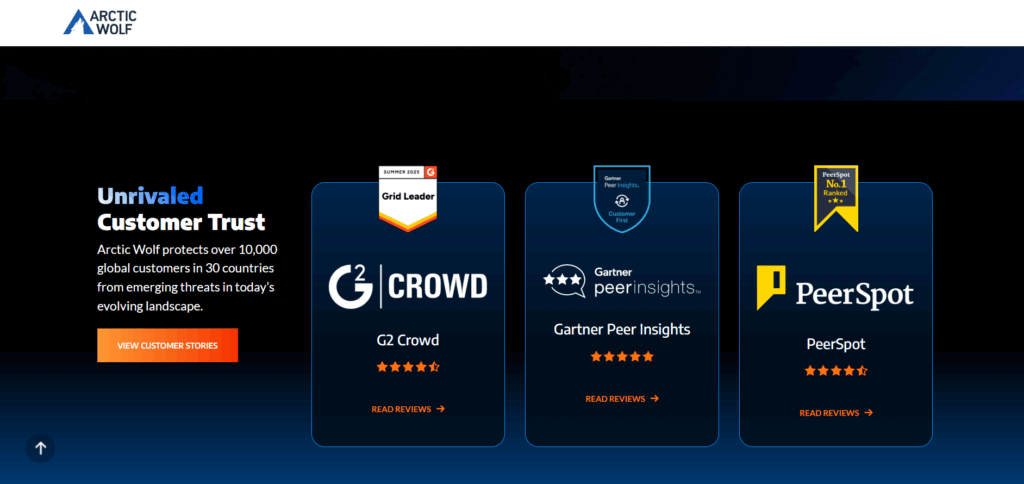
| Arctic Wolf ⭐⭐⭐⭐ | Mid-market companies seeking fully managed security operations | Concierge Security Team with bundled cloud monitoring | SOC 2, HIPAA, PCI DSS, NIST |
| Expel ⭐⭐⭐⭐ | Tech companies wanting transparent MDR with broad SIEM integrations | Expanded SIEM integrations (Sumo Logic, CrowdStrike LogScale, Google SecOps) | SOC 2, HIPAA, PCI DSS |
| Rapid7 ⭐⭐⭐⭐ | Organizations needing vulnerability management paired with SIEM | Incident Command AI-powered next-gen SIEM with behavioral analytics | PCI DSS, HIPAA, SOC 2, GDPR |
| NTT Security ⭐⭐⭐½ | Global enterprises requiring hybrid/cloud managed SIEM | 10 global SOCs with multi-OEM support (Sentinel, LogRhythm, QRadar) | ISO 27001, SOC 2, PCI DSS, GDPR |
| Red Canary ⭐⭐⭐⭐ | Endpoint-heavy environments wanting MDR with advanced analytics | MDR-first approach with broad EDR integration (CrowdStrike, SentinelOne) | SOC 2, HIPAA, PCI DSS |
| Deepwatch ⭐⭐⭐½ | Splunk-native organizations needing managed SOC operations | Deep Splunk expertise with insurance-panel incident response | SOC 2, HIPAA, PCI DSS, NIST |
1. UnderDefense, Best for SaaS Companies Needing AI-Powered Detection with Human-Led Response
✅ Overview
UnderDefense is a managed cybersecurity provider founded in 2017, headquartered in New York with 120 security engineers across three continents. The company delivers a security-as-a-service platform anchored by its AI-powered UnderDefense MAXI platform, combining 24/7 threat detection, incident response, compliance automation, and penetration testing. What sets UnderDefense apart architecturally is its “AI SOC + Human Ally” model, a vendor-agnostic approach that unifies AI-driven detection with dedicated concierge analyst response, designed to own security outcomes rather than just escalate alerts.
🔧 Core Services
- 24/7 Managed Detection & Response (MDR): 2-minute alert-to-triage and 15-minute escalation for critical incidents, 96% MITRE ATT&CK coverage
- Unified UnderDefense MAXI Platform: Vendor-agnostic integration across 250+ existing security tools (CrowdStrike, Splunk, SentinelOne, Microsoft Defender, Elastic), with SOAR-as-a-Service included by default
- Concierge Analyst Response (ChatOps): Direct analyst communication via Slack, Teams, or email to verify suspicious activity with affected users, closing the context gap that causes false positives
- Compliance Automation: Forever-free compliance kits for SOC 2, HIPAA, ISO 27001, and GDPR; automated evidence collection from security monitoring
- Proactive Threat Hunting & Dark Web Monitoring: Campaign-based threat hunting sweeps, external attack surface monitoring, and leaked credentials detection
- Penetration Testing & vCISO: Full-spectrum offensive security (web, cloud, network, mobile) plus fractional CISO services for strategic guidance
💡 Why SaaS Companies Consider UnderDefense
Most SaaS companies outgrow the “one security person handling everything” model around 100 to 200 employees but lack the budget for a full SOC (typically $750K+/year). UnderDefense positions itself as the force multiplier: you keep your existing security tools, and the UnderDefense MAXI platform layers detection, response, and compliance on top. The documented proof points are specific: threat detection 2 days faster than CrowdStrike OverWatch in head-to-head case studies, 100% ransomware prevention record across 500+ MDR clients over 6 years, and 99% false positive reduction through custom detection tuning and direct user verification.
🎯 Ideal Customer Profile
- SaaS companies with 50 to 1,000 employees needing enterprise-grade protection on mid-market budgets
- Compliance-driven organizations requiring SOC 2, HIPAA, or ISO 27001 certification
- Security-lean teams already using CrowdStrike, Splunk, SentinelOne, or Microsoft Defender who want managed response without tool replacement
- PE portfolio companies needing standardized security baselines across multiple entities
💰 Commercial Model
UnderDefense operates on transparent, published pricing: $11 to $15/endpoint/month with OPEX monthly charges (no upfront CAPEX). The UnderDefense MAXI platform includes a freemium tier for nearly 2,000 businesses, with MDR, compliance kits, dark web monitoring, and SOAR bundled, not sold as add-ons. Onboarding is 30-day turnkey deployment with custom detection tuning, security hardening, and ransomware simulation testing included.
⏰ When to Shortlist
Organizations that want to protect their existing security investments rather than replace them, need transparent and predictable pricing, and require analysts who verify alerts directly with users rather than escalating “please investigate” tickets should include UnderDefense during the RFP stage. If you’re evaluating managed SIEM and need both detection and response under one roof with full compliance support, UnderDefense fits.
💬 Customer Reviews
“They have an exceptionally talented team who is very engaged and provides extra care. If I had to pick a single word, I would call them proactive. They keep us informed, suggesting relevant and cost-effective security improvements and new use cases that enhance our defenses. And we love the monthly report, we gain valuable insights into security posture and incidents, and share them with the board of directors. Plus, their expert management of our SIEM has added to the value of our security investments and tools.”
— Yaroslava K., IT Project Manager UnderDefense G2 – Verified Review
“Honestly, some security tools are more complicated than the threats themselves. UnderDefense gives proactive tips too. Feels like my IT department suddenly got way smarter.”
— Andriy H., Co-Founder and CTO at Contora Inc. UnderDefense G2 – Verified Review
2. Taegis XDR, Best for Microsoft-Ecosystem Organizations Wanting XDR + SIEM Convergence
✅ Overview
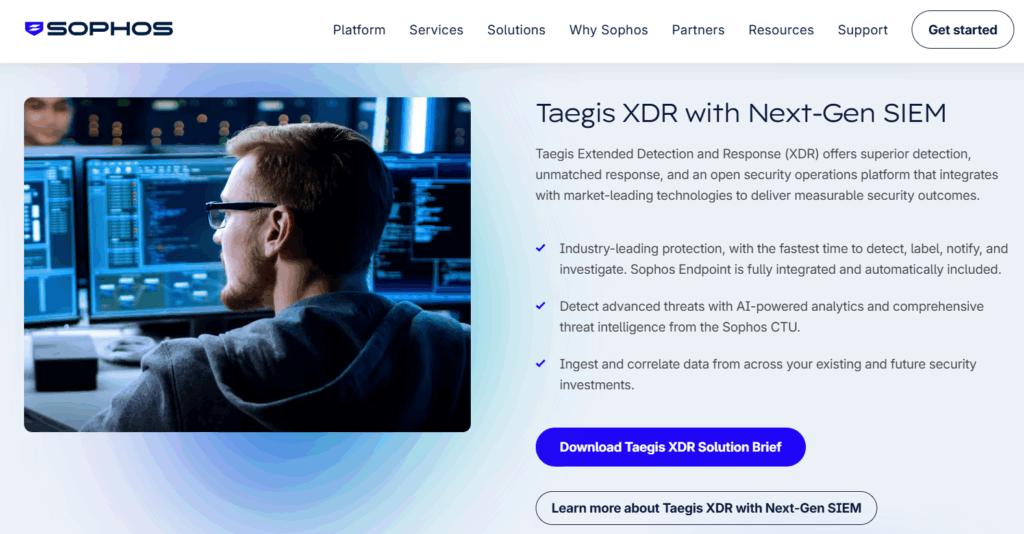
Taegis is a managed cybersecurity provider built on over two decades of real-world threat intelligence. Its cloud-native Taegis platform combines Extended Detection and Response (XDR), Managed Detection and Response (MDR), and vulnerability management into a unified security operations experience. For SaaS companies operating primarily within the Microsoft ecosystem, Taegis offers deep integration with Azure, Microsoft 365, and Sentinel while providing its proprietary Counter Threat Unit (CTU) intelligence.
🔧 Core Services
- 24/7 Managed Detection & Response via Taegis ManagedXDR
- Cloud-native XDR platform with threat intelligence enrichment (including Sophos Intelix integration)
- Vulnerability management (Taegis VDR)
- Threat hunting with Counter Threat Unit intelligence
- SIEM replacement capabilities with advanced detection and actionable insights
💡 Why SaaS Companies Consider Taegis
SaaS organizations already invested in Microsoft’s security ecosystem find Taegis XDR appealing because Taegis integrates hundreds of leading technologies, and its XDR platform can replace traditional SIEM deployments with advanced threat detection. The CTU research team provides continuously curated threat intelligence, reducing detection gaps.
🎯 Ideal Customer Profile
- Microsoft-centric organizations using Azure, Microsoft 365, and Sentinel
- Mid-market to enterprise companies (200 to 5,000 employees)
- Teams wanting XDR to replace or augment existing SIEM
- Organizations needing vulnerability management paired with detection
💰 Commercial Model
Taegis operates on subscription-based pricing aligned with organization size and monitored assets. Taegis XDR is available on the AWS Marketplace. Pricing typically requires a custom quote based on environment scope.
⏰ When to Shortlist
Consider Taegis if your organization is deeply invested in the Microsoft security ecosystem and wants a single platform that combines XDR, SIEM, and vulnerability management with two decades of threat intelligence backing it.
💬 Customer Reviews
“I appreciate that they introduced the NDR feature and zero-day protection in this product. The running interface is good enough; I can see the web traffic, web monitor, and application monitor traffic here, so it is adequate for now.”
— Verified User Taegis XDR – G2 Verified Review
“It’s a complete solution package. More from the perspective of SOC to ensure that every endpoint is taken care of from a cybersecurity perspective. I can see the current number of threats that are there in the organization.”
— Verified User Taegis XDR – G2 Verified Review
3. Alert Logic (Fortra), Best for SMBs Needing Embedded SIEM with MDR in a Single Platform
✅ Overview
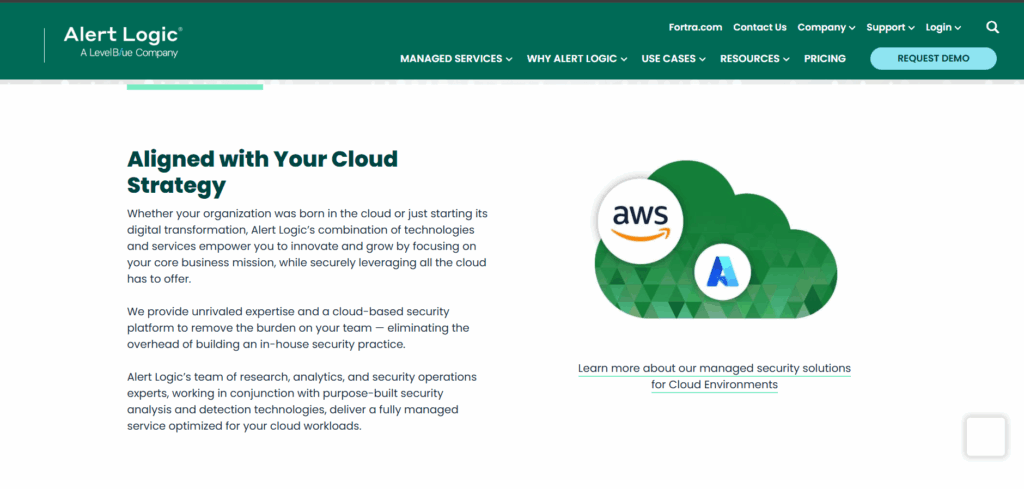
Alert Logic, now part of Fortra, delivers Managed Detection and Response with an embedded SIEM purpose-built for cloud, SaaS, on-premises, and hybrid environments. Named a Leader in the G2 Grid for MDR, Alert Logic processes 30PB+ of threat telemetry from over 4,000 customers and positions itself as a compliance-first security platform, particularly strong for PCI DSS.
🔧 Core Services
- 24/7 SOC monitoring with embedded SIEM and MDR
- Network, application, and endpoint threat detection with asset discovery
- PCI scanning and compliance reporting (SOC 2, HIPAA, HITRUST)
- Four service tiers: Essentials, Professional, Enterprise WAF, Enterprise ActiveWatch
- Cloud-native deployment with API integration at no additional cost
💡 Why SaaS Companies Consider Alert Logic
Alert Logic appeals to SMBs and mid-market organizations that need SIEM, MDR, and compliance bundled together without managing separate tools. Its transparent tiered pricing starting at $550/month makes it accessible for smaller teams, and its strong PCI DSS support is a draw for companies handling payment data.
🎯 Ideal Customer Profile
- SMB to mid-market organizations (25 to 1,000 employees)
- AWS-centric cloud deployments needing embedded SIEM
- PCI DSS-driven organizations requiring compliance reporting
- Teams wanting MDR + vulnerability management in one platform
💰 Commercial Model
Alert Logic offers transparent tiered pricing with four service packages starting at $550/month for a minimum of 25 protected nodes. This makes it one of the more accessible managed SIEM options for smaller organizations.
⏰ When to Shortlist
Include Alert Logic during evaluation if your primary driver is compliance (especially PCI DSS), you’re operating in AWS, and you want an all-in-one MDR+SIEM bundle at an SMB-friendly price point.
💬 Customer Reviews
“Having a 24/7 SOC that we don’t have to manage is hands down my favorite. In addition to this, the reports run and are delivered on the schedule that we’ve selected. Without the reports, we’d possibly miss findings that may no longer be in the console due to our ephemeral environment.”
— Monique L., Product Security Sr. Analyst Alert Logic – G2 Verified Review
“We’ve had a pretty terrible experience with Alert Logic. The product was oversold and underdelivered. Support doesn’t seem to understand their products, we’ve gotten so many conflicting responses to issues that I can’t count them anymore.”
— Information Security Officer Alert Logic – Gartner Verified Review
4. Arctic Wolf, Best for Mid-Market Companies Seeking Fully Managed Security Operations
✅ Overview
Arctic Wolf is a managed cybersecurity provider focused on delivering a fully outsourced Security Operations Center experience. Its platform combines continuous threat monitoring, risk management, and incident response into a single managed service built around its proprietary Security Operations Cloud and Concierge Security Team model.
🔧 Core Services
- 24/7 Managed Detection & Response with Concierge Security Team
- Cloud and endpoint security monitoring via proprietary Security Operations Cloud
- Vulnerability and risk management with guided remediation
- Security awareness training
- Compliance readiness assistance (SOC 2, HIPAA, PCI DSS)
💡 Why SaaS Companies Consider Arctic Wolf
Many mid-market technology companies lack the budget to run an internal SOC. Arctic Wolf positions itself as an operational partner, providing a dedicated concierge team and bundled cloud monitoring. For organizations starting from scratch with no existing security investments, the single-vendor ecosystem simplifies procurement.
🎯 Ideal Customer Profile
- Mid-market companies with 100 to 1,000 employees
- Organizations preferring single-vendor security simplification
- Compliance-driven teams handling customer data
- Companies transitioning from point tools to managed operations
💰 Commercial Model
Arctic Wolf operates on subscription-based pricing. However, pricing is opaque: the median annual contract is approximately $96K with no published per-endpoint rates. A 60-day renewal notice (rather than the typical 30 days) has been flagged by some customers.
⏰ When to Shortlist
Consider Arctic Wolf if you’re starting from scratch with no existing security tool investments and prefer a single-vendor ecosystem that handles everything end-to-end. Be aware that you’ll likely need to replace your existing SIEM and security tools with their proprietary stack.
💬 Customer Reviews
“We received little value from ArcticWolf. The product offered little visibility when we were using it. Anything you want to look at or changes you need to make in the product must go through their engineering team. As an MSP, this is a horrible way to do business for us.”
— Matt C., Manager, Cybersecurity Services Arctic Wolf – G2 Verified Review
“Arctic Wolf provides solid detection and response capabilities, but overly relies on the client’s team for remediation, which really hurts the value of the service.”
— VP of Technology Arctic Wolf – Gartner Verified Review
5. Expel, Best for Tech Companies Wanting Transparent MDR with Broad SIEM Integrations
✅ Overview
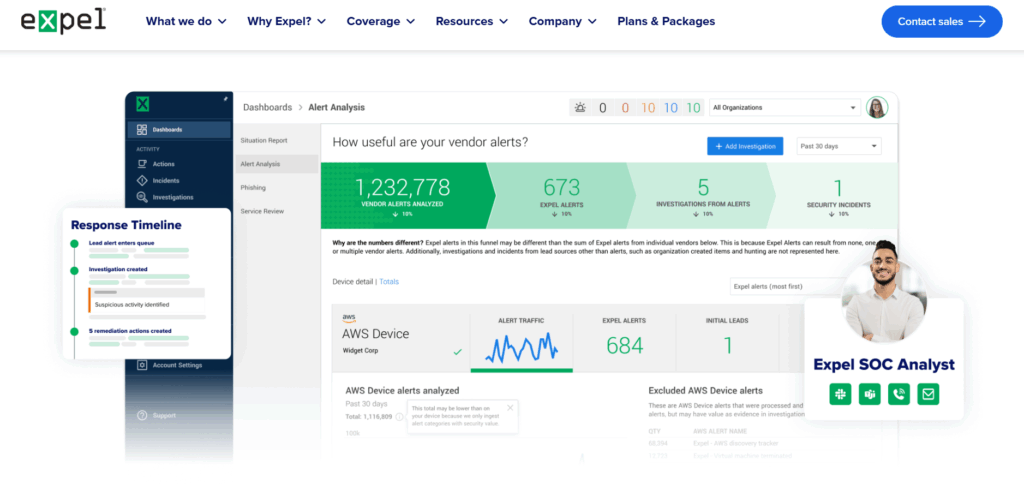
Expel delivers software-driven MDR that works with customers’ existing security tools. The platform is known for its expanded SIEM integrations, including Sumo Logic, CrowdStrike LogScale, and Google SecOps, and a transparent outcomes dashboard that shows exactly what analysts are investigating and why. Expel’s automation capabilities filter and triage alerts before human analysts engage.
🔧 Core Services
- 24/7 MDR with automated alert triage and human analyst investigation
- Broad SIEM integrations (Sumo Logic, CrowdStrike LogScale, Google SecOps)
- Transparent MDR outcomes dashboard
- Cloud, endpoint, and SaaS monitoring
- Low-cost data lake offering for log retention
💡 Why SaaS Companies Consider Expel
Expel’s strength is transparency: customers can see investigation details, analyst notes, and outcome metrics directly in the platform. For tech companies that value visibility into their MDR provider’s work, Expel provides a clear window into detection and response operations.
🎯 Ideal Customer Profile
- Technology companies with 500 to 10,000 employees
- Organizations already invested in cloud-native SIEM platforms
- Teams wanting transparent, software-driven MDR operations
- Enterprise environments needing broad integration support
💰 Commercial Model
Expel’s pricing is typically custom-quoted based on environment scope. While generally positioned at the higher end of the MDR market, its transparent operations model and broad integration support provide clear value for larger organizations.
⏰ When to Shortlist
Include Expel if your organization prioritizes transparency in MDR operations, already runs cloud-native SIEM platforms, and has the internal resources to handle remediation when escalated, since Expel’s model stops at detection and escalation rather than full containment.
💬 Customer Reviews
“Slack integration for notifications and support requests. Support requests are handled very quickly and accurately. However, lack of support for EKS in AWS GovCloud was promised to us before we signed our contract, but later was removed from the roadmap.”
— Verified User in Manufacturing, Enterprise Expel – G2 Verified Review
“The automations for filtering alerts from a variety of different services are excellent. The ability to submit an issue for investigation based on user, device, etc. and quickly see high volumes of information from multiple systems pulled together in one place speeds responsiveness tremendously. However, the onboarding didn’t include an alert type-by-alert type discovery effort.”
— Verified User in Non-Profit Organization Management Expel – G2 Verified Review
6. Rapid7, Best for Organizations Needing Vulnerability Management Paired with SIEM
✅ Overview
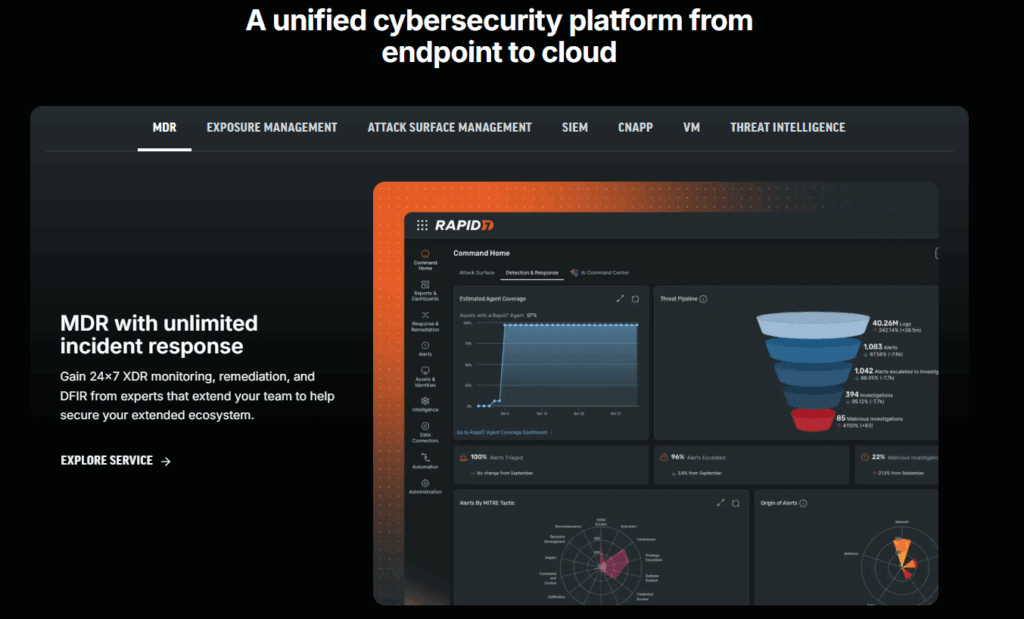
Rapid7 offers a cloud-native SIEM platform (InsightIDR) combined with Managed Detection and Response, vulnerability management (InsightVM), and SOAR automation (InsightConnect). Its Incident Command AI powers behavioral analytics and next-gen SIEM capabilities. Rapid7 is often considered by organizations that want vulnerability assessment and SIEM under one vendor.
🔧 Core Services
- InsightIDR cloud-native SIEM with behavioral analytics
- Managed Detection & Response with Incident Command AI
- InsightVM vulnerability management
- InsightConnect SOAR automation
- Digital forensics and incident response (DFIR)
💡 Why SaaS Companies Consider Rapid7
Rapid7’s CRC Essentials license bundles InsightVM, InsightCloudSec, and InsightConnect into a single package, appealing for small security teams wanting vulnerability management, cloud security, and automation in one license. The platform’s behavioral analytics and SOAR capabilities reduce manual investigation.
🎯 Ideal Customer Profile
- Organizations prioritizing vulnerability management alongside SIEM
- Mid-market to enterprise companies with hybrid cloud/on-prem environments
- Teams wanting integrated SOAR automation
- Security operations centers needing DFIR capabilities
💰 Commercial Model
Rapid7 operates on subscription-based pricing with multiple product tiers. The CRC Essentials bundle provides strong value for smaller teams, though complex pricing and potential overage charges have been noted by reviewers.
⏰ When to Shortlist
Evaluate Rapid7 if vulnerability management is a top priority alongside SIEM, and your organization has the technical capacity to manage a more complex platform with steeper learning curves.
💬 Customer Reviews
“Their CRC Essentials license is absolutely value for money as it includes three of their products. However, it has made our work significantly more. The InsightVM product seems to have missing coverage for some major softwares. I raise more than 3 support tickets each month due to technical issues with the product.”
— Himanshu K., IT Security Operations Engineer Rapid7 – G2 Verified Review
“Rapid7 is a tool that does the job, however lacks in several aspects such as integrations, default rule set and asset association. The support is not awesome, added to their managed services team that looks more like a sales team.”
— Manager, Project Management Rapid7 – Gartner Verified Review
7. NTT Security, Best for Global Enterprises Requiring Hybrid/Cloud Managed SIEM
✅ Overview
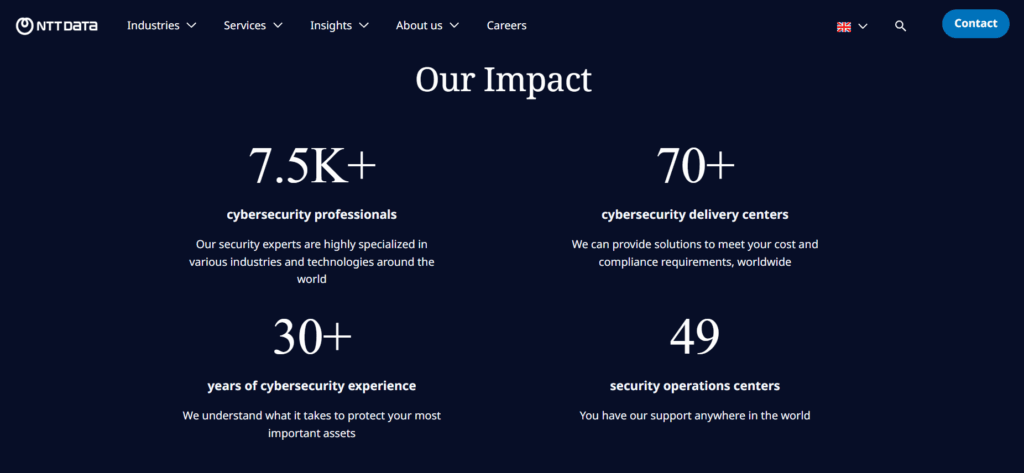
NTT Security (part of NTT Ltd.) is a global IT infrastructure and services company operating 10 Security Operations Centers worldwide. Its Managed Detection and Response service is built on Microsoft Sentinel, combining human and machine expertise with leading technologies and threat intelligence. NTT positions itself as a managed SIEM partner for enterprises needing multi-region, multi-OEM support across LogRhythm, QRadar, Splunk, and Sentinel.
🔧 Core Services
- 24/7 managed security monitoring across 10 global SOCs
- MDR built on Microsoft Sentinel with AI-driven analytics
- Multi-OEM SIEM support (LogRhythm, QRadar, Splunk, Sentinel)
- Standard and advanced monitoring tiers with escalation support
- MDR add-ons for Endpoint and Security Device Management
💡 Why SaaS Companies Consider NTT Security
NTT appeals to global enterprises that need managed security operations across multiple regions with strict data residency requirements. The strategic partnership with Microsoft, including Azure Expert Managed Services Provider status and 8 Specializations, makes NTT a natural fit for Sentinel-native deployments.
🎯 Ideal Customer Profile
- Global enterprises with 1,000+ employees across multiple regions
- Organizations heavily invested in Microsoft Sentinel
- Companies needing multi-OEM SIEM management without building internal expertise
- Regulated industries requiring data residency compliance
💰 Commercial Model
NTT operates on enterprise-level subscription pricing with service tiers and deployment options. Custom quoting is required based on organization scope and global deployment needs.
⏰ When to Shortlist
Include NTT Security if your organization operates globally, requires managed SIEM operations across multiple OEM platforms, and values Microsoft’s ecosystem with the backing of a proven enterprise IT services provider.
💬 Customer Reviews
“NTT’s MDR service combines human and machine expertise with leading technologies and threat intelligence to reduce the mean time to detect and respond to cyber attacks. The cloud-native, analytics-driven offering built on Microsoft Sentinel enables organizations to collect data at scale across all users, devices, apps, and infrastructure.”
— NTT MDR Documentation
“Each service tier offers 24/7 monitoring by our dedicated Security Operations Centers (SOCs). Standard Tier designed for organizations with standardized security compliance requirements across core technologies.”
— NTT Enterprise Security Monitoring Documentation
8. Red Canary, Best for Endpoint-Heavy Environments Wanting MDR with Advanced Analytics
✅ Overview
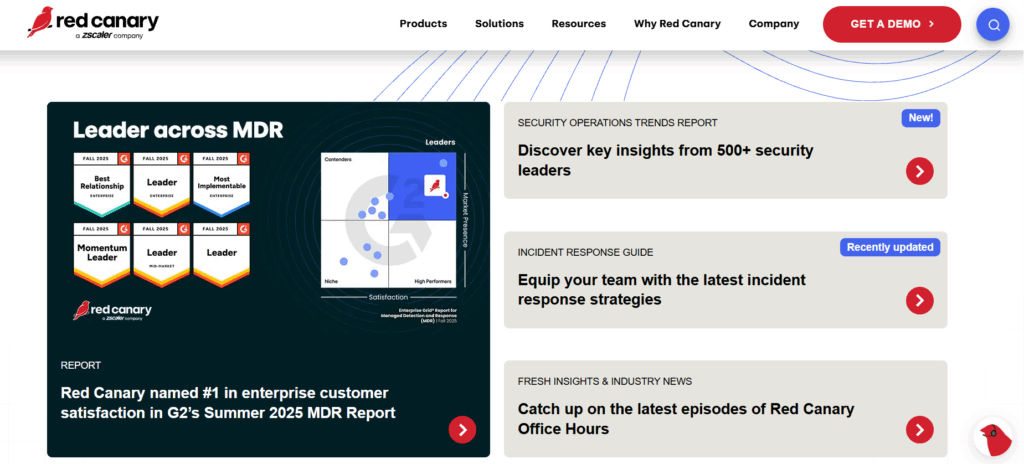
Red Canary delivers an MDR-first approach with advanced analytics, providing 24/7 threat detection and response with broad EDR integration across CrowdStrike, SentinelOne, and Carbon Black. Recently acquired by Zscaler, Red Canary focuses on reducing alert noise while surfacing actionable threats through its managed SOC. The platform is particularly strong for organizations already invested in endpoint detection tools that need a human layer on top.
🔧 Core Services
- 24/7 MDR with advanced analytics and playbook automation
- Broad EDR integration (CrowdStrike, SentinelOne, Carbon Black, Microsoft Defender)
- Cloud security alert monitoring (Azure, AWS)
- Threat hunting with comprehensive threat reports
- Custom automation creation for end users
💡 Why SaaS Companies Consider Red Canary
Red Canary’s strength lies in reducing noise from endpoint detection tools. For organizations already running CrowdStrike or SentinelOne, Red Canary provides the analyst layer that triages and investigates before escalating, saving internal teams from alert fatigue. The IR team and detection engineers are consistently praised for expertise.
🎯 Ideal Customer Profile
- Enterprise organizations (1,000+ employees) heavily using Microsoft or CrowdStrike stacks
- Companies needing a 24/7 SOC analyst layer on top of existing EDR
- Teams wanting endpoint-focused MDR with cloud coverage expansion
- Organizations where Palo Alto Networks is part of the security architecture
💰 Commercial Model
Red Canary’s pricing is custom-quoted based on protected endpoints and environment scope. Engagements include onboarding support, continuous monitoring, and detection engineering.
⏰ When to Shortlist
Include Red Canary if your security architecture is endpoint-heavy (CrowdStrike, SentinelOne, Microsoft Defender) and you need a managed SOC layer that reduces noise and provides 24/7 coverage. Note that SIEM integration (e.g., Splunk) may require custom API scripts.
💬 Customer Reviews
“The IR team and detection engineers here are truly outstanding, and it’s always a pleasure to collaborate with them. The implementation was very easy. However, during several external penetration tests, Red Canary was not able to identify the malicious activity while the tests were ongoing. Also, they do not have any sort of alert ingestion integrations with Splunk.”
— Verified User in Insurance, Enterprise Red Canary – G2 Verified Review
“The Threat Hunting Team is excellent. They responded quickly and provided good information and insight. However, there have been several instances where we expected RC to identify an issue and no alert was surfaced. On the account rep side, there is a lack of training, such that when asked for clarification, those requests are either insufficiently responded to or outright ignored.”
— Mike S., Information Security Manager, VP Red Canary – G2 Verified Review
9. Deepwatch, Best for Splunk-Native Organizations Needing Managed SOC Operations
✅ Overview
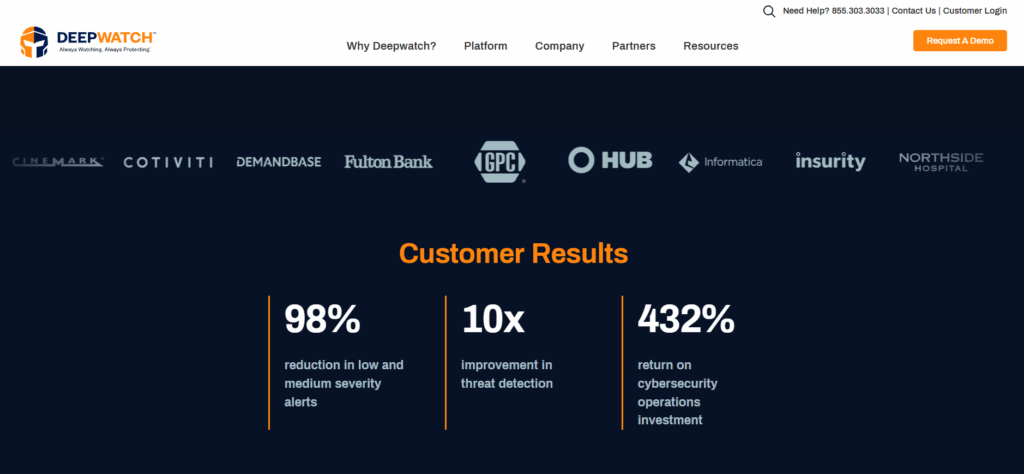
Deepwatch is a managed security services provider with deep expertise in Splunk-based environments. Approximately 95% of its pipeline originates from Splunk partnerships through GuidePoint Security and incident response panels with insurance providers. For SaaS companies already running Splunk as their primary SIEM, Deepwatch offers managed SOC operations that leverage existing deployments rather than requiring migration.
🔧 Core Services
- 24/7 managed SOC operations built around Splunk
- Incident response through insurance panel partnerships
- Threat detection and monitoring for cloud and on-prem environments
- Compliance reporting (SOC 2, HIPAA, PCI DSS, NIST)
- Guided remediation and security advisory
💡 Why SaaS Companies Consider Deepwatch
For organizations already heavily invested in Splunk, Deepwatch provides managed operations without requiring a SIEM migration. The insurance-panel incident response capability is a differentiator for companies where cyber insurance requirements drive security purchasing decisions.
🎯 Ideal Customer Profile
- Splunk-native organizations with 500+ employees
- Companies where cyber insurance requirements drive security operations
- Mid-market to enterprise teams needing managed SOC on existing SIEM
- Organizations purchasing through GuidePoint or similar TSD channels
💰 Commercial Model
Deepwatch operates on subscription-based pricing typically tied to Splunk licensing and ingestion volume. Because of the Splunk dependency, total cost of ownership can be higher than alternatives. Pricing requires custom quoting.
⏰ When to Shortlist
Include Deepwatch if Splunk is your existing SIEM platform, you want managed SOC operations layered on top without migration, and you value incident response capabilities tied to cyber insurance panels. Be aware that the Splunk dependency makes it expensive and limits architectural flexibility.
💬 Customer Reviews
⚠️ Note: Deepwatch has limited publicly verified G2/Gartner reviews available at time of evaluation. Prospective buyers should request customer references directly during the RFP process.
“Deepwatch’s 95% pipeline dependency on Splunk deals through GuidePoint means the solution is tightly coupled to the Splunk ecosystem. For organizations committed to Splunk, this is a strength. For those seeking flexibility, this architecture can be limiting and expensive.”
— UnderDefense Competitive Analysis Documentation
⚡ How UnderDefense Simplifies the Evaluation
UnderDefense eliminates the build-vs-buy paralysis by providing transparent SLAs (2-minute alert-to-triage and 15-minute escalation for critical incidents), documented proof points (2 days faster detection than CrowdStrike OverWatch), and 96% MITRE ATT&CK coverage, with a 30-day onboarding that lets you validate these claims firsthand. Unlike providers that require proprietary stack replacement or opaque enterprise quotes, UnderDefense integrates with your existing 250+ tools at a published $11 to $15/endpoint/month, so you can compare the real cost of managed SIEM operations before committing.
Q2: How Were These Managed SIEM Providers Evaluated and Ranked?
Transparency in methodology matters, especially when you’re a CISO or CTO about to commit six figures to a security partner. Every provider in this guide was scored across five weighted criteria totaling 100%, designed to reflect the operational realities of SaaS companies running multi-cloud workloads.
📊 Five Evaluation Criteria
| Criterion | Weight | What It Measures |
|---|---|---|
| Cloud-Native Architecture & Multi-Cloud Support | 25% | AWS/Azure/GCP depth, SaaS delivery model, API-first design, elastic log scaling |
| Detection Accuracy & Active Response | 25% | AI triage quality, false-positive reduction, active remediation vs. alert-only escalation, MITRE ATT&CK coverage |
| Setup Speed & Usability | 20% | Onboarding time, portal UX, time-to-value, self-service capabilities |
| Compliance & Reporting Automation | 15% | SOC 2/HIPAA/PCI DSS/ISO 27001 automated evidence generation, audit-readiness |
| Pricing Transparency | 15% | Published pricing, predictable models, absence of hidden fees |
⭐ Star Rating Scale and Results
Scores map to star ratings as follows: 81 to 100 = ★★★★★, 61 to 80 = ★★★★, 41 to 60 = ★★★, 21 to 40 = ★★, 0 to 20 = ★.
| Provider | Score | Rating | Top Strength | Weakest Area |
|---|---|---|---|---|
| UnderDefense | 93/100 | ★★★★★ | Vendor-agnostic integration + concierge response | N/A |
| Expel | 79/100 | ★★★★ | Transparent MDR operations dashboard | Pricing transparency, no compliance bundling |
| Taegis | 78/100 | ★★★★ | CTU threat intelligence + Taegis XDR | Onboarding complexity |
| Arctic Wolf | 75/100 | ★★★★ | Concierge Security Team model | Proprietary lock-in, opaque pricing |
| Rapid7 | 74/100 | ★★★★ | Vulnerability management + SIEM pairing | Support quality, platform complexity |
| Red Canary | 72/100 | ★★★★ | EDR integration breadth | Limited SIEM integrations, endpoint-focused |
| Alert Logic | 68/100 | ★★★★ | Accessible SMB pricing with bundled SIEM | Outdated UI, limited integrations |
| Deepwatch | 62/100 | ★★★★ | Deep Splunk expertise | Expensive Splunk dependency, limited flexibility |
| NTT Security | 58/100 | ★★★ | Global SOC footprint (10 SOCs) | Legacy OEM-dependent model, less SaaS-optimized |
✅ Why UnderDefense Leads
UnderDefense scored highest because it checked every box that matters for SaaS companies: vendor-agnostic integration across 250+ tools without forcing replacement, detection paired with active concierge response (not monitoring-only), published pricing at $11 to $15/endpoint/month, the fastest cloud SIEM deployment (operational in days via 30-day turnkey onboarding), and automated compliance report generation covering SOC 2, HIPAA, and ISO 27001 bundled at no extra cost.
⚠️ Why NTT Security Scores Lowest
NTT Security scored lowest primarily due to its legacy OEM-dependent architecture requiring multi-vendor SIEM management (LogRhythm, QRadar, Splunk), enterprise-only pricing with no published rates, and a service model less optimized for cloud-native SaaS environments with ephemeral workloads. For global enterprises with established on-prem footprints, NTT remains viable. However, for SaaS companies needing speed and flexibility, the fit is limited.
Q3: What Is Managed SIEM and Why Do Cloud-Native SaaS Companies Need It? [toc=Why SaaS Needs Managed SIEM]
🔍 The Fragmented Security Reality for SaaS
SaaS companies operate ephemeral cloud workloads across AWS, Azure, and GCP, generate massive log volumes from CI/CD pipelines, and typically manage 40 to 70 security tools. The result: alerts are everywhere, but understanding is nowhere. Managed SIEM is a fully outsourced service where a third-party provider deploys, configures, tunes, and monitors a SIEM 24/7 on behalf of the customer, eliminating the need for 3 to 6 dedicated SIEM engineers that most mid-market teams simply cannot recruit or retain.
❌ Why Self-Managed and On-Prem SIEM Fail SaaS
Traditional SIEM platforms like on-prem Splunk or QRadar require dedicated hardware, 6 to 12 months to mature detection rules, and capacity planning that conflicts with elastic cloud workloads. Even cloud-hosted legacy SIEM creates alert fatigue without operational support; you’re still the one waking up at 2 AM. Legacy MSSPs add monitoring but without intelligence: checkbox coverage based on rigid playbooks rather than real-time threat context. As one former CISO put it during a recent discussion on building vs. buying SOC capabilities: “I just can’t automate everything. I can’t get to a fully lights-out automated security stack because we always run into situations that need human analysis.”
⏰ Cloud-Native Managed SIEM as the New Standard
Cloud-native SIEM is delivered as SaaS, auto-scaling, API-first, with native integrations for AWS CloudTrail, Azure Monitor, and GCP Audit Logs. The modern SIEM market is projected to reach $13.55 billion by 2029, with cloud SIEM revenue growing at a 17.5% CAGR versus just 3.4% for on-premise solutions. The critical architectural shift: detection without response is noise, and response without context is risk. The AI SOC + Human Ally model combines automated ML-driven detection with concierge human response, closing the gap between what tools flag and what actually needs action.
💸 The Talent Gap Driving Adoption
The global cybersecurity workforce gap reached approximately 4.8 million unfilled roles, with the workforce needing to increase by 87% to satisfy current demand. For SaaS companies selling to enterprise buyers, managed SIEM is not a convenience but a strategic necessity for continuous compliance evidence (SOC 2 Type II) and investor-grade security posture. Startups often face their first compliance pressure as early as year two, when enterprise customers ask “show me your ISO 27001” and there’s nobody internally to deliver it.
✅ How UnderDefense Simplifies This
UnderDefense eliminates the build-vs-buy paralysis by providing vendor-agnostic integration that preserves existing tool investments, AI-assisted triage that reduces alert volume by 99%, and concierge analysts who detect AND respond instantly, isolating endpoints, revoking credentials, and containing breaches without waiting for customer approval. The 30-day turnkey onboarding gets SaaS companies from zero to operational managed SIEM in days, not months.
Q4: What SaaS-Specific Threats Does Managed SIEM Detect Across Multi-Cloud Environments?
SaaS companies face a unique threat surface that generic SIEM detection rules miss entirely. Multi-cloud environments spanning AWS, Azure, and GCP create blind spots when monitored in silos. Managed SIEM normalizes and correlates logs from AWS CloudTrail, Azure Activity Logs, and GCP Audit Logs into unified cross-cloud detection rules. However, the real differentiator is detecting SaaS-specific attack patterns that legacy SIEM was never designed for.
🎯 SaaS Threat Model Mapped to SIEM Detection
- CI/CD Pipeline Compromise: Unauthorized code pushes, secrets exposure in build logs, IaC drift detection across Terraform/CloudFormation. CI/CD pipelines routinely miss 40 to 60% of API endpoints, leaving critical blind spots that become high-probability breach points. Log source: AWS CodePipeline, GitHub Audit Logs, Azure DevOps.
- API Key Exposure & Abuse: Anomalous API call patterns, leaked credentials in public repos, OAuth token abuse. In 2025, attacks on API hosts ran 72% higher than on traditional websites, while API vulnerability exploitation grew 13x. Log source: AWS CloudTrail API events, Azure API Management, GCP API Gateway.
- Identity Sprawl & Privilege Escalation: Cross-cloud IAM anomalies, dormant admin accounts, impossible travel detections across Azure AD/AWS IAM/GCP IAM. Log source: Okta System Logs, Azure AD Sign-In Logs, AWS IAM Access Analyzer.
- Supply-Chain & Third-Party SaaS Risks: Unauthorized OAuth app grants, suspicious SaaS-to-SaaS integrations, data exfiltration via sanctioned apps. The Salesloft/Drift breach in August 2025 demonstrated how compromised OAuth tokens from a single vendor impacted 700+ organizations’ Salesforce environments. Log source: Microsoft 365 Audit Logs, Google Workspace Admin Logs, Salesforce Event Monitoring.
- Container & Kubernetes Runtime Threats: Cryptomining, container escape attempts, anomalous pod behavior. A Sysdig report found that 75% of container attacks go undetected because organizations lack runtime monitoring. Log source: AWS EKS Audit Logs, Azure AKS Diagnostics, GCP GKE Logs.
🛡️ UnderDefense Detection Advantage
UnderDefense’s AI SOC reduces thousands of daily alerts to actionable incidents through ML-driven behavioral baselining, auto-classification, and false-positive suppression, cutting human triage workload by up to 80%. Concierge analysts verify suspicious activity directly with affected users via Slack and Teams before escalating, catching sophisticated lateral movement and privilege abuse that rule-based SIEM misses. Documented outcomes: 2-minute alert-to-triage and 15-minute escalation for critical incidents, 96% MITRE ATT&CK coverage, and 2-day faster detection than CrowdStrike OverWatch.
Q5: Should Your SaaS Company Build, Buy, or Outsource SIEM, and What Will It Cost?
Every SaaS company eventually faces this question, and the wrong answer locks you into years of misaligned spend. The three paths look straightforward on paper: build an in-house SOC with a self-managed SIEM, buy a cloud-native SIEM and self-operate it, or outsource to a managed SIEM provider. However, the real cost goes far beyond licensing fees. Here’s a framework for making that decision based on operational reality, not vendor marketing.
⚠️ The Cost Reality Most Teams Miss
- Build (in-house SOC + self-managed SIEM): 6 to 12 month buildout, $500K to $1.2M/year for 3 to 5 analysts plus licensing. You own everything, but you also own every on-call rotation, every tuning cycle, and every false positive at 2 AM.
- Buy (cloud-native SIEM, self-operate): Splunk Cloud, Microsoft Sentinel, or Elastic, $150K to $400K/year in licensing plus 2 to 3 FTEs for ongoing tuning, rule writing, and incident triage. The platform is modern, but someone still has to drive it.
- Outsource (managed SIEM provider): $5K to $25K/month fully managed, with 24/7 monitoring, detection engineering, and incident escalation included. You trade some control for operational speed.
❌ The Wrong Way to Decide
Most SaaS companies choose based on brand familiarity (“Microsoft Sentinel because we’re Azure-native”) or cheapest licensing, completely ignoring operational costs, response capability gaps, and compliance overhead. The real question isn’t “which SIEM has the best dashboard?” but “can this approach scale with our cloud growth AND satisfy SOC 2/HIPAA auditors without dedicated GRC headcount?”
✅ Decision by SaaS Maturity Stage
| Maturity Stage | Team Size | Recommended Path | Cost Range | Why |
|---|---|---|---|---|
| Early-Stage (pre-SOC 2, 10 to 50 employees) | 0 to 1 security | Outsource managed SIEM | $3K to $8K/month | Rapid deployment, compliance-ready from day one, no hiring required |
| Growth-Stage (SOC 2 certified, multi-cloud, 50 to 500 employees) | 1 to 3 security | Outsource with vendor-agnostic provider | $8K to $20K/month | Multi-cloud visibility, elastic scaling, retain your existing stack |
| Enterprise SaaS (multi-framework, 500+ employees) | 3 to 10+ security | Outsource AI-driven SOC + proactive threat hunting | $20K to $50K+/month | Concierge response, continuous compliance evidence, MITRE ATT&CK coverage |
As one CISO shared in a recent conversation we hosted, the decision often comes down to “I need to do something, it’s probably irresponsible if I’m not monitoring 24/7. So my options are fully in-house, hybrid, or outsourced, and each comes with a dollar exchange.”
💰 Compliance Acceleration Through Managed SIEM
SOC 2 Type II alone requires continuous monitoring evidence, 90+ day log retention, access audit trails, and documented incident response. HIPAA adds PHI access monitoring. PCI DSS adds cardholder data environment logging. Doing this manually takes most teams 3 months of audit prep. With automated compliance dashboards, managed SIEM can compress that to 3 weeks.
| Compliance Framework | Required SIEM Capability | UnderDefense Coverage |
|---|---|---|
| SOC 2 Type II | Continuous monitoring, 90+ day retention, access audit trails, incident documentation | ✅ Included, forever-free compliance kits, automated evidence collection |
| HIPAA | PHI access monitoring, breach notification logging | ✅ Included, identity-aware detection, audit-ready reporting |
| PCI DSS | Cardholder data environment logging, daily log review | ✅ Included, 24/7 SOC monitoring with compliance dashboards |
| ISO 27001 | Risk-based monitoring, continuous control validation | ✅ Included, UnderDefense MAXI Compliance maps controls to real telemetry |
Where UnderDefense Stands
| Decision Criterion | Score | Why |
|---|---|---|
| Vendor-agnostic integration | ✅ 2/2 | 250+ integrations, works with your existing stack |
| Active response capability | ✅ 2/2 | Full containment + remediation, 2-minute alert-to-triage and 15-minute escalation for critical incidents |
| Transparent pricing | ✅ 2/2 | Published $11 to $15/endpoint/month |
| Compliance automation | ✅ 2/2 | Forever-free compliance kits + automated evidence |
| 30-day onboarding | ✅ 2/2 | Turnkey deployment with custom detection tuning |
| User verification (ChatOps) | ✅ 2/2 | Direct communication via Slack/Teams/Email |
| 24/7 analyst access | ✅ 2/2 | Tier 3 to 4 concierge analysts, 15-min critical escalation |
| Total | 14/14 |
The real question isn’t which SIEM has the most integrations but which provider can detect, verify, and contain threats the way a dedicated security team would, while keeping you continuously audit-ready.
Q6: How Does Managed SIEM Compare to MDR, MSSP, and SOCaaS for SaaS Companies?
Managed SIEM, MDR, MSSP, and SOCaaS solve overlapping but distinct problems. For SaaS companies, the critical distinction is whether the provider manages your SIEM infrastructure AND responds to threats, only monitors and alerts, or provides detection and response across your full stack regardless of SIEM.
⏰ Quick Differentiators
- Managed SIEM: Outsourced SIEM operation + log management + correlation rules + 24/7 monitoring. Infrastructure-focused, someone runs your SIEM for you, but response may or may not be included.
- MDR (Managed Detection & Response): Detection + active response across endpoints, cloud, identity, and network. Outcome-focused, the provider owns the detection-to-containment workflow.
- MSSP (Managed Security Service Provider): Monitoring + alerting against SLAs without active response. Compliance-focused, you get dashboards and ticket escalations, but your team still investigates.
- SOCaaS (SOC as a Service): Fully outsourced SOC team including SIEM + response + threat hunting. Comprehensive, but quality and depth vary dramatically by provider.
✅ Which Model Fits SaaS Companies?
For SaaS companies running multi-cloud with lean teams, the ideal model combines managed SIEM operational excellence with MDR-grade active response, which is exactly what the AI SOC + Human Ally approach delivers. We manage your SIEM while our concierge analysts detect, verify with affected users, and contain threats that traditional managed SIEM and legacy MSSPs cannot match.
The right model depends on your current security maturity, tool investments, and whether you need someone to manage your SIEM, respond to your threats, or both. UnderDefense uniquely spans both, managing your SIEM while providing concierge analyst response.
This analysis is based on operational outcomes across 500+ managed security deployments and documented case studies including 2-minute alert-to-triage, 15-minute escalation for critical incidents, and 2-day faster detection than CrowdStrike OverWatch.
Q7: Managed SIEM for SaaS, Frequently Asked Questions [toc=Managed SIEM FAQ]
How much does managed SIEM cost for a SaaS company?
Pricing varies by tier. SMB SaaS companies (under 100 employees) typically pay $3K to $8K/month. Mid-market SaaS ($8K to $20K/month) and enterprise SaaS ($20K to $50K+/month) scale based on log volume, endpoints, and compliance requirements. UnderDefense offers transparent pricing at $11 to $15/endpoint/month, no hidden fees, no “contact sales” barriers.
How long does managed SIEM take to deploy?
Top providers deploy in 2 to 4 weeks. UnderDefense’s cloud SIEM is operational in days, with custom correlation rules and MITRE ATT&CK mapping from day one. We invest a full 30 days for high-quality onboarding, building customized detection to deliver only confirmed, validated offenses, cutting 99% of noise.
Can managed SIEM help my SaaS company pass SOC 2 Type II?
Yes. SOC 2 Type II requires continuous monitoring evidence, log retention (90+ days), access audit trails, and incident documentation. Managed SIEM automates evidence collection across all of these. UnderDefense MAXI Compliance platform goes further, mapping real security telemetry to compliance controls and providing auditors with verifiable evidence, not theoretical policies.
What’s the difference between managed SIEM and running my own Splunk/Sentinel?
Self-managed SIEM requires 2 to 3 dedicated engineers for ongoing tuning, rule writing, and monitoring, plus the overhead of hiring, training, and retaining niche security talent. Managed SIEM outsources the entire operational burden while delivering expert-level detection from day one. As one experienced CISO put it: “When I switch vendors, I get to start all over on the tuning process. I want to control where my data lives and ask my MDR partner to log in to my system.”
Will managed SIEM lock me into a specific vendor’s tools?
It depends entirely on the provider. Vendor-locked providers (like Arctic Wolf) require you to replace your existing SIEM with their proprietary technology, and when you leave, your business logic, correlation rules, and automation don’t come with you. Vendor-agnostic providers like UnderDefense integrate with your existing stack (Splunk, Elastic, Sentinel, and 250+ tools), preserving your security investments and ensuring you always own your data.
Does managed SIEM work across AWS, Azure, and GCP simultaneously?
Leading providers normalize and correlate telemetry from all three clouds. The key question to ask during evaluation: does the provider offer native API integration depth for each cloud platform, or generic syslog ingestion that misses cloud-specific context? UnderDefense provides detection and response tailored to AWS, Azure, GCP, and Kubernetes environments with full multi-cloud visibility from a single pane of glass.
Is managed SIEM the same as MDR?
No, they solve related but different problems. Managed SIEM focuses on running your SIEM infrastructure (log management, correlation, monitoring). MDR focuses on detection and active response across your full security stack. For a complete breakdown, see Q6 above or read the full Managed SIEM vs MDR vs MSSP comparison guide.
1. What is managed SIEM, and why do SaaS companies need it?
Managed SIEM is a fully outsourced security information and event management service where a dedicated provider handles log collection, correlation, threat detection, and incident alerting on your behalf — 24/7.
For SaaS companies, we see three forces making managed SIEM essential rather than optional:
-
Multi-cloud complexity. Most SaaS teams run workloads across AWS, Azure, and GCP simultaneously. Each cloud generates distinct log formats, API structures, and telemetry streams. A managed SIEM provider normalizes all of this into a single detection layer.
-
Compliance pressure. Enterprise buyers increasingly require SOC 2, HIPAA, or ISO 27001 attestation before signing contracts. Managed SIEM provides the continuous log monitoring and audit trail that these frameworks demand.
-
Talent scarcity. Building an internal SOC capable of tuning SIEM rules, writing custom detections, and triaging alerts around the clock requires 5–8 specialized analysts — a $750K+ annual commitment most SaaS companies cannot justify.
We built our managed SIEM service specifically for teams facing this exact combination: growing cloud footprint, aggressive compliance timelines, and limited security headcount.
The result is enterprise-grade visibility without the operational burden of managing SIEM infrastructure yourself.
2. How do we evaluate managed SIEM providers for cloud-native SaaS environments?
We recommend a five-criteria evaluation framework specifically calibrated for SaaS security operations:
-
Multi-cloud ingestion. Can the provider natively collect logs from AWS CloudTrail, Azure Activity Logs, and GCP Cloud Audit Logs without requiring custom connectors or middleware? If you need separate integrations for each cloud, that is a red flag.
-
Detection-as-code support. Forward-looking SaaS teams treat detection rules like software — versioned, tested, and deployed through CI/CD. Providers offering only GUI-based rule builders limit your team’s ability to scale.
-
Vendor-agnostic architecture. Your SIEM provider should work with your existing EDR, identity, and SaaS tools — not force you to replace them. We integrate with 250+ existing tools because we believe your security investments should be preserved, not abandoned.
-
Response capability. Does the provider only detect and notify, or can they contain and remediate? Detection without response is just expensive alerting.
-
Compliance evidence automation. The provider should generate audit-ready artifacts for SOC 2, ISO 27001, and HIPAA automatically — not as a separate add-on.
Use our SIEM Buyer’s Guide to score each provider against these criteria before committing.
3. What is the difference between managed SIEM, MDR, and MSSP for SaaS companies?
These three service models overlap but serve fundamentally different purposes. Understanding the distinction prevents you from buying the wrong layer of protection:
-
Managed SIEM focuses on log aggregation, correlation, and detection across your entire environment — cloud, network, identity, SaaS applications. The output is structured visibility and compliance-ready monitoring.
-
MDR (Managed Detection and Response) goes further by adding 24/7 human-led threat hunting, investigation, and active response — including containment and remediation. MDR providers don’t just tell you about threats; they stop them.
-
MSSP (Managed Security Service Provider) typically offers monitoring and alerting based on predefined playbooks, but investigation and response are returned to your team.
For most SaaS companies, the ideal solution combines managed SIEM visibility with MDR-level response. That is exactly why we built the MAXI platform — to unify SIEM log intelligence with 24/7 analyst-driven response in a single engagement, eliminating the gap between “we detected something” and “we stopped it.”
You can explore this comparison in depth in our article on MDR vs. SOC as a Service.
4. How much does managed SIEM cost for a SaaS company?
Managed SIEM pricing varies based on three primary factors: daily log ingestion volume (GB/day), number of data sources, and the level of analyst support included.
Here are the typical ranges we see across the market:
-
Basic managed SIEM (log collection + alerting only): $3,000–$8,000/month
-
Mid-tier managed SIEM (correlation + custom detection rules + compliance reporting): $8,000–$15,000/month
-
Full managed SIEM + response (24/7 analyst coverage + threat hunting + incident containment): $11–$15/endpoint/month
The hidden cost trap we see most often is ingestion-based pricing. Providers like Splunk charge per GB ingested, meaning your costs scale unpredictably as your SaaS platform grows and generates more logs. We publish transparent managed SIEM pricing specifically to eliminate this uncertainty.
For a full cost breakdown and comparison across vendors, our Managed SIEM Pricing Guide provides the detailed benchmarks security leaders need to build an accurate budget.
5. Can managed SIEM providers monitor AWS, Azure, and GCP simultaneously?
Yes — but not all providers do it equally well. True multi-cloud SIEM monitoring requires native API-level integration with each cloud platform’s logging and telemetry services, not just generic syslog collection.
Here is what we look for (and what we deliver) in multi-cloud managed SIEM:
-
AWS: Native CloudTrail, GuardDuty, VPC Flow Logs, and Security Hub integration
-
Azure: Activity Logs, Azure AD sign-in telemetry, Defender for Cloud alerts, and Sentinel workspace connectivity
-
GCP: Cloud Audit Logs, Security Command Center findings, and VPC flow telemetry
The critical architectural requirement is normalization — the ability to correlate a suspicious identity event in Azure AD with lateral movement detected in AWS CloudTrail and data exfiltration signals in GCP Storage logs. Without cross-cloud correlation, you have three separate dashboards, not unified visibility.
We provide dedicated AWS security monitoring, Azure security monitoring, and GCP monitoring — all unified through a single MAXI detection layer.
6. Should we build an in-house SIEM, buy a SIEM tool, or outsource to a managed SIEM provider?
This is the most consequential decision in SaaS security operations, and we see most companies get it wrong by underestimating the operational cost of self-managed SIEM.
Here is the honest comparison:
-
Build in-house: Full control, full burden. Requires SIEM licensing ($50K–$250K+/year), 5–8 dedicated analysts ($750K+ annually), and ongoing detection engineering. Best for companies with 1,000+ employees and a mature security program.
-
Buy SIEM tool, manage yourself: Lower licensing cost ($20K–$100K/year) but the same staffing challenge. Your team writes detection rules, tunes alerts, and responds to incidents — usually alongside their other responsibilities. This leads to alert fatigue and coverage gaps.
-
Outsource to managed SIEM: Turnkey visibility, compliance evidence, and 24/7 monitoring from day one. You retain ownership of your data and your existing security stack. Best for SaaS companies with 50–1,000 employees.
For most SaaS companies in growth mode, outsourcing delivers the strongest ROI. We documented an 830% return on investment over 3 years across our managed security clients — because the math on hiring, tooling, and operational overhead simply does not compete.
Learn more about the cost dynamics in our SOC cost calculator.
7. How does managed SIEM help SaaS companies achieve SOC 2 and ISO 27001 compliance?
Compliance frameworks like SOC 2 Type II and ISO 27001 share a common requirement: continuous monitoring and evidence of security event detection, investigation, and response. Managed SIEM addresses this across three compliance dimensions:
-
Continuous log monitoring. SOC 2 Trust Service Criteria CC7.2 and CC7.3 require organizations to detect and respond to security events. Managed SIEM provides the 24/7 log collection and alerting that auditors verify during assessments.
-
Audit trail integrity. ISO 27001 Annex A.12.4 mandates event logging and monitoring. Managed SIEM preserves immutable audit trails with timestamped evidence of every detected event, investigation step, and response action.
-
Automated evidence collection. Instead of scrambling before audits, managed SIEM generates compliance artifacts continuously — reducing audit preparation from weeks to hours.
We built forever-free compliance kits into our managed SIEM offering because we believe compliance should be a byproduct of good security operations, not a separate expense.
For a deeper walkthrough of compliance controls, our Guide to 2025 Compliance and 24/7 Log Monitoring maps specific SIEM capabilities to framework requirements.
8. What SaaS-specific threats does managed SIEM detect that endpoint tools miss?
Endpoint detection (EDR) monitors device-level behavior — process execution, file changes, registry modifications. It is essential, but it misses entire threat categories that SaaS companies face:
-
Identity-based attacks. Credential stuffing, session hijacking, and OAuth token abuse occur at the identity layer (Okta, Azure AD, Google Workspace), not on endpoints. Managed SIEM correlates identity logs with behavioral baselines to detect compromised accounts.
-
Cloud infrastructure manipulation. Attackers modifying IAM policies, creating rogue Lambda functions, or disabling CloudTrail logging in AWS operate entirely outside EDR’s visibility. SIEM detection on cloud API logs catches these configuration-level attacks.
-
SaaS application abuse. Unauthorized data exports from Salesforce, privilege escalation in Slack admin consoles, or shadow IT tool adoption are invisible to endpoint agents.
-
Lateral movement across clouds. An attacker pivoting from a compromised Azure AD account to AWS resources through federated identity trust — only cross-cloud SIEM correlation detects the full kill chain.
We have published a detailed breakdown of cloud security architecture for SaaS environments that maps these threat categories to specific detection strategies.
Understanding why SIEM alone isn’t enough — and why pairing SIEM with human-led response is critical — is what separates security theater from actual protection.