




Q1. Why is SOAR a Half-Measure in 2026, and What Replaces It?
A traditional SOAR (Security Orchestration, Automation, and Response) program in 2026 is a maintenance treadmill. Brittle Python playbooks, integration debt, and rule sprawl that nobody trusts. Agentic AI orchestration replaces it with reasoning agents that pull logs, correlate evidence, and draft containment in seconds. Humans still own Tier-3 and Tier-4 validation. The benchmark moved from a 30-minute manual workflow to a 2-minute Alert-to-Triage SLA, and most SOAR programs cannot get there without a rebuild.
See how the UnderDefense Agentic AI SOC investigates, triages, and resolves real alerts.
The four-year tuning treadmill nobody talks about
A prospect told me last quarter that his team had been whitelisting EDR (Endpoint Detection and Response) noise for four years straight. Four years. They never finished. Every new sensor added more rules, every rule added more exceptions, and the playbooks they wrote in 2022 broke every time a vendor pushed a schema change. That is the hidden tax of legacy SOAR and SOC automation.
Most SOAR adoption stalls at “we automated five playbooks.” A 2024 SANS SOC Survey found that under 25% of SOCs report mature SOAR adoption, and analyst burnout remained the top operational pain. The tools collected telemetry and parsed data, but they never let the infosec community treat detection logic as code, version-controlled, and shipped through CI/CD pipelines.
SOAR was orchestration without intelligence
Here is the contrarian read. SOAR was a half-measure from day one. It automated the click, not the thought. When a Tier-1 analyst ran a phishing playbook, SOAR pulled the email headers, queried VirusTotal, and pasted the output. The analyst still had to decide. The playbook never asked the user, “Did you actually click this link?” It never reasoned across SIEM (Security Information and Event Management), EDR, and identity logs in one pass.
Static playbooks cannot keep up with cloud sprawl, multi-tool stacks, or attacker pace. The fix is not “better SOAR.” The fix is a different category, closer to a modern MDR approach with reasoning agents at the core.
The 2-minute SLA is the new floor
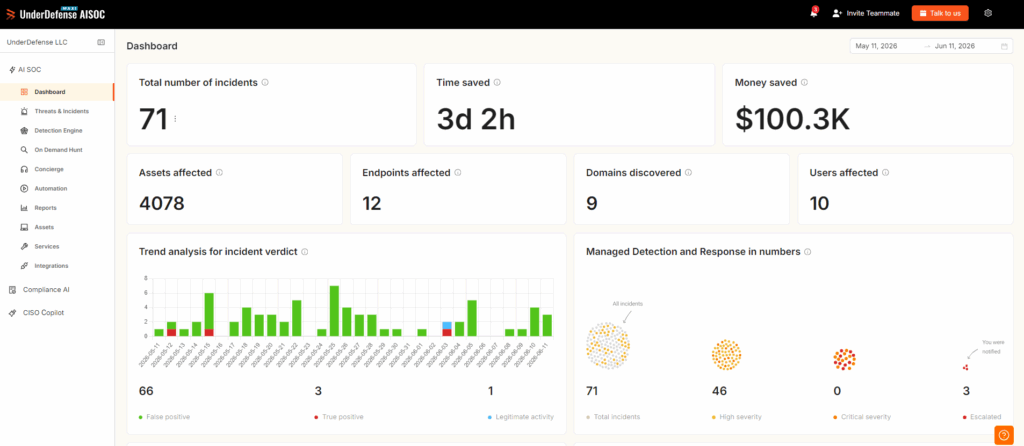
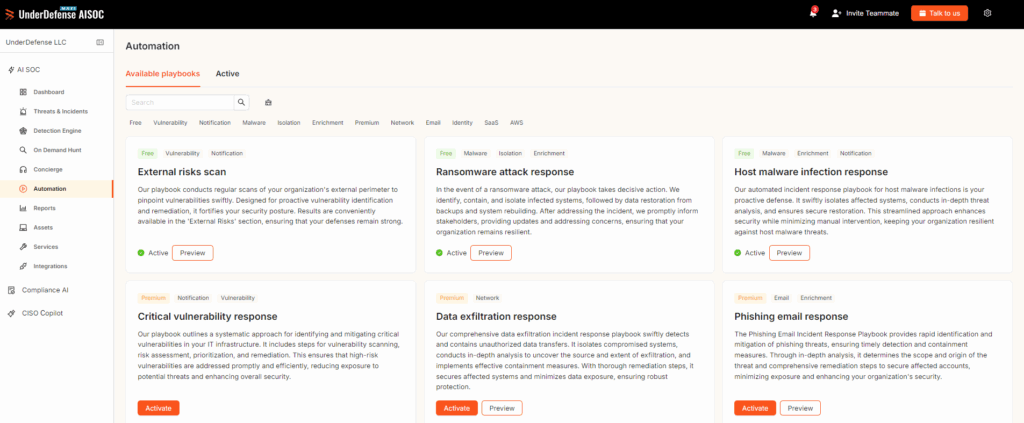
In our experience running UnderDefense Agentic AI SOC across customer environments, the operational standard has moved. We measure Alert-to-Triage in seconds, not minutes, and we publish a 2-minute Alert-to-Triage SLA backed by synthetic transactions on every data source, with a 15-minute escalation SLA for critical incidents. Agentic orchestration handles the investigation grunt work, queries the SIEM, pulls the logs, correlates across systems, and hands a structured finding to a senior analyst. The human still validates. The robot just stops wasting their time.
If you are still buying SOAR as a 2026 line item, you are buying the previous decade’s solution to a problem that has already changed shape. The MDR buyers guide walks through the replacement path in detail.
Q2. What Exactly is AI Security Orchestration (and How Does It Differ from Automation)?
AI Security Orchestration is the autonomous coordination of detection, investigation, and response across your SIEM, EDR, identity, and cloud stack, driven by reasoning agents instead of static scripts. Automation runs one task. Orchestration sequences many tasks contextually, pulling logs, enriching IOCs (Indicators of Compromise), validating with the affected user via ChatOps, and triggering containment, all under human-in-the-loop governance and a measurable MITRE ATT&CK coverage map.
Automation is a hammer. Orchestration is a workflow with judgment.
Automation says, “When X happens, run Y.” A firewall rule. A password reset script. A SOAR playbook that disables an account. One input, one output, no thinking.
AI Security Orchestration is different. The agent perceives the alert, reasons about what to ask next, picks tools, executes, and validates. If the EDR says “suspicious PowerShell,” the orchestrator queries the SIEM for parent processes, asks identity for recent logins, pings the user on Slack, and then drafts a containment plan. AI orchestration is the coordinated management of multiple AI components and data sources to deliver an end-to-end outcome. That is the right shape, and it is exactly the model behind conversational SOCs.
A phishing alert in plain English
Picture an alert at 11:14 a.m. A user clicked a link. The agentic loop runs in parallel. It pulls the email from M365, the URL detonation from the sandbox, the endpoint telemetry from CrowdStrike, and the identity events from Entra ID. It correlates everything against MITRE ATT&CK technique T1566 (Phishing). It pings the user, “Did you just click the DocuSign link?” If the user says no, the orchestrator triggers credential rotation, a forced logout, and a host quarantine. If the user says yes, it routes to the analyst with full context attached. Total time, under two minutes.
This is the Iron Man suit. The analyst is still Tony Stark. The orchestrator just bolts on the speed. For a real example, see how MDR reduced MTTR to 9 minutes for a US government organization.
How it maps to NIST SP 800-61
NIST Special Publication 800-61 Revision 3 lays out the incident response lifecycle as Detect, Analyze, Contain, Eradicate, Recover, and Post-Incident. AI Security Orchestration compresses Detect through Contain into a single autonomous loop, while keeping Eradicate and Post-Incident in human hands. That split matters for SOC 2 Type II auditors, who want to see a reversible action with an audit trail, not a black-box decision.
If your vendor calls “automation” and “orchestration” the same thing, ask them which step the agent reasons about. If the answer is “none,” it is automation in a new wrapper. Run a quick read against our list of AI SOC red flags before you sign.
Q3. How Does Agentic AI Actually Investigate an Alert in Under Two Minutes?
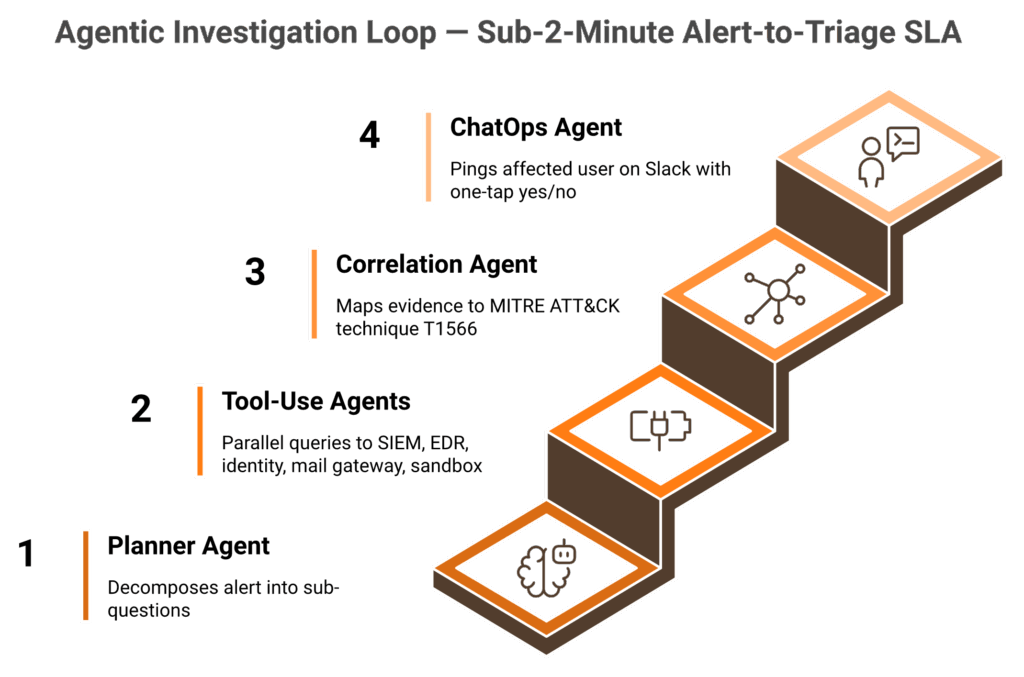
An agentic investigation runs four steps in parallel. (1) The planner decomposes the alert into sub-questions. (2) Tool-use agents query SIEM, EDR, and identity APIs simultaneously. (3) A correlation agent fuses evidence against MITRE ATT&CK. (4) A ChatOps agent pings the affected user on Slack or Teams to validate. The full loop closes in under 120 seconds. Human-driven SOAR typically needs 30 to 60 minutes for the same depth.
The Zimbra Memcache exploit at 1:47 a.m.
A customer of ours got hit by a Zimbra Memcache exploit pattern. The attacker ran the payload between 1 a.m. and 3 a.m., a window where business-hours admins are asleep and most managed SOCs send a “we will look at this in the morning” auto-reply. Our agentic loop caught it on the third packet because it was running 24/7 with no shift handoff.
The Mandiant M-Trends 2025 report still puts global median dwell time near 10 days. Agentic orchestration cuts that to hours, not because the AI is smarter than your analyst, but because it never sleeps and never gets distracted by Monday’s exec review. Compare that with our case where UnderDefense detected a cyberthreat faster than CrowdStrike OverWatch.
The four-step loop, in order
- Planner agent ⏰ decomposes the alert into a question tree. “Is this a real phish, a misclick, or a compromised account?”
- Tool-use agents query every relevant data source in parallel. SIEM, EDR, identity, mail gateway, and sandbox.
- Correlation agent ✅ fuses the evidence into a MITRE ATT&CK technique map and scores confidence.
- ChatOps agent ✅ pings the user with a yes/no question and captures the response.
Each agent is observable. Each step is logged. No black box. That is the test we run on our own UnderDefense Agentic AI SOC environment, and it is the test I would run on any vendor demo.
Breaking the fourth wall is the unlock
Most manual playbooks stall at “we need to confirm with the user.” That confirmation step is where 80% of investigation time goes. We solved it by pinging the user directly on Slack, Teams, or SMS with a one-tap response. The user knows in five seconds whether they ran that command or clicked that link. The investigation closes immediately.
“The biggest win for me was getting actual control over our security alerts. The platform itself is straightforward, it pulls in data from all our existing security tools, so we didn’t have to rip and replace anything.”
— Verified User, Marketing and Advertising UnderDefense G2 – Verified Review
Synthetic transactions prove the SLA
A 2-minute Alert-to-Triage SLA is meaningless without proof. We run synthetic transactions against every data source. A scripted login, a fake malware hash, and a test webhook. If the alert does not fire and complete triage in under 120 seconds, we know the pipeline is broken before the customer does. If your provider cannot show you their last seven days of synthetic transaction results, the SLA is marketing copy. Our breakdown of SLAs in cybersecurity detection and response goes deeper.
Q4. The Agentic Arms Race: Why Defenders at Human Speed Have Already Lost
Threat actors weaponized agentic AI in 2024 and 2025. LLM agents now autonomously chain reconnaissance, credential stuffing, lateral movement, and data staging. Defenders running manual SOAR playbooks operate at roughly 1/100th attacker speed, a structural loss before the first alert fires. Agentic orchestration is not a productivity upgrade. It is the only way to match the cadence of agentic adversaries while keeping human judgment at the decisions that matter.
The barrier to entry collapsed
For the first time in cybersecurity history, the skill barrier for sophisticated attacks dropped while attack effectiveness went up. A mediocre attacker with Claude or Cursor can now chain exploits that used to require an elite red team. Recent research on autonomous LLM red-team agents shows that agents can complete reconnaissance, vulnerability identification, and exploit generation in minutes, not days.
⚠️ This is not theory. We have run these scenarios on real apps in our New York community sessions, using only public tools like OpenAI, Claude, and Perplexity. Transparent prompts, observable outcomes, no proprietary magic. The attackers already have what most defenders are still planning to buy in Q4. Our perspective on AI in cybersecurity covers the defender playbook in detail.
The math is brutal
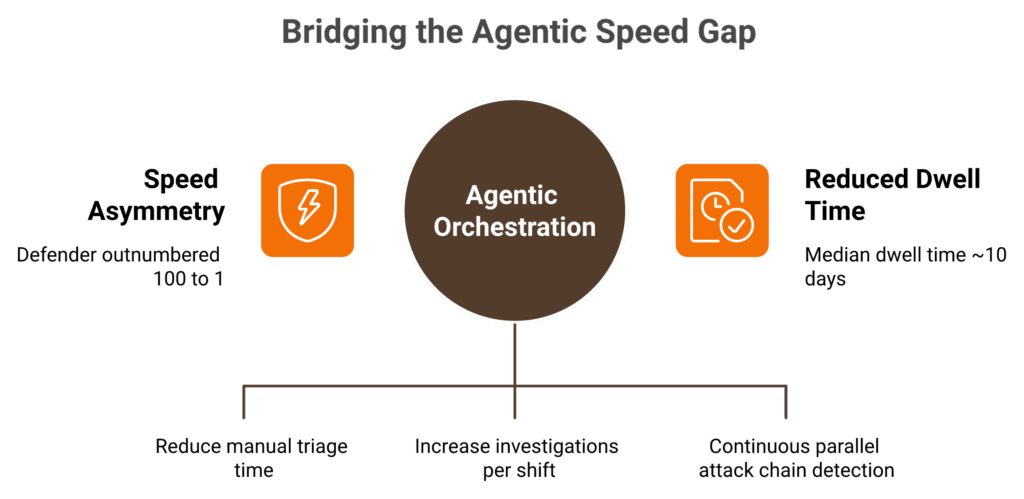
A human analyst on a 30-minute manual triage cycle can handle roughly 16 investigations per shift. An agentic attacker running 24/7 can launch hundreds of parallel attack chains in the same window. The defender is outnumbered 100 to 1 before anyone makes a decision. Mandiant’s 2025 dwell-time data tells the same story from the other end. Median containment is still measured in days, while attacker tooling moved to minutes.
⏰ “Time is the currency of the cloud.” If your response cycle is human-speed, you have already paid the bill. The same logic shows up across the ransomware threat landscape, where attacker velocity is the deciding variable.
Agentic defense is the only structural answer
You cannot hire your way out of this. Verizon’s 2025 DBIR confirms the human-element bottleneck in 60%+ of breaches, and the talent gap is not closing. The only response that scales is agentic orchestration on the defender side, with humans where they actually add value. Tier-3 and Tier-4 analysts validating containment. CISOs governing the agents. Engineers tuning the detection logic as code.
“Still not quite there with the remediation side of things. We receive alerts, but not necessarily a clear path to resolution. This is not an extension of our security team as was originally sold.”
— Sr Cybersecurity Engineer, Manufacturing Arctic Wolf – Gartner Verified Review
“It’s reassuring to know they’re always watching for threats, and it doesn’t cost a fortune. They catch and stop problems quickly, which is a huge relief. The platform works really well with our other security tools, which makes things much simpler.”
— Serhii B., Chief Information Security Officer UnderDefense G2 – Verified Review
We built UnderDefense Agentic AI SOC for exactly this asymmetry. The AI handles the mechanical investigation. The human handles the judgment call. Less theater, more throughput. Less black box, more blue team. If you want to see how this lands in the field, our MDR service page lays out the operating model end to end.
Q5. The 4-Stage SOC Orchestration Maturity Ladder (Where Are You Today?)
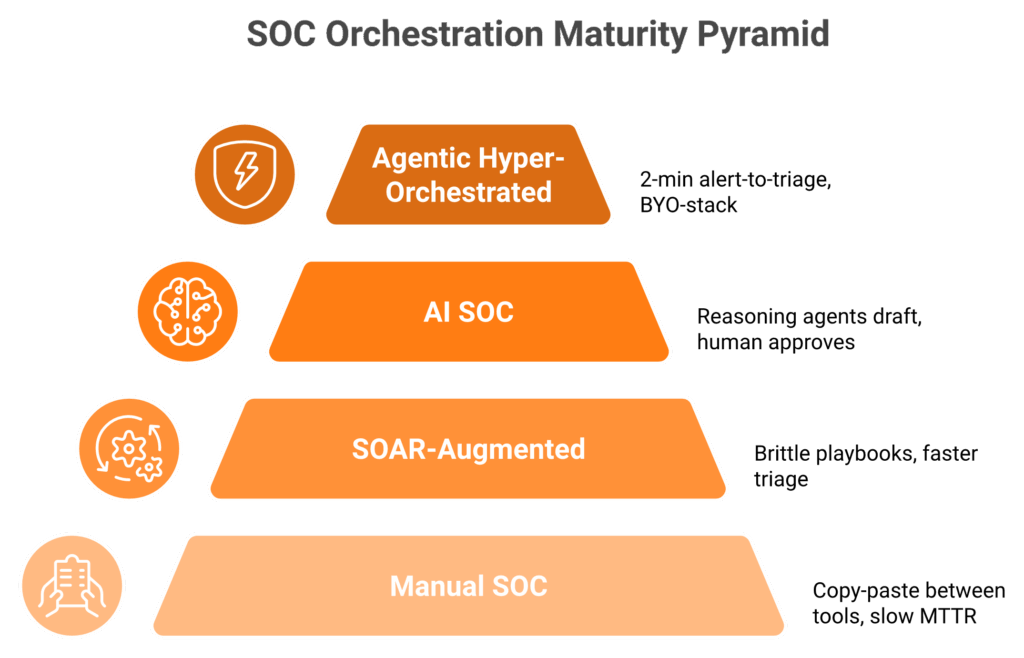
Every Security Operations Center (SOC) sits on a four-stage ladder. Stage 1 is a Manual SOC, where analysts copy-paste between tools. Stage 2 is SOAR-Augmented, where Python playbooks automate maybe 20% of triage but break monthly. Stage 3 is an AI SOC, where reasoning agents draft investigations and humans approve actions. Stage 4 is Agentic Hyper-Orchestrated, with autonomous investigation, BYO-stack orchestration, and ingestion-tuned economics. Most enterprises sit between Stage 1 and Stage 2. The SEC 8-K materiality clock is forcing the move to Stage 3 and 4.
Where most SOCs actually live today
A 2024 SANS SOC Survey found that under 25% of SOCs report mature SOAR adoption, and analyst burnout still leads the operational pain list. That tracks with what we see in the field. A 1,000-person SaaS company with Splunk, CrowdStrike, and Entra ID typically has three or four playbooks running, plus a wiki of “things we meant to automate.” That is Stage 1.5, not Stage 2. The decision to keep building or buy outside help often comes down to the outsourced vs in-house SOC tradeoff.
The jump to Stage 3 is not about buying a new product. It is about giving the analyst an AI co-pilot that handles the mechanical investigation while the human keeps the judgment call.
The four stages, side by side
| Stage | What It Looks Like | Headcount Ratio | MTTR (Mean Time to Respond) | Audit Posture | Typical Vendor |
|---|---|---|---|---|---|
| 1. Manual SOC | Copy-paste between SIEM, EDR, and ticket | 1 analyst per ~500 alerts/day | Hours to days | Spreadsheet evidence | In-house, legacy MSSP |
| 2. SOAR-Augmented | 5 to 20 playbooks, breaks monthly | 1 per ~1,500 alerts/day | 30 to 60 min triage | Playbook logs | Splunk SOAR, Tines, Torq |
| 3. AI SOC | Reasoning agents draft, human approves | 1 per ~5,000 alerts/day | Under 10 min | Per-action audit trail | Most “AI SOC” entrants |
| 4. Agentic Hyper-Orchestrated | Autonomous investigation, BYO stack | 1 per ~15,000 alerts/day | 2-min Alert-to-Triage | Immutable, time-stamped | UnderDefense Agentic AI SOC |
The 5-question self-assessment
Ask your team these on Monday. ⏰
- Can you produce the last 10 autonomous response actions you took, with timestamps? (If no, you are Stage 1 or 2.)
- What is your alert-to-triage SLA in seconds, and do you measure it with synthetic transactions?
- Do your detection rules live in Git with version control and CI/CD?
- Can a Tier-1 analyst handle 5,000 alerts a day without burning out?
- When the SEC 8-K materiality clock starts, can you produce evidence within four business days?
If you want a deeper diagnostic, walk through our SOC metrics breakdown for MTTD and MTTR alongside this self-assessment.
A fleet of Ferraris with rookie drivers
⚠️ Stage 4 is not free. I have watched customers buy elite orchestration tools and then under-staff the operators. It is a fleet of Ferraris with rookie drivers, and the cars end up in the ditch. In our experience shipping UnderDefense Agentic AI SOC across 500-plus customer environments, Stage 4 only works when the senior analyst pool grows alongside the agent capability.
If you do not have Tier-3 talent on the bench, do not jump from Stage 1 to Stage 4. Run Stage 3 with a partner, build the muscle, and graduate. Many teams use a virtual CISO engagement to plan that progression without overbuying tools.
“Underdefense is a great choice for teams like ours that are short on resources. It automates many tasks, plus, with 24/7 monitoring, we know we’re always protected. The platform seamlessly integrates our existing security tools, simplifying management.”
— Inga M., CEO UnderDefense G2 – Verified Review
Q6. How Does Hyper-Orchestration Map to MITRE ATT&CK, F3EAD, and the Adversary Trifecta?
Effective AI Security Orchestration runs on three frameworks at once. The Lockheed Martin Cyber Kill Chain provides strategy. MITRE ATT&CK v15 provides the operational vocabulary. The Diamond Model provides analyst methodology for activity threads. F3EAD (Find, Fix, Finish, Exploit, Analyze, Disseminate) layers on top as the response cadence. Most SOCs cover under 40% of relevant ATT&CK techniques with high-fidelity detections, so agentic orchestration’s measurable lift is technique-by-technique coverage, not a marketing claim.
Why three frameworks, not one
I have watched too many SOC teams pick one framework, frame it on the wall, and call it a day. That breaks the moment a real incident lands. A mid-market manufacturer I spoke with last month had ATT&CK posters in the SOC and zero technique-level coverage measurement. Their detection engineer could not tell me which of T1078 (Valid Accounts) sub-techniques they actually caught. That is the gap between framework theater and framework operations.
Each framework answers a different question your senior analyst asks during an incident:
- Kill Chain asks “what stage of the attack is this, and where do we cut it off?” Reconnaissance, Weaponization, Delivery, Exploitation, Installation, C2, and Actions on Objectives.
- MITRE ATT&CK v15 asks “which technique and sub-technique?” T1566.001 versus T1566.002 versus T1078. That precision feeds detection engineering.
- Diamond Model asks “is this the same actor, infrastructure, or capability we saw two weeks ago?” That stitches incidents into campaigns.
Most enterprises run high-fidelity detections on a minority of ATT&CK techniques, leaving the rest as low-confidence noise. Mapping every detection to one Tactic, Technique, and Procedure (TTP) turns coverage into a number your board can read and your auditor can audit. Pair that with our list of top threat detection tools when you assess your stack.
F3EAD applied to a real phishing case
F3EAD comes from joint military operations doctrine. It moves a SOC from passive detection to closed-loop response. Walk through a phishing alert with it:
| F3EAD Step | What the Agentic Loop Does | ATT&CK Technique Touched | Time Budget |
|---|---|---|---|
| ✅ Find | Detection fires on suspicious M365 sign-in pattern | T1566.002 (Spearphishing Link) | 0 to 30 sec |
| ✅ Fix | Orchestrator pins user, host, and active session | T1078 (Valid Accounts) | 30 to 60 sec |
| ✅ Finish | Autonomous credential rotation, forced logout, and host isolation | T1531 (Account Access Removal) | 60 to 120 sec |
| ✅ Exploit | Agent harvests related sessions, OAuth grants, and mailbox rules | T1098.002 (Additional Email Delegate) | 2 to 5 min |
| ✅ Analyze | Senior analyst validates and writes lessons learned | N/A (human) | 15 to 30 min |
| ✅ Disseminate | Detection update ships back to Git as code | New Sigma/KQL rule | Same day |
That is what F3EAD looks like when a SOC actually runs it. Not a slide. A clock. For a fully worked playbook, see our phishing playbook.
Detection logic as code: the Monday move
Working with 500-plus security teams, what I have noticed is that the mature ones treat detection rules like software. They write rules in Sigma, KQL, or Splunk SPL. They version them in Git. They run unit tests on detection logic with replayable telemetry. They ship through CI/CD (Continuous Integration/Continuous Deployment) pipelines.
Here is the Monday move for your detection engineer:
- Pick your 10 highest-volume detections. Move them from the SIEM UI into a Git repo this week.
- Add a unit test that replays a known-bad event and a known-good event for each rule.
- Tag every rule with its ATT&CK technique ID in the commit message.
- Publish your coverage map (rule count per technique) on the team wiki.
If your SOC ships a detection update once a quarter through a vendor ticket, you are not running orchestration. You are running a museum. The teams that survive the agentic-attacker era are the ones who can ship a new detection in an hour, not a quarter. Our take on whether AI kills or saves your SOC team goes into the operating-model implications.
Q7. How Does Agentic Orchestration Map to NIST CSF 2.0, NIS2, and the SEC 8-K Rule?
Agentic orchestration earns its budget at the audit. NIST Cybersecurity Framework 2.0’s new Govern function demands evidence of every autonomous action. The EU NIS2 Directive forces 24-hour incident reporting across covered entities. The SEC’s Item 1.05 amendment requires 8-K materiality disclosure within four business days. Manual SOCs miss these clocks routinely. Agentic orchestration produces immutable, time-stamped artifacts, turning compliance into a continuous control mapped automatically to SOC 2 Type II, ISO 27001, HIPAA, and PCI DSS.
Why Govern (GV) changed the game
NIST CSF 2.0, published in February 2024, added Govern as a sixth function alongside Identify, Protect, Detect, Respond, and Recover. Govern asks one operational question. “Can you prove who decided what, and on what authority?” An autonomous agent that disables a user account at 2 a.m. has to leave a Govern-grade trail. Reason, authorization, action, and reversal path.
A black-box MDR provider that “took care of it” cannot answer that question to a SOC 2 Type II auditor. Our broader compliance services page lays out how to map controls to evidence cleanly.
Mapping capability to clock
| Capability | NIST CSF 2.0 Function | NIS2 Article | SEC 8-K Trigger | Audit Artifact |
|---|---|---|---|---|
| Autonomous containment | RS.MI (Mitigation) | Art. 23 (24-hr early warning) | Item 1.05 materiality | Time-stamped action log |
| Detection coverage map | DE.CM (Continuous Monitoring) | Art. 21 (Risk measures) | N/A | ATT&CK technique map |
| Human-on-the-glass approval | GV.RR (Roles, Responsibilities) | Art. 20 (Governance) | Item 1.05 process | Approval chain audit trail |
| Reversible action | RC.RP (Recovery Planning) | Art. 23 (Final report) | 8-K amendment | Rollback evidence |
| Detection-as-code | ID.IM (Improvement) | Art. 21 (Continuous improvement) | N/A | Git commit history |
Compliance as a byproduct, not a workstream
⏰ The SEC’s four-business-day clock starts the moment your CFO determines materiality, not when forensics finishes. If your SOC needs a week to reconstruct a timeline, you are already late. Agentic orchestration logs every step in real time, so the disclosure draft writes itself. For EU-covered entities, our DORA testing guide walks through similar evidence requirements.
In our experience supporting Fortune 500 incident response, the customers who pass audits cleanly are the ones who treat compliance as a byproduct of good logging, not a separate quarterly project. Less theater, more throughput.
If your provider hands you a PDF report two weeks after the incident, that is not a control. That is a souvenir. A solid IR plan template can close that documentation gap in a single afternoon.
“They have an exceptionally talented team who is very engaged and provides extra care. We love the monthly report, we gain valuable insights into security posture and incidents, and share them with the board of directors. Plus, their expert management of our SIEM has added to the value of our security investments and tools.”
— Yaroslava K., IT Project Manager UnderDefense G2 – Verified Review
Q8. The True Cost of a Manual SOC: Synthesizing IBM, Mandiant, SANS, and Verizon DBIR
The Cost of a Manual SOC for a 1,000 to 10,000-employee enterprise lands between $4.1M and $6.8M annually in avoidable breach exposure, analyst burnout, and ingestion overspend. Verizon’s 2025 DBIR puts median containment in days. Mandiant’s 2025 M-Trends reports global dwell time near 10 days. SANS 2024 found under 25% of SOCs run mature SOAR. IBM’s 2024 Cost of a Data Breach quantifies AI/automation savings at $2.22M per breach. Agentic orchestration is the only line item that compresses all four.
The four-quadrant cost model
💸 Most CFOs do not budget for the manual SOC. They budget for the tools and assume the people are free. They are not. Run the numbers through a SOC cost calculator before your next budget cycle.
| Cost Quadrant | Driver | Annual Range | Primary Source |
|---|---|---|---|
| 💰 Avoidable breach exposure | 10-day median dwell time | $1.8M to $2.8M | IBM 2024, Mandiant 2025 |
| 💸 Analyst burnout and turnover | 99% false-positive rate, manual triage | $0.6M to $1.2M | SANS 2024 |
| ⚠️ Ingestion overspend | Unlimited logging, no tuning | $0.9M to $1.6M | Vendor SIEM benchmarks |
| ❌ Compliance and audit drag | Manual evidence reconstruction | $0.8M to $1.2M | Verizon DBIR 2025 |
| Total | $4.1M to $6.8M |
These numbers are conservative. They exclude regulatory fines under GDPR Article 33 or NIS2, which can dwarf the operational costs.
Ingestion Tuning is the funding mechanism
⭐ Here is the unlock most CISOs miss. Agentic orchestration is often punished by high-fidelity logging costs. Every new detection means more SIEM ingestion, and your bill goes up. Ingestion Tuning flips that. By deduplicating, sampling, and routing low-value telemetry, mature programs cut volume 50% to 90%.
The savings fund the orchestration layer. The orchestration layer compresses the breach window. The breach window compression cuts the IBM-quantified $2.22M per breach. It is a closed loop, and the CFO can read the math on one page. Our managed SIEM pricing guide shows where the levers actually sit.
The $300K accidental discovery
A customer’s orchestration layer paid for itself in 90 days by catching a payroll fraud scheme that pure malware-detection rules would have missed. The agentic loop correlated unusual payroll metadata with off-hours admin activity. No malware. No EDR signature. Just a pattern that a human analyst could not have surfaced fast enough. That is what “doing the R in MDR” looks like in dollars. Compare with our SIEM and SOC case where a customer avoided $650K in losses.
If your current provider cannot produce a story like that, ask them why. The 2026 cybersecurity budget playbook walks through how to reframe the line items for the CFO.
“Lack of true remediation in the response, costing us significantly in resources and introducing risks in security.”
— VP of Technology, Services Arctic Wolf – Gartner Verified Review
“UnderDefense is surprisingly affordable considering the level of protection we get. Their proactive threat hunting and rapid response have saved us from incidents that could have been incredibly costly.”
— Verified User, Program Development UnderDefense G2 – Verified Review
Q9. SOAR vs AI SOC vs Agentic MDR vs Hyper-Orchestration: Which One Do You Actually Need?
If your team writes Python playbooks weekly, you have SOAR debt. If your vendor parrots alerts back, you have monitoring-only MDR. AI SOC adds reasoning. Agentic MDR adds autonomous response with human escalation. Hyper-Orchestration adds the BYO-stack layer that orchestrates Splunk, Sentinel, and CrowdStrike without forcing a proprietary lake. Pick based on stack debt, regulatory load, and whether your provider does the R in MDR.
The five paradigms, side by side
| Paradigm | Cost Model | Integration | Response Autonomy | Audit Trail | Time to Value | Lock-In Risk |
|---|---|---|---|---|---|---|
| UnderDefense Agentic AI SOC | Per-endpoint, transparent | BYO Splunk/Sentinel/CrowdStrike, 250+ tools | Sub-2-min credential wipes, resets, and isolation | Per-action immutable log | 23 days for 1,200 endpoints | Low (you keep your SIEM) |
| Arctic Wolf (Pure MDR) | Bundled, opaque | Proprietary appliance | Alert escalation, limited remediation | Tickets, not actions | Weeks | High (vendor-managed config) |
| ReliaQuest GreyMatter (AI SOC) | Per-asset | Multi-tool, but central platform | Mixed, mostly assisted | Platform-bound | Months | Medium |
| CrowdStrike Falcon Complete (Endpoint MDR) | Per-endpoint | Falcon-centric | Strong on endpoint, weak on identity/cloud context | Endpoint-bound | Days | High (Falcon dependency) |
| Palo Alto Cortex XSOAR (Legacy SOAR) | Per-action, per-playbook | Wide, but DIY | Scripted only | Playbook logs | 6 to 12 months | Medium |
For the deeper landscape, see our 2025 list of top MDR providers.
When pure MDR breaks
❌ Pure MDR providers tend to drop ownership at the response line. The Gartner-published Arctic Wolf review put it directly:
“Still not quite there with the remediation side of things. We receive alerts, but not necessarily a clear path to resolution. This is not an extension of our security team as was originally sold.”
— Sr Cybersecurity Engineer, Manufacturing Arctic Wolf – Gartner Verified Review
A second one, sharper:
“Lack of true remediation in the response, costing us significantly in resources and introducing risks in security.”
— VP of Technology, Services Arctic Wolf – Gartner Verified Review
That is the gap our UnderDefense Agentic AI SOC customers describe filling. ✅
“The biggest win for me was getting actual control over our security alerts. The platform itself is straightforward, it pulls in data from all our existing security tools, so we didn’t have to rip and replace anything.”
— Verified User, Marketing and Advertising UnderDefense G2 – Verified Review
Scenario-based picks
The right choice usually maps to one of these profiles:
✅ Stage 1 to 2 SOC, 1,000 to 5,000 employees, existing Splunk. Hyper-Orchestration with MDR for Splunk. Keep the SIEM, add agentic response.
⚠️ Endpoint-only shop, no SIEM. Falcon Complete works, but plan for identity and cloud blind spots.
✅ Heavy compliance load (NIS2, 8-K). Hyper-Orchestration with immutable audit trails.
✅ Budget cut, need to consolidate three vendors. Agentic MDR with concierge response, validated against the MDR buyers guide.
⚠️ Ground-zero, no SIEM, no SOC. Bundled MDR is fine to start, but read the renewal clause. Arctic Wolf customers flagged a 60-day auto-renewal trap.
In our experience, the deciding factor is rarely the feature list. It is whether you keep ownership of your data and your business logic when the contract ends. If you are evaluating a switch, our piece on why businesses switch cybersecurity providers is worth a read.
See how UnderDefense Agentic AI SOC resolves a real incident on your stack.
Q10. What Failure Modes and Human-on-the-Glass Governance Keep Agentic AI Safe?
Agentic AI in the SOC reaches correct conclusions roughly 30% of the time without human validation, and it introduces failure modes legacy SOAR never had. Prompt injection on investigation agents. Hallucinated containment that disables production accounts. Audit-trail gaps that fail SOC 2 Type II evidence checks. The mitigation is human-on-the-glass governance. Every autonomous action stays reversible, logged, and Tier-3 reviewed within a defined window. Banning AI tools backfires by creating Shadow AI.
The 30% accuracy ceiling, and why bias is a feature
Internal operational data across our customer base shows agentic AI is correct in roughly 30% of security cases without human validation. That is not a marketing failure. It is the reason Tier-3 and Tier-4 analysts stay in the loop. A measurable, biased model that analysts can tune beats an unbiased black box that nobody can audit.
A 2022 USENIX Security study by Alahmadi et al. found that production SOC alerts can carry false-positive rates approaching 99% before triage. AI gets us from 99% noise to 30% reliable suggestions. Humans take it from 30% to closed-case truth. Our take on AI SOC red flags covers the failure patterns to watch for in vendor demos.
The five failure modes you have to design against
| ⚠️ Failure Mode | Likelihood | Control | Audit Artifact |
|---|---|---|---|
| Prompt injection via email/web content | High | Sandbox agent inputs, block tool-use on untrusted text | Input provenance log |
| Hallucinated containment (wrong account disabled) | Medium | Reversible action, 5-min Tier-3 review window | Rollback evidence |
| Tool-use chain abuse (agent escalates own privileges) | Low to Medium | Least-privilege RBAC (Role-Based Access Control) on agent tokens | Token scope log |
| Audit-trail gap | Medium | Immutable per-action logs, time-stamped | SOC 2 evidence file |
| Shadow AI on personal devices | High | Monitor, do not ban | DLP and proxy telemetry |
Recent 2024 research on prompt-injection attacks against autonomous agents shows the attack surface is real and growing. Treat every agent input as untrusted by default. For agent-specific monitoring patterns, MDR for AI walks through the controls.
Human-on-the-glass governance, in practice
❌ Banning ChatGPT only creates Shadow AI on personal devices, removing CISO visibility entirely. The goal is monitoring what the AI agents are actually doing, not pretending they are not there. Working with 500-plus customer environments, what I have seen is that the organizations who govern agents well share three patterns. Reversibility on every autonomous action, named human reviewers for every action class, and a published review SLA.
Our own UnderDefense Agentic AI SOC playbook is simple. Every credential rotation, every forced logout, and every host isolation comes with a 5-minute Tier-3 review window and a one-click rollback. ✅ A senior analyst can undo any agent decision before it propagates. That is what human-on-the-glass actually means. A formal incident response retainer keeps that governance live around the clock.
If your provider cannot show you the rollback button, it is not governance. It is faith.
“Their customer-centric approach is a breath of fresh air. SOC analysts and support team are incredibly responsive and knowledgeable. The platform’s high-fidelity alerts and automated enrichment help us quickly identify and address threats.”
— Verified User, Computer Software UnderDefense G2 – Verified Review
Q11. The 15-Question Vendor Evaluation Checklist for Replacing SOAR
Most vendor demos show a Ferrari with a rookie driver. The 15 questions below separate real AI Security Orchestration from marketing skin. Show me your last 10 autonomous actions on a real customer. Do you support BYO Splunk/Sentinel/CrowdStrike or force a proprietary lake? What is your alert-to-triage SLA in seconds? What is your model accuracy with and without human validation? Is your pricing per-seat, per-event, or per-outcome? Skip vendors who deflect any of these. Pair this checklist with the SIEM buyers guide for stack-level evaluation.
Capability (questions 1 to 4)
- ✅ Show me the last 10 autonomous response actions you took on a customer like us, with timestamps.
- ✅ What is your alert-to-triage SLA in seconds, and how is it measured? (Look for synthetic transactions.)
- ✅ What is your published MITRE ATT&CK technique coverage rate?
- ✅ Do you do the R in MDR? Can you show credential wipes, password resets, and forced logouts performed under 2 minutes?
Integration (questions 5 to 8)
- ✅ Do you support BYO Splunk, Sentinel, Chronicle, or CrowdStrike, or do you force a proprietary data lake?
- ✅ How many native integrations do you have? (UnderDefense lists 250-plus.)
- ✅ Who owns the detection rules at contract end?
- ✅ Can your agents query our existing identity provider, M365, and ticketing tool out of the box?
The breadth of UnderDefense Agentic AI SOC integrations is worth checking against your current stack before any RFP.
Governance (questions 9 to 12)
- ⚠️ What is your model accuracy with and without human validation?
- ⚠️ Show me the rollback button for any autonomous action.
- ⚠️ How do you defend agents against prompt injection?
- ⚠️ Can you produce per-action audit logs that satisfy SOC 2 Type II and NIS2 Article 23?
Economics (questions 13 to 15)
- 💰 Is your pricing per-seat, per-event, per-endpoint, or per-outcome?
- 💰 What is the renewal notice window? (Arctic Wolf reviewers flagged a 60-day auto-renewal trap.)
- 💰 What is your ingestion-tuning approach to keep SIEM costs flat?
If you want grounded numbers behind these questions, the MDR pricing page lays out the per-endpoint model in the open.
M365 E5 entitlement audit before you buy
Before signing any new vendor, run an M365 E5 audit. Many enterprises already own Defender XDR, Sentinel, and Purview seats they never deployed. Do not buy redundant orchestration when the seat is already paid for. Our work on MDR for Microsoft 365 walks through the entitlement map.
“UnderDefense MAXI integrates well with our systems, specifically with our SIEM, Splunk. Their team is proactive in identifying and addressing threats.”
— Oleg K., Director Information Security UnderDefense G2 – Verified Review
“What stood out the most was their responsiveness and flexibility, no matter the issue, they tackled it quickly and professionally.”
— Arman N., CTO UnderDefense G2 – Verified Review
Red-flag callout. ❌ If a vendor cannot answer questions 1, 5, 9, or 13 in the demo, walk. Those four questions filter out 80% of the noise. For a wider competitor sweep, check our Rapid7 alternatives 2026 roundup.
Q12. Your Monday-Morning 30/60/90-Day Plan to Move Beyond SOAR
Here is what you do this week. Day 1, audit your alert-to-investigation ratio and false-positive rate per detection rule. Week 1, run a MITRE ATT&CK Navigator coverage map and identify your five biggest gaps. Day 30, run synthetic transactions on every data source to prove sub-2-minute alerting. Day 60, pilot one agentic orchestration playbook on a high-volume alert class. Day 90, tie ingestion-tuning savings to the orchestration budget and present a board update with MTTR delta and 8-K readiness.
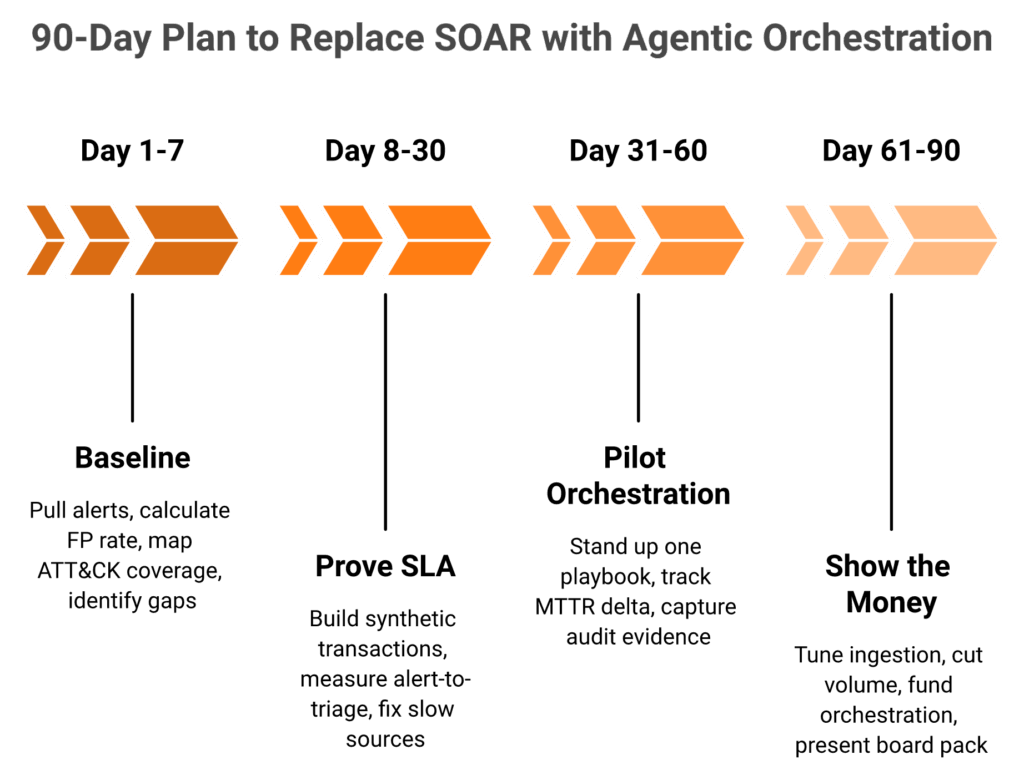
⏰ Day 1 to Day 7: Baseline
- Pull the last 30 days of alerts. Calculate FP rate per rule.
- List your top 10 noisiest detection rules. Mark which ones nobody triages.
- Run MITRE ATT&CK Navigator against your current detection inventory.
- Identify the five techniques with highest business risk and lowest coverage.
For the metric definitions, see our SOC metrics guide.
⏰ Day 8 to Day 30: Prove the SLA
- Build a synthetic transaction for every data source (SIEM, EDR, identity, mail, and cloud).
- Measure alert-to-triage time in seconds. Publish the number internally.
- If any source exceeds 2 minutes, fix the pipeline before adding new detections.
Operating standards for these SLAs are documented in our SLA in cybersecurity breakdown.
⏰ Day 31 to Day 60: Pilot Agentic Orchestration
- Pick one high-volume alert class (phishing, suspicious login, or malware EDR alert).
- Stand up an agentic playbook with reversible containment and Tier-3 review.
- Track MTTR delta against the manual baseline.
- Capture every audit artifact for SOC 2 and NIS2 evidence.
If ransomware sits high on your scenario list, our ransomware response plan is a good template to lift.
⏰ Day 61 to Day 90: Show the Money
- 💰 Run an Ingestion Tuning pass. Cut low-value telemetry by 50% to 90%.
- 💰 Apply the savings to fund the orchestration layer.
- 💰 Present the board pack: MTTR delta, ATT&CK coverage gain, and 8-K readiness under SEC Item 1.05.
- 💰 Decide on Stage 3 or Stage 4 expansion.
For the wider budget conversation, point your CFO to the 2026 cybersecurity budget playbook.
What I am thinking about next
The next 18 to 24 months will not be about whether agentic AI belongs in the SOC. That argument is over. The question I keep coming back to is governance. Who owns the audit trail when the agent acts faster than a human can read? My current read is that the winners will be teams who treat detection logic as code, who run their agents in the open, and who keep humans on the glass for every reversible action. If your CISO cannot answer “show me the rollback” in 30 seconds, that is the conversation worth having. Less theater, more throughput. Less black box, more blue team. When you are ready to scope a switch, contact us.
References
Research Papers
- Georgiadou, A., Mouzakitis, S., & Askounis, D. “Assessing MITRE ATT&CK Coverage in Enterprise Detection” Computers & Security, 2023.
- Alahmadi, B. A., Axon, L., & Martinovic, I. “99% False Positives: A Qualitative Study of SOC Analysts’ Perspectives on Security Alarms” USENIX Security Symposium, 2022.
- arXiv cs.CR. “Prompt Injection Attacks Against Autonomous LLM Agents” arXiv, 2024.
Official Documentation and Standards
- NIST. “Cybersecurity Framework (CSF) 2.0” Published: February 26, 2024.
- EU. “Directive (EU) 2022/2555 (NIS2 Directive)” Published: December 14, 2022.
- SEC. “Cybersecurity Risk Management, Strategy, Governance, and Incident Disclosure (Item 1.05, Form 8-K)” Published: July 26, 2023.
- NIST. “SP 800-61 Rev. 3: Incident Response Recommendations” Published: April 2025.
- MITRE Corporation. “MITRE ATT&CK Framework v15” Published: 2024.
- MITRE. “MITRE ATT&CK Navigator v15” Published: 2024.
Datasets
- Verizon. “2025 Data Breach Investigations Report (DBIR)” 2025.
- Mandiant. “M-Trends 2025” 2025.
- IBM Security. “Cost of a Data Breach Report 2024” 2024.
Blogs
- SANS Institute. “2024 SANS SOC Survey: Facing Top Challenges in Security Operations” Published: 2024. [Secondary source]
- IBM. “What Is AI Orchestration?” Published: January 22, 2025. [Secondary source]
- Swimlane. “The Art of AI SOC Orchestration” Published: March 24, 2026. [Secondary source]
- Forrester. “Forrester Wave: Managed Detection and Response Services” Published: 2025. [Secondary source]
- Sr Cybersecurity Engineer, Manufacturing. “Arctic Wolf Gartner Review” [Secondary source]
- VP of Technology, Services. “Arctic Wolf Gartner Review” [Secondary source]
- Verified User, Financial Services. “Arctic Wolf G2 Review” [Secondary source]
- Verified User, Marketing and Advertising. “UnderDefense G2 Review” [Secondary source]
- Arman N., CTO. “UnderDefense G2 Review” [Secondary source]
- Oleg K., Director Information Security. “UnderDefense G2 Review” [Secondary source]
1. What is AI Security Orchestration, and how is it different from SOAR?
We define AI Security Orchestration as the autonomous coordination of detection, investigation, and response across SIEM, EDR, identity, and cloud, driven by reasoning agents instead of brittle Python playbooks. Legacy SOAR automates a single click. Orchestration sequences many tasks contextually, pulling logs, enriching IOCs, validating with the affected user via ChatOps, and triggering reversible containment under human-on-the-glass governance. In our experience running UnderDefense Agentic AI SOC across customer environments, the operational difference is reasoning. SOAR scripts cannot ask, “Did you actually click this link?” Agentic orchestration can, and the loop closes in under two minutes against a 30 to 60-minute manual baseline. Key distinctions:
-
SOAR is scripted automation of one task. Orchestration is workflow with judgment.
-
SOAR breaks on schema changes. Reasoning agents adapt to context.
-
SOAR logs playbook runs. Orchestration logs per-action audit trails ready for SOC 2 Type II.
Compare further with our breakdown of SOC automation for CISOs.
2. Does AI Security Orchestration actually replace SOAR, or do we run them side by side?
We replace SOAR for new investigation classes and retire it as agentic playbooks reach parity. Running both in parallel is fine for 90 days. Running both for a year means you are funding two stacks and tuning two rule sets. Most enterprises sit between Stage 1 (Manual SOC) and Stage 2 (SOAR-Augmented). The jump to Stage 3 (AI SOC) is not a rip-and-replace. It is a graduated migration where orchestration handles new alert classes (phishing, suspicious sign-ins, EDR detections) while SOAR sunsets the legacy playbooks. Our practical sequence:
-
Week 1 to 4. Pilot one agentic playbook on the highest-volume alert class.
-
Week 5 to 12. Migrate the next three playbooks. Sunset the old ones in Git.
-
Quarter 2. Decommission SOAR licensing at renewal.
Read our guide to MDR services for the full operating model.
3. How does agentic AI investigate an alert in under two minutes?
We run four agents in parallel. A planner decomposes the alert into sub-questions. Tool-use agents query SIEM, EDR, identity, mail gateway, and sandbox APIs simultaneously. A correlation agent fuses evidence against MITRE ATT&CK techniques. A ChatOps agent pings the affected user on Slack, Teams, or SMS to validate. The unlock is breaking the fourth wall. Most manual playbooks stall at “we need to confirm with the user,” and that confirmation step consumes 80% of investigation time. We solved it by pinging the user directly with a one-tap response. The investigation closes immediately. Steps in order:
-
Planner agent writes a question tree.
-
Tool-use agents run SIEM, EDR, and identity queries in parallel.
-
Correlation agent maps to ATT&CK and scores confidence.
-
ChatOps agent captures the human “yes/no” within seconds.
See how this lands in production on our MDR service page.
4. How does AI Security Orchestration map to NIST CSF 2.0, NIS2, and the SEC 8-K rule?
We treat compliance as a byproduct of good logging. NIST CSF 2.0’s new Govern function demands evidence of every autonomous action. EU NIS2 forces 24-hour incident reporting under Article 23. SEC Item 1.05 requires 8-K materiality disclosure within four business days. Manual SOCs miss these clocks because timeline reconstruction takes a week. Agentic orchestration produces immutable, time-stamped artifacts in real time, mapped automatically to SOC 2 Type II, ISO 27001, HIPAA, and PCI DSS controls. Audit-ready artifacts:
-
Per-action immutable log for RS.MI mitigation evidence.
-
ATT&CK technique coverage map for DE.CM continuous monitoring.
-
Approval chain audit trail for GV.RR governance.
-
Rollback evidence for RC.RP recovery planning.
Our compliance services page lays out the control mapping.
5. What does an AI Security Orchestration platform actually cost, and how does it pay back?
We see a true Cost of a Manual SOC between $4.1M and $6.8M annually for 1,000 to 10,000-employee enterprises, broken across avoidable breach exposure, analyst burnout, ingestion overspend, and audit drag. IBM’s 2024 Cost of a Data Breach quantifies AI/automation savings at $2.22M per breach. The funding mechanism most CISOs miss is Ingestion Tuning. By deduplicating, sampling, and routing low-value telemetry, mature programs cut SIEM volume 50% to 90%. The savings fund the orchestration layer. Cost stack:
-
Avoidable breach exposure: $1.8M to $2.8M.
-
Analyst burnout and turnover: $0.6M to $1.2M.
-
Ingestion overspend: $0.9M to $1.6M.
-
Compliance and audit drag: $0.8M to $1.2M.
Run your numbers through our SOC cost calculator before the next budget cycle.
6. What governance keeps agentic AI from making catastrophic autonomous decisions?
We design every autonomous action to be reversible, logged, and Tier-3 reviewed within a 5-minute window. Internal data shows agentic AI reaches correct conclusions in roughly 30% of cases without human validation. That is the reason senior analysts stay on the glass. The five failure modes we design against are prompt injection, hallucinated containment, tool-use chain abuse, audit-trail gaps, and Shadow AI on personal devices. Banning AI tools backfires. Monitor what the agents do, do not pretend they are not there. Controls to demand from any vendor:
-
One-click rollback on every autonomous action.
-
Least-privilege RBAC on agent tokens.
-
Immutable per-action logs.
-
Sandboxed agent inputs to block prompt injection.
Our list of AI SOC red flags covers the demo-floor warning signs.
7. How do we evaluate AI Security Orchestration vendors without falling for marketing skin?
We use a 15-question checklist that filters out 80% of the noise. Four questions matter most. Show me your last 10 autonomous actions on a real customer. Do you support BYO Splunk, Sentinel, Chronicle, or CrowdStrike, or force a proprietary lake? What is your alert-to-triage SLA in seconds, measured by synthetic transactions? Is your pricing per-seat, per-event, per-endpoint, or per-outcome? Walk if a vendor deflects any of those four. Pure MDR providers tend to drop ownership at the response line, leaving customers with alerts but no remediation. Vendor red flags:
-
No published MITRE ATT&CK coverage rate.
-
No demo of credential wipes, password resets, or forced logouts under 2 minutes.
-
Auto-renewal clauses with 60-day notice traps.
-
“AI” branding without a model-accuracy number.
Pair this with the MDR buyers guide for stack-level evaluation.
8. What is the 30/60/90-day plan to move beyond SOAR?
We run a measurable, board-readable plan that ties technical wins to budget math. Day 1 to Day 30, baseline. Pull 30 days of alerts, calculate FP rate per rule, run MITRE ATT&CK Navigator, and identify the five techniques with highest business risk and lowest coverage. Build synthetic transactions on every data source and prove sub-2-minute alerting. Day 31 to Day 60, pilot. Stand up one agentic playbook on a high-volume alert class with reversible containment and Tier-3 review. Track MTTR delta against the manual baseline. Day 61 to Day 90, monetize. Run an Ingestion Tuning pass to cut low-value telemetry by 50% to 90%. Apply the savings to fund orchestration. Present the board pack with MTTR delta, ATT&CK coverage gain, and 8-K readiness under SEC Item 1.05. Our 2026 cybersecurity budget playbook maps the line items.