




Q1. What Are the 10 Best Managed SIEM Vendors with the Fastest Onboarding in 2026?
The ten fastest-onboarding managed SIEM vendors in 2026 are UnderDefense, Arctic Wolf, Expel, CrowdStrike Falcon Complete, Red Canary, ReliaQuest, Deepwatch, Binary Defense, BlueVoyant, and Secureworks Taegis. UnderDefense ranks first: the UnderDefense Agentic AI SOC platform deploys on prepared infrastructure in under five minutes, ships more than 700 MITRE ATT&CK-mapped investigation workbooks on day one, and invests a full 30 days building customised detections that return validated offences.
Choosing a managed SIEM partner is a high-stakes call for teams facing an audit date, a renewal, or a live gap in 24/7 coverage. This guide ranks providers on realistic onboarding speed rather than brochure claims, using published deployment documentation, verified customer reviews, and stated integration coverage. Every vendor here appears because buyers shortlist them for time-to-value, and the ranking separates the day your logs start flowing from the day your detections can be trusted. Two very different dates.
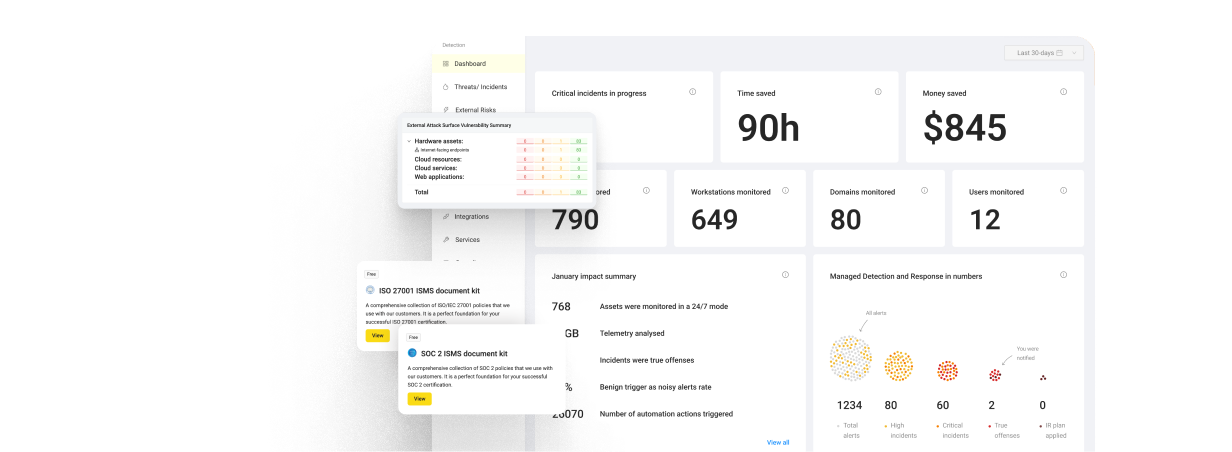
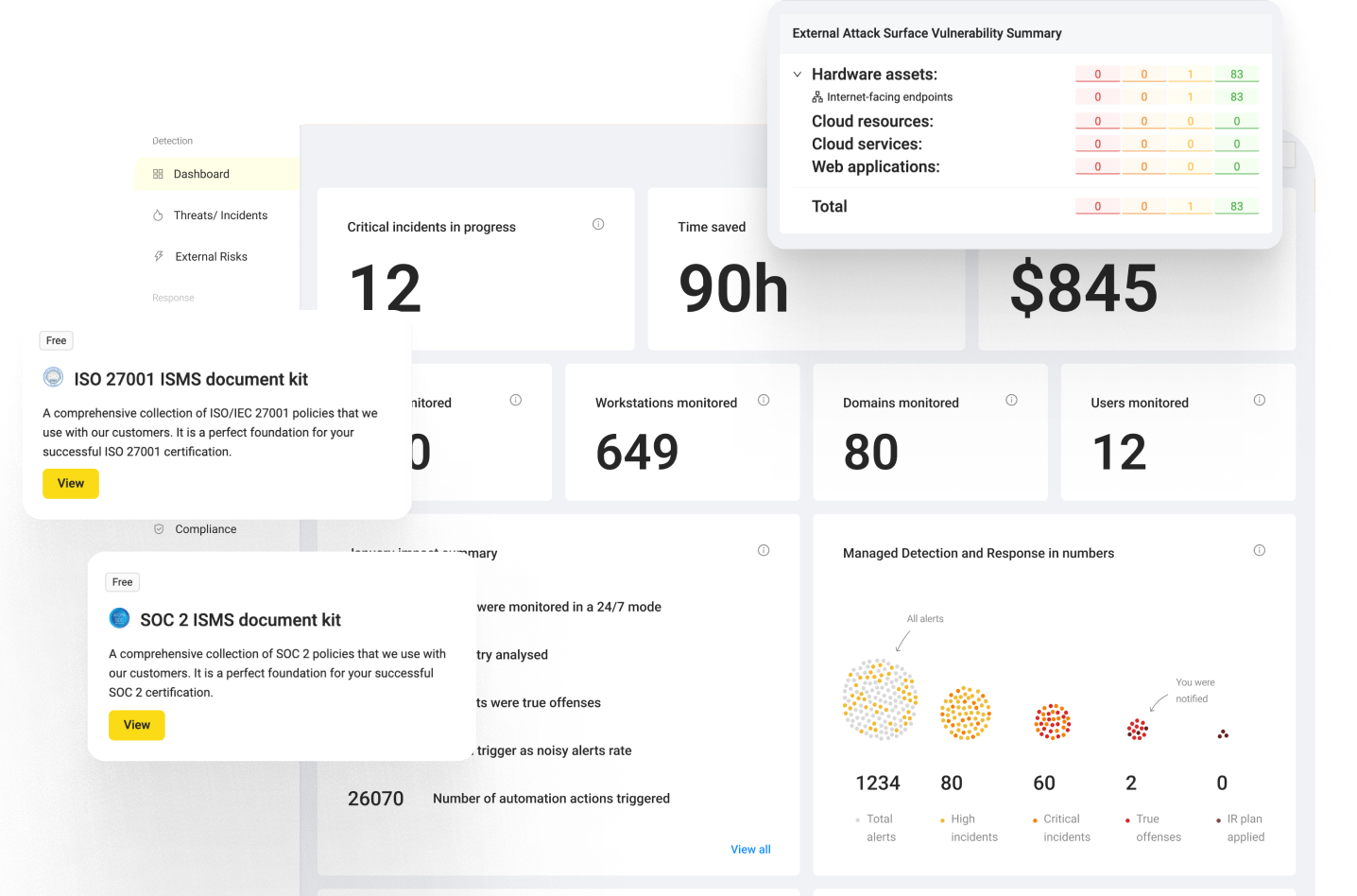
See how the UnderDefense Agentic AI SOC investigates, triages, and resolves real alerts.
The Ranking at a Glance
| Provider | Best For | Key Strength | Compliance |
| 1. UnderDefense 5 stars | Teams that want speed without losing SIEM ownership | Runs inside your existing Splunk, Sentinel, Chronicle, QRadar, or Elastic with no rip-and-replace | SOC 2, ISO 27001, HIPAA, PCI DSS, GDPR, NIS2, and DORA support |
| 2. Arctic Wolf 4 stars | Mid-market teams with no internal SOC | Concierge Security model with a named team | SOC 2, HIPAA, and PCI DSS readiness |
| 3. Expel 4 stars | Cloud-first estates with strong endpoint telemetry | Transparent workbench and fast connector-based setup | SOC 2, ISO 27001 |
| 4. CrowdStrike Falcon Complete 4 stars | Existing Falcon customers | Next-Gen SIEM data onboarding built around the Falcon agent | SOC 2, PCI DSS, HIPAA |
| 5. Red Canary 3 stars | Endpoint-heavy security teams | Detection engineering depth and published detector logic | SOC 2, ISO 27001 |
| 6. ReliaQuest 3 stars | Enterprises wanting heavy automation | GreyMatter automation layer across existing tools | SOC 2, ISO 27001, PCI DSS |
| 7. Deepwatch 3 stars | Splunk-committed enterprises | Deep Splunk engineering bench | SOC 2, HIPAA, PCI DSS |
| 8. Binary Defense 3 stars | Mid-market teams wanting co-managed SIEM | Flexible co-managed model and open telemetry intake | SOC 2, HIPAA |
| 9. BlueVoyant 3 stars | Microsoft-native environments | Sentinel and Defender specialisation with native connectors | SOC 2, ISO 27001, CMMC support |
| 10. Secureworks Taegis 3 stars | Regulated enterprises needing broad coverage | Long-running threat research and Taegis XDR telemetry breadth | SOC 2, ISO 27001, PCI DSS, HIPAA |
Why the Ranking Uses Validated Detections, Not First Log
Most vendors quote one blended onboarding number. That number usually measures the moment data arrives, which is the easy part.
I score the harder date instead: the day a detection fires and an analyst can act on it without guessing. Ingestion is plumbing. Trust is engineering.
1.1 UnderDefense (UnderDefense Agentic AI SOC)
5 stars. Score: 94/100. Realistic onboarding: platform in under 5 minutes, validated detections by day 30.
Overview
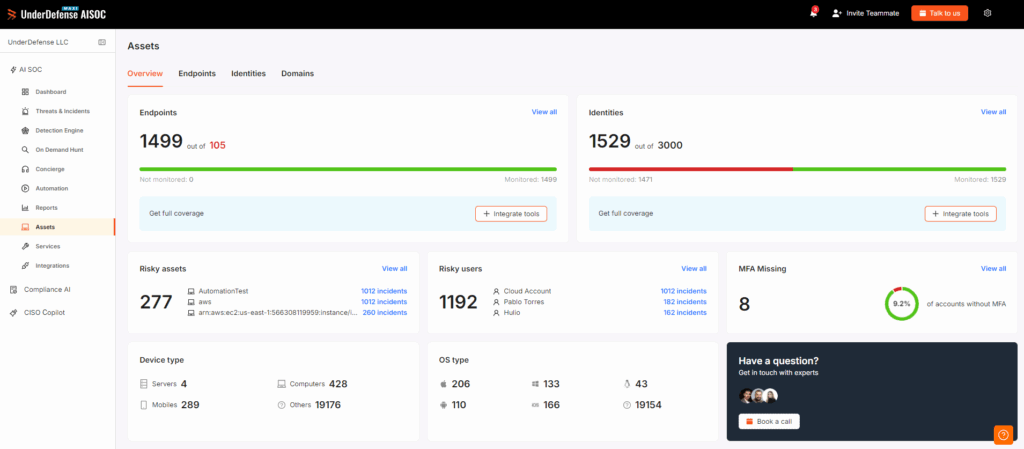
UnderDefense delivers an Agentic AI SOC that sits on top of the SIEM a customer already owns, rather than replacing it. The platform, UnderDefense Agentic AI SOCI, runs as a unified security operations layer across identity, endpoint, cloud, network, and SaaS telemetry.
Full deployment on prepared infrastructure takes under five minutes, and the platform ships with over 700 MITRE ATT&CK-mapped investigation workbooks that are operational on day one. Those workbooks encode how our SOC analysts actually investigate, which is why the clock to a usable detection is short.
Core Services
- 24/7 threat detection and autonomous investigation via six specialised AI Teammates, 200+ agent skills, and 400+ AI tools
- Managed SIEM and co-management across Splunk, Sentinel, Chronicle, QRadar, and Elastic
- Detection Logic as Code: rules version-controlled, unit-tested, and deployed through CI/CD
- On-premise and air-gapped deployment on any Kubernetes cluster, with bring-your-own AI model
- Incident response support, threat hunting, vCISO advisory, and compliance evidence reporting
Why Companies Consider UnderDefense
The pull is speed that does not cost ownership. Every investigative step is observable and auditable, so a security director can show a board exactly what the AI did and what a human decided.
UnderDefense Agentic AI SOC also asks people questions. ChatOps pings users over Slack, Teams, email, or SMS to confirm whether that odd login was really them. That single habit kills a large share of false positives during the first month.
Ideal Customer Profile
Best suited for:
- Mid-market through Fortune 500 organisations, with no employee-count floor
- Teams that already own a SIEM and refuse to migrate off it
- Regulated, sovereign, or air-gapped environments where telemetry cannot leave the perimeter
- Security leaders facing a SOC 2, NIS2, DORA, or PCI DSS date inside two quarters
Commercial Model
Subscription pricing scaled to monitored assets and ingest volume, with cloud-delivered or fully on-premise deployment. A built-in AI Cost Center gives finance live, per-investigation visibility into model token consumption and dollar cost. Independent analysis puts on-premise UnderDefense Agentic AI SOC at up to 44% lower total cost of ownership than building an equivalent AI investigation pipeline in-house, and published managed SIEM pricing makes that comparison straightforward.
When to Shortlist
Shortlist UnderDefense when the deadline is real, the SIEM is staying, and the answer to “who owns the detection logic when we leave” has to be “we do.”
Customer Reviews
“The speed of onboarding was a delightful surprise. In times where integrating new systems can take weeks, UnderDefense had us up and running in no time. Their 24/7 detection and response service is fast and comprehensive, providing us with a granular, real-time view of our environment.”
– Valeriia D., Marketing Specialist, UnderDefense G2 – Verified Review
“Setting everything up took some back and forth to get our tools properly integrated. Not really a complaint since it’s expected, but worth mentioning for others considering the service. You’ll need to dedicate some time upfront to get things configured properly.”
– Verified User in Marketing and Advertising, UnderDefense G2 – Verified Review
“No Underdefense’s fault entirely, but getting all our logs and stuff flowing took longer than I expected.”
– Andriy H., Co-Founder and CTO, UnderDefense G2 – Verified Review
That third review is the honest one, and I keep it in every deck. Log flow depends on approvals and parsers inside the customer’s own building. UnderDefense measured this directly in one environment: correlation tuning during onboarding cut daily ingestion from 300GB to roughly 35 to 40GB, which lowered licence cost while raising signal quality at the same time.
UnderDefense holds position one because it pairs a five-minute platform deployment with a deliberate 30-day detection-engineering window, running on the SIEM you already paid for.
Managed SIEM
WHERE THIS IS HANDLED
UnderDefense runs managed SIEM inside the stack you already own.
If you want a second opinion on which of these onboarding timelines is realistic for your environment, this is the work we do every day.
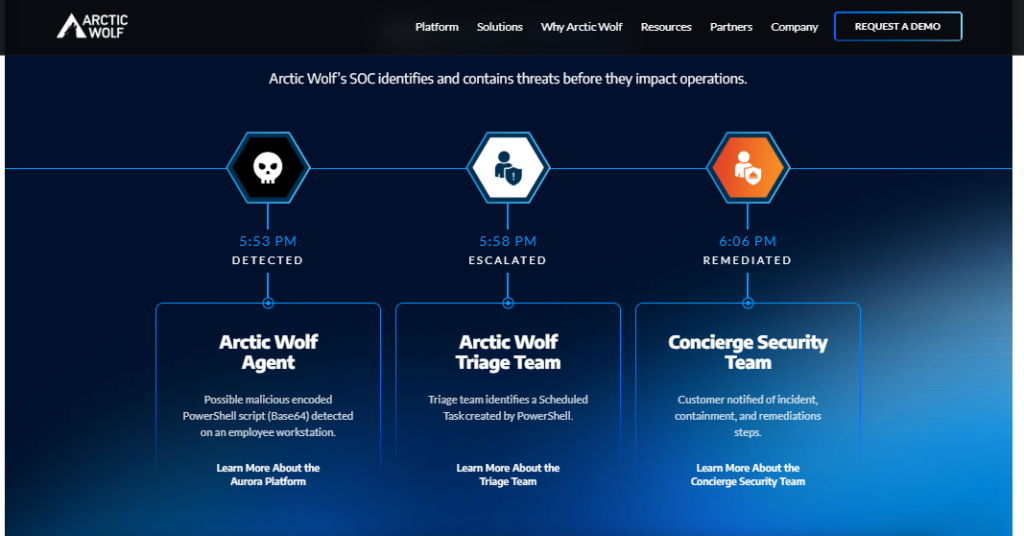
1.2 Arctic Wolf
4 stars. Score: 71/100. Realistic onboarding: 2 to 4 weeks to first alerts, 60 to 90 days to tuned coverage.
Overview
Arctic Wolf runs a fully outsourced security operations model for organisations that do not want to build an internal SOC. The service bundles continuous monitoring, risk management, and incident response into one managed subscription, which is why mid-market buyers keep shortlisting it.
Onboarding is genuinely quick at the front end. The reason is architectural: telemetry flows into Arctic Wolf’s own platform, so template detections switch on without waiting for your parsers.
Core Services
- 24/7 monitoring and threat detection through the Concierge Security model
- Cloud and endpoint security monitoring
- Vulnerability and risk management
- Incident response support and log monitoring
- Compliance readiness assistance across SOC 2, HIPAA, and PCI DSS
Why Companies Consider Arctic Wolf
Buyers get a named security team instead of a dashboard licence, which solves the staffing problem directly. For a 200-person company with two IT generalists, that trade is often worth making.
The structural cost arrives later. Detections, correlation rules, and automation live in Arctic Wolf’s stack, so leaving means rebuilding that logic somewhere else, a pattern worth reading about before signing any managed SIEM contract with lock-in risk.
Ideal Customer Profile
Best suited for:
- Organisations with roughly 50 to 1,000 employees
- Cloud-first estates, with AWS the strongest fit
- Security-lean teams moving from tools to managed operations
- Compliance-driven companies wanting a single vendor
Commercial Model
Subscription pricing aligned to organisation size and monitored assets, with onboarding support included. Renewal terms deserve a careful read before signing, and a breakdown of Arctic Wolf pricing helps set expectations.
When to Shortlist
Shortlist Arctic Wolf when you have no internal SOC, a mostly cloud estate, and no strong requirement to keep detection logic in your own repository.
The Catch
On-premise coverage is thin, customisation runs through Arctic Wolf’s engineering team, and enterprise buyers frequently outgrow the model. Teams that hit that ceiling usually start reviewing Arctic Wolf alternatives at renewal.
Customer Reviews
“Anything you want to look at or changes you need to make in the product must go through their engineering team. As an MSP, this is a horrible way to do business for us.”
– Matt C., Manager, Cybersecurity Services, Arctic Wolf G2 – Verified Review
“Beware they add a 60 day renewal notice instead of the typical 30 day notice. If you don’t give notice of cancelling any services before 60 days, you will automatically renew everything.”
– Verified User in Electrical/Electronic Manufacturing, Arctic Wolf G2 – Verified Review
UnderDefense sees the same trade from the other side: customers who arrive after a rip-and-replace engagement usually spend their first month rebuilding correlation rules that never transferred out.
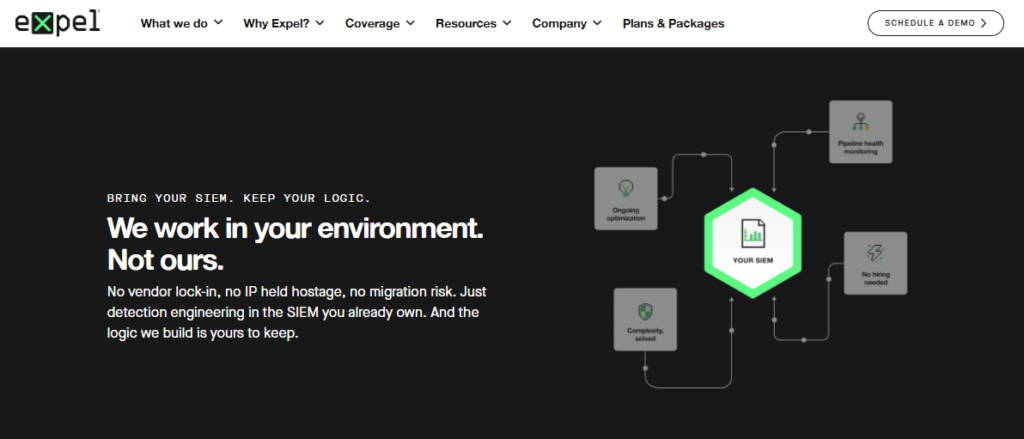
1.3 Expel
4 stars. Score: 68/100. Realistic onboarding: 1 to 3 weeks to first alerts, 45 to 75 days to tuned coverage.
Overview
Expel connects to tools a customer already owns through API integrations rather than a proprietary agent. That design choice is the main reason its front-end setup runs fast.
The workbench is unusually transparent for this category. A security director can watch an investigation unfold, which shortens the trust-building phase that normally drags onboarding out.
Core Services
- 24/7 detection and response across cloud, identity, and endpoint telemetry
- API-based integration with existing EDR and cloud platforms
- Transparent investigation workbench with visible analyst notes
- Phishing triage and remediation guidance
- Cloud posture and configuration monitoring
Why Companies Consider Expel
Buyers pick Expel when they already own good tools and want analysts on top of them. Nothing gets ripped out, so procurement moves quickly, which is the same logic behind running an AI SOC on your existing SIEM.
Ideal Customer Profile
Best suited for:
- Cloud-first companies with mature endpoint tooling in place
- Larger mid-market and enterprise teams, often above 5,000 employees
- Security teams that want to audit analyst reasoning
Commercial Model
Subscription pricing tied to monitored technologies and user counts, with integrations included in standard onboarding.
When to Shortlist
Shortlist Expel when your stack is modern, your logs already flow, and transparency matters more than deep custom detection work. Buyers who weight that factor heavily usually compare providers with transparent investigation trails.
The Catch
Coverage leans heavily on endpoint signals. Network, SaaS, and identity telemetry can leave visibility gaps that only surface during a real incident. Smaller organisations often fall below the size Expel serves comfortably.
1.4 CrowdStrike Falcon Complete
4 stars. Score: 66/100. Realistic onboarding: days for endpoints, 60 to 90 days for full SIEM data onboarding.
Overview
Falcon Complete moves fastest when the Falcon agent is already deployed. Endpoint coverage can go live in days, because the telemetry pipe already exists.
The slower part is Next-Gen SIEM data onboarding. Third-party log sources need parsing and field mapping before detections behave properly.
Core Services
- Fully managed endpoint detection, investigation, and remediation
- Next-Gen SIEM with third-party log ingestion
- Identity threat protection and cloud workload security
- Threat intelligence enrichment on escalations
- Managed threat hunting
Why Companies Consider CrowdStrike
Existing Falcon customers get the shortest possible path to 24/7 coverage. One agent, one console, one contract.
Ideal Customer Profile
Best suited for:
- Organisations already standardised on Falcon endpoints
- Teams wanting endpoint-led detection with SIEM added later
- Enterprises comfortable consolidating on a single vendor
Commercial Model
Per-endpoint subscription with separate data ingestion tiers for Next-Gen SIEM. Ingest volume drives most of the variable cost.
When to Shortlist
Shortlist Falcon Complete when Falcon is already your endpoint standard and endpoint risk is the primary worry. Teams weighing the managed layer separately often review CrowdStrike OverWatch against a dedicated AI SOC first.
The Catch
Non-endpoint telemetry is the long pole. The Zimbra case I keep returning to makes the point: attackers used a crafted HTTP request in memcache to harvest more than ten credential pairs. Despite CrowdStrike and Splunk being present, the initial phase went fully undetected, because logs were never enabled on a pilot application.
1.5 Red Canary
3 stars. Score: 59/100. Realistic onboarding: 3 to 6 weeks to first alerts, 90 days plus to tuned coverage.
Overview
Red Canary built its reputation on detection engineering discipline and publishes much of its detector logic openly. That rigour produces high-quality alerts and a longer ramp.
Core Services
- Managed detection across endpoint, cloud, identity, and SaaS
- Published detection engineering and testing methodology
- Automated response playbooks
- Threat intelligence research output
- Alert triage with confirmed-threat escalation
Why Companies Consider Red Canary
Teams that have been burned by noisy vendors come here for signal quality. The detection library is a genuine asset, and the same discipline shows up in providers that treat rules as detection as code.
Ideal Customer Profile
Best suited for:
- Endpoint-heavy security teams with in-house analysts
- Larger organisations, commonly above 5,000 employees
- Buyers who value detection depth over deployment speed
Commercial Model
Subscription based on endpoint and identity counts, with response automation priced separately.
When to Shortlist
Shortlist Red Canary when detection quality outranks your calendar and you have an internal team to receive escalations.
The Catch
Onboarding runs long, and customers report extended ramp periods before steady state. If your audit date sits eight weeks out, the timeline works against you.
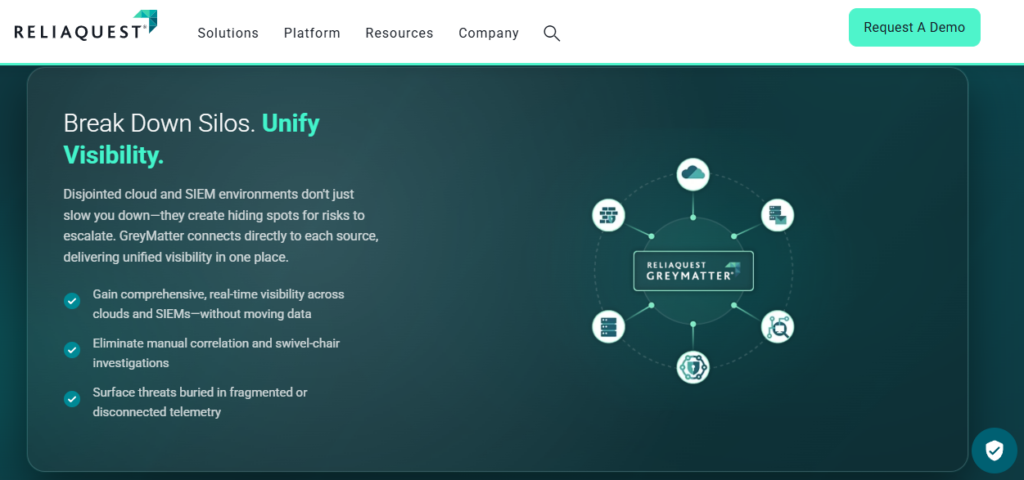
1.6 ReliaQuest (GreyMatter)
3 stars. Score: 55/100. Realistic onboarding: 3 to 5 weeks to first alerts, 90 to 120 days to tuned coverage.
Overview
ReliaQuest layers its GreyMatter platform across tools you already run, which sounds like the vendor-agnostic path. In practice, the platform aims to take over the SIEM role over time.
Core Services
- Automated detection, investigation, and response through GreyMatter
- Integration layer across existing security tooling
- Threat hunting and attack surface management
- Detection coverage reporting mapped to frameworks
- 24/7 monitoring with automated containment options
Why Companies Consider ReliaQuest
Automation volume is the draw. Enterprises with thin staffing want machine-speed triage across many tools.
Ideal Customer Profile
Best suited for:
- Enterprises with sprawling, multi-vendor tool estates
- Teams prioritising automation coverage over analyst narrative
- Organisations consolidating detection reporting
Commercial Model
Platform subscription plus service fees scaled to integrated tools and data volume.
When to Shortlist
Shortlist ReliaQuest when tool sprawl is your main problem and heavy automation is acceptable. Teams uneasy about that balance often start with a list of ReliaQuest alternatives.
The Catch
Customers describe over-reliance on automation, with tickets returning to them lacking clear answers. That pattern shows up in peer feedback across this category, where analysts provide little context and follow-up requests go unanswered. An alert without a decision is still your work.
1.7 Deepwatch
3 stars. Score: 52/100. Realistic onboarding: 4 to 8 weeks to first alerts, 4 to 6 months to tuned coverage.
Overview
Deepwatch runs deep Splunk engineering, which suits organisations already committed to Splunk. That dependency shapes both cost and calendar.
Core Services
- Managed detection built on Splunk Enterprise Security
- Custom detection engineering and content tuning
- Threat hunting and vulnerability management
- Compliance-aligned reporting
- 24/7 monitoring with named squad model
Why Companies Consider Deepwatch
Splunk-heavy enterprises get engineers who genuinely know the platform. For complex data problems, that expertise is real, and it is the same bench requirement behind any MDR engagement built on Splunk.
Ideal Customer Profile
Best suited for:
- Enterprises with existing Splunk licences and large ingest volumes
- Regulated organisations needing custom detection content
- Teams with budget headroom for Splunk data costs
Commercial Model
Service subscription layered on top of Splunk licensing, which the customer usually funds separately.
When to Shortlist
Shortlist Deepwatch when Splunk is permanent and the ingest budget is already approved.
The Catch
The Splunk tie raises cost, and the architecture stays comparatively closed. Response ownership after a confirmed breach is the gap customers feel most. Alert Logic peer reviews illustrate the wider pattern well: one reviewer described a system that got infected while support took no responsibility for the incident.
1.8 Binary Defense
3 stars. Score: 50/100. Realistic onboarding: 3 to 6 weeks to first alerts, 90 days to tuned coverage.
Overview
Binary Defense offers a co-managed model, meaning your team and theirs share the console and the workload. That flexibility helps mid-market teams who want to keep some control.
Core Services
- Co-managed SIEM and 24/7 SOC monitoring
- Open telemetry intake across mixed tooling
- Threat hunting and counterintelligence research
- Endpoint monitoring and containment support
- Detection tuning alongside the customer team
Why Companies Consider Binary Defense
Co-management preserves institutional knowledge inside your own team. Analysts stay close to the data instead of behind a portal, which is the core argument for keeping your own SIEM data lake.
Ideal Customer Profile
Best suited for:
- Mid-market teams with one or two internal security staff
- Organisations wanting shared console access
- Buyers rebuilding after an unsatisfactory MSSP contract
Commercial Model
Subscription scaled to log sources and endpoints, with co-managed SIEM licensing usually customer-owned.
When to Shortlist
Shortlist Binary Defense when you want partnership rather than full outsourcing, and you have staff to participate.
The Catch
Co-management only works when your team shows up. Thin internal staffing is one of the top causes of onboarding slippage across every provider in this list, which is why a managed SIEM readiness assessment belongs before the contract.
1.9 BlueVoyant
3 stars. Score: 48/100. Realistic onboarding: 2 to 4 weeks in Microsoft estates, 90 days to tuned coverage.
Overview
BlueVoyant specialises in Microsoft Sentinel and Defender, and native connectors do most of the heavy lifting. In a Microsoft-native estate, that connector density is the strongest predictor of a quick start.
Core Services
- Managed Sentinel and Defender operations
- Native connector deployment and data onboarding
- Supply chain and external risk monitoring
- Digital risk protection
- 24/7 monitoring with compliance reporting
Why Companies Consider BlueVoyant
Microsoft E5 customers avoid paying twice for telemetry they already license. The economics are straightforward, and the same holds for MDR built around Microsoft 365.
Ideal Customer Profile
Best suited for:
- Microsoft-native organisations running Sentinel or Defender
- Public sector and defence suppliers needing CMMC support
- Teams wanting supply chain visibility alongside detection
Commercial Model
Subscription priced on monitored assets, with Sentinel ingest costs billed through the customer’s Azure account.
When to Shortlist
Shortlist BlueVoyant when Microsoft is the centre of your estate and Sentinel is staying.
The Catch
The specialisation cuts both ways. Non-Microsoft telemetry, legacy applications, and OT sources need custom parsers, which is where the calendar stretches. Hybrid estates usually need a managed SIEM built for hybrid and on-premise sources.
1.10 Secureworks Taegis
3 stars. Score: 46/100. Realistic onboarding: 4 to 8 weeks to first alerts, 4 to 6 months to tuned coverage.
Overview
Secureworks brings long-running threat research and broad telemetry coverage through Taegis. Enterprise procurement teams trust the name, and enterprise timelines follow.
Core Services
- Taegis XDR with managed detection and response
- Third-party telemetry ingestion and correlation
- Incident response retainers
- Threat intelligence from long-standing research teams
- Compliance and regulatory reporting support
Why Companies Consider Secureworks
Regulated enterprises want a provider that survives due diligence. Breadth of coverage and research pedigree carry weight in board packs.
Ideal Customer Profile
Best suited for:
- Large regulated enterprises with complex estates
- Organisations needing incident response retainers alongside monitoring
- Global teams requiring multi-region coverage
Commercial Model
Subscription tied to endpoints and ingested data, with incident response retainers priced separately.
When to Shortlist
Shortlist Secureworks when scale, research depth, and multi-region coverage matter more than time-to-value.
The Catch
Onboarding follows enterprise pacing, and detection content lives in the Taegis stack. Switching later means rebuilding correlation rules and automation somewhere else, the exact cost covered in this guide to avoiding managed SIEM vendor lock-in.
How to Read This Ranking Against Your Own Estate
Nobody should buy from position order alone. Three variables move a vendor up or down for your specific environment.
Count your log sources that lack a native connector. That number, more than any brochure claim, sets your real timeline. Then check whether a migration is in flight, because detection translation off Splunk or QRadar adds four to ten weeks. A structured list of managed SIEM evaluation questions keeps that conversation honest.
The Benchmark Every Timeline Must Beat
Median break-in time has dropped to roughly 48 minutes, and the fastest observed break-in sits around 51 seconds. Set that against a six-month ramp and the gap becomes a board-level number.
My honest read: a 30-day window spent on detection engineering beats a 14-day window spent on template rules. UnderDefense chose the 30-day bar deliberately, building customised detections that return validated offences and cutting roughly 99% of noise. I could be reading our own data too strongly here, though the ingestion figures keep pointing the same direction.
UnderDefense earns position one on a narrow, testable claim: UnderDefense Agentic AI SOC platform deployment in under five minutes, detections written as version-controlled code you keep, and a 30-day engineering window running on the SIEM you already own.
Q2. How Were These Managed SIEM Vendors Scored and Ranked?
Each vendor was scored out of 100 across five weighted criteria: Time-to-First-Validated-Detection 30%, Vendor-Agnostic Integration 25%, Investigation Transparency and Depth 20%, Verified User Reviews 15%, and Pricing Transparency 10%. Bands run 0-20 for one star through 81-100 for five. UnderDefense scores 94. No vendor funded, reviewed, or previewed this ranking.
Why Speed Alone Is a Bad Criterion
Ranking purely on calendar days would reward the wrong behaviour. A provider can switch on template rules in ten days and hand you a bigger alert queue.
Oxford researchers surveyed SOC analysts and recorded one practitioner quantifying the alarm problem at 99% false positives. Speed that multiplies that number is a cost, so depth carries weight beside it here, which is the whole argument behind treating alert fatigue as a design problem.
The Five Criteria and Accepted Evidence
Every score traces to something checkable. Vendor marketing claims were logged but never scored on their own.
| Criterion | Weight | Evidence accepted |
| Time-to-First-Validated-Detection | 30% | Vendor deployment documentation, stated durations inside verified reviews |
| Vendor-Agnostic Integration | 25% | Published connector lists, co-management support for customer-owned SIEM |
| Investigation Transparency and Depth | 20% | Evidence trails, query counts per investigation, and analyst notes visible to customer |
| Verified User Reviews | 15% | G2 and Gartner Peer Insights, mixed ratings, and sample date range disclosed |
| Pricing Transparency | 10% | Published pricing pages, ingest-tier disclosure, and retention overage terms |
Why Prevention ROI Was Excluded
Proving breach-prevention ROI is a trap, and I stopped trying years ago. Proving a negative is a very difficult proposition, because no single tool can claim the breach that never happened.
So the rubric measures comparative cost and time-to-value of delivery options instead. That is a number a CFO can actually audit, and a managed SIEM ROI calculator makes the comparison concrete.
Star Bands and Full Disclosure
| Score | Rating |
| 81-100 | 5 stars |
| 61-80 | 4 stars |
| 41-60 | 3 stars |
| 21-40 | 2 stars |
| 0-20 | 1 star |
The time-to-value dataset came from mining more than 100 recent G2 and Gartner Peer Insights reviews for stated onboarding durations. Reviews spanned 2019 through early 2026, with heavier weight on entries from the last 24 months. Scores carry a last-verified date and get re-checked quarterly.
Where I Might Be Wrong
Review-mined durations are self-reported, so they skew toward memorable extremes. My current read is that they still beat vendor brochures, though I hold that view loosely.
Anyone can reproduce this. Take the five weights, pull the same review sets, and score your own shortlist using a standard set of managed SIEM evaluation questions.
UnderDefense scored 94 out of 100, losing marks only on published pricing for enterprise on-premise deployments, and scoring highest for operating inside a SIEM the customer already owns rather than replacing it.
Q3. How Long Does Managed SIEM Onboarding Actually Take, Phase by Phase?
Managed SIEM onboarding runs two weeks to six months. Platform deployment and first log flow take 5 minutes to 14 days on cloud-native estates. Full priority log-source coverage takes 2 to 6 weeks. First validated detections land day 21 to 45. Tuned steady state arrives day 30 to 90, stretching to six months where custom parsers, OT telemetry, or a Splunk migration are involved.
The Four Milestones Vendors Blend Into One
Most proposals quote a single number. That number usually measures ingestion, which is the plumbing rather than the protection.
Split it into four dates instead. Contract-to-first-log (day 0 to 14), first-log-to-full-coverage (week 2 to 6), coverage-to-first-validated-detection (day 21 to 45), and detection-to-tuned-steady-state (day 30 to 90).
The Five Phases in Order
- Scoping and log-source discovery, including parser availability per source
- Access, agent, and connector deployment with change-control approvals
- Ingestion, parsing, and normalisation (mapping raw logs into common fields)
- Detection enablement mapped to MITRE ATT&CK (the public catalogue of attacker techniques)
- Alert tuning, playbook validation, and 24/7 SOC handover
UnderDefense separates these dates in the contract, with UnderDefense Agentic AI SOC deploying on prepared Kubernetes infrastructure in under five minutes, followed by a 30-day detection-engineering window. The full sequence is laid out in this managed SIEM implementation guide.
The Migration Surcharge Nobody Quotes
Leaving Splunk or QRadar adds real weeks. You need a parallel run, historical data rehydration, and detection translation into the new platform.
Budget four to ten extra weeks for that translation alone. Correlation logic rarely ports cleanly, so someone rewrites it by hand.
Why the Clock Matters
Mandiant put global median dwell time at 14 days in 2025, up from 11. Set that against a six-month ramp and the exposure window becomes a board-level number.
Two tactical habits I insist on during every ramp. Generate a synthetic transaction proving each source can raise an alarm within two minutes. Configure sources using logical DNS names rather than IP addresses, so one node covers another during maintenance.
The Evidence Each Milestone Must Produce
| Milestone | Written proof required |
| First log flow | Source inventory with per-source ingestion timestamp |
| Full coverage | Gap report listing every source still missing a parser |
| First validated detection | Alert with full evidence trail and analyst decision |
| Tuned steady state | False-positive baseline plus ATT&CK coverage by tactic |
What Customers Report
“The speed of onboarding was a delightful surprise. In times where integrating new systems can take weeks, UnderDefense had us up and running in no time.”
– Valeriia D., Marketing Specialist, UnderDefense G2 – Verified Review
“No Underdefense’s fault entirely, but getting all our logs and stuff flowing took longer than I expected.”
– Andriy H., Co-Founder and CTO, UnderDefense G2 – Verified Review
Both reviews are true at once, and that is the point of splitting the milestones. Teams that check parser coverage first with a managed SIEM readiness assessment rarely get surprised here.
UnderDefense contracts the deployment date and the validated-detection date separately, because a customer deserves to know which promise is being made.
Q4. Why Does a Two-Week Onboarding Often Cost More Than a 30-Day One, and What Actually Causes Delay?
Two-week onboardings usually ship template detections over native connectors, so alerts arrive fast and confirmed findings slowly. Delay concentrates in six places, ranked: missing parsers for custom and legacy sources, network and agent access approvals, change-control windows, data-owner sign-off, OT telemetry, and thin internal staffing. Integration and schema mapping consume the calendar. Detection logic rarely does.
Faster Is Better, Except When It Is Not
The common view says shorten onboarding at any cost. The flaw shows up in month two, when a security director discovers they bought a faster way to be wrong.
UnderDefense saw the economics directly in one environment, cutting daily ingestion from 300GB to roughly 35 to 40GB by tuning correlation rules to drop unused and duplicate logs. Licence cost fell and signal quality rose in the same window. Vendors who bill by volume have no reason to make that trade, which is worth checking against published managed SIEM pricing.
Ranked Causes of Delay
- Missing parsers for custom and legacy log sources, which no brochure predicts
- Network and agent access approvals inside your own organisation
- Change-control windows that only open monthly
- Data-owner sign-off on which logs may leave which system
- OT and manufacturing telemetry, which often has no modern connector
- Thin internal staffing to support the provider’s engineers
Security orchestration research identifies interoperability and semantic unification as the dominant integration bottleneck, which matches what actually happens on the ground. Industrial estates feel it hardest, which is why managed SIEM for manufacturing follows a different plan.
Run This Self-Assessment Before Signing
Count four things and read your realistic band.
| Answer | Points |
| Log sources with no native connector: 0-3 / 4-10 / 11+ | 0 / 2 / 4 |
| Change-control cadence: weekly / monthly / quarterly | 0 / 1 / 3 |
| OT or legacy industrial telemetry present | +3 |
| SIEM migration in flight | +3 |
Score 0 to 2 means two to four weeks is realistic. Score 3 to 6 means 45 to 90 days. Score 7 or higher means plan for four to six months and stop negotiating on speed.
Where Agentic AI Genuinely Compresses the Calendar
AI helps on four tasks, all of them engineering work. Parser generation, log normalisation, detection drafting, and evidence summarisation.
UnderDefense runs over 100 distinct large language model invocations to autonomously investigate a single alert, which is a recursive reasoning process rather than a single prompt. That depth is what turns a raw alert into a documented decision, and it is measurable as AI SOC investigation speed.
Where AI Changes Nothing
No model approves your firewall change request. No agent gets a data owner to sign off, and none of them knows which server runs payroll.
One founder let an agent write code unsupervised, and it deleted his production database. So before any agent writes a detection, make it write a plan document first, then edit that document yourself. That review step is the core of human-in-the-loop SOC design.
What to Put in Writing Instead
Contract two false-positive baselines: one at day 30, one at day 90. Make the day-90 number the actual go-live date.
Ask each vendor which playbooks ship pre-built and how many are live on day 14. The answer separates engineering from marketing quickly, and the clauses worth insisting on are collected in this guide to SOC contract clauses.
UnderDefense treats detections as version-controlled code, unit-tested and deployed through CI/CD, so the tuning work stays in your repository when the contract ends.
Q5. Does Fast Onboarding Mean Giving Up Ownership of Your SIEM, Detections and Logs?
Often yes. The fastest onboardings are frequently fast because the provider replaces your stack with their proprietary SIEM, where template detections deploy instantly. The cost lands at renewal: correlation rules, business logic, and automation do not transfer out, so switching restarts tuning from zero. Retention defaults also vary from 90 days to 12 months, which changes both compliance eligibility and true cost.
Why Rip-and-Replace Looks Fast on the Gantt Chart
Replacing your SIEM removes the hardest onboarding problem, which is your data. The vendor controls the schema, the parsers, and the rules, so nothing needs negotiating.
Then you switch vendors three years later. The business logic, the correlation rules, and the automation rules do not come with you, so you start the tuning process all over again. That renewal trap is covered in detail in this guide to avoiding managed SIEM vendor lock-in.
Where the Pain Shows Up
Peer reviews describe the pattern in plain terms. One Gartner reviewer of a major provider wrote that this is not an extension of our security team as was originally sold.
Another described log collectors showing as working, then no logs available when an investigation needed them. Ownership questions surface exactly at that moment.
The Ownership Test, Vendor by Vendor
| Provider | Runs in your SIEM | Detection content on exit | On-premise or air-gapped |
| UnderDefense | Yes, unified layer over existing SIEM, EDR, and cloud logs | Versioned, unit-tested code you keep | Yes, any Kubernetes cluster |
| Arctic Wolf | No, proprietary platform | Vendor-side | Limited |
| ReliaQuest | Overlay trending toward SIEM replacement | Vendor-side | Limited |
| Deepwatch | Splunk-dependent | Splunk-tied content | Splunk-dependent |
| BlueVoyant | Yes, Microsoft Sentinel | Sentinel-resident | Azure-bound |
| Expel | Yes, API integrations | Vendor workbench | Cloud only |
What “Detection Logic as Code” Actually Means
Rules written in flexible query languages, held in version control, unit-tested, and deployed through CI/CD (automated release pipelines). The logic lives in your repository, which is the standard set by platforms built for detection as code with CI/CD pipelines.
I want all the Lego bricks that make up the hard pieces of an AI SOC, then I want to build my own platform on top. That is the test I would apply to any provider.
Managed SIEM, XDR, and MDR in 60 Words
Managed SIEM centralises log aggregation, correlation, retention, and compliance reporting. XDR prioritises real-time detection and response across endpoint, identity, and cloud. MDR wraps analyst-led investigation around either one. Most 2026 providers now sell converged SIEM plus XDR under one contract, which is exactly why the ownership question needs asking separately, and this breakdown of managed SIEM versus MDR versus MSSP keeps the categories straight.
What Customers Say About Setup and Ownership
“The seamless integration and optimization of the EDR platform, CrowdStrike, has been impressive. Despite the complexity involved, they delivered the deployment to 1200 endpoints in just 23 business days.”
– Oleksii M., Mid-Market, UnderDefense G2 – Verified Review
“We’d love to see a more streamlined customization process that reduces implementation time and unlocks even greater value for us.”
– Oleksii M., Mid-Market, UnderDefense G2 – Verified Review
“You pretty much have to whitelist everything you don’t want it to block. In our multi-application environment this process has been going on for 8 months.”
– Verified User in Civil Engineering, Arctic Wolf G2 – Verified Review
Three Exit Clauses to Negotiate Before Signing
- Detection content export: all correlation rules and playbooks delivered in a documented, machine-readable format within 30 days of termination.
- Raw log ownership: logs remain your property, exportable at no per-GB egress fee, with retention stated in months.
- Data residency and deployment: named region, plus the right to run on-premise or air-gapped if regulation changes.
Buyers who want that language pre-drafted can start from this collection of SOC contract clauses.
UnderDefense operates as a unified layer on top of your existing SIEM, EDR, and cloud logs, treats detections as versioned and unit-tested code, and deploys fully on-premise or air-gapped, so logs and AI data stay in your own SIEM data lake.
Q6. What Does Managed SIEM Cost, and What Must the Onboarding SLA Contain to Hit Your Compliance Date?
Pricing tracks ingest volume: roughly 2,000 to 3,500 GBP monthly at 50 EPS, 3,500 to 6,000 at 100 EPS, and 10,000-plus at 250 EPS before retention upgrades. Demand four dated milestones with service credits: first log flow, full source coverage, first validated detection, and tuned steady state with a stated false-positive baseline. Separate alert-to-triage from escalation instead of accepting one blended MTTR.
Pricing Bands by Volume
EPS means events per second, the standard ingest unit vendors price against. Published managed SIEM price ranges give you a baseline to negotiate against.
| Ingest volume | Typical monthly range | Retention exposure |
| 50 EPS (about 5 GB/day) | 2,000 to 3,500 GBP | 90-day default, overage per GB |
| 100 EPS (about 10 GB/day) | 3,500 to 6,000 GBP | 6 months typical |
| 250 EPS (about 25 GB/day) | 10,000+ GBP | 12 months priced separately |
Retention overage is where budgets break. Ask for the per-GB rate beyond the included tier in writing.
Why to Reject Blended MTTR
MTTR (mean time to respond) merges two different promises into one soft number. Triage speed and escalation speed are separate operational commitments, so contract them separately, a point made at length in this AI SOC SLA guide.
UnderDefense commits to 2-minute alert-to-triage and 15-minute escalation for critical incidents as two distinct SLAs. One number would hide which promise failed.
The Four Milestone Clauses in Draftable Form
- First log flow: “Provider shall achieve ingestion from all Tier 1 sources listed in Schedule A by day X, evidenced by per-source timestamps.”
- Full source coverage: “All sources in Schedule A ingesting and parsed by day X, with a written gap report for any exclusions.”
- First validated detection: “At least one confirmed true-positive escalation with full evidence trail by day X.”
- Tuned steady state: “False-positive rate at or below Y% measured across day 60 to 90, with service credits of Z% of monthly fees per week of slippage.”
The Regulatory Clocks That Set Your Start Date
| Requirement | Clock | Milestone it depends on |
| SOC 2 Type II | 3 to 12 month observation window | Tuned steady state before window opens |
| PCI DSS 4.x | 12-month retention, 3 months immediately available | First log flow plus retention tier |
| NIS2 | 24-hour early warning, 72-hour notification | 24/7 handover complete |
| GDPR Article 33 | 72-hour breach notification | Validated detection with evidence |
| SEC Item 1.05 | Four business days after materiality | Escalation SLA in place |
| CMMC 2.0 | Phased assessment dates | Full coverage plus documented monitoring |
Work backwards from the binding date. If your SOC 2 window opens in November, tuned steady state must land in October, which sets your latest acceptable start. Mapping evidence requirements early is easier with an AI SOC compliance guide in hand.
The One-Page Budget Map for Your CFO
Skip the ROI slide. Ask the CFO one question instead: what is your projected cost of business interruption per day?
Then map current spend across the five NIST CSF functions, Identify, Protect, Detect, Respond, and Recover. That single page shows where you spend and where you have nothing, which is a conversation finance can act on, and it pairs well with structured security budget planning.
Ask for Per-Investigation Cost
Agentic AI consumes compute, and compute has a price. Any provider running autonomous investigation should be able to show you the unit cost.
UnderDefense includes an AI Cost Center that gives procurement per-investigation cost visibility, which is unusual disclosure for this category.
UnderDefense contracts two commitments rather than one blended figure, 2-minute alert-to-triage and 15-minute escalation for critical incidents, with the AI Cost Center making the per-investigation economics auditable before renewal.
Q7. Which Managed SIEM Onboards Fastest for Your Environment, and What Should Day 90 Look Like?
Fastest depends on your estate. Microsoft-native mid-market environments onboard quickest with Sentinel-based providers on native connectors. Multi-cloud AWS and GCP estates need proven non-endpoint telemetry coverage. Hybrid OT and SCADA rules out cloud-only vendors. Regulated EU and air-gapped environments require on-premise deployment, narrowing the field to one or two options.
Four Estate Archetypes
| Estate | Fastest realistic option | Timeline band | Disqualifier |
| Microsoft-native mid-market | Sentinel-based provider on native connectors | 2 to 4 weeks | Heavy non-Microsoft or legacy sources |
| Multi-cloud SaaS scale-up | API-integrated provider with cloud and identity depth | 3 to 6 weeks | Endpoint-only coverage leaving SaaS and identity gaps |
| Hybrid OT and manufacturing | Provider with on-premise deployment and custom parsers | 8 to 16 weeks | Cloud-only architecture |
| Regulated or air-gapped enterprise | On-premise Kubernetes deployment | 6 to 12 weeks | No air-gapped option |
UnderDefense covers on-premise, AWS, GCP, Azure, SaaS, network, identity, and OT/SCADA, and scales from mid-market to Fortune 500 with no employee-count floor. Industrial estates usually need the pattern described in AI SOC for IT and OT environments.
The Employee-Count Floor Nobody Advertises
Several strong providers effectively require 5,000-plus employees before the engagement model works. A 600-person company asking for custom detection work often gets templates instead, which is why AI SOC for the mid-market is a separate conversation.
Ask directly what your smallest comparable customer looks like. The answer predicts how much attention you get in month three.
Seven Questions to Ask Every Vendor
- How many native parsers exist for my exact stack, source by source?
- What is live on day 14 versus day 90?
- What false-positive baseline will you commit to at day 30 and day 90?
- Who owns the detection content if I leave?
- Do you run inside my SIEM, or replace it?
- Who are your data scientists, and how do you evaluate model output?
- What happens at 2am when containment is needed, and who presses the button?
The Depth Test Made Concrete
Question six matters more than it looks. Many AI security startups will never tell you who their data scientists are, and never discuss evaluations. The disclosure standard worth holding them to is set out in this piece on AI SOC explainability and transparency.
UnderDefense runs over 100 distinct large language model invocations to autonomously investigate a single alert, against a human baseline of 40 to 50 queries across six tools. Ask to see the line-by-line evidence trail either way.
Your Day-90 Scorecard
- Full priority log-source coverage, with a written gap report for exclusions
- ATT&CK coverage documented by tactic, not by vague percentage
- False-positive baseline measured and falling month over month
- Line-by-line evidence on every escalation, readable by a non-analyst
- Synthetic transactions passing on every source inside two minutes
- A monthly report your board can read without translation
What Ramp-Up Actually Surfaces
“Impressed by the 30-day Impact Report. Building our cybersecurity from scratch felt like a daunting challenge.”
– Val R., Small-Business, UnderDefense G2 – Verified Review
“Setting it up can be tricky, especially for those new to such comprehensive security solutions.”
– Verified Reviewer, UnderDefense G2 – Verified Review
Onboarding surfaces more than malware. UnderDefense discovered a fraud during one customer’s first three months that saved roughly 300,000 dollars, which nobody had scoped for. I could be over-indexing on one case, though visibility keeps paying in unbudgeted ways.
The Question I Am Still Sitting With
A European telecom now runs a fully autonomous on-premise AI SOC at 44% lower total cost of ownership than an equivalent in-house build, using UnderDefense Agentic AI SOC. My open question is whether mid-market teams reach that model in 18 months or five years.
See how UnderDefense Agentic AI SOC resolves a real incident on your stack.
1. How fast can managed SIEM onboarding realistically happen in 2026?
Realistic managed SIEM onboarding runs two weeks to six months, and the spread depends almost entirely on your estate rather than the provider’s brochure. We split the calendar into four dates instead of quoting one blended number:
- Contract to first log flow: 5 minutes to 14 days on cloud-native estates
- First log to full priority source coverage: 2 to 6 weeks
- Coverage to first validated detection: day 21 to 45
- Detection to tuned steady state: day 30 to 90
Six months becomes realistic when custom parsers, OT telemetry, or a Splunk migration sit in scope. Migration alone adds four to ten weeks, because correlation logic rarely ports cleanly and someone rewrites it by hand.
UnderDefense deploys the MAXI platform on prepared Kubernetes infrastructure in under five minutes, then spends a deliberate 30-day window building customised detections that return validated offences. We contract the deployment date and the validated-detection date separately, so a customer knows exactly which promise is being made. Anyone planning a ramp should read our managed SIEM implementation guide before agreeing to a single headline number.
2. Why does a two-week onboarding often cost more than a 30-day one?
Two-week onboardings are usually fast because the provider ships template detections over native connectors inside their own platform. Alerts arrive quickly and confirmed findings arrive slowly, so month two is when a security director discovers they bought a faster way to be wrong.
The cost shows up in three places:
- Alert volume rises without validation, so your team absorbs the triage work you outsourced
- Ingest stays untuned, and volume-billed vendors have no reason to reduce it
- Detection content lives vendor-side, so switching later restarts tuning from zero
UnderDefense measured the opposite trade directly in one environment, cutting daily ingestion from 300GB to roughly 35 to 40GB by tuning correlation rules to drop unused and duplicate logs. Licence cost fell and signal quality rose in the same window.
My honest read is that a 30-day window spent on detection engineering beats a 14-day window spent on template rules. Buyers weighing that trade should compare timelines against published managed SIEM price bands, because speed bought with untuned ingest reappears as a licence line item.
3. What does managed SIEM cost at different ingest volumes?
Managed SIEM pricing tracks ingest volume, measured in events per second. Current market bands look like this:
- 50 EPS, about 5 GB per day: 2,000 to 3,500 GBP monthly, 90-day retention default with per-GB overage
- 100 EPS, about 10 GB per day: 3,500 to 6,000 GBP monthly, six months retention typical
- 250 EPS, about 25 GB per day: 10,000 plus GBP monthly, 12-month retention priced separately
Retention overage is where budgets actually break. Ask for the per-GB rate beyond the included tier in writing before signing, and confirm whether ingest is billed through your own cloud account or the provider’s.
Agentic platforms add a second cost axis, because autonomous investigation consumes compute and compute has a price. UnderDefense includes an AI Cost Center that gives procurement live per-investigation cost visibility, which is unusual disclosure for this category and makes renewal economics auditable.
Skip the prevention-ROI slide when you take this to finance. Map current spend across the five NIST CSF functions instead, and use structured security budget planning to show where you spend and where you have nothing.
4. What must an onboarding SLA contain to hit a compliance date?
Demand four dated milestones with service credits, not one go-live date. Each clause should name the evidence that proves it:
- First log flow: ingestion from all Tier 1 sources by day X, evidenced by per-source timestamps
- Full source coverage: every source parsed by day X, with a written gap report for exclusions
- First validated detection: one confirmed true-positive escalation with full evidence trail by day X
- Tuned steady state: false-positive rate at or below Y percent measured across day 60 to 90, with credits per week of slippage
Then work backwards from the binding regulatory date. A SOC 2 Type II window opening in November means tuned steady state must land in October, which sets your latest acceptable start. PCI DSS 4.x depends on first log flow plus the retention tier, while NIS2 depends on completed 24/7 handover.
Reject blended MTTR. UnderDefense contracts 2-minute alert-to-triage and 15-minute escalation for critical incidents as two distinct SLAs, because one merged number hides which promise failed. Our SLA guide sets out the language worth insisting on.
5. Do you keep your detections and logs if you leave the provider?
Often no, and that is precisely why some onboardings look so fast. Replacing your SIEM removes the hardest onboarding problem, which is your data, because the vendor then controls the schema, the parsers, and the rules. The bill arrives at renewal, when correlation rules, business logic, and automation do not transfer out and tuning restarts from zero.
Negotiate three exit clauses before signing:
- Detection content export: all rules and playbooks in a documented, machine-readable format within 30 days of termination
- Raw log ownership: logs remain your property, exportable with no per-GB egress fee, retention stated in months
- Data residency: named region, plus the right to run on-premise or air-gapped if regulation changes
UnderDefense operates as a unified layer on top of your existing Splunk, Sentinel, Chronicle, QRadar, or Elastic deployment, treats detections as version-controlled and unit-tested code you keep, and deploys fully on-premise or air-gapped on any Kubernetes cluster. Teams evaluating this risk should read our analysis of avoiding managed SIEM vendor lock-in before signing a three-year term.
6. Which managed SIEM onboards fastest for a Microsoft-native estate?
In a genuinely Microsoft-native mid-market estate, Sentinel-based providers running on native connectors are the fastest realistic option, typically two to four weeks to first alerts. Connector density is the strongest single predictor of a quick start, and E5 customers avoid paying twice for telemetry they already license.
The disqualifier is heavy non-Microsoft or legacy tooling. Specialisation cuts both ways, so non-Microsoft telemetry, legacy applications, and OT sources need custom parsers, which is exactly where the calendar stretches.
Other estates land differently:
- Multi-cloud SaaS scale-up: API-integrated provider with cloud and identity depth, 3 to 6 weeks
- Hybrid OT and manufacturing: on-premise deployment with custom parsers, 8 to 16 weeks
- Regulated or air-gapped enterprise: on-premise Kubernetes deployment, 6 to 12 weeks
UnderDefense covers on-premise, AWS, GCP, Azure, SaaS, network, identity, and OT/SCADA telemetry, and scales from mid-market to Fortune 500 with no employee-count floor, which matters because several strong providers effectively require 5,000 plus employees before the engagement model works. Microsoft-centred teams can see the delivery model in our MDR for Microsoft 365 practice.
7. What actually causes managed SIEM onboarding delay?
Integration and schema mapping consume the calendar. Detection logic rarely does. Ranked by how often they bite:
- Missing parsers for custom and legacy log sources, which no brochure predicts
- Network and agent access approvals inside your own organisation
- Change-control windows that only open monthly
- Data-owner sign-off on which logs may leave which system
- OT and manufacturing telemetry with no modern connector
- Thin internal staffing to support the provider’s engineers
Run a quick self-assessment before signing. Score two points for 4 to 10 sources with no native connector and four for 11 plus, one point for monthly change control and three for quarterly, plus three each for OT telemetry and a migration in flight. Score 0 to 2 means two to four weeks is realistic, 3 to 6 means 45 to 90 days, and 7 or higher means plan for four to six months and stop negotiating on speed.
Agentic AI compresses parser generation, normalisation, detection drafting, and evidence summarisation, though no model approves your firewall change request. Check parser coverage first with our managed SIEM readiness assessment.
8. What should managed SIEM look like at day 90?
Day 90 is the date worth contracting as real go-live. By then you should hold six things:
- Full priority log-source coverage, with a written gap report for every exclusion
- ATT&CK coverage documented by tactic, not by a vague percentage
- A false-positive baseline measured and falling month over month
- Line-by-line evidence on every escalation, readable by a non-analyst
- Synthetic transactions passing on every source inside two minutes
- A monthly report your board can read without translation
Two habits I insist on during every ramp: generate a synthetic transaction proving each source can raise an alarm, and configure sources using logical DNS names rather than IP addresses so one node covers another during maintenance.
Onboarding also surfaces more than malware. UnderDefense discovered a fraud during one customer’s first three months that saved roughly 300,000 dollars, which nobody had scoped for. I could be over-indexing on one case, though visibility keeps paying in unbudgeted ways. When the timeline needs scoping against your actual sources rather than a template, talk to our team.