




Q1: What Are the 9 Best AI SOC Platforms for Healthcare HIPAA-Compliant Threat Detection in 2026?
The 9 best AI SOC platforms for healthcare in 2026 are UnderDefense Agentic AI SOC, Arctic Wolf, CrowdStrike Falcon Complete, Expel, ReliaQuest GreyMatter, Red Canary, Microsoft Defender/Sentinel, eSentire, and Rapid7 MDR. Healthcare breaches now average $7.42M, so HIPAA teams need coverage across network, SaaS, and identity, plus fast concierge response. UnderDefense Agentic AI SOC leads because it stays vendor-agnostic and pairs AI detection with analysts who talk directly to affected users.
Here is the operator scene I keep coming back to. A hospital IT director pinged us near midnight, staring at a Defender console lighting up with alerts nobody could rank. His SIEM logged everything but told him nothing. His endpoint tool saw the laptop, but not the person or the patient data behind it. That gap, endpoint visibility without organizational context, is where most healthcare SOCs quietly break. Alerts pile up, tickets bounce back without answers, and the on-call human burns out. My read after sitting inside that work across many environments: the tool rarely fails first. The context around the tool fails first.
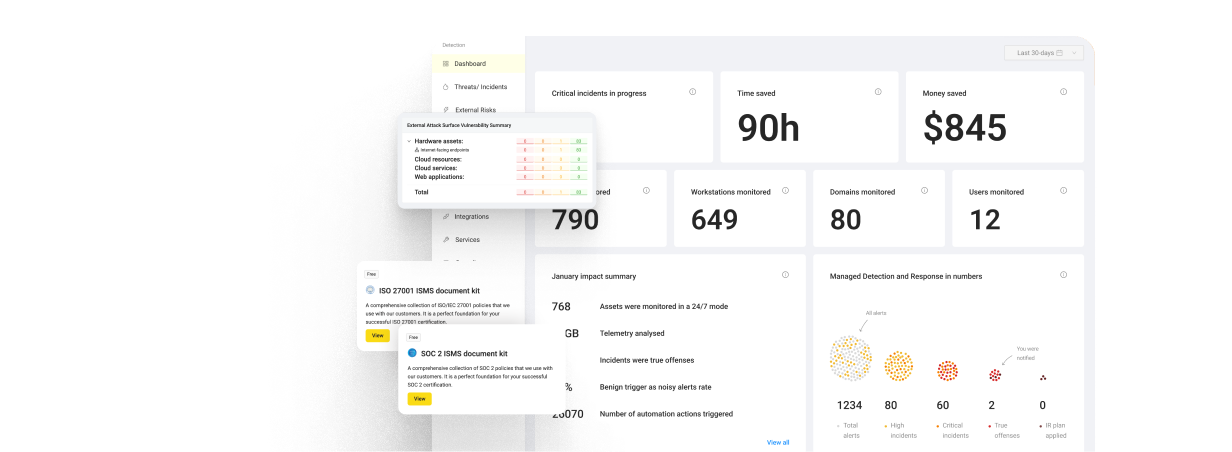
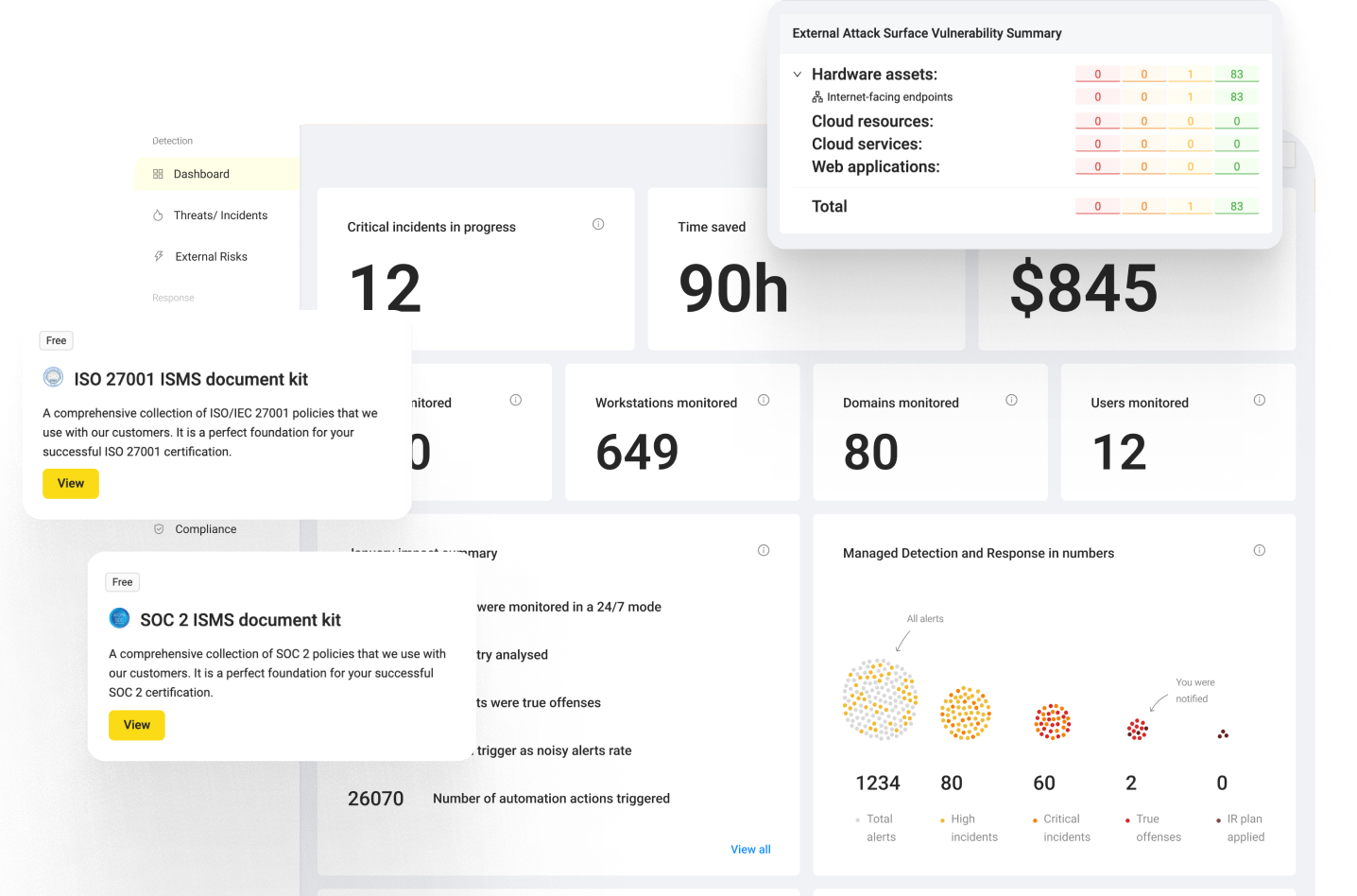
See how the UnderDefense Agentic AI SOC investigates, triages, and resolves real alerts.
Editorial Introduction
Choosing an AI SOC for a HIPAA-regulated healthcare organization is a high-stakes decision, since a single breach averages $7.42M and exposes protected patient data. For this guide, we analyzed the nine most-considered MDR and AI SOC providers using operational, technical, and business criteria that matter to hospitals, payers, and health-tech firms. We assessed each on detection maturity, coverage breadth, HIPAA BAA support, response ownership, and verified customer feedback. This shortlist serves CISOs, IT Directors, and CTOs at organizations weighing outsourced security operations over an in-house SOC. If you are preparing an RFP or vendor shortlist, these providers are the ones you will most often evaluate.
Comparison Table
| Provider (Stars) | Best For | Key Strength | Compliance |
|---|---|---|---|
| UnderDefense Agentic AI SOC (5 stars) | HIPAA teams wanting vendor-agnostic AI SOC plus Human Ally | Detects across your existing stack, then analysts respond and verify with users | HIPAA, SOC 2, ISO 27001, and GDPR |
| Arctic Wolf (3 stars) | Mid-market teams wanting a fully managed SOC | Concierge Security model with 24/7 monitoring | SOC 2, HIPAA, and PCI DSS |
| CrowdStrike Falcon Complete (4 stars) | Endpoint-first enterprises | Mature EDR-led detection and response | HIPAA, SOC 2, and PCI DSS |
| Expel (4 stars) | Cloud and SaaS-heavy teams | Broad integrations and transparent workbench | HIPAA, SOC 2, and PCI DSS |
| ReliaQuest GreyMatter (3 stars) | Large teams unifying existing tools | SIEM and tool aggregation layer | HIPAA, and SOC 2 |
| Red Canary (3 stars) | EDR-centric detection engineering | Strong threat hunting team | HIPAA, SOC 2, and PCI DSS |
| Microsoft Defender / Sentinel (4 stars) | Microsoft-native shops | Native E5 telemetry and cloud SIEM | HIPAA, SOC 2, and FedRAMP |
| eSentire (4 stars) | Firms wanting aggressive containment | Fast MDR response with Atlas platform | HIPAA, SOC 2, and PCI DSS |
| Rapid7 MDR (3 stars) | Teams tied to InsightVM and IDR | Unified vuln and detection stack | HIPAA, SOC 2, and PCI DSS |
1. UnderDefense Agentic AI SOC: Best for HIPAA Teams Wanting a Vendor-Agnostic AI SOC With Human Ally Response
Overview
UnderDefense Agentic AI SOC is our AI SOC platform built on one belief I hold strongly: security is people, process, and tools, in that order. The UnderDefense Agentic AI SOC platform pulls telemetry from your existing SIEM, EDR, cloud, and identity tools, so healthcare teams do not rip and replace what they already trust. When a threat surfaces, our analysts do not just escalate a ticket. They verify with the affected user, often over Slack, and own the outcome.
Core Services
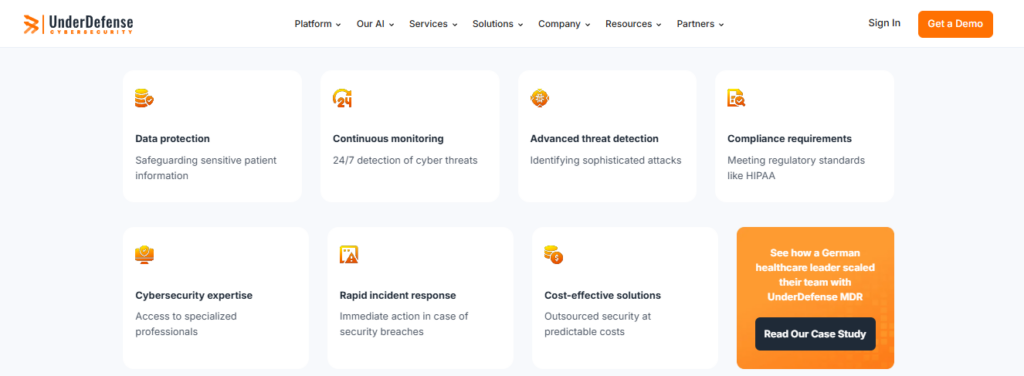
- 24/7 Managed Detection and Response across network, SaaS, endpoint, and identity
- AI-driven alert triage with heavy noise reduction
- Concierge analyst response and ChatOps user verification
- Vendor-agnostic integration across your current stack
- vCISO and compliance support for HIPAA, ISO 27001, and SOC 2
For a hospital under HIPAA, this reduces overhead while keeping continuous visibility. You keep your SIEM and your data. We add the humans and the AI around it.
Why Healthcare Companies Consider UnderDefense
Most healthcare IT teams cannot build a 24/7 SOC in this hiring market. One reviewer told this story plainly.
“The biggest problem they solved was our 24/7 coverage gap. We needed round-the-clock monitoring for compliance reasons, but building our own SOC wasn’t realistic with our budget and the current hiring market.”Verified User in Marketing and Advertising UnderDefense G2 Verified Review
That is the pattern. Teams want outcomes, not another dashboard. Here is the part I care about most. Rather than one blurred “MTTR” number, we hold two distinct SLAs: a 2-minute Alert-to-Triage and a 15-minute escalation for critical incidents. Those are different promises, and healthcare teams deserve to see both.
Ideal Customer Profile
Best suited for:
- Healthcare and health-tech firms with 50 to 1,000 employees
- HIPAA-driven teams handling protected patient data
- Security-lean teams needing outsourced expertise without tool lock-in
- Organizations moving from raw tools to managed operations
Commercial Model
UnderDefense uses transparent per-endpoint pricing, roughly $11 to $15 per endpoint per month. Engagements include onboarding, tool integration, continuous monitoring, and monthly impact reports. Setup takes some upfront configuration, which reviewers flag honestly.
“Setting everything up took some back and forth to get our tools properly integrated. Not really a complaint since it’s expected, but worth mentioning for others considering the service.”Verified User in Marketing and Advertising UnderDefense G2 Verified Review
When to Shortlist
Shortlist UnderDefense when you want a HIPAA-ready SOC that works with the tools you already own, and when response ownership matters as much as detection. I might be wrong for a pure Microsoft-only shop that never plans to add a tool. For everyone juggling a mixed stack, this is the work we do every day.
Reviews
“I used to work with many MDR solutions in the past, and so far UnderDefense is the best one!”Inga M., CEO UnderDefense G2 Verified Review
“Honestly, some security tools are more complicated than the threats themselves. UnderDefense isn’t just about catching bad stuff, they give proactive tips too.”Andriy H., Co-Founder and CTO UnderDefense G2 Verified Review
2. Arctic Wolf: Best for Mid-Market Teams Seeking a Fully Managed SOC
Overview
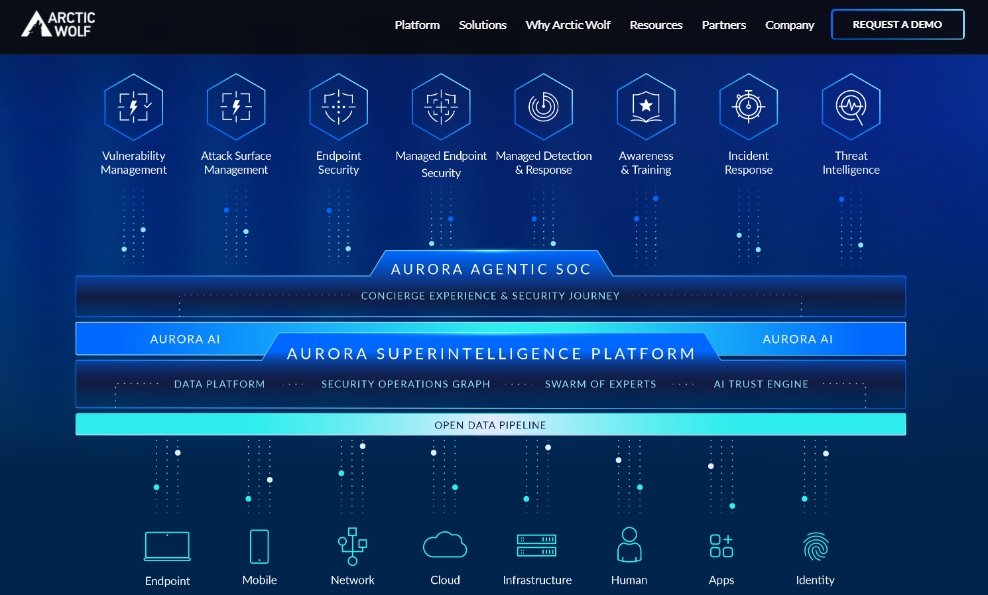
Arctic Wolf delivers a fully outsourced Security Operations Center through its Concierge Security model, aimed at teams that want enterprise-grade protection without building an internal SOC. It combines continuous monitoring, risk management, and incident response into one managed service. For healthcare firms with lean staff, that packaging is attractive on paper.
Core Services
- 24/7 Managed Detection and Response
- Cloud and endpoint monitoring
- Vulnerability and risk management
- Incident response support
- Compliance readiness assistance (SOC 2, HIPAA, and PCI DSS)
Why Healthcare Companies Consider Arctic Wolf
Many mid-market teams lack the budget or talent to run their own SOC. Arctic Wolf positions itself as an operational partner rather than a tool vendor. The strength is alerting and coverage. The honest limitation, which shows up repeatedly in reviews, sits on the response and ownership side. Buyers weighing Arctic Wolf alternatives often start here.
Ideal Customer Profile
Best suited for:
- Organizations with 50 to 1,000 employees
- Compliance-driven teams handling sensitive data
- Security-lean teams needing outsourced monitoring
- Companies moving from tools to managed operations
Commercial Model
Arctic Wolf typically uses subscription pricing aligned with organization size and monitored assets. One recurring caution from customers is to watch the renewal terms.
“Beware they add a 60 day renewal notice instead of the typical 30 day notice. If you don’t give notice of cancelling any services before 60 days, you will automatically renew everything.”Verified User in Electrical/Electronic Manufacturing Arctic Wolf G2 Verified Review
When to Shortlist
Shortlist Arctic Wolf when you want solid 24/7 detection and a relationship-driven account team, and when your internal team can carry the remediation load. Where I would pause for healthcare is that the response often stops at the alert. A Gartner reviewer captured the gap that hurts HIPAA teams most, when logs are needed for an actual investigation. Teams comparing options can review our best AI SOC providers breakdown and the wider managed SIEM versus MDR versus MSSP guide before deciding.
The trade-off view: strong 24/7 detection and account management, and broad coverage for mid-market, though remediation frequently leans back on your team, and log retrieval and analyst context can fall short during investigations.
Reviews
“Arctic Wolf provides solid detection and response capabilities, but overly relies on the client’s team for remediation, which really hurts the value of the service.”VP of Technology Arctic Wolf Gartner Verified Review
“Log collectors show working, however when asked to provide logs for an investigation no logs could be provided. Analysts provide little context, and when asked for more information in the investigation nothing is ever provided or even communicated.”CISO Arctic Wolf Gartner Verified Review
3. CrowdStrike Falcon Complete: Best for Endpoint-First Enterprises
Overview
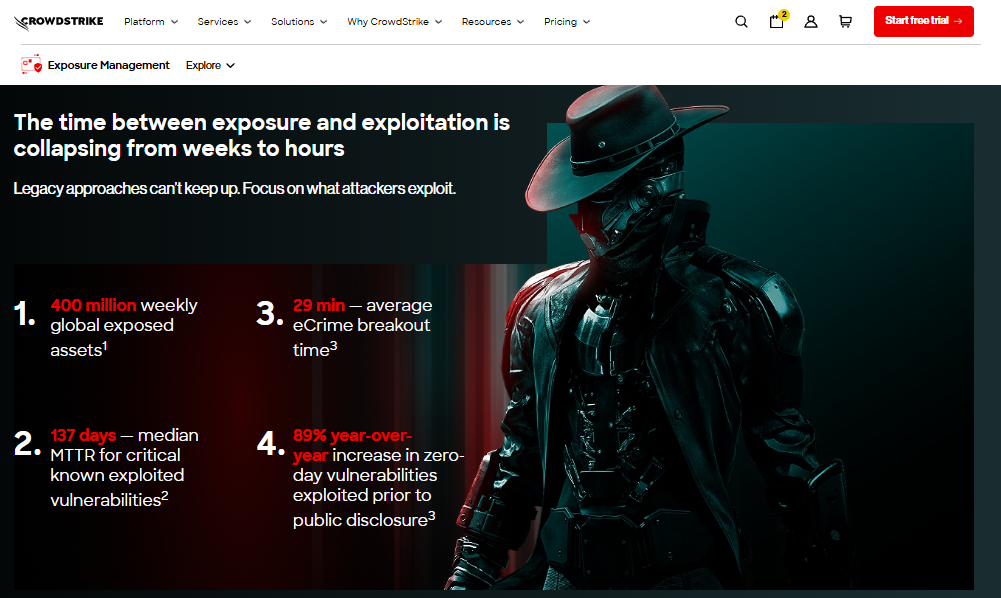
CrowdStrike Falcon Complete is a fully managed detection and response service built on the Falcon endpoint platform. It pairs mature endpoint detection and response (EDR), which means software that watches laptops and servers for attacks, with a 24/7 team that hunts and contains threats. For healthcare enterprises standardized on Falcon, the endpoint telemetry is deep and fast.
Core Services
- 24/7 managed detection, hunting, and response on the Falcon platform
- Endpoint detection and response (EDR) and next-gen antivirus
- Identity threat protection add-ons
- Managed containment of compromised hosts
- HIPAA, SOC 2, and PCI DSS alignment
Why Healthcare Companies Consider CrowdStrike
Hospitals with thousands of endpoints want fast containment when a device gets hit. Falcon Complete delivers that on the endpoint layer with real depth. My honest read after years in the SOC is that the endpoint story is excellent, and the organizational context around it is where teams still lean on their own people. This is where managed EDR alone leaves a gap.
Ideal Customer Profile
Best suited for:
- Enterprises already standardized on the Falcon agent
- Endpoint-heavy environments needing fast containment
- Teams wanting a single-vendor EDR plus MDR bundle
Commercial Model
CrowdStrike uses per-endpoint module licensing, often bundled into tiers. Costs rise as you add identity, cloud, and log modules, so healthcare buyers should model the full stack, not just the base agent.
When to Shortlist
Shortlist Falcon Complete when endpoint protection is your top priority and you accept a Falcon-centric architecture. The trade-off worth naming is that endpoint-first coverage can miss the wider picture across network, SaaS, and identity, and the user-verification step often stays with your team.
The trade-off view: deep, fast endpoint detection, and strong 24/7 containment, though visibility centers on the endpoint layer, with mature threat hunting, while broader stack context and user verification lean back on you.
4. Expel: Best for Cloud and SaaS-Heavy Teams
Overview
Expel is a technology-driven MDR provider known for a transparent analyst workbench and broad integrations across cloud, SaaS, and identity tools. It ingests logs from your existing platforms, so healthcare teams keep their stack while Expel triages alerts. The interface and API breadth are consistent strengths in reviews.
Core Services
- 24/7 detection and response across cloud, SaaS, and endpoint
- Transparent investigation workbench
- Broad API integrations
- Alert triage and noise reduction
Why Healthcare Companies Consider Expel
Cloud-heavy health-tech firms like that Expel investigates before escalating, which cuts noise for small teams. One recurring limitation surfaces in reviews. As an external provider, Expel sometimes lacks deep knowledge of your specific environment, so it comes back to your team for verification. Strong alert triage and noise reduction only go so far without organizational context.
Ideal Customer Profile
Best suited for:
- Cloud and SaaS-first organizations
- Small internal SOC teams needing a force multiplier
- Teams valuing transparency and integrations
Commercial Model
Expel prices on a subscription model scaled to your environment and data sources. Onboarding is fairly straightforward, though integration upkeep needs attention as vendor APIs change.
When to Shortlist
Shortlist Expel when your risk lives in cloud and SaaS and you want a transparent workbench. The trade-off to weigh is that organizational context gaps mean frequent check-backs with your internal team.
Reviews
“The Expel team has a solid set of skills that span a reasonable breadth of what you would expect to find in a Security Operations organization… there is still a limit to the environmental/organizational knowledge inherent in the service. This leads to a fairly frequent need for engagement with our internal team to get clarification and verification.”Verified User in Computer Software Expel G2 Verified Review
“Slack integration for notifications and support requests. Support requests are handled very quickly and accurately… Lack of support for EKS in AWS GovCloud. This was promised to us before we signed our contract, but later was removed from the roadmap.”Verified User in Manufacturing Expel G2 Verified Review
5. ReliaQuest GreyMatter: Best for Large Teams Unifying Existing Tools
Overview
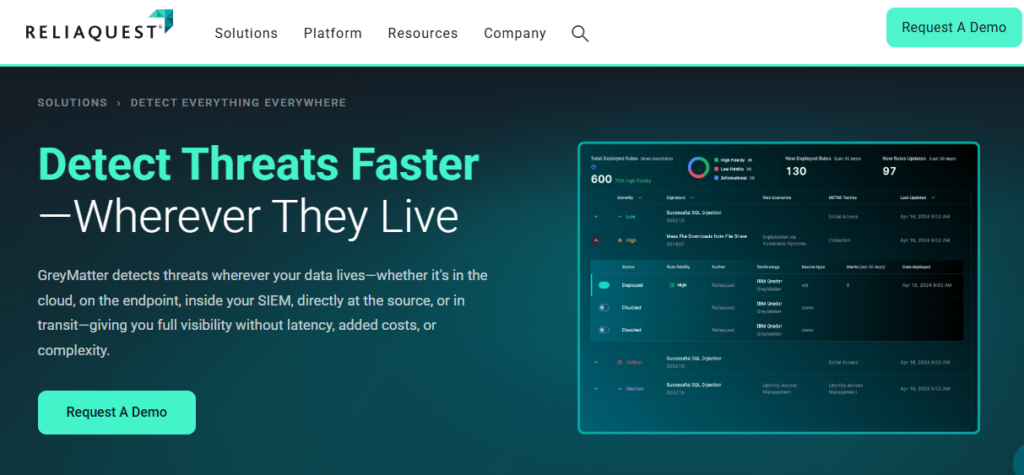
ReliaQuest GreyMatter is a security operations platform that aggregates data from your existing SIEM, EDR, and cloud tools into one layer. It aims to unify detection and response across a sprawling toolset, which appeals to larger healthcare systems with many products. The pitch is one pane of glass over what you already run.
Core Services
- Detection and response aggregation across existing tools
- 24/7 monitoring and analyst support
- Automated response playbooks
- Threat hunting and metrics reporting
Why Healthcare Companies Consider ReliaQuest
Large teams tired of swivel-chairing between consoles want one unified layer. My honest note is that aggregation helps, but some customers report tickets that come back without a clear resolution path, which slows healthcare response. A well-run managed SIEM layer should close, not widen, that gap.
Ideal Customer Profile
Best suited for:
- Larger enterprises with many security tools
- Teams wanting a unifying operations layer
- Organizations with an existing SIEM investment
Commercial Model
ReliaQuest uses an annual subscription scaled to environment size and data volume. Expect a platform-led engagement with dedicated support.
When to Shortlist
Shortlist ReliaQuest when your main pain is tool sprawl across a big stack. The trade-off is that the value depends heavily on your underlying tools, and clarity on resolution can vary.
The trade-off view: unifies a sprawling toolset, with automated response playbooks, though value hinges on your existing tools, with 24/7 analyst support, while resolution clarity can vary per ticket.
6. Red Canary: Best for EDR-Centric Detection Engineering
Overview
Red Canary is an MDR provider respected for strong detection engineering and a skilled threat-hunting team. It layers on top of EDR tools, most notably CrowdStrike, to reduce SIEM noise and surface real threats. Reviewers consistently praise the people and the noise reduction.
Core Services
- 24/7 managed detection and response
- Detection engineering and threat hunting
- Noise reduction across log sources
- Cloud and identity alerting
Why Healthcare Companies Consider Red Canary
Teams that already run a strong EDR want Red Canary to sharpen detections and hunt. The honest caveat in reviews is heavy reliance on CrowdStrike, thinner coverage elsewhere, and occasional gaps during penetration tests. Regular penetration testing exposes exactly these blind spots.
Ideal Customer Profile
Best suited for:
- EDR-first teams wanting detection engineering
- Organizations valuing a strong hunt team
- Mid-market to enterprise security groups
Commercial Model
Red Canary prices on subscription tied to monitored endpoints and data sources. Onboarding is generally smooth per customer feedback.
When to Shortlist
Shortlist Red Canary when detection quality on your EDR matters most. The trade-off to weigh is that integrations beyond CrowdStrike can feel limited, and some teams expected alerts that never surfaced.
Reviews
“Red Canary first and foremost has reduced the amount of noise we were getting from our various log sources in our SIEM… I wish the integrations beyond Crowdstrike were a bit more robust and greater in number. Red Canary is perhaps too reliant on Crowstrike and less on our other sources which are important Cloud, Identity Email, etc..”Verified User in Computer Software Red Canary G2 Verified Review
“The IR team and detection engineers here are truly outstanding… Over the past few years, we’ve undergone several external penetration tests, and during these assessments, Red Canary was not able to identify the malicious activity while the tests were ongoing.”Verified User in Insurance Red Canary G2 Verified Review
7. Microsoft Defender / Sentinel: Best for Microsoft-Native Shops
Overview
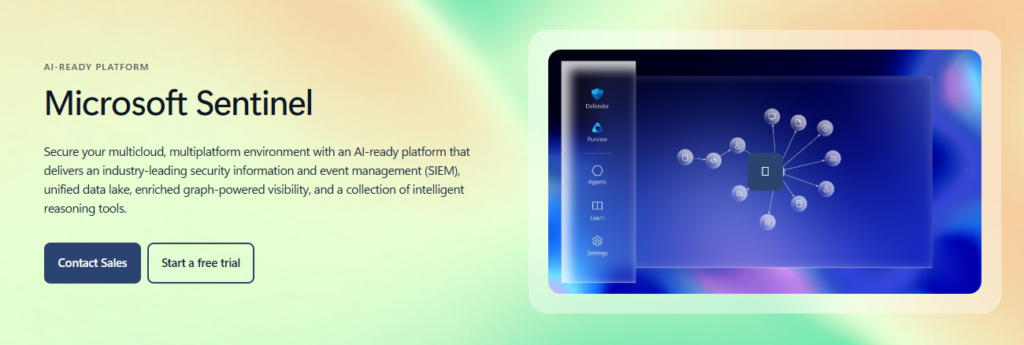
Microsoft Defender and Sentinel form a native detection and cloud SIEM stack for organizations deep in the Microsoft ecosystem. Sentinel is the cloud SIEM, which collects and analyzes security logs, while Defender covers endpoint, identity, and cloud. For healthcare teams on Microsoft E5 licensing, the telemetry is rich and already paid for.
Core Services
- Cloud-native SIEM (Sentinel) with broad log ingestion
- Endpoint, identity, and cloud detection (Defender)
- Automation and playbooks
- HIPAA, SOC 2, and FedRAMP alignment
Why Healthcare Companies Consider Microsoft
Microsoft-native hospitals get strong coverage without adding a new vendor. My practical caution is that Sentinel is powerful, but it needs skilled hands to tune, and ingestion costs can climb fast. This is exactly where a managed layer for Microsoft 365 earns its keep.
Ideal Customer Profile
Best suited for:
- Microsoft E5 and Azure-centric organizations
- Teams wanting native telemetry and one vendor
- Groups with in-house SIEM engineering, or a managed partner
Commercial Model
Sentinel bills largely on data ingestion and retention, so costs scale with log volume. Defender rides on Microsoft licensing tiers like E5.
When to Shortlist
Shortlist Defender and Sentinel when you are Microsoft-native and want to consolidate. The trade-off is that ingestion-based pricing can surprise you, and running it well demands real SOC engineering or a managed partner on top.
8. eSentire: Best for Firms Wanting Aggressive Containment
Overview
eSentire is an MDR provider built around its Atlas platform, known for aggressive threat containment and fast response. It focuses on stopping attacks quickly across endpoint, network, and cloud. For healthcare firms prioritizing speed of containment, that posture is the draw.
Core Services
- 24/7 managed detection and response
- Aggressive automated and analyst-led containment
- Network, endpoint, and cloud coverage
- HIPAA, SOC 2, and PCI DSS alignment
Why Healthcare Companies Consider eSentire
Teams that value fast lockdown of threats like eSentire’s containment-first posture. My honest read is that aggressive containment reduces dwell time, though it can occasionally disrupt legitimate work if tuning is loose in a clinical environment. Mature incident response depends on tuning that fits the workflow.
Ideal Customer Profile
Best suited for:
- Organizations prioritizing rapid containment
- Mid-market to enterprise healthcare and finance teams
- Groups wanting a strong response SLA
Commercial Model
eSentire prices on subscription scaled to environment and signals monitored. Engagements include onboarding and continuous response coverage.
When to Shortlist
Shortlist eSentire when speed of containment is your top requirement. The trade-off to weigh is that aggressive automated actions need careful tuning so clinical workflows are not disrupted.
The trade-off view: fast, aggressive containment, with broad network and endpoint coverage, though tuning matters to avoid disruption, with strong response SLAs, while a platform-centric approach limits flexibility.
9. Rapid7 MDR: Best for Teams Tied to InsightVM and InsightIDR
Overview
Rapid7 MDR is a managed service built on the Insight platform, unifying vulnerability management (InsightVM) and detection and response (InsightIDR). It appeals to teams that want vulnerabilities and detections in one stack. The bundled licensing is a common reason healthcare teams evaluate it.
Core Services
- 24/7 managed detection and response (InsightIDR)
- Vulnerability management (InsightVM)
- Cloud security and automation (InsightConnect)
- Compliance and reporting support
Why Healthcare Companies Consider Rapid7
Teams wanting vulnerability and detection data together like the packaged Insight license. The honest caution from reviews is that coverage gaps, heavy administrative effort, and inconsistent support show up repeatedly. Buyers should confirm true SOC coverage before committing.
Ideal Customer Profile
Best suited for:
- Teams already using InsightVM or InsightIDR
- Groups wanting vuln plus detection in one platform
- Cost-conscious mid-market security teams
Commercial Model
Rapid7 bundles products into licenses like CRC Essentials, tied to endpoints and assets. Buyers should validate coverage and support in a proof of concept before committing.
When to Shortlist
Shortlist Rapid7 MDR when you value a unified vuln-and-detection stack. The trade-off is that coverage gaps and support consistency are real risks, so test thoroughly first.
Reviews
“Their CRC Essentials license is absolutely value for money as it includes three of their products… The InsightVM product is supposed to give us a nice coverage for vulnerability management but it seem to have missing coverage for some major softwares, including Visual Studio and NVidia which is a massive drawback especially for a games development company.”Himanshu K., IT Security Operations Engineer Rapid7 G2 Verified Review
“The pre-sales crew is great. Really make you think you’ll get high tier support… The scan engine doesn’t function. I’m unable to scan our IP ranges, and they’ve ignored requests to get this resolved.”Verified User in Farming Rapid7 G2 Verified Review
Where UnderDefense Fits Across These Nine
Here is the pattern I keep seeing across these environments. Endpoint-first tools see the device, cloud-first tools see the workload, and SIEM-led tools see the logs. Each is strong in its lane, and each leans back on your team for the organizational context and user verification that close an incident. We built the UnderDefense Agentic AI SOC platform to be vendor-agnostic across your existing stack, so you keep your SIEM and your data ownership. Our analysts do not stop at the alert. They verify with the affected user over ChatOps and own the outcome, holding a 2-minute Alert-to-Triage and a 15-minute escalation for critical incidents. That is the work we do every day for HIPAA teams, and you can book a demo to see it live.
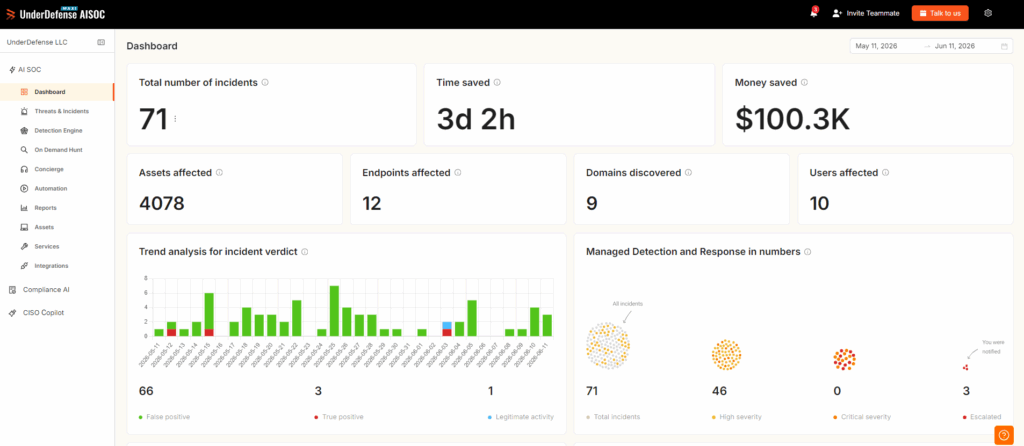
Q2: How Did We Score and Rank These AI SOC Platforms?
We ranked each platform on five weighted criteria: Cross-Domain Coverage (30%), Detect-and-Respond Speed (25%), HIPAA and Compliance Fit (20%), Vendor-Agnostic Integration and No Lock-In (15%), and Pricing Transparency (10%). Scores map to stars, where 0 to 20% earns 1 star and 81 to 100% earns 5 stars. UnderDefense scores 5 stars because it performs across all five axes, not endpoint alone.
Why These Five Criteria Matter to a Healthcare CISO
I built this rubric around what actually breaks at 2 a.m., not what looks good on a datasheet. A healthcare CISO does not lose sleep over detection volume. They lose sleep over a threat that crossed from email to identity to a patient database while three consoles each saw one slice. Cross-domain coverage carries the most weight for that exact reason. Speed of response comes next, because faster triage on the same old alerts is not real transformation. For teams weighing this, our best AI SOC providers breakdown expands on each axis.
How the Stars Are Computed
Each provider earns a percentage per criterion, and we weight and sum those to a single score. That score then maps to the star scale above. These dimensions mirror how G2 and Gartner frame the MDR and SOC-as-a-Service categories, so the rubric is not something I invented in a vacuum. My honest note is that pure monitoring-only MSSPs, meaning managed security service providers that watch but rarely act, lose points here by design. Our comparison of AI SOC versus MDR, MSSP, and SOAR unpacks why.
| Criterion | Weight | What It Measures | Why It Matters |
|---|---|---|---|
| Cross-Domain Coverage | 30% | Visibility across network, SaaS, endpoint, and identity | A threat rarely stays in one lane |
| Detect-and-Respond Speed | 25% | Time from alert to triage and containment | Dwell time is where breaches grow |
| HIPAA and Compliance Fit | 20% | BAA, audit trails, retention, and PHI handling | Non-negotiable for patient data |
| Vendor-Agnostic Integration | 15% | Works with existing tools, no forced rip-and-replace | Protects prior security spend |
| Pricing Transparency | 10% | Clear, predictable cost model | Budgets are finite and real |
We at UnderDefense score well here precisely because the UnderDefense Agentic AI SOC platform reads across your whole stack, and our analysts act on what they find, rather than escalating a ticket and calling it done.
Q3: What Is an AI SOC, and Does It Replace or Promote Your Analysts?
An AI SOC is a security operations center where AI agents investigate alerts end-to-end, then hand decisions to human analysts. A true agentic system makes 100+ distinct large language model (LLM) invocations to investigate a single alert, unlike a “GPT wrapper” that just gives you a faster way to be wrong. It does not replace analysts. It kills triage toil so they can hunt.
What an AI SOC Actually Is
Think of a SOC as the room where alerts get investigated. An AI SOC puts autonomous agents in that room to do the first-pass digging. The agent pulls context, checks logins, correlates activity, and builds a case. The difference between real and fake here is depth. A genuine agentic system, meaning one where AI reasons in many steps, may fire over 100 LLM calls to chase one alert. A thin wrapper fires one and guesses. Our primer on what an AI SOC is goes deeper on this.
Foot Soldiers and Generals
I use a simple frame with my team. The AI agents are foot soldiers, and human engineers are the generals. Agents scale the routine work no human should babysit. Humans own intent, architecture, and the messy edge cases that automation gets wrong. I might be wrong for very simple environments, but you cannot scale a modern SOC on humans alone, and you cannot trust everything to a script either. This is the heart of our AI SOC analyst model.
Why It Promotes Analysts Instead of Replacing Them
Early research backs this direction, with reinforcement learning shown to improve alert prioritization in SOC settings. Here is a vulnerability moment I will own. For years, we patched gaps with thousands of lines of brittle PowerShell, and a fragile script is no substitute for a real platform. That toil should have died long ago. We built UnderDefense Agentic AI SOC as recursive agentic investigation, with our concierge analysts acting as the generals, not a bolt-on wrapper. It is a shift from tooling to true AI incident response.
Q4: What Does HIPAA Actually Require From an AI SOC?
A HIPAA-compliant AI SOC must satisfy the Security Rule: 45 CFR 164.308(a)(1) risk analysis, 164.308(a)(6) incident procedures, and 164.312(b) audit controls with application-, system-, and user-level trails. Those records must be retained at least six years under 164.316(b)(2)(i). It also requires a signed Business Associate Agreement (BAA) before any protected health information (PHI) is touched, plus the 164.402 four-factor breach test and 60-day reporting.
The BAA Gate Comes First
A BAA is the contract that makes a vendor legally accountable for your PHI. No signed BAA means no PHI, full stop. I treat this as a hard disqualifier when a hospital shortlists an AI SOC. If a provider hesitates on the BAA, the evaluation is over. The scale of getting this wrong is not abstract. The Change Healthcare breach hit 192.7 million individuals, the largest patient breach on record. Our MDR for healthcare starts from this gate.
Audit Logs, Retention, and PHI Handling
The audit-control clause means you log at the application, system, and user level, then keep those logs for six years. NIST SP 800-66r2, published February 2024, is the current federal guide for implementing these safeguards. My practical read is that audit trails are not just paperwork. One bad login from an unexpected country can be a compromise from years ago still quietly logging in today. This is why security log analysis and long-term retention matter so much.
| CFR Clause | Requirement | SOC Capability That Satisfies It |
|---|---|---|
| 164.308(a)(1) | Risk analysis | Continuous risk assessment and posture reporting |
| 164.308(a)(6) | Incident procedures | Documented detection and response playbooks |
| 164.312(b) | Audit controls | App-, system-, and user-level logging |
| 164.316(b)(2)(i) | Six-year retention | Long-term secure log storage |
| 164.402 / 164.410 | Breach test and 60-day reporting | Four-factor assessment and notification workflow |
| 164.502(e) | Business Associate Agreement | Signed BAA before any PHI access |
Here is where a healthcare-native posture matters. Rather than streaming every log field, we let teams restrict PHI to specific fields and run point-in-time queries, so sensitive data stays out of scope where it does not belong. At UnderDefense, we map a full BAA to each cited clause through our compliance services, which generic MSSPs rarely offer. If you have already been hit, our breach response team can step in fast.
Q5: How Do You Close the Visibility Gap and Cut Alert Fatigue Across Network, SaaS, Identity, and IoMT?
You close the gap by monitoring network, SaaS, identity, and IoMT (Internet of Medical Things, meaning connected devices like infusion pumps) together, not just endpoints. A hospital network is an M&M: hard shell, soft center, so one compromised Microsoft 365 doctor account slips past the perimeter. Endpoint-only tools miss this. AI clustering and prioritization then cut duplicate alerts and dwell time before you add headcount.
The M&M Network Problem
Picture a hospital network as an M&M candy. Hard shell on the outside, soft and open on the inside. Once an attacker steals one doctor’s M365 login, they are past the shell and roaming the soft center. Credential abuse is the top way in, present in 22% of breaches. Endpoint tools watch the laptop, but they do not watch that stolen identity moving through SaaS. IoMT devices, like a networked infusion pump, are a full blind spot for most of them. This is exactly what our MDR for Microsoft 365 is built to catch.
What the Research Says About Alert Fatigue
Alert fatigue is real, and the data backs the stakes. Ransomware now appears in 44% of breaches, up 37% from the prior year. When analysts drown in duplicate alerts, dwell time grows, and those attacks mature. AI that clusters related alerts and prioritizes them cuts the noise before you hire more people. My honest read is that faster babysitting of the same alerts is not real progress, but smarter correlation is. Our take on alert fatigue in cybersecurity expands on this, alongside modern AI-enabled incident triage.
Two Moves You Can Make Monday
Here are two things I would run this week. First, a free OAuth shadow-IT hunt using your existing M365 or Google Workspace logs, which surfaces risky app grants at zero cost. Second, an ingestion diet, where you tune log sources down and cut volume sharply without losing signal. Endpoint-focused providers leave this exact gap open, as Expel customers note. A well-run managed SIEM keeps that signal intact.
“there is still a limit to the environmental/organizational knowledge inherent in the service. This leads to a fairly frequent need for engagement with our internal team to get clarification and verification.”Verified User in Computer Software Expel G2 Verified Review
We built the UnderDefense Agentic AI SOC platform to ingest network, SaaS, identity, IoMT, and your existing SIEM, so we close the exact gap endpoint-only tools leave wide open.
What I keep asking myself heading into the next year is this: as IoMT sprawl grows, how many hospitals even have an inventory of what is talking on their network?
Q6: Cloud vs. On-Premises AI SOC: Which Fits Your Healthcare Environment?
Choose cloud-native if you are a cloud-first health-tech firm wanting fast rollout and elastic scale. Choose on-prem or hybrid if you run legacy clinical systems, IoMT devices, or data-residency rules that keep protected health information (PHI) inside your walls. The best AI SOC supports all three from one platform, so you are not locked to a vendor’s SIEM the way some Arctic Wolf customers report.
The Real Trade-Off for Hospitals
Most hospitals are not cloud-first or on-prem. They are both at once. Old clinical systems and medical devices often cannot move to the cloud, and some cannot even be patched easily. Data-residency rules may require PHI to stay on hardware you control. A pure cloud SOC struggles with that reality. My current read is that deployment flexibility matters more in healthcare than in almost any other sector. Our guide to AI SOC deployment models walks through each option.
Why Hybrid Flexibility Beats Lock-In
The risk with rigid providers is architectural, not personal. When a vendor forces its own SIEM, you lose data ownership and flexibility. Arctic Wolf customers have flagged this pattern in reviews. If you are weighing options, our Arctic Wolf alternatives breakdown is a useful starting point.
“This is not an extension of our security team as was originally sold.”Sr Cybersecurity Engineer Arctic Wolf Gartner Verified Review
| Deployment Model | Best For | HIPAA / Residency Note | Watch-Outs |
|---|---|---|---|
| Cloud-native | Cloud-first health-tech | Confirm BAA and region controls | Legacy and IoMT gaps |
| On-premises | Legacy clinical systems | PHI stays inside your walls | Slower scaling, more upkeep |
| Hybrid | Mixed hospital estates | Keep PHI local, detect everywhere | Needs a vendor-agnostic partner |
We run cloud, on-prem, and hybrid from one vendor-agnostic platform, so hospitals keep PHI on-prem while still getting AI detection across the whole estate. That flexibility is the core of how our SOC service fits messy healthcare environments.
The question I am sitting with is this: as more clinical devices come online, will pure cloud SOCs ever fully serve a hospital, or will hybrid stay the honest answer?
Q7: How Do You Evaluate an AI SOC Vendor Without Getting Burned?
Ask three things before signing. Prove the AI is genuine recursive investigation, not a scripted playbook. If a vendor claims their AI is “unbiased,” treat it as a warning sign. Map every security dollar onto NIST CSF families, so you see where you spend and where you have nothing. Demand architecture-level controls, not prompt guardrails any clever trick can bypass.
The AI-Hype Trap
Vendors love the word “AI” right now, and buyers get burned by it. GenAI risk is not hypothetical either, with roughly 15% of employees using GenAI tools on corporate devices. My contrarian take is that a vendor who says their model is “unbiased” is either confused or hiding something. Ask them to show the investigation, step by step, on a live alert. Show beats tell every time. Our list of AI SOC evaluation questions gives you the exact prompts.
Architecture-Level Controls Over Prompt Guardrails
Here is where teams get fooled. Prompt guardrails are instructions telling the AI what not to do, and clever “grandma” style tricks bypass them. Real safety lives at the architecture level, where dangerous actions are simply not possible. I have seen an over-eager agent delete a production database because nobody restricted its actions. So the rule is simple. Let AI reason freely, but restrict what it can actually do to deterministic, approved steps. This is central to how we approach AI SOC explainability and transparency.
The NIST CSF Budget Map
Before you sign anything, map your spend to the NIST Cybersecurity Framework (CSF), a standard grouping of security functions like Identify, Protect, Detect, Respond, and Recover.
- List every security dollar against a CSF function.
- Find the families where you spend heavily and the ones where you have nothing.
- Ask each vendor to show, with evidence, which gaps they actually close.
- Demand transparent pricing and a real recursive-investigation demo.
- Confirm deterministic action limits and a signed BAA.
We welcome every one of these questions at UnderDefense, because transparent pricing, real recursive investigation, and restricted deterministic actions are how we built our MDR service. When you are ready, you can contact us and run the checklist against us directly.
The open question I would put to any CISO reading this is this: if you ran this exact checklist against your current provider tomorrow, how many answers would you actually like?
1. What is the best AI SOC for healthcare HIPAA-compliant threat detection in 2026?
We rank UnderDefense Agentic AI SOC first among the nine leading platforms, followed by Arctic Wolf, CrowdStrike Falcon Complete, Expel, ReliaQuest GreyMatter, Red Canary, Microsoft Defender/Sentinel, eSentire, and Rapid7 MDR.
Our top pick leads for three healthcare-specific reasons:
- It stays vendor-agnostic and works across your existing SIEM, EDR, cloud, and identity tools.
- Its analysts verify with the affected user over ChatOps and own the outcome, rather than escalating a ticket.
- It holds two distinct SLAs, a 2-minute Alert-to-Triage and a 15-minute escalation for critical incidents.
Healthcare breaches now average $7.42M, so HIPAA teams need coverage across network, SaaS, and identity, plus fast concierge response. Each provider fits a different profile, from endpoint-first enterprises to Microsoft-native shops. You can see how our MDR for healthcare approaches this, or compare the wider field in our best AI SOC providers guide before shortlisting.
2. What does HIPAA actually require from an AI SOC?
A HIPAA-compliant AI SOC must satisfy the Security Rule and sign a Business Associate Agreement (BAA) before it touches any protected health information (PHI).
The core requirements we map for hospitals include:
- 45 CFR 164.308(a)(1), ongoing risk analysis.
- 164.308(a)(6), documented incident procedures.
- 164.312(b), audit controls at application, system, and user level.
- 164.316(b)(2)(i), at least six-year log retention.
- 164.402 and 164.410, the four-factor breach test and 60-day reporting.
We treat a signed BAA as a hard disqualifier. If a provider hesitates, the evaluation is over. The scale of getting this wrong is not abstract, since the Change Healthcare breach hit 192.7 million individuals. NIST SP 800-66r2, published February 2024, is the current federal guide for these safeguards. We map a full BAA to each cited clause through our compliance services, which generic MSSPs rarely offer.
3. Does an AI SOC replace our security analysts?
No. A genuine AI SOC promotes your analysts rather than replacing them by killing the triage toil that burns people out.
Here is the frame we use with our own team:
- AI agents are the foot soldiers that scale routine, first-pass investigation.
- Human engineers are the generals who own intent, architecture, and messy edge cases.
The difference between real and fake here is depth. A true agentic system makes 100+ distinct large language model (LLM) invocations to investigate a single alert. A thin “GPT wrapper” fires one call and gives you a faster way to be wrong. You cannot scale a modern SOC on humans alone, and you cannot trust everything to a script either.
Early research shows reinforcement learning improving alert prioritization in SOC settings, which supports this direction. We built our platform as recursive agentic investigation with concierge analysts acting as the generals. Learn how our AI SOC analyst model works in practice.
4. Should we choose a cloud, on-premises, or hybrid AI SOC for our hospital?
Choose cloud-native if you are a cloud-first health-tech firm wanting fast rollout and elastic scale. Choose on-premises or hybrid if you run legacy clinical systems, IoMT devices, or data-residency rules that keep PHI inside your walls.
Most hospitals are not one or the other, but both at once:
- Old clinical systems and medical devices often cannot move to the cloud, and some cannot be patched easily.
- Data-residency rules may require PHI to stay on hardware you control.
- A pure cloud SOC struggles with that reality.
The best AI SOC supports all three models from one platform, so you are not locked to a vendor’s SIEM. Deployment flexibility matters more in healthcare than in almost any other sector. We run cloud, on-premises, and hybrid coverage from one vendor-agnostic SOC service, letting hospitals keep PHI local while still getting AI detection across the whole estate.
5. How do we evaluate an AI SOC vendor without getting burned?
Ask three things before signing, and demand architecture-level controls rather than prompt guardrails any clever trick can bypass.
Our practitioner checklist:
- Prove the AI is genuine recursive investigation, not a scripted playbook, shown live on a real alert.
- Treat any “unbiased AI” marketing claim as a red flag, since that vendor is either confused or hiding something.
- Map every security dollar onto NIST CSF families, so you see where you spend and where you have nothing.
- Confirm deterministic action limits, because we have seen an over-eager agent delete a production database.
- Require transparent pricing and a signed BAA.
Prompt guardrails are just instructions, and “grandma” style tricks bypass them. Real safety lives where dangerous actions are simply not possible. We welcome every one of these questions. Run the full list from our AI SOC evaluation questions against us directly.
6. Why does endpoint-only coverage fail healthcare security teams?
Endpoint-only tools fail because a hospital network is like an M&M, a hard shell with a soft center, and threats rarely stay on the endpoint.
Consider the common attack path:
- An attacker steals one doctor’s Microsoft 365 login, which is the top way in, present in 22% of breaches.
- They are now past the perimeter, roaming SaaS and identity, which endpoint tools do not watch.
- IoMT devices, like a networked infusion pump, are a full blind spot for most endpoint-focused providers.
Ransomware now appears in 44% of breaches, up 37% year over year, and dwell time grows when analysts drown in duplicate alerts. AI that clusters and prioritizes alerts cuts that noise before you add headcount. We ingest network, SaaS, identity, IoMT, and your existing SIEM to close this exact gap. Our work on alert fatigue in cybersecurity explains how we reduce the noise.
7. How much does an AI SOC for healthcare cost?
Pricing models vary widely, and transparency should be a scoring criterion, not an afterthought.
The common models we see across the nine providers:
- Per-endpoint pricing, roughly $11 to $15 per endpoint per month for transparent providers.
- Subscription pricing scaled to organization size, monitored assets, and data sources.
- Ingestion-based pricing, like Microsoft Sentinel, where costs climb with log volume.
- Bundled product licenses, like Rapid7 CRC Essentials, tied to endpoints and assets.
We weight pricing transparency in our rubric because budgets are finite and real. Opaque pricing and black-box investigation are two of the biggest frustrations healthcare teams report. Our engagements include onboarding, tool integration, continuous monitoring, and monthly impact reports. See our transparent MDR pricing to model your own numbers before you compare quotes.
8. How did you score and rank these nine AI SOC platforms?
We ranked each platform on five weighted criteria, then mapped scores to a five-star scale.
The rubric weights what actually breaks at 2 a.m.:
- Cross-Domain Coverage (30%), visibility across network, SaaS, endpoint, and identity.
- Detect-and-Respond Speed (25%), time from alert to triage and containment.
- HIPAA and Compliance Fit (20%), BAA, audit trails, retention, and PHI handling.
- Vendor-Agnostic Integration (15%), works with existing tools, no forced rip-and-replace.
- Pricing Transparency (10%), a clear, predictable cost model.
Cross-domain coverage carries the most weight because a threat rarely stays in one lane. These dimensions mirror how G2 and Gartner frame the MDR and SOC-as-a-Service categories, so the rubric is not invented in a vacuum. Pure monitoring-only MSSPs lose points here by design. Explore how our UnderDefense Agentic AI SOC platform performs across all five axes.