




Q1. What Is AI-Powered Incident Response, and Why Is It Non-Negotiable in 2026?
The Dual Definition You Need to Understand
AI-powered incident response is the application of machine learning, behavioral analytics, and generative AI to compress every phase of the cybersecurity incident lifecycle, from detection and investigation to containment and recovery, from hours into minutes. But here’s what most articles miss: in 2026, this term carries a dual meaning. There’s using AI to enhance IR workflows. And there’s the emerging discipline of responding to incidents that target AI systems themselves, including model poisoning, prompt injection, adversarial attacks on ML pipelines, and training data exfiltration.
NIST SP 800-61r3, released in April 2025, now serves as the foundational framework for both dimensions, while MITRE ATLAS and CoSAI extend traditional IR playbooks to cover AI-specific threat vectors. Don’t confuse incident response (security-specific threat containment) with incident management (broad IT service continuity). They share a name, but the skillsets, tooling, and urgency are fundamentally different.
⚠️ Why Traditional IR Is Failing: The Numbers Don’t Lie
The threat context in 2026 is brutal, and the data backs it up. Unit 42’s latest report shows AI-assisted attacks reduced time-to-exfiltration down to 25 minutes in simulated environments, and real-world intrusions now reach exfiltration in 1.2 hours for the fastest quartile, down from 4.8 hours the year prior. Meanwhile, 73% of security professionals report AI-powered threats are already hitting their organizations, with hyper-personalized phishing, automated exploit chaining, and adaptive malware leading the charge.
⏰ The Defender’s Dilemma
On the defender side, the picture is equally painful. Mid-market SOCs face 4,000+ weekly alerts, analyst burnout drives an average 18-month tenure, and 44% of security teams have adopted AI for IR workflows, which means 56% are still running manual investigation at human speed against machine-speed attacks. Here’s the critical distinction: automated IR means scripted SOAR playbooks executing predefined steps. AI-driven IR means systems that reason through evidence, adapt investigation paths, and make contextual severity decisions. One follows a script; the other thinks.
Traditional IR vs. AI-Augmented IR vs. IR for AI Systems
| Dimension | Traditional IR | AI-Augmented IR | IR for AI Systems |
|---|---|---|---|
| Detection Method | Signature-based rules, manual log review | ML behavioral baselines, anomaly detection | Model drift monitoring, adversarial input detection |
| Evidence Types | Logs, network captures, disk images | Unified cross-tool telemetry, enriched context | Training data audits, model weights, prompt logs |
| Investigation Approach | Manual analyst-driven, tool-by-tool | AI-assisted correlation, NLP querying | Causal analysis of model behavior, MITRE ATLAS mapping |
| Response Speed | Hours to days | Minutes to sub-hour | Depends on model complexity and blast radius |
| Human Role | Primary investigator | Decision-maker on AI-surfaced findings | AI/ML specialist + security analyst hybrid |
| Framework Alignment | NIST CSF, SANS IR | NIST CSF, MITRE ATT&CK | NIST SP 800-61r3, CoSAI, MITRE ATLAS |
✅ How UnderDefense Operationalizes Both Dimensions
UnderDefense’s MAXI platform operationalizes both sides of this equation, using AI-driven detection across 250+ integrated tools while providing human concierge analysts who understand the organizational context needed to investigate AI-targeted attacks alongside conventional threats. This “AI SOC + Human Ally” architecture eliminates the gap between detection and response that defines both traditional IR failure modes.
Q2. How Does AI Work Across the 7 Phases of Incident Response?
The Framework: AI Compresses, It Doesn’t Replace
AI doesn’t eliminate the incident response lifecycle. Instead, it compresses timelines, enables parallel execution, and adds capabilities impossible at human speed. The 7-phase AI-powered incident lifecycle remains the organizing framework, but what changes is how each phase operates. The key components powering this system include an intelligent threat detection engine, a smart triage and contextual analysis module, AI-assisted investigation and digital forensics, automated response playbooks with dynamic orchestration, a threat intelligence integration layer, and a continuous learning feedback loop.
🔧 The Technical Mechanics Under the Hood
Before walking through each phase, here’s what makes the system work at a technical level:
- Data Ingestion and Normalization — Collecting and standardizing telemetry from endpoints, SIEM, identity, cloud, and network sources into a unified data model. Without this, you’re correlating across spreadsheets.
- ML-Based Anomaly and Threat Detection — Behavioral baselines using unsupervised clustering and supervised classification detect both known and novel threats. AI-driven behavioral analytics platforms detect up to 95% of insider threats that signature-based tools miss entirely.
- Cross-System Event Correlation — Connecting signals from CrowdStrike endpoint alerts to Splunk log events to Okta identity anomalies to AWS CloudTrail API calls into unified attack timelines. This is where context lives.
- Deception Technologies — AI-managed honeypots and decoy assets that detect lateral movement and attacker reconnaissance with near-zero false positives.
✅ The 7-Phase AI-Powered IR Lifecycle
| Phase | AI Capability | Human Role | Key Technology | Output |
|---|---|---|---|---|
| 1. Detection & Identification | Surfaces anomalous patterns across all telemetry in real time | Validates alert context and business relevance | UEBA, ML anomaly engines | Prioritized threat alerts |
| 2. Logging & Recording | Automated evidence preservation including volatile memory and container snapshots | Verifies evidence chain of custody | Forensic capture tools, cloud-native logging | Immutable evidence repository |
| 3. Classification & Prioritization | ML-driven severity scoring based on asset criticality, exposure context, and threat intel enrichment | Reviews high-severity classifications | Threat intelligence platforms, risk scoring engines | Severity-ranked incident queue |
| 4. Investigation & Diagnosis | AI-powered root cause analysis correlating events into attack narratives; GenAI natural-language querying | Leads deep-dive analysis, adds organizational context | SIEM correlation, GenAI copilots | Attack timeline and RCA report |
| 5. Resolution & Recovery | Automated containment within guardrails: credential revocation, endpoint isolation, firewall rule deployment | Approves high-impact actions, verifies remediation | SOAR orchestration, EDR response APIs | Contained and verified incident |
| 6. Closure & Documentation | Automated incident report generation, timeline reconstruction, evidence packaging | Reviews for regulatory submission accuracy | GenAI report generators | Compliance-ready documentation |
| 7. Review & Improvement | Lessons-learned pattern mining, detection rule refinement via feedback loops, playbook versioning | Drives strategic program changes | ML feedback pipelines | Updated detection rules and playbooks |
How UnderDefense Operationalizes Every Phase
UnderDefense operationalizes AI across every lifecycle phase through the MAXI platform, from 24/7 AI-driven detection and automated triage (Phases 1–3) to human-led investigation and concierge containment (Phases 4–5) to automated reporting and continuous tuning (Phases 6–7). This compresses what traditionally takes hours into a documented 2-minute alert-to-triage and 15-minute escalation for critical incidents, because the platform automates the investigation grunt work while analysts handle the judgment calls.
Q3. What Are the Highest-Impact Use Cases of AI in Incident Response?
Where AI Delivers the Biggest ROI for Analyst Time
AI contributes most where analyst time gets consumed disproportionately: triaging noisy alerts, assembling cross-tool context, and determining what actually matters versus what’s benign. The 77% of organizations that have adopted AI for cybersecurity are primarily deploying it for phishing detection (52%), intrusion and anomaly response (46%), and user-behavior analytics (40%). Here are the 10 highest-impact use cases operating in production today.
Use Cases 1–5: Detection Through Optimization
⭐ Real-Time Threat Detection and Behavioral Analytics — ML baselines detect anomalous user/entity behavior that rule-based systems miss: low-and-slow attacks, insider threats, and credential abuse patterns. AI-driven behavioral analytics platforms detect up to 95% of insider threats and unknown malware variants that signature-based tools miss entirely.
✅ Automated Alert Prioritization and Triage — AI scores and routes thousands of daily alerts by severity, asset criticality, and threat intelligence enrichment. This reduces analyst workload by 80–90%, letting teams focus on confirmed threats instead of chasing noise.
Phishing, Malware, and SIEM Optimization
Phishing Detection and Automated Response — NLP analysis of email content, URL reputation, and sender behavioral patterns triggers automatic quarantine and user notification. With 52% of organizations deploying AI specifically for phishing detection, this is the most widely adopted use case.
Automated Malware Analysis — Sandboxing with ML classification produces verdicts in seconds versus hours of manual reverse engineering. Adaptive malware that rewrites itself to evade defenses demands analysis speed that only ML classification can deliver.
SIEM Integration and Optimization — AI enriches SIEM data with contextual scoring, reduces storage costs by filtering noise, and improves detection fidelity. This is especially critical for organizations that want to preserve SIEM/data ownership while adding intelligence.
Use Cases 6–10: Hunting Through Containment
Threat Hunting and Adversary Emulation — AI proactively searches for indicators of compromise across historical data, mapping findings to MITRE ATT&CK TTPs. This shifts SOC teams from reactive to proactive, finding threats before they trigger alerts.
💡 Incident Summarization Using NLP — GenAI generates human-readable incident narratives from raw log data in seconds, reducing the 60%+ of senior analyst time consumed by documentation.
Cloud, Playbooks, and Intelligent Containment
Unified Defense Across Hybrid and Multi-Cloud Environments — AI normalizes and correlates telemetry across AWS, Azure, GCP, and on-prem into a single detection layer. Without this, your cloud security is a collection of disconnected consoles.
Automated Decision-Making and Playbook Generation — AI generates dynamic response playbooks for novel threat types rather than relying solely on pre-scripted SOAR workflows. When the playbook says “investigate further,” AI drafts the next steps.
⚡ Intelligent Containment With Confidence-Based Routing — AI auto-executes high-confidence responses (isolate endpoint, revoke credential) while escalating ambiguous cases to human analysts. This is where speed and judgment coexist.
The Use Case No Pure-AI Platform Can Replicate
UnderDefense’s concierge analyst model adds a use case no purely AI platform can match: direct user verification via Slack, Teams, or email to confirm or refute suspicious activity, closing the context gap between detection and confirmed threat. This ChatOps verification is why UnderDefense reduces customer-facing alerts by 99% while maintaining 96% MITRE ATT&CK coverage.
Q4. How Are Generative AI and Agentic AI Reshaping SOC Investigation and Response?
⏰ The Investigation Bottleneck Nobody Talks About
Most SOC teams still investigate threats manually: copying alert data into spreadsheets, writing complex SPL/KQL queries across 4–5 different tools, and producing incident reports by hand. Even with SOAR automation, investigation requires human reasoning that doesn’t scale. The result: 45-minute mean investigation times, inconsistent report quality, and senior analysts spending 60%+ of their time on documentation instead of threat hunting. GenAI and agentic AI are the two technology shifts solving this bottleneck, not by replacing analysts, but by handling the mechanical cognitive work that consumes their hours.
Why SOAR Playbooks Aren’t Enough
Traditional SOAR handles known scenarios with scripted playbooks but stalls at novel threats. When the playbook says “investigate further,” the human bottleneck returns. Traditional MDR providers still escalate these ambiguous cases back to the customer’s team with “please investigate” tickets. The alert is automated, but the cognitive work isn’t. Here’s where GenAI delivers across the five IR workflow stages:
| IR Workflow Stage | GenAI Application |
|---|---|
| Incident Identification & Data Collection | Automated log parsing, IOC extraction, threat enrichment from multiple feeds |
| Analysis & Root Cause Determination | Natural-language querying across SIEM data, automated timeline assembly, causal chain reasoning |
| Containment Strategy & Threat Segmentation | Dynamic containment recommendations, blast radius analysis, impact prediction |
| System Restoration & Verification | Guided remediation checklists, restoration validation, configuration drift detection |
| Post-Incident Review & Documentation | Automated report generation, lessons-learned synthesis, playbook updates |
The Agentic AI Evolution: From Scripts to Reasoning
Here’s the paradigm shift worth paying attention to. The global agentic AI market is projected at $9.87 billion in 2026, growing at a 42% CAGR, because the industry recognizes the gap between scripted automation and autonomous reasoning. The critical difference: SOAR executes pre-written scripts (“if phishing email, then quarantine”). Agentic AI reasons through evidence: “This PowerShell script was launched by a service account at 2 AM from an IP not previously associated with this account. Confidence level: 87% malicious. Recommended action: isolate endpoint and verify with account owner.”
From Automation to Autonomy
This is the shift from automation to autonomy. Agentic AI systems produce investigation verdicts with confidence levels and route decisions appropriately between auto-execution and human approval.
How UnderDefense Integrates GenAI With Human Oversight
UnderDefense MAXI integrates GenAI capabilities with human analyst oversight through an “AI drafts, human validates” model. AI-generated investigation summaries are reviewed and enriched by dedicated Tier 3–4 analysts before delivery. This eliminates hallucination risk while preserving speed. Unlike pure-tool approaches, UnderDefense analysts add organizational context: who is this user? Is this behavior normal for their role? The concierge model means agentic AI decisions are backstopped by human judgment, not by your already-overwhelmed internal team.
✅ The Proof Is in Production
Organizations using AI-assisted investigation report 90% reduction in investigation time, and UnderDefense’s documented 2-minute alert-to-triage and 15-minute critical escalation SLA reflects this GenAI-augmented, human-validated workflow in production across 500+ MDR clients. With 77% of organizations now running GenAI in their security stack but only 37% having a formal AI policy, the gap between deployment speed and governance oversight continues to widen, making the human-in-the-loop model not just preferable, but essential.
Q5. What Are the Measurable Benefits, ROI, and Real-World Results of AI in Incident Response?
⏰ The Budget Conversation Nobody Prepares For
A CISO presents to the board: “We need AI in our incident response.” The CFO asks: “What’s the ROI?” The CISO has vendor claims but no independent benchmarks, no before-and-after metrics from comparable organizations, and no calculation model. This scenario repeats in every budget cycle because most AI IR content offers qualitative claims, “faster detection!”, without quantified proof.
Here’s what the numbers actually say, and how to build a business case your CFO can approve.
📊 The Benefits Framework: 9 Measurable Outcomes
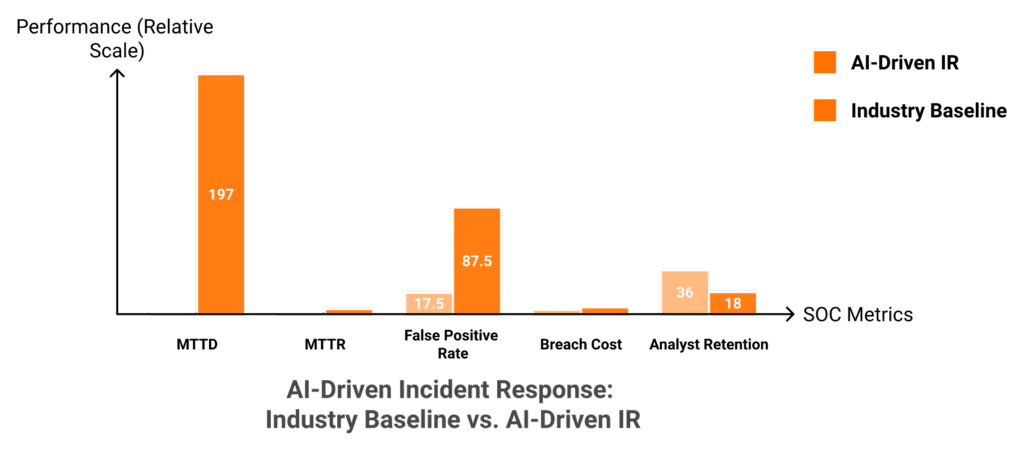
IBM’s 2025 Cost of a Data Breach Report provides the baseline. Organizations using AI and automation extensively cut breach costs to $3.62 million versus $5.52 million for non-users, a $1.9 million savings per breach. The mean time to identify and contain a breach dropped to 241 days, a nine-year low, with AI-powered organizations shaving 80 days off the breach lifecycle.
| Benefit | Industry Baseline | With AI-Driven IR |
|---|---|---|
| MTTD (Mean Time to Detect) | 197+ days | Under 30 minutes |
| False Positive Rate | 80–95% of alerts | Reduced by 80–95% |
| MTTR (Mean Time to Respond) | 4+ hours | Under 30 minutes |
| Scalability | Linear headcount growth | 10x alert volume, same team |
| Cost Savings (per breach) | $5.52M (no AI) | $3.62M (extensive AI) |
| Analyst Retention | ~18-month tenure | ~36-month tenure |
| Decision Accuracy | Human judgment under pressure | Evidence-based severity scoring |
| Security Posture | Reactive | Proactive and predictive |
| Threat Intel Aggregation | Manual cross-referencing | Automated cross-source enrichment |
💰 ROI Calculation Model
(Annual cost of manual IR operations) − (AI IR platform cost) + (Breach cost avoidance based on improved MTTD/MTTR) = Net ROI. UnderDefense publishes a SOC Cost Calculator for readers to model their own scenario.
✅ Real-World Proof: Before and After
Case Study 1: MTTR Reduction (Healthcare) — Mid-market healthcare company, 1,200 endpoints, 3-person security team. MTTR reduced from 4.5 hours to 28 minutes after deploying AI-driven MDR. Customer-facing alerts dropped by 99%.
Case Study 2: False Positive Elimination (PE Portfolio Tech Company) — 3,500 endpoints. False positive rate reduced from 94% to under 8%. Analyst triage hours reduced from 15/week to 2/week, estimated $280K annual savings.
Case Study 3: Autonomous Containment (Financial Services) — Black Basta ransomware variant detected and contained in under 9 minutes, preventing lateral movement across 847 endpoints. $0 ransom paid versus industry average $1.5M+ demand.
UnderDefense’s Documented Results
We built UnderDefense MAXI to deliver measurable outcomes, not vendor promises. Documented results across 500+ MDR clients: 0.5-hour MTTR for critical incidents, 99% alert noise reduction through custom detection tuning, and a 100% ransomware prevention record over six years. In a documented head-to-head, we detected and contained a threat 2 days faster than CrowdStrike OverWatch, because AI-driven detection without human context still leaves gaps only concierge analysts communicating directly with users can close.
“Before the guys from UD stepped in, we were getting bombarded with alerts from all our security tools. Their team cleaned up our configurations and got the noise under control within the first week.”
— Verified User, Marketing and Advertising UnderDefense – G2 Verified Review
“UnderDefense MAXI helped us save money on security by automating tasks and making things run smoother.”
— Julia K., Marketing Manager UnderDefense – G2 Verified Review
From unknown MTTD and 4-hour MTTR to sub-30-minute detection and containment: that’s not incremental improvement, but architectural transformation.
Q6. What Are the Challenges, and How Do You Avoid the Most Common Failure Modes?
⚠️ The Failure Reality
Despite growing AI adoption in security operations, a significant percentage of AI security initiatives underperform, and the root causes are operational, not algorithmic. Prompt-based exploits alone account for 35.3% of all documented AI security failures. Security leaders must understand these failure modes before investing, not after. The pattern is predictable: organizations bolt AI onto fragmented tool stacks, skip data normalization, and expect magic.
❌ The 6 Failure Modes, With Mitigation
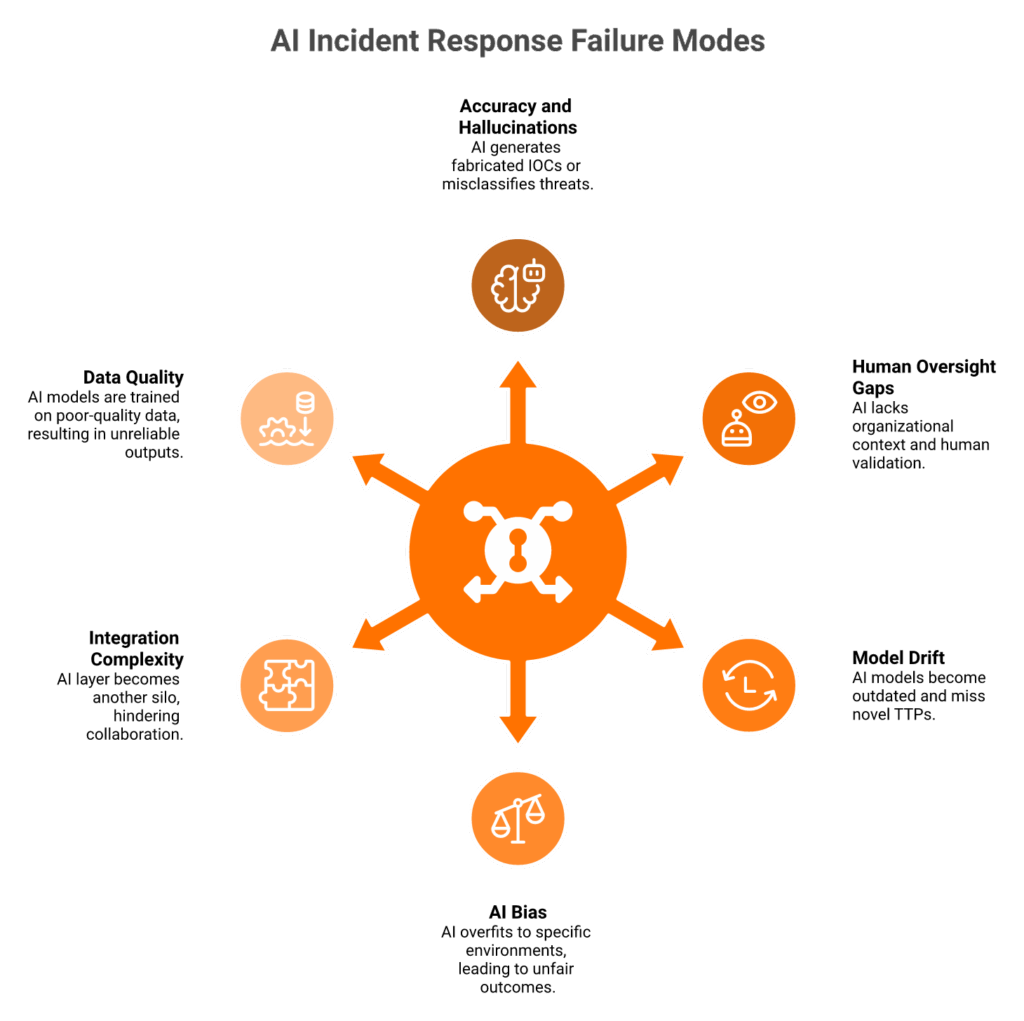
1. Accuracy and Trust Issues / AI Hallucinations
AI IR tools can fabricate IOCs or misclassify benign activity. The root cause is overreliance on model output without validation layers.
✅ Mitigation: Confidence-level routing with human validation for ambiguous cases. If the model isn’t 90%+ confident, a human reviews it.
2. Human Oversight Requirements
Fully autonomous AI lacks organizational context. It doesn’t know that your CTO runs PowerShell scripts at midnight before product launches.
✅ Mitigation: “AI drafts, human validates” model with clear escalation thresholds.
3. Model Drift and Evolving Threats
Models trained on last year’s attacks miss novel TTPs. Detection logic decays without continuous feedback.
✅ Mitigation: Continuous retraining on organization-specific data, weekly detection tuning cycles.
4. AI Bias in Training Data
Models overfitted to specific environments produce skewed results. A model trained on financial services data will generate false positives in healthcare.
✅ Mitigation: Diverse training datasets and regular bias audits across customer verticals.
5. Integration Complexity With Legacy Stacks
Adding an AI layer on top of fragmented tools creates another silo, not a solution.
✅ Mitigation: Vendor-agnostic platform approach that integrates the existing stack rather than replacing it.
6. Data Quality Dependencies
Garbage in, garbage out. If your SIEM ingests noisy, unnormalized data, your AI model inherits every gap.
✅ Mitigation: Data normalization and validation before model training, not after deployment.
✅ 5 Rules for AI IR Automation
- Start with high-volume, low-complexity incidents: phishing triage, password reset alerts
- Maintain human-in-the-loop for critical severity incidents
- Continuously retrain models on organization-specific data
- Establish clear escalation paths between AI and human analysts with documented confidence thresholds
- Document and audit all AI-driven response actions for compliance and continuous improvement
How UnderDefense’s Architecture Avoids Each Failure Mode
We designed our architecture around the failure modes, not just the capabilities. Vendor-agnostic integration across 250+ tools eliminates silo risk. Concierge analysts provide the organizational context AI lacks: they learn who your VIPs are, which teams run unusual scripts, and what “normal” looks like in your environment. Confidence-based routing ensures humans approve edge cases. Our 30-day onboarding includes data normalization and baseline tuning, and weekly detection tuning sessions close the feedback loop that prevents model drift.
The Architecture Is the Answer
We maintain a 100% ransomware prevention record across 500+ MDR clients because detection without context is noise, and response without trust is risk. The human-AI balance isn’t optional but the architecture itself. Every investigative step is observable and auditable. No black boxes. No “trust me, it works.”
Q7. AI Incident Response Tools: Which Platforms Should Security Leaders Evaluate in 2026?
⚠️ The Decision Dilemma
Choosing AI IR tooling means committing to a security architecture your SOC will depend on for years. SOAR, XDR, SIEM, and MDR vendors all claim “AI-powered” capabilities, but the architectures are fundamentally different. Some automate scripts faster, while others actually reason through evidence. Pick wrong, and you’re locked into a single-vendor ecosystem or stuck with automation that escalates the hard decisions back to your team.
❌ The Wrong Way to Decide
Most security leaders compare feature checklists or chase brand recognition. This ignores the critical architectural question: can the tool reason through ambiguous threats with organizational context, or does it just execute predefined scripts faster?
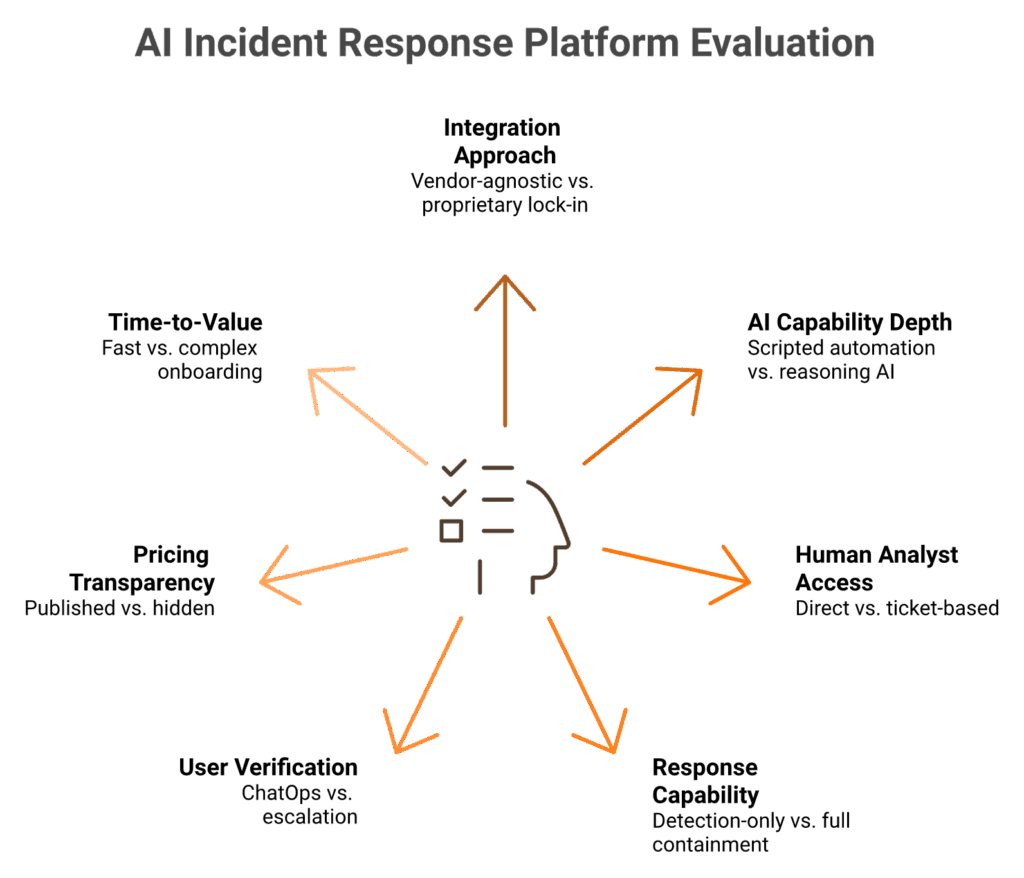
Here are the 7 evaluation criteria that actually matter:
- Integration Approach — Vendor-agnostic vs. proprietary lock-in
- AI Capability Depth — Scripted automation vs. reasoning/agentic AI
- Human Analyst Access — Direct Tier 3–4 communication vs. ticket-based escalation
- Response Capability — Detection-only vs. full containment and remediation
- User Verification — ChatOps direct vs. escalate to customer
- Pricing Transparency — Published rates vs. “contact sales”
- Time-to-Value — Deployment timeline and onboarding complexity
📊 Head-to-Head Comparison: 8 Platforms Scored
| Platform (Category) | Integration | AI Depth | Human Access | Response | User Verification | Pricing | Time-to-Value | Score |
|---|---|---|---|---|---|---|---|---|
| UnderDefense MAXI (Full-Stack MDR+AI) | ✅ | ✅ | ✅ | ✅ | ✅ | ✅ | ✅ | 14/14 |
| Palo Alto Cortex XSOAR (SOAR) | ⚠️ | ✅ | ❌ | ⚠️ | ❌ | ❌ | ❌ | 6/14 |
| Splunk SOAR (SOAR) | ⚠️ | ⚠️ | ❌ | ⚠️ | ❌ | ❌ | ❌ | 4/14 |
| Microsoft Sentinel + Copilot (AI-SIEM) | ⚠️ | ⚠️ | ❌ | ⚠️ | ❌ | ❌ | ⚠️ | 5/14 |
| FortiSOAR (SOAR) | ⚠️ | ⚠️ | ❌ | ⚠️ | ❌ | ❌ | ⚠️ | 5/14 |
| Swimlane Turbine (SOAR) | ⚠️ | ✅ | ❌ | ⚠️ | ❌ | ❌ | ⚠️ | 6/14 |
| IBM QRadar SOAR (SOAR) | ⚠️ | ⚠️ | ❌ | ⚠️ | ❌ | ❌ | ❌ | 4/14 |
| Rapid7 InsightConnect (SOAR) | ⚠️ | ⚠️ | ❌ | ⚠️ | ❌ | ❌ | ❌ | 4/14 |
✅ = Full capability | ⚠️ = Partial | ❌ = Not available or requires your team
Where UnderDefense Stands
UnderDefense scores 14/14 because it was designed from the ground up as an AI SOC with Human Ally support, not a retrofitted monitoring tool or standalone SOAR platform. Every other tool on this list requires your team to be the “human in the loop.” UnderDefense provides the humans: dedicated concierge analysts who know your environment and respond on your behalf.
“Their SOC team is responsive and knows their stuff. When they escalate something, they include the context we need to understand the issue quickly.”
— Verified User, Marketing and Advertising UnderDefense – G2 Verified Review
“We received little value from ArcticWolf. The product offered little visibility when we were using it… Anything you want to look at or changes you need to make in the product must go through their engineering team.”
— Matt C., Manager, Cybersecurity Services Arctic Wolf – G2 Verified Review
“Rapid7 is a tool that does the job, however lacks in several aspects such as integrations, default rule set and asset association.”
— Verified Reviewer Rapid7 – Gartner Verified Review
Q8. How Do You Assess Readiness and Build a Complete AI Incident Response Playbook?
Part 1: AI IR Maturity Model, Where Do You Stand?
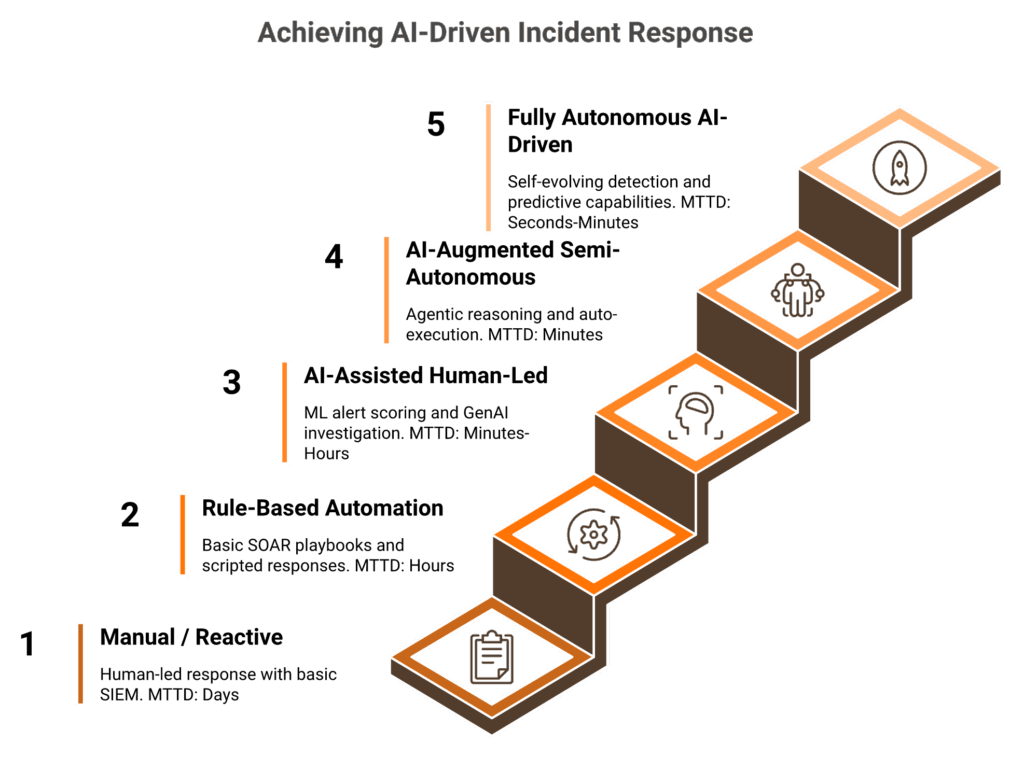
Before selecting tools or vendors, security leaders need an honest baseline. This 5-level maturity model serves as a self-assessment framework:
| Level | Detection Method | Investigation | Response | Human Role | Typical MTTD | Target KPIs |
|---|---|---|---|---|---|---|
| 1 — Manual/Reactive | Rule-based SIEM | Manual triage | Manual | Primary operator | Days | Establish baseline |
| 2 — Rule-Based Automation | Basic SOAR playbooks | Scripted responses | Semi-automated | Approves all decisions | Hours | Reduce triage time 50% |
| 3 — AI-Assisted Human-Led | ML-powered alert scoring | GenAI investigation assist | Automated for low-severity | Leads; AI supports | Minutes–Hours | MTTD < 1 hour |
| 4 — AI-Augmented Semi-Autonomous | Agentic AI reasoning | Auto-execution of high-confidence responses | Autonomous for confirmed threats | Approves edge cases | Minutes | MTTR < 30 min |
| 5 — Fully Autonomous AI-Driven | Self-evolving detection | Predictive threat anticipation | Continuous model optimization | Governance oversight | Seconds–Minutes | Zero dwell time |
☐ Self-Assessment Checklist
Answer these 8 questions honestly to pinpoint your maturity level:
- ☐ Do you have 24/7/365 threat monitoring?
- ☐ Are alerts from all sources (endpoint, identity, cloud, and network) correlated in one view?
- ☐ Can you contain a critical threat within 30 minutes of detection?
- ☐ Does your team verify suspicious user activity directly before escalating?
- ☐ Does security monitoring auto-generate compliance evidence?
- ☐ Do you have AI-assisted investigation capabilities?
- ☐ Can your SOC handle 10x alert volume without additional headcount?
- ☐ Do you retrain detection models on organization-specific data?
Score interpretation: 7–8 ✓ = Level 4–5 | 4–6 ✓ = Level 2–3 | 0–3 ✓ = Level 1
Part 2: 12-Week Implementation Roadmap
Weeks 1–2: Assess
Tool inventory, alert volume baseline, MTTD/MTTR measurement, maturity scoring, and gap identification.
Weeks 3–4: Select and Procure
Apply the evaluation framework from Q7. Define success KPIs. Build business case with ROI model from Q5.
Weeks 5–8: Integrate
Data normalization, detection rule configuration, and automated playbook deployment for initial use cases (phishing triage, credential compromise, and endpoint isolation).
Weeks 9–12: Train and Exercise
Analyst workflow transition from manual to AI-augmented. Define roles: SOC Lead, Platform Admin, Executive Sponsor, and Escalation Manager. Run tabletop exercises simulating real incident scenarios.
Ongoing
Weekly detection tuning, monthly playbook review, quarterly maturity re-assessment, and continuous expansion of automated use cases.
📋 AI IR Plan Template: Essential Components
Every documented AI incident response plan needs these elements:
- Severity classification — 4 levels (Critical/High/Medium/Low) with response SLAs for each
- Response team RACI matrix — Who is Responsible, Accountable, Consulted, and Informed
- Communication protocols — Internal escalation, executive notification, and regulatory reporting timelines
- Automated vs. human decision thresholds — Confidence-level routing rules
- Evidence preservation requirements — Chain of custody for forensic and compliance purposes
- Post-incident review cadence — Blameless retrospectives within 48 hours of containment
⏰ Compressing the Timeline With UnderDefense
UnderDefense compresses this 12-week roadmap into a 30-day turnkey deployment. UnderDefense MAXI integrates with your existing 250+ tool stack from day one, AI-driven detection goes live within the first week, and dedicated concierge analysts provide the training, tuning, and optimization as an ongoing service. Most organizations jump from Level 1–2 to Level 3–4 within the first month.
Q9. What Governance Frameworks Apply, and How Do You Respond to Incidents Caused BY AI?
⚠️ The Governance Imperative
AI in incident response introduces compliance considerations that most security leaders have not faced before: model explainability, automated decision accountability, data handling in AI pipelines, and audit trails for autonomous containment actions. Three frameworks now directly address AI security governance:
- NIST AI Risk Management Framework (AI RMF 1.0): Governance, risk mapping, and trustworthiness requirements for AI systems, organized across four functions: Govern, Map, Measure, and Manage. In February 2026, Treasury released the Financial Services AI RMF built directly on this structure, introducing 230 control objectives.
- CoSAI AI Incident Response Framework v1.0 (November 2025) : The first framework specifically addressing incident response for AI systems. Published by the Coalition for Secure AI, it covers AI-specific threat classification, model supply chain security, and adversarial ML response procedures.
- EU AI Act Article 62 : Mandatory incident reporting requirements for high-risk AI systems, including timelines, severity classification, and authority notification procedures.
📋 Framework-to-Capability Alignment
| Governance Standard | AI IR Capability Required |
|---|---|
| NIST AI RMF | Model governance, bias monitoring, explainability |
| CoSAI v1.0 | AI threat taxonomy, model integrity verification, response playbooks |
| EU AI Act Article 62 | Reporting timelines, severity classification, authority notification |
| NIST CSF 2.0 | Detect/Respond/Recover function requirements |
| SOC 2 Type II | Automated evidence collection, continuous monitoring documentation |
| ISO 27001 | AI risk treatment, AI-specific incident classification, ISMS integration |
| HIPAA | PHI handling in AI analysis pipelines, breach notification automation |
❌ Responding to Incidents Caused BY AI
This is the emerging discipline most organizations overlook entirely: what happens when AI itself is the attack surface?
- Model Poisoning: Adversaries inject malicious data into training pipelines, causing models to produce attacker-favorable outputs.
- Adversarial Attacks: Crafted inputs that cause misclassification or evasion of AI-powered detection systems.
- Bias Manifestation: AI systems producing discriminatory or skewed security responses affecting specific user populations.
- Data Leakage: Training data extraction attacks revealing sensitive information embedded in model weights.
Vertical-Specific Considerations
Healthcare (HIPAA): Patient safety AI incidents require breach notification automation and minimum necessary access for ML models accessing PHI. Financial Services: The new FS AI RMF introduces 230 mapped control objectives covering fraud detection AI failures and model risk management. Critical Infrastructure: AI in OT/ICS incident response carries safety implications for autonomous response in physical systems, with CISA reporting requirements adding additional compliance layers.
✅ How UnderDefense Closes the Governance Gap
The UnderDefense MAXI platform generates compliance evidence automatically. Every AI-driven detection, analyst action, and containment decision is logged with full audit trails that map directly to SOC 2, ISO 27001, and HIPAA controls, with forever-free compliance kits included at no additional cost. For organizations facing AI-specific incidents, our concierge analysts provide the investigative expertise to handle model-targeted attacks alongside conventional threats.
Q10. Which AI-Powered Threat Detection and Response Solution Fits Your Organization?
Matching Solutions to Maturity
The right AI-powered threat detection and response solution depends on three factors: your existing security stack, your team’s operational maturity (reference the maturity model in Q8), and whether you need a tool to augment your SOC or a managed service that operates as your SOC. The leading platforms in 2026 span SOAR, XDR, AI-native SIEM, and full-stack MDR, each with distinct architectural trade-offs.
What Separates the Top Solutions
- Integration flexibility: Vendor-agnostic (works with your existing CrowdStrike/Splunk/Microsoft stack) vs. proprietary lock-in requiring tool replacement
- AI depth: Scripted automation vs. agentic reasoning that adapts to novel threats
- Human expertise model: Direct analyst access vs. ticket-based escalation vs. fully self-serve
- Response capability: Detection-only vs. full containment and remediation included
- Pricing model: Transparent per-endpoint pricing vs. opaque enterprise quotes requiring sales calls
Where the Leading Platforms Excel
Each platform excels in different scenarios: UnderDefense MAXI for organizations wanting AI-driven detection with human concierge response on their existing stack, Cortex XSOAR for Palo Alto-native environments needing advanced orchestration, and Microsoft Sentinel for organizations fully committed to the Azure ecosystem. The right choice requires evaluating specific features, pricing, real-user reviews, and deployment requirements side by side.
This evaluation is based on documented response times, published pricing, G2 Spring 2026 rankings, MITRE ATT&CK coverage claims, and operational outcomes across 500+ MDR deployments.
Q11. How Does UnderDefense Operationalize AI Incident Response With the AI SOC + Human Ally Model?
The Operational Answer
UnderDefense’s AI SOC + Human Ally model operationalizes every concept covered in this article: AI-powered detection, GenAI-augmented investigation, automated containment, governance compliance, and continuous optimization, all through a unified platform backed by dedicated security analysts who function as an extension of your team, not a ticket queue.
How the UnderDefense MAXI Platform Works
Here is the architecture, step by step:
- Vendor-agnostic ingestion layer connects to 250+ existing tools (CrowdStrike, Splunk, SentinelOne, Microsoft Defender, Okta, AWS, Azure, GCP) without requiring tool replacement, protecting existing security investments
- AI-driven correlation engine maps alerts across endpoint, identity, cloud, and network telemetry into unified incident timelines
- Confidence-based routing auto-executes high-confidence containment (credential revocation, endpoint isolation, lateral movement blocking) while escalating ambiguous cases to human analysts
- Concierge analysts communicate directly with affected users via Slack, Teams, or email to verify suspicious activity, making UnderDefense the only MDR provider that contacts users directly
- Full containment and remediation, not just detection and escalation
💰 Why It Matters: Business Outcomes
| Metric | UnderDefense Result |
|---|---|
| Alert-to-Triage | 2-minute documented SLA |
| Escalation for Critical Incidents | 15-minute SLA |
| Customer-Facing Alert Reduction | 99% through custom detection tuning |
| MITRE ATT&CK Coverage | 96% |
| Faster Than CrowdStrike OverWatch | 2 days (documented case study) |
| Transparent Pricing | $11–15/endpoint/month |
| Compliance Kits | Forever-free (SOC 2, ISO 27001, HIPAA) |
| Onboarding | 30-day turnkey deployment |
⏰ The Future: Human-AI Partnership Becomes More Critical
As the industry moves from Level 3 (AI-assisted) to Level 4–5 (autonomous/self-evolving), the trust relationship between AI and human expertise becomes more critical, not less. Predictive security, pre-incident intervention, AI-to-AI adversarial defense, and IoT/edge computing IR are the next frontiers, all requiring the human-AI partnership model we have operationalized from day one.
Stop renting alert dashboards. Start hiring an AI SOC with a dedicated security ally.
“The platform works really well with our other security tools, which makes things much simpler. And we really appreciate that we can customize the threat detection to focus on our specific needs.”
— Serhii B., Chief Information Security Officer UnderDefense – G2 Verified Review
“UnderDefense MAXI integrates well with our systems, specifically with our SIEM, Splunk. Their team is proactive in identifying and addressing threats, providing 24/7 oversight.”
— Oleg K., Director Information Security UnderDefense – G2 Verified Review
“Analysts provide little context, and when asked for more information in the investigation nothing is ever provided or even communicated. Support incidents are not worked to completion and communication evaporates.”
— CISO, Manufacturing Arctic Wolf – Gartner Verified Review
While traditional MDR tells you “suspicious login detected, please investigate,” UnderDefense tells you who logged in, confirms with the user directly, and contains the threat before your team wakes up, with documented response times 2 days faster than CrowdStrike OverWatch.
1. How does AI improve mean time to detect (MTTD) and mean time to respond (MTTR) in incident response?
AI compresses both MTTD and MTTR by automating the cognitive work that traditionally consumes analyst hours. IBM’s 2025 Cost of a Data Breach Report shows organizations using AI and automation extensively reduced breach identification and containment to 241 days — an 80-day improvement and a nine-year low.
In practice, we see even more dramatic results at the SOC level:
-
MTTD drops from 197+ days to under 30 minutes through ML-powered behavioral baselines that detect anomalous patterns across endpoint, identity, cloud, and network telemetry in real time.
-
MTTR drops from 4+ hours to under 30 minutes via automated containment actions — credential revocation, endpoint isolation, and firewall rule deployment — executed within confidence-based guardrails.
Our MAXI platform delivers a documented 0.5-hour MTTR for critical incidents and a 2-minute alert-to-triage SLA across 500+ MDR clients. The key is not just detection speed but response authority — we don’t escalate alerts for your team to investigate; our concierge analysts own containment. In a documented case, we detected and contained a threat 2 days faster than CrowdStrike OverWatch because AI detection without human context leaves gaps only direct analyst communication can close.
2. What are the highest-impact use cases of AI in incident response for SOC teams?
We see the highest ROI from AI in areas where analyst time gets consumed disproportionately — triaging noisy alerts, assembling cross-tool context, and determining what’s actionable versus benign. The 10 highest-impact use cases in production today are:
-
Real-time threat detection and behavioral analytics — ML baselines detect insider threats and credential abuse patterns that rule-based systems miss, catching up to 95% of unknown malware variants.
-
Automated alert prioritization and triage — AI scores thousands of daily alerts by severity and asset criticality, reducing analyst workload by 80–90%.
-
Phishing detection and automated response — NLP analysis of email content, URL reputation, and sender behavior triggers automatic quarantine.
-
Automated malware analysis — ML-powered sandboxing produces verdicts in seconds versus hours of manual reverse engineering.
-
SIEM integration and optimization — AI enriches SIEM data with contextual scoring while reducing storage costs.
-
Threat hunting and adversary emulation — AI proactively searches historical data, mapping findings to MITRE ATT&CK TTPs.
-
Intelligent containment with confidence-based routing — auto-executes high-confidence responses while escalating ambiguous cases to human analysts.
What no pure-AI platform replicates is direct user verification via Slack, Teams, or email, which is how our concierge analyst model closes the context gap between detection and confirmed threat.
3. What is the difference between AI-driven incident response and traditional SOAR automation?
The difference is architectural, not incremental. Traditional SOAR executes pre-written scripts: “if phishing email, then quarantine.” It handles known scenarios but stalls at novel threats — when the playbook says “investigate further,” the human bottleneck returns.
AI-driven incident response, by contrast, reasons through evidence:
-
SOAR approach: Scripted if-then logic, predefined playbooks, static rules.
-
AI-driven approach: Behavioral analytics that detect anomalies across telemetry, agentic reasoning that produces investigation verdicts with confidence levels, and dynamic playbook generation for novel threat types.
The critical distinction: SOAR automates tasks; AI augments judgment. Agentic AI systems can evaluate something like “This PowerShell script was launched by a service account at 2 AM from an IP not previously associated with this account — confidence level 87% malicious — recommended action: isolate endpoint and verify with account owner.”
Our MAXI platform integrates both — SOAR playbooks handle known, high-confidence scenarios at machine speed, while agentic AI handles ambiguous cases with human analyst oversight through our “AI drafts, human validates” model. This is why we achieve 96% MITRE ATT&CK coverage alongside a 99% reduction in customer-facing alerts.
4. How much does AI-powered incident response cost, and what is the ROI?
The ROI model for AI incident response comes down to a straightforward calculation: (Annual cost of manual IR operations) − (AI IR platform cost) + (Breach cost avoidance based on improved MTTD/MTTR) = Net ROI.
The numbers supporting this are clear:
-
Breach cost savings: IBM reports organizations using extensive AI and automation cut breach costs to $3.62M versus $5.52M for non-users — a $1.9M savings per breach.
-
Analyst productivity: AI reduces triage hours by 80–90%, which at mid-market SOC salaries translates to $150K–$300K in recovered analyst capacity annually.
-
Headcount scalability: Handle 10x alert volume with the same team size, avoiding the $180K–$250K cost of each additional Tier 2 analyst.
For managed AI IR services, transparent pricing matters. We publish our MDR pricing at $11–$15/endpoint/month — and that includes 24/7 AI-driven detection, dedicated concierge analysts, and full containment authority. Use our SOC Cost Calculator to model your specific scenario.
One PE portfolio tech company we work with reduced false positive triage from 15 hours/week to 2 hours/week — an estimated $280K in annual savings on a 3,500-endpoint deployment.
5. What are the biggest challenges and failure modes when implementing AI in incident response?
Most AI security initiatives underperform due to implementation failures, not technology limitations. The root causes are operational and predictable. We track six core failure modes:
-
AI hallucinations and trust issues — AI IR tools can fabricate indicators of compromise. Mitigation: confidence-level routing with human validation for ambiguous cases.
-
Human oversight gaps — Fully autonomous AI lacks organizational context. Mitigation: “AI drafts, human validates” model with clear escalation thresholds.
-
Model drift — Models trained on last year’s attacks miss novel TTPs. Mitigation: continuous retraining on organization-specific data with weekly detection tuning.
-
AI bias in training data — Models overfitted to specific environments produce skewed results. Mitigation: diverse datasets and regular bias audits.
-
Integration complexity — AI bolted onto fragmented tools creates another silo. Mitigation: vendor-agnostic platform approach that integrates existing stacks.
-
Data quality dependencies — Garbage in, garbage out. Mitigation: data normalization before model training.
We designed our architecture specifically around these failure modes. Our 30-day onboarding includes data normalization and baseline tuning, and weekly detection tuning sessions close the feedback loop that prevents drift.
6. Which AI incident response tools and platforms should security leaders evaluate in 2026?
The AI IR platform landscape spans four categories, each with distinct trade-offs:
-
SOAR Platforms (Palo Alto Cortex XSOAR, Splunk SOAR, FortiSOAR, Swimlane Turbine) — strong in scripted automation and orchestration but require your team to be the human-in-the-loop.
-
AI-Enhanced SIEM (Microsoft Sentinel + Security Copilot) — powerful in Microsoft-native environments but partially locked to the Azure ecosystem.
-
SOAR with AI Layer (IBM QRadar SOAR, Rapid7 InsightConnect) — established platforms with growing AI capabilities but limited response authority.
-
Full-Stack MDR with AI (UnderDefense MAXI) — combines AI-driven detection, automated orchestration, and dedicated human concierge response.
Evaluate platforms across seven criteria: integration approach (vendor-agnostic vs. proprietary), AI capability depth (scripted vs. agentic), human analyst access, response capability, user verification, pricing transparency, and time-to-value.
The critical architectural question: can the tool reason through ambiguous threats with organizational context, or does it just execute predefined scripts faster? Every SOAR platform requires your team as the human-in-the-loop. UnderDefense provides the humans.
7. How do you build an AI incident response playbook and assess organizational readiness?
Start with an honest maturity assessment. We use a 5-level AI IR Maturity Model:
-
Level 1 (Manual/Reactive): Rule-based SIEM, manual triage, MTTD measured in days.
-
Level 2 (Rule-Based Automation): Basic SOAR playbooks, scripted responses, MTTD in hours.
-
Level 3 (AI-Assisted Human-Led): ML-powered alert scoring, GenAI investigation assistance, MTTD in minutes-to-hours.
-
Level 4 (AI-Augmented Semi-Autonomous): Agentic AI reasoning, auto-execution of high-confidence responses, MTTD in minutes.
-
Level 5 (Fully Autonomous): Self-evolving detection, predictive anticipation, MTTD in seconds.
Your AI incident response plan needs six core elements: severity classification with SLAs, a RACI matrix, communication protocols, automated vs. human decision thresholds, evidence preservation requirements, and post-incident review cadence.
Follow a 12-week implementation roadmap: assess (Weeks 1–2), select and procure (Weeks 3–4), integrate (Weeks 5–8), train and exercise (Weeks 9–12), then optimize continuously. UnderDefense compresses this into a 30-day turnkey deployment — most organizations jump from Level 1–2 to Level 3–4 within the first month.
8. What governance frameworks apply to AI in incident response, and how do you respond to AI-caused incidents?
Three frameworks now directly address AI security governance:
-
NIST AI Risk Management Framework (AI RMF 1.0): Covers governance, risk mapping, and trustworthiness across four functions — Govern, Map, Measure, and Manage. Treasury’s February 2026 Financial Services AI RMF builds on this with 230 control objectives.
-
CoSAI AI Incident Response Framework v1.0 (November 2025): The first framework specifically addressing incident response for AI systems, covering AI-specific threat classification and model supply chain security.
-
EU AI Act Article 62: Mandatory incident reporting for high-risk AI systems, including timelines and severity classification.
The emerging discipline most organizations overlook: responding to incidents where AI itself is the attack surface — model poisoning, adversarial attacks, bias manifestation, and training data extraction.
We close this governance gap through our AI SOC + Human Ally model. Every AI-driven detection, analyst action, and containment decision is logged with full audit trails mapping directly to SOC 2, ISO 27001, and HIPAA controls. We include forever-free compliance kits at no additional cost, and our concierge analysts provide investigative expertise for both conventional threats and AI-targeted attacks.