




Q1. What Are the 12 Best Threat Detection and Intelligence Tools for Enterprise SOCs in 2026?
The threat landscape in 2026 demands both real-time detection (XDR, EDR, SIEM, NDR) and contextual intelligence (TIP, CTI, dark web monitoring). No single tool covers both, except MDR platforms designed to unify them. For this report, we analyzed 30+ platforms across both categories and shortlisted 12 based on operational, technical, and business criteria relevant to modern security organizations. These selections span vendor-agnostic MDR, endpoint-native XDR, autonomous AI detection, threat intelligence platforms, and open-source community tools.
Our Evaluation Criteria
Each provider included in this list was assessed across five key areas:
- Detection & Response Capability — 24/7 monitoring maturity, MITRE ATT&CK coverage, MTTD/MTTR benchmarks, and automated containment readiness
- Threat Intelligence Depth — Quality and timeliness of CTI feeds, dark web monitoring, IOC enrichment, and STIX/TAXII interoperability
- Integration & Deployment Flexibility — Vendor-agnostic compatibility with existing SIEM, EDR, cloud, and identity tools; cloud, hybrid, and on-prem deployment modes
- Customer Validation — Verified user reviews on G2, Gartner Peer Insights, and community adoption signals
- Scalability & Pricing Transparency — Suitability for mid-market to enterprise SOCs, published pricing versus opaque “contact sales” models
Who This Guide Is For
This shortlist is designed specifically for:
- CISOs and Security Directors evaluating unified detection-and-response platforms for hybrid environments
- IT Directors and CTOs at mid-market organizations (100–5,000 endpoints) seeking to consolidate fragmented security stacks
- SOC managers comparing XDR, SIEM, and TIP solutions for MITRE ATT&CK coverage and alert triage efficiency
- PE Operating Partners assessing cybersecurity posture across portfolio companies
If your organization is moving toward vendor evaluation or preparing an RFP for threat detection and intelligence capabilities, the providers below represent established platforms frequently considered during the buying process.
| Provider Name | Best For | Key Strength | Compliance |
|---|---|---|---|
| UnderDefense ⭐⭐⭐⭐⭐ | Unified detection + response across existing stacks | AI SOC + Human Ally MDR with vendor-agnostic 250+ integrations | SOC 2, HIPAA, ISO 27001, GDPR (forever-free compliance kits) |
| CrowdStrike Falcon XDR ⭐⭐⭐⭐ | Falcon-native endpoint-centric XDR | Unified lightweight agent with OverWatch threat hunting | SOC 2, HIPAA, PCI DSS, FedRAMP |
| Palo Alto Cortex XSIAM ⭐⭐⭐⭐ | Large enterprises consolidating SIEM + XDR + SOAR | AI-driven SOC automation with autonomous analytics | SOC 2, HIPAA, PCI DSS, ISO 27001 |
| SentinelOne Singularity XDR ⭐⭐⭐⭐ | Autonomous, low-touch endpoint detection | Static + behavioral AI with ransomware rollback | SOC 2, HIPAA, PCI DSS, FedRAMP |
| Flare ⭐⭐⭐⭐ | Identity-centric intelligence and credential monitoring | Custom collection feeds across the cybercrime ecosystem | SOC 2 Type II |
| Darktrace DETECT + RESPOND ⭐⭐⭐⭐ | Self-learning AI for network anomaly detection | Unsupervised ML that learns organizational behavior patterns | SOC 2, ISO 27001, GDPR |
| Recorded Future ⭐⭐⭐⭐ | Real-time threat intelligence at scale | Largest machine-collected intelligence dataset globally | SOC 2, ISO 27001 |
| Google Mandiant Threat Intelligence ⭐⭐⭐⭐ | APT tracking and incident response intelligence | Frontline intelligence from 1,000+ IR engagements annually | SOC 2, FedRAMP, ISO 27001 |
| Anomali ThreatStream ⭐⭐⭐⭐ | TIP aggregation with SIEM enrichment | Multi-source intelligence aggregation with STIX/TAXII | SOC 2, ISO 27001 |
| Rapid7 InsightIDR ⭐⭐⭐⭐ | Cloud SIEM with built-in UEBA | Unified SIEM, EDR, and threat intelligence in one console | SOC 2, HIPAA, PCI DSS, ISO 27001 |
| ThreatConnect ⭐⭐⭐ | Intelligence operationalization with risk quantification | TIP + SOAR + risk scoring in a single platform | SOC 2, ISO 27001 |
| MISP ⭐⭐⭐ | Budget-constrained SOCs and CTI sharing communities | Open-source, community-driven threat intelligence sharing | Self-managed (no vendor compliance) |
1. UnderDefense: Best for Unified Detection + Response Across Your Existing Security Stack
📋 Overview
UnderDefense is a managed detection and response (MDR) provider built around the AI SOC + Human Ally model, a vendor-agnostic architecture that unifies AI-driven detection with dedicated concierge analyst response. Unlike traditional MDR providers that require proprietary tool replacement, UnderDefense layers on top of your existing security investments, connecting endpoints, cloud, identity, network, and SaaS telemetry into a single context-aware detection-and-response layer through its MAXI platform.
✅ Core Services
- 24/7 Managed Detection & Response with AI-driven alert triage and human analyst investigation
- Vendor-agnostic integration across 250+ existing security tools (CrowdStrike, SentinelOne, Splunk, Microsoft Defender, Elastic, Okta, and more)
- Concierge analyst response: dedicated analysts communicate directly with affected users via Slack, Teams, or email to verify suspicious activity and own outcomes
- ChatOps-driven remediation: credential revocation, endpoint isolation, and lateral movement blocking executed within 0.5-hour MTTR for critical incidents
- Proactive threat hunting with 96% MITRE ATT&CK coverage and custom detection tuning that reduces customer-facing alerts by 82%
🎯 Why Companies Consider UnderDefense
Most mid-market security teams face the same operational reality: they have CrowdStrike for endpoints, Splunk or Elastic for logs, Okta for identity, and separate cloud consoles, but no unified system that reasons across all of them. UnderDefense solves this by acting as the connective intelligence layer. We do not ask you to replace your tools; we make them work together. When behavioral alerts need context (“Did Jane run that PowerShell script?”), our analysts reach out directly via Slack or Teams to verify, then contain confirmed threats before your team wakes up.
🏢 Ideal Customer Profile
- Mid-market to enterprise organizations with 100–5,000 endpoints
- Security-lean teams that need 24/7 expert coverage without building an in-house SOC
- Companies with existing security tool investments (SIEM, EDR, cloud) they want to keep and optimize
- Compliance-driven organizations handling SOC 2, HIPAA, ISO 27001, or GDPR requirements
- PE portfolio companies needing rapid security posture improvement across multiple entities
💰 Commercial Model
UnderDefense operates on transparent, published pricing at $11–15/endpoint/month, one of the only MDR providers to publish per-endpoint rates. This covers 24/7 monitoring, investigation, analyst response, and compliance kit access. No hidden professional services fees, no per-incident charges, and no “contact sales” pricing games. Onboarding is 30-day turnkey deployment with custom detection tuning included.
⏰ When to Shortlist
Shortlist UnderDefense when you need a force multiplier for your existing security team, not a tool replacement. If your priority is keeping your current SIEM and EDR investments while adding 24/7 expert-driven detection and response with transparent, predictable pricing, UnderDefense belongs on your evaluation list.
💬 Customer Reviews
“The biggest win for me was getting actual control over our security alerts. Before the guys from UD stepped in, we were getting bombarded with alerts from all our security tools. Their team cleaned up our configurations and got the noise under control within the first week. Now when we get an alert, we know it’s something worth looking into.”
— Verified User in Marketing and Advertising, UnderDefense — G2 Verified Review
“Honestly, some security tools are more complicated than the threats themselves. Underdefense isn’t just about catching bad stuff, they give proactive tips too. Feels like my IT department suddenly got way smarter.”
— Andriy H., Co-Founder and CTO at Contora Inc., UnderDefense — G2 Verified Review
2. CrowdStrike Falcon XDR + Falcon Intelligence: Best for Falcon-Native Endpoint-Centric Extended Detection
📋 Overview
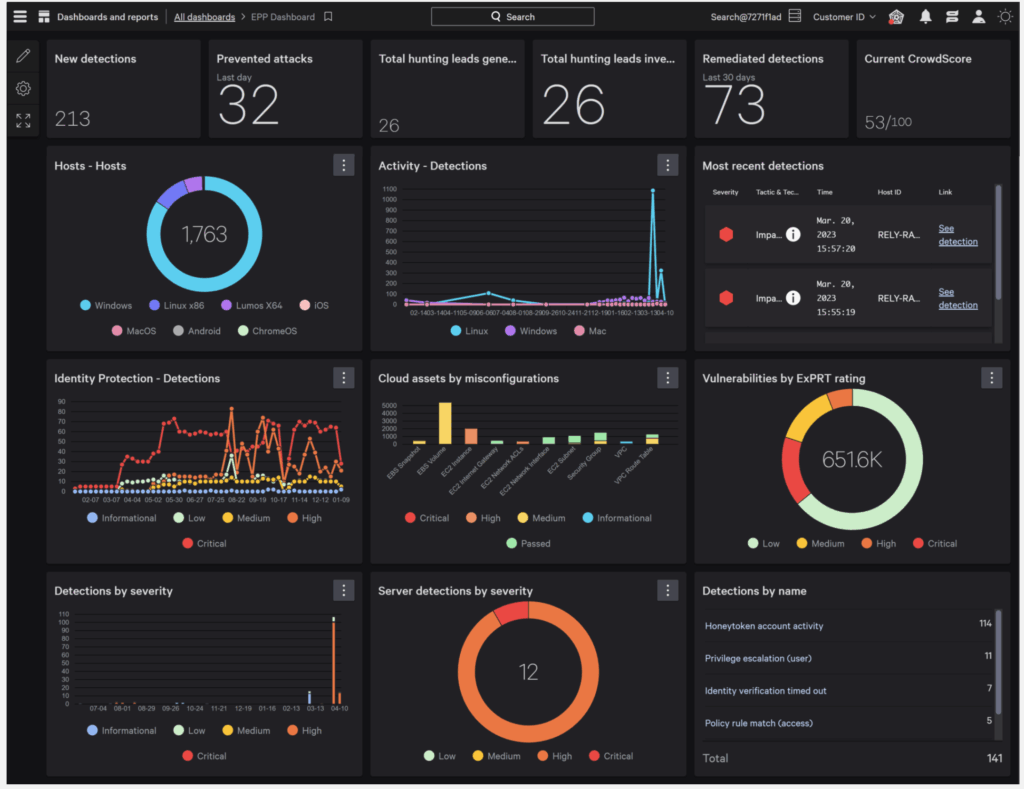
CrowdStrike Falcon Insight XDR extends the company’s industry-leading EDR capabilities into a cross-domain detection and response platform. Built on the cloud-native Falcon platform, it correlates telemetry from endpoints, cloud workloads, identity, and third-party data sources through a single lightweight agent. Falcon Intelligence adds integrated threat intelligence with IOC scoring, adversary tracking, and automated enrichment, making it a strong choice for organizations already invested in the CrowdStrike ecosystem.
✅ Core Services
- Endpoint detection and response (EDR) with real-time XDR correlation across identity, cloud, and network
- Falcon OverWatch 24/7 managed threat hunting led by CrowdStrike experts
- Falcon Intelligence for automated threat intelligence, adversary profiling, and IOC enrichment
- Integrated firewall management and USB device control
- Cloud workload protection (CWP) for containers and Kubernetes
🎯 Why Companies Consider CrowdStrike Falcon XDR
CrowdStrike’s reputation is built on endpoint protection excellence: their lightweight agent consistently ranks among the top EDR solutions in independent testing. The XDR extension adds cross-domain visibility, and OverWatch provides always-on threat hunting. For organizations that have standardized on CrowdStrike endpoints, Falcon XDR is the natural extension for broader detection coverage.
🏢 Ideal Customer Profile
- Organizations already using CrowdStrike Falcon for endpoint protection
- Mid-market to enterprise teams seeking XDR without multi-vendor complexity
- Security teams wanting managed threat hunting (OverWatch) alongside detection
- Falcon-native environments looking to extend detection to identity and cloud
💰 Commercial Model
CrowdStrike Falcon XDR is available as part of the Falcon Enterprise bundle at $184.99/device/year (list price), which includes EDR, XDR, threat hunting, NGAV, and firewall management. Falcon Elite and Falcon Complete MDR tiers offer custom pricing with additional threat intelligence modules and full managed response. Volume discounts and multi-year terms commonly yield lower rates.
⏰ When to Shortlist
Shortlist CrowdStrike Falcon XDR if your organization is already invested in the Falcon ecosystem and wants to extend endpoint detection into cross-domain XDR without introducing a new vendor. Be aware that XDR capabilities are strongest within the CrowdStrike ecosystem; cross-vendor correlation requires additional configuration.
3. Palo Alto Cortex XSIAM: Best for Large Enterprises Consolidating SIEM + XDR + SOAR
📋 Overview
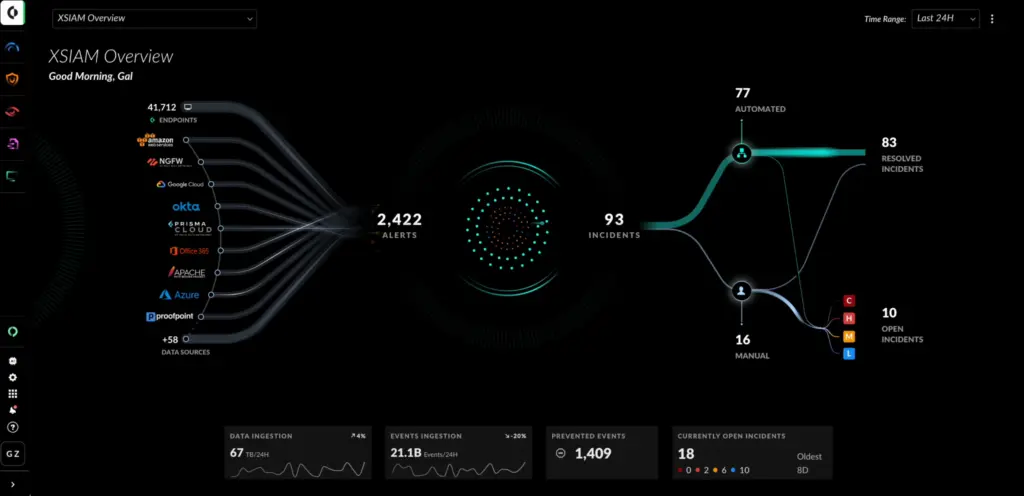
Palo Alto Networks’ Cortex XSIAM (Extended Security Intelligence and Automation Management) represents the convergence play, combining SIEM, XDR, SOAR, ASM, and threat intelligence into a single AI-driven platform. XSIAM aims to replace the traditional SOC stack with autonomous analytics that can ingest, normalize, and correlate massive volumes of security data at machine speed. It is an ambitious platform designed for large enterprises ready to consolidate fragmented security operations.
✅ Core Services
- AI-driven SOC automation unifying SIEM, XDR, SOAR, and TIP in one platform
- Autonomous analytics engine for real-time correlation across all telemetry
- Identity threat detection and response (ITDR) module
- Attack surface management (ASM) and exposure management
- Managed Threat Hunting as an optional add-on
🎯 Why Companies Consider Cortex XSIAM
XSIAM appeals to organizations drowning in security tool sprawl. If you are running separate SIEM, XDR, SOAR, and TIP platforms, each with its own console, license, and integration overhead, XSIAM promises consolidation into a single pane. The AI-driven analytics engine can process data at a scale that would overwhelm traditional SIEMs, and the autonomous investigation capabilities reduce manual analyst workload.
🏢 Ideal Customer Profile
- Large enterprises (5,000+ endpoints) with mature security operations
- Organizations ready to consolidate and replace existing SIEM + SOAR stacks
- Palo Alto-centric environments (NGFW, Prisma, Cortex XDR) seeking platform unification
- Security teams with the budget and engineering resources for complex deployment
💰 Commercial Model
Cortex XSIAM uses a combination of usage-based consumption (data ingestion/data lake credits) and licensed coverage (endpoint/XDR counts) plus optional modules. Palo Alto does not publish list pricing; all quotes are custom. Industry feedback consistently describes XSIAM as premium-priced, with annual commitments typically starting at $250,000+ for mid-size deployments.
⏰ When to Shortlist
Shortlist Cortex XSIAM if you are a large enterprise ready for full SOC stack consolidation and have the budget and engineering resources for a complex migration. Organizations with smaller teams or tight budgets should evaluate whether the deployment complexity and cost align with operational reality.
4. SentinelOne Singularity XDR: Best for Autonomous, Low-Touch Endpoint Detection and Response
📋 Overview
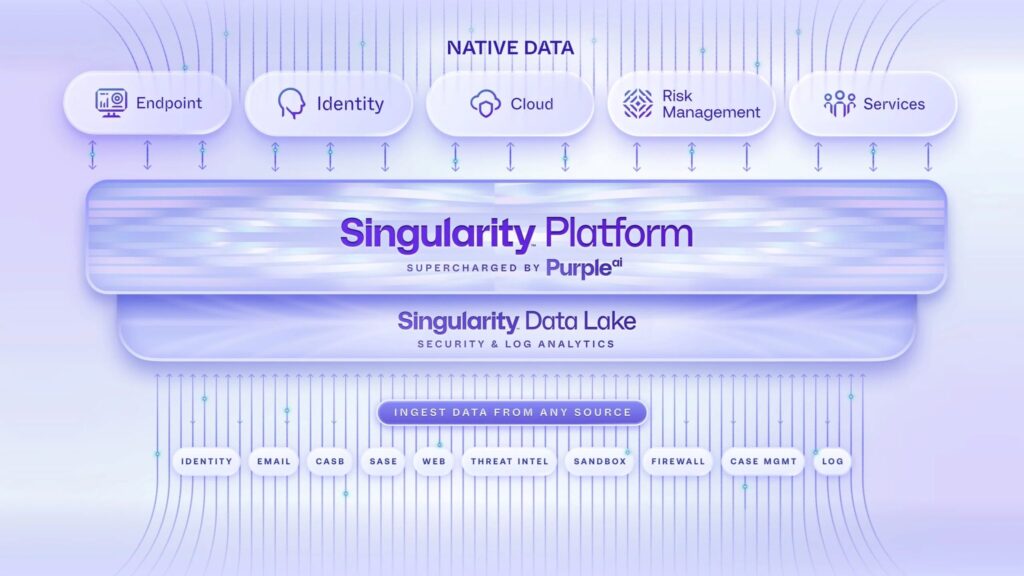
SentinelOne Singularity XDR uses static and behavioral AI engines to detect and respond to threats autonomously across endpoints, cloud workloads, and identity. The platform is designed for speed: automated threat containment, rollback of ransomware changes, and remediation can execute without human intervention. For security teams that need detection-and-response with minimal manual effort, SentinelOne delivers a compelling autonomous approach.
✅ Core Services
- Static and behavioral AI engines for autonomous endpoint detection and response
- Ransomware rollback to restore encrypted files to pre-attack state
- Cloud-native deployment with Kubernetes and container workload protection
- OS-level visibility and control across Windows, macOS, and Linux
- Storyline technology providing automated attack visualization and root cause analysis
🎯 Why Companies Consider SentinelOne
SentinelOne’s autonomous approach appeals to teams that cannot staff a 24/7 SOC but need real-time response capability. The AI-driven containment means threats can be neutralized in seconds without waiting for a human analyst. Ransomware rollback is a particularly differentiating feature: it can reverse encryption damage at the OS level, a capability few competitors match natively.
🏢 Ideal Customer Profile
- Mid-market organizations seeking automated, low-touch endpoint security
- DevOps-heavy environments with dynamic cloud and container workloads
- Security teams prioritizing autonomous response speed over manual investigation
- Organizations evaluating CrowdStrike alternatives with competitive pricing
💰 Commercial Model
SentinelOne pricing is generally more competitive than CrowdStrike, with Singularity Core starting at approximately $69.99/endpoint/year and Singularity Complete (including XDR) at higher tiers. Enterprise and custom pricing is available for larger deployments. PeerSpot users note that “the pricing on SentinelOne is far more reasonable and cheaper than Cortex XDR.”
⏰ When to Shortlist
Shortlist SentinelOne Singularity XDR if your team values autonomous detection and response with minimal analyst intervention, especially for endpoint and cloud workload protection. Consider whether your environment needs the cross-vendor correlation that vendor-agnostic MDR platforms provide on top.
5. Flare: Best for Identity-Centric Threat Intelligence and Credential Monitoring
📋 Overview
Flare is an identity-first cyber threat intelligence platform that monitors the dark web, illicit Telegram channels, and stealer log markets to surface the exposed credentials, leaked secrets, and cybercrime chatter that put an organization at risk. Rather than another detection engine, Flare plugs in underneath your existing SIEM, SOAR, and identity stack, turning raw underground signals into prioritized, actionable intelligence. Its defining strength is custom collection across the cybercrime ecosystem, monitoring 117,000+ Telegram channels, hundreds of dark web forums and markets, and more than one million new stealer logs each week, then validating and remediating identity exposures automatically.
✅ Core Services
- Continuous dark web, clear web, and Telegram monitoring for leaked credentials, stealer logs, and data leaks across the cybercrime ecosystem
- Identity Exposure Management with Microsoft Entra ID and Okta write-back to automatically validate exposed accounts and trigger password resets or session revocation
- Threat Flow generative AI that translates multilingual dark web discussions, correlates across sources, and produces intelligence reports in seconds
- 5-point risk scoring and prioritization to cut alert noise, plus threat actor profiling and ransomware leak-site tracking
- SIEM, SOAR, and ticketing integrations (Microsoft Sentinel, Splunk, Slack, Teams, Jira, ServiceNow) with a REST API and SDKs, deployable in about 30 minutes
🎯 Why Companies Consider Flare
Modern attackers increasingly log in rather than break in, buying valid credentials harvested by infostealer malware from dark web and Telegram markets. Flare addresses that reality directly: it detects exposed credentials in stealer logs and breach dumps, validates them against your identity provider, maps the blast radius across connected services, and closes the detection-to-remediation gap from days to seconds. For teams that want deep, proprietary underground coverage without building a threat-hunting function, Flare typically replaces three to five legacy or open-source tools and reports up to a 94% reduction in successful account takeover.
🏢 Ideal Customer Profile
- Organizations experiencing credential-based attacks, account takeover, or infostealer exposure across their workforce or customer base
- SecOps and CTI teams that need dark web, Telegram, and stealer log intelligence feeding their existing SIEM/SOAR workflows
- Microsoft Entra ID or Okta environments wanting automated validation and remediation of exposed credentials
- Lean security and GRC teams seeking to consolidate multiple monitoring tools into a single, fast-to-deploy platform
💰 Commercial Model
Flare uses identifier-based subscription pricing with unlimited users on every plan, a deliberate break from the per-seat model of legacy TIPs, offered across Core and Enterprise tiers with a free trial available. Deployment typically completes in about 30 minutes. A commissioned Forrester Total Economic Impact study reported 321% ROI with payback in under six months, and Flare maintains a 4.8-star rating on Gartner Peer Insights.
⏰ When to Shortlist
Shortlist Flare if your priority is identity-first external threat intelligence, catching leaked credentials and cybercrime exposure before they turn into a breach, rather than endpoint or log-based detection. Be aware that Flare is an intelligence and exposure-management layer, not an XDR or SIEM: it enriches and remediates on top of your detection stack rather than replacing it, so it is best paired with the detection and response tools already in your environment.
6. Darktrace DETECT + RESPOND: Best for Self-Learning AI Network Anomaly Detection
📋 Overview
Darktrace takes a fundamentally different approach to threat detection, using unsupervised machine learning that learns your organization’s “pattern of life” and identifies deviations in real time. Rather than relying on signatures or rules, Darktrace’s Self-Learning AI builds a baseline of normal behavior across network, email, cloud, and OT environments, then flags anomalies that traditional tools miss. Darktrace RESPOND can take autonomous containment actions at machine speed.
✅ Core Services
- Self-Learning AI that establishes behavioral baselines without signatures or rules
- Network detection and response (NDR) with full packet inspection
- Autonomous RESPOND actions (e.g., throttling connections, blocking lateral movement)
- Email security through Darktrace/Email with AI-driven phishing detection
- OT/ICS environment monitoring for industrial and critical infrastructure
🎯 Why Companies Consider Darktrace
Darktrace excels at finding threats that bypass signature-based tools: insider threats, zero-days, and novel attack patterns that have not been seen before. The unsupervised ML approach means it does not need threat intelligence feeds to detect anomalies; it learns what “normal” looks like for your specific organization and flags deviations. This is particularly valuable for environments where traditional detection rules generate excessive false positives.
🏢 Ideal Customer Profile
- Organizations with complex, heterogeneous network environments
- Industrial and critical infrastructure with OT/ICS security requirements
- Security teams focused on insider threat and zero-day detection
- Enterprises wanting AI-first detection that does not rely on signature updates
💰 Commercial Model
Darktrace pricing is quote-based, typically structured per IP address or per monitored device. Industry estimates place costs at approximately $4–6/IP per month for mid-size deployments, though enterprise pricing varies significantly based on network complexity and modules selected. No published list pricing is available.
⏰ When to Shortlist
Shortlist Darktrace if your primary detection gap is network-level anomaly detection, especially for insider threats, zero-days, and lateral movement that endpoint tools miss. Consider pairing with an MDR provider for human-driven investigation and response context that autonomous AI alone may not provide.
7. Recorded Future Intelligence Platform: Best for Real-Time Threat Intelligence at Scale
📋 Overview
Recorded Future operates the world’s largest commercially available threat intelligence dataset, collecting and analyzing data from the open web, dark web, technical sources, and closed forums using machine learning and natural language processing. The platform transforms raw data into actionable intelligence: IOC enrichment, adversary tracking, vulnerability prioritization, and geopolitical risk scoring, delivered through API integrations, browser extensions, and SIEM/SOAR connectors.
✅ Core Services
- Machine-collected threat intelligence from open web, dark web, and technical sources
- Real-time IOC enrichment and risk scoring for SIEM/SOAR integration
- Adversary infrastructure tracking and attribution analysis
- Vulnerability intelligence with prioritization based on active exploitation
- Brand and third-party risk monitoring across the external attack surface
🎯 Why Companies Consider Recorded Future
When your SOC needs context beyond what your detection tools provide (“Is this IP associated with a known threat actor?”, “Is this CVE being actively exploited in the wild?”, “Are our credentials on the dark web?”), Recorded Future delivers that intelligence layer. The breadth and timeliness of their data collection is unmatched by most competitors, making it the gold standard for enterprise threat intelligence programs.
🏢 Ideal Customer Profile
- Enterprise SOCs with dedicated threat intelligence analysts
- Financial services and government organizations requiring geopolitical risk intelligence
- Security teams needing real-time IOC enrichment for SIEM/SOAR workflows
- Organizations with dark web monitoring and brand protection requirements
💰 Commercial Model
Recorded Future pricing is quote-based and modular. Entry-level intelligence modules start at approximately $10,000–$25,000/year, while full enterprise platform deployments with multiple modules typically range from $100,000–$300,000+/year depending on data volume, user count, and modules selected.
⏰ When to Shortlist
Shortlist Recorded Future if your SOC needs a dedicated threat intelligence platform to enrich detection workflows, prioritize vulnerabilities based on active exploitation, and monitor the dark web for organizational exposure. Note that Recorded Future is intelligence, not detection: it enhances other tools but does not replace XDR or EDR.
8. Google Mandiant Threat Intelligence: Best for APT Tracking and Incident Response Intelligence
📋 Overview
Google Mandiant (acquired by Google Cloud in 2022) brings frontline intelligence from over 1,000 incident response engagements annually, giving their threat intelligence a depth of adversary behavioral knowledge that is difficult to replicate. Mandiant Threat Intelligence combines human-verified intelligence from active breach investigations with machine learning-driven analysis, providing SOCs with detailed adversary profiles, campaign tracking, and tactical indicators.
✅ Core Services
- Frontline threat intelligence derived from 1,000+ annual incident response engagements
- Adversary profiling (APT groups, FIN groups, UNC groups) with detailed TTPs
- Campaign tracking and attack attribution analysis
- Integration with Google Chronicle SIEM and broader Google Cloud security
- Mandiant Advantage platform for automated intelligence operationalization
🎯 Why Companies Consider Google Mandiant
Mandiant’s intelligence is unique because it comes from active breach investigations, not just automated collection. When they report on an adversary’s TTPs, it is because their incident responders have observed it firsthand. This frontline perspective makes Mandiant intelligence particularly valuable for threat hunting, red team validation, and understanding the specific adversaries targeting your industry.
🏢 Ideal Customer Profile
- Enterprise organizations facing sophisticated, state-sponsored, or APT-level threats
- Financial services, healthcare, and government agencies with high-value target profiles
- SOCs that need human-verified intelligence for threat hunting and detection engineering
- Google Cloud/Chronicle customers seeking native intelligence integration
💰 Commercial Model
Mandiant Threat Intelligence pricing is quote-based and premium, reflecting the human-verified, frontline nature of the intelligence. Enterprise packages are typically structured as annual subscriptions with pricing dependent on modules, user seats, and integration requirements. Expect $100,000+/year for comprehensive enterprise access.
⏰ When to Shortlist
Shortlist Google Mandiant if your threat model includes APT-level adversaries and you need human-verified intelligence with detailed TTP analysis. Mandiant is best paired with detection platforms (XDR, SIEM) that can operationalize the intelligence into detection rules and hunting queries.
9. Anomali ThreatStream: Best for Multi-Source Threat Intelligence Aggregation and SIEM Enrichment
📋 Overview
Anomali ThreatStream is a threat intelligence platform (TIP) designed to aggregate, normalize, and enrich threat intelligence from hundreds of sources: commercial feeds, open-source intelligence (OSINT), ISACs, and internal telemetry. ThreatStream acts as the central intelligence hub that feeds enriched IOCs and context into your SIEM, SOAR, and detection tools, reducing the manual effort of managing multiple intelligence feeds.
✅ Core Services
- Multi-source intelligence aggregation from 200+ commercial, OSINT, and ISAC feeds
- Automated IOC deduplication, normalization, and confidence scoring
- STIX/TAXII native support for standardized intelligence sharing
- SIEM/SOAR integration for automated detection rule enrichment
- Threat intelligence lifecycle management with analyst collaboration tools
🎯 Why Companies Consider Anomali ThreatStream
Organizations that subscribe to multiple threat intelligence feeds, each in different formats, with overlapping IOCs, and varying confidence levels, need a platform to make sense of it all. ThreatStream centralizes this chaos, normalizes the data, scores confidence levels, and pushes enriched intelligence into your SIEM and SOAR automatically. It is the operational backbone for mature threat intelligence programs.
🏢 Ideal Customer Profile
- Enterprise SOCs managing multiple commercial and OSINT threat intelligence feeds
- Organizations with dedicated threat intelligence teams needing a centralized TIP
- SIEM-heavy environments (Splunk, QRadar, Elastic) requiring automated IOC enrichment
- ISACs and industry groups conducting collaborative threat intelligence sharing
💰 Commercial Model
Anomali ThreatStream pricing is quote-based, with annual subscriptions structured around data volume, user count, and integration complexity. Mid-market deployments typically start at $50,000–$100,000/year, with enterprise-scale implementations ranging higher depending on feed licenses and modules.
⏰ When to Shortlist
Shortlist Anomali ThreatStream if your organization manages multiple threat intelligence feeds and needs a centralized platform to aggregate, normalize, and operationalize them. ThreatStream is a TIP, not a detection platform: it makes your existing SIEM and XDR smarter but does not replace them.
10. Rapid7 InsightIDR + Threat Command: Best for Cloud SIEM with Built-In UEBA and Threat Intelligence
📋 Overview
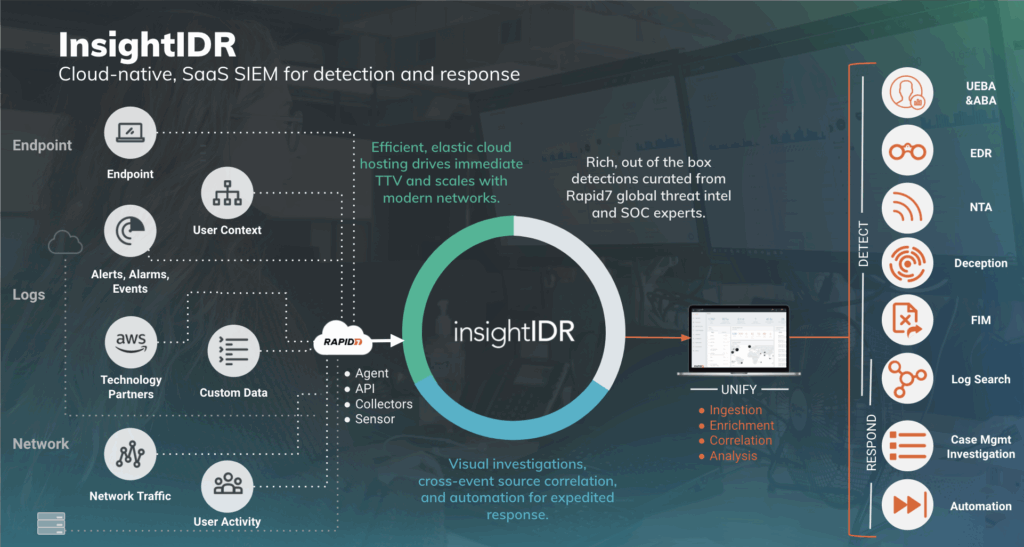
Rapid7 InsightIDR combines cloud-native SIEM, UEBA (user and entity behavior analytics), and endpoint detection in a single console. Paired with Threat Command (formerly IntSights), it adds external threat intelligence: dark web monitoring, brand protection, and adversary reconnaissance detection. For mid-market organizations that need SIEM capabilities without the complexity and cost of enterprise-grade platforms, InsightIDR offers an accessible entry point.
✅ Core Services
- Cloud-native SIEM with log management, correlation, and compliance reporting
- Built-in UEBA for insider threat detection and anomalous behavior analysis
- Endpoint detection via Rapid7 Insight Agent
- Threat Command for dark web monitoring, brand protection, and external attack surface intelligence
- Automated response through InsightConnect SOAR integration
🎯 Why Companies Consider Rapid7 InsightIDR
InsightIDR’s appeal is accessibility: it bundles SIEM, UEBA, and endpoint detection into a single, relatively straightforward platform that does not require a dedicated engineering team to deploy and maintain. For mid-market organizations that cannot justify the cost and complexity of Splunk or QRadar, InsightIDR provides meaningful detection capability at a more approachable price point.
🏢 Ideal Customer Profile
- Mid-market organizations (100–1,000 endpoints) seeking cloud SIEM without enterprise complexity
- Security teams needing combined SIEM + UEBA + endpoint detection in one console
- Organizations requiring dark web monitoring and external threat intelligence (Threat Command)
- Compliance-driven environments needing built-in reporting for SOC 2, HIPAA, PCI DSS
💰 Commercial Model
InsightIDR pricing starts at approximately $3.82/asset/month for the base SIEM tier, with additional costs for Threat Command, InsightConnect SOAR, and managed services. The consumption-based model scales with monitored assets and data ingestion volume. Rapid7 also offers managed detection and response (MDR) as an add-on service.
⏰ When to Shortlist
Shortlist Rapid7 InsightIDR if you need an accessible cloud SIEM with built-in UEBA and want to add external threat intelligence through Threat Command. Evaluate whether InsightIDR’s detection depth meets your requirements for advanced threats; some organizations find they need a dedicated MDR layer on top for expert-driven response.
11. ThreatConnect: Best for Intelligence Operationalization with Risk Quantification
📋 Overview
ThreatConnect occupies a unique position in the threat intelligence market by combining TIP capabilities with SOAR orchestration and quantitative risk scoring. The platform enables security teams to not only collect and analyze threat intelligence but also operationalize it through automated playbooks and measure its impact through financial risk quantification, translating technical threats into business-language risk metrics that boards and executives understand.
✅ Core Services
- Threat intelligence platform (TIP) with multi-source aggregation and analyst collaboration
- Integrated SOAR for playbook automation and orchestrated response
- Quantitative risk scoring that translates threats into financial impact metrics
- CAL (Collective Analytics Layer) for machine learning-driven intelligence enrichment
- Intelligence-driven vulnerability prioritization
🎯 Why Companies Consider ThreatConnect
ThreatConnect appeals to organizations that need to bridge the gap between technical security operations and executive risk communication. The risk quantification capability lets CISOs present board-level metrics (“This threat campaign represents a $2.3M potential loss”) rather than technical indicators that do not translate to business decisions. The integrated SOAR means intelligence can automatically trigger response playbooks.
🏢 Ideal Customer Profile
- Enterprise security teams with dedicated threat intelligence and risk management functions
- CISOs needing to communicate cyber risk in financial terms to boards and executives
- Organizations seeking TIP + SOAR consolidation in a single platform
- Regulated industries requiring quantitative risk assessment for compliance frameworks
💰 Commercial Model
ThreatConnect pricing is quote-based, with modular licensing for TIP, SOAR, and risk quantification components. Entry-level TIP deployments start at approximately $30,000–$50,000/year, with full platform implementations (TIP + SOAR + Risk Quantification) ranging from $100,000–$250,000+/year depending on scale and modules.
⏰ When to Shortlist
Shortlist ThreatConnect if your organization needs to operationalize threat intelligence while communicating cyber risk to executives in financial terms. The platform is best suited for mature security programs with dedicated intelligence analysts; smaller teams may find the complexity exceeds their operational capacity.
12. MISP (Open-Source Threat Intelligence Platform): Best for Budget-Constrained SOCs and CTI Sharing Communities
📋 Overview
MISP (Malware Information Sharing Platform) is the leading open-source threat intelligence platform, developed and maintained by CIRCL (Computer Incident Response Center Luxembourg) and a global community of contributors. MISP enables organizations to collect, store, distribute, and share cybersecurity indicators and threat intelligence at zero licensing cost. It is the backbone of many ISAC sharing communities and government CERT operations worldwide.
✅ Core Services
- Open-source threat intelligence sharing and collaboration platform (zero license cost)
- Native STIX/TAXII support for standardized intelligence exchange
- Flexible taxonomy and galaxy system for threat classification and adversary tagging
- Community-driven threat feeds and sharing groups (ISACs, CERTs, private communities)
- REST API for integration with SIEM, SOAR, and detection platforms
🎯 Why Companies Consider MISP
MISP’s value proposition is simple: enterprise-grade threat intelligence management at zero licensing cost. For organizations participating in intelligence sharing communities (ISACs, government CERTs, industry consortiums), MISP is often the required platform. It is also an excellent starting point for organizations building their first threat intelligence program without the budget for commercial TIPs.
🏢 Ideal Customer Profile
- Government CERTs and national cybersecurity agencies
- ISAC members and organizations participating in threat intelligence sharing communities
- Budget-constrained security teams building their first TIP capability
- Research institutions and academic organizations studying threat intelligence
💰 Commercial Model
MISP is completely free and open-source under the AGPL license. Costs are limited to infrastructure (self-hosted servers), engineering time for deployment and maintenance, and optional third-party support contracts. Several managed MISP hosting services exist for organizations that prefer not to self-host.
⏰ When to Shortlist
Shortlist MISP if you need a threat intelligence sharing platform at zero license cost or participate in community intelligence sharing programs. Be prepared to invest engineering time in deployment, maintenance, and integration; MISP is powerful but requires technical resources that commercial TIPs handle as managed services.
🔒 How UnderDefense Unifies Detection + Intelligence + Response
Here is what I have observed across hundreds of security environments: the real gap is not detection or intelligence. It is the operational layer that connects them. You can run CrowdStrike for endpoints, Recorded Future for intelligence, and Splunk for logs, but when an alert fires at 2 AM, someone still needs to investigate, verify, and respond.
That is what we built UnderDefense to solve. Our MAXI platform integrates with every tool on this list: ingesting alerts from your XDR, enriching them with threat intelligence feeds, correlating across identity and cloud telemetry, and handing confirmed incidents to dedicated concierge analysts who verify suspicious activity directly with affected users via Slack or Teams. The result is a unified detection, intelligence, and response workflow that operates 24/7 without requiring you to replace a single tool in your stack.
If your organization is evaluating any combination of the tools above and wants to see how they connect through a single operational layer, book a demo or use our SOC Cost Calculator to model what unified detection and response looks like for your environment.
Q2. How Were These 12 Threat Detection and Intelligence Tools Selected? Scoring Methodology
⚠️ Why Methodology Matters
Most “best tools” listicles rank the publisher’s own product first and never explain the scoring. That is not evaluation but marketing disguised as research. For this guide, we used a transparent, weighted framework built around the five dimensions that actually determine whether a threat detection or intelligence tool delivers operational value in a real SOC environment. Over 30 platforms were assessed; 12 made the cut.
✅ The 5 Evaluation Criteria
Each tool was scored across five weighted criteria totaling 100%:
Cross-Functional Intelligence (25%)
Signal correlation across endpoints, cloud, identity, and network; MITRE ATT&CK coverage breadth; IOC/TTP enrichment depth; dark web and supply chain risk visibility. Tools that only see one domain (endpoints or logs or identity) scored lower than platforms that reason across all of them.
Response Capability & MTTR (25%)
Containment vs. alert-only; documented MTTR; SOAR integration; automated playbooks. Detection without response is noise. A tool that spots a threat but cannot isolate an endpoint or revoke a credential scored lower than one that closes the loop.
Setup & Usability (20%)
Deployment timeline, onboarding complexity, integration architecture with existing SIEM/EDR/SOAR/ticketing, cloud-native and Kubernetes support. A platform that takes six months and a professional services engagement to deploy gets penalized versus one that is operational in 30 days.
Pricing Transparency (15%)
Published per-endpoint or per-user rates, TCO predictability, hidden cost disclosure. If a vendor’s answer to “how much does it cost?” is “contact sales,” that is a transparency gap, and it got scored accordingly.
User Reviews & Market Validation (15%)
G2 and Gartner Peer Insights ratings, documented case studies, analyst recognition, and community adoption signals. Real operator feedback outweighs vendor marketing decks.
⭐ Star Rating Scale
| Rating | Score Range | Meaning |
|---|---|---|
| ★★★★★ | 81–100 | Excels across all five criteria with documented proof |
| ★★★★ | 61–80 | Strong in most areas with minor gaps |
| ★★★ | 41–60 | Solid in core function but notable limitations |
| ★★ | 21–40 | Narrow scope or significant operational gaps |
| ★ | 0–20 | Limited applicability for enterprise SOCs |
Tool Scores and Rationale
| Tool | Rating | Rationale |
|---|---|---|
| UnderDefense | ★★★★★ | 250+ integrations, 2-min alert-to-triage, published $11–15/endpoint pricing, 96% MITRE coverage, 30-day deployment |
| CrowdStrike Falcon XDR | ★★★★ | 100% MITRE detection in 2025 Evals, strong endpoint XDR, premium pricing, Falcon-ecosystem dependency |
| Palo Alto Cortex XSIAM | ★★★★ | Ambitious SIEM+XDR+SOAR convergence, premium pricing, complex deployment |
| SentinelOne Singularity XDR | ★★★★ | Autonomous AI detection, competitive pricing, strong rollback, fewer cross-vendor integrations |
| Flare | ★★★★ | Identity-first dark web and credential intelligence, ~30-min deployment, identifier-based pricing, intelligence-only (no native detection) |
| Darktrace DETECT + RESPOND | ★★★ | Unique self-learning AI for anomaly detection, quote-based pricing, limited response ownership |
| Recorded Future | ★★★★ | Largest commercial intelligence dataset, premium pricing, intelligence-only (no detection) |
| Google Mandiant | ★★★★ | Frontline IR-derived intelligence, human-verified, premium pricing, intelligence-only |
| Anomali ThreatStream | ★★★ | Strong TIP aggregation, STIX/TAXII native, requires dedicated analysts to operationalize |
| Rapid7 InsightIDR | ★★★ | Accessible cloud SIEM with UEBA, mid-market friendly, less hands-on response |
| ThreatConnect | ★★★ | TIP + SOAR + risk quantification, smaller ecosystem, niche focus |
| MISP | ★★ | Free open-source CTI sharing, requires significant operational investment, no vendor support |
🔍 How UnderDefense Maximizes All Five
UnderDefense scores five stars because it is the only platform on this list that maximizes all five criteria simultaneously: 250+ vendor-agnostic integrations (Cross-Functional), 2-minute alert-to-triage with 15-minute escalation for critical incidents (Response), 30-day turnkey deployment (Setup), published $11–15/endpoint/month pricing (Pricing), and documented outcomes including detection 2 days faster than CrowdStrike OverWatch (Validation).
Q3. Threat Detection vs. Threat Intelligence: Taxonomy, Lifecycle, and Why They’re Converging in 2026
⏰ The Fragmented Taxonomy
Here is the operational reality in most enterprise SOCs: threat detection and threat intelligence live in separate workflows, managed by different teams, running on disconnected tools. Threat detection tools (XDR, EDR, SIEM, NDR) operate in real time, ingesting telemetry from endpoints, network, cloud, and identity to flag suspicious activity as it happens. Threat intelligence platforms (TIPs, CTI feeds, dark web monitoring services) work on a different cadence, aggregating and enriching IOCs, adversary TTPs, and geopolitical risk data to provide strategic context.
The full detection lifecycle flows through seven stages: detect → investigate → contain → eradicate → recover → report → prevent. Intelligence feeds (IOCs, TTPs, threat actor profiles, dark web signals) should flow into detection rules at stage one and inform prevention at stage seven. In practice, they rarely do, because most organizations run these as parallel tracks that never intersect operationally.
❌ The Silo Problem
| Component | Role | Limitation in Isolation |
|---|---|---|
| XDR/EDR (CrowdStrike, SentinelOne) | Real-time endpoint and cross-domain detection | Sees behavior, but lacks strategic intelligence context on who is attacking and why |
| SIEM (Splunk, Elastic, QRadar) | Log aggregation, correlation, compliance | Collects everything, but drowns analysts in noise without enrichment |
| SOAR (Phantom, Tines, Torq) | Playbook automation, orchestration | Automates response steps, but only as good as the detection and intelligence feeding it |
| TIP (Recorded Future, Anomali, MISP) | IOC aggregation, threat actor tracking | Provides context, but does not detect or respond to live threats |
| NDR (Darktrace, Vectra) | Network anomaly detection | Sees lateral movement, but misses endpoint and identity context |
The typical mid-market SOC runs CrowdStrike for endpoints, Splunk for logs, Recorded Future or VirusTotal for intelligence enrichment, and maybe a separate SOAR for playbook automation. Each tool generates its own alerts, its own console, its own version of truth. The analyst becomes the manual correlation layer, spending hours cross-referencing data across four or five tabs to answer one question: Is this a real threat?
Open-source tools like MISP and OpenCTI offer zero-cost IOC sharing but require dedicated analysts to operationalize, curate, and maintain. Commercial TIPs like Recorded Future and Mandiant deliver curated intelligence at $50K–$250K+/year but provide no operational response. Neither approach alone closes the loop between knowing about a threat and stopping it.
✅ The Convergence Thesis
Detection without intelligence generates context-free alerts. Intelligence without detection is a research project. In 2026, the architectural advantage belongs to platforms that reason across both, correlating live telemetry with threat actor TTPs, dark web signals, and supply chain risk data in a single operational layer.
This convergence is already visible in how the major platforms are evolving. Palo Alto’s XSIAM merges SIEM, XDR, SOAR, and TIP into one engine. CrowdStrike’s Falcon Intelligence sits inside its XDR. Identity-first platforms like Flare push dark web and credential intelligence directly into SIEM, SOAR, and identity workflows. The market is telling you the same thing: siloed tools are a liability, not an architecture.
🔍 UnderDefense’s Unified Model
We built the UnderDefense MAXI platform to collapse the detection-intelligence loop entirely. UnderDefense MAXI ingests both open-source (MISP) and commercial intelligence feeds alongside live detection signals from 250+ tools, correlating endpoint alerts, identity anomalies, cloud misconfigurations, and threat intelligence enrichment in a single context-aware layer. Human analysts bridge the gap between automated correlation and contextual judgment, because AI finds patterns but experienced operators understand intent.
While traditional MDR tells you “suspicious login detected, please investigate,” UnderDefense tells you who logged in, cross-references threat intel on the source IP, verifies with the user directly via Slack, and contains the threat before your team wakes up, with documented response times 2 days faster than CrowdStrike OverWatch.
Q4. The Complete Comparison: Pricing, MITRE ATT&CK Coverage, Benchmarks, and Compliance Mapping
💰 Pricing Matrix
| Tool | Pricing Model | Published Rate | Annual Estimate (500 Endpoints) | Hidden Costs |
|---|---|---|---|---|
| UnderDefense | Per-endpoint/month | $11–15/endpoint/month | $66,000–$90,000 | None: compliance kits, onboarding, and analyst access included |
| CrowdStrike Falcon XDR | Per-device/year (bundled) | $184.99/device/year (Enterprise) | ~$92,500 | OverWatch, Falcon Complete, and Intelligence modules are add-ons |
| Palo Alto Cortex XSIAM | Usage-based + licensed | Contact sales | $250,000+ (typical mid-size) | Data ingestion overage, professional services, module add-ons |
| SentinelOne Singularity | Per-endpoint/year (tiered) | ~$69.99/endpoint/year (Core) | ~$35,000–$75,000 | Vigilance MDR and Singularity Data Lake are extra |
| Flare | Identifier-based (unlimited users) | Free trial; Core & Enterprise tiers (custom) | Varies by identifiers monitored | Managed takedown services, premium intelligence reports |
| Darktrace | Per-IP or per-device | Contact sales | ~$150,000–$300,000 (est.) | Professional services, RESPOND module may be separate |
| Recorded Future | Modular annual subscription | Contact sales | $100,000–$300,000+ | Per-module pricing, API access tiers |
| Google Mandiant | Annual subscription | Contact sales | $100,000+ | IR retainer, Advantage modules priced separately |
| Anomali ThreatStream | Annual subscription | Contact sales | $50,000–$100,000+ | Feed licenses, integration professional services |
| Rapid7 InsightIDR | Per-asset/month | ~$3.82/asset/month (base) | ~$23,000–$50,000 | Threat Command, InsightConnect, MDR add-ons extra |
| ThreatConnect | Annual subscription | Contact sales | $75,000–$200,000+ | CAL modules, SOAR orchestration add-ons |
| MISP | Open source ($0) | Free | $0 + operational cost (~1–2 FTEs) | Staff time, infrastructure, no vendor support |
📊 MITRE ATT&CK Coverage
| Tool | ATT&CK Techniques Covered | Detection Type | Key Visibility Gaps | Evaluation Source |
|---|---|---|---|---|
| UnderDefense | 96% across customer tool stack | Telemetry + Technique (via integrated tools) | Dependent on customer’s existing tool coverage | Documented case studies, internal benchmarks |
| CrowdStrike Falcon XDR | 100% (2025 MITRE Eval) | Technique-level | Limited outside Falcon ecosystem | MITRE Engenuity Enterprise 2025 |
| Palo Alto Cortex XSIAM | ~95%+ (vendor claim) | Technique-level with autonomous analytics | Requires Palo Alto native data sources for full coverage | Vendor documentation |
| SentinelOne Singularity | 100% (2025 MITRE Eval) | Technique-level | Cross-vendor correlation gaps outside S1 ecosystem | MITRE Engenuity Enterprise 2025 |
| Flare | Intelligence enrichment only | IOC/TTP and identity-exposure mapping | No real-time detection capability | Intelligence-only platform |
| Darktrace | N/A (behavioral, not signature-based) | Anomaly-based | Does not map directly to ATT&CK techniques; behavioral model | Not evaluated in MITRE rounds |
| Recorded Future | Intelligence enrichment only | IOC/TTP mapping | No real-time detection capability | Intelligence-only platform |
| Google Mandiant | Intelligence enrichment only | TTP and campaign tracking | No real-time detection capability | Frontline IR data |
| Anomali ThreatStream | IOC enrichment only | IOC confidence scoring | No detection engine; enriches other tools | TIP platform |
| Rapid7 InsightIDR | ~80%+ (estimated) | General + Technique | Advanced ATT&CK techniques, cloud-native gaps | Community benchmarks |
| ThreatConnect | IOC enrichment only | Risk-scored IOCs | No native detection engine | TIP + SOAR platform |
| MISP | Community-sourced IOCs | IOC sharing | No detection, no scoring, no automated operationalization | Open-source community |
⏰ Deployment Benchmarks
| Tool | Alert-to-Triage | MTTR (Critical) | False Positive Reduction | Deployment Timeline | Source |
|---|---|---|---|---|---|
| UnderDefense | 2 minutes | 15-min escalation (critical) | 99% noise reduction | 30 days | Documented client outcomes |
| CrowdStrike Falcon XDR | Not published | Not published (OverWatch) | Moderate | 2–4 weeks (agent deploy) | Vendor documentation |
| Palo Alto Cortex XSIAM | Not published | Not published | High (AI-driven) | 3–6 months (full stack migration) | Customer reports |
| SentinelOne Singularity | Seconds (automated) | Seconds (automated containment) | Moderate | 1–2 weeks (agent deploy) | Vendor claims |
| Flare | Real-time (credential alerts) | Under 60 sec (automated credential remediation) | 5-point risk scoring | ~30 minutes | Vendor documentation, third-party reviews |
| Darktrace | Real-time (autonomous) | Seconds (RESPOND) | Variable (learning period) | 1–2 weeks + 2-week learning | Vendor documentation |
| Recorded Future | N/A (intelligence-only) | N/A | N/A | Days (API integration) | N/A |
| Google Mandiant | N/A (intelligence-only) | N/A | N/A | Days (platform access) | N/A |
| Anomali ThreatStream | N/A (TIP) | N/A | N/A | 2–4 weeks | Vendor documentation |
| Rapid7 InsightIDR | Minutes | Hours (with MDR add-on) | Moderate | 1–3 weeks | Vendor documentation |
| ThreatConnect | N/A (TIP + SOAR) | N/A | N/A | 4–8 weeks | Vendor documentation |
| MISP | N/A (open source) | N/A | N/A | Weeks to months (self-managed) | Community benchmarks |
✅ Compliance Mapping
| Tool | NIS2 | DORA | SOC 2 | ISO 27001 | HIPAA | GDPR | Board Reporting |
|---|---|---|---|---|---|---|---|
| UnderDefense | ✅ Included | ✅ Included | ✅ Forever-free kits | ✅ Forever-free kits | ✅ Forever-free kits | ✅ Included | ✅ Auto-generated |
| CrowdStrike Falcon XDR | ⚠️ Partial | ⚠️ Partial | ✅ Supports | ✅ Supports | ✅ Supports | ✅ Supports | ⚠️ Custom dashboards |
| Palo Alto Cortex XSIAM | ⚠️ Partial | ⚠️ Partial | ✅ Supports | ✅ Supports | ✅ Supports | ✅ Supports | ⚠️ Add-on reporting |
| SentinelOne Singularity | ⚠️ Partial | ❌ Not included | ✅ Supports | ✅ Supports | ✅ Supports | ✅ Supports | ❌ Limited |
| Darktrace | ⚠️ Partial | ⚠️ Partial | ✅ Supports | ✅ Supports | ⚠️ Partial | ✅ Supports | ⚠️ Basic |
| Recorded Future | ❌ | ❌ | ❌ | ❌ | ❌ | ❌ | ⚠️ Intelligence reports |
| Google Mandiant | ❌ | ❌ | ❌ | ❌ | ❌ | ❌ | ⚠️ Intelligence reports |
| Anomali ThreatStream | ❌ | ❌ | ❌ | ❌ | ❌ | ❌ | ❌ |
| Rapid7 InsightIDR | ⚠️ Partial | ⚠️ Partial | ✅ Supports | ✅ Supports | ✅ Supports | ✅ Supports | ✅ Built-in reporting |
| ThreatConnect | ❌ | ❌ | ⚠️ Partial | ⚠️ Partial | ❌ | ❌ | ✅ Risk quantification |
| MISP | ❌ | ❌ | ❌ | ❌ | ❌ | ❌ | ❌ |
🔍 How UnderDefense Leads Across All Four Matrices
UnderDefense is the only tool on this list that documents 2-minute alert-to-triage (SLA-backed), 99% alert noise reduction, 30-day turnkey deployment, 96% MITRE ATT&CK coverage across all customer tools, and includes forever-free compliance kits (SOC 2, HIPAA, ISO 27001) with auto-generated board reporting derived directly from detection telemetry. No other platform on this list combines detection, intelligence, response, compliance, and transparent pricing in a single vendor-agnostic layer.
Q5. How AI, Behavioral Analytics, and Autonomous SOCs Are Reshaping Threat Detection in 2026
The global threat intelligence market is projected to reach $8.22 billion in 2026, growing at an 18.3% CAGR through 2034. Every vendor in the space now claims “AI-powered” detection on their marketing page. The reality on the ground is far messier. Capabilities range from basic rule automation repackaged with an AI label to genuine agentic systems that correlate, reason, and act across telemetry streams. Three technology layers define the real landscape right now:
- AI/ML detection engines running supervised and unsupervised anomaly models against endpoint, network, and cloud telemetry
- Behavioral analytics and UEBA platforms that profile user and entity baselines to catch insider threats conventional signatures miss
- SOAR platforms enabling automated containment playbooks, isolate endpoint, revoke credential, block lateral movement, within seconds of detection
⚠️ AI-Washing vs. Real Autonomy
Here’s where it gets honest. Most “AI-powered” tools are still correlation rules with a machine learning wrapper. The gap between genuine AI, like SentinelOne’s Purple AI running autonomous triage, Palo Alto’s XSIAM correlating cross-source telemetry, or Darktrace’s autonomous response model, and rebranded static rules is enormous. LLM-powered security copilots (Microsoft Security Copilot, CrowdStrike Charlotte AI) genuinely augment analyst workflows: they summarize incidents, translate IOCs into plain language, and draft response playbooks. But they don’t replace human judgment. AI without human oversight creates autonomous false-positive factories, systems that isolate production servers at 2 AM because a legitimate admin session triggered an anomaly model nobody tuned. That’s not detection. That’s disruption.
✅ The 2026 Operating Standard
The standard that’s actually working in production environments is straightforward: AI handles volume, humans handle judgment. Agentic AI correlates thousands of daily alerts into actionable clusters. Humans verify context, was that login attempt a compromised credential or the CFO traveling internationally, and make containment decisions. Think of it as an autonomy spectrum:
- Analyst-Dependent: MISP, LogRhythm, humans drive every step
- AI-Assisted: Splunk, Rapid7, automation suggests, humans decide
- AI-Augmented: CrowdStrike, SentinelOne, AI triages, humans verify escalations
- AI SOC + Human Ally: UnderDefense, AI detects and correlates across your full stack; dedicated Tier 3–4 analysts verify via ChatOps and contain threats end-to-end
🔍 How UnderDefense MAXI Operationalizes This Model
We built UnderDefense MAXI around this reality. AI-driven behavioral analytics handle detection across 250+ integrated tools, your existing SIEM, EDR, cloud, and identity sources stay in place. When the AI flags suspicious activity, it doesn’t just escalate an alert ticket into a queue. It routes directly to dedicated analysts who verify through ChatOps, reaching affected users via Slack or Teams, confirming whether that 3 AM VPN login was legitimate, and containing threats through credential revocation, endpoint isolation, or lateral movement blocking when needed. At the board level, AI generates executive risk dashboards translating threat data into business impact metrics that CISOs can present without a translator.
⏰ Why Human Oversight Isn’t Optional
Gartner research shows only 15% of IT leaders are piloting fully autonomous AI agents without human oversight. Harvard Business Review puts the overall AI project failure rate at 80%. The pattern is consistent: automation without governance collapses. Our model is built for this reality, AI speed with human judgment, observable workflows you can audit, and zero black boxes.
Q6. How to Choose the Right Tool: Decision Framework by SOC Maturity, Budget, and Use Case
Choosing a threat detection and intelligence stack means committing to a security architecture for years. Most leaders default to brand recognition or feature-count comparisons, ignoring the critical operational question: Can this tool detect, contextualize, AND respond? A tool that detects but can’t act is just a more expensive alert generator. A tool that responds without context creates collateral damage. The decision framework below replaces gut instinct with structured criteria.
❌ The Wrong Way to Evaluate
Picking tools based on Gartner quadrant position, peer pressure, or the vendor with the best demo rarely translates to operational success. Common evaluation mistakes include: choosing by brand alone, ignoring response capability entirely, underestimating deployment timelines by 3–6x, and comparing feature lists instead of measurable outcomes like MTTD, MTTR, and false-positive rates.
✅ The 7-Criteria Evaluation Framework
Score each tool 0–2 per criterion (0 = absent, 1 = partial, 2 = full):
| Criterion | What to Evaluate |
|---|---|
| Vendor-Agnostic Integration | Works with your existing SIEM, EDR, cloud, no rip-and-replace |
| Detection + Response | Detects threats AND contains them (not just escalates) |
| MITRE ATT&CK Coverage | Documented coverage percentage across techniques |
| Human Analyst Access | Direct 24/7 access to Tier 2+ analysts, not a ticket queue |
| Pricing Transparency | Published pricing, predictable TCO, no hidden professional services |
| Deployment Speed | Time from contract to operational monitoring (days, not months) |
| Compliance Integration | Pre-built mapping to NIS2, SOC 2, ISO 27001, HIPAA |
📋 Recommendations by SOC Maturity
- No SOC (0 analysts): UnderDefense full MDR, fully managed detection, response, and compliance from day one
- Emerging (1–3 analysts): UnderDefense + existing EDR, layer AI SOC expertise over your current CrowdStrike or SentinelOne deployment
- Scaling (4–10 analysts): Cortex XSIAM or Flare + Recorded Future + UnderDefense co-managed SOC for after-hours coverage and escalation support
- Mature (10+ analysts): Custom XDR stack + Mandiant threat intel + MISP + UnderDefense after-hours and surge capacity
By Use Case:
- Insider threats → Darktrace + UnderDefense UEBA
- Ransomware defense → CrowdStrike + UnderDefense containment
- Supply chain risk → ThreatConnect + UnderDefense
- APT defense → Mandiant + Recorded Future + UnderDefense threat hunting
⭐ Where UnderDefense Stands
Across these seven criteria, UnderDefense scores 14/14, not because it’s a single tool that does everything, but because it layers onto your existing tools rather than replacing them. That vendor-agnostic architecture is the differentiator: 250+ integrations, transparent $11–15/endpoint/month pricing, and 0.5-hour MTTR for critical incidents.
“UnderDefense MAXI integrates well with our systems, specifically with our SIEM, Splunk. Their team is proactive in identifying and addressing threats, providing 24/7 oversight.”
— Oleg K., Director Information Security UnderDefense G2 – Verified Review
“Underdefense act as an extension of our team, so we don’t need additional resources, ensuring 24/7 protection. It also solved our problem of having separate security tools that didn’t work well together.”
— Inga M., CEO UnderDefense G2 – Verified Review
💰 The Track Record
UnderDefense maintains a 100% ransomware prevention record across 500+ MDR clients over six years, with documented cases detecting threats two days faster than CrowdStrike OverWatch. That’s the difference between evaluating features on a spreadsheet and evaluating outcomes in production.
Q7. Ready to Build Your Threat Detection Stack? Get a Custom Assessment
The right threat detection and intelligence stack depends on three things you already know but may not have mapped together: your current security investments, your SOC maturity level, and your compliance requirements. The evaluation framework in this article gives you the structure. But applying it to your specific environment, with your specific tools, gaps, and regulatory deadlines, requires a conversation, not a calculator.
🔍 What the Assessment Includes
We offer a free custom stack assessment that maps your existing tools against the 7-criteria evaluation framework covered in Q6. Here’s exactly what you get:
- Current tool stack gap analysis against MITRE ATT&CK coverage, identifying what your existing EDR, SIEM, and cloud tools cover and where blind spots remain
- Projected MTTD/MTTR benchmarks based on your environment size, data volume, and current response workflows
- Integration architecture review, which tools to keep, which to layer, and which to replace (if any)
- Compliance mapping to NIS2, SOC 2, ISO 27001, and HIPAA with specific evidence collection recommendations
- Published pricing estimate at $11–15/endpoint/month with no hidden costs, no professional services surprises
✅ Why This Assessment Works
This isn’t a generic questionnaire that generates a PDF nobody reads. It’s based on the same methodology used across 500+ MDR deployments, documented MITRE ATT&CK evaluations, and the pricing and benchmark data compiled throughout this article. Our team, 120 security engineers across three continents, reviews your environment with the same rigor we apply to clients like WWE, Volkswagen, Shell, and the Bill & Melinda Gates Foundation.
The goal is simple: give you a clear, actionable map from where you are today to where your threat detection stack needs to be, with specific tools, timelines, and costs. No black boxes. No “contact sales for pricing.” Just transparent, reproducible outcomes you can take to your board.
1. What are the best threat detection and intelligence tools for enterprise SOCs in 2026?
We evaluated over 30 platforms and shortlisted 12 based on five weighted criteria: cross-functional intelligence, response capability and MTTR, setup and usability, pricing transparency, and user reviews with market validation.
The 12 tools that made the cut span multiple categories:
-
Vendor-agnostic MDR: UnderDefense — unifies detection and response across your existing security stack with 250+ integrations, published $11–15/endpoint/month pricing, and 96% MITRE ATT&CK coverage.
-
Endpoint-native XDR: CrowdStrike Falcon XDR and SentinelOne Singularity XDR — both scored 100% in 2025 MITRE evaluations but are strongest within their own ecosystems.
-
Identity intelligence: Flare — identity-first dark web, Telegram, and credential monitoring that feeds your existing SIEM, SOAR, and identity stack.
-
AI anomaly detection: Darktrace DETECT & RESPOND — unsupervised ML for zero-day and insider threat detection.
-
Threat intelligence platforms: Recorded Future, Google Mandiant, Anomali ThreatStream, ThreatConnect, and MISP — each serving different maturity levels from enterprise-grade commercial intelligence to open-source community sharing.
The key differentiator we consistently see across deployments is that detection without response is noise. Tools that only alert but cannot contain threats leave the hardest work — investigation, verification, and remediation — on your team. That is why our managed detection and response approach layers human-driven response on top of AI detection, closing the loop that standalone tools leave open.
2. How do threat detection tools differ from threat intelligence platforms?
This is the most common confusion we encounter during vendor evaluations. Threat detection tools and threat intelligence platforms serve fundamentally different functions in the security operations lifecycle, though they are converging rapidly in 2026.
Threat detection tools (XDR, EDR, SIEM, NDR) operate in real time. They ingest telemetry from endpoints, networks, cloud workloads, and identity systems to flag suspicious activity as it happens. Their output is alerts — something potentially malicious is occurring right now.
Threat intelligence platforms (TIPs, CTI feeds, dark web monitoring) work on a different cadence. They aggregate and enrich indicators of compromise (IOCs), adversary TTPs, and geopolitical risk data to provide strategic context. Their output is intelligence — here is what threat actors are doing, and here is how it maps to your environment.
The operational gap is this: detection without intelligence generates context-free alerts. Intelligence without detection is a research project. We built our MAXI platform to collapse this gap entirely — ingesting both live detection signals and intelligence feeds from 250+ integrated tools, correlating them in a single context-aware layer, and handing confirmed incidents to dedicated analysts who verify and contain threats end-to-end. That is the convergence thesis that defines modern SOC operations in 2026.
3. How much do threat detection and intelligence tools cost in 2026?
Pricing across threat detection and intelligence tools varies enormously — from zero (MISP, open-source) to $300,000+/year (Cortex XSIAM, Recorded Future enterprise). Here is a realistic breakdown from our evaluation:
-
UnderDefense MDR: $11–15/endpoint/month — published, all-inclusive (detection, response, compliance kits, 24/7 analyst coverage). One of the only MDR providers to publish per-endpoint rates.
-
CrowdStrike Falcon XDR: $184.99/device/year (Falcon Enterprise list), custom pricing for Falcon Complete MDR.
-
SentinelOne Singularity: Starting ~$69.99/endpoint/year (Core tier), XDR at higher tiers.
-
Flare: Identifier-based subscription with unlimited users on every plan (Core and Enterprise tiers), free trial available — a break from per-seat TIP pricing.
-
Palo Alto Cortex XSIAM: $250,000+ typical mid-size, usage-based plus licensed modules. Contact sales only.
-
Recorded Future / Mandiant: $100,000–$300,000/year for full enterprise intelligence.
-
MISP: Free (open-source), costs limited to self-hosted infrastructure and engineering time.
The hidden cost most buyers miss is not the license — it is the operational overhead of tools that detect but cannot respond, forcing your team to bridge the gap manually. We publish our pricing transparently because predictable TCO is a security architecture decision, not a negotiation.
4. What MITRE ATT&CK coverage should I expect from threat detection tools?
MITRE ATT&CK coverage is the most commonly cited benchmark in threat detection evaluations, but the numbers can be misleading without context. Here is what we see across the 12 tools we assessed:
-
CrowdStrike Falcon XDR: 100% detection in 2025 MITRE Engenuity evaluations — strongest within the Falcon ecosystem, limited cross-vendor correlation.
-
SentinelOne Singularity: 100% detection in 2025 MITRE evaluations — autonomous AI-driven, weaker outside the S1 ecosystem.
-
UnderDefense: 96% across customer tool stacks — because we layer across your existing EDR, SIEM, and cloud tools, our coverage depends on and enhances what you already have.
-
Palo Alto Cortex XSIAM: ~95% (vendor claim) — requires Palo Alto native data sources for full coverage.
-
Flare: Intelligence enrichment only — maps IOCs, TTPs, and identity exposures to the ATT&CK framework rather than providing real-time detection coverage.
Intelligence-only platforms like Recorded Future, Mandiant, and Anomali do not provide real-time detection coverage — they enrich and map IOCs/TTPs to the ATT&CK framework but rely on your detection tools to operationalize that intelligence.
The critical question is not “what percentage?” but “percentage of what?” A tool that scores 100% on its own endpoints but misses cloud, identity, and SaaS gaps is less operationally valuable than a vendor-agnostic platform that correlates across your entire stack at 96%.
5. How do I choose the right threat detection tool based on my SOC maturity?
The right tool depends less on vendor reputation and more on your operational reality — team size, existing investments, and response capability. We use a maturity-based decision framework across our 500+ MDR deployments:
-
No SOC (0 analysts): Start with fully managed detection and response. UnderDefense full MDR provides 24/7 coverage without requiring internal headcount — AI-driven detection, concierge analyst response, and compliance kits included from day one.
-
Emerging SOC (1–3 analysts): Layer MDR expertise over your existing EDR (CrowdStrike or SentinelOne). Your analysts handle daytime operations; UnderDefense covers after-hours, escalations, and threat hunting.
-
Scaling SOC (4–10 analysts): Consider Cortex XSIAM or Flare for identity intelligence, plus Recorded Future for intelligence enrichment and a co-managed MDR for after-hours surge capacity.
-
Mature SOC (10+ analysts): Custom XDR stack, Mandiant or Recorded Future for intelligence, MISP for community sharing, and UnderDefense for after-hours and surge support.
Score each vendor 0–2 across seven criteria: vendor-agnostic integration, detection + response capability, MITRE ATT&CK coverage, human analyst access, pricing transparency, deployment speed, and compliance integration. Providers scoring 10+ represent genuine operational partnership. Below 7 means you are buying an alert feed, not managed detection and response.
6. Can AI fully replace human analysts in threat detection and response?
No — and anyone claiming otherwise is selling you a liability, not a solution. We track this closely: Gartner research shows only 15% of IT leaders are piloting fully autonomous AI agents without human oversight, and Harvard Business Review puts the overall AI project failure rate at 80%.
Here is the reality we see operationally across 500+ MDR environments:
What AI does well:
-
Volume processing — correlating thousands of daily alerts into actionable clusters
-
Behavioral baselining — identifying deviations that signature-based rules miss (Darktrace’s self-learning AI, SentinelOne’s autonomous containment)
-
Speed — automated containment actions executing in seconds
What AI cannot do:
-
Contextual judgment — determining whether a 3 AM VPN login is a compromised credential or the CFO traveling internationally
-
User verification — reaching out to affected employees via Slack or Teams to validate suspicious activity
-
Organizational understanding — knowing that a specific PowerShell script is legitimate in your environment
We built UnderDefense MAXI around the operating standard that is actually working in production: AI handles volume, humans handle judgment. Our AI SOC with Human Ally model means AI detects and correlates across your full stack, then dedicated Tier 3–4 analysts verify via ChatOps and contain threats end-to-end.
7. What is the difference between XDR, EDR, SIEM, and MDR for threat detection?
These acronyms overlap enough to cause genuine confusion during vendor evaluation. Here is the operational distinction:
-
EDR (Endpoint Detection and Response): Monitors endpoints — laptops, servers, workstations — for malicious behavior. CrowdStrike Falcon and SentinelOne are the category leaders. Limited to endpoint telemetry.
-
XDR (Extended Detection and Response): Extends EDR across multiple domains — endpoints, cloud, identity, network, email. Cortex XSIAM and Falcon XDR are examples. Broader visibility, but typically strongest within a single vendor ecosystem.
-
SIEM (Security Information and Event Management): Aggregates and correlates logs from across your environment for compliance reporting and historical analysis. Splunk, Elastic, and Rapid7 InsightIDR are common choices. Generates alerts but provides no response capability.
-
MDR (Managed Detection and Response): A service, not a tool. Combines technology with human analysts who monitor, investigate, and respond to threats 24/7. UnderDefense MDR layers on top of your existing EDR, XDR, and SIEM — making them work together rather than replacing them.
The critical takeaway: most organizations need a combination, not a single solution. The question is whether you want to be the manual correlation layer connecting these tools, or whether you want a vendor-agnostic MDR platform that does it for you.
8. How fast should threat detection tools respond to critical incidents?
Response speed is the metric that separates tools that detect from tools that protect. Based on our operational benchmarks and the data compiled across all 12 tools in this evaluation:
Industry benchmarks to demand from vendors:
-
MTTD (Mean Time to Detect): Under 5 minutes for critical threats. UnderDefense delivers 2-minute alert-to-triage with SLA backing.
-
MTTR (Mean Time to Respond): Under 30 minutes for critical incidents. UnderDefense documents 0.5-hour MTTR for critical incidents — with full containment (credential revocation, endpoint isolation, lateral movement blocking), not just ticket escalation.
-
Alert noise reduction: 80%+ reduction in customer-facing alerts. We achieve 82% reduction through custom detection tuning in the first 30 days.
For context, most standalone tools do not publish response metrics at all — CrowdStrike OverWatch, Palo Alto XSIAM, and Darktrace do not disclose MTTD/MTTR benchmarks publicly. In documented head-to-head scenarios, UnderDefense detected and contained threats 2 days faster than CrowdStrike OverWatch.
The question to ask every vendor is not “can you detect threats?” — it is “when you detect a threat at 2 AM, what happens next?” If the answer is “we escalate to your team,” that is not response. That is expensive alerting.